Introduction: Why Digital Discourses?
The digital world is shaping and being shaped by human interaction more rapidly than ever before in human history (e.g., Aiken, Reference Aiken2016; Thorne, Black, & Sykes, Reference Thorne, Black and Sykes2009), making the patterns for communicating and interpreting meaning increasingly difficult to discern (Sykes, Reference Sykes, Sauro and Chappelle2016). The heterogeneous composition of interlocutors, dynamically shifting discursive expectations, digitally sophisticated user populations, and prolific appearance of sensitive topics present an unwieldy picture that can be difficult to operationalize, not to mention teach and learn in the languages one is learning. Despite this complexity, the digital world cannot be ignored (Thorne, Sauro, & Smith, Reference Thorne, Sauro and Smith2015; Yus, Reference Yus2010). Digitally mediated communication is ever present in a political climate in which Twitter feeds and Instagram posts make or break politicians, celebrities, and companies (Page, Reference Page2012; Stieglitz & Dang-Xuan, Reference Stieglitz and Dang-Xuan2012) and in an era of globalization and increasingly multicultural interactions (Thorne et al., Reference Thorne, Black and Sykes2009).
Moving away from technology as the vehicle to deliver “important content,” the analysis to follow examines the complex digital world from the perspective that digital discourses (i.e., language patterns occurring in digitally mediated interactions or as a result of digitally mediated interactions, even if that occurs by analog means) form both the content and the context to be included so that learners can fully participate in fundamental multilingual experiences and, more broadly, a set of life experiences that are both prolific and high stakes. As such, the focus of this article is not primarily on the use of digital spaces as instructional tools, though a case for each is certainly warranted (for reviews, see Reinhardt, Reference Reinhardt2019; Sykes, Reference Sykes2018). Instead, extending Yus's (Reference Yus2010) call for the study of “ciberpragmatics,” this article attempts to frame digitally mediated discourse as dynamic, co-constructed, relevant, high stakes, and impactful—and therefore essential for any learner's multilingual repertoire (Thorne et al., Reference Thorne, Black and Sykes2009, Reference Thorne, Sauro and Smith2015). The remainder of this section briefly explores what is meant by digital discourses and situates the remainder of the discussion around two ubiquitous contexts: hashtags and digital games. Each is a (digital) discursive practice that is ubiquitous in social, political, educational, and economic domains, yet, largely absent from language instruction. Drawing on empirical work, the article then describes a framework with specific examples for learner exploration of digital discourses as part of their language learning experience. The article will conclude with implications for future research and teaching.
For the purposes of this discussion, digital discourses are language patterns occurring in digitally mediated interactions or as a result of digitally mediated interactions, even if those occur by analog means. This focus both recognizes the hybridity of interaction and avoids the false dichotomy between online and offline communication. From this perspective, digital discourses form a fundamental context for human interaction, not merely a facilitative tool to learn something “more important.” Included in the consideration of digital discourses, therefore, are a variety of cases similar to the following examples: (a) two travelers looking at the hashtags in an online travel feed deciding where to visit next, (b) friends sitting at a bar talking face to face when one tells a story from a really bad day and the other uses game language (e.g., buffs and spells) to respond, and (c) the discussion between a parent and child about how to caption an Instagram picture.
Two exemplar contexts—hashtags and digital games—were selected to serve as catalysts for research and implementation practices that consider digital discourses as both the content and the context. Though certainly only two of many potential exemplars, each offers salient, ubiquitous, and researched contexts that can be considered especially useful for language learners when building competence in their target language and engaging with the target culture. Learning the patterns of digital discourse associated with each context positions language learners to (a) engage with extended communities beyond traditional academic domains; (b) explore subtle, yet critical cultural and political practices in their first, and subsequent, languages; and (c) examine cultural and interpersonal phenomena in ways that may, or may not, be salient via other mechanisms. In the sections that follow, we explore the digital discourse patterns of both hashtags and digital games in relation to the ways their consideration might be especially valuable in the language classroom.
Hashtags
Hashtags, defined by Merriam-Webster (2018) as a “a word or phrase preceded by the symbol # that classifies or categorizes the accompanying text (such as a tweet),” are a ubiquitous discursive move and, arguably, a critical component of expert social media practices. Hashtagging practices (i.e., the action of creating, applying, and interpreting hashtags) have become ubiquitous in social media contexts, carrying both social and economic capital. It is estimated, for example, that one post by a celebrity such as Katy Perry is valued at $86,000 (see https://www.tweetbinder.com/blog/economic-value-tweet/ for examples of how this value is calculated). The social value is also inherent for noncelebrity users, as represented in Figure 1. In this example, the 13 hashtags attached to the post form the caption of the outdoor image, indicating the general region where the photo was taken (#pacificnorthwest, #pnw), what the person was doing (#hikingadventures), and connecting to a number of interest groups (e.g., #getoutdoors).
Example Instagram image with a series of hashtags.

This practice augments the image placement in a variety of ways and adds context for both the poster and the reader. Furthermore, the hashtags extend the social context to the information being shared and place it within a larger social landscape (e.g., a hiking community). This participation in the full discursive landscape, including the salient digital practices of any community, or set of communities, is a fundamental skill for users in their dominant language and any languages they are learning. An avid soccer fan wanting to participate in the international soccer fan communities, for example, would need to understand hashtags in a variety of languages, but especially any language they were learning, to participate in the wider international community. Without this language skill, they would miss meaningful updates, trade implications, and rivalry histories, as much of that information is embedded in hashtags associated with any update posts.
Initially, hashtags were primarily used to group images in like categories and, in doing so, filter them in a larger context among other like posts (see, e.g., Shi, Gao, Zhang, Zhong, & Huang's [Reference Shi, Gao, Zhang, Zhong, Huang, Motoda, Wu, Cao, Zaiane, Yao and Wang2013] analysis of the clustering of general and specific hashtags). However, as is the case with many emergent digital discourse practices, those functions have evolved to include a variety of complex functions that shift across time and digital contexts, among other things (Dorsch, Zimmer, & Stock, Reference Dorsch, Zimmer and Stock2017; Wikström, Reference Wikström2014). Most relevant to our discussion of second language (L2) learning and teaching are three functions that are not only descriptions of discursive patterns of hashtags, but that also extend to a larger cultural understanding in nondigital contexts. As learners build their target language repertoire, each function can serve as a goal for their interaction(s) in multilingual contexts. The functions are the following:
(1) Marketing and public relations (Page, Reference Page2012; Wikström, Reference Wikström2014; Zappavigna, Reference Zappavigna2015)
(2) Interpersonal interaction (Dorsch et al., Reference Dorsch, Zimmer and Stock2017; Wikström, Reference Wikström2014; Zappavigna, Reference Zappavigna2015)
(3) Organizing text around a topic, movement, or phenomena, (Cunha et al., Reference Cunha, Magno, Comarela, Almeida, Gonçalves and Benevenuto2011; Dorsch et al., Reference Dorsch, Zimmer and Stock2017; Sanlı & Lambiotte, Reference Sanlı and Lambiotte2015; Wikström, Reference Wikström2014; Veletsianos, Reference Veletsianos2017; Zappavigna, Reference Zappavigna2015)
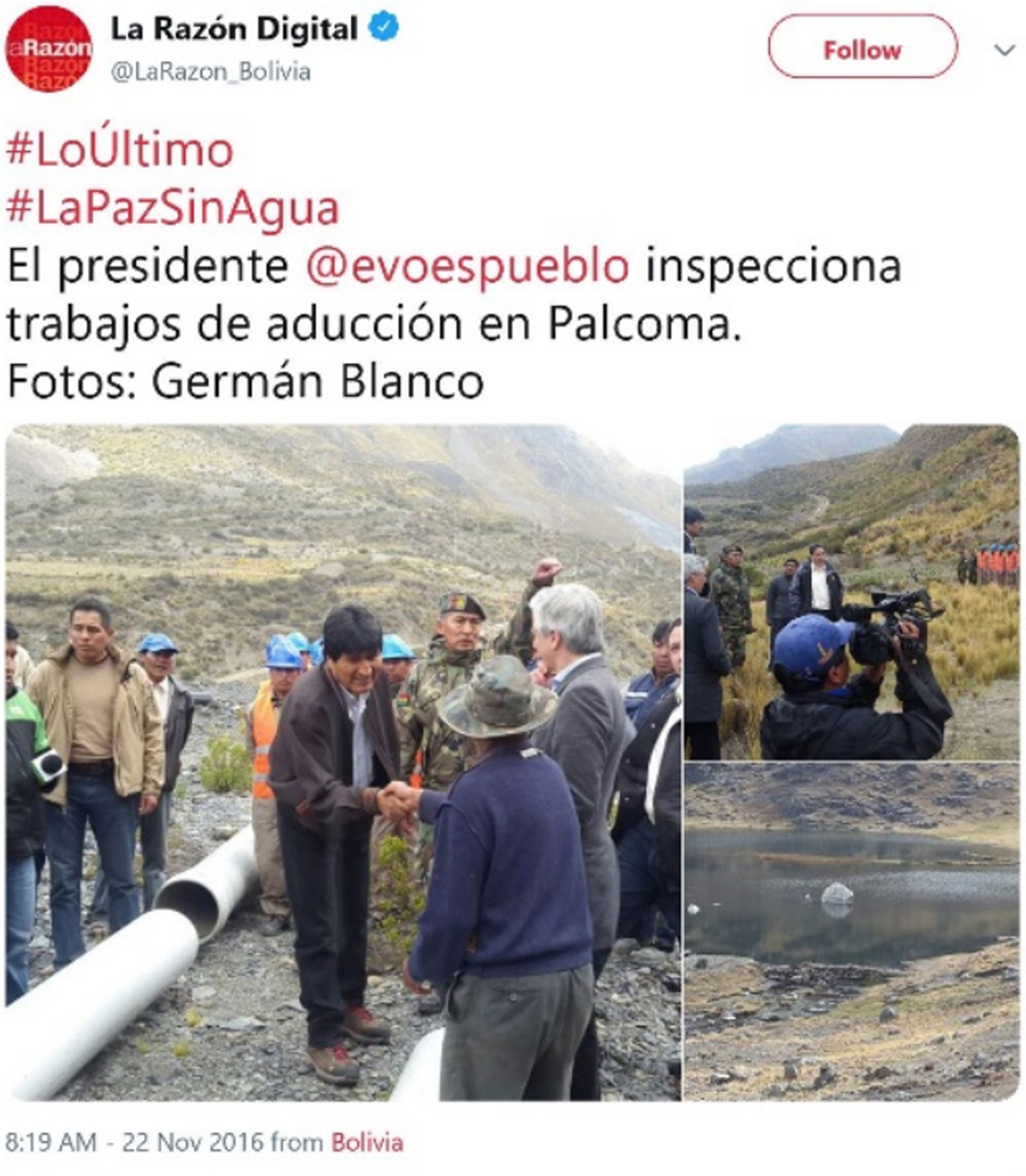
Each function affords an opportunity for multilingual, multicultural engagement that serves a direct and often high-stakes purpose. Empirical evidence on the use of hashtags for world language learning is sparse, at best, with a sprinkling of mentions of hashtags wrapped into other discussions of the value of social media platforms as tools to facilitate language learning (McBride, Reference McBride, Lord and Lomika2009; Mitchell Reference Mitchell2009; Reinhardt & Zander, Reference Reinhardt and Zander2011). Drawing on work explicitly focused on the discursive functions of hashtags, significant, concrete connections to second language acquisition are both feasible and necessary. Moreover, the rich dynamicity and reflection of cultural trends found in hashtags can be tapped for deep, reflective engagement at all levels of language learning by selecting a hashtag of critical importance to a current political event or pop cultural movement. The learners can then trace that hashtag throughout its use, exploring the ways it is used, by whom, and the implications for its insertion in certain types of posts (see below for analytical tools that can enhance this analysis). Take, for example, the hashtag #LaPazSinAgua associated with the Bolivian water crisis and drought. Used as a way to connect stories on the crisis (see Figure 2), the hashtag evolved and continued to gain popularity as a protest tool. In this case, learners of Spanish can dive deep into the use of this hashtag to add cultural relevance, align practices with current behaviors of Spanish speakers in the region, and engage with a meaningful current issue, even with limited language proficiency, given that the lexical bundle is manageable across all levels.
Post containing the hashtag #LaPazSinAgua.

A focus on the value of hashtags and their use in the language in which they are being used directly responds to recent calls for transformation in approaches to world language education and the development of 21st-century skills (Modern Language Association, 2007; Pellegrino & Hilton, Reference Pellegrino and Hilton2012). However, to do this well, systematic analysis of their use is critical to move beyond intuitive understanding toward patterns that have been empirically documented. The remainder of this section presents three fundamental discourse functions of hashtags that are relevant for language learners—(a) marketing and public relations, (b) interpersonal interaction, and (c) text organization—and explores the potential of each for language teaching and learning.
Discourse Function 1: Marketing and Public Relations
Understanding the ways in which hashtags are used by corporations, celebrities, and politicians is at the forefront of the analysis of hashtag behavior. High-stakes hashtags, both in terms of the loss or gain of financial and social capital, can be worth millions of dollars and are notably distinct from hashtags used for interpersonal interaction or text organization (An & Weber, Reference An and Weber2016; Page, Reference Page2012; Wikström, Reference Wikström2014). Consider, for example, recent hashtag trends such as #deletefacebook, which sent Facebook stock plummeting in 2018, or current political races in which candidates win or lose based on their ability to use, or intentionally opt out of, social media. As a result, much of the work around this discursive function focuses on ways to build and measure public sentiment through the automated analysis of hashtags (Cunha et al., Reference Cunha, Magno, Comarela, Almeida, Gonçalves and Benevenuto2011; Davidov, Tsur, & Rappoport, Reference Davidov, Tsur and Rappoport2010; Lu & Thomas, Reference Lu, Thomas, Greenberg, Kennedy and Bos2015; Ma, Sun, Yuan, & Cong, Reference Ma, Sun, Yuan and Cong2014; Mohammad & Kiritchenko, Reference Mohammad and Kiritchenko2015; Qadir & Riloff, Reference Qadir, Riloff, Moschitti, Pang and Daelemans2014; Weston, Chopra, & Adams, Reference Weston, Chopra, Adams, Moschitti, Pang and Daelemans2014).
This work on public sentiment, as well as the resulting hashtag behaviors, can serve as a meaningful starting point to interpreting and producing hashtags in one's dominant language, as well as the language they are learning. The marketing and public relations functions of hashtags are especially useful for language learning and teaching from the perspective of deep exploration and analysis of language and cultural trends. Likened to the types of analysis made possible through cultural analysis in the Culture Project (Furstenberg, Levet, English, & Maillet, Reference Furstenberg, Levet, English and Maillet2001), word association and connections to current events serve as catalysts for further exploration. Augmented by big data algorithms and millions of users, learners can analyze hashtag trends to gain the skills needed to follow political events and social trends while simultaneously analyzing varying shifts in cultural perspectives and political debates. A recent example from the literature is the use of the hashtag #mariagepourtous in France during the marriage reform debates in 2012. Drawing on a corpus of media tweets and interpersonal tweets, Lai, Bosco, Patti, and Virone (Reference Lai, Bosco, Patti and Virone2015) used diachronic and synchronic analyses to examine the ways in which sentiment was built in French using a hashtag associated with a social reform movement. This analysis would be exceedingly useful for any student of French wishing to gain cultural insights and build the skills necessary to participate in the French-speaking community. It can then be extended to include readings, media analysis, and scaffolded, domain-specific lexicon work related to the topic.
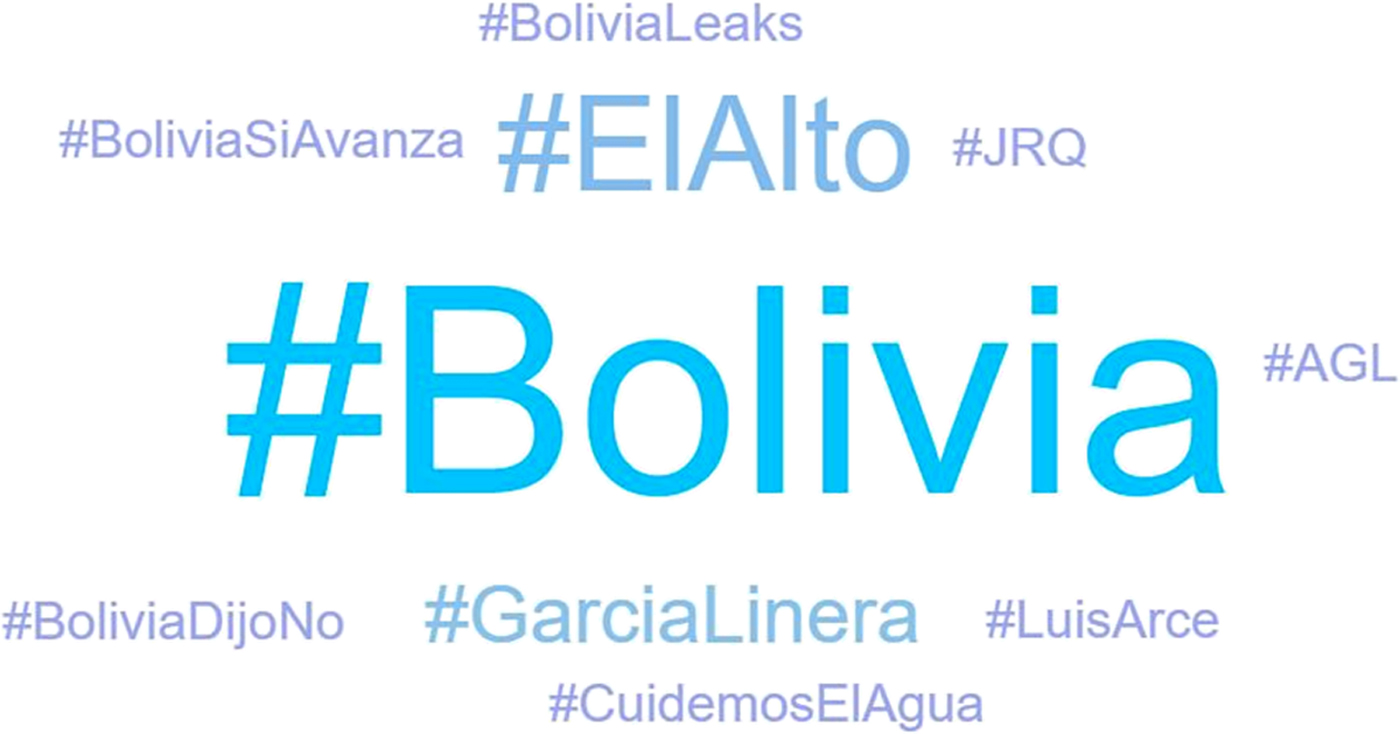
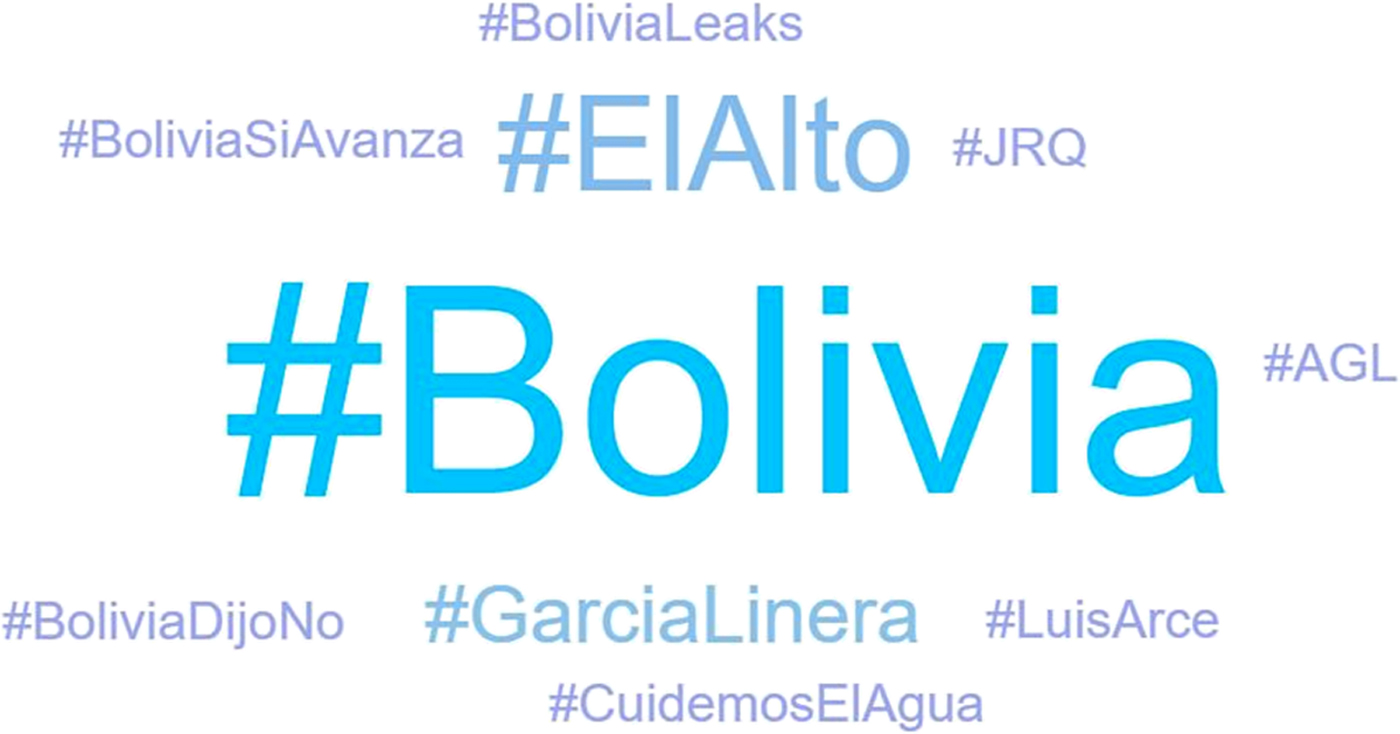
In addition to the content itself, the systems designed to analyze hashtags in the world can also be very useful in multilingual contexts. Indeed, a number of hashtag aggregators (i.e., Hashtagify, Pixlee, Talkwalker) that use complex, computerized analysis of hashtags are available for use at no cost. These aggregators analyze public social media to produce reports that show trends, associate hashtags with regions or languages, and provide a corpus of language surrounding their use. Returning to the example above, #LaPazSinAgua, Figure 3 represents a hashtag association map of all hashtags placed in proximity. To deepen their knowledge, learners can be given the map and asked to figure out why each of the other hashtags is present, thereby increasing their understanding of the discourse pattern as well as the larger event or issue related to the hashtag. In addition, they can be given a list of other possible associations to decide if they are a good or bad fit with the present grouping. Finally, learners can then be asked to select their own current event, research an associate popular hashtag, predict associated meanings, and, finally, use an aggregator to compare their findings with the actual analysis.
Association map #LaPazSinAgua.
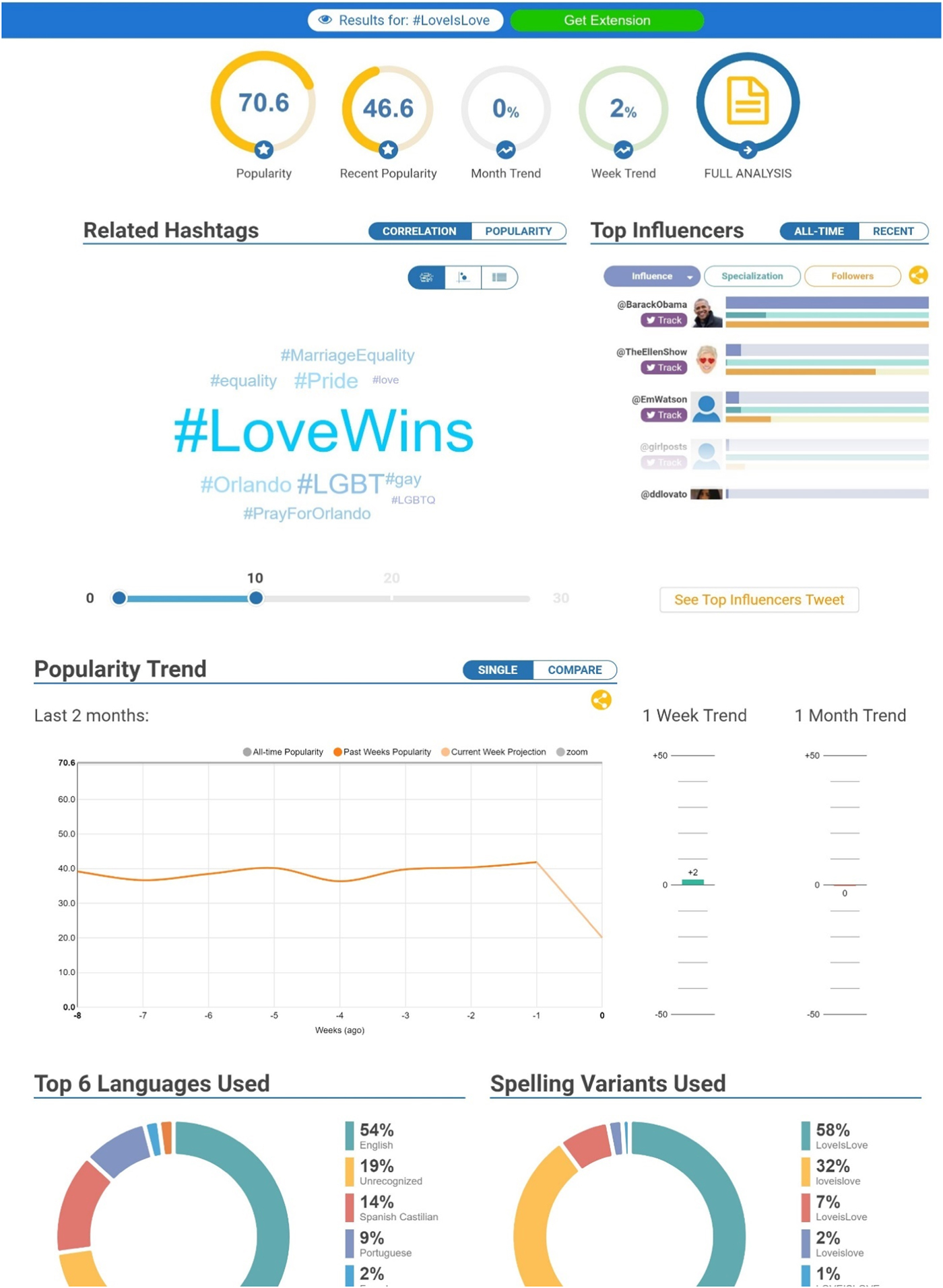
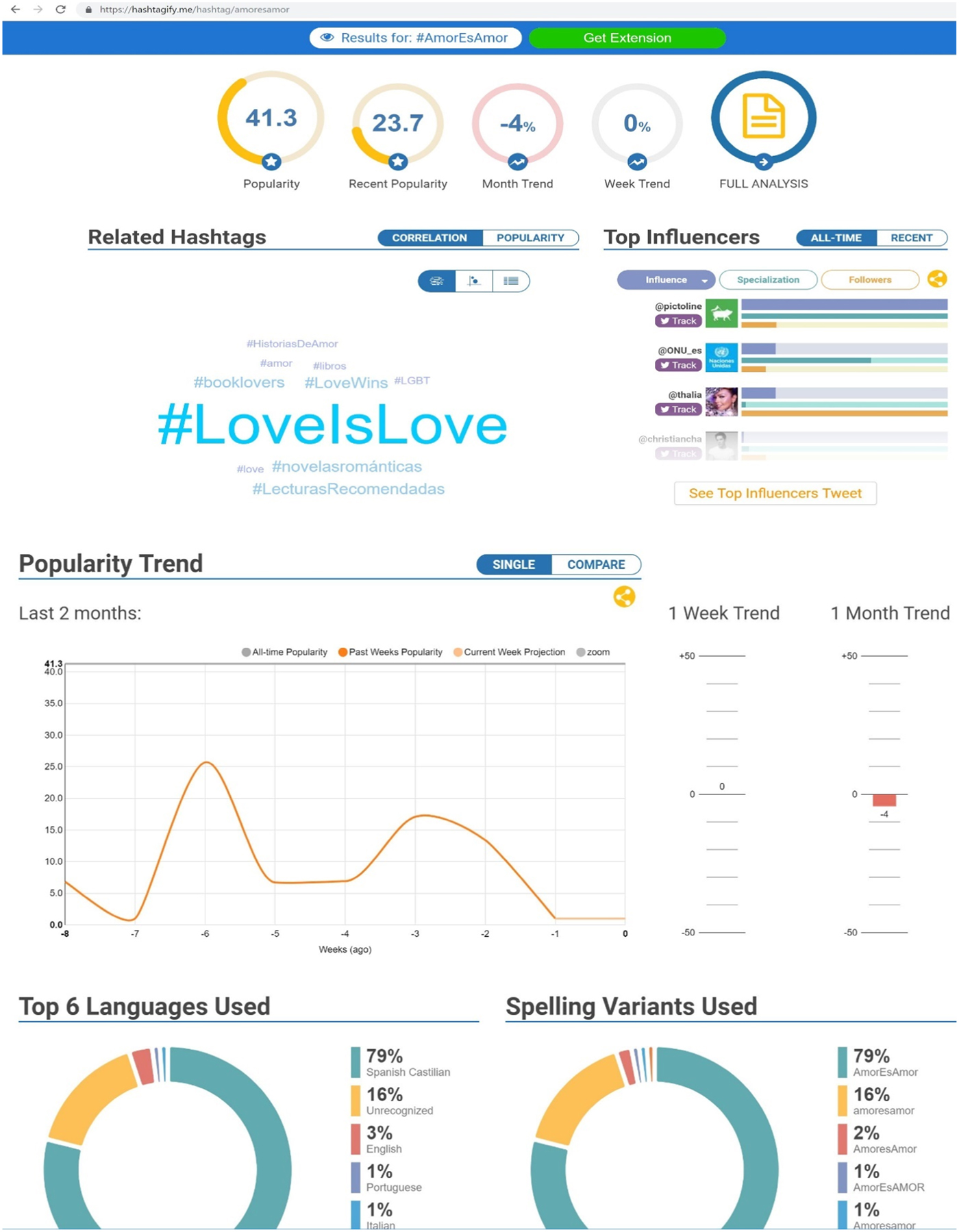
In addition to the semantic connections made via hashtag aggregators, full analyses can be used to further observe and analyze the language itself. These might include elements such as who uses the hashtag, how frequently it is used, and in what language. Educators can ask students to do an analysis and then reflect on possible interpretations related to audience, ideology, and identity, for example. As a demonstration of how this practice might work, Figures 4 and 5 show sample analyses of the popular hashtags #loveislove and its Spanish counterpart #amoresamor.
A sample Hashtagify analysis of the #loveislove.

A sample Hashtagify analysis of the #amoresamor.
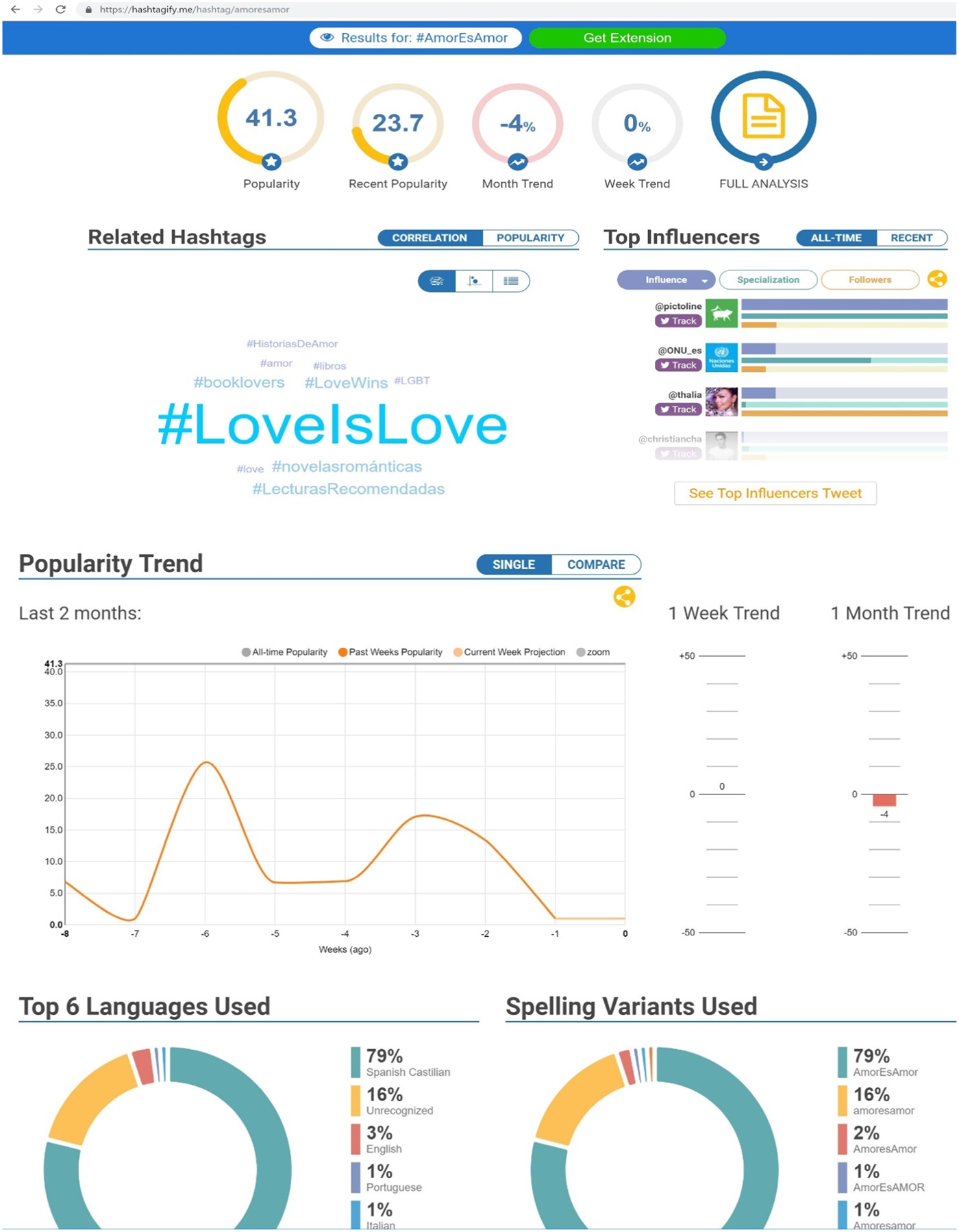
A comparison of these two reports across languages can be used to facilitate learners’ understanding of the larger political and social context, and also microlevel linguistic analyses related to the lexical chunk itself. As a starting point, learners could be asked to analyze, for example, why #loveislove is trending at 70.6% and #amoresamor at 41.3% and/or why the trend changes at certain points in time. They could be asked to research top influencers in each language (i.e., @BarackObama and @pictoline) and describe why those influencers might be associated with the particular hashtag or even conduct a semantic analysis of the related hashtags as depicted in Figure 3. Regardless of the skills being built, hashtags can be utilized by language educators to facilitate close reading and deep analysis of cultural patterns, ideologies, and identities, a laudable and frequently cited goal of language classes at the intermediate and advanced levels (Modern Language Association, 2007; Thorne & Reinhardt, Reference Thorne and Reinhardt2008) as well as multilingualism more broadly (Kramsch, 2013). Moreover, the use of real-time data builds digital literacy skills critical to the consumption and production of online interaction and prepares learners for the interactional contexts in which they likely find themselves.
Discourse Function 2: Interpersonal Interactions
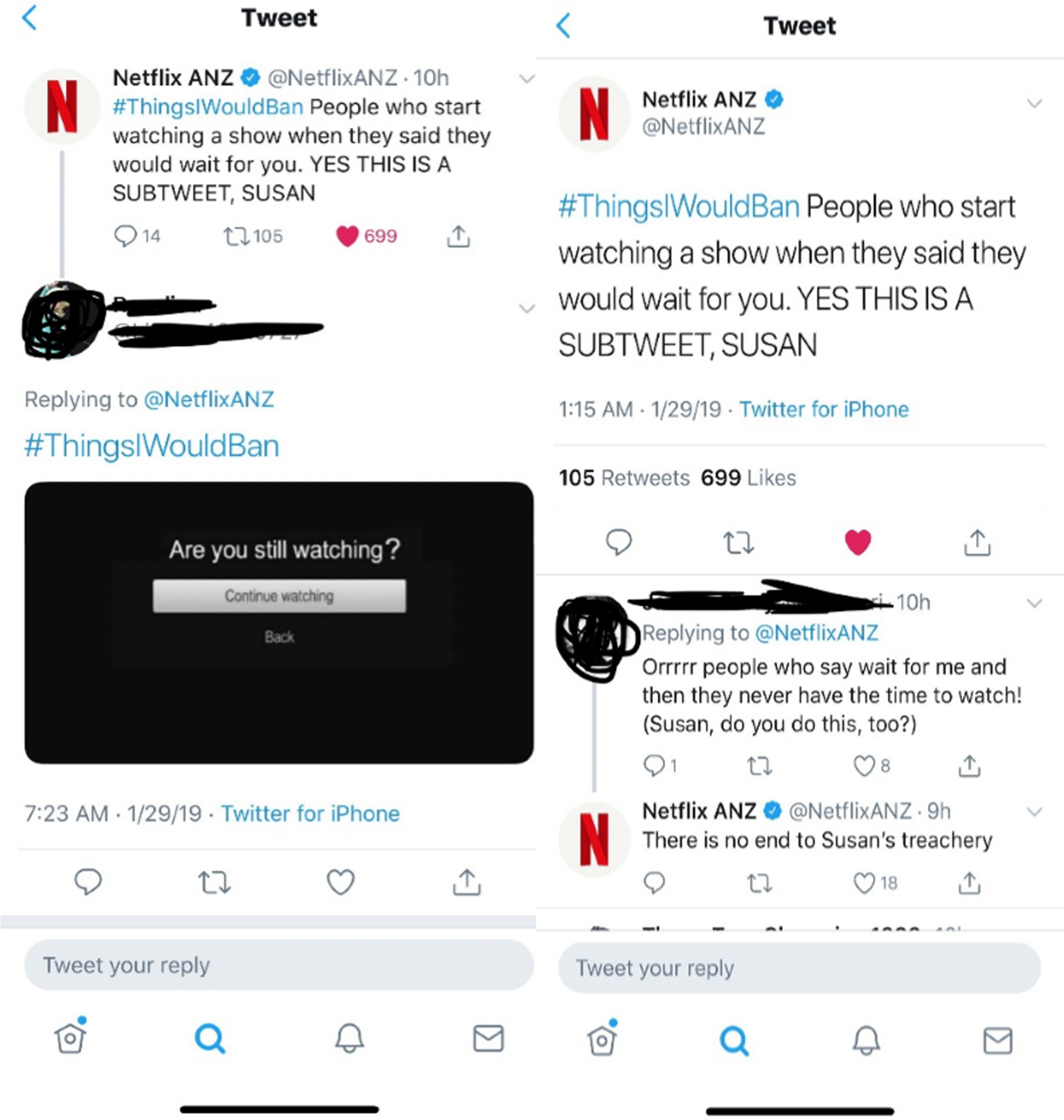
In addition to public facing posts, hashtags are used to build solidarity in interpersonal interaction via social networks such as Twitter and Instagram (Dorsch et al., Reference Dorsch, Zimmer and Stock2017; Wikström, Reference Wikström2014; Zappavigna, Reference Zappavigna2015). Much remains to be learned about this function; however, data demonstrate a complexifying and contextualizing function for users. This function can be seen in the two tweets in Figure 6, in which the fictional character Susan is personified and the interaction occurs around the hashtag #ThingsIWouldBan.
ThingsIWouldBan.
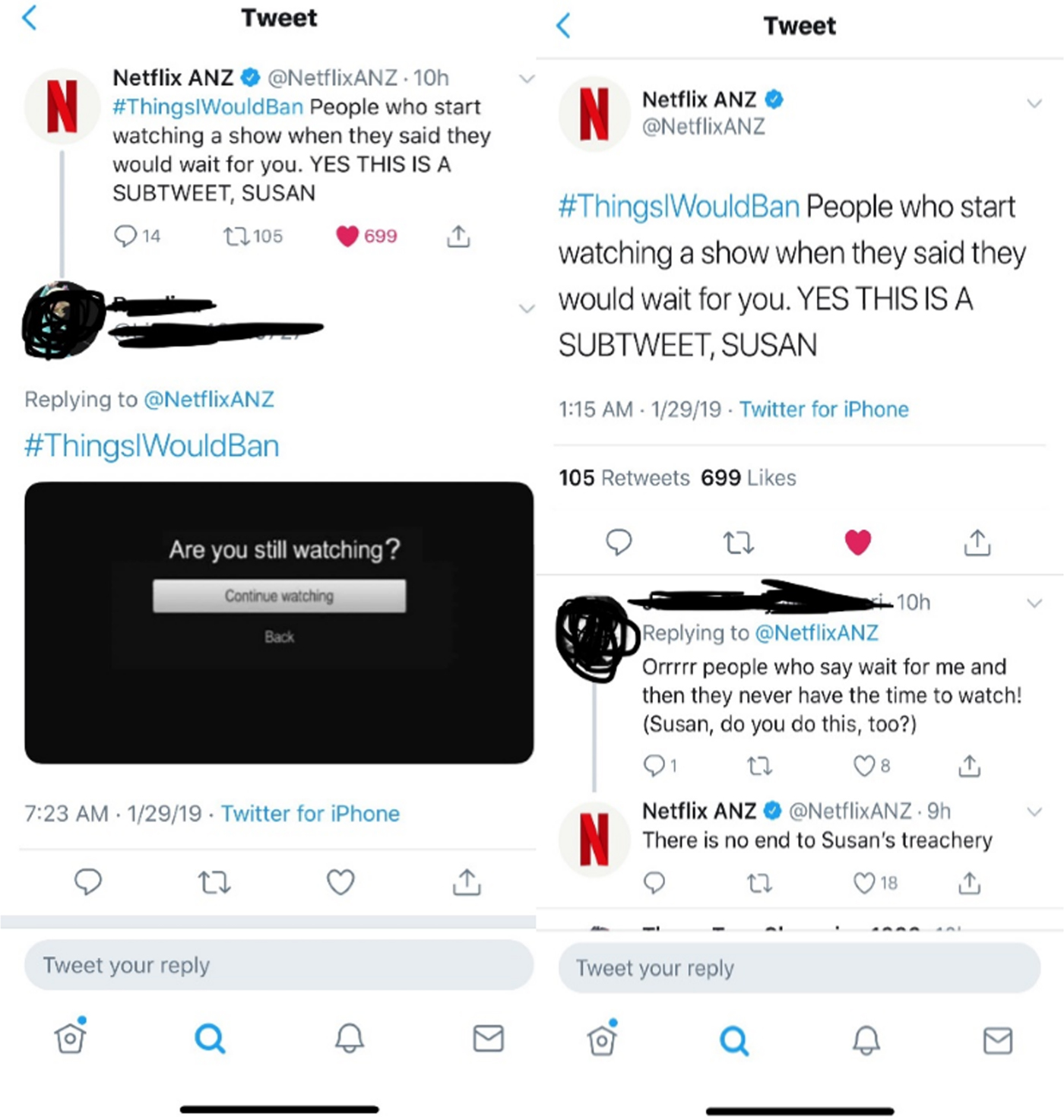
While also related to the corporate function previously described, this series of tweets uses the hashtag to add context to the interaction and to describe two watching behaviors that people do not like. This practice is congruent with an analysis of the pragmatic functions of hashtags in Twitter, in which Scott (Reference Scott2015) reported that hashtags in Twitter were used to guide the hearer (i.e., reader) through explicit and implied meaning. Offering more detail to the current understanding of interactional functions, Wikström (Reference Wikström2014) described the use of hashtags that represent inside jokes or solidarity building between regular interactants. As learners begin to engage in interactions with interlocutors in the target language, an adept use of hashtags can augment and shape that interaction. Language learners must not only know how to interpret hashtags, but, if participating in online communities, they also must also know how to produce them accurately to express their own meaning in the target language.
Furthermore, in some cases where social media and hashtags are less prolific, this might mean learning to communicate similar contextual information in different ways. In other cases, it might mean learning to limit the use of seemingly political or provocative hashtags to avoid cultural missteps and, more importantly, avoid dangerous situations in regions where dissent is less permissible than in others.
Function 3: Text Organization
Text organization and categorization also offers significant potential for multilingual exploration and interaction. Grouping and categorizing similar or dissimilar hashtags allows learners to see cultural trends, but, more importantly, analyze their use across languages to add to the diversity of perspective available to them. While certainly not the only two applicable digital discourse behaviors worthy of attention, translation and the analysis of event-driven cultural trends are especially useful for language learners and fundamental to engaged participation.
Translation can be especially useful for the development of intercultural communicative competence and the ability to consider a variety of perspectives. Drawing on a learning process similar to those seen in the Cultura Project (see, e.g., Furstenberg et al., Reference Furstenberg, Levet, English and Maillet2001), an analysis of ways in which different groups of people create hashtags for the same event can add insight into the interpretation of that event. As an example, Carter, Tsagikas, and Weerkamp (Reference Carter, Tsagkias and Weerkamp2011) offered critical insight into understanding the value of translated, multicultural hashtags. Taken from a machine translation perspective, they argued for a sophisticated algorithm to translate hashtags that moves beyond statistical machine translation of the hashtag toward a more sophisticated translation plurality and multicultural distinctions when translating hashtags. Utilizing the hashtags in Spanish and English in categorizing the event of 33 trapped Chilean miners, the proof-of-concept study uses the analysis of #33mineros and other associated hashtags to demonstrate the need to account for a cultural perspectives when considering hashtags, noting a critical distinction between the hashtags used by Spanish speakers—#33mineros, #rescatemineros, #fuerzamineros—as compared to English speakers—#chilemine, #chileanminers, #minerescue. As noted by Carter et al. (Reference Carter, Tsagkias and Weerkamp2011), the addition of a Chile reference by English speakers is unique and, when coupled with more general hashtags such as #Chile, represents an event-centric view of the country and events there, as if it were the only thing happening. Carter et al., therefore, suggested translation reflective of these varying perspectives, an endeavor that would, undoubtedly, impact a language learner's perspective of an event across languages. Language classrooms would be an optimal context to analyze these differences, reflect on their implications, and, ultimately, apply the results to a deeper linguistic and cultural understanding.
Coupled with timelines and historical dates, the life and death of a hashtag can also be analyzed as related to the impact of the event or movement diachronically. (For more on the life and death of hashtags, see Cunha et al. Reference Cunha, Magno, Comarela, Almeida, Gonçalves and Benevenuto2011; Glasgow & Fink, Reference Glasgow, Fink, Greenberg, Kennedy and Bos2013; Maity, Saraf, & Mukherjee, Reference Maity, Saraf and Mukherjee2016; Varol, Ferrara, Ogan, Menczer, & Flammini, Reference Varol, Ferrara, Ogan, Menczer and Flammini2014). Examples of this pattern can be found in the analysis of the hashtags used during the London riots (Glasgow & Fink, Reference Glasgow, Fink, Greenberg, Kennedy and Bos2013), the 2012 U.S. presidential debates (Lin, Margolin, Keegan, Baronchelli, & Lazer, Reference Lin, Margolin, Keegan, Baronchelli and Lazer2013), and the 2012 Mexican presidential election (Abascal-Mena, López-Ornelas, & Zepeda-Hernández, Reference Abascal-Mena, López-Ornelas, Zepeda-Hernández, Ant Ozok and Zaphiris2013). All indicate relevant and noteworthy trends in discourse patterns that are relevant for language learners’ development.
Congruent with the findings of Reinhardt and Zander (Reference Reinhardt and Zander2011) and, more broadly, the cultures of use model proposed by Thorne (Reference Thorne and Magnan2008), the field of language learning and teaching has the opportunity to greatly diversify and strengthen learners’ target language repertoires by explicitly addressing the functions of digital discourse(s), in this case, hashtags. In doing so, this approach also suggests that one should be cautious not to oversimply the use of hashtags by, for example, asking learners to turn seemingly arbitrary vocabulary lists into hashtags to describe a picture or creating hashtags void of more subtle content. Instead, language classes can be used to give learners the analysis and reflection skills critical to wielding the dynamic behaviors associated with digital discourses in the target language.
Digital Games
In comparison to hashtags, the research on digital games is more varied and prolific. Furthermore, it has been directly tied to the endeavor of language learning more broadly (see Sykes & Reinhardt, Reference Sykes and Reinhardt2013, and Reinhardt, Reference Reinhardt2019, for an in-depth discussion of digital games as related to language learning). Reflective of trends in the field, much of the work on digital games and language learning continues to explore the use of digital games as instructional tools in the classroom (e.g., Cornillie, Thorne, & Desmet, Reference Cornillie, Thorne and Desmet2012; Holden & Sykes, Reference Holden and Sykes2011; Reinhardt, Reference Reinhardt2019). However, much can also be gained by continuing the current focus on the digital discourses associated with digital games, including a robust consideration of the games themselves as cultural texts (Liang, Reference Liang2012; Reinhardt, Reference Reinhardt2013; Thorne, Fischer, & Lu, Reference Thorne, Fischer and Lu2012) and the surrounding attendant discourse spaces (e.g., discussion forums, machinima groups, and modding communities) spaces associated with user participation (Peña & Hancock, Reference Peña and Hancock2006; Thorne et al., Reference Thorne, Black and Sykes2009).
A comprehensive discussion of the digital discourses associated with digital games is well beyond the current discussion (for detailed analyses, see Reinhardt, Reference Reinhardt2019; Thorne et al., Reference Thorne, Black and Sykes2009). However, in maintaining the objective of highlighting critical digital discourse spaces relevant to language teaching and learning, digital games cannot be ignored. Drawing on a three-pronged approach to examining digital games, Reinhardt and Sykes (Reference Reinhardt, Sykes and Reinders2012; see also Sykes & Reinhardt, Reference Sykes and Reinhardt2013) described three contexts of digital discourse that warrant attention: (a) interaction with games, (b) interaction through games, and (c) interaction around games. A fourth element—interacting about games—can also be added (see Knight, Marean, & Sykes, Reference Knight, Marean, Sykes, Dressman and Sadler2019). Each has a role to play in furthering the development of digital discourse abilities on the part of the learners and can serve as an area of focus for analysis and inquiry in, and out, of the classroom.
Interactions with the Game
Interactions with the game focus on the discourse patterns present in the game itself. Defined by Reinhardt and Sykes (Reference Reinhardt, Sykes and Reinders2012) as those dealing with “game narratives or fictional content, and game rules” (p. 3), patterns include the discourse needed to navigate the game, interact with nonplayer characters (i.e., simulated, in-game characters), and interpret the game narrative. As such, digital games serve as cultural artifacts that both reflect and shape cultural narratives. Careful study and close “reading” of the games themselves offer unique insight into folklore, political satire, fantasy stories, identity development, and language variety. As can be seen in Gee's (Reference Gee2005) canonical use of The Sims to learn the discourse of power-making survival as a single parent exceedingly challenging, through digital game discourse, learners can explore social narratives, manipulate game discourses, and analyze their impact, resulting in a profound influence on learners’ perception of the world. The casual game LifeQuest depicts the “white picket fence” American dream in which the player must compete with high school rivals to “succeed” in life. It is ripe with satire, and a detailed analysis yields an experience in which the game narrative is proven to be too homogeneous and not reflective of the typical “American” approach to life. The ability to analyze digital discourses in games can be likened to a learner's ability to critically examine a film, novel, or short story. Ripe with hot-button social, political, and economic issues, digital games are noteworthy contexts for interactive exploration of these topics, and they warrant educators’ attention.
Interactions Through the Game
Multiplayer games also facilitate game-mediated interaction in which players engage with one another to accomplish game-oriented tasks and, at times, extend the digital discourses to other areas of life. Specific patterns of interaction vary greatly across games, numbers of players, and types of gameplay (Reinhardt & Sykes, Reference Reinhardt, Sykes and Reinders2012). Sykes and Dubreil (Reference Sykes, Dubreil and Taguchiin press) noted the various types of interactional patterns in which learners find themselves when participating in digital games. This includes, for example, the facilitation of L2 pragmatic development in Spanish while playing World of Warcraft (Soares, Reference Soares2010); pragmatic abilities in English while playing Rush (Kirby, Reference Kirby2017); and successful, independent multilingual interaction in Ukrainian and Russian while playing World of Warcraft (Thorne, Reference Thorne and Magnan2008). Furthermore, the guild structure (i.e., established groups of players that play with one another) creates contexts for social interaction and collaborative work critical to socialization and, in turn, the development of the digital discourses required for successful participation (Bryant, Reference Bryant2006). Unique to interaction through digital games is the ability to archive and analyze these interactions after the fact, making reflection, analysis, and development a practical, feasible, and reasonable goal. While not all language learners will engage in interactions through multiplayer games, their distinct discourse patterns, intricate lexicon and sequencing patterns, and salient nature make them especially useful in the language learning context.
Interactions Around the Game
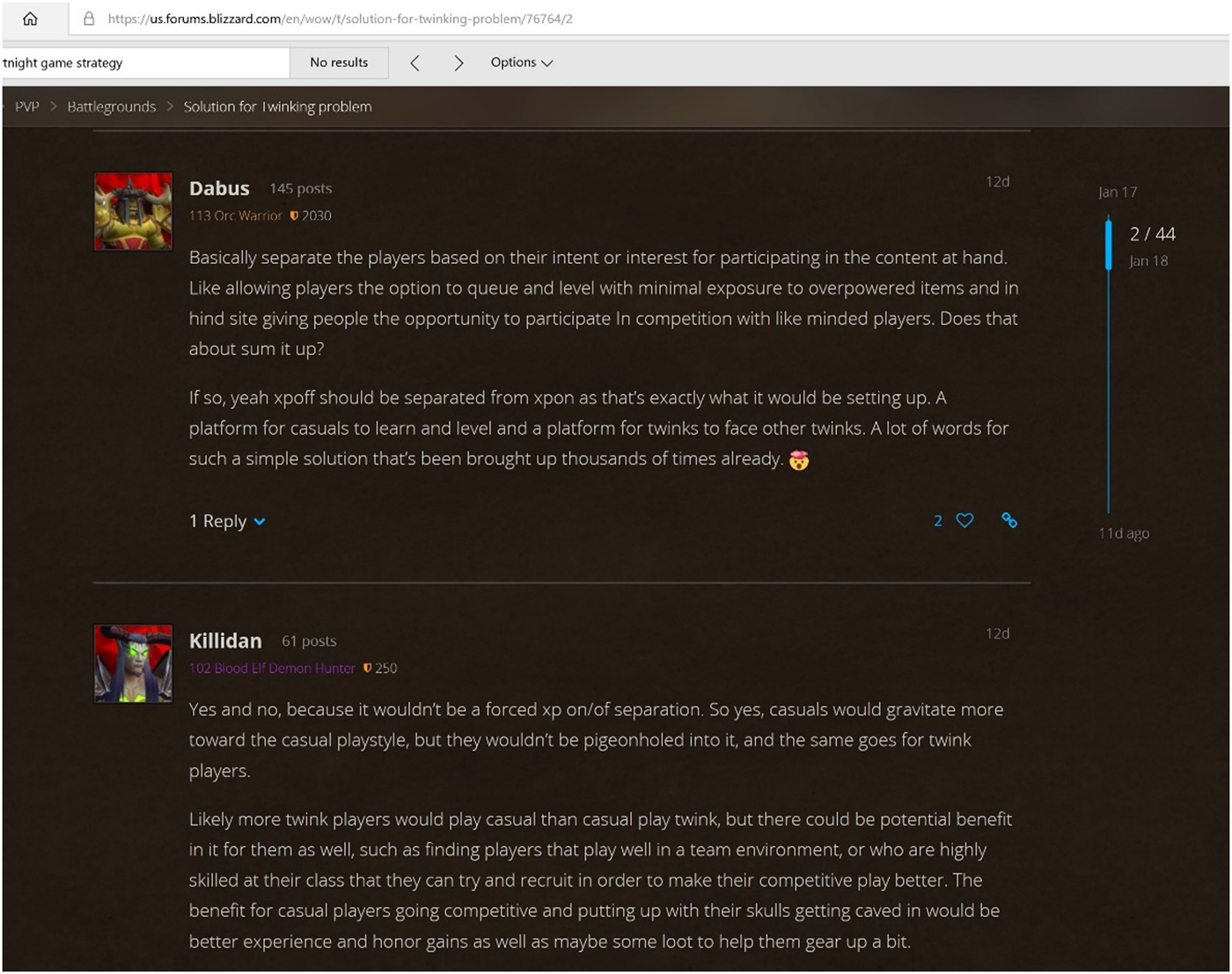
In addition to the game itself and the discourse patterns occurring in and through digital games, numerous digital discourse patterns can be discerned utilizing the game as a catalyst for interaction in which users mitigate disagreement, make hypotheses, offer help, ask for help, present evidence, and offer counterpoints (Steinkuehler, Reference Steinkuehler2008; Steinkuehler & Chmiel, Reference Steinkuehler, Chmiel, Barab, Hay, Songer and Hickey2006; Thorne et al., Reference Thorne, Black and Sykes2009). These attendant discourse spaces are varied, complex, and held together by a shared interest in the same game. They include, for example, game strategy discussion forums such as that seen in Figure 7.
Game strategy discussion forum.

In this discussion, the players were debating the best way for different types of players to engage in player-versus-player mode when the objectives are different. The lexicon is game specific (e.g., twink, forced xp on/off separation, honor gains, loot), and the players clearly position themselves as experts, compared to more “casual gamers” interacting in the space. While patterns of interaction will vary based on the forum, the game, the time of year, and many other factors, the patterns are both relevant and meaningful for anyone wishing to participate in these digital communities. Learning to interpret and produce language in these contexts will undoubtedly expand a learner's target language repertoire. Furthermore, comparisons of dominant and target language discussion forums will also lead to general insights about discursive expectations (i.e., appropriate pragmatic behavior).
In addition to discussion forums, other attendant discourse spaces include game-associated fan fiction on dedicated wikis (Black, Reference Black2009; Sauro, Reference Sauro2017) and postgame walkthroughs, machinima, and game-related memes for others to see (Thorne et al., Reference Thorne, Black and Sykes2009). Each one of these practices offers a context for the analysis of digital discourse patterns that are publicly available for analysis and directly tied to cultural, social, and political hot topics. This broader scope of discourse allows for the expansion of the genre, type, and topic of language available to most language learners.
Interactions About the Game
The final type of digital discourse relevant to the increased proficiency of language learners refers to the interactions occurring in the world about digital games (Knight et al., Reference Knight, Marean, Sykes, Dressman and Sadler2019). Much as the analysis of hashtag behaviors can lead to cultural understanding through careful analysis of translations, trends over time, and specific social issues, the impact of digital games also can reverberate outside of the game communities. This entails activities that explicitly make connections between the games and the rest of the world around them. One recent example of this impact is the notion of fortnitis (i.e., the term used by educators to indicate a significant number of school absences on a particular day, often known to be the result of a Fortnite event). As a result, changes have been made in schools and libraries to account for the significant uptake of gameplay. Many students say they continue to play, regardless of the consequences due to the perceived potential economic gain and increase in social status as a result of excelling at gameplay. As an example, Ninja, one of the noted top Fortnite players, has been reported to earn up to $500,000 per month in endorsement dollars (source: tubefilter.com). Regardless of one's opinion of the game(s), the practice, or the surrounding discourse, the real-world impact cannot be ignored. This furthers the need to ensure that language learners have the skills to engage in these contexts around the world, and, more broadly, they understand the societal impact of such behaviors (see, e.g., Aiken, Reference Aiken2016).
A Framework for Exploring Digital Discourse
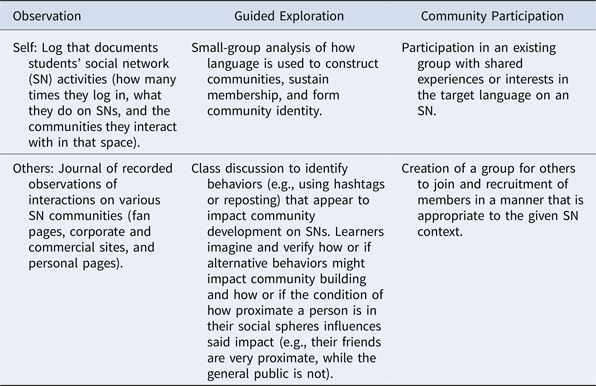
Despite its critical importance, explicit instruction around digital discourse is largely absent from world language courses at all levels, if not openly criticized in some cases. Furthermore, most research and practice endeavors focus on the use of technology for the learning of languages in face-to-face contexts, making it difficult to shift the focus away from the tool and toward the discursive practices under consideration. Two notable exceptions are the multiliteracies approach offered by the New London Group (1996) and Thorne and Reinhardt's (Reference Thorne and Reinhardt2008) bridging activities model. In each, learners are first asked to observe social practices, digital discourse, and other products central to the community. This is done by analyzing and reflecting on their own practice as well as those of others. At this stage, learners are also asked to collect artifacts and examples relevant to the topic they are studying. After observing and collecting examples, they are then asked to move to an analysis stage, where they engage in deep, detailed analysis of the artifacts they have collected. The final stage is participation in the practice itself, which is almost always possible in digital contexts. The goal of participation is to facilitate learner agency, through choice and domains of participation. Drawing on the application of both models in digital games and social networks, Sykes, Holden, and Knight (Reference Sykes, Holden, Knight, Ducate and Arnold2019) offered sample activities at each of the three stages for the exploration of digital discourse practices. Table 1 shows one such example for social networks.
The Application of the New London Group (1996) and Bridging Activities (Thorne & Reinhardt, Reference Thorne and Reinhardt2008) for Learning Social Networks (adapted from Sykes et al., Reference Sykes, Holden, Knight, Ducate and Arnold2019, pp. 373–375).

Expanding this model to apply hashtags and digital games further extends the context and domains to be covered, the digital discourses that can be analyzed, and the learners’ choices in determining which digital spaces are most relevant to their needs and interests. One way to approach digital discourses explicitly is through intentional focus on one of the many functions described throughout this article. For example, in a second-year proficiency-based language class, learners might be asked to pick a hashtag related to a celebrity or political figure mentioned in their textbook and then collect examples of the use of that hashtag in their native language and the target language (observation). Then, in class, the learners could be asked to analyze and describe the contextual information that the hashtags give the user (guided exploration) as related to the communicative target being studied (e.g., diminutive formation, descriptions, describing in action activities). Finally, the class could come up with a few Twitter questions to post to the celebrity, using appropriate hashtags for their interests. Ultimately, the goal would be to master the digital discourse patterns and then be able to interpret and produce them in other contexts as well. Regardless of the specific objective, explicit attention to digital discourses in a variety of contexts is fundamental to full participation in the target culture; in today's discursive practices; and, consequently, in social, economic, and political life. Much work remains in terms of determining the patterns themselves as well as the best ways to incorporate their exploration in the classroom.
Future Research and Practice
The prolific nature of digital communication will, undoubtedly, continue opening doors for research topics and transformed classroom practice. Two key research areas will yield especially notable insight into the development of language skills necessary for participation in digital discourse practices: (a) continued empirical examination of digital discourse and its patterns of evolution in a wide variety of languages and cultures and (b) studies measuring the efficacy of the pedagogical frameworks presented here and elsewhere to determine best practices for classroom integration.
The studies synthesized above serve as catalysts for additional examination of digital discourses in each of the two areas. Relatively new compared to other contexts, our understanding of discursive practices in each of the two digital contexts is limited in terms of topic of analysis and language. Current work focused on the discourse patterns in hashtags and digital games is overwhelmingly focused on English practices with a handful of studies in other languages. Moreover, studies comparing practices across languages are even more sparse. These comparisons, while not categorical or prescriptive, would be especially useful for language learners as they work in contexts that are simultaneously familiar and completely new, as well as come to grips with the multilingual, multicultural realities that these comparisons make more salient.
Research in this area could include analyses of
• the ways users engage with digital discourses over time;
• how those practices shift based on contextual factors (internal and external);
• how patterns vary and/or remain similar across, for example, languages; socioeconomic factors, race, and gender; and
• systems and approaches for using big data and algorithms to gain insight not feasible through other means of analysis.
This work is fundamental to understanding how language is used and interpreted in digital contexts, as well as informing curriculum design and lesson planning for classroom instruction. Furthermore, even those learners not enrolled in formal classrooms or institutions can begin to explore and develop their own multilingual skills for participating in a variety of digitally mediated environments.
Critical to a deeper understanding of ways in which explicit attention to digital discourse practices can be integrated in traditional language classrooms or other learning contexts is empirical measurement of the instructional means deemed most effective for learning. The work can, and should, evaluate the implementation of a variety of pedagogical models to facilitate learning. Research along this vein could, for example,
• compare the learning outcomes and learning processes of two pedagogical models applied in similar contexts;
• measure the learning of the same model applied across different learning contexts;
• examine the effectiveness, or lack thereof of the pedagogical model, in a variety of languages with notably diverse student populations;
• examine teacher perceptions and expertise in digital discourse; and
• appraise the impact of teacher training in digital discourse and pedagogical models as related to classroom integration.
The ubiquitous nature of digital communicative practices make them impossible to ignore and, more importantly, representative of linguistic practices that are vital for participation in communities around the world. Regardless of the approach taken, it is essential to understand the ways in which learners can develop the language skills needed to find their own digital voice.