Multiple hospital outbreaks of Clostridium difficile infection (CDI) attributed to the NAP1/BI/027 (NAP1) strain have been reported in North America and Canada since 2000.Reference McDonald, Killgore and Thompson1, Reference Loo, Poirier and Miller2 Toxigenic C. difficile strains contain a pathogenic locus consisting of tcdA and tcdB genes which encode for toxins A and B.Reference O’Connor, Johnson and Gerding3 The NAP1 strain has a deletion in the tcdC gene (a negative regulator of tcdA and tcdB), which may contribute to increased production of toxins A and B, the main C. difficile virulence factors.Reference O’Connor, Johnson and Gerding3 In addition, the NAP1 strain produces a binary toxin encoded by the cdtA and cdtB genes.Reference O’Connor, Johnson and Gerding3 It has been proposed that this binary toxin may have an additive virulence effect with toxins A and B.Reference McDonald, Killgore and Thompson1, Reference O’Connor, Johnson and Gerding3
Risk factors and clinical outcomes of patients diagnosed with CDI caused by the NAP1 strain compared with non-NAP1 strains have been investigated. Risk factors for the development of CDI due to NAP1 strains include advanced age and prior use of fluoroquinolones.Reference Vardakas, Konstantelias, Loizidis, Rafailidis and Falagas4 Patients diagnosed with CDI caused by a NAP1 strain have reported more severe outcomes compared with patients diagnosed with CDI caused by a non-NAP1 strain.Reference Miller and Gravel, Mulvey5–Reference See, Mu and Cohen7 Thus, we conducted a single-center, retrospective, case-control study to determine whether markers of CDI severity correlated with NAP1 as detected by the Xpert® C. difficile Epi assay. Secondary objectives of the study were to determine whether NAP1 strains versus non-NAP1 strains exhibit a difference in (1) risk factors for the development of CDI, (2) recurrence of CDI, and (3) mortality after an initial episode of CDI.
METHODS
Polymerase chain reaction (PCR) assay for diagnosis of CDI was implemented at our institution in July 2011. In January 2012, the Xpert C. difficile Epi test was implemented in our clinical laboratory to presumptively identify the NAP1 strain by PCR amplification of the tcdB and cdt genes and tcdC nt 117 gene deletion in patient stool specimens. No culture or formal strain typing on C. difficile isolates was performed. Our single-center, retrospective, case-control chart review included hospitalized, adult patients who had a positive stool C. difficile PCR assay and who were diagnosed with an initial episode of CDI (non-NAP1 or NAP1 strain) between January 2012 and January 2013. Patient stool specimens were reported as being positive or negative for C. difficile and the NAP1 strain. For every patient diagnosed with CDI caused by the NAP1 strain, two control patients diagnosed with their initial episode of CDI caused by a non-NAP1 strain, isolated in chronological sequence, were included in the analysis (2:1 matching ratio). Patients (including those who tested positive for either strain) were excluded if they did not receive therapy, they were previously diagnosed with CDI, their initial CDI was diagnosed as an outpatient, or they were <18 years old.
Markers of severity studied included white blood cell count (>15 cells/μL), increased serum creatinine (≥1.5 times baseline), ileus, toxic megacolon, serum albumin (<2.5 g/dL), fever (>38°C), computed tomography (CT) findings of colitis (thickened colonic wall, colonic dilatation, or ascites), and pseudomembranous colitis on colonoscopy.Reference Cohen, Gerding and Johnson8, Reference Zar, Bakkanagari and Moorthi9 Peak value for white blood cell count or serum creatinine, and presence of colitis were reviewed and documented within 48 hours of the positive stool assay. Laboratory value for serum albumin closest to the date of the positive stool assay was recorded.
Potential risk factors for CDI included antibiotic usage 3 months preceding diagnosis, age, hematological and solid tumor malignancy, duration of hospitalization (number of days from admission to laboratory confirmed diagnosis of CDI), use of nasogastric tube, proton pump inhibitor use, renal insufficiency (defined as a pre-existing medical condition prior to CDI diagnosis), and inflammatory bowel disease.Reference Vardakas, Konstantelias, Loizidis, Rafailidis and Falagas4, Reference Debast, Vaessen, Choudry, Wiegers-Ligtvoet, van den Berg and Kuijper10, Reference Goorhuis, Debast and Dutilh11 The data regarding CDI recurrence and all-cause mortality within 30 and 60 days following the initial CDI episode were collected. Regimens used for treatment of CDI were also recorded.
Statistical Analysis
Mann-Whitney U tests were used to compare the two cohorts on age, white blood cell count, duration of hospitalization, and days to recurrence, while χ2 (or Fisher exact) analyses were used for all categorical comparisons. Finally, an exploratory multivariable binary logistic regression model was built to determine predicators of the NAP1 strain. Variables that achieved P ≤0.5 in the univariable analysis were included in the model.
RESULTS
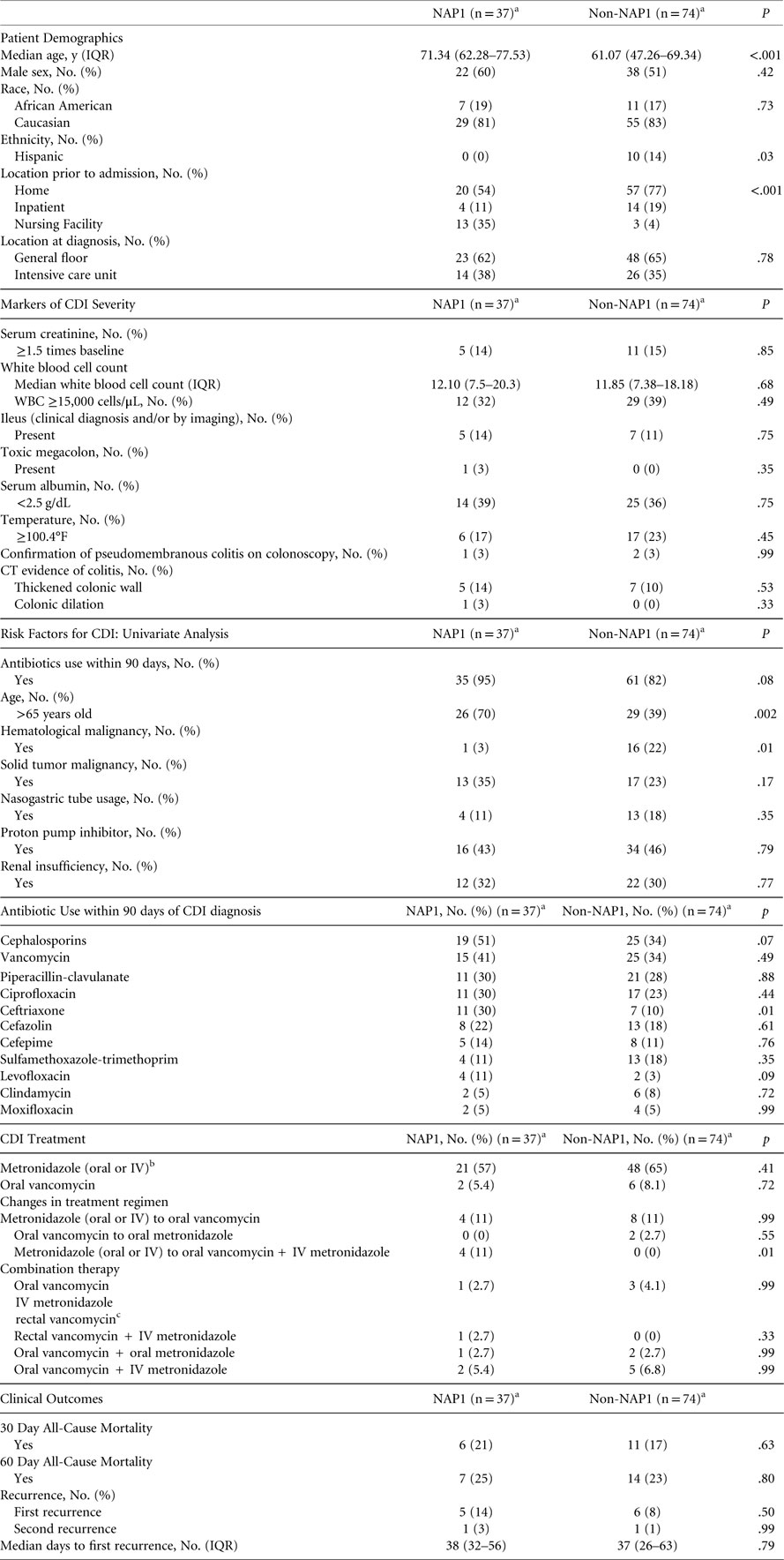
Our study was conducted during a nonepidemic CDI time period at our institution. The incidence of hospital-onset (HO)-CDI declined in each of the previous 3 years (13.9 HO-CDI per 10,000 patient-days in 2011, 9.2 HO-CDI per 10,000 patient-days in 2012, and 7.8 HO-CDI per 10,000 patient days in 2013, P=.99). During the study period, a total of 494 stool specimens tested positive for C. difficile by PCR; 90 of these specimens were also reported as positive for NAP1. Of these 90 cases, 37 met inclusion criteria (Figure 1). Patients in the NAP1 group were older and more likely to have resided in a nursing home prior to hospitalization (Table 1). There was no difference in length of hospitalization from admission to diagnosis between the non-NAP1 group (median, 2.00; IQR, 1.00–6.25) and the NAP1 group (median, 1.00; IQR, 1.00–6.50; P=.98). Regarding markers of severity, no difference was noted between the NAP1 and non-NAP1 groups in the number of patients with a serum creatinine >1.5 times their baseline (14% vs 15%; P=.85) or white blood count greater than 15 cells/uL (32% vs 39%; P=.49) (Table 1). The presence of ileus, colitis, and pseudomembranous colitis on colonoscopy were similar between the non-NAP1 and NAP1 groups (Table 1).
Allocation of stool specimens that met inclusion and exclusion criteria.

Baseline Characteristics, C. difficile infection (CDI) Severity, Risk Factors for CDI, Treatment, and Outcome of Patients Infected with NAP1 and Non-NAP1 Strains
NOTE. IQR, Interquartile range; NAP1, NAP1/BI/027 strain; Non-NAP1, non-NAP1/BI/027 strain.
a Denominator varies due to available data. NAP1=NAP1/BI/027 strain. Non-NAP1=non-NAP1/BI/027 strain.
b Two patients in non-NAP1 group received oral metronidazole then oral vancomycin and were switched back to oral metronidazole.
c One patient in the NAP1 group received oral vancomycin +IV metronidazole + rectal vancomycin and was switched to oral metronidazole.
Regarding risk factors for the development of CDI, patients in the NAP1 group were more likely to be older than 65 years of age in comparison to the non-NAP1 group (70% vs 39%; P=.002) (Table 1). There was no difference between groups in antibiotic usage within 3 months of CDI diagnosis (NAP1 group=95% vs non-NAP1 group=82%; P=.08). Exposure to ciprofloxacin (NAP1 group=30% vs non-NAP1 group=23%; P=.49), levofloxacin (NAP1 group=11% vs non- NAP1 group=3%; P=.094), and moxifloxacin (NAP1 and non-NAP1 groups=5%; P=.99) were similar between the 2 groups. However, patients in the NAP1 group were more likely to be exposed to ceftriaxone within 3 months of their CDI diagnosis than the non-NAP1 group (30% vs 10%; P=.01). In a multivariable model, those ≤65 years of age were 3 times more likely to have NAP1 than were individuals <65 years of age (OR=3.00, 95% CI: 1.21–7.45, P=.02); further, those residing in a nursing home prior to hospitalization were ten times more likely to have NAP1 than were individuals admitted from home (OR=10.45, 95% CI: 2.61–41.82, P=.001) (Table 2).
Multivariable Logistic Regression Analysis of Risk Factors for C. difficile Infection (CDI) among Patients Infected with NAP1 and Non-NAP1 Strains
NOTE. Hematological malignancy was removed as a variable from the multivariable model due to lower than expected frequencies.
a Multivariable logistic regression analysis.
Of 111 patients, 94 (85%) received metronidazole for treatment of CDI (Table 1). More patients in the NAP1 group had treatment changes from metronidazole (intravenous or oral formulation) to oral vancomycin plus intravenous metronidazole compared with the non-NAP1 group (11% [4 of 37] vs 0%; P=.01). Review of patient charts suggested that the addition of vancomycin to the treatment regimen was due to worsening clinical status (ie, leukocytosis, hypotension) in 3 cases. In the other case, the change may have been due to anticipation of impending neutropenia.
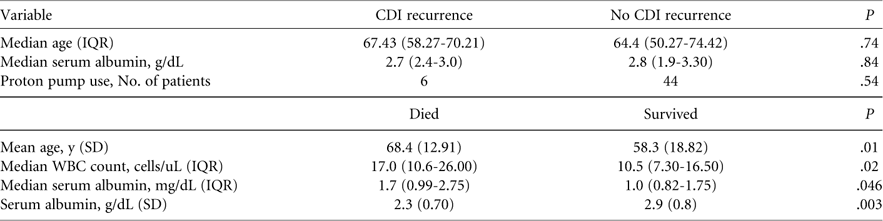
Regarding clinical outcome, the difference in the number of first and second recurrent episodes of CDI between the NAP1 and non-NAP1 groups was not statistically significant (first recurrence: NAP1=14% vs non-NAP1=8%, P=.50; second recurrence: NAP1=3% vs non-NAP=1%, P=.99). Among those who experienced CDI recurrence (n=10), the two cohorts did not differ in median days to first recurrence (NAP1= 38 d vs non-NAP1=37 d; P=.79). Finally, the incidence of 30-day and 60-day mortality was similar between the 2 groups (P=.63 and P=.80, respectively) (Table 1). When risk factors were determined among the entire cohort irrespective of their strain, age, white blood cell count, serum creatinine level and albumin level correlated with mortality, but age, albumin level, and proton pump inhibitor used did not correlate with CDI recurrence (Table 3).
Risk Factors for Recurrent C. difficile Infection (CDI) and Mortality among the Whole Study Cohort
NOTE. SD, standard deviation.
DISCUSSION
The incidence of CDI caused by the NAP1 strain in the United States published in clinical literature ranges between 20% and 80%, with the higher rates noted during outbreaks.Reference McDonald, Killgore and Thompson1, Reference Loo, Poirier and Miller2, Reference Cloud, Noddin, Pressman, Hu and Kelly12–Reference Black, Weaver and Jones15 Our single-center, retrospective, case-control study conducted during a non-epidemic CDI time period observed a NAP1 incidence of 18% among all CDI stool specimens. The incidence of CDI caused by the NAP1 strain in our study is lower than the rate reported among 25 hospitals in the Chicago area in 2009 (61%).Reference Black, Weaver and Jones15
Our study found older age and residence at a nursing home immediately prior to hospitalization as risk factors among patients diagnosed with CDI caused by the NAP1 strain. Older age has been reported as a risk factor for the development of CDI caused by the NAP1 strain in epidemic and nonepidemic settings.Reference Debast, Vaessen, Choudry, Wiegers-Ligtvoet, van den Berg and Kuijper10, Reference Cloud, Noddin, Pressman, Hu and Kelly12, Reference Labbé, Poirier and MacCannell16 In the present study, patients in the NAP1 group were admitted from a nursing home prior to hospitalization at a greater frequency than patients in the non-NAP1 group. An investigation into the prevalence of asymptomatic carriage of the C. difficile among long-term care facility residents in 1 institution showed that ~50% of the residents were asymptomatic fecal carriers of toxin-producing C. difficile strains; 37% of these strains were noted to be NAP1.Reference Riggs, Sethi, Zabarsky, Eckstein, Jump and Donskey17 A prospective study investigating the frequency of C. difficile infection and disease severity outcomes showed that a greater number of patients diagnosed with CDI caused by the NAP1 strain had C. difficile symptoms developing at an outside facility (defined as outside hospital, rehabilitation facility, or nursing home) compared with home (P=.0097) or the study hospital (P=.0016) when compared with patients diagnosed with CDI caused by a non-NAP1 strain.Reference Cloud, Noddin, Pressman, Hu and Kelly12 Patients residing in a nursing home may be at risk for developing CDI caused by the NAP1 strain due to age, previous hospitalization, comorbidities, differing infection control practices at long-term care facilities and hospitals, and/or exposure to antibiotics.Reference Cloud, Noddin, Pressman, Hu and Kelly12, Reference Morgan, Rodrigues and Elston18–Reference Boone, Goodykoontz and Rhodes20
Prior use of antibiotics, specifically fluoroquinolones, was reported as a risk factor for the development of CDI caused by the NAP1 strain.Reference Debast, Vaessen, Choudry, Wiegers-Ligtvoet, van den Berg and Kuijper10, Reference Labbé, Poirier and MacCannell16 In our study, there was no difference between study groups in antibiotic use 3 months prior to diagnosis of CDI. A higher percentage of patients in the NAP1 strain group received fluoroquinolones three months prior to their diagnosis of CDI compared with patients in the non-NAP1 group; however, this difference was not statistically significant. Historically, C. difficile isolates typed as NAP1 strains were susceptible to fluoroquinolones.Reference McDonald, Killgore and Thompson1 However, isolates obtained since 2000 have been reported to be highly resistant to fluoroquinolones.Reference McDonald, Killgore and Thompson1
In our study, the use of cephalosporins was not found to be statistically different between the 2 study groups. However, when each specific cephalosporin was compared, ceftriaxone was prescribed at a higher rate 3 months prior to CDI diagnosis in the NAP1 group than in the non-NAP1 group. Conflicting results have been reported regarding the risk of CDI after exposure to cephalosporins. A meta-analysis reported a lower risk of CDI caused by the NAP1 strain among those that received a cephalosporin compared with patients diagnosed with CDI caused by the non-NAP1 strain (OR, 0.70; 95% CI: 0.46–1.07).Reference Vardakas, Konstantelias, Loizidis, Rafailidis and Falagas4 However, in a retrospective, case-control study, a multivariate analysis identified cephalosporin monotherapy as an independent risk factor for CDI caused by NAP1 (OR, 7.8; 95% CI: 2.9–20.9).Reference Debast, Vaessen, Choudry, Wiegers-Ligtvoet, van den Berg and Kuijper10 The impact of cephalosporins on the incidence of CDI caused by the NAP1 strain may be due to the amount of cephalosporin use or a specific characteristic of the drug class. The influence of cephalosporins on CDI caused by NAP1 strain warrants further investigation.
In clinical literature, reports differ regarding the impact of the NAP1 strain on the clinical outcome of patients diagnosed with CDI.Reference Cloud, Noddin, Pressman, Hu and Kelly12, Reference Sirard, Valiquette and Fortier21–Reference Walk, Micic and Jain24 Clinical studies have shown that CDI caused by the NAP1 strain are associated with a decreased cure rate, increased severity of disease, and disease relapse.Reference Petrella, Sambol and Cheknis22, Reference Marsh, Arora, Schlackman, Shutt, Curry and Harrison23 Studies conducted in a nonepidemic setting reported no difference in disease severity or mortality among patients diagnosed with CDI caused by the NAP1 strain when compared with patients diagnosed with the non-NAP1 strain.Reference Cloud, Noddin, Pressman, Hu and Kelly12, Reference Sirard, Valiquette and Fortier21 Our study was conducted in a nonepidemic setting, and we were unable to detect a difference in severity or CDI recurrence among patients in the non-NAP1 and NAP1 groups. We did find that patients with NAP1 infections were more likely to have vancomycin added to their treatment regimen. Although the results of NAP1 strain designation were reported, clinical factors more likely influenced the decision to modify the treatment regimen. Our study suggests that reporting the NAP1 strain designation as determined by the Xpert C. difficile Epi test may not be clinically useful in a routine setting. Large, prospective clinical trials investigating the outcome and severity of CDI caused by NAP1 strain in a nonepidemic setting may offer further insight.
The limitations inherent in our study include a limited number of patients and the retrospective nature of data collection. Among our entire study cohort, a statistical analysis of risk factors for CDI recurrence and mortality was conducted.Reference Abou Chakra, Pepin, Sirard and Valiquette25 Our results were similar to those published in the literature regarding risk factors for mortality among patients diagnosed with CDI, regardless of NAP1 presence, but our results did not correlate with risk factors for CDI recurrence. Regarding patients diagnosed with CDI caused by the NAP1 strain, our results correlated with, as well as differed from, previously published conclusions. A larger study population may have revealed a greater difference in risk factors and clinical outcome associated with the NAP1 strain. Another area of interest generated by our results includes the impact of location of residence prior to hospital admission. A larger study, including a greater number of patients admitted from a nursing home, may assist in determining whether the increased incidence of CDI caused by the NAP1 strain reported in our study is a concern associated with nursing homes in general or is due to an infection control issue for specific nursing homes. Thus, our study highlights other areas of further investigation regarding the clinical impact of CDI caused by the NAP1 strain.
ACKNOWLEDGMENTS
The project described was supported in part by the Loyola Clinical Research Office (CRO). The work is the responsibility of the authors and does not necessarily represent the views of the CRO.
Financial support: None reported.
Potential conflicts of interest: SJ reports that he is funded by the Veterans Affairs Research Service. PS reports that he has received a research grant and consulting fee from Cepheid. TS, SP, WA, and LL report no conflicts of interest relevant to this article.