Introduction
Historically, the area of corporate disregard,Footnote 1 where the presumption of separate corporate personality established in Salomon v Salomon Footnote 2 is set aside, has a poor reputation for certainty of reasoning and is often dismissed as ‘jurisprudence by metaphor or epithet’.Footnote 3 In key cases where the judiciary have engaged in attempted reform, such as Adams v Cape Industries Footnote 4 and Prest v Petrodel Resources Ltd,Footnote 5 the identification of problems and their potential solutions has come down to an – admittedly skilled – but subjective judicial reasoning process of legitimising one set of case law and diminishing others. In the area of corporate disregard this has not, as yet, proved entirely successful and as Moore has commented, ‘allowing the independent legal existence of a corporate entity to be disregarded by a court only in a narrow and arbitrarily defined range of cases, is doctrinally unsustainable’.Footnote 6
To provide an alternative way of approaching the issue, we conducted an empirical study of the relationship between rationale and outcome within UK corporate disregard cases from the nineteenth to the twenty-first century. We examine the evidence from three perspectives. First, we examine the broad range of instrumental rationales found in the case law by disregard rates in order to identify where issues might be arising with individual rationales. Secondly, as suggested in the wider empirical literature, we examine the rationale rates by jurisdiction in order to see whether there were problematic interpretation issues concentrated in particular parts of the court levels. Thirdly, we examine the rationale rates by substantive claim to see whether contextual aspects of the doctrine, as the court identified with family law in Prest, were influencing outcomes.
By providing an empirical study on the rationales instrumental to corporate disregard outcomes we aim to introduce a broader evidential view of where concerns may lie, which can both aid critique of key judicial historical developments such as Adams and Prest and provide a broader evidence base that might aid future judicial reform of the area.
1. Background
(a) Doctrinal foundations
The paper begins by examining academic and judicial perceptions of the problems within the doctrine of corporate disregard. While the beginnings of corporate disregard lie in earlier cases than Salomon v Salomon,Footnote 7 the differences in outcome in that decision between the Court of Appeal and the House of Lords form part of the doctrinal foundation of disagreement about the underlying judicial perception of what might justify disregarding the corporate form and attributing liability. In finding that the company was but a ‘sham’ and a mere ‘alias’ or ‘agent’ for Mr Salomon, the Court of Appeal read into the statute a ‘bona fides’ requirement for forming a company. In the House of Lords, Lord Halsbury, dismissing the Court of Appeal decision, upheld what he described as the real and separate existence of a company duly constituted by law and was extremely critical of the Court of Appeal examining the motives of its founders.Footnote 8
In the decades that followed, the Salomon decision became embedded because, under the then rules of the Supreme Court, the House of Lords was unable to overrule its previous decisions, and so the differing judicial views as to the legitimate use of the corporate form lay buried. The seeds of later categories of corporate disregard were, though, emerging. In Gilford Motor Co Ltd v Horne,Footnote 9 a former employee who was bound by a covenant not to solicit customers from his former employers set up a company to do so. The court found that the company was but a ‘front’ for Mr Horne and issued an injunction. This category would emerge in the 1960s in the case of Jones v Lipman Footnote 10 as allowing the courts to disregard the corporation where the company was a ‘mere facade concealing the true facts’.Footnote 11 Similarly in 1939, in Smith, Stone & Knight v Birmingham Corpn,Footnote 12 the court set out a concept of agency as an exception to the Salomon principle that would reappear throughout the century.
One of the most significant features of the development of the corporate disregard case law is the repeated inability of the judiciary to agree as to the rationale they see as justifying it. In DHN Food Distributors Ltd v Tower Hamlets,Footnote 13 for example, Lord Denning argued that a group of companies was in reality a single economic entity and should be treated as one legal entity. His fellow judges Sachs LJ and Karminski LJ carefully shied away from agreeing that broad single economic entity rationale. Two years later the House of Lords, in Woolfson v Strathclyde Regional Council,Footnote 14 stated that the veil of incorporation would be upheld unless it was a facade. In 1985, in Re a Company,Footnote 15 the Court of Appeal asserted a broad interest of justice approach to corporate disregard.Footnote 16 There was, however, a growing disquiet about this uncertainty as to when the Salomon principle could be disregarded.Footnote 17
In Adams v Cape Industries Footnote 18 the court attempted to address this and provide a certain set of rationale for disregarding the corporate form across all areas of law. The Court of Appeal concluded that it could do so in only three narrow circumstances: where the court is interpreting a statute or a document; where the corporation is a ‘mere facade’ (a la Jones v Lipman); and where an agency relationship exists. The court dismissed justice-based rationales, stating:
[n]either in this class of case nor in any other class of case is it open to this court to disregard the principle of Salomon v A Salomon & Co Ltd [1897] A.C. 22 merely because it considers it just so to do.…Footnote 19
However, despite this strong precedent, consistency remained elusive,Footnote 20 and in 2013 the Supreme Court again attempted to clarify matters.
In Prest v Petrodel Resources Ltd Footnote 21 – a family law case – a Supreme Court, unusually made up of seven judges, unanimously concluded that a corporation could not be disregarded in the absence of impropriety. Instead, a solution, in this particular circumstance, was found in a resulting trust. However, in discussing the corporate disregard issue, agreement on exactly when it might occur escaped the Court. Lord Sumption proposed two underlying principles, which he called ‘the concealment principle’ and ‘the evasion principle’ with which Lord Neuberger broadly agreed. ‘Concealment’ in his view did not give rise to piercing of the corporate veil but was rather a looking behind the corporate veil to identify legally relevant facts. ‘Evasion’, as in Jones v Lipman, did warrant piercing the corporate veil ‘if there is a legal right against the person in control of it which exists independently of the company's involvement, and a company is interposed so that the separate legal personality of the company will defeat the right or frustrate its enforcement’.Footnote 22
Lady Hale, Lords Wilson, Walker, Clarke and Mance, disagreed, with varying degrees of strength, as to the extent that it was possible to set out a closed set of principles for corporate disregard. Lady Hale and Lord Wilson, in particular, strongly disagreed, instead suggesting a broader category of ‘unconscionable advantage’ was operating.Footnote 23
Since Prest, Lord Sumption's principles have become an important working framework in corporate disregard cases.Footnote 24 In R v Sale and R v McDowell the Court of Appeal, while noting the obiter status of Lord Sumption's view and the differing views of the other Supreme Court Judges, went on to use Lord Sumption's formula. Similarly, the Privy Council decision of Lord Neuberger, in Persad v Singh Footnote 25 utilised Lord Sumption's formula in rejecting an argument that a company was simply its controller's ‘alias’ or ‘front’.
However, as with Adams, it has not yet led to the clarity sought. In both Pennyfeathers Ltd v Pennyfeathers Co Ltd Footnote 26 and Wood v Baker,Footnote 27 for example, the courts somewhat confusingly failed to distinguish between evasion and concealment. Similarly, and somewhat ironically given the negative views of alter ego as a corporate disregard rationale by Lords Sumption and Neuberger in Prest,Footnote 28 the courts’ difficulties in working with Lord Sumption's principles seems to have propelled a sort of quasi-agency and alter ego rationale back to prominence. In R v Sale Footnote 29 the Court of Appeal, in finding that the evasion principle did not apply, found, using the concealment principle, that the company and the defendant were ‘indivisible’. In R v McDowell Footnote 30 the Court of Appeal explicitly linked the company and its controller as alter ego and in Clegg v Pache Footnote 31 both the High Court and the Court of Appeal without discussion of the case law authority found that a company was a ‘mere cloak or alter ego’ that justified treating the company's profits and the controller's profits as one and the same.Footnote 32
Significantly, the status of Lord Sumption's principles has been questioned. In Gramsci Shipping Corpn v Lembergs Footnote 33 the Court of Appeal considered the case to have an uncertain precedential value given the differing views of the judges. In 2018 the Court of Appeal in IBM United Kingdom Holdings Ltd v Dalgleish Footnote 34 again emphasised that, given the differing views of the Supreme Court judges, Prest had not settled the matter of when the courts can engage in corporate disregard.
Perhaps the differential views on the finality of Lord Sumption's principles are best captured in the recent opposing approaches of the High Court and the Court of Appeal in Rossendale Borough Council v Hurstwood Properties (A) Ltd. In the High Court, Judge Hodge considered:
In my judgment, the Claimant does have an arguable case on this particular ground. The doctrine of piercing the corporate veil is a developing area of jurisprudence. I am not satisfied that Lord Sumption's judgment was intended as an exhaustive statement of the circumstances in which the court might disregard the corporate veil.Footnote 35
In the Court of Appeal Lord Justice Richards, while declining to disregard the corporate veil and in a thoughtful judgment, recognised the different views of the Supreme Court judges in Prest, and that other disregard categories were possible – albeit, in his view, rare.Footnote 36 As Allan, examining the state of the post-Prest case law commented, ‘[i]t seems that the radical approach taken in Prest has neither introduced doctrinal coherence nor checked the profligate use of metaphors to justify ignoring the corporate veil’.Footnote 37
(b) Academic treatments
The fragmented nature of the doctrine over time is also reflected in the scholarship on corporate disregard.Footnote 38 Some commentators have been highly critical of judicial development of the area.Footnote 39 From Kahn-Freund's 1944 description of Salomon as a ‘calamitous’ decision,Footnote 40 through Ireland's finding of ‘absurdity’ and ‘ossification’,Footnote 41 to Moore's ‘temple built on faulty foundations’,Footnote 42 this literature broadly views the Salomon decision to have been a mistake.
In the 1960s, when enough case law on corporate disregard had built up, Samuels noted the courts occasionally ‘lifted’, ‘parted’, ‘tore’, ‘rent’, breached’, or ‘pierced’ the corporate veil.Footnote 43 In the mid-1970s Schmitthoff claimed judicial qualifications were so broad that the Salomon decision had ceased to be the most important case in company law.Footnote 44 In 1986 Rixon concluded that the Court of Appeal was but ‘a short step to the proposition that the courts may disregard Salomon's case whenever it is just and equitable to do that’.Footnote 45 By the late 1980s a distinct sense had emerged within this scholarship that the judiciary had lost its way.Footnote 46
To a large extent the literature narrowed after Adams v Cape Industries, which itself forms a crossover part of this literature as a response to academic criticism. Prest, at least in terms of Lord Sumption's principles, similarly links into this thread of rationale scholarship.
As we have noted above, within the academic literature the wider status of Prest remains controversial. While some have welcomed the attempt to put some discipline on the area of corporate disregard and view the increased certainty of Lord Sumption's principles as a positive development,Footnote 47 the majority response has been critical for a range of reasons. A minority would have liked to see the doctrine eliminated entirely,Footnote 48 or have attacked the generality of attempting to use a private law solution out of context.Footnote 49 Others, reflecting some of the judicial views in the post-Prest case law, have questioned the status of Lord Sumption's principles as finally defining the scope of corporate disregard.Footnote 50
However, a significant group have pointed to the difficulty of applying Lord Sumption's principles objectively and consistently, given the overlap between them in reality and concerned by the confusion emerging in the case law advocate a revisiting of the issue by the judiciary.Footnote 51 As Xing notes:
The application of the concealment and evasion principles forming the bulwark of Lord Sumption's analysis has been, on reflection, significantly more difficult. While some decisions can be criticised for failing to apply these principles more precisely and rigorously, other cases which attempt to do so demonstrate more fundamental problems with the framework in the first place; namely, that the distinctions between the concepts are not sustainable, and that they in any event may not be sufficiently robust to accommodate the various ways in which corporate controllers may harness corporate vehicles to a range of misuses…Footnote 52
Overall it would seem that repeated traditional academic and judicial attempts to draw a line in the sand as to a doctrine of corporate disregard have repeatedly proved problematic. Our aim in this paper is to examine judicial rationales in this area within an empirical framework. We believe this can provide a broader, more evidence-based overview of instability in the area that can complement more traditional judicial approaches to developing the law in this area.
2. Methodology
(a) Conceptual framework
The network of published decisions that form the core of our common law has been described as a ‘gold mine for scientific work’.Footnote 53 Foreshadowed by Oliver Wendell Holmes,Footnote 54 scholars have deployed a wide variety of techniques to extract and analyse data from judicial opinions. As Karl Llewellyn cautiously prescribed, ‘finding out what the judges say is but the beginning of your task. You will have to take what they say and compare it with what they do’.Footnote 55 The challenge is not simply one of interpretation, because ‘[w]e have no way of knowing exactly what the facts were that were in sight of the judges who have participated in preparing opinions, nor do we know exactly what was in their minds and hearts’.Footnote 56 Moreover, even the simplest dispute affords some measure of ‘weak’ discretion to a judge concerning the application of the relevant law to a set of facts.Footnote 57 The exercise of such discretion does not happen openly, prompting some to contend that ‘the judge's art, when greatly practiced, is far too subtle to be measured by any existing behavioural technique’.Footnote 58
While one may question whether such a broad, cynical acknowledgement is warranted, it would be naive to believe that aspects of a case are never omitted or selectively presented within an opinion to support its ultimate holding. Nevertheless, this type of data from judicial opinions can be valuable. Mark Hall and Ronald Wright, for instance, have asserted that content analysis
is better suited to studying judicial reasoning itself, retrospectively. Scholars can use the method to learn more, for instance, about how results are justified … [and it] is perhaps more relevant to … seeking a measurable understanding of substantive law or the legal process.Footnote 59
For instance, content analysis of judicial opinions can reveal patterns that may evince whether the law has been applied consistently, judicial discretion has been exercised impactfully, uncertainly or some other aspect about adjudication.Footnote 60
(b) Rationale analyses
The path to all empirical studies of corporate disregard begins with Robert Thompson's analysis of American cases.Footnote 61 The overall results and parameters of his path-breaking work have been canvassed quite thoroughly, but less attention has been directed to his work compiling the rationales behind the decisions. Thompson created a list of 85 possible rationales, which he organised into the following categories:
— undercapitalisation;
— failure to follow corporate formalities;
— overlap of corporate records, functions or personnel;
— misrepresentation;
— shareholder domination;
— intertwining and lack of substantive separation;
— use of the conclusory terms ‘alter ego’ and ‘instrumentality’;
— the general ground of fairness;
— assumption of risk;
— refusal to let a corporation pierce itself;
— statutory policy.Footnote 62
This same approach has been adopted by other studies of AmericanFootnote 63 and AustralianFootnote 64 corporate disregard cases.
While valuable, collecting rationale data is also challenging, as the court's decision may rest on multiple grounds, which may vary in their weight and whose effects, therefore, can be difficult to disentangle; as Fred McChesney has noted, ‘[s]imply registering the presence or absence of certain factors in the cases cannot disclose the relative importance of each factor individually’.Footnote 65
One option to redress these concerns is to examine all the various rationales with multiple regression analysis. John Matheson, for instance, has used logistic regression to analyse thousands of American veil-piercing cases.Footnote 66 But the technique may not be suitable when, as is the case here, the data pool is considerably smaller; moreover, this sort of statistical analysis still can be limited if the underlying data tabulate mere mentions of factors, rather than when a particular factor was truly instrumental to the court's ultimate decision.
Another strategy that has been attempted is algorithmic text analysis.Footnote 67 Jonathan Macey and Joshua Mitts have used this form of analysis to avoid the ‘substantial subjectivity and arbitrariness’ of manual coding.Footnote 68 This of course misses the point that statistical algorithms are the product of human design and coding and simply automate the subjective decisions of Macey and Mitts.Footnote 69 Indeed, Macey and Mitts acknowledge that they excluded conclusory metaphorical rationales such as alter ego.Footnote 70 As many commentators – including Macey and Mitts themselves – have observed, the domain of corporate disregard is notoriously replete with conclusory, metaphorical language.Footnote 71 Precisely because they are proxies for deeper rationales, these metaphors should, in our view, be part of any examination of judicial reasoning; and, indeed, such terms comprise a significant part of the datasets of other common law empirical veil-piercing studies. The decision by Macey and Mitts to ‘filter out’ such phrases at the outset both illustrates the point that subjectivity was present and generated a dataset that omits large swaths of relevant cases and likely precludes any meaningful comparison of results with other studies.Footnote 72
(c) Our study
As with our other work on corporate disregard, we have taken a distinct approach towards analysing judicial rationales.Footnote 73 The results here are filtered from an initial dataset of 909 cases down to a final dataset of 213 UK corporate disregard cases from 1885 up to and including 2014.Footnote 74 The cases come from Westlaw,Footnote 75 LexisNexis,Footnote 76 various print sources, and Charles Mitchell's 1999 English study.Footnote 77 In drawing the cases from the online sources we used four search phrases: ‘disregard! /s (entity entities)’, ‘pierc! /s veil’, ‘lift! /s veil’, and ‘Salomon /s Salomon’.Footnote 78
Having compiled our initial set of cases, for the next phase we adopted an intensive manual approach to filtering, as cases were then examined by both authors separately and together for relevance, and only cases with a meaningful disregard outcome were then included in the final dataset. Within that filtering, preliminary interlocutory matters or jurisdiction issues were not included where they did not reflect reliable outcomes or reasoning.Footnote 79 Similarly, cases where corporate disregard was potentially engaged but the judge eliminated it from consideration were not included.Footnote 80 Reverse-piercing,Footnote 81 successor liability,Footnote 82 and transfers within bankruptcy,Footnote 83 were also eliminated despite their doctrinal links.
The cases within the final dataset then were again coded manually by each author separately and agreed together. A range of factual information about each case was collected, such as the year of decision and whether the corporate form was disregarded. In cases where a court applied separate analysis to different co-defendant corporations or individuals, we created separate entries for the same opinion,Footnote 84 so there are 213 cases within the dataset but 216 observations. Information about the specific Court, division, and subdivision was compiled, and whether the decision was at trial, intermediate appellate, or supreme level.
Information was also collected about the substantive claim as to whether a corporate disregard request lay in contract, criminal, fraud/deception, statutory, or tort law. Where multiple substantive claims were present, any of which may relate to a court's ultimate disposition, we recorded all of the substantive claims within a case on a non-exclusive basis.
As we noted earlier, the area of corporate disregard has over its history been permeated by extraordinary conclusory, metaphorical terms, which have been used at times and continue to be used – even after Lord Sumption's attempts in Prest to introduce a more exact phraseology – by the judiciary in confusing and obfuscating ways.Footnote 85 Interpreting the instrumental meaning of a rationale within each case is therefore vital. According to David Millon,
[i]f the asserted rationales are actually uninformative, the real challenge is to figure out what kinds of acts really motivate courts to pierce the corporate veil. This would require a case-by-case reading of the facts of each piercing decision in order to discern just what it is that triggers the court's belief (or perhaps just intuition) that the corporation's shareholders have acted improperly.Footnote 86
This is the approach that has been taken in one study of American veil-piercing casesFootnote 87 and, continuing our intensive method, this is the one that we have used here. In doing so we did what lawyers seeking to understand the law of corporate disregard would do: read all the opinions carefully and assess whether the reasons cited by a court were instrumental in the ultimate decision whether or not to disregard the corporate form.
This encompasses all instances in which the court noted that evidence, a factor, or some other kind of justification was absent or present; and when multiple instrumental rationales were present within a case, they were all recorded. In doing so we did not start with a pre-existing set of categories but rather recorded what the court indicated was the instrumental rationale. We then placed them into categories. Where they matched categories within the established doctrinal and academic literature we used those established categories but where a novel category arose we created a category for that instrumental rationale. Where the rationales defied categorisation we created a catch-all category called ‘Other’.
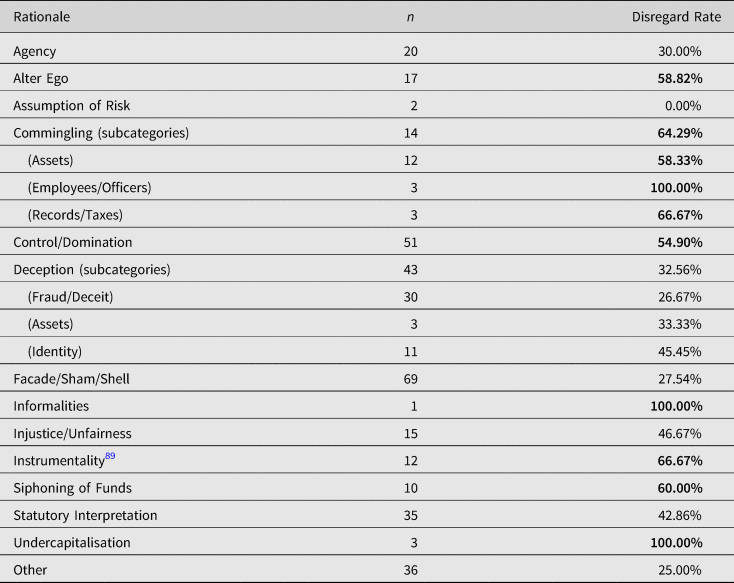
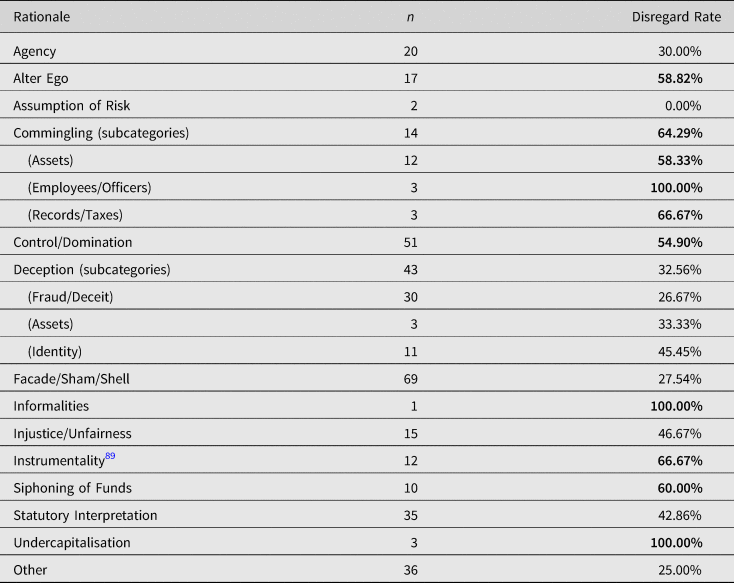
We recorded a total of 14 categories of instrumental rationales: Agency, Alter Ego, Assumption of Risk, Commingling, Control/Domination, Deception, Facade/Sham/Shell, Informalities, Injustice/Unfairness, Instrumentality, Siphoning of Funds, Statutory Interpretation, Undercapitalisation, and Other. For certain rationales, subcategories were used. Commingling was divided into whether it involved assets, employees/officers, records/taxes. Deception was divided into whether it concerned fraud/deceit, assets, or the identity of the shareholder (Table 1).
Frequency and disregard rate by rationaleFootnote 88
However, as discussed earlier, there is no way to discern entirely whether the publicly articulated rationales cited by a court truly are the driving instrumental reasons for the outcome. Metaphors in particular are – by their very nature – chosen to provide a shape for an explanation but without providing exact detail. As such, the disregard rationales we capture may operate similarly to a Rorschach test whereby articulated rationales reveal information about judicial deliberation, whether conscious or unconscious; for instance, recurring specific rationales, such as Deception, may indicate preferred evidence, whereas conclusory metaphors, such as Alter Ego, may indicate a lack of evidence or complete evidence for the ultimate decision. In presenting our conclusions we also provide tables with raw numbers, which serves the purpose of informing readers and equipping them with the means separately to make additional educated decisions about what we think are reliable inferences, or indeed to see further meaning in the data.
There are, of course, other limitations to our study's design that should be borne in mind when interpreting our conclusions. Because our dataset concerns only judicial opinions, our results do not capture the dynamics of cases that never reached final disposition, and so the portrait is but a part of the overall population of corporate disregard litigation.Footnote 90 This issue is not just present within empirical study of case law but also traditional black letter analysis. Nevertheless, it is an important caveat to bear in mind when interpreting our conclusions, as they might not be representative of all potential disputes.Footnote 91 But, without access to any non-filed or settled matters, these publicly available cases are currently the best means for acquiring broad evidential insight into judicial reasoning that will assist our understanding and development of the area.
3. Results
The results presented here should be read with great care. Unlike other studies, the frequency data should not be interpreted as reporting simply the total number of cases in which a rationale was mentioned by a court in our dataset; rather, given our intensive method, the frequency data reflect the number of times in which a rationale was deemed to be instrumental – either in its articulated absence or presence within a case – to an ultimate decision whether or not to disregard the corporate form. Further, the disregard rate provided for each rationale should not be compared to the overall corporate disregard rate of 35.65% for our entire case dataset; the disregard rate for each rationale instead reflects its propensity or weight towards whether a corporate disregard claim was successful or not. For example in Table 1 below, the courts articulated Facade/Sham/Shell 69 times as a rationale that was instrumental to an outcome. The disregard rate for Facade/Sham/Shell of 27.54% means that it was articulated by the court as instrumental in disregarding the corporate form in only 27.54% of cases and that conversely in 72.46% of cases the court articulated that its absence was instrumental to a no disregard outcome that upheld the corporate form.
(a) Rationale frequency and disregard rate
Table 1 presents data on the frequency and disregard rate for each rationale within our UK dataset, with disregard rates in excess of 50.00% appearing in bold and subsets in brackets.
Facade/Sham/Shell is the rationale that was instrumental in the largest number of cases by a significant margin; this is hardly a surprise, given that it is one of the most clearly and consistently articulated categories for corporate disregard over the past century, and is one of the categorical rationales authorised by the Adams decision.Footnote 92 Interestingly, the rationale also features a low 27.54% disregard rate. That rate is the lowest among any of the rationales except for the Other category, which contains very diffuse rationales that resist generalisation.Footnote 93 This would suggest that the focus on Facade/Sham/Shell as a problematic rationale in Prest may have been misplaced, because although it has a high frequency in the case law it is distinguished by its low rate of disregard indicating – in our view – a rationale well policed by the judiciary.
Despite its apparent diminution in the Adams case, Injustice has persistence within the data and its 46.67% rate suggests that while it is uncertainly adjudicated it is not the arbitrary get out of (corporate disregard) jail card suggested in the literature, but rather more finely balanced and uncertain within the case law.Footnote 94 Indeed in Prest Lady Hale and Lord Wilson's broad concept of ‘unconscionable advantage’ seems to reflect this continuing stream of judicial rationale.Footnote 95 Whether its presence is as concerning as the academic and judicial literature suggests is questionable give its low frequency within our data.
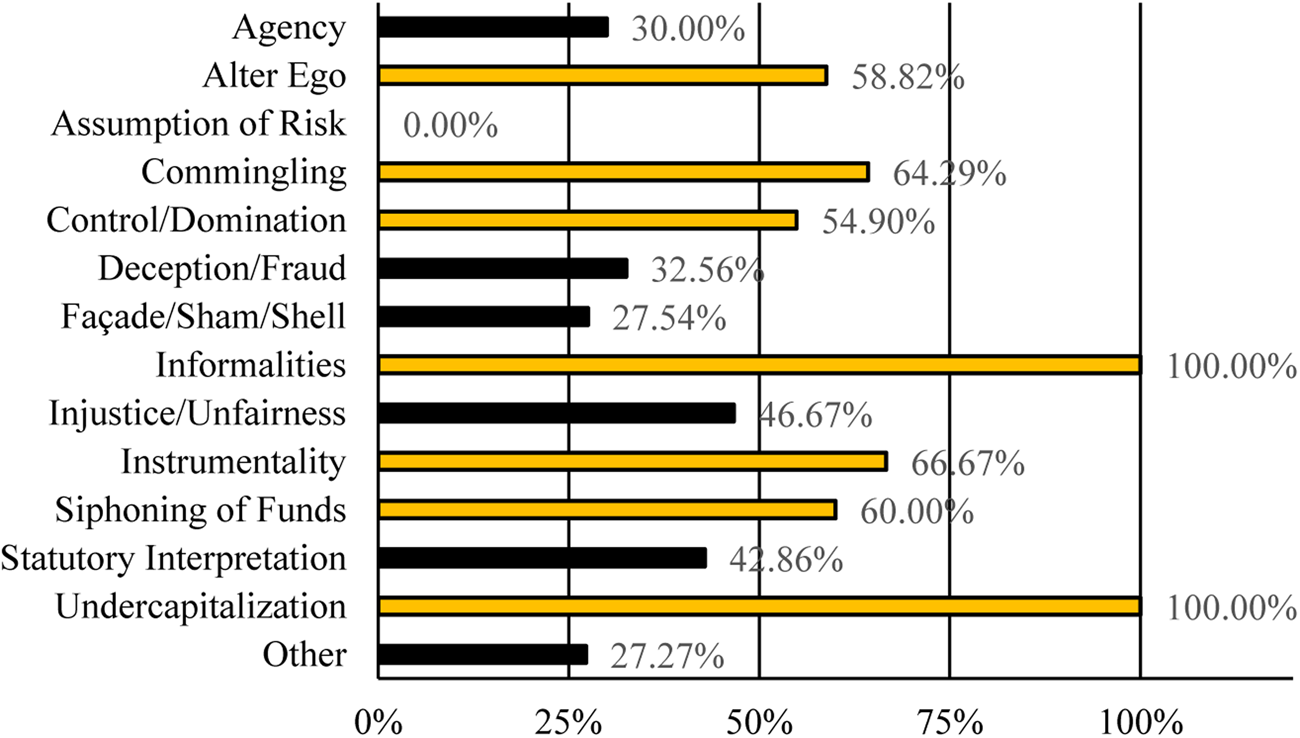
Breaking the data down further, Figure 1 below depicts the disregard rate for each rationale, with the black bars indicating rates below 50.00%, that is, skewing towards the rationale's absence justifying a rejection of the corporate disregard request. Only three rationales feature disregard rates comparable to that of Facade/Sham/Shell: Agency (30.00%), Assumption of Risk (0.00%), and Deception (32.56%).
Disregard rate by rationale
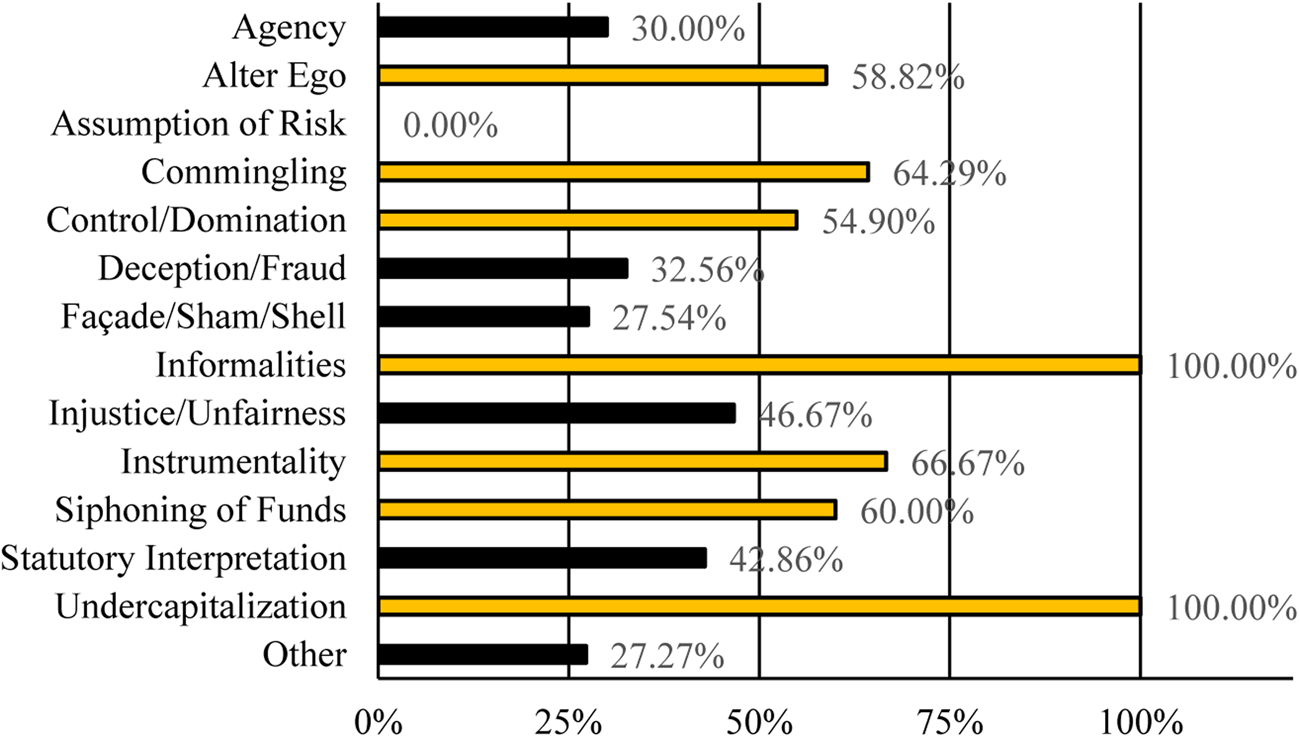
Assumption of Risk may be discounted on the basis of its infrequency, but the other rationales – along with Facade/Sham/Shell – are commonly mentioned by courts to be circumstances when disregard of the corporate form could occur. For example an overall disregard rate for a rationale that leans toward 0.00% suggests a tendency that the rationale's absence should result in no disregard; and when the rationale leans towards 100%, that suggests a high, but not absolute, degree of judicial consensus that the presence of that rationale will result in disregard. The low disregard rates for this cluster of rationale indicate that their absence from a case frequently results in preservation of the corporate form. Put differently, the data suggest that Agency, Deception and Facade/Sham/Shell are considered essential elements in a significant number of corporate disregard requests.
If we take a macro view of the rates in terms of judicial consensus then within the data a 0–40% disregard rate indicates a fair degree of judicial consensus as to how that rational is adjudicated, 41–60% indicates a degree of uncertain adjudication and 61%–100% again indicates a degree of consensus in adjudication. Eliminating rationales with low numbers such as Undercapitalisation (3), Informalities (1) and Assumption of Risk (2) leaves 11 rationales with meaningful frequency within the data. Overall, in terms of their certainty of adjudication, matters look finely balanced with six rationales in the certain range and five in the uncertain range. Interestingly of the six rationales in the certain range, four tilt towards upholding the corporate form and two towards a disregard outcome in terms of their rates. This would seem to accord with the overall picture of uncertainty within the wider academic and judicial commentaries.
However, dividing the rationales by numerical frequency yields a different picture. We organised the 11 remaining rationales into a spectrum of low frequency (0–19), mid-frequency (20–39), and high frequency (40+) rationales. From that breakdown three high frequency rationales are present: Control/Domination, Deception and Facade/Sham/Shell. Deception and Facade/Sham/Shell have low rates and therefore a high degree of certainty and judicial consensus towards no disregard. Control/Domination is the only high frequency rationale that has an overall uncertain judicial consensus as to its adjudication, although – as we will observe below – Deception is uncertainly adjudicated at the intermediate appeal level. In percentage terms, 68.71% of the time a high frequency rationale is instrumental to an outcome it is within the certain range of judicial adjudication and strongly tilts towards a no-disregard outcome. The three categories in the mid frequency range – Statutory Interpretation, Agency and Other – similarly have two with low rates indicating judicial consensus and one, Statutory Interpretation, is uncertain but only just. Again within the mid-frequency we can observe that in percentage terms 61.53% of the time a mid-frequency rationale is instrumental to an outcome, it is within the certain range of judicial adjudication and strongly tilts towards a no-disregard outcome. Within the five low frequency rationales of Alter Ego, Commingling, Injustice, Instrumentality, and Siphoning, only two, Commingling and Instrumentality, have rates that indicate a degree of certainty of judicial adjudication. The other three have rates in the uncertain range. In percentage terms, where a low frequency rationale is instrumental to an outcome, it is within the certain range of judicial adjudication only 38.23% of the time and in a very different pattern to the mid and high frequency rationales tilts towards a disregard outcome. Viewed as a whole this is not a picture of uncertainty of adjudication or direction of outcome as there is overall a high degree of certainty of adjudication and direction of outcome towards no disregard in the mid to high frequency rationales which declines in the low frequency range. Given this finding, the slippery reputation of disregard adjudication may be overstated. Academic and judicial commentaries of the area may be disproportionally emphasising the uncertainty from minority rationales and are perhaps not recognising that in a significant majority of cases the judiciary, when high or mid frequency rationales are instrumental, find that it is not present and do not disregard the corporate form.
In policy terms this would point to both the attempts at reform in Adams and Prest as being at least partly misdirected, which may explain why matters continue to be problematic. Our evidence would suggest that broadly over the range of our dataset the judiciary have policed Agency and Facade/Sham/Shell particularly robustly, which would not indicate a problem unless one views any corporate disregard outcome as problematic. Deception is similarly adjudicated overall but with, as we consider below, instability at the intermediate appellate level and again, as we consider below, unlike Agency and Facade/Sham/Shell is strongly influenced by substantive claim. Within the high frequency rationale evidence, Control/Domination would seem to warrant particular attention given its uncertain adjudication; similarly, within the mid frequency rationales, Statutory Interpretation sits within the uncertain range. Where the reform instinct in Adams was right, was in the low frequency rationales in that all five would arguably warrant attention. In particular our data on Injustice and its low level persistence after Adams had specifically dismissed it as a legitimate rationale would indicate that even where a specific judicial intervention occurs in this area it does not necessarily embed itself as precedent would require. The continued presence of Alter Ego as a rationale since Prest may reflect that same phenomenon.
Moreover, as we observe below, our dataset confirms that Facade/Sham/Shell in particular became an increasingly prominent rationale after the Adams decision, which may further explain the attention drawn to Facade/Sham/Shell in Prest.
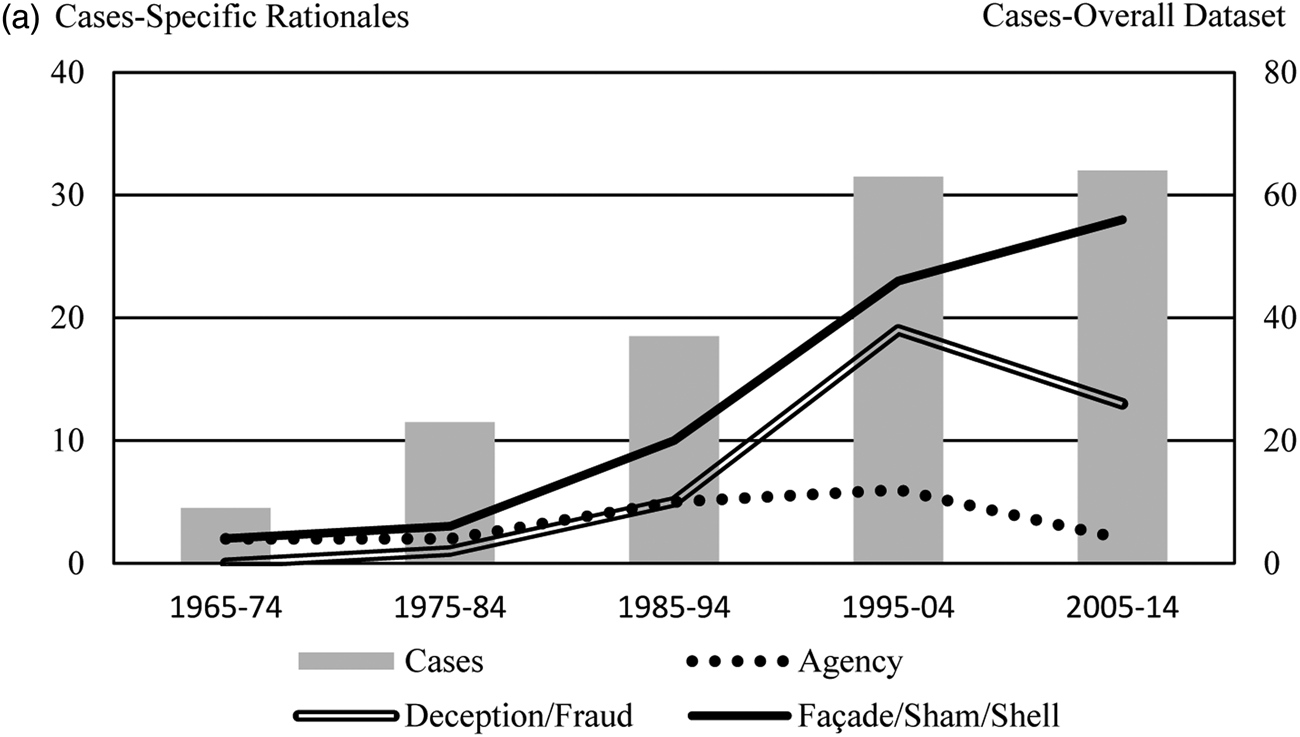
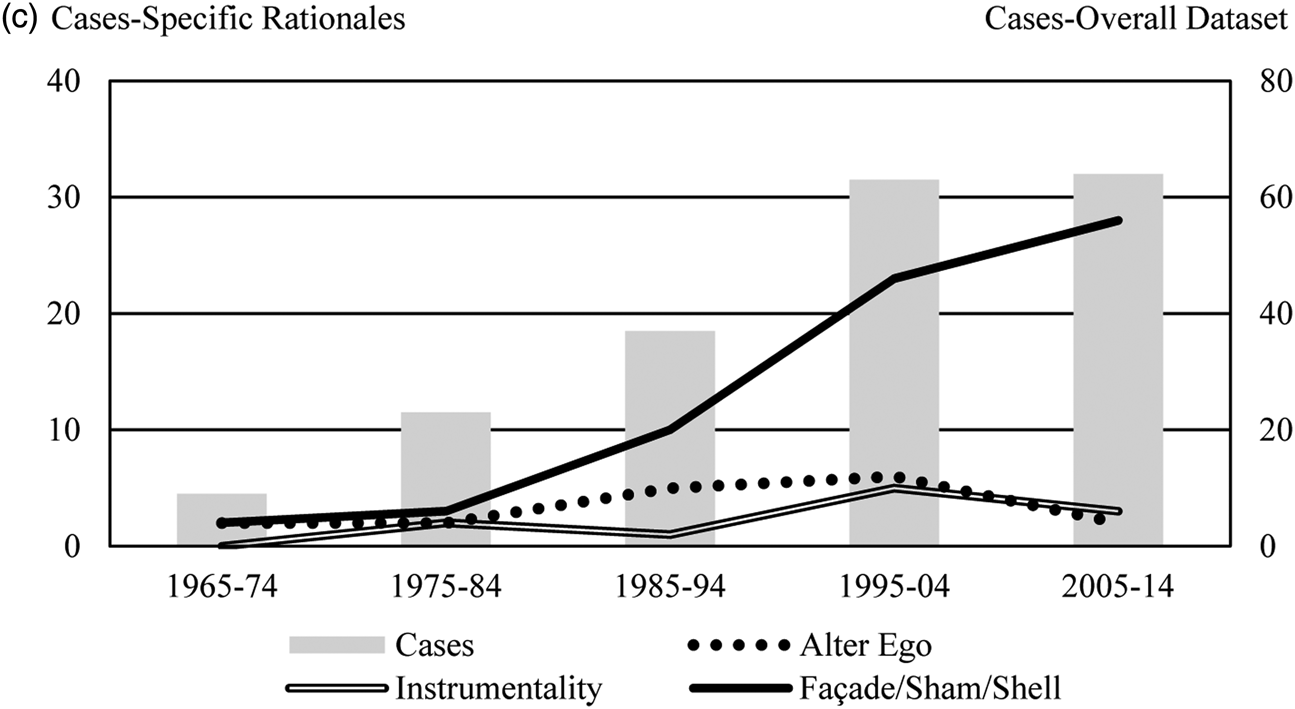
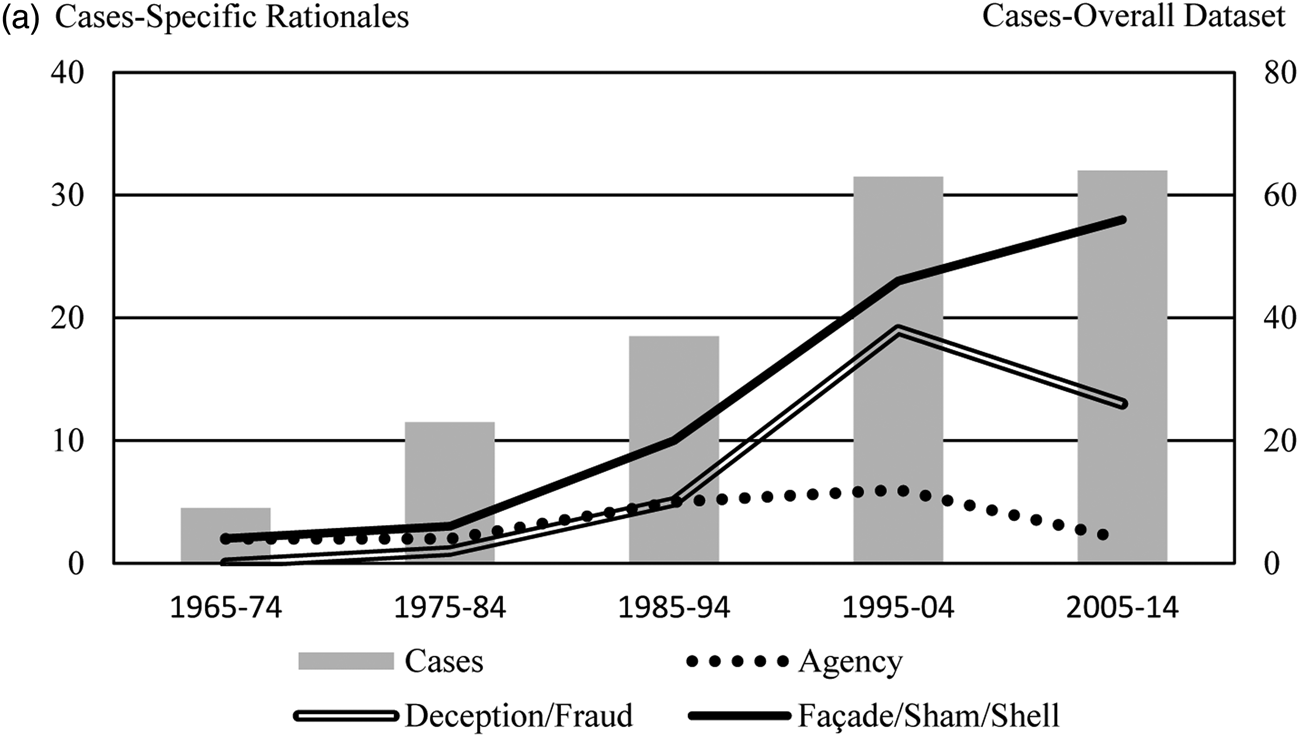
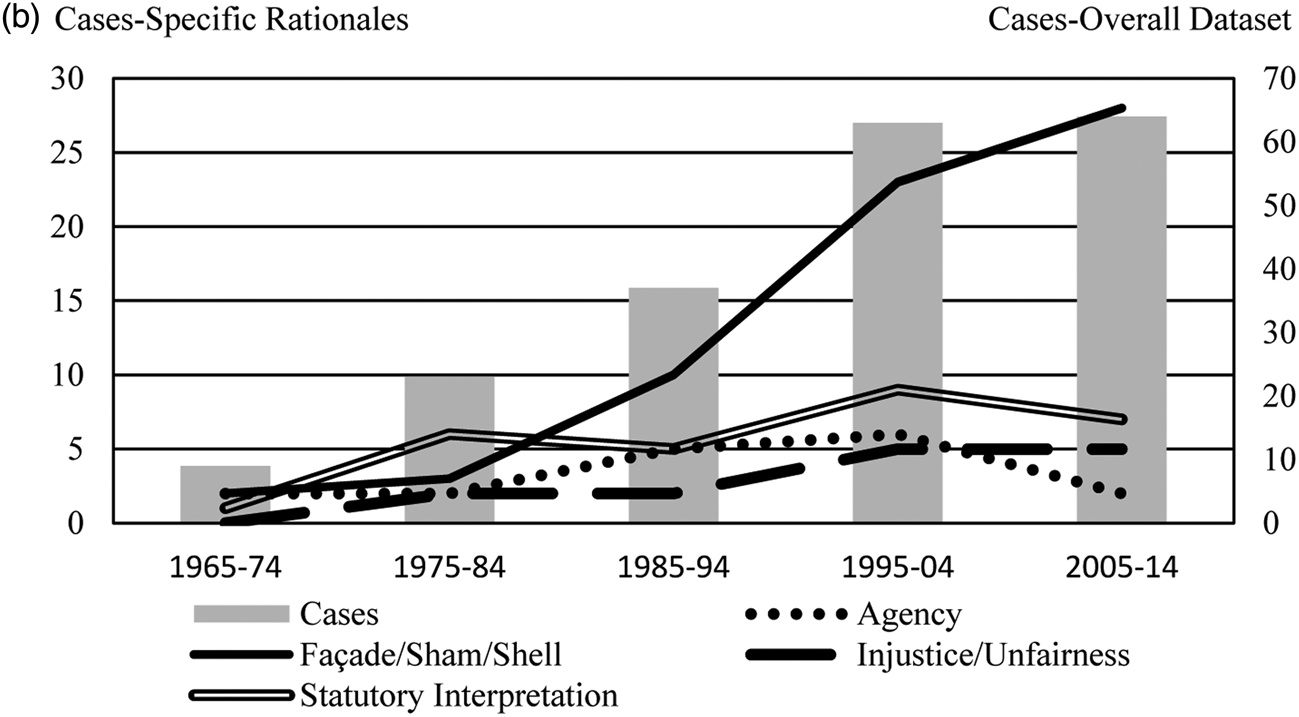
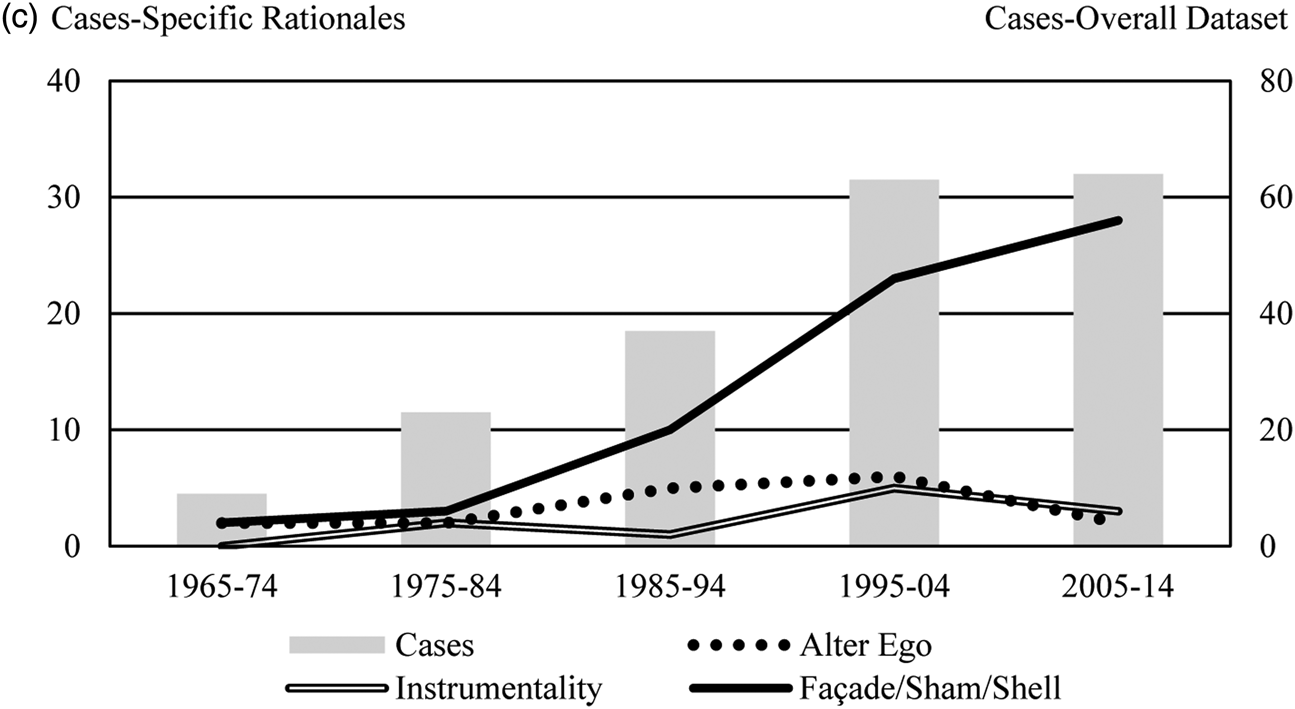
Figure 2A provides a time-based comparison of the frequency with which Agency, Deception, and Facade/Sham/Shell have been instrumental rationales; as a point of reference, the number of cases within our dataset for each decade is supplied in connection with the scale on the right-hand side of the graph. Agency has ebbed and flowed rather steadily over the decades, and thus its presence has diminished given the increase in the number of cases. In contrast, Deception and Facade/Sham/Shell mirrored each other in the decade after Adams v Cape Industries plc,Footnote 96 steadily increasing in proportion to the number of cases. Deception's rise and fall is puzzling. Although it had been rising slowly over previous decades, its rise in the 1990s seems to have been directly related to the Adams decision. In Adams an ‘intention to deceive’ is briefly discussed as a defence by Cape but is not at issue in corporate disregard terms.Footnote 97 It may simply be that perhaps the narrowing of disregard categories in Adams may have caused litigants to place more emphasis on deception elements of an action, which associate closely with Facade Sham/Shell. However, Deception sharply declines as an articulated instrumental rationale after the new millennium, while Facade Sham/Shell continued to increase. Similarly, as Figures 2A, 2B and 2C illustrate, while Facade/Sham/Shell had been increasing in frequency over the course of the 1980s it accelerates rapidly after the narrowing of other rationales and its reaffirmation by Adams in 1990. This may also explain its low overall disregard rate, as it may be that its frequency increase is partly because with the narrowing of acceptable categories it became a catch-all quasi-metaphorical rational for litigants. In simple terms, after Adams the proposition may have been put more and more that some element of a case fits within the facade rationale and in turn the courts found that while it is a legitimate rationale it is not present in the vast majority of cases where it is claimed to be present.
Frequency of cases and rationales with low disregard rates over time.
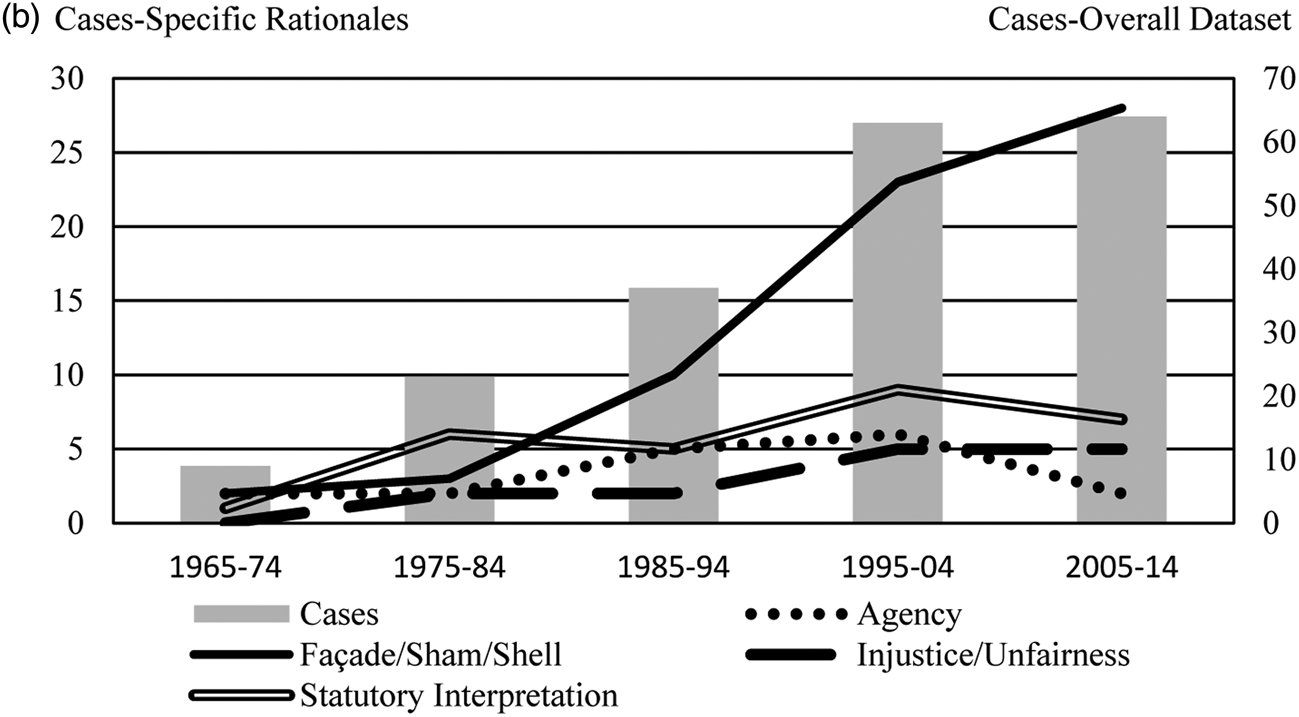
Adams rationales over time.
Frequency of cases and ‘metaphorical’ rationales over time.
The impact of Adams can be observed closely in Figure 2B, where we consider the key rationales the case legitimised and one key category it dismissed.Footnote 98 As we have noted, Facade/Sham/Shell experiences an extraordinary increase in frequency immediately after Adams. But the rationale interestingly has a low 27.54% disregard rate, and thus strongly tends to be instrumental in its absence in that the judiciary did not find the necessary elements of Facade/Sham/Shell to be present. By comparison Statutory Interpretation also is cited by courts more frequently after Adams, but then declines after the new millennium; and the 42.86% disregard rate indicates that Statutory Interpretation is a more finely balanced rationale which slightly tilts towards being instrumental in its absence. The increase in Statutory Interpretation's frequency may be due to its becoming a specific rationale category after Adams within which judges felt safe articulating on disregard, while its fine balance indicates its broad discretionary nature. This may be inevitable, but as discussed above, in policy reform terms it would possibly argue, given the broad trend over recent decades of tightening disregard categories, for a more robust set of criteria for rationalising corporate disregard when interpreting a statute given its uncertain direction and presence within the case law. Agency as a category of disregard rationale increases slightly in the decade after Adams and, as with Statutory Interpretation, declines in the new millennium. As with Facade/Sham/Shell, Agency is highly instrumental in its absence, with a 30% disregard rate. Unlike the more metaphorical Facade/Sham/Shell, the Agency rationale articulated in Adams is very specifically a close express agency, which may explain why it does not have the explosive growth observed in Facade/Sham/Shell and why both Lady Hale and Lord Neuberger consider it to have continued legitimacy in Prest.Footnote 99
As discussed earlier, Injustice/Unfairness was a key rationale category that was specifically disapproved of in the Adams case and yet rises in frequency over the decade after Adams and remains an important, if low frequency category, in the rest of the decade data. Its 46.67% disregard indicates a finely-balanced category in terms of injustice being found present or absent by the judiciary and again highlights a discretionary interpretable nature. In reality, though, its fine balance and low frequency overall means it only leads to a disregard outcome in a very small number of cases. The fact it is finely balanced and remains a persistent category may, along with the metaphorical categories, contribute to the observations, both judicial and academic, about the ambiguity of rationale present in the area of corporate disregard. It also indicates that despite a significant precedent in Adams ruling out its legitimacy as a rationale, judges have continued to utilise it. As noted earlier, Lady Hale's and Lord Wilson's ‘unconscionable advantage’ concept in Prest indicates that even at the highest level a broad injustice based exception is contemplated.
As compared to other conclusory, metaphorical rationales in Figure 2C, Facade/Sham/Shell is the only high frequency one and it enjoys a conspicuous increase over time. In that sense it is unusual both generally and specifically within the metaphorical rationales. This may be because, as noted above, while Adams legitimises it as a category it does so with reference to the specific circumstance present in cases such as Jones v Lipman, so in effect using a metaphorical wrapper to legitimise a specific set of circumstance that are far from uncertain.
In Prest Lord Sumption's evasion and concealment principles were intended to put some rigour into Facade/Sham/Shell, as he viewed it as a confusing and questionable rational, by removing the metaphorical aspect.Footnote 100 As we have noted above, our data indicates that although it was a high frequency and increasing rational, the judiciary appear to be policing Facade/Sham/Shell in a fairly rigorous manner. As also noted earlier, given the difficulty the judiciary have had utilising Lord Sumption's narrow principles since Prest, our data may back up recent academic observations about the effect of Lord Sumption's principles by indicating that the metaphorical aspect of the historical Facade/Sham/Shell, combined with the legitimising focus in Adams on cases such as Jones v Lipman, provided a balance of rigour and flexibility that may have been lost in Lord Sumption's principles. Revisiting this matter would be an important point of possible judicial attention.
There were, however, some patterns among other rationales that exhibited relatively high disregard rates, which might also warrant concern. When courts focused on specific, concrete evidence, such as the Commingling of Assets (58.33%) and Siphoning of Funds (60.00%), the outcome leaned more towards disregard of the corporate form; but this also applied to the conclusory rationales, Alter Ego (58.82%) and Instrumentality (66.67%). This may indicate that concrete evidence-based rationales have high rates of disregard where that evidence is present and that conclusory low frequency highly metaphorical rationales have high rates for exactly the opposite reason that there is no concrete evidence and the metaphor is occluding whatever the real reason is. Again it may be that this contrast is one of the reasons the area is regarded as problematic and points to a reform focus on the two problematic occluding metaphorical low frequency rationales of Alter ego and Instrumentality. Additionally, as discussed earlier, the difficulty of working with Lord Sumption's principles since Prest seems to have led to the recent unexpected rise in explicit or quasi Alter Ego rationales. One explanation for that may be that in those principles closing off the metaphorical aspect of Facade/Sham/Shell, the judges have – in search of some flexibility – reinserted it through Alter Ego justifications.
(b) Rationale by jurisdiction
With the continuing caveat regarding settled case data, the nature of legal appeal processes has been found to be relevant to disregard outcomes in the UK and elsewhere,Footnote 101 and particularly at the intermediate appeal level within the UK, where it has been suggested that some instability in the corporate disregard doctrine lies.Footnote 102 Focusing on how individual rationales are interpreted at each level may provide an additional layer of analysis to identify potential issues. Additionally, examining the rationales at each court level may provide a gauge of the health of the precedential ecosystem, where a high degree of difference between disregard rates at each level might indicate precedential confusion and perhaps provide a further focus for where that confusion lies.
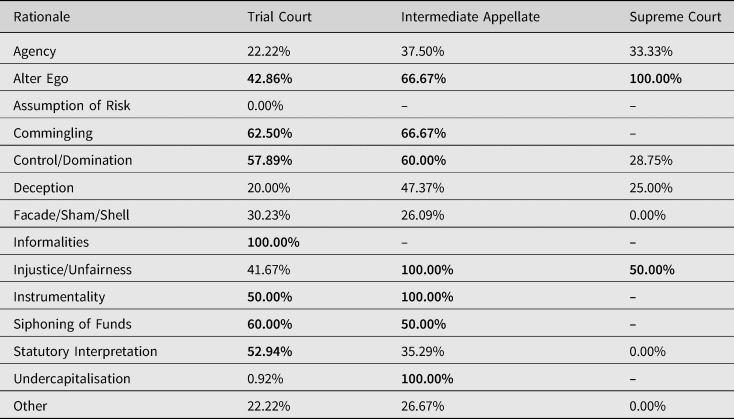
As can be observed in Table 2, overall we did find a pattern of generally higher rates of disregard within the rationale categories at the intermediate appellate level than trial, similar to other studies, which might warrant concern, where rates of disregard were higher in 9 of the 12 rationale categories where appeals were present. In particular, remarkably high rates were observed in the Injustice, Instrumentality and Undercapitalisation rationale categories at the intermediate appeal level. Instrumentality and Undercapitalisation feature a very small number of observations that account for the high volatility between the trial court and intermediate appellate court levels. This again leaves Injustice, despite its disapproval in Adams, as a notable, continuing but low frequency instrumental intermediate appellate court rationale that appears to drive disregard of the corporate form outcomes at that level.
Disregard rate for rationales by jurisdiction
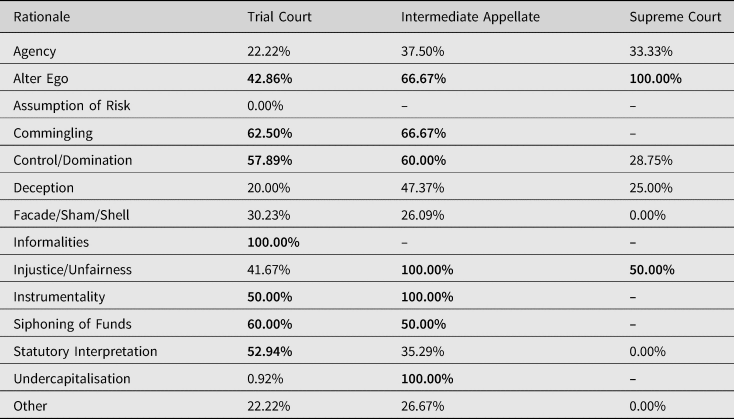
The overall pattern reversed at the Supreme Court level, where rates were generally much lower across seven of the eight rationale categories, where appeals to the Supreme Court were present, with only Alter Ego breaking that trend with a notable 100% rate. Overall Alter Ego, Facade/Sham/Shell and Statutory Interpretation stand out as having unusual patterns of disregard at each appellate level. The disregard rates for Alter Ego rise at the intermediate appellate and Supreme Court levels, which appears to have some relationship to this being driven by criminal Alter Ego cases in the English Court of Appeal. This may also play an additional part in explaining why Alter Ego remains a persistent rationale since Prest as a number of those cases are criminal Court of Appeal cases. This indicates that family law – as was the focus in Prest – may not be the only contextual outlier in the judicial utilisation of corporate disregard concepts – something we take up further in the next section. However, we could find no such correlation at the Supreme Court level that might help explain the 100% disregard rate for Alter Ego.
The disregard rates for both Facade/Sham/Shell and Statutory Interpretation drop at both the intermediate appellate and Supreme Court levels, which may be because they are Adams categories that may bring a greater level of exacting precedential scrutiny. This might also be partly true of Agency, with its rising and falling pattern. If we return to the disregard rates as indicators of certainty/uncertainty of judicial analysis, we find that the trial courts are relatively uncertain in their adjudication of disregard rationales with six rationale rates from 11 in the uncertain range.Footnote 103 Intermediate appellate courts have a much higher degree of certainty of adjudication overall, with only three rationale rates from 11 in the uncertain category. The Supreme Court had the highest level of overall certainty of adjudication, with seven of the eight rationales adjudicated at the Supreme Court Level falling within the certain range. These patterns would seem to reflect the instability present in both the judicial and academic accounts of the disregard doctrine that seems, despite attempts by the senior courts, to lack a clear precedential direction for the High Court.
However, if we examine the individual rationale rates by frequency band, as earlier, we can provide a more exact focus for where that instability lies. Of the three high frequency rationales, Control/Domination, Deception and Alter Ego, again we can observe that Control/Domination is the only one within the uncertain range at the trial court level. At the intermediate appellate level adjudication becomes more uncertain with Control/Domination and Deception falling within the uncertain range. At the Supreme Court level all three are within the certain range. Within the three categories in the mid frequency range, Statutory Interpretation, Agency and Other, only one, Statutory Interpretation, is in the uncertain range. At the intermediate appellate and Supreme Court level all three were within the certain range.
Indeed, the analysis by mid and high frequency rationales, which represent the great majority of cases within our dataset, indicates that apart from Control/Domination and Deception at the intermediate appellate level there is not just a high degree of certainty as to adjudication across jurisdiction level but all the certain rationales rates in the high to mid frequency at all court levels are in the low percentages, indicating a high degree of consensus towards no disregard.
However, in the low frequency rationales of Alter Ego, Commingling, Injustice, Instrumentality, and Siphoning, at trial level matters were notably different in that four of the five were in the uncertain range. At the intermediate appellate level that switches around, with four of the five in the certain range. Notable in the certain range of low frequency rationale rates at the trial and intermediate appellate range, is that unlike the mid-high frequency rationales all the low frequency rationales in the certain range are high percentage rates indicating a consensus towards disregard. At the Supreme Court level, two of the threeFootnote 104 rationale categories adjudicated are within the certain range but with no consensus as to disregard or no-disregard.
Overall there is a high degree of certainty within the adjudication of rationales across jurisdiction. In the mid and high frequency rationales at all levels of adjudication within the certain rationales there were low disregard rates, indicating a consensus towards upholding the corporate form. However, two of the high frequency rationales, Control/Domination and Deception, have an unusual degree of uncertainty about their adjudication at the intermediate appellate level, which in policy terms might warrant judicial attention.Footnote 105 Similarly in the low frequency rationales matters were different, with a high degree of uncertainty at trial court and – apart from the Supreme Court – a tendency within the certain rationale rates to disregard the corporate form. On our evidence here this may again warrant a focus in terms of judicial reform.
(c) Rationale by substantive claim
While disregard rationales are expressed within a particular remedial context we were also concerned, as pioneered by the court in Prest with its concern as to how disregard rationales were operating in family law, to examine possible contextual elements that might relate to the substantive claim within the action.
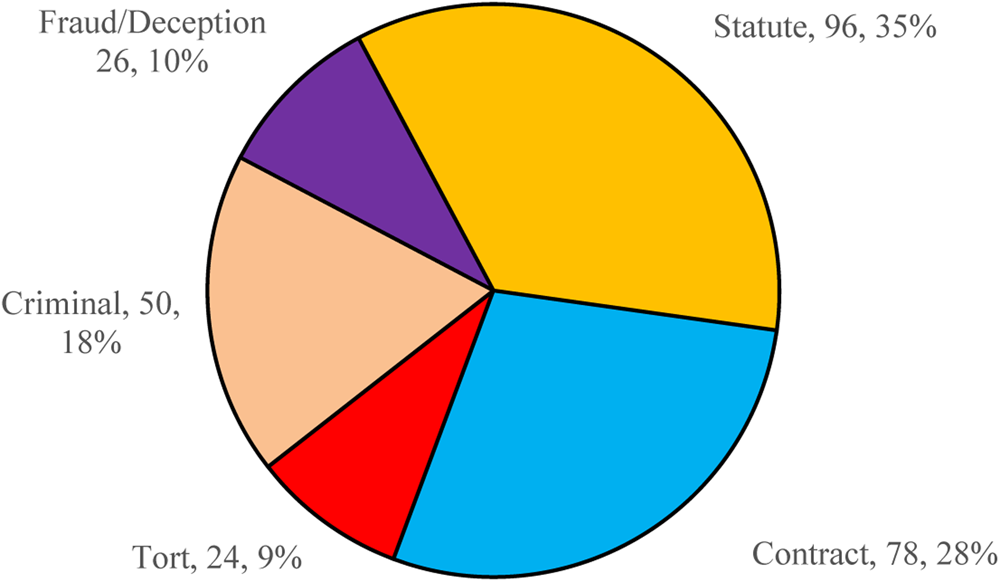
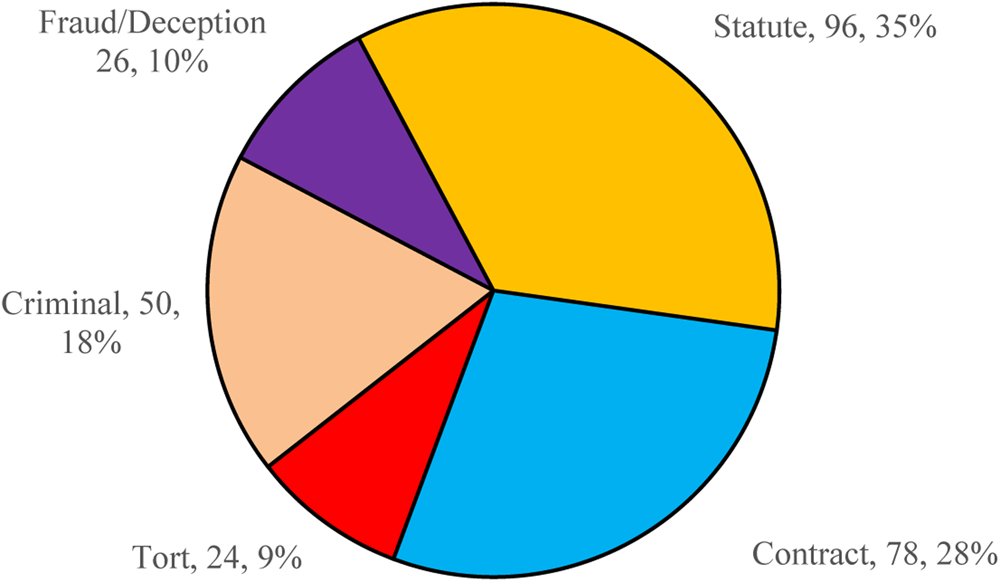
Figure 3 depicts how substantive claims were distributed in our dataset. Although Charles Mitchell utilised a more fine-grained set of categories for substantive claims,Footnote 106 we both find a larger number of contract rather than tort claims, with statutory claims comprising the largest overall category. These proportions, however, do not hold when examined in relation to the frequency of different types of instrumental rationales where Control/Domination, Deception, and Facade/Sham/Shell form an important cluster across all substantive claims.
distribution of substantive claims
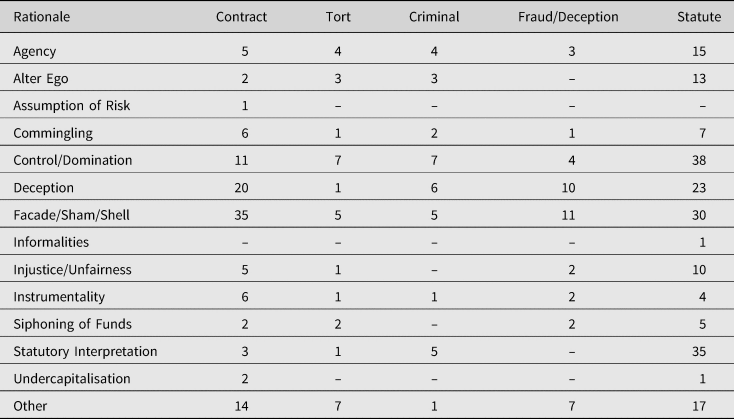
As Table 3 shows, courts cite Agency, Alter Ego and Siphoning of Funds a comparable number of times with respect to all non-Statutory claims. Put differently, these rationales appear to be disproportionately underrepresented with respect to Contract and Criminal claims. By way of contrast, Control/Domination, Deception, and Facade/Sham/Shell all seem to be cited roughly in proportion to the distribution of substantive claims within our dataset.
Frequency of rationales by substantive claim.Footnote 108
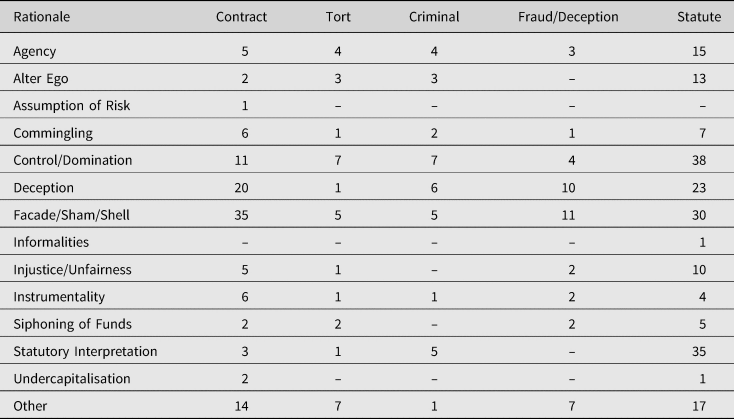
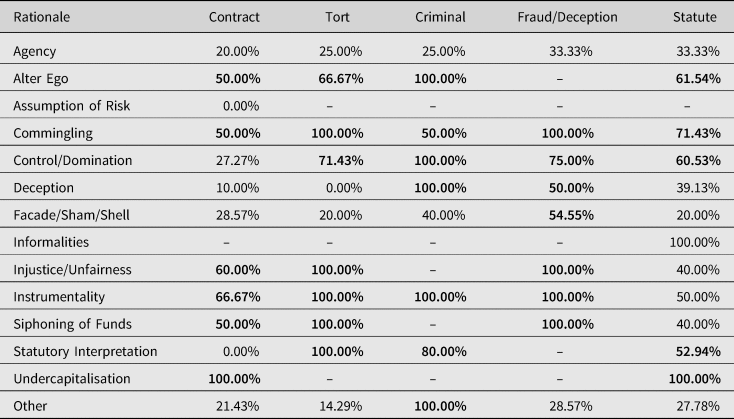
As Table 4 evinces, the corporate disregard rates for each rationale are not very stable across the types of substantive claims. Agency and Facade/Sham/Shell have an exceptional status within the data, as they have relatively low disregard rates that are roughly consistent across all substantive claims.Footnote 107 As we have noted before, this may be because Agency and Facade/Sham/Shell are among the concrete strongly policed categories legitimised in Adams and again would suggest Lord Sumption may have been mistaken in attempting to reform Facade/Sham/Shell. Statutory Interpretation, another Adams rationale, behaves differently within the substantive claims and its discretionary nature may explain the wide range of disregard rates across substantive claims.
Disregard rate for rationales by substantive claim.

Significantly, as Table 4 indicates, the disregard rate seems to bear a stronger relationship to the type of substantive claim than the rationale. The Criminal and Fraud/Deception substantive claim categories have, for example, comparatively high rates and a high degree of certainty of adjudication tilting strongly towards a disregard outcome broadly across the instrumental rationales regardless of frequency. Statute as a substantive claim has a more mixed picture with a mixed range of rates and a high degree of certainty of adjudication tilting towards a no-disregard outcome. By frequency of rationale that mix of rates is also present.
Our dataset also features a higher overall disregard rate for most rationales in Tort versus Contract. Deception, Facade/Sham/Shell, and Other are exceptions in this regard, all of which feature comparatively low disregard rates for Tort and Contract. Tort particularly has a distinctive feature if analysed by certainty of adjudication. With its distinctive low and high rates it has a remarkable certainty of adjudication across all rationales with a tendency towards disregarding the corporate form. Indeed, it is notable that across all the rationales by substantive claim there are a high number of rationale rates at either end of the certainty of adjudication percentages with not many in the uncertain category. Conversely, Contract stands out for the relatively high number of rationales in the uncertain category. In terms of the Contract versus Tort narrative, it is not just that Tort has an unusually certain relatively uniform disregard outcome oriented approach to the adjudication of disregard rationales but also that disregard rationales operating in Contract have a higher degree of uncertain adjudication.
Analysis by frequency allows us to focus in on the key differences. In Contract, in contrast to all the other substantive claims, all three high frequency rationales (Facade/Sham/Shell, Deception and Control/Domination) are uniformly certain in adjudication and in terms of their low rates, a strong tendency to uphold the corporate form. In the mid frequency rationales (Statutory Interpretation, Agency and Other) the pattern is exactly the same. However, a remarkable amount of uncertainty is present with four of the five rationales in the low frequency rationale category (Alter Ego, Instrumentality, Commingling, Injustice and Siphoning) having rates within the uncertain adjudication range. Overall, Contract stands out with its certainty of adjudication focused on low rates tilting strongly towards no-disregard in the mid and high frequency rationales and the remarkable uncertainty found in its low frequency rationales. Contrasted with Tort, in terms of mid to high frequency rationales, Tort has a more mixed picture with a high degree of certainty but less uniform direction of outcome as while the majority of rates are at the low end there are also a minority of very high rates. The big difference occurs in the low frequency rationales, where Tort has remarkably high disregard rates.
Overall, in Contract, the judiciary are much more reluctant to disregard the corporate form than where the substantive claim is Tort, Criminal or Fraud/Deception, while a more mixed picture exists where Statute is the substantive claim. Perhaps the most striking example is Control/Domination, where the disregard rate is quite low for Contract (27.27%), and yet extremely high for all other remaining substantive claims. Similarly, as we noted above, highly elevated corporate disregard rates were present in almost all of the rationales for Criminal and Fraud/Deception claims. These results are difficult to explain in light of the fact that corporate disregard is a remedy whose rationales should be detached from the nature and dynamics of the underlying substantive claim.Footnote 109
In Prest the view of the court in looking at family law as applying a contextual disregard doctrine parallels our substantive claim evidence. Our evidence, though, would suggest the issue is much more prevalent than just family law and that in particular Tort and Criminal disregard adjudications seem strongly contextual. This may be both a key part of their adjudication and the historical oft-commented on instability of corporate disregard.
As such, the rationales broadly appear to operate differently depending on the nature of the substantive claim, and no overall thread is evident, apart again from two of the Adams rationale categories of Agency and Facade/Sham/Shell. We were unable to detect any statistical patterns that might provide a possible answer as to why substantive claims were so significant and would suggest that a key element the data may be picking up is that some articulated rationales are covering an occluded, deeper and clearly important claim-specific element to the outcomes, such as the involuntary nature of Tort, the voluntary nature of Contract and the imperative nature of Crime.Footnote 110 This might indicate that there is a further layer of operational difficulty to Lord Sumption's principles, beyond the narrowness already commented on, which might explain the difficulty the courts have had working with them recently, in that a ‘one size fits all’ approach may struggle, given the evident contextual forces that appear on our evidence to be broadly at work.
Conclusion
Our study attempts to establish an empirical foothold within this notoriously slippery area of law that might form a different way of looking at reform issues in corporate disregard. With the continuing caveat regarding settlement data, we found that overall there is no empirically detectable single thread of rationale that runs through all disregard claims. However, Agency and Facade/Sham/Shell have, particularly after Adams v Cape Industries plc,Footnote 111 become key well policed disregard rationales. This would also, in our view, indicate that the reform of Facade/Sham/Shell in Prest may have been misplaced, and that replacing the Adams interpretation of that rationale with its combined analogous and metaphorical elements for the narrower concealment and evasion principles may explain the difficulty the judiciary have had with the narrowness of those principles absent a metaphorical flexibility of interpretation. Deception was also notably a high frequency rationale with certainty of adjudication, apart from at the intermediate appellate level, that tilted strongly towards no-disregard. While deception was unrelated directly to the Adams categories, it increased in the 1990s immediately after the Adams decision. We do not have an explanation for this phenomenon but we hypothesise it may be related, at least initially, to an increased emphasis on deceptive behaviour surrounding Facade/Sham/Shell.
Overall, we found a high degree of certainty of judicial adjudication within our data, focused on a no-disregard outcome. Uncertainty of adjudication, when present, was found when Control/Domination and Statutory Interpretation were instrumental and in the low frequency rationales, particularly the metaphorical ones. Injustice, although infrequent, was notable for its persistence and uncertain adjudication, despite its dismissal as an illegitimate rationale in the Adams case. For a legal system that operates on a precedential basis, the continuing existence of Injustice as a rationale after Adams, even though low frequency, is particularly noteworthy.
On our evidence of the broad rates our reform instinct would not lie with the well-policed rationales of Agency and Facade/Sham/Shell but rather with Control/Domination, Deception, Statutory Interpretation, Injustice and the low frequency metaphorical rationales. All apart from Control/Domination and Deception contain – by their nature – broad discretion, which may explain their uncertain adjudication and so Control/Domination's and to an extent Deception's (at the intermediate appellate level) presence in the uncertain category is perplexing given that they both lend themselves to more concrete interpretation, and so point to rationales of particular concern.
Examining rationales by trial jurisdiction, we found rationale disregard rates broadly higher at the intermediate appellate level than at trial or Supreme Court level. However, when broken down by frequency of rationale, we found a broad degree of certainty of judicial adjudication focused on upholding the corporate form. That contradiction is explained by two high frequency rationales, Control/Domination and Deception, that were uncertain in adjudication at the intermediate appellate level, while Alter Ego and Injustice were also notable low frequency driver of disregard outcomes focused at the intermediate appellate level. Why these four rationale categories engage instability at the intermediate appellate level is unclear but provides an additional empirical signal to potentially focus reform.
Possibly the most important evidential finding in our study emerged when rationales were viewed by substantive claims. Remarkably, the disregard rates broadly have a stronger link to the underlying substantive claim than the rationale expressed, which may indicate that an obscured contextual element related to the substantive claim is operating. Agency and Facade/Sham/Shell, however, appear unaffected by the underlying substantive claim, which would further emphasise their core rationale status and again that the court in Prest may have been erroneous in perceiving Facade/Sham/Shell as problematic.
The identification of substantive claim as influential was a recognised driver of the Supreme Court's decision in Prest. Our evidence would indicate that the contextual element of substantive claim is influencing the interpretation of corporate disregard rationales across a broader range of areas, not just family law. The effect of substantive claim may also provide an empirical signal that a ‘one size fits all’ approach to corporate disregard, as attempted in Adams and to an extent in Prest, may not be realistically operable across the range of circumstance faced by the judiciary, as the rationales may hide a deeper unarticulated element related to the core circumstance of the substantive claim. This again would suggest that Lord Sumption's narrow principles of concealment and evasion should be revisited.