Introduction
The Research Domain Criteria (RDoC) initiative was launched by the US National Institute of Mental Health (NIMH) as a framework for approaching both research on and diagnosis of mental disorders. Much research challenges the categorical representation of disorders of the Diagnostic and Statistical Manual (DSM) of the American Psychiatric Association and the International Classification of Diseases (ICD). The goal of the RDoC program is to facilitate the research-based validation of constructs, defined by neurobiological and behavioral measures to support revisions of current diagnostic systems (Cuthbert, Reference Cuthbert2014). This initiative presently outlines five major domains of human functioning and behavior intended to reflect the contemporary understanding of major neurobiological systems. A key premise of RDoC is that these ‘cross-disorder’ constructs are relevant to multiple diagnoses. This premise has been supported by research indicating common risk factors for multiple disorders (Lee et al., Reference Lee, Ripke, Neale, Faraone, Purcell, Perlis, Mowry, Thapar, Goddard, Witte, Absher, Agartz, Akil, Amin, Andreassen, Anjorin, Anney, Anttila, Arking, Asherson, Azevedo, Backlund, Badner, Bailey, Banaschewski, Barchas, Barnes, Barrett, Bass, Battaglia, Bauer, Bayés, Bellivier, Bergen, Berrettini, Betancur, Bettecken, Biederman, Binder, Black, Blackwood, Bloss, Boehnke, Boomsma, Breen, Breuer, Bruggeman, Cormican, Buccola, Buitelaar, Bunney, Buxbaum, Byerley, Byrne, Caesar, Cahn, Cantor, Casas, Chakravarti, Chambert, Choudhury, Cichon, Cloninger, Collier, Cook, Coon, Cormand, Corvin, Coryell, Craig, Craig, Crosbie, Cuccaro, Curtis, Czamara, Datta, Dawson, Day, De Geus, Degenhardt, Djurovic, Donohoe, Doyle, Duan, Dudbridge, Duketis, Ebstein, Edenberg, Elia, Ennis, Etain, Fanous, Farmer, Ferrier, Flickinger, Fombonne, Foroud, Frank, Franke, Fraser, Freedman, Freimer, Freitag, Friedl, Frisén, Gallagher, Gejman, Georgieva, Gershon, Geschwind, Giegling, Gill, Gordon, Gordon-Smith, Green, Greenwood, Grice, Gross, Grozeva, Guan, Gurling, De Haan, Haines, Hakonarson, Hallmayer, Hamilton, Hamshere, Hansen, Hartmann, Hautzinger, Heath, Henders, Herms, Hickie, Hipolito, Hoefels, Holmans, Holsboer, Hoogendijk, Hottenga, Hultman, Hus, Ingason, Ising, Jamain, Jones, Jones, Jones, Tzeng, Kähler, Kahn, Kandaswamy, Keller, Kennedy, Kenny, Kent, Kim, Kirov, Klauck, Klei, Knowles, Kohli, Koller, Konte, Korszun, Krabbendam, Krasucki, Kuntsi, Kwan, Landén, Långström, Lathrop, Lawrence, Lawson, Leboyer, Ledbetter, Lee, Lencz, Lesch, Levinson, Lewis, Li, Lichtenstein, Lieberman, Lin, Linszen, Liu, Lohoff, Loo, Lord, Lowe, Lucae, MacIntyre, Madden, Maestrini, Magnusson, Mahon, Maier, Malhotra, Mane, Martin, Martin, Mattheisen, Matthews, Mattingsdal, McCarroll, McGhee, McGough, McGrath, McGuffin, McInnis, McIntosh, McKinney, McLean, McMahon, McMahon, McQuillin, Medeiros, Medland, Meier, Melle, Meng, Meyer, Middeldorp, Middleton, Milanova, Miranda, Monaco, Montgomery, Moran, Moreno-De-Luca, Morken, Morris, Morrow, Moskvina, Muglia, Mühleisen, Muir, Müller-Myhsok, Murtha, Myers, Myin-Germeys, Neale, Nelson, Nievergelt, Nikolov, Nimgaonkar, Nolen, Nöthen, Nurnberger, Nwulia, Nyholt, O'Dushlaine, Oades, Olincy, Oliveira, Olsen, Ophoff, Osby, Owen, Palotie, Parr, Paterson, Pato, Pato, Penninx, Pergadia, Pericak-Vance, Pickard, Pimm, Piven, Posthuma, Potash, Poustka, Propping, Puri, Quested, Quinn, Ramos-Quiroga, Rasmussen, Raychaudhuri, Rehnström, Reif, Ribasés, Rice, Rietschel, Roeder, Roeyers, Rossin, Rothenberger, Rouleau, Ruderfer, Rujescu, Sanders, Sanders, Santangelo, Sergeant, Schachar, Schalling, Schatzberg, Scheftner, Schellenberg, Scherer, Schork, Schulze, Schumacher, Schwarz, Scolnick, Scott, Shi, Shilling, Shyn, Silverman, Slager, Smalley, Smit, Smith, Sonuga-Barke, St Clair, State, Steffens, Steinhausen, Strauss, Strohmaier, Stroup, Sutcliffe, Szatmari, Szelinger, Thirumalai, Thompson, Todorov, Tozzi, Treutlein, Uhr, van den Oord, Van Grootheest, Van Os, Vicente, Vieland, Vincent, Visscher, Walsh, Wassink, Watson, Weissman, Werge, Wienker, Wijsman, Willemsen, Williams, Willsey, Witt, Xu, Young, Yu, Zammit, Zandi, Zhang, Zitman, Zöllner, Devlin, Kelsoe, Sklar, Daly, O'Donovan, Craddock, Sullivan, Smoller, Kendler and Wray2013).
The RDoC Positive Valence Systems domain primarily concerns responses to positive motivational situations, consisting of constructs such as Approach Motivation (AM), Initial Responsiveness to Reward Attainment, Sustained Responsiveness to Reward Attainment, Reward Learning, and Habit. AM is a multi-faceted construct that includes component processes such as reward valuation, effort valuation, reward prediction error, and preference-based decision-making. The current study focuses on the effort valuation component of the AM construct, which is defined as the processes by which the cost(s) of attaining an outcome is computed, and the tendency to overcome those response costs to obtain a positive reinforcer (NIMH, 2016).
Previous research regarding the role of effort valuation in psychopathology has consistently found differences in effort-based decision-making between patients with mental disorders and healthy comparison subjects. A study examining reward motivation in major depressive disorder (MDD) found that MDD patients are less willing to expend effort for rewards, and are less effective in their use of information about the magnitude and probability of rewards to guide choice behavior (Treadway et al., Reference Treadway, Bossaller, Shelton and Zald2012). For autism spectrum disorders (ASDs), research has found a relationship between effort-based decision-making and repetitive behavior symptoms in individuals with ASD. Affected individuals were more willing to expend effort to obtain a reward regardless of differences in reward value and probability (Damiano et al., Reference Damiano, Aloi, Treadway, Bodfish and Dichter2012). Several studies have examined effort valuation in schizophrenia, noting that impaired effort allocation is a consistent finding in individuals with the disorder relative to healthy comparison participants (Treadway et al., Reference Treadway, Peterman, Zald and Park2015; McCarthy et al., Reference McCarthy, Treadway, Bennett and Blanchard2016). These research findings suggest that measures of effort valuation could be useful predictors of psychiatric disorder; yet, it remains unclear if effort valuation relates to specific diagnoses, to dimensions of psychopathology, or if any associations with psychopathology are consistent across, age, sex, and race.
The impact of effort evaluation on psychopathology has been observed in schizophrenia, where an overall reduction in effort allocation was associated with worse community and work function (Barch et al., Reference Barch, Treadway and Schoen2014). Evidence of a reward-processing deficit in adults with ASD has been demonstrated in research regarding decision-making. Researchers observed a positive association between inefficient effort-based decision-making and decreased sensitivity to reward parameters. These findings provide a possible explanation for the characteristic reduction in motivation to seek social interaction and stimuli (Damiano et al., Reference Damiano, Aloi, Treadway, Bodfish and Dichter2012). Therefore, understanding the relationship between psychopathology and aberrations in effort valuation may provide valuable insight into behavioral impairments spanning several diagnostic categories.
Sex differences have been observed across multiple forms of psychopathology, especially in disorders that have previously also been linked to aberrant reward behavior. These differences include rates of occurrence, type and degree of symptom severity, and treatment response. Examples of differing prevalence would be the 3:1 male to female ratio observed in ADHD or the 2:1 female to male ratio for anxiety/depression (Altemus et al., Reference Altemus, Sarvaiya and Neill Epperson2014; Ji et al., Reference Ji, Hong, Wang, Chatterjee, Riley, Lee, Surkan, Bartell, Zuckerman and Wang2018). With respect to symptomatology, previous research in ASD has found that externalizing problems, such as aggressive behavior and hyperactivity, were more prominent in males, whereas internalizing problems, such as emotional issues in anxiety and depression, were greater in females (Werling and Geschwind, Reference Werling and Geschwind2013). Our current understanding of the mechanisms behind these differences is limited, and it is still unclear how and to what degree they are influenced by genetics, physiological factors, and social conditions. In light of that, we believe that it is critical to include investigation of sex differences in relating reward behavior to psychopathology. To our knowledge, no research has examined the effects of sex on the relationship between effort valuation and psychopathology. Building upon that, by specifically focusing on how sex impacts effort valuation and reward processing, we hope to gain further understanding of the underlying mechanisms of abnormal behavior associated with psychopathology.
As an RDoC-based study, our intent was to take a broad approach to relating reward behavior to psychopathology. To this end, we included the Social Adjustment Inventory for Children and Adolescents (SAICA) and Injury Behavior Checklist (IBC) to also examine the relationship between social behavior, aggression, and injurious behavior in order to gain a more complete understanding of human reward behavior. Aberrant social behavior and aggression have been linked with atypical reward behavior in previous research. In depression, a reduced neural response to social reward has been found among offspring of depressed parents as compared with those whose parents had no history of depression (Olino et al., Reference Olino, Silk, Osterriter and Forbes2015). Similar dysregulated reward mechanisms have been observed between substance use disorders and impulsive-aggressive behavior, and to date, reward behavior has been understudied in aggression research (Venables, Reference Venables2017). These findings suggest that reward behavior could be a key component of many areas of human brain function and investigating atypical reward responses may be important to multiple research domains, including psychopathology.
Against this backdrop, the current study aims to examine effort valuation as a correlate of psychopathology in children and adults, and the moderating effects of sex on the relationship between effort valuation and psychopathology. We hypothesized that effort valuation would be a significant correlate of multiple dimensions of psychopathology, and aim to investigate how sex modulated that relationship. If aberrant reward behavior was indeed linked to psychopathology, we anticipated that we might also observe sex-related differences, based on findings from previous research regarding gender differences in mental disorders. By understanding these connections, we hoped to further establish the validity of effort valuation as a relevant construct in psychiatric research. To that end, we also aim to investigate the cross-generational and familial continuity of the construct by comparing effort valuation between parents and their children, as well as between siblings. We hypothesized that effort valuation would be predictive of similar domains of psychopathology between adults and children and that effort evaluation would be significantly correlated among siblings and between parents and children.
Methods
Procedure
Participants were recruited from a variety of sources within the greater Syracuse area, including the Child and Adolescent Psychiatry Clinic at SUNY Upstate Medical University and child psychiatrists and mental health clinicians working in private practice in the community, as well as from community events (local fairs, festivals, etc.). Children with the following characteristics and conditions were excluded from the study: adopted, sensorimotor disabilities, a diagnosed neurological condition, a history of head injury with documented loss of consciousness lasting more than 10 min, an uncontrolled medical condition, use of psychotropic medications, or an inability to understand the English language. Exclusionary criteria were the same for parents, with the exception of the adoption criterion and the addition of two other criteria: parents who did not have the ability to independently complete study tasks and women who were pregnant or gave birth within 6 months prior to the study visit were excluded from participation. An estimate of intelligence quotient (IQ) was obtained from scores on the vocabulary and abstraction subtests of the Shipley-2 (a validated, age-appropriate instrument for subjects between the ages of 7 and 89 years). This was applied to both adults and children within the recommended age range. As the mean of these two tests correlates 0.90 with full scale IQ, subjects with an estimated IQ below 80 were excluded. Informed consent was obtained from all parents and assent was given by all children upon arrival for their study visit.
Participants
A total of 1215 children and 1044 parents, with and without a history of psychiatric problems, participated in this study. Our study population is drawn from a convenience sample that was purposely enriched for psychopathology via recruitment in local clinics. All children were between the ages of 6 and 12 years (mean age = 9 years, s.d. = 2.2), and their parents were between the ages of 23 and 59 years (mean age = 37 years, s.d. = 7.2). Parental age was capped at 59 years of age to avoid the possibility of cognitive decline. While there were approximately equal numbers of female and male children (49% v. 51%), significantly more of the participating parents were female than male (69% v. 31%). Participants were diverse in their ancestral backgrounds, with 65% of parents identifying as White, 24% Black, and 11% other or multiple races, and 55% of children identifying as White, 25% Black, and 20% other or multiple races. Additionally, 7% of parents and 11% of children were Hispanic. Parents reported both for themselves and for their children whether they had ever sought mental health care for emotional or behavioral problems, with 41% of children and 45% of parents reporting such psychiatric history. The dataset includes a total of 770 different families, with an average family size of 2.93.
Measures
Study visits were approximately 3 h in length, and involved the completion of a variety of computerized inventories and behavioral paradigms.
Effort Expenditure for Rewards Task
The Effort Expenditure for Rewards Task (EEfRT) was developed by Treadway and colleagues to measure effort-based decision-making (Treadway et al., Reference Treadway, Buckholtz, Schwartzman, Lambert and Zald2009). The task is a multi-trial game in which participants are asked to choose between a ‘hard task’ and an ‘easy task’ in order to obtain monetary rewards. Each trial consists of a required number of repeated manual presses of a keyboard button within a time limit in order to be eligible to win a small monetary reward. Easy task trials required 30 button presses with the dominant index figure within 7 s with an assigned reward value of $1.00, while hard-task trials required 100 button presses with the non-dominant little finger within 21 s with a varying assigned reward value between $1.24 and $4.30. Subjects were not guaranteed to win the reward upon task completion; some trials were ‘no-win’ trials in which the subject receives no reward, and others were ‘win’ trials in which the subject receives the assigned reward amount. At the beginning of each trial in the adult version of the EEfRT task only, subjects are provided with one of three levels of probability for actually obtaining a reward upon trial completion: ‘high’ (88%) probability of it being a win trial, ‘medium’ (50%), and ‘low’ (12%). Thus, not every trial may result in a reward, even if the participant successfully completed the task. Probability levels apply to both the hard and easy task, with equal proportions of each probability level across the experiment. Probability of choosing the hard task was calculated for each subject overall, across all trials. This probability component is not present in the child version of the EEfRT task. All subjects received trials presented in the same randomized order. Our analysis variables for the EEfRT task are effort expenditure and reward sensitivity. Effort expenditure for each individual was calculated as the percentage of trials for which that participant chose the hard task. Individuals who chose the hard task more than 50% of the time were considered to have high effort expenditure, and those who chose the hard task less than 50% of the time were considered to have low effort expenditure. To derive reward sensitivity, a logistic betaweight was calculated via a generalized linear model with hard task choice as the outcome (dependent) variable and reward magnitude (monetary amount; dollars) as the predictor (independent) variable.
Adult Self Report
The Adult Self Report (ASR) was used to measure psychopathology in adult participants. This 126-item self-report measure is well validated and widely used in clinical practice to assess symptoms of psychopathology and adaptive functioning in individuals aged 18–59 years (Rescorla and Achenbach, Reference Rescorla and Achenbach2004). Participants were asked to respond to each item on a three-point scale from not true to very true/often true. The ASR provides T-scores for seven syndrome scales (anxious/depressed, withdrawn, somatic complaints, thought problems, attention problems, aggressive behavior, rule-breaking behavior), six scales specific to symptoms of DSM diagnoses (affective disorders, anxiety disorders, somatic problems, avoidant personality features, attention/deficit hyperactivity problems, antisocial personality features), three composite scores (internalizing composite, externalizing composite, total problems composite), and four scales assessing substance use (tobacco, alcohol, recreational drugs, substance use composite). An adaptability composite is also provided along with subscale scores for friendships, spouse, family, and employment. Due to the nature of the ASR assessment, the minimum possible T-score generated is 50, which would represent a participant whose level of self-reported psychopathology is that of a typically developing, psychiatrically unaffected individual (no psychopathology). A T-score of 50 then represented a ‘zero value’ in our study. These outcome variables are simply T-scores; they are not count data.
Child Behavior Checklist
The Child Behavior Checklist (CBCL) was used to measure psychopathology in children. This 113-item parent-report measure is well validated and widely used in clinical practice to assess emotional and behavioral functioning in children ages 6–18 years (Achenbach, Reference Achenbach1991). Parents were asked to respond to each item on a three-point scale from not true to very true/often true, indicating how true the item is for their child. The CBCL provides T-scores for eight syndrome scales (anxious/depressed, withdrawn/depressed, somatic complaints, social problems, thought problems, attention problems, rule-breaking behavior, aggressive behavior), nine DSM-oriented scales (affective problems, anxiety problems, somatic problems, attention deficit/hyperactivity problems, oppositional defiant problems, conduct problems, sluggish cognitive tempo, obsessive compulsive problems, post-traumatic stress problems), and three composite scores (internalizing composite, externalizing composite, total problems composite). The CBCL shares the same minimum T-score as the ASR (50), so our outcome variables follow the same logic described in the section above.
Social Adjustment Inventory for Children and Adolescents
The SAICA was used to measure children's functioning across several domains. This 78-item semi-structured interview was designed to assess social functioning in children ages 6–18 years (John et al., Reference John, Gammon, Prusoff and Warner1987). Direct responses to the interview questions from the children were recorded on a four-point scale, with higher scores indicating greater impairment. Mean scores were created for four domains of functioning: current school functioning, spare time activities, peer functioning, and current home behavior. An overall functioning score was calculated by taking the mean of these subscale scores.
Injury Behavior Checklist
The IBC was used to measure dangerous and problem behavior in children. This 24-item parent-report measure asks respondents to rate the frequency of injurious behaviors displayed by their child (Potts et al., Reference Potts, Martinez, Dedmon, Schwarz, DiLillo and Swisher1997). For each item, parents were asked to rate their children on a five-point scale from not at all to more than once a week. Items were sum-scored, with possible scores ranging from 24 to 120, and with higher scores indicating more frequent injurious and problem behaviors.
Statistical analyses
Statistical analyses used R version 3.4.1. A series of negative binomial regression models examined effort valuation as a predictor of psychopathology in children. Negative binomial regression was used to account for non-normal distribution of the outcome variables, which were T-scores. These variables also had an over-representation of zeros because both the ASR and CBCL T-scores less than the mean (zero) are fixed at zero by the developers of the ASR and CBCL scoring algorithms. These extra zeros were modeled as zero inflation within the negative binomial framework. Main effects of effort expenditure, reward sensitivity, and sex were tested, as well as interaction effects of effort expenditure, reward sensitivity, and sex. All child models covaried for parent income and education, but not age, as there was no association between child's age and EEfRT scores.
Similar to the children, negative binomial regression was used to account for non-normal distribution of outcome variables in parents. Main effects of effort expenditure, reward sensitivity, and sex were tested, as well as interaction effects of effort expenditure, reward sensitivity, and sex. All adult models covaried for demographic variables including age, IQ, education, employment, income, race, and marital status.
Robust standard errors were used across all models to account for non-independence in the data such as those caused by familial relationships. Paired-sample correlation tests using intraclass correlations as well as Kendall's τ were also conducted to determine the degree of sibling–sibling and parent–child correlations.
Multiple imputation was utilized to handle missing adult income data, as 25% of participants chose not to report their household income. Ten imputations were conducted. Demographic variables including education, employment, marital status, age, IQ, ancestry, and sex were used to predict income in the imputation procedure. When modeled together, these variables explained a large proportion of the variance in income (R 2 = 0.698). Multiple imputation was not used for any other variable, as missing data was not an issue for any other variables included in these analyses.
The Benjamini Hochberg False Discovery Rate method (Benjamini and Hochberg, Reference Benjamini and Hochberg1995) corrected for multiple testing. This procedure is a recommended alternative to Bonferroni-type corrections, which are often criticized for increasing the likelihood of type-II errors, particularly when a large number of tests are conducted (Perneger, Reference Perneger1998). A 5% false discovery rate was utilized for determining the significance of findings across both groups. The total number of tests conducted was 18 for the adults and 21 for the children. p values reported in the results are false discovery rate-adjusted.
Results
See online Supplementary Table S1 for more demographic information about the participants of this study. Online Supplementary Tables S2 and S3 include bivariate correlations between measures of effort expenditure, reward sensitivity, and each of the outcome variables tested.
EEfRT task statistics
For the adult participant population, average proportion of hard task choices was 36.76%, and the average reward sensitivity betaweight was 0.765. Mean percent completion rate among adults was 93.47%. On average, adult participants timed out in their choice of the hard v. easy task in 5.90% of trials. For the child participant population, average proportion of hard task choices was 58.34%, and the average reward sensitivity betaweight was 0.118. Mean percent completion rate among children was 87.27%. On average, child participants timed out in their choice of the hard v. easy task in 1.38% of trials. Additionally, we calculated the number of participants in each population who chose only easy or only hard tasks (possibly indicating lack of task comprehension), to confirm that these subjects’ choices did not drive the reported associations with psychopathology. For adults, 0.7% of participants chose only easy tasks, and 0.0% of participants chose only hard tasks. For children, 0.6% of participants chose only easy tasks, and 3.5% of participants chose only hard tasks.
Models predicting child psychopathology
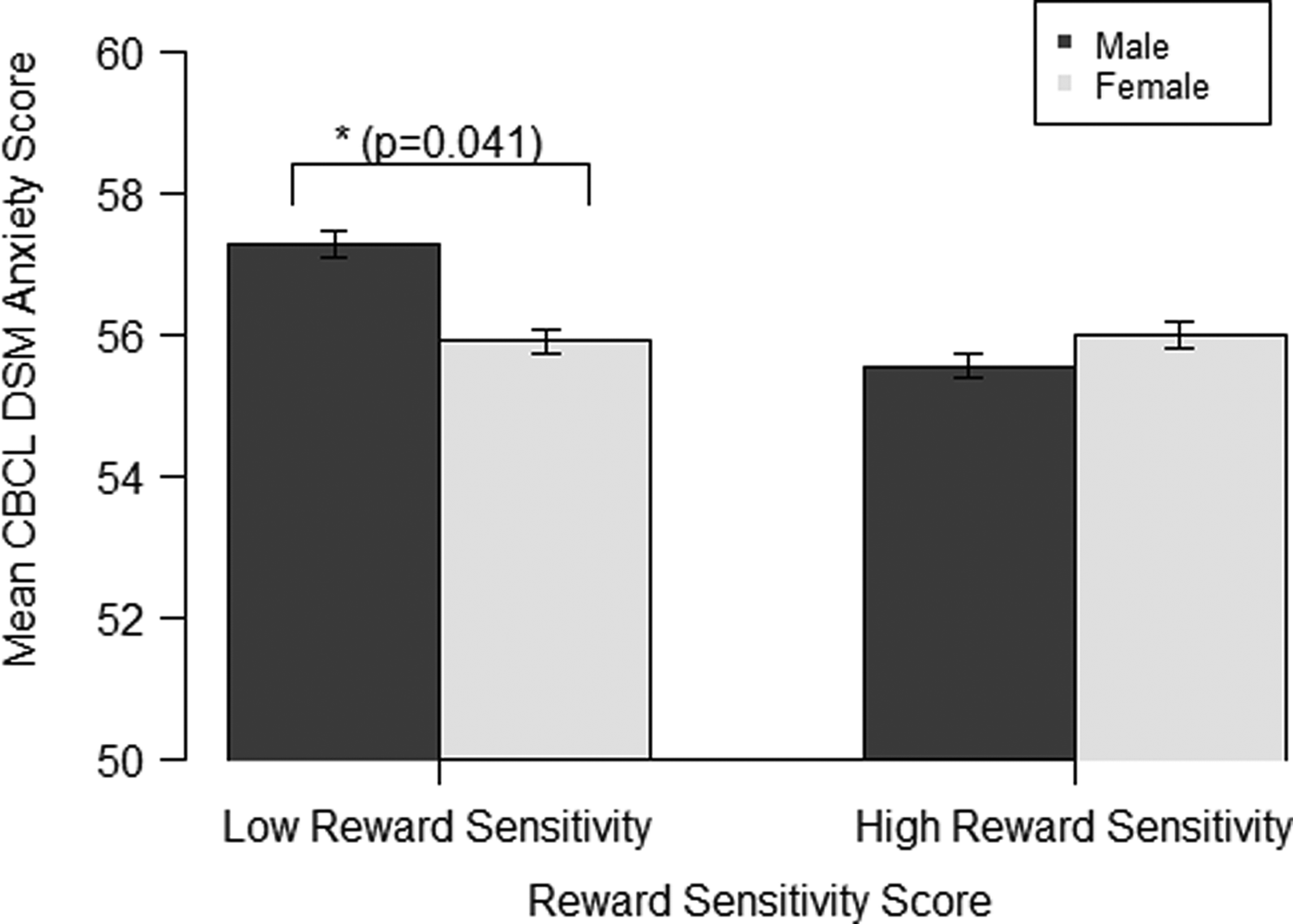
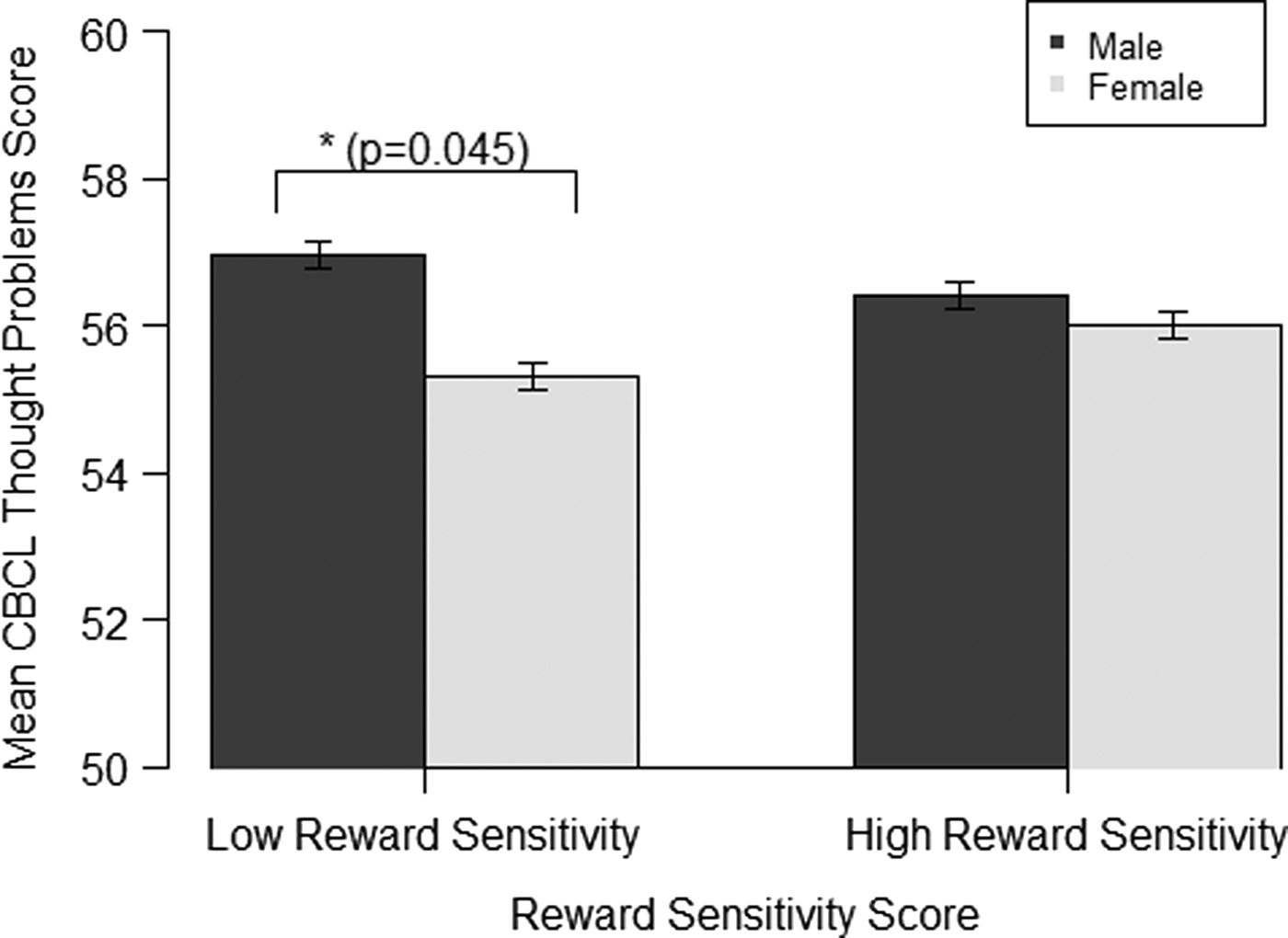
Additional interactions between reward sensitivity and sex were observed in the models predicting DSM-5 anxiety problems. At low reward sensitivity, increased anxiety problems were observed for male subjects relative to female subjects (β = 0.522, p = 0.041) (Fig. 1). Similarly, we found increased thought problems at low reward sensitivity for male subjects in comparison to female subjects (β = 0.438, p = 0.045) (Fig. 2).
Reward sensitivity and sex in CBCL DSM anxiety problems.

Reward sensitivity and sex in CBCL thought problems.

Models predicting adult psychopathology
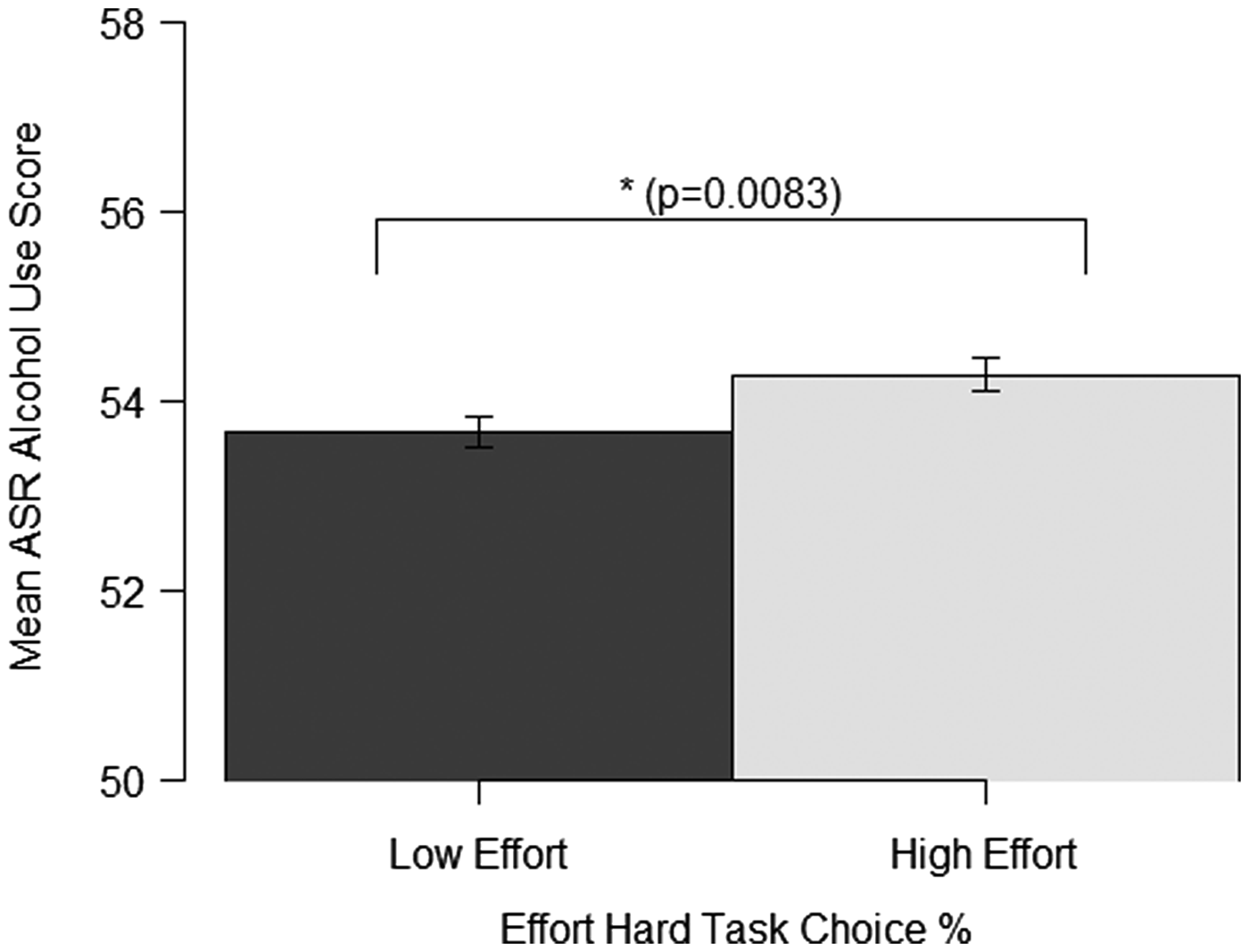
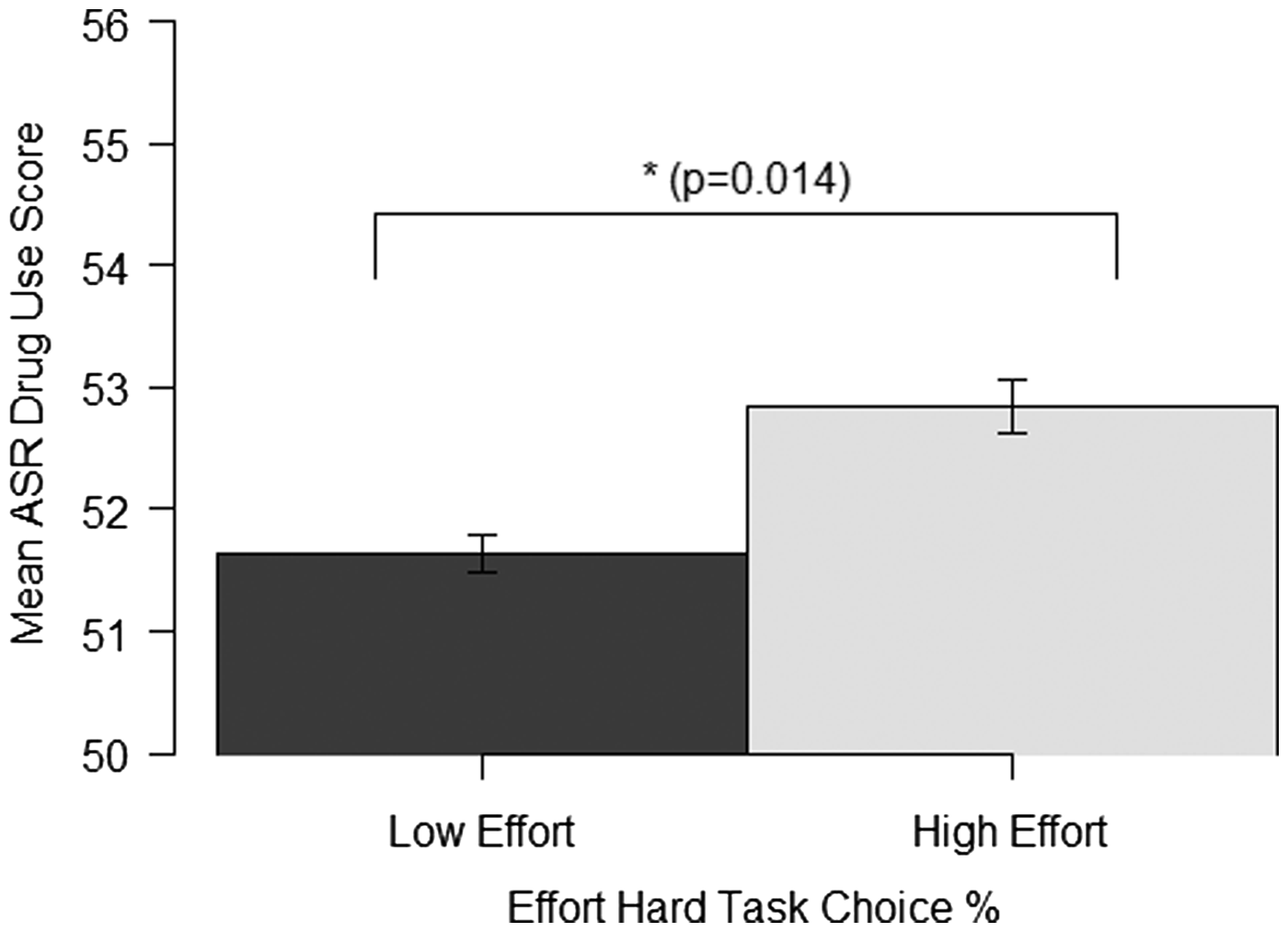
A main effect of effort expenditure was observed in the models predicting ASR alcohol use. At high hard task choice percentage, increased alcohol usage was observed for our subjects (β = 0.531, p = 0.0083) as compared with those with low hard task percentage (Fig. 3). Additionally, a main effect of effort expenditure was observed in the models predicting ASR drug use. At high hard task choice percentage, increased drug usage was observed for our subjects (β = 3.398, p = 0.014) as compared with those with low hard task choice percentage (Fig. 4).
Effort in ASR alcohol use.

Effort in ASR drug use.

Familial transmission
In examining the transmission of effort valuation within families, we found significant sibling–sibling correlations but no significant parent–child correlations. When examining associations of effort valuation between siblings using EEfRT hard task choice percentage, we found a significant positive correlation between both full siblings (r = 0.13, p = 0.039) and half siblings (r = 0.19, p = 0.008). However, in examining associations of effort valuation between these children and their parents using EEfRT hard task choice percentage, we found no significant correlations between children and their respective mothers and fathers (p > 0.05).
Discussion
The current study sought to test hypotheses regarding the relationship between effort valuation and psychopathology in children and adults, and to determine the impact of sex on these relationships. As we hypothesized, effort valuation was a significant predictor of multiple dimensions of psychopathology, some of which were moderated by sex. However, our hypothesis that effort valuation would be linked to the same psychopathologies between adults and children was not supported. Additionally, while we found significant relationships between effort valuation and several areas of psychopathology and functioning that varied by sex, many of our tests of association were negative and correlations between effort valuation and psychopathological outcomes were generally small. Given the large size of our sample, these negative findings cannot be attributed to low statistical power. These results suggest that dysfunction in effort valuation may be a contributing factor rather than a driving force for a range of psychopathology and impairment in children and adults.
Contrary to our hypothesis, effort valuation was associated with different psychopathologies for adults and children. Additionally, while a positive sibling–sibling correlation was found for effort valuation, no significant correlation was found between parents and their children. Given that many psychiatric conditions are transmitted in families, the lack of parent–child correlations for effort valuation presents important questions to consider for future research, especially since there have been no prior familial studies of effort valuation in psychopathology to date. This result may mean that the child and adult assessments for effort valuation do not gauge the same constructs. For example, the parent version of the EEfRT included an additional reward evaluation component (probability of trial actually resulting in reward) in each trial which was not present in the child version. That difference may have impacted adult subjects’ decision-making process. Alternatively, the lack of parent–child correlation could indicate that effort valuation, and its correlates, change as a child moves through the stages of development. At the time of assessment, children were between the ages of 6 and 12 years. Changes in effort valuation have been previously observed in a comparison study between 4- and 6-year old children where the older children displayed greater ability to evaluate effort and reward quality (Benozio and Diesendruck, Reference Benozio and Diesendruck2015).
Previous studies in children have found sex and reward sensitivity to be linked to anxiety disorder, such that clinically anxious male youth displayed both decreased risk taking and sensitivity to reward in comparison to clinically anxious females, as well as typically developing male and female youths (Dorfman et al., Reference Dorfman, Rosen, Pine and Ernst2016). Our results provide further support for the relationship between sex, reward sensitivity, and anxiety disorder, where at low reward sensitivity we found that male children reported greater anxiety problems than female children. It has become increasingly apparent that the study of gender differences in adolescent anxiety is important, given that anxiety disorders often begin to present symptomatically in adolescence. Additionally, a longitudinal study of adolescents demonstrated a greater level of functional impairments among anxious males than anxious females with regards to academic performance, self-esteem, sense of well-being, and socialization with friends (Derdikman-Eiron et al., Reference Derdikman-Eiron, Indredavik, Bakken, Bratberg, Hjemdal and Colton2012). As a result, the gender-specific alterations in the reward system measures observed both here and in previous research suggest that treatments for anxiety that target the reward system may need to be tailored to gender.
While past studies have also found relationships between ASDs and both aberrant effort valuation and diminished reward processing in children (Scott-Van Zeeland et al., Reference Scott-Van Zeeland, Dapretto, Ghahremani, Poldrack and Bookheimer2010; Mosner et al., Reference Mosner, Kinard, McWeeny, Jasmine, Markiewitz, Damiano-Goodwin, Burchinal, Rutherford, Greene, Treadway and Dichter2017), we found that this relationship may differ based on sex. Our results revealed that lesser reward sensitivity was associated with a higher degree of thought problems in male children v. females. Thought problems according to the CBCL scale include seeing or hearing things, repeating acts, and strange ideas/behavior. In children, thought problems have been linked with relatively high sensitivity and specificity to ASD (Mazefsky et al., Reference Mazefsky, Anderson, Conner and Minshew2011). To our knowledge, no previous studies have specifically examined the moderating effects of sex in relating effort expenditure or reward sensitivity with ASD in children. However, with ASD being a predominantly male disorder (Loomes et al., Reference Loomes, Hull and Mandy2017), understanding gender-specific alterations in reward behavior may be important for treatment development.
Limitations/future directions
The current work has several limitations. The use of self-reported race, rather than genetic data, to understand ancestry may have placed greater weight on the social over the biological component of an individual's ancestral background. Participants’ self-reported racial identity may not fully align with their genetic ancestry, instead representing their personal understanding of their ancestral background. For example, Hispanic participants may only identify with their Hispanic ethnicity rather than any racial category. Future research should compare the implications of self-identified ancestry v. genetic ancestry to determine if these differing ways of defining one's heritage diverge in relation to effort valuation and associated psychopathological outcomes.
In the current study, we were unable to examine the impact of racial identities other than White/Caucasian and Black/African-American due to the low number of individuals who identified with other races. Also, our adult sample was disproportionately female, so future studies should seek to recruit a more balanced sample in addition to correcting the under-representation of other racial minorities besides Black/African-American. Few participants displayed elevated symptoms for some of the psychological problems examined in this study, so future research collecting data from more individuals who experience particular psychological problems may reveal new or clearer patterns between effort valuation and specific forms of psychopathology.
With regards to our assessments of psychopathology, we acknowledge that our usage of parent-reports as measures for both child and parent psychopathology is an important limitation as it represents an indirect rather than direct measure of child psychopathology. While the CBCL and ASRs cover a wide range of psychopathological outcomes, further research on effort valuation should be conducted in the context of additional psychopathologies not specifically included in the CBCL or ASR, such as schizophrenia or ASD. Relationships with those two disorders in particular have been established in adults using the EEfRT paradigm (Damiano et al., Reference Damiano, Aloi, Treadway, Bodfish and Dichter2012; Barch et al., Reference Barch, Treadway and Schoen2014; Treadway et al., Reference Treadway, Peterman, Zald and Park2015; McCarthy et al., Reference McCarthy, Treadway, Bennett and Blanchard2016), but studies of children have not been conducted to date.
In addition, future studies should explore the relationship between other Positive Valence System constructs and psychopathology and impairment using a similar approach, to determine if these constructs differentially associate with various forms of psychopathology and functioning. It will be important to consider longitudinal work to investigate the stability of effort valuation over time, especially with regards to children passing through stages of their development. Such work will be key to understanding how effort valuation at various stages of life might be used to predict future psychopathology and functioning in individuals.
Conclusions
The current study establishes effort valuation as a relevant psychological construct for understanding psychopathology and functioning in adults and, especially, in children. Findings from this study both confirm and expand upon the current state of knowledge in the field with regards to examining sex when considering how effort valuation relates to anxiety disorder and ASDs in children, and alcohol and drug use in adults. The associations observed with regards low effort expenditure, low reward sensitivity, and these types of psychopathology indicate that deficits in reward processing behavior may be an important therapeutic target. Furthermore, effort expenditure and reward sensitivity may be potentially modifiable risk factors, and our data demonstrates that the degree to which these risk factors impact pathology might be a key factor in developing targeted treatment strategies, as well as an important consideration in further research to understand the biological mechanisms underlying these behavioral deviations. These results highlight the importance of examining effort valuation as it relates to areas of psychopathology and functioning not previously examined, and provides evidence in favor of longitudinal study of effort valuation to further determine the stability of the construct over time and through developmental stages.
Supplementary material
The supplementary material for this article can be found at https://doi.org/10.1017/S0033291718003884.
Acknowledgements
The authors would like to thank our subjects for their participation in this research study, which was funded by NIH grants and supplements (R01MH101519-01A1 and R01MH101519-01A1S1). The authors also wish to thank Tom Weickert for his helpful and critical discussion.