Introduction
Post-traumatic stress disorder (PTSD) is prevalent, disabling and highly co-morbid with other disorders (Kessler et al. Reference Kessler, Chiu, Demler, Merikangas and Walters2005; Alonso et al. Reference Alonso, Petukhova, Vilagut, Chatterji, Heeringa, Ustun, Alhamzawi, Viana, Angermeyer, Bromet, Bruffaerts, de Girolamo, Florescu, Gureje, Haro, Hinkov, Hu, Karam, Kovess, Levinson, Medina-Mora, Nakamura, Ormel, Posada-Villa, Sagar, Scott, Tsang, Williams and Kessler2010). It is more common among women than men (Seedat et al. Reference Seedat, Scott, Angermeyer, Berglund, Bromet, Brugha, Demyttenaere, de Girolamo, Haro, Jin, Karam, Kovess-Masfety, Levinson, Medina Mora, Ono, Ormel, Pennell, Posada-Villa, Sampson, Williams and Kessler2009) and is most likely to have its onset in early adulthood (Kessler et al. Reference Kessler, Angermeyer, Anthony, de Graaf, Demyttenaere, Gasquet, de Girolamo, Gluzman, Gureje, Haro, Kawakami, Karam, Levinson, Medina Mora, Oakley Browne, Posada-Villa, Stein, Adley Tsang, Aguilar-Gaxiola, Alonso, Lee, Heeringa, Pennell, Berglund, Gruber, Petukhova, Chatterji and Ustun2007). Most people with PTSD either do not receive, or delay seeking, treatment for many years following onset (Wang et al. Reference Wang, Lane, Olfson, Pincus, Wells and Kessler2005). Although there is much evidence concerning the remission of acute PTSD reactions (Bryant, Reference Bryant2003), there are few data pertaining to remission of chronic PTSD in the population. Data from longitudinal follow-up studies suggest that although more than half of people with PTSD eventually remit, many report symptoms for several years (McFarlane, Reference McFarlane2000; Yule et al. Reference Yule, Bolton, Udwin, Boyle, O'Ryan and Nurrish2000; Perkonigg et al. Reference Perkonigg, Pfister, Stein, Hofler, Lieb, Maercker and Wittchen2005; McLaughlin et al. Reference McLaughlin, Conron, Koenen and Gilman2010). Severity of symptoms and co-morbidity with other mental and substance use disorders (McFarlane, Reference McFarlane2000; Zlotnick et al. Reference Zlotnick, Rodriguez, Weisberg, Bruce, Spencer, Culpepper and Keller2004), in addition to the number and type of traumas experienced (Zlotnick et al. Reference Zlotnick, Warshaw, Shea, Allsworth, Pearlstein and Keller1999; Kolassa et al. Reference Kolassa, Ertl, Eckart, Kolassa, Onyut and Elbert2010), are all associated with a more chronic course of PTSD. However, many of the relevant studies are limited by the use of clinical or non-representative community samples and by relatively short follow-up periods.
Large epidemiological surveys are well placed to address these issues because they use representative samples and have the potential to index the onset and offset of symptoms. Nevertheless, only three studies have examined remission from PTSD symptoms over lifetime in representative community surveys and they provide conflicting evidence. Kessler et al. (Reference Kessler, Sonnega, Bromet, Hughes and Nelson1995), using data from the National Comorbidity Survey (NCS), determined that the median time to remission of PTSD was 3 years for respondents who had ever sought treatment for mental disorders and 5 years for those who had not. PTSD failed to remit in more than one-third of respondents. Breslau (Reference Breslau2009) reanalysed data from the regionally representative 1996 Detroit Area Survey of Trauma and found that approximately 26% of PTSD cases remitted by 6 months and 40% by 12 months, with a median time to remission of 2 years. In more than one-third of cases, PTSD persisted for more than 5 years. Time to remission was longer for females and for those who experienced traumas directly. Pietrzak et al. (Reference Pietrzak, Goldstein, Southwick and Grant2011) similarly found, in data from Wave II of the National Epidemiologic Survey on Alcohol and Related Conditions (NESARC), that time to remission was longer for those who had experienced traumas directly. However, the median time to remission of PTSD in the whole sample was 11.2 years, considerably longer than that suggested by earlier estimates. Importantly, both the NCS and the Detroit Area Survey of Trauma were based on samples with upper age limits of 54 and 45 years respectively. It is possible that inclusion of older participants in the NESARC contributed to a more comprehensive picture of PTSD course in the population and the longer time to remission reported in this study. However, estimates of duration and remission in this analysis were based on reports of respondents' only or longest episodes, and Pietrzak et al. (Reference Pietrzak, Goldstein, Southwick and Grant2011) did not model time to PTSD remission over lifetime, making direct comparisons with previous estimates difficult.
To date, no large epidemiological studies have modelled PTSD course over the lifetime beyond age 54 years, or examined in detail the correlates of PTSD remission. The current study sought to extend knowledge in this area by addressing these issues. We used data from the 2007 National Survey of Mental Health and Wellbeing in Australia (NSMHWB; Slade et al. Reference Slade, Johnston, Oakley Browne, Andrews and Whiteford2009), a large representative survey of persons aged 16–85 years to: (1) model the course of remission from PTSD over lifetime and (2) examine in detail the relationship between time to remission from PTSD and trauma experience, co-morbidity, symptom severity and service utilization.
Method
Sample
The 2007 Australian NSMHWB was a nationally representative population survey with a sample size of 8841 (Slade et al. Reference Slade, Johnston, Oakley Browne, Andrews and Whiteford2009). Respondents were selected at random from a stratified, multistage area probability sample of persons aged 16–85 years living in private dwellings and data were weighted according to the inverse probability of being selected. Despite the survey achieving a lower than expected response rate of 60%, an intensive non-response follow-up study determined that mis-estimation at the aggregate level is likely to be small (Slade et al. Reference Slade, Johnston, Oakley Browne, Andrews and Whiteford2009).
Measures
Experience of trauma, PTSD and other DSM-IV disorders were assessed using a modified version of the World Health Organization's World Mental Health Composite International Diagnostic Interview (WMH-CIDI; Kessler & Ustun, Reference Kessler and Ustun2004), a highly structured interview with questions designed to operationalize the diagnostic criteria for each mental disorder. The PTSD module enquired about lifetime exposure to 29 specific potentially traumatic events (PTEs; Mills et al. Reference Mills, McFarlane, Slade, Creamer, Silove, Teesson and Bryant2011). Those who reported at least one PTE were asked whether the experience resulted in ‘problems like upsetting memories or dreams, feeling emotionally distant or depressed, trouble sleeping or concentrating, and feeling jumpy or easily startled’. Those who either answered no to this question, or who reported no lifetime exposure to PTEs, were not administered the remaining PTSD questions. Respondents who endorsed more than one PTE were asked to nominate their worst event and the remaining PTSD module was administered with reference to this event. Trauma experience was categorized in terms of (a) type of trauma: interpersonal or assaultive violence (combat experience, serious physical or sexual abuse, rape or other sexual or physical assault) or other shock or injury (natural disaster, life-threatening accident or illness, witnessing violence, injury or death) versus indirect trauma (person close dying unexpectedly or experiencing trauma) (Breslau, Reference Breslau2009; Breslau et al. Reference Breslau, Kessler, Chilcoat, Schultz, Davis and Andreski1998), (b) age at trauma (childhood trauma: before age 16 versus trauma in adulthood) and (c) number of traumatic event types (single versus multiple). Trauma age and type were examined with reference to respondents' only or worst trauma. Calculation of multiple trauma types included any trauma that occurred over the respondents' lifetime.
The survey assessed the presence and age of onset of 12 other DSM-IV mental disorders. For the analysis of remission, co-morbidity with PTSD was treated as a time-dependent variable. That is, if respondents met criteria for PTSD and another disorder, the age of onset for both disorders was examined to determine whether PTSD was temporally primary to, simultaneous with (same year), or temporally secondary to that of the co-morbid disorder. Because the analysis was limited to disorder groups, the earliest disorder onset for each group was used and diagnostic hierarchy rules were not applied. For each cluster of PTSD symptoms (re-experiencing, avoidance, hypervigilance), respondents were asked about the amount of distress (none, mild, moderate, severe, very severe) and disruption to normal life (not at all, a little, some, a lot or extremely) that each set of symptoms caused at the time when they were the ‘most frequent and intense’. Respondents were also asked whether they had ever sought help for PTSD symptoms with any health professional, and if so, the age at which they first sought help.
Assessment of remission from PTSD
Respondents were asked about the age at which they first experienced symptoms of re-experiencing, avoidance or hypervigilance, and for how long each of these symptom clusters persisted. The longest of these three durations was added to the PTSD onset age to obtain the age at which they most recently experienced PTSD symptoms, referred to here as their most recent episode. Respondents were classed as remitted if their most recent episode was more than 12 months before their interview.
Analysis
Complex sampling procedures in SAS version 9.2 (SAS Institute Inc., USA) and SUDAAN Release 10 (Research Triangle Institute, USA) were used for this analysis. Prevalence estimates were weighted to conform to independent population estimates and standard errors obtained through the delete-a-group jack-knife variance technique. Gender comparisons were examined using adjusted Wald χ2 statistics, and odds ratios (ORs) for co-morbid disorders were obtained using logistic regression. Estimates of projected lifetime risk, age at selected age-of-onset percentiles and median times to remission were obtained using Kaplan–Meier survival estimates. Univariable and multivariable correlates of time to PTSD remission were obtained using continuous time Cox proportional hazards regression (Hosmer & Lemeshow, Reference Hosmer and Lemeshow1999). Individual contributions of variables were assessed using adjusted Wald F statistics and estimates of likelihood of remission over lifetime are presented as hazard ratios (HRs) with 95% confidence intervals (CIs). Tied survival times were handled using the Efron approximation of the partial risk and all variables were screened for proportionality of hazards and outliers (Grambsch & Therneau, Reference Grambsch and Therneau1994).
Results
Prevalence and severity
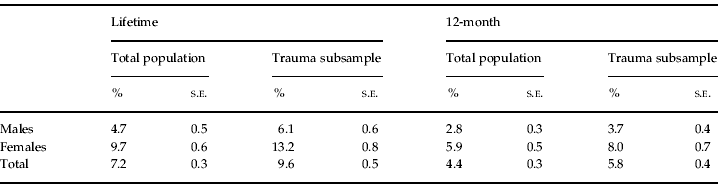
Three-quarters of the population (74.9%, s.e.=0.7) had experienced at least one potentially traumatic event over their lifetime (Mills et al. Reference Mills, McFarlane, Slade, Creamer, Silove, Teesson and Bryant2011). Lifetime PTSD prevalence was 7.2% (s.e.=0.3) for the whole population, or 9.6% (s.e.=0.5) as a proportion of those who had experienced at least one PTE (Table 1). The odds of lifetime PTSD were higher among women than men in the whole population (OR 2.2, 95% CI 1.7–2.9) and among those who had experienced a trauma (OR 2.3, 95% CI 1.8–3.0). The highest ratings of severity were reported for symptoms of avoidance, where 73.2% (s.e.=4.5) of males and 72.4% (s.e.=2.6) of females with lifetime PTSD reported severe or very severe avoidance. There were no differences between males and females in terms of severity for any of the three PTSD symptom clusters or for overall severity (p=0.22–0.98). Nearly 80% of both males (79.5%, s.e.=4.1) and females (79.3%, s.e.=2.7) reported severe distress or disruption caused by PTSD symptoms.
Lifetime and 12-month prevalence of DSM-IV post-traumatic stress disorder (PTSD)

s.e., Standard error.
Co-morbidity
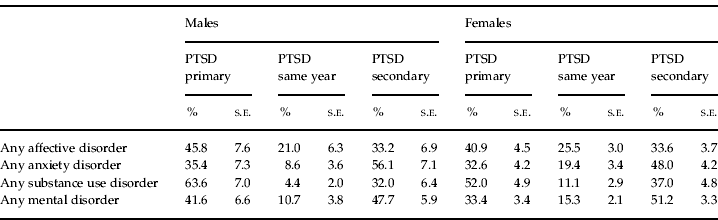
As expected, PTSD was highly co-morbid with other mental and substance use disorders, with 86.4% (s.e.=2.3) of males and 76.6% (s.e.=3.3) of females meeting criteria for another lifetime mental disorder. Among males with PTSD, the prevalence of anxiety, affective and substance use disorders was 51.7% (s.e.=5.9), 50.4% (s.e.=5.6) and 64.8% (s.e.=4.9) respectively. Among females the equivalent figures were 54.2% (s.e.=3.7), 50.7% (s.e.=3.1) and 32.2% (s.e.=2.9). PTSD was temporally secondary for 47.7% (s.e.=5.9) of co-morbid mental disorders among males and 51.2% (s.e.=3.3) among females (Table 2). PTSD was the temporally primary disorder for 41.6% (s.e.=6.6) of co-morbid disorders for males and 33.4% (s.e.=3.4) for females, the most common domain being substance use disorders (where 63.6% of co-morbid substance use disorders among males and 52.0% among females followed the onset of PTSD). There were no significant differences between males and females in the temporal sequencing of co-morbid disorders (p=0.10–0.78).
Co-morbid disorders among those with lifetime post-traumatic stress disorder (PTSD) (n=664)

s.e., Standard error.
Age of onset and projected lifetime risk
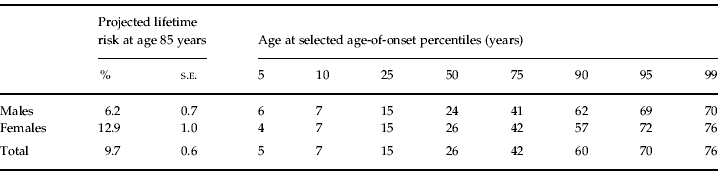
The median age of onset of PTSD was 26 years, with 25% of people reporting onset by age 15 and 75% by age 42 (Table 3). Projected lifetime risk (the estimated proportion who will have the disorder by the end of their lifetime) at 85 years was 9.7% (s.e.=0.6), 1.3 times higher than the lifetime prevalence (the proportion who had the disorder at some time in their life up to the age at interview) and was significantly greater for females compared with males (HR 2.1, 95% CI 1.6–2.8, p<0.001).
Projected lifetime risk of DSM-IV post-traumatic stress disorder (PTSD) and age at selected age-of-onset percentiles

s.e., Standard error.
Time to PTSD remission
The median time to PTSD remission was 14 years (Fig. 1). It was estimated that 14.9% (s.e.=1.7) of people will have remitted within 1 year of symptom onset, 26.6% (s.e.=2.4) within 2 years and more than one-third (37.9%, s.e.=2.8) within 5 years. More than a third (36.6% s.e.=3.0) will continue to have symptoms 30 years after onset. The projected lifetime remission rate was 91.9% (95% CI 66.9–99.7), suggesting that almost all cases could be expected to eventually remit. Survival curves for remission did not differ according to sex or age cohort (p=0.33 and 0.68 respectively).
Survival curve indicating years after onset until remission from post-traumatic stress disorder (PTSD) in the population.

Multivariable correlates of PTSD remission
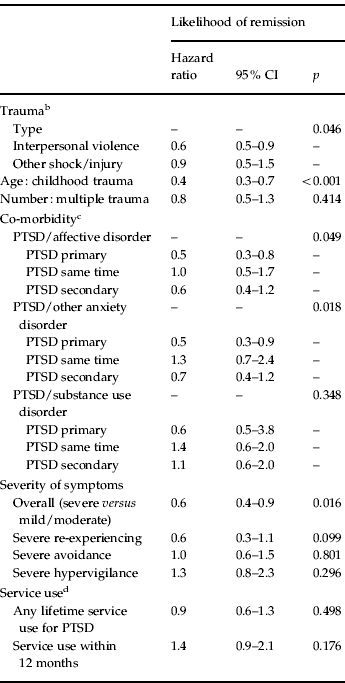
Almost half the sample reported interpersonal violence (46.3%, s.e.=3.2) as their only or worst trauma, 19.2% (s.e.=2.0) other injury or shock and just over a third (39.2%, s.e.=2.8) reported that their worst trauma had occurred in childhood. Five variables remained significant in a simultaneous multivariable model adjusted for sex and age cohort (Table 4): trauma involving interpersonal violence (HR 0.6, 95% CI 0.5–0.9), childhood trauma (HR 0.4, 95% CI 0.3–0.7), temporally secondary affective (HR 0.5, 95% CI 0.3–0.8) and anxiety disorders (HR 0.5, 95% CI 0.3–0.9) and severe PTSD symptoms (HR 0.6, 95% CI 0.4–0.9) were all associated with a decreased likelihood of, and longer time to, remission from PTSD when the effects of other variables were controlled. Co-morbid disorders before the onset of PTSD or at around the same time did not affect time to remission over lifetime. Although development of secondary substance use disorders was related to longer time to remission in univariable models, it did not remain significant in the final model.
Likelihood of remission from post-traumatic stress disorder (PTSD) over lifetime – simultaneous multivariable model adjusted for sex and age of cohortFootnote a

CI, Confidence interval.
a The final model was also tested adjusting for age of onset and effects remained unchanged.
b Reference groups for trauma variables were indirect trauma, adult trauma and single trauma respectively.
c Co-morbid disorder groups were replaced in a full model with a variable modelling any mental disorder co-morbidity but this variable was not significant (p=0.090). Co-morbid disorder groups were compared to those with PTSD only, that is PTSD and not the disorder group of interest. For analysis of temporal ordering, people who reported onset of a co-morbid disorder after remission from PTSD were excluded.
d Because of more missing data on this variable, a separate simultaneous model that included service use was used to obtain hazard ratios (HRs) and associated CIs for this variable.
Service use for PTSD within 12 months of symptom onset was also significant in univariable models only. Detailed modelling indicated that its effect on PTSD remission was mediated by its relationship with trauma experience. Those who experienced interpersonal violence were less likely to report service use within 12 months of onset compared to those who had experienced indirect trauma (18.7% v. 34.6%, Wald χ2=9.1, p=0.010). Similarly, those who had experienced trauma in childhood were less likely to use services within 12 months compared to those experiencing trauma in adulthood (8.2% v. 38.4%, Wald χ2=43.5, p<0.0001). Once these variables were added to the model of PTSD remission, the relationship between service utilization and time to remission was no longer significant.
Discussion
To our knowledge, this study represents the first detailed examination of the correlates of PTSD remission over the lifetime in a general population sample. As expected, PTSD was found to be common, disabling and highly co-morbid with other mental disorders. The median age of onset of 26 years was similar for males and females, and although it was estimated that most people with PTSD will eventually remit, at least half are likely to have symptoms 14 years after onset, and more than a third will still experience symptoms 30 years later. Those who experience interpersonal violence or childhood trauma, those with a temporally secondary anxiety or affective disorder and those with more severe PTSD symptoms are less likely to remit at any point over their lifetime and are estimated to have a longer median time to remission compared to those with other trauma experiences, no co-morbid disorders or less severe PTSD symptoms.
Estimates of the lifetime prevalence of PTSD and associated co-morbidity in this sample are consistent with those from other countries using similar assessments (Seedat et al. Reference Seedat, Scott, Angermeyer, Berglund, Bromet, Brugha, Demyttenaere, de Girolamo, Haro, Jin, Karam, Kovess-Masfety, Levinson, Medina Mora, Ono, Ormel, Pennell, Posada-Villa, Sampson, Williams and Kessler2009; Byers et al. Reference Byers, Yaffe, Covinsky, Friedman and Bruce2010), and with previous estimates in Australia (Creamer et al. Reference Creamer, Burgess and McFarlane2001). The finding that PTSD is associated with significant distress and impairment and has its onset in early adulthood is also consistent with previous reports (Kessler et al. Reference Kessler, Angermeyer, Anthony, de Graaf, Demyttenaere, Gasquet, de Girolamo, Gluzman, Gureje, Haro, Kawakami, Karam, Levinson, Medina Mora, Oakley Browne, Posada-Villa, Stein, Adley Tsang, Aguilar-Gaxiola, Alonso, Lee, Heeringa, Pennell, Berglund, Gruber, Petukhova, Chatterji and Ustun2007). However, one of the more striking findings of the present study relates to lifetime ‘risk’ of, and median time to, remission. We determined that almost all (92%) of those with PTSD could eventually be expected to remit, compared with around half to two-thirds in previous community samples in the USA (Kessler et al. Reference Kessler, Sonnega, Bromet, Hughes and Nelson1995; Breslau, Reference Breslau2009). The median time to remission in the current sample is considerably longer than that suggested by these earlier studies (2 and 5 years), but is more consistent with the recent estimate of 11.2 years provided by the NESARC (Pietrzak et al. Reference Pietrzak, Goldstein, Southwick and Grant2011). It is possible that the inclusion of older participants in this study and in the NESARC provides a more comprehensive picture of PTSD over the life course, and this contributed to a longer remission time (Averill & Beck, Reference Averill and Beck2000; Busuttil, Reference Busuttil2004). The current findings extend and support those reported by Pietzrak et al. (Reference Pietrzak, Goldstein, Southwick and Grant2011), which suggest that the course of PTSD in the community may be more chronic than previously thought.
Within this context, the findings regarding correlates of time to remission are informative. Trauma experience was one of the strongest correlates of remission from PTSD. Those who had experienced childhood trauma and those who experienced interpersonal violence were less likely to remit and were estimated to have a longer time to remission than those with other trauma experiences. Limited available data suggest that experience of direct as opposed to indirect trauma is associated with a more chronic course of illness (Breslau, Reference Breslau2009; Pietrzak et al. Reference Pietrzak, Goldstein, Southwick and Grant2011). The current study extends these findings to demonstrate that interpersonal or assaultive violence is specific in its tendency to lead to a longer time to remission over lifetime. Similarly, childhood adversity and trauma have been found to lead to greater vulnerability to further trauma, to the onset and development of other disorders throughout the life course (Breslau et al. Reference Breslau, Chilcoat, Kessler and Davis1999; Jonas et al. Reference Jonas, Bebbington, McManus, Meltzer, Jenkins, Kuipers, Cooper, King and Brugha2011; McLaughlin et al. Reference McLaughlin, Berglund, Gruber, Kessler, Sampson and Zaslavsky2011) and to more complex and difficult to treat forms of PTSD (Bryant, Reference Bryant2010). This study is the first to demonstrate a relationship between childhood trauma and time to remission from PTSD in a general population sample. Given that those who experienced childhood or interpersonal trauma were also less likely to use services for PTSD within 12 months of symptom onset, we would argue that these groups represent priorities for prevention of chronic PTSD (Silverman et al. Reference Silverman, Pina and Viswesvaran2008; Rolfsnes & Idsoe, Reference Rolfsnes and Idsoe2011).
Development of a secondary anxiety or affective disorder was also significantly associated with a decreased likelihood of remission from PTSD over lifetime and a longer time to remission. Temporally primary disorders, however, and those that developed at around the same time as PTSD were not. Co-morbid affective and anxiety disorders have been associated with a more chronic course of PTSD (McFarlane, Reference McFarlane2000; Zlotnick et al. Reference Zlotnick, Rodriguez, Weisberg, Bruce, Spencer, Culpepper and Keller2004) and, notably, Perkonigg et al. (Reference Perkonigg, Pfister, Stein, Hofler, Lieb, Maercker and Wittchen2005) also found that incident disorders during the follow-up period were associated with longer time to remission than baseline co-morbid disorders. What is unclear, however, is whether the development of subsequent co-morbidity perpetuates the symptoms of PTSD or whether a more chronic course of PTSD over the long term places individuals at higher risk of developing a co-morbid affective or anxiety disorder. There is significant evidence from other sources suggesting a shared underlying vulnerability to disorder that emerges in the transition phase following the acute stress response to a trauma (McFarlane, Reference McFarlane2000). It has been suggested that vulnerable individuals, once exposed to trauma, are more likely to develop both PTSD and a subsequent co-morbid disorder (Breslau et al. Reference Breslau, Davis, Peterson and Schultz2000, Reference Breslau, Peterson and Schultz2008; Marshall et al. Reference Marshall, Miles and Stewart2010). Within this context, it may be that chronic PTSD places individuals at higher risk of developing subsequent co-morbid disorders, which in turn perpetuate the symptoms of PTSD. Whatever the mechanisms, it is clear from a clinical perspective that interventions aimed at treating those with chronic PTSD need to consider active treatment of co-morbid symptoms of anxiety and affective disorders (Bryant et al. Reference Bryant, O'Donnell, Creamer, McFarlane, Clark and Silove2010; Marshall et al. Reference Marshall, Miles and Stewart2010).
A relationship between development of secondary substance use and remission from PTSD was indicated in early univariable models but did not remain once the effects of other variables were controlled. One possibility for this is that at least some of this group are using substances to self-medicate their PTSD symptoms (Mills, Reference Mills2009; Hien et al. Reference Hien, Jiang, Campbell, Hu, Miele, Cohen, Brigham, Capstick, Kulaga, Robinson, Suarez-Morales and Nunes2010). PTSD may seem to have ‘artificially’ remitted for those with secondary substance use disorders if the substances are acting to dampen the PTSD symptoms. Alternatively, the effect of substance use on the perpetuation of PTSD symptoms may be mediated by an independent relationship with childhood trauma (Khoury et al. Reference Khoury, Tang, Bradley, Cubells and Ressler2010) or co-occurring anxiety or affective disorders. Observations from both clinical and other community studies indicate that the relationship between substance use and course of PTSD is likely to be complex (Mills, Reference Mills2009; Hien et al. Reference Hien, Jiang, Campbell, Hu, Miele, Cohen, Brigham, Capstick, Kulaga, Robinson, Suarez-Morales and Nunes2010). Prospective longitudinal studies that carefully assess these symptoms over time are well suited to future investigation of this relationship.
The present findings need to be considered alongside several limitations. Although large cross-sectional studies have the advantage of representative samples and long retrospective periods to assess course of a disorder, they are limited in several ways. First, retrospective reporting is subject to inaccuracy of recall, and although the NSMHWB used methods similar to those used in the WMH Surveys to improve this (Kessler et al. Reference Kessler, Angermeyer, Anthony, de Graaf, Demyttenaere, Gasquet, de Girolamo, Gluzman, Gureje, Haro, Kawakami, Karam, Levinson, Medina Mora, Oakley Browne, Posada-Villa, Stein, Adley Tsang, Aguilar-Gaxiola, Alonso, Lee, Heeringa, Pennell, Berglund, Gruber, Petukhova, Chatterji and Ustun2007), dating of events from retrospective studies is not equivalent to those from prospective studies (McFarlane, Reference McFarlane2000). Moreover, apart from mood-related and retrospective bias, it is possible that, in the current study, cognitive decline could influence memory for onset and offset of symptoms reported by the elderly respondents. Second, a cross-sectional study does not readily allow for accurate recording of the fluctuating or episodic nature of disorder. The analysis did not examine delayed-onset PTSD (Smid et al. Reference Smid, Mooren, van der Mast, Gersons and Kleber2009), nor did it examine the persistence of symptoms in terms of the amount of time respondents spent ‘in episode’ over their lifetime. It was not possible, for example, to record how many respondents experienced short periods of remission, followed by recurrence of symptoms over their lifetime. Third, given that the presence of only one of the three PTSD symptom clusters was required for non-remission, it is likely that some of the unremitted cases in this analysis would be described clinically as subthreshold PTSD cases. Although, in the NESARC, partial PTSD was associated with significant co-morbidity and dysfunction in addition to a chronic course (Pietrzak et al. Reference Pietrzak, Goldstein, Southwick and Grant2011), it needs to be conceded that the extent to which this group influenced estimates of chronicity in the present study is not known. Fourth, symptoms of PTSD, trauma type and age at trauma were all assessed in relation to respondents' only or worst event rather than for the full range of traumas experienced. Although this is consistent with previous research, it is possible that some of the ongoing PTSD symptoms could be explained by a trauma not nominated as the respondent's worst event. Similarly, it is likely that trauma experience after the onset of PTSD will influence chronicity (Perkonigg et al. Reference Perkonigg, Pfister, Stein, Hofler, Lieb, Maercker and Wittchen2005) and this was not examined in the present study.
These limitations notwithstanding, the study extends current knowledge about the course of PTSD in the population in several ways. First, this is the first study to use epidemiological data to model remission from PTSD over lifetime to 85 years. It indicates that although remission rates may be higher than previously thought, median time to remission may be substantially longer. Second, the findings indicate that trauma experience is an important marker for remission. Those who experience interpersonal violence or childhood trauma are less likely to remit at any point over their lifetime compared to those with other trauma experiences. They are also less likely to seek treatment within 12 months of symptom onset and we would argue that these groups represent a priority for prevention of chronic PTSD. Third, the findings with regard to co-morbidity suggest that chronic PTSD is likely to be associated with development of both affective and anxiety disorders, highlighting the importance of treatment of co-morbid disorders in individuals with chronic PTSD.
Acknowledgements
The 2007 NSMHWB was funded by the Australian Government Department of Health and Ageing, and conducted by the Australian Bureau of Statistics. We thank the NSMHWB Reference Group for their input in the survey's design, and also all those who participated in the survey. Funding for the study reported here came from National Health and Medical Research Centre Project Grant No. 630414.
Declaration of Interest
None.