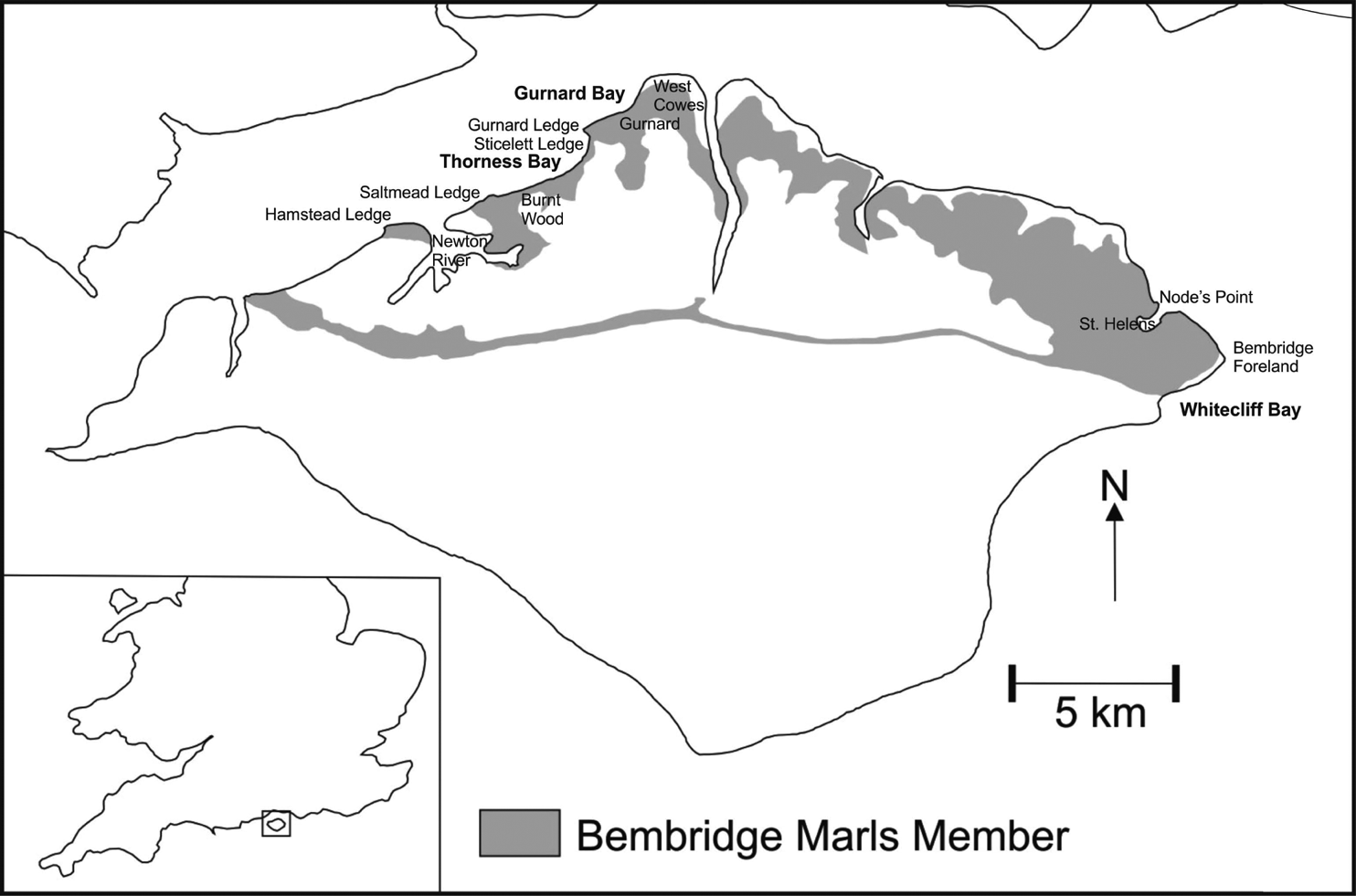


The Insect Limestone of the Isle of Wight, UK, is remarkable for the exquisite preservation of insects and spiders, which makes it a Konservat-Lagerstätten. These arthropods are by their nature fragile organisms which, due to their terrestrial habitat, are only preserved as fossils in exceptional circumstances. The Insect Limestone is a very fine-grained limestone that has enabled the preservation of delicate structures in three dimensions on a micron scale. The exceptional three-dimensional preservation has led to this limestone being called ‘opaque amber’. It lies within a unit known as the Insect Bed, near the base of the Bembridge Marls Member and outcrops on the north side of the island (Fig. 1). The Bembridge Marls were deposited in fresh-brackish water lakes and lagoons (Daley Reference Daley1973, Reference Daley1999). For a summary of the geology of the Isle of Wight see Hopson (Reference Hopson2011).
Map of the Isle of Wight showing the outcrop of the Bembridge Marls Member and localities.

Repositories of Insect Limestone collections. The Natural History Museum, London (NHMUK) houses the most important historical collection of Insect Limestone material, consisting of about 4000 pieces of rock with fossil arthropods and plants (many have more than one insect preserved). It houses the Edwin A'Court Smith Collection, purchased in 1877 and 1883, the Rev. Peter B. Brodie Collection, purchased in 1898, and the Reginald W. Hooley Collection, purchased in 1924. Brodie was given (and exchanged) specimens by Smith (see Brodie Reference Brodie1878) and Hooley purchased the remainder of Smith's collection at auction after his death in 1900 (Reid & Chandler Reference Reid and Chandler1926; Crane & Getty Reference Crane and Getty1975; Jackson in Motkin Reference Motkin1991). Thus, parts and counterparts of individual insects have turned up in all three collections and have different numbers, because they were registered at different times. They are labelled ‘Gurnard Bay' or ‘Gurnet Bay' (which is an old name for Gurnard Bay), although Smith collected specimens all the way from West Cowes to Newtown River on the northwest side of the Isle of Wight (Jarzembowski Reference Jarzembowski1980). Most of the specimens probably came from Thorness Bay (see Jarzembowski Reference Jarzembowski1976).
Other historical material consists of the main part of the Colenutt Collection housed by the Museum of Isle of Wight Geology (MIWG) and the Isle of Wight County Museum Service (IWCMS), and the Lacoe Collection at the National Museum of Natural History, Smithsonian Institution, Washington. Since the 1970s, additional specimens have been collected by Professor Ed. A. Jarzembowski, Mr Tony Mitchell, AJR and local collectors. This additional material is deposited in the Maidstone Museum & Bentlif Art Gallery, the Booth Museum of Natural History (Brighton), NHMUK, MIWG, and the University of Portsmouth. The material collected by Mitchell is unbiased, as all fragments were kept. A prolific local collector, Andy Yule, donated specimens to the NHMUK and recently deposited the remainder of his collection at MIWG.
In 2005, AJR discovered an unregistered collection of 177 Insect Limestone specimens at the Sedgwick Museum, Cambridge. This collection contains counterparts of insect specimens at the NHM (including types), which indicates that this is another part of the Smith collection that was referred to by Crane & Getty (Reference Crane and Getty1975). A label with ‘1883' written on it suggests that the Sedgwick Museum acquired this collection in 1883, the same year in which the NHM purchased a collection from Smith.
There are also parts of the Colenutt Collection in the Oxford University Museum of Natural History, mentioned by Poulton in Marshall & Staley (Reference Marshall and Staley1931) and Davis (Reference Davis1945), and in the Winchester City Museum, mentioned by Crane & Getty (Reference Crane and Getty1975). These were only found out about late on in the course of the project and have not been studied.
1. History of the study of the terrestrial fossil arthropods from the Insect Limestone
Joseph Edwin Smith, also known as Edwin A'Court Smith, was the first person to discover and publish on the insects of the Insect Limestone (Smith Reference Smith1874). In this short note, he recorded the “finding of a bed of insects- flies, gnats, and the larva and pupa of the latter, the larva in count-less thousands – also the wings, in great numbers, of a variety of flies, butterflies, and one or two grasshoppers; also a wing resembling that of a Mole Cricket. There are likewise, two or three beetles.” Smith also refers to the presence of gastropods and two feathers. More information about Smith can be found in Reid & Chandler (Reference Reid and Chandler1926), Crane & Getty (Reference Crane and Getty1975) and Motkin (Reference Motkin1991); the latter includes a photo of Smith and his family taken in about 1880.
Smith's discovery was discussed in more detail by Brodie (Reference Brodie1878), who indicated that Smith had been collecting for 20 years. Several orders, families and genera of insects were recorded by Brodie (Reference Brodie1878) and by Frederick Smith in Woodward (Reference Woodward1878, Reference Woodward1879). By today's classification, these are included within the following 11 orders: Coleoptera, Diptera, Hemiptera, Hymenoptera, Isoptera, Lepidoptera, Neuroptera, Odonata, Orthoptera, Plecoptera and Trichoptera. They also record the presence of spiders for the first time.
Species of aquatic Crustacea (Branchiopoda, Isopoda and Ostracoda) were named by Woodward (Reference Woodward1878, Reference Woodward1879) and Sherborn & Jones (Reference Sherborn and Jones1889). The first terrestrial arthropod to be named from the Insect Limestone was the spider Eoatypus woodwardii McCook (Reference McCook1888a, Reference McCookb). The spiders have received little attention until Selden (Reference Selden2001) re-described this species and described an additional species.
The first insect to be named was the butterfly (Lepidoptera) Lithopsyche antiqua Butler, Reference Butler1889, although it was originally described as a moth. Brodie (Reference Brodie1894) provided an updated list of orders, families and genera, including the first mention of an earwig (Dermaptera) and a myriapod. The latter record has not been confirmed from the recent study of the collections, so is probably a misidentification.
It wasn't until nearly 20 years later that a detailed study of the material was commenced, resulting in 157 species being named in 14 orders (Coleoptera, Diptera, Hemiptera, Hymenoptera, Isoptera, Lepidoptera, Mecoptera, Neuroptera, Odonata, Orthoptera, Plecoptera, Psocoptera, Thysanoptera and Trichoptera), in a proliferation of papers published over a period of 15 years by Cockerell (Reference Cockerell1915, Reference Cockerell1917, Reference Cockerell1921a, Reference Cockerellb, Reference Cockerellc, Reference Cockerell1922a, Reference Cockerellb, Reference Cockerellc, Reference Cockerell1926, Reference Cockerell1927), Donisthorpe (Reference Donisthorpe1920), Cockerell & Andrews (Reference Cockerell and Andrews1916), Cockerell & Haines (Reference Cockerell and Haines1921), Edwards (Reference Edwards1923), Kennedy (Reference Kennedy1925) and Rosen (Reference Rosen1913). Theodore Dru Addison Cockerell was a very prolific entomologist who wrote nearly 4,000 papers on Recent and fossil insects (Rasnitsyn & Quicke Reference Rasnitsyn and Quicke2002). Details of his life were published by Weber (Reference Weber2000). Cockerell's first paper on insects of the Insect Limestone was based on those in the Lacoe Collection in the United States National Museum, i.e. Smithsonian Institution, Washington (Cockerell Reference Cockerell1915), rather than the much larger Natural History Museum (London) collection.
Over the next 50 years, although several papers discussed previously described species, only a few new species were named: four species of grasshoppers and crickets (Orthoptera) by Zeuner (Reference Zeuner1937) and a beetle by Crowson (Reference Crowson1962).
Jarzembowski (Reference Jarzembowski1976) listed additional families collected in 1975. He went on to undertake a thorough study of some of the rarer orders (Isoptera, Lepidoptera, Mecoptera, Neuroptera and Plecoptera), re-describing previously named types, figuring additional material and naming seven new species (Jarzembowski Reference Jarzembowski1980). He first recorded the presence of insects in the Insect Limestone on the east side of the island (Jarzembowski Reference Jarzembowski1976, Reference Jarzembowski1980, Jarzembowski & Palmer Reference Jarzembowski, Palmer, Jarzembowski, Siveter, Palmer and Selden2010), and he first discovered insects at Hamstead Ledge in 2005.
Since 1980, previously described species have been discussed in various papers and new species of jumping plant lice (Hemiptera: Psylloidea) were named by Klimaszewski, in Klimaszewski & Popov (Reference Klimaszewski and Popov1993), based on material in the Booth Museum of Natural History. Nel & Jarzembowski (Reference Nel and Jarzembowski1999) reviewed and re-described damselflies and dragonflies (Odonata), figuring some new specimens, but they did not name any new species.
McCobb et al. (Reference McCobb, Duncan, Jarzembowski, Stankiewicz, Wills and Briggs1998) studied the unbiased Maidstone Museum collection and found that the most abundant insect order is the Hymenoptera (wasps and ants, 45%); of these the most abundant family is the Formicidae (ants). The next most abundant order is the Diptera (flies, 25%), followed by the Coleoptera (beetles, 13%) and Hemiptera (bugs, 9%). Eight other orders make up the final 8%. This contrasts with the biased NHM collection, where the dominant order is Diptera (36%), then Hymenoptera (30%), Coleoptera (17.5%) and Hemiptera (6%), with 13 other orders making up the last 10.5% (three of these orders are only known from single specimens) (AJR, this study).
McCobb et al. (Reference McCobb, Duncan, Jarzembowski, Stankiewicz, Wills and Briggs1998) studied the taphonomy of the insects, based on the Maidstone Museum collection. The remains are dominated by wings and elytra; however, complete insects are also found in three dimensions. They often have original colouration preserved. McCobb et al. (Reference McCobb, Duncan, Jarzembowski, Stankiewicz, Wills and Briggs1998) found that the cuticle, although altered, preserves original structures (including hairs and pores) on the micron-scale. Some internal tissue remains (such as muscle) are also preserved; however, these have been replaced by calcite and most of their details are lost. Some cavities within the insects are completely filled with crystalline calcite. The undistorted three-dimensional nature of many of the insects suggests that the limestone lithified very quickly.
Using cluster analysis to compare the Insect Limestone fauna with modern insect faunas collected from different habitats by various techniques, McCobb et al. (Reference McCobb, Duncan, Jarzembowski, Stankiewicz, Wills and Briggs1998) concluded that the insect fauna indicated a primary sub-tropical/tropical forest subject to significant rainfall and is most similar to that collected using emergence and pitfall traps. It also compared closely with that of Dominican amber. However this study does not take into account that some elements of the Insect Limestone fauna do not live in that environment today and that some are better fliers than others. The study of the insects for the INTAS project indicates that there were several different environments in close proximity. Specific data on particular groups can be found in subsequent papers in this volume, and other groups are still being studied, so it would be premature to provide a detailed discussion on the palaeoenvironment until these studies are complete.
With regard to the other fossils from the Insect Limestone, an account of the molluscs is given by Munt (Reference Munt2014 – this volume) and the plants by Hayes & Collinson (Reference Hayes and Collinson2014 – this volume). Study of the Crustacea and vertebrates is underway.
2. The Geology of the Insect Bed
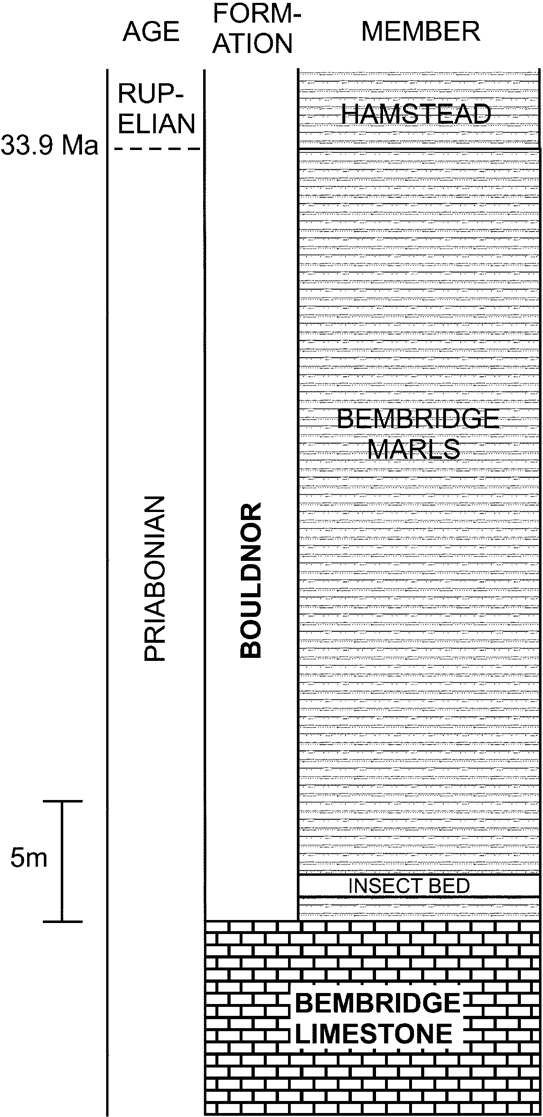
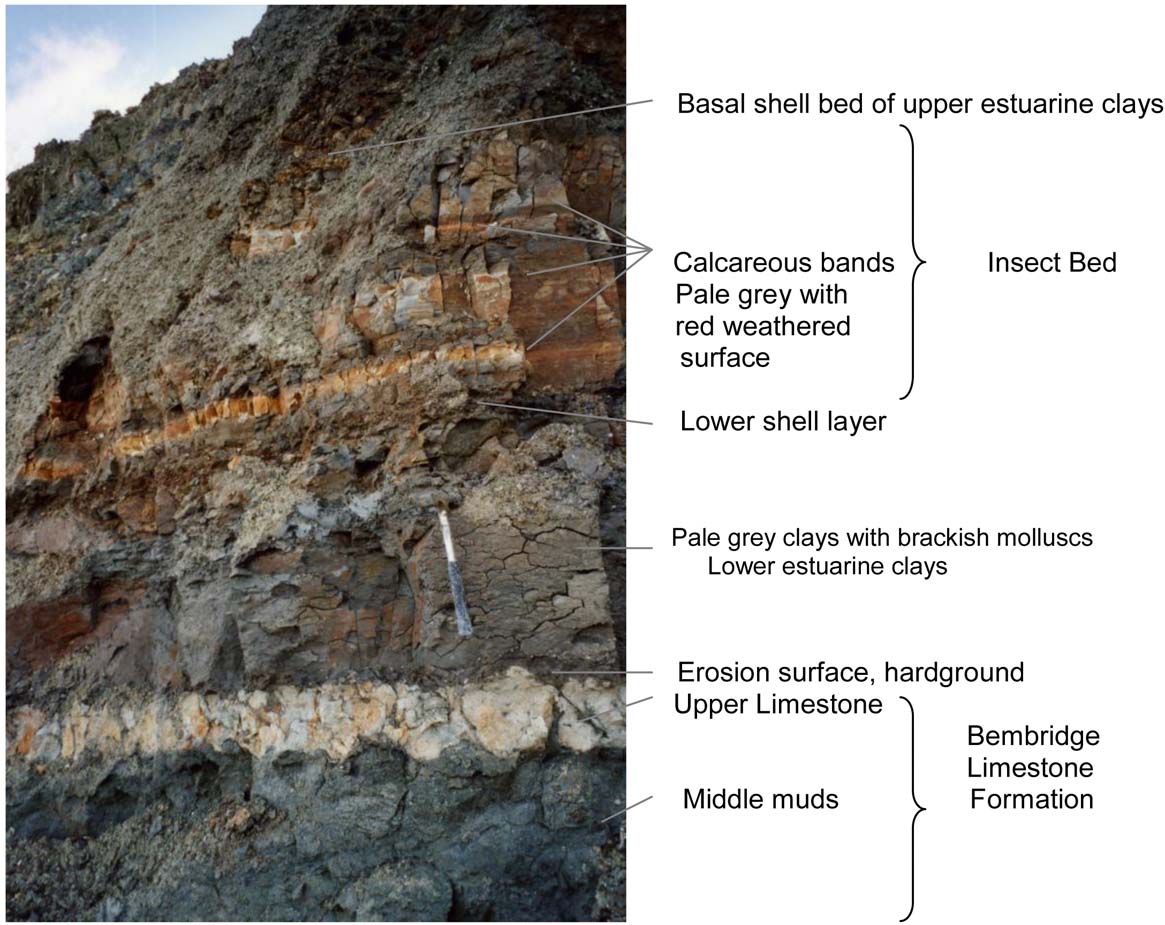
It is important to distinguish the Insect Limestone from the Insect Bed. The Insect Limestone is a fine-grained micrite that contains the insects, whereas the Insect Bed is the marl unit in which the limestone occurs (see Jarzembowski Reference Jarzembowski1980). The Insect Bed is about 1m thick and its base lies about 1m above the base of the Bembridge Marls Member within the Bouldner Formation of the Solent Group (Insole & Daley Reference Insole and Daley1985) (Fig. 2). It is under- and overlain by shell beds with a brackish/quasi-marine fauna (Jarzembowski Reference Jarzembowski1980). The Bembridge Marls Member is up to 34 m thick (Hopson Reference Hopson2011). Molluscs, plants, isopods and vertebrates have been found in the Insect Bed, although the insects and branchiopod crustaceans have only been found in the Limestone.
Stratigraphy of the Bembridge Marls Member showing the position of the Insect Bed.

2.1. Early history of the geology of the Insect Limestone
Bristow (Reference Bristow1862) published a section of the Bembridge Marls, measured in 1856, but there is no mention of any fine-grained limestone facies. Brodie (Reference Brodie1878, p. 6) gave the earliest account of an outcrop of the Insect Limestone based on information provided by Smith as follows: “Not very far from West Cowes, going towards Gurnet Bay, the limestone crops out on the beach, and although but little in quantity, some well preserved insects have been met with. A thin seam of the same stone occurs a few feet higher westward, but fossils are scarce. The Insect Limestone is quite lost at Gurnet Bay, and does not again appear till seen in the section below, about five hundred yards to the west of the western arm of the Bay. The part where it was most continuous was on the east side of Thorness Bay, where it formed a reef extending a long distance from the beach, composed of thick blocks of limestone.” Here it is reported to have yielded “numerous remains of Insects, beetles, elytra and wings.” A rudimentary section of the ‘Bembridge Series’ is given from an exposure “further on in the same direction” presumably southwest of Thorness Bay where the limestone is described as “2. Light-grey and blue-coloured limestone with Insects, Crustacea, and plants… 1 in to 2 ft.” A further description states “at Thorness Bay No. 2 [=Insect Limestone] crops out, and extends outwards as a reef toward the sea, and it reappears near Newton river.” Fossils are recorded as being extremely scarce westward of Thorness Bay. From this, it appears that the thickest units of insect-bearing limestone were to be found at Thorness Bay and that elsewhere fossils were rare; thus Smith probably collected most of his specimens from Thorness Bay, not Gurnet Bay [=Gurnard Bay] as stated on the NHMUK labels (Jarzembowski Reference Jarzembowski1976).
Brodie (Reference Brodie1878, pp 8–9) recorded three main lithologies: “one softer and white, little harder than soft chalk; the other grey or dingy blue, and harder; and the other a badly fracturing, hard blue, almost crystalline limestone.” He goes on to say that the latter “has preserved the insects in a wonderful manner, but fractures so irregularly that they are often injured in breaking the stone,” with a footnote to say that “Mr. Smith observes that owing to the perverse fracture he has lost a very considerable number of specimens, at least ten for every insect preserved.”
Reid in Bristow (Reference Bristow1889) established the position of the Insect Limestone within the lower part of the Bembridge Marls. In 1888, he measured a section west of Gurnard Ledge, which is at the northeast end of Thorness Bay. He recorded three inches (=0.08 m) of Insect Limestone, with its base lying 3 ft, 10 inches (=1.17 m) above the Bembridge Limestone.
2.2. Stratigraphy
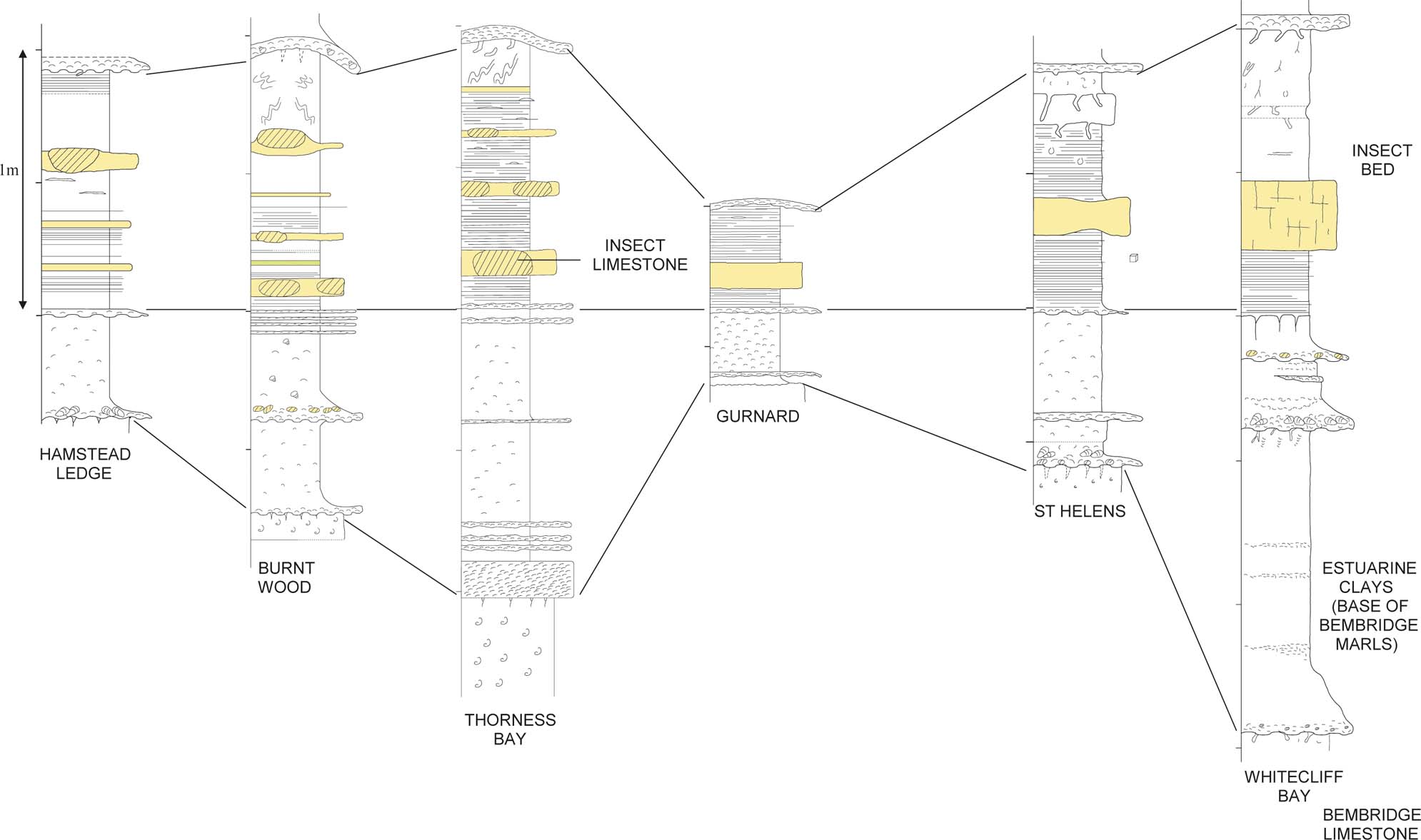
Exposures of the Insect Bed are confined to coastal sections, and although these have been studied at Whitecliff Bay, St Helens, Thorness Bay and Burnt Wood (for example, Jarzembowski Reference Jarzembowski1980; Daley Reference Daley1999), the Insect Bed has not been described at Hamstead Ledge. Daley (Reference Daley1999) believed the Insect Limestone to be absent at this location, so this may represent a temporary or localised exposure, which was first noted in 2004 (Andy Gale, pers. comm. 2004). Sections were logged by AS from the base of the Bembridge Marls Member (the contact with the Bembridge Limestone) to the overlying shell layer in 2004–2005 (Fig. 3).
Correlation of the Insect Bed on the Isle of Wight, from west to east.

The upper part of the underlying Bembridge Limestone Formation is eroded so that the limestone underlining the Bembridge Marls at each location represents different phases of the cyclical sequence identified by Armenteros et al. (Reference Armenteros, Daley and Garcia1997). Therefore, the depositional environments varied in water depth, pore-water composition and pedogenic modification. The basal 0.2–1.4 metres of the Bembridge Marls below the Insect Bed comprises marine and brackish shell beds within a succession of sandy and muddy sediments. The presence of Ostrea and Nucula in the Bembridge Oyster Bed of Whitecliff Bay, suggest this was a transgressive event resulting in brackish estuarine conditions (Murray & Wright Reference Murray and Wright1974; Keen Reference Keen, Bate and Robinson1978), although the presence of boring and nestling bivalves in a basal lag of stromatolitic concretions at Burnt Wood suggests that normal marine salinities were attained temporarily (Pinto Reference Pinto2004). Above the Oyster Bed the sequence is essentially regressive.
The shell beds delimiting the Insect Bed are composed of 70–90% bioclasts in an iron-stained sand matrix. The fossil assemblage is dominated by single valves and intact specimens of the bivalve Corbicula obovata, with the gastropods Tarebia acuta and Pychopotamides vagus. The shells are predominantly convex-up in a current stable orientation, suggesting that they were deposited in higher-energy storm events. Extant Potamides occur on tidal mudflats and shallow river-influenced coastal lagoons, and although Corbicula may survive in a range of salinities, they occur in greater abundance in lower salinity brackish environments (Daley Reference Daley1972). Therefore, the co-occurrence of Corbicula and Pychopotamides probably reflects post-mortem mixing during transportation.
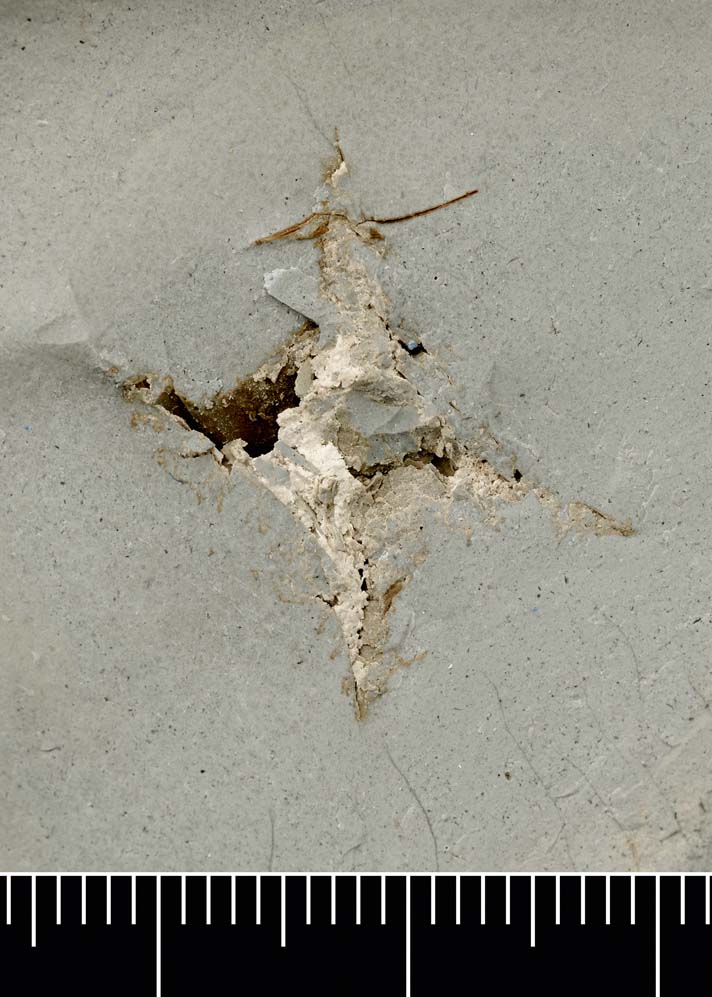
The Insect Bed comprises laminated silts and clays, with discrete concretionary lenses or thin but continuous bands of calcareous mudstones or marls and micritic limestone. The fine grain size and planar laminations indicate the sequence was deposited in a low-energy environment. Halite pseudomorphs were present in the laminated clays at St Helens and in the limestone from Thorness Bay, Burnt Wood (Fig. 4) and St Helens, suggesting the Insect Bed was deposited in a hypersaline lagoon. However the pseudomorphs are rare, so super-saturation may have only occurred sporadically. Above the Insect Bed, the succession comprises estuarine muds containing brackish and freshwater molluscs, with a laterally persistent basal shell bed.
Large hopper-faced Halite pseudomorph in Insect Limestone, from Burnt Wood.

2.2.1. Whitecliff–Bembridge Foreland
The most complete and expanded succession of the lower Bembridge Marl is found in the section between Whitecliff Bay and the Bembridge Foreland. The Insect Bed is exposed in the cliff at the northern end of Whitecliff Bay and can be traced dipping gently at 2° northwards from Black Rock Point [N.G.R. SZ 647867] along the lower cliff and foreshore to Bembridge Foreland [SZ 657875]. The bed is approximately 1 metre thick, with a continuous 0.15–0.25-m band of micritic limestone. The limestone displays vertical root casts and evidence of pedogenic modification, and contains multiple conjugate thrust faults. Fine-grained, well sorted partings of wind-blown sand and allochthonous glauconite occur locally; fossil material is rare, and although charcoal was evident, only a single Oecophylla wing has been recorded (Jarzembowski Reference Jarzembowski1980), and a beetle wing-case was found at Bembridge Foreland in 2005.
2.2.2. St Helens
A section of the lower Bembridge Marls, approximately 200–300 m long, is visible in the low-slipped cliffs between Node Point and St Helens Church. The Insect Bed is approximately 8 m above the base of the cliffs at Node Point [SZ 638900] and dips southwards towards the axis of the Bembridge Syncline so that the southern end [SZ 638897] lies 0.5 m above the cliff base. The succession shows some condensation from Whitecliff Bay; the Insect Bed is 0.65–0.85 m thick, with a single 0.1 m-thick course of limestone. The limestone has yielded insects, anostracans and rare conchostracans (Jarzembowski & Palmer Reference Jarzembowski, Palmer, Jarzembowski, Siveter, Palmer and Selden2010). The contact between the Bembridge Limestone Formation and the Bembridge Marls is visible at Horestone Point [SZ 633907], where a 0.44-m sequence of grey clays with Corbicula and Pychopotamides shell beds is eroded and overlain by Quaternary gravels. The Insect Bed is absent and was either eroded by the gravels or lay outside the depositional basin. The condensed sequence of the lower Bembridge Marls suggests that if the limestone was deposited it should be visible, so this location may mark the lateral extent of the depositional basin in the east of the island.
2.2.3. Gurnard
A localised section of the Insect Bed was seen northeast of Gurnard [SZ 476957], although the extent of the exposure was obscured by land-slips and sea defences. The succession is condensed, with a maximum thickness of 35 cm and a single band 9-cm band of calcareous mudstone in a sequence of laminated clays and silts. The reduced depth suggests this location may lie close to the margin of the depositional basin. Non-exposure of the Insect Bed in the centre of the island means that links between the locations in the east of the island and those in the northwest can only be inferred and deposition may have occurred either in a single basin or in two discrete depositional areas. Differences in the succession between the east and northwest coasts of the island, such as the frequency of calcareous mudstones, support the possibility of two depocentres. However, the differences may also reflect localised sediment influxes or variations in water depth within a single basin.
2.2.4. Thorness Bay
The cliffs and foreshore of Thorness Bay, between Sticelett Ledge [SZ 461941] and Gurnard Ledge [SZ 463946] provide the most extensive exposures of the Insect Bed, and the majority of fossils in the A'Court Smith and Maidstone Collection are probably derived from this location (Jarzembowski Reference Jarzembowski1980). The best exposures occur in an approximately 150-m section south of Gurnard Ledge. The Insect Bed is 0.6–1.0 m thick, with three or four calcareous beds; the lowest calcareous bed is a near continuous band of indurate limestone, whereas the upper beds have discontinuous concretions within softer, less well-cemented, pale calcareous mudstone or marl layers.
2.2.5. Burnt Wood
The lower Bembridge Marls are exposed in low cliffs for nearly two km from the edge of Burnt Wood [SZ 440930] towards Newtown Harbour. The Insect Bed varies in thickness from 0.45 m to 0.95 m and comprises planar laminated silts and muds, with four bands of pale calcareous mudstones (Fig. 5). Indurated lenses of limestone occur frequently throughout the calcareous bands, although the larger concretions are generally restricted to the uppermost band. The uppermost 0.3 m of muds are extensively slumped and microfaulted. The uneven topography of the overlying shell layer may result from channelling of the uppermost Insect Bed, or from deflection over larger lenses of limestone.
Photograph of the section at Burnt Wood.

2.2.6. Hamstead
The Insect Bed is locally exposed in a ten-metre section at Hamstead Ledge [SZ 404920]. The bed comprises approximately 0.9 m of dark grey laminated clays, with three pale calcareous mudstone bands between 2.5 cm and 9 cm thick. The uppermost marl course is locally well lithified; the concretions have a slightly domed upper surface, with fine silt laminations and a curved, undulating base. Initial examination of the concretions identified ostracods, beetle elytra, fragments of Oecophylla and dipteran wings, Galba shells and plant debris, although the material requires preparation prior to more detailed study.
Limestone intraclasts, 2–4 cm in diameter, were evident in shell lags at Burnt Wood and Whitecliff Bay. The clasts are composed of pale cream coloured limestones with abundant charophytes and therefore probably originated from the Bembridge Limestone. Their presence suggests erosion of the underlying beds occurred prior to deposition of the Insect Bed. Daley & Edwards (Reference Daley and Edwards1971) attributed this to Palaeogene (pre-Bembridge Marls) uplift of the Porchfield and Bembridge Anticlines and subsequent erosion. Between Thorness Bay and Burnt Wood, the upper part of the Bembridge Limestone is extensively channelled; the channels have a wavelength of 1–200 m and amplitude of 0.5–0.8 m. These cut out most of the uppermost part of the Bembridge Limestone, but do not erode it completely. Therefore, the intraclasts and shell layers which are not laterally persistent may represent channel lag deposits. At Whitecliff Bay, the evidence is less conclusive, Daley & Edwards (Reference Daley and Edwards1971) identified that the base of the Bembridge Marls overstepped successively older beds within the Bembridge Limestone and attributed this to intra-Palaeogene tectonic warping. However, the Oyster Bed also dies out laterally between Howgate Bay and Bembridge Foreland, towards the axes of the Bembridge syncline; therefore the upper part of the Bembridge Limestone and lower Bembridge Marls may also have been channelised.
The predominance of fine-grained clays and silts suggests the sequence was deposited in a low-energy, low-lying marginal marine environment. Active faulting would have steepened river profiles, increasing the potential energy and resulting in the deposition of coarser material. Therefore, the conjugate faulting in the limestone facies at Whitecliff Bay probably occurred post-depositionally, and the Insect Bed was deposited during a period of slow basin subsidence.
2.3. Sedimentology of the Insect Limestone
The limestone facies is a fine-grained argillaceous limestone with a conchoidal fracture. Fresh surfaces are blue-grey in colour and weather to produce a brownish yellow rind. Polished sections from Burnt Wood, Thorness Bay and St Helens show frequent planar silt laminae, 1–4 mm thick, and coarser detrital layers up to 1 cm thick. Both laminae and layers contain finely-comminuted carbonaceous material; erosional bases and graded fining-upward bedding are occasionally visible. The layers can be traced laterally into the clay, suggesting they are concretionary and do not infill channels as suggested by McCobb et al. (Reference McCobb, Duncan, Jarzembowski, Stankiewicz, Wills and Briggs1998).
Flame structures and convolute lamination are present and are early post-depositional structures indicative of soft sediment deformation. Flame structures are formed when denser materials are deposited on to soft muds and convolute laminations, due to the shear stress caused by flow over the surface (Nichols Reference Nichols1999). These structures and the frequency of the layers suggest the basin was a dynamic environment with regular influxes of sediment, but there appears to be no regularity to the influxes.
Microfaults cut the deformational structures and bedding, suggesting small-scale deformation after lithification. These cannot be traced into the overlying clays, but this may be due to the small displacement. The limestone facies lacks bioturbation or root traces; the presence of rare halite pseudomorphs with hopper faces suggests deposition occurred in a shallow hypersaline lagoon.
The structure and texture of the limestone unit in Whitecliff Bay varies from the other locations. Intraclasts of limestone with the finely laminated texture described above occur in a coarser-grained matrix. The matrix contains frequent pyrite aggregates, local concentrates of carbonaceous material and quartz grains and irregular shaped, calcite-lined fenestrae pores. Although some limestone clasts are horizontally bedded many have been rotated upwards or displaced.
Daley (Reference Daley1971) identified syndepositional desiccation cracks infilled with sediment and calcite-lined diagenetic cracks; he proposed the sediment was deposited as a series of high- and low-carbonate layers which crossed a critical carbonate/clay threshold of 4:1. Layers with greater than 80% carbonate lithified early and remained cohesive, whilst the low carbonate layers became plastic and mobile, breaking through the cohesive layers. Flow was originated by the build-up of pore-water pressure and accentuated by surface desiccation. After mobilisation, the layers and water-escape structures were converted to limestone by later diagenetic carbonate enrichment. However, neither the mottled texture and water-escape structures in the limestone nor the thin carbonate-marl layering are seen at the other localities. Daley (Reference Daley1971) determined the chemical composition by acidification with dilute HCl and the ‘clay’ phase included quartz and iron pyrites. The original data gave a carbonate/clay ratio of 5.25:1; removing the weight of quartz and pyrite would further increase this ratio above the critical 4:1 threshold.
Hand specimens of the limestone reacted vigorously to etching solutions, and were stained deep-blue by the Alizarin Red S with potassium ferricyanide solution and red-brown by Alizarin Red S alone. This indicates that the limestone is predominantly composed of ferroan calcite (Adams et al. Reference Adams, MacKenzie and Guilford1984); the stain was uniform and no variation was visible at ×100 magnification. However, the intensity of the colour may mask small zones of different composition. To produce ferroan calcite, reducing conditions must have existed. In oxidised pore-water, ferrous iron is oxidised to ferric iron and precipitates as iron hydroxide. Anoxic conditions are produced by deep burial, but this is unlikely in this case, as the three-dimensional preservation of insects and soft tissues suggests early and therefore near-surface diagenesis. Alternatively, anoxia may result from stagnation of oxidising waters and/or decomposition of organic material in sediments. To form ferroan calcite, the Eh of the pore waters is below the stability field of FeS2, so that iron is incorporated into calcite rather than pyrite (Tucker & Wright Reference Tucker and Wright1990). Therefore, the pyrite present in the hand specimens from Whitecliff Bay must have formed during or after a secondary phase of calcite precipitation.
Dolomite CaMg(CO3)2 is absent from the samples. Dolomite precipitation is inhibited by the presence of organic acids and sulphate ions SO42−; sulphate is present in seawater and less than 5% seawater is sufficient to inhibit dolomite precipitation. Therefore, to prevent dolomitisation in a coastal evaporitic lake would require a high organic input, the total absence of seawater in the pore fluid or greater than 5% seawater. Armenteros et al. (Reference Armenteros, Daley and Garcia1997) identified a gypsiferous lake-margin facies in the lacustrine Bembridge Limestone and attributed the absence of dolomite to seawater migration in the pore fluids.
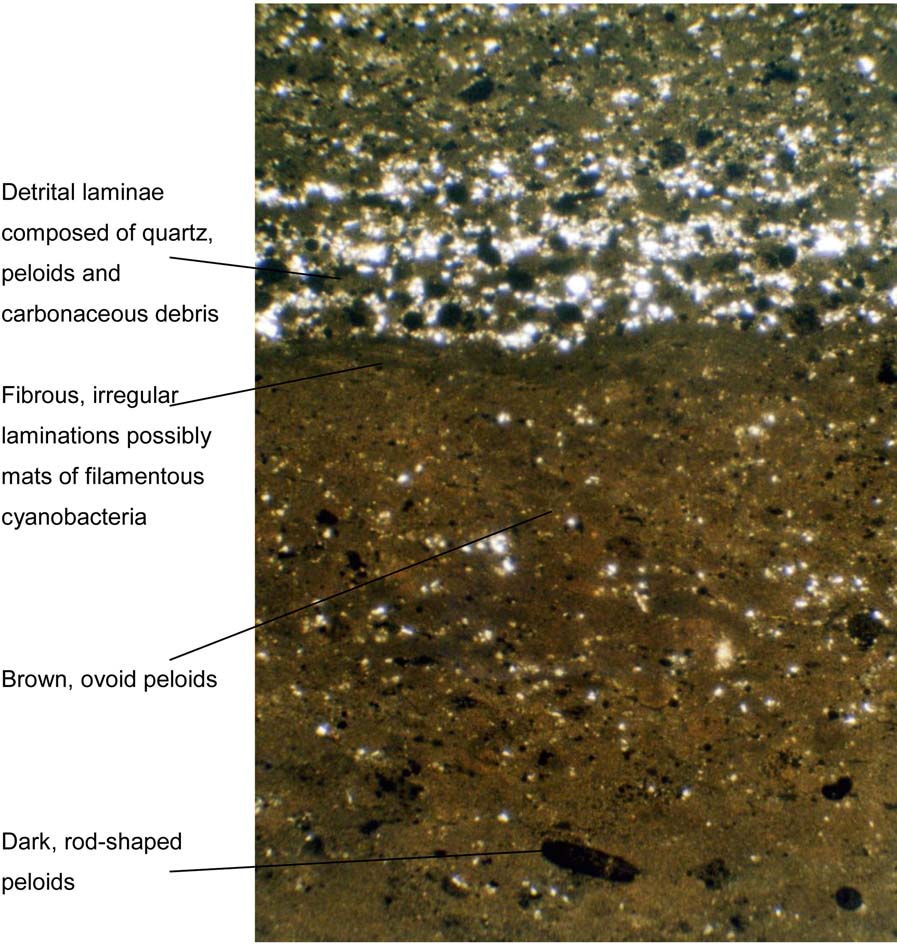
In thin section, the limestone facies from Burnt Wood, Thorness Bay and St Helens is primarily composed of micrite with a grain size of less than 5 μm. The texture varies from almost opaque with a brown tint to areas with a distinct clotted, peloidal fabric (Fig. 6). The peloids vary from brown ovals to dark rods (at the bottom of figure); they are composed of micrite and lack any recognisable internal structure. Bioclasts comprise less than 1% by volume and are predominantly single valves, or carapaces of ostracods with the original structure preserved. The calcite of the ostracod valves shows no evidence of micritisation; therefore, the peloids are probably not micritised bioclasts. Fining-upwards silty laminae composed of approximately 50% quartz, bioclasts, peloids and carbonaceous detritus occur at intervals; erosional bases are occasionally evident.
Photomicrograph of the limestone facies from Thorness Bay. Scale: ×50 magnification.

The peloids contain abundant dark rods, approximately 0.5 mm in length. These are locally concentrated into lenses or detrital laminae with fine-grained quartz, where they comprise 60–80% by volume. The rods appear current-aligned and are sufficiently coherent to distort the margin and membrane of insect wings when they impinge. They are composed of micrite and lack any recognisable internal structure, suggesting early micritisation of organic material; such peloids are generally interpreted as faecal in origin (Adams et al. Reference Adams, MacKenzie and Guilford1984). Their co-occurrence with fossilised Branchipodites vectensis suggested the rods may be anostracan faecal pellets. They are similar in size to those of the Recent species Artemia salina, particularly when fed on cyanobacteria (Self Reference Self2005).
Filamentous mats occur infrequently and are poorly developed, restricted to less than 1 cm in depth. The laminae are picked out by variations in the density of micrite, with small, 2–3-mm, laminoid fenestrae between the layers; the irregularity in shape and layering suggests they are biogenic rather than formed by physical processes. The peloids and bioclasts are enclosed in micrite, which appears to have adhered to the surface or grown outwards, resulting in the formation of cavities where they coalesced. The cavities are infilled with microcrystalline equant sparite.
Ostracod valves are intact and undeformed, which would indicate there has been no mechanical compaction, as these are thin-walled and easily broken. Therefore, the primary structure of the limestone is probably intact. Non-fabric selective vug (irregular) pore-spaces are lined by very fine-grained (1–3 μm) equant calcite, indicating rapid growth from numerous nucleation points. Larger pores are occasionally partially filled by coarser, equant to columnar calcite, which nucleate as equant crystals and elongate as they grow into voids (Saller & Moore Reference Saller and Moore1991). They can be differentiated from acicular calcite as equant-columnar crystals become wider away from the cavity walls. Equant calcite is typically formed in meteoric environments (Tucker Reference Tucker2001) and the presence of ferroan calcite indicates precipitation occurred within the phreatic zone.
The limestone is predominantly a matrix-supported carbonate mud with less than 10% allochems, so classified as a mudstone according to Dunham (Reference Dunham and Ham1962). Peloids are the most abundant allochem and vary in concentration from over 75% to less than 1%; therefore, the limestone is a pelmicrite–peloid-bearing micrite – based on the classification scheme of Folk (Reference Folk1959, Reference Folk and Ham1962).
The cohesive limestone facies from Whitecliff Bay is similar in structure to the limestone described above, but includes glauconite and thin silt partings. The high degree of sorting suggests the silts were windblown. The glauconite occurs as scattered bright green grains; although Triat et al. (Reference Triat, Odin and Hunziker1976) reported glauconite in lacustrine deposits, Odin & Matter (Reference Odin and Matter1981) argued that glauconitisation is a peculiar process of marine environments and therefore glauconite is interpreted as allochthonous when present in non-marine deposits (Amorosi Reference Amorosi1997). When isolated from the limestone, the glauconite was well rounded with a polished surface and good internal size sorting, which suggests the grains were allochthonous.
In cathodoluminescence microscopy (CL) the luminescence colour and intensity is a function of the ratio of Fe2+ to Mn2+ concentrations, with Mn2+ acting as an activator and Fe2+ as an inhibitor (Tucker & Wright Reference Tucker and Wright1990). As the staining had shown the presence of ferroan calcite and initial geochemical analysis indicated high manganese concentrations, it was expected that CL would reveal any slight variations in calcite composition. However, the thin sections of the limestone from Burnt Wood, Thorness Bay and St Helens showed a uniform dull orange luminescence, indicating a single phase of precipitation. The thin sections from Whitecliff Bay showed variations in luminescence and two types of deformational structures were identified: bifurcating cracks and sediment filled voids. Vertical cracks are lined with bright orange calcite; the cracks also contained fine-grained quartz and pyrite aggregates in pore spaces.
Ferroan calcite precipitates from negative Eh waters below the stability field of FeS2. Therefore, pyrite formation would require the pore waters to be more Eh positive, indicating calcite precipitated in the cracks during a later phase of cementation. To form pyrite, organic material must have been present; together with the vertical orientation and pattern of bifurcation, the inclusion of organic material would suggest the cracks represent plant roots.
In the hand specimens from Whitecliff Bay, intraclasts of limestone with the same texture as the limestone from the other localities are enclosed in a coarser-grained matrix. The matrix has a high carbonaceous content, with patches of dense micrite, and is stained darker due to melanisation; these features are indicative of the early stages of pedogenic modification (Tucker & Wright Reference Tucker and Wright1990). Microkarst surfaces are marked by laterally continuous layers of matrix, with rooting structures and sediment-filled cracks descending from them. Therefore, the limestone at Whitecliff Bay may have been deposited in a palustrine environment with periodic exposure and/or soil development and plant growth.
The petrographic analysis and preservation of intact three-dimensional insects supports early lithification of the limestone facies, with little or no subsequent diagenetic recrystallisation or neomorphism. Therefore, elemental geochemical analysis should reflect environmental conditions at the time of deposition. The presence of halite pseudomorphs with hopper faces suggests that deposition occurred in a hypersaline lagoon. However, the pseudomorphs are rare which suggests saturation was only achieved occasionally. Halite precipitates out of sea water once it has been concentrated to less than 10% of its original volume. The evaporites formed in continental saline lakes depend on the chemistry of the lake waters, but are mainly carbonate and sulphates of sodium or magnesium (Nichols Reference Nichols1999). The aim of the geochemical analysis was to determine whether the diagenetic fluids were derived from freshwater/meteoric or marine sources, based on compositional differences between these fluids.
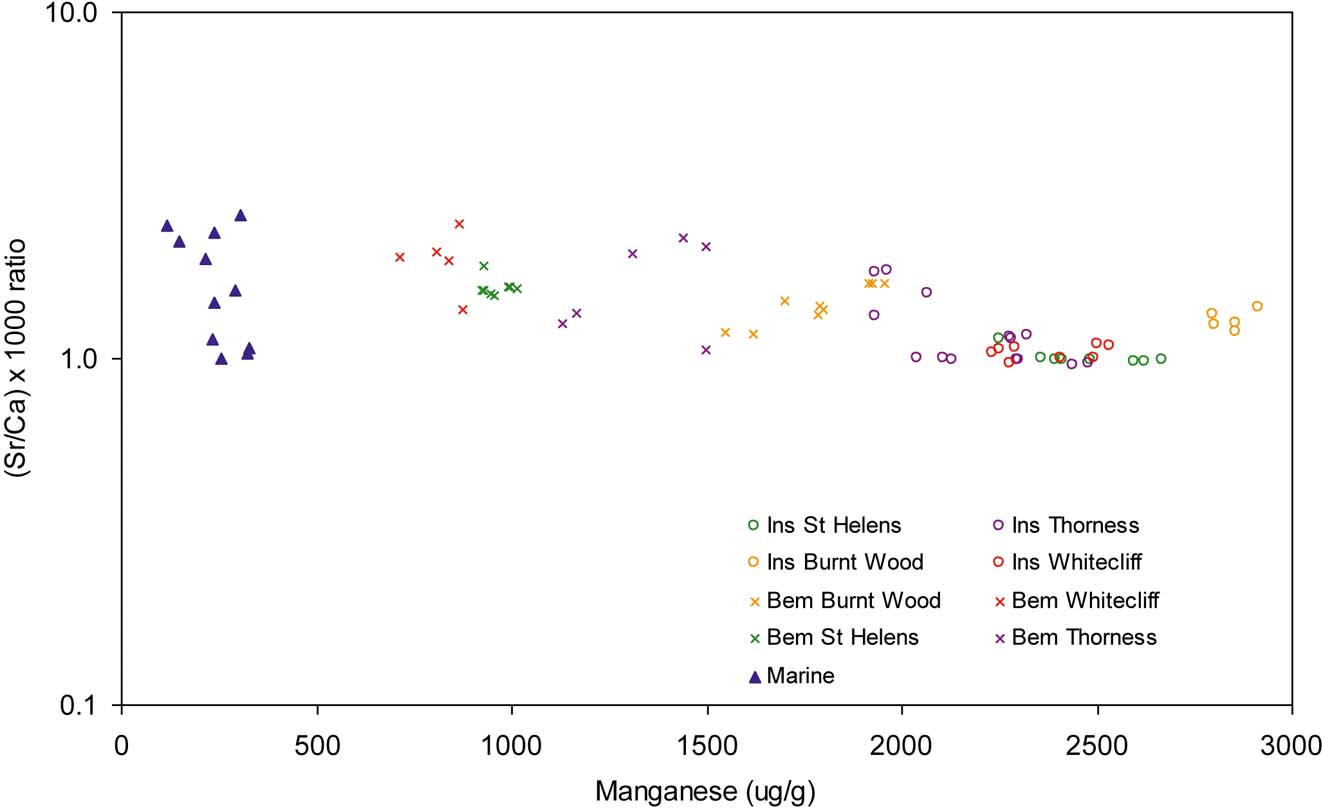
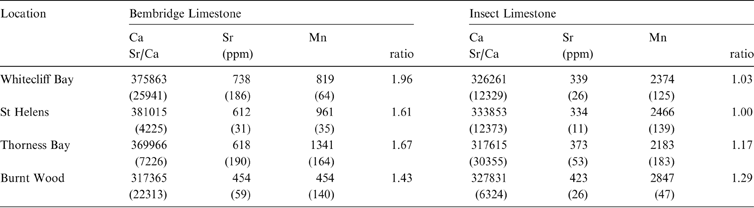
Covariation plots of the strontium/calcium ratio against manganese concentration are widely used to delimit the magnitude of diagenesis in marine carbonates and the provenance of diagenetic fluids, due to their divergent partition coefficients, association with the carbonate lattice and large compositional differences between marine and meteoric waters (Sarkar et al. Reference Sarkar, Sarangi, Ebihara, Bhattacharya and Ray2003). The covariation plot of strontium/calcium ratio against manganese concentration (Fig. 7) shows that the manganese concentrations in both the Bembridge and Insect limestones are significantly higher than published shallow marine-littoral values (Sarkar et al. Reference Sarkar, Sarangi, Ebihara, Bhattacharya and Ray2003). Manganese concentrations are enhanced in diagenetic fluids derived from meteoric sources (Brand & Veizer Reference Brand and Veizer1980); therefore these high levels would indicate deposition in a freshwater environment. A predominantly lacustrine–palustrine environment for the Bembridge Limestones is supported by the presence of pulmonate freshwater gastropods, particularly Galba and Planorbina, and a land snail fauna (Pain & Preece Reference Pain and Preece1968). Studies of the mammalian fauna suggest woodland or forest surrounding or adjacent to the lake and support a continental environment (Hooker et al. Reference Hooker, Collinson, Van Bergen, Singer, Leeuw and Jones1995). The manganese concentrations in the Insect Limestone were also significantly higher than levels in the underlying Bembridge Limestone at each location (Table 1).
Strontium/calcium ratio versus manganese concentration plot for the Bembridge (Bem) and ‘Insect (Ins) Limestones’ and a shallow marine-littoral limestone. Marine limestone concentrations from Sarkar et al. (Reference Sarkar, Sarangi, Ebihara, Bhattacharya and Ray2003).

Calcium, strontium and manganese concentrations of the Bembridge and Insect Limestones. The concentrations are expressed in ppm and are the mean of 8–14 samples with the standard deviations shown in brackets. The Sr/Ca ratio shown is ppm Sr/ppm Ca ×1000. Typical values for Eocene/Oligocene shallow marine-littoral carbonates are Ca 304456 ppm (Standard deviation s=87205), Sr 504 ppm (s=229) and Mn 244 ppm (s=68), where n=11, Sr/Ca ratio ×1000=1.66 (Sarkar et al. Reference Sarkar, Sarangi, Ebihara, Bhattacharya and Ray2003).

The incorporation of Mn2+ into calcite from aqueous solutions is governed by (aMe2+/aCa2+) activity ratio, the crystal growth rate (with increased enrichment of Mn2+ relative to the liquid phase with decreasing precipitation rates) and temperature (the distribution coefficient for Mn increases with increasing temperature (Kallis et al. Reference Kallis, Bleich and Stahr2000). The concentration of manganese in solution is primarily affected by changes in redox potential and the higher concentration may reflect dysoxic conditions during diagenesis. However the aqueous concentration is also dependent on the type and levels of Mn-bearing minerals and organic compounds present and the presence of Mn-reducing microbes (Kallis et al. Reference Kallis, Bleich and Stahr2000). In argillaceous limestones, such as the Insect Limestone, high concentrations of manganese may result from influxes of soil-derived oxy-hydroxides (Hendry Reference Hendry1993).
The Sr/Ca ratio of the Insect Limestone also varies from the underlying Bembridge Limestone at each location (Table 1). The lower Sr/Ca ratio of the Insect Limestone results from decreased strontium (Sr) concentrations rather than increased calcium (Ca) content and the Bembridge Limestone ratio approximates to the marine value of 1.66. The upper part of the Bembridge Limestone Formation is eroded and overlain by a transgressive succession of brackish/marine shell beds and estuarine clays. The higher Sr/Ca ratio of the Bembridge Limestones may reflect pene-contemporaneous lateral migration of saline pore-waters, as suggested by Armenteros et al. (Reference Armenteros, Daley and Garcia1997), based on the development of microlenticular gypsum in a lake-margin facies. However, this facies was confined to the Gurnard area and the ratio at the other locations may result from calcite precipitation infilling cavities or neomorphism during the marine transgression.
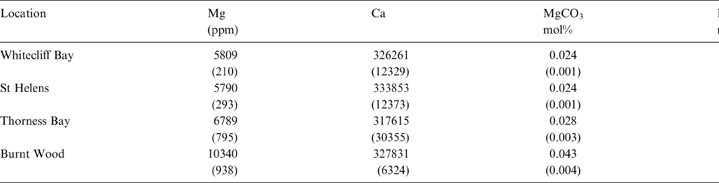
Saller & Moore (Reference Saller and Moore1991) proposed that magnesium concentrations could be used to distinguish calcite cements precipitated in fresh water from those precipitated in mixed fresh and marine waters. Calcite precipitated from relatively pure meteoric water should have lower magnesium concentrations (<2.0 mol% MgCO3) than those from mixed sources. The calculated magnesium carbonate concentration for the Insect Limestone is 0.024–0.043 mol% (Table 2), which suggests precipitation from pure meteoric sources. The data from ICP-OES analysis is expressed as oxide weight %; converting the result to magnesium carbonate assumes all the magnesium was originally present as the carbonate and therefore probably overestimates the true concentration. However, as the concentrations are considerably lower than the threshold value, this is unimportant. The Mg/Ca ratio of 0.017–0.032 (Table 2) in the Insect Limestone is also below the threshold of 0.3 given for meteoric diagenesis (Tucker Reference Tucker2001). Phreatic meteoric ground-water passes into a mixing zone with seawater at relatively shallow depths in coastal locations (Tucker Reference Tucker2001), increasing the Mg/Ca ratio towards the threshold. Therefore, the low ratio indicates near-surface precipitation.
Magnesium and calcium concentrations in the Insect Limestone. Concentrations of magnesium and calcium are expressed in ppm and are the mean of 8–14 samples, with the sample standard deviation shown in brackets. The Mg/Ca ratio was calculated as mean ppm Mg/mean ppm Ca and mol % MgCO3, by converting %MgO to %MgCO3 and dividing by the RMM.

Both the thresholds for meteoric diagenesis are based on analysis of calcite cements, whereas the lithium metaborate fusion method used gives whole rock analysis. Acid dissolution and x-ray diffraction indicated the Insect Limestone in Whitecliff–Howgate Bay was composed of 84% calcite with a 16% insoluble residue of illite, kaolinite, quartz and iron pyrites (Daley Reference Daley1971). These insoluble minerals generally contain low levels of the cations (Ca, Sr, Mg and Mn) used in these comparisons, although some Mg2+ occurs in illite and manganese can be absorbed onto clays (Tucker Reference Tucker2001). However, observed concentrations of these cations in the Insect Limestone vary so substantially from typical marine values that low concentrations in the clay minerals would be insufficient to account for the variation. The geochemical analysis suggests precipitation of calcite occurred in a near-surface meteoric environment.
3. The age of the Insect Bed
There has been uncertainty as to whether the Insect Bed is late Eocene or early Oligocene in age (Jarzembowski Reference Jarzembowski1980; Insole et al. Reference Insole, Daley and Gale1998). The boundary between these epochs is dated at 33.9 million years old according to the 2012 International Stratigraphic Chart, produced by the International Commission on Stratigraphy (http://www.stratigraphy.org/). This is an important time in the history of the planet, as it was a transition from a warm to cool climate (Collinson Reference Collinson1981; Prothero Reference Prothero1994; Ross et al. Reference Ross, Jarzembowski, Brooks, Culver and Rawson2000).
Using magnetostatigraphy and other evidence, Gale et al. (Reference Gale, Huggett, Pälike, Laurie, Hailwood and Hardenbol2006, Reference Gale, Huggett and Laurie2007) attempted to place the lithostratigraphic units of the Solent Group within the chronostratigraphic time scale. They identified a normal polarity zone that included the top two metres of the Bembridge Limestone Formation and bottom four metres of the Bembridge Marls Member (which includes the Insect Bed). They identified this zone as Chron 13n and concluded that the Eocene/Oligocene boundary lay near the bottom of the Bembridge Limestone Formation, thus the Insect Bed would be early Oligocene (Rupelian) in age.
However, this view was disputed by Hooker et al. (Reference Hooker, Collinson, Grimes, Sille and Mattey2007, Reference Hooker, Grimes, Mattey, Collinson, Sheldon, Koeberl and Montanari2009), who considered that the Chron in question is actually subchron 1n of C13r, which places the Eocene/Oligocene boundary either high within the Bembridge Marls Member or low within the overlying Hamstead Member. They support this argument using microfossil and mammal biostratigraphy. Thus the current theory is that the Insect Bed is latest Eocene in age (Priabonian) and this is followed here.
Hooker et al. (Reference Hooker, Grimes, Mattey, Collinson, Sheldon, Koeberl and Montanari2009) also indicate that the Bembridge Marls were deposited over about 300,000 years, which would date the Insect Bed at about 34.2 Ma (+/−∼100,000 years) and indicates that it was deposited over about 10–15,000 years. Thus, the Insect Limestone fauna can be directly compared to that of the Florissant Formation in the USA, which is radiometrically dated at 34.07 million years old (Meyer Reference Meyer2003); and the Baltic amber fauna, which is also primarily Priabonian (Standke Reference Standke2008).
4. Acknowledgements
Many thanks to Peta Hayes and Margaret Collinson for supplying the base map used in Figure 1, and to Phil Crabb for taking Figure 4. Many thanks also go to INTAS for funding this project (No. 03-51-4367). The geochemical analyses and microscopy were undertaken by AS at the Department of Earth Sciences, University of Greenwich, as part of an MSc Dissertation supervised by Andrew Gale.