The National Museum of the Royal Navy (NMRN) is the United Kingdom's newest national museum, we have reached our tenth anniversary with over one million visitors a year; our website receives three million visits and our twitter feeds reach two and a half million people. Formed in 2009, our constituent museums were the Royal Naval Museum, the Royal Marines Museum, Royal Navy Submarine Museum, the Fleet Air Arm Museum and Explosion! Museum of Naval Firepower. HMS Warrior Trust joined the collections in 2018. The museum also cares for several historic ships including HMS Victory, a First Rate ship; HMS Warrior (1860), an armoured ironclad; HM Monitor M33 (1915), which served at Gallipoli; HMS Caroline, a C class light cruiser (1914) in Belfast, which has been listed as a finalist for Art Fund Museum of the Year 2019; HMS Trincomalee, a Leda class Frigate, (1818) and RML 497, a Second World War Motor Launch, both in Hartlepool. The Museum is also working on the restoration of a Landing Craft (LCT 7074) in conjunction with the D-Day Museum and with several other affiliates. Through the ships and collections, we aim to tell the story of the people and the purpose of the Royal Navy, as well as its power and progress with technological developments.
A key element in identifying the collections and bringing them together was to create a joint catalogue from the different systems we were all using. This process took a year of planning and testing before moving all the data across. We prioritised this as essential for us as a curatorial team, and for the staff of the museum, to be able to search across all collection elements. This paper would have been very difficult to compose without access to the combined data, and it has given our team a much greater understanding of our collection scope.
‘Cactus’, watercolour possibly painted in or near Tripoli, Libya, c. December of 1941 by Royal Marine, Ernest W. Young. Image courtesy of the National Museum of the Royal Navy.

Within the extensive collections held by the museum are over two million photographs from early Victorian daguerreotypes and ambrotypes to recent digital prints. The collection is well rounded depicting all aspects of naval life and is comprised from personal donations and collections of official naval photography. There is also a large collection of photographic albums from the 19th and 20th centuries which contain some of the most important documentary evidence of key Royal Naval actions and humanitarian relief. As people voyage across the world in peace and war, the photographs also record changes across all the continents during the time span of the collection. There are many Crown Copyright images from the official collections, some of which are duplicated as each of the founding museums acquired their own copy of an image.
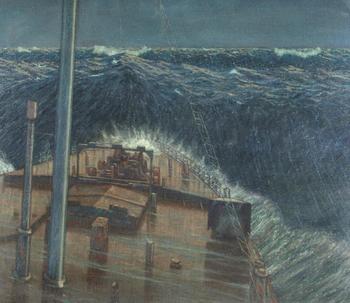
The art across the NMRN cover a wide variety of styles and techniques. The focus is on paintings, drawings and prints, numbering around 4,500 in number, which cover the late 17th century through to the present day. The variety of the subject matter is extensive including portraiture and caricature, seascapes, landscapes, detailed uniform studies, naval operations and the Royal Marines Band Service. The Naval Academy and its later successors in naval education taught drawing as a required skill to aid observation and reconnaissance. The encouragement to observe and draw produced talented amateur artists who served in all branches of the Royal Navy, and their works are well represented within the collection. This category includes Vice Admiral Sir Roderick Macdonald RN, Lieutenant Colonel William Masters RMLI (Royal Marine Light Infantry), Captain James Cottell RM, Captain Guy Griffiths RM and Leading Signalman Phillip Needell who painted Northern Patrol during the First World War. Like many others, Needell joined the Royal Navy for duration of the war and returned to his job as a bank clerk after hostilities ceased. Another unpublished collection of watercolours was painted by Marine Ernest W Young while stationed in North Africa (Libya and Algeria) with the Royal Marines during the Second World War in 1943. Marine Young worked as a commercial artist following the war.
‘Northern Patrol’, unglazed oil painting by Phillip Needell depicting the Northern Patrol during World War One. Image courtesy of the National Museum of the Royal Navy.

Our collections are not closed, the Royal Navy is an active service and our collections policy reflects this. For example, the Museum has acquired recent works by personnel serving on operations in Afghanistan, 2007, and Lachlan Goudie showing the construction of the Type 45s and the Queen Elizabeth class aircraft carriers. Contemporary collecting keeps our collections relevant to current events. We recognise that the navy is not the global power of the past, but it remains a military force which operates in partnership with allies and whose resources are determined by government priorities.
The museum has been fortunate to have received some of the works formerly held by the Ministry of Defence Art Collection. This collection has its origins in the collection assembled by the Admiralty, where from the early 19th century, successive First Lords and Admiralty Secretaries commissioned portraits or bequeathed items from their private collections. It then grew further through bequests and gifts to the Admiralty, the War Office, and then the MOD to be a diverse range of historic material of over two thousand items in 2017. The collection was managed by staff, with a central store in MOD Main Building, but a large proportion was on long-term loan for display to government and MOD establishments. The written statement of the intention to transfer this collection to public institutions was listed in Parliament in May 2016. In March 2017, the collections were formally disbanded and transferred by deed of gift for charitable purposes to different public collections – principally The Government Art Collection, National Army Museum, Royal Museums Greenwich, and NMRN. The NMRN was allocated 776 items including oil paintings, watercolours, prints, figureheads and furniture. This transfer is a significant addition to the range and quality of the NMRN's collection of Art, containing works for example by Nicholas Pocock (1740-1821), Norman Wilkinson (1878-1971) and Muirhead Bone (1876-1953).
We are still in the process of defining our fine art and three-dimensional decorative art such as embroideries, glass, ceramics, bronzes and silver dating from the 18th century onwards. One of our more recent acquisitions is the illustrated sign board for a pub, prompting a discussion of “does a sign qualify as art?” People who formerly worked as brewery artists would certainly say that they are. These are curated across multiple disciplines and not held as a single collection. Because of this, we are unable to currently confirm the full extent of these holdings. We have identified around six thousand trophies, and a thousand models, some of which would fall into this category. Documenting this is something we recognise as a future issue to be addressed.
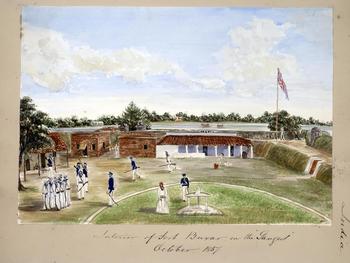
‘India. Interior of Fort Buxar on the “Ganges” October 1857’, watercolour by Henry D. Grant. Image courtesy of the National Museum of the Royal Navy.

Imagery in the collection is not only found in traditional sources, but can be found in diaries, Midshipman's journals, training documents and works undertaken for military reconnaissance. Many drawings are scientific or technical in nature undertaken for navigation, surveying, ship construction and maintenance. The archive contains individual documents which are of international significance: personnel records from key branches of the Royal Navy which unlock the histories of 100,000s of men and women plus personal collections including journals, letters and over a thousand diaries from the American War of Independence in 1776 to Afghanistan in 2003.
The supporting library collections hold around twenty-five thousand published items. The holdings include rare books with prints, specialist material supporting the collections and maritime art history. Cataloguing some of the art works can involve elements of detective work, due to the large numbers of people that have been with the service in the course of its history. Our library collections can help confirm service details of some naval artists from specialist sources. One case study is the additional research we have done on a well-illustrated album of 37 watercolours drawn by Lieutenant Henry Duncan Grant, First Lieutenant on HMS Pearl (1856-1859). He was part of the naval brigade that landed and travelled 1,000 miles inland in India in 1857. We can confirm Grant's service provenance from copies of the Navy List, a serial publication which records which ship an officer was serving in. There is a general account which confirms his full name and his subsequent promotion to the rank of Commander afterwards in The Royal Navy: a history from the earliest times to the death of Queen Victoria by William Laird Clowes. A detailed study of the naval brigades in the Indian Mutiny 1857 -1858 was published by the Navy Records Society, 1947, further helping to identify the location of some of the images. His album also demonstrates the issues in cataloguing the material we hold. The water colours are with NMRN collections in Portsmouth, his journal including the voyage to Calcutta is held in Cambridge University Library and his cadet's training log is in the National Library of Scotland, Manuscript Collections. It reflects how items can be dispersed through time and location; the wide, sometime global, distribution of related items is noticeable in naval and maritime history.
As a legacy from the founding museums, items are held in thirty separate collection stores across six sites. Like many museums, some of the stores are in historic or former military buildings that were not designed for holding large heritage collections. Conditions within those stores put our items at risk of damage from damp or pests. We are fortunate to have in-house conservators who assist in caring for our collections. They have also helped in establishing quarantine areas and best practice from the different elements affecting our founding museums.
The Museum put forward a detailed £13 million proposal entitled SeaMore to the Heritage Lottery Fund for the conversion of a partially used storehouse in Portsmouth Historic DockyardFootnote 1 as a new collection centre. The objective was to relocate the Royal Marine collections into the dockyard, unite the NMRN's collections from the dispersed sites and to substantially improve public physical access to eighty percent of the entire NMRN collection through our new collections centre. The proposal was well received in the early stages, with £2 million LIBOR funding announced in 2015. In April 2016, the National Museum of the Royal Navy received a Round 1 pass from the Heritage Lottery Fund (HLF) to develop the transformative ‘SeaMore’ project. The project unfortunately did not receive a Round 2 pass for the £13 million in 2018Footnote 2. This was a significant disappointment to the NMRN.
We have redesigned our building plans to store our collections to work with a smaller budget, this is likely to reduce the planned eighty percent of the collection on open public access to a much lower figure. We are now aiming to relocate the Royal Marines Museum for £3 million. Our fundraising and events teams are now working extremely hard to generate financial support through functions, the Friends of the Museum, charitable events and an adoption scheme for items of significance.
In January 2019 our enquiry service was suspended for the duration of the project. Access to the reserve collections has ceased during the packing and building works related to the move, which is scheduled for completion in 2020. We are still providing some access to the public through several other means, including Ask the Archives which is an open curator session once a month, our beta online catalogueFootnote 3 and a print on demand service for a small number of collection images. The oil paintings in the collection are publicly accessible through the Art UK project. The largest collections are held in Portsmouth (formerly the Royal Naval Museum) and the Royal Marines Museum.
In the process of writing this article, it became clear to us that the museum needs to look at how we define our art collections in more detail. In the packing phase, we are discovering items that previously not been documented, and of which even the curators were not aware. The next two years will see continuing change in the museum as we finish the collection move and start to unpack into our redesigned store. During this period, we will take the opportunity to revise how we document our art and images across all the collections. We will be increasing the amount of digital imagery online, and then will be able to reinstate public access. Most of all, we are looking forward to sharing our previously little-known collections.