INTRODUCTION
Developing low energy compact accelerator mass spectrometry (AMS) systems, which have the advantages of smaller instrument size, easier-to-operate instruments and high-performance, is the recent trend of AMS systems. The open air single stage accelerator mass spectrometry (SSAMS) system and the compact AMS system (MICADAS) which have these advantages for radiocarbon (14C) measurement have been successfully developed by NEC and ETH, respectively (Klody et al. Reference Klody, Schroeder, Norton, Loger, Kitchen and Sundquist2005; Synal et al. Reference Synal, Stocker and Suter2007). These two systems were delivered to many AMS laboratories and are in use for routine 14C measurement (Skog Reference Skog2007; Bard et al. Reference Bard, Tuna, Fagault, Bonvalot, Wacker, Fahrni and Synal2015; Linares et al. Reference Linares, Macario, Santos, Carvalho, dos Santos, Gomes, Castro, Oliveira and Alves2015; Ravi Prasad et al. Reference Ravi Prasad, Cherkinsky, Culp and Dvoracek2015; Salehpour et al. Reference Salehpour, Håkansson, Possnert, Wacker and Synal2016). In order to develop 14C measurement with compact AMS system at CIAE, the first home-made single-stage AMS system in China for 14C measurement was set up in 2016. Based on this system, 14C has been successfully measured (He et al. Reference He, Bao, Pang, Li, Jiang, You, Su, Hu, Zhao, Shen and Wang2019). The system then was transferred to Guangxi Normal University in 2017. In order to carry out 14C measurement at CIAE, a second similar SSAMS has been set up in March 2018. There are some improvements in the second SSAMS system compared to the first one. Based on the second SSAMS system, a series of experiments was carried out for the performance test. The system description and the performance of 14C measurement are reported.
SYSTEM DESCRIPTION
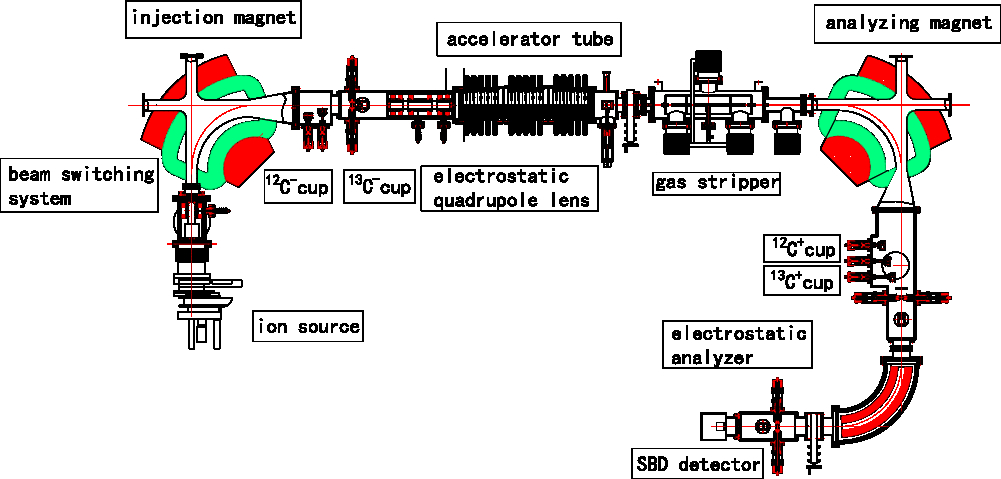
The layout of the single-stage system is shown in Figure 1. The system is a compact instrument of 2.3 × 3.9 m2 over all dimensions. The negative ion source, the 90º injection magnet and the electric quadrupole lens are located at 200kV voltage deck. A 40 sample NEC MC-SNICS negative ion source with extractor einzel lens is utilized. Just behind the ion source X-Y steerers are mounted and then a 90º double focusing dipole magnet with bending radius of 35 cm is utilized for low energy mass analysis and for injection of negative ions. The magnet chamber is electrically insulated and biased for injecting 14C–, 13C– and 12C– sequentially into the accelerator tube. At the image focal point of the injection magnet, adjustable X slits are installed and a movable Faraday cup is mounted behind the slits. Two movable offset Faraday cups which are located in front of the slits and near the image points of injection magnet are used to measure the beam currents of 13C– and 12C– respectively during 14C– injection. After the injection magnet, an electrostatic quadrupole lens is installed for focusing the beams through the acceleration tube and the molecule dissociating gas stripper canal. An air insulated accelerator tube is used to connect high voltage deck and ground potential between the electric quadrupole lens and the housing of the gas stripper canal. For improving the stability of the stripper gas pressure and the vacuum of outside the stripper canal, the charge exchange canal (50 cm long, diameter 6 mm) is located inside a differentially pumped housing instead of the first SSAMS system which has only a gas stripper canal and one pump. In order to depress scattering background, an additional pump is mounted between the stripper canal and analyzing magnet for improving the vacuum conditions. A precision needle valve is used to accurately control the gas flow and hence control the gas pressure in the canal. A vacuum gauge installed outside the stripper canal on an outer pumping chamber is used to measure the gas stripper pressure. Gas recycling is not used in this system to ensure the purity of the gas stripper. After the negative ions pass through the gas stripper, the positive ions analyzed by the high energy mass analysis system which consist of a 90º double focusing magnet and an electrostatic spherical analyzer (ESA) both with a 35-cm bending radius. Two offset Faraday cups are located near the image points of the magnet to measure the beam current of 12C+ and 13C+. Two adjustable X slits are set at the image point of the magnet and ESA to reduce the background of ions reaching the final detector. A surface barrier detector is used to measure 14C.
Layout of the single-stage AMS system.

EXPERIMENTAL CONDITIONS
The operating conditions of the system are briefly outlined as follows: The ion source cathode voltage and extraction voltage are set at 4 kV and 16 kV, respectively. Ions with extraction energy of 20 keV are transferred to the injection magnet. The high voltage deck is set at 180KV and a total ion energy of 200 keV is used for 14C measurement. Helium is used as stripper gas and the charge state of 1+ is selected for the higher transmission and higher yield the 1+ charge states (Schulze-König et al. Reference Schulze-König, Seiler, Suter, Wacker and Synal2011). Under these conditions, a series of experiments has been carried out for optimizing the performance of the system.
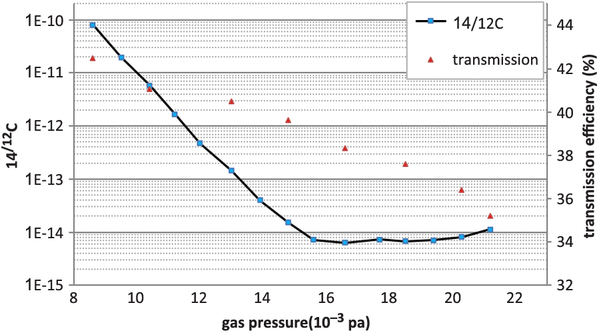
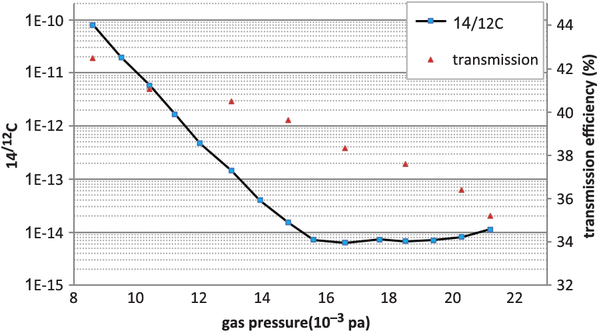
The transmission efficiency and the background level are the key points for the AMS measurement. The stripper gas thickness is strongly related to the transmission efficiency and the background level. The experimental results with a blank sample are shown in Figure 2. With increasing the gas stripper pressure corresponding to increase the thickness of stripper gas, an exponential reduction of molecules background is observed. However, at gas pressure as measured at the stripper housing of higher than 1.66 × 10⁻² Pa the exponential slope turns in to a plateau. The background level reach to 14C/12C = 6 × 10–15. With further increasing gas pressures, the 14C/12C ratios slightly increase again. The plateau background mainly comes from the scattered particles of 13C which injected as 13CH– in the injection magnet. The background level of 14C/12C = 6 × 10–15 and transmission efficiency of 38% have been achieve at the gas pressure of 1.65 × 10⁻² Pa. The transmission efficiency defined as the ratio between the 12C+ current just before the detector and the 12C− current after the injection magnet. In the following experiments, the gas pressure is set at 1.66 × 10⁻² Pa for the lower background and relative higher transmission efficiency. The performance of the system has been tested after optimizing the measurement conditions.
Transmission efficiency and background level are plotted as a function of helium gas stripper pressure. Blue squares represent the ratio of 14/12C, the 14 represents the sum of 14C+, 13CH+ and 12CHH+. Red triangles represent the transmission efficiency. (Please see electronic version for color figures.)
RESULTS AND DISCUSSION
Blank Samples Measurement
Blank samples were used to test the system detection limit. Blank samples produced from unprocessed graphite powder and blank samples processed in our graphitization line have been analyzed. We observe 14C/12C ratios between 6 × 10–15 and 1.5 × 10⁻¹⁴ depending on the actual content of 13CH molecules in the extracted ion beam. The results shown a linearity correlation between the background counts and the integrated beam current of 13C+ molecular fragments from the 13CH molecules. The integrate beam current of the 13C+ molecular fragments has been measured with the 12C+ Faraday cup after the high-energy analyzing magnet due to the 13C+ molecular fragments almost have the same magnetic rigidity as 12C+. Similar phenomena also found in MICADAS system (Synal et al. Reference Synal, Stocker and Suter2007). The obvious correlation indicates a background component proportional to molecular impurities in the mass 14 beam. This correlation is utilized to apply a background correction. On the other hand, decreasing the 13CH content is important for improving the detection limit. In order to decrease the content of 13CH, we use Zn to reduce CO2 to graphite instead of hydrogen, and the results show it can depress the content of 13CH. Using Mn to reduce CO2 to graphite for reducing the content of 13CH is also reported (Szidat et al. Reference Szidat, Jenk, Gäggeler, Synal, Hajdas, Bonani and Saurer2004). At present, the detection limit of 14C/12C = 6 × 10–15 can be established with the SSAMS system.
Standard Sample Measurements
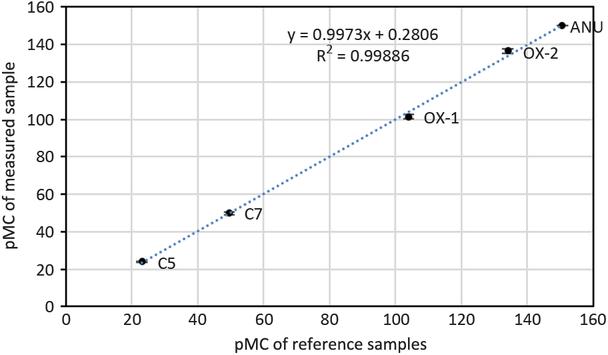
Five sets of samples covering different content of 14C standards were measured to check the performance of the SSAMS system. The standards samples of OXI (consensus value 104.51 pMC), OXII (consensus value 134.07 pMC), ANU (consensus value 150.61 pMC), IAEA-C7 (consensus value 49.53 pMC) and IAEA-C5 (consensus value 23.05 pMC) have been used. In all these measurements ANU samples have been used as AMS standards and the other samples have been treated as unknown samples. Each sample was analyzed in 6–8 runs of 200–300 s measurement time each and a typical counting statistics-based uncertainty of less than 1.5% was reached (internal uncertainty). The average of all the measurements for each sample were normalized to the average value of the ANU standard. The results are shown in Figure 3. As shown in the Figure 3, the measured values are consistent with their consensus values within the uncertainty and they have nice linearity among the standard samples. These results provide adequate quality and confidence in used of the SSAMS system for 14C measurement.
Comparison of the measured pMC values with the known reference sample values.

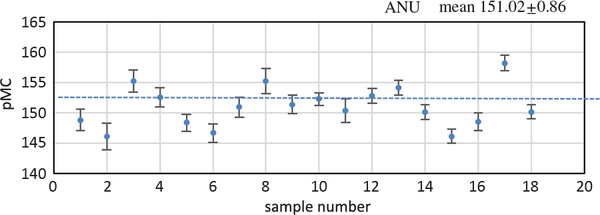
The long-term stability of the system has also been checked. The samples of ANU have been analyzed as unknown samples and normalized by OX-II standard samples neighbor in measurement time in the wheel. The results of one month measurement are shown in Figure 4. A precision of 0.57% was obtained based on the results. The mean value of the measurement data is 151.02 ± 0.86 pMC which, within the standard error, agrees well with the consensus value of 150.61.
Results of ANU reference samples over one month routine measurement.

13C/12C Measurement
The parameter of δ13C is necessary for real-time fractionation compensation during AMS measurements. The fractionation correction normally reduces the standard deviation of single measurements of one sample. The on-line δ13C measurement is based on the 13C/12C measurement with the AMS system. In order to check the capability of δ13C measurement, a preliminary experiment has been carried out. In our SSAMS system, the ratio of 13C/12C is determined by measuring the beam current of 12C+ and 13C+ with the two offset Faraday cup near the image points of the analyzing magnet by sequential injection 12C– and 13C– with injection magnet. The reproducibility of the measurements for individual cathodes is about 0.25% during 8 runs. The results also shown that each cathode has its own measurement value of 13C/12C and there is variation with increasing analysis time, these phenomena are partly due to time-dependent sputtering depth profiles and surface ionization potential variations during the sputtering processes. These are the common phenomena in AMS measurement (Salehpour et al. Reference Salehpour, Håkansson, Possnert, Wacker and Synal2016). The preliminary results show that the δ 13C can be measured with the SSAMS system. It will be used in the case of needing high-precision 14C measurement for δ 13C mass fractionation correction.
CONCLUSIONS AND OUTLOOK
The new home-made single stage AMS has been successfully established. The new system has better performance compared to the first SSAMS made at CIAE. Based on the new system, the measurement precision of about 0.5% for modern samples and background level of about 0.5 pMC for blank samples have been obtained. With following improvement of the quality of sample preparation, the performance of ion source and the stable beam current monitor system, the measurement precision can be improved and background level can be decreased further. Nowadays, the new SSAMS system has been operating steadily and routine samples measurement have been done. The applications in the field of the air pollution for analyzing the source of aerosol, biomedical for drug tracer and archaeology for dating of historical artifacts have been carried out. More applications will be carried out with the advantages of the easy operation and high throughput in the future.
ACKNOWLEDGMENTS
This work was partly supported by the National Natural Science Foundations of China (NSFC) under Grant No. 11705287, 11675269, 11575296, 11875326, and 11765004.