INTRODUCTION
An important debate in the language acquisition literature revolves around the extent to which children's semantic development is shaped by recurrent patterns in the input versus cognitive and perceptual sensitivities that children bring to the task of language learning (Gentner, Reference Gentner and Kuczaj1982; Slobin, Reference Slobin and Slobin1985). But increasingly, researchers are moving away from an ‘either-or’ dichotomy in thinking about these issues, suggesting that multiple factors play a role in shaping the course of language development. The challenge lies in identifying the relative contributions of the key factors that play a role at different stages in development. This study sets out to examine the relative weight of input properties and semantic transparency in children's acquisition of verb meanings. Data from children acquiring different languages constitute an important source of evidence allowing us to evaluate how input factors and early non-linguistic sensitivities interact in shaping children's acquisition of lexical meaning (e.g. Clark, Reference Clark2004).
The present study explores how children acquiring different languages learn to use verbs to label events involving a spatial distinction that they are sensitive to in the first year of life: the vertical versus horizontal orientation of objects (Bomba, Reference Bomba1984; Essock & Siqueland, Reference Essock and Siqueland1981; Quinn & Bomba, Reference Quinn and Bomba1986). If very young children are able to distinguish non-linguistically between two events based on object orientation – placing a bottle horizontally vs. vertically at a location – will they also find it easy to make a similar distinction linguistically by using distinct labels for the two events, e.g. ‘lay/stand the bottle on the table’? Or does children's ability to label such a spatial distinction rely on how often they have heard the distinction being made in the ambient language? Is it influenced by the semantic transparency of the labels – the ease with which object orientation can be inferred as a component of the meaning of these labels? All these factors are likely to influence acquisition, but the focus of this study is to determine whether any one of the factors has a more important role to play in children's acquisition of verb meaning.
To explore these issues, the present study focuses on how children and adults use ‘caused posture’ verbs (e.g. set/stand, lay) to label the vertical versus horizontal orientation of objects in placement events (e.g. putting an apple on a plate). Our study investigates children acquiring Dutch and Tamil, two languages that differ in the frequency with which caused posture verbs are used in the input, as well as their semantic transparency.
In languages like English or Tamil, a bottle placed on a table is typically labelled with a general verb such as put or veyyii. But in Dutch, caused posture verbs are habitually used to distinguish between placement events based on factors including (but not limited to) the orientation of the objects (e.g. Lemmens, Reference Lemmens, Stefanowitsch and Gries2006). Thus, a Dutch speaker is obliged to choose between zetten ‘set/stand’ and leggen ‘lay’ to label any given placement event depending on the disposition of the object with respect to the ground. A general verb plaatsen ‘place’ exists, but its use in colloquial speech is vanishingly rare.Footnote 1 The use of the monomorphemic ‘caused posture’ verbs is an unmarked, natural way for Dutch speakers to describe a wide range of placement events. So children acquiring Dutch have to learn to classify placement events into finer categories for the purpose of labelling them appropriately when talking about them.
Children acquiring a language such as Tamil learn to group together all placement events into one broad category since they often hear the same general ‘put’ verb being used to describe them. For instance, the general verb veyyii is typically used to describe a bottle placed on a table either horizontally or vertically. However, children also have to learn to distinguish placement events based on factors such as object orientation in order to appropriately use caused posture verbs such as nikka veyyii ‘make stand’ and paDka veyyii ‘make lie’. Caused posture verbs in Tamil are complex forms encoding caused position by use of the (light) verb veyyii as an auxiliary (which adds the notion of ‘cause’) following the infinitival form of an intransitive verb that specifies the position of the located object (Asher, Reference Asher1985).Footnote 2 Relative to Dutch, caused posture verbs are optional and infrequent in Tamil.Footnote 3
In addition to frequency of use, caused posture verbs differ in Dutch and Tamil with regard to their relative semantic transparency. We define the ‘semantic transparency’ of a verb as the ease with which its meaning components may be inferred. We operationalize the ‘ease of inferring meaning components’ in terms of two observable characteristics of caused posture verbs in the two languages: analyticity of form and the diversity of situational and discourse contexts in which they occur in the ambient language. With regard to form, Tamil maps the causal subevent and resulting orientation of the placed object onto two separate morphemes (e.g. nikka/paDka veyyii ‘stand/lie+cause’). The mapping of meaning onto separate morphemes may draw children's attention to those aspects of the structure of an event labelled by the morphemes nikka and paDka, respectively. In Dutch, the use of a single portmanteau morpheme (zetten or leggen) that conflates the causal and result subevents of an event may render the internal structure of the events labelled by the verb less available for inspection.
With regard to contextual diversity, Tamil uses caused posture verbs in a relatively narrow range of contexts. Typically, Tamil speakers use caused posture verbs in lieu of the general verb veyyii to mark a contrast in the vertical or horizontal orientation of two or more objects, or to remark on the non-canonical orientation of an object. For example, when describing a bottle lying down, Tamil speakers can use the general verb veyyii ‘put’ but are likely to use the caused posture verb paDka veyyii ‘make lie’ for this non-canonical orientation. When describing the bottle in its canonical orientation – standing vertically on its base – veyyii ‘put’ is the preferred option, not nikka veyyii ‘make stand’. But if the speaker wanted to remark on a contrast in orientation, e.g. ‘the bottle is standing, not lying down’, then nikka veyyii is used to describe the orientation of the bottle. In contrast, in Dutch, leggen and zetten are used as the unmarked option and in a wider range of contexts. The use of these expressions is determined not only by factors such as the vertical versus horizontal orientation of the located object, but also by additional factors, such as whether the located object is resting on its functional base (cf. Lemmens, Reference Lemmens, Stefanowitsch and Gries2006). For instance, expressions such as zet een bord op tafel ‘set a plate on the table’ is used because plates have a functional base, even though they have greater horizontal than vertical extent. Further, zetten may be used for objects that maintain a rigid extension along the maximal axis, even when non-vertical, e.g. ik zet even dit oortje terug (vast) aan het kopje ‘I set this handle back to the cup’ (=fix it to the cup again) (Lemmens, Reference Lemmens, Stefanowitsch and Gries2006: 6–7). The verb leggen may be used when the object is equally extended in all directions (e.g. a ball), and even for substances with no fixed shape (e.g. hier binnen allemaal hooi neerleggen ‘lay down all the hay here inside’).
In sum, the caused posture verbs in Tamil and Dutch differ in their frequency relative to the general ‘put’ verb within each language, and in their semantic transparency – the ease with which their meaning components may be inferred from their forms and their ranges of contexts of use. If input frequency exerts the stronger influence, then Dutch children will acquire the high-frequency caused posture verbs early and accurately since they have many opportunities to identify the dimensions of meaning underlying the use of distinct labels applied to placement event scenarios. But Tamil children will not distinguish vertical and horizontal placement events using low-frequency caused posture verbs as early and accurately as Dutch children since both kinds of events are typically labelled with the general ‘put’ verb in their experience.
On the other hand, if semantic transparency, as defined above, facilitates children's ability to infer the meaning components of even infrequently occurring verbs, children acquiring Tamil should easily learn to use caused posture verbs to label object orientation distinctions. But Dutch children should be at a disadvantage in acquiring monomorphemic and contextually diverse caused posture verbs to distinguish placement events on the basis of object orientation. They should use them later and less accurately than children acquiring Tamil.
The current research draws on (1) child-directed speech data from Dutch and Tamil corpora and (2) elicited production data. In Study 1 we examine patterns of caused posture verb use in child-directed speech. In Study 2 we investigate children's and adults' frequencies of use of placement verbs in an elicited production task, comparing children's verb frequencies in production with those in the input. We also explore patterns of verb extension for horizontal versus vertical placement events to examine whether Tamil- and Dutch-speaking children use the same verbs for the same scenes as adults in each language.
STUDY 1
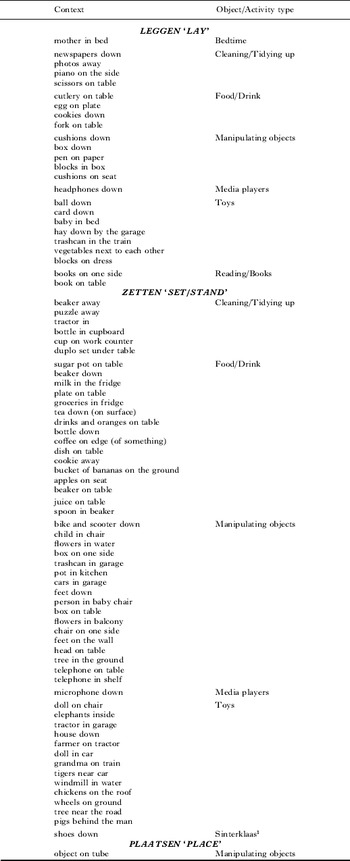
In this study we examined corpora of child-directed speech in Tamil and Dutch for use of placement terms and caused posture verbs. For Tamil we used twenty-five files in CHILDES (MacWhinney, Reference MacWhinney2000) from Vanita (aged 0 ; 9–2 ; 9) (Narasimhan, Reference Narasimhan1981). Thirteen files were also drawn from a Tamil corpus of two children from different families interacting with their caregivers at home (Ach, Ais; 1 ; 3–2 ; 2) collected by B. Narasimhan and R. Amritavalli (for details, see Senft & Smits, Reference Senft and Smits2000). For Dutch, we used 186 files in CHILDES from six different children (Abel, Daan, Josse, Matthijs, Peter, Tomas; aged 1 ; 5–3 ; 7) (Wijnen & Bol, Reference Wijnen, Bol, de Boer, de Jong and Landeweerd1993). The two corpora consist of spontaneous speech produced during interactions between children and their families and friends in home settings in relatively unstructured contexts. Since the placement of objects at locations is a ubiquitous practical activity across cultures, the types of contexts in which placement verbs are used in the two languages are similar, although the languages differ in which verbs are preferred to describe these situations (see Appendix A for examples of contexts of use of placement verbs in the two languages).
For the Dutch input corpus, we extracted utterances containing placement verbs using the CLAN program (MacWhinney, Reference MacWhinney2000). All three verbs (zetten, leggen, plaatsen) were extracted from the CHILDES files using an alphabet file that specified all inflected forms of the three verbs. A more general search was also conducted for all strings containing the root form of the three verbs. A second alphabet file was created based on the outputs of the two searches and non-placement verbs were excluded. The final output was generated using the second alphabet file. In the case of Tamil, the search function in Microsoft Excel was used to identify placement verbs. We searched for all words in the transcript with the string ‘ve’ or ‘va’ (to take into account spelling variants in the transliteration) for the general verb; and the strings ‘nik’ and ‘paD’ or ‘pad’ for the caused posture verbs. The output was then hand-pruned to remove instances that were not placement verbs.
We analyzed the corpus data in each language, examining the relative proportions of use of the general ‘put’ verb and the two caused posture verbs, respectively. We extracted all tokens of these types of placement verbs from the adult input, exclusively targeting concrete uses, that is, instances of placement verbs being applied to the caused movement of a concrete object such as a ‘ball’, ‘egg’, ‘tractor’, etc.
In Tamil (Table 1), the general ‘put’ verb veyyii massively predominates in the input to children across all age groups (between 93–100% of all instances). The caused posture verbs are vanishingly rare (9 instances in total).
Percentages of concrete uses of placement verbs (veyyii, nikka veyyii, paDka veyyii) in adult child-directed speech in Tamil across age groups

In Dutch (Table 2) zetten is used more often than leggen in the input to the youngest children (78·5% vs. 21%). Over time, the distribution becomes more balanced. The general verb plaatsen ‘place/put’ is used only once.
Percentages of concrete uses of placement verbs (zetten, leggen, plaatsen) in adult child-directed speech in Dutch across age groups

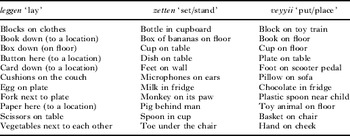
The examination of the patterns of use of the caused posture verbs in Dutch input also clearly shows that Dutch-acquiring children hear these verbs used in a wide variety of contexts, e.g. to describe the placement of ‘cup on table’, ‘spoon in cup’ or ‘fork next to plate’. This is different from Tamil, where the general verb veyyii ‘put’ is typically employed in similar kinds of contexts rather than caused posture verbs (see Table 3). The use of a caused posture verb in Tamil in such contexts is marked or even infelicitous, as, for instance, in ‘egg on plate’, ‘feet on wall’, ‘milk in fridge’, ‘toe under chair’, ‘microphones on ears’ (see Appendix A for further details of the contexts of placement verb use in the two languages).
Examples of contexts of use for caused posture expressions in Dutch input and the general placement verb in Tamil input

In the analyses in the following sections, we focus on concrete uses of placement verbs exclusively. Nevertheless, it is important to note that zetten and leggen are not only applied to a wider variety of contexts than their Tamil counterparts in their caused motion sense, but are frequently extended to non-motion contexts as well (for example ik zal het in de agenda zetten ‘I will put it in the agenda’). Many of the non-placement uses are idiomatic or metaphorical extensions, e.g. uitleggen ‘explain’, overleggen ‘discuss’, knoop leggen ‘tie a knot’, koffie zetten ‘make coffee’, uitzetten ‘turn off’, aanzetten ‘come up with, put on’, afzetten ‘turn off’, hoog zetten ‘turn up’, aan het werk zetten ‘set to work’, handtekening erin zetten ‘giving your signature’, and so on. Interestingly, zetten is not only more frequent than leggen when non-placement meanings are included in the counts (70% of all uses of caused posture verbs (N=1254)), it is also used more often with non-placement meanings (17·6% of all uses of zetten (N=876)) compared to leggen (9·8% of all uses of leggen (N=378)), a difference that is statistically significant (χ2 (1, N=1254)=11·82, p<0·001). We return to this point in the general discussion section at the end of the paper.
STUDY 2
In this study, we used a referential communication task (Krauss & Glucksberg, Reference Krauss and Glucksberg1977; Yule, Reference Yule1997) to elicit natural production data while maintaining control over the extensions of placement predicates. Participants described video clips depicting placement events to a confederate who selected a picture corresponding to the description. The dependent variable was the verb used to describe the placement event.
Participants
Participants were twenty-three children acquiring Tamil (aged 3 ; 11 to 6 ; 7) and twenty-six children acquiring Dutch (aged 3 ; 1 to 6 ; 0) recruited through a Tamil-medium school (Chennai, India), and a Dutch preschool (Molenhoek, the Netherlands). A median split of the Tamil children at age 4 ; 9 yielded two groups (age M=4 ; 2, N=13 and M=5 ; 7, N=10). Similarly, a median split of the Dutch children at age 4 ; 5 produced two groups (age M=3 ; 9, N=14 and M=5 ; 2, N=12). For ease of exposition, the child groups are referred to as ‘four-year-olds’ and ‘five-year-olds’. Additionally, ten adult native speakers of Tamil and ten adult native speakers of Dutch acted as controls.
Materials
The stimuli consisted of video clips of sixteen target events (duration M=6·8 s, SD=3·1 s) showing a female actor manually placing eight objects either in a vertical or horizontal position on a table top or a bookshelf (see Appendix B). Twenty filler events and three warm-up items were also included. All our test trials involve an object with a salient maximal axis being placed in a particular location in a vertical/horizontal orientation under the manual control of the agent that persists until the object comes to rest. The filler items depicted ‘non-core placement’ events such as placement of objects without a salient maximal axis (put cookie batter in tray) or uncontrolled motions (drop doll lying, flick coin). A set of still photos of the objects in the videos in their end locations was also produced. The stimulus clips were randomized and organized into two orders. Within each age group, the presentation of the stimulus order was counterbalanced.
Procedure
Participants were tested individually. Participants saw one video clip at a time on a laptop screen manipulated by Experimenter 1. Experimenter 2, who could not see the video screen, asked ‘What did the woman do?’ Based on the participants' descriptions, Experimenter 2 then had to choose the correct still image from the whole set of stills depicting the placement scenes and display it to the participant for confirmation. Experimenter 2 would occasionally select an incorrect picture to minimize feedback about the correctness of the children's answers. If participants gave a simple locative expression or an intransitive description (e.g. ‘the book is/lies on the table’), Experimenter 2 asked ‘What happened?’ or ‘What did the woman do?’ Adults controlled the computer themselves. The testing procedure was otherwise identical for adults and children. The entire testing session was audio- and videotaped.
Data treatment
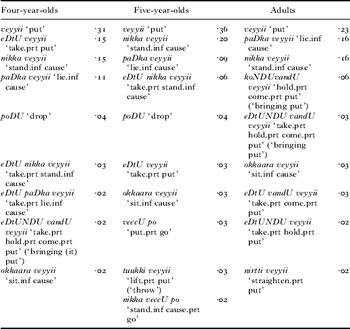
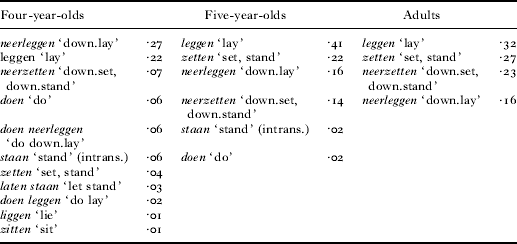
Native speakers of Tamil and Dutch transcribed the first spontaneous transitive description of each video clip in each language set (cf. Plumert, Ewert & Spear, Reference Plumert, Ewert and Spear1995). The predicates (participial and finite verbs) were selected for further analysis. Uses of the same verb with different tense/agreement properties were treated as identical. Where two utterances described the same scene with different object labels, the first one was selected. Finally, in cases of self-corrections and uninterpretable utterances, the first immediately following complete and/or interpretable description was retained. We list the placement expression types most frequently used (three or more tokens) per age group to describe the sixteen target scenes (proportions computed as verb type/total number of responses per age group) in Table 4 (Tamil) and Table 5 (Dutch).
Proportions of the most frequent placement expressions used for the sixteen scenes across the age groups in TamilFootnote 1

1 Omissions due to fewer than three tokens: Four-year-olds: 28 tokens (13%); five-year-olds: 17 tokens (11%); adults: 43 tokens (27%).
Proportions of the most frequent placement expressions used for the sixteen scenes across the age groups in DutchFootnote 1
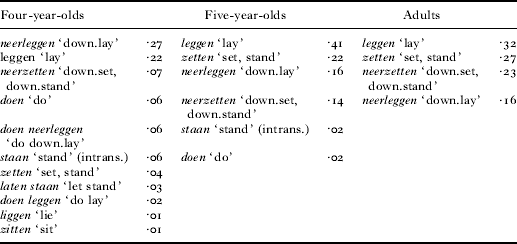
1 Omissions due to fewer than three tokens: Four-year-olds: 45 tokens (20%); five-year-olds: 8 tokens (4%); adults: 4 tokens (2%).
Coding
We first identified the most frequent verb forms produced by the adults in each language and grouped verbs for the sixteen target scenes into verb types. In Tamil, this led to four different verb types: veyyii ‘put’, nikka veyyii ‘make stand’, paDka veyyii ‘make lie’ and OTHER. In Dutch, the procedure yielded three verb types: leggen, ‘lay’ (with or without prefixes), zetten, ‘set/stand’ (with or without prefixes) and OTHER. These coding schemes were then applied to the child language data in each language. Mean proportions were calculated for each verb type by computing an arithmetic mean over the proportions of verb use per verb and participant. These were then arcsine transformed for statistical analysis (Howell, Reference Howell2002). Non-transformed values are reported in the figures and text.
RESULTS
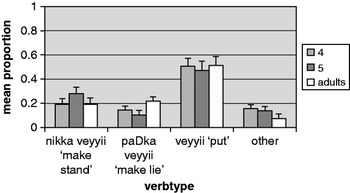
In Tamil (Figure 1), the general verb veyyii ‘put’ was on average most frequent for all groups, followed by nikka veyyii ‘make stand’ and paDka veyyii ‘make lie’, and finally by the OTHER category. A repeated-measures ANOVA with verb type as the within-subject factor and age as the between-subject factor revealed a significant main effect of verb type (F1(3, 28)=20·5, p<0·001, ηp2=0·69; F2(3, 19)=10·24, p<0·001, ηp2=0·62). Paired-samples t-tests (alpha level adjusted to 0·025 for multiple comparisons) showed that veyyii ‘put’ was used significantly more often than nikka veyyii ‘make stand’ (t(32)=−4·21, p<0·001), paDka veyyii ‘make lie’ (t(32)=−6·16, p<0·001) and OTHER verbs (t(32)=7·34, p<0·001). There was no significant interaction between verb type and age group, however. All age groups thus used all verb types to the same extent.
Mean use of nikka veyyii, paDka veyyii, veyyii and OTHER in Tamil for the sixteen target scenes across age groups (error bars=standard error).

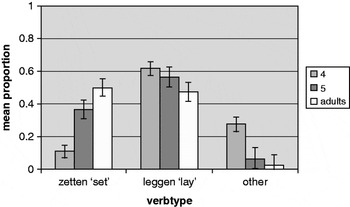
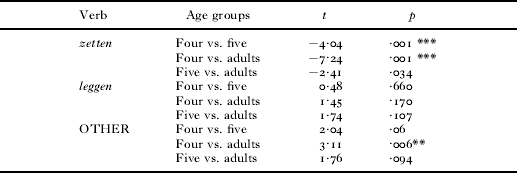
In Dutch (Figure 2), all groups mainly used the two caused posture verbs zetten ‘set’ and leggen ‘lay’ followed by a small number of OTHER verbs. There was a significant main effect of verb type (F1(2, 32)=23·24, p<0·001, ηp2=0·59; F2(2, 20)=108·0, p<0·001, ηp2=0·92), and a significant interaction between verb type and age (F1(4, 66)=6·25, p<0·001, ηp2=0·28; F2(4, 42)=10·49, p<0·001, ηp2=0·5). Independent samples t-tests (alpha level adjusted to 0·025 for multiple comparisons) used to explore the interaction are summarized in Table 6. They reveal that four-year-olds used significantly fewer instances of zetten than adults and so did five-year-olds (marginally), with four-year-olds using significantly fewer even than the five-year-olds. Four-year-olds also used significantly more instances of OTHER than adults, whereas the five-year-olds did not differ from adults in this respect. The groups did not differ in their use of leggen.
Mean use of zetten, leggen and OTHER in Dutch for the sixteen target scenes across age groups (error bars=standard error).

Summary of independent-samples t-tests for mean use of verb type by age in Dutch (equal variances not assumed, adjusted alpha level 0·025 for multiple comparisons). Significance marked by *
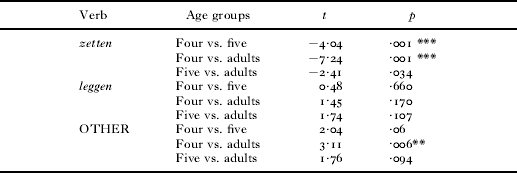
Overall, children's verb choices reflect the general preferences in adult usage in both languages. That is to say, in Tamil, caused posture verbs are less frequent than the general ‘put’ verb in all age groups, whereas in Dutch there is a predominance of caused posture verbs in all age groups. However, beyond this general observation, the picture is more complex. Tamil children, by age four, are similar to adults in how frequently they use both the general verb ‘put’ and the less frequent caused posture verbs. In contrast, Dutch children at age five are unlike adults in their significant under-use of zetten, although they do not differ in their use of leggen. Furthermore, the Tamil children's adult-like patterns of use of the highly infrequent caused posture verbs in the production task is a remarkable feat given how vanishingly rare they are in Tamil child-directed speech (see Table 1). Conversely, the Dutch children's verb use in the production task is strikingly different from that of adults given the predominance of the caused posture verbs in Dutch child input. In fact, the Dutch children's preference for leggen goes in the opposite direction from the overall dominance of zetten in the early input.
VERB USE IN THE PRODUCTION TASK – MEANING/EXTENSION
The final analysis focuses on the relationship between form and meaning, and examines whether children use the same verb forms in similar ways as adults for particular scenes. Although Tamil children match adult frequencies of use of the infrequent caused posture predicates, they may not apply them appropriately. Conversely, Dutch children who do not reproduce adult-like patterns of use of high-frequency verbs may still be sensitive to their meaning.
We grouped the target scenes by orientation into two groups of eight scenes each: horizontal and vertical placement. All verb responses, including inappropriate forms for a given orientation, went into the analysis. For each age group, the proportion of responses per verb type was calculated. We consider verb use for objects in each orientation separately.
Results – horizontal items
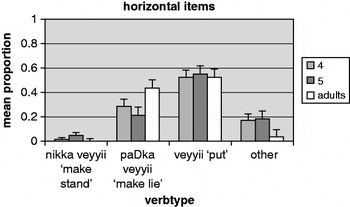
In Tamil the preferred verb choice for horizontal items should be the general verb veyyii or the caused posture verb paDka veyyii ‘make lie’. All age groups did indeed overwhelmingly use ‘put’ followed by ‘make lie’ (Figure 3). The child groups also used a few instances of OTHER verbs and, very rarely, ‘make stand’. One-way ANOVAs for each verb type with age group as the between-subject factorFootnote 4 revealed no difference between the groups in use of ‘put’, OTHER or ‘make lie’.Footnote 5 Overall, Tamil children, by age four, are already adult-like in their application of verbs to scenes of horizontal placement.
Mean use of nikka veyyii, paDka veyyii, veyyii and OTHER in Tamil for eight horizontal target scenes across age groups (error bars=standard error).

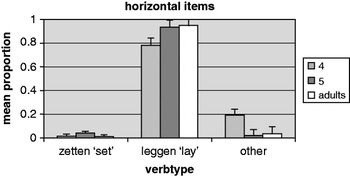
In Dutch, the typical verb choice for horizontal items should be the caused posture verb leggen ‘lay’. All age groups overwhelmingly used the verb leggen for items placed horizontally (Figure 4). The four-year-olds also used a sprinkling of OTHER verbs. A repeated measures ANOVA with verb type as the within-subject factor and age group as the between-subject factor revealed a main effect of verb type (F(2, 32)=189·2, p<0·001, ηp2=0·92). Paired-samples t-tests (alpha level adjusted to 0·025 for multiple comparisons) to explore the main effect showed that leggen was used significantly more often than both zetten (t(35)=−16·62, p<0·001) and OTHER verbs (t(35)=10·8, p<0·001), which did not differ from zetten. There was no interaction of verb type by age (F<1), indicating that Dutch children already use leggen for horizontal items as often as adults by the age of four.
Mean use of zetten, leggen and OTHER in Dutch for eight horizontal target scenes across age groups (error bars=standard error).

Results – vertical items
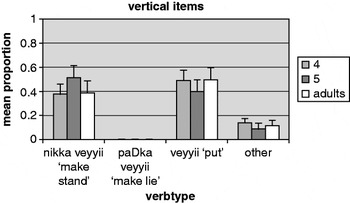
In Tamil, the typical verb choice for vertical items should be the general verb veyyii or the caused posture verb nikka veyyii ‘make stand’. All age groups predominantly used ‘put’, followed by ‘make stand’ (Figure 5). No group ever used ‘make lie’ for vertical objects. One-way ANOVAs for each verb with age group as the between-subject factor revealed no difference between the groups for any verb (F<1). Tamil children, by age four, are already adult-like in their application of verbs to scenes of vertical placement.
Mean use of nikka veyyii, paDka veyyii, veyyii and OTHER in Tamil for eight vertical target scenes across age groups (error bars=standard error).

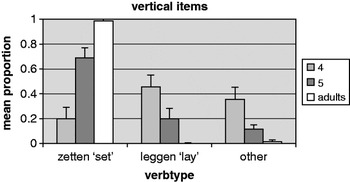
In Dutch, the typical verb choice for vertical items should be the caused posture verb zetten ‘set/stand’. Adults used this verb 99% of the time (Figure 6), but strikingly, the child groups rarely did. The four-year-olds instead used leggen ‘lay’ for almost half of the vertical items.
Mean use of zetten, leggen and OTHER in Dutch for eight vertical target scenes across age groups (error bars=standard error).

One-way ANOVAs for each verb with age group as the between-subject factor revealed a main effect of age for zetten (F(2, 35)=10·57, p<0·001). Independent sample t-tests indicated that four-year-olds (t(22)=−4·79, p<0·001) and five-year-olds used zetten significantly less often than adults (t(20)=−4·32, p<0·001), but that the child groups did not differ from each other. There was no difference between the four- and five-year-olds' use of leggen or of OTHER verbs.
On an individual level, all the Tamil children except three correctly distinguished horizontal from vertical placement in their uses of nikka veyyii and paDka veyyii (one four-year-old and two five-year-olds used nikka veyyiii ‘make stand’ in five scenes where the object was horizontally placed). They were thus consistent with adult language use for both orientations. The number of errors made by the three children was also low – between 1 and 3 in number. In the case of Dutch children, the picture is very different. Only three of the four-year-olds and three of the five-year-olds completely distinguished the orientations. Among the nine five-year-olds who committed errors, six children made 1–2 errors, and three children made 4–7 errors. In both groups, errors predominantly occurred for vertical placement (four-year-olds made 2/50 errors for horizontal versus 48/50 errors for vertical placement; five-year-olds made 4/23 errors for horizontal versus 19/23 for vertical placement). In the Dutch adult data only one orientation error occurred for a horizontal scene.
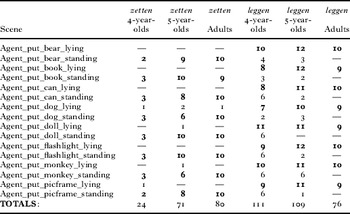
In sum, Tamil children are adult-like by the age of four. In both orientations they prefer the general ‘put’ verb, but apply ‘make lie’ and ‘make stand’ appropriately. In contrast, Dutch children are not adult-like even by the age of five. The verb leggen is overextended to vertical scenes, whereas zetten is underextended. Over time, the uses of zetten for vertical placement scenes increase but non-adult-like extension patterns remain even in the oldest children. Importantly, the over- and underextensions of the two verbs are evenly distributed across the scenes and are not driven by any individual placement event (see Table 7). That is to say, the overextension of leggen is seen across all vertical scenes. Conversely, although zetten is underextended, it is used for all vertical scenes.
Distribution of Dutch verbs zetten ‘set’ and leggen ‘lay’ across scenes in the elicited production task (correct verbs for a given orientation are in bold)

General discussion
This paper examined how children acquiring Tamil and Dutch learn to use verbs to label placement events, targeting both the frequency of use of verb forms and the extension patterns or the meanings of those verb forms.
The first study explored input frequency in child-directed speech in Tamil and Dutch. It revealed that Tamil children frequently hear the general verb veyyii whereas the caused posture verbs are rarely encountered. Dutch children, in contrast, hear the two caused posture verbs zetten ‘set’ and leggen ‘lay’ equally frequently, with somewhat more instances of zetten than of leggen at a younger age.
The second study investigated children's own production, comparing it to the input findings and to the production of adult native speakers. The first main finding concerns the frequency of use of verb types. The results showed that whereas children's overall frequencies of placement verb types appear to reflect the language-specific preferences of the adults, their use of the individual verb forms is not equally adult-like in the two languages. Tamil children already match both frequency distributions in child-directed speech and adult production in their use of the highly frequent ‘put’ verb, veyyii, and the infrequent caused posture verbs at age four. In contrast, Dutch children's production matches neither the frequencies in child-directed speech nor the adult production. Despite hearing the two caused posture verbs approximately equally frequently in the input, Dutch children as old as five consistently overuse leggen ‘lay’ although both leggen and zetten ‘set/stand’ are very frequent in adult production. If anything, children favour the less frequent of the two verbs.
The second main finding concerns the meaning of the verb types in terms of extension patterns. The results indicate that four-year-old Tamil children appropriately use paDka veyyii ‘make lie’ for horizontal scenes, and nikka veyyii ‘make stand’ for vertical scenes despite the low frequency of these verbs in the input. In contrast, five-year-old Dutch children still overgeneralize leggen to both horizontal and vertical scenes, and undergeneralize zetten despite the high frequency of these verbs. Interestingly, the errors are unidirectional; zetten is rarely used for horizontal placement scenes.
In sum, the patterns of use of caused posture verbs in children acquiring Tamil match the frequency distributions of caused posture verbs in the input as well as the spatial semantic distinctions that condition their use. That is, they alternate between use of the caused posture verbs and the general ‘put’ verb at the same rates as adults do, while respecting the distinction between horizontal and vertical placement events. Children acquiring Dutch do not match the input frequencies of the caused posture verbs, nor do they distinguish the horizontal–vertical categorical boundary that adults observe in their labelling behaviour. Further, the direction of children's overextension errors (overuse of leggen) appears not to be influenced by the higher frequency of zetten in child-directed speech in Dutch.
The cross-linguistic differences in the semantic developmental patterns of Tamil and Dutch children suggest that if children do have a prelinguistic sensitivity to object orientation that facilitates their ability to label the distinction between vertical versus horizontal placement events, it does not play a determining role. Tamil children's ability to infer the dimensions of meaning of verbs that are vanishingly rare in the input is a remarkable feat. But Dutch children's failure to accurately label vertical and horizontal placement events in their language, even though the terms are very frequent in the input, suggests that even a perceptually available distinction such as object orientation may fail to be identified as a component of verb meaning until quite late in development. Notice that the results from the Tamil-speaking four-year-old children show that Dutch children's difficulty cannot be attributed to a general cognitive inability to label the distinction between horizontal and vertical placement events at this stage in children's development.
The findings instead suggest that semantic transparency, defined here in terms of analyticity of form and variety in contexts of use, influences children's ability to infer the dimensions of spatial meaning in caused posture verbs more than input frequency. Tamil children distinguish between placement events on the basis of object orientation appropriately using verbs that are rarely used to make such distinctions in the input, whereas Dutch children are unable to make the same distinctions using verbs that are used frequently in the input to label such distinctions. Given prior research showing the facilitative effects of input frequency in acquiring the meanings of verbs (Theakston, Lieven, Pine & Rowland, Reference Theakston, Lieven, Pine and Rowland2002; Reference Theakston, Lieven, Pine and Rowland2004), we think it is unlikely that high-input frequency would be detrimental to children's ability to discern the semantic factors conditioning verb use. Rather, children's difficulty with inferring the meaning of the Dutch caused posture verbs may be attributed to the diversity of contexts in which they are used in the input (see Table 3 and Appendix A). As object orientation is only one of the features conditioning use of the two Dutch caused posture verbs, it takes time for children to fully work out the range of situations in which this factor influences the use of caused posture verbs, despite their frequency. Further, in our corpus of Dutch caregivers' input to children both caused posture verbs are used with non-placement senses relatively often: for zetten this amounts to 17·6% of the total uses of zetten (N=876), and for leggen it amounts to 9·8% of all uses of leggen (N=378). Finally, the conflation of cause and result in a single morpheme in Dutch may also contribute to the difficulty in inferring the semantic components of placement events. Further research is needed to investigate whether children have difficulties with the polysemy of these verbs by examining children's spontaneous uses of zetten and leggen in different contexts, including non-placement contexts.
One may argue that Dutch children know the appropriate verb meanings, but owing to the demands of speech production are unable to retrieve the appropriate verb and instead select another word from the same semantic domain (Huttenlocher, Reference Huttenlocher and Solso1974). Alternatively, their overextensions may arise from semantic reorganization reflecting increasing awareness of abstract semantic relationships (Bowerman, Reference Bowerman1978). However, processing difficulties and late errors should afflict Tamil children as well, but they do not. Moreover, contrary to typical late error patterns (Bowerman, Reference Bowerman1978: 982), the Dutch child overextensions intriguingly occur in only one direction, are found in both age groups, and are even more frequent than correct uses in the youngest children (cf. Gathercole, Reference Gathercole1982). Pending comprehension data (Thomson & Chapman, Reference Thomson and Chapman1977), these considerations suggest that Dutch children have early non-adult-like meanings for zetten and leggen.
A possible source of confusion in learning the meanings of the caused posture verbs in Dutch has to do with the use of directional particles. As Table 5 shows, children, like adults, are using neer ‘down’ as a (prefixed) particle with both zetten and leggen among their most frequent forms. The preponderance of the use of neer is also found in the input, constituting 90·1% of the 287 co-occurrences of placement verbs with particles (including prefixed and non-prefixed uses) in our corpus of Dutch caregivers' child-directed speech. Verbs such as neerzetten/neerleggen not only encode causation and the resulting orientation in the verb, but also the direction of motion (‘down’) in the particle. It might be argued that children's errors with the caused posture verbs arise from a tendency to focus on the direction of motion encoded in the particle, ignoring other dimensions of meaning encoded in the verb.
But a closer examination of the elicited production data reveals that there are fewer orientation errors overall in the uses of forms that co-occur with neer vs. forms that do not. Out of the 65 cases where there were orientation errors involving zetten and leggen, the verb+particle combinations were used erroneously less often (error rates: neerleggen 31%, neerzetten 3%, leggen 58%, zetten 8%). The directional particle neer therefore does not appear to be a source of confusion in children's attempts to unpack the meanings of the caused posture verbs.
Rather, children's difficulties may lie in understanding how to integrate the causal subevent and the result (orientation) state that constitute the placement event. Interestingly, when children encode the result state with an intransitive verb, they rarely make orientation errors. Out of a total of 22 uses of intransitive posture verbs (16 uses of staan ‘stand’; 3 uses of zitten ‘sit’; 3 uses of liggen ‘lie’), there is only one orientation error (with zitten). But when we look outside these 22 instances to examine cases where the children try to describe the causal event in addition to the result state, we find that children resort to a range of devices, some of which are innovative from an adult point of view (indicated with asterisks below). These include semantically compositional forms that combine an intransitive posture verb (e.g. staan/liggen/zitten ‘stand/lie/sit’) with a causative form, e.g. *doen staan ‘make stand’ (3 instances) and laten staan ‘let stand’ (7 instances). Examples of responses include: *Nu doet ie de foto staan. ‘now he makes stand the photo’, or de beertje laten staan ‘let the bear stand’. Interestingly, we do not find combinations of doen/laten with the intransitive verbs liggen and zitten. However, these verbs occur quite infrequently in our dataset – a larger corpus may better reveal the combinatorial possibilities of these verbs.
In two instances, the causal subevent is indicated in a separate phrase, for instance with a prepositional phrase as in En hij staat op de tafel. Met de hand van de mevrouw ‘And he stands on the table. With the hand of the lady.’ An interesting case involves the correct use of the intransitive verb to encode the result orientation of the object combined with incorrect use of the caused posture verb (11 instances), for instance, hij legt het poppetje op de tafel. Hij staat. ‘He lays the doll on the table. He [the doll] stands.’ These cases co-occur with instances where both intransitive and transitive verbs encode the same orientation, e.g. Staat een hondje recht. Die heeft de mevrouw neergezet ‘Stands straight a dog. The lady set it down.’ We find no combinations of intransitive and transitive verbs encoding contrasting orientations with the verbs liggen or zitten, again possibly because there are few instances of their use in our dataset.
In some cases the causal subevent receives double coding (18 instances); to describe a scene where a doll is placed on a surface in the standing position, the child says *Hij doet neerleggen. ‘He does lay down’. In other cases, the causal subevent is encoded with the verb doen alone, without use of the caused posture verb (18 instances). In 11 of these 18 cases, the verb doen ‘do/make’ is combined with a locational phrase: Hond. Liggen.*Die doet op de plank ‘Dog. Lie. She does on the board’; elsewhere it occurs without any specification of the final location of the object.
The use of periphrastic expressions or multiple clauses to describe causation and orientation is not frequent relative to the caused posture verb use, but the fact that such periphrastic expressions are employed, especially by the younger children, suggests sensitivity to the individual semantic components of causation and orientation. What is difficult is the packaging of these semantic components into monomorphemic verbs. That said, it remains a challenge to explain why children acquiring Dutch do not randomly alternate between the two caused posture verbs until they converge on appropriate patterns of use. Neither input frequency nor the generality of the meaning of the two verbs with respect to each other predicts why leggen is used as an overly general verb, while zetten is restricted to a subset of vertical placement events. The verb zetten is initially used more frequently than leggen in child-directed speech, and zetten is also identified by Lemmens (Reference Lemmens, Stefanowitsch and Gries2006) as having a more general meaning relative to a verb such as leggen, being used as a ‘default’ placement verb that means ‘put in canonical position’. But, as we discussed in the ‘Introduction’, the verb zetten is also more polysemous compared to leggen. Our analysis of verb use in child-directed speech reveals that zetten is used significantly more often with non-placement meanings (17·6%) than leggen (9·8%) in the input. Possibly, the more frequent use of zetten in non-placement contexts could explain why children prefer to apply leggen to placement events irrespective of distinctions in orientation. A more fine-grained investigation of the different contexts of use of zetten and leggen in caregivers' input is required to further illuminate these issues.
The relatively late acquisition of the horizontal/vertical distinction in Dutch children is unexpected given prior research suggesting that children acquire fine-grained language-specific spatial distinctions early (e.g. Brown, Reference Brown, Bowerman and Levinson2001; Choi & Bowerman, Reference Choi and Bowerman1991). But in order to be acquired, a particular semantic distinction must be ‘salient’ to the child. Our study shows that semantic transparency, rather than the frequency of linguistic forms in the input, facilitates the availability of a particular semantic contrast during verb learning.
Our cross-linguistic comparison also demonstrates that gradual, late acquisition of a semantic distinction in a particular language does not automatically imply that children are generally incapable of making surprisingly rapid and accurate inferences about meaning based on very little input. Rather, the type of input children receive may obscure a peceptually available semantic distinction or facilitate its rapid discovery as a component of verb meaning. In particular, a surprisingly strong influence is exerted by the semantic transparency of the expressions used to label a particular distinction. Only through further cross-linguistic comparison and more experimental work will we be able to assess the interplay of probabilistic factors such as input frequency, semantic transparency and prelinguistic biases in constraining development in other semantic domains.
APPENDIX A: EXAMPLES OF CONTEXTS OF USE OF PLACEMENT VERBS IN THE INPUT
DUTCH

1 Traditional winter holiday celebrated on St.Nicolas' eve.
Examples of utterances with placement verbs in Dutch
Food/drink:ik heb jouw thee daar neergezet ‘I put your tea over there’
Dinnertime:Matthijs, wil jij ook wat bestek op de tafel leggen? ‘Matthijs, could you also put some cutlery on the table?’
Toys:Ja, dan leg je die boven op de trein ‘Yes, then you put that one on top of the train’
Reading/Books:Nou moeten we deze boekje aan de kant leggen ‘Now we have to put these books aside’
Bedtime:Zal ik jou maar eens even in bed gaan leggen? ‘Shall I put you down in the bed now?’
Cleaning/Tidying up:Heb je hem netjes in de kast gezet? ‘Did you put it properly/neatly in the cupboard?’
Sinterklaas:Wat had je bij de kachel gezet? ‘What did you put next to the heater?’
Toilet training:Goed idee, moet ik jou eens even op de po zetten? ‘Good idea, should I put you on the potty now?’
Media players:ik leg even de microfoon goed ‘I'll lay the microphone down properly’
Manipulating objects:Leg er maar op ‘Just lay it on top’
TAMIL

Examples of utterances with placement verbs in Colloquial Tamil (verb in bold font)
Animate objects:anga veccUkaLUgano~ veLiiya ‘Putting (the fish) there outside, must wash (it)’
Body parts:eppiDi kai veppaabayandUkkiTTU? ‘How does (she) put her hand fearfully?’
Books/Writing:pensil enga Daa veccE? ‘Where did you put the pencil?’
Clothing:dressU vaaylE vekkakuuDaadU ‘Mustn't put dress in mouth’
Food/Drink:kukkar enga vekkanum? ‘Where should (one) put the cooker?’
Grooming:boTTu veyyii ‘Put a dot (on forehead)’
Household objects:uLLa veccirUDii cello~ ‘Put (the chalk) inside, dear’
Kitchen utensils:paTTU, spuunE vecciDu ‘Dear, put the spoon (away)’
Cleaning/Tidying up:angA veyyi ‘put (cleaning cloth) there’
Toys:anda bommai kiiLA veyyii ‘put that doll down’; ororu paappaavE nikka veyyii ‘stand the dolls (on the floor) one by one’
APPENDIX B: MATERIALS (TARGET ITEMS IN BOLD)