


Recent years have seen a spate of literature on featural markedness, with the development of substantive markedness hierarchies designed to capture cross-linguistic generalisations concerning the preference for certain sounds. At the same time, there has not been a careful and thorough testing of these markedness hierarchies with an eye towards determining phonological diagnostics for markedness, laying out predictions of the hierarchies, evaluating the hierarchies against a wide range of evidence and providing support for the ways in which substantive markedness constraints function in grammar. Claims about the substance of markedness tend to be based on criteria such as frequency and implication as well as various phonological processes such as neutralisation and epenthesis, but at every turn those claims have been subject to debate.
Paul de Lacy has entered into this debate, taking on an ambitious task in his book Markedness: reduction and preservation in phonology. This book grows out of his 2002 dissertation, but has much new to offer in both depth and breadth of theory and empirical coverage; as he points out in the preface, unlike his previous work, the book focuses on the competence–performance distinction (see below), determining markedness diagnostics, vowel markedness, conflation in place and comparison with other theories of markedness (p. xiii). In this extraordinarily detailed and empirically rich work, framed within Optimality Theory, de Lacy argues that substantive featural markedness is part of linguistic competence. There are pressures to preserve marked sounds, but at the same time pressures exist to turn marked sounds into unmarked sounds, as well as to collapse marked and unmarked sounds. He lays these principles out as four leading ideas, as follows (pp. 1–2):
(1)


In this book, de Lacy takes the reader on a journey through the complex and fascinating terrain of markedness: he reviews the major recent literature on markedness, he sets out diagnostics for markedness, he develops a new theory of markedness hierarchies, he studies a range of phonological phenomena (epenthesis, neutralisation, assimilation, vowel reduction, sonority-driven stress) and he examines over 150 languages, many of which he introduces to the theoretical literature.
De Lacy begins with an assumption that has been challenged in the literature (see, for instance, Battistella Reference Battistella1990, Hume & Tserdanelis Reference Hume and Georgios2002, Hume Reference Hume2003, Haspelmath Reference Haspelmath2006, among others): there is a formal phenomenon that can be identified as universal substantive markedness. He faces this challenge head on at the beginning of the book, identifying three major issues that confront a theory of universal substantive markedness, namely those listed as the first three leading ideas given in (1): markedness diagnostics do not always appear to work (competence-markedness (c-markedness) vs. performance-markedness (p-markedness)), marked elements may be favoured (preservation of the marked) and markedness distinctions can be ignored (markedness conflation).
Beginning in Chapter 1 with a discussion of the two types of markedness, de Lacy distinguishes markedness that is part of i-language (a speaker's internal knowledge of language; Chomsky Reference Chomsky1986), namely c-markedness, from other markedness effects, taking c-markedness as the core of what must be accounted for. Other markedness diagnostics fall under the rubric of p-markedness, and, de Lacy argues, these need not be accounted for by a phonological theory that takes i-language as its central concern, as these involve language use. P-markedness includes some of the diagnostics most frequently identified with markedness in the literature, including frequency (both cross-linguistic and within a language), diachronic change and language acquisition. These all involve factors external to i-language, and thus fall outside the scope of the book. In this book de Lacy focuses solely on c-markedness. The identification of two types of markedness has a long history, going back to Trubetzkoy (Reference Trubetzkoy1939), who distinguishes logical markedness from natural markedness. De Lacy's categorisation differs in a major way from Trubetzkoy's, however, in that de Lacy identifies featural substance as core in terms of both competence and performance, while for Trubetzkoy, logical markedness need not be related to featural substance in universal terms, but instead is related to phonological patterning within a system.
Considering c-markedness, then, de Lacy argues that frequently considered phonological diagnostics for markedness in fact must be divided into two types. First are diagnostics that he argues to be valid; some of these are summarised in (2) (p. 28).
(2)
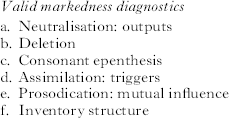
These diagnostics can be used to establish the substantive markedness hierarchies that de Lacy employs, discussed below. They have something in common with each other: in each case, the diagnostic is not subject to constraints on preservation of the marked, or faithfulness, but involve output constraints (traditionally called markedness constraints in the Optimality Theory literature) alone.
Second are phonological diagnostics that de Lacy argues are invalid for assessing markedness; several of these are given in (3) (p. 30):
(3)
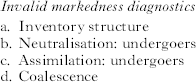
Some diagnostics are included in both the valid and invalid lists. The difference between the valid and invalid ones lies in the relationship to preservation: a diagnostic is not valid if faithfulness is involved, being ranked higher than relevant output constraints. For instance, with the output of neutralisation, preservation of the marked is not relevant; however, with the undergoers of neutralisation, a preservation constraint may be ranked such that a marked element is maintained, while a less marked element is subject to neutralisation. Rankings of pertinent output and preservation constraints are thus primary, with pure markedness arising only when the latter, faithfulness constraints, are ranked lower than the former, markedness constraints.
Critical to de Lacy's work is the establishment of markedness hierarchies, and he uses diagnostics of the type listed in (2) to establish these. Key to understanding hierarchies is the existence of a set of output constraints and a set of faithfulness constraints. The hierarchy that is perhaps the best studied, and forms the core of the book, is the Place of Articulation hierarchy, developed out of much previous work (e.g. Prince & Smolensky Reference Prince and Smolensky1993, Lombardi Reference Lombardi1998, Reference Lombardi2002, de Lacy Reference de Lacy2002 within the Optimality Theory tradition). De Lacy begins his study of place of articulation markedness with the following hierarchy, adapted from Lombardi (Reference Lombardi1998, Reference Lombardi2002).
(4) |dorsal>labial>coronal>glottal|
According to this hierarchy, glottals are least marked in terms of place of articulation, while dorsals are most marked. De Lacy then argues that this hierarchy is best formalised as a series of output constraints (markedness constraints) and faithfulness constraints (also called preservation constraints), as in (5) (pp. 2–3 and elsewhere).
(5)
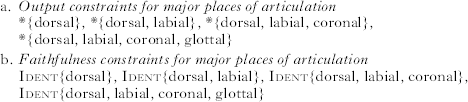
Considering first the output constraints in (5), these favour less marked elements – glottals in terms of place of articulation – as these incur fewer violations than the more marked coronals, which in turn incur fewer violations than the more marked labials, and so on. The dorsals violate each of the output constraints, and in this sense are the most marked. If an output constraint is ranked above a faithfulness constraint, markedness of dorsals will necessarily be reduced. These constraints, while not universally ranked, are in a subset relationship with one another.
A subset relationship holds between the faithfulness constraints as well, with dorsals being the most likely to be maintained: the faithfulness constraints all function to preserve dorsal, while only a single markedness constraint functions to preserve glottal. In Chapter 2, de Lacy develops a formal theory of constraints, with detailed discussion of how markedness hierarchies can be constructed.
Markedness is visible in many processes, as outlined in (2), and Chapter 3 is a study of reduction in markedness, where output constraints play the critical role. De Lacy begins with a discussion of consonant epenthesis, identifying a number of possible epenthetic elements: [ʔ t h N n r j w]. (Note that the symbol ‘N’ represents what de Lacy argues to be a glottal nasal; it is frequently confused with the dorsal nasal but is, he proposes here and in his 2002 thesis, distinct.) Setting the glide [w] aside for the moment, these potential epenthetic segments are all coronal or glottal in terms of place. Abstracting away from manner of articulation and considering only place of articulation, glottal epenthesis is straightforward to achieve. The following tableau illustrates glottal epenthesis in Mabalay Atayal (Austronesian) (p. 85).
(6)
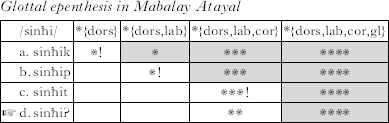
In this tableau, only output constraints are included; preservation constraints are not relevant in epenthesis. Note that glottal epenthesis is preferred, as a glottal violates only one of the output constraints, while each of the other places of articulation cause violations of at least one additional output constraint. (I focus only on the quality of the epenthetic segment here; I ignore numerous other constraints introduced by de Lacy to motivate epenthesis. See his work for a far more detailed analysis.)
One might expect that only glottal epenthesis would be possible, yet epenthesis of coronals is also found in languages. Again I focus solely on achieving a segment of the appropriate place of articulation, setting aside the other constraints that de Lacy motivates to account for the presence of an epenthetic segment. In an examination of epenthetic [t] in Axininca Campa (Arawakan), de Lacy argues that [t] as well as glottal stop can be epenthetic due to constraint conflict: the place hierarchy favours glottals, as in (4) and (5a). However, there is a second hierarchy, the sonority hierarchy, which interacts with the place of articulation hierarchy. The sonority hierarchy favours the coronal stop over the glottal stop since, de Lacy argues, coronals are considered to be less sonorant than glottals (de Lacy cites a number of sources for the high sonority of glottals, and provides phonological evidence for this position from transparency and sonority distance effects as well as coda constraints; see pp. 95–96). If a position prefers a less sonorant element, then a coronal will be chosen over a glottal despite the fact that the coronal is more marked in terms of place of articulation. Axininca Campa and Mabalay Atayal differ in their rankings of constraints that require low sonority elements in a particular prosodic position with respect to place of articulation constraints: in the former the glottal is eliminated as epenthetic because of higher-ranked sonority preferences; in the latter the relevant sonority preference constraints are ranked lower than the place of articulation constraints, allowing the place of articulation constraints to be unimpeded. Thus constraint conflict yields different results, both of which follow from markedness considerations.
What about the epenthetic [w]? It is clear why glottals and coronals can be epenthetic. Given the discussion above, it is not difficult to guess why [w] might be able to be epenthetic: there must be some other constraint or constraint hierarchy that interacts with the place of articulation hierarchy and functions to eliminate both the glottal and the coronal. An epenthetic [w] is found in Chamicuro (Arawakan) and, as expected, de Lacy argues that conflicting hierarchies make this the least marked segment available as epenthetic (pp. 106–107). A glottal is banned as epenthetic because of a high-ranked constraint prohibiting this high-sonority item in the relevant position. This combines with a constraint that requires that the epenthetic segment be an approximant. A palatal glide is disallowed because of a constraint *[—anterior]. A constraint rules out a liquid. Thus [ʔ h j l] are not allowed as epenthetic; [w] emerges as the winner because these other segments are ruled out by independently motivated constraints. Basically, the constraint *[—anterior], ranked above the output constraint *{dorsal, labial}, forces the next available place of articulation – labial – to emerge.
While it is possible for [w] to be epenthetic – through the introduction of an output constraint against the feature [anterior] that is not really motivated in the book (why is the palatal glide not simply a coronal glide?; what motivates the feature [—anterior] in addition to [coronal] on this glide?) – not anything can be epenthetic, and the theory makes strong predictions about segments that should never be epenthetic. In particular, there should not be an epenthetic [p] or an epenthetic [k]; there should not be an epenthetic [m] or an epenthetic dorsal nasal. Considering [p], the labial stop could be epenthetic if both [t] and glottal stop were eliminated through conflicting constraint hierarchies, in a way similar to how [w] is able to emerge as epenthetic when a glide is judged to be the optimal manner based on constraint ranking and the palatal glide is unavailable. However, de Lacy argues that there is no markedness hierarchy in which [p] is less marked than [t]: they are the same in terms of sonority, and [p] is more marked in terms of place of articulation. Thus while [t] can be favoured over glottal stop, [p] will not be favoured over [t]. Similarly, dorsals should never be favoured as epenthetic segments, as no constraint hierarchy has these as less marked than the other places of articulation.
Is this claim empirically adequate? Are there other consonants than those that de Lacy identifies that can be epenthetic? There are a number of cases of velar epenthesis that are reported in the literature. These include Buriat (Altaic; Poppe Reference Poppe1960) and Mongolian (Altaic; Svantesson et al. Reference Svantesson, Tsendina, Karlsson and Franzén2005), as well as Mandarin Chinese (Duanmu Reference Duanmu2000) and Carrier (Athabaskan; Prunet Reference Prunet1990). While de Lacy reanalyses Buriat, arguing that the segment analysed as an epenthetic velar is in fact not truly epenthetic but is present for morphological reasons, each of these cases would require careful study.
In Chapter 3, de Lacy also examines the output of neutralisation, again arguing that markedness reduction is found. Neutralisation has long been taken as a markedness diagnostic, since Trubetzkoy's (Reference Trubetzkoy1939) early work on markedness. De Lacy argues that the output of neutralisation provides a valid neutralisation diagnostic, since preservation does not interfere. In a survey of the outputs of neutralisation, de Lacy argues that the only outputs of neutralisation of place of articulation are glottal and coronal. Neutralisation to glottal is quite straightforward to account for. An example comes from Malay (Austronesian), where /k/ neutralises to [ʔ] in a coda, while /p/ and /t/ remain. The neutralisation of /k/ is shown in (7) (p. 113).
(7)

The high ranking of the output constraint *{dorsal} rules out the maintenance of [k] in a coda; it is realised as a glottal stop, no matter how the other constraints are ranked, for reasons discussed above. The failure of /p/ and /t/ to neutralise is also accounted for by this ranking, as shown in (8) for /p/ (p. 114).
(8)
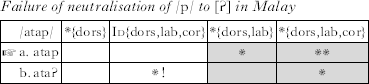
Because the constraint requiring identity to labial place of articulation is ranked higher than the output constraint against labial place, the labial place is maintained. Thus the most highly marked place of articulation neutralises, while others do not.
Neutralisation to coronal place of articulation is also possible by a device similar to that discussed for epenthesis: glottals are banned in certain positions. Again the intersection of different hierarchies leads to different results.
Just as epenthesis should not result in labials or dorsals generally, unless there are conflicting hierarchies, neither should neutralisation. De Lacy addresses a number of cases in which epenthesis and neutralisation have been argued to yield places of articulation other than coronal and glottal. De Lacy argues that such cases can be attributed to misapplication of the terms epenthesis and neutralisation, and misanalysis of morphological phenomena (he also argues that cases of glottal N are misidentified as velar). In terms of the former, de Lacy argues that synchronic alternations are necessary to evaluate potential counterexamples. Both parts of this phrase – synchronic (not diachronic) and alternations (not static patterns) – are required to assess whether markedness is involved, and de Lacy contends that some apparent counterexamples to his claims must be eliminated because they do not meet these criteria. In terms of misanalysis, de Lacy argues that some cases of apparent epenthesis of labials and dorsals disappear when a more careful morphological analysis is done; Buriat dorsal epenthesis is accounted for in this way.
Despite de Lacy's careful examination of potential counterexamples, one must again question whether the survey actually lays out the full range of facts cross-linguistically. First, with respect to epenthesis, are the reported cases of epenthesis of a velar consonant, noted above. Second, there are cases of neutralisation to places of articulation other than glottal and coronal, cases where synchronic alternations exist. There are languages in which nasals neutralise to [m] in word-final position; for instance in Manam (Austronesian; Lichtenberk Reference Lichtenberk1983), Sentani (Papuan; Cowan Reference Cowan1965) and Miya (Chadic; Schuh Reference Schuh1998), among others, there are alternations between underlying distinct places of articulation in nasals and surface [m] or [ŋ]. In Manam, /m n ŋ/ surface as either [m] or [ŋ] in certain positions of neutralisation, while in Miya and Sentani the labial and coronal nasal both occur in morpheme-final position, and both neutralise to [m] or [ŋ] word-finally. Similarly, as de Lacy points out, neutralisation to [k] should not be possible, but there are dialects of East Finnmark Saami where neutralisation of /p t k/ to [hk] in prepausal position is reported (Nielsen Reference Nielsen1926) and other cases of neutralisation to velars are reported (for example, in Toba Batak (Austronesian; Nababan Reference Nababan1981) stops neutralise to [k] before a sonorant; in Carib of Surinam (Cariban; Hoff Reference Hoff1968) stops neutralise to a velar fricative (Hoff Reference Hoff1968; interpreted by Gildea Reference Gildea1995: 65 as an uvular fricative and, de Lacy speculates on page 134, perhaps an [h]), before an obstruent). Thus, despite the remarkable breadth of languages that de Lacy considers in the book, and despite the reanalyses that he proposes for a number of languages that eliminate them as counterexamples, there nevertheless remain languages with neutralisation to and epenthesis of labials and dorsals that appear to be more difficult to explain away based on conflicting hierarchies or various kinds of misanalysis. Such cases suggest that the gaps in outputs of neutralisation and epenthesis that are predicted by the theory developed in this book may well not be gaps, but rather that such patterns are found in some languages. Again, further study of the languages is required.
While Chapter 3 deals with markedness reduction, Chapter 4 addresses the flip side, markedness preservation. Output constraints are most important in attaining reduction to the unmarked, and preservation constraints ensure preservation of the marked. Thus, if an identity constraint for a velar is ranked above the output constraint militating against this place of articulation, the velar will remain; a coronal may nevertheless neutralise if the output constraint that includes [coronal] is ranked above the identity constraint on coronal. De Lacy shows that a wide range of possible inventories can be produced as a result of place of articulation neutralisation: the major restriction is that either a glottal or a coronal must be included. He argues that there are only three gaps: with respect to stops, an inventory in a position of neutralisation consisting of just [p k], just [k] or just [p] is not possible if stops of the other places of articulation neutralise to one of these.
Again, it is necessary to ask whether the generalisation that neutralisation inventories of [k], [p] and [p k] are not possible is correct. Some such inventories, consisting of just a velar stop or a velar fricative, are identified in the discussion above. There are inventories in which only a labial is possible in a neutralisation position as well; see the discussion of languages such as Manam above. Finally, there are languages with [p k] alone. In some South Vietnamese dialects, after long vowels, only [p k] (and corresponding nasals) are found, while after short vowels further places of articulation are available (Pham Reference Pham1997). This case does not meet the criterion of synchronic alternation, so would perhaps be dismissed. There are a number of other languages with just [p k] in a neutralisation position; these include some Tibetan dialects (Denwood Reference Denwood1999) and Kana (Cross River; Ikoro Reference Ikoro1996), among others. Again, these would likely be rejected as not involving synchronic alternations. At the same time, the surface inventories do not include a coronal or glottal stop in the neutralisation position.
Just as undergoers of neutralisation do not reveal pure markedness, neither do targets of assimilation: again preservation of the marked potentially plays a very important role. De Lacy shows that unmarked elements can be targets: coronals are well known in the literature as targets of assimilation, as discussed in the literature on coronal underspecification. When coronals assimilate to the exclusion of other places of articulation, this is attributed to preservation of the marked place of articulation within the cluster. However, the reverse pattern is also possible: undergoers of assimilation may be marked rather than unmarked. For instance, in Sri Lankan Portuguese Creole, dorsals and labials undergo assimilation, while coronals do not (Smith Reference Smith1978). De Lacy attributes such effects to markedness constraints on clusters: essentially these constraints favour homorganic clusters and value clusters with less highly marked segments over those with more highly marked segments. While in some ways of looking at featural markedness, undergoers of assimilation are considered to be unmarked (e.g. Rice Reference Rice1999), for de Lacy, undergoers can be either unmarked or marked, and thus do not provide a valid diagnostic for markedness.
De Lacy discusses conflation in Chapters 5 and 6, focusing on the collapse of markedness distinctions in markedness reduction (Chapter 5) and in markedness preservation (Chapter 6). In Chapter 7 he addresses vowel markedness, identifying several conflicting hierarchies that obscure markedness effects in epenthesis and neutralisation with vowels. He claims, nevertheless, that there are certain impossible patterns of epenthesis and neutralisation. In particular, epenthesis of a round vowel is not possible – epenthetic vowels are restricted to central vowels and front vowels of any height and, perhaps, back unround vowels. De Lacy proposes that languages that have been argued to have epenthetic round vowels have been misanalysed. In particular, he examines Seediq (Austronesian), where it has been claimed that [u] is epenthetic (Holmer Reference Holmer1996); on the basis of instrumental analysis, he argues that the vowel is better analysed as schwa, at least in normal speech. He also addresses claims for epenthetic round vowels in Dravidian languages, suggesting that these are likely not round. In a study of epenthetic front round vowels in French, he cites recent research that suggests that the epenthetic vowel is not of the same phonetic quality as the underlying front round vowels. Nevertheless, there are a number of other languages in which there are reported to be round epenthetic vowels; these include Buol (Austronesian; Zobel Reference Zobel, Adelaar and Himmelmann2005) and Kambera (Austronesian; Klamer Reference Klamer1998, Reference Klamer, and 2005). While languages with round vowels as epenthetic are certainly not common, and are perhaps subject to alternative analyses, such cases are definitely reported in the literature, and they call into question the claim that the substance of the markedness hierarchies is universal.
In the final major chapter of the book, de Lacy summarises the predictions of the proposed theory and compares it with other theories of markedness, arguing that it is superior on empirical grounds as well as being more restrictive. In particular, he challenges theories that claim that markedness does not exist in the sense of the competence mechanisms proposed in the book (e.g. Blevins Reference Blevins2004 on Evolutionary Phonology), and he argues against theories of representational complexity as markedness (e.g. Rice Reference Rice1996) as well as against contrast-based theories of markedness (e.g. Rice Reference Rice1999, Reference Rice and Lacy2007, Causley Reference Causley1999) and comparative markedness (McCarthy Reference McCarthy2003), and addresses other recent debates in markedness as well (e.g. the claim of Howe & Pulleyblank Reference Howe and Douglas2004 that markedness hierarchies are expressed through faithfulness constraints). He brings a wealth of additional data to these evaluations, examining a wide range of consequences of each of these theories. As one might imagine, the critiques offered by de Lacy are open to debate, and this chapter will be far from the end of the debate on how to account for markedness effects if, in fact, such effects even exist in a universally substantive way. De Lacy treats the alternative hypotheses with respect, and raises numerous questions for debate.
This book represents a masterful development of a detailed theory of substantive markedness – it is a true tour de force. It is thorough, with very careful attention to detail of both theory and languages. The work is creative and original; it is intellectually challenging, and it is worthy of very careful study – each time I return to the book I discover in it things that I had not absorbed on the previous reading. Nevertheless, many many questions arise. I have focused on predictions of the theory, pointing out that it is unclear that the generalisations hold up; if so, the basic foundations of the theory are called to account. It would be possible to critique the work on theory-internal grounds as well. It is not clear whether the narrow definition of markedness – as de Lacy says in the conclusion ‘The key to understanding markedness is in determining what the term refers to’ (p. 408), with ‘synchronic Competence-related phenomena that are not influenced by preservation’ defining markedness – is one that will be generally adopted. As de Lacy says: ‘I think it is a safe prediction that the concept of markedness will continue to be controversial’ (p. 408).
The division of markedness into two types by de Lacy, c-markedness and p-markedness, seems appropriate to me, although some might dispute this. The question in my mind is whether the more phonological notion of markedness – de Lacy's c-markedness – is truly based in substance, or if it is a more abstract notion, based in asymmetries rather than in contentful hierarchies. While de Lacy does an extraordinary job of arguing against counterexamples to his claims, counterexamples keep popping up as one reads grammars. Will these counterexamples all disappear through reanalysis? This is not clear, and it could be that the occasional cases of velar epenthesis and neutralisation to labial and velar cannot all be argued away and must be taken seriously, leading to a major rethinking of the theory. De Lacy provides much food for thought.Footnote 1


