

INTRODUCTION
Among the many underpinning problems in managing and utilizing human resources, desired employee performance attainment is increasingly becoming a ubiquitous issue of contemporary organizations. This issue intensifies with the advent of steep competitive work environments marked with industry consolidation (Basu, Mohanty, Bhaskaran, & Ahmad, Reference Basu, Mohanty, Bhaskaran and Ahmad2016; Business Standard, 2018, april). In this globalized world, obtaining competitive advantage primarily through technological advancements and financial resources is becoming increasingly difficult. Technological and financial resources have become easily replicable (Luthans & Youssef-Morgan, Reference Luthans and Youssef-Morgan2017). However, it is difficult to replicate individual psychological resources among organizations. Therefore, psychological resources play a key role in sustaining and augmenting competitive advantage.
It is axiomatic that employee performance attainment is a major concern in the corporate sector, but what propels one to perform better than the other? It is not only compensation or skills that drive an employee to perform better. Campbell, McCloy, Oppler, and Sager (Reference Campbell, McCloy, Oppler, Sager, Schmitt and Borman1993) argue that performance is not solely dependent on effort but what factors drive one to put in the required persistent effort is an intriguing issue. Therefore, it is imperative to understand the underlying positive factors that could contribute to employee performance in this dynamic work environment.
Perceived organizational support (POS) reflects ‘employees global beliefs concerning the extent to which the organization values their contributions and cares about their well-being’ (Eisenberger, Huntington, Hutchison, & Sowa, Reference Eisenberger, Huntington, Hutchison and Sowa1986: 501). Considerable research has examined the direct relationships of POS with work outcomes (e.g., Rhoades & Eisenberger, Reference Rhoades and Eisenberger2002; Riggle, Edmondson, & Hansen, Reference Riggle, Edmondson and Hansen2009). However, review of the extant literature on POS suggests that there is a dearth of research aimed at examining underlying mechanisms and boundary conditions (moderated-mediation investigation) of the relationship between POS and performance (Kurtessis, Eisenberger, Ford, Buffardi, Stewart, & Adis, Reference Kurtessis, Eisenberger, Ford, Buffardi, Stewart and Adis2017; Rhoades & Eisenberger, Reference Rhoades and Eisenberger2002; Riggle et al., Reference Riggle, Edmondson and Hansen2009). Meta-analysis results suggest that POS studies accounted for a very small variance with performance (Riggle et al., Reference Riggle, Edmondson and Hansen2009). This small variance could be possibly attributed to individual factors like positive motivational propensities arising from psychological resources that might not have been taken into consideration while conducting studies on POS and performance. Drawing upon organizational support theory (Aselage & Eisenberger, Reference Aselage and Eisenberger2003; Eisenberger et al., Reference Eisenberger, Huntington, Hutchison and Sowa1986; Eisenberger & Stinglhamber, Reference Eisenberger and Stinglhamber2011), we propose that employees’ favorable perception of organizational support would help in nurturing positive psychological resource (i.e., psychological capital [PsyCap]; Luthans, Avolio, Avey, & Norman, Reference Luthans, Avolio, Avey and Norman2007), which in turn would encourage and motivate for performance. Therefore, one of the objectives of this study is to advance our understanding on the underlying mechanisms (mediating role) of psychological resource (PsyCap) on the relationship between POS and performance.
Furthermore, based on social exchange theory (SET), scholars argue that human relationships with the organization do not necessarily occur unilaterally and unconditionally. Instead, human relationships depend on the relevant perceptual factors and situations that may strengthen or weaken the job attitudes and work outcomes (Cropanzano, Anthony, Daniels, & Hall, Reference Cropanzano, Anthony, Daniels and Hall2017; Cropanzano & Mitchell, Reference Cropanzano and Mitchell2005; Rigotti, Reference Rigotti2009). Hence, with the lens of SET, we attempt to investigate the moderating role of organizational justice perception in the indirect relationship of POS and performance via PsyCap. Figure 1 depicts the hypothesized moderated-mediation model. The premises of this hypothesized model are grounded in sound theoretical support and they are discussed in the hypotheses formulation section.
Hypothesized moderated-mediation model

This study endeavors to make both theoretical and pragmatic managerial contributions. First, by examining the underlying mediating process on the relationship between POS and performance, this study advances our understanding in terms of the individual positive psychological differences that account for the relationship between POS and performance. Second, this study sheds new insights on the moderating effect of contingent factor (e.g., organizational justice) perception in the indirect relationship of POS and performance via PsyCap. Third, a review of extant literature suggests that the majority of POS and its correlates have been studied in the Western context. Scholars are univocal in their argument that for asserting generalizability of a construct, multiple studies need to be conducted across different cultures and contexts. Toward this assertion, scholarly arguments are put forth under the ambit of generalizability theory (Cronbach, Gleser, Nanda, & Rajaratnam, Reference Cronbach, Gleser, Nanda and Rajaratnam1972), context theory (Johns, Reference Johns2006), cultural dimensions (Hofstede, Reference Hofstede1980), and Gelfand, Erez, and Aycan's (Reference Gelfand, Erez and Aycan2007) work on cross-cultural organizational behavior. Therefore, as this research is conducted in Indian and Indian society being collectivistic in nature (Hofstede, Reference Hofstede1980), this research merits attention.
THEORETICAL BACKGROUND AND HYPOTHESES DEVELOPMENT
POS and Psychological Capital
POS is defined as ‘employees global beliefs concerning the extent to which the organization values their contributions and cares about their well-being’ (Eisenberger et al., Reference Eisenberger, Huntington, Hutchison and Sowa1986: 501). POS is strongly contingent on employees’ attributions with regard to the organization's intention behind the treatment (favorable or unfavorable) they receive from the organization (Kurtessis et al., Reference Kurtessis, Eisenberger, Ford, Buffardi, Stewart and Adis2017). POS reflects the social exchange process in which employees feel a sense of obligation to help the organization for accomplishing its objectives, in return of the economic and socioemotional benefits they receive (Cropanzano & Mitchell, Reference Cropanzano and Mitchell2005; Kurtessis et al., Reference Kurtessis, Eisenberger, Ford, Buffardi, Stewart and Adis2017). Similarly, employees also tend to believe that increased effort from their side would lead to greater rewards (Kurtessis et al., Reference Kurtessis, Eisenberger, Ford, Buffardi, Stewart and Adis2017).
Luthans, Youssef-Morgan, and Avoilio (Reference Luthans, Youssef-Morgan and Avolio2007: 3) defined PsyCap as: ‘an individual's positive psychological state of development characterized by: (1) having confidence (self-efficacy) to take on and put in the necessary effort to succeed at challenging tasks; (2) making a positive attribution (optimism) about succeeding now and in the future; (3) persevering toward the goals, and when necessary, redirecting paths to goals (hope) in order to succeed; and (4) when beset by problems and adversity, sustaining and bouncing back and even beyond (resilience) to attain success’. In simple words, PsyCap is conceptualized as a higher-order core construct consisting of self-efficacy, optimism, hope, and resilience (Luthans et al., 2007). Conceptually and empirically, PsyCap represents a higher-order latent construct. There is an underlying thread of commonality in terms of motivational propensity and positive appraisal within the sub-constructs (Luthans et al., 2007). PsyCap exhibits a synergetic effect and displays that the whole is greater than the sum of its parts (Luthans et al., 2007).
Although scholarly works on PsyCap suggest that it is agentic in nature (goal-directed energy and self-regulating behaviors), however, the role of favorable social mechanisms and a congenial psychological environment in the cultivation of PsyCap cannot be ignored (Luthans & Youssef-Morgan, Reference Luthans and Youssef-Morgan2017). Drawing from organizational support theory (Aselage & Eisenberger, Reference Aselage and Eisenberger2003; Eisenberger et al., Reference Eisenberger, Huntington, Hutchison and Sowa1986), we posit that POS could create the necessary positive conditions for PsyCap to flourish in the workplace. For example, when workforce perceives organizational support, they are most likely to develop hope resource in them by generating multiple pathways (unproven or newer methods) with contingency planning in view for accomplishing an objective. Similarly, in the event of failure or mistakes, those employees perceiving organizational support are likely not to be fearful of reprisal or punishment for their unintentional mistakes, thereby such employees would tend to develop resilience resource in them.
In a similar vein, POS can augment self-efficacy in employees. As discussed earlier, self-efficacy indicates ‘people's beliefs in their capabilities to produce desired effects by their own actions’ (Bandura, Reference Bandura1997). It is pertinent to mention that self-efficacy is conceptualized as being agentic in nature. However, if not fully but partially favorable social support could be one of the contributors to self-efficacy development (Bandura, Reference Bandura1997). For instance, employees perceiving organizational support from their mentors are likely to develop self-efficacy in them. This is likely to occur when supervisors or managers repose faith in employee capabilities through positive social persuasion, encouragement, trust, and by providing positive constructive feedback (Bandura, Reference Bandura1997). Positive social persuasion is likely to convince the employees that they possess the essential capabilities to successfully execute the task in view and this could instil a can-do attitude (Litt, Reference Litt1988). Furthermore, applied research work on the Pygmalion effect (Eden & Shani, Reference Eden and Shani1982) in the workplace suggests that positive leadership behavior and positive expectations build self-efficacy.
Optimism, which is another component of PsyCap, could get nurtured when employees perceive organizational support. Optimism as a positive psychological resource reflects realistic positive expectations, explanations, and attributions (Seligman, Reference Seligman1998). When employees perceive organizational support, they are likely to remain positive in general and could feel encouraged to take up a challenging task. They are most likely to explain mistakes or setbacks as temporary and as being caused by external factors. For instance, when employees commit mistakes, they are likely to remain positive when they perceive organizational support in terms of their capabilities and are expected to explain failures as temporary, situation specific, and as the cause of some external factors with a positive explanatory style.
Given these scholarly insights, it suggests that POS could potentially serve as a source of positive environmental resources that would help individuals in the positive appraisal of circumstances. POS is expected to contribute toward augmenting hope, self-efficacy, optimism, and resilience in employees. A combination of these positive psychological resources would lead to the development of PsyCap. Therefore, we propose the following:
Hypothesis 1: Perceived organizational support will be positively associated with psychological capital.
Psychological Capital and Performance
Work performance is dependent on many factors like task proficiency, quantum of effort, conducive environment that promotes cooperation among team members, personal discipline, quality of supervision with able leadership, and effective management/administration (Campbell et al., Reference Campbell, McCloy, Oppler, Sager, Schmitt and Borman1993). Scholars argue that individual positive psychological resources (e.g., PsyCap) leads to performance because of its motivational propensities (Luthans, Avolio, Walumbwa, & Li, Reference Luthans, Avolio, Walumbwa and Li2005).
Principally, PsyCap shares a relationship with the dimension of a demonstrating effort. For example, when an employee works hard to succeed, such individuals are likely to be motivated and put in a continuous effort. Individuals who are higher in PsyCap are generally enthusiastic and put in the effort which translates into a higher performance (Luthans et al., 2007). Hence, Luthans, Youssef-Morgan, and Avolio (Reference Luthans, Youssef-Morgan and Avolio2015) emphasize that PsyCap has motivational potential and has positive impact on performance. The mechanism of putting in effort is very clearly explained by Avey, Reichard, Luthans, and Mhatre (Reference Avey, Reichard, Luthans and Mhatre2011), and they are of the opinion that those individuals in possession of higher levels of self-efficacy are confident about their own potential and expend their efforts toward goal achievement. This argument is supported by Bandura (Reference Bandura1997). Furthermore, Avey et al. (Reference Avey, Reichard, Luthans and Mhatre2011) point out that such individuals have willpower and generate multiple solutions to problems utilizing their (hope) capacity. Avey et al. (Reference Avey, Reichard, Luthans and Mhatre2011) further emphasize that high PsyCap individuals have positive expectations about results (optimism), and it has also been observed that individuals who are high on PsyCap bounce back from adversity, displaying the ability of resilience (Avey et al., Reference Avey, Reichard, Luthans and Mhatre2011). Given these scholarly arguments we propose the following:
Hypothesis 2: Psychological capital will be positively associated with performance.
Mediating Role of Psychological Capital
Drawing on the understandings from organizational support theory (Aselage & Eisenberger, Reference Aselage and Eisenberger2003; Eisenberger & Stinglhamber, Reference Eisenberger and Stinglhamber2011; Eisenberger et al., Reference Eisenberger, Huntington, Hutchison and Sowa1986), we posit that when employees feel perceived support from the organization, a favorable social mechanism evolves with a congenial supportive psychological environment. This is likely to nurture a positive mental process required for PsyCap (Luthans & Youssef-Morgan, Reference Luthans and Youssef-Morgan2017). PsyCap, in turn, is expected to positively influence performance. This assertion is supported with the integrative nature of PsyCap that encompasses motivational, emotional, cognitive, and actional components, all of which are likely to contribute positively to performance (Luthans et al., Reference Luthans, Youssef-Morgan and Avolio2015). Self-efficacy component offers the mindset to accept the challenge and expend efforts to achieve the goal (Bandura, Reference Bandura1997), while the hopeful employee identifies sub-goals and pathways to achieve these sub-goals (Snyder, Reference Snyder2002). To augment the process, resilient efforts are directed to tackle obstacles and develop contingency plans to pursue alternative pathways (Masten & Reed, Reference Masten, Reed, Snyder and Lopez2002). Moreover, the employees with greater capacity for optimism are likely to have a positive perspective (Seligman, Reference Seligman1998); positive emotions resulting from such perspective build internal resources and expand the contours of activity (Fredrickson, Reference Fredrickson2001). Furthermore, PsyCap is postulated to develop ‘positive appraisal of circumstances and probability for success based on motivated effort and perseverance’ (Luthans et al., 2007: 550). Thus, an employee with high levels of PsyCap can strive to develop and consolidate cognitive, affective, and motivational inputs needed for performance. At the same time, the integrative PsyCap represents a developmentally changing phenomenon that, depending on employees’ transaction with their work demands, especially in times of crisis and transitions, enables employees to restructure their balance and is psychologically geared to demonstrate work performance. Therefore, we hypothesize the following:
Hypothesis 3: Psychological capital will mediate the positive relationship between perceived organizational support and performance.
Moderating Role of Organizational Justice
Organizational justice refers to the perception of employees regarding fairness involved in dealing with procedure and distribution of both tangible and intangible rewards in the organization (Colquitt, Reference Colquitt2001). It is widely suggested in research that social exchange plays a pivotal role in the fabric of individuals’ organizational lives (Blau, Reference Blau1964; Cropanzano et al., Reference Cropanzano, Anthony, Daniels and Hall2017; Cropanzano & Mitchell, Reference Cropanzano and Mitchell2005). Insights from SET (Blau, Reference Blau1964; Cropanzano et al., Reference Cropanzano, Anthony, Daniels and Hall2017; Cropanzano & Mitchell, Reference Cropanzano and Mitchell2005) can be drawn to understand the influencing role of employees’ perception of organizational justice on POS and its moderating influence on the relationship between POS and PsyCap. Over the years, varying point of views have emerged on the phenomenon of social exchange; however, theorists have agreed on a common ground that social exchange indicates a series of mutually dependent interactions that leads to a sense of obligation and reciprocity is expected (Cropanzano et al., Reference Cropanzano, Anthony, Daniels and Hall2017; Cropanzano & Mitchell, Reference Cropanzano and Mitchell2005; Emerson, Reference Emerson1976). These interdependent interactions between the parties are contingent on the right conditions (Blau, Reference Blau1964; Cropanzano & Mitchell, Reference Cropanzano and Mitchell2005) and a stable positive organizational social system evolves with mutual reciprocity (Baran, Shanock, & Miller, Reference Baran, Shanock and Miller2012; Cropanzano & Mitchell, Reference Cropanzano and Mitchell2005). With this social exchange theoretical framework (Cropanzano et al., Reference Cropanzano, Anthony, Daniels and Hall2017; Cropanzano & Mitchell, Reference Cropanzano and Mitchell2005), a possible influencing role of organizational justice on POS can be deliberated. As discussed earlier, POS indicates the perception of the employees that the organization gives value to their contributions and cares for their well-being (Eisenberger et al., Reference Eisenberger, Huntington, Hutchison and Sowa1986). Furthermore, research also suggests that a favorable perception of organizational justice would strengthen favorable POS (Ahmed & Nawaz, Reference Ahmed and Nawaz2015; Rhoades & Eisenberger, Reference Rhoades and Eisenberger2002). Research demonstrates that when employees are treated unfairly, it results in inducing stress and marks the beginning of resource depletion (Robinson & Morrison, Reference Robinson and Morrison1995). Fair organizational justice procedures significantly contribute to favorable perception of organizational support, because it is a general perception that fairness in dispensing organizational justice is bestowed under the organization's discretionary choice and control (Moorman, Blakely, & Niehoff, Reference Moorman, Blakely and Niehoff1998; Wayne, Shore, Bommer, & Tetrick, Reference Wayne, Shore, Bommer and Tetrick2002). Therefore, when employees perceive that fair organizational justice is followed, it is likely to positively strengthen their POS.
As discussed earlier, the core of justice perception essentially connotes fairness involved in dealing with the procedure and distribution of both tangible and intangible rewards in the organization (Colquitt, Conlon, Wesson, Porter, & Ng, Reference Colquitt, Conlon, Wesson, Porter and Ng2001). Furthermore, fairness also involves transparent organizational communications and fair interpersonal dealings. As the administration of organizational justice flows from the authority figure and involves discretionary power. Therefore, it is reasonable to argue that favorable perception of organizational justice would eventually influence the perception of organizational support. Furthermore, the positive perception of organization support is likely to foster favorable social mechanisms and develop a congenial psychological environment (Cropanzano & Mitchell, Reference Cropanzano and Mitchell2005). These positive factors would invariably augment the positive motivational propensities of the individual psychological resources (e.g., hope, self-efficacy, resilience, and optimism) and the overall PsyCap. Therefore, organizational justice is posited to positively influence the relationship between POS and PsyCap.
Hypothesis 4: Organizational justice will moderate the strength of the relationship between perceived organizational support and psychological capital, such that the relationship will be stronger when organizational justice is high rather than low.
Moderated Mediation
Lastly, our proposed model is also geared to examine the role of organizational justice as a moderator to mediated relationships between POS and performance via PsyCap. We suggest that the indirect relationship between POS and performance through PsyCap depends on employees’ perception of organizational justice. As discussed earlier, when employees have a high level of favorable perception of organizational justice, it is likely to positively strengthen their POS. A work environment marked with POS would eventually help in augmenting individual's positive appraisal of self with regard to environmental circumstances (Howard, Reference Howard2017; Luthans et al., Reference Luthans, Youssef-Morgan and Avolio2015). Furthermore, based on the theorization of PsyCap (Luthans et al., 2007, Reference Luthans, Youssef-Morgan and Avolio2015), it is suggested that PsyCap represent vigor and positive motivational characteristics, such a positive personal psychological resource is likely to energize an individual and propel an employee to persistently exert effort with a positive mindset. With such kind of positive psychological resource, an employee is likely to withstand adversities and would mobilize internal motivational resources to positively influence performance.
In addition to this assertion, it is pertinent to deliberate on the potential influencing (moderating) effect of organizational justice on the mediating role of PsyCap in the relationship between POS and performance. It is axiomatic that all individuals working in any organization are subjected to the consequence of decisions taken by the authority. The span of organizational decisions is very wide and can affect individual salaries, promotions, location of work, project assignments, team composition, workforce strength, and some even influence social settings in which individual functions (Colquitt, Reference Colquitt2001). The consequences of decisions taken by the authority have both socioemotional and economic ramifications for employees, and it constitutes the reason for working in organizations (Cropanzano & Schminke, Reference Cropanzano, Schminke and Turner2001). Given the saliency of organizational decisions and its consequences, individuals working in the organization become very sensitive to organizational decision outcomes because it affects their cognitive, emotional, motivational, and behavioral aspect of work attitude. Therefore, favorable perception of organization justice in terms of fairness evaluation (distributive justice, procedural justice, interpersonal, and informational justice) is likely to influence POS, PsyCap, and eventually performance.
Furthermore, as discussed above in the preceding section, there is a discretionary element involved in promulgation and administering organizational justice that follows from the authority. When employees perceive that the organization is adhering to unbiased and fair ways in dispensing procedural and distributive justice, in such an amiable environment, the positive perception of organizational justice is likely to influence the mediating role of PsyCap on the relationship between POS and performance. Therefore, we propose that when employees have high levels of favorable perception of organizational justice, the effect of POS on PsyCap and ultimately on job performance will be stronger. On the contrary, when employees have low levels of organizational justice perception, the effect of POS on PsyCap and eventually on job performance will be weaker. Hence, we hypothesize the following:
Hypothesis 5: Organizational justice will moderate the mediated relationship between POS and performance via PsyCap such that the relationship will be stronger for employees with higher perceived level of organizational justice.
METHODS
Sample and Data Collection
Study 1
At this current juncture of time, the Indian telecom sector is in a state of unprecedented turmoil and the industry is undergoing large-scale consolidation. Few established foreign players (e.g., Vodafone) have merged with Indian telecom firms to sustain the cutthroat competition (The Economic Times, 2018, september). Similarly, with the opening of the Indian economy, under the policy framework of liberalization, privatization, and globalization (LPG), India has attracted multiple multinational life insurance firms to operate (World Bank, 1991). Under this backdrop, these sectors were deemed appropriate as the respondents of these sectors face steep ruthless competition and are susceptible to performance pressure. Rafaeli and Sutton (Reference Rafaeli and Sutton1987) argue that the work of employees in the service sector demands psychological resources and a positive attitude to sustain and accomplish success in a given task. Such conditions provide a great deal of saliency for examining the role of positive psychological resources. Hence, examination of samples from telecom and life insurance sectors would provide interesting insights.
Data for this study were collected from 465 respondents (448 males and 17 females) involved in sales and marketing of three large telecom and four major life insurance organizations operating in the eastern part of India. The response rate of this study was 71%. All the participants of this survey included Indian nationals and their average age was 35.50 years, with 3.44 years as average job tenure in the current organization. Respondents had an average 10.88 years of overall work experience. With regards to educational qualifications, 76.8% had bachelor's degrees and rest 23.2% had postgraduate or higher degrees.
Necessary permission was obtained from the human resource department of organizations concerned to conduct the survey. Data were collected with the help of survey questionnaires. As this research was based on self-report measures, there was a likelihood that findings could be affected with the common method variance bias issue because data on multiple constructs were obtained from the same source of respondents (Podsakoff, MacKenzie, Lee, & Podsakoff, Reference Podsakoff, MacKenzie, Lee and Podsakoff2003). Therefore, to reduce potential problems of ‘common method variance bias’, we followed the procedural recommendations of Podsakoff et al. (Reference Podsakoff, MacKenzie, Lee and Podsakoff2003). Accordingly, all respondents were assured that strict anonymity and confidentiality of their responses would be maintained. Furthermore, PsyCap, being a self-report measure, is susceptible to socially desirable responding bias (Harms & Luthans, Reference Harms and Luthans2012). Social desirability bias reflects the basic human nature to present oneself in a positive manner to others. This involves over-reporting opinions and behaviors that are congruent with values which are deemed socially acceptable (Neeley & Cronley, Reference Neeley, Cronley, Kahn and Luce2004). To examine such a potential problem, the Marlowe–Crowne Social Desirability Scale (Crowne & Marlowe, Reference Crowne and Marlowe1960) was used to collect data on socially desirability.
Study 2
We conducted this study to overcome the limitations associated with the cross-sectional nature of Study 1 data and to obtain better generalization of the study findings. This study was conducted on a sample of respondents from a large steel manufacturing firm located in the eastern region of India. Data for this study were collected in three different time periods. In the 1st wave, data for the POS (IV) and moderator (organizational justice) were collected. In the 2nd wave, after an interval of two weeks, data for the mediator (PsyCap) were collected. Finally, after another two weeks of gap, the 3rd wave of data was collected for performance (DV). This procedure of data collection was followed to do away with the issue of ‘common method variance bias’ associated in survey-based research (Podsakoff et al., Reference Podsakoff, MacKenzie, Lee and Podsakoff2003). This study included data from 216 respondents (208 males and 8 females). The response rate for this study was 76%. The average age of respondents was 35.10 years, and they had an average 10.61 years of work experience. Respondents had an average job tenure of 3.31 years in the current organization. The majority of the respondents (69%) had a bachelor's degree and the remaining 31% had postgraduate or higher degrees. Data for both studies have been archived in the data repository of this journal. The same can be retrieved from the link provided in the data availability statement.
Measures
Perceived organizational support
POS was measured with the help of a scale developed by Eisenberger et al. (Reference Eisenberger, Huntington, Hutchison and Sowa1986). We used eight items which had the highest factor loading from the original 36-item scale developed by the said authors. Respondents gave their responses on a 6-point Likert-type scale and indicated their agreement or disagreement ranging from ‘strongly disagree’ (1) to ‘strongly agree’ (6). A sample item of this scale includes ‘The organization really cares about my well-being’. Confirmatory factor analysis (CFA) results depict that all eight items significantly loaded on one latent POS factor with satisfactory model fit indices (χ 2 [df = 20] = 41.298, p < 0.01; comparative fit index (CFI) = 0.946; goodness of fit index (GFI) = 0.957; Tucker–Lewis index (TLI) = 0.924; root mean square error of approximation (RMSEA) = 0.069).
Psychological capital
PsyCap was measured with the help of a shorter version (12 items) from the PsyCap Questionnaire (PCQ) developed by Luthans et al. (2007). We obtained permission from Mind Garden (2017) to use the scale. This 12-item PCQ scale included four items for measuring hope, three items for self-efficacy, three items for resilience, and two items for measuring optimism. Respondents indicated their responses on a 6-point Likert-type scale and indicated their agreement or disagreement ranging from ‘strongly disagree’ (1) to ‘strongly agree’ (6). Following are the sample items of the scale: self-efficacy – ‘I feel confident in representing my work area in meetings with management’; hope – ‘I can think of many ways to reach my current work goals’; resilience – ‘I can get through difficult times at work because I've experienced difficulty before’; optimism – ‘I always look on the bright side of things regarding my job’. Psychometric validity of the PCQ instrument is well established in the published literature (Luthans et al., 2007). We conducted CFA using AMOS 20 to examine the factor structure. Each dimension loaded significantly high on the second–order latent factor PsyCap and the model yielded satisfactory fit indices (χ 2 [df = 50] = 87.515, p < 0.01; CFI = 0.958; GFI = 0.941; TLI = 0.944; RMSEA = 0.058). These CFA findings align with earlier research findings on the second–order latent factor structure of PsyCap (e.g., Gupta & Singh, Reference Gupta and Singh2014; Luthans et al., 2007).
Organizational justice
Organizational justice was measured by using a 15-item scale developed by Gupta and Singh (Reference Gupta and Singh2013). This scale was adopted from Colquitt (Reference Colquitt2001) and was validated in Indian cultural context by Gupta and Singh (Reference Gupta and Singh2013). Respondents marked their responses on a 5-point Likert-type scale and indicated their agreement or disagreement ranging from ‘strongly disagree’ (1) to ‘strongly agree’ (5). A sample item of this scale includes ‘I am free to appeal against the decisions arrived at during the meetings between me and my supervisor’. CFA results show that all items significantly loaded on their factors with the following fit indices (χ 2 [df = 84] = 126.829, p < 0.01; CFI = 0.951; GFI = 0.935; TLI = 0.939; RMSEA = 0.048).
Performance
Performance of the respondents was assessed with the help of Williams and Anderson's (Reference Williams and Anderson1991) 5-item scale. One item was reverse scored. Supervisors were asked to mark the performance ratings of the subordinates on a 5-point Likert-type scale with the following response pattern: ‘strongly disagree’ (1) to ‘strongly agree’ (5). One of the sample items of this scale is ‘Adequately completes assigned duties’. CFA results depict that all items significantly loaded with the following fit indices (χ 2 [df = 2] = 2.337, p = 0.311; CFI = 0.999; GFI = 0.996; TLI = 0.993; RMSEA = 0.027).
Conscientiousness and extraversion
Conscientiousness and extraversion elements of Big Five personality were measured using 2-items each from Gosling, Rentfrow, and Swann Jr's (Reference Gosling, Rentfrow and Swann2003) brief measure of the Big Five personality dimensions. Responses to each item were anchored with a 7-point scale ranging from ‘strongly disagree’ (1) to ‘strongly agree’ (7). A sample item of extraversion is ‘I see myself as extraverted, enthusiastic’. A sample item of conscientiousness is ‘I see myself as dependable, self-disciplined’.
Social desirability
Social desirability responses were measured using 10-items from Crowne and Marlowe's (Reference Crowne and Marlowe1960) social desirability scale. Respondents were asked to report either true or false against each item. This scale has demonstrated construct validity (Crowne & Marlowe, Reference Crowne and Marlowe1960) and is extensively used along with self-report measures. An example item of this scale is ‘I never hesitate to go out of my way to help someone in trouble’.
Control variables
Previous research suggests that age, gender, educational level, organizational tenure, and work experience were related to work performance (Hunter & Hunter, Reference Hunter and Hunter1984; Rowe, Reference Rowe1988; Sturman, Reference Sturman2003). Therefore, we considered these as control variables in our analyses. Age was measured in years (continuous variable). Gender was treated as a categorical variable. Education level was measured on an ordinal scale, organizational tenure was measured as total years of service in the current organization (continuous variable), and work experience was measured as the total number of working years and was treated as a continuous variable.
Furthermore, prior research demonstrates that elements of Big Five personality dimensions (e.g., extraversion and conscientiousness) were related to work performance (Barrick & Mount, Reference Barrick and Mount1991). Hence, these were also treated as control variables. As discussed earlier, social desirability responses are potential problems in studies based on self-report measures and can contaminate findings (Crowne & Marlowe, Reference Crowne and Marlowe1960). Therefore, social desirability was also considered as a control variable in our analyses.
RESULTS
Common Method Bias and Discriminant Validity
As discussed, we attempted to control common method bias by following both procedural and statistical recommended methods (Podsakoff et al., Reference Podsakoff, MacKenzie, Lee and Podsakoff2003). Procedurally, we attempted to control by assuring respondents that strict anonymity and confidentiality of the responses would be maintained. Statistically, we conducted analyses as per the suggestions of Podsakoff et al. (Reference Podsakoff, MacKenzie, Lee and Podsakoff2003) to evaluate the presence of common method variance bias. This analysis was conducted with the help of AMOS 20. We estimated our four-factor measurement model (PsyCap, organizational justice, POS, and performance) by including a latent variable in CFA, a common method factor, and loaded all indicators on the uncorrelated factor. As expected, the model fit improved slightly comparative to the four-factor hypothesized measurement mode (Williams, Cote, & Buckley, Reference Williams, Cote and Buckley1989; χ 2 [df = 288] = 376.945, p < 0.01; CFI = 0.931; RMSEA = 0.037). Williams et al. (Reference Williams, Cote and Buckley1989) suggest that the impact of common method variance bias is examined by the total variance of the unrelated method factor, and they recommend that it should be below 25%. In our data, common method variance bias accounted for 0.04% of total variance. Therefore, it accounts for a little variation in our data and is within the recommended threshold.
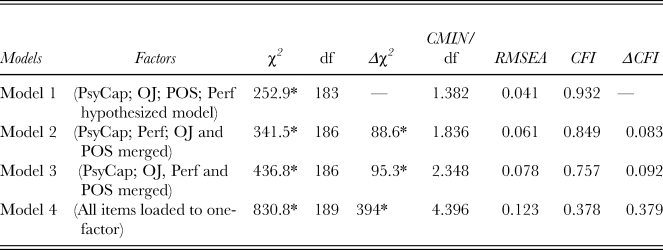
To examine the discriminant validity among our study variables, we conducted a series of confirmatory factor analyses with the help of AMOS 20. As can be found in Table 1, we compared our hypothesized four-factor model (PsyCap, organizational justice, POS, and performance) against a series of models (e.g., PsyCap, performance, organizational justice, and POS merged; PsyCap, organizational justice, performance, and POS merged; all items loaded into one-factor) on the basis of chi-square differences and fit indices. Results presented in Table 1 indicate that the four-factor hypothesized measurement model obtained a good fit with the data (χ 2 [df = 183] = 252.9, p < 0.01; CFI = 0.932; RMSEA = 0.041) and showed significantly better fit than other models including a one-factor mode (χ 2 [df = 189] = 830.8, p < 0.01; CFI = 0.378; RMSEA = 0.123). Anderson and Gerbing (Reference Anderson and Gerbing1988) suggest that the model, which has better χ 2 fit, demonstrates discriminant validity among its factors. As evident in Table 1, our hypothesized four-factor (Model 1) had a better χ 2 fit compared to other models, thus providing evidence toward discriminant validity among the study variables.
Competing models analyses

Notes: PsyCap: psychological capital; OJ: organizational justice; POS: perceived organizational support; Perf: performance; CFI: comparative fit index; RMSEA: root mean square error of approximation. *p < 0.01.
Hypotheses Testing
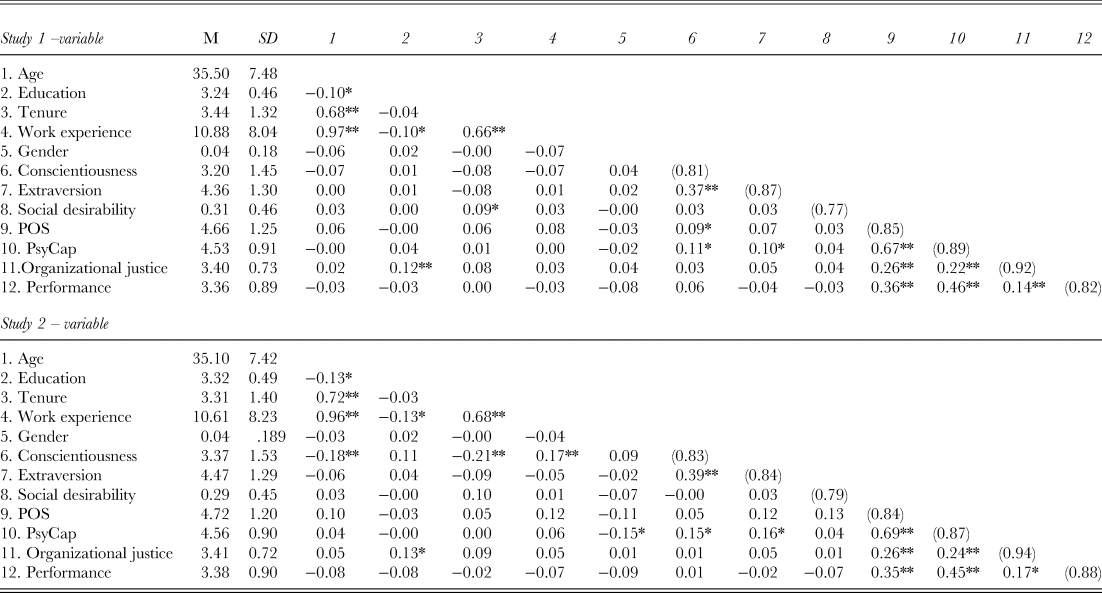
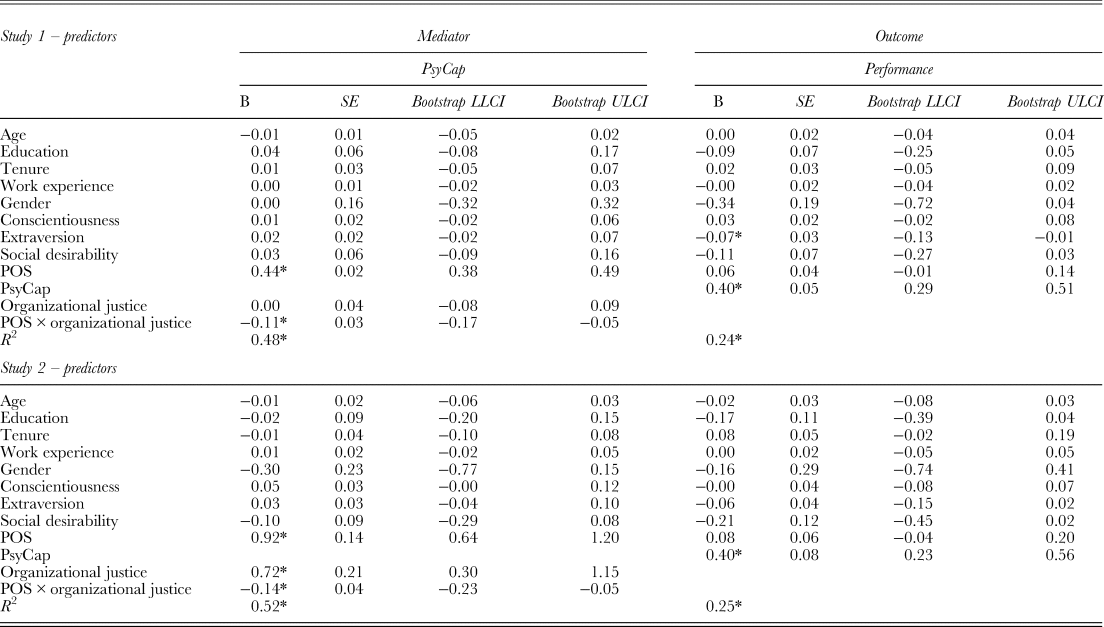
To test hypotheses 1 and 2, we conducted correlation and linear regression analyses. In hypothesis 1, we posited that POS will be positively related to PsyCap. As can be seen in Tables 2 and 3, it was found that POS had a significant positive relationship with PsyCap (Study 1: r = 0.67, p < 0.01; B = 0.49, p < 0.01; Study 2: r = 0.69, p < 0.01; B = 0.50, p < 0.01). Similarly, in hypothesis 2, we stated that PsyCap will be positively related to performance. It is observed from Tables 2 and 3 that PsyCap had a significant positive relationship with performance (Study 1: r = 0.46, p < 0.01; B = 0.40, p < 0.01; Study 2: r = 0.45, p < 0.01; B = 0.40, p < 0.01). Hence, both hypotheses 1 and 2 are supported. Furthermore, to examine the mediation and moderated-mediation hypotheses, Hayes's (Reference Hayes2013) SPSS, PROCESS macro (v.3.4), models 4 and 7 were used, respectively, with (bootstrapping samples = 5,000). Bootstrapping is a statistical resampling technique that estimates the standard deviations of a model from a sample (Hayes, Reference Hayes2013). Bootstrap tests involve nonparametric simulations which are a straightforward robust estimate for assessing indirect effects, they are widely used and are considered to be better than the Sobel test because typically in an indirect effect test, the estimate of standard error does not usually follow a normal distribution and is prone to provide a biased p-value (MacKinnon, Lockwood, Hoffman, West, & Sheets, Reference MacKinnon, Lockwood, Hoffman, West and Sheets2002). Before conducting the analyses, we mean-cantered all continuous variables (Aiken & West, Reference Aiken and West1991).
Descriptive statistics and correlations

Notes: POS: perceived organizational support; PsyCap: psychological capital; *p < 0.05; **p < 0.01; Study 1: N = 465; Study 2: N = 216; Cronbach's alpha is presented in parentheses along the main diagonal.
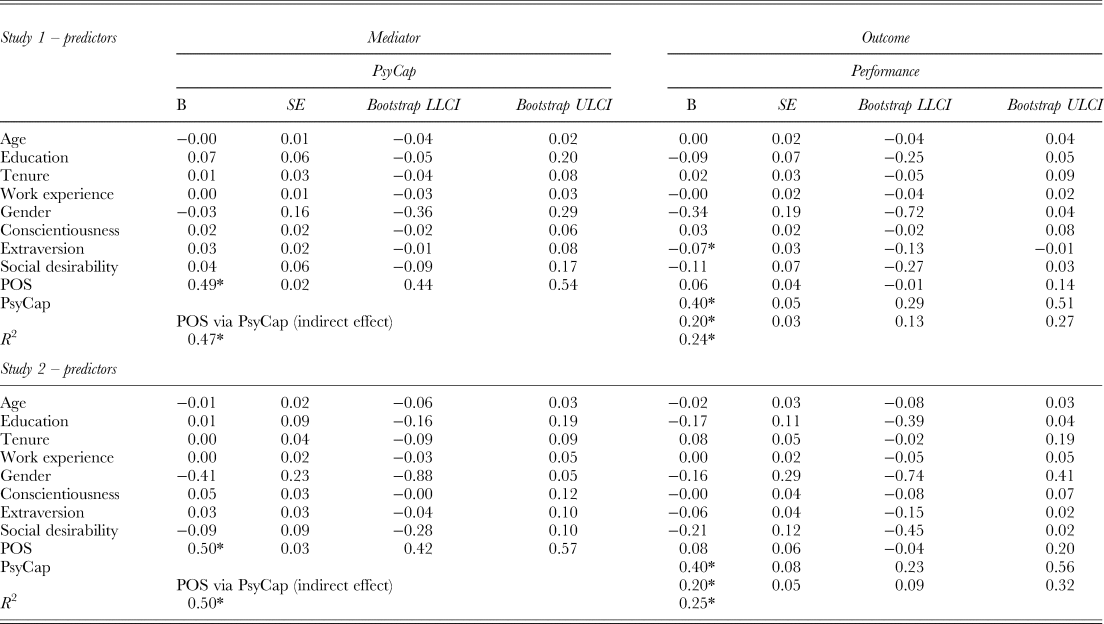
Main and indirect effect results

Notes: POS: perceived organizational support; PsyCap: psychological capital; B: unstandardized regression coefficients; SE: standard error; number of bootstrap samples = 5,000; level of confidence: 95 %; LLCI: lower level of confidence interval; ULCI: upper level of confidence interval; *p < 0.01; Study 1: N = 465; Study 2: N = 216.
Hypothesis 3 proposed that PsyCap would mediate the positive relationship of POS and job performance. We used Hayes's (Reference Hayes2013) SPSS, PROCESS macro, model 4 that provides an estimate for direct and indirect effects. Mediation results are presented in Table 3. We found that POS was positively related to PsyCap (Study 1: B = 0.49, p < 0.01, 95% confidence interval [CI] = 0.44–0.54; Study 2: B = 0.50, p < 0.01, 95% confidence interval [CI] = 0.42–0.57), and PsyCap, in turn, impacted performance (Study 1: B = 0.40, p < 0.01, 95% CI = 0.29–0.51; Study 2: B = 0.40, p < 0.01, 95% CI = 0.23–0.56). Furthermore, the results demonstrate that, controlling for age, gender, education, job tenure, work experience, Big Five personality dimensions (extraversion and conscientiousness), and social desirability, the indirect relationship of POS and performance via PsyCap (mediator) was significant (Study 1: B = 0.20, p < 0.01; Study 2: B = 0.20, p < 0.01), and it is also observed that a 95% confidence interval did not contain zero (Study 1: 95% CI = 0.13–0.27; Study 2: 95% CI = 0.09–0.32). Moreover, the direct relationship between POS and performance was non-significant (Study 1: B = 0.06, p = 0.11, 95% CI = −0.01 to 0.14; Study 2: B = 0.08, p = 0.19, 95% CI = −0.04 to 0.20) in the presence of PsyCap (mediator). These results support full mediation of PsyCap in the relationship between POS and performance. Therefore, hypothesis 3 is supported.
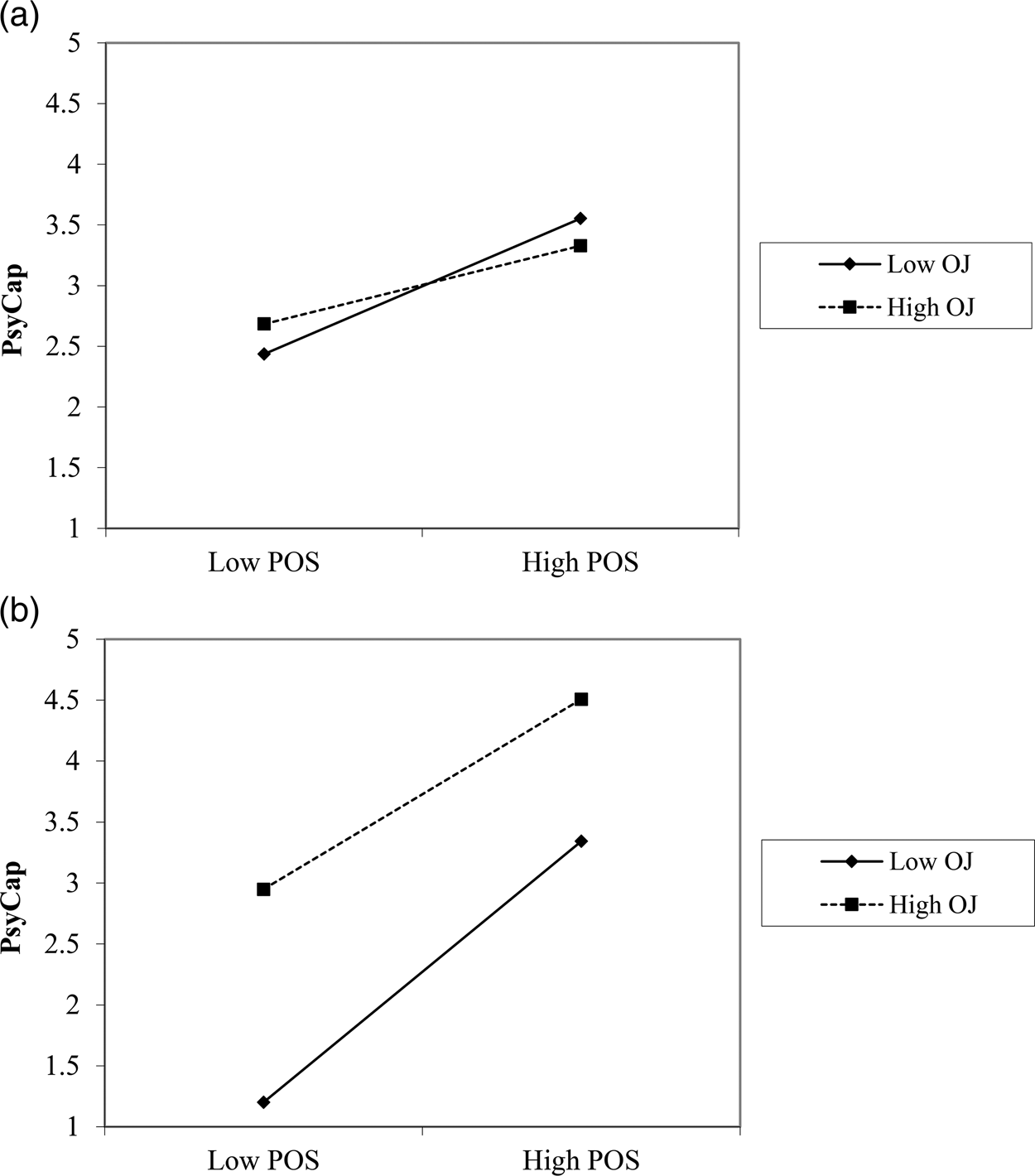
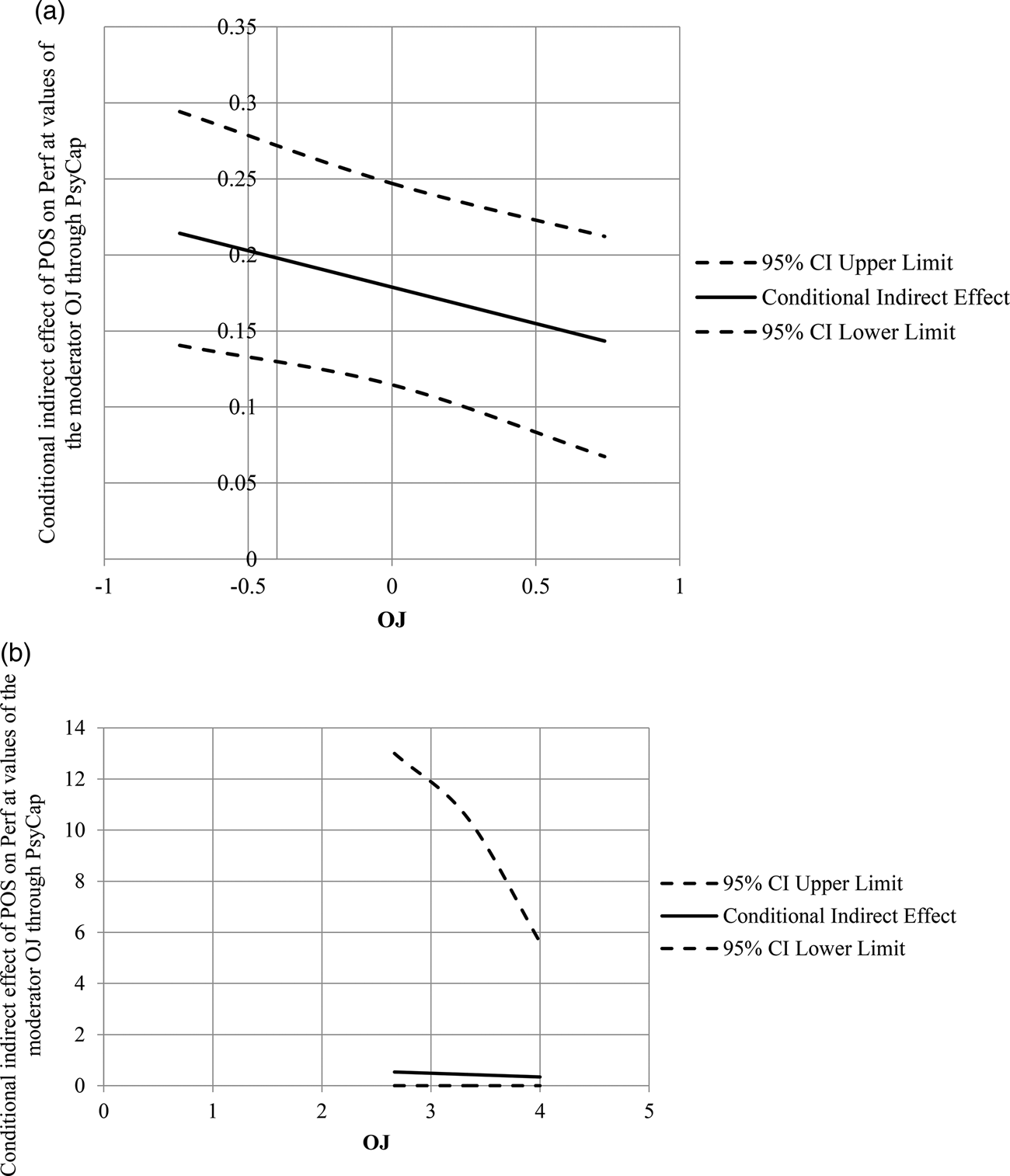
Hypothesis 4 posited that organizational justice would moderate the relationship between POS and PsyCap, such that the relationship will be stronger when organizational justice is high rather than low. It is observed from Table 4 that a significant interaction effect exists on PsyCap (Study 1: B = −0.11, p < 0.01, 95% CI = −0.17 to −0.05; Study 2: B = −0.14, p < 0.01, 95% CI = −0.23 to −0.05). Figures 2a and 2b depict the graphical representation of the interaction effect of POS and organizational justice on PsyCap. As per the suggested procedures of Aiken and West (Reference Aiken and West1991), we plotted the slope of interaction effect at two levels of the moderator (i.e., organizational justice [high: +1 standard deviation]; [low: −1 standard deviation]). The graphs in Figures 2a and 2b suggest that organizational justice moderates the strength of the relationship between POS and PsyCap; however, as the organizational justice level becomes high, it gradually retards the effect of POS on PsyCap. Therefore, hypothesis 4 is partially supported.
(a) Study 1: Moderating effect of organizational justice (OJ) on the relationship between POS and PsyCap (b) Study 2: Moderating effect of OJ on the relationship between POS and PsyCap

Moderated-mediation results

Note: POS: perceived organizational support; PsyCap: psychological capital; B: unstandardized regression coefficients; SE: standard error; number of bootstrap samples = 5,000; level of confidence: 95%; LLCI: lower level of confidence interval; ULCI: upper level of confidence interval; *p < 0.01; Study 1: N = 465; Study 2: N = 216.
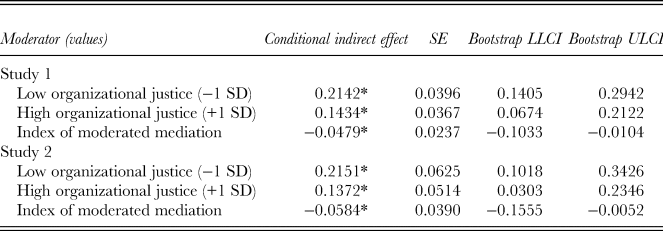
It was proposed in hypothesis 5 that organizational justice will moderate the mediated relationship of POS and performance via PsyCap, such that the relationship will be stronger for employees with higher perception organizational justice. With the help of SPSS, PROCESS macro, model 7 (Hayes, Reference Hayes2013), we examined this conditional indirect relationship between POS and performance via PsyCap at two levels of organizational justice: high (‘one standard deviation above the mean’) and low (‘one standard deviation below the mean’). Preacher, Rucker, and Hayes (Reference Preacher, Rucker and Hayes2007) emphasized that a conditional indirect effect (moderated-mediation effect) gets established when the strength of the predictor variable on the dependent variable via mediator varies across high and low of moderator. As seen in Table 5, results indicate that the strength of the indirect relationship of POS and performance via PsyCap was significant at both high and low levels of organizational justice (at high level, Study 1: B = 0.1434, p < 0.01, 95% CI = 0.0674–0.2122; at low level: B = 0.2142, p < 0.01, 95% CI = 0.1405–0.2942; index of moderated mediation: B = −0.0479, p < 0.01, 95% CI = −0.1033 to −0.0104 and at high level, Study 2: B = 0.1372, p < 0.01, 95% CI = 0.0303–0.2346; at low level: B = 0.2151, p < 0.01, 95% CI = 0.1018–0.3426; index of moderated mediation: B = −0.0584, p < 0.01, 95% CI = −0.1555 to −0.0052), and it is observed that at both high and low levels of the moderator, CIs did not include zero (see Table 5 and Figures 3a and 3b for the conditional indirect effect). Therefore, we can argue that there is evidence toward a conditional indirect relationship (moderated-mediation effect) on the relationship between POS and performance via PsyCap at two levels of organizational justice. However, it is pertinent to note that at a high level of the moderator (organizational justice), we observed a lower effect on performance (Study 1: B = 0.1434, p < 0.01; Study 2: B = 0.1372, p < 0.01), and at lower level of the moderator, we observed a higher effect on performance (Study 1: B = 0.2142, p < 0.01; Study 2: B = 0.2151, p < 0.01). A minute observation reveals a counter-intuitive finding in this study, as at low level of organizational justice, the indirect effect was high compared to a high level of organizational justice. Therefore, hypothesis 5 is partially supported. A possible explanation for this counter-intuitive finding could be discussed through the lens of Indian karma perception and with the Indian collectivist cultural context. Indian karmic philosophy and the principle of karma reflect that an individual's present karma affects the quality and nature of current and future lives (Lochtefeld, Reference Lochtefeld2002; Reichenbach, Reference Reichenbach1988; Zaehner, Reference Zaehner1973). This karmic cultural philosophy suggests that one's actions would definitely reap results in the future if not immediately (Reichenbach, Reference Reichenbach1988). This notion of karma is deeply embedded within the Indian cultural norms and value system. Therefore, a sense of tolerance and altruistic motivation prevails in the normative Indian cultural fabric. Given the predominance of Indian karmic philosophy and its karmic principles, the Indian workforce is likely to work harder following an injustice in the workplace in the expectation that they will get favorable treatment later in another domain.
(a) Study 1: Conditional indirect effects of POS on performance via PsyCap across different values of organizational justice (OJ) (b) Study 2: Conditional indirect effects of POS on performance via PsyCap across different values of OJ

Conditional indirect effects of perceived organizational support on performance at different levels of organizational justice

Notes: Number of bootstrap samples = 5,000; level of confidence: 95 %; LLCI: lower level of confidence interval; ULCI: upper level of confidence interval; SE: standard error; SD: standard deviation. *p < 0.01.
Furthermore, the prevalence of the collectivist nature of Indian society could further provide insights toward our counter-intuitive finding. Morris and Leung (Reference Morris and Leung2000) argue that perceptions of fairness are dependent on the prevailing cultural values and norms of the countries, and they argue that interpretation on justice will differ as per the existing cultural values. In individualistic cultures, people are expected to achieve individual goals, whereas, in a collectivistic culture, individuals are expected toward group goal achievements (Hofstede, Reference Hofstede1980). India being a collectivist culture, people give importance to group goal achievement rather than individual achievements (Hofstede, Reference Hofstede1980). People in collectivist culture like India have a tendency to be satisfied with limited means. In North American context, people are expected to be relatively more sensitive to injustice as it would hinder the expression of their self-uniqueness and hamper their goal achievements (Li & Cropanzano, Reference Li and Cropanzano2009). However, in Indian context, people are not highly sensitive to tolerate injustice as they are oriented toward maintaining interpersonal and organizational harmony (Gupta & Singh, Reference Gupta and Singh2013). Therefore, it is probably reasonable to suggest that at relatively low level of organizational justice perception, employees tend to remain motivated and continue to perform.
DISCUSSION
Theoretical Contributions
The findings of this study contribute to the literature in several ways. First, this study addresses the gap in literature by investigating the mediating role of PsyCap on the relationship between POS and performance (Riggle et al., Reference Riggle, Edmondson and Hansen2009). To best of our knowledge, this is the first study to advance our understanding on the role of PsyCap as an underlying explanatory positive mechanism in the relationship of POS and performance. Findings supported our conjecture that PsyCap is directly influenced by POS and PsyCap acts as an explanatory mechanism through which POS influences performance. A possible theoretical explanation could be attributed to organizational support theory (Aselage & Eisenberger, Reference Aselage and Eisenberger2003; Eisenberger et al., Reference Eisenberger, Huntington, Hutchison and Sowa1986; Rhoades & Eisenberger, Reference Rhoades and Eisenberger2002) and PsyCap theory (Luthans & Youssef-Morgan, Reference Luthans and Youssef-Morgan2017; Luthans et al., Reference Luthans, Youssef-Morgan and Avolio2015). Organizational support theory and PsyCap theory suggest that favorable social mechanisms and a congenial psychological environment accompanied by POS are the contributing factors that augment PsyCap. Furthermore, PsyCap, being a positive psychological resource endowed with motivational propensities, is likely to contribute to employee performance (Luthans et al., Reference Luthans, Youssef-Morgan and Avolio2015).
Second, the findings of this study evinced the potential influencing role of organizational justice perception in the relationship between POS and PsyCap. Furthermore, this study also sheds an understanding on the moderating role of organizational justice perception on the indirect relationship of POS and performance via PsyCap. Previous research on POS and work outcomes have examined the direct relationships of POS with work outcomes and have not focused on the contingent factors that might influence the relationships (Riggle et al. Reference Riggle, Edmondson and Hansen2009; Rigotti, Reference Rigotti2009). Scholars argue that social exchange does not operate unilaterally in a straightforward manner rather contingent factors could play a crucial role in an organizational context (see Colquitt et al., Reference Colquitt, Scott, Rodell, Long, Zapata, Conlon and Wesson2013; Cropanzano & Mitchell, Reference Cropanzano and Mitchell2005; Cropanzano et al., Reference Cropanzano, Anthony, Daniels and Hall2017). Toward this argument, our study was a novel attempt that examined the moderating influence of organizational justice perception on the indirect relationship of POS and performance through PsyCap. Therefore, our empirical findings contribute to the SET theory (Cropanzano & Mitchell, Reference Cropanzano and Mitchell2005; Cropanzano et al., Reference Cropanzano, Anthony, Daniels and Hall2017) by explaining the complex relationships of POS, PsyCap, performance, and organizational justice perception through a moderated-mediation examination.
Third, scholars emphasize on the necessity for examining constructs in different cultures for obtaining the generalizability of constructs and gaining new understandings on relationships (e.g., Cronbach et al., Reference Cronbach, Gleser, Nanda and Rajaratnam1972, generalizability theory; Gelfand et al., Reference Gelfand, Erez and Aycan2007; Hofstede, Reference Hofstede1980; Johns, Reference Johns2006, context theory). Johns (Reference Johns2006) opines that ‘relationships theorized or found in Western cultures might not hold up in non-Western cultures such that the validity of Western theories is said to be culturally biased’ (p. 400). Toward these assertions, this study provides a pertinent cultural relevant insight on the moderating influence of organizational justice perception on the indirect effect of POS on performance through PsyCap. With regards to the findings on conditional indirect effect of POS on performance at different levels of organizational justice perception, it was observed that at high level of organizational justice, it had a smaller effect on performance in contrast to the low level of organizational justice. This is a counter-intuitive finding to our proposition. These counter-intuitive findings can be understood through the lenses of Indian karmic philosophy and with the collectivist nature of Indian society. Indian karmic philosophy suggests that people believe that their actions will be certainly rewarded in the future in another domain if not instantly (Reichenbach, Reference Reichenbach1988). Similarly, India, being a collectivist society people, have a propensity to be contented with limited rewards and they believe in organizational and interpersonal harmony (Gupta & Singh, Reference Gupta and Singh2013). These subtle philosophical positioning of Indian socio-cultural norms influence the Indian employees to tolerate injustice. Therefore, this study's findings provide a novel insight that even at a low level of organizational justice perception, employees continued with high performance.
Managerial Implications
The findings of this study suggest pragmatic implications for effective management and utilization of human resources. Results suggest the important role of POS and PsyCap on performance. First, to cultivate a favorable perception of organizational support in employees, organizations should put efforts to explain to managers the importance of creating and maintaining a positive and supportive work environment that would satisfy employee needs. Every manager should positively guide employees. They should endeavor to appreciate and understand the circumstance in which employees work in organizations. Managers are required to be given training on ways to value individual employee's contribution and should strive to ensure overall employee well-being. These measures would help in augmenting POS in the work environment.
Second, as the results of this study indicate that PsyCap is an important underlying psychological resource through which performance is linked, efforts should be made to strengthen PsyCap resources in employees. Research findings suggest that PsyCap was developed with short training interventions (e.g., Luthans, Avey, Avolio, Norman, & Combs, Reference Luthans, Avey, Avolio, Norman and Combs2006). Accordingly, practitioners can take these valuable insights and can develop psychological resources (PsyCap) of their employees for performance improvement.
Third, this study found a positive association of PsyCap with performance and as per the argument made by Rafaeli and Sutton (Reference Rafaeli and Sutton1987) that those who are pre-dispositioned with psychological resources withstand work pressure and attain success than those who are less pre-dispositioned with psychological resources. Taking these understandings, human resource professionals can utilize the PsyCap instrument as one of the selection tools for ensuring employee performance.
Fourth, the results of this study suggest that favorable organizational justice perception influences performance, and it also moderates the strength of the relationships between POS and PsyCap. Organizational justice and decisions taken by organizations and managers have a wide influence on the socioemotional and economic needs of employees (Cropanzano & Schminke, Reference Cropanzano, Schminke and Turner2001). Given the importance of organizational decisions and its consequences, individuals working in the organization tend to be very sensitive toward organizational justice as it affects their cognitive, emotional, motivational, and behavioral aspect of work attitude. Therefore, organizations and mangers should be very careful and sensitive while administering organizational justice with the spirit of maintaining equity, fairness, and transparency. Fifth, the assessment of PsyCap can serve as a potential indicator of HR scorecard reflecting on the psychological resources available, overall psychological health, and probable future performance of employees.
Finally, the psychological resources of individual people serve as a source of competitive advantage. The reason being in this globalized world gaining competitive advantage only through technology and financial resources has increasingly become difficult because technology is easily replicable (Luthans & Youssef-Morgan, Reference Luthans and Youssef-Morgan2017), and financial resources are also available. However, replication of positive psychological capabilities/resources of employees among corporations is not easily achievable and hence, notion of psychological resources as a source of competitive advantage does exist. Psychological resources can generate human competencies leading to creations of both tangible and intangible assets. Given this argument and findings of this study, managers can understand the importance of psychological resources (PsyCap) and help it to nurture and develop through training and development interventions.
Limitations and Future Research Directions
Although this study made significant theoretical contributions and suggests practical managerial implications, it suffers from some limitations. First, as Study 1 was based on cross-sectional design, inferences on causality among the variables cannot be firmly established. However, an association of certain causal ordering may tentatively be indicated. To examine absolute causality, further research may be conducted with the help of longitudinal and experimental designs. Second, as this research was limited to few life insurance, telecom, and steel manufacturing firm, more samples should be collected from varied manufacturing and service sectors for improving the generalization of the findings. Third, further research could examine the individual effects of each organizational justice dimension on the focal variables of this study. Fourth, studies on the relationship between POS and performance can be conducted in light of multilevel investigations involving the influence of organizational culture and cultural dimensions of countries.
With respect to the counter-intuitive effect of low justice perception on performance, this study opens up an interesting scope for future research based on Indian karma perception. As discussed, the notion of karma is rooted within the Indian socio-cultural norms and value system. Indian karmic philosophy reflects that individual's karmic actions would certainly reap results in the future if not instantly (Reichenbach, Reference Reichenbach1988). This notion of karmic perception drives the Indian workforce to continuously work hard and they have a propensity to tolerate injustice in the workplace. Additional research can examine the effect of karma perception (White, Norenzayan, & Schaller, Reference White, Norenzayan and Schaller2019) on the dimensions of organizational justice (e.g., distributive justice, procedural justice, interpersonal, and informational justice; Colquitt, Reference Colquitt2001).
The findings of this research offer immense scope for novel scholarly opportunities to understand the influence of karma perception on several work attitudes like affective organizational commitment, turnover intentions, organizational citizenship behavior (OCB), job satisfaction, organizational trust, and employee performance through multilevel, longitudinal, and experimental investigations (see Zheng, Schuh, van Dijke, & De Cremer, Reference Zheng, Schuh, van Dijke and De Cremer2021). Further research endeavors can be undertaken to conduct comparative cross-cultural studies (see Tsui, Nifadkar, & Ou, Reference Tsui, Nifadkar and Ou2007) for examining the uniqueness of Indian karma perception on work correlates. In view with the discussed scope of further research, we envision a stream of scholarly deliberation, debate, and robust empirically investigations to emerge. This line of scholarly pursuits is likely to develop indigenous culture-specific organizational behavior theory in particular and culture centric management theory in general.
CONCLUSION
This results in this study provide an in-depth understanding on the relationships of POS, PsyCap, and organizational justice perception along with their influence on employee performance. This study makes two important contributions. First, the findings of this study demonstrate that POS influences performance through PsyCap. Second, this indirect relationship of POS on performance via PsyCap is moderated by the levels of organizational justice perception. The overall result of this study advances our understating on the underlying processes through which POS is related to performance. Further, this research suggests that helping employees to effectively improve their POS, PsyCap, favorable organizational justice perception, and performance would remain as one of the pivotal objectives while managing human resources. Endeavors in these directions would help corporations to gain human competitive advantage in 21st century organizations.
DATA AVAILABILITY STATEMENT
The data that support the findings of this research are openly available at https://doi.org/10.7802/2513