Introduction
Moyamoya disease is a rare condition that predominantly affects persons of Asian descent. It was first described in 1957 as ‘hypoplasia of the bilateral internal carotid arteries’.Reference Takeuchi and Shimizu1 On angiograms, abnormally dilated collateral vessels have the appearance of a puff of smoke, or ‘moyamoya’ in Japanese. The disease causes stroke associated with progressive stenosis of the intracranial internal carotid arteries and their proximal branches. The aetiology is unknown, although genetic factors appear to play a major role. The symptoms and signs of moyamoya disease can be attributed to changes in blood flow resulting from stenosis of the internal carotid arteries. Stroke, transient ischaemic attacks, haemorrhage, seizures and headaches are the major initial symptoms and signs of moyamoya disease.
We report a 28-year-old man with moyamoya disease that initially presented as unilateral sudden sensorineural hearing loss (SNHL).
Case report
A 28-year-old man presented to our out-patient clinic with sudden, right-sided hearing loss of 2 days' duration. He also complained of right-sided tinnitus, dizziness and a mild sensation of head fullness. Three months previously, the patient had suffered right-sided, sudden onset hearing loss of 1 day's duration, which had been diagnosed at another hospital and treated with high-dose oral steroids; the patient's hearing loss had improved and no further evaluation had been undertaken. He denied any previous noise exposure, trauma or upper respiratory tract infection, or any previous episodes of stroke, seizure, headache, or transient, one-sided limb weakness.
Physical examination showed normal auditory canals and tympanic membranes bilaterally. There was no otorrhoea, nystagmus or facial weakness.
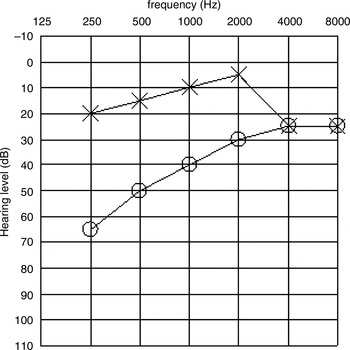
An audiogram demonstrated a sensorineural-type hearing loss in the right ear, with a pure tone average of 40 dB; the corresponding value for the left ear was 7 dB (Figure 1).
Audiogram showing sensorineural hearing loss in the right ear (○) and normal hearing in the left ear (×).

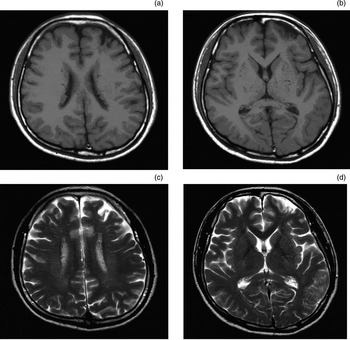
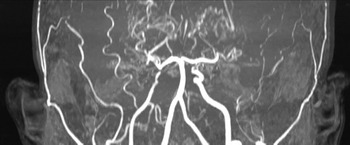
Brain magnetic resonance imaging (MRI) was arranged and incidentally revealed multiple small, hypointense dots around the periventricular and basal ganglia regions, from moyamoya disease associated collateral vessels (Figure 2). Magnetic resonance angiography showed multiple irregular perforating vessels. Occlusion of bilateral anterior cerebral arteries, middle cerebral arteries and distal internal carotid arteries was also found (Figure 3).
Axial magnetic resonance images using (a & b) T1-weighting and (c & d) T2-weighting, showing multiple small, hypointense dots around the periventricular and basal ganglia regions, indicating moyamoya disease associated collateral vessels.

Coronal, three-dimensional, ‘time-of-flight’ magnetic resonance angiograms with maximum intensity projection reconstruction, showing multiple irregular perforating vessels, together with occlusion of bilateral anterior cerebral, middle cerebral and distal internal carotid arteries.

The neurologists were consulted for further evaluation and management. A transcranial Doppler cerebral blood flow study showed right middle cerebral artery and anterior cerebral artery occlusion or very low flow velocity. A neck Doppler study revealed no obviously stenotic flow of any extracranial carotid vessel.
The patient was treated with high-dose steroids and a vasodilation agent for 5 days. Prescription of aspirin was suggested to prevent further stroke.
Following treatment, an audiogram showed only mild improvement, at 0.25, 0.5 and 8 kHz.
Discussion
Sudden SNHL was first described by De Kleyn in 1944, and is often defined as a SNHL of 30 dB or more across at least three contiguous frequencies occurring within 72 hours.Reference De Kleyn2 The incidence of sudden SNHL has been estimated to range from 5 to 20 per 100 000 persons per year. Any age group may be affected but the peak incidence occurs in the fifth and sixth decades of life. Vascular aetiologies of sudden SNHL are rare.Reference Chau, Lin, Atashband, Irvine and Westerberg3
The incidence of moyamoya disease peaks in two age groups: children approximately five years of age, and adults in their fourth decade. Females are affected nearly twice as frequently as males. Moyamoya disease is the most common paediatric cerebrovascular disease in Japan, with a prevalence of approximately 3 cases per 100 000 children.Reference Scott and Smith4 A 2005 US review reported an incidence of 0.086 cases per 100 000 persons, with incidence rate ratios of 4.6 for Asian Americans, 2.2 for African Americans and 0.5 for Hispanics, compared with whites.Reference Uchino, Johnston, Becker and Tirschwell5
The symptoms and signs of moyamoya disease can be attributed to changes in blood flow resulting from stenosis of the internal carotid arteries. There are two major aetiological categories of symptoms: those due to brain ischaemia (i.e. stroke, transient ischaemic attacks and seizures), and those due to the deleterious consequences of the compensatory mechanisms responding to the ischaemia (i.e. haemorrhage from fragile collateral vessels and headache from dilated transdural collaterals).Reference Scott and Smith4 Adults have higher rates of haemorrhage as a presenting symptom, while children present more with transient ischaemic attacks or ischaemic stroke. Radiotherapy to the head or neck, Down's syndrome, neurofibromatosis type one, and sickle cell disease have also been reported to be associated with moyamoya disease.
The definitive diagnosis is based on an arteriographic appearance characterised by stenosis of the distal intracranial internal carotid arteries, extending to the proximal anterior and middle arteries. Advances in MRI and magnetic resonance angiography have led to increased use of these methods for primary imaging in patients with symptoms suggestive of moyamoya disease. The diagnostic finding of moyamoya disease on MRI is reduced flow voids in the internal carotid arteries, anterior cerebral arteries and middle cerebral arteries, coupled with prominent flow voids through the basal ganglia and thalamus from moyamoya-associated collateral vessels.Reference Scott and Smith4
Current treatment of moyamoya disease aims to improve cerebral blood flow, which may prevent future strokes and reduce the frequency of symptoms. No known treatment can reverse the disease process. Therapeutic modalities include medical therapy (i.e. antiplatelet agents and calcium channel blockers) and surgery (i.e. direct and indirect revascularisation).
Moyamoya disease usually presents initially with neurological deficits, seizure or headache; otological symptoms are rarely seen. There are only three published case reports describing an association between moyamoya disease and hearing loss.Reference Setzen, Cacace, Eames, Riback, Lava and McFarland6–Reference Wakabayashi, Nakano, Isono and Hori8 Our patient represents the first published case of moyamoya disease with sudden, unilateral SNHL as the first presenting symptom.
The possible mechanism of our patient's symptoms may have been vascular occlusion, which was postulated as a cause for sudden SNHL as early as 1949.Reference Rasmussen9 The internal auditory artery which supplies the inner ear is a branch of the anterior inferior cerebellar artery, and is an end-artery with minimal collateral supply from other major arterial branches. Vascular occlusion may be due to thrombotic narrowing or plaque blocking the internal auditory artery, anterior inferior cerebellar artery or other major arterial branches. Magnetic resonance imaging is extremely useful in detecting asymptomatic vascular lesions which could affect the circulation of the inner ear.
• This is the first case report of moyamoya disease presenting with unilateral sudden sensorineural hearing loss (SNHL)
• Vascular lesions (e.g. moyamoya disease) should be considered in patients with sudden SNHL, especially children, young adults and Asians
• Due this disease's poor outcome, early diagnosis and treatment are important to prevent stroke
The possibility of a vascular lesion such as those occurring in moyamoya disease should be considered in all patients with sudden SNHL, especially children, young adults and Asian patients. Due to the poor outcome of moyamoya disease, early diagnosis and treatment are important to prevent stroke.