Overuse of antibiotics resulting in antimicrobial resistance in the intensive care unit (ICU) remains a significant concern. Reference Ruiz, Moragas and Trapero-Bertran1,Reference Nussenblatt, Avdic and Berenholtz2 Ventilator-associated pneumonia (VAP) is one of the most common ICU infections, with high morbidity and mortality. Reference Ferrer and Torres3,Reference Piriyapatsom, Lin and Pirrone4 However, it can be difficult to distinguish respiratory colonization from true infection, and positive cultures frequently lead to unnecessary antibiotic treatment. Reference Nussenblatt, Avdic and Berenholtz5 This issue is amplified due to limited evidence-based guidelines for diagnostic approaches to VAP. Reference Browne, Hellyer and Baudouin6,Reference Kalil, Metersky and Klompas7
Diagnostic stewardship in infectious diseases is the process of modifying test ordering, processing, and reporting to improve antimicrobial use. Reference Morgan, Malani and Diekema8 Although antimicrobial stewardship focuses on reducing unnecessary treatment after cultures are reported as positive with identification of specific bacteria, diagnostic stewardship intervenes upstream by preventing the ordering, performing, or reporting of a culture or bacterial identification when not clinically indicated. Reference Morgan, Malani and Diekema8 Although diagnostic stewardship interventions are being increasingly implemented, accounting for clinician beliefs and behavioral norms in intervention design is important to maximize intervention uptake and impact. 9,Reference Cordoba and Llor10 We studied healthcare provider (HCP) practices and perceptions of challenges associated with VAP diagnosis, and we sought to identify opportunities for diagnostic stewardship.
Materials and methods
Data collection
We conducted a qualitative study of HCPs across 5 ICUs (medical, neurology, trauma, surgical and cardiac surgery) at 1 academic, tertiary-care hospital in Baltimore, Maryland. We employed a purposive sampling strategy to optimize representation of clinician roles including attending physicians, residents and fellows (trainees), pharmacists, and advanced practice providers (APPs) such as nurse practitioners and physician assistants. Initial outreach to potential participants was done both by e-mail and in person to explain the purpose of the study. The interview guide was iteratively codeveloped by a survey methodologist, an infectious disease specialist and a pulmonary critical care specialist after review of the literature and process flows in the management of ventilated patients. The interview guide was reviewed by 3 clinicians for clarity, completeness, and time to complete prior to data collection. Semistructured interviews were conducted in person from January 1 to April 30, 2019, by a single study-team member (B.K.). We based the interview on concepts that emerged from our literature review, Reference Kenaa, Richert and Claeys11 and we focused on distinct steps in the process of diagnosing VAP (ordering of respiratory culture, sample collection and processing, reporting and interpretation of results) that were identified as potential targets for diagnostic stewardship. Similarly, we grouped the questions into 4 sections: (1) clinical suspicion and thresholds for respiratory culture ordering, (2) respiratory sample collection practice, (3) culture result interpretation, and (4) VAP diagnosis and treatment. The interviews consisted of 24 questions that took ∼15–30 minutes to complete. The full questionnaire is included as Supplementary Material (online).
We collected information on clinician role, primary ICU work location, and number of years in clinical practice. Based on the literature, we had planned to enroll between 15 and 50 participants, with the final sample determined based on attaining saturation of themes in the responses and representation of HCPs based on role and work location. Reference Guest, Bunce and Johnson12 This study was determined to be non–human-subjects research by the institutional review board at the University of Maryland, Baltimore.
Verbal consent was obtained at the onset of the interview, which was audio-recorded under deidentified labels and transcribed verbatim for analysis using Nvivo 12 software (QSR International, Burlington, MA). Initial content analysis was performed on 2 randomly selected transcripts by 3 research team members (B.K., L.M.O., and M.R.) to identify coding themes. All interviews were conducted by a single person; thus, to reduce bias, each transcript was independently coded by 2 reviewers and responses were organized into themes. These findings are presented in the Results section with supporting quotations from different HCPs indicated by role and participant number to ensure that they did not reflect the opinion of 1 or 2 participants. Where appropriate, the percentage of participants and respective denominators (total or subgroup) for specific themes are also presented.
Results
Participant characteristics
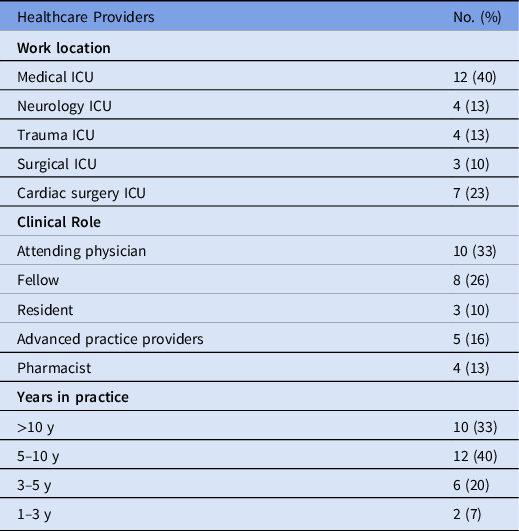
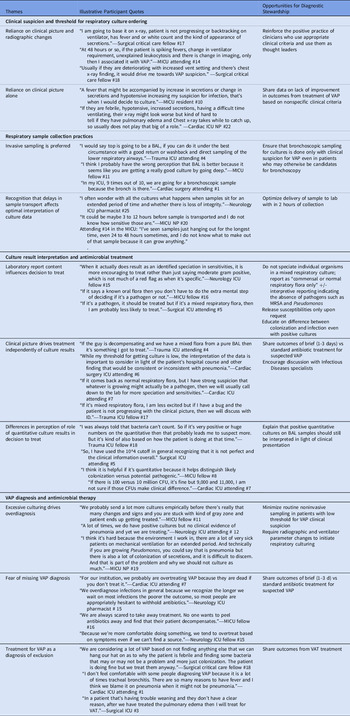
In total, 33 participants were approached for participation, and 30 were successfully interviewed. After 15 consecutive interviews, the next 5 participants did not provide significant new information; however, we continued interviewing additional HCPs to ensure adequate representation by type of ICU and HCP role. Of the 30 HCPs, 10 (33%) were attending physicians, 8 (27%) were clinical fellows, 3 (10%) were residents, 5 (17%) were APPs, and 4 (13%) were pharmacists. Years in clinical practice and primary place of work are summarized in Table 1. Identified themes are described below and are summarized in Table 2 with additional illustrative quotes, along with potential opportunities for diagnostic stewardship.
Characteristics of Participants in a Qualitative Assessment of the Diagnosis and Management of Ventilator-Associated Pneumonia Among Critical Care Clinicians (N=30)

Identified Themes Driving the Practice of Respiratory Overculturing and Overdiagnosis of Ventilator-Associated Pneumonia

Note. MV, mechanical ventilation; CHF, congestive heart failure; IPF, idiopathic pulmonary fibrosis; VAT, ventilator associated tracheitis; VAP, ventilator associated pneumonia; CPIS, clinical pulmonary infection score. Quotations have been slightly modified for clarity. For ‘invasive versus noninvasive sampling’ under ‘respiratory sample collection,’ pharmacists were excluded from that section.
1. Clinical suspicion and thresholds for respiratory culturing
Reliance on clinical picture and radiographic changes
For most HCPs, the patient’s clinical picture together with radiographic changes were the main drivers for initiating diagnostic work-up (83%, n = 30), and no particular clinical change emerged as more influential than others.
Attending #12 with 3–5 years of experience working in the neurology ICU: “Fever is the trigger, then we look at changes in vent settings, secretions, white count. The work-up will start with a chest x-ray, and if that shows an opacity, we will order a culture.”
Reliance on clinical picture alone
Although most would consider both clinical and radiographic criteria, few reported relying on clinical picture alone (17%, n = 30) for initiating work-up because radiographic changes can be unreliable.
Attending #1 with >10 years of experience working in the cardiac surgery ICU: “Fever, white count, dirty sputum… I take infiltrate off because there is heart failure and pulmonary fibrosis. So many other reasons for x-rays to look bad.”
2. Respiratory sample collection practices
Invasive sampling is preferred
Most attending physicians (80%, n = 10), trainees and APPs (93%, n = 16) preferred invasive respiratory culturing with bronchoalveolar lavage (BAL) or “mini-BAL” to endotracheal aspirates. Although techniques vary across institutions, mini-BAL is the practice of acquiring lower respiratory tract sample through a sterile catheter advanced 3–5 cm beyond the endotracheal tube with instillation of sterile saline and aspiration of contents. Reference Tasbakan, Gurgun, Basoglu, Ekren, Pullukcu and Bacakoglu13 The reasons stated for favoring BAL or mini-BAL over endotracheal aspirates were (1) less contamination and better-quality sample; (2) ability to view and sample the diseased lung; and (3) easy access to bronchoscopy at an academic hospital.
Surgical critical care fellow #17 in the trauma ICU: “I worry about the quality of the endotracheal aspirate and colonization. For me, bronchoscopy is the gold standard. I am able to send the deepest culture, which I believe is the most accurate reflection of the patients’ respiratory colony.”
Attending #14 in the medical ICU with >10 years of clinical experience: “If the patient is able to tolerate it, I would prefer to look at the airways and see if there is consistency with an ongoing infection.”
Recognition that delays in sample transport affects optimal interpretation of culture data
Delay in transport was also recognized as a barrier to optimal processing of collected samples. Overall, 30 HCPs (70%) admitted that it takes at least >2 hours or unknown duration of time for sample to reach the laboratory. However, 27 HCPs (85%) perceive that shorter travel time probably yields higher-quality results.
Cardiac ICU attending #6: “I think it takes hours, but less is better for the simple reason of having increased risk of contamination.”
3. Culture result interpretation and antimicrobial treatment
In total, 27 participants gave responses regarding the interpretation of culture data and challenges differentiating pathogenic from colonization. Most (70%) stated that the speciation of organisms on the report influences their decision to treat with antibiotics.
Laboratory report content influences decision to treat
MICU fellow #9: “I think I would be more inclined to treat the one that names a specific organism as opposed to mixed respiratory flora.”
Clinical picture drives treatment independently of culture results
Although respondents acknowledge that differentiating between true infection and colonization can be straightforward for certain organisms (eg, α-hemolytic Streptococcus or Candida spp), some commented that significant growth of even commensal organisms with clinical decline could prompt the team to treat with antibiotics. Few participants mentioned that they would discuss culture results with an infectious disease specialist prior to starting antibiotics.
Attending #1 in the cardiac surgery ICU: “If it says mixed respiratory flora, I have to use my clinical acumen and decide whether or not it’s a pathogen. If the person I know for a fact aspirated and it comes back mixed flora, I might have to treat if they have been in the hospital for >3 days.”
Differences in perception of role of quantitative culture results in decision to treat
Most participants (56%) considered quantitative culture data and colony forming units (CFU) prior to making a decision regarding treatment. However, some reported limited confidence in the 104 CFU cutoff.
Fellow #9 in the MICU: “I feel the quantitative seems to carry more weight, because it’s easier to treat when you have >104 CFU.”
4. VAP diagnosis and antimicrobial therapy
Overdiagnosis and overtreatment of VAP
Concerns regarding overdiagnosis and overtreatment of VAP were identified throughout the analysis. Most attending physicians (70%; n = 10) and trainees and APPs (75%, n = 16) believed that they were overdiagnosing VAP. This response was most frequent among HCPs in practice 5–10 years (91%; n = 12). When looking at individual ICUs, most respondents working in the medical ICU (66%; n = 12) and the neurology ICU (100%; n = 4) said they were overdiagnosing VAP in their respective units. Overtreatment was a concern among 10 ICU attending physicians (90%) and 16 trainees and APPs (68%). We identified 3 unique themes.
Excessive culturing drives overdiagnosis
HCPs stated that an increased likelihood of identifying bacteria when cultures are sent in the absence of correlating clinical findings can drive overdiagnosis of VAP.
Attending #4 in the trauma ICU: “Overculturing people theoretically results in more false positives and then more VAP diagnosis. I think the problem starts in that we’re not truly culturing the right person and we are not doing it appropriately.”
Others echoed the sentiment of sending respiratory culture “in the sense of completeness,” even if there is low suspicion for respiratory infection.
Pharmacist #24 in the medical ICU with >10 years of experience: “I think we tend to order cultures very easily. Any kind of fever or anything, we will order a respiratory culture and when it results in any organism, we question if it’s a true infection or not.”
Fear of missing a VAP diagnosis
In addition to driving excessive culturing, HCPs reported that the fear of missing a diagnosis simultaneously drives antimicrobial treatment, which is sometimes continued even in the absence of positive cultures. Interviews also revealed perceived pressure to “do something” beyond just monitoring the patient. Most respondents (63%, n = 30) admitted that they were more comfortable using antibiotics to prevent further clinical decline, even without clear signs of infection.
NP #21 in the neurology ICU: “We have a culture where we rather treat than miss something. And we tend to overlook the negative side of treating somebody that doesn’t need treatment, such as resistance issue, but I would rather have the patient on an antibiotic than not and have them decline.”
MICU fellow #9: “We are sepsis vigilant in our population, because the patients are sick, in shock and we don’t always know it’s not from infection, so we overtreat a lot of infection.”
Treating for VAP as a diagnosis of exclusion
HCPs commented on their practice of continuing antimicrobial treatment without definitively labeling the patient as having VAP or treating ventilator-associated tracheitis (VAT).
Surgical ICU attending #2: “There’s a certain population where we can’t figure out why they are not coming off the ventilator, so we will try some antibiotics and hopefully that will work.”
Attending #14 in the medical ICU: “A lot of times what we call VAP is actually tracheitis. There is nothing on the chest x-ray to even show that there is pneumonia. Tracheitis is what’s causing people to remain in the ICU.”
Discussion
In this study, we found that HCPs in our institution agree that there is concern for overdiagnosis and overtreatment for VAP. Clinical uncertainty and fear of missing a diagnosis leading to overculturing, and subsequent misinterpretation of culture data were identified as important drivers of overdiagnosis.
Our findings are consistent with previous studies. Reference Nussenblatt, Avdic and Berenholtz5,Reference Quick, Breite and Barnes14,Reference Singh, Rogers, Atwood, Wagener and Yu15 Nussenblatt et al Reference Nussenblatt, Avdic and Berenholtz5 previously reported that alternative diagnoses such as ventilator-associated tracheitis, pulmonary edema, and atelectasis triggered respiratory sampling leading to frequent positive cultures and VAP diagnoses. A review of neurology ICU patients revealed that leukocytosis and inconsistent VAP definitions, such as the Clinical Pulmonary Infection Score and evolving CDC criteria for VAP surveillance, likely contributed to unnecessary antibiotic treatment in 58% of cases. Reference Patzke, Armahizer, Badjatia and Motta16 A qualitative study in a pediatric ICU identified that fever alone can trigger respiratory sampling with negative results not contributing to antibiotic de-escalation. Reference Sick-Samuels, Fackler, Berenholtz and Milstone17
Most HCPs in our study rely on both clinical and radiographic changes to diagnose VAP. This finding is consistent with national guidelines Reference Kalil, Metersky and Klompas7,18 in which the clinical definition of pneumonia is supported by a new lung infiltrate along with clinical signs that the radiographic change is of an infectious origin. However, participants commented on the lack of specificity of those radiographic findings, Reference Quick, Breite and Barnes14,Reference Chao, Chang, Wu and Chan19 stating that 1 or more clinical symptoms in an actively decompensating patient was sufficient to send respiratory cultures even in the absence of radiographic changes.
When discussing respiratory culture reporting, participants stated that when individual organism species are identified, they lean toward VAP diagnosis and completing treatment. This perception might be fueled by literature and guidelines that emphasize “de-escalation” based on negative cultures, implying as a corollary that all positive cultures should have treatment continued. Reference Kalil, Metersky and Klompas7 Therefore, our findings reinforce the anchoring of VAP diagnosis on “positive” culture results. Although a few respondents acknowledged that differentiating infection from colonization can be optimized through consultation with infectious disease, microbiology, or antimicrobial stewardship teams, the ability of those specialists to evaluate the appropriateness of treatment of every positive clinical culture is limited, and consultation with microbiologists is not common practice in the United States. However, considering the low threshold for culturing repeatedly emphasized by our participants, and frequent “positive” cultures driving antimicrobial therapy, optimizing interpretation of culture results through modification of culture reporting could be an important avenue for intervention. “Behavioral nudging” of clinicians through modified laboratory reporting of respiratory cultures has been recently explored with promising results. Reference Musgrove, Tibbetts and Peters20,Reference Cunney21 In a before-and-after study, investigators adjusted their routine reporting from “commensal respiratory flora” to “commensal respiratory flora only” with an additional comment highlighting the absence of MRSA and P. aeruginosa. They found shorter duration of antibiotics and a decrease in the incidence of multidrug-resistant organisms after an intervention. Reference Musgrove, Tibbetts and Peters20 Another institution restricted the release of susceptibilities unless requested and found that antimicrobial therapy was more likely to be withheld when susceptibilities were not included in the culture report. Reference Cunney21
The preference for lower respiratory tract sampling in our study also merits discussion. Current IDSA/ATS guidelines recommend noninvasive sampling (ie, endotracheal aspirate) as sufficient for VAP diagnosis, citing efficiency and minimal patient risk without compromising clinical outcomes. Reference Kalil, Metersky and Klompas7,Reference Berton, Kalil and Teixeira22 This guideline is supported by a Cochrane review of 5 trials finding no difference between invasive and noninvasive sampling in mortality, duration of mechanical ventilation, ICU length of stay, or duration of antibiotic use. Reference Berton, Kalil and Teixeira22 In contrast, our respondents perceived invasive culturing as providing more reliable culture data through a lower likelihood of obtaining contaminated samples and clearer diagnostic cutoffs for pathogenic growth. This inclination is supported by a few studies have reported that invasive sampling and quantitative cultures were associated with shorter duration of antibiotics. Reference Raman, Nailor, Nicolau, Aslanzadeh, Nadeau and Kuti23,Reference Fagon, Chastre and Wolff24 These findings also highlight the need to develop similar cutoffs to define potentially pathogenic growth when using semiquantitative culture methods. Reference Scholte, Van Dessel and Linssen25 Lastly, because easy access to bronchoscopy may be a driver of BAL cultures at our institution, emphasizing that cultures only be sent in the appropriate clinical scenario remains relevant.
Beyond culture data, HCPs expressed their tendency to treat for VAP even in the absence of distinct clinical or radiographic criteria. Several participants mentioned that fear of missing a diagnosis with high morbidity and mortality is a significant barrier to successful antimicrobial stewardship. This finding is similar to other studies in which limiting potentially inappropriate antimicrobial use has been unsuccessful not due to lack of understanding of guidelines but applicability of those guidelines in clinical scenarios where diagnostic uncertainty prevails. Reference Singh, Rogers, Atwood, Wagener and Yu15,Reference Broom and Broom26,Reference Wunderink, Srinivasan and Barie27 HCPs acknowledge that while the pressure to ‘do something’ can be consequential with regard to exacerbating antibiotic resistance, perceived failure to provide care to a patient can be equally if not more devastating. Reference Cordoba and Llor10 To overcome this, acknowledging the lack of a gold standard for VAP diagnosis but arming clinicians with outcomes of short course (1–3 days) of antibiotic treatment Reference Singh, Rogers, Atwood, Wagener and Yu15,Reference Klompas, Li, Menchaca and Gruber28 based on clinical criteria (and not necessarily culture results) could be a potential opportunity to limit both unnecessary culturing and antibiotic use.
In our study, difficulty in liberating a patient from a ventilator was identified as a stimulus to use antibiotics in the presence of positive respiratory culture, as was a possible diagnosis of VAT, which can clinically mimic VAP and is associated with delay in ventilator weaning. Reference Kalil, Metersky and Klompas7,Reference Dallas, Skrupky and Abebe29 Although antimicrobial treatment for VAT does not lower mortality and is not recommended by guidelines, Reference Kalil, Metersky and Klompas7,Reference Agrafiotis, Siempos and Falagas30 some studies show poor outcomes from VAT and suggest that treatment could expedite ventilator weaning and prevent subsequent VAP. Reference Dallas, Skrupky and Abebe29 Therefore, VAT may continue to drive culturing and antibiotic use despite guideline recommendations. Thus, it is important to address this issue when designing diagnostic and antimicrobial stewardship interventions.
Our study has some limitations. Because participants were from a single center, their behavior and perceptions might have been influenced by practices unique to the institution, limiting generalizability. However, by including a diverse group of HCPs from multiple ICUs, these opinions helped identify common themes that can inform future interventions. Another limitation is that interviews were conducted by 1 person; to reduce personal bias, responses were analyzed by additional study team members.
In summary, our results show that HCPs acknowledge excessive respiratory tract culturing, misinterpretation of culture data, and fear of missing diagnosis as drivers of VAP overdiagnosis and antimicrobial use. We found opportunities for diagnostic stewardship for both “front-end” practices, such as ordering cultures and “back-end” processes of laboratory reporting, but interventions aimed at influencing ordering of cultures and starting antimicrobials will need to account for strongly held beliefs and practices in the ICU setting.
Acknowledgments
Financial support
No financial support was provided relevant to this article.
Conflict of interests
All authors declare that they have no conflict of interests related to this article.
Supplementary material
To view supplementary material for this article, please visit https://doi.org/10.1017/ice.2021.130