







1 Introduction
Let
 $\mathbb {D}=\{z\in \mathbb {C}: |z|<1\}$
denote the open unit disk in the complex plane
 $\mathbb {C}$
and let
 $H(\mathbb {D})$
be the space of all analytic functions in
 $\mathbb {D}$
endowed with the topology of uniform convergence in compact subsets. For
 $-1<s<\infty $
, a function
 $f\in H(\mathbb {D})$
belongs to the weighted Dirichlet spaces
 $\mathcal {D}_s$
if
 $$ \begin{align*}\|f\|^2_{\mathcal{D}_s}=|f(0)|^2+\int_{\mathbb{D}}|f^{\prime}(z)|^2(1-|z|^2)^s\mathrm{d}A(z)<\infty. \end{align*} $$
Here,
 $\mathrm {d}A$
is the normalized area measure on
 $\mathbb {D}$
.
Through this paper, we assume that
 $K: [0, \infty)\rightarrow [0, \infty)$
is a right-continuous and nondecreasing function, not identically zero. For
 $0<s<\infty $
, a function
 $f\in H(\mathbb {D})$
belongs to the Morrey type space
 $\mathcal {D}^{s}_{K}$
if
 $$ \begin{align} \|f\|^{2}_{\mathcal{D}^{s}_{K}}=|f(0)|^2+\underset{a\in \mathbb{D}}{\mathrm{sup}}\frac{(1-|a|^2)^s}{K(1-|a|^2)}\|f\circ\varphi_{a}-f(a)\| ^{2}_{\mathcal{D}_s}<\infty, \end{align} $$
where
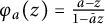 $\varphi _{a}(z)=\frac {a-z}{1-\bar {a}z}$
is a Möbius transformation of
 $\mathbb {D}$
. From the definition, we know that
 $\mathcal {D}^{s}_{K}$
mainly depends on the behavior of the function
 $K(t)$
for small t.
It is clear that
 $\mathcal {D}^{s}_{K}$
is always a subspace of
 $\mathcal {D}_s$
for
 $0<s<\infty $
, and
 $\mathcal {D}^{s_1}_{K}\subseteq \mathcal {D}^{s_2}_{K}$
for
 $0<s_1\leq s_2<\infty $
. Some choices of s and K give known spaces. For example, if
 $K(t)=t^{s\lambda }$
,
 $0\leq s, \lambda \leq 1$
, then
 $\mathcal {D}^{s}_{K}=\mathcal {D}^{\lambda }_s$
, which was considered in [Reference Galanopoulos, Merchán and Siskakis6]; if
 $s=1$
,
 $\mathcal {D}^{s}_{K}$
gives
 $H^2_K$
, and if
 $K(t)=t^s$
,
 $0<s<\infty $
, then
 $\mathcal {D}^{s}_{K}=\mathcal {Q}_s$
; see [Reference Wulan and Zhou24] for
 $H^2_K$
and [Reference Xiao26, Reference Xiao27] for the theory of
 $\mathcal {Q}_s$
spaces.
Denote by
 $\mathcal Q_K$
the space of all functions
 $f\in H(\mathbb {D})$
for which
 $$ \begin{align*}\|f\|^{2}_{\mathcal Q_{K}}=\underset{a\in\mathbb{D}}{\mathrm{sup}}\int_{\mathbb{D}}|f^{\prime}(z)|^{2}K(g(z,a))\mathrm{d}A(z)<\infty, \end{align*} $$
where
 $g(z,a)=\mathrm {log}|\frac {1-\bar {a}z}{z-a}|$
is the Green function of
 $\mathbb {D}$
with logarithmic singularity at
 $a\in \mathbb {D}$
. If
 $K(t)=t^{s}, 0<s<\infty $
, then
 $\mathcal Q_{K}=\mathcal Q_{s}$
. See [Reference Essén and Wulan4, Reference Essén, Wulan and Xiao5, Reference Wulan and Zhu25] for more results of
 $\mathcal Q_{K}$
spaces.
In 1938, Morrey spaces were introduced for solutions of partial differential equations and were subsequently studied as function classes in harmonic analysis on Euclidean spaces; see [Reference Morrey12, Reference Peetre18, Reference Zorko31]. The analytic Morrey spaces have attracted a lot of attention in recent years, for example, [Reference Galanopoulos, Merchán and Siskakis6, Reference Li, Liu and Lou9, Reference Liu and Lou10, Reference Wu and Xie23, Reference Wulan and Zhou24].
The purpose of this article is to study a more general analytic Morrey type space
 $\mathcal {D}^s_K$
with a nondecreasing function K. Firstly, a characterization of
 $\mathcal {D}^s_K$
is given by introducing K-Carleson measure. Secondly, as an extension of known results, we find a sufficient or necessary condition for the embedding map
 $I: \mathcal {D}^s_K\mapsto \mathcal {T}^s_{K}(\mu)$
to be bounded. Finally, we obtain a feature of
 $\mathcal {D}_K^s$
in terms of the fractional order derivatives, and build a bridge between two spaces
 $\mathcal {D}^{s_1}_K$
and
 $\mathcal {D}^{s_2}_K$
by the fractional order derivatives.
We will write
 $A\lesssim B$
, if there exists a constant
 $C>0$
such that
 $A\leq CB$
. Also, the symbol
 $A\approx B$
means that
 $A\lesssim B\lesssim A$
.
2 Spaces
 $\mathcal {D}^{s}_{K}$
via K-Carleson measures

We say K satisfies the doubling condition if there exist positive constants C and M such that
 $$ \begin{align*}K(t)\leq K(2t)\leq CK(t), \quad 0 < t < M. \end{align*} $$
In many situations, we will need to consider two conditions on K as follows:
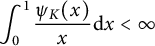 $$ \begin{align} \int_{0}^{1}\frac{\psi_{K}(x)}{x}\mathrm{d}x < \infty \end{align} $$
and
 $$ \begin{align} \int_{1}^{\infty}\frac{\psi_{K}(x)}{x^{1+\sigma}}\mathrm{d}x < \infty, \quad \sigma > 0, \end{align} $$
where
 $$ \begin{align*}\psi_{K}(x)=\underset{0 < t\leq1}{\mathrm{sup}}\frac{K(xt)}{K(t)},\quad 0 < x < \infty. \end{align*} $$
It is clear that the function
 $K(t)=t^p$
satisfies (2.1) for all p,
 $0<p<\infty $
, and satisfies (2.2) whenever
 $0<p<\sigma $
. The following results about the weight function will be needed ([Reference Essén, Wulan and Xiao5, Lemmas 2.1 and 2.2] or [Reference Wulan and Zhu25, Theorems 3.4 and 3.5]).
Lemma A Suppose K satisfies condition (2.1) and the doubling condition on
 $(0,1)$
. Then there exists a weight function
 $K_{1}$
such that
 $K_{1}$
is comparable with K on
 $(0,1)$
, and the function
 $\frac {K_1(t)}{t^c}$
is increasing on
 $(0,1)$
for all sufficiently small positive constants c.
Lemma B Suppose K satisfies condition (2.2) for some
 $\sigma>0$
. Then there exists a weight function
 $K_{2}$
such that
 $K_{2}$
is comparable with K on (0,1), and the functions
 $\frac {K_2(t)}{t^\sigma }$
and
 $\frac {K_2(t)}{t^{\sigma -c}}$
are both decreasing on
 $(0,1)$
for all sufficiently small positive constants c.
Remark 2.1 If K satisfies condition (2.2) for some
 $\sigma>0$
, we are able to obtain some results as follows.
-
(i) For
$0<t\leq r<\infty $
, it is easy to see that for all sufficiently small positive constants
$$ \begin{align*}\frac{K(r)}{K(t)}=\frac{K(r)t^{\sigma-c}}{r^{\sigma-c}K(t)}\bigg(\frac{r}{t}\bigg)^{\sigma-c}\leq\bigg(\frac{r}{t}\bigg)^{\sigma-c} \leq\bigg(\frac{r}{t}\bigg)^\sigma \end{align*} $$
$c<\sigma $
.
-
(ii) The function K satisfies the doubling condition [Reference Wulan and Zhu25, Corollary 3.2].
-
(iii)
$\mathcal Q_s\subseteq \mathcal {D}^{s}_K$
for
$\sigma \leq s<\infty $
. -
(iv) Furthermore, if K satisfies (2.1), then
$\mathcal {D}^{c}_K\subseteq \mathcal Q_K \subseteq \mathcal {D}^{\sigma }_K$
for all sufficiently small positive constants
$c<\sigma $
.




Proposition 2.1 Let
 $0<s< \infty $
. Then
 $\mathcal {D}^{s}_{K}\subseteq \mathcal {D}_{s}$
and moreover,
 $\mathcal {D}^{s}_{K}=\mathcal {D}_{s}$
if and only if
 $K(0)>0$
.
Proof Note that
 $\mathcal {D}^{s}_{K}\subseteq \mathcal {D}_{s}$
is obvious. Assume that
 $K(0)>0$
and
 $f\in \mathcal {D}_s$
. Since K is nondecreasing, we have
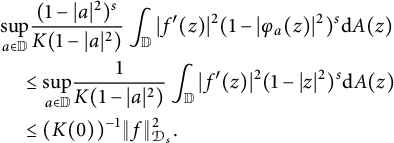 $$ \begin{align*} &\underset{a\in \mathbb{D}}{\mathrm{sup}}\frac{(1-|a|^2)^s}{K(1-|a|^2)} \int_{\mathbb{D}}|f^{\prime}(z)|^{2}(1-|\varphi_a(z)|^{2})^{s}\mathrm{d}A(z)\\ &\quad\leq\underset{a\in \mathbb{D}}{\mathrm{sup}}\frac{1}{K(1-|a|^2)} \int_{\mathbb{D}}|f^{\prime}(z)|^{2}(1-|z|^2)^{s}\mathrm{d}A(z)\\ &\quad \leq (K(0))^{-1}\|f\|^2_{\mathcal{D}_s}. \end{align*} $$
Thus,
 $f\in \mathcal {D}^{s}_{K}$
and so
 $\mathcal {D}^{s}_{K}=\mathcal {D}_s$
.
Conversely, for
 $0<r<1$
, let
 $\mathbb {D}(c,r)=\{z\in \mathbb {D}: |\varphi _{c}(z)| < r \}$
be a pseudo-hyperbolic disk centered at
 $c\in \mathbb {D}$
. It is well-known that
 $$ \begin{align*}1-|c|\approx|1-\bar{c}z|\approx1-|z| \end{align*} $$
for all
 $z\in \mathbb {D}(c,r)$
. Assume that
 $\mathcal {D}^{s}_{K}=\mathcal {D}_s, 0 < s < \infty $
. The closed graph theorem yields that the identity map from
 $\mathcal {D}_s$
to
 $\mathcal {D}^{s}_{K}$
is continuous. Thus, there exists a positive constant C such that
 $$ \begin{align} \|f\|_{\mathcal{D}^{s}_{K}}\leq C\|f\|_{\mathcal{D}_s} \end{align} $$
for all
 $f\in \mathcal {D}_s$
. For
 $c\in \mathbb {D}$
, we consider the test function
 $$ \begin{align*}f_c(z)=(1-|c|^2)^{1+\frac{s}{2}}\int_{0}^{z}\frac{\mathrm{d}\zeta}{(1-\bar{c}\zeta)^{2+s}}, \quad z\in \mathbb{D}. \end{align*} $$
The use of [Reference Zhu30, Lemma 3.10] yields
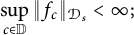 $$ \begin{align*}\mathop{\mathrm{sup}}\limits_{c\in \mathbb{D}} \|f_c\|_{\mathcal{D}_s}<\infty; \end{align*} $$
see [Reference Pau and Peláez16, Theorem 3.1]. Combining this with (2.3) gives that
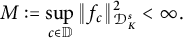 $$ \begin{align*}M:=\mathop{\mathrm{sup}}\limits_{c\in \mathbb{D}} \|f_c\|^2_{\mathcal{D}^{s}_{K}}< \infty. \end{align*} $$
Hence,
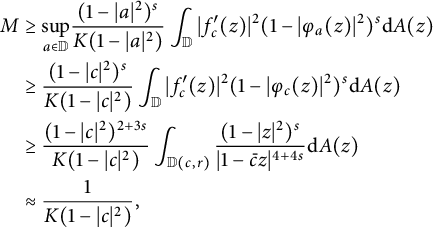 $$ \begin{align*} M&\geq\underset{a\in \mathbb{D}}{\mathrm{sup}}\frac{(1-|a|^2)^{s}}{K(1-|a|^2)} \int_{\mathbb{D}}|f_c^{\prime}(z)|^{2}(1-|\varphi_a(z)|^{2})^{s}\mathrm{d}A(z)\\ &\geq\frac{(1-|c|^2)^{s}}{K(1-|c|^2)} \int_{\mathbb{D}}|f_c^{\prime}(z)|^{2}(1-|\varphi_c(z)|^{2})^{s}\mathrm{d}A(z)\\ &\geq\frac{(1-|c|^2)^{2+3s}}{K(1-|c|^2)} \int_{\mathbb{D}(c,r)}\frac{(1-|z|^2)^{s}}{|1-\bar{c}z|^{4+4s}}\mathrm{d}A(z)\\ &\approx\frac{1}{K(1-|c|^2)}, \end{align*} $$
which clearly implies
 $K(0)>0$
. The proof is complete. ▪
Proposition 2.2 Suppose K satisfies condition (2.2) for some
 $\sigma>0$
. Then
 $\mathcal {D}^{s}_{K}=\mathcal Q_s$
if and only if
 $K(t)\approx t^s, 0 < s < \infty $
.
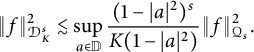
Proof The proof is easily completed by the following estimates:
 $$ \begin{align*}\|f\circ\varphi_{a}-f(a)\| ^{2}_{\mathcal{D}_s}\lesssim\frac{K(1-|a|^2)}{(1-|a|^2)^s}\|f\|^{2}_{\mathcal{D}_K^s},\quad a\in\mathbb{D}, \end{align*} $$
and
 $$ \begin{align*}\|f\|^{2}_{\mathcal{D}_K^s}\lesssim\mathop{\mathrm{sup}}\limits_{a\in\mathbb{D}}\frac{(1-|a|^2)^s}{K(1-|a|^2)}\|f\|^{2}_{\mathcal Q_s}. \end{align*} $$
▪
Let
 $|I|$
be the normalized length of arc I on the unit circle
 $\mathbb {T}$
, and let
 $S(I)$
be the Carleson box defined by
 $$ \begin{align*}S(I)=\bigg\{z\in\mathbb{D}: 1-|I|<|z|<1, \frac{z}{|z|}\in I\bigg\}. \end{align*} $$
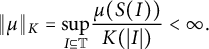
A positive Borel measure
 $\mu $
is a K-Carleson measure on
 $\mathbb {D}$
if
 $$ \begin{align*}\|\mu\|_{K}=\underset{I\subseteq\mathbb{T}}{\mathrm{sup}}\frac{\mu(S(I))}{K(|I|)}<\infty. \end{align*} $$
For
 $0<s<\infty, 0\leq \alpha <\infty $
, if we choose
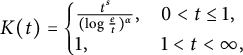 $$ \begin{align*} K(t)=\left\{\begin{array}{@{}ll} \frac{t^s}{(\log\frac{e}{t})^\alpha}, & 0 < t \leq1,\\ 1, & 1 < t < \infty, \end{array} \right. \end{align*} $$
then
 $\mu $
is
 $(\alpha, s)$
-logarithmic Carleson measure [Reference Zhao29]; if
 $\alpha =0$
, the
 $(0, s)$
-logarithmic Carleson measure coincides with s-Carleson measure.
Theorem 2.1 Suppose K satisfies (2.2) for some
 $0<\sigma <2$
and
 $\mu $
is a positive Borel measure on
 $\mathbb {D}$
. Then
 $\mu $
is a K-Carleson measure if and only if
 $$ \begin{align} \underset{a\in \mathbb{D}}{\mathrm{sup}}\frac{1}{K(1-|a|^2)}\int_{\mathbb{D}} \bigg(\frac{1-|a|^2}{|1-\bar{a}z|}\bigg)^p\mathrm{d}\mu(z)<\infty, \quad \sigma\leq p<\infty. \end{align} $$
Proof Assume that (2.4) holds. For an interval
 $I\subseteq \mathbb {T}$
, let
 $e^{i\theta }$
,
 $\theta \in [0,2\pi)$
, be the midpoint of I and
 $a=(1-|I|)e^{i\theta }$
. Note that
 $$ \begin{align*}|1-\bar{a}z|\approx|I|\approx1-|a|^2, \quad z\in S(I). \end{align*} $$
By the doubling condition, we have
 $$ \begin{align*}K(1-|a|^2)\approx K(|I|), \quad z\in S(I). \end{align*} $$
Thus,
 $$ \begin{align*} \frac{\mu(S(I))}{K(|I|)}\approx\frac{1}{K(|I|)}\int_{S(I)}\bigg(\frac{1-|a|^2}{|1-\bar{a}z|}\bigg)^p\mathrm{d}\mu(z) \lesssim\frac{1}{K(1-|a|^2)}\int_{\mathbb{D}}\bigg(\frac{1-|a|^2}{|1-\bar{a}z|}\bigg)^p\mathrm{d}\mu(z). \end{align*} $$
Therefore,
 $\mu $
is a K-Carleson measure.
On the other hand, suppose
 $\mu $
is K-Carleson measure and
 $2^nI$
denotes the arc with the same center as I and the length
 $2^n|I|$
. Then we have the following estimate:
 $$ \begin{align*} 2^{n-1}(1-|a|^2)\lesssim|1-\bar{a}z|, \quad z\in S(2^{n}I)\backslash S(2^{n-1}I), \end{align*} $$
which implies for
 $\sigma \leq p<\infty $
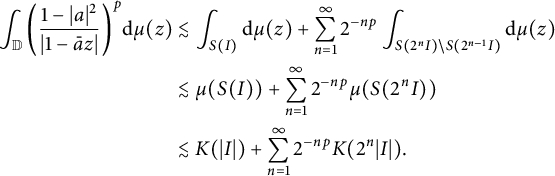 $$ \begin{align*} \int_{\mathbb{D}}\bigg(\frac{1-|a|^2}{|1-\bar{a}z|}\bigg)^p\mathrm{d}\mu(z) &\lesssim\int_{S(I)}\mathrm{d}\mu(z)+ \sum^{\infty}_{n=1}2^{-np}\int_{S(2^{n}I)\backslash S(2^{n-1}I)}\mathrm{d}\mu(z)\\ &\lesssim\mu(S(I))+\sum^{\infty}_{n=1}2^{-np}\mu(S(2^{n}I))\\ &\lesssim K(|I|)+\sum^{\infty}_{n=1}2^{-np}K(2^{n}|I|). \end{align*} $$
By Lemma B, there exists a sufficiently small positive constant c such that
 $$ \begin{align*} K(2^{n}|I|)\lesssim 2^{n(\sigma-c)}K(|I|),\quad n=1,2,\dots \end{align*} $$
Consequently,
 $$ \begin{align*} \int_{\mathbb{D}}\bigg(\frac{1-|a|^2}{|1-\bar{a}z|}\bigg)^p\mathrm{d}\mu(z) \lesssim K(|I|)+\sum^{\infty}_{n=1}2^{-(p-\sigma+c)n}K(|I|)\approx K(1-|a|^2). \end{align*} $$
This completes the proof of Theorem 2.1. ▪
Note that Theorem 2.1 gives a new characterization of
 $\mathcal {D}^{s}_{K}$
space in terms of K-Carleson measure by replacing
 $\mathrm {d}\mu (z)$
by
 $|f^{\prime }(z)|^2(1-|z|^2)^s\mathrm {d}A(z)$
and putting
 $p=2s$
.
Theorem 2.2 Suppose K satisfies (2.2) for some
 $0<\sigma <2$
and
 $\frac {\sigma }{2}\leq s<\infty $
. Then
 $f\in \mathcal {D}^{s}_{K}$
if and only if
 $$ \begin{align*}\underset{I\subseteq \mathbb{T}}{\mathrm{sup}}\frac{1}{K(|I|)}\int_{S(I)}|f^{\prime}(z)|^{2}(1-|z|^{2})^{s}\mathrm{d}A(z)<\infty. \end{align*} $$
3 The embedding map from
$\mathcal {D}^{s}_{K}$
to
$\mathcal {T}^s_{K}(\mu)$


Let X be a space of analytic functions in
 $\mathbb D$
. For
 $0 <p<\infty $
, a positive Borel measure
 $\mu $
on
 $\mathbb {D}$
is said to be a p-Carleson measure for the space X if the embedding map
 $I: X \mapsto L^p(d\mu)$
is a bounded operator, i.e., there is a constant
 $C>0$
such that
 $$ \begin{align} \int_{\mathbb{D}}|f(z)|^p\,d\mu(z)\le C\|f\|^p_{X} \end{align} $$
for all functions
 $f\in X$
. When the parameter
 $p=2$
, we always simply leave out the p in front of the Carleson measure. Note that the following two notations are different:
-
(i)
$\mu $
is a p-Carleson measure on
$\mathbb D$
and -
(ii)
$\mu $
is a p-Carleson measure for a space X.


Carleson’s embedding theorem [Reference Carleson3] shows that
 $\mu $
is a Carleson measure on
 $\mathbb D$
if and only if
 $\mu $
is a Carleson measure for
 $H^2$
. Similar results for some Bergman spaces and Dirichlet type spaces can be found in [Reference Oleinik13, Reference Stegenga21, Reference Wu22]. However, Stegenga [Reference Stegenga21] proved that
 $\mu $
is a Carleson measure for
 $\mathcal {D}_s$
implies that
 $\mu $
is an s-Carleson measure on
 $\mathbb D$
for
 $0<s<\infty $
but the converse is true only for
 $s\ge 1$
. There are many research works on these topics for different function spaces; see, for example, [Reference Girela and Peláez7, Reference Kerman and Sawyer8, Reference Liu, Lou and Zhu11, Reference Xiao27].
For
 $0<s<\infty $
and a positive Borel measure
 $\mu $
on
 $\mathbb {D}$
, we define a new space
 $\mathcal {T}^s_{K}(\mu)$
consisting of functions
 $f\in H(\mathbb {D})$
for which
 $$ \begin{align*}\|f\|^2_{\mathcal{T}^s_{K}(\mu)}=\underset{a\in\mathbb{D}}{\mathrm{sup}}\frac{1}{K(1-|a|^2)} \int_{\mathbb{D}}|f(z)-f(a)|^2\bigg(\frac{1-|a|^2}{|1-\bar{a}z|}\bigg)^{2s}\mathrm{d}\mu(z)<\infty. \end{align*} $$
We will consider the embedding map
 $I: \mathcal {D}^s_K\mapsto \mathcal {T}^s_{K}(\mu)$
and find sufficient or necessary condition for the operator I to be bounded. As an extension of results of [Reference Galanopoulos, Merchán and Siskakis6, Reference Liu, Lou and Zhu11, Reference Pau and Peláez15, Reference Qian and Li19, Reference Xiao28], we state the following theorem.
Theorem 3.1 Suppose K satisfies (2.2) for some
 $0<\sigma <2$
and
 $\frac {\sigma }{2}\leq s<\infty $
. For a positive Borel measure
 $\mu $
on
 $\mathbb {D}$
, the following results are true.
-
(i) If
$I: \mathcal {D}^{s}_{K} \mapsto \mathcal {T}^s_{K}(\mu)$
is bounded, then
$\mu $
is an s-Carleson measure on
$\mathbb D$
. -
(ii) If
$\mu $
is a Carleson measure for
$\mathcal {D}_s$
, then
$I: \mathcal {D}^{s}_{K} \mapsto \mathcal {T}^s_{K}(\mu)$
is bounded.




The following Lemmas will be used in the proof of Theorem 3.1.
Lemma C ([Reference Ortega and Fàbrega14, Reference Pau and Zhao17])
If
 $s>-1$
,
 $r, t>0$
with
 $r+t-s-2>0$
, then
 $$ \begin{align*} \int_{\mathbb{D}}\frac{(1-|z|^2)^s}{|1-\bar{a}z|^r|1-\bar{b}z|^t}\mathrm{d}A(z)\lesssim\left\{ \begin{array}{@{}ll} \frac{1}{|1-\bar{a}b|^{r+t-s-2}}, & r,t < 2+s,\\ \frac{1}{(1-|a|^2)^{r-s-2}|1-\bar{a}b|^{t}}, & t < 2+s < r,\\ \frac{1}{(1-|a|^2)^{r-s-2}|1-\bar{a}b|^{t}} +\frac{1}{(1-|b|^2)^{t-s-2}|1-\bar{a}b|^{r}}, & r,t > 2+s,\\ \end{array} \right. \end{align*} $$
for all
 $a,b\in \mathbb {D}$
.
Lemma 3.1 Suppose K satisfies (2.2) for some
 $0<\sigma <2$
and
 $\frac {\sigma }{2}\leq s<\infty $
. Then the functions
 $$ \begin{align*}f_{w}(z)=\frac{(1-|w|^2)^sK^{\frac{1}{2}}(1-|w|^2)}{(1-\bar{w}z)^{\frac{3s}{2}}}, \quad w, z\in\mathbb{D}, \end{align*} $$
belong to
 $\mathcal {D}^{s}_{K}$
and
 $$ \begin{align} \underset{w\in \mathbb{D}}{\mathrm{sup}} \|f_w\|_{\mathcal{D}^s_K}<\infty. \end{align} $$
Proof By a simple calculation,
 $$ \begin{align*} \|f_w\|_{\mathcal{D}^s_K}^2 \lesssim\underset{a\in \mathbb{D}}{\mathrm{sup}}\frac{(1-|a|^2)^{2s}K(1-|w|^2)(1-|w|^2)^{2s}}{K(1-|a|^2)} \int_{\mathbb{D}}\frac{(1-|z|^2)^s}{|1-\bar{w}z|^{3s+2}|1-\bar{a}z|^{2s}}\mathrm{d}A(z). \end{align*} $$
Case 1. For
 $\frac {\sigma }{2}\leq s<2$
, it follows from Lemma C that
 $$ \begin{align*} \int_{\mathbb{D}}\frac{(1-|z|^2)^s}{|1-\bar{w}z|^{3s+2}|1-\bar{a}z|^{2s}}\mathrm{d}A(z) \lesssim\frac{1}{(1-|w|^2)^{2s}|1-\bar{a}w|^{2s}}. \end{align*} $$
Thus,
 $$ \begin{align*} \|f_w\|_{\mathcal{D}^s_K}^2 \lesssim\underset{a\in\mathbb{D}}{\mathrm{sup}}\bigg(\frac{1-|a|^2}{|1-\bar{a}w|}\bigg)^{2s}\frac{K(|1-\bar{a}w|)}{K(1-|a|^2)} \lesssim\underset{a\in \mathbb{D}}{\mathrm{sup}}\bigg(\frac{1-|a|^2}{|1-\bar{a}w|}\bigg)^{2s-\sigma}\lesssim 1. \end{align*} $$
Case 2. For
 $s=2$
, choosing a number
 $\delta, 0<\delta \leq \sigma $
, and applying Lemma C, we have
 $$ \begin{align*} \int_{\mathbb{D}}\frac{(1-|z|^2)^2}{|1-\bar{w}z|^{8}|1-\bar{a}z|^{4}}\mathrm{d}A(z) &\lesssim\int_{\mathbb{D}}\frac{(1-|z|^2)^{2-\delta}}{|1-\bar{w}z|^{8-\delta}|1-\bar{a}z|^{4}}\mathrm{d}A(z)\\ &\lesssim\frac{1}{(1-|w|^2)^{4}|1-\bar{a}w|^{4}}+\frac{1}{(1-|a|^2)^{\delta}|1-\bar{a}w|^{8-\delta}}, \end{align*} $$
and hence
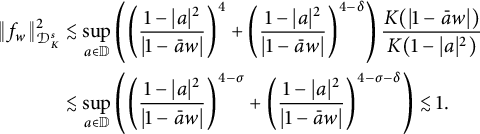 $$ \begin{align*} \|f_w\|_{\mathcal{D}^s_K}^2 &\lesssim\underset{a\in\mathbb{D}}{\mathrm{sup}}\left(\bigg(\frac{1-|a|^2}{|1-\bar{a}w|}\bigg)^{4}+ \bigg(\frac{1-|a|^2}{|1-\bar{a}w|}\bigg)^{4-\delta}\right)\frac{K(|1-\bar{a}w|)}{K(1-|a|^2)}\\ &\lesssim\underset{a\in \mathbb{D}}{\mathrm{sup}}\left(\bigg(\frac{1-|a|^2}{|1-\bar{a}w|}\bigg)^{4-\sigma}+ \bigg(\frac{1-|a|^2}{|1-\bar{a}w|}\bigg)^{4-\sigma-\delta}\right)\lesssim 1. \end{align*} $$
Case 3. For
 $2< s<\infty $
, we similarly obtain that
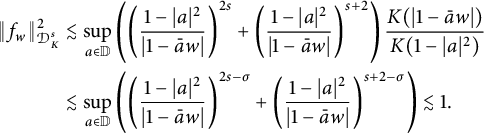 $$ \begin{align*} \|f_w\|_{\mathcal{D}^s_K}^2 &\lesssim\underset{a\in\mathbb{D}}{\mathrm{sup}}\left(\bigg(\frac{1-|a|^2}{|1-\bar{a}w|}\bigg)^{2s}+ \bigg(\frac{1-|a|^2}{|1-\bar{a}w|}\bigg)^{s+2}\right)\frac{K(|1-\bar{a}w|)}{K(1-|a|^2)}\\ &\lesssim\underset{a\in \mathbb{D}}{\mathrm{sup}}\left(\bigg(\frac{1-|a|^2}{|1-\bar{a}w|}\bigg)^{2s-\sigma}+ \bigg(\frac{1-|a|^2}{|1-\bar{a}w|}\bigg)^{s+2-\sigma}\right)\lesssim 1. \end{align*} $$
Therefore, (3.2) is checked. ▪
The following result gives an estimate on the growth of a function f in
 $\mathcal {D}^{s}_{K}$
.
Lemma 3.2 Suppose K satisfies (2.2) for some
 $0<\sigma <2$
and
 $\frac {\sigma }{2}\leq s<\infty $
. Then for any
 $f\in \mathcal {D}^{s}_{K}$
,
 $$ \begin{align} |f(z)-f(0)|\lesssim\|f\|_{\mathcal{D}^{s}_{K}}\bigg(\frac{K(1-|z|^2)}{(1-|z|^2)^s}\bigg)^{\frac{1}{2}}, \quad z\in\mathbb{D}. \end{align} $$
Proof Let
 $\mathbb {D}(w,r)=\{z\in \mathbb {D}: |\varphi _{w}(z)| < r \}, w\in \mathbb {D}, 0 < r < 1$
. Using the submean value property of
 $|f^{\prime }(z)|^{2}$
, we get
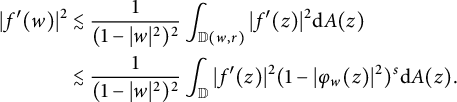 $$ \begin{align*} |f^{\prime}(w)|^{2}&\lesssim\frac{1}{(1-|w|^2)^{2}}\int_{\mathbb{D}(w,r)}|f^{\prime}(z)|^{2}\mathrm{d}A(z)\\ &\lesssim\frac{1}{(1-|w|^2)^{2}}\int_{\mathbb{D}}|f^{\prime}(z)|^{2}(1-|\varphi_{w}(z)|^2)^{s}\mathrm{d}A(z). \end{align*} $$
Hence,
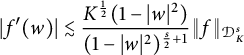 $$ \begin{align*}|f^{\prime}(w)|\lesssim\frac{K^{\frac{1}{2}}(1-|w|^2)}{(1-|w|^2)^{\frac{s}{2}+1}}\|f\|_{\mathcal{D}^{s}_{K}} \end{align*} $$
and
 $$ \begin{align} |f(w)-f(0)|=\bigg|w\int^1_0f^{\prime}(wt)\mathrm{d}t\bigg|\lesssim\|f\|_{\mathcal{D}^{s}_{K}} \int^1_0\frac{K^{\frac{1}{2}}(1-|wt|^2)}{(1-|wt|^2)^{\frac{s}{2}+1}}|w|\mathrm{d}t. \end{align} $$
Under the preliminary assumption that K satisfies condition (2.2) for some
 $\sigma $
, there exists a sufficiently small positive constant c such that
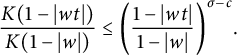 $$ \begin{align*} \frac{K(1-|wt|)}{K(1-|w|)}\leq\bigg(\frac{1-|wt|}{1-|w|}\bigg)^{\sigma-c}. \end{align*} $$
Consequently, the integral on the right-hand side of (3.4) is dominated by
 $$ \begin{align*} \frac{K^{\frac{1}{2}}(1-|w|)}{(1-|w|)^{\frac{\sigma-c}{2}}}\int^1_0(1-|wt|)^{\frac{\sigma-c-s}{2}-1}|w|\mathrm{d}t \lesssim\bigg(\frac{K(1-|w|)}{(1-|w|)^s}\bigg)^{\frac{1}{2}}. \end{align*} $$
Here, we choose
 $0<c<\sigma $
such that
 $\sigma -s-c>0$
for
 $\sigma -s>0$
and choose
 $0<c<\sigma $
such that
 $\sigma -s-c<0$
for
 $\sigma -s\le 0$
. Thus, we obtain the desired growth inequality (3.3). ▪
Proof Proof of Theorem 3.1
Suppose condition (i) holds; that is there exists a constant
 $C>0$
such that
 $$ \begin{align} \|f\|_{\mathcal{T}^s_{K}(\mu)}\le C\|f\|_{\mathcal{D}^s_K} \end{align} $$
holds for all
 $f\in \mathcal {D}^s_K$
. For
 $I\subseteq \mathbb {T}$
, let
 $e^{i\theta }$
,
 $\theta \in [0,2\pi)$
, be the midpoint of I. Choose
 $w=(1-2|I|)e^{i\theta }$
and
 $|I|<\frac {1}{8}$
. A simple geometric argument shows that
 $$ \begin{align} 2|I|\leq|1-\bar{w}z|\leq\frac{\sqrt{37}}{2}|I|, \quad z\in S(I). \end{align} $$
Consider the test function
 $f_{w}\in \mathcal {D}^s_K$
of Lemma 3.1, we have
 $$ \begin{align*} \|f_{w}\|_{ \mathcal{T}^s_{K}(\mu)}\lesssim\|f_{w}\|_{\mathcal{D}^{s}_{K}}\lesssim\underset{w\in \mathbb{D}}{\mathrm{sup}} \|f_w\|_{\mathcal{D}^s_K}<\infty. \end{align*} $$
By (3.6), we obtain
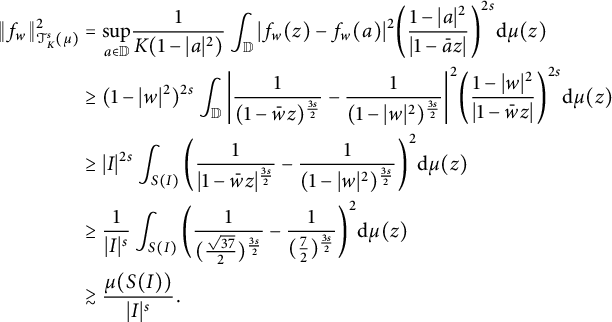 $$ \begin{align*} \|f_w\|^{2}_{ \mathcal{T}^s_{K}(\mu)} &=\underset{a\in \mathbb{D}}{\mathrm{sup}}\frac{1}{K(1-|a|^2)}\int_{\mathbb{D}}|f_w(z)-f_w(a)|^2 \bigg(\frac{1-|a|^2}{|1-\bar{a}z|}\bigg)^{2s}\mathrm{d}\mu(z)\\ &\geq(1-|w|^2)^{2s}\int_{\mathbb{D}}\bigg|\frac{1}{(1-\bar{w}z)^{\frac{3s}{2}}}-\frac{1}{(1-|w|^2)^{\frac{3s}{2}}} \bigg|^2\bigg(\frac{1-|w|^2}{|1-\bar{w}z|}\bigg)^{2s}\mathrm{d}\mu(z)\\ &\geq|I|^{2s}\int_{S(I)}\bigg(\frac{1}{|1-\bar{w}z|^{\frac{3s}{2}}}-\frac{1}{(1-|w|^2)^{\frac{3s}{2}}}\bigg)^2\mathrm{d}\mu(z)\\ &\geq\frac{1}{|I|^s}\int_{S(I)}\bigg(\frac{1}{(\frac{\sqrt{37}}{2})^{\frac{3s}{2}}}-\frac{1}{(\frac{7}{2})^{\frac{3s}{2}}} \bigg)^2\mathrm{d}\mu(z)\\ &\gtrsim\frac{\mu(S(I))}{|I|^s}. \end{align*} $$
Combining this with (3.5), we find
 $$ \begin{align*} \mu(S(I))\lesssim{|I|^s}, \end{align*} $$
which means that
 $\mu $
is an s-Carleson measure.
To prove (ii), we first show that if
 $f\in \mathcal {D}^{s}_{K}$
then
 $$ \begin{align} F_{K,a}(z)=\frac{(1-|a|^2)^{s}}{(K(1-|a|^2))^{\frac12}}\frac{f(z)-f(a)}{(1-\bar{a}z)^s}\in \mathcal{D}_s, \quad a\in \mathbb{D}, \end{align} $$
and
 $$ \begin{align} \|F_{K,a}\|_{\mathcal{D}_s}\lesssim \|f\|_{\mathcal{D}^s_K}, \quad a\in \mathbb{D}. \end{align} $$
Thus, if
 $\mu $
is a Carleson measure for
 $\mathcal {D}_s$
, then there is a constant
 $C>0$
such that
 $$ \begin{align*} \int_{\mathbb{D}}|F_{K,a}(z)|^{2}\mathrm{d}\mu(z)\leq C\|F_{K,a}\|^2_{ \mathcal{D}_s}\lesssim \|f\|_{\mathcal{D}^s_K}^2 \end{align*} $$
holds for all
 $f\in \mathcal {D}_s$
. Collecting all estimates above, we have that
 $$ \begin{align*} \|f\|_{ \mathcal{T}^s_{K}(\mu)}\lesssim\|f\|_{\mathcal{D}^{s}_{K}}, \end{align*} $$
which is the desired conclusion.
Now, we are going to check (3.7) and (3.8). In fact,
 $$ \begin{align*} \|F_{K,a}\|^2_{\mathcal{D}_s} &=\frac{(1-|a|^2)^{2s}}{K(1-|a|^2)}\left(|f(a)-f(0)|^2+\int_{\mathbb{D}}\bigg|\frac{\mathrm{d}}{\mathrm{d}z} \bigg(\frac{f(z)-f(a)}{(1-\bar{a}z)^s}\bigg)\bigg|^{2}(1-|z|^{2})^{s}\mathrm{d}A(z)\right)\\ &=\frac{(1-|a|^2)^{2s}}{K(1-|a|^2)}|f(0)-f(a)|^2+I(a). \end{align*} $$
By Lemma 3.2, the first term in the last sum is
 $$ \begin{align*} \frac{(1-|a|^2)^{2s}}{K(1-|a|^2)}|f(a)-f(0)|^2\lesssim\frac{(1-|a|^2)^s}{K(1-|a|^2)}|f(a)-f(0)|^2 \lesssim\|f\|^2_{\mathcal{D}^{s}_{K}}. \end{align*} $$
For the second term, we have
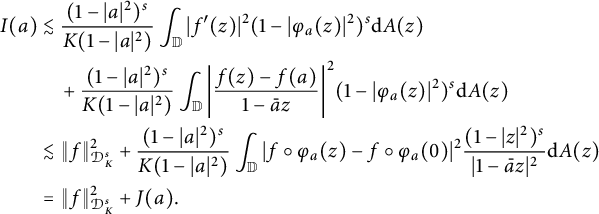 $$ \begin{align*} I(a)&\lesssim\frac{(1-|a|^2)^s}{K(1-|a|^2)}\int_{\mathbb{D}} |f^{\prime}(z)|^2(1-|\varphi_a(z)|^{2})^{s}\mathrm{d}A(z) \\ & \quad + \frac{(1-|a|^2)^s}{K(1-|a|^2)}\int_{\mathbb{D}}\bigg|\frac{f(z)-f(a)}{1-\bar{a}z}\bigg|^{2}(1-|\varphi_a(z)|^{2})^{s} \mathrm{d}A(z)\\ &\lesssim\|f\|^2_{\mathcal{D}^{s}_{K}}+\frac{(1-|a|^2)^s}{K(1-|a|^2)}\int_{\mathbb{D}} |f\circ\varphi_a(z)-f\circ\varphi_a(0)|^{2}\frac{(1-|z|^{2})^{s}}{|1-\bar{a}z|^2}\mathrm{d}A(z)\\ &=\|f\|^2_{\mathcal{D}^{s}_{K}}+J(a). \end{align*} $$
By the reproducing formula of Rochberg and Wu [Reference Rochberg and Wu20], we get
 $$ \begin{align*} f\circ\varphi_a(z)-f\circ\varphi_a(0)=\int_{\mathbb{D}}(f\circ\varphi_a)^{\prime}(\zeta) K(\zeta,z)(1-|\zeta|^2)^{s+1}\mathrm{d}A(\zeta), \end{align*} $$
where
 $s>-1$
and
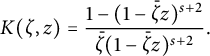 $$ \begin{align*} K(\zeta,z)=\frac{1-(1-\bar{\zeta}z)^{s+2}}{\bar{\zeta}(1-\bar{\zeta}z)^{s+2}}. \end{align*} $$
Obviously,
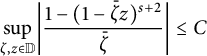 $$ \begin{align*} \underset{\zeta,z\in \mathbb{D}}{\mathrm{sup}}\bigg|\frac{1-(1-\bar{\zeta}z)^{s+2}}{\bar{\zeta}}\bigg|\leq C \end{align*} $$
holds for some constant
 $C>0$
. Choosing
 $0 < \varepsilon < s $
and by the Cauchy–Schwarz inequality,
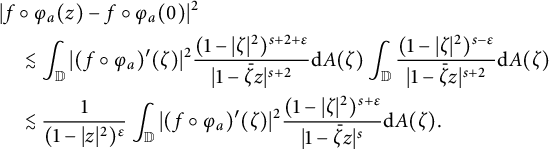 $$ \begin{align*} &|f\circ\varphi_a(z)-f\circ\varphi_a(0)|^2\\ &\quad \lesssim\int_{\mathbb{D}}|(f\circ\varphi_a)^{\prime}(\zeta)|^2\frac{(1-|\zeta|^2)^{s+2+\varepsilon}}{|1-\bar{\zeta}z|^{s+2}} \mathrm{d}A(\zeta) \int_{\mathbb{D}}\frac{(1-|\zeta|^2)^{s-\varepsilon}}{|1-\bar{\zeta}z|^{s+2}}\mathrm{d}A(\zeta)\\ &\quad \lesssim\frac{1}{(1-|z|^2)^{\varepsilon}}\int_{\mathbb{D}}|(f\circ\varphi_a)^{\prime}(\zeta)|^2 \frac{(1-|\zeta|^2)^{s+\varepsilon}}{|1-\bar{\zeta}z|^{s}}\mathrm{d}A(\zeta). \end{align*} $$
By Fubini’s theorem and Lemma C, we get
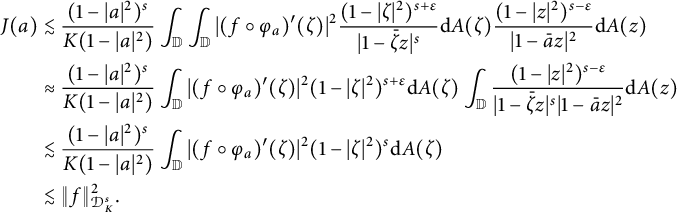 $$ \begin{align*} J(a)&\lesssim\frac{(1-|a|^2)^s}{K(1-|a|^2)}\int_{\mathbb{D}}\int_{\mathbb{D}}|(f\circ\varphi_a)^{\prime}(\zeta)|^2 \frac{(1-|\zeta|^2)^{s+\varepsilon}}{|1-\bar{\zeta}z|^{s}}\mathrm{d}A(\zeta)\frac{(1-|z|^{2})^{s-\varepsilon}}{|1-\bar{a}z|^2} \mathrm{d}A(z)\\ &\approx\frac{(1-|a|^2)^s}{K(1-|a|^2)} \int_{\mathbb{D}}|(f\circ\varphi_a)^{\prime}(\zeta)|^2(1-|\zeta|^2)^{s+\varepsilon}\mathrm{d}A(\zeta) \int_{\mathbb{D}}\frac{(1-|z|^{2})^{s-\varepsilon}}{|1-\bar{\zeta}z|^{s}|1-\bar{a}z|^2}\mathrm{d}A(z)\\ &\lesssim\frac{(1-|a|^2)^s}{K(1-|a|^2)}\int_{\mathbb{D}}|(f\circ\varphi_a)^{\prime}(\zeta)|^2(1-|\zeta|^2)^{s}\mathrm{d}A(\zeta)\\ &\lesssim\|f\|^2_{\mathcal{D}^{s}_{K}}. \end{align*} $$
For
 $1\leq s<\infty $
, we know that
 $\mu $
is a Carleson measure for
 $\mathcal {D}_{s}$
if and only if
 $\mu $
is an s-Carleson measure on
 $\mathbb {D}$
; see [Reference Stegenga21, Theorem 1.2]. However, this is no longer true for
 $0<s<1$
; see [Reference Aleman, Carlsson and Persson1, Reference Arcozzi, Rochberg and Sawyer2]. Thus, we obtain the following result.
Theorem 3.2 Suppose K satisfies (2.2) for some
 $0<\sigma <2$
and
 $1\leq s<\infty $
. For a positive Borel measure
 $\mu $
on
 $\mathbb {D}$
, the embedding map
 $I: \mathcal {D}^{s}_{K} \mapsto \mathcal {T}^s_{K}(\mu)$
is bounded if and only if
 $\mu $
is an s-Carleson measure.
Remark 3.1
-
(i) If
$K(t)=t^{s\lambda }$
,
$0<s, \lambda <1$
, Theorem 3.1
gives [Reference Galanopoulos, Merchán and Siskakis6, Theorems 3.4 and 3.5(2)]. -
(ii) If
$K(t)=t^s$
, Theorem 3.1
implies [Reference Liu, Lou and Zhu11, Theorem 5] and [Reference Xiao28, Theorem 1.1] (or [Reference Pau and Peláez15, Theorem 1]). -
(iii) If K satisfies condition (2.2) for
$\sigma =1$
, Theorem 3.2
was obtained by Qian and Li [Reference Qian and Li19, Theorem 2] for
$s=1$
and
$\mathrm {d}\mu (z)=|g^{\prime }(z)|^2(1-|z|^2)\mathrm {d}A(z)$
.



4 Fractional order derivatives and
$\mathcal{D}_K^s$
spaces

For fixed
 $b>1$
, consider the t-order derivative of a function
 $f\in H(\mathbb {D})$
defined by
 $$ \begin{align*} f^{(t)}(z)=\frac{\Gamma(b+t)}{\pi\Gamma(b)}\int_{\mathbb{D}} \frac{{\bar{w}}^{[t-1]}(1-|w|^2)^{b-1}f^{\prime}(w)}{(1-\bar{w}z)^{b+t}}\mathrm{d}A(w), \quad b+t>0. \end{align*} $$
Here,
 $[x]$
stands for the smallest integer greater than or equal to
 $x\in \mathbb {R}$
, and
 $\Gamma (\cdot)$
is the Gamma function. Note that
 $(f^{(t)})^{\prime }=f^{(t+1)}$
.
A direct computation yields
 $$ \begin{align*} (z^n)^{(t)}=\left\{ \begin{array}{@{}ll} \frac{\Gamma(b+n+t-1-[t-1])\Gamma(n+1)}{\Gamma(b+n)\Gamma(n-[t-1])}z^{n-1-[t-1]},& n\geq[t-1]+1,\\ 0,& n<[t-1]+1.\\ \end{array} \right. \end{align*} $$
It is easy to conclude that the t-fractional order derivative is just the usual tth order derivative if t is a positive integer.
In [Reference Wu and Xie23], Wu and Xie revealed that a function
 $f\in \mathcal Q_s$
can be viewed as its fractional order derivative in a Morrey space. In [Reference Wulan and Zhou24], Zhou and Wulan showed a connection between
 $H^2_K$
and
 $\mathcal Q_K$
by using the fractional order derivative. In this section, a characterization of
 $\mathcal {D}^{s}_K$
in terms of the fractional order derivative is given. As a by-product, we build a bridge between two spaces
 $\mathcal {D}^{s_1}_K$
and
 $\mathcal {D}^{s_2}_K$
by the fractional order derivatives.
Theorem 4.1 Suppose K satisfies (2.2) for some
 $0<\sigma <2$
and
 $\frac {\sigma }{2}\leq s<\infty $
. Then
 $f\in \mathcal {D}_K^s$
if and only if
 $$ \begin{align*} |f^{(t)}(z)|^2(1-|z|^2)^{2t-2+s}\mathrm{d}A(z),\quad \max\left\{0, \frac{1-s}{2},\frac{\sigma-s}{2}\right\} < t < \infty \end{align*} $$
is a K-Carleson measure.
Theorem 4.1 actually gives a relationship between two spaces
 $\mathcal {D}_K^{s_1}$
and
 $\mathcal {D}_K^{s_2}$
as follows.
Corollary 4.1 Suppose K satisfies (2.2) for some
 $0<\sigma <2$
. For
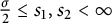 $\frac {\sigma }{2}\leq s_1, s_2<\infty $
with
 $s_1< s_2+2$
, the following statements are equivalent:
-
(i)
$f\in \mathcal {D}_K^{s_1}$
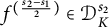
. -
(ii)
$f^{(\frac {s_2-s_1}{2})}\in \mathcal {D}^{s_2}_K$
.

The following lemma will be used in the proof of Theorem 4.1.
Lemma 4.1 Suppose K satisfies (2.2) for some
 $0<\sigma <2$
. For
 $0\leq s<\infty $
, let
 $$ \begin{align*} \max\bigg\{0, \frac{1-s}{2}, \frac{\sigma-s}{2}\bigg\} < \alpha < \infty, \quad \frac{1+s}{2} < b < \infty. \end{align*} $$
For
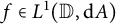 $f\in L^1(\mathbb {D}, \mathrm {d}A)$
, define
 $$ \begin{align*} Tf(z)=\int_{\mathbb{D}}\frac{(1-|w|^2)^{b-1}}{|1-\bar{w}z|^{\alpha+b}}f(w)\mathrm{d}A(w), \quad z\in\mathbb{D}. \end{align*} $$
If
 $|f(z)|^2(1-|z|^2)^{s}\mathrm {d}A(z)$
is a K-Carleson measure, then
 $$ \begin{align*} |Tf(z)|^2(1-|z|^2)^{2\alpha-2+s}\mathrm{d}A(z) \end{align*} $$
is also a K-Carleson measure.
Proof For given s, write
 $$ \begin{align*} \mathrm{d}\mu_f(z)=|f(z)|^2(1-|z|^2)^{s}\mathrm{d}A(z) \end{align*} $$
and
 $$ \begin{align*} \mathrm{d}\mu_{Tf}(z)=|Tf(z)|^2(1-|z|^2)^{2\alpha-2+s}\mathrm{d}A(z). \end{align*} $$
We verify that
 $\|\mu _f\|_K<\infty $
yields
 $\|\mu _{Tf}\|_K<\infty $
. To this end, for
 $I\subset \mathbb {T}$
, we set
 $2^nI$
as the subarc of
 $\mathbb {T}$
with the same center as I and length
 $2^n|I|$
for
 $n\in \mathbb {N^+}$
. Then
 $$ \begin{align*} \mu_{Tf}(S(I))&=\int_{S(I)}|Tf(z)|^{2}(1-|z|^{2})^{2\alpha-2+s}\mathrm{d}A(z)\\ &\leq\int_{S(I)} \bigg(\bigg\{\int_{S(2I)}+\int_{\mathbb{D}\backslash S(2I)}\bigg\}\frac{|f(w)|(1-|w|^{2})^{b-1}}{|1-\bar{w}z|^{\alpha+b}}\mathrm{d}A(w)\bigg)^2 \frac{\mathrm{d}A(z)}{(1-|z|^{2})^{2-s-2\alpha}}\\ &\lesssim E_1+E_2, \end{align*} $$
where
 $$ \begin{align*} E_1=\int_{S(I)}\bigg(\int_{S(2I)}\frac{|f(w)|(1-|w|^{2})^{b-1}}{|1-\bar{w}z|^{\alpha+b}}\mathrm{d}A(w)\bigg)^2 \frac{\mathrm{d}A(z)}{(1-|z|^{2})^{2-s-2\alpha}} \end{align*} $$
and
 $$ \begin{align*} E_2=\int_{S(I)} \bigg(\int_{\mathbb{D}\backslash S(2I)}\frac{|f(w)|(1-|w|^{2})^{b-1}}{|1-\bar{w}z|^{\alpha+b}}\mathrm{d}A(w)\bigg)^2 \frac{\mathrm{d}A(z)}{(1-|z|^{2})^{2-s-2\alpha}}. \end{align*} $$
For
 $E_1$
, we shall apply the classical Schur’s test [Reference Zhu30, Corollary 3.7] to a bounded operator on
 $L^2(\mathbb {D})$
. Indeed, we consider
 $$ \begin{align*} H(z,w)=\frac{(1-|z|^{2})^{\alpha-1+\frac{s}{2}}(1-|w|^{2})^{b-1-\frac{s}{2}}}{|1-\bar{w}z|^{\alpha+b}} \end{align*} $$
and the integral operator
 $$ \begin{align*} T_{H}g(z)=\int_{\mathbb{D}}|g(w)|H(z,w)\mathrm{d}A(w),\,\, g\in L^2(\mathbb{D}). \end{align*} $$
Using [Reference Zhu30, Lemma 3.10], we derive that for
 $$ \begin{align*} \mathrm{max}\big\{-\alpha-\frac{s}{2}, \frac{s}{2}-b\big\}<\gamma<\mathrm{min}\big\{\alpha-1+\frac{s}{2}, b-1-\frac{s}{2}\big\}, \end{align*} $$
we obtain that
 $$ \begin{align*} \int_{\mathbb{D}}H(z,w)(1-|w|^2)^{\gamma}\mathrm{d}A(w)\lesssim(1-|z|^2)^{\gamma} \end{align*} $$
and
 $$ \begin{align*} \int_{\mathbb{D}}H(z,w)(1-|z|^2)^{\gamma}\mathrm{d}A(z)\lesssim(1-|w|^2)^{\gamma}. \end{align*} $$
Accordingly, the operator
 $T_{H}$
is bounded from
 $L^2(\mathbb {D})$
to
 $L^2(\mathbb {D})$
. Applying this to the function
 $$ \begin{align*} g(w)=(1-|w|^2)^{\frac{s}{2}}|f(w)|\mathcal{X}_{S(2I)}(w), \end{align*} $$
where
 $\mathcal {X}_{S(2I)}$
is the characteristic function of
 $S(2I)$
, we get
 $$ \begin{align*} E_1\lesssim\int_{\mathbb{D}}\bigg(\int_{\mathbb{D}}|g(w)|H(z,w)\mathrm{d}A(w)\bigg)^2\mathrm{d}A(z)\lesssim \int_{\mathbb{D}}|g(z)|^2\mathrm{d}A(z)\lesssim\|\mu_f\|_K K(|I|). \end{align*} $$
To handle
 $E_2$
, we note that both
 $$ \begin{align*} 2^n|I|\lesssim|1-\bar{w}z|, \quad z\in S(I),\,\, w\in S(2^{n+1}I)\backslash S(2^{n}I), \end{align*} $$
and
 $$ \begin{align*} \int_{S(2^nI)}(1-|z|^2)^{\tau-2}\mathrm{d}A(z)\lesssim(2^n|I|)^\tau, \quad \tau>1, \end{align*} $$
hold for all
 $n\in \mathbb {N}$
. Using
 $\alpha>\mathrm {max}\big \{0, \frac {1-s}{2}, \frac {\sigma -s}{2}\big \}$
, we get
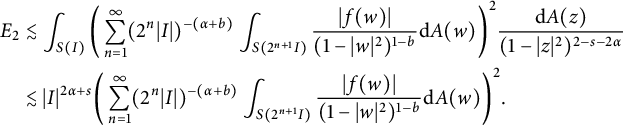 $$ \begin{align*} E_2 &\lesssim\int_{S(I)} \bigg(\sum_{n=1}^{\infty}(2^n|I|)^{-(\alpha+b)}\int_{S(2^{n+1}I)}\frac{|f(w)|}{(1-|w|^{2})^{1-b}} \mathrm{d}A(w)\bigg)^2\frac{\mathrm{d}A(z)}{(1-|z|^{2})^{2-s-2\alpha}}\\ &\lesssim|I|^{2\alpha+s} \bigg(\sum_{n=1}^{\infty}(2^n|I|)^{-(\alpha+b)}\int_{S(2^{n+1}I)}\frac{|f(w)|}{(1-|w|^{2})^{1-b}}\mathrm{d}A(w)\bigg)^2. \end{align*} $$
Note that
 $\|\mu _f\|_K<\infty $
. By Hölder’s inequality and Remark 2.1 (i),
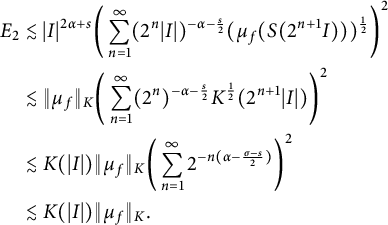 $$ \begin{align*} E_2&\lesssim|I|^{2\alpha+s} \bigg(\sum_{n=1}^{\infty}(2^n|I|)^{-\alpha-\frac{s}{2}}(\mu_f(S(2^{n+1}I)))^{\frac{1}{2}}\bigg)^2\\ &\lesssim\|\mu_f\|_K\bigg(\sum_{n=1}^{\infty}(2^n)^{-\alpha-\frac{s}{2}}K^{\frac{1}{2}}(2^{n+1}|I|)\bigg)^2\\ &\lesssim K(|I|)\|\mu_f\|_K\bigg(\sum_{n=1}^{\infty}2^{-n(\alpha-\frac{\sigma-s}{2})}\bigg)^2\\ &\lesssim K(|I|)\|\mu_f\|_K. \end{align*} $$
The foregoing estimates on
 $E_1$
and
 $E_2$
give
 $\mu _{Tf}$
is a K-Carleson measure. ▪
Now we are ready to prove Theorem 4.1. Let
 $f\in \mathcal {D}_K^{s}$
. By Theorem 2.2, we know that
 $|f^{\prime }(z)|^{2}(1-|z|^{2})^{s}\mathrm {d}A(z)$
is a K-Carleson measure. Since
 $$ \begin{align*} |f^{(t)}(z)|\leq\frac{\Gamma(b+t)}{\pi\Gamma(b)}\int_{\mathbb{D}} \frac{(1-|w|^2)^{b-1}|f^{\prime}(w)|}{|1-\bar{w}z|^{b+t}}\mathrm{d}A(w), \quad \mathrm{max}\left\{1,\frac{1+s}{2}\right\} < b < \infty, \end{align*} $$
we obtain by Lemma 4.1 that
 $$ \begin{align*} |f^{(t)}(z)|^2(1-|z|^2)^{2t-2+s}\mathrm{d}A(z) \end{align*} $$
is a K-Carleson measure.
Conversely, suppose
 $|f^{(t)}(z)|^2(1-|z|^2)^{2t-2+s}\mathrm {d}A(z)$
is a K-Carleson measure. Now we consider the function:
 $$ \begin{align*} g(z)=\frac{\Gamma(b+1)z^{[t-1]}}{\pi\Gamma(b+t-1)}\int_{\mathbb{D}} \frac{(1-|w|^2)^{b+t-2}}{(1-\bar{w}z)^{b+1}}f^{(t)}(w)\mathrm{d}A(w). \end{align*} $$
It follows from Lemma 4.1 that
 $|g(z)|^2(1-|z|^2)^{s}\mathrm {d}A(z)$
is a K-Carleson measure. To establish a relationship between g and
 $f^{\prime }$
, we express f and
 $f^{(t)}$
as Taylor series below:
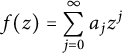 $$ \begin{align*} f(z)=\sum_{j=0}^{\infty}a_jz^j \end{align*} $$
and
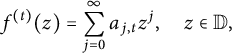 $$ \begin{align*} f^{(t)}(z)=\sum_{j=0}^{\infty}a_{j,t}z^j, \quad z\in\mathbb{D}, \end{align*} $$
where
 $$ \begin{align*} a_{j,t}=a_{j+m+1}\frac{\Gamma(j+b+t)\Gamma(j+m+2)}{\Gamma(j+1)\Gamma(j+m+1+b)}, \quad j\in\mathbb{N}, m=[t-1]. \end{align*} $$
Obviously,
 $m\geq 0$
. Rewrite
 $$ \begin{align*} g(z) =\sum_{j=0}^{\infty}\frac{\mathrm{B}(j+b+1,m)}{\mathrm{B}(j+1,m)}(j+m+1)a_{j+m+1}z^{j+m}, \end{align*} $$
where
 $\mathrm {B}(\cdot,\cdot)$
is the Beta function. Note that
 $$ \begin{align*} f^{\prime}(z) =g(z)+\sum_{j=0}^{\infty}(j+m+1)a_{j+m+1}z^{j+m}+\sum_{j=1}^{m}j a_jz^{j-1}-g(z). \end{align*} $$
By setting
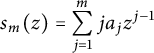 $$ \begin{align*} s_m(z)=\sum^{m}_{j=1}ja_jz^{j-1} \end{align*} $$
and
 $$ \begin{align*} h(z)=\sum_{j=0}^{\infty}\bigg(1-\frac{\mathrm{B}(j+b+1,m)}{\mathrm{B}(j+1,m)}\bigg)a_{j+m+1}z^{j+m+1}, \end{align*} $$
we obtain
 $$ \begin{align} f^{\prime}(z)=g(z)+s_m(z)+h^{\prime}(z). \end{align} $$
Case 1:
 $m=0$
. A simple calculation gives that
 $f^{\prime }=g$
. Therefore,
 $|f^{\prime }(z)|^2(1-|z|^2)^{s}\mathrm {d}A(z)$
is a K-Carleson measure.
Case 2:
 $m>0$
. Note that
 $|g(z)|^2(1-|z|^2)^{s}\mathrm {d}A(z)$
is a K-Carleson measure and
 $s_m$
is a polynomial. It remains to deal with the function
 $h'$
in (4.1). It is enough to show that
 $h\in \mathcal {D}_{s-\sigma }$
by the following argument:
 $$ \begin{align*} \frac{1}{K(|I|)}\int_{S(I)}|h^{\prime}(z)|^{2}(1-|z|^{2})^{s}\mathrm{d}A(z) \lesssim\frac{1}{|I|^\sigma}\int_{S(I)}|h^{\prime}(z)|^{2}(1-|z|^{2})^{s}\mathrm{d}A(z) \lesssim\|h\|^2_{\mathcal{D}_{s-\sigma}}. \end{align*} $$
Notice that
 $$ \begin{align} \|f\|^2_{\mathcal{D}_p}=\sum^{\infty}_{j=0}(1+j)^{1-p}|a_j|^2, \quad -1 < p < \infty, \end{align} $$
(see [Reference Stegenga21]) and a standard estimate
 $$ \begin{align*} 0<1-\frac{\mathrm{B}(j+b+1,m)}{\mathrm{B}(j+1,m)}\leq\frac{(b+1)m}{j+m+1}, \quad j\in\mathbb{N}. \end{align*} $$
Accordingly,
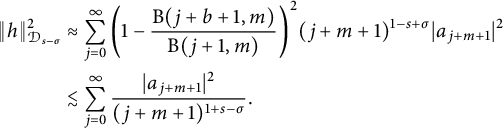 $$ \begin{align*} \|h\|^2_{\mathcal{D}_{s-\sigma}} &\approx\sum_{j=0}^{\infty}\bigg(1-\frac{\mathrm{B}(j+b+1,m)}{\mathrm{B}(j+1,m)}\bigg)^2(j+m+1)^{1-s+\sigma}|a_{j+m+1}|^2\\ &\lesssim\sum_{j=0}^{\infty}\frac{|a_{j+m+1}|^2}{(j+m+1)^{1+s-\sigma}}. \end{align*} $$
In addition, by Theorem 2.1 for any q,
 $\sigma \leq q<\infty $
,
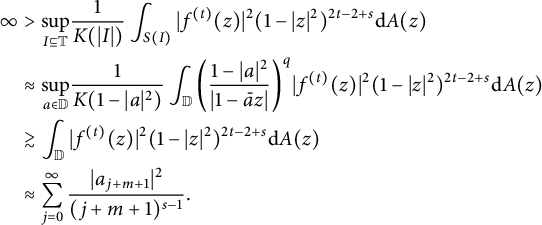 $$ \begin{align*} \infty&>\underset{I\subseteq \mathbb{T}}{\mathrm{sup}}\frac{1}{K(|I|)}\int_{S(I)}|f^{(t)}(z)|^2(1-|z|^2)^{2t-2+s}\mathrm{d}A(z)\\ &\approx\underset{a\in \mathbb{D}}{\mathrm{sup}}\frac{1}{K(1-|a|^2)}\int_{\mathbb{D}}\bigg(\frac{1-|a|^{2}}{|1-\bar{a}z|}\bigg)^q|f^{(t)}(z)|^2(1-|z|^2)^{2t-2+s}\mathrm{d}A(z)\\ &\gtrsim\int_{\mathbb{D}}|f^{(t)}(z)|^2(1-|z|^2)^{2t-2+s}\mathrm{d}A(z)\\ &\approx\sum^{\infty}_{j=0}\frac{|a_{j+m+1}|^2}{(j+m+1)^{s-1}}. \end{align*} $$
Here, the latter part holds by using (4.2) and the Stirling’s formula:
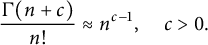 $$ \begin{align*} \frac{\Gamma(n+c)}{n!}\approx n^{c-1}, \quad c>0. \end{align*} $$
Therefore,
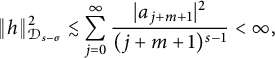 $$ \begin{align*} \|h\|^2_{\mathcal{D}_{s-\sigma}}\lesssim\sum^{\infty}_{j=0}\frac{|a_{j+m+1}|^2}{(j+m+1)^{s-1}}<\infty, \end{align*} $$
which is the desired result.



