The nursing shortage in post-industrial countries has been widely researched over recent decades in an attempt to understand and overcome the major causes behind this workforce crisis (Flinkman, Leino-Kilpi, & Salantera, Reference Flinkman, Leino-Kilpi and Salantera2010). At a time of increasing demands for nursing care, one of the explanations for this complex problem appears to be nurses’ voluntary turnover. In the literature on nurses’ turnover, most studies have focused on nurses’ intention to leave their job or organization, while fewer studies have been conducted on the intention to leave the profession (Flinkman et al., Reference Flinkman, Leino-Kilpi and Salantera2010) and even fewer on actual turnover (Brewer, Chao, Colder, Kovner, & Chacko, Reference Brewer, Chao, Colder, Kovner and Chacko2015). This tendency follows the conceptualization of nurses’ voluntary turnover as a gradual withdrawal process of intentions to leave and actual acts of leaving (Flinkman et al., Reference Flinkman, Leino-Kilpi and Salantera2010). Nevertheless, as intentions have consistently been found to be the best predictor of actual turnover behavior (e.g. Flinkman et al., Reference Flinkman, Leino-Kilpi and Salantera2010; Hom, Lee, Shaw, & Hausknecht, Reference Hom, Lee, Shaw and Hausknecht2017; Jourdain & Chênevert, Reference Jourdain and Chênevert2010; Leone et al., Reference Leone, Bruyneel, Anderson, Murrells, Dussault, de Jesus and Rafferty2015), the study of the determinants of nurses’ intentions to leave provides policy makers and human resources managers with the opportunity to structure nursing work conditions in ways that reduce the risk of turnover (Leone et al., Reference Leone, Bruyneel, Anderson, Murrells, Dussault, de Jesus and Rafferty2015).
Although voluntary turnover (e.g. from the work unit) may be an important opportunity for nurses’ professional development (Gilmartin, Reference Gilmartin2013), nurses’ job (organization or profession) turnover represents such a problem for the healthcare systems in terms of their capacity to care for patients and the quality of care provided that, according to the World Health Organization (2006), the ability of many countries to fight disease and improve health is at stake. In Europe, recent austerity measures adopted in countries such as Portugal have had significant negative effects on the availability of healthcare system resources, including reduced staffing and employment conditions, and increased migration of nurses to other countries. Although little has been done to systematically access the impacts of this crisis, recent data from the same research project to which the present study belongs, namely the Registered Nurse Forecasting (RN4Cast) study, has revealed that in the case of Portugal, 42.5% of nurses indicated that, given the opportunity, they would leave the organization the following year due to dissatisfaction (Leone et al., Reference Leone, Bruyneel, Anderson, Murrells, Dussault, de Jesus and Rafferty2015). The present article aims to further the knowledge of factors that influence Portuguese nurses’ turnover intention, with a view to contributing to its prevention.
Turnover predictors
Employee turnover has captured the attention of researchers for almost one hundred years, and throughout this century hundreds of empirical studies on turnover predictors (e.g. workplace conditions or job dissatisfaction) have been published, initially of an atheoretical nature, only later to become theory-driven (see Hom et al., Reference Hom, Lee, Shaw and Hausknecht2017 for a review). Turnover models have gradually become more complex, adopting a process approach and articulating a broad range of turnover determinants, ranging from the workplace (e.g. integration, pay), the labor market (e.g. job opportunity), the community (e.g. kinship responsibility) (e.g. Price & Muller, Reference Price and Mueller1981) to the family (e.g. number of children, marital status), in structural networks of relationships, advocating direct, moderated, multiple, alternative turnover pathways, and calling for structural equation modelling methods of empirical testing (Hom et al., Reference Hom, Lee, Shaw and Hausknecht2017).
Mirroring this evolution in the general management field of study, research on nursing has identified significant relationships between turnover and different types of individual, work-related and even family-related factors, highlighting that turnover is a complex process and is determined by a complex combination of diverse influences (Leone et al., Reference Leone, Bruyneel, Anderson, Murrells, Dussault, de Jesus and Rafferty2015). Nevertheless, literature on nurses’ voluntary turnover indicates that work-related stressful conditions are the main factors prompting nurses to leave their profession (e.g. Jourdain & Chênevert, Reference Jourdain and Chênevert2010). Research on work-related factors associated with nurses’ voluntary turnover has found significant relationships with variables such as work overload, team work, relationships between nurses and physicians, participation in decision-making, perceived control over practice, autonomy, career development possibilities, occupational commitment and job satisfaction (e.g. Flinkman et al., Reference Flinkman, Leino-Kilpi and Salantera2010; Van Bogaert, Meulemans, Clarke, Vermeyen, & Van de Heyning, Reference Van Bogaert, Meulemans, Clarke, Vermeyen and van de Heyning2009).
Burnout is another work-related factor that deserves special attention in this endeavor to understand nurses’ voluntary turnover. First, much of the research on burnout and on nurses’ turnover has consistently found significant associations between these two variables (e.g. Jourdain & Chênevert, Reference Jourdain and Chênevert2010). Second, many of the work-related stress factors that influence nurses’ turnover are also significantly associated with professional burnout, however few studies have explored the relationships among stress factors, burnout and nurses turnover (Jourdain & Chênevert, Reference Jourdain and Chênevert2010). Additionally, as highlighted by Leone et al. (Reference Leone, Bruyneel, Anderson, Murrells, Dussault, de Jesus and Rafferty2015), the nature of the turnover process calls for the study of more complex relationships among variables beyond simple bivariate or multiple associations between the aforementioned predictors and nurses’ turnover. Such is the case for the mediating roles of professional burnout and engagement, in the relationship between nursing work-related stress factors and turnover, which are the focus of the present study.
Nursing is one of the most widely studied professions in the burnout field, and the prevalence of burnout among nurses has been extensively confirmed (e.g. Jourdain & Chênevert, Reference Jourdain and Chênevert2010; Van Bogaert et al., Reference Van Bogaert, Meulemans, Clarke, Vermeyen and van de Heyning2009). Burnout has been defined as a syndrome of emotional exhaustion, depersonalization and lack of personal accomplishment, which occurs in human services professionals as a reaction to prolonged or chronic professional stress (e.g. Maslach & Leitter, 1997). As a job stress phenomenon, much of the research on nurses’ burnout has attempted to determine its underlying work-related stress factors (e.g. Jourdain & Chênevert, Reference Jourdain and Chênevert2010), other studies have focused on the relationships between burnout and important work outcomes such as intention to leave and turnover, while others have tested the assumed mediating role played by burnout between job stressors and given job outcomes (e.g. Van Bogaert, Kowalski, Weeks, Van Heusden, & Clarke, Reference Van Bogaert, Kowalski, Weeks, Van Heusden and Clarke2013). Indeed, some empirical studies support the contention that burnout mediates the impact of nursing practice stress conditions on nurses’ turnover variables (e.g. Jourdain & Chênevert, Reference Jourdain and Chênevert2010; Van Bogaert et al., Reference Van Bogaert, Meulemans, Clarke, Vermeyen and van de Heyning2009). Nonetheless, to the best of our knowledge, these relationships have not been studied since the adoption of the austerity measures in European countries such as Portugal, which has contributed to the worsening of nurses’ working conditions.
Thus, one of the main goals of the present study was to pursue further investigation in order to determine whether the mediating role of burnout in the relationship between work-related stress factors and turnover intention could be replicated within a Portuguese nursing population.
Despite high levels of job stress, many workers do not manifest symptoms of burnout, maintaining high engagement with work instead (Maslach & Leiter, Reference Maslach and Leiter1997). Engagement has been conceptualized as a positive, persistent and broad affective-cognitive state, characterized by vigor, dedication and absorption (Schaufeli & Bakker, Reference Schaufeli and Bakker2004). However, in a number of studies performed across various samples and countries, this three-dimensional engagement structure was not observed, representing, in some cases, a unique solution with a more suitable fit to the data than the three-dimensional model (e.g. Sonnentag, Reference Sonnentag2003).
Several authors have pointed out that employee engagement, namely that of nurses (e.g. Mendes & Stander, Reference Mendes and Stander2011), is one of the most effective factors contributing to the prevention of turnover intention. Thus, according to a current view on healthy, positive organizations (e.g. Mendes & Stander, Reference Mendes and Stander2011), human resources management should foster engagement to ensure both productivity and wellness for the organization and its employees, and contribute towards retaining talent. When the organization provides the worker with adequate job resources, higher job engagement is expected and, in turn, engaged workers will have a lower tendency to leave the organization. This mediating role of engagement was confirmed by Schaufeli and Bakker (Reference Schaufeli and Bakker2004) in a study with workers from different professional groups, however it was not studied with nurses. Hence, another main goal of the present study was to test the mediating role of engagement in the relationship between job resources and turnover intention in Portuguese nurses.
Theoretical framework and hypotheses
In a recent analysis of studies on nursing turnover over the last decades, Gilmartin (Reference Gilmartin2013) concluded the causal turnover model of Price and Mueller (Reference Price and Mueller1981) to be the dominant theoretical perspective used to explain the voluntary turnover of nurses. This model includes 11 determinants and hypothesizes organizational commitment as a moderator of intention to leave and voluntary turnover. Demographic characteristics, nature of the job, and perceptions of fair treatment at work are regarded as distal predictors, and nature of the work and work environment are postulated to be more proximal factors influencing job satisfaction, which in turn affects nurses’ commitment to the organization. Job satisfaction and commitment may lead to thoughts of leaving and ultimately to actual turnover. Although several researchers have proposed refinements to Price and Mueller’s model and other distinct conceptual turnover models have been identified in the nursing literature, Gilmartin (Reference Gilmartin2013) concluded that the nursing research has not kept pace with general management turnover conceptualizations and the current conceptual models account for only low to medium percentages of variance in nurses’ voluntary turnover.
Hence, Gilmartin (2013, pp. 19) launched the challenge for future research on nurses’ turnover to be anchored in specific models available in general turnover management studies and to add key variables, namely from stress models such as “…the types of stressors nurses face in their work stemming from job design, scope of practice, or professional role expectations”. Therefore, in the same vein, the present study has used the Job Demands–Resources model as a theoretical framework to test the mediation models of burnout and engagement in the relationship between job demands / resources and intention to leave the organization.
Job engagement and burnout were initially assumed (Maslach & Leiter, Reference Maslach and Leiter1997) to be opposite poles of the same continuum, however subsequent research has shown that these variables are independent, albeit moderately and negatively correlated phenomena, and have distinct determinants. Generally speaking, symptoms of burnout appear to be predicted by job demands typically found in highly stressful professions such as nursing, while engagement is more dependent on the job resources provided by the organization (Schaufeli & Bakker, Reference Schaufeli and Bakker2004).
Demerouti and colleagues (Demerouti & Bakker, Reference Demerouti and Bakker2011) proposed a heuristic model that attributes occupational outcomes, such as burnout and engagement, to work demands and resources. According to this Job Demands–Resources model, the demands are defined as physical, psychological, social and organizational aspects of work that require a sustained physical / psychological effort and are the main predictors of ill-being and professional burnout. Resources refer to the same physical, psychological, social and organizational aspects of work but are intended to reduce work demands and their costs, support the accomplishment of job-related aims, and stimulate personal growth, learning and development. According to the authors, the resources are good predictors of well-being, work involvement and good results (e.g. Demerouti & Bakker, Reference Demerouti and Bakker2011). Several empirical studies have revealed a negative relationship between work resources and burnout, particularly in relation to a decrease in cynicism, thus leading the authors to include this relationship in the Job Demands-Resources model (e.g. Schaufeli & Bakker, Reference Schaufeli and Bakker2004).
In accordance with this model (Demerouti & Bakker, Reference Demerouti and Bakker2011), the current research seeks to understand the particular influence of specific demands and resources on burnout / engagement and turnover intention. Based on the literature, workload has been identified as an important chronic stress factor (demand) that nurses deal with on a daily basis, and is among the most frequently mentioned factors of burnout and motivators for job turnover intention in nurses (Jourdain & Chênevert, Reference Jourdain and Chênevert2010; Van Bogaert, et al., Reference Van Bogaert, Kowalski, Weeks, Van Heusden and Clarke2013). Additionally, previous research (Jourdain & Chênevert, Reference Jourdain and Chênevert2010) has demonstrated that the emotional exhaustion dimension of burnout, in particular, plays an important role in the relationship between nurses’ work-related stress factors and turnover intention. Finally, two types of resources deemed relevant for nurses’ practice (Van Bogaert et al., Reference Van Bogaert, Meulemans, Clarke, Vermeyen and van de Heyning2009) were chosen for the purposes of this study, one at the work organization level - nurses’ participation in hospital affairs, and the other at the interpersonal level - physician-nurses relationship. Decision latitude is related to decision-making opportunities, being creative, and using one’s skills in the workplace, among other job characteristics. Low decision latitude combined with high demands has been found to contribute to nurses’ burnout and turnover intention whereas high participation in decision-making is associated with low emotional exhaustion (Van Bogaert et al., Reference Van Bogaert, Kowalski, Weeks, Van Heusden and Clarke2013). Similarly, mutual trust and respect and reciprocal collaboration between physicians and nurses is a main characteristic of a healthy working environment and may contribute to nurses’ retention [American Organization of Nursing Executives (AONE), 2003].
Hence, the following hypotheses were formulated.
H1. Burnout dimensions mediate the relationship of workload (demand) and of nurses’ participation in hospital affairs and the physician-nurse relationship (resources) with turnover intention.
H2. Emotional exhaustion has a greater total effect on turnover intention than the other two dimensions of burnout.
H3. Engagement mediates the impact of resources, nurses’ participation in hospital affairs and the physician-nurse relationship, on intention to leave.
Method
Participants
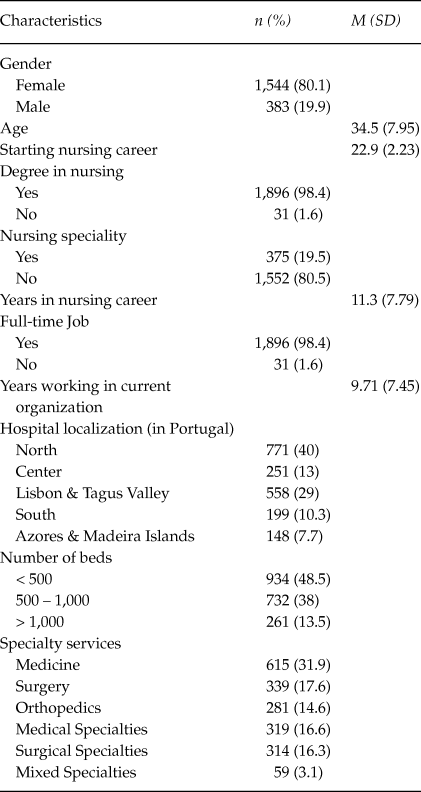
The sample comprised 2,235 Portuguese nurses from 31 hospitals out of a population of 2,905 nurses from 38 Portuguese hospitals, representing a participation rate of 76.9%. Out of the total sample, 1,927 nurses completed the descriptive data. The majority of nurses were female (80.1%) and their mean age was 34.5 years (range 22–61 years). Ninety-eight per cent of the participants had an academic degree in nursing (4 years of higher education) and 19% had a specialist degree in a clinical area of expertise. On average, these professionals had initiated their nursing career at the age of 22.9 years (range 17–44 years) and had 11.3 years of working experience, of which 9.7 years had been spent with their current employer, mostly with full-time contracts (98%). The majority of the participants worked in medical (48.2%) and surgical (48.7%) services in Portuguese hospitals in the North (40%) and the Lisbon and Tagus Valley (29%) regions, with less than 500 beds (49%) (Table 1). According to the data from the Portuguese Nursing Council (Ordem dos Enfermeiros, 2014) the sample was representative of the Portuguese nursing workforce.
Socio Demographic Characteristics of the Study Participants (n = 1,927)

Measures
The measures included in the current study focused both on job demands (e.g. workload) and resources (e.g. nurses’ participation in hospital affairs, physician-nurse relationship); as well as negative (e.g. burnout) and positive (e.g. engagement) psychological states and their implications on nurses’ intention to leave the organization.
Demands: Workload was measured with 2 items from the RN4Cast Nurse Survey (Sermeus et al., Reference Sermeus, Aiken, Van den Heede, Rafferty, Griffiths and Moreno-Casbas2011), one referring to the number of nurses’ working hours and the other indicating the number of patients for whom the nurses were directly responsible in their most recent shift. Both items were modelled as continuous variables and entered separately into the models under analysis.
Resources: Nurses’ participation in hospital affairs was measured with 5 items (α =.70, e.g. “Opportunity for nurses to participate in political decisions”). The physician-nurse relationship was assessed with 3 items (α =.80, e.g. “Physicians and nurses have good working relationships”). Both factors were subscales of the PES-NWI (Lake, Reference Lake2002). All responses were given on a 4-point Likert scale (1 = Totally Agree; 4 = Totally Disagree).
Burnout: Dimensions of burnout were assessed with the Maslach Burnout Inventory-Human Service Survey (Portuguese version by Jesus, Marques-Pinto, Fronteira, & Mendes, Reference Jesus, Marques-Pinto, Fronteira and Mendes2014) comprising 22 items measuring emotional exhaustion (9 items), depersonalization (5 items) and personal accomplishment (8 items). After performing a confirmatory factor analysis, results revealed a poor fit, χ2 = 2,298.05, df = 186, p < .001, CFI = .84, TLI = .82; SRMR = .08, RMSEA = .07, 90% CI [.069, .074]; hence, an exploratory factor analysis was performed. A three-factor solution was obtained, explaining 51% of the components’ variance. All items whose factor loadings were associated with more than one component were eliminated, namely one personal accomplishment item and four of the five depersonalization items. This solution was then submitted to a confirmatory factor analysis achieving a good fit, χ2 = 875.332, df = 97, p < .001, CFI = .92, TLI = .90; SRMR = .06, RMSEA = .06, 90% CI [.057, .063]. The validity of the depersonalization scale has long been questioned and its internal consistency is often found to be relatively low (e.g. Garden, Reference Garden1987). In the nursing research field, a study by Poghosyan, Aiken, and Sloane (Reference Poghosyan, Aiken and Sloane2009) investigated the factor structure and reliability of the Maslach Burnout Inventory (MBI) subscales among representative samples of nurses from eight countries and found that in Armenia, three of the original five items in the MBI’s depersonalization subscale failed to load on any scale. These results suggest that individuals from different samples / countries may interpret depersonalization items differently, which may result in inconsistent findings in the depersonalization scale (Poghosyan et al., Reference Poghosyan, Aiken and Sloane2009), as was the case in the current study. Emotional exhaustion was measured with 9 items (α = .87, e.g. “I feel emotionally exhausted at work”), depersonalization was assessed with 1 item (“I don’t really care what happens to some patients”), and personal accomplishment was measured with 7 items (α =.80, e.g. “I can easily understand how my patients feel about things”). All items were scored on a 7-point Likert scale ranging from 0 (Never) to 6 (Every Day). High scores in emotional exhaustion and depersonalization and low scores in personal accomplishment indicated high levels of burnout.
Engagement: The Utrecht Work Engagement Scale (Portuguese version by Marques-Pinto, Jesus, Mendes, & Fronteira, Reference Marques-Pinto, Jesus, Mendes and Fronteira2015) comprising 17 items was applied to assess engagement (α = .94, e.g. “I find the work that I do full of meaning and purpose”). All responses were given on a 7-point Likert scale ranging from 0 (Never) to 6 (Every Day). A confirmatory factor analysis was performed achieving an adequate factorial fit, χ2 = 1,893.69, df = 110 p < .001, CFI = .92, TLI = .90; SRMR = .04, RMSEA = .07, 90% CI [.066, .072].
Turnover intention: Intention to leave the organization was assessed with a dichotomous Yes/No item (“If possible, would you leave your current employer within the next year?”). The binary dependent variable was coded (0) staying vs. (1) leaving the organization.
Control variable: Professionals’ working experience, measured in number of years, was included to prevent confounding interconnections with the model predictors.
Procedures
This study is an extension of the multi country and cross RN4Cast project, funded by the Seventh Framework Program (Sermeus et al., Reference Sermeus, Aiken, Van den Heede, Rafferty, Griffiths and Moreno-Casbas2011), and was approved by the Portuguese Catholic University Ethics Committee and by the boards of administration of the hospitals participating in this study. The current Portuguese branch of the study followed the RN4Cast protocol, with two minor exceptions regarding the addition of a scale to the original data collection tools to measure work engagement, and an item to collect data on specialist education.
Data collection was carried out between October 2013 and April 2014 through a stratified random sampling procedure of 4–6 units per hospital, according to the number of hospital beds. All nurses in the selected nursing units were invited to participate in the study. Each potential participant nurse was handed a questionnaire, a brochure containing information, such as the call for voluntary participation, a statement explaining that filling in the questionnaire implied provision of informed consent and a sealed envelope for the anonymous and confidential return of the questionnaire.
Data analysis
The statistical analysis of the mediation models was based on a variance-covariance matrix. All parameters were estimated using the diagonally weighted least squares method (DWLS) given the categorical nature of the dependent variable, intention to leave the organization, an estimator designed to deal with discrete data (e.g. Bandalos, Reference Bandalos2014). The first indicator of each variable was constrained to 1.00 to ensure the statistical identification of the models to be tested, with the exception of the single-item latent variables – depersonalization and intention to leave the organization. In these cases, residual variances of both single indicators were set to zero (Little, Reference Little2013).
For latent variables with more than three items, multi-item parcels were constructed to simplify the model structure and reduce the number of parameters to be estimated. In each parcel, items were distributed according to their factor loadings, comprising indicators with high, medium and low loadings to create balance (Little, Cunningham, Shaham, & Widaman, Reference Little, Cunningham, Shahar and Widaman2002).
First, we tested the measurement models including all the latent variables and their observed indicators, as well as the control variables to assess their fit before proceeding with the structural analyses. The three structural models were then evaluated to better understand the relationships between the constructs. The first structural model assessed the main predictors of nurses’ intentions to leave the organization. The second structural model aimed to bolster the explanation of the dependent variable, by including burnout dimensions as negative psychological state mediators. Finally, the third structural model presented an alternative mediation path by adding engagement as a mediator, this time representing a positive psychological state. Significance of the mediating effects was tested through the bootstrap method (1,000 samples).
The robustness of the different models was assessed using the combination of several fit measures. In addition to χ2 tests, other indexes were evaluated to determine whether the models presented an acceptable factorial fit, such as the comparative fit index (CFI), the Tucker-Lewis index (TLI), the standardized root mean square residual (SRMR), the weighted root mean square residual (WRMR) for binary outcomes, and the root mean square error of approximation (RMSEA) with a 90% confidence interval. CFI and TLI values should be close to .90 or above (e.g. Bentler, Reference Bentler1990; Bentler & Dudgeon, Reference Bentler and Dudgeon1996), SRMR and RMSEA values below .08 (e.g. Hu & Bentler, Reference Hu and Bentler1999) and WRMR values below 1.0 (Yu, Reference Yu2002). All statistical analyses were performed using R software (R Core Team, 2015), namely the lavaan (Rosseel, Reference Rosseel2012) package. The first was applied for structural equation modelling, while the second was used to obtain descriptive, exploratory and internal consistency statistics. Multiple imputation with scale score means was applied to deal with missing data.
Results
Descriptive statistics
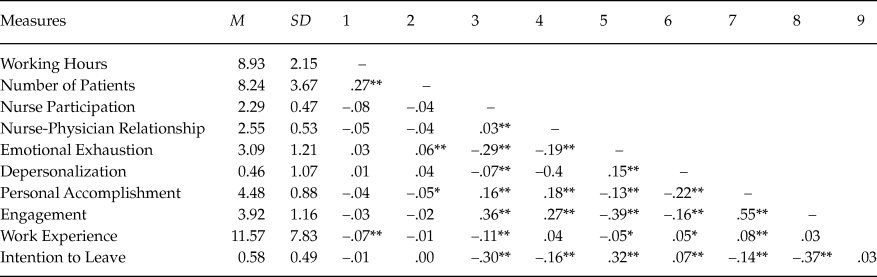
Table 2 displays descriptive information regarding the model variables. Nurses who intended to leave the organization, participated less (r = –.30) in hospital affairs, had worse working relationships with physicians (r = –.16), revealed more emotional exhaustion (r = .32) and depersonalization (r = .07) and expressed lower levels of personal accomplishment (r = –.14) and professional engagement (r = –.37), when compared to nurses who intended to stay.
Summary of Means, Standard Deviations, and Intercorrelations for the Model Variables (n = 2,235)

Note: M = Mean; SD = Standard deviation. Intention to leave is a binary variable with results given for those who intend to leave in comparison to those who intend to stay.
**p = .001, *p = .05.
Measurement model
The analysis of the measurement model indicated an acceptable fit χ2 = 578.721, df = 137, p < .001, CFI = .98, TLI = .97, SRMR = .03, RMSEA = .04, 90% CI [.035, .041]. All factor loadings were significant ranging from .48 to .93 (p < .001).
Structural models
Model 1 - Predictors of nurses’ intention to leave. The aim of the first structural model to be tested was to identify the main predictors of nurses’ intention to leave the organization. Although all other indexes revealed an adequate fit, this structural model had a moderate fit as WRMR, the most relevant index when outcome variables are binary, was above 1.0 χ2 = 117.530, df = 30, p < .001, CFI = .98, TLI = .97, WRMR = 1.449, RMSEA = .04, 90% CI [0.030, 0.043]), explaining around 21% of the variance of intention to leave. Results indicated that nurses’ participation in hospital affairs was the only significant predictor (B = –.93, SE = .07, β = –.45, p = < .001), while the physician-nurse relationship (B = –.05, SE = .09, β = –.02, p = .581), the number of nurses’ work hours (B = .01, SE = .01, β = .01, p = .668), the number of patients per nurse (B = –.00, SE = .01, β = –.01, p = .815) and nurses’ work experience (B = –.00, SE = .00, β = –.03, p = .209) failed to significantly predict intention to leave. Hence, to assure model parsimony, testing was conducted using this variable as the main predictor of nurses’ intention to leave the organization, with burnout dimensions and engagement as possible mediators to be included in subsequent structural models.
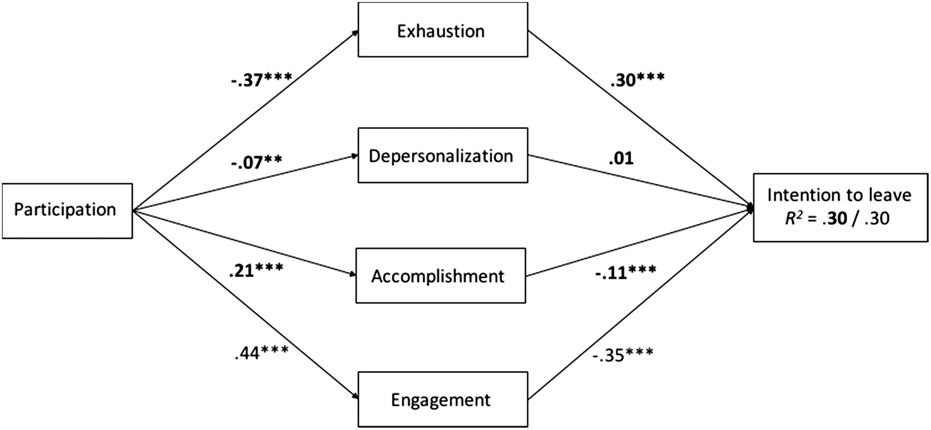
Model 2 - Testing burnout mediation. In this model, burnout dimensions were included. The model fit was very good, χ2 = 52.194, df = 34, p = .024, CFI = .99, TLI = .99, WRMR = .82, RMSEA = .02, 90% CI [0.01, 0.02], and, in comparison with model 1, there was an increase in the explained variance proportion of nurses’ intention to leave (30%). Two burnout dimensions had a significant impact on intention to leave, namely emotional exhaustion, suggesting that nurses who intended to leave the organization had higher levels of emotional exhaustion, when compared to those who intended to stay; and personal accomplishment, revealing that nurses’ who intended to leave the profession had lower levels of personal accomplishment. After bootstrapping (1,000 samples), it was possible to verify that both emotional exhaustion, indirect effect = –.23, SE = .03, β = –.11, p = < .001, 95% CI [–.89, –.2.06], and personal accomplishment, indirect effect = –.05, SE = .07, β = –.02, p = .001, 95% CI [–.02, –.07], mediated the relationship between nurses’ participation in hospital affairs and their intention to leave (Figure 1) thus giving partial support to Hypothesis 1. However, despite being significant, the indirect effect for personal accomplishment was small, which led us not to interpret this mediation path. These findings also give support to Hypothesis 2.
Standardized Estimates for the Mediation Model between Nurses’ Participation in Hospital Affairs and Intention to Leave the Profession.
Parameters in bold are for Model 2 with burnout dimensions as mediators; results for Model 3 with engagement as mediator are presented non-bolded and after the bar.
*p < .05, **p < .01, ***p < .001.

Model 3 - Testing engagement mediation. An alternative mediation path was tested by focusing on the impact of engagement on nurses’ intention to leave. The model fit was very good, χ2 = 8.998, df = 12, p = .703, CFI = 1.00, TLI = 1.00, WRMR = .51, RMSEA = .00, 90% CI [0.000, 0.017]. The proportion of explained variance remained at 30% when compared to Model 1. The parameter estimates were obtained after bootstrapping 1,000 samples to assess the significance of the mediating paths. Results indicated that engagement, indirect effect = –.32, SE = .03, β = –.15, p = < .001, 95% CI [–.26, –.38], mediated the relationship between nurses’ participation in hospital affairs and their intention to leave the organization (Figure 1), thus giving partial support to Hypothesis 3.
Discussion
Intention to leave the organization is seen as a major constraint to human resources in terms of health development and strengthening of the health system. The present article aimed to further the knowledge of factors that influence Portuguese nurses’ intention to leave their organizations. More specifically, we tested the mediating roles of professional burnout and engagement in the relationship between work-related factors and intentions to leave the organization in Portuguese nurses.
A correlation analysis revealed the expected relationships of turnover intentions with job resources (e.g. Van Bogaert et al., Reference Van Bogaert, Meulemans, Clarke, Vermeyen and van de Heyning2009), burnout (e.g. Van Bogaert et al., Reference Van Bogaert, Kowalski, Weeks, Van Heusden and Clarke2013) and engagement feelings (e.g. Mendes & Stander, Reference Mendes and Stander2011). However, contrary to previous studies (e.g. Jourdain & Chênevert, Reference Jourdain and Chênevert2010), in the present research no significant relationship with workload (job demand) was found.
In line with previous findings (e.g. Flinkman et al., Reference Flinkman, Leino-Kilpi and Salantera2010; Jaafarpour & Khan, Reference Jaafarpour and Khan2011; Van Bogaert et al., Reference Van Bogaert, Meulemans, Clarke, Vermeyen and van de Heyning2009, Reference Van Bogaert, Kowalski, Weeks, Van Heusden and Clarke2013), the results revealed that nurses’ participation in hospital affairs was a significant predictor of nurses’ turnover intentions, as expected, indicating that the higher the degree of nurses’ participation the greater their intention to stay in the organization. The possibility to make decisions that impact their professional practice and environment is an important motivational factor for nurses (Jourdain & Chênevert, Reference Jourdain and Chênevert2010). It is a known fact that working in hospitals is highly demanding for nurses as they have low work autonomy, poor career development opportunities, and a lack of alternatives for career change. In recent years, changes in patient needs, medical technology and financial resources, coupled with austerity measures adopted in countries such as Portugal, have increased nurses’ responsibilities in their care for patients, and, consequently, have required greater autonomy and participation in decision-making (Jaafarpour & Khan, Reference Jaafarpour and Khan2011). Under these circumstances, a proportion of nurses are expected to leave the profession if their work does not enable them to actively influence decision-making regarding activities that govern their professional practice policy and environment (e.g. Jaafarpour & Khan, Reference Jaafarpour and Khan2011).
Although since 2010 the austerity measures have led to cuts and restrictions in recruitment in public hospitals and, consequently, the actual workload and number of patients under the care of an individual Portuguese nurse may be considerably high (Leone et al., Reference Leone, Bruyneel, Anderson, Murrells, Dussault, de Jesus and Rafferty2015), the results of the current study are not in keeping with previous research that has found significant associations between both workload and the physician-nurse relationship and nurses’ turnover variables (e.g. AONE, 2003; Jourdain & Chênevert, Reference Jourdain and Chênevert2010; Van Bogaert et al., Reference Van Bogaert, Meulemans, Clarke, Vermeyen and van de Heyning2009, Reference Van Bogaert, Kowalski, Weeks, Van Heusden and Clarke2013).
Regarding the first hypothesis, the results indicated that emotional exhaustion mediates the relationship between nurses’ participation in hospital affairs and their intention to leave. More specifically, the higher the degree of nurses’ participation in hospital affairs, the lower their exhaustion and the lower their intention to leave the organization. As neither workload nor the physician-nurse relationship turned out to be significant predictors of turnover intention, and none of the other burnout dimensions were significant mediators, these findings only give partial support to Hypothesis 1. Nevertheless, it should be noted that this burnout mediation model alone explained 30% of the variance of intention to leave. Additionally, the results support and build on previous theory assumptions and research findings. Indeed, they give support to theory and research on the negative relationship between job resources and burnout (e.g. Demerouti & Bakker, Reference Demerouti and Bakker2011; Schaufeli & Bakker, Reference Schaufeli and Bakker2004) and to studies revealing that burnout mediates the impact of nursing work conditions on nurses’ turnover variables (e.g. Jourdain & Chênevert, Reference Jourdain and Chênevert2010; van Bogaert et al., Reference Van Bogaert, Meulemans, Clarke, Vermeyen and van de Heyning2009, Reference Van Bogaert, Kowalski, Weeks, Van Heusden and Clarke2013). Furthermore, the present study also extends these general findings as it tested the mediating role of burnout in the relationship between a job resource, nurses’ participation in hospital affairs, and turnover intention.
The results also give support to the second hypothesis since emotional exhaustion was the only burnout dimension with a significant effect on turnover intention. This finding is in line with previous studies showing that the emotional exhaustion dimension of burnout plays a more important role in the relationship between nursing work conditions and nurses’ turnover (e.g. Jourdain & Chênevert, Reference Jourdain and Chênevert2010).
As regards the third hypothesis, the results revealed that, contrary to prediction, the physician-nurse relationship was not a significant predictor of nurses´ turnover intention, but confirmed that engagement mediates the relationship between nurses’ participation in hospital affairs and their intention to leave, thus giving partial support to this hypothesis. The engagement mediation model alone explained 30% of the variance of nurses’ turnover intentions, and indicated that the higher the degree of nurses’ participation in hospital affairs, the higher their engagement and the lower their intention to leave the organization. These results give support to the Job Demands-Resources model assumptions and theory-driven studies regarding the role of job resources in the explanation of professional engagement (e.g. Demerouti & Bakker, Reference Demerouti and Bakker2011). The results also support previous research findings showing that nurses’ engagement is one of the most effective factors contributing to the prevention of turnover intention (e.g. Mendes & Stander, Reference Mendes and Stander2011). Finally, the results support and extend the study results of Schaufeli and Bakker (Reference Schaufeli and Bakker2004), on the mediating role of engagement in the relationship between job resources and turnover intentions, for nursing professionals. Accordingly, when nurses perceive adequate decisional involvement in hospital affairs, they tend to feel more engaged with their work and, in turn, engaged nurses have lower turnover intentions.
Despite the contributions of the current study to research and intervention on nurses’ intention to leave the organization, some limitations must be acknowledged. The first limitation is its cross-sectional nature, hence causal associations among the analyzed variables cannot be inferred, and reverse relations cannot be ruled out. Thus, the research models need to be tested longitudinally with mixed results regarding the burnout and engagement antecedents and consequences envisaged in the present study. Second, burnout and engagement antecedents and consequences partly overlap since both are related to job resources and to turnover intentions. As referred to by Schaufeli and Bakker (Reference Schaufeli and Bakker2004), the former relationship is probably due to the fact that demands and resources are not independent, since a resource deficit may increase demands and the latter may be related to the mental withdrawal facet of burnout. Therefore, future research should further test the discriminant validity of the mediating role of burnout and engagement, using more distal resources and demands and other turnover outcome measures such as actual turnover behavior. Another limitation of the study stems from the fact that only self-report measures were used, so findings must be taken with caution, and future research on these research models should also use objectively measured behavioral indicators. Additionally, due to validity issues, depersonalization was measured with only one item, thus interpretation of findings on this burnout dimension should be conducted with caution.
Nevertheless, taken together, the findings of the present study have important implications for policy makers and human resources managers who have the opportunity to improve the work conditions of nurses in Portugal. Indeed, as suggested by the results of a previous RN4Cast study (Heinen et al., Reference Heinen, Van Achterberg, Schwendimann, Zander, Matthews, Kózka and Schoonhoven2013), the elements of the work environment that are associated with intention to leave differ from country to country, therefore specific pathways to prevent nurses’ turnover should be considered in accordance with national contexts. First, including nurses in decision-making regarding their professional practice policy and environment is a crucial factor to reduce their turnover intentions and consequently to keep nurses in their jobs (e.g. Flinkman et al., Reference Flinkman, Leino-Kilpi and Salantera2010; Jaafarpour & Khan, Reference Jaafarpour and Khan2011). Second, according to the tested mediation models, two additional paths are critically important to respond to this prevailing problem, the first focusing on the reduction of nurses´ burnout symptoms of emotional exhaustion and the second geared towards the promotion of job engagement. Thus, it is essential for nursing work environments to be structured in ways that also improve nurses’ wellness, with a view to retaining the qualified nurses currently within the system. This could be an affordable organizational strategy to prevent future difficulties (Aiken et al., Reference Aiken, Sermeus, Van den Heede, Sloane, Busse, McKee and Kutney-Lee2012), considering the 42.5% rate of Portuguese nurses reporting turnover intentions in the present RN4cast study (Leone et al., Reference Leone, Bruyneel, Anderson, Murrells, Dussault, de Jesus and Rafferty2015).