Introduction
Nest predation is the main cause of nest failure in birds, and it is generally higher in the Tropics (Ricklefs Reference Ricklefs1969; Stutchbury & Morton Reference Stutchbury and Morton2001; Remeš et al. Reference Remeš, Matysiokova and Cockburn2012). Studies demonstrate that predation rates vary throughout the year (Cox et al. Reference Cox, Thompson and Faaborg2012a; Husby & Hoset Reference Husby and Hoset2018), may range from 5.0% (Kleindorfer Reference Kleindorfer2007) to 88.5% (Hanski & Laurila Reference Hanski and Laurila1993) and are usually higher in open-nesting than cavity-nesting species (Martin & Li Reference Martin and Li1992). Moreover, predation pressure during the evolution has influenced several life history and behavioural traits in birds including clutch size, egg coloration and nest-site selection (Martin Reference Martin1995; Lima Reference Lima2009; Remeš et al. Reference Remeš, Matysiokova and Cockburn2012).
Different factors have been demonstrated to affect nest predation probability (Devries et al. Reference Devries, Clark and Armstrong2018, Matysioková & Remeš Reference Matysioková and Remeš2018). The most well-known factors influencing breeding success are the diversity and abundance of predators (França et al. Reference França, Sousa, Santos, Duca, Gressler, Borges, Lopes, Manica, Paiva, Medeiros and Marini2009; Roshnath et al. Reference Roshnath, Athira and Allesh2019), parental behaviour (Gulson-Castillo et al. Reference Gulson-Castillo, Greeney and Freeman2018; Leniowski & Węgrzyn Reference Leniowski and Węgrzyn2018), nest-site characteristics (Fogarty et al. Reference Fogarty, Elmore, Fuhlendorf and Loss2017; Millones & Frere Reference Millones and Frere2017) and nest structure (Biddle et al. Reference Biddle, Broughton, Goodman and Deeming2018; Fulton Reference Fulton2019; Mouton & Martin Reference Mouton and Martin2019). Despite the great advances over the last decades (Ibáñez-Álamo et al. Reference Ibáñez-Álamo, Magrath, Oteyza, Chalfoun, Haff, Schmidt, Thomson and Martin2015), factors affecting nest predation in Tropical species are still much less well understood than for their temperate counterparts (Remeš et al. Reference Remeš, Matysiokova and Cockburn2012; Roper et al. Reference Roper, Sullivan and Ricklefs2010).
On the other hand, aspects such as nest density, egg conspicuousness and vegetation structure have been particularly understudied in the region. Evidence from temperate region suggest that a higher breeding density was associated with elevated predation rates (Shitikov et al. Reference Shitikov, Vaytina, Makarova, Fedotova, Volkova and Samsonov2018). This happens because predators may respond to temporal or spatial heterogeneity in resource abundance, especially those with large home ranges (Schmidt & Whelan Reference Schmidt and Whelan1999). Egg predation has been a strong selective force shaping the characteristics of birds’ eggs (Lack Reference Lack1968; Westmoreland & Kiltie Reference Westmoreland and Kiltie1996). For instance, eggshell coloration may improve crypsis, reducing the chances of detection by visually orientated predators (Cherry & Gosler Reference Cherry and Gosler2010; Stoddard et al. Reference Stoddard, Marshall and Kilner2011). Furthermore, vegetation structure has been suggested to improve nest concealment, thus reducing nest predation rates (Seibold et al. Reference Seibold, Hempel, Piehl, Bässler, Brandl, Rösner and Müller2013; Darolová et al. Reference Darolová, Krištofík and Hoi2014; Laidlaw et al. Reference Laidlaw, Gunnarsson, Méndez, Carneiro, Þórisson, Wentworth, Gill and Alves2020). For instance, taller vegetation has been demonstrated to be associated with a lower predation rate in ground artificial nests (Gillis et al. Reference Gillis, Gauffre, Huot and Bretagnolle2012).
Nest predators in the Neotropics are just recently being better described with the advances of monitoring technology (Ribeiro-Silva et al. Reference Ribeiro-Silva, Perrella, Biagolini, Zima, Piratelli, Schlindwein, Galetti and Francisco2018; Akcali et al. Reference Akcali, Adán Pérez-Mendoza, Salazar-Valenzuela, Kikuchi, Guayasamin and Pfennig2019; Perrella et al. Reference Perrella, Zima, Ribeiro-Silva, Biagolini, Carmignotto, Galetti and Francisco2019). A study conducted in a Tropical rainforest that used camera traps to investigate predation of natural nests recorded 12 different predator species of mammals and birds, mainly birds of prey (Ribeiro-Silva et al. Reference Ribeiro-Silva, Perrella, Biagolini, Zima, Piratelli, Schlindwein, Galetti and Francisco2018). Despite that, there is still a knowledge gap in terms of nest predator diversity and its association to habitat. The main predators in the region are suggested to be birds and reptiles (Menezes & Marini Reference Menezes and Marini2017; Mise et al. Reference Mise, Miranda, Santos, Curcino and Oda2021). Ramphastidae and Corvidae species, for example, are considered to be important nest predators, since they were recorded in different studies (França et al. Reference França, Sousa, Santos, Duca, Gressler, Borges, Lopes, Manica, Paiva, Medeiros and Marini2009; Cockle et al. Reference Cockle, Bodrati, Lammertink, Bonaparte, Ferreyra and di Sallo2016; Cove et al. Reference Cove, Fernandez, Alvarez, Bird, Jones and Fagan2017).
Artificial nests experiments have been conducted to answer questions such as how different ecological traits affect predation and what strategies are used by nest predators to help them locate nests (Kurucz et al. Reference Kurucz, Batáry, Frank and Purger2015; Holopainen et al. Reference Holopainen, Vaananen and Fox2020). The advantages of artificial nests include the possibility to have a larger sample size, to remove the effect of parental behaviour and to control for other nest (e.g. size, coloration and odour) and nest-site characteristics (e.g. height, habitat structure; Faaborg Reference Faaborg2004; Moore & Robinson Reference Moore and Robinson2004; Villard & Part Reference Villard and Part2004). In the Tropics, studies using artificial nests have demonstrated that nest type significantly affected nest survival (Djomo et al. Reference Djomo, Sedláček, Vokurková and Hořák2014). However, divergent results have been recorded for the influence of nest height (Duca et al. Reference Duca, Gonçalves and Marini2001) and vegetation structure (França & Marini Reference França and Marini2009; Michalski & Norris Reference Michalski and Norris2014; Spanhove et al. Reference Spanhove, Callens, Hallmann, Pellikka and Lens2014) on nest success, for example.
Considering that the main nest predators in the region are visually orientated, this study aims to investigate the factors affecting nest predation in the Brazilian Cerrado. We used artificial nests to test the following hypothesis: (1) a higher egg–nest contrast increases nest predation probability. Therefore, predation in nests filled with white eggs should be higher in comparison with brown eggs; (2) denser vegetation structure may help conceal the nests. Therefore, forest formations may have lower predation rates in comparison with savanna-like habitats; (3) nest density may increase the likelihood that a predator will find a nest. Thus, we expect to observe a greater predation for clustered distributed nests; and (4) the seasonality in the region may influence the variation in predation rate. Considering that most species in the region nests during the rainy season, we expected to observe a positive association between rainfall and predation rate.
Materials and methods
Study area
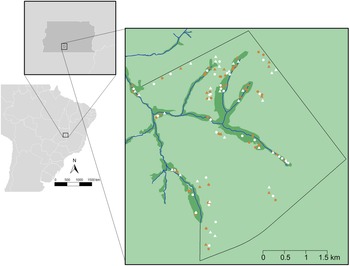
Nest predation experiments were conducted at the IBGE Ecological Reserve (15º56'41” S; 47º53'07” W) at the Cerrado (Brazilian savanna). The reserve comprises an area of 1,350 ha situated around 35 km from Brasília in Central Brazil (Figure 1). The area is composed by different vegetational physiognomies ranging from savanna-like formation (e.g. cerrado sensu strictu, sparse cerrado and grasslands) and forests (e.g. cerrado woodlands and gallery forests; Ribeiro Reference Ribeiro2011). The climate in the region is highly seasonal with a cold dry winter (May–September) and a hot summer (October–April). The monthly rainfall average is around 200 mm during the rainy season falling to less than 30 mm during the dry season (Silva et al. Reference Silva, Assad, Evangelista, Sano, Almeida and Ribeiro2008).
Location of the study area in the Brazilian Cerrado, Central Brazil. The black continuous line represents the limits of the IBGE Ecological Reserve. Dark green areas represent forest habitats and light green areas represent savanna-like habitats. Points indicates the distribution of artificial nests transects over the entire study period. White points represent transects with nests baited with white eggs and brown points represent transects with nests baited with brown eggs. Circles represent high-density transects and triangles represent low-density transects.

Artificial nests and experimental design
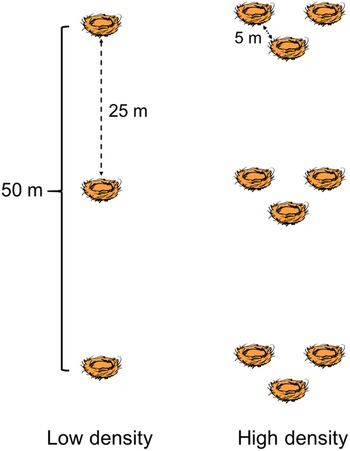
Artificial nests were handmade using a light brown sisal fibre to simulate natural passerine nests. Artificial nest dimensions were standardised according to the mean values of depth (50 mm) and diameter (70 mm) of passerine nests found in the region (Medeiros & Marini Reference Medeiros and Marini2007). The experiments were conducted between March 2017 and March 2018. A total of 768 nests were allocated in 128 transects (a straight line along which the nests were placed). On average, two transects were evaluated simultaneously per week. We alternate the treatments within and between weeks to avoid temporal pseudoreplication. To reduce the chances of spatial pseudoreplication, transects were placed at least 500 m of each other in each week. All nests were placed at a standardised height of 1.5 m off the ground on the available tree or shrub. To avoid producing cues to predators based on human scent, nests were manipulated using gloves during the entire process. We placed two eggs in each artificial nest, one plasticine and one quail (Coturnix coturnix) egg. We decided to use two different types of eggs to increase the chances of recording information on predator type. All eggs were hand-painted using a non-toxic gouache paint (similar to other studies, Gillis et al. Reference Gillis, Gauffre, Huot and Bretagnolle2012; Magige et al. Reference Magige, Moe and Røskaft2008). For half of the nests, both eggs were painted light brown (hereafter called cryptic eggs) and the other half were painted white. The white eggs (hereafter called conspicuous eggs) contrasted with the nest coloration becoming conspicuous even from a distant view. Artificial nests were distributed in transects of 50 m in length and were arranged equally in savanna-like and forest formations. We also simulated areas of low and high reproductive density. The low-density transects were composed by three artificial nests placed with 25 m distance between them. The high-density transects were composed by three sets of nests totalising nine nests (Figure 2). Each set of nests was composed by three nests, and the sets were also placed with 25 m distance between them. Within each set, the nests were arranged forming a triangle with sides measuring 5 m. Each nest was exposed for 7 days, and at the end of the period nest outcome was recorded. We considered that a nest was predated if at least one egg disappeared or was damaged. We recorded any marks left on eggs (e.g. marks of claws, teeth, pecks or scratches) to help identifying possible predators. We assumed that any tooth mark was performed by mammals and beak-shaped marks were produced by avian species. To aid the identification of predators, we placed a cryptic camera trap (HC-550 M/G) around 2 m away from some nests. The video recordings were performed for 7 weeks, from December 2017 to August 2018, producing a total sampling effort of approximately 1,176 hours. The presence of the camera trap did not increase the chances of nest predation (Z = 0.08; P = 0.929). To control for the seasonality effect observed in the region, we used the daily rainfall data from the historical record database of the Instituto Nacional de Meteorologia (Inmet, http://www.inmet.gov.br). We calculated the average rainfall recorded during the days the nests were exposed to predation. The data were obtained from the closest weather station available.
Scheme to represent the number of artificial nests and their spatial position in low- and high-density transects.

Statistical analyses
To investigate how the experimental treatments influenced the predation probability, we fitted a generalised linear mixed model with a binomial error distribution. Nest predation (yes or no) was used as the response variable, and egg conspicuousness, nest density, vegetational structure and seasonality (represented by rainfall) were considered as explanatory variables. The model was implemented using the glmer function from the lme4 package (Bates et al. Reference Bates, Mächler, Bolker and Steven2015). We used the nest-set ID nested withing transect as random terms in the model. We calculated the percentage of variance explained by each of the fixed effects only and the combination of fixed and random effects, using marginal and conditional R 2, respectively (Nakagawa & Schielzeth Reference Nakagawa and Schielzeth2013). Model diagnostics were done using the DHARMa package (Hartig Reference Hartig2020). To evaluate the association between predator group (mammals or birds) and habitats type (forest or savanna formation), we performed a chi-squared test of independence. All analyses were conducted in the software R 4.0.2. (R Development Core Team 2020).
Results
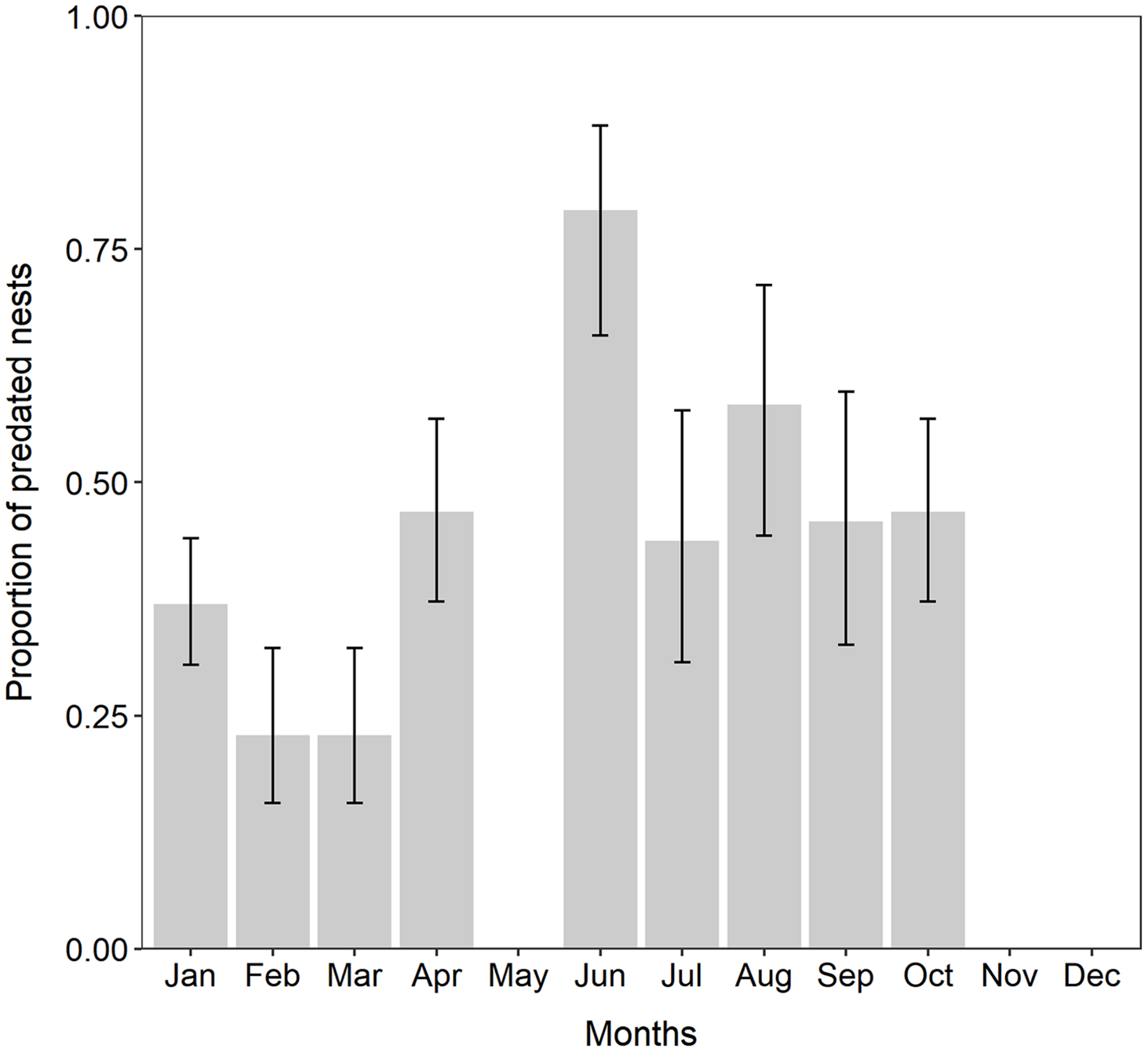
A total of 768 artificial nests were used in the experiments totalizing an exposure time of 129 thousand hours. Overall predation rate was 40.9% (n = 314) with nests being proportionally more predated during June (Figure 3). Considering only predated nests, for 44.9% (n = 141) of these nests both eggs were predated. For nests where a single egg was predated, plasticine eggs were more frequently target (35.0%; n = 110) in comparison with quail eggs (20.1%; n = 63).
Variation on the proportion of predated nests over the year in the study area.

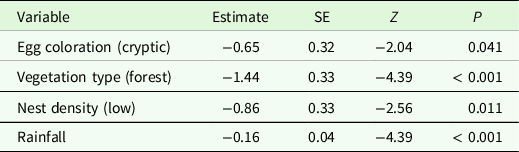
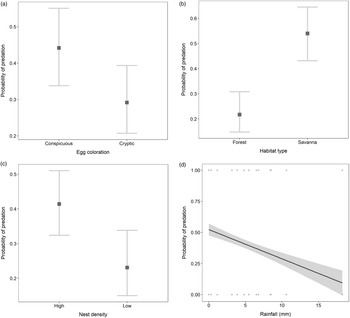
Predation probability was significantly higher for nests filled by conspicuous eggs, located in open habitats, at higher densities and during the dry period (marginal R 2 = 0.21, conditional R 2 = 0.51; Table 1). More specifically, we found that nests containing conspicuous eggs (23.2%; n = 178) were more predated than those nests baited by cryptic eggs (17.7%; n = 136; Z = −2.04; P < 0.041; Figure 4a). Similarly, nests placed at savanna-like formations (26.3%; n = 202) had higher predation rate than nests placed at forest habitats (14.6%; n = 112; Z = −4.38; P < 0.001; Figure 4b). Predation rate was also influenced by nest density. Clustered nests (26.3%; n = 202) showed a higher predation probability in comparison with more evenly spaced nests (14.6%; n = 112; Z = −2.56; P < 0.011; Figure 4c). The seasonality characterised by rainfall variation also influenced the predation probability. Periods of lower rainfall was associated with an elevated probability of predation (Z = −4.39; P < 0.001; Figure 4d).
Results from the generalised linear mixed model about the effects of egg coloration, vegetation type, nest density and rainfall on nest predation. Conspicuous, savanna-like and high density were set as reference categories. Transect and nest-set ID were included as random terms in the model

Effects of: (a) egg coloration; (b) habitat type; (c) nest density and (d) rainfall on the probability of artificial nest depredation over 7 days (with 95% confidence interval).

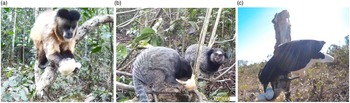
Marks left on plasticine eggs (n = 167), that included scratches, beak and tooth marks, revealed that eggs were attacked by different predators, mainly birds and mammals. Incisive tooth marks left on some eggs suggest that rodents were possible predators. For those nests where the identification of predator taxon (i.e. mammals or birds) was possible, we observed an association between predator group and habitats type (χ 2 = 23.39; P < 0 001). Mammals were the main predators in forest habitats, while birds were the main predators in savanna-like habitats. We recorded predation by black-tufted-marmoset (Callithrix penicillata), bearded capuchin (Sapajus libidinosus) and curl-crested jays (Cyanocorax cristatellus) in the camera trap (Figure 5). For instance, curl-crested jays were the main predator recorded in savanna-like habitats. Other potential predators were also recorded around nests, such as the common agouti (Dasyprocta sp.) and the opossum (Cryptonanus sp.).
Predators of artificial nests recorded with camera traps in the study area. (a) Bearded capuchin (Sapajus libidinosus) (b) Black-tufted-marmoset (Callithrix penicillata) and (C) Curl-crested jays (Cyanocorax cristatellus).

Discussion
Different ecological aspects affect the probability of nest predation in the Brazilian Cerrado. In accordance with our first hypothesis, nests baited with conspicuous eggs were more predated, which reinforces that the main predators in the study area are visually orientated. Egg coloration has been previously shown to have an important role in nest predation (Blanco & Bertellotti Reference Blanco and Bertellotti2002; Castilla et al. Reference Castilla, Dhondt, Díaz-Uriarte and Westmoreland2007; Magige et al. Reference Magige, Moe and Røskaft2008). Similarly to what we observed, an experimental study demonstrated that white eggs (conspicuous) were more predated than cryptic eggs (Gillis et al. Reference Gillis, Gauffre, Huot and Bretagnolle2012). This result is interesting because pigmented eggs are considered to be more costly to produce than white eggs (Moreno & Osorno Reference Moreno and Osorno2003); thus, nest survival benefit must have overcome this cost in many species that produce pigmented eggs. Moreover, different studies have suggested that the main nest predators in the Brazilian Cerrado are birds (França & Marini Reference França and Marini2009; Oliveira et al. Reference Oliveira, Almeida, Paiva and França2013), which use visual cues to locate nests. Nest predation by mammals have been recorded by other studies conducted in the biome, suggesting that marmosets and rodents may be responsible for most mammal predation events (Almeida et al. Reference Almeida, Lucindo, Costa and de Paula2013; Dodonov et al. Reference Dodonov, Paneczko and Telles2017; Guimarães-Silva Reference Guimarães-Silva2020). Moreover, differences in predation rate between plasticine and quail eggs may be related to the eggshell thickness of quail eggs, which may prevent small predators to open it (Maier & DeGraaf Reference Maier and Degraaf2000).
Vegetation structure is known to affect nest success in several avian species (Bellamy et al. Reference Bellamy, Burgess, Mallord, Cristinacce, Orsman, Davis, Grice and Charman2018; Vazquez et al. Reference Vazquez, Zamora-Nasca, Rodriguez-Cabal and Amico2021). In this study, as suggested in our second hypothesis, we have demonstrated that nest predation in forest habitats was lower than in savanna-like habitats. Forest habitats may help conceal the nest, making it difficult for predators to locate them, since vegetation cover is denser (Bellamy et al. Reference Bellamy, Burgess, Mallord, Cristinacce, Orsman, Davis, Grice and Charman2018; Krüger et al. Reference Krüger, Väänänen, Holopainen and Nummi2018; Dagan & Izhaki Reference Dagan and Izhaki2020). In addition, a denser vegetation may also hinder the access of predators or may reduce its movement in such habitats (but see Martin Reference Martin1993; Denno et al. Reference Denno, Finke, Langellotto, Barbosa and Castellanos2005). Although there are other ecological differences between forest and savanna-like habitats (e.g. predator species composition), vegetation cover has been demonstrated to affect predation probability, especially by aerial predators (Gillis et al. Reference Gillis, Gauffre, Huot and Bretagnolle2012; Segura et al. Reference Segura, Masson and Gantchoff2012; Vazquez et al. Reference Vazquez, Zamora-Nasca, Rodriguez-Cabal and Amico2021). The effect of a more complex vegetation structure (e.g. taller and denser vegetation) was associated with a lower predation rate in the Woodlark (Lullula arborea, Buehler et al. Reference Buehler, Bosco, Arlettaz and Jacot2017) and for five mixed-grass prairie passerines (Davis Reference Davis2005), for example.
Alternatively, predator community may also differ between vegetational habitats. Avian species may be a more common predator in open habitats, while mammals may be more prevalent in dense vegetation habitats. Studies have demonstrated that forest parameters affect the likelihood of predation by mammals and birds (Somsiri et al. Reference Somsiri, Gale, Pierce, Khamcha and Sankamethawee2020). For instance, evidence suggested that an increase in forest cover was associated with an increase in predation by rodents and a decrease in predation by brown-headed cowbirds (Molothrus ater, Cox et al. Reference Cox, Thompson and Faaborg2012b). Furthermore, a study conducted in different Patagonian forests demonstrated that birds are the dominant nest predator, but marsupials are a more common predator on sites with high shrub cover (Vazquez et al. Reference Vazquez, Zamora-Nasca, Rodriguez-Cabal and Amico2021). Thus, it is evident that bird species nesting on forest and savana-like habitats are exposed to different predators and may cope with different predation pressures. Here, we observed that curl-crested jays are an important nest predator in our study site, especially in savanna-like habitats. Other studies have already demonstrated that jays are a common nest predator in the Brazilian Cerrado (França et al. Reference França, Sousa, Santos, Duca, Gressler, Borges, Lopes, Manica, Paiva, Medeiros and Marini2009; Studer et al. Reference Studer, Ballarini and Marini2021). On the other hand, our results also suggest that primates may be dominant predators in forest habitats.
Nest density has been associated with lower predation rates in colonial species due to mobbing behaviour or other antipredation strategies such as the production of alarm calls (Wicklund & Anderson Reference Wicklund and Anderson1994; Perry & Andersen Reference Perry and Andersen2003; Natusch et al. Reference Natusch, Lyons and Shine2017). In contrast, a higher proximity to other nests have been suggested to reduce nest survival in some passerines (Roos Reference Roos2002; Shitikov et al. Reference Shitikov, Vaytina, Makarova, Fedotova, Volkova and Samsonov2018). Artificial nest experiments from Temperate region have produced ambiguous results, sometimes suggesting a density-dependent effect, but with an influence of the vegetation structure (Schmidt & Whelan Reference Schmidt and Whelan1999, but see Ackerman et al. Reference Ackerman, Blackmer and Eadie2004; Ringelman et al. Reference Ringelman, Eadie and Ackerman2012; Carpio et al. Reference Carpio, Castro-Caro and Tortosa2016). By removing parental effects using artificial nests, we have demonstrated that the clustering of nests in the habitat may promote a higher predation rate, as indicated in our third hypothesis. This may be due to the fact that a higher number of nests in an area could increase the chances of a nest being found. An alternative explanation for the observed pattern may be related to predator behaviour in relation to a reward phenomenon. A predator may invest more time searching for other nests in areas after encountering a nest (Schmidt & Whelan Reference Schmidt and Whelan1999).
The central region of South America is characterised by a strong seasonality with two marked seasons, dry and wet (Eiten Reference Eiten1972). Seasonality influences breeding behaviour of avian species in the region, with most species concentrating nesting activity at the beginning of the wet season, from September to December (Marini et al. Reference Marini, Borges, Lopes, Sousa, Gressler, Santos, Paiva, Duca, Manica, Rodrigues, França, Costa, França, Heming, Silveira, Pereira, Lobo, Medeiros and Roper2012). Our result demonstrated that rainfall was negatively associated with nest predation probability, which was contrary to our expectation (fourth hypothesis). On the other hand, this result may be associated with a possible reduction in the food availability for nest predators during the dry season. Thus, an increase in resource availability due to the presence of artificial nests was associated with a greater number of predation events. A similar result was observed for the Tropical, year-round breeding, red-capped larks (Calandrella cinerea, Mwangi et al. Reference Mwangi, Ndithia, Kentie, Muchai and Tieleman2018). The authors monitored nests over a 64-month period and despite the variation among years, they observed that rainfall negatively affected nest survival.
Nest predation in the Tropics is a complex phenomenon that is far from being fully comprehended, since we still do not have the whole picture of who are the main predators in the region (Menezes & Marini Reference Menezes and Marini2017). As we observed, different aspects may influence predation in the Tropics, so specific characteristics of nesting species must be considered in the interpretation of predation rates. Although there are many studies on the breeding biology of Neotropical birds, most of them did not investigate the causes of nest failure and those that did so, generally evaluated the same few variables of influence. Many aspects require clarification through further research, especially in the perspective of the predator’s behaviour and their population dynamics.
Acknowledgements
We would like to thank the Assessoria de Pós-graduação e Pesquisa from Centro Universitário de Brasília for all the support. We thank Laiana Aveiro and Matheus Reche who helped during fieldwork.
Financial support
This work was supported by the Scientific Initiation Program from the Centro Universitário de Brasília. IRA was supported by the Conselho Nacional de Desenvolvimento Científico e Tecnológico through a student scholarship.
Competing interests
The authors declare that they have no conflicts of interest.
Ethical statement
The authors assert that all procedures contributing to this work comply with applicable national and institutional ethical guidelines on the care and use of laboratory or otherwise regulated animals.