Introduction
Population ageing and increasing cultural diversity were two important socio-demographic changes in many Western countries, such as Australia, Canada, the United States of America (USA) and the United Kingdom (UK), in the 20th century, and are expected to continue throughout the 21st century (United Nations 2011). The number of older immigrants in these countries is also increasing rapidly, both in absolute terms and as a proportion of the population. In Australia, where the current study was conducted, there were 681,500 overseas-born older people (defined as those aged 65 years or over) in 1996, accounting for 31 per cent of the total older population (Gibson et al. Reference Gibson, Braun, Benham and Mason2001). In 2011, this number had increased to 1.1 million, accounting for 36 per cent of the older Australian population (Australian Bureau of Statistics 2012). This is a 63 per cent increase over a 15-year period, compared to a 30 per cent increase for the Australian-born population during this period.
Against this background, the study explored differences and similarities in the nature of older parent–child relationships between older Australian-born people and older Chinese immigrants. It focused on parent–child relationships because family relationships play a major role in shaping our lives and, of these relationships, those between parents and children are among the most fundamental and emotionally intense ones (e.g. Russon Reference Russon2003; Stanton Reference Stanton, Ingoldsby and Smith1995). There is further evidence that following changes in family structures in the past few decades, such as relatively high divorce rates, smaller family sizes (due to lower fertility rates) and increasing numbers of concurrent generations within families (due to increased life expectancy), vertical family relationships, that is, family relationships across different generations, such as those between parents and children, will become relatively more important compared to horizontal ones, that is, family relationships within the same generation (e.g. couple relationships and sibling relationships) (Bengston Reference Bengston2001). Finally, it is important to understand the nature of parent–child relationships as these relationships affect the exchange of care between parents and adult children, which, in turn, impact on social policies and service provision for families in our ageing society.
The study explored differences and similarities in parent–child relationships between older Australian-born people and older Chinese immigrants because there are unique characteristics in the nature of these relationships in Chinese families. Specifically, it is believed that the Confucian concept of filial piety, or Xiao (孝), defines the nature of parent–child relationships in Chinese families (Hashimoto and Ikels Reference Hashimoto, Ikels, Johnson, Bengtson, Coleman and Kirkwood2005; Hwang and Han Reference Hwang, Han and Bond2010). Filial piety refers to ‘the practice of respecting and caring for one's parents in older age, based on a moral obligation that children owe their parents’ (Hashimoto and Ikels Reference Hashimoto, Ikels, Johnson, Bengtson, Coleman and Kirkwood2005: 437). In traditional Chinese families, multigenerational co-residence was paramount in carrying out this filial care in everyday life and was considered a key indicator of filial piety. However, filial piety does not only involve providing material support but also showing respect and love to one's parents (Hashimoto and Ikels Reference Hashimoto, Ikels, Johnson, Bengtson, Coleman and Kirkwood2005; Sung Reference Sung2007).
Although the concept of filial piety is not unique to China, it is particularly associated with Chinese families because of the strong historical influence of Confucianism in China, which considered filial piety as ‘the centerpiece of the moral order of society’ (Hashimoto and Ikels Reference Hashimoto, Ikels, Johnson, Bengtson, Coleman and Kirkwood2005: 437). Due to this emphasis on filial piety, parent–child relationships occupy a much more central position in Chinese people's family relationships than that between a husband and a wife, as is the case in families in Western countries (Park and Chesla Reference Park and Chesla2007).
The other reason for focusing on this group is that older Chinese immigrants are one of the largest and fastest growing groups of older immigrants in many Western countries, including Australia, where they were the sixth largest group of older immigrants in 1996 and are projected to be the fourth largest immigrant older group by 2026 (Gibson et al. Reference Gibson, Braun, Benham and Mason2001). Similar patterns are seen elsewhere; for example, they were the largest group of older immigrants in Canada in 2001, accounting for 3 per cent of the total older population (Turcotte and Schellenberg Reference Turcotte and Schellenberg2006).
Understanding the nature of parent–child relationships: the solidarity–conflict model and the concept of ambivalence
Many different theoretical perspectives, such as social exchange theory (e.g. Homans Reference Homans1958) and the solidarity–conflict model (Bengtson and Roberts Reference Bengtson and Roberts1991; Katz et al. Reference Katz, Lowenstein, Philips, Daatland, Acock, Bengtson, Klein, Allen and Dilworth-Anderson2004), have been used to understand the nature of parent–child relationships. Among these perspectives, the solidarity–conflict model was used in this study because it provides a clear and comprehensive scheme for describing the nature and for measuring the various components of parent–child relationships (Silverstein and Giarrusso Reference Silverstein and Giarrusso2010). The solidarity–conflict model is also one of the most frequently cited theories of family relationships in later life (Steinbach Reference Steinbach2008) and has been used in several large-scale family studies with various ethnic groups and in cross-national contexts, such as the Netherlands Kinship Panel Study, a longitudinal survey on the nature and strength of family ties in the Netherlands (Dykstra et al. Reference Dykstra, Liefbroer, Kalmijn, Knijn and Mulder1999) and the Old Age and Autonomy: The Role of Service Systems and Intergenerational Solidarity study (OASIS), a cross-national project that examines the interacting role of family and the welfare state on autonomy and quality of life in old age (Lowenstein and Ogg Reference Lowenstein and Ogg2003).
The solidarity–conflict model conceptualises parent–child relationships as multidimensional, consisting of solidarity and conflict (Bengtson and Roberts Reference Bengtson and Roberts1991; Katz et al. Reference Katz, Lowenstein, Philips, Daatland, Acock, Bengtson, Klein, Allen and Dilworth-Anderson2004). Solidarity refers to ‘feelings of mutual affinity … and how these are expressed in behavioural terms’ (Dykstra et al. Reference Dykstra, Liefbroer, Kalmijn, Knijn and Mulder1999: 6) and consists of six dimensions: structural solidarity (e.g. living arrangements and/or geographic distance), associative solidarity (e.g. frequency of contact), functional solidarity (e.g. exchanges of intergenerational help), affectual solidarity (e.g. feelings of emotional closeness), consensual solidarity (e.g. perceived agreement in opinions, values and lifestyles) and normative solidarity (e.g. strength of obligations felt towards other family members) (Bengtson and Roberts Reference Bengtson and Roberts1991).
The early model focused on these solidarity dimensions and was criticised for being normative, as it described how family relationships should be rather than how they are (Marshal, Matthews and Rosenthal Reference Marshal, Matthews, Rosenthal, Maddox and Lawton1993). In response, a seventh dimension, namely conflict, was added to the model (Silverstein, Chen and Heller Reference Silverstein, Chen and Heller1996). This revised model considers conflict as a normal aspect of relations and argues that solidarity and conflict are separate dimensions rather than opposite poles of a single continuum (Clarke et al. Reference Clarke, Preston, Raksin and Bengtson1999; Parrott and Bengtson Reference Parrott and Bengtson1999).
The solidarity–conflict model might also be of particular relevance for research with older Chinese immigrants (Lin et al. Reference Lin, Bryant, Boldero and Dow2015). First, the solidarity framework might be used to operationalise the Confucian concept of filial piety. As discussed earlier, it is commonly believed that the Confucian concept of filial piety defines the nature of parent–child relationships in traditional Chinese families. However, this term is generally discussed as an ideology and there is no agreed view on how filial piety should be measured in the context of parent–child relationships. In contrast, the solidarity framework provides a clear scheme for describing and measuring the various components of intergenerational solidarity. Its inclusion of behavioural and affective dimensions is also consistent with the view that filial piety involves both behavioural and emotional support to one's parents (Hashimoto and Ikels Reference Hashimoto, Ikels, Johnson, Bengtson, Coleman and Kirkwood2005; Sung Reference Sung2007). Given these features, the solidarity framework might be used to conceptualise the Confucian concept of filial piety in modern society. Because the solidarity–conflict model is currently the most frequently cited theory of family relationships (Steinbach Reference Steinbach2008), connecting filial piety to the intergenerational solidarity theory and documenting this link empirically will also be useful for cross-cultural comparative research on family relationships. Second, the conflict dimension might complement the Confucian concept of filial piety when exploring parent–child relationships among older Chinese immigrants. It is argued that although this concept might persist after Chinese people emigrate to a different country, conflicts also arise in the context of immigration because parents and children might be at different stages of acculturation (Lin et al. Reference Lin, Bryant, Boldero and Dow2015).
In addition to the solidarity–conflict model, the study also included the concept of ambivalence to reflect recent theoretical advances. This concept was introduced by Luescher and Pillemer (Reference Luescher and Pillemer1998) as a competing perspective to the solidarity–conflict model and refers to ‘contradictions in relationships between parents and adult offspring that cannot be reconciled’ (Luescher and Pillemer Reference Luescher and Pillemer1998: 416). They argued that compared to the solidarity and conflict perspectives, ambivalence better reflects the nature of family relationships because ‘relations generate ambivalences’ and, thus, ‘the observable forms of intergenerational relations’ can be seen as ‘efforts to manage and negotiate these fundamental ambivalences’ (Luescher and Pillemer Reference Luescher and Pillemer1998: 414). In response, Bengtson et al. (Reference Bengtson, Giarrusso, Mabry and Silverstein2002) proposed that ambivalence can be operationally defined as the intersection of solidarity and conflict and, thus, it complements rather than competes with the solidarity–conflict model. To reflect these different theoretical perspectives of family relationships and present a more complete picture of the nature of older parent–child relationships, the solidarity, conflict and ambivalence dimensions were all included in the current study.
Differences in the nature of parent–child relationships between older Caucasians and older Chinese immigrants
A recent review on the nature of parent–child relationships among older Chinese immigrants has found that there are currently few studies investigating the differences in these relationships between older Caucasians and older Chinese immigrants (Lin et al. Reference Lin, Bryant, Boldero and Dow2015). From this limited research, there is evidence of differences in living arrangements (i.e. structural solidarity) and filial expectations (i.e. normative solidarity). For example, a relatively higher percentage of older Chinese immigrants live with their children compared to the Caucasian population (Lin et al. Reference Lin, Bryant, Boldero and Dow2015). The percentages ranged from 35 per cent (Kamo and Zhou Reference Kamo and Zhou1994) to 86 per cent (Phua, McNally and Park Reference Phua, McNally and Park2007), compared to 10–25 per cent reported for older Caucasians (Australian Bureau of Statistics 2012; Tomassini et al. Reference Tomassini, Glaser, Wolf, van Groenou and Grundy2004; United Nations 2005).
With regard to filial expectations, Laidlaw et al. (Reference Laidlaw, Wang, Coelho and Power2010) compared the level of filial expectations among three cultural groups (i.e. older Chinese immigrants living in the UK, older people living in mainland China and Scottish older people living in Scotland). They found that older Chinese immigrants had similar levels of filial expectations to Chinese people living in China and that these were significantly higher than those among Scottish-born older people (Laidlaw et al. Reference Laidlaw, Wang, Coelho and Power2010).
The differences in these two aspects are consistent with the view that the influence of filial piety persists even after Chinese people have emigrated to a foreign country (Li, Hodgetts and Ho Reference Li, Hodgetts and Ho2010). It is commonly assumed that older Chinese immigrants have good relationships with their children and are well looked after by them, in that they receive considerable financial, instrumental and emotional support from their children and, as a result, they do not need help from the outside (Chiu and Yu Reference Chiu and Yu2001; Lo and Russell Reference Lo and Russell2007).
However, there is also evidence of changes in the practice and meaning of filial piety among older Chinese immigrants (Lin et al. Reference Lin, Bryant, Boldero and Dow2015). For example, considerable numbers of older Chinese immigrants live independently (e.g. Gee Reference Gee2000; Lee and Angel Reference Lee and Angel2002). Of these, many live in public housing, receive limited support from their children, and rely on the government and community organisations for instrumental and financial support (e.g. Li Reference Li2011; Lo and Russell Reference Lo and Russell2007; Wong, Yoo and Stewart Reference Wong, Yoo and Stewart2005). Some studies have also found that many older Chinese immigrants have adjusted their filial expectations (Chiang-Hanisko Reference Chiang-Hanisko2010; Ip, Lui and Chui Reference Ip, Lui and Chui2007). For instance, some prefer to live independently than to live with their children (Lai Reference Lai2005; Mackinnon, Gien and Durst Reference Mackinnon, Gien and Durst1996). These studies’ results suggest that older Chinese immigrants’ relationships with their children are also influenced by their immigration experiences, and that the differences in these relationships between this group and older Caucasians might not be as small as was previously believed. However, few of these studies included older Caucasians as a comparison group and, thus, there is little direct evidence on the differences in the nature of parent–child relationships between the two groups.
The aim of this study was to contribute to this limited research and to explore the differences and similarities by examining the relationships of older Australian-born people and older Chinese immigrants with their adult children using the solidarity–conflict model and the concept of ambivalence. Based on the current literature, it was hypothesised that older Chinese immigrants would report higher levels of structural and normative solidarity than older Australian-born people. However, no hypotheses regarding the remaining dimensions were proposed due to the paucity of research in those areas.
Methods
Study design and participants
The study used a between-groups cross-sectional design, in which data were collected in structured interviews. Participants were two convenience samples of community-dwelling older people, specifically, a group of Australian-born older people (N = 60) and a group of older Chinese immigrants (N = 62). There were three general inclusion criteria for participation, namely being aged 65 years and over, living in the community and having at least one living child. To enhance comparison between the two groups, additional group-specific inclusion criteria were included to minimise diversity within each group. Specifically, Australian-born participants needed to have both parents born in English-speaking countries, such as Australia, the USA or the UK. Similarly, Chinese participants needed to have been born and lived in mainland China before emigrating to Australia. They also needed to have lived in Australia for more than three years to minimise the impact of cultural adjustment when individuals first emigrate to a foreign country. The theoretical base for this is Oberg's (Reference Oberg1960) and Winkelman's (Reference Winkelman1994) theories of stages of cultural adjustment, which state that people experience four stages (the honeymoon stage, the hostility stage, the gradual adjustment stage and the home stage) when emigrating to a new country. In this study, we restricted Chinese participants to those who had lived in Australia for more than three years to exclude people who were in the early stages of cultural adjustment.
Procedure
The study was conducted as the first author's PhD project, which explored the nature of older parent–child relationships and their associations with older people's psychological wellbeing. This paper reported results regarding the nature of parent–child relationships only.
The recruitment of participants was conducted between 2011 and 2012. A range of recruitment methods were used. Australian-born participants were recruited through advertisements placed in a free newspaper targeted at older people, a regional newsletter of the University of Third Age and the newsletter of the National Ageing Research Institute (NARI), a Melbourne-based research institute that conducts research with older people. Recruitment flyers were also sent to all NARI and some Council on the Ageing Victoria volunteers. Chinese participants were recruited through an advertisement placed in a free Chinese newspaper and flyers distributed to Chinese senior groups across the Melbourne metropolitan area. The first author also conducted recruitment talks to a small number of Chinese seniors’ groups.
Potential participants were asked to contact the first author or to leave their contact number with her. In follow-up telephone calls or e-mails, potential participants were provided with further information about the study. For those who confirmed their interest, an appointment was made either at their homes or another place they preferred, such as a public library.
Data were collected through standardised interviews and informed consent was obtained at the start of the interviews. The interviews were conducted by the first author, who was born in China and is fluent in English and Mandarin. They were conducted in English for Australian participants and in Mandarin for Chinese ones. Participants who were in couples (N = 8, three Australian couples and five Chinese ones) had the option of being interviewed separately. However, all chose to be interviewed at the same time. The interviews lasted from one to three hours, depending on how talkative the participants were and whether or not their spouse participated in the study.
Measures
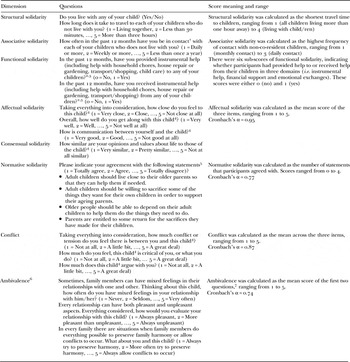
Measures used in the study included socio-demographic variables and variables relating to the participants’ relationships with their adult children. Socio-demographic variables included the participants’ age, gender, highest education level, marital status, home-ownership, self-perceived financial situation and physical health. The extent to which older people's relationships with their adult children were characterised by structural, associative, functional, affectual, consensual and normative solidarity, along with conflict and ambivalence, was assessed. Questions assessing these dimensions were adapted from those in earlier studies, where their reliability was reported as acceptable (e.g. Gans and Silverstein Reference Gans and Silverstein2006; Lowenstein Reference Lowenstein2007; Lowenstein and Daatland Reference Lowenstein and Daatland2006; Silverstein et al. Reference Silverstein, Gans, Lowenstein, Giarrusso and Bengtson2010). Table 1 provides details of these questions. For the solidarity dimensions, higher scores indicated higher levels of solidarity. For the conflict and ambivalence dimensions, higher scores indicated higher levels of conflict and ambivalence, respectively.
Measures of parent–child relationships

Notes: 1. Including both face-to-face contact and non-face-to-face contact (e.g. telephone, mail and e-mail). 2. The same question was also asked for financial support and emotional support. 3. Most participants who lived with their children indicated that they shared household chores, household maintenance and shopping with their co-resident children. Due to the nature of their living arrangements, it was difficult to divide unambiguously these activities into providing or receiving intergenerational help. For this reason, analyses of instrumental help were conducted on the data provided by the 97 participants who lived independently. 4. The questions were asked for a randomly selected child. 5. Based on the scale developed by Lee, Peek and Coward (Reference Lee, Peek and Coward1998). 6. Based on the questions developed by Lüscher and Pillemer (Reference Luescher and Pillemer1998). 7. Only the first two items were included because Cronbach's α was low (0.56) when the third item was included.
Statistical analyses
For nominal and ordinal variables, frequencies are reported. For continuous variables, Shapiro–Wilk tests were conducted to determine whether the variables were normally distributed. For variables that were normally distributed, means and standard deviations (SD) are reported. For variables that were not normally distributed, median and interquartile ranges (IQR) are reported. A range of statistical analyses, such as chi-square tests, Mann–Whitney U tests and linear regressions, were used to investigate the differences in the eight relationship dimensions.
Results
Participants’ demographic characteristics
Participants ranged in age from 65 to 82 years, with a median of 76 years (IQR = 8). Most (83.68%) were females and were married (76.62%). Approximately half were home-owners (61.50%), had university or higher education qualifications (57.47%) and considered their financial situation to be ‘very comfortable’ or ‘comfortable’ (62.51%). More than half (71.58%) rated their physical health to be ‘excellent’ or ‘good’. Participants had between one and five living children, with a median of 2.00 (IQR = 1.00). Together, they had 303 living children, of whom 158 (52%) were daughters.
Chinese participants had been in Australia for between three and 21 years, with a median of 15 (IQR = 4). Their ages at migration ranged from 52 to 73 years, with a mean of 62 years (SD = 4.01). The most common reasons given for migrating to Australia were to reunite with family (37.60%) and to help look after grandchildren (28.45%). Most Chinese participants either did not speak English well (35.57%) or not at all (25.40%).
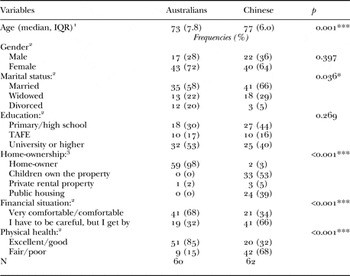
The respondents’ country of birth was not associated with gender or educational status (see Table 2). However, it was associated with their marital status and home-ownership, and there were differences in age and self-perceived physical health and financial situation (hereafter referred to as physical health and financial situation, respectively) between the two participant groups. Australian participants were younger, more likely to be divorced and home-owners, and reported better physical health and financial situation than the Chinese participants. The association between country of birth and home-ownership was particularly apparent when the participants were grouped according to living arrangements. Among those participants who lived with their children, all Australians owned their home whereas all Chinese immigrants lived in a home owned by their children. Among those who lived independently, most Australians (55.98%) owned the home, whereas more than half of the Chinese participants lived in public housing (24.60%) and a quarter (11.28%) lived in a property owned by their children. Finally, Australian-born participants (median = 3, IQR = 1) had significantly more children than Chinese participants (median = 2, IQR = 0, Mann-Whitney U = 1,114.50).
Differences in socio-demographic characteristics between Australian-born and Chinese participants

Notes: IQR: interquartile range. TAFE, technical and further education. 1. Mann–Whitney U test. 2. Chi-square test. 3. Fisher's exact test.
Significance levels: * p ⩽ 0.05, ** p ⩽ 0.01, *** p ⩽ 0.001.
Differences in the nature of parent–child relationships
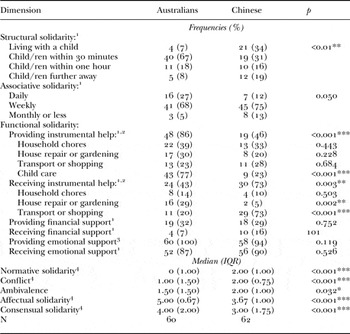
The respondents’ country of birth was associated with structural solidarity. Although Chinese participants were more likely to live with their children than Australian participants, they were less likely to have children living within 30 minutes (see Table 3). There was no association between country of birth and associative solidarity. However, country of birth was associated with two functional solidarity domains. Chinese participants were less likely than Australian participants to provide instrumental help, but were more likely to receive it. Country of birth was not associated with the remaining functional solidarity domains, namely providing or receiving emotional and financial support. Finally, there were associations between country of birth and the remaining relationship dimensions. Chinese participants reported higher levels of normative solidarity, conflict and ambivalence, but lower levels of affectual and consensual solidarity than Australian-born participants.
Differences between Australian and Chinese participants in the eight dimensions of parent–child relationships

Notes: IQR: interquartile range. 1. Chi-squared test. 2. Restricted to participants who lived independently (N = 97). 3. Fisher's exact test. 4. Mann–Whitney U test.
Significance levels: * p ⩽ 0.05, ** p ⩽ 0.01, *** p ⩽ 0.001.
To understand better the association between country of birth and instrumental help, the different types of instrumental help were analysed separately. There were associations between country of birth and providing child-care support, with Australian participants being more likely to provide such help than Chinese participants. There was no association between country of birth and providing instrumental help in the remaining three areas (i.e. household chores, house repairs or gardening, transport or shopping). With regards to receiving instrumental help, there were significant associations in two areas, namely house repairs or gardening, and transport or shopping. Compared to Australian participants, Chinese participants were less likely to receive help with house repairs or gardening, but more likely to receive help with transport or shopping. There was no association between country of birth and receiving help with household chores.
Differences in the nature of parent–child relationships when socio-demographic factors were considered
Regression analyses were conducted to investigate whether the associations or the differences in the seven relationship dimensions (i.e. all except associative solidarity) remained once the impact of socio-demographic characteristics (i.e. age, gender, marital status, education, physical health and financial situation) was controlled for. The model tested in the multinomial logistic regression analysis of the structural solidarity fit the data, χ2(21) = 51.12, p < 0.001, Cox & Snell R 2 = 0.34. Of the factors in the analysis, country of birth and education were significant predictors, χ2(3) = 17.95, p < 0.001 and χ2(3) = 11.65, p = 0.009.
The binary logistic regression models which predicted providing and receiving instrumental help fit the data, χ2(15) = 45.63, p < 0.001, Cox & Snell R 2 = 0.46, and χ2(15) = 30.24, p = 0.011, Cox & Snell R 2 = 0.27, respectively. Of the factors in the model examining the provision of instrumental help, country of birth and age were predictors, Wald's statistic = 6.24, degrees of freedom (df) = 1, p = 0.012, Exp (B) = 2.53, and Wald's statistic = 4.02, df = 1, p = 0.045, Exp (B) = −0.27, respectively. However, none of the factors predicted the receipt of instrumental help.
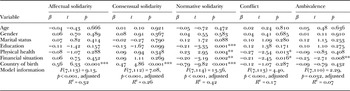
Linear regression analyses were used to analyse affectual, normative and consensual solidarity along with conflict and ambivalence. As the variables were skewed, they were transformed using optimal scaling before entering the regression model. All models were accounted for variance in the dependent variables (see Table 4). Country of birth was a predictor of affectual, consensual and normative solidarity, but not of conflict and ambivalence. Of the demographic variables, education was a predictor of normative solidarity, physical health was a predictor of normative solidarity and conflict, and financial situation was a predictor of normative solidarity, conflict and ambivalence.
Results of linear regression analyses examining the predictors of affectual solidarity, consensual solidarity, normative solidarity, conflict and ambivalence

Significance levels: * p ⩽ 0.05, ** p ⩽ 0.01, *** p ⩽ 0.001.
As there were a small percentage of couples included in this study, there was the possibility that their responses towards relationships with adult children might be affected by the presence of the other parent. Separate analyses were conducted with these participants (N = 16, eight couples) removed from the data-set. The results regarding differences in socio-demographic variables using couple-deleted data were the same as those using the whole data-set. The results regarding differences in parent–child relationships were also similar to those using the full data-set, except for the dimension of ambivalence, where the difference failed to reach significance using the couple-deleted data-set. This result, however, was consistent with the result that country of birth was not a predictor of ambivalence when the impact of other socio-demographic variables was considered. Consequently, the possible impact of couple status was not further explored in the study.
Discussion
This study is the first to use the solidarity–conflict model and the concept of ambivalence to explore differences and similarities in the nature of parent–child relationships between older Australian-born people and Chinese immigrants. There were differences between the two groups in all relationship dimensions except associative solidarity. Furthermore, these differences in solidarity dimensions persisted when socio-demographic factors were controlled for, whereas the differences in conflict and ambivalence did not.
Consistent with the hypotheses and the results of previous studies (e.g. Chiu and Yu Reference Chiu and Yu2001; Gurak and Kritz Reference Gurak and Kritz2010; Kritz, Gurak and Chen Reference Kritz, Gurak and Chen2000; Laidlaw et al. Reference Laidlaw, Wang, Coelho and Power2010; Phua, Kaufman and Park Reference Phua, Kaufman and Park2001), older Chinese immigrants were more likely to live with their children and reported higher levels of normative solidarity than Australian participants. These results indicate that filial piety continued to influence older Chinese people's relationships with their children after they emigrated to a Western country.
However, there might be other reasons for the higher rate of multigenerational living among older Chinese immigrants. First, it might be that Chinese participants had lower levels of English proficiency and were not confident in living independently in an English-speaking country. Second, it could be related to the lower home-ownership rate among this group. That is, older Chinese immigrants are more likely to live with their children than Australians because they are less likely to own their own homes. This difference in home-ownership between Australian and Chinese participants is consistent with the 2006 Australian Census data, which showed that older Chinese immigrants were among those with the lowest rates of home-ownership (Khoo Reference Khoo2011). One reason for this low home-ownership rate is that China is a middle-income country and older Chinese immigrants’ savings might be of limited value when converted to Australian dollars, and insufficient for purchasing a house.
Due to this difference in home-ownership, the meaning of multigenerational living differs between Australian-born and Chinese participants. Of the Australian-born participants who lived with their children, all lived in their own homes. That is, Australian-born participants were providing their children with accommodation. In contrast, of the Chinese participants who lived with their children, all lived in their children's homes and none owned a home. This pattern of multigenerational living among older Chinese immigrants is also different from that expected in the Confucian concept of filial piety, where married sons live in their parents’ houses. These findings highlight the changed meaning of multigenerational living among older Chinese immigrants and the important differences in the nature of such living arrangements to that of older Australian-born adults. As few studies have investigated these different types of multigenerational living, future larger-scale studies need to explore whether these differences apply to other older immigrant groups and whether the different types of multigenerational living are associated with a range of psychological outcomes among older parents.
Importantly, although Chinese participants were more likely to live with their children, the majority of them lived independently, and the latter were more likely to live further away from their children than Australian-born people. This finding was unexpected because it is commonly assumed that if older Chinese immigrants do not live with their children, filial piety results in them living closer to their children. One possible reason for this is that, as discussed above, most Australian-born participants were home-owners, whereas very few Chinese participants were, and most of the latter lived in public housing. Therefore, compared to Australian-born participants, Chinese participants likely had less choice about the location of their residence and had to live where the provided public housing is located. The finding from this study suggested that one unexpected consequence of living in public housing might be that they live further away from their children compared to those who live in private homes. The other possibility is that compared to Chinese participants, Australian participants had lived in their current houses for a longer time and their children were born and grew up there. When these children moved out to live independently, they might have continued living in these familiar neighbourhoods.
It is also important to highlight that the percentage of Chinese participants living in public housing (39%) in the present study was much higher than that in the general population (6%) (Australian Institute of Health and Welfare 2007). This result is consistent with previous studies which report that a considerable number of older Chinese immigrants live in public housing (Chiang-Hanisko Reference Chiang-Hanisko2010; Tsang, Liamputtong and Pierson Reference Tsang, Liamputtong and Pierson2004). Together, these results suggest that public housing might be a particularly important way for older Chinese immigrants to achieve independent living in host countries.
Of those living independently, the two groups also differed in three areas of functional solidarity, specifically, receiving help with transport or shopping, receiving help with house repairs or gardening, and providing child-care support. Compared to Australian participants, Chinese participants were more likely to receive help with transport or shopping. One possible reason for this increased help was that most Chinese participants had poor English proficiency and might not have felt confident going out on their own. Unexpectedly, Chinese participants were less likely to receive help with house repairs or gardening. One explanation may be that many Chinese participants lived in public housing and did not need such help compared to their Australian-born counterparts who are more likely to reside in private homes. Chinese participants were also less likely to provide child care than Australians, which is inconsistent with the finding that helping looking after grandchildren was one of the main stated reasons for migration to Australia. However, one possible explanation was that Chinese participants were older than Australian participants and that age is negatively associated with providing instrumental help (Albertini, Kohli and Vogel Reference Albertini, Kohli and Vogel2007; Hoff Reference Hoff2007). Furthermore, their grandchildren might be older, and require less help with child care. Another reason for the reduced likelihood of providing child-care support among Chinese participants was that they lived further away from their children than their Australian counterparts, and thus, might not be able to provide such help.
Importantly, in spite of the common belief that older Chinese immigrants receive a large amount of care from their children (Chiu and Yu Reference Chiu and Yu2001), the findings of the present study reveal that, compared to older Australian-born people, older Chinese immigrants are not more likely to receive help from their children, except in the area of transport or shopping. These findings are consistent with those from the study by Dong, Wong and Simon, which was conducted in the USA and found that many older Chinese immigrants perceived a lack of filial care from their children and that there might be ‘a disconnection between older adults’ conceptualizations of filial piety and the actual receipt of filial care’ (Reference Dong, Wong and Simon2012: 140).
Finally, there is an indication that older Chinese immigrants have poorer relationships with their adult children than older Australians. Chinese respondents reported lower levels of consensual and affectual solidarity and higher levels of conflict and ambivalence. Although the differences in conflict and ambivalence did not persist when socio-demographic factors were controlled for, nevertheless the differences in consensual and affectual solidarity did. One reason for lower levels of consensual solidarity is that as discussed earlier, older Chinese immigrants may maintain their traditional views about filial piety. However, it is likely that their children have acculturated to more Western views, resulting in lower levels of consensual solidarity among older Chinese immigrants. Lower levels of consensual solidarity, together with higher levels of normative solidarity, might further lead to lower levels of affectual solidarity, because different views are likely to alienate older parents from their children, and higher expectations are likely to be associated with more disappointment. However, it is also possible that the differences in affectual solidarity are a result of more prevalent multigenerational living among older Chinese participants because co-residence has been found to be associated with lower levels of affectual solidarity (Millward Reference Millward1998). Akiyama et al. (Reference Akiyama, Antonucci, Takahashi and Langfahl2003) further suggested that co-residence might result in more negative interactions between a parent and a child, as both parties have less control over the frequency of their interactions, and consequently, are less likely to be able to avoid negative interactions.
In summary, this study's results indicate that there are complex differences between older Australian-born people and older Chinese immigrants in their relationships with adult children. Some of these differences, such as more prevalent multigenerational living and higher levels of normative solidarity, likely reflect the strong influence of filial piety among older Chinese immigrants. This might be particularly true for Chinese participants in this study because most of them came to Australia when they were older. However, differences in other dimensions, such as a greater geographic distance and lower levels of consensual and affectual solidarity, are inconsistent with the concept of filial piety. These differences might be related to their experience as immigrants, such as having a more disadvantaged socio-economic status and being at a different stage of acculturation compared to their children. Finally, it is possible that these findings might reflect changes in the practice of the Confucian concept of filial piety in China where the Chinese participants in this study had spent most of their lives. For example, multigenerational co-residence is becoming less common in China, and although adult children are still an important source of instrumental and financial support, many older Chinese people do not receive such assistance from them (e.g. United Nations 2005; Wang Reference Wang and Ikels2004; Whyte Reference Whyte and Ikels2004).
The findings from this study also provide evidence for the usefulness of the solidarity–conflict model in understanding the nature of parent–child relationships among older Chinese immigrants. As discussed in the Introduction, although the Confucian concept is commonly used to understand parent–child relationships among this group, this term is often discussed as an ideology and there is no clear indication of how it can be measured empirically. The findings of this study suggest that the solidarity framework provides a useful tool to conceptualise this term and that the Confucian concept of filial piety is not peculiar or exotic but related to the universal concept of intergenerational solidarity. This development in the understanding of the Confucian concept of filial piety would enable researchers to conduct cross-cultural comparative work using the solidarity framework. Finally, the results regarding the conflict model suggest that conflict is common in older Chinese immigrants’ relationships with their children and that including this dimension complements the Confucian concept of filial piety when understanding parent–child relationships among this group.
Limitations of the current study and direction for future research
The findings of this study should be interpreted in the light of a number of limitations. Firstly, the study was based on a relatively small convenience sample. Although attempts were made to recruit older people who are more isolated, most participants were recruited through research organisations and social groups. Therefore, this sample is best considered as representing a healthy and active ageing sub-group of the older Australian population, and future larger-scale and population-based studies are needed to explore the generalisability of these findings.
Secondly, the current study was cross-sectional. Therefore, observed differences in parent–child relationships might be due to differences in cultural backgrounds, specifically filial piety, as well as the immigration experience of older Chinese immigrants. This raises questions regarding whether these results reflect the unique experiences of older Chinese immigrants or common experiences among older immigrants regardless of their cultural backgrounds. A longitudinal design which follows older Chinese immigrants or cross-sectional studies with a third comparison group of older people living in mainland China or other non-Chinese immigrants in Australia will help to identify differences attributable to general immigrant status and those uniquely attributable to Chinese immigrants.
Due to the small sample size, it was not possible to include certain potentially relevant covariates in the analyses, such as the number, gender and age of the children. Many of these variables might affect the nature of parent–child relationships and caution should be exercised in generalising findings from this study to the general older immigrant population.
Finally, the cultural background of the interviewer might have affected the group dynamics of the interviews, such that the interviewer is considered to be an in-group or an out-group member by the participants. In other words, the interviewees might have felt that their views are understood better when they were interviewed by an interviewer from a similar cultural background. As only one interviewer was used in the current study, this might have created methodological inconsistencies and future studies should consider employing multiple interviewers to ensure consistency between cultural backgrounds between the interviewees and interviewer.
Conclusion
The current study is the first to use the solidarity–conflict model and the concept of ambivalence to explore differences and similarities in parent–child relationships between older Australians and older Chinese immigrants. Significant differences between older Australian-born people and older Chinese immigrants were found in most dimensions, and the differences in solidarity dimensions persisted when socio-demographic factors were controlled for. These findings highlight the complexity in parent–child relationships in contemporary multicultural Western countries and have important implications for aged-care planning and provision. For example, of older people living independently, Chinese immigrants are likely to have greater need for aged-care services than Australian-born adults, because their children live further away and, thus, might be less available to provide help. This study also highlights the usefulness of the solidarity–conflict model as a theoretical framework to understand the nature of parent–child relationships among older Chinese immigrants.
Acknowledgements
Ethical approval for the study was granted by the Ethics Committee of the University of Melbourne. All authors made a substantial contribution to (a) the conception, design, analysis and interpretation of data; (b) the drafting of the article or revising it critically for important intellectual content; and (c) approval of the version to be published. No conflict of interest has been noted for any authors.