Introduction
Once there was a time in which the representative organs of democracy were seen as firmly anchored in society. In and around these organs, politics functioned as the intermediary process between society and government. Political authorities guiding public administration were responsible for the realization of collective goals agreed upon through the political process.
To a certain extent this picture has always been a fairytale. Now, instead, a gloomy image sets the tone. In many Western democracies voting has declined quite dramatically (Andeweg and Irwin, Reference Andeweg and Irwin2005). Politicians find it hard to deal with demands from society; politics is said to be in crisis. Simultaneously, authors claim to observe a ‘relocation of politics’ (Bovens et al., Reference Bovens, Derksen, Witteveen, Becker and Kalma1995). This notion refers to the exercise of power outside the central locus of the democratic system. Thus, a dual problem arises – one of democratic legitimacy and one of accountability. A shortage of democratic legitimacy in society is perceived for what governmental and other actors are doing while fulfilling public tasks (e.g. Benz and Papadopoulos, Reference Benz and Papadopoulos2006; Bekkers et al., Reference Bekkers, Dijkstra, Edwards and Fenger2007). In addition, supra-national and similar institutions are largely inaccessible to citizens or their political representatives. They practice modern governing, sometimes in centralized, controlled, and personalized ways, without correspondingly being held accountable towards society at large. Therefore, on the ‘input-side’ the relationship between society and government can be characterized in terms of representation-without-corresponding-participation. On the ‘output’ and ‘outcome’ sides, the relationship between government and achieving public results becomes one of power-without-corresponding-representation.
Although these contrasting expressions obviously may be seen as generalizations, they offer possibilities to reflect on modern governing in democratic contexts. Recently, the relation between what has been called ‘governance’, on the one hand, and democracy, on the other, has won a place on scholarly agendas in political science and related fields (e.g. Hirst, Reference Hirst2000; Benz and Papadopoulos, Reference Benz and Papadopoulos2006; Bekkers et al., Reference Bekkers, Dijkstra, Edwards and Fenger2007; Klijn and Skelcher, Reference Klijn and Skelcher2007; Sørensen and Torfing, Reference Sørensen and Torfing2007; Pierre, Reference Pierre2009). In this article we want to contribute to this debate in terms of political theory. We analyse the nature of the problem as a present mismatch between the practice of governance and the way democracy has been institutionalized. Our aim is to suggest a way of thinking about the relationship between democracy and governance that fits with the structural and cultural realities of contemporary public life, sometimes labelled as late modern, postmodern or even post-postmodern. Among the democratization strategies proposed and acted upon in practice, those aimed at strengthening the functions fulfilled by the existing institutions of representative democracy appear important. At the same time, the tradition of Western thought includes other models of democracy that may be relevant here. Developing an argument on the level of political theory enables us to restate the problem of the democratic deficit. Hence, it becomes possible to rethink democratization strategies beyond those focusing only on the traditional institutions of representative democracy.
The central question in this article is: Given structural and cultural developments affecting the current position of modern government, which strategies can be observed as aimed at bringing democratic control to a corresponding level? We present such an analysis, first, by characterizing the broader structural and socio-cultural context of modern governing in terms of some central concepts (second section). Next, we specify what is seen as problematic in the relationship between democracy and governance, as the concept rhetorically capturing modern governing. We do so while discussing the strategies pursued to enhance democratization in varying ways (third section). Finally, we adopt a conceptual framework for analyzing governance in its multiple dimensions that may cast a different light on what seems problematic and what presents possibilities (fourth section). The article ends with some concluding remarks (fifth section).
Governing in modern times
Modern governing
What does governing look like in modern times? Fundamental mechanisms of the exercise of power have been documented in classic texts like those of Machiavelli (Reference Machiavelli1985). The principles of modern bureaucracy were outlined by Weber (Reference Weber1947). There is no reason to suppose that these mechanisms and principles have become antiquated. At the same time, the welfare state has evolved to a scope that could hardly have been anticipated in the nineteenth century. Both its development and the political reaction to that development under the heading of government retrenchment can be seen as typical of the decades following the Second World War (Hood, Reference Hood2005). Therefore, modern governing is characterized by interventionism as well as by its opposite. Labelled as New Public Management the latter stands for an ideology promoting, first, that ‘the market’ should replace the role of government in as many fields as possible and, second, that government should be run like a business. In recent forms of governing the role of government can be seen as even more interventionist than in the first postwar era; cf. current anti-terrorist measures in the United States and measures on child protection in the United Kingdom. These forms of modern governing make Hill and Hupe (Reference Hill and Hupe2009: 91) speak of the present age as one of ‘neo-interventionism’.
Modern governing obviously takes many forms. Bovens et al. (Reference Bovens, Derksen, Witteveen, Becker and Kalma1995) point to the phenomenon that activities are performed under the heading of the common good, while what actually happens is not always clearly visible. They speak of the ‘relocation of politics’, distinguishing six directions in which ‘politics’ has moved away from the national state as the central locus. Internationalization means that much decision-making and rule-making have been relocated to the European Union and other supra-national institutions. Regionalism implies an ongoing decentralization of tasks towards sub-national, and in particular local and regional, governments. Bureaucratization means that cabinet members come into play more and more only at the final stage of the political–administrative process. Relocation to intra-civil service committees has taken place. Growing technocracy, a relocation of power to organizations in society, implies, for instance, that actors without an explicit mandate often make decisions about environmental and safety risks. Individualization refers to the emancipation of citizens in their relationship with institutions: the relocation towards the private domain. Expanding ‘juridicracy’, finally, refers to the relocation of politics towards the judicial branch within the trias politica.
Among many authors addressing the contemporary role of government in terms of governance Kooiman's (Reference Kooiman2003) approach is particularly relevant here. He distinguishes hierarchical, self-, and co-governance as three modes of governance. In fact these terms correspond with what has been referred to above as, respectively, an (neo-) interventionist way of governing, government retrenchment and giving way to ‘the market’, and a way of governing via networks and forms of collaboration and co-operation. In this article we use the term governance as capturing the range of various ways through which power is being exercised in the name of the common good nowadays, however far removed from the centre. Actors in the public domain practice modern governing as governance in a socio-cultural macro-context that has also evolved.
Modern citizens
As with governing, with respect to cultural context meanings cannot directly be read from what is observed. There is no singular and immediately obvious criterion for distinguishing between what has, on the one hand, been standard for a period of time and what, on the other, is ‘new’ in the sense that it poses challenges so far unknown. This ambiguity creates a market for Zeitgeist watching by authors trying to catch the broad lines of phenomena perceived as contemporary socio-cultural trends. Middle-range theory formation and the ceteris paribus testing of hypotheses are our ultimate objectives here. Therefore, what follows is to be conceived as an interpretation of some developments in the context of and relevant for modern governing. Going beyond the scope of this article, confronting this interpretation with empirical reality remains necessary.
In (post-) postmodern times, a variety of action locations set the stage for all kinds of ‘political’ activities of actors outside the political–administrative centre of the national state (de-centering). Second, a plurality of autonomous actors constitute a multitude of democratic publics and citizens who may serve in all kinds of representative roles (autonomization). A diversification of sense-giving activities emerges from this. Third, in addition to the more traditional political orientations, sense-making in terms of common interests, identities, and concerns may crop up in any other activities in which people engage (multi-sourced sense-making).
De-centering implies that relevant actors may come from anywhere. The attack on the Twin Towers and the Pentagon building in 2001 has made it clear that the enemy is not always the army of a foreign country. On the other hand, forms of bottom-up democratization may challenge vested regimes, as in Northern Africa in the beginning of 2011. In a globalized ‘network society’ multiple loyalties going above and beyond the state have become the rule rather than the exception (Castells, Reference Castells1998). People develop citizenship-like relationships with, for instance, regions and communes, quasi-governmental and non-governmental organizations, including churches, universities, and social movements (Frey, Reference Frey2003). A variety of action spots have emerged, setting the stage for all kinds of ‘political’ activities outside the locus of politics in its narrow sense. This implies a pluralization of both relevant polities and citizenship identifications: ‘(T)oday's world is characterized by belonging to many different entities at the same time (…)’ (Frey, Reference Frey2003: 102). These entities are ‘polities’ in terms of collective decision-making, the willingness of members to contribute to public goods, and various intrinsically based motivations to participate.
Autonomization means that modern citizens think that they can do without too many ties with formal institutions. Allegiance to formal religions, especially in terms of behavioural indicators such as regular church attendance, has declined in most Western countries (Norris, Reference Norris2002). The Netherlands, for instance, has been known for its ‘poldermodel’, expressing a culture of consultation between employers’ and employees’ organizations. Nevertheless, membership of labour unions has fallen significantly in the past decades (Norris, Reference Norris2002). Contemporary individuals believe that they are in charge of their own lives. At most, they see themselves as belonging to a specific subculture. A plurality of autonomous individuals can be seen that may serve their needs in all kinds of ‘political’ roles. We witness an increasing diversity in cultural orientations towards ‘politics’ and action forms (Norris, Reference Norris2002). These may still include the traditional role of voter, but also other roles, including the citizen–consumer, the ‘representative citizen’ in deliberative arrangements (Warren, Reference Warren2008), and citizens engaged in social self-governance.
To give sense to their lives people draw eclectically from a variety of sources. Multi-sourced sense-making refers to the phenomenon that modern citizens may aim at material prosperity, cherish their idiosyncratic features, and may be pragmatic believers, but remain involved in an ongoing quest for the meaning of life. Acknowledging ‘neither God nor king’ people pick and choose from a variety of sources of sense-making. They may address shopping as entertainment, while simultaneously participating in Internet communities.
A dual withdrawal?
Mair (Reference Mair2006) speaks of a citizen and elite withdrawal. With these terms he refers to the phenomenon that ‘just as citizens retreat to their own private and particularized spheres of interest, so too do the political and party leaders retreat into their own version of this private and particular sphere, which in their case is constituted by the closed world of the governing institutions’ (Mair, 2006: 22). If the latter term is conceived in a broad manner, then modern citizens have become ‘zapping’ consumers and address government and politics accordingly. Therefore, political representatives feel themselves increasingly unsupported, but nevertheless have to govern. They do so by allowing, or to a certain extent intentionally enhancing, the delegation of public tasks to an extensive range of institutions and actors. On the ‘downward’ line from throughput to outcome, in the relationship between government and performance, a problem of accountability hence arises. On the ‘upward’ line from input to throughput, in the relationship between society and government, in addition, a legitimacy problem can be observed. Both modern politicians and modern citizens seem to keep each other caught in a cycle of what Mair calls mutual disengagement (2006: 22).
Representative democracy and beyond
The primacy of politics and other normative hierarchies
In the previous section we noted a range of structural and socio-cultural developments as characteristic of modern governing. Given this situation, the questions to be posed are as follows: What form does the problem stemming from these developments take, and with which strategies is it being addressed? In order to specify the problem and the strategies related to it, there is a need to identify some of the normative ideas underlying representative democracy.
In political theory a variety of models of democracy can be distinguished (Lijphart, Reference Lijphart1999; Held, Reference Held2006). In empirical reality the variety in which these models of democracy occur is even greater; in many countries mixed forms can be observed. As a system of representative democracy, modern democracy came into being during the nineteenth century. It can be seen as a compromise between different democratic traditions. In the American context, these are referred to as the populist and pluralist, or ‘Madisonian’, traditions (Dahl, Reference Dahl1956; Birch, Reference Birch2001). The traditions prevalent in the European context are labelled as the collectivist and liberal traditions (Sabine, Reference Sabine1952; Thomassen, Reference Thomassen1991; Birch, Reference Birch2001).
We suggest that some elements in the collectivist tradition in particular lie at the basis of what is presented here as the dual problem of legitimacy and accountability. The central values in the collectivist tradition of democracy are popular sovereignty – or ‘the will of the nation’ (Birch, Reference Birch2001) –, political equality, and majority rule. In this tradition, representative institutions are expected to function as mechanisms whereby the will of the people can be translated into public policies. A crucial element is the idea that there is an identity between the voters and the elected. This implies that the elected representatives make the decisions that the people would have made if they were able to make the final decisions (Thomassen, Reference Thomassen1991). It is possible to conceptualize the relationship between society and public action through a robust system model, going from inputs to outcomes (Bekkers et al., Reference Bekkers, Dijkstra, Edwards and Fenger2007). The normative political theory behind the collectivist tradition of democracy thus involves a threefold hierarchy: the primacy of the will of the people, the primacy of politics, and the primacy of the governing centre. Hence, normatively there seems to be a direct line from ‘we the people’ to government (‘upward’), and from government to society (‘downward’). The latter relationship is measured in terms of performance: ‘Does the government realize what we, the citizens, have agreed with our political representatives, in such a way that we acknowledge it as carried out on our behalf?’
First, there is the vertical relationship between society and government at the macro-level. What members of legislatures come up with on behalf of the common good is rooted in the problems as seen by the members of the polis. Politics is the designation of the process through which popular agendas are set and translated into intentions for action. In this process on the input-side of government, one may speak of the primacy of society. The ‘will of the people’ is the ultimate point of reference.
Second, what the legislative branch agrees upon is to be done by the executive branch. Once the political agendas are set and corresponding objectives have been formulated, it is up to the institutions of the executive branch to produce the desired results. Following a logically preceding agenda-setting stage in the relationship between society and government, policymaking now occurs within government. This second relationship, between ‘politics’ and ‘administration’, also has a hierarchical character (Wilson, Reference Wilson1941; see also Frederickson and Smith, Reference Frederickson and Smith2003). It is the hierarchy in this relationship, on the throughput side of government, that has been traditionally addressed as the primacy of politics.
There is a third and final normative hierarchy, namely between government and performance, in what can now be seen as a stages model at the macro-level. On the output and outcome sides, government is supposed to produce the desired outcomes as agreed upon with society through the democratic process on the input side of government. One may speak here of the primacy of the governing centre, or the central state.
A dual problem
Against the background of the multiple hierarchies sketched above, as normatively supposed in the collectivist view of democracy, problems arise. More than the primacy of politics (on the throughput side of government), problems are perceived to arise when looked at from the angles of the primacy of society and the primacy of the governing centre. In particular, the primacy of society leads to the perception of a legitimacy problem, especially regarding the input side of government. On the output and outcome sides, and related with the throughput side of government, a problem of accountability is observed. Therefore, there is a dual problem of legitimacy and of accountability.
In the collectivist tradition the general assumption is that representative democracy on the input side plus government on the throughput side leads to legitimate government performance on the output and finally the outcome side. In this normative view of democracy the relationship between society and public achievements as ‘performance’ in the general interest has always been hierarchical and vertical, implying a staged process of decision-making. Society is supposed to have primacy over government, and politics primacy over administration, while government is expected to control the production of desired results. This being a normative view, it puts the ‘deficit’ rhetoric in perspective. We have sketched some structural and socio-cultural developments above. Given such complexities of society in a (post-) postmodern era, the linear, chain-like connections implied here seem to have been cut through at two points. First, the thinner connections between society and government cause a legitimacy problem. Lower voter turnouts and diminishing involvement in party politics are seen as a major expression of a smaller basis of legitimacy for what politicians are doing. This legitimacy problem on the input side of the political system is the essence of the so-called democratic deficit in a narrow sense. This creates the problem of representation-without-corresponding-participation.
Second, the connections between government and performance have been cut or in any case loosened. This is the discovery of what has been portrayed as the relocation of politics. The term governance indicates that governmental performance has become public performance, practised by a variety of actors rather than only by a centralized authority in the governing centre. As a consequence, in policy processes it is often unclear just who the deciding actors are and how they take various interests into account. Thus, the thinner connections between government and desired results cause an accountability problem or a problem of power-without-corresponding-representation.
One consequence seems to be a loss of relevance for the traditional organs of representative democracy, or even an undermining of the democratic Rechtsstaat. The idea of representative democracy is challenged by elected politicians engaging in ‘wheeling and dealing’ with societal actors, rather than doing what they are elected to do: political decision-making on behalf of the demos who gave them a mandate. Furthermore, fundamental questions can be raised about the inclusion of weakly organized interests in networks. ‘(T)he incorporation of organized interests into the formulation and implementation of political decisions can hardly be considered a process of democratization’ (Papadopoulos, Reference Papadopoulos2003: 478). These are only two aspects of what can be conceptualized under the heading of ‘democratic legitimacy’, which refers to the normative grounds upon which the members of a democratic community accept decisions that are made. If we take the ‘justifiability’ of institutional arrangements, decision-making processes and their outcomes as the overriding principle of democratic legitimacy (Føllesdal, Reference Føllesdal2006), empirically observable developments like those sketched above seem to jeopardize this principle of democracy.
Moreover, in a network setting it is less clear who is accountable for which tasks than in a traditional hierarchical setting. According to Mulgan (Reference Mulgan2000), accountability can be defined as a process of being called to account by some authority for one's actions (see also Dubnick and Romzek, Reference Dubnick and Romzek2003). This involves a social interaction between an ‘accountability holder’ and an ‘accountability holdee’ (Behn Reference Behn2001), or an ‘accountor’ and an ‘accountee’ (Bovens Reference Bovens2005a). The ‘problem of the many hands’ (Bovens et al., Reference Bovens, Derksen, Witteveen, Becker and Kalma1995: 22) means that many organizations are involved in policymaking processes. This situation makes it difficult for any accountability holder to determine who should be addressed about processes and outcomes, and to what extent.
Strategies of democratization
Pierre (Reference Pierre2009) addresses the present issue in terms of the tension between ‘reinvented’ administrative institutions, on the one hand, and a context of representative institutions that remain largely untouched, on the other. Exploring ways towards a parallel ‘reinvention of democracy’, he identifies some alternatives to traditional representation. Pierre focuses on what he calls network governance, stakeholderism, user boards, and market-based models of service delivery. Thus, he limits his selection of potential alternatives to traditional democracy to some particularly emergent administrative reforms gathered under the heading of New Public Management. Similarly to Pierre we do not aim to promote any normative perspective. Rather, we seek to provide a conceptual framework that will enable a rethinking of the democracy/governance nexus. When the point of reference is to enhance the correspondence of democracy with current governance practices, we see three strategies of democratization.
Strategy A. Back to the governing centre. In 2003, the Dutch government asked a committee chaired by a former deputy minister of the Interior to give advice on how to deal with so-called autonomized organizations (quangos; Van Thiel, Reference Van Thiel2000). The Committee's main conclusion was that the autonomization introduced was in conflict with a basic principle of the Dutch state system, that of no authority exercised without accountability (Kohnstamm Committee, 2004). This principle means that exercising power goes hand in hand with holding oneself available for account giving. On the basis of this principle the Committee advocated a restoration of the primacy of ministerial responsibility. In the Committee's view, it needed to be possible for Parliament to hold individual members of the Cabinet accountable for the ways in which government tasks were being fulfilled: ‘It should not be necessary to maintain all autonomized organizations. In principle, government must be able to fulfil government tasks within its own organization’ (p. 8). ‘The founding or maintaining of a quasi-autonomous organization often is proof of the inability of national government to let political control and the performance of public tasks go hand in hand’ (p. 9). To realize this – again new – situation a ‘turn around’ is deemed necessary (p. 7).
This strategy seems feasible with regard to quasi-autonomous organizations. This is not so clearly the case, however, for the practice of policymaking in networks. All kinds of private organizations, non-governmental organizations, and other stakeholders are involved in such networks. In these domains, a return to the political–administrative centre can hardly be seen as an adequate reaction to the relocation of politics.
Strategy B. Adding forms of deliberative democracy. In several countries experiments with forms of democratic practices in addition to voting can be observed. Among these are citizen juries, round-table conferences, and online policy exercises (Chambers, Reference Chambers2003; Edelenbos and Klijn, Reference Edelenbos and Klijn2006). Such arrangements seem to be inspired by the deliberative model of democracy. Providing venues for involving diverse actors (lay people, stakeholders, and experts) as equal partners in a process of free public argument, these arrangements enhance throughput legitimacy particularly. It must be acknowledged, however, that the deliberative model entails important weaknesses. For instance, on the input side deliberative arrangements tend to attract participants who already have the motivation, skills, and resources to participate (Wille, Reference Wille2001). This makes the relationship between such arrangements and the value of political equality somewhat uneasy. On the throughput side, the deliberative ideal of an unconstrained dialogue is difficult to attain. On the output side, the deliberative procedure lacks a mechanism that guarantees outcomes become final decisions. This means that deliberative arrangements in concrete governance practices must rely on other devices for closure, such as formal voting procedures. Thus, in political decision-making, elements stemming from models of deliberative, direct, and representative democracy have to be combined (Saward, Reference Saward2001).
With regard to the problem of representation-without-corresponding-participation deliberative democracy, as a supplement to traditional representative institutions, does provide new avenues for participation. However, since it focuses on the ‘mutual justifiability’ of political decisions (Held, Reference Held2006: 253) deliberation is also relevant for the following strategy.
Strategy C. Institutionalizing direct accountability. With their notion of the ‘relocation of politics’ Bovens et al. (Reference Bovens, Derksen, Witteveen, Becker and Kalma1995) launched a public debate in The Netherlands about the limits of central government (e.g. Van der Meer and Ham, Reference Van der Meer and Ham2001; In ‘t Veld and Kruiter, Reference In ‘t Veld and Kruiter2002). Reviewing that debate Bovens (Reference Bovens2005b) sketches three options for dealing with the situation. Bringing the new arenas of public decision-making back within the reach of representative government is the first option, as described in strategy A above. As a second option, Bovens mentions the hope that throughput and output legitimacy will compensate for democratic shortcomings on the input side. Here, measures such as the ones mentioned in strategy B above seem important. Bovens mentions the ‘spreading of democracy’ as the third option. The term refers to a situation in which the multiple exercise of power labelled as the relocation of politics is accompanied by a corresponding co-relocation of democracy. In this conception of democracy accountability is crucial. The latter, we conceive of as giving and asking considerations for one's actions, voluntarily or obligatorily, followed or not by rewards or sanctions.
In addition to the hierarchical relationship implied by the politics–administration dichotomy, Bovens (Reference Bovens2000) identifies more ‘horizontal’ forms of public accountability. He distinguishes these in terms of three developments: one from indirectly holding civil servants accountable towards directly holding them accountable; one from political towards public institutions, such as audit organs; and one from public institutions towards public opinion. This last development means that communication media, interest groups, and individual civil servants become accountors. There is a variety of accountability forums. Among the plurality of accountability holders what Schudson (Reference Schudson1998) calls monitorial citizens become important, both as individuals and groups. Hence, public accountability becomes pluriform and decentral (see also Bovens, Reference Bovens2005a).
Thus, ‘spreading democracy’ means that its scope is extended to the associations involved in the provision of public services. Opportunities for effective participation are sought in fields such as education, housing, public health, and welfare where people are directly affected in their everyday lives and in which they have specific ‘local knowledge’ that is directly valuable in decision-making (Engelen and Sie Dhian Ho, Reference Engelen and Sie Dhian Ho2004). Associative democracy draws primarily on the mechanisms of societal self-governance (Hirst, Reference Hirst1994). This type of democracy involves ‘devolving as many of the functions of the state as possible to society (while retaining public funding) and democratizing as many as possible of the organizations in civil society’ (Hirst, Reference Hirst2000: 28). Thus, a ‘politicization’ of civil society takes place. As suggested by Hirst, associations could function, at the minimum, as representative democracies, but they could also make use of direct democratic and deliberative devices. Moreover, at the macro-level of the various sectors, client associations can engage in supervision tasks (Bekkers and Homburg, Reference Bekkers and Homburg2002).
The strategies compared
Strategy A entails a restoration of the central relevance of government as embedded in a system of representative democracy. The focus of this form of democratization is bringing the control of governance practices – ‘relocated’ as they seem to be – back under the primacy of existing democratic institutions. Against the background of the developments sketched in the second section, the impact of such an effort may be disputed. At best this strategy will have a limited function. Strategy B, the further development of citizen representation within deliberative arrangements, can be seen as a complement to existing forms of representative democracy. Strategy C, the institutionalization of countervailing powers and the introduction of forms of associative democracy in the production of goods and service, seem to entail the strongest breach with the traditions of representative democracy.
In the discussion above the current relation between democracy and governance was characterized as one in which the exercise of power (governance) lacks the correspondence of adequate checks on that exercise (democracy). Three strategies aiming at enhancing this correspondence were discussed. In particular, the last strategy, moving towards horizontal forms of accountability and associative democracy, appears to have characteristics that can bring democracy up to date. At the same time, it is obvious that no panacea can be expected, from whatever strategy. Pierre (Reference Pierre2009: 593), for instance, points to the effect of the ‘disaggregation of the polity’ when the involvement of stakeholders is sought. Besides, it is clear that alternatives B and C are also foreseen as embedded within a framework of representative democracy remaining intact at the system scale. Matters of war, defense, and national security, but also macro-economics and environmental protection, will continue to require both effective governance and representative democracy at correspondingly appropriate scales. Apart from such matters of ‘high politics’, however, many issues are – and can be – dealt with at scales ‘lower’ than that of national government.
This being so, of the three presented strategies of democratization, the last seems to offer a line on which it is worthwhile to do more work. In the following section we do so by making links with a multi-dimensional conceptualization of governance that enables us to rethink democracy.
Accountable governance
Multiple governance
Both Bovens’ and Hirst's approaches provide useful starting points for rethinking the relationship between democracy and governance while aiming at enhancing the correspondence between the two. Hirst (Reference Hirst2000: 21) states that democratic reform in ‘organizational society’ requires ‘multiple foci of control and new practices of accountability, it requires proceeding to change things at different political sites and by different methods’. As a consequence, ‘(d)emocracy needs to be rethought on the assumption that it has no primary locus and no single demos (.)’ (Hirst, 2000: 24). In this context he welcomes the concept of governance. Stemming from a ‘ “post-political” search for effective regulation’ (Hirst, 2000: 13); the concept notably expresses how the role of government has changed. A common denominator in the variety of meanings of governance as a concept seems to be the recognition that modern governing goes beyond hierarchical steering (e.g. Rhodes, Reference Rhodes1997; Pierre and Peters, Reference Pierre and Peters2000; Kooiman, Reference Kooiman2003; Blatter, Reference Blatter2007). In an overarching way Hirst defines governance as ‘the means by which an activity or ensemble of activities is controlled or directed, such that it delivers an acceptable range of outcomes according to some established social standard’ (Hirst, Reference Hirst1997: 3).
When power appears to be exercised in a variety of places and citizens are differentiated in a plurality of publics (demoi), a rethinking of democracy indeed seems appropriate. The concept of governance may be instrumental to this aim – on the condition that it is treated as an umbrella concept, rather than reserving it for one particular way of governing (cf. Erkkilä, Reference Erkkilä2007). For this kind of rethinking of democracy we suggest that it is helpful to adopt the meta-theoretical framework developed by Hill and Hupe (Reference Hill and Hupe2009). Providing an alternative to the stages model of the policy process, their so-called ‘multiple governance framework’ can be useful here. Because it specifies and operationalizes the concept of governance, the framework enables links to be made with the concept of democracy.
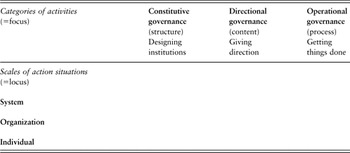
Taking their lead from Kiser and Ostrom's (Reference Kiser and Ostrom1982) ‘Three worlds of action’, Hill and Hupe distinguish a structure, content, and process dimensions of the concept of governance as a focus. Each of these dimensions refers to a broad set of related activities. These sets concern institutional design, giving direction, and getting things done. Respectively, Hill and Hupe (Reference Hill and Hupe2009: 123–127) speak of constitutive, directional, and operational governance, together called the trias gubernandi or ‘trinity of governing’. Differently from the traditional ‘stages model’ of the policy process, each of these activity clusters can be observed at any administrative layer. Both the number of acting actors and potential action situations can be thought of as infinite. Categorizing the scales of action situations Hill and Hupe speak in a summarizing way of three loci in political–societal relations: the locus of the system, that of the organization, and the locus of the individual. In fact, the vertical stages view on the policy process is thus replaced by a multi-dimensional framework. It conceptualizes the policy process as multiple governance (as set out in Table 1).

In this conceptualization, governance is essentially both ‘mixed-focus’ and ‘multi-local’. It entails different sets of activities as focuses: giving direction (cf. the stage of policy formation), but also managing activities (cf. the stage of implementation) and even designing institutions. Each of these activity sets can take various forms according to the specific action situations (locus) in which they take place. What then may be the consequences in terms of rethinking democracy?
Democracy as multi-local accountability
When the normative principles of the Rechtsstaat and democracy remain valid, but public power is being exercised with more or less legitimacy at many locations in the public domain, there is a need to reflect on the consequences of that situation for the institutional position of democracy. In the previous section, we argued that the collectivist tradition of democracy lies at the basis of the multiple hierarchies entailing the prevalence of the will of the people, the primacy of politics, and the primacy of the governing centre. Three strategies addressing the dual problem of legitimacy and accountability were pictured. Of the three, the last in particular can be related to the perspective on governance presented here. Aimed at institutionalizing direct accountability, the strategy expresses features of the liberal tradition of democracy. In this tradition, the function of the state is largely to protect and regulate the freedom and self-determination of individuals and groups (Sabine, Reference Sabine1952).
Then at the system scale, for instance, professional associations can be seen as direct countervailing powers – an essential institutional feature of a liberal conception of democracy. This certainly seems the case when such associations not only function in the traditional professions like those of medical doctors and lawyers, but also in those of street-level bureaucrats like police officers and social workers. Making an impact at various scales, such associations create institutional settings in which accountability is practiced. At the aggregated scale of professions the formulation of codes of conduct, certification procedures, citizens’ charters, appeal procedures, etc. can be addressed as structure-oriented activities of governance taking place with consequences for systems (of medicine, policing, social work, etc.) as a whole. At the scale of individual practice, such institutional arrangements give guidance to members of the profession involved. Professional norms give direction to, and sometimes restrain the random behaviour of, single practitioners. At that same scale of the shop floor peers and co-workers may make alternative judgements, while in direct contacts with citizens, the latter as patients, clients, and other similar roles express their rights. Both peers and citizens function as checks on the unlimited exercise of power.
In a different locus, organized users, customers, clients, or other direct stakeholders can be seen as institutions functioning as checks on the exercise of power as well. For instance, councils of parents at a school, of clients of social services around a Municipal Social Services Department, of tenants around a housing association – they can and do hold public organizations accountable for the way the latter practice public service delivery (directional governance). At this scale, organization-bound complaint procedures can, for example, be localized (constitutive governance). When citizens organized around specific public organizations take part in practical work (cf. parents helping pupils with reading in the classroom), they in fact become co-producers in public service delivery (operational governance). Institutional ‘democratic devices’ like the ones mentioned here actually deal with the accountability problem stated above.
These examples highlight the fact that around the various dimensions of governance, practised as it is in specified action situations, horizontal checks are at work that have a restraining effect on the random use of public executive power. Functional participation may provide legitimacy and enhance accountability. When people do have more opportunities to see what is happening for the common good and can react (accountability), they may be more prepared to give their support (legitimacy).
Given the prevalence of the multiple hierarchies stemming from a collectivist tradition of thought, we are not used to calling such functional, task-bound, checks ‘democracy’. Indeed, it is obvious that these mechanisms cannot be traced to a singular democratic institution. What is at stake is rather what Behn (Reference Behn2001) calls a ‘360-degree accountability for performance’ (Chapter 11), which he pleads to organize around ‘charter agencies’ (Chapter 10). At the same time, such mechanisms seem to fulfil functions similar to those representative democracy was once said to fulfil in the singular hierarchical relationships of earlier days. If modern citizens are recognized in the various roles they are, at different scales, actually fulfilling, this makes the way public power is being exercised more visible. Decision-making in a specific case becomes apparent, including the weighing up of interests that take place. Most important, the decision-makers involved can be held accountable, and often are, in one way or another.
Conclusion
In this article we have analyzed the relationship between governance and democracy. We deemed such an analysis necessary because of the impact of contemporary phenomena perceived as, more or less, universal. Under the heading of modern governing the relocation of power attracted attention, pointing to ways of governing beyond hierarchical steering, jointly addressed as governance. Socio-cultural developments in the transnational context were also characterized. We identified an emerging variety of action spots (de-centering), the relevance of a plurality of self-conscious actors (autonomization) and a diversification of sense-giving activities (multi-sourced sense-making).
In the third section we explored the nature of the problem in more depth. The discourse of a ‘democratic deficit’ may refer particularly to a legitimacy problem, but there is also an accountability problem. The first concerns the relation between society and government; the latter concerns the relation between government and performance. While government is normatively expected to bring about desired results on behalf of the people, several connections in the range of statist, multiple hierarchies have become thinner. On the input side, citizens and their political representatives have difficulty in finding each other. In the relationship between society and government, the legitimacy problem refers to insufficient support from citizens for public actions; there is representation-without-corresponding-participation. On the output, outcome, and throughput sides, a variety of stakeholders have become involved instead of just central government. In the relationship between government and performance the accountability problem refers to the lack of visibility of what public actors do and why they do it; power is exercised without corresponding representation.
Several strategies were explored, including that of a move towards associative democracy as addressed by Hirst (Reference Hirst1994). Then, in the penultimate section, it was shown that it is possible to rethink democracy in terms of Hill and Hupe's (Reference Hill and Hupe2009) conceptualization of governance. Thinking through the various locus/focus combinations in their analytical framework enables the specification of the ways in which the exercise of public power is matched by checks. In particular cases, some of these checks are already practised, while in other situations the conceptualization may function as a heuristic device making existing mechanisms explicit.
On the normative basis of the principles of the Rechtsstaat and democracy itself it appears feasible to reflect on the consequences of the shift ‘from government to governance’. This shift, obviously a claim, can be made productive when democracy is conceived in ways corresponding with the multi-dimensional and mixed-focal character of governance. That is to say: democracy can be conceived as multi-local, with functional participation providing legitimacy and enabling accountability as giving and asking considerations for one's actions. Rethinking democracy as multi-local accountability then means the acknowledgement of the empirical fact that in certain sets of activities of governance often more participants are involved than expected in the normative assumptions of a singular hierarchy. This is different to what may be presumed in the normative view on representative democracy. It implies that the probability that many contemporary citizens will get involved politically, in the narrow sense, remains low. However, this is not necessarily a problem. Co-direction on the formal layers of government has alternatives, particularly insofar as the action level of constitutive governance is concerned. Schudson's (Reference Schudson1998) notion of monitorial citizenship is relevant here. Functional participation may be helpful, while it is not least the possibility of intervention that becomes important. Although information and communication technology is not a panacea here, it can reveal opportunities previously unavailable.
Making the variety of actors, action levels, action situations, and administrative layers visible in specified contexts can be seen as a precondition, not in the least for governance research. New possibilities for holding public actors accountable may be detected. As far as accountability is concerned, these possibilities are no longer exclusively located in the traditional centres of representative democracy. Public accountability can be approached as de-centered. Conceiving of governance as mixed-focus has implications. It means in particular that the participation of citizens goes beyond voting and entails both extending the range of parties involved and deepening this involvement in processes of public decision-making. The institutional design of democratic arrangements implies various spots in which governance is practised. It is this variety that enables citizens and other non-permanently involved actors to engage in the making of decisions in the public domain. In these modern times, citizens will do so not only on the day of election, but also at the places and moments they deem most functional.
Acknowledgements
The authors thank Gerard Breeman, Kris Deschouwer, Michael Hill, and two anonymous reviewers of this journal for their suggestions on an earlier version of this article.