Introduction
Children and adolescents with persistent externalizing behaviours (i.e. aggressive and rule-breaking behaviour) are at increased risk for deviant outcomes when they reach adulthood, including delinquency and psychopathology. This risk may arise from the sheer persistence of these problems evolving into problems of conduct and personality typical for older ages, such as delinquent acts, antisocial personality disorder or substance use. However, the long-term consequences of child and adolescent externalizing behaviours often involve a much wider spectrum of social maladaptation in adult life, such as difficulties with maintaining relationships and holding down jobs (e.g. Sroufe, Reference Sroufe and Cicchetti1989; Capaldi & Stoolmiller, Reference Capaldi and Stoolmiller1999; Moffitt et al. Reference Moffitt, Caspi, Harrington and Milne2002; Fergusson et al. Reference Fergusson, Horwood and Ridder2005). We are interested in the long-term continuity of externalizing behaviour with regard to social functioning and the dependences of this relationship on the course, severity and type of antisocial behaviour. Cicchetti & Schneider-Rosen (Reference Cicchetti, Schneider-Rosen and Read1986) argued that successful development involves a series of interlocking social, emotional and cognitive competencies during childhood and adolescence. Externalizing behaviours interfere with the development of these competencies, causing a chain reaction of failures in adjustment that may continue into adulthood (Patterson & Yoerger, Reference Patterson, Yoerger and Hodgins1993). Lack of opportunity to acquire prosocial skills may be especially prominent in those children and adolescents who show persistent externalizing behaviours. Persistent externalizing behaviours may thus provide an accentuating effect that further reinforces and perpetuates pre-existing behavioural deviance leading to an increased risk of impaired social functioning in adulthood (Moffitt et al. Reference Moffitt, Caspi, Rutter and Silva2001).
Longitudinal studies have emphasized the heterogeneity in the developmental course of externalizing behaviours and of individuals who engage in these behaviours. Apart from externalizing behaviours that persist through childhood and adolescence into adulthood, individuals may start to display problem behaviours from puberty onwards that are limited in time to adolescence (Moffitt, Reference Moffitt1993; Patterson & Yoerger, Reference Patterson, Yoerger and Hodgins1993). Individuals displaying this so-called adolescence-limited behaviour pattern are probably exempted from cumulative continuity because they generally show better academic achievements, and keep the capacity to engage in close relationships (Moffitt, Reference Moffitt1993). Therefore, individuals with externalizing behaviours that are limited to adolescence may be less seriously afflicted with social impairment in adulthood than individuals with persistent externalizing behaviours throughout childhood and adolescence (Moffitt et al. Reference Moffitt, Caspi, Harrington and Milne2002).
Several studies provide evidence for negative social outcomes in adulthood for children and adolescents with externalizing behaviour. However, the long-term continuity of externalizing behaviours is dependent not only on the developmental course but also on the type of externalizing behaviour. For instance, high levels of delinquent behaviour in adolescence appeared to be associated with school drop-out, alcohol and drug use and high levels of aggressive behaviour in adolescence predicted school drop-out (Achenbach et al. Reference Achenbach, Howell, McConaughy and Stanger1998). Capaldi & Stoolmiller (Reference Capaldi and Stoolmiller1999) reported that conduct problems in males predicted a number of failures in the two years following senior high school, including failure to graduate from high school, enter higher education, attain and keep employment, and keep a driver's licence, along with early fatherhood. Aggressive behaviour may also be most persistent in children with neurological abnormalities (cf. Quay, Reference Quay1993), and therefore more related to poor job performance, whereas oppositional behaviour may constitute a greater risk for establishing intimate relationships. Status violations, including alcohol and drug use, and property violations, including stealing and vandalism, are associated with alcohol-related problems in young adulthood for both males and females (Duncan et al. Reference Duncan, Alpert, Duncan and Hops1997).
Social outcomes of child and adolescent problems may be very different for males and females. Males, more often than females, have behaviour problems that start early in life and are associated with neurodevelopmental impairment. These problems often lead to failure in school (Moffitt et al. Reference Moffitt, Caspi, Rutter and Silva2001). In addition, females, more often than males, have behaviour problems that are related to relationships with others, such as social and relational aggression (Crick & Zahn-Waxler, Reference Crick and Zahn-Waxler2003). We therefore expect that females with persistent externalizing behaviour in childhood are more likely to have difficulties with relationships in adulthood.
A few studies have reported different outcomes of similar behaviours in males and females. A study by Caspi et al. (Reference Caspi, Elder and Bem1987) showed that boys showing temper tantrums from ages 8–10 years experienced downward occupational mobility, erratic work lives, and greater likelihood of divorce in the subsequent 30 years, whereas girls with temper tantrums during the same age period married men with lower occupational status, were likely to divorce, and became ill-tempered mothers later in their lives. In the Dunedin study (Moffitt et al. Reference Moffitt, Caspi, Rutter and Silva2001), conduct-disordered males had significantly worse outcomes than conduct-disordered females in the domains of work, criminal justice and substance abuse. By contrast, conduct-disordered females had worse outcomes than conduct-disordered males in the domains of relationship with a partner, and in depression and physical health.
These studies provide evidence of long-term negative consequences in social functioning for children and adolescents with externalizing behaviour as well as possible gender effects on these consequences. However, most studies related externalizing behaviour at one point in time to social functioning many years later, indicating that the level of externalizing problems is related to adverse social outcomes. These studies did not investigate the impact of developmental trajectories or different types of externalizing behaviour on later social functioning. However, this information is needed because the association of earlier externalizing behaviour problems with social outcomes may depend on the onset and course as well as the type of these behaviours. To relate social outcomes to developmental continuity and change in problem behaviours, multiple assessments across the interval are needed. Because externalizing behaviours change considerably in both expression and frequency over the course of development, studies at any time in development can provide only limited information or may misrepresent the phenomenon (Kramer et al. Reference Kraemer, Yesavage, Taylor and Kupfer2000). Therefore, there is growing agreement that externalizing behaviour should be studied from a developmental perspective (Costello & Angold, Reference Costello, Angold, Sameroff and Lewis2000). Based on the ideas of developmental chaining and accentuation, we might expect stronger negative effects of trajectories of persistent problems starting in childhood versus trajectories involving adolescent onset or desistance from deviancy. In addition, different types of externalizing problems may lead to different social outcomes.
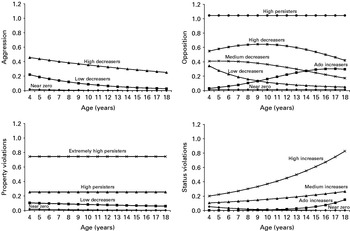
The present study aimed is to determine the associations between developmental trajectories of externalizing behaviours in childhood and social functioning in adulthood in a 14-year longitudinal study in the Dutch general population. We addressed the predictive value of child and adolescent developmental trajectories of four types of externalizing behaviours (Fig. 1), namely aggression (e.g. bullying), opposition (e.g. disobedient), property violations (e.g. steals) and status violations (e.g. use of alcohol or drugs) (cf. Frick et al. Reference Frick, Lahey, Loeber, Tannenbaum, Van Horn, Christ, Hart and Hanson1993), with regard to young adult educational and occupational outcome, social relationship, and substance use. We derived the following three hypotheses from the existing literature on developmental continuity and gender differences of externalizing behaviours. First, individuals with high levels of externalizing behaviours (i.e. aggression, opposition, property violations or status violations) have the highest risk of social impairment. Second, individuals with increasing levels of externalizing behaviours in adolescence (i.e. opposition or status violations) have more social impairment than individuals with low levels of externalizing behaviours, but less social impairment than individuals with high levels of externalizing behaviours. Third, males with high-level or adolescent-onset trajectories were expected to be at risk for work-related social impairment in contrast to females on the same developmental trajectory, who were expected to be at risk for personal-related and family-related social impairment.
Group-based developmental trajectories of aggression, opposition, property violations, and status violations. The y axis represents the raw syndrome scores. (From Bongers et al. Reference Bongers, Koot, van der Ende and Verhulst2004; reprinted with permission of Blackwell Publishing.)

Method
Sample
This study is part an ongoing longitudinal study of behavioural and emotional problems that began in 1983. Parents of child participants were interviewed at 2-year intervals until 1991 and the participants themselves were interviewed in 1997 when they were 18–30 years old. The original sample, involving 2600 children aged 4–16 years, was drawn from municipal registers that list all residents in the Dutch province of Zuid-Holland. The province of Zuid-Holland encompasses more than 3.2 million inhabitants (20% of the Dutch population) in environments ranging from rural to highly urbanized. A random sample was drawn of 100 children of each gender and age and with Dutch nationality. Of the 2447 parents who could be reached, 2076 (84.8%) responded and provided usable Child Behaviour Checklists (CBCL; Achenbach & Rescorla, Reference Achenbach and Rescorla2001). The original 1983 sample included 1016 boys and 1060 girls. Of all participants in the original sample who could be reached in the 1997 wave, 1615 provided complete information (77.8% of the 1983 sample; response rate corrected for deceased participants, individuals with intellectual disability, and participants who had emigrated). To investigate selective attrition, we compared drop-outs and remainders with respect to their 1983 CBCL total problems scores and internalizing and externalizing scale scores. An ANCOVA with age and gender as covariates showed that the participants for whom no outcome questionnaire was available in 1997 did not differ significantly from those with an outcome questionnaire available on the CBCL total problems score, internalizing and externalizing CBCL scales in 1983. In addition, drop-out was not dependent on the developmental trajectory of externalizing behaviours.
Measurements
From 1983 to 1991 the CBCL was used to obtain standardized parent reports of children's problem behaviours. The CBCL is a questionnaire to be completed by parents of 4- to 18-year-olds and contains 120 items covering behavioural or emotional problems that occurred during the past 6 months. The response format is 0 (not true), 1 (somewhat or sometimes true), and 2 (very true or often true). Good reliability and validity of the CBCL have been reported for the Dutch translation (Verhulst et al. Reference Verhulst, van der Ende and Koot1996).
The items of the CBCL were used to score four distinct factors of externalizing behaviour that were first specified by Frick et al. (Reference Frick, Lahey, Loeber, Tannenbaum, Van Horn, Christ, Hart and Hanson1993) : aggression (e.g. bullying), opposition (e.g. disobedient), property violations (e.g. steals), and status violations (e.g. use of alcohol or drugs). Confirmatory factor analyses showed a good fit of these behaviour factors to the longitudinal data set [the average goodness-of-fit index (GFI) across 1983–1991 was 0.92 for males and 0.96 for females; Bongers et al. Reference Bongers, Koot, van der Ende and Verhulst2004].
Trajectories of externalizing behaviours
In a previous study (Bongers et al. Reference Bongers, Koot, van der Ende and Verhulst2004, see Fig. 1) we identified for all four factors of externalizing behaviour developmental trajectories for ages 4–18 years using a semi-parametric mixture model (Nagin, Reference Nagin1999). The developmental trajectories were based on 6932 observations that were collected in the first five waves of the study. There was no effect of attrition on the observations and there was no effect of attrition on the classification in the developmental trajectories.
The semi-parametric mixture model is well suited for analysing within-subject-level developmental trends. This semi-parametric mixture model allows for cross-group differences in the shape of the developmental trajectories. Within each behaviour factor, the optimal number of groups with different developmental trajectories are estimated and selected using the Bayesian information criterion (Nagin, Reference Nagin1999). Model estimation produces two key outputs: parameter estimates that demarcate the shape of the trajectories across time (Bongers et al. Reference Bongers, Koot, van der Ende and Verhulst2004) and posterior probabilities of group membership for each individual in the sample for each of the trajectories. Using these probabilities, each child was designated the trajectory of each factor that best described their individual developmental trajectory, that is the largest probability for each individual indicated the trajectory that best conformed to that individual's behaviour over time. The child's classifications for the four different externalizing behaviours were used in further analyses. Therefore, each child could be classified at the same time in, for example, a high-level trajectory for aggression and a low-level (near-zero) trajectory for opposition. There were no age effects in the assignment of the individuals to the trajectories, indicating that there were equal amounts of younger and older children classified in each trajectory. There were also no cohort effects in the developmental trajectories and there were no significant differences between trajectories based on younger children and on the total sample of younger and older children.
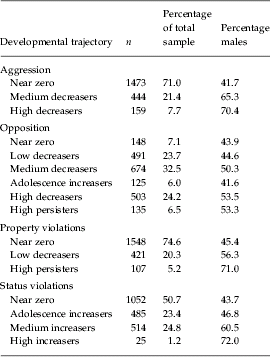
We found three trajectories for aggression, four different trajectories for status violations and property violations and six different trajectories for opposition (see Fig. 1). Because the extremely high persisters within property violations comprised only six males and females, we combined these participants with the high persisters within property violation for further analysis (see Bongers et al. Reference Bongers, Koot, van der Ende and Verhulst2004 for a description of the trajectories). The numbers of males and females in each trajectory are given in Table 1. Within each of the four behaviours we found a large group of individuals who followed a developmental trajectory on a low level, indicating that most individuals exhibited a few externalizing behaviours as reported by their parents. In this sample, 275 males and females were assigned to one or more of the high-level trajectories (64% to only one high-level trajectory, 22% to two high-level trajectories, 11% to three high-level trajectories, and 4% to four high-level trajectories). The most common high-level trajectory among these children was the high-level trajectory within aggression; six times more children follow this trajectory than the least common high-level trajectory (status violations).
Number of participants in the developmental trajectories
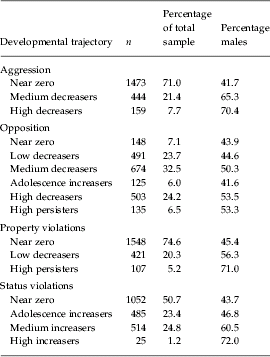
There were no differences in completion of social outcomes and functioning questionnaires between the developmental trajectories of each externalizing behaviour factor, p value of the χ2 test ranging from 0.22 to 0.67.
Social functioning
To obtain information on social outcomes in young adulthood we used a questionnaire including the following: (a) educational level, ranging from only primary school=1 to postgraduate education=7; (b) currently employed or studying (not working or studying=0; working or studying=1); (c) job level, ranging from occupations requiring no education necessary=1 to occupations requiring postgraduate education=5; (d) number of job changes in the past 2 years; (e) expulsion from school or job ever (not expelled=0, expelled=1); (f) number of different romantic partners in the past 2 years; (g) number of days drunk in the past 6 months; (h) number of times using drugs (e.g. marijuana, cocaine, glue) in the past 6 months; (i) suicide attempt ever (no attempt=0, attempt=1).
Current social functioning was assessed with the Groningen Questionnaire on Social Behaviour (GQSB; De Jong & Van der Lubbe, Reference De Jong and Van der Lubbe1994). The GQSB contains 115 items that are organized in 10 subscales covering different areas of social functioning. The young adults reported on social functioning in three domains: (1) intimate relationships; this scale describes the emotional commitment between individuals and their parents, partners and friends and the amount of time they spent on the relationships; (2) daily activities, which describes the functioning of the individuals in a daily routine, such as study, jobs and household, and their performances within these daily activities; and (3) spare time activities, which describe how the individuals experience the quality of their spare time activities. Participants were asked to indicate whether items were applicable to their situation within the past 4 weeks. Each item had four response options, ranging from never to always. By summing the item scores, a total score for each subscale was derived. Higher scores represent more problems in social functioning. Good reliability and validity of the GQSB have been reported for ages 18–65 years (De Jong & Van der Lubbe, Reference De Jong and Van der Lubbe1994). The GQSB has been shown to assess problems in social functioning in a valid way independent of potential psychopathology in the respondent. Test–retest correlations and internal consistency measures indicated adequate reliability (test–retest correlations ranged from 0.65 to 0.97, Cronbach's α from 0.62 to 0.89) (De Jong & Van der Lubbe, Reference De Jong and Van der Lubbe1994).
Not all scales of social functioning apply to all participants. For instance, participants who had never had a romantic partner could not indicate the number of romantic partners. However, in all cases the number of participants that could answer the question was sufficient, ranging from 823 (number of different romantic partners) to 1612 (intimate relationships, including parents).
Statistical analysis
We used multiple linear regression for continuous variables and multiple logistic regression for dichotomous dependent variables to determine associations between social functioning in adulthood and trajectories of externalizing behaviour. The associations were adjusted for the effect of gender (males=1, females=0), age, and socio-economic status of the parents in 1983. We conducted two analyses, one in which the near-zero trajectories of externalizing behaviour were used as a reference group, and another in which the adolescence increasers trajectories within opposition and status violations were used as a reference group. The second analysis indicates whether the adolescence increasers are at lower risk for negative social outcome and functioning than individuals on other developmental trajectories. Both analyses were conducted in a stepwise manner. In the first block we added the demographic variables gender, age and socio-economic status. In the second block we added the trajectories of externalizing behaviour. In the third block we added the interactions between gender and the trajectories. We reported the R 2 change in the blocks and we only reported the β values from the block that significantly improved the explained variance of the model. For the dichotomized variables we reported the Nagelkerke R 2 and the χ2 test of the model. We reported only the odds ratios for the block that improved the model.
Predictor variables were tested for collinearity using a tolerance criterion of 0.10. There was no evidence of multi-collinearity among the predictor variables. To adjust for multiple testing we used Bonferroni adjustments. We set the α-level at 0.05 and the number of tests was 16, so the adjusted α-level was set at 0.003. The analyses were performed using SPSS version 11.5 (SPSS Inc., Chicago, IL, USA).
Results
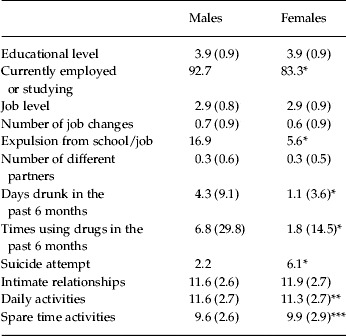
Table 2 presents the mean scores of the social functioning variables. For seven out of 12 variables there were significant, but with small effect sizes, gender differences in social functioning, including daily activities, currently employed or studying, being expelled from school or job, the number of days drunk in the past 6 months, and the number of times using drugs in the past 6 months, which were scored higher for males than females, and spare time activities and attempted suicide were scored higher in females than males.
Social outcome and social functioning measures for males and females

Values are % or mean (standard error).
p value t test or χ2 test for gender differences.
* p<0.001, ** p<0.01, *** p<0.05.
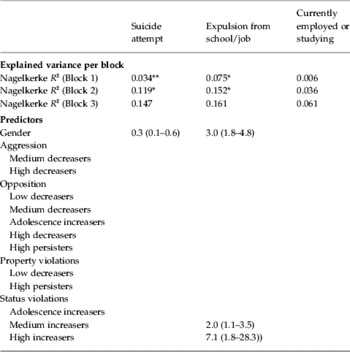
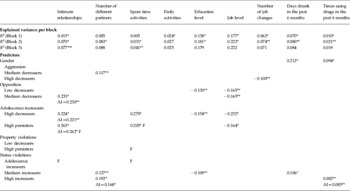
Tables 3 and 4 give the odds ratios and β values of significant associations between trajectories and social functioning measures. These indicate the contribution of each trajectory to the young adult outcomes, independent of the influence of other trajectories. The multiple linear regression and logistic regression analyses indicated that variation in most of the social functioning measures were explained by differences in developmental trajectories of opposition and status violation, while differences in developmental trajectories of aggression contributed to the prediction of only two variables, the number of different partners and the number of job changes. Developmental trajectories of property violations showed no unique association with social functioning in young adulthood (see Tables 3 and 4). None of the social functioning measures were related to all high-level trajectories, indicating that different externalizing behaviours do indeed incur different risks for young adult social outcome and functioning.
Associations between developmental trajectories of child and adolescent externalizing problems and social outcomes and social functioning in young adulthood

Significant odds ratios (with 95% confidence intervals), adjusted for age and socio-economic status, of the logistic regressions with the near-zero developmental trajectory as a reference category are reported (p<0.01).
* p<0.001, ** p<0.01.
Associations between developmental trajectories of child and adolescent externalizing problems and social outcomes and social functioning in young adulthood

Significant β values, adjusted for age and socio-economic status, of the linear regressions with the near-zero developmental trajectory as the reference category are reported (p<0.01).
Females (F) within the developmental trajectory reported significantly more social problems than the males within the developmental trajectory. AI indicates significant β values, adjusted for gender, age and socio-economic status, of the linear regressions with adolescence increasers within opposition and status violations as the reference category.
* p<0.001, ** p<0.003, *** p<0.05.
Overall, higher-level trajectories of opposition were associated with lower educational and job levels, and poorer functioning in intimate relationships and spare time activities. The higher-level trajectories of status violations were related to expulsion from school or work, number of different partners, educational level, and alcohol and drug abuse.
The high-level trajectories of status violations (high increasers) and opposition (high persisters) were significantly more strongly related to many of the social functioning measures than the trajectories that indicated less deviant externalizing behaviour, confirming our first hypothesis.
Confirming our hypothesis about increasing level trajectories, the two adolescence increasing trajectories (adolescence increasers of opposition and status violations) were less likely to be associated with undesirable young adult social functioning than the higher-level trajectories of the same factors (high persisters and high decreasers of opposition, and high increasers and medium increasers of status violations) (indicated by AI in Table 4).
Overall, when adjusted for externalizing behaviours, males reported more often than females alcohol and drugs abuse, as well as more often impairment in their daily activities and more often being expelled from school or job. However, females reported suicidal behaviour more often than males (Tables 3 and 4). Females on the high persisters trajectory of opposition or adolescence increasers trajectory of status violations were more likely to report problems with their spare time activities and intimate relationships than males on the same trajectory. In addition, females on the high persisters trajectory of property violations reported trajectory impaired functioning in their spare time more often than males.
Discussion
The objectives of this study were to test the predictive link between childhood trajectories of several types of externalizing behaviour and a range of social maladaptation in adult life. In congruence with our hypotheses we found that the more severe the externalizing behaviours were, the more severe was the social impairment in young adulthood. Furthermore, individuals with the highest level of externalizing behaviour had a larger risk for developing social impairment in young adulthood than individuals with externalizing behaviours that showed an onset of problems in adolescence. In contrast to what we had expected, we did not find that males with high-level trajectories of externalizing behaviour were more likely than females to have problems related to work. Females with high levels of externalizing behaviours had a higher risk of developing problems related to intimate relationships than males.
In agreement with the findings of previous studies (Caspi et al. Reference Caspi, Elder and Bem1987; Zoccolillo et al. Reference Zoccolillo, Pickles, Quinton and Rutter1992), this study showed that individuals with persistent externalizing behaviours in childhood and adolescence were at increased risk of social problems in young adulthood. Moreover, we found different predictive links for different externalizing behaviours. Individuals who followed trajectories with high levels of parent-reported opposition and status violations in childhood were most likely to report impairment on various indices of problems with social functioning as adults. By contrast, the results showed almost no unique predictions from trajectories of aggression and property violations to adult social functioning. This suggests that individuals who followed a high-level trajectory of aggression or property violations, apart from opposition or status violations, are not at particularly increased risk for impaired social functioning once they have reached young adulthood. We only found a link between aggression and impaired social functioning when aggression was combined with other high-level externalizing trajectories. Aggressiveness might be thought to be the behavioural feature most likely to predict externalizing behaviour, if only because delinquent activity and antisocial personality disorder frequently have an aggressive component. Nevertheless, although aggression is undoubtedly associated with externalizing behaviour, surprisingly little is known regarding its role in the developmental processes leading to such behaviour. Magnusson & Bergman (Reference Magnusson, Bergman and Rutter1990) found that aggressiveness was associated with crime only when part of a constellation of problem behaviours, suggesting that it is necessary to consider behaviour in terms of overall patterns and not only of supposedly separate traits.
The results from this study also suggest that high-level trajectories of opposition versus status violations are related to different forms of social impairment in adulthood. While individuals following high-level trajectories of opposition seem to be at risk for low achievement, problematic social interactions, and intimate relationships, individuals with high-level trajectories of status violations were most likely to use alcohol and drugs, be expelled from school, and have low educational attainment. Interestingly, they had no impaired social relationships.
Thus, although both high-level trajectories of opposition and status violations were related to impaired functioning in multiple domains of adult life, the types of functional impairment seem to differ, possibly reflecting the adult versions of typical behaviours included in these child/adolescent behavioural factors. This confirms the finding from Moffitt et al. (Reference Moffitt, Caspi, Harrington and Milne2002) that life-course persisters have more durable than changeable problems in their behaviour and their reaction to their environment. It seems that externalizing behaviours that are harmful for the individual themselves, such as status violations and opposition, have more severe long-term consequences than externalizing behaviours that have direct consequences for the society or environment of the individual (aggression and property violations). Because of these unexpected patterns within externalizing behaviours, further studies must emphasize the developmental continuities within externalizing behaviours and the links between different types of externalizing behaviours and adverse outcomes such as social impairment in young adulthood. Furthermore, we expected that both property and status violations were related to alcohol and drug use in young adulthood. However, only status violations was related to alcohol and drug use in young adulthood. We concluded that high-level property and status violations are both derived from the same socially deviant lifestyle (Duncan et al. Reference Duncan, Alpert, Duncan and Hops1997). However, the use of drugs and alcohol did make the continuation in adverse lifestyle more likely and did predispose to educational problems and to a broader pattern of social difficulties, while stealing (property violations) had no unique association with social functioning measures in young adulthood.
We expected that individuals with adolescence increasing externalizing behaviours would have better outcomes in all domains of social functioning than individuals with high-level problems (Roisman et al. Reference Roisman, Aguilar and Egeland2004). Indeed, young adults who showed adolescence-onset problems reported overall less impaired social functioning than individuals with high-level externalizing behaviours starting in childhood. This fits well in the theoretical frameworks of Moffitt (Reference Moffitt1993), who hypothesized that the more persistent, or early starting, a pathways is, the more difficult it is to reclaim a normal developmental pathway (Sroufe, Reference Sroufe and Cicchetti1989; Moffitt, Reference Moffitt1993). This suggests that the most important factors in increasing the risk of impaired social functioning are the occurrence of problem behaviour in childhood and the type of externalizing behaviour.
Contrary to our expectation, males with high-level externalizing behaviours were not more likely than females with high-level externalizing behaviours to report problems in the domains of work and substance abuse, although males reported overall more substance abuse and problems at work and school than females. The similarity of the negative effects of trajectories on later social functioning for both males and females was striking, and in congruence with earlier studies (Fergusson et al. Reference Fergusson, Horwood and Ridder2005). Only two interactions between trajectory and gender were significant, both indicating that females with the adolescence increasers trajectory of status violations were more impaired in intimate relationships and spare time activities than males in the same trajectory.
Besides the differences and similarities in continuity for males and females, the present findings suggest a gender paradox with regard to externalizing developmental trajectories. Although females in general have fewer externalizing behaviours than males, females with high-level trajectories were even more at risk for impairment in social relationships in young adulthood than males.
Strengths and limitations
Although the present study has various advantages in contrast to other studies, it is not without limitations. First, the central goal of the current study was to examine the relationship between child and adolescent externalizing behaviours and young adult social functioning. Earlier studies looked at this relationship by predicting adult functioning from childhood functioning measured at one point in time. However, using a representative general population sample that included multiple cohorts of males and females aged 4–18 years and six assessment time periods, the present study extended existing knowledge by determining the developmental relationships between trajectories of externalizing behaviour across childhood and adolescence and social functioning in young adulthood. Although the externalizing behaviour and social functioning measures are gathered in six waves across 14 years, there is no selective attrition for participants with severe behaviour problems. However, a limitation of our sample could be that the study population was a random sample of mainly Caucasian children and adolescents living in The Netherlands. It is uncertain to what extent cultural differences may be responsible for differences in the course of problem behaviour and their predictive link to adult behaviour.
A second advantage of the present study is that we distinguished four types of externalizing behaviour instead of combining together different types in one broad measure, because combining these behaviours may hamper the study of the developmental meaning of distinguishable types of externalizing behaviour (Nagin & Tremblay, Reference Nagin and Tremblay1999; Tremblay, Reference Tremblay2000). In addition, whereas existing studies looked predominantly at the development of externalizing behaviours in males, the present study investigated gender differences in the developmental continuity of externalizing behaviours to social functioning in adulthood.
A limitation of this study is the reliance on only parental reports to assess child and adolescent problem behaviour. Parents may be unaware of their child's rule-breaking behaviour and offences, especially as their child becomes an adolescent (Moffitt et al. Reference Moffitt, Caspi, Dickson, Silva and Stanton1996). Therefore, replications are essential to assess the generalizability of the present findings to other informants such as teachers and youths themselves. However, these parent reports of problem behaviour did predict independent young adults' reports of social functioning, which attests to their validity. Studies indicate that parents are well aware of problematic externalizing behaviour of children and adolescents but seem to be less aware of less problematic externalizing behaviours (Achenbach et al. Reference Achenbach, McConaughy and Howell1987).
Implications and further research
In general, the results of this study suggest a relationship between childhood and adolescent externalizing behaviours and adult social functioning: the more severe these externalizing behaviours, the more social functioning was impaired. These findings clearly suggest the importance of addressing mild to moderate levels of conduct problems in males and females. There is clearly a need for greater recognition of the fact that females are also at risk for externalizing behaviours, and that these difficulties are likely to have a pervasive impact on their adult life. The exploratory nature of the study encourages the need for replication of the findings in other samples.
The present study indicates that there are important patterns of risk involved in pathways of non-aggressive externalizing behaviours as well. For instance, high-level trajectories of opposition and status violations carry considerable risk for social impairment, while high-level trajectories of property violations and aggression showed no independent contribution to the prediction of poor adult social functioning. This suggests that, in the long run, children displaying opposition and status violations are following pathways that involve even more risk for social impairment than those displaying overt aggression.
Individuals with childhood opposition and status violations are at substantial risk for serious social problems during the transition from childhood to adulthood that may persist into their future. Our results clearly suggest the relevance of the prevention of childhood externalizing problems as a means of preventing undesirable social outcomes in adulthood. Therefore, longitudinal screening of children's and adolescents' externalizing problems may be a valuable tool in the early identification of those who are at increased risk of social impairment once they have reached young adulthood. In addition, the present study indicates that children with high levels of externalizing trajectories have poorer social skills in adulthood, and lower educational functioning. These social-cognitive outcomes not only are a consequence of the externalizing behaviour but also contribute to the development of the externalizing problem behaviour. These findings clearly suggest that potential targets for preventive interventions should be aimed at the amelioration of social-cognitive, academic and peer social skills.
Acknowledgements
This research project was supported by Sophia Scientific Foundation grant no. 302.
Declaration of Interest
None.