Introduction
Students in the United States received visual literacy training throughout primary and secondary school. They subconsciously dissect visual information daily through social media, advertisements, and other visual sources.
Studies have demonstrated the importance of engaging students in the learning process because it increases their attention and focus, motivates them to study, and practice higher order thinking skills.Footnote 1
The idea to create a visual literacy Open Education Resource (referred to as OER from this point on) grew out of the results of a student visual literacy study that the author conducted spanning four regular semesters (Fall and Spring, 2017–2018). The purpose of the study was to measure the visual literacy competency of enrolled students, to then provide effective support for improvement of these skills. In all, the survey resulted in 700+ responses. This data, in addition to the author's experiences when conducting student consultations, aid in the planning process for the pilot OER.
In the survey students were asked to analyse a work of art, the Roman mosaic, The Battle of Darius and Xerxes. The survey was comprised of five separate sections. The questions were a mix of 16 multiple-choice, yes/no, and short answer questions about the mosaic and the Library's Art and Art History research guide. The results revealed that students had good visual literacy skills, but they needed detailed prompts or instructions to tap into those skills.
The purpose of the visual literacy tool is to help lessen and eventually alleviate the students’ need for these prompts. By practicing with the OER tool, which will be comprised of activities that provide fewer, less-detailed instructions, students will eventually be able to conduct a visual analysis with little or no assistance.
Creating a Tool Rather than a Textbook
Instructors and librarians have created thousands of information literacy tools. The difficulty is that many of these are kindergarten through high school focused and most are proprietary, that is if an individual is not a student/employee of the institution hosting the tool, they may not have access to the tool. By creating a visual literacy tool that is truly open access, any educator can freely adapt it to their students’ specific needs.
Most OER resources come in the form of textbooks. This is not surprising, given the rising costs and high demand for open texts. However, a textbook would not meet the specific needs of a student who just wants to improve their visual literacy skills. A textbook would naturally be text based, whereas this OER would be constructed entirely of H5P activities, with minimal written content.
For those unfamiliar with H5P, it is the abbreviation for HTML5 Package. H5P is defined as:
… an open-source authoring tool used to design interactive educational tasks [1]. It allows educators to create content such as presentations, quizzes, games, and even interactive e-books.Footnote 2
An H5P centric tool would be flexible enough for instructors to set certain requirements students must meet to progress through its content. Zhadko and Ko refer to this as
a type of simple adaptive learning available in most learning management systems – sequencing the modules of content and activity so that certain items must be completed or must be completed at a particular level of competency before the student can move on to the next module.Footnote 3
The tool will not include a ready-made evaluation rubric or a description of how it relates to their courses’ learning outcomes. While it is important for students to know this information when the tool is part of class activities.Footnote 4 This allows instructors to set their own evaluation criteria. Furthermore, a rubric might confuse students who are using the tool for practice only, not for a grade or evaluation of their skill progression. It will include a description of what the tool is and how it will help them improve visual analysis skills.
Getting Started – Merrill's First Principles of Instruction
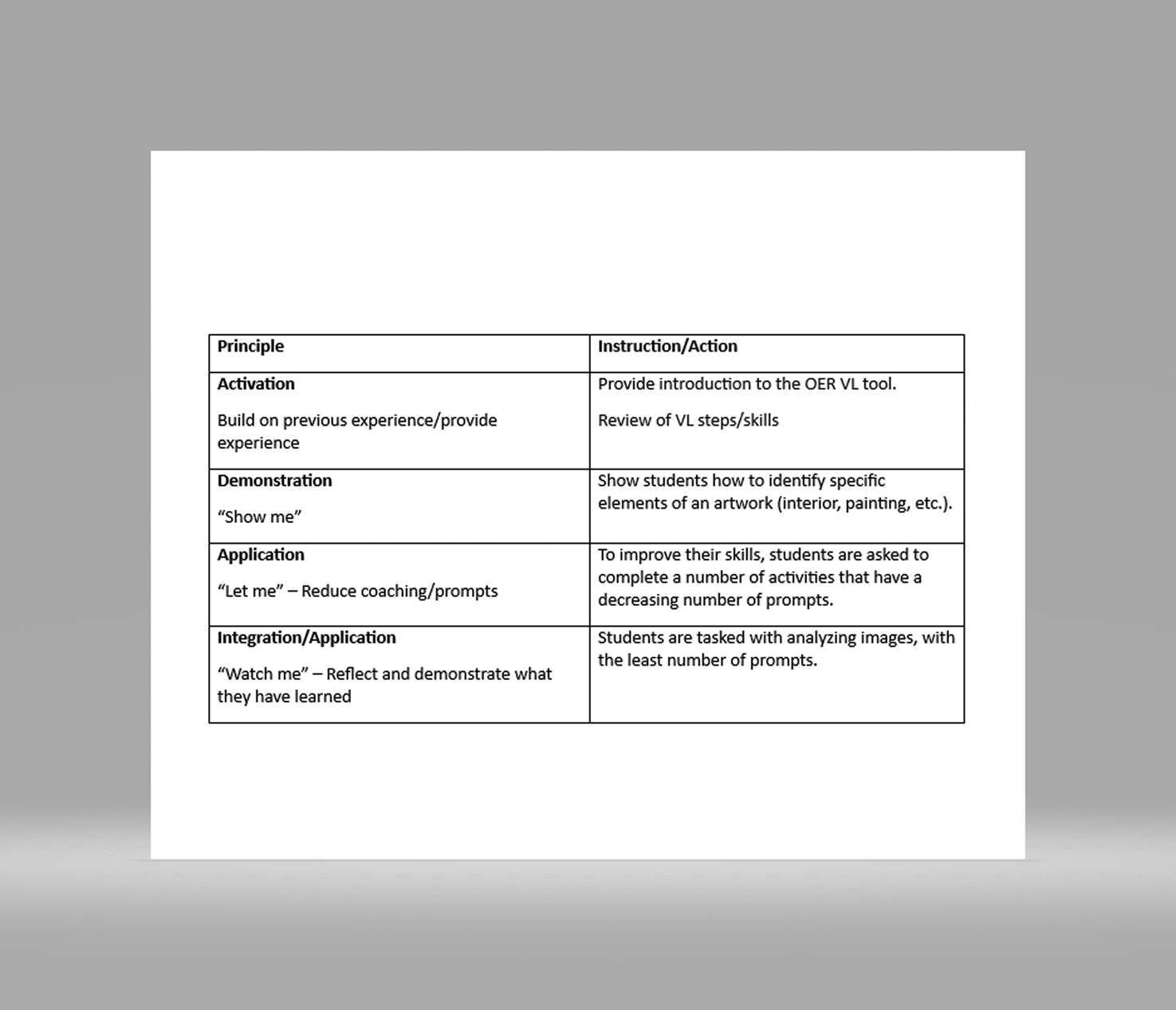
Merrill's First principles of instruction were used to create the overall structure of the tool. The table below outlines these principles and the actions that would apply to the tool.
Chart 1Footnote 5
This outline made the choice of H5P activities for the beginning and final exercises easy. However, choosing the H5P activities for Demonstration and Application are more challenging. What are the best or most effective H5P tools for the mid or practice part of the tool? What outcomes should be in place before deciding on the H5Ps? To move forward with this project, another source, A Taxonomy for Learning, Teaching, and Assessing: A revision of Bloom's taxonomy of educational objectives edited by Lorin Anderson et al. was consulted.
This chart shows a breakdown of Merrill's First principles of education and their instruction/action descriptions.

The Next Step – Revised Bloom's Taxonomy
Ordinarily the taxonomy would be used only for the creation of outcomes. However, further investigation of the revised version revealed an added benefit. The specific, action-based terminology that it uses to describe the learning process makes it ideal to solve the problem of what H5P activities to use in the Demonstration and Application sections of the tool. There are three levels of objectives, Global, Moderate, and Instructional. These levels are divided into scope, time needed to learn, as well as its purpose or function. The Global level is the broadest in scope, requires one or more years to learn and its purpose is to provide vision. It can be used to construct multiyear curricula. The Educational objective has a more moderate scope, may require weeks to months to learn, and deals with design curriculum, such as units of instruction. The Instructional objective level is narrowly focused, only requires hours or days to learn, and its function is to prepare lesson plans.Footnote 6
Based on these descriptions, the visual literacy tool would fit the Instructional level, since it is narrow in scope, could take as little as a few minutes up to days to complete and is a series of activities and exercises meant to bolster the students’ visual literacy. Since it is an OER, students who needed more time to absorb the lessons in the H5P could do so. Also, Educational objectives could help with choosing which and how many H5P activities to include.Footnote 7
The projected tool is educational, moderate and the time needed to learn will be weeks to months. The purpose or function is, as has been stated before, designing a tool with units of instruction that eventually lessens students’ reliance on detailed prompts to analyse images.Footnote 8 The instructional scope of the individual sections would be narrow, since it focuses on ‘reading’ images of art. Each section might take a week or an entire semester, depending on how the instructor or student chooses to use it.
The next step was to figure out what dimension would work best for the tool. Anderson and Krathwohl identify two dimensions, Knowledge, and Cognitive Process. Briefly, the Knowledge Dimension covers, ‘The interrelationships among the basic element within a larger structure that enable them to function together’Footnote 9 This includes, but is not limited to knowledge of classifications, principles, theories, forms of ownership, knowledge of subject specific skills, techniques and methods, and criteria for using appropriate procedures.Footnote 10 Since the students surveyed in the study already have this knowledge, this dimension does not seem to be the best of the two to use for the purpose of building a practice tool.
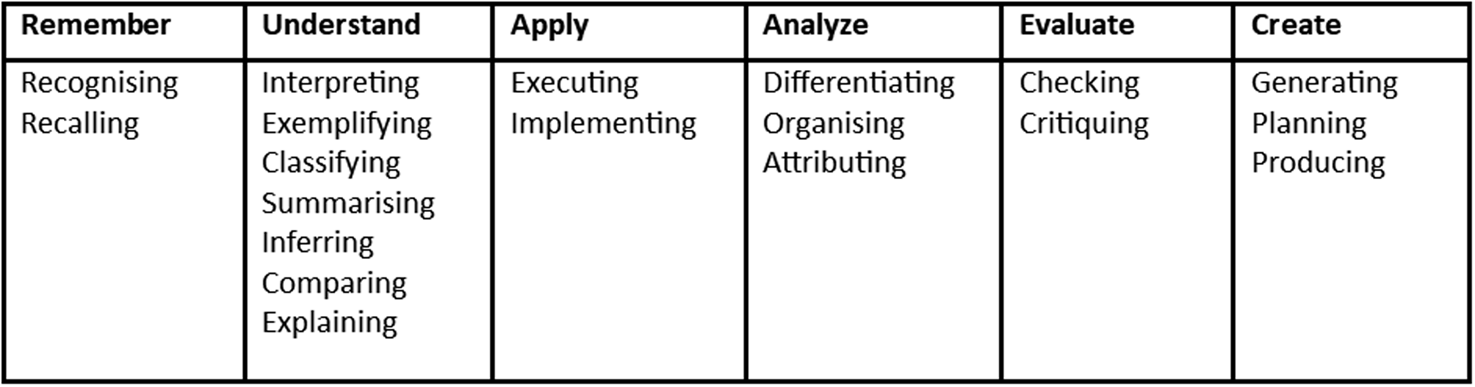
The Cognitive Dimension is a better guide for choosing H5P or creating other practice activities since it is action/engagement based. Chart 2 shows a simple breakdown of the six categories of Cognitive dimension which are Remember, Understand, Apply, Analyse, Evaluate, and Create. The Create category will not be included in the tool since those activities would depend on individual course objectives and is not necessary to achieve the overall outcome of this OER.Footnote 11
A simplified chart of Bloom's revised taxonomy.

Chart 2Footnote 12
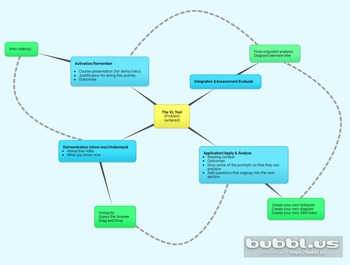
Comparing this chart with Merrill's four principles, we can see that Remember and Evaluate fit neatly in with Remember and Application/Integration. The other Categories, Understand, Apply and Analyse align more closely with Demonstration and Application. In fact, the Taxonomy's list of actions serves to enhance and expand upon Merrill's Principles. Image 1 is a visualisation of how these two approaches compliment each other, as well as providing an overview of how the tool will function.
This mind map shows the nonlinear arrangement of the tool and the links between Merrill's principles, Bloom's categories and potential H5P activities. Mind map created using - https://bubbl.us.

Choosing the most effective activities
Choosing H5P for the beginning and final exercises was relatively simple. The first H5P activities, listed in the chart below, fall in line with both Merrill's first step and the first section of Bloom's Revised Taxonomy which is Remembering. Remembering requires the student to retrieve “relevant knowledge from long-term memory.’Footnote 14 The final two H5P fit in with Merrill's Analysing and Evaluating. This leaves Understanding and Applying, for the mid-section. This section of the tool will be populated with activities with progressively decreasing prompts.
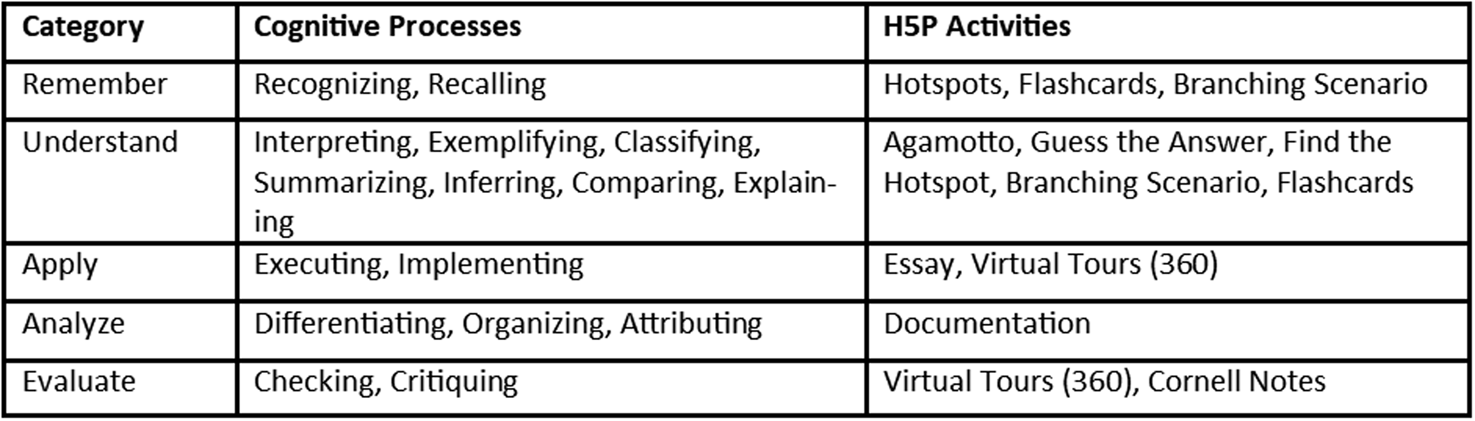
Using the Cognitive Process dimension of the taxonomy along with Merrill's principles, the activities will be selected to support its six categories. Chart 3 shows the breakdown of this dimension and the H5P that potentially align with them.
An illustration of the taxonomy's categories, cognitive processes and related H5P activities.

Chart 3Footnote 15
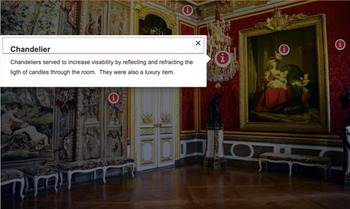
As mentioned previously in this article, the H5P activities for first part of both Merrill's and the revised taxonomy's Remember category were easy choices. One of these introductory exercises is called Image Hotspots. In Image 2, an interior, painting or other work of art can be populated with links (the Hotspots) that, when clicked, revealing text or videos that provide more information about a particular part of the image. This would help students refresh their memories of a particular artwork by reviewing key aspects of the artwork.
A hotspot activity, featuring an interior at the palace at Versailles, dominated by a portrait of Marie Antoinette and her children. Photo by Jeremy Bezanger on Unsplash.

Image 2
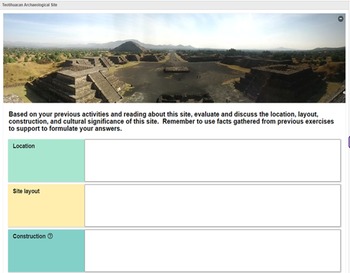
A final activity selected is a structure strip. This activity provides very few prompts. Instead, students must use the skills they have learned so far to analyse a work that they may or may not have encountered in their course. Image 3 shows a structure strip for the site of Teotihuacan, with space for students to type in their observations about its location, layout, construction and cultural significance.
Structure Strip activity, with an aerial photography of the Teotihuacan temple complex in Mexico. ‘Teotihuacan’ by Greg Schechter is licensed under CC BY 2.0.

Image 3
As chart 3 indicates, some H5P can fit in with multiple cognitive processes. Flash cards, which require learners ‘to fill in the text field and then check the correctness of their solution,’Footnote 16 could be used at various points in the tool to help increase the students’ retention of terms. Also, the Class Presentation can be altered from the typical course slide navigation so that it is more of a game where ‘…to let the user make choices and see the consequences of their choices.’Footnote 17
The middle section of the tool is still a work in progress. One such possible H5P included here might be a drag and drop featuring a floor plan of a Gothic cathedral. Students would identify important architectural elements of the plan by dragging terms to the proper location on the plan.Footnote 18
This OER, as Image 1 illustrates, is meant be flexible enough to accommodate students’ needs. For example, if a student reaches a certain point where they feel the need to review previous activities, they can return to any section or activity to review those skills. Instructors can choose which H5P would work best for their students at a particular point in their course. They may use some or all the H5P or remix them to better address visual literacy issues revealed in their students’ coursework.
Conclusion
The pairing of Merrill's and Bloom's resources has been effective in moving this project into the building phase. This phase will continue through the next few months. The first version's completion date has been fixed at August 2023. The tool will then be tested by students and faculty so that their feedback can be utilized in refining the H5P activities, making corrections and addressing any concerns about its structure and/or content before its official launch by the Spring 2024. As will all timelines, this may change slightly. The overall result hoped for here is the improvement of students’ visual literacy skills which they will need as the move into their post-university lives.