Introduction
Antipsychotics including first-generation antipsychotics (FGAs) and second-generation antipsychotics (SGAs) are commonly utilised as a pharmacological treatment for schizophrenia, psychotic disorders and bipolar disorder (Barbui et al., Reference Barbui, Conti, Purgato, Cipriani, Fortino, Rivolta and Lora2013; Buchanan et al., Reference Buchanan, Kreyenbuhl, Kelly, Noel, Boggs, Fischer and Aquino2009; Gentile, Reference Gentile2008). Women with pre-existing severe mental illness (SMI) sometimes require antipsychotics therapy during pregnancy to reduce symptoms and to prevent relapse. Furthermore, pregnancy can cause physiological, hormonal and psychological changes (Andersson et al., Reference Andersson, Sundström-Poromaa, Bixo, Wulff, Bondestam and Åström2003; Howard, Reference Howard2005; Jones, Chandra, Dazzan, & Howard, Reference Jones, Chandra, Dazzan and Howard2014; Vesga-Lopez et al., Reference Vesga-Lopez, Blanco, Keyes, Olfson, Grant and Hasin2008) that may increase the risk of psychiatric disorders, such as postpartum mood disorders (O'Hara, Schlechte, Lewis, & Varner, Reference O'Hara, Schlechte, Lewis and Varner1991; Yonkers, Vigod, & Ross, Reference Yonkers, Vigod and Ross2012). The benefits and the potential risks of the use of antipsychotic drugs during pregnancy should both be considered as well as any potential risks associated with stopping on-going antipsychotic therapy. Discontinuance may raise maternal anxiety levels, and also influence fetoplacental integrity and foetal central nervous system development (Cohen & Rosenbaum, Reference Cohen and Rosenbaum1998). In the past two decades, the use of antipsychotics in pregnant women, especially SGAs, has increased (Lao et al., Reference Lao, Tam, Wong, Besag, Man, Chui and Chan2017; Mitchell et al., Reference Mitchell, Gilboa, Werler, Kelley, Louik and Hernández-Díaz2011; Toh et al., Reference Toh, Li, Cheetham, Cooper, Davis, Dublin and Pinheiro2013). Studies are vital to explore the comparative safety and effectiveness of these drugs with respect to other therapeutic choices in pregnancy.
Gestational diabetes mellitus (GDM) is considered as a common adverse obstetric outcome in mothers with an estimated global prevalence of 4% to 16%, with differences between ethnicities and geographic regions (Brand et al., Reference Brand, West, Tuffnell, Bird, Wright, Tilling and Lawlor2018; Guariguata, Linnenkamp, Beagley, Whiting, & Cho, Reference Guariguata, Linnenkamp, Beagley, Whiting and Cho2014; Scholl, Sowers, Chen, & Lenders, Reference Scholl, Sowers, Chen and Lenders2001). Any woman can develop GDM during pregnancy, but the risk is especially high in women with a higher body mass index (BMI), a previous overweight baby, a previous GDM history, and parents or siblings with diabetes (NHS, 2018). Women with GDM are at higher risk for developing type 2 diabetes after pregnancy and more likely to have delivery complications including intrauterine foetal death, neonatal jaundice, preterm delivery, and infant macrosomia (American Diabetes Association, 2004; DeSisto, Kim, & Sharma, Reference DeSisto, Kim and Sharma2014; Vesco et al., Reference Vesco, Dietz, Bulkley, Bruce, Callaghan, England and Hornbrook2012).
It is well-known that treatment with antipsychotics is associated with metabolic side effects, such as weight gain and hyperglycemia (Bak, Fransen, Janssen, van Os, & Drukker, Reference Bak, Fransen, Janssen, van Os and Drukker2014; Regenold, Thapar, Marano, Gavirneni, & Kondapavuluru, Reference Regenold, Thapar, Marano, Gavirneni and Kondapavuluru2002). This association has been reported in clinical trials including children and adolescents, but no studies to date have included pregnant women (Bobo et al., Reference Bobo, Cooper, Stein, Olfson, Graham, Daugherty and Ray2013; De Hert, Dobbelaere, Sheridan, Cohen, & Correll, Reference De Hert, Dobbelaere, Sheridan, Cohen and Correll2011). To our knowledge, the latest published systematic review on this topic included articles in PubMed up to 31 March 2018 (Uguz, Reference Uguz2019). This review included not only observational studies but also review studies and concluded that no adequate evidence indicated a causal association between antipsychotics exposure in pregnancy and the risk of GDM. Furthermore, they did not conduct a meta-analysis; hence they were not able to provide an overall quantitative summary of their results. We therefore conducted a systematic review and meta-analysis on this topic including all observational studies published until March 2019 to demonstrate whether prenatal antipsychotics use can lead to a higher risk of GDM.
Methods
Search strategy and selection criteria
A systematic literature search was conducted in PubMed, EMBASE, PsycINFO and Cochrane Library databases up to 14 March 2019 following the Preferred Reporting Items for Systematic Reviews and Meta-analyses (PRISMA) guidelines and checklist (Appendix 1). Observational studies that investigated the relationship between antipsychotic use during pregnancy and the risk of GDM were searched using comprehensive search terms (Appendix 2). Articles that met the following criteria were included in this review: (1) cohort or case-control design; (2) reported the association between gestational antipsychotic use and the risk of GDM; and (3) published in the English language. Other study types, including animal studies, case reports, conference abstracts, book chapters, reviews and summaries or articles written in other languages were excluded. Our study protocol was registered in the International Prospective Register of Systematic Reviews database (PROSPERO: CRD42018095014).
Data analysis
All searched articles were screened independently by two investigators (ZW and BA) in order to identify the relevant papers based on titles, abstracts as well as full-text contents. Discrepancies were resolved through discussion. Information from eligible papers was extracted independently by two authors (ZW and PM) using a standardised data collection form which included the publishing year, study site, study period, data source (categorised with reference to previous methodological study (Wang et al., Reference Wang, Ho, Choy, Wong, Brauer and Man2018)), study design, sample size, medication exposure, exposure period and pregnancy definition, exposure as well as outcome ascertainment, selection of study and comparison group, confounding adjustment and statistical analysis. Outcome metrics such as risk ratio (RR), odds ratio (OR) and the corresponding 95% confidence intervals (CI) were extracted and included in the meta-analysis if appropriate. For the articles that did not provide relevant outcome metrics, the corresponding risk estimates were calculated if sufficient information was reported in the study.
The Newcastle-Ottawa Scale (NOS) was used to assess the methodological quality of observational studies. Separate NOS criteria were used for case-control and cohort studies. The assessment focuses on three major sections: selection (definition of cases/exposed subjects, representativeness of the cases/exposed subjects, selection of control/non-exposed subjects), comparability (controls or adjustment for confounding factors) and outcome/exposure (assessment/ascertainment of outcome/exposure, adequate non-response rate or follow-up time) with the total score ranging from zero to nine (Higgins & Green, Reference Higgins and Green2011; Stang, Reference Stang2010) and a higher score indicating a better quality. The quality of studies was independently assessed by two investigators (ZW and PM) and the studies that were rated as good (a score of one or above in each section and a total score of six or above) were included in the meta-analysis. Estimates were pooled using a random-effect model with the corresponding 95% CI for each outcome in the meta-analyses (DerSimonian & Laird, Reference DerSimonian and Laird1986). Subgroup analyses were conducted for users of (1) FGAs only, (2) SGAs only, and (3) any antipsychotics. Heterogeneity among included studies was evaluated using I 2, where a value of 0% is considered as no observed heterogeneity and larger values indicating increasing heterogeneity (Higgins, Thompson, Deeks, & Altman, Reference Higgins, Thompson, Deeks and Altman2003). A cut-off p value of 0.1 was considered statistically significant for heterogeneity which indicates a high degree of variance among the included studies. For articles using the same data source or population, the study with the largest sample size was included in the meta-analyses. All analyses were conducted using STATA 15. We conducted several sensitivity analyses in which we removed the study with the largest weight from the meta-analysis.
Results
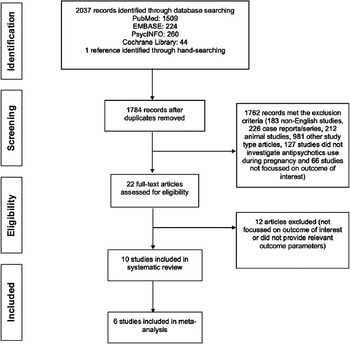
A total of 1784 records were identified for screening after removing 254 duplicates on 14 March 2019. Out of 22 full-text articles that were assessed for eligibility, 10 studies met the inclusion criteria for this systematic review with a total of 6642 exposed pregnant women and 1 860 290 unexposed controls (Bellet et al., Reference Bellet, Beyens, Bernard, Beghin, Elefant and Vial2015; Boden, Lundgren, Brandt, Reutfors, & Kieler, Reference Boden, Lundgren, Brandt, Reutfors and Kieler2012; Frayne et al., Reference Frayne, Nguyen, Bennett, Allen, Hauck and Liira2017; McKenna et al., Reference McKenna, Koren, Tetelbaum, Wilton, Shakir, Diav-Citrin and Einarson2005; Panchaud et al., Reference Panchaud, Hernandez-Diaz, Freeman, Viguera, MacDonald, Sosinsky and Cohen2017; Park et al., Reference Park, Hernandez-Diaz, Bateman, Cohen, Desai, Patorno and Huybrechts2018; Petersen et al., Reference Petersen, McCrea, Sammon, Osborn, Evans, Cowen and Nazareth2016; Reis & Kallen, Reference Reis and Kallen2008; Sadowski, Todorow, Yazdani Brojeni, Koren, & Nulman, Reference Sadowski, Todorow, Yazdani Brojeni, Koren and Nulman2013; Vigod, Gomes, Wilton, Taylor, & Ray, Reference Vigod, Gomes, Wilton, Taylor and Ray2015) (Fig. 1).
Study selection.

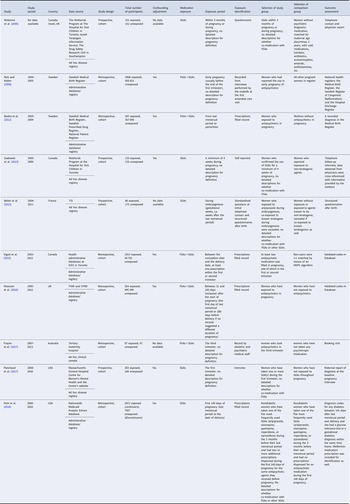
A summary of the characteristics of the included studies can be found in Table 1. All studies were published in English from 2005 onwards: four prospective cohort studies (Bellet et al., Reference Bellet, Beyens, Bernard, Beghin, Elefant and Vial2015; McKenna et al., Reference McKenna, Koren, Tetelbaum, Wilton, Shakir, Diav-Citrin and Einarson2005; Panchaud et al., Reference Panchaud, Hernandez-Diaz, Freeman, Viguera, MacDonald, Sosinsky and Cohen2017; Sadowski et al., Reference Sadowski, Todorow, Yazdani Brojeni, Koren and Nulman2013) and six retrospective cohort studies (Boden et al., Reference Boden, Lundgren, Brandt, Reutfors and Kieler2012; Frayne et al., Reference Frayne, Nguyen, Bennett, Allen, Hauck and Liira2017; Park et al., Reference Park, Hernandez-Diaz, Bateman, Cohen, Desai, Patorno and Huybrechts2018; Petersen et al., Reference Petersen, McCrea, Sammon, Osborn, Evans, Cowen and Nazareth2016; Reis & Kallen, Reference Reis and Kallen2008; Vigod et al., Reference Vigod, Gomes, Wilton, Taylor and Ray2015). Four studies recruited subjects in European countries (Bellet et al., Reference Bellet, Beyens, Bernard, Beghin, Elefant and Vial2015; Boden et al., Reference Boden, Lundgren, Brandt, Reutfors and Kieler2012; Petersen et al., Reference Petersen, McCrea, Sammon, Osborn, Evans, Cowen and Nazareth2016; Reis & Kallen, Reference Reis and Kallen2008), four in North America (Panchaud et al., Reference Panchaud, Hernandez-Diaz, Freeman, Viguera, MacDonald, Sosinsky and Cohen2017; Park et al., Reference Park, Hernandez-Diaz, Bateman, Cohen, Desai, Patorno and Huybrechts2018; Sadowski et al., Reference Sadowski, Todorow, Yazdani Brojeni, Koren and Nulman2013; Vigod et al., Reference Vigod, Gomes, Wilton, Taylor and Ray2015), one in Australia (Frayne et al., Reference Frayne, Nguyen, Bennett, Allen, Hauck and Liira2017) and one study was conducted by multiple centres including Israel and western countries such as Canada and UK (McKenna et al., Reference McKenna, Koren, Tetelbaum, Wilton, Shakir, Diav-Citrin and Einarson2005).
Summary of included studies

FGAs, first-generation antipsychotics; SGAs, second-generation antipsychotics; GDM, gestational diabetes mellitus; ENTIS, the European Network of Teratology Information Services; TIS, teratology information service; ICES, the institute for clinical evaluative sciences; THIN, the health improvement network; CPRD, the clinical practice research datalink.
Five studies were conducted with administrative databases/registries (Boden et al., Reference Boden, Lundgren, Brandt, Reutfors and Kieler2012; Park et al., Reference Park, Hernandez-Diaz, Bateman, Cohen, Desai, Patorno and Huybrechts2018; Petersen et al., Reference Petersen, McCrea, Sammon, Osborn, Evans, Cowen and Nazareth2016; Reis & Kallen, Reference Reis and Kallen2008; Vigod et al., Reference Vigod, Gomes, Wilton, Taylor and Ray2015), four used ad hoc disease registries (Bellet et al., Reference Bellet, Beyens, Bernard, Beghin, Elefant and Vial2015; McKenna et al., Reference McKenna, Koren, Tetelbaum, Wilton, Shakir, Diav-Citrin and Einarson2005; Panchaud et al., Reference Panchaud, Hernandez-Diaz, Freeman, Viguera, MacDonald, Sosinsky and Cohen2017; Sadowski et al., Reference Sadowski, Todorow, Yazdani Brojeni, Koren and Nulman2013) and one used an ad hoc clinical sample (Frayne et al., Reference Frayne, Nguyen, Bennett, Allen, Hauck and Liira2017). Reis and Kallen (Reference Reis and Kallen2008) identified exposures through interviews performed by midwives during antenatal care visits. All other administrative databases/registry studies identified exposures by prescriptions and/or filled prescription records (Boden et al., Reference Boden, Lundgren, Brandt, Reutfors and Kieler2012; Park et al., Reference Park, Hernandez-Diaz, Bateman, Cohen, Desai, Patorno and Huybrechts2018; Petersen et al., Reference Petersen, McCrea, Sammon, Osborn, Evans, Cowen and Nazareth2016; Vigod et al., Reference Vigod, Gomes, Wilton, Taylor and Ray2015). In studies conducted with ad hoc disease registries, exposure was assessed using a questionnaire (Bellet et al., Reference Bellet, Beyens, Bernard, Beghin, Elefant and Vial2015; McKenna et al., Reference McKenna, Koren, Tetelbaum, Wilton, Shakir, Diav-Citrin and Einarson2005), interview (Panchaud et al., Reference Panchaud, Hernandez-Diaz, Freeman, Viguera, MacDonald, Sosinsky and Cohen2017) or self-report (Sadowski et al., Reference Sadowski, Todorow, Yazdani Brojeni, Koren and Nulman2013). Exposure in the ad hoc clinical sample was recorded by obstetric and psychiatric medical staff (Frayne et al., Reference Frayne, Nguyen, Bennett, Allen, Hauck and Liira2017). Women were considered exposed if they had one or more antipsychotic prescriptions between their last menstrual period date and delivery date. Vigod et al. (Reference Vigod, Gomes, Wilton, Taylor and Ray2015) and Park et al. (Reference Park, Hernandez-Diaz, Bateman, Cohen, Desai, Patorno and Huybrechts2018) restricted their study cohort to women with at least two prescriptions during pregnancy and Sadowski et al. (Reference Sadowski, Todorow, Yazdani Brojeni, Koren and Nulman2013) required pregnant women to use a SGA for a minimum of 4 weeks during pregnancy. Additionally, six studies limited the exposure period specifically for early pregnancy (usually before the end of the first trimester) (Panchaud et al., Reference Panchaud, Hernandez-Diaz, Freeman, Viguera, MacDonald, Sosinsky and Cohen2017; Reis & Kallen, Reference Reis and Kallen2008), late pregnancy (Frayne et al., Reference Frayne, Nguyen, Bennett, Allen, Hauck and Liira2017) or a critical period for the outcome of interest: Vigod et al. (Reference Vigod, Gomes, Wilton, Taylor and Ray2015): within the first or second trimester; Petersen et al. (Reference Petersen, McCrea, Sammon, Osborn, Evans, Cowen and Nazareth2016): between 31 and 105 days after pregnancy start; Park et al. (Reference Park, Hernandez-Diaz, Bateman, Cohen, Desai, Patorno and Huybrechts2018): first 140 days of pregnancy (Park et al., Reference Park, Hernandez-Diaz, Bateman, Cohen, Desai, Patorno and Huybrechts2018; Petersen et al., Reference Petersen, McCrea, Sammon, Osborn, Evans, Cowen and Nazareth2016; Vigod et al., Reference Vigod, Gomes, Wilton, Taylor and Ray2015) (Table 1).
Five studies evaluated any antipsychotic exposure in mothers (Boden et al., Reference Boden, Lundgren, Brandt, Reutfors and Kieler2012; Frayne et al., Reference Frayne, Nguyen, Bennett, Allen, Hauck and Liira2017; Petersen et al., Reference Petersen, McCrea, Sammon, Osborn, Evans, Cowen and Nazareth2016; Reis & Kallen, Reference Reis and Kallen2008; Vigod et al., Reference Vigod, Gomes, Wilton, Taylor and Ray2015), while five focused on SGAs only (Bellet et al., Reference Bellet, Beyens, Bernard, Beghin, Elefant and Vial2015; McKenna et al., Reference McKenna, Koren, Tetelbaum, Wilton, Shakir, Diav-Citrin and Einarson2005; Panchaud et al., Reference Panchaud, Hernandez-Diaz, Freeman, Viguera, MacDonald, Sosinsky and Cohen2017; Park et al., Reference Park, Hernandez-Diaz, Bateman, Cohen, Desai, Patorno and Huybrechts2018; Sadowski et al., Reference Sadowski, Todorow, Yazdani Brojeni, Koren and Nulman2013). None of the SGAs studies provided details on whether the exposed group was co-prescribed FGAs. Three studies reported the risk of GDM relating to a specific drug (Bellet et al., Reference Bellet, Beyens, Bernard, Beghin, Elefant and Vial2015; Boden et al., Reference Boden, Lundgren, Brandt, Reutfors and Kieler2012; Park et al., Reference Park, Hernandez-Diaz, Bateman, Cohen, Desai, Patorno and Huybrechts2018). Boden et al. (Reference Boden, Lundgren, Brandt, Reutfors and Kieler2012) included women with olanzapine or clozapine alone or together with any other antipsychotics in the study cohort. Two studies investigated the same drug (aripiprazole) but reported opposite results: Bellet et al. (Reference Bellet, Beyens, Bernard, Beghin, Elefant and Vial2015) found a 15% increased risk (95% CI 0.33–4.04) v. Park et al. (Reference Park, Hernandez-Diaz, Bateman, Cohen, Desai, Patorno and Huybrechts2018) who reported an 18% decreased risk (95% CI 0.50–1.33). No study investigated the risk of GDM in users of FGAs only.
Only Panchaud et al. (Reference Panchaud, Hernandez-Diaz, Freeman, Viguera, MacDonald, Sosinsky and Cohen2017) and Park et al. (Reference Park, Hernandez-Diaz, Bateman, Cohen, Desai, Patorno and Huybrechts2018) reported the impact of the dosage on the risk of GDM. Both studies reported a positive dose-response association between the use of SGAs and the risk of GDM. In particular, Park et al. (Reference Park, Hernandez-Diaz, Bateman, Cohen, Desai, Patorno and Huybrechts2018) found the risk of GDM increased with increasing accumulated doses of olanzapine until approximately 700 mg and plateaued thereafter.
Six of the included articles dealt with confounding factors either by using multivariable adjustments in the regression model, restriction in control group selection or with propensity score (PS) methods (Boden et al., Reference Boden, Lundgren, Brandt, Reutfors and Kieler2012; Panchaud et al., Reference Panchaud, Hernandez-Diaz, Freeman, Viguera, MacDonald, Sosinsky and Cohen2017; Park et al., Reference Park, Hernandez-Diaz, Bateman, Cohen, Desai, Patorno and Huybrechts2018; Petersen et al., Reference Petersen, McCrea, Sammon, Osborn, Evans, Cowen and Nazareth2016; Reis & Kallen, Reference Reis and Kallen2008; Vigod et al., Reference Vigod, Gomes, Wilton, Taylor and Ray2015). In addition to comparing the outcome rate between the exposed group and unexposed group, four studies used further control groups in order to address confounding by indication: Petersen et al. (Reference Petersen, McCrea, Sammon, Osborn, Evans, Cowen and Nazareth2016) and Park et al. (Reference Park, Hernandez-Diaz, Bateman, Cohen, Desai, Patorno and Huybrechts2018) used ‘discontinuers’ (women who had taken prescriptions before pregnancy but had no prescriptions dispensed for an antipsychotic medication during pregnancy) as a control group; Panchaud et al. (Reference Panchaud, Hernandez-Diaz, Freeman, Viguera, MacDonald, Sosinsky and Cohen2017) restricted pregnant women who were not exposed to SGAs but with a psychiatric condition as a control group; Boden et al. (Reference Boden, Lundgren, Brandt, Reutfors and Kieler2012) included women who had taken any other type of antipsychotics (e.g. less anabolic or other generation antipsychotics) as an active control group. Among the four studies, three addressed maternal psychiatric diagnosis as a confounding factor (Panchaud et al., Reference Panchaud, Hernandez-Diaz, Freeman, Viguera, MacDonald, Sosinsky and Cohen2017; Park et al., Reference Park, Hernandez-Diaz, Bateman, Cohen, Desai, Patorno and Huybrechts2018; Petersen et al., Reference Petersen, McCrea, Sammon, Osborn, Evans, Cowen and Nazareth2016).
Most studies were conducted from 2005 onwards. One study that was included in the meta-analysis (Reis & Kallen, Reference Reis and Kallen2008) used data from 1995 until 2005. As SGAs were not widely used until 1995 (re-introduction of clozapine), their study sample mainly included women exposed to FGAs. As well as having a slightly different exposure group, Reis and Kallen (Reference Reis and Kallen2008) used multivariable adjustment only to control for possible confounding. All other studies that were included in the meta-analysis used either PS methods or discontinuers as a control group to try to tease out confounding by indication.
All included studies ascertained GDM in either a database, a physician's diagnosis report, or by structured questionnaire and selected adequate follow-up time for their outcome of interest. Two studies did not provide a description of those lost to follow-up (Bellet et al., Reference Bellet, Beyens, Bernard, Beghin, Elefant and Vial2015; McKenna et al., Reference McKenna, Koren, Tetelbaum, Wilton, Shakir, Diav-Citrin and Einarson2005).
Six included studies were considered as of good quality according to NOS assessment (Appendix 3). McKenna et al. (Reference McKenna, Koren, Tetelbaum, Wilton, Shakir, Diav-Citrin and Einarson2005), Sadowski et al. (Reference Sadowski, Todorow, Yazdani Brojeni, Koren and Nulman2013), Bellet et al. (Reference Bellet, Beyens, Bernard, Beghin, Elefant and Vial2015) and Frayne et al. (Reference Frayne, Nguyen, Bennett, Allen, Hauck and Liira2017) were excluded due to the poor quality with a score of zero in the NOS comparability assessment.
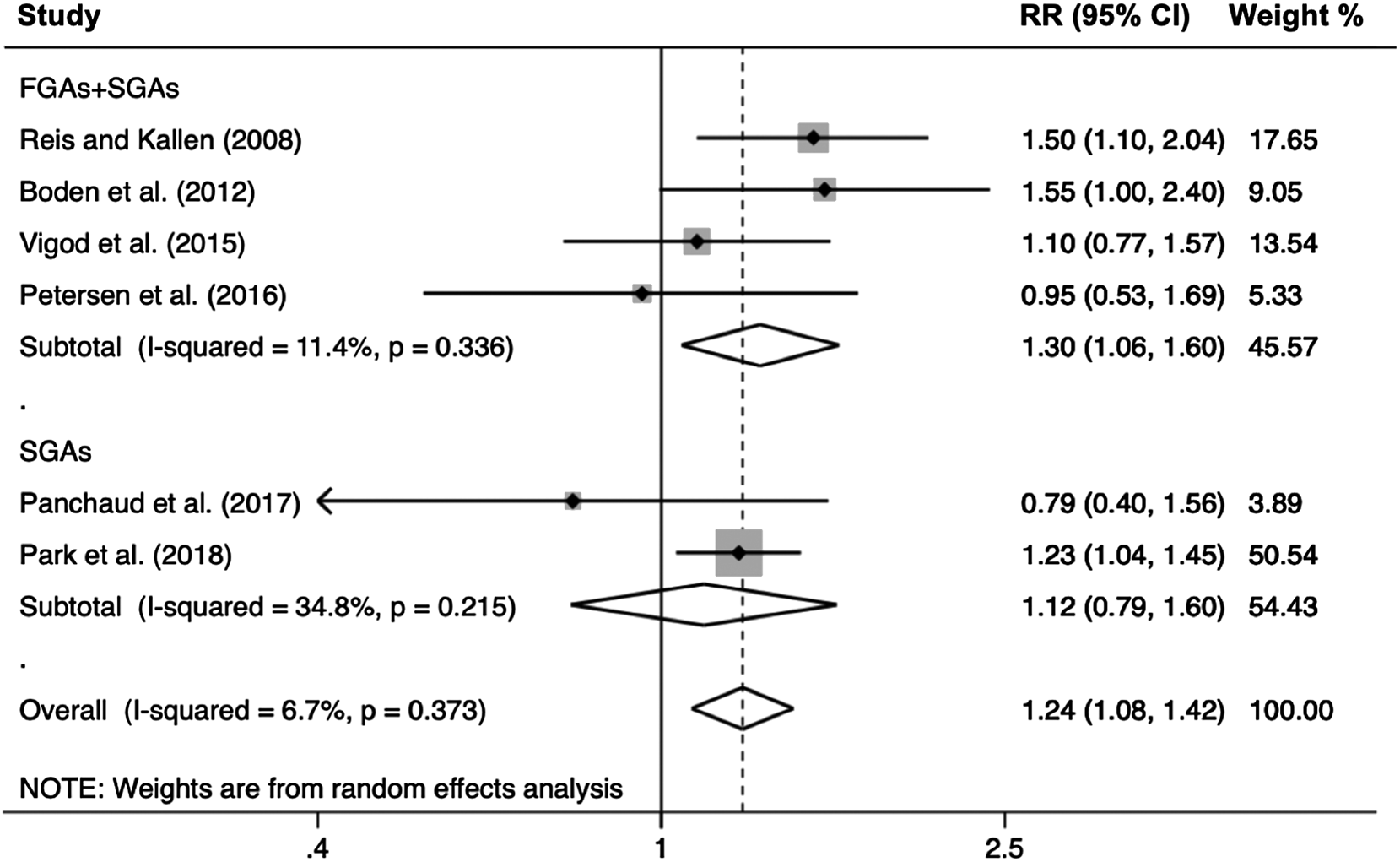
A summary of the individual study results can be found in Appendix 4. The results of our meta-analysis, with adjusted estimates for potential confounders, show that antipsychotic use in pregnancy can increase the risk of GDM by 24% (RR = 1.24; 95% CI 1.08–1.42) (Boden et al., Reference Boden, Lundgren, Brandt, Reutfors and Kieler2012; Panchaud et al., Reference Panchaud, Hernandez-Diaz, Freeman, Viguera, MacDonald, Sosinsky and Cohen2017; Park et al., Reference Park, Hernandez-Diaz, Bateman, Cohen, Desai, Patorno and Huybrechts2018; Petersen et al., Reference Petersen, McCrea, Sammon, Osborn, Evans, Cowen and Nazareth2016; Reis & Kallen, Reference Reis and Kallen2008; Vigod et al., Reference Vigod, Gomes, Wilton, Taylor and Ray2015) (Fig. 2). Within these six studies, four (Boden et al., Reference Boden, Lundgren, Brandt, Reutfors and Kieler2012; Petersen et al., Reference Petersen, McCrea, Sammon, Osborn, Evans, Cowen and Nazareth2016; Reis & Kallen, Reference Reis and Kallen2008; Vigod et al., Reference Vigod, Gomes, Wilton, Taylor and Ray2015) focused on any antipsychotics exposure with a pooled adjusted RR of 1.30 (95% CI 1.06–1.60).
Forest plot of the meta-analysis for gestational diabetes mellitus.

Two studies investigated the risk of GDM in users of SGAs only and reported a pooled adjusted RR of 1.12 (95% CI 0.79–1.60) (Panchaud et al., Reference Panchaud, Hernandez-Diaz, Freeman, Viguera, MacDonald, Sosinsky and Cohen2017; Park et al., Reference Park, Hernandez-Diaz, Bateman, Cohen, Desai, Patorno and Huybrechts2018). No study specifically focused on FGAs. The heterogeneity of the meta-analysis was low (I 2 = 6.7%, p = 0.373).
We conducted a subgroup analysis according to the timing of exposure during pregnancy. Two studies specifically defined the exposure time as the first trimester with an adjusted RR of 1.17 (95% CI 0.64–2.16) (Panchaud et al., Reference Panchaud, Hernandez-Diaz, Freeman, Viguera, MacDonald, Sosinsky and Cohen2017; Reis & Kallen, Reference Reis and Kallen2008). However, the heterogeneity of the meta-analysis was high (I 2 = 64.6%, p = 0.093). Three studies (Park et al., Reference Park, Hernandez-Diaz, Bateman, Cohen, Desai, Patorno and Huybrechts2018; Petersen et al., Reference Petersen, McCrea, Sammon, Osborn, Evans, Cowen and Nazareth2016; Vigod et al., Reference Vigod, Gomes, Wilton, Taylor and Ray2015) selected patients exposed to antipsychotics in a specific period during pregnancy [Vigod et al. (Reference Vigod, Gomes, Wilton, Taylor and Ray2015): within first or second trimester; Petersen et al. (Reference Petersen, McCrea, Sammon, Osborn, Evans, Cowen and Nazareth2016): between 31 and 105 days after pregnancy start; Park et al. (Reference Park, Hernandez-Diaz, Bateman, Cohen, Desai, Patorno and Huybrechts2018): first 140 days of pregnancy]. An increased risk of GDM was found among these three studies (adjusted RR: 1.19, 95% CI 1.03–1.37, I 2 = 0.0%, p = 0.632). Only Boden et al. (Reference Boden, Lundgren, Brandt, Reutfors and Kieler2012) generally presented the exposure time as pregnancy rather than any trimester or specific period during pregnancy.
Discussion
We conducted a systematic review and meta-analysis to investigate whether the use of antipsychotic agents during pregnancy is associated with increased risk of GDM. All included studies were assessed for data quality based on the exposure identification method, adequate follow-up, outcome assessment method, and representativeness of the general population (Wang et al., Reference Wang, Ho, Choy, Wong, Brauer and Man2018).
We found that exposure to antipsychotics during pregnancy is associated with an increased risk of GDM which is different from Uguz's study (Uguz, Reference Uguz2019). This may be because Uguz summarised the results based on a narrative review rather than an overall quantitative summary of each study's estimates. Similar results, indicating that antipsychotic use in pregnancy is associated with an increased risk of GDM, were observed in previous review studies which included both population-based studies and case reports (Galbally, Snellen, & Power, Reference Galbally, Snellen and Power2014; Gentile, Reference Gentile2008; Kulkarni et al., Reference Kulkarni, Storch, Baraniuk, Gilbert, Gavrilidis and Worsley2015). Nevertheless, there is insufficient evidence to demonstrate the effect of specific drug classes (FGAs or SGAs) or individual antipsychotic drugs. Only two studies focused on a specific drug class (SGAs) with opposite results (Panchaud et al., Reference Panchaud, Hernandez-Diaz, Freeman, Viguera, MacDonald, Sosinsky and Cohen2017; Park et al., Reference Park, Hernandez-Diaz, Bateman, Cohen, Desai, Patorno and Huybrechts2018) and no study particularly focused on FGAs. It is not possible to ascertain whether the effect of SGAs is due to the use of SGAs or perhaps the use of other psychotropic medications. FGAs and SGAs have different mechanisms of action which may result in different effects for pregnant women (Meltzer, Reference Meltzer2013). The use of SGAs increased over FGAs through 1989 to 2010 in the UK (Margulis, Kang, & Hammad, Reference Margulis, Kang and Hammad2014) and SGAs became the first-line treatment for schizophrenia (Meltzer, Reference Meltzer2013). It has been well documented that the use of SGAs could lead to insulin resistance and therefore cause metabolic adverse effects such as weight gain, glucose dysregulation and hyperlipidemia (Meltzer, Reference Meltzer2013). These metabolic adverse events could contribute to the development of GDM (Kulkarni et al., Reference Kulkarni, Storch, Baraniuk, Gilbert, Gavrilidis and Worsley2015). Recent studies suggested that certain SGAs, i.e. aripiprazole, might have less metabolic effects than other SGAs. It is, therefore, necessary to analyse the adverse outcomes in FGAs and SGAs separately, and ideally to examine the risks of specific antipsychotics individually.
According to our review, the risk of GDM was higher among women on higher SGAs doses which is similar to the study conducted by Yood et al. (Reference Yood, DeLorenze, Quesenberry, Oliveria, Tsai, Kim and L'italien2011). Panchaud et al. (Reference Panchaud, Hernandez-Diaz, Freeman, Viguera, MacDonald, Sosinsky and Cohen2017) explained that the dose-effect might be explained by the higher BMI in women receiving higher doses. Moreover, different exposed time periods may lead to distinct results relevant to the pathogenesis, e.g. early pregnancy is a time of insulin sensitivity (American Diabetes Association, 2017; Wang et al., Reference Wang, Ho, Choy, Wong, Brauer and Man2018). Further studies should be conducted by stratifying results by specific exposed trimesters and drug dosage, where possible.
In this systematic review, we found some methodological challenges. Firstly, studies using administrative databases/registries may be more representative of the general population, but may not comprehensively cover all potential confounders such as diet, alcohol and tobacco use (Wang et al., Reference Wang, Ho, Choy, Wong, Brauer and Man2018). Additionally, antipsychotics are often prescribed by specialist care providers rather than primary care providers, and most administrative databases/registries do not contain specialist information which may cause underestimation of exposure duration or overall exposure episodes. Studies conducted using ad hoc disease registries could potentially have more comprehensive information on subjects and may have longer follow-up periods (Wang et al., Reference Wang, Ho, Choy, Wong, Brauer and Man2018). However, major disadvantages of disease registries are selection bias and the lack of an untreated control group which may affect the actual drug effect (Wang et al., Reference Wang, Ho, Choy, Wong, Brauer and Man2018).
Moreover, poor antipsychotic adherence among patients with schizophrenia is common (Byerly, Nakonezny, & Lescouflair, Reference Byerly, Nakonezny and Lescouflair2007; Kane, Kishimoto, & Correll, Reference Kane, Kishimoto and Correll2013; Valenstein et al., Reference Valenstein, Blow, Copeland, McCarthy, Zeber, Gillon and Stavenger2004). Referring to the methods in previous studies addressing drug misclassification (Park et al., Reference Park, Hernandez-Diaz, Bateman, Cohen, Desai, Patorno and Huybrechts2018; Sadowski et al., Reference Sadowski, Todorow, Yazdani Brojeni, Koren and Nulman2013; Vigod et al., Reference Vigod, Gomes, Wilton, Taylor and Ray2015), we recommend to only include women who are in receipt of at least two prescriptions or with continuous usage for a set period of time.
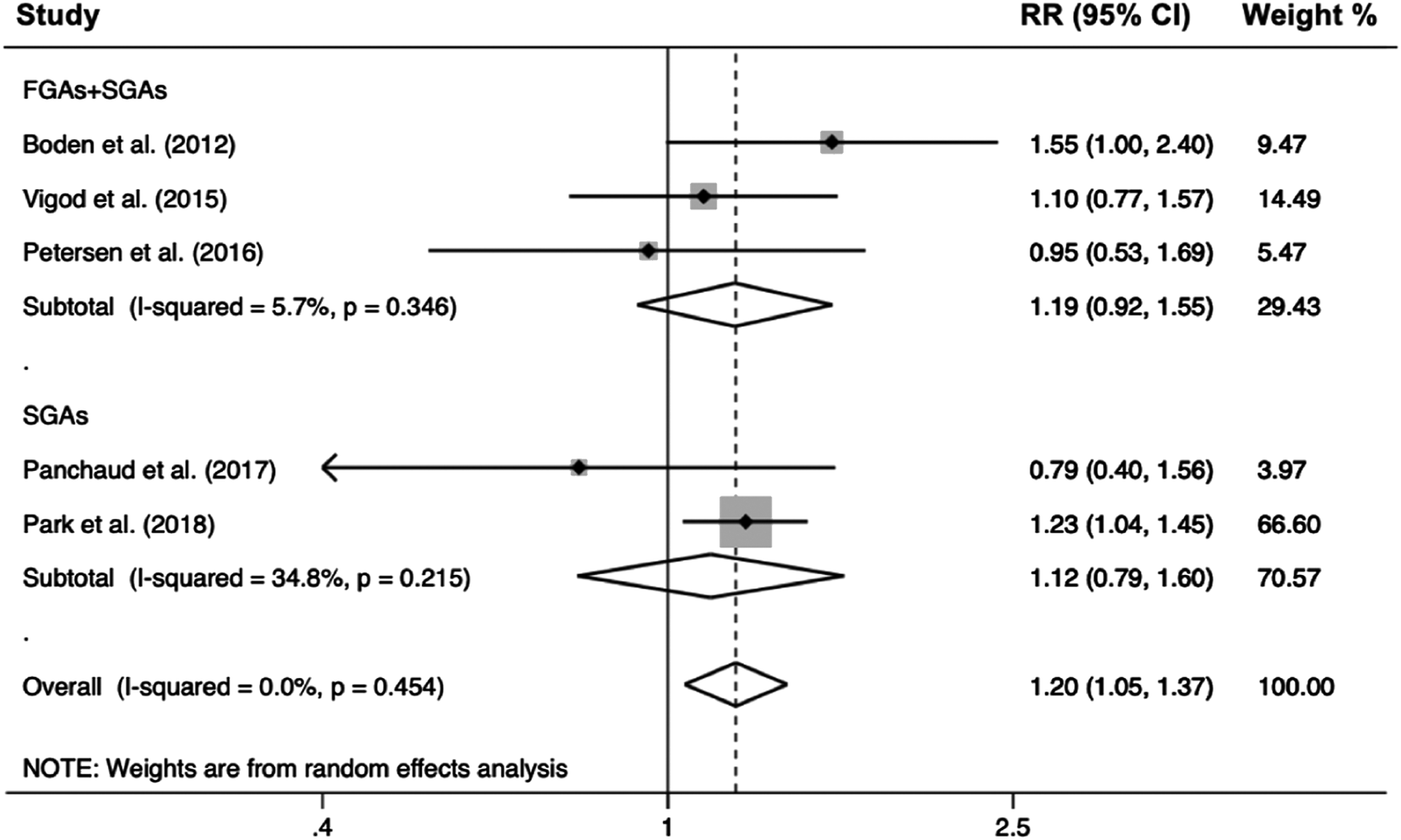
Confounders can affect the validity of estimates obtained from data and are the main source of bias in observational studies. In most of our included studies, multivariable adjustments were still the most common method to deal with potential confounders. Maternal age, smoking and alcohol consumption are considered the most relevant factors which can influence pregnancy complications and birth outcomes (Cnattingius & Lambe, Reference Cnattingius and Lambe2002; Luke & Brown, Reference Luke and Brown2007; Parker, McFarlane, & Soeken, Reference Parker, McFarlane and Soeken1994). However, in our meta-analysis, only Petersen et al. (Reference Petersen, McCrea, Sammon, Osborn, Evans, Cowen and Nazareth2016) adjusted all three of these factors. Four studies applied PS methods to minimise the effect of confounding factors (Panchaud et al., Reference Panchaud, Hernandez-Diaz, Freeman, Viguera, MacDonald, Sosinsky and Cohen2017; Park et al., Reference Park, Hernandez-Diaz, Bateman, Cohen, Desai, Patorno and Huybrechts2018; Petersen et al., Reference Petersen, McCrea, Sammon, Osborn, Evans, Cowen and Nazareth2016; Vigod et al., Reference Vigod, Gomes, Wilton, Taylor and Ray2015), while three latest studies conducted sensitivity analyses using different control groups (Panchaud et al., Reference Panchaud, Hernandez-Diaz, Freeman, Viguera, MacDonald, Sosinsky and Cohen2017; Park et al., Reference Park, Hernandez-Diaz, Bateman, Cohen, Desai, Patorno and Huybrechts2018; Petersen et al., Reference Petersen, McCrea, Sammon, Osborn, Evans, Cowen and Nazareth2016). Additionally, the maternal psychiatric diagnosis should be considered as a necessary confounding factor and, where possible, adjusted for in the main analysis as well as sensitivity analyses to minimise the influence of the disease itself. The results of the meta-analysis for FGAs and SGAs combined were largely driven by the results of the study by Reis and Kallen (Reference Reis and Kallen2008) (weight: 17.76%). Removing this study from the meta-analysis in a post-hoc sensitivity analysis showed that there was only weak evidence for the association between antipsychotic use and GDM [RR 1.19 (95% CI 0.92–1.55)] (Fig. 3).
Forest plot of the meta-analysis for gestational diabetes mellitus (sensitivity analysis, without Reis and Kallen (Reference Reis and Kallen2008)).

The potential consequences of an untreated psychotic episode may be severe and may lead to an increased risk of relapse or exacerbate symptoms, thus, antipsychotics should be prescribed if there is a clinical need (Jones et al., Reference Jones, Chandra, Dazzan and Howard2014). Clinicians need to weigh the potential adverse outcomes of antenatal exposure to drugs against the potential risk of untreated illness. Our study results indicate that antipsychotic exposure during pregnancy may lead to a higher probability of GDM and emphasise that women using antipsychotic agents in the antenatal period should be referred for GDM testing. NICE guidelines on the clinical management of antenatal and postnatal mental health recommend that gestational diabetes should be screened in women taking antipsychotic medication – blood glucose and HbA1c monitoring (NICE, 2014). A healthy diet and regular exercise during pregnancy would be of benefit to women to control blood glucose levels. It is also notable that clinicians should not switch treatment e.g. from FGAs to SGAs in the absence of strong evidence that doing so may be of benefit to women. According to NICE guidelines, for women with GDM, in addition to dietary changes and blood glucose monitoring, treatment with antidiabetic agents should be considered to prevent further complications (NICE, 2015).
This study is the first meta-analysis focused on the relationship between prenatal exposure to antipsychotics and the risk of GDM and included all relevant literature to date. Reviewer selection bias was minimised by using a comprehensive search strategy and independent text screening as well as data extraction. All studies included in the meta-analysis were conducted with administrative databases/registries or ad hoc disease registries which provided a relatively large sample size and good generalisability. There has been no published study in Asian populations, and we would recommend future studies to investigate whether the result is different for western and eastern populations. Methodological differences in study designs, the selection of the exposure and control groups, duration of follow-up, exposure and outcome definitions, may influence the accuracy of the risk estimates. Future studies should be conducted using an appropriate exposure period, adequate follow-up time and a larger sample size for more accurate results and a higher validity and representativeness of the general population (Wang et al., Reference Wang, Ho, Choy, Wong, Brauer and Man2018). Studies focusing on individual agents, dose-effect or comorbidities are also recommended in the future. We observed low heterogeneity in the adjusted pooled estimates which may represent the consistency of the results after adjusting for potential confounding factors. Studies included in our meta-analysis may still have been affected by residual confounding factors. Future studies are therefore necessary to be conducted to address confounding with a more comprehensive approach.
Conclusion
In conclusion, our systematic review and meta-analysis suggest that exposure to antipsychotic agents during pregnancy is associated with a higher risk of GDM. Future studies should focus on specific drug classes: typical or atypical antipsychotics, doses, interaction with comorbidities and/or different trimester exposure in order to help clinicians to manage the risk of GDM if initiation or continuation of antipsychotic prescriptions during pregnancy is needed.
Supplementary material
The supplementary material for this article can be found at https://doi.org/10.1017/S003329171900401X.
Author contributions
Zixuan Wang, Ian Wong and Ruth Brauer conceptualised the idea. Data curation was done by Zixuan Wang, Basmah Alfageh and Pajaree Mongkhon. Formal analysis was performed by Zixuan Wang. Methodology was carried out by Zixuan Wang, Kenneth Man, Pajaree Mongkhon, Ruth Brauer and Ian Wong. Project administration was done by Ian Wong and Ruth Brauer. Ian Wong, Ruth Brauer and Kenneth Man supervised the project and was validated by Ian Wong and Ruth Brauer. Original draft was written by Zixuan Wang and it was reviewed and edited by Zixuan Wang, Ian Wong, Ruth Brauer and Kenneth Man.
Financial support
No funding was used to conduct for this study.
Conflict of interest
Ian Wong has received grants from The Research Grants Council (Hong Kong), Innovative Medicines Initiative, Shire, Janssen-Cilag, Eli-Lily, Pfizer and the European Union FP7 programme, outside the submitted work; was a member of the National Institute for Health and Care Excellence (NICE) ADHD Guideline Group and the British Association for Psychopharmacology ADHD guideline group and acted as an advisor to Shire. Kenneth Man and Ruth Brauer are recipients of the UCL CW Malpethorpe Fellowship. Kenneth Man has received personal fees from IQVIA Ltd, outside the submitted work. Zixuan Wang, Basmah Alfageh and Pajaree Mongkhon have no other competing interests. No other relationships or activities could appear to have influenced the submitted work.