


Introduction
Poverty and space are two recurrent and intertwined themes of urban sociology, even though the linear correlation between widening socioeconomic disparities and socio-spatial polarization has been frequently contested (Reference Marcuse, Kempen, Marcuse and KempenMarcuse and Van Kempen 2000). Contemporary urban research seeking to explore the mechanisms of reproduction of social inequities has subscribed to the compelling argument that the concentration of poverty in segregated neighborhoods entails adverse effects on both individual living conditions and neighborhood-level resources (Reference SampsonSampson 2012).
Nevertheless, the neighborhood or concentration-effect hypothesis is far from unanimously acknowledged and has divided scholarship into two competing approaches to social inquiry. Whether individuals are ultimately trapped in their socio-residential environments or whether they are able to deploy strategies to overcome neighborhood-level structural constraints remains a yet unresolved question and continues to pose challenges for both methodological issues and urban policies.
The expanding popularity of the concept of social capital (Reference Bourdieu and RichardsonBourdieu 1983) and the resurgence of interest in the social and institutional dimensions of economic development have influenced a wide array of qualitative neighborhood studies since the 1980s. This renewed interest stems from the argument that individuals embedded in socially diverse and spatially dispersed networks increase their chances of achieving economic integration (Reference Granovetter, Marsden and LinGranovetter 1982), mitigating poverty and vulnerability (Reference MoserMoser 1998), and obtaining social and emotional support (Reference Small and NewmanSmall and Newman 2001). Alternatively, structural readings on poverty that center on neighborhood-level fieldwork make reference to William J. Wilson (Reference Wilson1987), who investigated the main causes and consequences of concentrated urban poverty in the Afro-American ghetto South Side of post-Fordist Chicago.
Recently, more conciliatory multilevel approaches have emerged within urban scholarship, aimed at eliminating the gap between structural determinism and methodological individualism. Following Sampson’s (Reference Sampson2012) rationale, neighborhood-level socio-interactional, socio-psychological, organizational, and cultural mechanisms intermediate between agency and structure, thus providing crucial insights into the modus operandi of the reproduction of poverty in urban space. Similar attempts have been made by Kaztman (Reference Kaztman1999) in the Latin American context, introducing the concepts of activos, vulnerabilidades y estructuras de oportunidades (assets, vulnerabilities, and structures of opportunity). Kaztman asserts that the family embedded in economically deprived neighborhoods loses a certain amount of tangible and intangible resources whose mobilization is conditioned by the prevailing structures of opportunity provided by the state, the market, and society.
Research exploring the consequences of living in peripheral neighborhoods of Brazilian metropolises corroborate the cumulative impact of unequal access to labor and educational opportunities and to urban services affecting the socioeconomic achievements of their inhabitants (Reference Carvalho, Pereira, Carvalho and PereiraCarvalho and Pereira 2014; Reference Ribeiro and KoslinskiRibeiro and Koslinksi 2009). However, there is major disagreement among researchers focusing on micro-urban contexts characterized by spatial proximity between socioeconomically distant groups. On the one hand, Almeida and D’Andrea (Reference Almeida and D’Andrea2004) argue that amplified structures of employment opportunities promoted by affluent neighborhoods foster the poor inhabitants’ economic integration. On the other hand, Andrade and Silveira (Reference Andrade and Silveira2013) emphasize that the functional character of employment-related cross-class interactions reproduces engrained social hierarchies, while mechanisms of social segmentation engender a class-stratified access to urban resources.
Salvador da Bahia, Brazil’s first capital, epitomizes patterns of macro-scale center-periphery segregation as well as patterns of micro-scale segregation in which socially distant classes live in geographical proximity, though separated by gated communities’ protective devices. Located in the impoverished Northeast, the country’s fourth largest city is characterized by a highly stratified labor and housing market with a well-above-national-average proportion of its inhabitants pursuing activities in the informal sector and dwelling in precarious housing conditions.
This article aims to contribute to the hypothesis of neighborhood effects on the basis of qualitative research conducted in Salvador. It investigates the potential interference of structural disadvantages—high rates of poverty, unemployment, and crime—in the operationalization of the individual’s networks and her or her striving for economic integration. Drawing on empirical data collected in Nordeste de Amaralina, a centrally located shantytown embedded in an area of affluent gated communities, and the peripheral neighborhoods Plataforma and Fazenda Grande II, we seek to verify whether widened opportunity structures, encompassing both job opportunities and access to high-quality urban infrastructure, can be corroborated within the constellations of geographical contiguity between socially distant classes, in comparison to both peripheral urban contexts.
Poverty and Place within the Field of Neighborhood Studies in (Latin) America
In the 1980s, the debate about urban poverty in American metropolises polarized into three diverging arguments centered around the concept of an urban underclass. First, a conservative culturalist approach correlated the poverty of the Afro-American urban underclass concentrated in inner-city ghettos with its alleged incapacity to adopt the social ascension model of white American mainstream society (Reference Lewis and MoynihanLewis 1968). Second, a liberal approach proposed that the underclass mostly subscribes to the mainstream cultural system and social aspirations, asserting that limited opportunities of social ascension fostered the emergence of an alternative value and behavioral system capable of rationalizing and supporting structural constraints (Reference GansGans 1962). Last, a structuralist approach anchored the socioeconomic deterioration of the urban underclass in a broader context of labor-market restructuring, sociodemographic transformations, and changes within the class composition of inner-city neighborhoods (Reference WilsonWilson 1987).
The ensuing debate on neighborhood effects was mostly instigated by Wilson’s (Reference Wilson1987) structural approach to urban poverty, grounded on the concept of social isolation, defined as the poor ghetto population’s lack of sustained interaction with individuals and institutions representing mainstream society. Wilson emphasized the importance of social networks for labor market integration and access to material and nonmaterial resources, as already postulated by Granovetter (Reference Granovetter, Marsden and Lin1982), who distinguished between two nonexclusive dimensions of social capital. On the one hand, a dense network grounded on kinship and friendship ties promotes social cohesion, the strengthening of collective identity, intragroup solidarity, and the short-term stabilization of daily situations. On the other hand, a sparsely knit network of weak ties shows a lower degree of homophily and localism, which widens the access to nonredundant information considered crucial for the job-seeking process.Footnote 1 According to Wilson (Reference Wilson1987), particularly these latter bridging networks experienced a sharp decline in the racially segregated neighborhoods of Chicago due to the out-migration of the black working and middle classes.
More recent research findings have not universally supported Wilson’s argumentation. On the basis of qualitative research, Small (Reference Small2004) advocates a conditional approach to neighborhood effects, positing that the socio-residential context interferes in various ways in the individual’s well-being. In the same vein, Sampson (Reference Sampson2012) asserted that neighborhood effects are neither merely the reflection of individual-level disaggregated attributes nor the sum of structural constraints, but must be related to social-interactional and institutional processes that involve collective aspects of community.
The application of Wilson’s neighborhood effect hypothesis to the Brazilian urban context has generally proven to be difficult. Brazil differs from the United States in terms of industrialization and urbanization processes, labor and housing market structures, and institutional-political idiosyncrasies. Nevertheless, expressive socioeconomic cleavages inscribed into the urban landscape can be observed in both cases. Contrasting with the US case, Brazilian metropolises historically have hosted both patterns of large-scale residential segregation and spatial constellations of geographic proximity of socially distant groups. The emergence of black ghettos as a result of institutionalized racially discriminatory practices can’t be verified in Brazilian metropolises; however, socioeconomic disparities inscribed into the cities’ spatial organization strongly coalesce along racial lines.
In the early research context, the concept of marginalidade (marginality) emerged as a key explanation for social inequalities during the 1950s and 1960s and pointed at the deficiencies of the model of import substitution to absorb low-skilled workers into formal labor market structures. However, in contrast to the US case, marginalidade-derived culture-of-poverty theories haven’t succeeded in political rhetoric and the public imaginary. Integration into an informal labor market has prevented the lower classes from being considered as dissociated from mainstream society, in part owing to their large representation within the whole economically active population.
In spatial dimensions, the dichotomous relationship between socioeconomic exclusion and integration reproduced within the structures of the labor and housing market permanently shaped the socio-spatial organization of Brazilian metropolises. These patterns have fueled geographical separation between the middle and upper classes in the central areas or cones of expansion, with broad access to the employment sector, good-quality housing, and urban infrastructure, and the lower echelons’ informal settlements in rather socially homogeneous peripheral areas lacking urban infrastructure (Reference Torres, L. Marques, Ferreira and BitarTorres et al. 2003).
Nevertheless, the synergetic but yet profoundly asymmetric relationships between the formal and informal labor markets in the paradigm of the import substitution model consolidated a certain functional interdependence between socioeconomically distant groups. In addition, cross-class interactions were maintained through employment relations in the low-qualified domestic service sector.
Since the late 1980s, a wide set of sociodemographic, economic, and political transformations have led to substantial alterations in patterns of socioeconomic mobility and living conditions of the lower echelons (Reference Carvalho, Pereira, Carvalho and PereiraCarvalho and Pereira 2014). These transformations encompass dismantlement of the import substitution model, restructuring of social policies, and erosion of primary support structures maintained within family and community networks. As a result of the liberalization of land markets, the self-segregation of the middle and upper classes in socioeconomically highly homogeneous gated communities or urban enclaves has led to geographic closeness of rich and poor classes in peripheral regions, as already demonstrated in other Latin American metropolises (Sabatini and Salcedo 2007).
Despite the enduring structures of economic segregation and the highly stratified access to urban services, Brazilian scholars have only recently acknowledged that structural disadvantages at the neighborhood level, along with a highly homogeneous population composition, might exert an independent impact on the individual’s living conditions. Ribeiro and Lago (Reference Ribeiro and Lago2001), comparing the degree of integration of favela dwellers and non–favela dwellers in the labor market in Rio de Janeiro, point to income disadvantages of favela dwellers resulting from their territorial stigmatization. Ribeiro and Koslinski (Reference Ribeiro and Koslinski2009) argued that public schools located in peripheral neighborhoods suffer from disinvestment, which, in conjunction with the deleterious influence of local peer groups, accounts for higher school drop-out rates and lower school achievements.
Marques (Reference Marques2016), comparing the impact of poverty and residential economic segregation on the economic achievements of individuals dwelling in either peripheral or central neighborhoods of São Paulo and Salvador from a social network perspective, posits that a greater proportion of primary ties in personal networks interferes negatively in the individual’s income level, whereas the embeddedness in institutional spheres of sociability facilitates labor market integration. Though emphasizing the substantial variation between the poor neighborhood dwellers’ social networks and the middle-class control group regarding the degree of homophily and localism, Marques asserts that segregation and poverty do not automatically lead to the inhabitants’ social isolation nor impede their economic integration.
According to Andrade and Silveira (Reference Andrade and Silveira2013), geographical contiguity to the affluent gated communities of the Serra neighborhood (Belo Horizonte) provides significant locational advantages for economic integration to the poor population living nearby. These results are consistent with the research conducted in Santiago de Chile by Sabatini and Salcedo (2007). Accordingly, these socio-spatial configurations widen the opportunities for the lower echelons in terms of labor market integration and access to urban services; moreover they promote a higher valorization of the poor neighborhood in the inhabitants’ self-perception. Nevertheless, qualitative research carried out in similar socio-spatial settings of Belo Horizonte and Rio de Janeiro point to the absence of cross-class interactions, apart from employment relationships, because of unequal, class-based access to public transport, the educational system, hospitals, and recreational space (Reference Andrade and SilveiraAndrade and Silveira 2013), and owing to the shantytowns’ territorial stigmatization (Reference RibeiroRibeiro 2008).
For the purpose of this research, it will be particular relevant to verify whether neighborhood effects can explain the prevalence of certain patterns of social networks hampering the interviewees’ economic integration, as US scholars have demonstrated. This study explores the social mechanisms that provide further understanding into the modus operandi of neighborhood effects. Qualitative research on neighborhood effects grounded on a multidimensional conception of poverty is still needed within urban scholarship in Brazil. By identifying the mechanisms’ common underlying structures and causal pathways, qualitative research might support more efficient place-based interventions.
Setting the Stage: The Socio-Spatial Organization of Salvador
Salvador, Brazil’s first capital founded in 1549, functioned as the main commercial and administrative hub of an Atlantic economy supported by the African slave trade and the export of sugar and other plantation products. Salvador’s prominence in the agro-export trade declined following the transfer of the national capital to Rio de Janeiro in 1763, resulting in period of enduring economic stagnation that lasted until the second half of the twentieth century.
The dynamic of Salvador’s territorial expansion has to be regarded in light of processes of industrialization, initiated by the implementation of Brazil’s largest oil company, Petrobras, in the nearby Recôncavo region in the 1950s. This process attracted large waves of immigrants coming from the impoverished hinterland regions, who eventually would occupy the central and peripheral regions of the city in precarious conditions of housing and infrastructure (Reference Carvalho, Pereira, Carvalho and PereiraCarvalho and Pereira 2014).
However, the industrial sector declined in the 1980s, and federal investments relocated to the Southeast. It became evident that industry would not play a crucial role in Salvador’s labor market composition, since the capital-intensive production was unable to absorb a significant contingent of the less-qualified population and did not yield positive spillovers for the local economy. This phenomenon has remained unaltered until the present day: more than 40 percent of Salvador’s economically active population is employed in the low-wage tertiary sector. Furthermore, the asymmetric socio-spatial distribution of the city results from market-driven mechanisms reproduced within the real estate labor market and large-scale state housing policies that have consolidated patterns of residential segregation following a radial-concentric logic.
Concerning the suburban and later metropolitan expansion of Salvador, three vectors of territorial expansion can be distinguished: Orla Atlântica Norte, Subúrbio Ferroviário, and Miolo Urbano (Reference Carvalho, Pereira, Carvalho and PereiraCarvalho and Pereira 2014). The Orla Atlântica Norte region accounts for more than 44 percent of the city’s size and concentrates most of its employment opportunities, attracting the upper and upper-middle classes, who settled in mostly vertical gated communities. The Subúrbio Ferroviário, located in the southwest of Salvador, occupies approximately 12.5 percent of the city’s total surface and has mostly grown beyond urban planning patterns. During Salvador’s urbanization and industrialization process, unoccupied land was invaded by the lower classes, and unfinished self-constructed settlements surfaced along the railway lines. The third vector of expansion, the so-called Miolo Urbano, adds up to 35 percent of the city’s surface. Between the 1970s and 1980s, the local government together with the National Housing Bank (Banco Nacional de Habitação, BNH) ordered the construction of large-scale scattered-site housing complexes affordable for the lower to middle classes with stable employment. Yet, these eligibility criteria could not be met by the lower echelons, which eventually invaded the spaces adjacent to the housing complexes.
Concomitantly to the three-vector dynamic of urban expansion, a more fragmented socio-spatial division emerges at the micro level, characterized by the geographic contiguity between middle- and upper-class gated communities (condominios) and previous settlements of the lower echelons. These constellations can be found throughout the whole Orla Atlântica Norte region and in the majority of the traditional middle-class neighborhoods, despite past slum-clearance interventions.
Methodological Considerations
On the basis of Marques’s (Reference Marques2016) analysis of social networks in São Paulo, we will examine the affiliation of the inhabitants with different spheres of sociability. Limiting the number of contacts affiliated to each sphere to ten, we created seven typologies clustered around the pivotal role of the family for social network constitution: (1) predominantly family and between-neighbor ties; (2) predominantly between-neighbor ties and family; (3) family, between-neighbor ties, and friendship; (4) family, friendship, and work; (5) family, between-neighbor ties, and religious associations; (6) family, between-neighbor ties, and studies; (7) family, work, and nonreligious associations. We hypothesize that the social networks within the primary spheres of sociability (family, friendship, and between-neighbor ties) mostly provide short-term stabilization of the individual’s daily situation, whereas the secondary spheres of sociability (work, studies, and nonreligious and religious associations) become paramount for the job-seeking process and the access to extralocal resources.
Assessing the patterns of mobilization of the interviewees’ social networks for economic integration, we seek to explore whether and how the interviewees accessed information about employment opportunities arising in the neighborhood and, in the Nordeste de Amaralina case, in the nearby affluent gated communities. Finally, we investigate whether the vitality of structures of support and reciprocity promoted within between-neighbor and family relationships can be corroborated in the three neighborhoods, inquiring about the frequency with which interviewees provide and receive daily support, such as child care, watching the neighbor’s house, taking someone to the hospital, and supplying food.
We use these methodological instruments in order to verify Wilson’s hypothesis about whether neighborhood effects produce the individual’s confinement to the local social context in his/her daily interactions, and if specific patterns of social networks within the primary spheres of sociability create obstacles to the individuals’ economic integration and access to material or nonmaterial resources.
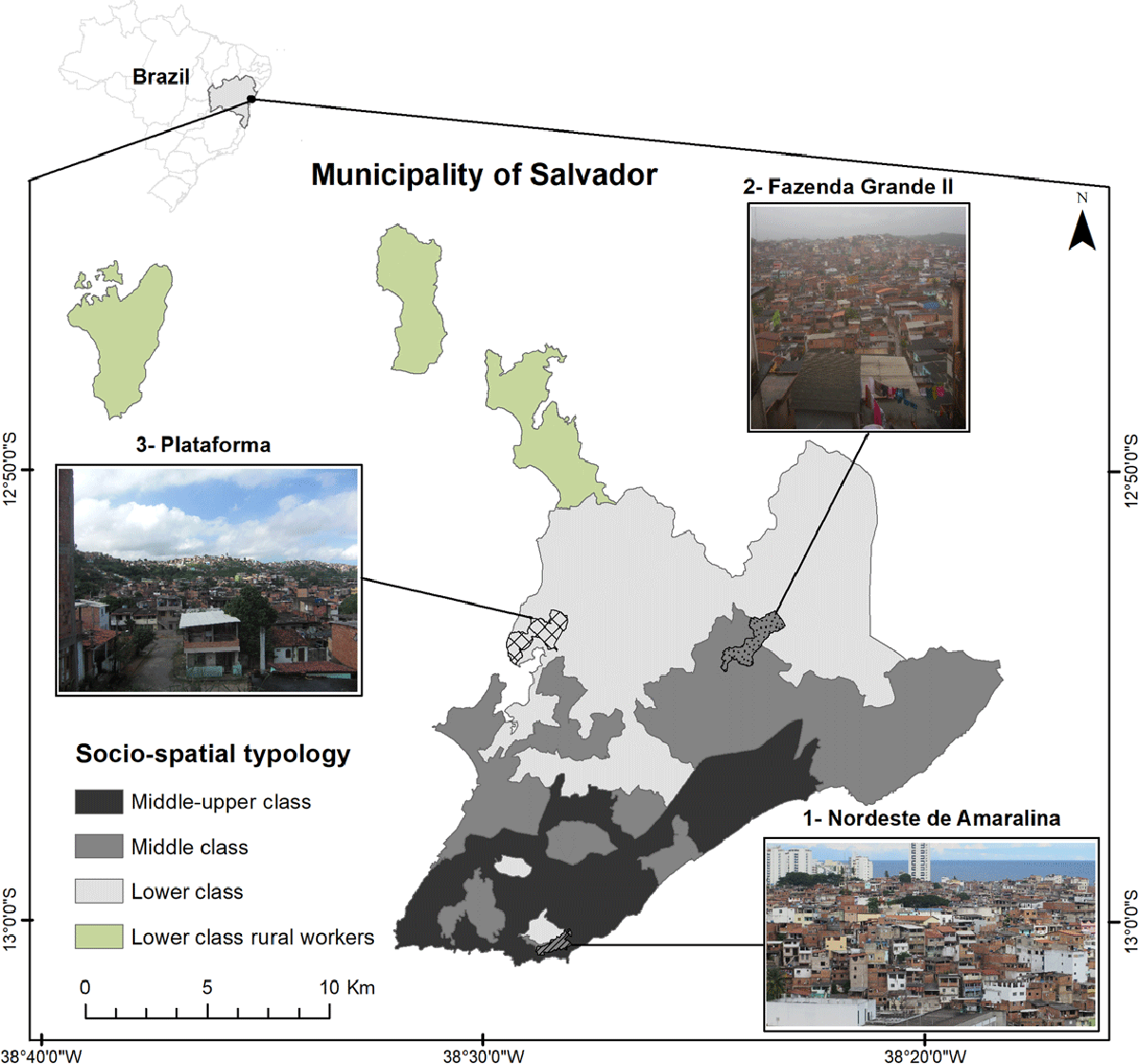
The research was conducted in the three shantytowns of Nordeste de Amaralina (Orla Atlântica Norte), Plataforma (Subúrbio Ferroviário), and Fazenda Grande II (Miolo Urbano). As Figure 1 shows, Nordeste de Amaralina is located in the city’s southern part and might be considered as a poor enclave amid middle-and upper-class neighborhoods, whereas Plataforma is located in the northwestern part of the city and embedded in a homogeneously lower-class region. Fazenda Grande is located in the northeastern part of the city and is surrounded by lower- and middle-class neighborhoods.Footnote 2 The terminology underlying the distribution of socio-professional groups in Salvador is based on the classification system proposed by Carvalho and Pereira (Reference Carvalho, Pereira, Carvalho and Pereira2014).Footnote 3
Spatial distribution of socio-professional groups in the municipality of Salvador adapted to census tract level. The map integrates three representative photos of the neighborhoods. Photos: Stephan Treuke.
According to the 2010 Decennial Census published by the Sistema de Informação Municipal de Salvador (SIM) and the Programa das Nações Unidas para o Desenvolvimento (PNUD), the sociodemographic profiles of their populations point to a high degree of social vulnerability, taking into account the household head’s average income and educational level, the proportion of female heads of household with low educational levels, the proportion of inhabitants employed in the informal labor market, and the proportion of inhabitants considered vulnerable to poverty. According to longitudinal crime statistics published by the Secretaria da Segurança Pública do Estado da Bahia (2018), Nordeste de Amaralina and Plataforma show an increase in crime with a strong spatial concentration of homicides, assaults, and thefts, whereas Fazenda Grande II shows lower crime levels.
A total number of sixty semistructured interviews were conducted in Nordeste de Amaralina, Plataforma, and Fazenda Grande II between May and November 2015. After a first sample test performed in Nordeste de Amaralina, we found that twenty interviews displayed a substantial internal variability, which further induced us to conduct an equal number of twenty interviews in each of the other two neighborhoods for comparative reasons. The interviewees were randomly selected in the streets or targeted with the help of community leaders. In order to reduce the selection bias within the analyzed sample, interviewees chosen were between the ages of sixteen and sixty-five, thus corresponding to different life cycles. Overall, the sample showed low variability in terms of average household income (roughly between US$300 and US$450), educational level (ranging between secondary school degree completed and uncompleted), and occupational status (roughly one-third of the interviewees said they were unemployed).
Targeted individuals were asked to provide some basic information about their income, occupational status, educational level, age, sex, years of residence in the neighborhood, and family composition. Next, we used a questionnaire to address the three issues outlined above related to the structure of social networks and the individual’s patterns of mobilization for economic integration and for access to material and nonmaterial resources. The interviews lasted for approximately half an hour and were mostly realized at home and during the week, as well as on the weekends. Later, the transcriptions of the audio-recorded interviews were submitted to an interpretative analysis. The transcription records were complemented by fieldwork observations, including participation in several meetings held by the neighborhood councils, which provided important insights into the socio-institutional organization of the three neighborhoods.
It must be acknowledged that the scope of the present research, opting for a qualitative approach and with its reduced sample size of sixty interviews, is clearly limited and doesn’t allow valid generalizations for other socio-spatial settings in Salvador or elsewhere, since we chose not to rely on procedures of inferential statistics permitting a quantitative and longitudinal assessment of neighborhood effects. Nevertheless, in the three cases studied we could identify a set of mechanisms and social processes operating at the neighborhood level whose common structures and similar causal pathways might be useful for future research and for urban policies.
Nordeste de Amaralina
Since the 1960s, the strategic proximity of Nordeste de Amaralina to the affluent summer houses and gated communities of Rio Vermelho, Amaralina, and Pituba has contributed to attracting successive influxes of immigrants coming from Bahia’s impoverished rural hinterland regions, which gradually led to the neighborhood’s demographic densification and illegal land occupation. With 21,887 inhabitants, Nordeste de Amaralina shows a high demographic density rate of 34,051 habitants per square kilometer.Footnote 4
The average household head’s income amounted to 1,530 reais (roughly US$425), and 12.40 percent of the population was living below the poverty line. This contrasts sharply with the surrounding middle- to upper-class neighborhoods with an average household head income amounting to 3,592 reais in Amaralina, 6,282 reais in Rio Vermelho, and 7,513 reais in Pituba. In the census tract of Vale das Pedrinhas–Nordeste de Amaralina, the unemployment rate rose to 26.3 percent, and only 62.38 percent of the population had finished secondary school. The proportion of inhabitants considered socially vulnerable to poverty amounted to 24.86 percent, while 27.27 percent of the female household heads with children had not completed elementary school. The proportion of the economically active population over eighteen without an elementary school degree and working in the informal labor market amounted to 21.58 percent.
Concerning the inhabitants’ patterns of sociability, we could corroborate the strong relevance of the primary spheres of sociability of family and friendship, in other words of social networks following the typologies (1) and (3). To a lesser degree, we can confirm the importance of the more workplace-based typology (4), whereas between-neighbor ties were less represented. The access to crucial information about job vacancies in the formal labor market is conditioned by the interviewees’ contact with local people already employed in the nearby gated communities, in particular janitors and watchmen. Thus we can confirm the importance of the bridging function of two key persons employed as security guards in the middle- to upper-class gated communities. Nevertheless, a weakening of this intermediary function of kinship and friendship ties could be attested, which, according to the older interviewees, stems from the fact that job referrals may constrain their own relationships with the employers, due to the high incidence of robbery committed in the gated communities by persons who benefited from those recommendations.
Overall, the frequency of employment links with nearby gated communities has decreased in recent years because of, first, a decline in the demand for personal services as a result of the middle classes’ loss of economic power, and second, the opting for job recruitment strategies based on the premise of “neighborhood safety and external image first” at the expense of the factor of geographic proximity. Since confidence, trust, and intimacy are paramount requirements for gated community jobs, these factors tends to outweigh the economic savings made in the employees’ salaries with regard to expenses for public transport. Finally, changes in the labor contract regime for employees induced a rise in employer’s salary expenses, which discourages particularly formal contracts for housekeepers.
According to the interviewees, all professional activities realized in the gated communities required submissive behavior, which by and large reproduces the hierarchies between socially distant groups and therefore impedes cross-class interactions not related to employment. Notwithstanding these developments, strategic access to the nearby gated communities and office buildings of Pituba, Amaralina, and Rio Vermelho and the nearby beaches offers a plethora of street vendor opportunities, including the selling of fruits, vegetables, beverages, and fast food. The stable demand for these products allowed the absorption of people dismissed from their former jobs in the gated communities, even though our fieldwork observations showed that these shifts substantially increased the overlap between street vendors, which in turn caused a decrease in their daily revenues. Moreover, most of the interviewees pointed to a direct correlation between the decline of gated-community jobs and the rise of thefts and assaults carried out in the neighborhood’s affluent surroundings, causing further deterioration of the shantytown’s external image.
Strong ties showing a high degree of homophily and localism become crucial for gaining access to jobs in the informal labor market. However, for the interviewees, the bridging function of kinship and friendship networks, already attested by Marques (Reference Marques2016), almost exclusively benefits their economic integration into the informal labor market, which, taking into consideration recent employment statistics for Salvador (roughly 32 percent employed in the informal labor market), reaches far larger proportional dimensions than in São Paulo.Footnote 5
Apart from broader employment opportunities, cross-class social distance patterns are maintained in all other spheres of communication because of the segmented access to high-quality urban infrastructure located in the affluent surroundings: access to the private system of education and medical care still remains a privilege of the middle to upper class, whereas the inhabitants of Nordeste de Amaralina have to rely on often qualitatively deficient local schools and hospitals. Indeed, we were able to confirm the precarity of the local schools’ material and infrastructural conditions; on several occasions we encountered the schools temporarily closed due to police raids on drug trafficking.
During our visits to the busy Avenida Manoel Dias da Silva and Rua Visconde de Itaborahy (Amaralina), where most of the office buildings are located, we did not witness any cases of cross-class interactions except for the informal street trade. Furthermore, leisure activities that might be expected to promote at least the physical convergence of socially distant groups, like shopping at the nearby Shopping da Cidade, excludes Nordeste de Amaralina dwellers from social participation, owing to their reduced monetary budget and to frequently reported stigmatization when entering the shopping center. The major field of leisure activities for them is the Praia de Amaralina, a nearby beach avoided by the middle and upper class because of frequent assaults and robberies.
Concerning the interviewees’ resorting to social networks to obtain material and nonmaterial resources, a certain decline of reciprocity and support was attested. According to the interviewees, this stems from a lack of confidence in their neighbors, resulting from the impact of local drug trafficking on former between-neighbor relationships in conjunction with the diffusion of a rather individualistic lifestyle that conflicts with the community’s common interests. This decline of between-neighbor reliability has been partially compensated by affiliation to dense associative networks tied to the Protestant churches, which offer a wide array of material and nonmaterial resources to their members. We observed different situations in which support such as food and clothing was given to the local population.
When assessing the capacity of the primary structures of reciprocity to promote support of daily needs such as childcare, food supply, and house watching, we registered the same weakening of between-neighbor solidarity ties, counterbalanced by the strengthening of kinship ties. These developments have to be interpreted in light of the increasing female participation in the (informal) labor market paired with the rising number of female-headed households. Along with the overall precarious economic situation, both tendencies account for the sharp decline in the field of between-neighbor support, while material and nonmaterial resources circulate within extended families living in the same household. According to the interviewees, the erosion of trust resulting from the high incidence of robbery, theft, and violent crimes plays a significant role in explaining the social withdrawal to kinship ties.
Plataforma
Located in the northwestern area of the Subúrbio Ferroviário, Plataforma grew informally around the proletarian housing complex Vila Operária, adjacent to the industrial plant Fábrica Têxtil São Braz, which was deactivated in 1959. Its population amounted to 34,034 inhabitants with a density rate of 14,571 habitants per square kilometer. The average income of household heads was estimated at 1,076 reais (roughly US$300), whereas the adjacent neighborhoods show even lower income, amounting to 766 reais in São João do Cabrito and 1,046 reais in Itacaranha. In 2010, 12.66 percent of the population was living under the poverty line. In the census tract Plataforma-Itacaranha–São João do Cabrito, the unemployment rate rose to 30.02 percent, and only 62.38 percent of residents had finished secondary school. The proportion of inhabitants considered as socially vulnerable to poverty amounted to 36.34 percent, while 35.22 percent of the female household heads with minor children had not completed elementary school. The proportion of the economically active population over eighteen without primary school and working in the informal labor market amounted to 27.63 percent.
The local social context remains paramount for the constitution of social ties and the mobilization of social capital in Plataforma, with a clear predominance of network type (1) and, to a lesser degree, type (3). Workplace-based social networks are even less widely represented than in Nordeste de Amaralina, whereas religious associations, corresponding to the network type (5), gain a stronger relevance for the interviewees’ patterns of sociability.
The majority of the interviewees commented that they seldom interacted with nonresidents, owing to the fact that, except for their workplace, most of their resources for daily needs (i.e., schools, hospitals, supermarkets, and leisure activities) are located within Plataforma’s boundaries. This confinement to the local context contrasts with Nordeste de Amaralina, where the lack of leisure activities and the greater availability of employment opportunities in its surroundings creates greater extralocal orientation and fosters the interviewees’ contact with nonresidents. One of the most frequently cited explanations for the restriction to neighborhood-bounded interactions is that residents lack financial resources for daily transport to the central regions of the city, where most employment offers and urban services are concentrated. Local labor market opportunities are scarce and are mostly limited to small-scale family businesses and informal street selling of fruits and vegetables. Similarly, the adjacent poor neighborhoods offer few opportunities for street merchandise because of their populations’ overall precarious income levels and the already saturated informal labor market.
The overwhelming majority of the interviewees reported reduced access to kinship and friendship ties connecting them to the formal labor market, given limited local employment opportunities, and because the high degree of localism and homophily characterizing their social networks reduces access to information about job vacancies to the sparsely available options mostly found in the informal labor market. In this case, family support networks act as important channels transmitting information and contacts about local job opportunities. By the same token, we could confirm the primacy of kinship networks in the development of strategies to deal with daily precarity and in the provision of material and nonmaterial resources. However, the clustering of family members around highly fragmented networks with weak intergroup connections creates obstacles to their economic integration because of the redundancy of the information transmitted. In the same vein, the promotion of short-term survival structures based on a defensively designed family safety net compensates neither the occupational instability inherent to the informal market nor the individual’s permanent exclusion from the formal labor market.
Concerning the constitution of networks in the sphere of sociability and friendship, it is noteworthy that the inhabitants are reluctant to integrate unknown individuals into their existing networks. As in Nordeste de Amaralina, a decline in the importance of friendship as a prime context for the constitution and maintenance of social ties can be noticed, contrasting with former times, when the population was united within organized groups claiming improvements in the access to basic urban services. In present times, these social interactions are reduced to a small number of intimate and nearby neighbors. This phenomenon contributes to an increasing territorial fragmentation of networks, organized across small units of geographically proximate neighborhood groups, promoting reciprocal and trustworthy relationships. A comparatively weak dynamic of affiliation to local associations could be registered, except for the neighborhood council. This institutional sphere of sociability promotes short-term material support for the most vulnerable inhabitants and constitutes an important environment for the exchange of sociability, though without providing contacts capable of fostering their economic integration.
According to the interviewees, the structures of between-neighbor reciprocity and support have weakened considerably during the last ten years, especially concerning child care and surveillance of the neighbor’s house, whereas virtually all the respondents confirmed receiving and providing support in food supply and in situations of emergency. At the same time, social ties in the spheres of sociability, neighborhood, and friendship transcend a high degree of mistrust, weakened solidarity, and cohesion. The erosion of trust in between-neighbor relationships is mostly perceived as a result of the superposition of criminal structures on the neighborhood’s social organization and of a more individualistic lifestyle centered on the achievement of personal goals.
The major social support is provided by religious associations, which reinforce intragroup cohesion and solidarity for members while excluding noncongregants from access. These ties operate as circuits of reciprocity and promote access to material and nonmaterial goods, such as help in housing construction and support in cases of illness and drug dependence. These religious associations have as members most of the key people who provide access to information about informal employment opportunities primarily located in the neighborhood. Nevertheless, participation in these institutional spheres does not foster economic integration. The majority of the interviewees stated that they frequent a religious association but do not draw any specific advantages or financial improvements from their affiliation.
Fazenda Grande II
Located in the northeastern region of the Miolo Urbano, Fazenda Grande II grew demographically with the settlement of lower-middle-class inhabitants in scattered low-rise buildings constructed by the BNH in the 1970s, and the concomitant invasion of its less-valued surroundings by the lower classes, mostly in informal dwellings. Its population amounted to 18,159, showing a demographic density rate of 8,573.74 habitants per square kilometer. The average household head’s income amounted to 1,308 reais (roughly US$372). Similar income levels could be registered for its surrounding neighborhoods Fazenda Grande I (1,219 reais) and Fazenda Grande III (1,233 reais), whereas the adjacent Cajazeiras XI (918 reais) shows substantially lower income patterns. In the census tract Fazenda Grande II–Jaguaripe I, 39.25 percent of the population was considered as vulnerable to poverty. The unemployment rate amounted to 13.09 percent, and only 41.79 percent had finished secondary school. The proportion of the economically active population over eighteen without primary school and working in the informal labor market amounted to 32.26 percent, whereas 45.17 percent of the female household heads with minor children had not completed elementary school.
Our results show significantly more diversified patterns of sociability when compared to the other two samples: while the typologies (1), (2), and (3) were equally strongly represented, emphasizing the pivotal role of between-neighbor relationships for daily interactions, we could also attest the interviewees’ major connectivity with local and nonlocal individuals and social groups. These social ties were predominantly constituted within the secondary spheres of sociability, particularly within workplace-based and religious or nonreligious associative environments, thus corresponding to the typologies (5), (6), and (7). In contrast to the two previously studied samples, virtually all interviewees declared that they participate regularly in the neighborhood council’s meetings, and that they participate in social and cultural associations at least once a week. The social contacts tied to Protestant churches play an even more prominent role in the interviewees’ daily interactions here than in Plataforma.
The greater proportion of formally and informally employed persons within the sample partially explains the widened access to extralocal information about job vacancies. As a positive outcome of the stronger affiliation to workplace-based networks, family members and intimate friends are more likely to benefit from job referrals. We could clearly distinguish between, on the one hand, intermediation to the informal labor market along kinship, friendship, and between-neighbor ties, and, on the other hand, intermediation to the formal labor market along institutional and workplace-based ties. Hence, one of the main differences of the Fazenda Grande II interviewees, when compared to the other two samples, lies in their recourse to a more diversified portfolio of social ties showing a higher degree of internal diversity and territorial dispersion. These ties become paramount for access to information about job vacancies and also to material and nonmaterial resources, which help to mitigate poverty among the most vulnerable social groups.
In this context, it needs to be emphasized that the greater socioeconomic heterogeneity encountered within the sample’s composition reflects the aforementioned co-occurrence of the scattered-site apartment dwellers and those poorer inhabitants living in the more precarious housing located along the boundaries with Cajazeiras XI. These two socially distant groups converge physically in the use of Fazenda Grande II’s public schools and childcare centers, hospitals, commercial, social, and cultural infrastructure, public spaces of recreation, public transport, and churches, thus increasing the potential for daily interactions. The peaceful coexistence between these groups also fosters the lower-middle classes’ understanding and empathy for the greater social vulnerability of the lower classes who live nearby, in part because of the absence of physical barriers of the built environment.
At the same time, the average income of the lower-middle class is not high enough to generate a demand for personal services such as watchmen, gardeners, and housekeepers, which could foster the lower echelons’ economic integration, as demonstrated in the Nordeste de Amaralina case. The main local job opportunities are limited to small-scale family business and the informal street trade. However, during our fieldwork, we were able to observe the construction and recent opening of a local shopping center (Shopping Cajazeiras), small clothing boutiques, restaurants, and bars, which, according to the interviewees, reflect the increasing demand of the more affluent apartment dwellers for local entertainment and leisure activities.
As far as the vitality of between-neighbor support is concerned, we could verify an unaltered high willingness to promote material and nonmaterial help for neighbors, friends, and family members, particularly in the areas of food supply, childcare, house watching, and transportation to the hospital. According to the interviewees, the structures of between-neighbor reciprocity and support have remained at equally high levels; this positive aspect of community life is often interpreted in light of the weak influence of drug-trafficking-related crime on the neighborhood’s social organization. Moreover, the overall positively evaluated high degree of intimacy, stability, and trustworthiness characterizing between-neighbor relationships was explained by the fact that most of the families came from the same region in Bahia’s impoverished hinterland and migrated to the neighborhood in the 1970s and 1980s. Virtually all the interviewees confirmed that they had been living in Fazenda Grande II for more than twenty years and claimed to know nearly everybody living nearby, a dynamic which also favored the strong collective mobilization for the improvement of the local urban infrastructure.
These collective mobilizations are organized by the neighborhood council and philanthropic associations located in both Fazenda Grande II and its surrounding neighborhoods, which promote a strong intergroup solidarity. The high degree of cohesion provided within these institutional environments stems from their vital importance in the initial phase of neighborhood’s occupation in the late 1970s, where the middle- to lower-class apartment dwellers and the poor shantytown inhabitants had to come together to demand improvements in access to basic urban services such as electricity, water, garbage collection, and the sewage system. This principle of collective engagement around institutional environments has remained unaltered, and even the younger interviewees declared that they participate in decision processes affecting the community’s well-being. As a result, the community has succeeded in claiming public investments in local schools, hospitals, and urban infrastructure. Beyond their function of political organization, the local neighborhood council and philanthropic associations provide a set of material and social resources for the most vulnerable families.
Complementarily to the strong engagement of these associations, the Protestant churches offer a wide range of material and social support while they strengthen the intragroup solidarity and cohesion of their members. The majority of the interviewees asserted that their affiliation to the church yielded a considerable improvement of their living conditions, given the strong support it provided, ranging from free lawyer consultations to help in housing construction and with food supply. Furthermore, their active participation granted access to information about job vacancies in both the formal and informal labor markets, because of the churches’ strong links with other lower-middle- and middle-class neighborhoods located in Salvador.
Discussion
Analyzing the results obtained in this multisite research, locational advantages benefiting the economic integration of a reduced number of interviewees can be observed in the case of Nordeste de Amaralina. Nevertheless, the deterioration of the neighborhood’s image as crime-ridden, the middle classes’ financial crisis and declining demand for personal services in gated communities, and changes in the contractual regime of housekeepers have produced alterations within the complex supply-demand logic.
The dialectical relation between economic integration and social avoidance underlines the fact that spatial proximity interacts with social distance so that locational advantages do not automatically translate into improved socioeconomic integration of the favela’s population, unlike that demonstrated by Sabatini and Salcedo (2004). Structures of micro-scale segregation—paired with strong territorial stigmatization of the favela’s inhabitants—and segmented access to education, the health system, and leisure activities, produce the interviewees’ confinement to the local social context; cross-class interactions only take place in a highly commodified context. Additionally, the impact of crime on the interviewees’ living conditions and self-perception, as well as on the community’s social organization, must be considered as an intervening factor explaining the enduring neighborhood effects in Nordeste de Amaralina, notwithstanding its proximity to employment opportunities. Unlike patterns documented by Wilson’s research in the US context, kinship and friendship ties provide vital information about local job vacancies and therefore do not automatically hamper the interviewees’ economic integration. This, however, only applies to those employment opportunities emerging in the informal labor market, whereas economic integration into the formal labor market is rendered difficult by the lack of workplace-based networks.
Spatial isolation paired with the absence of local job opportunities interferes negatively in the Plataforma interviewees’ living conditions and strongly confines them to the local social context. Contrasting with the Nordeste de Amaralina case, social networks within the primary spheres of sociability do not provide leverage for the individual’s integration into the informal labor market; this is because of the scarcity of job opportunities and the absence of more affluent inhabitants generating a demand for low-skilled personal services; the high unemployment rate that further exacerbates the interviewees’ dissociation from job-related bridging networks; and the depletion of individuals’ material resources, reducing the mechanism of job referrals to kinship ties. Here, the causal correlation between the low degree of exposure to socioeconomically dissimilar nonresidents and the interviewees’ difficulties of economic integration is more consistent with Wilson’s (Reference Wilson1987) hypothesis of social isolation.
In Fazenda Grande II, a large degree of internal diversity and territorial dispersion can be registered in the composition of the interviewees’ social ties, due to their resorting to workplace-based and religious or nonreligious associative networks with a strong social leverage function. The physical convergence of socially dissimilar individuals within schools, hospitals, bar, supermarkets, public transport, and public space fosters daily interactions between the lower-middle-class apartment inhabitants and the lower classes dwelling in more precarious housing. The vitality of the commercial, social, and cultural infrastructure depends essentially on the population’s engagement on behalf of common goals and on the economic support provided by the lower-middle-class segment.
Table 1 synthesizes our main findings and allows direct comparison between the three locations regarding the impact of neighborhood effects on residents’ chances of socioeconomic integration. Three intervening factors account for the variability within the three samples: access to job opportunities, the impact of crime, and access to urban infrastructure.
Synthesis of the main findings.

The research corroborated that the combined impact of segregation and poverty confers a higher degree of localism and homophily to the structure of the inhabitants’ networks. At the same time, an individual’s affiliation to secondary spheres of sociability fosters their economic integration into the formal labor market, as has already been demonstrated by Marques (Reference Marques2016). Whereas Wilson’s correlation between the prevalence of strong ties and lowered chances of economic integration can only be confirmed with regard to the access to jobs in the formal labor market, his hypothesis of social isolation reveals important similarities between the US and Brazilian cases when shifting the focus to cross-class links outside of employment, which, in the Brazilian case, are by and large inhibited by the segmented access to school, public transport, hospitals, and leisure activities. In both Nordeste de Amaralina and Plataforma, the lack of exposure to middle-class peer groups and role models transmitting conventional attitudes toward education, steady employment, and family stability fosters the reproduction of patterns of deviant behavior. The interviewees agreed that the omnipresent contact with peer groups affiliated with local drug trafficking gave false incentives to adhere to informal pathways of economic integration while devaluing school as an opportunity for upward social mobility.
Furthermore, the results draw attention to the fact that the networks constituted in the social spheres of family, neighborhood, and friendship may reproduce and even reinforce the mechanisms of poverty in contexts of segregation, if the lack of opportunities for intergroup interaction coincides with low levels of solidarity, trust, and compliance with mutual obligations at the neighborhood scale. The voluntary involvement of neighborhood inhabitants in activities of active support, social control, and supervision of other individuals on the basis of shared collective norms and socially accepted practices operates in social contexts with a vital structure of socioeconomic resources and is based on collective premises like trust, reciprocity, and solidarity, as shown in the case of Fazenda Grande II.
At the same time, the neighborhoods Nordeste de Amaralina and Plataforma reveal erosion of the legitimacy of social and collective norms that support expected neighborhood-level mutual obligations, because of their populations’ exposure to frequent homicides, assaults, and robberies. In both cases, perceived disorder and the feeling of “loss of control” point to the fact that these neighborhoods might get locked into dynamic processes that generate stigmatizing reputations, selective out-migration, and reduced willingness to intervene on behalf of collective well-being.
Final Considerations
This research emphasized the strong relevance of social network analysis for explanatory models investigating the reproduction of poverty and social inequities in Brazilian metropolises, given their capacity to foster or thwart socioeconomic integration. Although we acknowledge that structural disadvantages do not automatically lead to social isolation and resource depletion, our study demonstrates that social interactions tend to be critically confined to the local social context. The vitality of social and institutional networks has proven to suffer from exogenous (poverty, unemployment, crime, residential segregation, social segmentation) and endogenous (declining family organization, mistrust, fear of victimization, community disintegration) destabilizing factors operating simultaneously at the neighborhood level.
Quantitative scholarship is capable of establishing causal relationships between the unequal spatial distribution of labor and educational opportunities and the reproduction of poverty, and of discovering long-term developments within the population’s socioeconomic mobility. Complementing quantitative studies, qualitative research makes a strong contribution to neighborhood-effect research by identifying the socio-organizational mechanisms and processes operating at the neighborhood level that help us to understand how the socio-residential context shapes the individual’s daily living conditions. Structuralist approaches mostly fail to account for the neighborhood effect’s heterogeneity and for the complex causal interrelatedness of the social mechanisms at stake. In the same vein, experimental research designs that seek to estimate the impact factor of intervening variables by statistically controlling for individual-nested socioeconomic attributes reify social reality for the sake of research parsimony.
In our research, the neighborhood, regarded as the social space where most daily interactions take place, is considered as the analytic dimension intermediating between agency and structure, as compellingly shown by Sampson (Reference Sampson2012). The merits of the qualitative approach to neighborhood effects become particularly evident when we focus on the spatial proximity between socially distant groups, since the relations of functional interdependence between affluent gated-community dwellers and poor favela inhabitants can’t be adequately explored with recourse to census data sets.
Beyond social network analysis, our research has also uncovered shifts within the primary systems of social support resulting from broader societal transformations but also from essentially spatial determinants. Widespread myths about the unaltered high endogenous potential of community and household resources and support systems within lower-class Brazilian neighborhoods should be examined carefully, given the impact of crime on between-neighbor relationships, alterations in family composition, and declining collective mobilization on behalf of common goals. Likewise, we have to acknowledge that individual or household-centered strategies to mobilize socio-institutional resources are critically conditioned by larger structures (i.e., the state, labor market, and society), as already postulated by Kaztman (Reference Kaztman1999).
The predominance of a specific methodological approach to poverty in urban scholarship, embodied in a historically consolidated sociocultural understanding and perception of social inequities, shapes the political agenda, which determines how these challenges can be adequately addressed and how potential threats to social integration can be disarmed. In this context, three approaches can be distinguished.
The individualist approach focuses on the analysis of disaggregated indicators at the individual/household level without taking into full consideration the structural forces explaining socioeconomic deprivation. In the United States, the individual’s spatial position in the city is considered highly congruent with his or her personal merits and labor market position. Devised as a prime strategy to combat segregation and the spatial concentration of poverty, people-based policies are conceived to enhance access to equal opportunities at the household level, for instance by transplanting randomly selected families to supposedly enriching neighborhoods with lower poverty and unemployment rates and a lesser proportion of ethnic/racial minority groups.
The structural approach to urban poverty is grounded on the premise that transformations produced in the realm of (global) labor markets, the social welfare system, and society have caused disruptions in the structures and institutions of social support that previously had guaranteed full participation in the mainstream society. Following this rationale, place-based policies are implemented in order to widen local opportunity structures for the whole population, mostly by investing in urban infrastructure. More sustainable strategies encompass local job creation or the construction of affordable housing in socioeconomically more heterogeneous regions (a mostly European housing policy).
Embedded in a broader discussion about the underlying roots of socio-spatial polarization and the widening of socioeconomic inequities, the indirect approach to poverty promotes labor and housing market de-commodification strategies in compliance with the transformations produced in the socio-productive paradigm of post-Fordism (Reference TreukeTreuke 2018). However, this approach frequently remains confined to the discussion podium since interventions into the labor market and national economy have to challenge the gap between competition-driven liberalization and state protectionism, ironically in an era of globalization.
The Brazilian case diverges substantially from both the US and European countries. Structural dualism inherent in both the architecture of social policies and the formal-informal labor market paradigm has generated enduring socioeconomic cleavages with a strong racial bias, which translated into expressive socio-spatial polarization in contemporary metropolises. Strategies to eradicate urban poverty and to mitigate social inequities are rather consistent with the individualist approach; likewise, threshold-based quantitative assessments focusing on the individual’s income and educational levels have remained largely unchallenged. It remains crucial to observe whether the cash-transfer program Bolsa Família and the large-scale residential program Minha Casa Minha Vida have uplifted the lower classes from extreme poverty and contributed to the emergence of a new middle class, or whether these tendencies will turn out to be ephemeral given the enduring economic recession that exacerbates tendencies toward the spatial concentration of structural disadvantages.


 Open access

