The English spelling system is notoriously difficult to master, because as well as having regular relationships between sounds and spelling (e.g., the sound [z] is written as z, as in zoo or quiz), it also has numerous inconsistent and irregular relationships (e.g., [z] can also be written as s or x, as in bees or xylophone). However, the apparent “chaos” of English spelling is less extensive if larger scale patterns are considered (Kessler & Treiman, Reference Kessler and Treiman2003). For example, some spellings can be conditioned by their position in a word, and/or by their adjacent letters (e.g., word-initial [kh] is usually written c before a, o, and u, but k before e and i). In other cases, a word's morphological structure can influence its spelling. For example, a word's inflectional ending can determine the spelling of its last few letters, regardless of its pronunciation. This can lead to different spellings for the endings for words such as purest (a superlative) and purist (a person), but the same spellings for the endings for words such as laughed and smiled (both regular past-tense verbs), or laugh s and smile s (both plural nouns, or third-person singular verbs).
As discussed in more detail below, major theoretical and empirical accounts of spelling development suggest that writers learn quite early that plural nouns and third-person singular verbs should be spelled with a final --s in English. However, there is growing evidence that these simple rules may not be used at all by many children, and even not by some adults (Bourassa, Beaupre, & MacGregor, Reference Bourassa, Beaupre and MacGregor2011; Kemp & Bryant, Reference Kemp and Bryant2003). In direct contrast to conventional assumptions, many children and even adults may rely instead on individual, word-specific spellings to get these endings right. Further, whether or not these morphological rules are used may vary with the level of education attained in adulthood (Mitchell, Kemp, & Bryant, Reference Mitchell, Kemp and Bryant2011). For people who do apply these spelling rules, it is not known when their application begins or how it progresses. The aim of this study was thus to examine, for the first time, both overall performance and individual differences in the application of two seemingly simple morphological spelling rules, by participants in primary school, secondary school, and adulthood.
CONVENTIONAL ASSUMPTIONS ABOUT THE ACQUISITION OF INFLECTIONAL ENDINGS
Conventional stage-based models of English spelling development hold that children learn to spell simple inflectional endings such as –s, –ed, –er, and –ing by about the age of 9 to 10 years (Ehri, Reference Ehri, Wolraich and Routh1986, Reference Ehri, Templeton and Bear1992, Reference Ehri, Perfetti, Rieben and Fayol1997; Frith, Reference Frith, Patterson, Coltheart and Marshall1985; Gentry, Reference Gentry1982; Gentry & Gillet, Reference Gentry and Gillet1993; Henderson & Templeton, Reference Henderson and Templeton1986). There is some evidence that children's initial spelling of inflectional endings improves quite quickly, and is usually correct by the end of primary school, in studies of both naturalistic spelling (e.g., Green, McCutchen, Schwiebert, Quinlan, Eva-Wood, & Juelis, Reference Green, McCutchen, Schwiebert, Quinlan, Eva-Wood and Juelis2003; Varnhagen, McCallum, & Burstow, Reference Varnhagen, McCallum and Burstow1997) and spelling to dictation (Leong, Reference Leong2009; Walker & Hauerwas, Reference Walker and Hauerwas2006). For example, the regular plural ending –s appears to be acquired reasonably well in the first 2 years of writing experience (e.g., Read, Reference Read1986; Treiman, Reference Treiman1993), although third-person singular –s appears to take longer to get right (Leong, Reference Leong2009; Turnbull, Deacon, & Kay-Raining Bird, Reference Turnbull, Deacon and Kay-Raining Bird2011).
However, a closer look at these and other data reveals that the acquisition of inflectional endings is not as rapid or complete as these conventional stage-based spelling models would claim. For example, the first graders in Treiman's (Reference Treiman1993) and Turnbull et al.’s (Reference Turnbull, Deacon and Kay-Raining Bird2011) studies occasionally used –z for plurals ending in the sound [z]. Green et al. (Reference Green, McCutchen, Schwiebert, Quinlan, Eva-Wood and Juelis2003) found that even though overall mean rates of correctness were 86%–92%, only 61% to 76% of their individual third- and fourth-grade participants spelled plural noun inflections correctly, and Sterling (Reference Sterling1983) observed phonetic spellings of inflectional endings in children as old as 12 years. Many of the correct spellings in the studies reviewed above might come from children's store of rote-learned orthographic forms. It is therefore important also to test the spelling of novel words, whose orthographic representation cannot be retrieved from memory. For example, Beers and Beers (Reference Beers, Beers, Templeton and Bear1992) asked children in school Grades 1 to 6 to spell inflected pseudowords such as guds, and found that the correct use of the plural inflection –s was very similar across grade levels, but not at ceiling (approximately 80%).
Further, in previous studies, children may simply have been using a particular spelling for a certain sound pattern, regardless of its morphological status. The only way to rule out this possibility is to compare children's spelling of both uninflected and inflected words. In a large longitudinal study that made this comparison for another inflection, the regular past-tense –ed, Nunes, Bryant, and Bindman (Reference Nunes, Bryant and Bindman1997a) found that children learned to spell this ending only very gradually, between the ages of 6 to 10 years. They moved from sound-based spelling (e.g., kist for kissed), to applying –ed indiscriminately to verbs and nonverbs (e.g., kissed but also sofed for soft), then just to verbs (whether regular or irregular, e.g., sleped for slept), and finally only to regular verbs. In a second study, this gradual pattern of acquisition was also shown to occur in the spelling of pseudowords (Nunes, Bryant, & Bindman, Reference Nunes, Bryant and Bindman1997b), where stored word knowledge could not be used. These findings suggest that without directly contrasting uninflected and inflected word forms, the ability to spell inflected endings correctly can be easily overestimated.
LEARNING TO SPELL THE INFLECTIONAL ENDING –s
The –s endings of regular plural nouns and third-person singular verbs constitute two of the simplest spelling rules in English (especially when applied to one-syllable words, as in most of the research). To reiterate, regular plural (inflected) nouns may be pronounced with a final [s] (as in bricks) or [z] (as in bees), or with [ɪz] (as in boxes). However, they are always written with a final –s. Similarly, present-tense verbs inflected in the third person, such as picks, sees, and fixes, are always written with a final –s. In contrast, uninflected words pronounced with a final [s] or [z] are virtually never spelled with a final –s. Instead, these singular nouns or uninflected verbs are generally written with –x (if their final [s] is preceded by the sound [k], as in box or fix), or with –ze, –zz, or –se (as in breeze or seize). (There are some uninflected words spelled with a final –s, but these are mostly multisyllabic words of Greek or Latin origin such as mathematics and diabetes, plus some low-frequency monosyllabic exceptions such as lens.)
The correct spelling of the word endings discussed so far could always be achieved on the basis of their meaning or their morphological status, as all have had a sound structure that could plausibly be either inflected or uninflected. However, there are some English words whose sound structure (and thus whose spelling) means that they can occur only in inflected form. Specifically, words in which a final [z] is preceded by a voiced consonant (such as [d], [g], [n]) are virtually all inflected, and therefore spelled with a final –s (as in leads, begs, and swans). Thus, it is very common to see penultimate voiced consonants written together with –s, but very uncommon to see them written with other representations of [s] such as –z, –ze, and –se. In other words, combinations such as –gze and -bz simply look wrong. There is now robust evidence that humans can, and do, learn all kinds of patterns from their environment without direct instruction, including the spellings for certain sounds (e.g., Thompson, Fletcher-Flinn, & Cottrell, Reference Thompson, Fletcher-Flinn and Cottrell1999), but also quite complex statistical patterns of letter co-occurrence (e.g., Hayes, Treiman, & Kessler, Reference Hayes, Treiman and Kessler2006; Pollo, Treiman, & Kessler, Reference Pollo, Kessler and Treiman2009; Treiman & Kessler, Reference Treiman and Kessler2006). Thus, such words could conceivably be spelled correctly with a final –s on the basis of people's sensitivity to the frequency with which letters co-occur, without a thought to morphological status.
Several studies support the conclusion that the accurate spelling of some morphological endings could be achieved via sensitivity to letter co-occurrence rather than to morphology. Kemp and Bryant (Reference Kemp and Bryant2003) assessed the use of the plural rule in children (school years 2 to 4, aged 6 to 9) and adults by asking them to spell one-syllable pseudowords ending in [z]. They found that participants were much more likely to use the ending –s correctly for pseudowords presented as plurals when the final [z] was preceded by a voiced consonant (e.g., writing stogs in There are some baby [stɒgz] in the pond: 74% correct for children, 91% for adults) than when it was preceded by a long vowel (e.g., writing grues in There are some baby [gruz] in the pond: 37% correct for children, 50% for adults). These findings were extended by Bourassa et al. (Reference Bourassa, Beaupre and MacGregor2011), who found that children in Grade 4 (aged 9–10 years) used inflectional –s correctly for the final [z] of pseudowords presented as inflected nouns and verbs (e.g., writing scrays in Al [skrez] the fish in the afternoon) more often than they incorrectly used –s for pseudowords presented as uninflected (e.g., writing scraze in Joe and Sue will [skrez] the bike). However, their performance was still very low (all means between 21% and 37%). It appears that child and adult spellers do not consistently use the morphology-based plural rule when confronted with new words, and instead may rely on statistical patterns of letter co-occurrence.
EDUCATIONAL LEVEL DIFFERENCES
One unexpected finding from Kemp and Bryant's (Reference Kemp and Bryant2003) was that the adult participants who had been to university performed significantly better than adults who had not. It is not unsurprising that those who go on to tertiary education might have higher literacy skills than those who pursue other types of employment. However, given the apparent simplicity of the plural spelling rule, and the widespread assumptions about its early acquisition, it was unexpected that performance would differ with education level. This issue was explored by Mitchell et al. (Reference Mitchell, Kemp and Bryant2011), who gave participants inflected and uninflected nouns and verbs, with two different end sounds ([ks] and [z]), and used a spelling choice task rather than a dictation task, which allowed more pseudowords to be tested in a shorter time. They, too, found clear differences in the responses of young adults who were university students, and those who had not attended university, but were instead involved in (semi)skilled training. As well as calculating overall mean scores, the authors assessed individual performance, by considering which participants performed above chance in selecting the morphologically appropriate spelling for the pseudowords. The difference was striking: more than 80% of university students consistently chose the appropriate spelling, whereas less than 8% of nonuniversity students did so.
It is difficult to compare these findings to those of previous studies, as there is a dearth of research on spelling and morphological knowledge in adults who are not reading disabled, but who are also not at university. Numerous researchers have investigated various aspects of spelling (e.g., Coleman, Gregg, McLain, & Bellair, Reference Coleman, Gregg, McLain and Bellair2009; Greenberg, Ehri, & Perin, Reference Greenberg, Ehri and Perin2002; Kemp, Parrila, & Kirby, Reference Kemp, Parrila and Kirby2009) and morphological processing (e.g., Leikin & Hagit, Reference Leikin and Hagit2006; Raveh & Schiff, Reference Raveh and Schiff2008) in adults with poor literacy skills, whether because of limited educational opportunity or dyslexia. However, much of the extant research on typical adults’ spelling (e.g., Burt, Salzgeber, & Carroll, Reference Burt, Salzgeber and Carroll2013; Holmes & Malone, Reference Holmes and Malone2004) and morphological processing (e.g., Rueckl & Aicher, Reference Rueckl and Aicher2008; Sánchez-Gutiérrez & Rastle, Reference Sánchez-Gutiérrez and Rastle2013) has come from samples of university students. This means that many conclusions about adult spelling knowledge could well represent overestimations, as they are based on the performance of a subgroup of adults who are likely to have higher literacy skills, on average, than the general population. We do not know how well such conclusions apply to adults who do not go on to tertiary education, but who would not identify as having literacy difficulties. More than half of adults in the United Kingdom do not have a tertiary education (UK Government, 2014). It is therefore essential to test the spelling and morphological knowledge of this majority group, not just from those at university, if we are to draw conclusions that are relevant to a wider range of adults.
THE PRESENT STUDIES
The aim of the studies presented here was to assess knowledge of the rules about spelling plural noun and third-person singular verb –s in children at primary school, secondary school, and in a group of young adults who had not been to university. This is the first research to use a spelling choice test of the ability to apply both noun and verb endings, across such a range of ages, including adults not at university. Further, the few previous studies to assess the use of inflectional –s have presented the stimuli in a single form only (e.g., How many [priz] can you see?), whether as a dictation task (Bourassa et al., Reference Bourassa, Beaupre and MacGregor2011; Kemp & Bryant, Reference Kemp and Bryant2003) or a spelling choice task (Mitchell et al., Reference Mitchell, Kemp and Bryant2011). It is possible that rather than having an imperfect grasp of the relevant morphological rules, the participants simply did not pay sufficient attention to the sentence context to make use of its morphological cues in their responses. In the present studies, we instead included two forms of each pseudoword (inflected and uninflected, in counterbalanced order), and asked participants to choose the spelling of the second form. For example, participants might hear Last week I saw a [pri], and today I heard two [priz] singing, and then choose the appropriate spelling of [priz] as prees or preeze. (In this case, prees is correct, as the sentence makes clear it is a plural.) Providing two forms of the target pseudoword might help to focus attention on its morphological form, and thus give participants a greater chance of applying their morphological knowledge. In each of our three studies, we examined overall mean scores, to assess overall spelling knowledge of these patterns and to provide a comparison with previous research. However, our main aim was to assess the tendency of individual participants to perform above chance at choosing the correct type of spelling. We predicted that in each age group tested, there would be a group of participants who knew and used the rules under study, and a group who did not. In general, those who know the rule should perform consistently above chance on the pseudowords whose spelling they are asked to choose. Those who do not know the rule should perform around chance level.
EXPERIMENT 1: PRIMARY SCHOOL CHILDREN
In this first experiment, we looked at the ability to choose the morphologically appropriate spelling for pseudowords presented as inflected and uninflected verbs and nouns, in children in British school years 4 to 6 (aged 8–11 years). According to the conventional models of spelling development and experimental findings discussed earlier, most children at this stage of their schooling should have learned to go beyond sound-based spelling, and should be making use of the morphological structure of words in their spelling. However, none of our participants had received any formal instruction in morphology or morphology-based spelling patterns. Such instruction was not part of the United Kingdom's National Curriculum at the time of testing, and the teachers of the classes involved confirmed that they had not taught the children anything about morphology. Their responses were in line with the findings of research conducted with British teachers around the same time, which revealed that the vast majority had no explicit knowledge of morphology themselves (Hurry, Curno, Parker, & Pretzlik, Reference Hurry, Curno, Parker, Pretzlik, Nunes and Bryant2006; Hurry et al., Reference Hurry, Nunes, Bryant, Pretzlik, Parker, Curno and Midgely2005).
Method
Participants
Participants were 317 British children (162 boys, 155 girls) in school years 4 to 6, at four government-funded primary schools in a middle-class area of Southeast England. The children had a mean age of 9.8 years, and a range of 8.0 to 11.9 years. Fifty-five of these children (17%) spoke an additional language to English.
Materials
GENERAL SPELLING
General spelling ability was measured by asking children to spell to dictation the first 15 words of the spelling subtest of the Wide Range Achievement Test—Third Version (WRAT-3; Wilkinson, Reference Wilkinson1993), which increase in difficulty. Time constraints precluded the presentation of up to all 40 words until children made 6 errors in a row, as is standard for this subtest, and thus we used raw, rather than standardized, scores in our analyses.
REAL-WORD ORTHOGRAPHIC CHOICE
A set of 20 real words was presented to test participants’ ability to choose the correct one of two potential spellings, both with the same pronunciation. This is an ability required to succeed on the main task of pseudoword orthographic choice. These one-syllable real words ended in [ks] or [z], and each child was presented with either 10 [ks] or 10 [z] real words, to match the end sound of the pseudowords with which they were later presented, as described below. Each real word appeared twice in a sentence; once in inflected form (as a plural noun, e.g., boxes, or a third-person singular verb, e.g., sacks), and once in uninflected form (as a singular noun, e.g., box, or first-person singular verb, e.g., sack). Each form could occur first or second in the sentence. These sentences were read aloud by the researcher (e.g., We need some large boxes. Have you got a spare box? or Here is another sack. Can you carry two sacks?). For each target form, participants saw two possible spellings, one correct (e.g., box), and the other with the same pronunciation but a morphologically incorrect ending (e.g., bocks). These real words, and the other pseudowords, are shown in Appendix A.
VC[Z] ORTHOGRAPHIC CHOICE
A set of 10 pseudoword pairs ending in a vowel + voiced consonant + [z] sound (referred to as VC[z] pseudowords) was developed. These pseudowords were presented in spoken sentence contexts. They were presented first in uninflected and then in inflected form, half as nouns (e.g., In my garage I have one [plin], but in the shed there are three more [plinz]) and half as verbs (e.g., We [krʌn] after school, but Mary [krʌnz] in her lunch break). As described in more detail further below, for each pseudoword, participants chose which they considered to be the more suitable spelling (e.g., pleenze or pleens for [plinz]; cruns or crunze for [krʌnz]). As noted above, verbs and nouns with this VC[z] pattern are nearly always inflected and require a final –s spelling. To avoid children becoming biased to choose –s every time, these pseudowords were added to the main pseudoword orthographic choice task described below, in which the correct choice varied.
MAIN PSEUDOWORD ORTHOGRAPHIC CHOICE TASK
Finally, a set of 120 one-syllable pseudoword pairs (based on Mitchell et al., Reference Mitchell, Kemp and Bryant2011, shown in Appendix A) was used to test participants’ ability to choose the appropriate spelling on the basis of morphology alone. Half of the pseudowords ended in [ks] and half in [z], and each was placed in a different sentence context that indicated whether the pseudoword was intended as a noun or a verb. Thus, there were 30 pseudowords of each category (end sound and word type). The pseudowords had an overall mean number of 14.4 (SD = 10.8) phonological neighbors (real words that differed from the pseudowords by a single phoneme), and these neighbors had a summed word frequency of 409.5 (SD = 926.9; Rastle, Harrington, & Coltheart, Reference Rastle, Harrington and Coltheart2002). As above, each pseudoword appeared twice per sentence. It appeared once in uninflected form, for which the appropriate ending was always –x (e.g., snox) or –ze (e.g., preeze). It also appeared once in inflected form, for which the appropriate ending was always –s (e.g., snocks and prees). Order was counterbalanced so each pseudoword was presented half the time as a noun and half as a verb, and half the time the target spelling was inflected, and half the time uninflected. Each time, the choice was between two possible spellings of the second, target, pseudoword in each sentence (e.g., snocks/snox or prees/preeze).
Procedure
Participants were tested in 12 class groups of 25 to 30, in three classes at each year level (4, 5, and 6) at each of the four schools. Children completed the 15-word general spelling test to dictation. It proved too onerous for these young children to each make spelling decisions about all 120 pseudoword pairs, and so each child was administered just 30 pairs, consisting of 30 [ks] nouns, or 30 [ks] verbs, or 30 [z] nouns, or 30 [z] verbs (counterbalanced across schools and year groups). The presentation order of the 30 pseudoword pairs, combined with the 10 real-word pairs and the 10 VC[z] pseudoword pairs, was randomized to generate four separate 50-item sequences. The experimenter explained, “We are going to do some work with made-up words. We call these made-up words ‘pseudowords’ because they do not have any meaning in the English language. For each pseudoword you will hear two sentences. The sentences will contain different forms of the same pseudoword. Your task is to choose the most suitable spelling for the second form of the pseudoword by ticking the box next to your choice from the two words that you have printed in front of you.”
The experimenter asked the participants if they had any questions, and then for each task, read each sentence, including the two forms of the target (pseudo)word for participants to choose the most suitable spelling for the second form. Even though having prerecorded stimuli would have ensured the identical delivery of each pseudoword, it was much more familiar for the children, and more engaging, to hear spelling words pronounced by an adult. Watching the experimenter read the stimuli also provided visual, as well as auditory, information about the pseudowords. The placement (upper or lower) of the correct form of each target on the response sheet was counterbalanced. An example item is given below.

Results and discussion
Group means
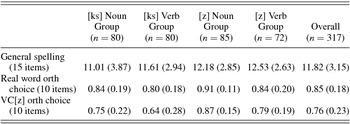
To gain an overall view of children's performance, we first considered the group means for the test of general spelling, and for the orthographic choice tests of the real words and the VC[z] pseudowords, shown in Table 1. Overall scores on the real-word orthographic choice task were high, which suggests that as a group, participants grasped the task requirement of selecting the correct one of two spellings for a single heard word. When presented with a choice of spellings for the VC[z] pseudowords, children performed quite well overall, which suggests that they, like children in previous studies, were sensitive to the fact that [z] after a voiced consonant is virtually always spelled –s. The 55 children who knew an additional language to English did not differ significantly from the rest on any of these initial tasks (all ps > .05). Their data were therefore retained for all further analyses.
Means (standard deviations) for primary school children's general spelling (raw scores), and real word and VC[z] pseudoword orthographic choice (proportions)

Note: General spelling score out of 15.
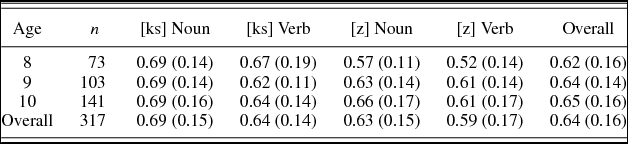
Mean performance on the main pseudoword orthographic choice task is shown in Table 2. The interitem reliability of the scales was moderate to good, with Cronbach α calculated as 0.71 for the [ks] nouns, 0.65 for the [ks] verbs, 0.69 for the [z] nouns, and 0.73 for the [z] verbs. As shown in the table, participants chose the morphologically appropriate spelling only about two-thirds of the time in most cases, with little consistent increase across age groups, and some small variations between word types.
Mean proportions (standard deviations) of primary school children's correct pseudoword orthographic choices across age groups
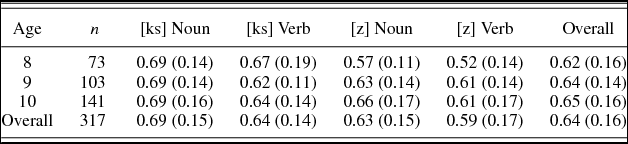
Note: Each child completed 30 items of one sound/word type combination.
Individual performance
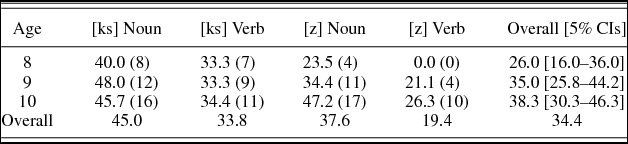
Our main aim, however, was to go beyond group means to consider individual performance. We had predicted that some children would use the relevant morphological rules and perform consistently above chance, whereas others would not. In a two-option choice task with 30 trials, chance performance is 15, and on the binomial, a score of 21 or more is significantly above chance (as 21 is significantly more than 15 at p = .04). Thus, it was highly likely that children who scored ≥21 out of 30 on their pseudoword category ([ks] nouns, [ks] verbs, [z] nouns, or [z] verbs) had used a morphological rule to guide their spelling choice for that category. Table 3 presents the percentage and number of participants of each age group who performed significantly above chance for each category. We also checked for potential sex differences, but saw very little difference between the percentage of boys (38.3%) and girls (36.8%) who performed significantly above chance.
Percentage (number) of primary school children in each age group who performed significantly above chance on pseudoword orthographic choice

As shown in Table 3, the children who performed significantly above chance on their pseudoword category were in the minority, for each age group, ranging from 26% of the 8-year-olds up to 38% of the 10-year-olds. Their mean scores out of 30, for the [ks] nouns and verbs, and the [z] nouns and verbs, were 24.9, 24.0, 23.7, and 25.4, respectively. These significantly above-chance scores suggest that these participants were using the morphological rule under study. The remainder (the majority of children) had scores that were around chance level, ranging from 73% of the 8-year-olds to 62% of the 10-year-olds. Their mean scores out of 30 for the pseudoword groups listed above were 17.4, 16.7, 16.1, and 15.9, respectively. The performance of these children leads us to conclude that they were not using the morphological rule at all, or that they were using it too sporadically to reach consistently above-chance performance.
We considered which factors may have contributed to children performing at or above chance on this task. We first ruled out the possibility that their orthographic choices were strongly related to the phonological characteristics of individual pseudowords: neither the number of each pseudoword's phonological neighbors nor the summed frequency of those neighbors was significantly related to the likelihood that the most appropriate pseudoword spelling would be chosen. Nor was the likelihood of appropriate spelling choice significantly related to the order in which a pseudoword was presented. This suggests that overall, participants did not learn to, or realize how to, choose the correct spelling during the course of the task, which is perhaps unsurprising given the lack of feedback during the task.
A binary logistic regression was conducted to assess which, if any, of the main factors of interest contributed to achieving above-chance or chance performance: general spelling ability (as measured by the WRAT-3), sex, or age group, or the two manipulated pseudoword factors, word type (noun or verb) and word ending ([ks] or [z]). This generalized linear mixed models analysis revealed that a significant contribution was made to pseudoword orthographic choice by spelling ability (p = .004), word type (p = .016), and word ending (p = .035), but not by sex or age group (nor any interactions). Specifically, children improved slightly but significantly with each extra word spelled correctly on the general spelling task (odds ratio [OR] = 1.02), and were slightly but significantly more likely to perform better on pseudowords presented as nouns than as verbs (OR = 1.08) and on pseudowords ending in [ks] than in [z] (OR = 1.07).
Overall, these findings suggest that by the age of 10 years, most children have not yet fully grasped the seemingly simple English rules concerning the spellings of nouns and present-tense verb inflections. Their uneven performance across word types (nouns and verbs) and end sounds ([ks] and [z]) suggests that participants were relying on patterns of letter co-occurrence, and not (just) morphology to make their spelling decisions. These findings support those of Kemp and Bryant (Reference Kemp and Bryant2003) and Bourassa et al. (Reference Bourassa, Beaupre and MacGregor2011), but are at odds with the predictions of conventional spelling models, which suggest that simple inflectional endings should be largely mastered by this stage. Previous research has shown an improvement in spelling pseudowords’ inflectional endings from the primary school years to adulthood (Kemp & Bryant, Reference Kemp and Bryant2003). In the present study, the likelihood of above-chance performance did not improve significantly with age, but it did improve with general spelling ability. This was unexpected, as age and spelling ability are correlated. In this sample, however, the variation in spelling skill with age must have been sufficiently large that the relationship with above-chance performance held only with spelling ability. In our second experiment, we asked secondary school students, who were both older and more experienced with spelling, to complete the same tasks.
EXPERIMENT 2: SECONDARY SCHOOL CHILDREN
Conventional models of spelling development, as well as empirical data, suggest that knowledge of morphology-based spelling patterns, like knowledge of other aspects of written language, develops with age and with exposure to written text. In this second experiment, we investigated the performance of secondary school students in school years 7 to 9 (aged 11–14 years) on the orthographic choice task of the spellings of inflected and uninflected endings of pseudoword nouns and verbs. Like the children in Experiment 1, they had received no explicit instruction in morphology or morphology-based spelling patterns.
Method
Participants
Participants were 190 British children (98 boys, 92 girls) in school years 7 to 9, with a mean age of 12.9 years, and a range of 11.4 to 14.7 years. Because there were relatively few 11-year-olds (n = 23) and 14-year-olds (n = 18), we grouped participants into two more even age groups; 11 to 12 years (n = 97) and 13 to 14 years (n = 93). These children attended a school drawn from a moderate to high socioeconomic status population with relatively high academic expectations, in the same area as the primary schools visited for Experiment 1. Forty-two (22%) of these children spoke an additional language to English.
Materials
GENERAL SPELLING
General spelling ability was measured by asking children to spell to dictation the first 25 words of the WRAT-3 (Wilkinson, 1995), which increase in difficulty. Again, time constraints on testing prevented the test being administered in its standardized form (until six consecutive errors had been made), and so we used raw scores in our analyses.
REAL-WORD ORTHOGRAPHIC CHOICE
As a test of participants’ ability to choose the correct one of two potential spellings for a heard word, the 20 monosyllabic real nouns and verbs from Experiment 1 were presented to each child; 10 ending in [ks] and ending in [z], in the same sentence contexts as before. Because of time constraints on testing, VC[z] pseudowords (e.g., ploons) were not administered.
MAIN PSEUDOWORD ORTHOGRAPHIC CHOICE TASK
The set of 120 pseudoword pairs and sentences from Experiment 1 was used in this study.
Procedure
Participants were tested at their school, with two classes from each school year tested together, in groups of 60–65. They completed the 25-word general spelling test to dictation. Because these older children were capable of completing more items than those in the previous experiment, each child was asked to select the correct spelling for 60 of the 120 pseudoword pairs. Each participant was presented with 30 [ks] nouns and 30 [z] nouns, or with 30 [ks] verbs and 30 [z] verbs (counterbalanced across school years). Again, the [z] and [ks] pseudoword pairs were randomized, together with the 20 real-word pairs, to generate four separate 80-item sequences. Children were asked to tick the box that they thought corresponded to the more suitable spelling of the second form of the target, with instructions as in Experiment 1.
Results and discussion
Group means
Children's scores for the test of general spelling, and of their spelling of the experimental real words, are shown in Table 4. As half the children were presented with orthographic choices about nouns, and half about verbs, the means for these two groups are also shown. The children performed very well on the real-word orthographic choice task, which suggests that they understood the task requirements. The 42 children who had an additional language to English did not differ significantly from their peers on either of these tasks (ps > .05). Thus, we retained all participants’ data in the subsequent analyses.
Means (standard deviations) for secondary school children's general spelling (raw scores out of 25) and real word spelling (proportions)

The children's mean performance on the [z] and [ks] pseudoword nouns and verbs was then considered. The interitem reliability of the scales was moderate to good for three of the scales, with Cronbach α calculated as 0.76 for the [ks] nouns, 0.80 for the [ks] verbs, and 0.74 for the [z] nouns, but weaker, 0.52, for the [z] verbs. The mean performance on these pseudowords is presented in Table 5, where it is seen that overall, these children selected the morphologically appropriate spelling for about two-thirds of the pseudowords, regardless of age group or word type. It thus appears that these secondary school students had a better idea of these morphological rules than primary school students (cf. Experiment 1; see Bourassa et al., Reference Bourassa, Beaupre and MacGregor2011; Kemp & Bryant, Reference Kemp and Bryant2003), but their overall mean performance was still quite low.
Means (standard deviations) for secondary school children's spelling of pseudowords across age groups

Note: Each child completed 60 nouns or 60 verbs.
Individual performance
Our main aim was to consider individual performance. The number of participants who had performed above chance (at least 21 out of 30) on each of the pseudoword categories was calculated, as shown in Table 6. For each pseudoword type, we identified a group who had performed significantly above chance. In most cases, the above-chance group constituted the minority of the sample, and the overall percentage of children who performed above chance was around 36% for the younger group and 54% for the older group. There were no obvious sex differences, with similar percentages of male (45.4%) and female (43.5%) participants performing above chance. The mean numbers of appropriate choices for the [ks] nouns and verbs, and the [z] nouns and verbs, were 24.7, 25.0, 24.4, and 24.8, respectively, for these above-chance performers. The remainder of the children performed at around chance level. Their mean appropriate choices for the pseudoword types listed above were 16.8, 15.7, 16.5, and 16.8, respectively. We suggest that the former group were applying the morphological rules, and that the latter group were not, or only very occasionally.
Percentage (numbers) of secondary school children in each age group who performed significantly above chance on pseudoword orthographic choice

As in Experiment 1, an initial check confirmed that participants’ tendency to choose the most suitable pseudoword spelling was not significant to the phonological characteristics of the pseudowords (number of phonological neighbors or summed word frequency of those neighbors), nor to the order in which the pseudowords were presented. A binary logistic regression was conducted to assess whether achieving above-chance or chance performance was significantly determined by general spelling ability, sex, age group, pseudoword type (noun or verb), or ending ([ks] or [z]). This generalized linear mixed models analysis showed that a significant contribution was made by spelling ability (p < .001), word type (p = .031), and word ending (p = .012), but not by sex or age group (nor any interactions), even though spelling generally improves with age. Specifically, children improved significantly with each extra word spelled correctly on the general spelling task (OR = 1.35), and were nearly twice as likely to perform above chance on pseudowords presented as nouns than as verbs (OR = 1.75) and on pseudowords ending in [ks] than in [z] (OR = 1.89). As in Experiment 1, these variations across pseudoword types and ending sounds suggest that participants were not simply applying morphological rules when making spelling choices.
Although the mean scores were similar to those of Experiment 1, the percentage of individuals who could correctly choose the appropriate ending for inflected and uninflected nouns and verbs appeared higher in secondary school than in primary school. We would assume that this improvement comes about as a result of increased exposure to, and experience with, written and spoken language. However, it should also be borne in mind that these children attended a school with relatively high academic standards, and might have shown better performance than would be seen in other schools. Nevertheless, we would expect to see further improvement in an adult sample. This was the focus of our final experiment.
EXPERIMENT 3: ADULTS
In this third experiment, we presented the same set of pseudowords to an adult sample. Previous evidence suggests that the ability to correctly spell these kinds of pseudoword is nearly ubiquitous in undergraduates but substantially rarer in those without a university degree (Kemp & Bryant, Reference Kemp and Bryant2003; Mitchell et al., Reference Mitchell, Kemp and Bryant2011). However, there are no data on whether there are differences between adults who have not attended university, but who have completed different levels of preuniversity education, and we tested these groups here. Outside a university context (where students often receive course credit for research participation), it can be difficult to recruit groups of adult participants in spelling studies, especially when a pool of community volunteers does not exist. We were able to secure the participation of a large group of new recruits to the British Armed Services. These young adults were currently at the compulsory basic training stage, during which there is no differentiation of officers from other ranks. In general, these recruits represent a wide cross-section of society and education, from young school-leavers, to those already highly skilled in particular fields (e.g., electrical or mechanical engineers), and those who would later achieve officer rank. Although this group had more males than females, in most other aspects it appeared more representative of the general population than most university-based psycholinguistic samples. Such samples are very often made up of first-year psychology students, who tend to be unrepresentative of the general population not only in their usual sex ratio (usually female dominated) but also, more important, in that they are also likely to have much higher academic and literacy skills than their nonuniversity peers. Thus, we felt that at least some generalizations could be made from Experiment 3’s participants to the general population.
Method
Participants
Participants were 95 young adults (84 male, 11 female) with a mean age of 21.5 years, and a range of 17 to 32 years. All had recently joined the British Armed Services as new recruits and were beginning training in a variety of skilled and semiskilled occupations. The participants had completed school up until at least the age of 16 years; all had completed their General Certificate of Secondary Education (GCSE, completed during the ages of 14–16 years), and 22 had also taken A-level exams (General Certificate of Education Advanced Level, taken during the ages of 16–18 years), but none had attended university. English was the first language for all but 3 participants in the sample.
Materials
GENERAL SPELLING ABILITY
General spelling ability was measured by administering, to dictation, all 40 words of the WRAT-3, with raw scores reported here.
REAL-WORD ORTHOGRAPHIC CHOICE
Participants were asked to choose the correct spellings of the 20 real words presented in Experiment 2.
VC[Z] ORTHOGRAPHIC CHOICE
Participants were presented with the 16 monosyllabic VC[z] pseudowords (e.g., truds, inflected –s spelling always correct) used in Experiment 1.
MAIN PSEUDOWORD ORTHOGRAPHIC CHOICE TASK
The same 120 pseudowords, in the same sentence contexts, were presented as in Experiments 1 and 2.
Procedure
Participants were tested in a classroom, in groups of 14 to 30, as described for Experiments 1 and 2. These adult participants were each given all pseudoword 120 pairs: 30 each of [ks] nouns, [ks] verbs, [z] nouns, and [z] verbs. The combination of sentences and pseudowords was systematically varied to control for any word-level effects. The sequence of presentation of the 20 real-word pairs, 16 VC[z] pseudoword pairs, and 120 [z] and [ks] pseudoword pairs was randomized to generate four separate 156-item sequences.
Results and discussion
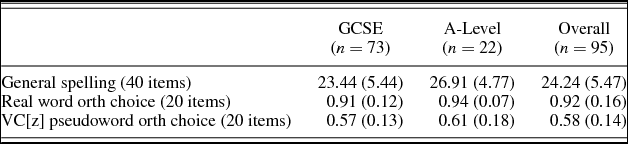
The mean numbers of correct spellings on the general spelling test, of correctly selected spellings of real words and of VC[z] pseudowords, for participants of the two education levels, are shown in Table 7. Participants did relatively well, although certainly not at ceiling, at choosing the appropriate spelling for the real words, which suggests that they understood the task requirements. On the VC[z] pseudowords, however, performance was quite low, suggesting that participants made limited use of the cues provided by words with this pattern.
Means (standard deviations) for adults’ general spelling (raw scores out of 40), and real word and VC[z] pseudoword orthographic choice (proportions)

The participants’ performance on the four categories of experimental pseudowords was then considered. The reliability of the scale for the categories was moderate to good, with Cronbach α calculated at 0.71 for [ks] nouns, 0.60 for [ks] verbs, 0.72 for [z] nouns, and 0.68 for [ks] verbs. The participants’ mean scores on the [z] and [ks] pseudowords are shown in Table 8. Overall, participants chose the appropriate spelling for these pseudowords a little less than two-thirds of the time, with minor variations across education level and pseudoword category. It appears that the understanding and use of apparently simple morphological rules is not perfect by adulthood, at least in this sample.
Means (standard deviations) for adults’ spelling of pseudowords (proportions) across education groups

Note: All participants completed all 30 of each pseudoword type.
Individual differences
We then calculated the number and percentage of participants who performed significantly above chance (21 or more out of 30) on the four categories of [ks] nouns, [ks] verbs, [z] nouns, and [z] verbs. These significantly above-chance performers are shown in Table 9. Even in this adult sample, overall, only a minority of participants chose appropriate spellings at a rate higher than would be expected by chance: about 37% overall. On the [ks] nouns and verbs, and the [z] nouns and verbs, these adults showed mean scores out of 30 of 24.4, 24.0, 24.4, and 24.6, respectively. The remainder of the sample chose spellings at around chance level, which suggests that they were not consistently following morphological rules. Their mean scores across pseudoword types were 16.7, 16.5, 15.7, and 15.5, respectively. In contrast to the child samples, a greater percentage of women (36.4%) performed above chance than men (28.3%). However, this difference seems to be driven by the smaller group with A-levels (men 41.6%, women 56.3%), rather than the larger group with GCSEs (men 24.6%, women 25.0%).
Percentage (numbers) of adults of each education level who performed significantly above chance on pseudoword orthographic choice

As in the previous two experiments, there was no significant relationship between performance on the pseudoword orthographic choice task and the phonological features of the pseudowords (number of phonological neighbors or neighbors’ summed word frequency), nor of the order in which a pseudoword occurred in the test. A binary logistic regression was conducted to assess whether general spelling ability, education level, sex, pseudoword type (noun or verb), or ending sound ([ks] or [z]) helped to determine whether a participant would show above-chance or chance performance. This generalized linear mixed models analysis showed that spelling ability (p < .001), education level (p = .044), and word ending (p = .007) all made a significant contribution to performance on the pseudoword orthographic choice task, but sex and word type did not (nor any interactions). Specifically, participants improved significantly with each extra word spelled correctly on the general spelling task (OR = 1.14), were more likely to perform better if they had completed A-levels than GCSEs (OR = 1.71) and were nearly twice as likely to perform better on pseudowords ending in [ks] than in [z] (OR = 1.93). Thus, although adults did not differ in their performance on nouns and verbs, the difference in ending sound suggests that participants were using word-level, nonmorphological cues, in addition to any use of more reliable sentence-level morphological cues. The results also confirm previous findings of differences in applying simple morphological rules in adults with different levels of education (Kemp & Bryant, Reference Kemp and Bryant2003; Mitchell et al., Reference Mitchell, Kemp and Bryant2011), but suggest a differentiation even between those who have completed different levels of schooling preuniversity.
Comparison across experiments
We would have liked to present the same 120 stimuli to all participants across the three experiments. However, as mentioned earlier, this proved too difficult for the younger participants, and so our compromise was to present the full set of items in a fully or partially between-subjects design for the two school-age groups. This meant that we could not fully compare performance across the three experiments. However, we were able to make basic comparisons by conducting a chi-squared analysis on the proportion of participants who performed above chance overall on the main pseudoword orthographic choice tasks, across the three experiments: 34.4% of primary students, 44.7% of secondary students, and 37.3% of adults, as shown in Tables 3, 6, and 9. It confirmed that the differences across the three groups did not reach significance, χ2 (2) = 5.47, p = .07.
GENERAL DISCUSSION
We examined the ability of primary school children, secondary school children, and adults of two different education levels to choose spellings for pseudowords presented as inflected and uninflected nouns and verbs. The rules about using –s for the inflected forms, and other spellings for the uninflected forms, are among the simplest in the English orthography. The sentence contexts highlighted the morphology of the target pseudowords by presenting them in both inflected and uninflected forms. However, we found that across the age groups tested, participants chose the morphologically appropriate spelling only about two-thirds of the time.
This finding is important in that it goes against the claims made in conventional models of spelling development (e.g., Ehri, Reference Ehri, Perfetti, Rieben and Fayol1997; Frith, Reference Frith, Patterson, Coltheart and Marshall1985; Gentry & Gillet, Reference Gentry and Gillet1993; Henderson & Templeton, Reference Henderson and Templeton1986), and of various naturalistic and experimental spelling studies (e.g., Green et al., Reference Green, McCutchen, Schwiebert, Quinlan, Eva-Wood and Juelis2003; Leong, Reference Leong2009; Read, Reference Read1986) that simple inflectional endings are acquired by age 9 or 10, and certainly by the end of primary school. However, the present results support the conclusions of studies that have used more systematic or rigorous spelling comparisons to show that many children and adults (who have not received explicit teaching in this area) make no use, or inconsistent use, of morphological conventions in their spelling (Bourassa et al., Reference Bourassa, Beaupre and MacGregor2011; Kemp & Bryant, Reference Kemp and Bryant2003; Nunes et al., Reference Nunes, Bryant and Bindman1997a). The overall mean scores in the current study are higher than those in previous similar studies that have used a dictation format (Bourassa et al., Reference Bourassa, Beaupre and MacGregor2011; Kemp & Bryant, Reference Kemp and Bryant2003), but similar to the one previous study to use the easier two-alternative forced-choice format (Mitchell et al., Reference Mitchell, Kemp and Bryant2011).
The main aim of this study, however, was to go beyond group means to consider performance at the level of individual spellers. In each sample (primary students, secondary students, and adults), we saw a smaller group of participants who performed above chance on the orthographic choice task, and a larger group who did not. In none of the three samples did pseudoword order correlate significantly with pseudoword score: that is, over the course of the task, participants did not appear to learn or work out the morphology-based rule that could aid performance. These results support the idea that spellers do not make reliable use of morphological rules in their writing, at least when they have not been taught these rules, as in our samples. We conclude that in each sample, a minority of participants understood the morphological rules under study, and used them reasonably consistently (if imperfectly) in their spelling choices. The majority of participants, however, did not seem to use these morphological rules, and performed at, or close to, chance. These findings underscore the vital importance of considering individual differences in spellers’ use and understanding of morphology (Bryant & Nunes, Reference Bryant, Nunes, Pacton and Deacon2008).
The percentage of participants in the above-chance group appeared to increase with age group/education level within the three samples, but age group/education contributed significantly to performance group only in the adults. It seems that the children did not show consistent improvement with age, as might be expected on the basis of conventional models of spelling development. Although spelling skill generally improves with age, it seems that the variation in general spelling ability seen within groups was wide enough to mean that only spelling score itself, rather than exact age, was enough to predict membership of the above-chance group.
The difference between adults at different secondary education levels observed here adds to previous findings that adults with a university education make better use of the plural –s inflection than those without (Kemp & Bryant, Reference Kemp and Bryant2003), and specifically, that the vast majority of university-educated adults perform above chance on this kind of pseudoword spelling task, while the vast majority of non-university-educated adults do not (Mitchell et al., Reference Mitchell, Kemp and Bryant2011). We do not wish to imply that a longer education is what teaches people to understand and use simple morphological rules. Instead, we suggest that individuals who are more interested and skilled in the structure of written language are probably those who pick up on morphological regularities in language and learn to apply them in writing. These people are the ones who are likely to go on to tertiary education, where these linguistic and analytical skills are valued. Those who are less interested in the structure of language might never notice these morphological regularities or learn these rules, and might be more likely to choose a less academic path.
If children and adults do not consistently use morphological rules to spell inflected and noninflected endings, on what do they base their spelling decisions? We suggest that participants were using their knowledge of statistical patterns of letter co-occurrence. This suggestion is supported by participants’ performance on the VC[z] pseudowords (ending in a voiced consonant plus [z], e.g., [stɒgz], stogs), which exemplified the pattern that word-final [z] after a voiced consonant is nearly always spelled –s, regardless of morphology. In line with previous research (Kemp & Bryant, Reference Kemp and Bryant2003), the primary school participants chose the correct ending about 75% of the time for these pseudowords. In contrast with the children, and with previous adult performance (Kemp & Bryant, Reference Kemp and Bryant2003; Mitchell et al., Reference Mitchell, Kemp and Bryant2011), the adults chose the correct ending only about 58% of the time. Previous studies have shown that sensitivity to statistical patterns in spelling increases with age/school grade and develops from print exposure rather than direct instruction (e.g., Hayes et al., Reference Hayes, Treiman and Kessler2006; Thompson et al., Reference Thompson, Fletcher-Flinn and Cottrell1999; Treiman & Kessler, Reference Treiman and Kessler2006). The present findings suggest that such sensitivity might also differ between adults, and might be associated with education level. More generally, however, it seems that when spelling inflected words in the real world, some adults and children may simply be relying on knowledge of a large number of individually learned words, rather than using the kinds of morphological rules, or even statistical patterns, often assumed.
Across the three experiments, participants did not perform equally well on all four categories of pseudoword. The spellers in all three samples were more likely to perform above chance on pseudowords ending in [ks] than in [z]. This might reflect a tendency to rely on knowledge of stored spellings: participants may have tried to think of similar-sounding real words on which to base their decisions. However, this does not seem to be the whole explanation: neither the number of real words that were just one phoneme different nor these words’ frequency in written language was related to the likelihood of participants choosing the morphologically appropriate spelling for the pseudowords. Even if participants were able to think of infrequent real words to use as spelling analogies, this would be a generally unsuccessful strategy, as there would be both inflected and uninflected phonological neighbors for virtually all the items (e.g., [priz] could be spelled like knees or breeze, or [zæks] like packs or wax). Participants may also have based their pseudoword spelling choices on individual patterns of word-final letter co-occurrence. Thus, they may have found it easier to choose an appropriate analogy for [ks] than [z] pseudowords because of the smaller range of possible spellings that exist for real words ending in [ks]: they can be spelled with –x or with –s preceded by a representation of [k]. Real words ending in [z], however, can be spelled with –z, –zz, –ze, –se, or –s, and this range of possibilities may have made it more difficult to choose the correct one of the two presented in the task.
There was also a difference for pseudoword type. Both the primary and secondary school children were more likely to perform above chance when choosing the endings for nouns than for verbs (a difference not seen in the adult sample). This finding would not be predicted by stage models of spelling development, which suggest that children acquire simple inflectional endings, including plural noun/present verb –s, at about the same time. However, it does fit with the robust finding that plural noun –s is acquired quite early in speech, and certainly earlier than third-person present verb –s in toddlers’ speech (Brown, Reference Brown1973; de Villiers & de Villiers, Reference de Villiers and de Villiers1973), and in children's naturalistic writing (Turnbull et al., Reference Turnbull, Deacon and Kay-Raining Bird2011) and dictated spelling (Bourassa et al., Reference Bourassa, Beaupre and MacGregor2011; Leong, Reference Leong2009). Further, a post hoc analysis showed that real monosyllabic nouns of the structure used for our pseudowords (ending in a long vowel plus [z] or a short vowel plus [ks]) are more numerous (n = 483) and have a higher summed frequency (19,960) than real monosyllabic verbs with that structure (n = 300, summed frequency = 14,438; Coltheart, Reference Coltheart1981). Thus, our child participants’ superior performance on nouns than verbs probably also reflects their greater exposure in written text to nouns than verbs of the forms used in our experiments.
There are several limitations to these studies that should be considered. The reliability data for the major outcomes were for the most part only moderate, and future research designs should aim to improve on these values. An unavoidable limitation was that the child participants had the capacity to complete only one-quarter (primary students) or one-half (secondary students) of the 120 pseudoword stimuli completed by the adults. This means that statistical comparison across the three experiments was restricted to a simple comparison of the proportion of above-chance performers in each. Further, the secondary school from which we drew our sample had relatively high academic standards, and unlike those in our adult sample, it is likely that many of the secondary school participants would go on to university. Thus, any comparisons between our three broad samples need to be interpreted with caution, as they are not necessarily equally representative of their respective age groups overall. Having better matched groups would strengthen this aspect of future research in this area.
Nevertheless, the present finding of above-chance performance in less than half of adults with A-levels, and just over a quarter of adults with GCSEs, adds to previous suggestions (Kemp & Bryant, Reference Kemp and Bryant2003; Mitchell et al., Reference Mitchell, Kemp and Bryant2011) that many adults might never acquire this inflection at all. As noted earlier, almost all research on spelling and morphology in typical adults (and even much research on dyslexic adults) comes from undergraduate students, often in female-dominated groups, who provide a convenient and reliable participant pool (e.g., Burt et al., Reference Burt, Salzgeber and Carroll2013; Coleman et al., Reference Coleman, Gregg, McLain and Bellair2009). However, in most countries, including the United Kingdom (UK Government, 2014), they do not represent the majority of the population. The military participants tested here were male dominated, but we did not see evidence for strong sex differences. These recruits’ wide range of educational backgrounds means that their responses are probably more representative of those of the general population than the responses of a traditional undergraduate sample would be. Future research in this area should aim to test an even greater variety of participants, to allow broader generalizations to be made.
In sum, the present studies add to the findings that suggest that children, and even adults, may not know and apply apparently simple morphology-based rules in their spelling. On a practical level, the results emphasize the importance of testing the use of spelling rules systematically, through the use of unfamiliar words and through comparing performance on words that do not require the spelling pattern under study, as well as on words that do. If many people are not able to apply simple morphological rules, then it is important to teach these rules explicitly from the early years of school. On a theoretical level, the current findings contribute to the idea that some spelling and morphological knowledge is acquired later than is usually assumed, or not at all. Finally, these outcomes serve as a reminder of the need to consider individual, as well as overall, performance, and of the importance of looking beyond the university classroom, before drawing general conclusions about spelling ability, and particularly about the use of morphemes in spelling, in adults.
APPENDIX A
Real-word spelling pairs
In Experiment 1, primary school children saw 10 [ks] or 10 [z] word pairs; in Experiments 2 and 3, secondary school children and adults saw 10 [ks] and 10 [z] word pairs: fox/focks, bocks/box, hoax/hoacks, ficks/fix, wax/wacks, sacks/sax, lox/locks, trucks/trux, packs/pax, kicks/kix; breeze/brees, cheese/chees, blays/blaze, maze/mays, wheeze/whees, seaze/seas, zooze/zoos, beeze/bees, plays/plaze, and sways/swaze. (Note that in several cases the “incorrect” choice did represent a possible word (e.g., sax, lox), but these words were nonsensical as well as morphologically inappropriate in the contexts given, and of much lower frequency than the correct choice, and thus it was considered unlikely that any participants would be confused by the potential alternative spellings.)
VC[Z] [seudoword pairs
In Experiment 1, primary school children saw a subset of 10 of these pseudoword pairs; in Experiment 3, adults saw all 16 pseudoword pairs: credze/creds, pleenze/pleens, stogs/stogze, broogze/broogs, clavs/clavze, troms/tromze, crunze/cruns, nargs/nargze, vinze/vins, veets/veetze, stoogze/stoogs, truds/trudze, lomze/loms, noogs/noogze, foomze/fooms, and chabs/chabze.
Main pseudoword pairs
In Experiment 1, primary school children saw 30 pseudoword pairs: all [ks] nouns, all [ks] verbs, all [z] nouns, or all [z] verbs; in Experiment 2, secondary school children saw 60 pseudoword pairs: either all [ks] and [z] nouns or all [ks] and [z] verbs; in Experiment 3, adults saw all 120 pseudoword pairs. Half the time the pseudowords were presented as nouns and verbs as listed here; half the time they were counterbalanced and presented as verbs and nouns: [z] nouns: vaze/vays, moize/moys, droze/droes, heeze/hees, gruze/grues, preeze/prees, kaze/kays, fooze/foos, kroize/kroys, phoze/phoes, troze/troes, fruze/frues, skaze/skays, klaze/klays, vruze/vrues, stroze/stroes, zaze/zays, creeze/crees, greeze/grees, blize/blies, stuze/stues, cleeze/clees, taze/tays, pruze/prues, thaze/thays, veeze/vees, and pluze/plues. [z] verbs: skoize/skoys, smuze/smoos, dwaize/dways, kize/kies, deeze/dees, voze/voes, stoze/stoes, sreeze/srees, queeze/quees, smoize/smoys, kleeze/klees, druze/drues, dooze/doos, keeze/kees, speeze/spees, moze/moes, swuze/swues, veeze/vees, voize/voys, fruze/frues, dreeze/drees, glize/glise, broze/broes, blooze/bloos, steeze/stees, vuze/voos, gooze/goos, vraze/vrays, streeze/strees, and snaze/snays. [ks] nouns: snox/snocks, crex/crecks, drax/dracks, thex/thecks, frix/fricks, krux/krucks, drex/drecks, zix/zicks, glix/glicks, slox/slocks, thax/thacks, yox/yocks, grax/gracks, brux/brucks, blex/blecks, jex/jecks, grix/gricks, vox/vocks, quox/quocks, plax/placks, blux/blucks, plix/plicks, bix/bicks, frax/fracks, zax/zacks, prex/precks, tox/tocks, gox/gocks, jix/jicks, and swex/swecks. [ks] verbs: drux/drucks, glox/glocks, yax/yacks, trex/trecks, dax/dacks, yex/yecks, brox/brocks, dox/docks, blix/blicks, gax/gacks, crix/cricks, prex/precks, drox/drocks, prox/procks, grex/grecks, srix/sricks, prax/pracks, frex/frecks, srex/srecks, brax/bracks, yix/yicks, grux/grucks, plex/plecks, drix/dricks, swox/swocks, plox/plocks, strix/stricks, tex/tecks, skax/skacks, and trox/trocks.
ACKNOWLEDGMENTS
We thank the school students and the new recruits to the British military services who took part in these studies. We are also grateful to the school staff and parents, and to the military services, for allowing us to administer our tasks to these participants.