Introduction
Direct oral anticoagulants (DOACs) are indicated for a number of medical conditions, including non-valvular atrial fibrillation and venous thromboembolism.Reference Gómez-Outes, Suárez-Gea, Lecumberri, Terleira-Fernández and Vargas-Castrillón 1 Their adoption into clinical practice has been rapid, accounting for 62% of new anticoagulant prescriptions for atrial fibrillation and 98% of anticoagulant-related drug costs between 2010 and 2013.Reference Desai, Krumme and Schneeweiss 2 These numbers are expected to grow as more studies analyze the safety of DOACs in other patient populations, including pregnant patients and patients with end-stage renal disease.Reference Young, Al-Mondhiry, Vaida, Ambrose and Botti 3 , Reference Hart, Pearce and Aguilar 4
While the risk of bleeding with DOACs may be lower compared to a vitamin K antagonist,Reference Kakkos, Kirkilesis and Tsolakis 5 the use of any anticoagulant still poses an increased bleeding risk. A satisfactory solution to bleeding in patients taking DOACs has yet to be developed.Reference Sartori and Prandoni 6 Therapies for reversing anticoagulation include drug removal through dialysis and administration of prothrombin complex concentrates (PCCs).Reference Sartori and Prandoni 6 Dialysis may take too long to be effective in an emergency, and PCCs may lead to thrombotic complications in a vulnerable population.Reference Sorensen, Spahn, Innerhofer, Spannagl and Rossaint 7 , Reference Makris, Van Veen, Tait, Mumford and Laffan 8 In October of 2015, the Food and Drug Administration (FDA; Silver Spring, Maryland USA) approved idarucizumab, a specific antidote for the DOAC, dabigatran, a direct thrombin inhibitor. While idarucizumab appears effective, it is costlyReference Yogaratnam, Ditch, Medeiros, Doyno and Fong 9 and may not be practical when needed in the emergency department (ED) or prehospital setting. It also does not address the reversal of the DOACs that inhibit factor Xa (FXa).
This study explores the ability of kaolin-based and chitosan-based topical hemostatic agents to reverse the effects of a representative DOAC, rivaroxaban. Rivaroxaban binds to the active site of FXa and inhibits FXa’s ability to convert prothrombin to thrombin, preventing amplification of the coagulation cascade.Reference Kubitza and Haas 10 Inhibiting FXa also prevents platelet activation.Reference Kubitza and Haas 10
Topical hemostatic agents have been used by military and Emergency Medical Service providers for the control of external hemorrhage.Reference Gordy, Rhee and Schreiber 11 The agents are available at sporting goods stores, military surplus vendors, or online marketplaces without a prescription. They are applied as impregnated bandages or powders, and their onset of effect is extremely rapid.Reference Gordy, Rhee and Schreiber 11 The various hemostatic agents work by different mechanisms.
Chitosan-based products cause platelet activation and erythrocyte adhesion, due to their positively charged carbohydrate components binding negative charged moieties on erythrocytes.Reference Cox, Schreiber, McManus, Wade and Holcomb 12 , Reference Granville-Chapman, Jacobs and Midwinter 13 This mechanism is independent of the clotting cascade and should be unhindered by FXa inhibitors. Thus, chitosan-based products should improve coagulation in blood anticoagulated with rivaroxaban.
Kaolin, the key component of other hemostatic products, works by two mechanisms. First, the inert minerals in the product act by rapidly dehydrating their substrate.Reference Makris, Van Veen, Tait, Mumford and Laffan 8 Kaolin also initiates the intrinsic coagulation pathway by activating factor XII (FXII).Reference Rhee, Brown and Martin 14 , Reference Walsh 15 Since FXII is upstream of the actions of the rivaroxaban, the authors predicted that this product would not be effective at promoting coagulation in blood anticoagulated with rivaroxaban.
Methods
The authors conducted a prospective, experimental pilot study at two university-based EDs with a combined annual adult volume of over 270,000 patients. This study was approved by the Institutional Review Boards of both Columbia University Medical Center (New York, New York USA) and Weill Cornell Medical College (New York, New York USA). Patients who presented to the ED and met the following criteria were eligible for the study: (1) taking rivaroxaban for any indication; (2) age ≥18 years; (3) non-pregnant; and (4) not taking any other anticoagulant or anti-platelet medication other than aspirin. Eligible subjects were identified using the electronic medical record system or by direct patient interview with informed consent obtained by one of the authors. Participants completed a health history questionnaire which assessed their medications, medication compliance, past medical history, and reasons for the current ED visit. Participants then had one tube of citrated blood (2.7 mL) drawn for analysis.
Both the kaolin-based hemostatic agent, QuikClot Combat Gauze (Z-Medica, LLC; Wallingford, Connecticut USA), and the chitosan-based agent, Celox Hemostatic Granules (Medtrade Products Ltd; Crewe, United Kingdom), were stored in sealed plastic bags in a secure location after opening and handled only with forceps and nitrile gloves to avoid contamination.
Blood samples were analyzed by rotational thromboelastometry (ROTEM) using a ROTEM delta (TEM Innovations GmbH; Munich, Germany) analyzer within two hours of acquisition. For each sample, three tests were run simultaneously at 37°C using Non-Activated Thromboelastometry (NATEM), following the manufacturer’s instructions, except where otherwise stated. The NATEM test was chosen for two reasons: first, there are no additives to the blood other than the reagent (0.2 mol/l CaCl2 in HEPES buffer pH 7.4 and 0.1% sodium acide) used to re-calcify the citrated blood; and second, it is sensitive to any change in the coagulation system. Clotting time (CT), clot formation time (CFT), and maximum clot firmness (MCF) were analyzed. For each citrated tube, the first test used the participant’s blood only. During the second test, 15 granules of chitosan-based hemostatic were transferred, using a folded slip of paper, to the participant’s blood in the step immediately after adding the re-calcifying agent. Finally, a 0.5cm x 0.5 cm square of kaolin-impregnated gauze was added to the remaining citrated blood. Since the NATEM tests were always performed in the same order, the volume of remaining blood was constant at 2.02mL, which is equivalent to the volume of blood in the citrated tube (2.7mL), less the blood used in the two previous tests (340µL per test). The tube was inverted gently back and forth for 30 seconds to expose the blood to the gauze prior to being added to the analyzer. After the measurements were taken, the data were entered into a Microsoft Excel 2010 (Microsoft Corporation; Redmond, Washington USA) spreadsheet. The percentage of patients whose ROTEM parameters responded to the hemostatic agent and the average percent changes in ROTEM parameters were determined.
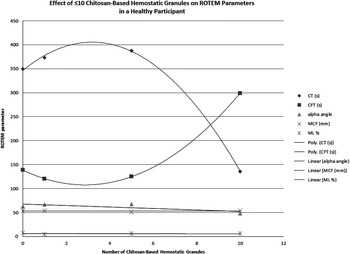
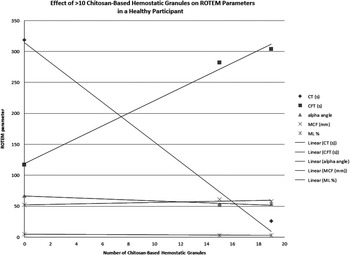
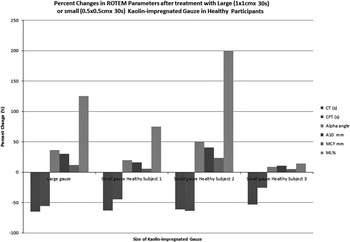
To the authors’ knowledge, the coagulation effects of topical hemostatic agents have not been previously evaluated using ROTEM. To determine the amount of hemostatic agent needed for each ROTEM test, it was necessary to detect an effect on coagulation parameters while simultaneously preventing the blood from clotting too quickly for the machine to measure. For the chitosan-based hemostatic agent, the test dose of 15 granules was determined empirically. The number of granules was increased until the machine could not perform an analysis because the sample clotted too quickly (Figure 1 and Figure 2). The method for testing the kaolin-impregnated gauze was also devised empirically, using the smallest practical area to demonstrate an effect. Initially, a 1x1cm piece of kaolin-impregnated gauze was added to a tube of citrated blood and inverted gently for 30 seconds just prior to adding the exposed blood to ROTEM. The gauze itself is not added to the ROTEM, since doing so is not technically possible in the analyzer. After testing the 1x1cm gauze, a smaller piece of gauze (0.5x0.5cm) was tested, and it was noted that it could also demonstrate a similar effect on ROTEM parameters. This size of gauze was then tested with three different tubes of citrated blood from healthy participants, showing a consistent direction of effect (Figure 3).
Data from Empiric Determination of Chitosan-Based Hemostatic “Dose” for Subsequent Experiments (≤10 granules). Abbreviations: CFT, clot formation time; CT, clotting time; MCF, maximum clot firmness; ROTEM, rotational thromboelastometry.

Data from Empiric Determination of Chitosan-Based Hemostatic “Dose” for Subsequent Experiments (>10 granules). Abbreviations: CFT, clot formation time; CT, clotting time; MCF, maximum clot firmness; ROTEM, rotational thromboelastometry.

Data from Empiric Determination of Kaolin-Based Hemostatic “Dose” for Subsequent Experiments. Abbreviations: CFT, clot formation time; CT, clotting time; MCF, maximum clot firmness; ROTEM, rotational thromboelastometry.

Results
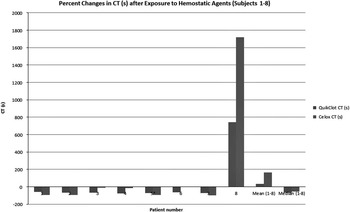
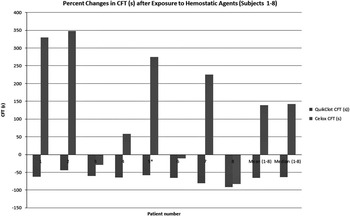
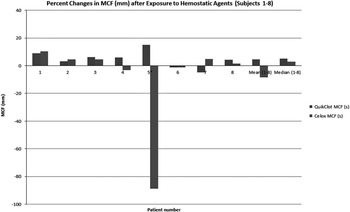
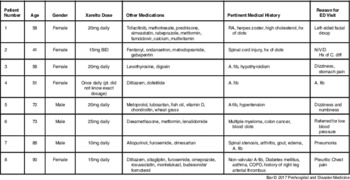
A summary of participant characteristics is given in Table 1. Figure 4 through Figure 6 illustrate the changes in coagulation parameters for individual patients. Notably, the clotting times for Participant 8 were outliers (>1.5 interquartile ranges above the 3rd quartile) for unknown reasons. For this reason, both the mean and median of the dataset are reported.
Percent Changes in Clotting Time (seconds) after Exposure to Hemostatic Agents. Note: During the test of the chitosan-based hemostatic agent, the ROTEM recorded error code 6033, which means that the measurement was influenced by drying of the sample (likely due to chitosan-based hemostatic test effect). During the kaolin-impregnated gauze test, the ROTEM recorded error code 4033, which is a motion timeout error. This usually occurs when the firmness cannot be determined due to mechanical failure. Abbreviations: CT, clotting time; ROTEM, rotational thromboelastometry.

Percent Changes in Clot Formation Time (seconds) after Exposure to Hemostatic Agents. Note: During the test of the chitosan-based hemostatic agent, the ROTEM recorded error code 6033, which means that the measurement was influenced by drying of the sample (likely due to chitosan-based hemostatic test effect). During the kaolin-impregnated gauze test, the ROTEM recorded error code 4033, which is a motion timeout error. This usually occurs when the firmness cannot be determined due to mechanical failure. Abbreviations: CFT, clot formation time; ROTEM, rotational thromboelastometry.

Percent Changes in Max Clot Firmness (millimeters) after Exposure to Hemostatic Agent. Note: During the test of the chitosan-based hemostatic agent, the ROTEM recorded error code 6033, which means that the measurement was influenced by drying of the sample (likely due to chitosan-based hemostatic test effect). During the kaolin-impregnated gauze test, the ROTEM recorded error code 4033, which is a motion timeout error. This usually occurs when the firmness cannot be determined due to mechanical failure. Abbreviations: MCF, maximum clot firmness; ROTEM, rotational thromboelastometry.

Patient Characteristics

Abbreviation: ED, emergency department.
Of the samples treated with kaolin-impregnated gauze, seven (87.5%) showed reductions in CT, eight (100.0%) showed reductions in CFT, and six (75.0%) showed increases in MCF. Additionally, the average percent change in CT, CFT, and MCF for all patients was 32.5% (Standard Deviation [SD]: 286; Range: -75.3 to 740.7%); -66.0% (SD:14.4; Range: -91.4 to -44.1%); and 4.70% (SD: 6.10; Range: -4.8 to15.1%), respectively. The corresponding median percent changes were -68.1%, -64.0%, and 5.2%, respectively.
Of the samples treated with chitosan-based hemostatic, six (75.0%) showed reductions in CT, three (37.5%) showed reductions in CFT, and five (62.5%) showed increases in MCF. The average percent changes for CT, CFT, and MCF for all patients were 165.0% (SD: 629; Range: -96.9 to 1718.5%); 139.0% (SD: 174; Range: -83.3 to 348.0%); and -8.38% (SD: 32.7; Range: -88.7 to 10.4%), respectively. The corresponding median percent changes were -53.7%, 141.8%, and 3.0%, respectively.
Discussion
The overall results of this study were encouraging. Because kaolin activates the clotting cascade prior to the activation of FXa,Reference Rhee, Brown and Martin 14 , Reference Walsh 15 the authors hypothesized that there would be no changes in CT, CFT, or MCF in blood treated with kaolin-based hemostatic. Therefore, seeing the majority of samples treated with kaolin-based hemostatic responding in a direction towards increased coagulability was unexpected. This may be the result of an incomplete blockade of FXa by rivaroxaban, or the kaolin may be working by an entirely different mechanism.
For the samples treated with the chitosan-based hemostatic agent, the authors hypothesized that the CT and CFT would decrease and that the MCF would increase. This proved to be true in the majority of cases for the CT, but not for the CFT and MCF, with the CFT actually increasing. It is suspected that the CFT increased because the parameter is proportional to the rate of fibrin polymerization. As a clot forms in the analyzer, forming strands of fibrin resist the motion of the pin, which the machine detects to generate a measurement. Chitosan-based hemostatics do not act by polymerizing fibrin, but instead by aggregating erythrocytes to form a gel-like clot. This type of clot may be providing less resistance to pin motion, leading to higher CFT readings. This explanation is consistent with the observed results for the samples treated with kaolin-impregnated gauze, which showed reductions in CFT. Since kaolin-based hemostatic agent works by activating the clotting cascade and therefore increasing fibrin polymerization, the clots it generates cause increased motion restriction on the pin, leading to the observed results. The results for MCF in samples treated with chitosan-based hemostatic agent were variable. Since the MCF is dependent on the amount of clottable substrate, the results may be explained by the fact that each granule of chitosan-based hemostatic is not exactly the same size and shape. Therefore, each 15 granules tested may have had a different surface area and total volume upon which to build clot.
Based on this study, it is difficult to make head-to-head comparisons between the hemostatic agents. However, in general, the magnitude of the changes in CT and CFT were much higher with chitosan-based hemostatic agent compared to the kaolin-impregnated gauze, but the variability of response was also higher. This may be explained by the fact that such a small number of chitosan-based hemostatic granules were used in these tests. Since each granule is not the same size and shape, there is room for considerable variability. However, in the setting of an actual wound to which grams of granules are introduced, it is possible that the differences between granules would average out and a more consistent effect would be observed. For this reason, future studies using in vivo models of bleeding would help facilitate direct comparison and also help determine if changes in ROTEM parameters correspond to a clinically significant effect at a real wound site.
Limitations
This study has several other limitations, notably the small sample size. The authors were also unable to enroll enough case-matched controls not taking rivaroxaban in the study. Performing the same test on blood samples from these participants would allow comparisons between the percent changes in these participants and the ones taking rivaroxaban, and if the hemostatic agents are either fully or partially overcoming the anticoagulation. It would also allow better control of other participant characteristics that might be influencing the action of kaolin-based hemostatic or chitosan-based hemostatic. Lastly, this study relied on self-report for assessing compliance with medications, so it is possible that some of the patients were not taking rivaroxaban as directed or were taking other undisclosed medications.
To help address these limitations, there are several next steps: (1) increase the study sample size; (2) recruit case-match controls to account for additional patient characteristics and alternate medication interactions; and (3) expand recruitment to other DOACs.
Despite the aforementioned limitations, this study adds two contributions to the literature. First, it demonstrates that ROTEM analysis can be used to detect changes caused by topical hemostatic agents. Second, it suggests that such hemostatic agents may be beneficial as an adjunct to other methods of hemorrhage control in patients taking rivaroxaban. This is likely to be valuable to prehospital providers and providers working in backcountry settings who need a field-expedient solution that requires minimal medical training to apply. It would also be particularly valuable to physicians who need local anticoagulation reversal at a wound site, without the systemic reversal of anticoagulation that an antidote would provide. Future studies may help determine which specific hemostatic agent is ideal in these circumstances.
Conclusion
Rotational thromboelastometry can detect changes in coagulation parameters caused by topical hemostatic agents when these agents are applied to rivaroxaban-anticoagulated blood. These changes trended in the direction towards increased coagulability, suggesting that kaolin and chitosan-based hemostatic agents may be effective at improving coagulation in these patients.
Acknowledgements
The authors would like to thank Michele Steinkamp, RN and Gebhard Wegener, MD for generously allowing the use of their ROTEM machines and supplies to process the samples. The authors would also like to thank Sunday Clark, ScD for her assistance.
Author Contributions
Jonathan Bar: literature search, study design, data collection, data analysis, data interpretation, writing, and critical revision. Alexa David: data collection and critical revision. Tarek Khader: literature search, data collection, writing, and critical revision. Mary Mulcare: data interpretation, data analysis, and critical revision. Christopher Tedeschi: study design, data interpretation, data analysis, and critical revision.