The old order in organic chemistry was changing, the art of the subject diminishing, its science increasing: no longer could one just mix things: sophistication in physical chemistry was the basis from which all chemists, including the organic chemist, must start. C. K. Ingold (Brock Reference Brock2000, 547–548)
1. Introduction
The progress in organic chemistry from Wöhler's synthesis of urea in 1828Footnote 1 to Woodward's successes in natural products synthesis in the second half of the twentieth century stands as a testament to the immense power of science to expand our understanding of the world. Woodward's synthesis of vitamin B12 (in collaboration with Eschenmoser)Footnote 2 demanded delicate control over a broad range of organic transformations and this control demanded, at least to some extent, understanding how and why organic reactions proceed in the ways that they do.Footnote 3 The scientific understanding that is manifest in modern synthetic organic chemistry was hard won by the cumulative effects of a long series of individual advances, both theoretical and technological. While recognizing that it is only part of a complicated story, in this paper I want to focus on the role of one of the more important theoretical advances that contributed to our contemporary understanding of the phenomena of organic chemistry. More specifically, the theoretical advance in which I am interested—the Ingold Revolution (circa 1934)—is one that led to a qualitative change in the way that organic chemists understand the phenomena that they study.Footnote 4 In other words, this revolution opened up the possibility of explaining classes of phenomena that could not have been explained before and which substantially changed the terms in which the phenomena of organic chemistry were to be explained. If it is possible to articulate how and why this advance led to a shift in the quality of our understanding of chemical phenomena, then it should be possible to develop some philosophical insight into the nature of scientific understanding, at least as this understanding is manifest in organic chemistry.
Before the Ingold Revolution, organic chemists had already made important theoretical advances that allowed for a dramatic increase in their ability to both explain and predict organic transformations. The most important of these advances was the development of structural formulas in the second half of the nineteenth century.Footnote 5 The development and use of such formulas by Kekulé, Couper, and others indicated their recognition that the distribution of atoms in space was the characteristic that individuated chemical kinds. By settling upon a (natural) classification scheme for the objects that they study, organic chemists were in a position to establish projectable correlationsFootnote 6 and to exploit analogies between the individuating characteristics of chemical kinds in making both predictionsFootnote 7 and explanations. So, more concretely, the adoption of structural formulas enabled chemists to focus on correlations between the structures of chemical compounds and the reactions that those compounds could undergo. This focus eventually paid off in the functional group classification scheme that is not only still used as the organizational basis for organic chemistry, but which also supports, to a certain extent, the prediction and explanation of organic reactions. The explanations and predications made possible by the functional group classification scheme (or more generally by correlations between structure and reactivity) proceed, roughly, by assimilating reactions (or compounds) of interest to standard types whose behavior is already known. While this type of explanation and/or prediction was (and is) extremely useful to organic chemists, it is insufficient to address many of the theoretical concerns that are important in contemporary organic chemistry.
The explanatory strategy that allowed organic chemists to go beyond the sorts of correlational explanations facilitated by the functional group classification scheme was born in the Ingold Revolution. The following quote from the historian of chemistry William Brock will serve nicely to highlight the importance of this revolution in the development of chemical understanding:
Wöhler, in a famous metaphor, had compared organic chemistry in the 1830s to a dark jungle. Nineteenth century structural chemists revealed the nature of the trees and leaves of this forest and pointed to the common patterns of growth as well as methods for quickly getting from A to B. But their maps of this jungle were presented to the tyro as a catalogue of preparations and reactions. The Ingold Revolution was to look for patterns in reactivity and to explain why reactions occurred in the way that they did by relating reactivity to molecular structure … Wöhler's forest was now revealed as an ordered plantation. (Brock Reference Brock2000, 569)
The Ingold Revolution, as Brock understands it, represents an additional theoretical development over and above the introduction of structural formulas. While structural chemists were able to make some headway in taming the “dark jungle” of organic chemistry by identifying “common patterns” of reactivity, they left their discipline as a “catalogue of preparations and reactions.” Only after the Ingold Revolution was organic chemistry unified in a systematic way and thereby “revealed as an ordered plantation.” One useful—though noticeably less colorful—way of restating Brock's point might be to say that even after the introduction of structural formulas, organic chemistry was still very much a descriptive science, unable to explain the correlations between structure and reactivity on which its functional group classification scheme depended. The importance of the Ingold Revolution, then, was to transform organic chemistry into a more theoretical science in which the patterns in reactivity (merely describable by the structural chemist) would themselves be explicable in robust, general terms. At the heart of Ingold's approach was a new theoretical device—the electronic reaction mechanism—which purported to describe how organic transformations take place by tracing both the movement of nuclei and the flow of the electrons responsible for chemical bonding.Footnote 8 While accounts of chemical bonding have evolved since Ingold's Revolution, both the role of mechanisms as the central theoretical construct of organic chemistry and most of the ways in which mechanisms are used to support explanations of chemical reactivity have endured. We can get a sense of the contemporary unifying role that mechanisms play in providing explanations of chemical phenomena by considering the following quote form a modern textbook in theoretical organic chemistry:
Theories about reaction mechanisms can explain diverse chemical phenomena in terms of a relatively small number of general principles. It is this latter capability of mechanistic theory that makes it important as an organizing device for the subject of organic chemistry as a whole. (Lowry and Richardson Reference Lowry and Richardson1987, xi)
This quote, together with the quote from Brock, suggest that the Ingold Revolution transformed the way that organic chemists understand the phenomena they study by providing a unified framework for explaining organic reactions that depended upon relating reactivity and structure through mechanisms. Understanding how these ideas come together to create a unified, systematic explanatory strategy for organic chemistry should prove to be philosophically interesting because this strategy resulted in a qualitative shift, with profound practical implications, in the way that organic chemists come to terms with the phenomena they study.
2. Explanation in Organic Chemistry after the Ingold Revolution
In order to get a handle on how the Ingold Revolution enabled organic chemists to reveal their subject as an “ordered plantation,” I will analyze the sorts of explanations that became possible as a result of this revolution. This will involve describing a model of post-Ingold explanation in organic chemistry and then trying to characterize how this style of explanation both allows organic chemists to explain a broad range of phenomena and enhances their ability to control and manipulate organic transformations. The model of explanation in organic chemistry that I will describe has been more explicitly characterized elsewhere (Goodwin Reference Goodwin2003), so I will just sketch the model here and give some examples that emphasize aspects of this model that are particularly salient to its relationship to scientific understanding.
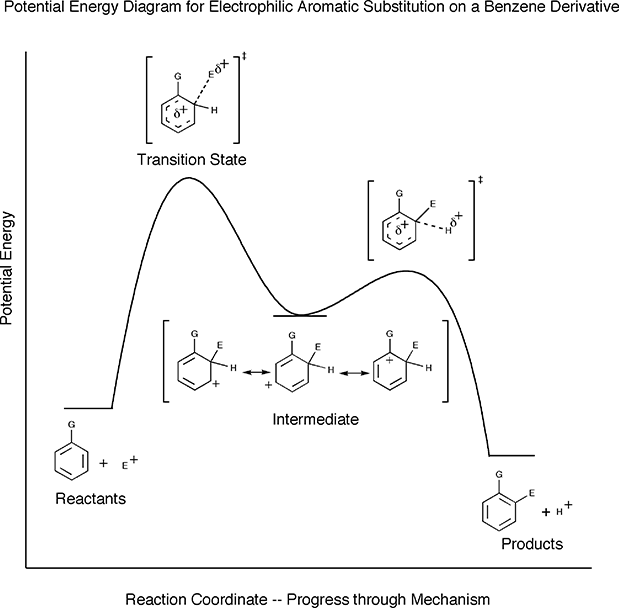
Many of the explanations offered in organic chemistry can be thought of as answers to ‘why’ questions about organic transformations. Thus, for example, the explanation of the relative rates of a class of reactions can be thought of as an answer to a question like, Why is the rate of reaction A greater than the rate of reaction B (rather than the same, or less than, the rate of reaction B)? Similarly, explanations of preferred pathways (and thus structural features of the products), or product distributions can also be construed as answers to these sorts of contrastive ‘why’ questions. There is a common background theoretical model that is employed in answering questions of this sort. For present purposes, we can think of this background theoretical model as the Potential Energy Diagram of the reaction (or reactions) mentioned in relevant ‘why’ question. Such diagrams plot the potential energy of intermediate structures in a transformation against the reaction coordinate, or the measure of progress through the transformation (see Figure 1 for an example). Direct answers to ‘why’ questions of this sort are provided by pointing out qualitative features of, or contrasts between, the relevant potential energy diagrams. To return to our previous example, one would answer a question about relative rates (or explain the relative rates of) a class of reactions by citing qualitative differences in the energies of the transition states (or highest energy points) of the reaction diagrams.
This figure depicts the most important intermediate structures in the ortho eletrophilic attach (by E+) of a monosubstrated benzene (with substituent G). These structures are superimposed over a qualitative potential energy diagram for this transformation. Adapted from Vollhardt and Schore (Reference Vollhardt and Schore1994, 574).

There is a feature of the direct answers to ‘why’ questions about organic transformations described above that it is important to highlight. The facts described in such direct answers are not only sufficient to entail that the topic of the question is true (in our example, that A is faster than B) and the alternatives in the contrast class are false (that the rates are not the same and B is not faster than A), but they are also in many cases (in the context of organic explanation) qualitative necessary conditions of the presupposition of the relevant question. In other words, in virtue of accepting the question as well posed, an experienced explainer can already infer the sorts of qualitative features of the potential energy diagrams that will constitute the direct answer to the question.Footnote 9 So to vary the example a bit, if someone asks for an explanation of the fact that a reaction under kinetic control (that is, a reaction whose product distribution is determined by the speed at which products form) results in product A rather than product B, it can be inferred that the direct answer to the question will be something like, Because the activation energy for transformation resulting in A is significantly lower than the activation energy for the transformation resulting in B. Because they, in some sense, follow from the form of the question, the direct answers to ‘why’ questions about organic transformations cannot be at the heart of what allows organic chemists to understand, explain, and control particular transformations. Instead, the direct answers to these ‘why’ questions reveal the common, theoretical apparatus provided by thermodynamics and transition state theory (or analogs) that underwrites how organic chemists think about transformations.Footnote 10
The additional component of explanation in organic chemistry—the component that allows the organic chemist to flesh out the formal, direct answers to ‘why’ questions—is provided by a structural account. The essential role of a structural account is to explain the relevant qualitative energy differences described in the direct answer to the question in terms of structural features of the reactants, products, or intermediate structures. Typically, these accounts proceed by applying a sequence of robustly applicable concepts that convert easily recognizable structural features into qualitative energy differences. For example, adjacent unsaturated electronegative substituents result in reduced relative energy for carbanions (because of resonance stabilization). Recognizing that a particular carbon-hydrogen bond has such an adjacent group while another does not would allow one to account for the fact that the conjugate base resulting from removal of the one hydrogen would have a relatively lower energy than the conjugate base resulting from removal of the second. A relative energy difference of this sort is precisely what would have to be accounted for in order to provide a structural account of the direct answer to a question about the relative acidity of the two hydrogens (Lowry and Richardson Reference Lowry and Richardson1987, 303–308). It is these robustly applicable structural concepts that provide the links between structure and energy, which when applied against a background theoretical model that links energy and reactivity, lead to the links between structure and reactivity that are characteristic of Ingold's approach to understanding chemical phenomena.Footnote 11
I have not yet explained the important role of mechanisms in providing explanations in organic chemistry. A mechanism is an idealized description of how the reactants in a transformation are converted into the products. Typically a mechanism will display the movement of both electrons (or chemical bonds) and nuclei as a sequence of representative intermediate structures. In the simplest case, the mechanism of a concerted transformation might be represented by a single intermediate structure that indicates both the approximate geometry and the bond breakage/formation occurring in the highest energy intermediate structure (the transition state) (see Figure 1 for an example). The simplest way to appreciate the importance of mechanisms to explanation in organic chemistry is to recognize that while most ‘why’ questions that one would ask in organic chemistry would be formulated by making reference to the structures of the reactants and products of the relevant transformations, the direct answers to these questions would involve indicating relative energy differences between intermediates in the transformations (most frequently the transition state). In order to provide a structural account of energy differences between intermediates in chemical transformations, one must know something about the structure of these intermediates—and this is exactly what a mechanism provides. For example, in many cases in organic chemistry where reactions are essentially irreversible, the product distribution of a reaction is decided by which of the possible products forms fastest. To explain a product distribution in such cases requires explaining why the transition state of the faster transformation is lower in energy than the transition state of the slower, competing transformation. A structural account of this kind of energy difference would require either knowing the structures of the transition states so that structural concepts could be applied directly to these intermediate structures, or appealing to something like the Hammond PostulateFootnote 12 which can be used to decide which structural features of the reactants or products are likely to determine the relative energies of the transition states. In either case, a concern for the mechanisms of transformations is demanded by the background theoretical model that chemists use in accounting for transformations. This model indicates that many questions about transformations can only be answered by appealing to energy differences between structures intermediate between reactants and products.
3. An Example: Electrophilic Substitution on Benzene Derivatives
In order to give a more concrete sense of how robustly applicable structural concepts can be employed in providing structural accounts of the relative energy differences relevant to explanation in organic chemistry, I am going to consider a class of reactions in which differences in rate and product distribution can be explained by invoking a small number of easily recognizable structural features. After describing how these structural concepts can be employed in these explanations, in the following section I will explain why they are much less useful at generating predictions, but can nonetheless lead to synthetic strategies that allow substantial control over the relevant class of reactions. The contemporary understanding of the class of reactions I am going to consider derives in large part from Ingold's work.Footnote 13
Benzene is a hydrocarbon composed of six carbon atoms and six hydrogen atoms arranged such that the carbon atoms form a six-membered ring and each carbon is attached to one hydrogen atom. A benzene derivative is a compound in which one (or more) of the hydrogens in a benzene molecule is replaced by a different chemical group called a substituent. Under appropriate circumstances, both benzene derivatives and benzene itself can undergo chemical transformations in which one of the hydrogens attached to the benzene ring is replaced by an electron-poor substituent called an electrophile, such transformations are known as electrophilic substitution reactions (see Figure 1, which shows the reactants, products and most important intermediates in an electrophilic aromatic substitution reaction on a benzene derivative superimposed over a potential energy diagram of the reaction).
There are vast differences in the rates of comparable electrophilic substitution reactions on benzene derivatives. Depending on what the substituent is in a benzene derivative, the rate of an electrophilic substitution reaction may be either faster or slower than the comparable substitution reaction when run with benzene itself. Substituents that lead to rates of reaction faster than the comparable reaction run with benzene are known as activating substituents, while substituents that lead to slower rates of reaction are knows a deactivating substituents. In order to provide a structural account of the impact of the substituents on the rates of these reactions, structural features of these substituents must be used to argue that activating substituents lead to a lower energy transition state (relative to benzene) while deactivating substituents lead to a higher energy transition state.
Because explaining differences in the rates of two reactions requires comparing the energies of the highest energy intermediates, if such a comparison is grounded in structural features of those intermediates, then something must be known, or assumed, about the mechanisms of the reactions.Footnote 14 In the case of electrophilic aromatic substitution reactions on benzene and its derivatives (again, see Figure 1 for an example of such a mechanism), there is a fairly firm consensus that the mechanism is a two step process, the first step of which is rate determining (has the highest energy intermediate). In the first step of the mechanism, the electrophile forms a bond with one of the unsubstituted carbons in the benzene ring thereby both disrupting the especially stable bonds that it had with the other members of the benzene ring and leading to a net positive charge on the ring. The second step involves the loss of a proton by the newly substituted carbon in the ring. The loss of the proton allows the ring carbon to resume especially stable bonding with the other members of the benzene ring and removes the net positive charge on the substituted benzene (Lowry and Richardson Reference Lowry and Richardson1987, 627–633). Because the rate-determining step in these reactions involves the creation of a positive charge on the benzene ring, substituents can influence the overall rate of the reaction by either stabilizing or destabilizing the formation of this carbocation intermediate.Footnote 15
The effect of substituents on the stability of this carbocation intermediate, and thus on the rate of the substitution reaction, arises from the combinations of two effects, known as the Inductive and Resonance Effects.Footnote 16 In the case of a particular substituent, one can determine, on the basis of structural features, both whether or not these effects will be applicable and whether the effect will lead to an increased or a decreased rate of reaction. The Inductive effect, which is important for providing explanations throughout organic chemistry, is the result of the substituent being either electron-donating or electron-withdrawing. These characteristics can themselves be discerned by considering both the composition and structure of the substituent. In general, substituents that either bond through (or contain) an electronegative atom such as (O, N, or one of the halogens) are electron withdrawing, while alkyl groups (groups containing just carbon and hydrogen) are electron releasing. In the case of electrophilic substitution on benzene derivatives, an electron releasing substituent will stabilize the carbocation intermediate (relative to benzene) by partially canceling the positive charge on the benzene ring and therefore leading to a faster rate. On the other hand, an electron withdrawing substituent would destabilize the carbocation intermediate by adding to the net positive charge on the ring and thereby slow the reaction down. The Resonance effect, which is also widely applicable throughout organic chemistry, is the result of the delocalization of electrons in chemical bonding. It is possible to determine whether a Resonance effect is important for a particular structure by considering the Lewis structures (which are simple representations of the distribution of valence electrons) that can be written for that structure. When it is possible to produce especially stable Lewis structures for a particular species,Footnote 17 this indicates that the delocalization of electrons would lead to increased stability for that species, while the presence of particularly unstable Lewis structures would indicate that there would be little stabilization due to electron delocalization. In the case of electrophilic substitution on benzene derivatives, it is the possibility of Lewis structures for the carbocation intermediate that determines whether or not the resonance effect is important for a particular substituent. For this particular type of reaction, there is a resonance effect leading to a more stable carbocation, and thus to a faster reaction (for certain products at least, but see below), when the substituent is bonded to the benzene ring through an electronegative atom containing a lone electron pair. Together, the Inductive and Resonance effects typically suffice to explain the effect of a particular substituent on the rate of electrophilic substitution, though in cases where the effects are conflicting, there is no a priori way of predicting which effect will dominate. So, for example, an amino substituent (−NH2) should decrease the rate by the Inductive effect (since Nitrogen is more electronegative than carbon) and increase it by the Resonance effect (since the nitrogen has a lone electron pair). As it turns out, the Resonance effect dominates and amino groups are strong activators, but in the analogous case of the halogens the Inductive effect dominates and so halogens are deactivators (Vollhardt and Schore Reference Vollhardt and Schore1994, 599–604).
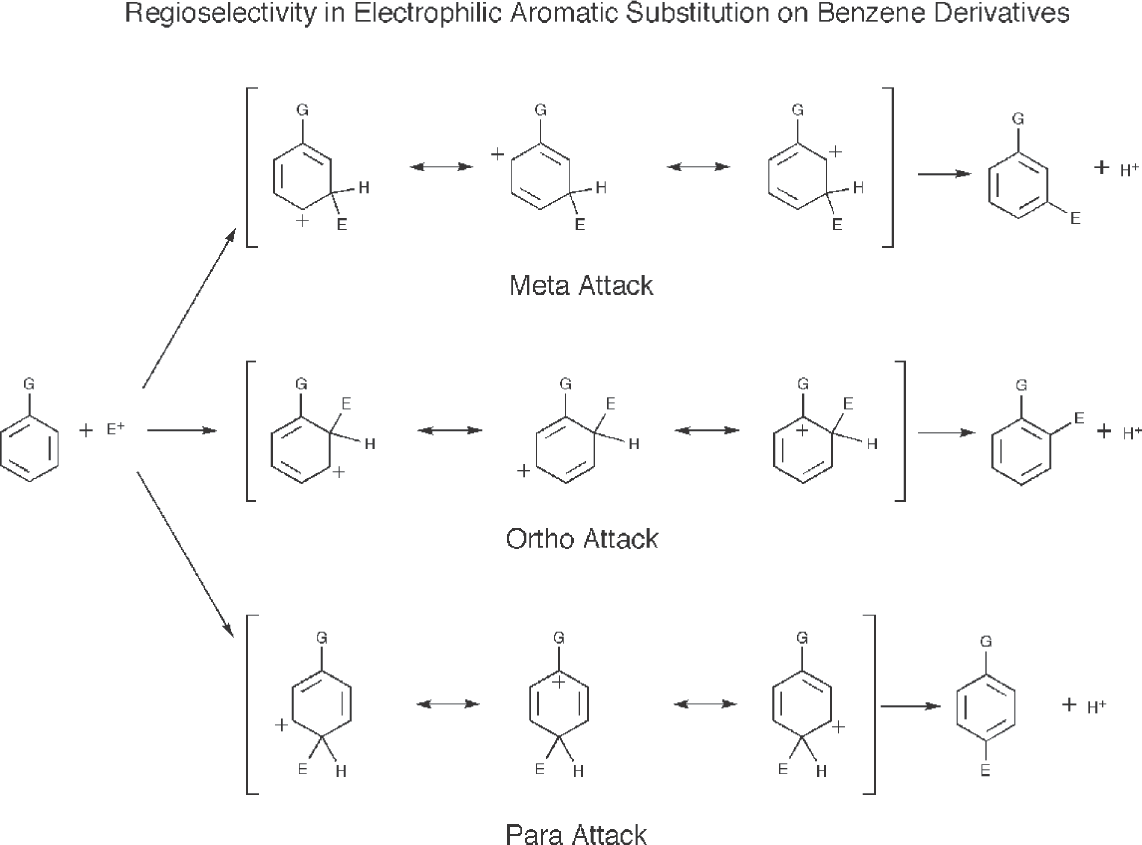
In addition to explaining the relative rates of electrophilic substitution on benzene derivatives by rationalizing the energetic impacts of various substituents on the transition states, the Inductive and Resonance effects can also be appealed to in order to explain the regioselectivity of these substitution reactions (see Figure 2, which shows the resonance structures of the intermediates leading to the different possible products of electrophilic substitution on derivatives of benzene). In a benzene derivative with only one substituent, there are five remaining hydrogens that might be removed in an electrophilic substitution reaction. If such a reaction shows a preference for substituting for certain of these hydrogens rather than others, then it is said to be regioselective. Because these substitution reactions are generally under kinetic control, regioselectivity is also explained by noting energy differences between the carbocation intermediates that would result from removal of the various hydrogens. The five hydrogens that might be removed in an electrophilic substitution can be partitioned into three equivalent classes according to their distance from the substituent on the ring. Ortho hydrogens are one carbon from the substituent, meta hydrogens are two carbons away, and the para hydrogen is three carbons away from the substituent. Activators direct substitution to the ortho and para hydrogens, while deactivators generally direct substitution to the meta hydrogens. This selectivity can be explained by comparing the resonance structures available for the different possible carbocation intermediates. When substitution occurs at either the ortho or para position, one of the resonance structures for the carbocation intermediate places a positive charge on the carbon to which the substituent is attached. If the substituent is an electron donor (and so has a positive Inductive effect), then one expects this resonance structure to be particularly stable because some electron density could be released from the substituent to reduce the positive charge on the ring carbon. Similarly if the substituent has a lone electron pair and thus has a positive Resonance effect, then when substitution occurs ortho or para, one can write a particularly stable Lewis structure for the carbocation where the positive charge is located on the bonding atom of the substituent (but where that bonding atom still has an octet). On the other hand, if the substituent is an electron withdrawing group (a deactivator) then placing a positive charge on the carbon to which the substituent is bound leads to a particularly unstable Lewis structure because “removing electron density from a positively charged center is energetically unfavored” (Vollhardt and Schore Reference Vollhardt and Schore1994, 598). As a result, deactivators generally favor substituting for the meta hydrogen where no such resonance structure is possible. Individual substitution reactions, and particularly those applied to multiply substituted benzene derivatives, may also exhibit regioselectivity that is controlled by steric factors, where the removal of a particular hydrogen is discouraged by the presence of bulky neighboring groups (Vollhardt and Schore Reference Vollhardt and Schore1994, 606). In summary, by appealing to structurally revealed features such as the presence of electronegative atoms, the possibility of certain resonance structures, or the existence of bulky substituents, the product distributions of many substitution reactions on benzene derivatives can be explained by linking these structural concepts with energy differences in relevant intermediate structures. The example provided by substitution on benzene derivatives is typical of post-Ingold explanation in organic chemistry, though of course new concepts (such as neighboring group effects) have been introduced where resonance, induction and steric hindrance have proved inadequate.Footnote 18
This figure depicts the three possible outcomes of attack by electrophile, E+, on a benzene with one substituent, G. The most important resonance structures of each of the possible intermediates are shown in brackets. Adapted from Vollhardt and Shore (Reference Vollhardt and Schore1994, 596).

4. Some Philosophically Significant Features of This Example
Before moving on to try to describe why post-Ingold explanations lead to an increase in scientific understanding, I want use the example of substitution reactions on benzene derivatives to bring out some important features of explanation in organic chemistry. First, it is often possible to explain a phenomenon in organic chemistry when that phenomenon could not have been predicted. This kind of situation occurs when there is a fairly firm sense of which structural features are relevant to a certain phenomena, but those structural features have conflicting energetic implications for the relevant structures. So, for example, we can return to the case of the effect of halogen substituents on electrophilic substitution in benzene derivatives. Halogens are very electronegative, so they can be expected to be strong electron-withdrawing groups and therefore to deactivate substitution by the Inductive effect. On the other hand, halogens have several lone electron pairs, which allow for particularly stable Lewis structures of the carbocation intermediate, and so they should activate substitution by the Resonance effect. As it turns out, halogens deactivate the benzene ring because “on balance the inductive effect wins out” (Vollhardt and Schore Reference Vollhardt and Schore1994, 603). Because there are only two structural features relevant to the activation or deactivation of the benzene ring in electrophilic substitution and these features have opposing effects in the case of the halogens, by appealing to the phenomena itself we can decide which of those factors is responsible for, or explains, the impact of halogens on the rate of this type of reaction. In fact, the case of the halogens is even more interesting because they direct substitution to the ortho and para hydrogens. Recall that electron-withdrawing groups generally direct substitution to the meta hydrogen because the carbocation formed by meta substitution does not have a Lewis structure where the positive charge is on the carbon to which the substituent is attached (which is particularly destabilized, indicating that the carbocation as a whole is less stable). Groups with a lone electron pair, on the other hand, direct substitution ortho and para because particularly stable Lewis structures are possible when the positive charge can be placed on the carbon to which the substituent is attached (indicating that the carbocation is more stable). Because halogens direct to ortho and para hydrogens, the effect of having especially stable Lewis structures made possible by the lone electron pairs in the case of ortho and para substitution must overwhelm the effect of having particularly unstable Lewis Structures which have an electron withdrawing group adjacent to a positive charge. The upshot is that while Inductive effects control the overall rate relative to benzene substitution, it is the Resonance effects that control the product distribution. In cases like this where effects compete, it is not generally possible to predict which effect will dominate using the sorts of qualitative comparisons that are used in Structural Accounts; nonetheless, it is often possible to explain the relevant feature of a transformation by appealing to facts about its outcome.
When effects compete, the numerical magnitudes of the effects decide what happens in a particular transformation. It is much more difficult, and much less common, for organic chemists to be able to make the sorts of quantitative estimates of the energetic impact of a structural feature that would be required in order to support even a qualitative prediction in such a case. Though there are a variety of empirical techniques available to organic chemists for quantifying the importance of substituent effects on reaction rates or equilibria,Footnote 19 the basic strategy of these techniques is measure the energetic impact of a substituent in a standard case and then to assume that there will be a simple functional relationship (such as a linear relationship) between this energy difference and the energy difference in cases of interest. Predictions can be made for a reaction once the parameters detailing the relationship between the energy differences in the standard case and the energy difference in the reaction of interest have been found. The applicability of these techniques is often limited to reactions relevantly similar to the standard reactions, and even where such predictions are possible, they are based on low-level empirical generalizations.Footnote 20 It seems plausible to conclude that in those cases where quantitative predictions can be made in organic chemistry, those predictions are not explanatory (at least by employing the sort of resources characteristic of post-Ingold organic chemistry) because they are based largely on mere correlations.
One of the characteristic features of traditional covering-law accounts of scientific explanation is that according to such accounts, there should be symmetry between explanation and prediction. That is to say that if it is possible to explain a phenomenon, then it should have been possible to predict it, and vice versa. A common criticism of this model of scientific explanation is that explanation/prediction symmetry breaks down in cases of well-established, but unexplained, correlations between two phenomena. In such a case, it would be possible to predict a phenomenon even though one could not explain it. As we have seen in the last paragraph, this seems to be the situation for those predications that are based on quantifying the energetic contributions of structural features in organic chemistry. Explanation in organic chemistry is also an example of the other—less frequently recognized—sort of counterexample to the explanation/prediction symmetry thesis, for it seems possible to provide explanations of phenomena in organic chemistry that could not have been predicted. One philosopher who has analyzed this sort of counterexample to the explanation/prediction symmetry thesis is Michael Scriven. He diagnosed the source of these counterexamples as follows:
Explanations can be supported by assertions about qualitative necessary conditions whereas even a conditional prediction requires quantitative sufficient conditions. … [A] prediction has to say when something will happen, or what will (sometime) happen, a causal explanation only what made it happen. (Scriven Reference Scriven and Pitt1988, 60)
This is a useful general characterization of just the sort of situation that came up in the prior discussion of explanation/prediction asymmetry in organic chemistry. It seemed that it was perfectly acceptable to explain a phenomenon in organic chemistry by pointing out what structural feature must have been responsible for the relevant energy difference, given that the phenomenon occurred. That is to say that one can provide a structural account in organic chemistry by identifying qualitative necessary conditions for the relevant energy differences. Such accounts can quite legitimately make use of the fact that the relevant phenomena occurred. On the other hand, it is much less common to have the sort of quantitative information that would be required to either make numerical predictions or even to predict which factor will dominate when there are conflicting structural features at play in a structure.
Scriven's diagnosis was provided in the course of examining certain kinds of causal explanations that are given in science and everyday life, such as explaining why a bridge collapsed by identifying the cause. Models of explanation in which phenomena are explained by providing an argument that shows they were to be expected, which are the sort of models that predict explanation/prediction symmetry, are particularly poorly suited for modeling explanations of this sort. Arguing that something was to be expected, like predicting it, requires identifying something like sufficient conditions for the phenomena. Since causal explanations often invoke the phenomena to be explained, if you insist upon thinking of them as arguments that the phenomena was to be expected, then they turn out to be circular arguments (since they use the conclusion as a premise).Footnote 21 The fact that Scriven's diagnosis of why causal explanation does not exhibit explanation/prediction symmetry maps so neatly onto the sort of explanation/prediction asymmetry that occurs in organic chemistry suggests that structural accounts may be much more formally analogous to traditional causal explanations than they are to explanations of the covering-law variety.Footnote 22 Indeed, both the ways that organic chemists identify the structural concepts that are relevant to a certain explanation and the ways that those concepts are invoked in explaining and predicting the phenomena seem to be more accurately characterized by John Stuart Mill's account of inductive logic than they are by twentieth century positivist accounts of scientific method. It is useful to think of the robustly applicable concepts of the structural accounts as analogous to sets of causal factors. When a particular feature appears in a structure, then this will have the effect of either raising or lowering the energy of that structure in a particular direction (the direction will, in general, depend on the overall chemical environment). These features can be identified by the Method of Difference, where one demonstrate differences in rate, or product distribution (or other measurable quantity that indicates a particular energy difference), between structures that differ only by the presence of that one structural feature. Once a relatively complete set of these energetic relevant structural features have been developed, one can explain what happens in novel cases by identifying the structural feature, or features that are responsible for the relevant energy difference. Predictions based on identifying structural features would depend on being able to ‘compose’ the effects of all of the operative structural features. Needless to say, the language of organic chemistry also supports this analogy, since the results of the general sorts of features invoked in giving structural accounts are known as “effects” of various sorts (steric, inductive, or resonance, for example).
One worry about thinking of structural accounts of energy differences as analogous to causal explanations is that it may become mysterious how explanation would be connected with being able to control and manipulate chemical transformations. It was the triumphs of synthetic organic chemistry that I invoked to motivate the idea that our understanding of organic chemistry has grown tremendously in the last two hundred years, but it is not clear how being able to identify the structural causes of energy differences would account for this kind of practical understanding. By contrast, if explaining something entails knowing that it was to be expected, then it seems clear why being able to provide explanations would translate into the ability to control and manipulate things. In virtue of being able to explain something, you would know sufficient conditions for bringing it about, so that by controlling those conditions, you could control the relevant phenomenon. The way around this worry is to recognize that knowing the causal factors relevant to a phenomena is often enough to allow the sort of design and control of reactions that goes on in synthetic organic chemistry. The question of how, and to what extent, the insights of theoretical organic chemistry drove the progress of synthetic organic chemistry is an extremely rich and interesting question, so I can only hope to offer some hints as to how the answer might go (in this paper at least). The key, I think, is to realize that even though there is no general explanation/prediction symmetry in providing structural accounts, it is still possible to make qualitative predictions when all the relevant structural factors have the same directional impact on the relevant energy (and so one can know the qualitative outcome of composing these factors). The consequence of this is that by artful design, a product can often be synthesized by a sequence of steps each of which has a predictable outcome because only one structural feature is (or complementary structural features are) relevant. As a brief example, the synthesis of multiple-substituted benzenes often requires careful planning because once substituents are on the ring they influence the possible placement of further substituents (because of the regioselectivity described earlier). If the substituents on a ring direct further substitution to the wrong hydrogen, or if multiple substituents direct substitution to different hydrogens, then one will generally get at best very poor yields of the desired substitution product. There are a variety of practical techniques for designing synthetic pathways that circumvent these issues. These techniques include using oxidation/reduction reactions to interconvert between meta and ortho/para directors (such as between amino groups and nitro groups) and using blocking groups to eliminate the possibility of substitution at particular hydrogens (Vollhardt and Schore Reference Vollhardt and Schore1994, 610–614). Collectively, these sorts of techniques allow the synthetic chemist to ensure that there are minimal conflicting ‘causes’ at play in the steps of his/her synthesis and thus to be able to predict, to a certain extent, the outcome of a synthetic strategy.
5. Unification and Understanding in Organic Chemistry
Now that I have shown how the model of explanation in organic chemistry can be applied to some actual cases of explanation in the discipline, I want to use this model to explain the sense in which post-Ingold organic chemistry allows for greater ‘scientific understanding’ of organic transformations. To introduce the topic, I will begin with a quote from Philip Kitcher, where he expresses the hope that an account of explanation will shed light on the nature of scientific understanding:
We would like to understand and evaluate the popular claim that the natural sciences do not merely pile up unrelated items of knowledge of more or less practical significance, but that they increase our understanding of the world. A theory of explanation should show us how scientific explanation advances our understanding. (Kitcher Reference Kitcher1981, 508)
One way of trying to connect explanation and scientific understanding is through the idea of unification. The thought is that explanatory theories, such as post-Ingold organic chemistry, unify our knowledge in some way, and it is this unification which accounts for the scientific understanding that these theories provide. It seems to me that there is something in this idea, though it is not clear that contemporary attempts to articulate what it means for a theory to be unified are applicable in the case of organic chemistry.
The two most famous attempts to flesh out the idea that understanding in science comes from unification (which is understood to be a characteristic of explanatory theories) are due to Michael Friedman and Philip Kitcher. Friedman claims that, “Science increases our understanding of the world by reducing the total number of independent phenomena that we have to accept as ultimate or given” (Friedman Reference Friedman1974, 15). Because Friedman's attempt occurs in the context of a covering-law model of explanation where explanations are thought of as arguments for a description of the phenomena to be explained, his suggestion amounts to the idea that one theory is more unified than another insofar as it appeals to fewer basic laws in arguing for the phenomena that it explains (or insofar as it explains more phenomena using the same number of laws). Similarly, Kitcher claims that, “By using a few patterns of argument in the derivation of many beliefs we minimize the number of types of premises that we must take as underived” (Kitcher Reference Kitcher1981, 529). Kitcher's account also occurs in the context of thinking of explanations as arguments, but on his account a theory is unified insofar as it minimizes the number of argument patterns that it employs in producing its explanations.Footnote 23 In both accounts, explanatory theories are unified in the sense that they are economical in the arguments that they provide as explanations of various phenomena. Understanding in science then amounts to a certain economy in the types of arguments that a theoretical science provides.
There is at least one sense in which Kitcher's emphasis on the role of recurring patterns of argument in the unification of scientific theories is borne out by post-Ingold organic chemistry. The direct answers to contrastive why questions about organic transformations are all formulated against the background theoretical apparatus provided by thermodynamics and transition-state theory (or analogs). Though the incorporation of this model of chemical transformations was no doubt an important component of the evolution of organic chemistry into a theoretical science, it will not suffice as an explanation of the increase in explanatory power that accompanied the Ingold Revolution. As I mentioned earlier, the direct answers to questions about transformations are formal in that they follow, in the context of organic chemistry, from the presupposition of the question. It is the structural accounts of these direct answers that really give individual content to the explanations of, and therefore to the scientific understanding manifest in, organic chemistry. If this is right, then the scientific understanding, and the unification upon which it depends, manifest in post-Ingold organic chemistry must somehow originate in these structural accounts.
If, as I suggested earlier, structural accounts—which play such an essential role in the explanations of post-Ingold organic chemistry—should be thought of as analogous to attempts to identify the causes of phenomena, then the sorts of connections between explanation and unification proposed by Friedman and Kitcher should not be expected to work well in the case of organic chemistry. Structural accounts, like Scriven's causal explanations, are not cleanly construed as arguments. The goal of a structural account is to identify the structural feature or features responsible for the relevant energy difference; it is not to show that the relevant energy difference was to be expected. Furthermore, there do not seem to be any laws—at least in the traditional sense of exceptionless, general claims—invoked in the explanations of organic chemistry that might be identified as the source of a more unified account of the phenomena.Footnote 24 This makes it difficult to understand the unification achieved by post-Ingold organic chemistry as originating in the economy of either the laws that it invokes or the types of arguments that it produces.
It is possible, however, to preserve the basic idea that understanding in organic chemistry originates in a sort of economy in the explanations that it provides without insisting that those explanations be thought of—unnaturally, as I have contended—as arguments. The basic idea is that unification in organic chemistry was (and is) achieved by isolating a relatively small set of robustly applicable concepts that allow one to convert the structural features of organic molecules or intermediates into qualitative energy differences. These concepts can then be used, by applying them to particular structures of interest, to generate structural accounts of the energy differences that ultimately underwrite many of the explanations of organic chemistry. The fact that there is such a broad range of questions about organic transformations that can be addressed by invoking this small set of robustly applicable concepts is what grounds the thought that post-Ingold organic chemistry is a unified discipline founded in systematic principles. Thus what allowed organic chemists to organize Wöhler's dark forest was not the discovery of some fundamental laws from which the phenomena of organic chemistry could be derived, nor was it simply the identification of a robust argument pattern (though this was important). Instead post-Ingold organic chemistry was unified by the identification of a small set of quasicausal factors that collectively could be used to account for most of the energy differences between structures that, according to the background theoretical model, were responsible for the features of organic transformations that chemists were interested in explaining.
Understanding the unity of organic chemistry to originate in this relatively small set of broadly applicable structural concepts also allows for natural explanations of both how chemists apply their theories in novel cases and why these theories often fail to support predictions. The concepts that facilitate structural accounts are identified (and taught) by examining reactions in which they are the only structural feature relevant to the outcome of a reaction, but then they can subsequently be used in explaining or designing more complicated cases by ‘composing’ the effects of these structural features with the other features relevant in a particular case. The portability of these structural concepts allows many novel phenomena to be explained by using a small set of basic concepts identified and learned in straightforward cases. At the same time, it is the broad applicability of these structural concepts that undermines their predictive accuracy.Footnote 25 In order to be portable, a structural feature must occur in all sorts of different chemical environments; however, it is the details of the chemical environment decide the quantitative features of chemical reactions. As a result, while recognizing that a structural feature is present in a chemical structure might allow for qualitative estimates of its energetic impact, it would not generally support quantitative prediction.Footnote 26 The compositional explanatory strategy of post—Ingold organic chemistry trades predictive accuracy for unity and explanatory range.
In summary, post-Ingold organic chemistry manifests increased scientific understanding because it employs a small set of robustly applicable structural concepts to provide accounts for a vast number of the possible energy differences that determine the characteristics of organic reactions. This is an example of a compositional, rather than a deductive, strategy for understanding a class of phenomena because it proceeds by first isolating and identifying a (hopefully complete, but subject to expansion) set of relevant factors, then it explains more complicated or novel cases by composing the relevant information out of this set of factors. The distinctive sort of unification (and understanding) achieved by this sort of compositional strategy is overlooked, or misrepresented, by accounts of scientific understanding that rest upon an economy of arguments. There can be no denying either the centrality of organic chemistry or the immense progress that it has made as a theoretical science, and so—insofar as my account of how it manages to unify our knowledge of the phenomena is plausible—there can be no denying the importance of this sort of compositional unification in our scientific encounters with the world. It is my hope that by focusing on extremely successful theoretical sciences that are neither nomological and quantitative nor teleological in character (such as organic chemistry), it will be possible to open up new perspectives on the ways that scientists come to terms with the world.