Introduction
The fortune jack Seriola peruana Steindachner, 1876 is a pelagic and demersal fish species distributed in the Tropical Eastern Pacific, from the surface to 30 m deep (Robertson and Allen, Reference Robertson and Allen2015). This species is a member of the Carangidae family, known for their gregarious nature in coastal and pelagic zones, making them easy to catch by local artisanal fisheries near shore (McClane, Reference McClane1974). However, unlike other species in the family of the genera Gnathanodon, Caranx, and Seriola, it reaches small sizes and is moderately appreciated for sport fishing (FAO, Reference Fischer, Krupp, Schneider, Sommer, Carpenter and Niem1995). Despite its lack of commercial value (Tavera et al., Reference Tavera, González-Acosta and De La Cruz-Agüero2005), the fortune jack is usually caught as a bycatch in artisanal fisheries and a target species in sport fishing throughout its distribution (Smith-Vaniz, Reference Smith-Vaniz and Fischer1995; Malcolm et al., Reference Malcolm, Olivas and Dagostino2021).
The fortune jack is reported as an oviparous fish with pelagic eggs (Palacios-Salgado et al., Reference Palacios-Salgado, Ramírez-Valdez, Rojas-Herrera, Amores-Granados and Melo-García2014). During juvenile and adult stages, it feeds on other pelagic fishes such as jack mackerel (Trachurus symmetricus), King Gar (Scomberesox scombroides), and Pacific sardine (Sardinops sagax) (Aron et al., Reference Aron, Flores, Wolff and Riquelme1992), and preyed by pelagic fishes such as Xiphias gladius (Ibáñez et al., Reference Ibáñez, González and Cubillos2004). In the Central Mexican Pacific, the total length (TL) varies between 22 and 67 cm but commonly reaches 45 cm TL, reaching 3000 g of weight and having an isometric growth (r 2 = 0.98; Rojo-Vázquez et al., Reference Rojo-Vázquez, Lucano-Ramírez and Ruiz-Ramírez2009). Other information on the biology and ecology of this species is scarcely known.
During the last 30 years, several reports have documented the northern habitat expansion of S. peruana in the Central Mexican Pacific. Madrid Vera et al. (Reference Madrid Vera, Ruiz Luna and Rosado Bravo1998) reported S. peruana as part of the fish assemblage inhabiting the continental shelf of Michoacán, Mexico, and surrounding regions. Lucano-Ramírez et al. (Reference Lucano-Ramírez, Ruiz-Ramírez, Aguilar-Palomino and Rojo-Vázquez2001) recorded it on the coasts of Jalisco and Colima, Mexico; Tavera et al. (Reference Tavera, González-Acosta and De La Cruz-Agüero2005) extended the northern distribution range to Baja California Sur (BCS), on the southern coast of the Gulf of California (GC), with this record Del Moral-Flores et al. (Reference Del Moral-Flores, González-Acosta, Espinosa-Pérez, Ruiz-Campos and Castro-Aguirre2013) included S. peruana as a component of the ichthyological species that inhabit the area around Los Islotes Island in the southern GC, near Bahía de La Paz, BCS; Palacios-Salgado et al. (Reference Palacios-Salgado, Ramírez-Valdez, Rojas-Herrera, Amores-Granados and Melo-García2014) included these species in the marine ichthyofauna from Acapulco Bay and the adjacent coast in Guerrero, Mexico. Lastly, it has been reported by Torrescano-Castro et al. (Reference Torrescano-Castro, Lara-Mendoza, Torres-Covarrubias and Cortés-Hernández2016) as a part of the ichthyofauna caught by small-scale fisheries from the Isabel Island in the southeastern GC (Figure 1). Gomez Vanega et al. (Reference Gómez-Vanega, Espino-Barr and López-Uriarte2021) reported that S. peruana was commonly caught in the artisanal fisheries of the Central Mexican Pacific during the 2002 to 2017 period, which could indicate a high abundance of the species in the area. This study refers to a new record and range extension of S. peruana, providing the first evidence of the occurrence of this species on the east coast of the Upper GC based on three specimens caught by artisanal fishermen in Puerto Peñasco, Sonora, Mexico.
(A) Distribution of Seriola peruana along the Tropical Eastern Pacific. (B) New distribution records of the fortune jack in the Mexican Pacific: previous records in databases (black dots), new records from literature (red dots), and the northernmost record in the northern GC presented in this study (red star).

Materials and methods
The distribution of Seriola peruana was determined by compiling records from published databases online like the Barcode of Life Data Systems (BOLD, 2024), Global Biodiversity Information Facility (GBIF, 2024), Ocean Biodiversity Information System (OBIS, 2024), and the International Union for Conservation of Nature and Natural Resources (Smith-Vaniz et al., Reference Smith-Vaniz, Robertson, Dominici-Arosemena and Molina2010). Also, fish records were obtained from the Academy of Natural Sciences at Philadelphia, California Academy of Sciences, Florida Museum of Natural History, Los Angeles County Museum of Natural History (LACM), MCZ-Harvard University, National Museum of Natural History, Smithsonian Institution, Scripps Institute of Oceanography, and Universidad Nacional Autonoma de Mexico – IBiologia – CNPE/Coleccion Nacional de Peces (Fishnet2, 2024). Likewise, specimens preserved at ichthyological collections of the Centro Interdisciplinario de Ciencias Marinas (CICIMAR-CI) and Centro de Investigaciones Biológicas del Noroeste (CIBNOR) were reviewed to find other records inside the GC. Also, an exhaustive search for records with the synonym Seriola mazatlana Steindachner, 1876 within the GC was carried out to rule out possible taxonomic confusion with small specimens, review queries, and evaluate the available data.
In addition to the above information, in April 2024, local fishermen caught three individuals of S. peruana in Puerto Peñasco, Sonora (Figure 1), at a depth of 19 m, using a bottom net with a 9 cm mesh size. The specimens were identified with specialized keys and fish catalogues (Smith-Vaniz, Reference Smith-Vaniz and Fischer1995; Allen and Robertson, Reference Allen and Robertson1998). Biometrics and meristic data were measured following Tavera et al. (Reference Tavera, González-Acosta and De La Cruz-Agüero2005); body measurements were performed to the nearest mm, using a flexible measurement tape and the total weight with a digital balance (Ohaus; precision of 0.1 g). Sex and gonad stage were determined by macroscopic examination of the dissected gonad using a Carl Zeiss Stemi stereomicroscope. The macroscopic classification of the gonad was determined according to Poortenaar et al. (Reference Poortenaar, Hooker and Sharp2001). All specimens were catalogued and deposited in the Ichthyological Collection of the Centro de Investigaciones Biológicas del Noroeste (CIBN5734).
Results
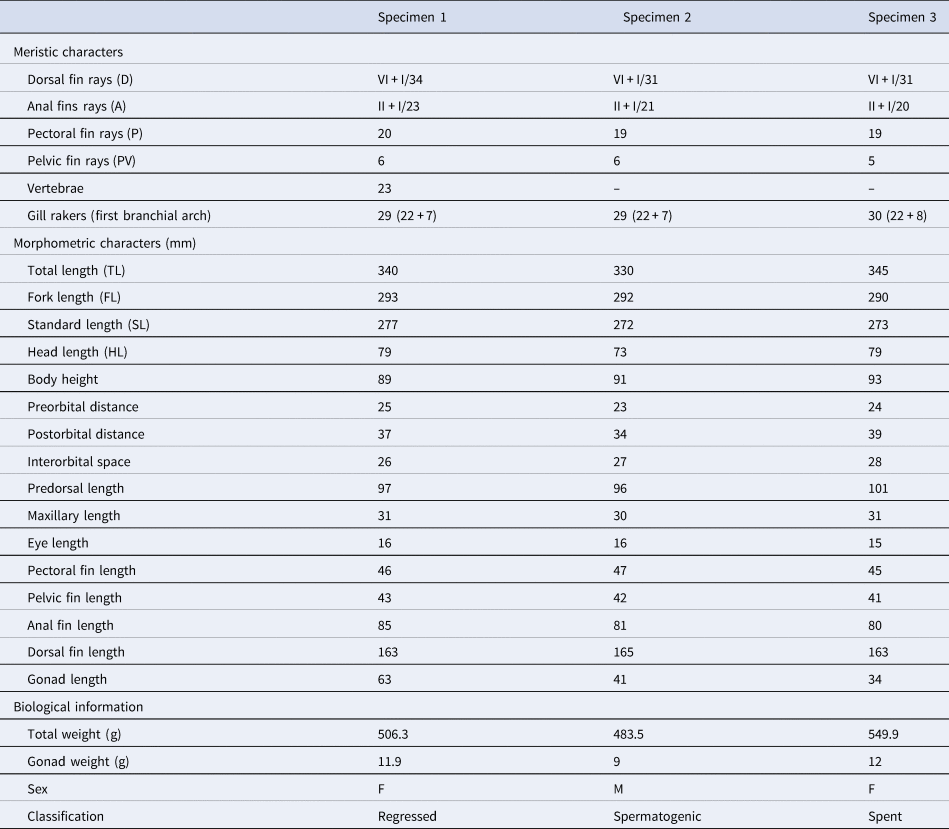
One male and two female specimens of the fortune jack were collected in Puerto Peñasco, Sonora, Mexico. These specimens are characterized by a fusiform and elongated body, 338 mm in mean TL, 292 mm in mean fork length, 274 mm in mean standard length, and 91 mm in mean body depth. X-ray study was conducted on one specimen, revealing 23 total vertebrae (11 thoracic and 12 caudal), small cycloid scales, and holes in the dorsal and ventral portions of the caudal peduncle. Silver dorsal coloration (above the lateral line) and body sides, and belly white (Figure 2A, B).
Specimen of S. peruana CIBN5734 (340 mm TL) collected in the northern GC: (A) lateral view and (B) X-ray view.

The snout is short and slightly concave; the upper jaw extends behind the middle of the pupil; the supramaxila is slightly wide. The first branchial arch has 30-gill rakers mean 8 in the upper branchial arch, and 22 in the lower branchial arch (Table 1).
Meristic, morphometric, and biological data of Seriola peruana caught in the northern GC in April 2024

The dorsal fin was the most extended, with 164 mm mean in the base, composed of VI + I spines and 31–34 soft rays. The anterior lobe in the second portion was slightly elevated and did not end in finlets. A dark coloration was observed in the base of the interradial membrane.
The base of the anal fin was 82 mm mean long. The anal fin formulae was II + I and 20 soft rays. The first pterygiophore is curved (Figure 2B); the length of the pelvic and pectoral fins were 42 and 46 mm, respectively, translucent to white in colour. The caudal fin changed from a clear to a greyish colour in the end.
The gonad of the fortune jack specimens examined was similar in shape and coloration to that of yellowtail amberjack (Seriola lalandi), presenting 48 mm in mean length, 12 g in mean ovaries weight, and 41 mm, 9 g for testes, respectively. The ovary shape was variable; two female adults were classified in regressed and spent stage with red-orange long lobes and flaccid bloody ovaries, respectively. The male specimen showed elongated testes with cream-white coloration.
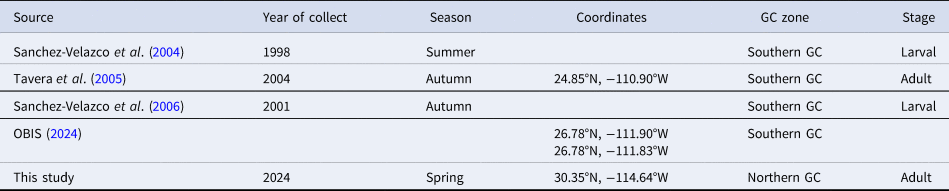
The search in collections and databases showed 31 results (Figure 1A), including seven records for Mexico, particularly inside the GC three in adult or juvenile stage and other two from larval assemblages (Table 2). The information does not indicate a particular season through the year when this species occurs in the GC.
Occurrences of S. peruana in databases and publications from the GC

GC regionalization according to Lavín and Marinone (Reference Lavín, Marinone, Velasco-Fuentes, Sheinbaum and Ochoa2003).
Discussion
The presence of Seriola peruana in the GC is supported by previous records from San Jose Island (Tavera et al., Reference Tavera, González-Acosta and De La Cruz-Agüero2005) and Bahía Concepción in BCS (Robertson and Allen, Reference Robertson and Allen2015; OBIS, 2024), both limited to the western coast of the GC and Isla Isabel at the southeast GC (Torrescano-Castro et al., Reference Torrescano-Castro, Lara-Mendoza, Torres-Covarrubias and Cortés-Hernández2016). Therefore, in addition to the three fortune jack specimens reported in this study, the northernmost range extension in the known distribution of this carangid in the Upper GC, suggests a resident population of this pelagic species in the region. The presence in the northern GC and both coasts of this inner sea could be promoted owing to its capability of a wide-ranging migration to find feeding grounds and preferential habitats along the coastline (Aron et al., Reference Aron, Flores, Wolff and Riquelme1992), we suggest an increased presence in the northern GC including both the western and eastern coast of the gulf.
The presence of adults with different maturity stages confirms a population of the species in the GC that reproduces itself and moves to the coast for reproductive events. Information on S. peruana eggs inside GC during April 2016 was recorded around San Jose Island, San Francisquito Island, and Santa Cruz Island (R. Saldierna-Martinez, personal communication, January 2024), and larvae have been identified in coastal ichthyoplankton surveys such as those from La Paz Bay in August 1998 and October 2001 (Sánchez-Velasco et al., Reference Sánchez-Velasco, Jiménez-Rosenberg, Shirasago and Obeso-Nieblas2004, Reference Sánchez-Velasco, Beier, Avalos-García and Lavín2006).
Nevertheless, when surveys in the GC have been conducted mainly at offshore sampling stations the presence of eggs and larvae is little or no presence (e.g. Aceves-Medina et al., Reference Aceves-Medina, Jiménez-Rosenberg, Hinojosa-Medina, Funes-Rodríguez, Saldierna, Lluch-Belda, Smith and Watson2003; Urias-Leyva et al., Reference Urias-Leyva, Aceves-Medina, Avendaño-Ibarra, Saldierna-Martínez, Gómez-Gutiérrez and Robinson2018). This is in contrast to the hypothesis by Palacios-Salgado et al. (Reference Palacios-Salgado, Ramírez-Valdez, Rojas-Herrera, Amores-Granados and Melo-García2014), as an oviparous fish with pelagic eggs. In fact, the reproductive migrations to the coastal zone have been observed in other genus species, such as Japanese amberjack (Seriola quinqueradiata) and banded rudderfish (Seriola zonata) (Aprieto, Reference Aprieto1974; Uchida et al., Reference Uchida, Dotu, Mito and Nakahara1985).
Although the information on the first maturity size and histological condition of this species is still unknown, other members of the genus, such as Seriola lalandi, appeared to have the same macroscopic appearance in ovaries and testes. Based on the Poortenaar et al. (Reference Poortenaar, Hooker and Sharp2001) criteria, the three specimens collected in Puerto Peñasco were adult fishes near or after reproduction; this supports evidence of a reproductive population inhabiting the GC, including the northern area. It is possible that the fortune jack specimens had their first reproductive events due to the medium size of the fish (33.5 cm in mean TL) compared with the expected size of 40 cm. However, a maximum TL of 66.5 cm and a total weight of 2.66 kg have been recorded for this species (Robertson and Allen, Reference Robertson and Allen2015). Nonetheless, it is necessary to conduct reproductive studies with a representative sample size of the local population.
Artisanal fishermen from Puerto Peñasco mentioned that even though S. peruana is rarely caught as a bycatch during spring, it is discarded owing to having no commercial value. This information coincides with that reported by Tavera et al. (Reference Tavera, González-Acosta and De La Cruz-Agüero2005) in the southern GC. However, Torres-Núñez et al. (Reference Torres-Núñez, Bravo-Olivas, Moreno-López and Gómez-Morales2023) mention that S. peruana is marketed as a second-rate product in Bahía de Banderas, Nayarit, and Torres-Hernández et al. (Reference Torres-Hernández, Palacios-Morales, Romero-Gallardo, Salazar-Araujo, García-Meraz, Madrigal-Guridi, Del Moral-Flores and Dominguez-Domínguez2016) classified this species as commercial use for the Michoacan coast. As S. peruana prefers warm waters from the tropical and equatorial zones (Galland et al., Reference Galland, Hastings and Leichter2019), its presence in temperate habitats from the GC could be related to the transition between winter and spring when the sea surface temperature reaches more than 17°C.
Even though the number of adult individuals registered is low, the distribution recorded of the fortune jack is currently from the southern GC to the Chilean Sea, including the oceanic Galápagos Island, Equator, and Malpelo Island in Colombia. Based on all these records and the steady increase in its habitat towards the northern Mexican Pacific, this species could be considered an indicator species of environmental changes, and its unusual distribution further north could be due to ocean warming from climate change (Tavera et al., Reference Tavera, González-Acosta and De La Cruz-Agüero2005; Arvedlund, Reference Arvedlund2009). In other species of the genus Seriola with northward range expansions already observed (Stuart-Smith et al., Reference Stuart-Smith, Pecl, Pender, Tracey, Villanueva and Smith-Vaniz2018; Bacheler et al., Reference Bacheler, Gregalis, Gillum, Pickett, Schobernd, Schobernd and Teer2022). Also, Seriola fasciata has been proposed as a species adapting to warming waters that have colonized the Mediterranean, adjacent to its native range (Andaloro et al., Reference Andaloro, Falautano, Sinopoli, Passarelli, Pipitone, Addis and Castriota2005; Langeneck et al., Reference Langeneck, Minasidis, Doumpas, Giovos, Kaminas, Kleitou, Tiralongo and Crocetta2022; Cillari et al., Reference Cillari, Falautano, Maggio, Perzia, Sinopoli and Castriota2024). However, additional research focused on identifying the main environmental drivers of the spatiotemporal distribution of S. peruana would help determine whether climate change may be causing its habitat expansion (Arvedlund, Reference Arvedlund2009). On the contrary, in recent years, there has also been an increase in scientific effort in sampling low commercial value species in the GC, which could increase the observation of uncommon species in the region. Thus, increasing the occurrence of the species will allow the development of population dynamic studies, such as population structure, life history, and trophic level, which are warranted to assess the ecological importance of the species throughout its distribution.
Data
The authors confirm that the data supporting the findings of this study are available within the article.
Acknowledgements
The authors are grateful to Felipe Rocha and Oscar Nieblas for all the field facilities, Alexandra Elbakyan for bibliographical support, Allan Akenaton Olvera Gamboa for the X-ray images, Lucia Campos Davila for the handlig of samples and the ichthyological collections of CICIMAR and CIBNOR. The authors would also like to thank two anonymous reviewers for providing comments that improved our manuscript.
Author contributions
A. E. R.-C.: conceptualization, funding acquisition, methodology, review, and editing; U. R.-R.: conceptualization, methodology, formal analysis, review, and editing; Z. R.-M.: data analysis, review, and editing; A. F. G.-A.: data analysis, review, and editing.
Financial support
A. E. R.-C. acknowledges the UTMSI programme. U. R.-R. and A. F. G.-A. acknowledge SNII-CONAHCyT programme, and A. F. G.-A. is also thankful for the COFAA and EDI-IPN programmes.
Competing interests
None.