INTRODUCTION
Palliative care, including pain and symptom control, delivery of coordinated services, psychosocial and spiritual care, and support for the patient and family, is important at the end of life, because of its contribution to improve the quality of life of terminally ill patients (Hearn & Higginson, 1998; Billings, 2000; Davies & McVicar, 2000). This care should at least be commonly provided when a patient's life has become unbearable and hopeless (Quill et al., 2000). However, despite the possible provision of palliative care, there still are some patients who request euthanasia or physician-assisted suicide (EAS) in the last phase of their life (Hedberg et al., 2002).
In the Netherlands, physicians are allowed to grant a patient's request for EAS under certain conditions. When deciding whether or not to grant such a request, palliative care is important, because it is related to one of the requirements for prudent practice that should be met. Physicians have to consider whether palliative options are still available and inform the patient accordingly (Board of the Royal Dutch Medical Association, 2003). Therefore, for the physician, the application of palliative options is an important safeguard to ensure that everything possible has been considered before a request for EAS is contemplated.
However, application of a palliative option does not necessarily imply that the request for EAS will be withdrawn. Studies in Oregon, where assisted suicide is allowed, showed that in some patients, the unbearable suffering continued and that other patients wanted to maintain control and wanted the option of assisted death to remain available for possible future use (Sullivan et al., 2000; Hedberg et al., 2002). Furthermore, a patient has the right to refuse the treatment that is offered, and a physician could also consider the palliative option(s) to be rather ineffective or nonrealistic, that is, medically futile (Davies & McVicar, 2000).
The aim of this study was to obtain information about the availability, application, and effect of possible palliative options for patients who request EAS, based on the following research questions: To what extent are palliative options (still) available for patients who request EAS and what are these palliative options? How often are palliative options applied and does the frequency differ between the various types of options? To what extent do palliative options result in either withdrawal of or persistence in the request and does this differ between the various types of options? Is there a relationship between the types of palliative options that are available? What are the reasons for withdrawal of or persistence in the request?
METHOD
Design
The data used in this study were collected for the project “Support and Consultation on Euthanasia in the Netherlands” (SCEN). In this project, general practitioners (GPs) receive training in formal consultation and give expert advice to colleagues who have questions about EAS (Jansen-van der Weide et al., 2004). In this retrospective study, data were obtained from the posttest, which consisted of a written questionnaire sent to all GPs in districts in which the project was implemented before August 2001 (18 of the 23 GP districts in the Netherlands), 1.5 years after the start of the project.
Definitions
In this study, euthanasia was defined as the “intentional termination of life,” by someone other than the patient at the patient's explicit request, and physician-assisted suicide was defined as “intentionally helping a patient to terminate his or her life at the patient's explicit request.”
Population
Data collection took place in the period from April 2000 to December 2002. Of the 6596 GPs who received a questionnaire, 556 GPs were no longer in practice and therefore their questionnaires were not included in the sample. In total, 60% of the GPs returned the questionnaire (n = 3614). All questionnaires that were returned were processed anonymously.
Measurement Instruments
The questionnaire contained structured questions about the characteristics of the most recent explicit request (if any) received by the GP within the previous 1.5 years. Of the 3614 respondents, 1681 described such a request. The GPs answered questions with regard to the availability of curative and palliative options. For this article, the findings on the availability of palliative option were used. GPs described whether or not the options were applied, what reasons they and the patients had for not applying an option or (if an option was applied) for persistence in the request, and questions about the decision-making process. In questions that were applicable, they were asked to base their answers on the situation at the end of their decision-making process.
Analysis
To relate the characteristics of palliative options, their application, and their effect to the final outcome of the decision-making process, the cases were subdivided into five “outcome groups”: the request was granted and EAS was administered, the request was granted but the patient died before the administration of EAS, the patient died before the final decision was made, the patient finally withdrew the request, and the request for EAS was refused. To determine the extent to which the application of palliative options and persistence in or withdrawal of the request were related to specific types of palliative options, the different types of options were classified in three categories for some of the analyses: medication, treatment taking place in hospital, and artificial administration of food/fluids.
Statistical significance was calculated by means of the chi-square test. Each time one outcome group was compared with all the other outcome groups together (unless stated otherwise).
RESULTS
Availability of Palliative Options
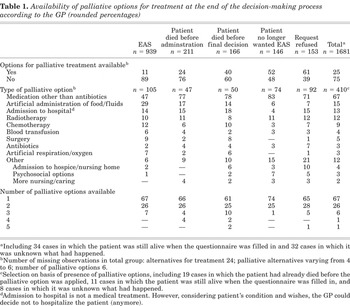
Table 1 shows that at the time of the request for EAS, palliative options were (still) available in 25% of the cases, least often in cases in which EAS was administered (11%), increasing to 61% in which the request was refused (p < .001, EAS cases vs. other groups). In general, when palliative options were available, medication other than antibiotics (67%) was the most frequently mentioned option. Other (but less frequently mentioned) palliative options were artificial administration of food/fluids (15%) and admission to hospital (13%). Medication other than antibiotics was mentioned less often, and artificial administration of food/fluids was mentioned more often in cases of EAS (47% and 29%, respectively) than in the other groups (respectively 71%–83%, and 6%–17%) (p < .001, for both, EAS cases vs. other groups). Admission to a hospice or nursing home was mentioned more often as a palliative option for patients who died before the end of the decision-making period and for refused requests (respectively 6% and 10%), compared to the other groups (0%–3%; p = .03, patients who died before the final decision and refused requests vs. other groups). For all groups, most often only one palliative option was (still) available (67%).
Availability of palliative options for treatment at the end of the decision-making process according to the GP (rounded percentages)

Application of Palliative Option, Persistence in Request, and Reasons
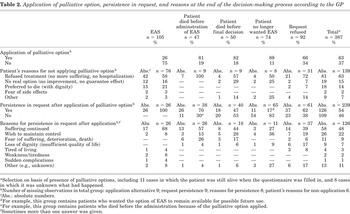
Table 2 shows that in 63% of the requests a palliative option was applied, least often in cases of EAS (26%) compared to the other groups (between 66% and 89%; p < .001, EAS cases vs. other groups). The reasons most frequently mentioned by the patient (according to the GP) for not applying a palliative option were refused treatment (63%), no real option (15%), and preferred to die (with dignity) (14%). Refusal of treatment more often occurred in refused requests (72%) than in cases of EAS (58%), for whom preferring to die (with dignity) more often was a reason for not applying the option (21% vs. 7%). However, this was not statistically significant. After application of the palliative option, all EAS cases and most patients who died before the administration of EAS persisted in their request (respectively 100% and 70%), whereas a minority of patients who withdrew their request did so (17%; p < .001, withdrawn request vs. other groups). The reasons most frequently mentioned for persistence in the request were suffering continued (48%), wish to maintain control (22%), and fear (9%). The wish of the patient was more important in requests from patients who died before the final decision and those who withdrew their request (respectively 28% and 36%) than for patients in the other groups (8%–19%; p = .05, withdrawn requests and patients who died before the final decision vs. other groups). Continued suffering was mentioned more often in cases of EAS (68%) than in the other groups (39%–57%; p < .001, EAS cases vs. other groups).
Application of palliative option, persistence in request, and reasons at the end of the decision-making process according to the GP

Type of Palliative Option and Application
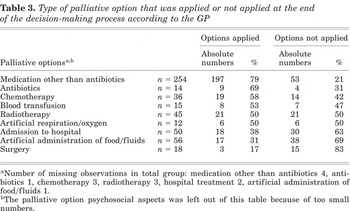
Table 3 shows per type of palliative option the percentage of cases in which the option was applied. Antibiotics and other medication were applied most often (79% and 69%, respectively), whereas hospital admission, artificial administration of food/fluids, and surgery were least often applied (38%, 31%, and 17%, respectively).
Type of palliative option that was applied or not applied at the end of the decision-making process according to the GP

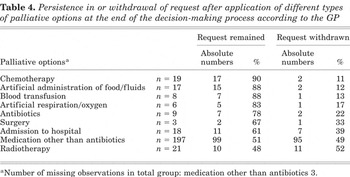
Table 4 shows per palliative option how often it resulted in the patient withdrawing the request. For most palliative options, the patients persisted in their request, especially concerning options like chemotherapy (90%), artificial administration of food and fluids (88%), blood transfusion (88%), artificial respiration/oxygen (83%), and antibiotics (78%). Other options like medication other than antibiotics and radiotherapy more often made the patient withdraw the request (respectively 49% and 52% vs. 11%–39%; Table 4).
Persistence in or withdrawal of request after application of different types of palliative options at the end of the decision-making process according to the GP

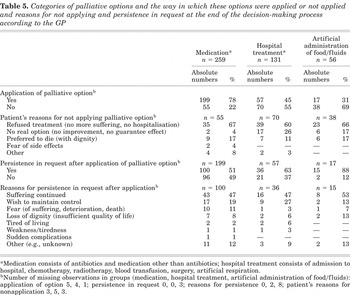
Table 5 shows a classification of the palliative options in three categories. Medication as a palliative option was applied most frequently (78%), decreasing to artificial administration of food/fluids, which was applied least often (31%; p < .001, all categories). Between the categories there were no differences in reasons for not applying an option. Treatment taking place in hospital was considered to be medically futile more often than medication or artificial administration of food/fluids (26% vs. 4% and 17%; p = .0015, all categories). After application of a palliative option, most patients who received artificial administration of food/fluids persisted in their request, whereas fewer patients who received medication or treatment taking place in hospital did so (88% vs. 51% and 63%; p = .003, all categories). There were no differences between the categories in the most important reasons for persistence in the request. After treatment taking place in hospital, persistence in the request more often occurred than after the application of other palliative options because of the patient's wish to maintain control (27% vs. 19% and 13%; p = n.s., all categories).
Categories of palliative options and the way in which these options were applied or not applied and reasons for not applying and persistence in request at the end of the decision-making process according to the GP

DISCUSSION
Palliative options were most frequently available for patients whose request was finally refused (61% vs. 11%–52%). Medication other than antibiotics was mentioned most frequently as a palliative option (67%), but less often in cases of EAS than in the other groups (47%). Mostly the palliative option was applied (63%), except in cases of EAS (26%). If a palliative option was not applied, this was mainly because the patient refused the treatment, especially in cases in which the request was finally refused. After application of the palliative option, approximately half of the patients persisted in their request. This was most frequently because the suffering continued, especially in cases of EAS. Medication as a palliative option was applied most frequently, whereas artificial administration of food/fluids was least frequently applied. Compared to the other palliative options, medication other than antibiotics and radiotherapy more often resulted in a patient withdrawing the request (49% and 52%).
SCEN, within the framework of which this study was carried out, is a nationwide project, and in 18 of the 23 GP districts in the Netherlands, the GPs received a questionnaire. Therefore, the data are representative for general practice and contain many cases. In addition to increasing the power of the study, this also made it possible to obtain information on all types of requests. One limitation is that the study only focuses on GPs. However, GPs receive most of the requests for EAS (Onwuteaka-Philipsen et al., 2003). Another limitation of this study is that it is retrospective. However, a request for EAS is an exceptional occurrence, and the GPs were only asked to recall just 1.5 years at the most. A further limitation is that the GPs gave the information about the patient's reasons for persistence in the request, and it is possible that their decision influenced their description of the patient's reasons.
This study shows that medication other than antibiotics is most frequently mentioned as a palliative option for patients who request EAS. Unfortunately, GPs were not asked to specify the type of medication concerned. However, it would probably mainly include pain and symptom treatment (SUPPORT Principal Investigators, 1995; Rousseau, 1996; Lobchuk et al., 1997; Nelson et al., 2000; Onwuteaka-Philipsen et al., 2003; Klinkenberg et al., 2004; Jansen-van der Weide et al., 2005).
Of the palliative options mentioned, some, such as chemotherapy, radiotherapy, and surgery, could also be life-prolonging or even curative. Although we categorized the different types of palliative and curative options in the questionnaire, we still were dependent on the GPs' interpretation of a option being palliative or curative. It is possible that some of the chosen palliative options are actually life prolonging; especially we did not prestructure the option of life-prolonging option for treatment. There is no reason to believe that Dutch GPs especially have a lack of knowledge on this issue. A recent European study showed that Dutch GPs more than GPs in other countries have had palliative care training (Löfmark et al., 2006). There also are special Palliative Consultation Teams in the Netherlands that might contribute to the provision of good quality of palliative care (Kuin et al., 2004).
In cases of EAS the administration of food/fluids was mentioned more frequently as a palliative option. These patients were probably already very close to death, making this palliative option one of the few options left in trying to alleviate their suffering. This is in line with the finding that in cases of EAS the palliative options that were still available usually were not applied, because of the burden involved and the patient's wish to die (with dignity).
Medication is the most frequently applied option. In contrast to other palliative options, this option is usually easy to apply, it has a relatively low burden on the patient, and its effectiveness is probably easier to determine. Palliative options that are more often forgone, such as surgery, artificial administration of food/fluids, and hospital admission, probably have a less certain or only short-term effect. Clearly, they are more difficult to apply, and impose a relatively heavy burden on the patient. For instance, it is known that the artificial administration of food/fluids does not improve the comfort of terminal cancer patients (McCann, 1994).
Application of a palliative option could result in a withdrawal of the request by the patient. However, many patients persisted in their request after the application of a palliative option, especially in the case of options such as chemotherapy, artificial administration of food/fluids, and blood transfusion. Other options such as medication other than antibiotics and radiotherapy more often resulted in the patient withdrawing the request. Logically, patients could withdraw a request when pain or symptom management becomes effective, and apparently in the latter options this is more often the case.
Irrespective of the effectiveness of palliative options, there seem to be patients who want to maintain control of their lives and therefore want to make sure that the option of EAS remains possible. In another study this phenomenon has also been reported (Sullivan et al., 2000). This autonomy of the patient is considered to be important in improving the patient's quality of life (Greenstreet, 2001). Other patients persist in their request, because their suffering continues. However, this does not automatically lead to the request being granted. Other factors, such as the physical and mental condition of the patient and the reasons for requesting EAS, also play a role (Jansen-van der Weide et al., 2005).
Overall, for many patients who request EAS palliative options are still available. The fact that palliative options occur least frequently in requests that resulted in EAS and most frequently in refused requests suggests that GPs include the availability of palliative options in their decision making. The fact that not all options are applied or, if applied, the patient persists in the request seems to be related to the autonomy of the patient, the burden on the patient, and medical futility of the option.
ACKNOWLEDGMENTS
We are indebted to the thousands of general practitioners who provided the data. This study was funded by the Royal Dutch Medical Association and the Dutch Ministry of Health.