What is the voice? The voice is always a dream voice, and we can never speak about the experience of the voice except in the register of fantasy, desire, phantom, myth. Even, and perhaps especially when we may speak of the materiality of the voice, we evoke imaginary substance and mythical powers.
Steven Connor, Beyond Words Footnote 1Introduction
What might the medieval Chinese practice of foot binding possibly have to do with the operatic medium? What can the particular opera The Empress's Feet, based on a tale about a mythical origin of foot binding, show us about the nature of the voice? How can a staging of this opera bring out otherwise hidden affinities and relationships? These questions are among the inquiries that will guide what follows in this essay.
First, I will provide an account both of the opera The Empress's Feet and of the tale it is based on. I will spend some time exploring the opera's complex formal structure, its central themes and the way it transforms the original tale. The tale, centring on the origin of foot binding, makes the practice the consequence of bouts of sleepwalking that have afflicted a queen as foot binding is devised as the malady's successful resolution. I will thus explore some of the significant aspects, imaginary as well as factual, of both the practice of foot binding and the phenomenon of sleepwalking. I will suggest that the opera not only casts itself as related thematically to the tale and to the practice of foot binding, but also establishes a further parallel between foot binding and a form of bodily mutilation that is associated with the development of the medium of opera in the West, namely the phenomenon of the castrato. The threefold consideration of foot binding, sleepwalking and the voice of the castrato will serve to reveal the liberating aspect of the opera – call it the agency or voice given to the feet ‘unbound’. I will conclude with an account of a production of The Empress's Feet which I directed in 2014, in order to exemplify the realization in performance of the interpretation outlined in the article, namely the relation between foot binding, sleepwalking and the voice of the castrato.
My central argument is that in the transformation of the tale first into opera and then into performance, a body part – the foot – is allotted ever more agency and independent unconscious will. The children's tale puts an end to the feet's nocturnal excursions, which carry the body according to a will of their own. The feet are operated on in a procedure that ensures that thereafter they are no longer active, that they will never again guide the body as it sleepwalks. In the opera, in contrast, the operation performed on the feet is not the end of the matter. The opera allows us to imagine: it opens for us a space of the imagination where the feet, now liberated, can give expression to their will and force.
The opera forms a bond that links a body wholly controlled by its feet with a singing voice. Its treatment of the voice serves the portrayal of feet as possessing a will of their own that exert a nocturnal power over the entire body. The opera expresses this odd agency by complicating the overall notion of agency in the work: the voice, since it permeates the surroundings of sleep, dream, nightmare and sleepwalking, is unanchored, not connected to any clear source emitting it, is ambiguously estranged from any sort of attachment to a specific consciousness. I argue, then, that the opera The Empress's Feet casts singing as an expression of sleepwalking feet, voicing their will to walk over and above any conscious aim and direction; the opera as a whole, I thus claim, expresses an ‘anomalous structure of agency’, as Stephen Thomson calls it, with sleepwalkers being ‘the unconscious authors of their actions’.Footnote 2 It is the singing voice that brings to life the strange world that is home to nightmare, sleepwalking, identity shifts, imagined personae, constant fluctuations of awareness and, finally, liberation.
This vision is what inspires the opera's transformation as it is realized in its staged performance. The heart of the performance is the sleepwalking feet; the landscape is that of the imagination. The staging constantly calls to mind the sleepwalker's fantastic, unexplainable surefootedness.Footnote 3 These virtuosic feet walk in mid-air, are continually wandering and carrying off the performers. Not only do they dominate the performers’ movements; they are also a presence in props and set design. The performance imagines how the power of singing endows feet with greater agency.
Part I: The Empress's Feet
The tale
The Empress's Feet (1995), with music by composer Evelyn Ficarra and a text by Valerie Whittington, is based on a children's tale from 1946 that traces the tradition of foot binding to an origin in large, disobedient feet.Footnote 4 The Chinese tale on which the opera is based is centred on a sleepwalking Empress with enormous, beautiful feet.Footnote 5 The tale revolves around the Empress's restricted awareness, her reduced consciousness and inability to recall what exactly her feet do. The feet take over in sleep when consciousness is dimmed. Consciousness migrates to the lowest part of the body; the feet, transformed into independent beings, are given a will of their own, which the rest of the body, puppet-like, follows. An independent will is attributed to them: ‘my feet’, said the Queen, ‘want to walk’.Footnote 6 It is they who are responsible for carrying the body away at night. In the tale, these sleepwalking feet are faulted and then ‘punished’ by being operated on and ‘trimmed’: to release the sleepwalker from what has become regular nightmarish walks, the feet are submitted to a procedure that reduces their size. This intervention, miraculously, is painless. Not stumps but new, tiny, beautiful feet are its result. An operation solves the problem of wandering, opinionated feet. In the fairy tale, the transformation of the Empress's large feet puts an end to her sleepwalking. But, newly graced with small feet, the Empress becomes envious of women whose feet are now larger than hers. An ensuing proclamation from the Emperor prohibits any woman from having larger feet than his wife's. Years of ongoing foot mutilation are transformed and reduced into a miraculously quick, painless instant. The gradual processes involved in binding – bodily distortion, mutation of shape, inhibition of growth – are contracted into a single brief, painless event. The custom's onset is referred to the envy felt long ago by one woman who lost her gorgeous large feet and thus demanded exquisite tiny ones for the kingdom's entire female population. The diminutive foot, now made into a symbol of prettiness, is enforced on all women.Footnote 7 The children's tale, an origin myth for the thousand-year Chinese tradition of female foot binding, accounts for the adulation of small feet by providing these extremities with a glorious mythic past.
The opera
The opera The Empress's Feet is radical in its employment of the voice in translating the tale into song. It is composed for a single bare voice. In other words, it is cast for a single unaccompanied singer possessing an exceptionally wide range. The Empress's Feet was commissioned in 1995 by the internationally renowned singer Linda Hirst. Hirst is a former member of the Swingle Singers and is co-founder of Electric Phoenix. Quite exceptionally, she sings and records in a wide range of styles, including, for example, extended vocal technique (Luciano Berio) and rock (Pink Floyd). Linda Hirst has risen to prominence for her performances and recordings of contemporary music.Footnote 8 Utilizing Hirst's extraordinary range, The Empress's Feet is composed for a vocal range spanning nearly three octaves (E3–C6). Moreover, scored a cappella, the singer is given no anchor or reference: there is nothing for her to rely on for alignment and tuning.
The piece's enormous challenge may explain why, in an earlier staging in 2012 by Joni-Rae Carrack,Footnote 9 the vocal part was divided among several singers, who also performed as puppeteers. In the question-and-answer session with the artists following the performance, which I attended, Evelyn Ficarra, the composer, gently commented that had the work called for several singers rather than one, she would have composed it accordingly. I took the composer's reaction to indicate the importance of the singing's execution not being eased or otherwise facilitated by dividing up the part. On the contrary, the strain, difficulty and rarity of such a vocal range offers material to work with.
The demands that the opera places upon the single voice are further reflected in its complex form. The Empress's Feet is constructed with modular units of music-and-text that are reiterated, curtailed, cut, pasted, fragmented, repositioned or otherwise displaced and relocated; it is built on scenes that are repetitions and variations of one another. There are twelve short scenes in ABA′ form, each between one and six minutes long, that altogether amount to roughly thirty minutes. Each of the scenes has a title – ‘First Song’, ‘Second Song’, ‘Third Song’, ‘A Dream’, ‘She Dreams’ and so on, and this emphasizes their interconnections, intertextuality and referentiality. The scenes are variations of one another in terms of text, music and recurrent patterns of text–music units. Like a kaleidoscope, reiterations shift between the opera's various levels: single notes, motifs, patterns, phrases, scenes and overall structure. A closer look at the ABA′ structure, reveals how the A part involves dreams, dreams within dreams, memories of dreams, awakenings, sleepwalkings, nightmares and songs about feet. In the middle B section, the score indicates three personae present within the singing voice: A Singer, the Empress and the Emperor. They are woven into a dream; present as memory; figure in a song about nightmarish sleepwalking and participate in an efficient operation on the feet. The A′ reworks material from the preceding A and B parts, fragmenting, expanding, truncating, and varying it. A′ also introduces new text, imbuing the music's patterns with new meanings but not letting go of earlier associations.Footnote 10
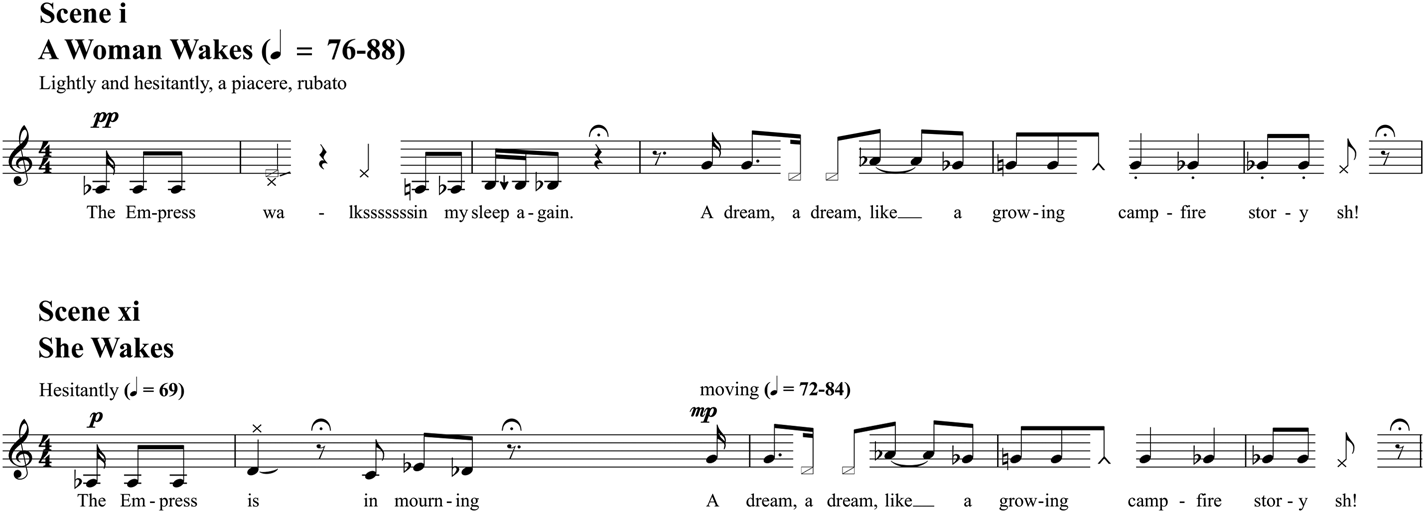
Text and music recurrently seem inseparable, as though they cannot be sorted or pulled apart, as though they were stuck in a configuration. The music, more often than not, sounds like something the listener has already heard elsewhere in the opera. To take an example, consider the phrase in scene i, ‘The Empress walkssssss in my sleep again. A dream, a dream, like a growing campfire story sh!’. It is reworked and slowed down yet set to almost the same music in scene xi, in the phrase ‘The empress is in mourning. A dream, a dream like a growing campfire story, sh!’. The musical variation occurs only for the textual variation: ‘walkssssss in my sleep again’ (i) becomes ‘is in mourning’ (xi). The music's variation is minute: slight rhythmic and melodic simplification is apparent even as the melodic contour and the narrow range (minor third) is wholly retained. Wherever the text in the phrase is identical, so is the music; the text recurs, and with it the music. The musical material is tightly knit. The range is circumscribed, in effect orbiting around one pitch. The phrase exclusively circles the pitch of G, moving half a note below, half a note above, returning to it and introjecting vocal effects – speaking, tongue clicking, whispering. I hear this phrase – and this on the whole is typical – not as anchoring the G but, on the contrary, in search of it, as though it always escapes (see Fig. 1).
The Empress's Feet, by Evelyn Ficarra and Valerie Whittington. Sc. i, ‘A Woman Wakes’, mm. 1–5; sc. xi, ‘She Wakes’, mm. 1–5. London: Contemporary Music Voices, c/o British Music Information Centre.

What is the rationale for the form and structure, the use of music and text as well as the single voice? The treatment of the voice, the repetitions and fragmentations, all serve to establish and sustain a dreamlike world. Segmenting the broad range enables, furthermore, the rendering of shifting identities, imagined personae and fluctuating levels of awareness. The multiplication of identities is evident in the addition of the figure of A Singer to the protagonists in the tale. Yet A Singer not only tells and comments but also internalizes the voice of others, while moving through different states of consciousness.Footnote 11 A Singer is in a state hovering somewhere in a zone where sleepwalking, storytelling, singing, dreaming and wakefulness can all take place; A Singer is at once dreamer, sleepwalker and minstrel. A Singer tells us of an Empress's marvellous feet and sings their praises; A Singer dreams, forgets, awakens, remembers, sleepwalks, runs, has nightmares, as if the voice is the Empress's, even as it is not hers. It is as if what surrounds the Empress, as well as what resides within her mind – places, situations, actions, states of mind, other characters – are situated within that one voice. A Singer, an all-encompassing voice, embodies everyone and everything.
In the preface to The Empress's Feet, co-written by the composer and the librettist, Ficarra and Whittington describe their opera:
A woman dreams and dreams about a woman who dreams … A sleep and a forgetting. A sleep and a remembering. A dreamer wakes and tries to reconstruct from the fragments in her memory the story she has read and has found recurring in her dreams. In time and space far removed from her waking world.Footnote 12
The opera nests dreams inside dreams, so that one is uncertain whether anything occurs outside sleepwalking: we are immersed in ‘a state that is not quite reality, a state in which identities are less permanent and more permeable, where the object of the “plot” … is to explore, to be confused, to hover in a strangely timeless world’.Footnote 13 The opera is a dream that ‘comes in parts … each night’. A dreamer, a woman, A Singer is remembering a dream about an Empress with enormous feet; in turn, a dream resurfaces in A Singer's memory through song; A Singer, dreaming of an Empress, receives an Emperor's call to sing the praises of an Empress's beautiful outsized feet, but then an Empress's nightmares are also those of A Singer. A Singer, as dreamer, is at once within and outside the dream world. It is the singer who dreams a sleepwalking Empress, is a witness to the operation performed upon her inside her dream, is an Empress undergoing a cutting, and is a singer praising an Empress's feet. Whom are we listening to? Whose voice is it? Who sings, sleepwalks, dreams and retains the residue of dreams?
The changes made to the tale – so that all nests within the condition of sleepwalking and all exists as singing – are bound up with one another. Sleepwalking in the opera is not a scene within the story, but rather sleepwalking is the very frame of The Empress's Feet, permeating everything in it. The Empress's Feet is associated with the tradition of nineteenth-century sleepwalking scenes such as those in Bellini's La sonnambula and Verdi's Macbeth. For instance, it shares with sleepwalking scenes in earlier works an interweaving of past with present, and uses memory as a means of portraying a state of disarray. It diverges from these scenes, however, in that the state of sleepwalking is not enclosed within a scene but permeates the entire space of the opera. The Empress's Feet is also associated with twentieth-century monodrama – for instance in its fragmented, fractured music and breakdown of language.Footnote 14
The Empress's Feet does not retell the fairy tale through singing but transforms storytelling itself through song, precisely to address the difficulty of telling a tale in a state of sleepwalking. A story is remembered and forgotten, hovering between states of consciousness and not anchored in any subjectivity; it shifts temporalities as it is enacted, as it recurs, is reconstructed and recounted. A story is fragmented by the condition of sleepwalking, out of which A Singer, invented by the opera, sings of the attempts to draw out the story and her position within it. Telling, enacting, dreaming and singing are embodied in voice.
The opera's expression of the theme of sleepwalking is then evident in the strange bond it forms between body and voice, or more specifically between a body wholly controlled by its feet and a singing voice.Footnote 15 The opera provides a voice for feet and for their movements; it is, as it were, an opera that makes feet sing. In The Empress's Feet, feet are transformed: they move not by walking but by sleepwalking. Here feet possess a will of their own, a nocturnal power over the body, whereby they are also given a voice. The Empress's Feet imagines singing as an expression of sleepwalking feet which voice their will to walk. The emanation of the voice is estranged, belonging not to the mouth but to that particular body part that generates movement, that extracts the body into motion; the body's lowest part, the terminal point of the legs which forms the basis of our postures and positions, of standing, walking, moving.Footnote 16
What I claim, then, is that in the opera The Empress's Feet's circumscribed self-enclosed space of dream-and-nightmare, nothing exists that is not derived from the voice. It is memory and illusion, speaking and walking, the materiality of breath and unaccountable pain. Feet acquire a life of their own and become the counterpart of the singing voice, what it conjures as its own image. The opera traps us inside its voice and provides no escape route. We are caged within the confines of the work's tininess, narrowness and internal repetition; we are entrapped within a voice. Caught within a process that is circular, unending and estranged from reality.
The opera simulates a truncated work, one halted in the midst of a breath. The impression of incompleteness mirrors the opera's plot, itself a juxtaposition of fragmented memories and bits of dreams, walks and songs. The compositional technique is aligned with the work's subject matter via an unanchored experience. Text and music are shared throughout; time, space, consciousness, identities, and dreams are conflated. This fosters an ambiguous and unreal quality in the opera where everything is permeable, hovering, timeless.
Sleepwalking permeates the whole space of the opera, forming a sphere removed from consciously guided actions and understanding. Sleepwalking has its own understanding or meaningful movement, removed from our active and directed engagement with our surroundings. It exhibits or brings out something more fluid and pliable in human gestures and embodied existence. Put slightly differently, one could say that there is an intelligence of the body, that there are things the body can do only by being dissociated from the control of consciousness.
From tale to opera
The opera transforms the fairy tale's portrayal of sleepwalking. In the fairy tale, sleepwalking is associated with nightmares and is viewed as endangering the Empress. In addition, in the opera, sleepwalking allows the Empress to wander and dream of freedom. In the fairy tale, the Empress has been walking at night since she was a child. When the Emperor learns of her sleepwalks, he follows her:
The Emperor feared that Ti Chin might fall or hurt herself, so he caught up with her, put one arm around her waist, and with the other covered her mouth lest she should scream upon her awakening. And sure enough, Ti Chin was frightened and struggled, until she awoke and saw it was her husband who held her.Footnote 17
The Emperor's first suggestion is to tie her ankle to the bed with a golden chain. That night, the Empress has a nightmare. In it, she is wandering, looking for her husband, but she never finds him; a dragon attacks her – in the manner in which the Emperor had tried to protect her. In the fairy tale, the Emperor comes up with a new suggestion to cure his wife: reduce the size of her feet by cutting off nine inches.
The Empress's nightmares result from enforced restrictions on her feet, which are tied to ensure that she will not walk at night. Once she is prevented from sleepwalking she is afflicted with bad dreams about them. Indeed, the fairy tale offers a negative portrayal of the phenomenon of sleepwalking, linking it to night terrors and violence. The opera accompanies this depiction with an account that situates sleepwalking as a placeholder for dreams of freedom.
The opera radicalizes the predicament of the independent feet by constructing a new ending to the story. The operation on the feet, initially resulting in the loss of their power to carry the body, leads ultimately to the opening of a space of fantasy, to the singing of the Empress's fantasized homecoming. Rather than following the tale to its original end, the opera sides with the feet. It concludes with a dream in which the large feet and the splendour of their walking are restored, imagining feet that are strong, broad, and long, their huge strides once again audible in the dark. The fantasy that human, embodied existence is malleable cannot be fulfilled without inflicting violence. But the opera's last scene is also a radiant moment of wish fulfilment, when, as if in a dream, the Empress returns from far away, carried home by her enormous, beautiful feet.
Part II: sleepwalking, foot binding and the castrato
To deepen our sense of the relation formed between the themes of sleepwalking, foot binding and the operatic voice, I will, in this second part, briefly elaborate on the historical and cultural aspects of these related registers.
Sleepwalking feet
The restriction of sensory impressions in sleepwalking, and the effects produced by such restriction, have long fascinated scientists. The somnambulist would experience only those sensations that pertained to the specific action performed. During a sleepwalking episode, the sleepwalker can walk, talk and eat, but she can also act violently, thereby endangering herself and others around her – punching, grabbing a knife, setting off a pistol.Footnote 18
The eyes, usually open, do not see. Memory also seems to function in a particular way. The sleepwalker seems to have separate memory tracks that each remains unaware of the other: while awake the sleepwalker remembers nothing of the sleeping episode but does recall such events while experiencing the episode, as though possessing a dual memory: one branch of memory working during sleep, the other while awake.Footnote 19
Up to the Renaissance, sleepwalking was viewed as a species of possession, divine or diabolic, as well as a unique ability, and an opening to secret knowledge. In the eighteenth and nineteenth centuries, French and German scientists experimented with artificially inducing an altered state of consciousness, exploring what they came to term magnetic somnambulism. Schelling understood this condition to be a state in which central wakeful consciousness recedes and the separate intelligence of particular organ parts is revealed.Footnote 20 Somnambulists, regarded as clairvoyant and possessing the ability to discover hidden knowledge inaccessible via other means, were employed in the service of advancing scientific knowledge. Viewed as being free from the restrictions of time and space, they were taken to have access to past, present and future. In a somnambulistic trance, matter, space and time are transcended. Unbound from the body, the soul – termed ‘flying soul’ and possessing the power to travel faster than electricity and even to voyage to other planets – could transport itself anywhere. Its special abilities were understood to be based on forces of electricity and magnetism. The somnambulist, usually a woman, became an instrument in a scientific investigation conducted by the magnetizer. The therapeutic situation was divided between the powers of the somnambulist and those of the magnetizer who induced magnetic sleep.Footnote 21 Magnetic somnambulism was at once employed for healing (through seeing inside a body); for gathering information through extrasensory perception, telepathy and precognition; and for theological explorations of extraterrestrial realms. The latter aim was devoted to the pursuit of gnostic knowledge or magnetic gnosis ‘with claims of direct access to a superior knowledge pertinent to dimensions of reality beyond the domain bounded by material reality, space and time’.Footnote 22 A somnambulist was believed to possess some kind of internal sense through which she could access the underlying nature of reality and existence. Mesmerists conceived of a duality between daytime consciousness and nighttime consciousness: the former is limited, whereas the latter is wider, deeper and ‘grounded in an expanded consciousness to which we gain access in dreams and other altered states of consciousness, such as the somnambulistic trance, and in which we find ourselves liberated from the narrow limitations of time, space, and linear causality’.Footnote 23 Along these lines it was believed that true and superior knowledge was to be found in sleep. Highly gifted somnambulists were ‘sleep specialists’ or ‘sleep virtuosos’, expert in ‘using altered states of consciousness with a superior degree of sophistication, so as to take advantage of their full epistemological potential’.Footnote 24 Such notions led to late nineteenth-century theories of cerebral automatism or unconscious cerebration, referring to a physical process, to reflexes of the cerebrum activated during dreams and waking hours. In this view, somnambulism is believed to result from a strong current of unconscious cerebration, which ‘prompts the sleeper to rise from his or her bed and perform actions usually done while awake’.Footnote 25 In the late nineteenth century, ‘the sleepwalker symbolized a central controversy of Romantic medicine. If behaviors involving higher brain functions (such as speaking, writing, or sensory perception) could be accomplished automatically by sleeping persons … then the regulatory power of the soul or will appears questionable’.Footnote 26 These ideas led ultimately to Freud's conception of the unconscious. Sleepwalking figures in important ways in the development of models of the unconscious mind.Footnote 27 Hypnosis as practised during the initial stages of psychoanalysis is analogous to artificially induced sleepwalking, mesmerism being a scientific–theatrical version of this process.
This fin de siècle period was a time of vampire tales such as Dracula (1897), whose eponymous protagonist induces somnambulistic trances in his victims, and hypnotist fables such as George du Maurier's novel Trilby (1894), whose Svengali fully controls the artist Trilby, whom he transforms into a singer:
Falling under the spell of a malevolent despot, these young heroines relinquish volitional control and with it the ability to check, account for, or even recall their actions … [They] become other than themselves, other to themselves, abrogating self-control as they obliviously transgress, like automatons, moral, social, racial, class, and sexual boundaries.Footnote 28
Lois Cucullu has shown how these seduction stories depend on somnambulism and take place during an episode of altered consciousness. It is a state portrayed by the novels as impressionable, susceptible and with violent and fatal consequences for the women: ‘these somnambulist fictions mobilize sleep, that most private and subjective state, and turn it from a restful condition into its opposite in order to represent what they deem women's latent desires’.Footnote 29
The underlying fascination with sleepwalking for Romantic and Victorian writers led ultimately to frightening theological implications: ‘sleepwalking ominously suggested the possibility that the human body and brain could function mechanically, without the guiding power of the soul or will’.Footnote 30
Since then, sleepwalking has become largely a neglected phenomenon.Footnote 31 It is still today poorly understood,Footnote 32 its fundamental cause is still unknown,Footnote 33 and medical treatment is still in its infancy.Footnote 34 In fact, the definition of sleepwalking varies.Footnote 35 It is viewed as a sleep disorder, a mental disorder,Footnote 36 an arousal disorderFootnote 37 relatedFootnote 38 or unrelated to sleep terrors,Footnote 39 an acting out of dreamlike mentations.Footnote 40 Today, much of the sense of strangeness surrounding sleepwalking has subsided. It has been disenchanted. More sophisticated methods were developed to characterize what occurs in the brain during an episode, establishing that sleepwalking is a behaviour characterized by partial arousal during slow-wave sleep.Footnote 41 It has been further established that the brain sleeps in regions, so that sleep and wakefulness can coexist simultaneously in different brain regions.Footnote 42 One may be sleeping in one sense, while awake in another.Footnote 43
Foot binding
Making sleepwalking central to an origin story about foot binding yields a tale that conceals the horrors of a body part's gradual deformation. The feet are also empowered with activity, special abilities, a gift of self-walking. The fairy tale constructs a set of specificities regarding when and how walks occur, and in this it strangely parallels how foot binding conspicuously causes movement to be laboured, thus producing a certain gait. Among the traditional explanations for foot binding as a practice is the view that small, lotus-shaped feet were erotically charged (with emphasis placed on the fetishizing of delicate slippers and shoes) or were meant to imitate the feet of dancers performing on a lotus flower; alternately, foot binding has been seen as a route for upward class mobility or as evidence of a strong-willed character as shown through the endurance of pain. Finally, it has been regarded as a way to restrict women from straying too far or from participating in arduous labour.Footnote 44 Explanations for the custom can be divided into four categories. The first is the symbolic, in which foot binding is viewed as emblematic of the castration of women. Freud held this view, as is mentioned in Julia Kristeva's book About Chinese Women:
Freud saw in the custom of foot-binding the symbol of the castration of women which Chinese civilization was unique in admitting. If by ‘castration’ we understand the necessity for something to be excluded so that a socio-symbolic order may be built – the cutting off of one part of the whole, so that the whole as such may be constituted as an alliance of homogeneous parts – it is interesting to note that for Chinese feudal civilization this ‘superfluous’ quantity was found in women.Footnote 45
The second category for explanation is the aesthetic, which emphasizes that the practice turns mutilation into beauty. The third is the economic, which views the tradition as a means of masking the value of female labour. Lastly, a socially oriented explanation focuses on class mobility and the possibility of marrying up. In fact, Dorothy Ko argues that foot binding was not only a painful immoral practice but also a form of mother–daughter bonding. Entailing lifelong daily maintenance, foot binding provided a mother with the role of ensuring the continuation of what has been seen, according to Ko perhaps misguidedly, as a means of victimization.Footnote 46
In fact, the search for origins, the vagueness of what can be found and the invention of origin discourse have all contributed to the establishment of the meanings of foot binding as such. Scholars place the practice's origin as far back as the third century BC or alternately the third century AD, or even as late as the tenth century.Footnote 47 Eighth-century tales and ballads describing peeping on women who are dancing with their socks cast off offer images of seduction and sensuousness. If these accounts attest to the origin of foot-binding, then the practice was not initially associated with chastity but rather regarded as morally dubious, and would in fact have been condemned. But it is unclear whether foot binding emerged before the tenth century. From the fifteenth century onwards, we find several accounts that place the custom's source in the tenth century. Evidence to support these descriptions is for the most part unknown and unverifiable.
Indeed, there are numerous kinds of foot binding which have over time acquired multiple and contested meanings:
Footbinding began as an act of embodied lyricism – to live as the poets imagined – and ended as a ridiculous exercise of excess and folly. In the final analysis, self-contradiction – the ability to encompass conflicting desires and the tendency to turn against itself – is the only enduring trait of footbinding as a social practice and as a subject of knowledge. For this reason, it continues to both repel and fascinate long after it has ceased to be a viable practice.Footnote 48
The bound foot became the focus of meticulous acts of definition and measurement, and footwear intended to enhance its allure was duly fashioned. Depending on the historical period, the primary emphasis was placed either on an ideal arched shape or on size. Measurements and artificial corporeality were fetishized. In addition, binding produced a fixation on exteriority and decor – shoes and slippers, textiles, embroidery and ornaments. There were various fashions in shoes, slippers and leggings, as well as embroidery and adornment. Because the bound foot is known only by its exterior shape, size and outward packaging, it provides no hint of the flesh underneath. What conceals the foot is fetishized and perceived in isolation from the female body. Ko identifies changes from what we find in the sixteenth century, when female footwear was charged with erotic connotations, to the evidence of the seventeenth century – predominantly through allusions in poetry and drama – when the foot itself became the erotic object. She shows how the practice can arouse the imagination: a body part that is hidden generates sensual fantasies. Unseen, the bound foot becomes an object of male inquiry, allure and desire. The seventeenth-century writer Li Yu, in his essay ‘Hands and Feet’, provides a description of the bound foot: ‘The feet of Lanzhou women measure at most three inches, some even smaller. Their steps are agile and quick – like flying – sometimes outpacing even the men’.Footnote 49 In the eighteenth and nineteenth centuries, foot binding was essential to Chinese definitions of womanhood. At this time, a further change can be detected: though a strong taboo against exposed feet remained in place, no longer was there a preoccupation with a passive decorated entity detached from the body. The foot was returned, as it were, to the realm of the body. The feet's attraction became tied to gesture and posture and to its movements. Binding alters the posture, shifts the foot's centre of gravity and produces a mincing gait that was praised, prized and eroticized as ‘lotus steps’. The way a woman walks, as an expression of both gait and anatomy, became central: her step ought to be small, slow, dainty, deliberate, agile.Footnote 50 The stylized foot is lauded as an improvement upon nature – reshaped, remolded, gauged, masked and made to move otherwise.
Castrati
The violence inflicted on the feet, to produce the small lotus shape, is a perverse aesthetic wonder. Strangely enough, it has a counterpart in the history of Western opera. It calls to mind the figure of the operatic castrato, the paradigmatic voice of the medium's notion of bel canto, of that which is beautiful. The relation between foot binding and the castrato, though not a manifest theme of the opera The Empress's Feet, nevertheless becomes central to the opera's performance, which I will discuss below in the third and final part of this paper.
Boys were castrated to produce a bizarre, marvellous, and deformed singing voice. Both the operatic voice and foot binding blend beauty with cruelty, violence and the erotic. Fundamental to the history of Western opera is the invention of a new aesthetic of beauty: an unnatural yet alluring voice created by the castration of pre-adolescent boys. Its eroticism, emerging from an unnatural re-formation of the body, is akin to that of Chinese foot binding, which inhibits the growth of girls' feet and deforms the foot into the shape of a flower. Castration is linked to the modification of the male voice and the enhancement of vocal powers in a manner analogous to the way foot binding is viewed as the symbol of women's castration and the artificial moulding of a female foot creates erotic attraction.Footnote 51 Each respective custom constructs an idealized image: castrati serve as the voice of gods and virile kings; when their feet are bound, women are deemed fit to marry into the upper class. Both are aestheticized, in art, in life; both are forms of performance, singing and marriage. Both technologies of the body are achieved only under conditions of a long and laboured process involving daily practice and meticulous care over a span of years. Long-term effects on the body manifest themselves in old age, as seen in the effeminate features of ageing castrati and the deformation of feminine features in women with bound feet.
The castrato is an intentionally constructed voice, for whom the anatomy has been artificially altered: ‘his voice was made – it was made by surgeons, singing masters, and the singers’.Footnote 52 The castrati were castrated before puberty so that they would keep the high voices that they would otherwise grow out of. No natural voice could match that of the unnaturally created castrato's. The castrati were known for the beauty conveyed through the extraordinary timbre of their singing, along with their exceptional breath control, stamina, coloratura, tessitura and supreme technique achieved through their famously uncompromising practice regimes:
There is scarce information about the process, this is what we know: The anesthetic process – a combination of opium and bilateral carotid compression – led to significant morbidity and mortality. Aside from bilateral orchiectomy, there are also descriptions of atrophy via ‘constant’ compression and a method employing incandescent tongs to remove the entire scrotum and its contents.Footnote 53
Around four thousand boys were castrated annually in hopes of achieving operatic success. These aspirants hailed not only from poor economic backgrounds. Throughout the seventeenth and eighteenth centuries, the procedure was routine, even though most castrated boys did not become successful singers. Prohibition against women's voices in the church led to boys, falsetto and castrati being used to sing the parts written for high voices. The fashion then moved to secular music, predominantly in Italy. Because castration was used as medical treatment for several maladies,Footnote 54 it was regarded differently than it is today.Footnote 55 It was, however, illegal: ‘their castration, forbidden under canon rule, was justified by the Church and society in terms of Catholic blood sacrifice’.Footnote 56 Castrati were popular from the late sixteenth century to the late eighteenth, the vogue spreading from Italy to other countries in Europe.Footnote 57 In their operatic roles these castrated males stood for God, the king, the ruler – they were idealized men. Their popularity declined in the nineteenth century because of new ethical codes and changes in operatic styles.
Part III: performing The Empress's Feet
The disembodied voice
All the themes outlined above came together in a production of The Empress’s Feet. In 2014, together with my Tel Aviv-based ensemble TA OPERA ZUTA, I directed a performance of the opera. I will devote this section to discussing a few aspects of the performance.Footnote 58
For the single voice that carries the entire weight of the piece, we cast an unnatural-sounding timbre, a disembodied voice emerging from loudspeakers in surround sound. There are no evident correlations among sound, body, performer, voice or word. The free-floating, unanchored recording is of a countertenor singer, a timbre that repeatedly unsettles our sense of a singing body. It has been argued by scholars that according to present-day understanding the countertenor is not a substitute for a castrato voice but is, rather, a special category of its own. However, a countertenor's voice is often conflated with that of the castrato, since it is still common to cast this voice in roles composed for castrati.Footnote 59
The countertenor sings in the extreme upper range of a natural male voice. It is a relatively rare voice:Footnote 60 ‘The countertenor's vocal register and vocal production – that is, the use of falsetto with contemporary bel canto vocal production – create a truly unique sound, which has not existed heretofore in music history’.Footnote 61 The countertenor's voice approximates the quality and timbre of the female voice. It is often difficult for countertenors to sing loudly, as to do so makes the result sound strained and vulnerable. Casting a countertenor in the performance of TA OPERA ZUTA implicates opera, hinting toward the medium of opera's version, as it were, of bound feet: the castration of boys for aesthetic purposes. The performance reinscribes the cruelty–beauty linkage of foot binding present in the fairy tale that is not explicit in the opera itself.
The voiceless bodies
Onstage there are four performers: a bass singer, an acrobat and two unspecified performers. The performers onstage look like and move as variants of one another; often they move about as a conglomerate figure or are set in motion in ways bordering on dream images, recalling sleepwalkers. The staging, by undermining expectations that any of the performers will be a source of the voice's emission, realigns the voice with other aspects of the performance such as props, attributes of the set, movement and lighting. The impression is of the voice animating aspects of the stage – as if it were a puppeteer and the stage its puppet; as if the voice were in between, both puppet and puppeteer, retaining an inherent ambiguity as to the place it emanates from.
The performance opens with the children's story of The Empress's Feet read aloud by the bass singer. This happens before the opera begins so it transpires that when the opera begins, its opening marked by the sound of the countertenor's voice, a version of the tale has already been heard and thus the opera is already a variant repetition. The opera is experienced in relation to the reading, like and unlike the story it is based on. This is the case in terms not only of the alternative accounts given in the story and the opera, but also of the differences in voice: timbre, intonation, delivery, performativity and so on in the bass's storytelling versus the countertenor's singing.
Once the opera is under way, the low voice of the bass singer re-emerges as a ghost voice, a disturbance destabilizing the recorded voice. In the first scene, ‘A Woman Wakes’, for example, the more the music is fragmented, the more the low voice, in heterophony, joins in fragments, slightly off, in delay, not catching the recording on time or on pitch. It is heard as though the bass voice is coming from within the main voice's sounds and is internal to the countertenor's strange timbre as if it were acting as its ‘dreamvoice’.Footnote 62
The low pitch not only transpires as a reverberation and a further effect added to the opera's loops, whispers or singing-while-inhaling effects. The low sounds do not merely extend the one voice of the opera, but also camouflage it, blending into the soundscape of the one voice. And when the low voice remains silent, lip-syncing the countertenor's overriding voice, the performing body of the onstage singer only echoes a possible embodiment, never actually tying a voice to a body.
Aerial feet, soaring voice
The performance figures the conditions of sleepwalking consciousness across the entire opera. It explores a kind of singing that intimates that somnambulist consciousness for sleepwalking is, precisely, a dissociation of behaviour from a person's presence of mind. It manifests itself in a body that performs apart from its unity with the soul that, in its normal state, is merely its other side. Because the state of sleepwalking cannot be recollected, and since one of its determining traits is amnesia about its sleepwalking episode, the sleepwalking is performed without awareness. A sleepwalker is someone who never tells a story; the body, as it were, takes over and performs that story. This is how the performance tells of the knowledge that belongs to sleepwalking, to an altered mode of awareness; it voices the body, its motion, trajectory and wishes, dissociated from consciousness. Singing becomes the imagination of a different register, knowledge of, through and by the body. The sleepwalker, a ‘flying soul’, a ‘sleep virtuoso’, possesses secret ways to move.
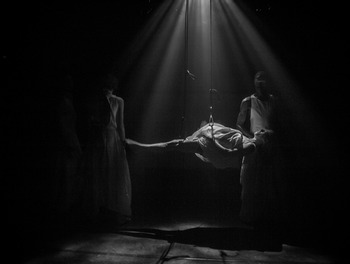
These moves are figured in the performance by way of an aerial acrobat. An acrobat's feet are strong, high above the ground, and are admired by the audience for their virtuosity and the possibilities of movement they can realize. An acrobat's performance is at odds with what regulates everyday bodily encounters, with what these encounters must conform to; movements and the occupation of space are often at odds with the register of regular human capacities. Here is a body that counters the pull of gravity itself, which governs our dealings with the world while we are awake (see Fig. 2).Footnote 63
Sleeping in mid-air. The Empress's Feet by Ficarra and Whittington, TA OPERA ZUTA. Director: Michal Grover-Friedlander; acrobat: Reenat Caidar-Avraham. Photograph by Tali Bøgen.

Neither anchored to the ground nor fixed in a position in space, an acrobat may roam in space, aerial-like, may float and soar above the audience. An acrobatic act destabilizes equilibrium and defies nature's laws. A fearless body, undefeatable, unlimited, repeatedly taking risks, a death-defying body: ‘An acrobat increases and accentuates the difference between his behavior and the norm … The spectator … considers the acrobat “another sort” of being’.Footnote 64 Not restricted by weight or by a necessary stability or balance, an acrobat seems to walk herself, as if she really were a somnambulistic ‘flying soul’. An acrobat maintains an illusion of physical freedom, with the feet seeming unrestrained, going forth of their own accord, elevating the body high above, airborne, on display, in excessive use as if feet really were given agency. This agency is achieved precisely through the identification of the weightless movement with the all-encompassing voice propagating in the air. The body in the air, carried by feet which are as freed from gravity as a voice is, transports us farther and farther away.
I have shown that in the transformation of the tale about the origins of foot binding, first into opera and then into performance, the possibility of presenting feet acquiring an agency of their own is heightened. Singing expresses the sleepwalking, as it voices the feet's will to walk freely, allowing us to imagine their future unbound. The opera reformulates the portrayal of the origin of foot binding in the tale, and re-empowers the feet. The performance by TA OPERA ZUTA complicated this gesture even more. The performance marks the linkage of cruelty and beauty at the heart of foot binding by alluding to the voice of the operatic castrato in which such a linkage is also evident. At the same time, the performance underscores even further the power of sleepwalking feet and their pleasure in wandering: feet even roam freely in the air. It is precisely the medium of opera, with its apotheosis of voice, that can offer a powerful image of hidden possibilities of the body.
I would like to thank Marcus Cheng Chye Tan, Tereza Havelková, Fintan Walsh, Aoife McGrath and the two anonymous reviewers of my article for extremely helpful comments and suggestions.