Introduction
Selenium (Se) is an essential nutrient, necessary for adequate function of selenoproteins. These proteins include the antioxidant enzymes glutathione peroxidases (GSH-Px). As a consequence, Se plays a role in cell antioxidant defence, immune response and reduction of inflammation (Arthur et al., Reference Arthur, McKenzie and Beckett2003; Schomburg et al., Reference Schomburg, Schweizer and Köhrle2004). Feeding Se to pregnant or lactating females increases tissue Se content and GSH-Px activity in cows, ewes, sows and their offspring (Lacetera et al., Reference Lacetera, Bernabucci, Ronchi and Nardone1996 and Reference Lacetera, Bernabucci, Ronchi and Nardone1999; Rock et al., Reference Rock, Kincaid and Carstens2001; Mahan and Peters, Reference Mahan and Peters2004). It can stimulate antibody response to an antigen in calves and enhance immunoglobulin G (IgG) concentrations in colostrum produced by cows (Swecker et al., Reference Swecker, Thatcher, Eversole, Blodgett and Schurig1995; Awadeh et al., Reference Awadeh, Kincaid and Johnson1998). Moreover, greater colostrum yields have been reported when cows were treated with inorganic Se (Lacetera et al., Reference Lacetera, Bernabucci, Ronchi and Nardone1996). To our knowledge, no data were available in swine. The increase in Se content in the dams and their progeny is greater when Se is supplied as organic Se from an enriched yeast source, as compared with inorganic Se from sodium selenite (sows: Mahan and Kim, Reference Mahan and Kim1996; cows: Pehrson et al., Reference Pehrson, Ortman, Madjid and Trafikowska1999; ewes: Rock et al., Reference Rock, Kincaid and Carstens2001). Providing organic versus inorganic Se to sows has also been suggested to reduce pre- and post-weaning mortality of piglets (Lampe et al., Reference Lampe, Gourley, Sparks and Stumpf2005a and Reference Lampe, Gourley, Sparks and Stumpf2005b). The present study was designed to compare the influence of organic and inorganic Se provided in sow diets during late gestation and lactation, with two objectives. Firstly, the influence of the Se source was investigated on colostrum production and immunoglobulin concentration. Given the nutritional and immunological importance of colostrum for newborn piglet survival (Rooke and Bland, Reference Rooke and Bland2002; Le Dividich et al., Reference Le Dividich, Rooke and Herpin2005), we may wonder whether organic Se could improve piglet survival through an impact on colostrum quality or yield. Secondly, it was evaluated whether Se content of the piglets at weaning influences its response to a deterioration of sanitary conditions, as may occur in the post-weaning facilities.
Material and methods
Animals, experimental design and sow feeding
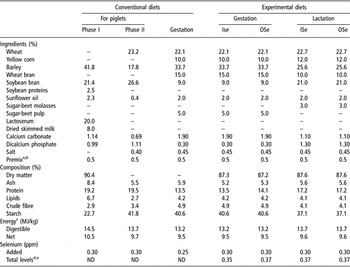
The experiment was carried out at the INRA experimental herd (UMR SENAH, Saint-Gilles, France). It was conducted in two replicates on 22 crossbred LR × LW sows from parity one to parity four and their piglets (PP × (LR × LW)). Parities were balanced across treatment. Littermate sows were allocated to one of two feeding regimens at 85 days of pregnancy. During the last month of pregnancy (beginning at day 88) and during lactation, sows were fed experimental diets for gestating and lactating sows, respectively, supplemented with organic Se (group OSe, n = 11) or inorganic Se (group ISe, n = 11), provided at a dose of 0.3 ppm (Table 1). Inorganic Se was supplied as sodium selenite and organic Se as Sel-Plex® (Alltech Inc., Nicholasville, KY, USA), an Se-enriched yeast product that contains at least 98% selenium in the form of organo-selenium compounds. The experimental diets contained 45 IU/kg of vitamin E, as standard diets. They contained the same concentration of digestible energy and Se for the ISe and OSe sows (Table 1). During the last month of pregnancy, sows received 2.7 kg of feed daily. On the day of farrowing and on the first day of lactation, sows were fed 2.7 kg and then the feed supply was progressively increased to reach 5.5 kg by day 4, then 6.5 kg/day at the end of lactation. Feed supply was limited to prevent variation in feed consumption between sows. Throughout the experimental period, feed refusals were weighed daily. From insemination to day 87 of pregnancy and after piglet weaning, sows were fed a conventional diet for gestating sows supplemented with 0.25 ppm of inorganic Se (Table 1).
Composition of conventional and experimental diets

aSupplied the following amounts/kg of diet, for sows: vitamin A, 10 000 IU; vitamin D3, 1500 IU; vitamin E 45 mg, vitamin K3, 2 mg; thiamine, 2 mg; riboflavin, 4 mg; nicotine acid, 15 mg; d-pantothenic acid, 10 mg; pyridoxine 3 mg; d-biotin, 0.2 mg; folic acid, 3 mg; vitamin B12, 0.02 mg; choline, 500 mg; Fe, 80 mg; Cu, 10 mg; Mn, 40 mg; Zn, 100 mg; Co, 0.1 mg; and I, 0.6 mg. For conventional diets, Se was provided as sodium selenite at 0.3 mg/kg of diet for piglets and 0.25 mg/kg for gestating sows.
bThe premix used for the experimental diets did not contain Se.
cCalculated values based on INRA-AFZ (2004).
dND = not determined.
eTotal Se levels were determined by ICP-MS (0.35 ± 0.04; 0.37 ± 0.04; 0.37 ± 0.08 and 0.37 ± 0.01 ppm).
Management of sows and litters
Sows were housed in individual stalls or crates. They were moved from the gestation to the farrowing rooms on day 104 ± 1 of gestation. Parturition was induced on day 114 of gestation. During farrowing, oxytocin was injected and piglets were manually extracted if necessary. At birth, each piglet was identified with an ear clip. Each piglet was weighed at birth (umbilical cords were cut to limit biased measurements) and 24 h later. Because standardizing litter size at birth was not possible in practice, the original litter was kept under the sow during the first 24 h after birth. This procedure should not influence litter weight gain from birth to 24 h of age and colostrum yield, as these parameters have been shown to be independent of litter size (Le Dividich et al., Reference Le Dividich, Rooke and Herpin2005). Litters were not standardized thereafter but, when the litter was large, litter size was reduced to the number of functional teats minus one. Castration, iron injection and tattoos were performed after 24 h. During lactation, piglets received no creep feed but had free access to water and to the sow trough. Piglets were weighed and weaned at 26 ± 1 days of age. Before and after weaning, diarrhoea incidence was registered and treated.
Management of weaned piglets
Some piglets were submitted to an experiment to evaluate the impact of Se source on growth performance when weaning occurs either in good or in poor sanitary conditions, according to a procedure previously validated (Le Floc’h et al., Reference Le Floc’h, Jondreville, Matte and Seve2006). Within each litter, two pairs of piglets were selected on a live-weight basis. Within each pair, one piglet was assigned to a high sanitary status (HSS) and the other to a low sanitary status (LSS). The high sanitary conditions were obtained by cleaning and disinfecting rooms before piglet arrival. These rooms housed 10 experimental piglets. For the low sanitary conditions, rooms were neither cleaned nor disinfected after previous occupation by pigs from the same herd. They housed 10 experimental piglets mixed with 10 non-experimental piglets in order to increase the microbial pressure. All piglets were individually reared. They were fed ad libitum phase I diet (Table 1). An antibiotic was added to the diet for HSS piglets only (avilamycin, 4 g/kg of feed). Antibiotic treatment was used to improve the sanitary status of the piglets housed in the clean environment. The experiment lasted for 15 days. Fasted piglets and feed refusals were weighed at the end of the experiment.
Piglets not used in the previous trial were moved to the post-weaning facilities. They were housed in groups of 10, on slatted floors. All weaned piglets were fed conventional diets, phase I diet for 2 weeks and then phase II diet for 4 weeks. Feed was offered for ad libitum intake. These conventional diets contained Se provided at 0.3 ppm as sodium selenite (Table 1). Piglets were weighed after 6 weeks post weaning.
Sampling
Single blood samples were collected from sows, by puncture in the jugular vein, 2 h after the morning meal on day 85 of pregnancy, on the day of weaning and 6 weeks later. Blood samples were taken from the same three to five piglets in each litter, at birth, at weaning and 6 weeks later. Blood samples were not centrifuged and were immediately frozen at −20°C. Blood samples were also collected from piglets submitted to the sanitary experiment, at the end of the experiment. They were collected on EDTA, centrifuged for 15 min at 3500 × g at 4°C. Plasma was aliquoted and stored at −20°C.
Colostrum was obtained just after birth of the first piglet and 3, 6 and 24 h later (t0, t3, t6 and t24, respectively). This t24 time was calculated by adding 24 h to the mid-duration of farrowing. Milk was collected on day 14 of lactation and on the day of weaning before piglet removal. Colostrum and milk were immediately filtered on gauze, sampled and stored at −20°C.
Biological analyses
IgG in colostrum and milk were analysed using a commercial kit (Pig IgG ELISA Quantitation kit; Bethyl Laboratories, Montgomery, USA, ref. E100-104), according to an adaptation by I. Oswald (UR66 Pharmacologie-Toxicologie, INRA, Toulouse, France). The validated procedure was described by Devillers et al. (Reference Devillers, Farmer, Mounier, Le Dividich and Prunier2004a). Colostrum was diluted at 1/500 000 (t0, t3 and t6 samples) or at 1/100 000 (t24 samples) and milk was diluted at 1/5000 (mid-lactation) and 1/2000 (late lactation). Each dilution was measured twice in duplicate and data are the means of four values. To prevent plate-to-plate variation in the IgG assay, the two treatments were represented on each plate. The coefficients of variation between and within plates were 14% and 5.8%, respectively, for a colostrum sample containing 67 mg/ml of IgG.
The plasma concentration of haptoglobin, used as an indicator of inflammatory response (Eckersall et al., Reference Eckersall, Saini and McComb1996), was measured by a colorimetric assay (Phase Haptoglobin Assay; Tridelta Development Limited, Wicklow, Ireland).
The Se content in experimental diets and blood samples was analysed by ICP-MS (Inductively Coupled Plasma Mass Spectrometry) in the UT2A laboratory (Ultra Traces Analyses Aquitaine, Université de Pau et des Pays d’Adour, France).
Calculations and statistical analyses
Individual colostrum intake by newborn pigs during the first 24 h of life was estimated from piglet weight variation between birth and 24 h. The equation was proposed by Devillers et al. (Reference Devillers, van Milgen, Prunier and Le Dividich2004b):

where CI = colostrum intake (g), BW = pig body weight at 24 h (kg), BWb = pig body weight at birth (kg), t = time elapsed from birth to weighing around 24 h (min) and t fs = time elapsed from birth to first suckling (min). According to Devillers et al. (Reference Devillers, van Milgen, Prunier and Le Dividich2004b), the interval elapsed between birth and first suckling (t fs) can be estimated between 15 and 30 min without major error. In the present experiment, an average interval of 20 min was chosen. When piglets lost much body weight during the first day of life, CI value was negative. We considered that these piglets had not consumed colostrum and that the CI value was nil. Colostrum production by sows during the 24 h after farrowing commenced was calculated by summing colostrum intakes of all the piglets in the litter.
The data were submitted to an analysis of variance using the GLM procedure of SAS (SAS, 1996). All models included the effects of the treatment (organic versus inorganic Se) and of the replicate and the interaction between these two factors. For piglet performance, a split-plot design was used with treatment, replicate and the interaction, and sow nested within group (error to test the effects of treatment, replicate and the interaction). For Se in sow blood and Se and IgG in colostrum and milk, the repeated procedure of SAS was used. For Se in pig blood, the general model showed a significant interaction between treatment and day of sampling effects. Therefore, the analysis was performed day by day, using a split-plot design with the sow nested within group as an error term. For sanitary challenge, the experimental treatments (ISe v. OSe and HSS v. LSS) were compared within pairs using the interaction treatment × pair as the error term.
One of the 22 sows allocated to the experiment farrowed at 112 days of gestation without annunciating signs. Therefore, data on piglets at birth and on colostrum are available only for 21 sows (10 in the group OSe and 11 in the group ISe).
Results
Sow and litter performance
Sows from the two groups consumed the same amount of experimental diets (76.7 ± 0.3 kg during the last 28 days of pregnancy and 129.8 ± 0.7 kg during lactation).
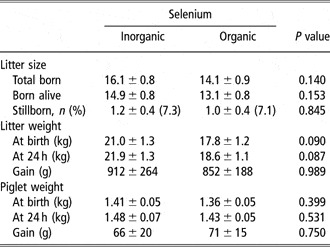
Litter size did not significantly differ between the two groups of sows (Table 2). Nevertheless, the total number of piglets born and the number of piglets born alive were higher by two piglets, on average, for the ISe than for the OSe sows. The proportion of stillborn piglets did not differ between groups and averaged 7.2% of total piglets. Litter weight at birth and at 24 h tended to be higher in the ISe group (P < 0.1). Litter weight gain varied from −654 to +1982 and averaged 884 ± 161 g (P > 0.1). No effect of Se source was found on piglet weight at birth and at 24 h, as well as on weight gain (Table 2).
Influence of selenium sources in sow diet on litter size and piglet growth during the first 24 h of life (mean ± s.e.)

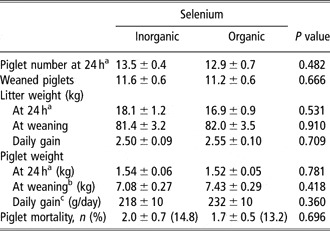
During lactation, growth performance of litters and individual performance of piglets did not differ between the two groups of sows (Table 3). At weaning, the piglets from the OSe sows were 0.35 kg heavier than those from the ISe sows, but the difference did not reach the level of significance. Piglet mortality throughout lactation averaged 14% and was not influenced by treatment (P > 0.1). The ISe and OSe sows weaned 11.4 piglets on average. During the 6 weeks after weaning, piglets gained 499 ± 81 g daily and growth rate was not influenced by sows’ regimens (P > 0.1).
Influence of selenium sources in sow diet on litter and piglet performance during lactation (mean ± s.e.)

aAfter reduction of litter size to the number of teats minus one.
bAfter adjustment for litter size, P = 0.65.
cAfter adjustment for litter size, P = 0.73.
Colostrum, milk and immunoglobulin G
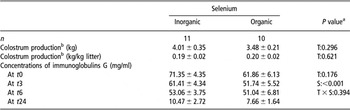
Estimated colostrum production during 24 h was highly variable among sows, varying from 1.6 to 5.4 kg. The ISe sows produced on average 500 g more than the OSe sows, but the difference was not significant (P > 0.1; Table 4). When colostrum production was expressed per kg of litter, it was similar in the two groups. Colostrum production was not significantly correlated with litter size (r = 0.28, P = 0.22) or litter weight (r = 0.42, P = 0.06).
Production of colostrum by sows fed inorganic or organic selenium, and colostrum concentrations of immunoglobulins G (mean ± s.e.)

aT = dietary treatment effect; S = time of sampling effect; T × S = treatment × sampling interaction.
bEstimated production during 24 h after the onset of farrowing.
Averaged concentrations of IgG decreased progressively during the 24 h after farrowing commenced (P < 0.001; Table 4). They further decreased in milk where they were very low (3.1 ± 1.1 and 1.7 ± 1.0 mg/ml in mid- and late lactation, respectively). No Se treatment effect was found on IgG concentrations in colostrum and milk.
Concentrations of Se in sows, colostrum, milk and piglets
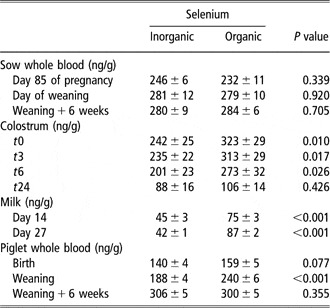
The source of Se had no effect on Se concentrations in sow whole blood (Table 5). Concentrations were lower (P < 0.001) in late pregnancy than on the day of weaning and 6 weeks after. Concentrations of Se in colostrum were higher (P < 0.05) in the OSe than in the ISe group at the onset of farrowing, 3 and 6 h later but the difference was no longer observed at 24 h (Table 5). They were significantly higher (P < 0.05) during the first 6 h following the onset of farrowing than 24 h later. In mid- and late lactation, milk produced by the OSe sows contained higher levels of Se (Table 5). Feeding sows organic Se instead of inorganic Se increased average Se concentration by almost 35% in colostrum and 90% in milk.
Influence of dietary selenium source on selenium content in sow and piglet whole blood, colostrum and milk (mean ± s.e.)

At birth, piglets born from sows fed organic Se tended to have higher concentrations of Se in blood than piglets from the ISe sows (Table 5). The difference was markedly accentuated at weaning and was completely erased 6 weeks after weaning (Table 5).
Performance of weaned piglets in response to depressed sanitary conditions
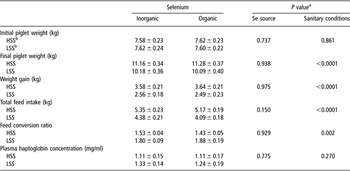
Weaned piglets reared for 15 days in good sanitary conditions ate more (P < 0.001) and gained 1.1 kg more than piglets reared in non-sanitized rooms (P < 0.001; Table 6). Their feed conversion ratio was better (P < 0.01). Sanitary conditions did not influence mean plasma haptoglobin concentrations (P > 0.1). The source of Se fed to the dams did not influence piglet performance or haptoglobin concentrations (Table 6).
Influence of selenium source fed to the dams on piglet response to a deterioration of sanitary conditions in post-weaning room (mean ± s.e.)

aEffects of Se source and sanitary conditions, respectively. For all criteria, the Se source × sanitary conditions interaction was not significant.
bPiglet sanitary status, high (HSS) or low (LSS), was obtained by rearing weaned piglets in good or poor sanitary conditions.
Discussion
The source of Se did not significantly influence pig and litter growth rate, during lactation and during the 6 weeks after weaning, in agreement with published data (Mahan and Kim, Reference Mahan and Kim1996; Yoon and McMillan, Reference Yoon and McMillan2006). The two extra piglets born alive when sows were fed inorganic Se were not related to a reduced incidence of stillbirths but to a greater whole litter size, which was established before dietary treatments started. The difference in litter sizes cannot therefore be attributed to treatment. Piglet mortality rate was similar to the average mortality (14.4%) in French herds, calculated from the national database of sow performance in 2006. Because of the limited number of females and unequal litter sizes, the present experiment was not designed to investigate the effect of Se source on pig mortality.
Short-term effects on Se concentrations in sows, piglets, colostrum and milk
The chemical form of Se provided to pregnant females has been reported to significantly affect Se content in various tissues of the dams, but not in serum (in sows: Mahan and Kim, Reference Mahan and Kim1996; Yoon and McMillan, Reference Yoon and McMillan2006; cows: Awadeh et al., Reference Awadeh, Kincaid and Johnson1998; ewes: Rock et al., Reference Rock, Kincaid and Carstens2001). In the present study, we chose whole blood as an indicator of circulating Se because more than 50% of Se in circulation is present in erythrocytes, mainly bound to haemoglobin (Butler et al., Reference Butler, Whanger, Kaneps and Patton1990; Giguère et al., Reference Giguère, Fortier and Matte2005). The form of Se fed to sows did not alter blood Se concentration, which is consistent with findings in ewes (Rock et al., Reference Rock, Kincaid and Carstens2001). In contrast, a 16% increase in whole-blood Se concentration was reported in sows fed organic Se versus inorganic Se for 3 months (Fortier et al., 2004). In cows, organic Se was more effective in increasing blood Se concentrations than sodium selenite after 22 months of supplementation, but not before (Awadeh et al., Reference Awadeh, Kincaid and Johnson1998). It is likely that the effect of Se source on blood Se content depends on the duration of supplementation. Because Se in the Se-enriched yeast source is essentially provided as selenomethionine, the greater blood Se content may be related to the non-specific incorporation of selenomethionine to blood proteins.
The non-specific incorporation of selenomethionine to proteins has also been proposed to explain the better transfer of organic Se through placenta to foetuses, as compared to inorganic Se. Indeed, feeding organic Se to pregnant sows is reported to increase the Se content of piglets at birth, by 50% to 130% depending on tissues (liver, loin, whole body; Mahan and Kim, Reference Mahan and Kim1996; Mahan and Peters, Reference Mahan and Peters2004). Effects on Se content in blood or serum seem to be more moderate. Yoon and McMillan (Reference Yoon and McMillan2006) observed a 28% increase in serum and our results indicated only a trend towards a marginal increase in blood of neonates. Therefore, the only measurements of Se in blood or serum may not be adequate to assess piglet Se content, at least at birth.
The greater Se concentration in colostrum and milk when sows were fed organic Se is consistent with previous findings (Mahan, Reference Mahan2000; Mahan and Peters, Reference Mahan and Peters2004; Yoon and McMillan, Reference Yoon and McMillan2006). This confirms that Se is better transferred to colostrum and milk when it is provided as organic Se. As suggested by Mahan (Reference Mahan2000), the organic Se could be non-specifically incorporated to milk proteins as selenomethionine. As a consequence of better Se transfer to milk, blood Se contents of piglets at weaning were higher by nearly 30% in the OSe than in the ISe group, in agreement with previous observations in serum and tissues of weaned pigs (Mahan and Kim, Reference Mahan and Kim1996; Mahan and Peters, Reference Mahan and Peters2004).
Colostrum production and immunity
Our results indicate that the source of Se fed to the sows had no influence on litter growth and colostrum production during the 24 h post partum. In agreement with previous findings (Le Dividich et al., Reference Le Dividich, Rooke and Herpin2005), estimated colostrum production was not significantly correlated with litter characteristics at birth. Similarly, Se source had no influence on IgG concentration in colostrum and milk. This is consistent with previous findings, showing no effect of the chemical form of Se given to pregnant ewes on concentrations of IgG in colostrum (Rock et al., Reference Rock, Kincaid and Carstens2001). In antioxidant activities and immune modulation, selenium and vitamin E appear to work together (Oldfield, Reference Oldfield2003). In the present experiment, diets for sows contained 45 IU/kg of vitamin E, as recommended by the National Research Council (NRC, USA) (standard diets). It seems therefore that supplementing diets with 0.3 ppm of Se supplied as sodium selenite, together with vitamin E, provides adequate levels of Se (and vitamin E) with regard to the IgG concentration of colostrum.
Weaned piglet response to depressed sanitary environment
Deterioration of sanitary conditions in post-weaning facilities has been shown to impair nutrient utilization and pig growth performance by inducing a moderate inflammatory response (Schneider and Bronsch, Reference Schneider and Bronsch1973; Le Floc’h et al., Reference Le Floc’h, Jondreville, Matte and Seve2006). This immune response can be evidenced by increased plasma concentrations of haptoglobin, a major acute-phase protein in pigs (Le Floc’h et al., Reference Le Floc’h, Jondreville, Matte and Seve2006). The experimental design we used has been proposed as a reliable model to investigate changes in nutrient requirements induced by deterioration of sanitary status and health (Le Floc’h et al., Reference Le Floc’h, Jondreville, Matte and Seve2006). Indeed, conditions challenging the immune system are known to induce changes in nutrient metabolism. In these circumstances, requirements for nutrients involved in body defences, such as Se, would be theoretically increased. In the present study, as expected, growth rate and feed conversion were depressed when piglets were housed in bad sanitary conditions. The lack of difference in mean haptoglobin concentrations between LSS and HSS piglets was unexpected due to the difference in growth performance between the two groups. This could be due to the fact that several piglets reared in the clean room, which had unexplained great concentrations of haptoglobin (i.e. >1.5 g/L) without exhibiting lower growth rate and any clinical signs of disease compared to piglets housed in the same conditions. These piglets were equally distributed in the ISe and OSe groups. As a consequence, average haptoglobin concentrations in the HSS group were greater than previously described (Le Floc’h et al., Reference Le Floc’h, Jondreville, Matte and Seve2006). Our results also indicate that piglet response to sanitary conditions was not influenced by the source of Se fed to the dams, despite the higher Se contents of piglets born from sows fed organic Se. These piglets may not have a better antioxydative capacity, as suggested by Mahan and Peters (Reference Mahan and Peters2004). These authors reported that GSH-Px activities seemed to plateau when Se was provided at a 0.15 ppm level irrespective of the form. In the present study, weaned piglets were fed a first-stage diet supplemented with 0.3 ppm of inorganic Se, according to the current practice in French herds. Our findings suggest therefore that, in herd conditions, the higher Se content as determined by whole-blood Se levels of piglets at weaning, when the dams were fed organic Se, would not prevent short-term reduction of growth performance due to depressed sanitary conditions.
Long-term effects on blood Se concentrations in sows and piglets
Whole-blood Se concentrations did not decrease in sows during the 6 weeks after weaning. During this period, the sows were no longer fed the experimental diets, but a conventional diet supplemented with only 0.25 ppm of inorganic Se. This supports previous findings showing no influence of Se level beyond 0.25 ppm of supplementation (Mahan and Peters, Reference Mahan and Peters2004). In piglets, the influence of the Se source on blood Se concentrations was no longer observed 6 weeks after weaning. Standard diets for weaned pigs supplemented by 0.3 ppm of inorganic Se could therefore be adequate regarding pig Se content, as previously reported (Meyer et al., Reference Meyer, Mahan and Moxon1981). However, Se measurements in tissues are necessary before concluding on the actual Se content of pigs 6 weeks after weaning.
Independent of dietary treatments, blood Se contents in pigs increased by 40% between weaning and 10 weeks of age. This increase is consistent with previous findings (Meyer et al., Reference Meyer, Mahan and Moxon1981) and may be related to an active synthesis of selenoproteins by growing pigs. In sows, also, blood Se concentrations varied over time, being lower in late pregnancy. A decline in serum Se contents was previously reported in sows, with lower contents at 90 and 110 days of pregnancy (Mahan and Kim, Reference Mahan and Kim1996; Mahan and Peters, Reference Mahan and Peters2004). This decline in Se contents may be related to an active transfer of Se to foetuses, as suggested by Mahan and Kim (Reference Mahan and Kim1996), and also to an increase in blood volume during pregnancy (Matte and Girard, Reference Matte and Girard1996).
In conclusion, our findings confirm that, as compared with inorganic Se, organic Se fed to the dam is better transferred to colostrum and milk, and consequently to piglets. They indicate that Se source influences neither the quantity of colostrum produced by the sows nor the IgG concentration in colostrum and milk. Finally, they show that the higher Se content of piglets at weaning does not limit the reduction of growth performance when weaning occurs in deteriorated sanitary conditions. Therefore, under these experimental conditions, organic Se did not improve immune response as compared with non-organic Se.
Acknowledgements
The authors wish to thank the staff of Saint-Gilles and Michel Lefebvre for taking care of the animals and help for sample collection. They are grateful to Chrystèle David and Brigitte Trépier for expert technical assistance.