


Introduction
Obsessive-compulsive disorder (OCD) in schizophrenia
The associations between psychotic disorders and obsessive-compulsive symptoms (OCS) were first been described by Westphal in the 19th century (Westphal, Reference Westphal1878). Since then, several epidemiological studies have investigated the co-occurrence of OCS and psychosis and a recent meta-analysis estimated that around 12% of patients with schizophrenia also fulfil the criteria for OCD (Achim et al. Reference Achim, Maziade, Raymond, Olivier, Merette and Roy2011). Almost 25% of patients with schizophrenia describe obsessive, distressing, intrusive thoughts and related compulsions (e.g. repeated hand washing, checking behaviour, counting or cleaning) conceived as attempts to neutralize the obsessions (Buckley et al. Reference Buckley, Miller, Lehrer and Castle2009; Lysaker & Whitney, Reference Lysaker and Whitney2009; Mukhopadhaya et al. Reference Mukhopadhaya, Krishnaiah, Taye, Nigam, Bailey, Sivakumaran and Fineberg2009). This high life-time risk for patients with schizophrenia to suffer from comorbid OCD stands in contrast to low prevalence rates of OCD in the general population and a low risk of only 1.7% for primary OCD patients to suffer from additional psychotic symptoms (de Haan et al. Reference de Haan, Dudek-Hodge, Verhoeven and Denys2009).
Regarding clinical implications of comorbid OCS in schizophrenia most studies report that the obsessions and related compulsions severely disturb the patient's cognitive and emotional flexibility. Patients with schizophrenia and comorbid OCS were found to report lower subjective well-being and quality of life (de Haan et al. Reference de Haan, Sterk and van der Valk2012a), to show dysfunctional coping preferences, greater levels of hopelessness (Lysaker et al. Reference Lysaker, Whitney and Davis2006), more social dysfunctions (de Haan et al. Reference de Haan, Sterk and van der Valk2012b), and poorer treatment response (Jaeger et al. Reference Jaeger, Messer, Laux, Pfeiffer, Naber, Schmidt, Gaebel, Klosterkötter, Heuse, Maier, Lemke, Ruether, Buckkremer, Gastpar, Riedel, Bottlander, Strauss and Moeller2008) compared to schizophrenia patients without comorbid OCS. Comorbid patients have also repeatedly been found to present with more severe global, positive and negative symptoms (Cunill et al. Reference Cunill, Castells and Simeon2009) and more severe depressive symptoms (de Haan et al. Reference de Haan, Hoogenboom, Beuk, van Amelsvoort and Linszen2005; Lysaker & Whitney, Reference Lysaker and Whitney2009). Thus, in contrast to early concepts where the presence of OCS was thought to have a protective effect regarding psychotic disintegration (Stengel, Reference Stengel1945), subsequent research suggests higher impairment.
In addition, several studies compared cognitive performance between schizophrenia patients with and without comorbid OCS and the majority reported larger deficits for comorbid samples in specific domains, such as executive functioning, cognitive flexibility and visuo-spatial memory (Schirmbeck et al. Reference Schirmbeck, Rausch, Englisch, Eifler, Esslinger, Meyer-Lindenberg and Zink2012a). These findings demonstrate that the comorbidity of OCS in patients with schizophrenia is a frequent and often underestimated clinical problem with major impact on full functional recovery.
The clinical presentation of OCS in schizophrenia is diverse with manifestation of OCS prior to, concurrent with, or after first onset of psychosis (Hwang et al. Reference Hwang, Kim, Yum and Opler2009). Within the latter group a significant proportion of comorbid patients, suffer from second-onset OCS that have been induced or at least aggravated by second-generation antipsychotics (SGA), e.g. clozapine (Schirmbeck et al. Reference Schirmbeck, Rausch, Englisch, Eifler, Esslinger, Meyer-Lindenberg and Zink2012b; Schirmbeck & Zink, Reference Schirmbeck, Zink and Ritsner2012a).
Diagnostic implications
When dealing with the phenomenon of OCS in patients with schizophrenia clinicians are initially confronted with the difficult diagnostic challenge of differentiating between obsessions and delusions or compulsions and reactions to hallucinations. This becomes especially difficult if patients show poor insight into the irrational nature of their obsessions or compulsions. Since a reliable and valid characterization of presented symptoms is the most important basis for subsequent treatment approaches, several aspects should be considered. This includes the administration of standardized diagnostic scales, such as the Structured Clinical Interview for DSM-IV (SCID-I; First et al. Reference First, Spitzer, Gibbon and Williams2002) and the Yale–Brown Obsessive Compulsive Scale (YBOCS; Goodman et al. Reference Goodman, Price, Rasmussen and Mazure1989). Obsessive thoughts and ideas are acknowledged as originating in the person's mind and as being unreasonable or excessive. This definition allows the distinction from hallucinations. Ruminations or stereotypic thoughts or repeated actions that are exclusively related to the content of psychotic symptoms should not be rated as comorbid OCS but be attributed to the primary psychotic condition. In cases where a careful symptom differentiation was guided by the criterion of insight, reliable identification of comorbid OCS with the YBOCS has been reported (Poyurovsky & Koran, Reference Poyurovsky and Koran2005). Evidence further suggested that presented OCS dimensions are in most cases similar to those in primary OCD (Faragian et al. Reference Faragian, Pashinian, Fuchs and Poyurovsky2009).
If questionable obsessions or compulsions first emerge during the acute psychotic exacerbation, they should be re-assessed after psychotic remission. In cases of de novo occurrence or aggravation of OCS subsequent to the initiation of SGA treatment, medication-induced OCS should be considered (Schirmbeck & Zink, Reference Schirmbeck, Zink and Ritsner2012b).
Pharmacological treatment approaches
Several pharmacological treatment interventions have been suggested to improve OCS in this highly impaired group, including combination as well as augmentation strategies. Adding mainly dopaminergic SGAs, such as aripiprazole to SGAs with predominant and potent antiserotonergic properties has been shown to improve OCS (Schirmbeck & Zink, Reference Schirmbeck, Zink and Ritsner2012b). Similarly, a decrease in comorbid OCS severity has been reported in a switch-over study to amisulpride (Kim et al. Reference Kim, Shin, Kim, Yang, Hwang and Yoon2008). Furthermore, the combination with several serotonergic antidepressants has been suggested, such as the additional treatment with the tricyclic antidepressant clomipramine or selective serotonin reuptake inhibitors (SSRIs), usually fluvoxamine (Hwang et al. Reference Hwang, Kim, Yum and Opler2009). Results have been heterogeneous and some studies failed to observe the intended effects of OCS reduction. Finally, first hints suggest anti-obsessive effects of the augmentation with mood stabilizers such as valproic acid (Zink et al. Reference Zink, Englisch, Knopf, Kuwilsky and Dressing2007; Canas et al. Reference Canas, Aydinoglu and Sinani2012) or lamotrigine (Poyurovsky et al. Reference Poyurovsky, Glick and Koran2010). Based on this evidence pharmacological treatment guidelines for heterogeneous subgroups within the comorbid sample have been suggested, ranging from dose adjustment for SGA-induced or aggravated OCS to augmentation strategies and the addition of SSRIs for pre-existing OCS (Hwang et al. Reference Hwang, Kim, Yum and Opler2009; Schirmbeck & Zink, Reference Schirmbeck, Zink and Ritsner2012b). However, additive side-effects and pharmacokinetic interactions have to be considered when applying combination or augmentation strategies (Andrade, Reference Andrade2013).
While the described pharmacological approaches appear to be beneficial in reducing OCS in patients with schizophrenia, no studies reported complete remission of OCS, often with remaining clinically relevant symptom severity (YBOCS >16). Accordingly, the American Psychiatric Association stated that when OCS in patients with schizophrenia do not respond to treatment options such as addition of a SSRI or switching to another SGA, a trial of cognitive behavioural therapy (CBT) could be attempted (Koran et al. Reference Koran, Hanna, Hollander, Nestadt and Simpson2007).
The aim of this paper is to review published evidence regarding the effectiveness of CBT for comorbid OCS/OCD in schizophrenia and to provide suggestions for its implementation in clinical practice.
CBT in the treatment of schizophrenia and primary OCD patients
CBT for primary OCD, in particular those interventions that include exposure therapy with response prevention (ERP), has excellent empirical support in randomized control trials. Recent meta-analyses report positive outcome measures with high effect sizes of up to d = 0.998 (95% confidence interval 0.559–1.437) (Rosa-Alcazar et al. Reference Rosa-Alcazar, Sanchez-Meca, Gomez-Conesa and Marin-Martinez2008). Consequently, treatment guidelines suggest CBT including exposure as the treatment of first choice for OCD. Of the various modes of exposure, massive vs. graduated approaches have not been compared so far, but empirical evidence shows higher effectiveness of the therapist-guided exposure compared to the self-application of ERP (Rosa-Alcazar et al. Reference Rosa-Alcazar, Sanchez-Meca, Gomez-Conesa and Marin-Martinez2008). Positive treatment effects in 60–70% of OCD patients have been shown to remain relatively stable over follow-up periods of 6–8 years (Rufer et al. Reference Rufer, Hand, Alsleben, Braatz, Ortmann, Katenkamp, Fricke and Peter2005).
CBT has also been proven effective in the treatment of schizophrenia. Several controlled clinical trials and recent meta-analyses demonstrated positive effects including cognitive remediation, treatment-resistant positive and negative symptoms, as well as comorbid depressive episodes (Wykes et al. Reference Wykes, Steel, Everitt and Tarrier2008; Sarin et al. Reference Sarin, Wallin and Widerloev2011; Grant et al. Reference Grant, Huh, Perivoliotis, Stolar and Beck2012). Thus, not surprisingly, international consensus guidelines declared CBT as a core component in the treatment of schizophrenia (Lehman et al. Reference Lehman, Lieberman, Dixon, McGlashan, Miller, Perkins and Kreyenbuhl2004; Gaebel et al. Reference Gaebel, Riesbeck and Wobrock2011).
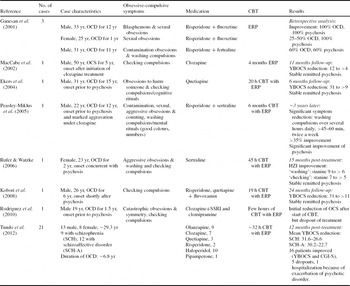
In conclusion, results from clinical trials applying CBT for OCD and for several syndromes within schizophrenia make it compelling to consider CBT as a treatment option for comorbid OCS/OCD in patients with schizophrenia. However, despite conceptual and empirical support, the value of CBT for this comorbid group of patients has not been evaluated in controlled clinical trials. Nevertheless, several important suggestions for current treatment options and future research can be derived from the reviewed case reports and a case series (see Table 1).
Case reports and case series of CBT for OCD in schizophrenia

CBT, Cognitive behavioural therapy; CGI-S, Clinical Global Impression – Severity scale; ERP, exposure and response prevention; HZI, Hamburger Zwangsinventar; OCS, obsessive-compulsive symptoms; OCD, obsessive-compulsive disorder; SA, schizoaffective disorder; SCH, schizophrenia; SGA, second-generation antipsychotics; SSRI, selective serotonin reuptake inhibitors; YBOCS, Yale–Brown Obsessive Compulsive Scale.
Summarized literature of applied CBT in cases with OCD and schizophrenia. Screening of public databases (PsycINFO, Google-Scholar, Pubmed) revealed reports of 30 heterogeneous cases.
CBT for OCS/OCD in patients with schizophrenia
Review of the literature
In order to review published literature on CBT for OCS in schizophrenia, we performed a systematic and comprehensive search of available public databases (Pubmed, PsycINFO, Google Scholar) using the search terms [‘obsessive’ or ‘compulsive’ or ‘obsessive compulsive disorder’] and [‘schizophrenia’ or ‘psychosis’ or ‘psychotic disorder’] and [‘psychotherapy’ or ‘cognitive behavioural (behavioral) therapy’]. From the resulting findings available before February 2013 all publications on CBT for OCS in patients with schizophrenia were included in the review. Table 1 summarizes the results of this search regarding number of cases, sample characteristics, methodological aspects of CBT and reported outcome measures.
Overall, 30 comorbid patients received CBT including ERP or just ERP alone. All patients reported clinically meaningful obsessive-compulsive severity.
Favourable outcome measures of OCS severity were reported in 24 patients. In more detail, Tundo et al. (Reference Tundo, Salvati, Di Spigno, Cieri, Parena, Necci and Sciortino2012) investigated a sample of 21 patients with schizophrenia and schizoaffective disorder and severe, comorbid OCD (YBOCS scores on average 31.6). Results showed statistically significant improvements over 12 months in YBOCS scores, as well as in general illness severity and global assessment of functioning. The authors classified 52% of treated patients as ‘much or very much’ improved, 33% as responders and 19% as remitters. Furthermore, over all participants the insight into the illness significantly increased.
Of the nine case reports, seven reported a decrease of symptom intensity of over 35%. According to the OCD therapy response criteria of Pallanti et al. (Reference Pallanti, Hollander, Bienstock, Koran, Leckman, Marazziti, Pato, Stein and Zohar2002) this criterion defines a successful therapy outcome. Of the three case studies which reported YBOCS change scores, all presented post-CBT scores <16, representing a decrease to mild OCS severity.
Regarding safety and tolerability of CBT with ERP, high awareness has been drawn to possible negative effects on schizophrenia symptoms. An increase of psychotic positive symptoms was reported in two cases. In one of these cases psychotic symptoms worsened with the introduction of CBT, but were able to be countered with an increased medication dose (Ganesan et al. Reference Ganesan, Kumar and Khanna2001). In another case the patient showed reluctance to commit to exposure elements and interfering psychotic symptoms. The therapist therefore decided to suspend exposure-based treatment and focused on cognitive techniques (Peasley-Miklus et al. Reference Peasley-Miklus, Massie, Baslett and Carmin2005). Within the case series, CBT was discontinued in one case because of psychotic exacerbation and subsequent hospitalization after more than 6 months of psychotherapy (Tundo et al. Reference Tundo, Salvati, Di Spigno, Cieri, Parena, Necci and Sciortino2012). It is unclear whether worsening of psychotic symptoms represented a natural course of schizophrenia in these cases or whether these symptoms were intensified by the involvement in ERP. For all other cases stable remitted psychosis or improvement of psychotic symptoms were reported throughout CBT.
With respect to dropout rates, 6/30 patients discontinued therapy. Of these one dropped out after the first session, four thought CBT to be ineffective and one was hospitalized for an episode of psychotic exacerbation, as reported above (Rodriguez et al. Reference Rodriguez, Corcoran and Simpson2010; Tundo et al. Reference Tundo, Salvati, Di Spigno, Cieri, Parena, Necci and Sciortino2012). Preliminary results therefore indicate non-adherence rates to CBT which are comparable to those reported in the literature for primary OCD patients (13–36%). Dropout rates in pharmacological treatment studies for primary OCD are often higher (Abramowitz et al. Reference Abramowitz, Franklin and Foa2002).
Since 6/30 (20%) patients were also treated with SSRIs, the question arises to what extent symptom reduction might be attributed to medication effects. However, in two cases SSRI treatment had been started significantly before CBT initiation, showing limited effectiveness (Peasley-Miklus et al. Reference Peasley-Miklus, Massie, Baslett and Carmin2005; Kobori et al. Reference Kobori, Sato, Katsukura and Harada2008; Rodriguez et al. Reference Rodriguez, Corcoran and Simpson2010). Within the retrospective analysis by Ganesan and colleagues, two of three cases stated that additional behavioural therapy in form of ERP helped to improve their OCS (Ganesan et al. Reference Ganesan, Kumar and Khanna2001). Finally, one patient neither responded to SSRI treatment, nor completed an ERP trial.
With respect to the time of first manifestation of OCD, six patients reported onset prior to, 10 concurrent with and 14 after psychotic manifestation. For those studies, which reported on the type of obsessions and compulsions this information is presented in Table 1. However, due to the small overall sample size it is impossible to infer statements on differential effectiveness of CBT for different modes of clinical presentation. A lack of information within the case series makes it further impossible to answer the question of how many investigated individuals developed OCS as a consequence of their antipsychotic medication. However, despite ongoing clozapine treatment the majority of the nine cases experienced significant reduction in symptom severity.
In conclusion, reported evidence is certainly limited by the small numbers of investigated participants and the lack of controlled clinical trials. However, with questionable adverse clinical outcomes in 10%, preliminary results suggest good retention and a meaningful or marked reduction of OCS severity in 80% of reported cases.
Concerns regarding CBT with ERP for OCD in schizophrenia
The obvious question that arises is why CBT as a treatment modality for comorbid OCS in schizophrenia has been so rarely investigated, despite the large prevalence rates of co-occurrence, significant additional impairment of affected individuals and encouraging statements in current treatment guidelines. Reasons for insufficiently evaluated and implemented CBT approaches seem to be linked to tolerability concerns. In fact, psychotic symptoms or diagnoses of schizophrenia have been included as exclusion criteria in clinical ERP trials for OCD. Accordingly, a study that evaluated clinicians’ perceptions on exposure-based CBT in patients with severe mental illness, reported a number of concerns including the fear that ERP and accompanied intervention-related arousal would result in severe exacerbation of psychiatric symptoms (Frueh et al. Reference Frueh, Cusack, Grubaugh, Sauvageot and Wells2006). However, countering these concerns above summarized evidence of CBT for comorbid OCD in schizophrenia suggest positive outcome measures with a significant decrease in OCS severity and stable remitted psychosis.
Future perspective: implication of CBT for comorbid OCS/OCD
In order to provide suggestions for the clinical implementation of CBT for OCS in schizophrenia and as a basis for future systematic clinical trials, possible adaptations of empirically supported CBT manuals for OCD and schizophrenia are proposed. The main goal of CBT for this group of patients is to ensure stability of psychotic symptoms while challenging OCS. Suggestions are based on successfully treated cases by Rufer & Watzke (Reference Rufer, Watzke, Fricke, Rufer and Hand2006) and Kobori et al. (Reference Kobori, Sato, Katsukura and Harada2008), who provide detailed treatment descriptions and recommendations. Before the introduction of, and throughout CBT a stable antipsychotic medication is a necessary requirement to ensure the utmost reduction of psychotic symptoms.
Psychoeducation
In order to ensure that participants have a good understanding of the aetiology and course of schizophrenia symptoms, psychoeducation regarding these topics should be implemented at the beginning of CBT, with a specific focus on early signs of psychotic exacerbation, individual coping mechanisms and the development of an emergency plan for the case of a deterioration of schizophrenia (Bauml et al. Reference Bauml, Frobose, Kraemer, Rentrop and Pitschel-Walz2006).
Based on diagnostic implications (see above), detailed exploration and specific questions (e.g. ‘What indicates an obsession? How does it differ from a normal thought and a hallucination or delusion?’), should help to differentiate between psychotic and obsessive-compulsive phenomena. To detect any signs of exacerbation psychotic symptoms should be routinely explored throughout sessions and prioritized.
Subsequently, psychoeducation and conditional analyses focusing on OCD (Veale, Reference Veale2007; Salkovskis, Reference Salkovskis2007) should not only explore the content and frequency, degree of insight and feared consequences, but also capture the reactivity to environmental factors and possible interrelations between psychotic symptoms and OCS. These analyses of functional interrelations will help to understand the mechanism by which OCS develops and is maintained. The goal is to reach a consensus understanding and to develop a shared illness model and treatment goals.
Cognitive modification and behavioural experiments
Because typical assumptions and cognitive biases are particularly important in the pathogenesis and maintenance of OCS, cognitive interventions and behavioural experiments represent an indispensable part of treatment (Veale, Reference Veale2007). The aim of these interventions is not necessarily to stop intrusive thoughts, but to change the appraisal of intrusive thoughts and to develop an understanding of how and why they influence experienced symptoms.
In their case report, Kobori et al. (Reference Kobori, Sato, Katsukura and Harada2008) describe an important aspect of cognitive restructuring, namely providing information to the patient, which he had been unaware of. This so called ‘lack of real world knowledge’ (Kingdon & Turkington, Reference Kingdon and Turkington1994) refers to the fact that patients with schizophrenia sometimes miss important knowledge about day-to-day living, because of lengthy hospitalizations and withdrawal from daily routine. Practical information and demonstrations may thus lead to alternative explanations of intrusive thoughts (Kobori et al. Reference Kobori, Sato, Katsukura and Harada2008).
Recent meta-cognitive approaches have linked the need for control and negative beliefs about uncontrollability and danger not only to OCD but also to the formation of hallucinations (Moritz et al. Reference Moritz, Peters, Laroi and Lincoln2010). Re-evaluating an overinflated sense of responsibility and challenging intolerance of uncertainty or the need for control, therefore constitutes an important therapeutic goal and an indispensable part in the preparation for subsequent exposure exercises.
ERP
From their clinical experience in working with schizophrenia patients with OCS, Rufer & Watzke conclude that based on detailed diagnostic evaluations, a good understanding of symptom development and maintenance, and an emphasis on the therapeutic relationship and resources of the patient, an effective engagement in ERM becomes possible (Rufer & Watzke, Reference Rufer, Watzke, Fricke, Rufer and Hand2006).
Recommendations suggest a gradual mode of exposure starting with the least distressing of feared situations (Rufer & Watzke, Reference Rufer, Watzke, Fricke, Rufer and Hand2006). According to the rationale of habituation, the participant is instructed to resist the urge to carry out a particular compulsion or to leave the situation or to engage in cognitive avoidance strategies. However, with the primary goal of stable psychotic symptoms, patients should never be forced into ERP but encouraged to participate. A first conjoint goal may be defined in gradually reducing compulsions or delaying them for as long as possible. Based on meta-analytical results in primary OCD, therapist-guided exposure should initially be applied, before subsequently increasing self-exposure exercises (Rosa-Alcazar et al. Reference Rosa-Alcazar, Sanchez-Meca, Gomez-Conesa and Marin-Martinez2008). If these aspects are integrated into the psychotherapy setting, it seems promising that evidence-based CBT including ERP will add to currently available treatment modes for OCS in schizophrenia.
Addressing more general areas of impairment
While working with the comorbid group deficits in more general areas such as inadequate stress-coping skills, problem-solving or cognitive impairment might become apparent and specifically important to address. For example a patient might explain the initial development of his OCS (e.g. extensive checking) as a strategy to cope with experienced cognitive deficits. In addition to mainly symptom-oriented therapy, it then becomes necessary to resort to CBT manuals for schizophrenia, which provide strategies to improve negative symptoms and to adequately cope with cognitive deficits (e.g. Lincoln, Reference Lincoln2006).
Final discussion
Pharmacological combination and augmentation strategies seem to reduce OCS severity in patients with schizophrenia but do not eliminate all symptoms. Therefore, the development and clinical evaluation of CBT approaches for this highly impaired group of patients seems crucial.
This review of published literature shows that so far, CBT including ERP has rarely been investigated as a treatment modality. Preliminary results from described case reports and case series suggest that CBT, including gradual exposure, could be an effective treatment approach in cases with sufficient remission of psychotic symptoms under stable antipsychotic pharmacotherapy. Further research integrating the proposed aspects of CBT for this group of patients is highly desirable.
Declaration of Interest
None.
Acknowledgements
F.S. was supported by a grant from Evangelisches Studienwerk. M.Z. received unrestricted scientific grants from the European Research Advisory Board (ERAB), German Research Foundation (DFG), Pfizer Pharma GmbH, Servier and Bristol–Myers–Squibb Pharmaceuticals; further speaker and travel grants were provided by AstraZeneca, Lilly, Pfizer Pharma GmbH, Bristol–Myers–Squibb Pharmaceuticals and Janssen Cilag.
(1) To introduce the reader to the clinically relevant phenomena of obsessive-compulsive symptoms in schizophrenia and possible treatment options.
(2) To provide the reader with a detailed review regarding case reports and a case series investigating CBT in the treatment of schizophrenia patients with additional OCS.
(3) To suggest specific needs and adaptations of empirically evaluated CBT approaches for the comorbid group of patients.



Comments
No Comments have been published for this article.