Introduction
During folliculogenesis, when the primary oocyte undergoes substantial growth, gene transcription and the subsequent stabilization of de novo transcripts enable the storage of large quantities of messenger ribonucleic acid (mRNA) for subsequent utilization by the fertilized zygote during early development. In cattle, maternal RNAs and proteins stored in secondary oocytes are responsible for the events that control early embryo development until the maternal-zygotic transition (MZT) at around the 8- to 16-cell stage (Memili & First, Reference Memili and First2000; Misirlioglu et al., Reference Misirlioglu, Page, Sagirkaya, Kaya, Parrish, First and Memili2006). It has been proposed that the presence of sufficient stocks of mRNA in secondary oocytes, which are regulated by synthesis and degradation, determines their competence to develop embryos until the MZT and beyond (Fair et al., Reference Fair, Hyttel, Greve and Boland1996; Picton et al., Reference Picton, Briggs and Gosden1998; Yoon et al., Reference Yoon, Kim, Chung, Choi, Lee, Cha and Lee2006).
The acquisition of competence is often measured as the ability to overcome, in vitro, particular events during development, i.e. meiotic resumption or development beyond the MZT. To identify markers associated with developmental competence, different prospective models have been used to measure qualitative and quantitative characteristics of gene transcripts in oocytes and embryos (Wrenzycki et al., Reference Wrenzycki, Herrmann and Niemann2007). The best established models include measurements of cleavage kinetics (Lonergan et al., Reference Lonergan, Khatir, Piumi, Rieger, Humblot and Boland1999), follicle size (Blondin & Sirard, Reference Blondin and Sirard1995), age of the oocyte donor (Revel et al., Reference Revel, Mermillod, Peynot, Renard and Heyman1995) and cumulus–oocyte complex (COC) morphology (Bilodeau-Goeseels & Panich, Reference Bilodeau-Goeseels and Panich2002). Although all these models have provided important information about oocyte development competence, their main limitation is that only an estimated competence can be assigned to each group (competent or incompetent) due to their inability to predict with sufficient accuracy which oocytes or embryos analysed will eventually develop into blastocysts. Indeed, differences in the proportions of blastocysts developed from putative competent or incompetent groups are often small due to the presence of samples with oocytes from the opposite group. This inherent limitation of prospective models increases the chances of erroneous detection of gene transcripts either by the identification of false positive markers of competence or by missing markers that are present at low concentrations.
In this study, we propose a retrospective strategy based on an oocyte biopsy to study cytoplasmic elements associated to developmental competence. We tested the hypothesis that in vitro matured oocytes that are able to support embryo development to the blastocyst stage in vitro have higher amounts of mRNA than those embryos that undergo developmental block.
Materials and Methods
Oocyte source and cytoplasm biopsy
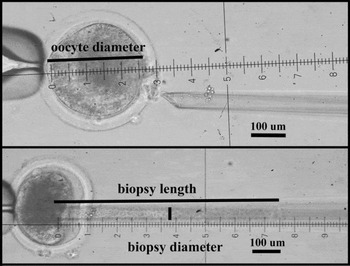
All chemicals were purchased from Sigma Co. unless otherwise described. Bovine ovaries were collected at a local abattoir and transported to the laboratory within 4 h in saline solution (NaCl 0.9%) at 35–37°C. Bovine cumulus–oocytes complexes (COCs) were recovered by follicular aspiration (3–8 mm diameter) using a syringe with an 18-gauge needle. Oocytes surrounded by compact layers of cumulus cells and evenly granulated cytoplasm were selected for in vitro maturation (IVM). COCs were washed twice in IVM medium (TCM199, Gibco) and cultured in 100 μl microdrops of IVM medium for 20 h under a humidified atmosphere of 5% CO2 in air at 38.5°C. After IVM, cumulus cells were removed by manual pipetting in the presence of hyaluronidase (2 mg/ml), and oocytes with a first polar body were selected for biopsy. Selected oocytes were placed in manipulation medium (phosphate-buffered solution) supplemented with cytochalasin B (5 μg/ml) for 10 min before micromanipulation. The diameter of each oocyte was measured and recorded. A fraction of cytoplasm from each oocyte was aspirated with a beveled pipette with a 25 μm inner diameter (Eppendorf Inc.) under an inverted microscope (DMIRB-Leica) equipped with micromanipulators (Narishige Inc.). The cytoplasm biopsy was performed on the opposite side of the polar body to avoid removing the metaphase-II plate. Oocyte volume was estimated from its diameter and 5 to 10% of the cytoplasm was removed from each oocyte (Fig. 1). Oocytes were classified as small (<122 μm; smaller than one standard deviation of the mean), average (122–127 μm; mean plus and minus one standard deviation), and large (>127 μm; higher than one standard deviation of the mean).
Procedure used for cytoplasm biopsy. The diameter of each oocyte was recorded and measurements were obtained of the length and width of the respective biopsy within the pipette. Volume (μm3) calculation was performed as such: oocyte volume = 4/3 × π × R3 and biopsy volume =π × R2 × L; where R: radius and L: length. The volume of the biopsy removed from each oocyte was approximately 5 to 10% of its original volume.

After each biopsy aspiration, cytoplasm samples were placed in 1 μl of polyvinylalcohol solution (PVA, 0.1%) containing RNase inhibitor (1 U/μl), and immediately frozen in liquid nitrogen. Respective micromanipulated oocytes were stored individually in synthetic oviduct fluid (SOF) medium (Tervit et al., Reference Tervit, Whittingham and Rowson1972) in the incubator for 4 h and, at 26 h of maturation, were parthenogenically activated. Chemical activation was achieved by exposure of oocytes to 5 μM ionomycin in TCM-199 with 0.03 mg/ml BSA for 4–5 min and subsequently incubated in SOF medium containing 6-dimethylaminopurine (6-DMAP, 2 mM) for 3 h at 38.5°C and 5% CO2 in air. Presumptive zygotes were incubated in 90 μl microdrops of SOF medium and cultured individually using the well-of-the-well system (WOW; Vajta et al., Reference Vajta, Peura, Holm, Paldi, Greve, Trounson and Callesen2000). Cleavage was recorded at 90 h post activation (hpa) and blastocyst development was evaluated at 196 hpa. A control group of 20 non-micromanipulated oocytes was activated concurrently to biopsied oocytes. Activated oocytes were classified as following: embryos that reached the 2-cell stage and then blocked before 8 cells (2c-blocked); embryos that reached the 8-cell stage but blocked before the blastocyst stage (8c-blocked); embryos that developed to the blastocyst stage (blastocyst). Seven replicates were performed with 40 manipulated and 20 control oocytes in each replicate. Three replicates were used for embryo developmental characterization of the system and comparison of total mRNA amount between oocytes with different developmental competence while four replicates were used for mRNA relative quantification of three housekeeping genes.
Global polyA-RNA analysis
Immediately after thawing the biopsy tubes on ice, 1 μl of RNase-free water containing oligo dTTP (12–18) (1 μg) was added to each sample. Samples were heated to 70°C for 5 min and cooled to 4°C for the addition of enzyme (ImProm-IITM Reverse Transcriptase, Promega) and reagent mix [Tris, 250 mM; KCl, 375 mM; DTT, 50 mM; MgCl2, 3 mM; dNTP, 10 mM each; oligo dGTP(12) (template switching primer) 1 μg; RNase inhibitor, 1 U/μl; reverse transcriptase, 50 U] in a final volume of 5 μl. Samples were then incubated at 50°C for 1 h, heated to 70°C and frozen at –20°C until use.
Template switch reverse transcription and global cDNA amplification (acDNA) in real-time PCR were used to estimate the relative abundance of polyadenylated mRNA, as previously described (Biase et al., Reference Biase, Merighe, Santos-Biase, Martelli and Meirelles2008). Global cDNA amplification was performed in a real-time PCR thermocycler (Applied Biosystems 7500 Real Time PCR System) using SYBR Green I as double-stranded DNA dye. Reactions were carried out with the LightCycler FastStart DNA Master SYBR Green I reaction mix (1×, Roche Diagnostics Corporation) supplemented with MgCl2 (5 mM), oligo dGTP(12) (0.2 μM), oligo dTTP(12) (0.2 μM) in a final volume of 10 μl. The PCR protocol started with a denaturation step at 95°C for 10 min followed by 45 cycles at 95°C for 10 s, 57°C for 1 min and 72°C for 2 min, and finished with a dissociation curve for specific fragment amplification control. PCR efficiency was estimated for global cDNA amplification in each sample using the method and software published previously (LinReg; Ramakers et al., Reference Ramakers, Ruijter, Deprez and Moorman2003) applying default parameters (number of points between 4 and 6 and best correlation coefficient). Fluorescence threshold line was fixed at the average of the lower and higher fluorescence values used by the software to estimate PCR efficiency.
Fold differences among experimental groups were calculated for each biopsy using the following formula as previously described (Livak & Schmittgen Reference Livak and Schmittgen2001):

In order to perform comparative analysis of global polyA mRNA among oocytes with different developmental competence, test were oocytes for which embryos developed either to blastocyst or blocked at the 8-cell stage; and calibrator were oocytes which embryos cleaved but blocked before reaching the 8-cell stage. Comparative analysis of global polyA mRNA among oocytes with different diameter categories were done considering test the average or large oocytes; and calibrator the small oocytes. As the removed cytoplasm was fixed for every oocyte, the calculated fold change for each biopsy was corrected by the percentage of cytoplasm removed from the oocyte [corrected FC = FC × (% cytoplasm removed × 100)−1]. Results are expressed as mean ± standard error of corrected fold change in triplicate data.
Gene-specific relative quantification
Samples were thawed on 1 μl RNase-free water containing 0.5 μg random hexamer primers, heated to 70°C for 5 min and them cooled to 4°C. The reverse transcriptase enzyme (50 U; ImProm-IITM, Promega) and reagent mix (Tris, 250 mM; KCl, 375 mM; DTT, 50 mM; MgCl2, 3 mM; dNTP, 10 mM each; RNase inhibitor, 1 U/μl) were added to a final volume of 5 μl. Samples were then incubated at 25°C for 5 min and 45°C for 45 min. After cDNA synthesis, 35 μl of water were added to each tube and stored at −20°C until use.
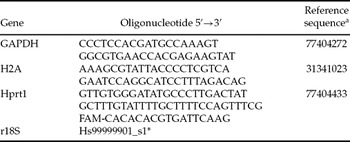
Real-time PCR was performed for glyceraldehyde-3-phosphate dehydrogenase (GAPDH), Histone 2A (H2A), hypoxanthine phosphorbosyl transferase 1 (Hprt) and ribosomal (subunit 18S) transcripts. One-fifth of the RT solution was used for singleplex reactions containing either SYBR® Green Master Mix for GAPDH and H2A, or TaqMan® Master mix for Hprt and r18S (Applied Biosystems) at recommended concentration (1×). Amplifications were carried using 0.1 μM of each oligonucleotide (Table 1) and cycling conditions as recommended by the manufacturer. Melting curve analysis was added at the end of each cycle to evaluate the amplification specificity for GAPDH and H2A genes. For each set of primers the amplification efficiency was estimated using the procedure described in the previous section. Fold differences were calculated using the 2− ΔΔCt method (Livak & Schmittgen, Reference Livak and Schmittgen2001), in which the r18S gene was used to normalize RNA amount and the experimental group of oocytes which embryos cleaved but arrested before the 8-cell stage was considered the calibrator sample. Eight biopsies were used for each group for this experiment and results were expressed as mean ± standard error of fold change in quadruplicate data.
Oligonucleotides used for specific gene fragment amplification.

*Assay identifier provided by Applied Biosystems company.
aSequence identifier (gi) from the National Center for Biotechnology Information.
Statistical analysis
In order to evaluate the effect of manipulation on the embryo developmental rates, the difference of blastocyst rates between experimental and control groups from the first three replicates was statistically evaluated by hypothesis test of different proportions, using Z statistics. Fisher's exact test was applied to evaluate oocyte diameter distribution among developmental classes. Following real-time PCR data analysis, fold change values among experimental groups were compared by Student's t-test.
All statistical tests were performed using the Statistical Analysis System (SAS). The null hypothesis (Ho) was that there was no difference among tested values and the differences were considered to be statistically significant when probability of the alternative hypothesis [P(H1)] was lower than 0.05.
Results
Effect of cytoplasm biopsy on development
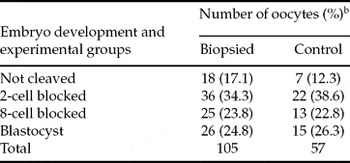
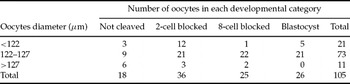
Our first goal was to verify whether the removal of cytoplasm by micromanipulation from metaphase arrested oocytes would affect their ability to develop in vitro. Following parthenogenetic activation, embryo cultures from three oocyte micromanipulations resulted in developmental stages similar to concurrent non-manipulated controls (Table 2), indicating that the micromanipulation procedure used for oocyte biopsy did not affect the ability of oocytes to develop in vitro to the blastocyst stage (p > 0.10).
Development distribution of oocytes by competence groups evaluated after biopsy removal and parthenogenic activationa.

aData obtained in the three replicates.
bPercentages obtained from the total number of oocytes placed in culture.
Association analysis of global and housekeeping mRNA with oocyte competence
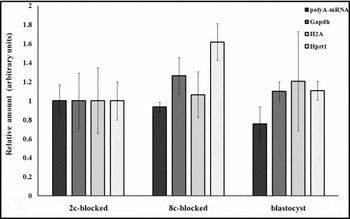
Based on our previous finding that oocyte biopsy does not affect development we were able to retrospectively associate the transcript contents of oocytes with their ability to develop to different stages in vitro. A comparative analysis of total mRNA amounts among biopsies resulted in no differences between oocytes from which embryos were able to develop to the blastocyst stage and those that blocked both at the 2- and 8-cell stages (p > 0.10, Figure 2). Moreover, no differences in specific mRNA relative amounts were observed among oocytes with different developmental competence for any of the housekeeping genes analysed (GAPDH, H2A and Hprt1– p > 0.10, Figure 2). The lack of variation between the constitutively expressed genes were not generated by the 18S ribosomal RNA normalization, as a very small variation in the cycle threshold (Ct) was observed among the three experimental groups (Ct mean ± standard error 2c-blocked: 19.87 ± 0.27; 8c-blocked: 20.58 ± 0.26; blastocyst: 19.11 ± 0.13). Together, these results indicate that the amounts of mRNA present in the cytoplasm of metaphase-stage oocytes are not directly associated with their development outcome in vitro.
Comparative analysis of global polyA mRNA and specific housekeeping mRNA amounts among oocytes with different embryo developmental competences. For comparison purposes, 2-cell blocked embryos were set as calibrators for the remaining groups.

Relationship between oocyte diameter with competency and global transcript levels
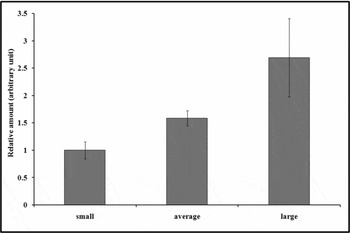
Oocytes were measured to determine whether the size of metaphase oocytes used for micromanipulation showed a relationship to development outcome. The diameter of the oocytes used for biopsies averaged 124 μm and ranged from 110 to 130 μm. Oocytes were ranked according to size and classified as small (<122 μm), medium (between 122 and 127 μm) and large (>127 μm). Using the above classification, no significant effect of oocyte diameter was observed on any of the developmental competence classes analyzed (p > 0.10; Table 3), indicating that diameters within the ranges analysed did not affect development. Nonetheless, no oocyte with a diameter larger than 127.1 μm developed to the blastocyst stage, suggesting that increased size is adverse to development. Global polyA mRNA amounts in oocytes of different size categories did differ among oocytes with different diameters (p < 0.05; Figure 3), indicating a relationship between oocyte size and transcript abundance.
Distribution of embryo development according to oocyte diameter.

Global polyA mRNA amounts among oocytes with different diameters. Oocyte diameters were obtained and classified as small (<122 μm), average (between 122.1–127 μm) and large (>127 μm). For comparison purposes, small oocytes were set as calibrators for the remaining groups. Values difference were significant at α = 0.05.

Discussion
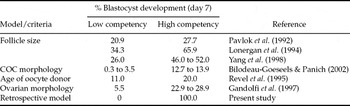
The combination of oocyte biopsy by micromanipulation, culture of the respective embryo in individual drops and real-time PCR approach for mRNA detection allowed a retrospective analysis of global and specific mRNA amounts in oocytes with different developmental competence. In contrast with previous prospective models that use different selection criteria to estimate putative correlations with oocyte competence (Table 4), the model described herein uses the analysis of a small fraction of the oocyte's cytoplasm and, thereby, enables us to unequivocally associate mRNA abundance patterns with its ability to develop into blastocyst without disturbing development rates. Others have retrospectively examined mRNA molecules from blastomere biopsies and associated with the ability of blastocysts to develop a healthy calf after embryo transfers (El-Sayed et al., Reference El-Sayed, Hoelker, Rings, Salilew, Jennen, Tholen, Sirard, Schellander and Tesfaye2006). Using a large-scale microarray analysis, the latter found blastocyst-specific transcripts that were present in embryos that produced offspring, confirming the value of using a retrospective approach to identify candidate genes associated with competence. Together, the approach proposed herein and the one described above suggest a common effort to establish models that allow an accurate molecular analysis of embryo and gamete competence.
Examples of comparison of blastocyst development rates in different models/criteria systems used to identify oocytes showing low and high competency.

Comparison of the amounts of global polyA mRNA resulted in similar quantities among in vitro matured oocytes with different development potential, which was also confirmed with three specific housekeeping genes. These results contrast with a previous study using the same quantification methods in which immature oocytes derived from COCs with different morphology contained different amounts of mRNA, being the highest mRNA amount found in oocytes derived from the COCs morphology groups with high development competence (Biase et al., Reference Biase, Merighe, Santos-Biase, Martelli and Meirelles2008). As the latter study used immature oocytes, it is possible that the quantities of mRNA in the oocyte are altered during maturation to the metaphase stage, which could have diminished the differences in global and housekeeping transcripts between competent and non-competent oocytes. Indeed, previous studies have indicated a decrease by half in polyA mRNA content during in vitro maturation, which could be due to translation or deadenylation of specific transcripts (Lequarré et al., Reference Lequarre, Traverso, Marchandise and Donnay2004). It has been proposed that the reduction of maternal mRNA present in immature oocytes is necessary for an adequate embryo genome activation and further development (Bettegowda et al., Reference Bettegowda, Lee and Smith2008).
Previous RNA quantification on oocytes showed no difference in the mRNA quantity of calf compared with cow oocytes (Lequarré et al., Reference Lequarre, Traverso, Marchandise and Donnay2004). The first are usually unable to develop efficiently to the blastocyst stage, supporting our finding that global mRNA amounts are not related to developmental competence.
A high proportion of oocytes analysed were within the 120 to 130 μm diameter range, which may explain why we could not demonstrate an association between oocyte diameter and its embryo development potential. Previous studies have indicated that immature oocytes with diameter smaller than 110 μm before maturation show a lower probability to reach the metaphase-II stage (Fair et al., Reference Fair, Hyttel and Greve1995). Only selected gametes were used in this study, i.e. with a homogeneous cytoplasm and polar body, which explains why no oocyte was less than 110 μm in diameter. Our data show that no oocyte with a diameter greater than 127 μm was able to support embryo development to the blastocyst stage, suggesting that overgrowth may affect competence. It is plausible that larger oocytes originated from follicles that have undergone some levels of atresia after having peaked during folliculogenesis.
Within the size range of this study, oocytes separated in three diameter classes had different global mRNA amount, where the oocytes larger than 127 μm presented the highest mRNA quantity. The increased stock of mRNA could be a reason why some oocytes were larger than others, however this difference does not account for an adequate in vitro embryo development since all embryos derived from large oocytes blocked before blastocyst.
In summary, results obtained in this study suggest that in in vitro maturated oocyte competence is not associated with global mRNA amount, suggesting that a wide-range microarray approach may be better suited for the identification of specific molecular markers associated with developmental competence. Although the largest oocytes have more quantity of mRNA than the others, it might be negatively associated with developmental competence. The retrospective model of ooplasm biopsy reported herein is suited for the identification of markers of developmental competence allowing thereby an accurate analysis of the molecular basis of maternal inheritance in metaphase II oocytes.
Acknowledgements
The authors acknowledge the support of the Coordenação de Aperfeiçoamento de Pessoal de Ensino Superior (CAPES) for providing FHB a doctoral fellowship, and also the Fundação de Amparo à Pesquisa do Estado de São Paulo (FAPESP) for providing financial support for this study and a postdoctoral fellowship to FHB.