Patients with borderline left cardiac disease have multiple left-sided obstructive lesions including aortic and mitral stenosis, and the presence of endocardial fibroelastosis. Staged left ventricular rehabilitation has recently been applied to a subgroup of such patients as a means of left ventricular salvage and eventual biventricular conversion.Reference Emani, Bacha and McElhinney1 In addition to aortic and mitral valve repairs, this procedure requires the resection of endocardial fibroelastosis, which is adherent to the left ventricular myocardium. Preliminary studies have shown the ability to achieve conversion from single ventricle palliation to biventricular circulation in a subset of patients.Reference Emani, Bacha and McElhinney1
Ventricular dyssynchrony is a relatively common finding in patients following single ventricle palliation, with potential long-term sequelae.Reference Bacha, Zimmerman and Mor-Avi2–Reference Graham, Scheurer, Saul, Bradley and Atz5 The effect of left ventricular rehabilitation and endocardial fibroelastosis resection on the conduction system and ventricular synchrony has not yet been evaluated. Electrical dyssynchrony results from the disruption of the coordinated ventricular activation. It is recognised as a prolongation of the QRS interval on surface electrocardiogram, representing either a bundle branch block or intraventricular conduction delay. As the Purkinje network resides in the endocardium and is vulnerable to excision or damage during endocardial fibroelastosis resection, this procedure presents specific concerns with regard to the potential for electrical conduction delay.Reference Han, Gurofsky and Lee6, Reference Coghlan, Coghlan, Buckberg and Cox7 We hypothesise that endocardial fibroelastosis resection results in ventricular dyssynchrony and QRS prolongation in patients undergoing staged left ventricular rehabilitation following single ventricle palliation.
Materials and methods
Patient population
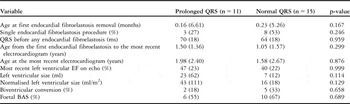
This is a retrospective study of patients with borderline hypoplastic left cardiac disease who have undergone single ventricle palliation and staged left ventricular rehabilitation consisting of endocardial fibroelastosis resection between January, 2001 and December, 2007. The study was approved by the institutional research internal review board. The patients were identified using the surgical database and the medical and surgical charts were reviewed. Reviewed data included demographics, electrocardiograms, echocardiograms, cardiac magnetic resonance imaging, cardiac pre-natal or post-natal procedures, and surgical interventions and outcomes (Table 1). The presence of endocardial fibroelastosis was determined by either echocardiography or cardiac magnetic resonance imaging, and the decision for surgical excision was determined by the cardiology and surgical attendance at the time of the associated surgical procedure, with consideration given to information gathered during preoperative planning, specifically the presence of endocardial fibroelastosis by echocardiogram or magnetic resonance imaging. In each case, the baseline left ventricular volume was sufficiently hypoplastic to mandate initial single ventricle palliation. Left ventricular size and function were evaluated using either the most recent cardiac magnetic resonance imaging or echocardiogram.
Patient characteristics compared between those with and without QRS prolongation (QRS value above the 98th percentile for age) at most recent follow-up, excluding the only patient with a QRS above 98th percentile before any endocardial fibroelastosis procedure: median (interquartile range), n (%).

BAS, balloon atrial septostomy; EF, ejection fraction
Electrical dyssynchrony
Ventricular conduction delay was defined as a QRS duration greater than the 98th percentile for age as measured by surface electrocardiogram.Reference Rijnbeek, Witsenburg, Schrama, Hess and Kors8 Standard 12-lead electrocardiograms were retrospectively evaluated and QRS intervals were measured from electrocardiograms obtained immediately prior and subsequent to each endocardial fibroelastosis resection, and from the most recent electrocardiogram. QRS intervals pre- and post-surgical intervention with endocardial fibroelastosis resection were compared and evaluated for absolute change in QRS duration and absolute QRS duration.
Statistical analysis
Continuous variables are presented as medians with interquartile range and categorical variables are presented as counts with percentages. Continuous data were examined for normality and were analysed using the Wilcoxon rank-sum test. Categorical data were analysed using Fisher’s exact test or χ2 test. The Wilcoxon signed-rank test was used for non-independent continuous data. Correlation coefficients were calculated using Spearman’s correlation. Two-tailed p-values less than 0.05 were considered statistically significant. Statistical analysis was performed using SAS version 9.1 (SAS Institute Inc., Cary, North Carolina, United States of America).
Results
Patient characteristics
The median age at the time of initial endocardial fibroelastosis resection was 7 days (2 days–4.8 years). A total of 23 resections were performed during the Norwood procedure, 20 during the bidirectional Glenn, two during the Fontan, and two during biventricular repair. In all, 11 (41%) patients underwent a single surgical endocardial fibroelastosis resection while 16 (59%) underwent multiple resections. A total of 17 (63%) patients had undergone foetal aortic valvuloplasty. At the time of the most recent electrocardiogram, eight (30%) patients had been converted to two-ventricle physiology, ten (37%) were palliated with the Fontan procedure, seven (26%) were in the post-bidirectional Glenn stage and two (7%) were in the post-Norwood stage. Two patients underwent permanent pacemaker implantation using cardiac resynchronisation therapy devices, and QRS duration was evaluated up until the time of pacemaker implantation. In the first patient, the pacemaker was implanted for high-grade atrio-ventricular block following the Fontan operation. The second patient underwent resynchronisation pacing secondary to severe ventricular dyssynchrony and poor function at the time of a two-ventricle repair. This patient experienced a change in the ejection fraction from 26.3% to 56.8% following biventricular pacing; however, device implantation was concomitant with surgical biventricular conversion. There were three deaths, two following the stage I Norwood palliation, and one late mortality following the bidirectional Glenn procedure.
Acute changes in QRS duration following endocardial fibroelastosis resection
Change in QRS duration in the immediate peri-operative period was evaluated for all 47 surgical endocardial fibroelastosis resections. Change in QRS duration surrounding each resection ranged between −16 milliseconds and 36 milliseconds with a median of 0 millisecond (p = 0.09). Only one patient had a baseline QRS duration greater than the 98th percentile before their initial endocardial fibroelastosis resection. Four patients developed QRS duration greater than the 98th percentile subsequent to their initial endocardial fibroelastosis resection.
Midterm QRS duration results
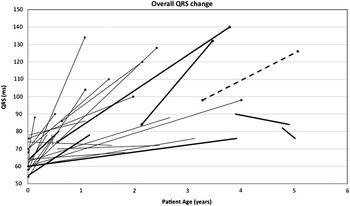
At the time of the last documented surface electrocardiogram, 44% of patients, 12 out of 27, showed interventricular conduction delay with a QRS duration greater than the 98th percentile (Fig 1). The change in QRS from the initial QRS before any endocardial fibroelastosis resection to the most recent QRS ranged from −6 to 76 milliseconds, with a median and interquartile range of 20 milliseconds (30; p < 0.0001). Two patients developed left bundle branch block, one patient developed right bundle branch block with left anterior fascicular block, and two patients developed isolated right bundle branch block.
Line plots of QRS pre- and post-procedures for endocardial fibroelastosis resection (p < 0.0001). QRS duration in milliseconds is on the vertical axis and patient age in years is on the horizontal axis. Each of the 27 patients is represented by a single line with two data points. The left sided point is the patient age and QRS duration immediately before the first endocardial fibroelastosis resection procedure. The right-sided point is the patient age and QRS duration at the most recent electrocardiogram performed after all endocardial fibroelastosis resection procedures; median (SD) age at most recent QRS is 2.1 (1.6) years. Patients (n = 12) with the most recent QRS greater than 98th percentile are labelled with full circles. Patients (n = 8) who ultimately underwent biventricular conversion are identified by the thicker plot lines. The only patient with a QRS greater than the 98th percentile before any endocardial fibroelastosis resection is presented by a dashed line.

Table 1 shows the patient characteristics compared between the two groups defined by a normal or a prolonged QRS, greater than 98th percentile for age, at most recent follow-up. The single patient with a QRS duration greater than the 98th percentile before their initial resection was excluded. The median QRS was 110 (34) milliseconds in the prolonged QRS group and 76 (8) milliseconds in the normal QRS group. The average ejection fraction by the echocardiogram in the study group as a whole was 41.7% with a range from 4% to 78.8%. As magnetic resonance imaging data were not available for all patients and when available were often at variable time points, all ejection fraction data were obtained by echocardiogram. There was no difference in the ejection fraction in patients with normal QRS duration and those with QRS duration greater than 98th percentile. There was no association with multiple endocardial fibroelastosis resections as opposed to a single endocardial fibroelastosis resection in patients with prolonged QRS duration greater than 98th percentile.
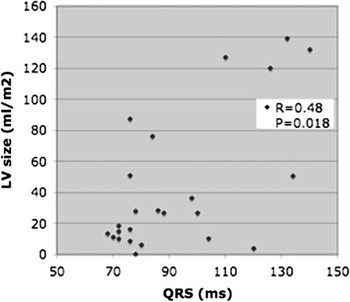
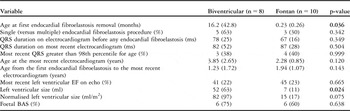
The association between the most recent QRS value and the left ventricular volume was examined using the Spearman correlation, showing a correlation coefficient of 0.54 (p = 0.006; Fig 2). Table 2 shows the comparison of characteristics between those patients with successful biventricular repair versus those with Fontan physiology. Patients with successful biventricular repair were associated with earlier initial endocardial fibroelastosis resection and absolute left ventricular volume with a trend towards larger left ventricular volume normalised for patient size. There was no significant difference in QRS duration between the two groups.
Scatter plot of most recent QRS (milliseconds) and left ventricular volume (millilitres); Spearman’s correlation coefficient (R).

Patient characteristics compared between those achieving biventricular repair and those remaining in the single ventricle physiology state at most recent follow-up: median (interquartile range), n (%).

BAS, balloon atrial septostomy; EF, ejection fraction
Bold values represent p-value <0.05
Discussion
Electrical synchrony in patients with congenital cardiac disease is a rapidly emerging area of focus within paediatric cardiology and cardiovascular surgery. The effect of disruption of normal electrical conduction on long-term ventricular function and clinical outcome in patients with congenital cardiac disease is poorly understood. Of particular concern is the role of electrical dyssynchrony in patients with single ventricle physiology, a group already at risk for ventricular dysfunction and failure.
The presence of endocardial fibroelastosis may limit post-natal left ventricular growth and has been associated with increased morbidity and mortality following single ventricle palliation.6 Consequently, there has been recent interest in the resection of the fibrotic tissue in order to promote left ventricular growth and eventually achieve biventricular circulation.Reference Emani, Bacha and McElhinney1, Reference Han, Gurofsky and Lee6, Reference Sharland, Chita and Fagg9 The effect this resection of fibrotic endocardial tissue has on the distal conduction system and the Purkinje system has not been previously evaluated. The potential for injury to the left ventricular Purkinje system is high due to its proximity to the endocardial surface and the sharp dissection necessary to perform the endocardial fibroelastosis resection.Reference Han, Gurofsky and Lee6, Reference Coghlan, Coghlan, Buckberg and Cox7
This study was a descriptive evaluation of ventricular conduction system integrity performed by examining the changes in QRS duration following endocardial fibroelastosis resection. There was no statistically significant change in QRS duration between the preoperative and acute post-operative periods. Left bundle branch block was rare with only two patients showing left bundle branch block and one patient with left anterior fascicular block on the most recent surface electrocardiogram. At the most recent electrocardiogram, a QRS duration above the 98th percentile for age was present in 44% of the patients. Although these findings show a significant incidence of electrical and potentially mechanical dyssynchrony, these findings are consistent with previous reports of intraventricular conduction delay in other patients with hypoplastic left cardiac syndrome and argues against endocardial fibroelastosis resection as the sole source for intraventricular delay.Reference Friedberg, Silverman, Dubin and Rosenthal4, Reference Graham, Scheurer, Saul, Bradley and Atz5 Furthermore, there was no difference in the overall electrical dyssynchrony measured by QRS duration in patients with biventricular repair compared with those with ultimate Fontan palliation and was not felt to be a significant clinical determinate in the decision of one versus two ventricular repairs.
To our knowledge, this is the first study linking QRS duration with left ventricular size in patients with hypoplastic left cardiac syndrome. The correlation between left ventricular size and electrical synchrony in patients with hypoplastic left cardiac syndrome is poorly understood; however, it has been previously shown that increased left ventricular size and mass may affect right ventricular function and be detrimental to the success of long-term single ventricle palliation.Reference Sugiyama, Yutani, Iida, Arakaki, Yamada and Kamiya10–Reference Graham, Atz and Bradley13 In the small subset of patients who had undergone completed surgical palliation, those patients with biventricular palliation had larger absolute left ventricular volumes and a trend towards larger volumes indexed for patient size. Patients with biventricular palliation were also associated with younger age at initial endocardial fibroelastosis resection. It could be argued that earlier initial endocardial fibroelastosis removal may be associated with improved promotion of the left ventricular volume, although patient numbers were small and successful biventricular repair was not a primary outcome of this study.
Staged left ventricular rehabilitation is a promising surgical strategy that has resulted in biventricular conversion of certain patients with single ventricle physiology. However, the demonstration of electrical dyssynchrony at late follow-up warrants further investigation. Specifically, the extent of endocardial fibroelastosis resection, the timing of left ventricular rehabilitation, and the effects of dyssynchrony on haemodynamics must be determined when attempting to re-establish the left ventricle as the sole systemic ventricular chamber. Interventional therapy for ventricular dyssynchrony in congenital cardiac disease is an evolving area of study.Reference Karpawich14–Reference Cecchin, Frangini and Brown16 Previous studies have shown that multi-site pacing can improve acute cardiac performance following single-ventricle palliation.Reference Bacha, Zimmerman and Mor-Avi2, Reference Zimmerman, Starr, Koenig, Smith, Hijazi and Bacha17 Although early consideration must be given to resynchronisation in this group of patients, the effects of chronic resynchronisation therapy upon haemodynamics and clinical outcomes are yet to be elucidated.
The results of this study must be interpreted in the context of its retrospective and single-centre design. In addition, the small sample size limited the statistical power and not all patients underwent cardiac magnetic resonance imaging.
Conclusion
Interventricular conduction delay is a common finding in patients with the borderline hypoplastic left cardiac disease undergoing staged left ventricular rehabilitation, although QRS prolongation typically occurs late following surgical endocardial fibroelastosis resection. In these patients, left ventricular size correlates with QRS duration. The long-term impact of QRS prolongation on morbidity and mortality in patients following endocardial fibroelastosis resection and ventricular rehabilitation will require further evaluation.