1. INFINITIVAL TO: AN OVERVIEW
Pullum (Reference Pullum1982), citing earlier suggestions informally circulated by both Paul Postal and Richard Hudson, and published work by Robert Fiengo (Reference Fiengo1980), gives syntactic arguments that infinitival to is a nonfinite auxiliary. These arguments, while persuasive and influential, have not gone undisputed; most recently, Huddleston (Reference Huddleston, Huddleston and Pullum2002a), in his extensive entry on infinitival constructions in The Cambridge Grammar of the English Language (Huddleston & Pullum et al. Reference Huddleston and Pullum2002, henceforth CGEL), argues against Pullum's analysis. His challenge comprises the following points:
• the elliptical stranding possibilities for to are constrained in ways that do not hold for auxiliaries, requiring special conditions if to is analyzed as an auxiliary;
• to differs from all overt auxiliaries in its failure to head a main clause;
• to is semantically vacuous, in contrast to undisputed verbs; and
• its distribution displays a pattern of optionality which is far more typical of complementizers – with that the paradigm example – than of what we expect from auxiliaries.
In Huddleston's view, these alleged deficits require stipulative conditions on auxiliary to which offset the claimed benefits of taking to to belong to this class. Conversely, he claims that some of the distributional facts which have been adduced on behalf of auxiliary to can be captured by alternative formulations which do not depend on properties of auxiliaries and therefore need not be taken as supporting Pullum's proposal.
I argue in what follows that Huddleston's objections are either empirically untenable or fall out (as noted by Pullum in his original paper) on completely independent grounds (Section 2), and that new research findings confirm the behavior of to as strongly auxiliary-like, in ways at odds with the behavior of subordinators, or phrases marked by such elements (Section 3). My findings, summarized in Section 4, strongly suggest that Pullum's original conclusion was indeed the correct one.
2. Nonarguments against auxiliary to
2.1 The argument from putative exceptionality
Huddleston invokes an array of data adduced in Stirling & Huddleson (Reference Stirling, Huddleston, Huddleston and Pullum2002), including the contrast between They suggested I call the police, but I decided not to/*to not __ and They said I should call the police, but I decided I should not__. Huddleston's argument from this contrast centers on the claim that ‘unlike auxiliary verbs, to must immediately precede the ellipsis site’ (Huddleston Reference Huddleston and Pullum2002: 1526); therefore, some special exception must be stipulated for to to exempt it from this supposed general pattern. But Pullum had already spoken to this point, in his observation that ‘although not can follow a finite auxiliary that is stranded by VP ellipsis, it is impossible to have not after a stranded nonfinite auxiliary ….xactly the same thing is true withnot placed after strandedto’ (Pullum Reference Pullum1982: 201–202; emphasis added), and, as I now argue, Pullum was right.
The key point here is that the pattern Huddleston attributes to auxiliary verbs in general holds only for finite auxiliary verbs. The latter can appear in two distinct syntactic structures involving negation, which we illustrate here via the modal could, with the semantic contributions of the substructures in the trees given in much abbreviated form:
- (1)
(a) Robin could not do that.
(b)

(c)

These two structures, as shown in Gazdar, Pullum & Sag (Reference Gazdar, Pullum and Sag1982), Warner (Reference Warner and Borsley2000), and Kim & Sag (Reference Kim and Sag2002), give rise to a semantic scope ambiguity (as in the annotations at the top of the two trees in (1)), which corresponds systematically to differences in the form of appropriate tag questions (You could not do it, could you? (¬⋄)/You could not do it, couldn't you? (⋄¬)); contraction (You couldn't do it (¬⋄/*⋄¬)) and, crucially the distribution of gaps:
- (2)
(a) Robin could do that, but you could not __. (¬⋄)
(b) *Robin could do that, and you could not __. (⋄¬)
As argued at length in Bouma, Malouf & Sag (Reference Bouma, Malouf and Sag2001) and Kim & Sag (Reference Kim and Sag2002), dependents of a head may take the form of gaps in ellipsis or extraction constructions, but heads themselves cannot. In the structure [VPcould [VPnot [VP α]]], this condition on gaps entails that α must be overt; hence the status of (2b). But because only the negation structure in (1c) is available to nonfinite auxiliaries, it follows that in such structures, not can never precede a gap. Thus we have You would do that, but I would not vs. *You would have done that, but I would have not. And from these straightforward patterns, Huddleston's should not/to not data follow immediately on the assumption that to is, as claimed, an invariably nonfinite auxiliary: [SI [VPdecided [VPnot [VP [Vto] [VP Ø]]]]] is a legal ellipsis, since the ellipsed VP is a complement of the head to, but in [SI [VP [Vdecided [VP [Vto] [VPnot [VP Ø]]]]], the VP head of the larger VP is ellipsed, and hence the structure is not legal.
Interestingly, the discussion of negation in CGEL appears to assume precisely the not-as-complement/not-as-adjunct distinction which is made structurally explicit in (1) above. Thus, Pullum & Huddleston (Reference Pullum, Huddleston, Huddleston and Pullum2002: 804) cite the examples given here in (3) (underlining in the original):
- (3)
(a) They must not read it.
(b) You can [not answer their letters]: you're not legally required to respond.
These examples are followed by the abservation that
the meaning of the first clause in [(3b)] is ‘you are permitted not to answer their letters’, with can thus having scope over not. In this use, the not will characteristically be stressed and prosodically associated with answer rather than can by means of a very slight break separating it from the unstressed can. The fact that the modal has scope over not makes this semantically comparable to [(3b)], but syntactically it differs in that it has secondary negation rather than the primary negation of [(3a)]. This is evident from the fact that the reversed polarity tag for the can clause is can't you? The meaning is quite different from You can't/cannot answer their letters, which has primary negation in the can clause, and where the negative has scope over the modal (“It is not possible or permitted for you to answer their letters”).
In [(3b)], therefore – unlike [(3a)] – the syntax matches the semantics, with the not located in the subordinate, non-finite clause. (Pullum & Huddleston Reference Pullum, Huddleston, Huddleston and Pullum2002, 805–806; emphasis added)
The analysis presented in this section is thus fully compatible with the position taken in CGEL itself.
2.2 More on ellipsis and stress
Another issue raised in Huddleston's critique is the contrast between Not to __ would be a mistake and *To __ would be a mistake – a pattern to shares with have and be, as chronicled in some detail in Zwicky & Levin (Reference Zwicky and Levin1980), where the following data are exhibited:
(4) I didn't see the exhibit last time, but this time I'm
.
 .
(5) I don't think you'll have anyone want to take early exams.
For anyone
is most unlikely.
 is most unlikely.
(6) Tony would have preferred not to sleep on a wood pillow.
However, he's been
by his friends.
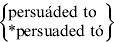 by his friends.
(7) I'm sure you didn't enjoy my first piano recital.
would have been extraordinary.
 would have been extraordinary.
(8) I wouldn't be upset not to be chosen. But, on the other hand, I wouldn't be

As Zwicky & Levin note, this pattern affects only to, have and be. Pullum offers their observations as an additional argument in favor of auxiliary to; Huddleston counters that this pattern does not necessarily implicate membership in a natural class comprising these three, except in a sense which has nothing to do with auxiliary verb status: ‘the stress facts are expressible in a different way: we can say that it is strongly preferred for a stranded form that is stressed to bear tense’ (Huddleston Reference Huddleston, Huddleston and Pullum2002a: 1186). But this formulation is incorrect, as manifest in the data adduced by Zwicky & Levin. In the first place, as they note,
stressed infinitival have, be and to are fine when a following gap has a different source – Wh movement in (18) and (19), Topicalization in (20) and (21) …:
(18) I've made some pot roast, or I can get you some shrimp. What are you going to háve?
(19) At first you said you were going into the Marines; now you're planning to go to theological school. What do you want to bé when you grow up?
(20) I don't have many clothes, but that suit I want to háve.
(21) I'm a competent researcher, but a good teacher I could never bé.
…
(32) We must do some of the exercises. Which shall we dó?
(Zwicky & Levin Reference Zwicky and Levin1980: 634, 636)
The stranded items here are both stressed and tenseless, but their well-formed status seems uncontroversial. Furthermore, as Zwicky & Levin observe, there are many examples of stressed forms in other elliptical constructions which do not bear tense, but are still unexceptionable, e.g. Everyone thinks Millie will pass the exam, but I don't even think she'll trý, I asked Norman why he was sobbing, but he wouldn't saý.
Huddleston's alternative formulation of the relevant condition thus appears factually incorrect: ‘stressed items that are stranded’ do not, in general, demand tense. Zwicky & Levin's original formulation – ‘the offending configuration in our examples is the following: a contrastively stressed nonfinite verbal (infinitoid or participle) followed by a gap created by V[erb]P[hrase]D[eletion]’ (636) – is, in contrast, empirically unexceptionable. It is important to emphasize that the constraint involves not just any ‘items’ which are ‘stranded’; it is confined to the ‘infinitoids’ – have, be and to, along with the participles done/doing. Pullum's invocation of the discussion in Zwicky & Levin (Reference Zwicky and Levin1980) on behalf of auxiliary to therefore constitutes a valid and persuasive supporting argument.
2.3 The argument from semantic emptiness
Huddleston comments, in connection with treatment of infinitival to as a defective auxiliary, that
the case for to being a VP subordinator is stronger. To has no meaning independently of the semantic properties of the infinitival complement construction as a whole. It functions with respect to the VP lend him the money in much the same way as whether functions in whether she ever lent him the money, or that in that she lent him the money. It would seem both syntactically and semantically appropriate to place to in the same category as whether and that, the category of subordinators. (Huddleston Reference Huddleston, Huddleston and Pullum2002a: 1185)
This argument is unconvincing, in view of the fact that the auxiliaries do and copula be are semantically parasitic on the denotation of their respective complements. Indeed, Huddleston himself appears to hold precisely the same view of auxiliary do as the sources cited: ‘do … is a semantically empty, or dummy auxiliary verb introduced to permit the formation of negative, inverted and emphatic constructions whose canonical counterpart contains no semantically contentful auxiliary verb’ (Huddleston Reference Huddleston, Huddleston and Pullum2002b: 93; bold in original); elsewhere he notes that copula be ‘in some cases … has little semantic content’ (Huddleston Reference Huddleston, Huddleston and Pullum2002c: 218). Semantic parasitism is evidently not restricted to ‘subordinators’ and thus, in itself, has no weight in deciding between auxiliary and complementizer status for some linguistic form.
2.4 Limitation to nonroot constituents
Huddleston's next argument warrants quoting in full:
[T]here are no counterexamples in English to this very broad generalisation: all verbs can occur as head of a main clause. Even the highly anomalous verb beware, which has no inflected forms at all, occurs in main clauses like Beware the Jabberwock. If admitted as a meaningless and defective auxiliary verb, the item to would be the unique exception to a principle which holds for all of English and, as far as we know, for all languages, because it can only appear in non-elliptical sentences when some other verb is superordinate to it. (Huddleston Reference Huddleston, Huddleston and Pullum2002a: 1186; emphasis in original)
The critical caveat here is, again, that only finite forms of verbs can head main clauses, and once again, we note that Pullum has already addressed precisely these points.
One might think that all the characteristic behavioral properties of auxiliary verbs furnish arguments that to does not belong in this class. But in fact things only retain this appearance as long as we overlook the distinction between finite and nonfinite (tensed and nontensed) verbs. Once that distinction is made, a simple observation essentially clears up all the peculiarity of to at a stroke: to lacks the tensed and participial parts of the verbal paradigm, and always appears in its base form, in base form contexts. (Pullum Reference Pullum1982: 205; emphasis added)
Since base form contexts for verbs across the board exclude head position in root clauses, it would appear that again Huddleston's objection was satisfactorily refuted two decades before CGEL appeared in print.
To add any force to Huddleston's argument, it would be necessary to establish that an invariably nonfinite verb somehow contradicts some broad generalization. Such a premise would be quite diffcult to establish, given the peculiarities of the English auxiliaries, among other verbs, as noted in Pullum (Reference Pullum1982: 206), who gives a number of examples, e.g. invariably past (participial) wrought. Modal auxiliaries have exclusively finite forms – a property which, as first observed in McCawley (Reference McCawley, Fillmore and Langendoen1971), straightforwardly yields the invariably leftmost position in any string of auxiliaries in which they occur. Another interesting case, originally noted in a related connection in Pullum (Reference Pullum1982: 206), is the frozen form use(d), which shows residual auxiliary properties for some speakers, and which can only occur in the scope of a semantically past tense operator: I use*(d) to ski a lot/Did you ever use(%d) to ski very much? Or again: auxiliary need, which contrasts with the need selecting an infinitival complement in several ways, is morposyntactically invariant, not only having no nonfinite (including gerundive) form, but, for many if not most speakers, no past tense form either: This year, I won't do that when (I'm) ordered to, and I'll get in trouble/Last year, I wouldn't do that when (I was) ordered to, and I got in trouble vs. This year, you needn't do that when (you're) ordered to/#Last year, you needn't do that when (you were) ordered to. The invariant form of modal need (in marked contrast to the raising verb which selects an infinitival VP complement) and its semantic restriction to nonpast finite contexts are unique in English.Footnote 2 How, in view of such examples, would an inherently nonfinite auxiliary represent anything particularly implausible?
2.5 Alleged vs. real optionality
Huddleston (Reference Huddleston, Huddleston and Pullum2002a) lays particular stress on the supposedly significant degree of optionality, compared with uncontroversial heads, which to displays in its distribution:
The argument that [to] is not a head is that under certain conditions it is omissible without any change in meaning or grammatical construction type. One such case is [(9)]:
(9) [(a)] All I did was to ask a question. [(b)] All I did was ask a question.
In this respect to is like the finite subordinator that (though the latter is of course very much more freely omissible). It is not at all like heads, which never seem to be freely and optionally omissible in this way without a change of construction. (Huddleston Reference Huddleston, Huddleston and Pullum2002a: 1186)
On the contrary, across its whole range of distribution, to manifests a systematic indispensibility. Huddleston's sole class of contexts attesting to the putatively free omissibility of to, the pseudocleft-like construction illustrated in (9), is anything but representative about the data in (9), as can be readily seen by changing the tense from past to nonpast: All you do is (*to) ask the question, in which to must not appear. Conversely, when the verb changes from do to something less notably idiosyncratic in its possibilities, infinitival to cannot be omitted: All I want/'m hoping for/ask is *(to) be given a chance to eat a steak. It thus appears that even within the empirical domain of the one construction type which Huddleston invokes, the to omissibility facts are exactly the opposite of what he claims. With the exception of past tense nonauxiliary did, the all pseudocleft consistently resists omission of to from the postcopular ‘presentational’ component.Footnote 3 A brief overview of what pseudocleft constructions in which infinitival to appears confirms that its lack of free omissibility in the all pseudoclefts is the rule, not the exception.
- (10)
(a) What I did was (??to) sign the letter. (standard pseudocleft)Footnote 4
(b) I prefer/hope/intend/aspire/tried/expect … *(to) read a book. (infinitival complementation)
(c) I chose a book *(to) read on the train. (purpose clause)
(d) I mentioned the topic (in order) *(to) annoy Terry. (purpose adjunct)
(e) Robin is easy *(to) please. (easy missing object construction)
(f) It's easy *(to) please Robin.
In infinitival relatives and interrogatives, a variety of other kind of missing object constructions apart from easy examples, and many other structural families in English, to is as resistant to omission as in the examples given.
In contrast, the clausal complementizer that, supposedly strongly parallel to to, reflects a very different pattern of optionality. We find, for a huge range of verbs, including believe, insist, hope, pray, imagine and argue, that that-clausal complements alternate freely with their that-less counterparts. Similarly, while extraposed finite clauses are much more common with that than without, a simple Google search easily turned up cases of the latter (e.g. surprised me you didn't find any designer yet) associated with a wide variety of heads, including worry, amuse, concern, bother and offend, e.g. It surprised me/worried/amused/concerned me (that) everyone was so hostile to the idea. The contrast also holds between nonfinite and finite adjectival complements: Robin was eager/reluctant/anxious/hesitant *(to) cooperate with the authorities vs. I'm worried/scared/anxious/hopeful (that) she may do something reckless.
All in all, it seems fair to say that Huddleston's attempt – on the basis of the sole example (9) – to defend the parallelism of that and to misses the mark, and invites comparison with a suggestion that data such as Robin is (supposed) to do this support rejection of supposed as the head of the phrase supposed to do this, on the grounds that since supposed is clearly omissible, it is therefore unheadlike in its behavior. The one relevant point which emerges from this whole discussion is that to does share, with lexical heads – and indeed, most complementizers – a resistance to being freely omitted in the great majority of cases. These considerations make it clear that the whole issue of omissibility in connection with to must be taken out of play in assessing Huddleston's arguments.
3. Why to is an auxiliary, not a ‘subordinator’
I have argued above that, pace Huddleston (Reference Huddleston, Huddleston and Pullum2002a), there are no trade-off costs at all in taking to to be an auxiliary as the explanation for its support of VP ellipsis. Beyond ellipsis, however, there is still stronger reason to take to to be the auxiliary head of a VP.
3.1 To is a head
The extraction phenomenon exhibited in (11) has been little studied until quite recently.
- (11)
(a) Who knows, if you get your own place (which you should) and just go about living life, he may miss you enough and realize his own independence and move out too. (http://uk.answers.yahoo.com/question/index?qid=20090805230841AAKnDth)
(b) I still have 12 days to return it, which I might if the signal problem still exists, but I don't want to. (http://news.cnet.com/8301-17938_105-10269446-1.html)
(c) I took a few shots beforehand so I would know that it worked, and that I could use my iPhoto to download pictures (which I could if I treated the camera as a thumb drive). (http://www.amazon.com/Vivitar-Vivicam-Digital-Camera-Underwater/product-reviews/B002BHG40U)
Such examples are instances of what Arnold & Borsley (Reference Arnold, Borsley and Müller2010) label auxiliary-stranding relative clauses (ASRCs). The authors observe that the possibility exhibited in examples of the sort illustrated in (11) appears to be confined to VP complements of auxiliaries (e.g. *In that pub, people [drink only real ale]i, which we should let/make/have Robin __ ifor his own good), and present persuasive evidence that the wh-filler in such ASRC cases is not in fact a pro-VP. They note, for example, that VPs cannot normally be fronted from post-auxiliary position to form relative clauses such as (12a–b), and that this cannot be attributed to a general failure of a wh-feature to appear on the VPs (e.g. (12c)):
- (12)
(a) *Robin could only find peanuts in the cupboard, eat which she must never.
(b) *Robin said she would [invite Leslie to the party]j, to whichj was unthinkable to me.
(c) The elegant partiesi, to be invited to one of whichi was a privilege, had usually been held at Delmonico's.
It would therefore be a priori unlikely for the tokens of which in (11) to belong to the VP category otherwise barred from relative clause ‘pivot’ position when linked to a post-auxiliary gap site. Note also the contrast between I promised I would (aggressively) pursue this matter, and aggressively pursue this matter I definitely will and If I pursue this matter, (*aggressively) which I will, the opposition will be very sorry, showing that even though VPs of the form [VP Adv VP] can be fronted, ASRC which (in contrast to e.g. do so) cannot support an adverbial modifier. For these and several other reasons, Arnold & Borsley conclude that the somewhat peculiar which relative proforms in ASRCs are indeed NPs, and also fillers linked exclusively to gaps in the complement structure of auxiliaries – accounting for their divergent behavior with respect to the extraction pattern of ordinary VPs dominating wh-elements, and entailing, as they argue, a filler/gap mismatch analysis.
The restriction of ASRCs to auxiliary gap sites makes this class of nonrestrictive relative clauses a diagnostic for auxiliary status – a position actually adopted in CGEL itself, which notes that this ‘supplementary relative construction … strands auxiliary verbs’ (Stirling & Huddleston Reference Stirling, Huddleston, Huddleston and Pullum2002: 1523). It is therefore highly suggestive that, unlike ‘subordinator’-marked phrases (but just like overtly auxiliary-headed VPs), the bare-form sister VPs which normally follow infinitival to front easily, both in topicalization, as in (13), and in ASRC phenomena, as in (14).
- (13)
(a) He wants me to lend him the money, so lend him the money I have to __. (given as well-formed in Huddleston Reference Huddleston, Huddleston and Pullum2002a: 1183)
(b) I now have the evidence to enable me to challenge all those involved, and challenge them I intend to. (http://menz.org.nz/cosa/horror-stories/, Peter's story, fromDecember 1994)
- (14)
(a) If I return to Salzburg, which I intend to in the near future, I will do it on my own or with a friend. (http://www.igougo.com/journal-j16299-Salzburg-The_Birthplace_of_Mozart.html#ReviewID:1230905)
(b) Lately I've been feeling kind of melancholy that I've never been with another girl, and if I marry her (which I want to, eventually) I never will, and I feel I'm missing out. (http://www.scarleteen.com/cgi-bin/%20forum/ultimatebb.cgi?ubb=get_topic;f=3;t=010083;p=1)
Example (14b) is particularly important because it shows that data such as (14a) cannot be analyzed as some kind of quasi-sluicing phenomenon corresponding to If I return to Salzburg, which iI intend to return to__ i, for such an analysis plainly cannot work for (14b), corresponding as it would to the ill-formed If I marry her i (which I want to marry__ i), in view of the obvious clash of animacy/humanness specifications between her on the one hand and which on the other. So far as the auxiliary to hypothesis is concerned, the data given above in connection with make/let/have is critically important, because it is representative of a body of evidence that the ASRC pattern is restricted specifically to auxiliaries.
A possible way out is that, since the ASRC in effect piggybacks on ordinary ellipsis, and since Huddleston has already conceded that VP ellipsis following infinitival to requires an ad hoc proviso, we might claim that it is reasonable to expect the ASRC phenomenon to extend to to as well, even if it were not an auxiliary. Crucially, however, ASRC is not an epiphenomenon of generic ellipsis, but rather an unpredictable effect, requiring a special condition on the valence specifications of auxiliaries. This condition, given in detail in Arnold & Borsley (Reference Arnold, Borsley and Müller2010), corresponds to the mismatch between the filler on the one hand and the overtly realized verb-type categories otherwise selected, without exception, by all auxiliaries on the other. And on Huddleston's view of infinitival structure, to must not be a head (since if it were, it would be the head of a VP, hence a verb, not a complementizer); hence it lacks valence specifications – again requiring a completely coincidental convergence between to on the one hand and the auxiliaries on the other.
Suppose instead that subordinators were indeed heads; then auxiliaries and to might be parallel in the right way. But Huddleston's own arguments for to as a complementizer rest crucially on it not being a head. Huddleston, as we have already noted, takes the structure of infinitival phrases to be, in essence, like that given here in (15):
(15)
If phrasal category is projected from the head daughter, as assumed throughout in CGEL, then the above structure cannot be correct, and Huddleston's analysis would instead have to be (16).
(16)
But this would then commit Huddleston to an analysis in which infinitival clauses such as for Robin to do that would have the structure in (17) – directly contradicting the structure for infinitivals he explicitly assumes (and which he would therefore be expected to reject, and rightly so as I argue directly).
(17)
3.2 Infinitivals are VPs
Nonetheless, it is conceivable that an advocate of an analysis in which to is a complementizer/‘subordinator’ might take a harder position than Huddleston: if (17) is a necessary consequence of identifying to with C, then so be it. But there are several excellent reasons to reject this approach.
3.2.1 XP VP is a canonical clause structure
All other things being equal, we would prefer to minimize the introduction of bizarre or anomalous structures in the absence of compelling reasons. There appears no independent motivation whatever for assuming the existence of a structure of the form (18), which would be part of the putative (17) above.
(18)
Such structures do not constitute English clauses (e.g. *The twins that Robin is a spy, Terry if your cousin sends me a message), so that there is no motivation for positing the existence of structures such as those in (18). Conversely, there is ample warrant for taking XP VP strings to be, roughly speaking, the canonical form of English clauses, so that Huddleston's assumption that (for) Robin to contact us represents a (C)[NP VP] sequence has to be taken as the null hypothesis.
3.2.2 Manner adverbials modify VPs, but not CPs
Manner adverbial are particularly averse to modification of non-VP constituents, apart from certain APs. We have, e.g. I doubt (*slowly) that Robin solved the problem/*(Slowly) that Robin solved the problem, I doubt, What I wonder is (*noisily) whether/if Robin solved that problem on her own, (*Erratically) for Robin to be a spy would bother me, which are only well-formed if the manner adverb option is suppressed. This pattern is in marked contrast to what is apparent in Robin graciously/happily/quietly accepted the outcome, What I can't imagine is (Robin) graciously/happily/quietly accepting the outcome, … and graciously/happily/quietly accepted the outcome Robin indeed has, I expect Robin graciously/happily/quietly to accept the outcome, etc. If to infinitival phrases are CPs, we expect the former pattern of well-formedness, while their status as VP should correspond to the latter pattern. And indeed a Google search on the template [Pronoun expect us Adverb to], yielded many hits of this form, a random sample of which proved in every case to be idiomatic English text, e.g. How do these young men expect us happily to watch Camilla at a memorial service for Diana?, It well illustrates how low we must have sunk in when they expect us quietly to undergo such treatment, We cannot possibly expect them happily to fight on our behalf, if we do not look after their families who are left behind, My parents must have had reservations, if never spoken, and I suspect even now that they expect me eventually to move on to a career more in line with my expensive education, and I want eventually to leave here.
3.2.3 To+VPs are auxiliary valents, CPs are not
With the solitary exception of the strange would rather (that) S idiom, which is fixed in its lexical content and hardly more relevant than the relic form illustrated by Would that he were here!, and the copula be, whose complements include all types, there are three kinds of auxiliary valents: not, one or another subtype of uncontroversial VP, and infinitival phrases:
- (19)
(a) Robin has (not) finished the paper.
(b) Leslie ought to finish the paper.
(c) NP
Robin is a spy.
 Robin is a spy.
There is no auxiliary apart from be which can appear in (19c), and the appearance of both infinitivals and full clauses in such copula contexts (e.g. The question is whether Robin will cooperate) is irrelevant to its categorial status since, as noted, be combines with XP for all major categories X (The question is moot/a troubling one/out of order). All other canonical auxiliaries combine productively with VPs exclusively, and the fact that ought, modal be and used all take an infinitival valent is prima facie evidence that the latter warrants characterization as a VP.
3.2.4 Nonextraction of the to VP
Clearly ‘subordinator’-marked phrases front readily, e.g. That Robin had in fact been a spy, I simply could not accept __, Whether or not Robin was a spy I had long since stopped wondering __, and so on. Unlike these, but precisely like most overtly auxiliary-headed VPs, to VPs themselves do not front: *To do that, I intend/*To get her old job back, Robin really wants/*To convince the committee to change their minds, we desperately hope.Footnote 5 Compare these data with (20):
- (20)
(a) * … and have worried about this I should __.
(b) * … and be asleep already she might.
(c) *? … and been talking casually she had.
These data reflect my judgments and the overwhelming majority of English native speakers who I have queried. No such problem confronts any claim that that/whether/if+S sequences are constituents, as the cases cited earlier make clear. What the data adduced in the previous paragraph show is that the status of fronted to+VP sequences is quite comparable to that of the fronted auxiliary-headed VPs in (20), and contrasts markedly with that of the fronted ‘subordinator’-marked constituents. On the assumption that to is an auxiliary verb, this behavior is unremarkable; on Huddleston's analysis, in contrast, it becomes yet another anomaly in the behavior of to-‘subordinated’ constituents.
3.3 Implications of whether/to stacking
Finally – and again unlike ‘subordinators’ – to can itself be directly preceded by a ‘subordinator’:
- (21)
(a) *I wonder if that Robin is a spy.
(b) *Who knows whether that Robin is a spy?
(c) *Can you tell me if whether Robin is a spy?
(d) *I can't decide whether for me to invite her.
(22) Robin can't decide whether to invite her.
Given the association of that and if with finite clauses, for with infinitive clauses and whether both with finite and nonfinite constituents, we might expect at least some of the items in (21) to be well-formed, but in fact no such cases of ‘subordinator’ doubling are permitted. All approaches to the syntax of English, and a variety of other languages with complementizer-like elements, clearly contain some mechanism for blocking sequences comparable to the ill-formed English *I believe that that Robin is a spy, *I didn't know that if Robin were a spy, or the examples in (21). It is particularly striking, then, that the ‘subordinator’ whether can appear stacked above a constituent which is itself a putative subordinator, in contrast to the relentless suppression of such a possibility in the full pattern of data of which (21) is a representative sample. For appears to be specified as a full clause marker, hence the prohibition on for to in English (though there seems to be some variation here; e.g. i long for to see him again attested by viscoti_cold at http://romantics-unite.livejournal.com/romantics_unite); that and if both require finite clausal heads.
4. The evidence: A summary
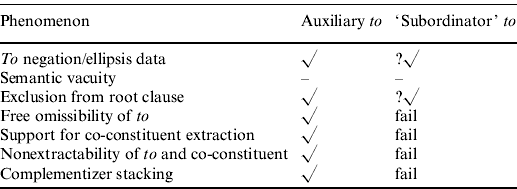
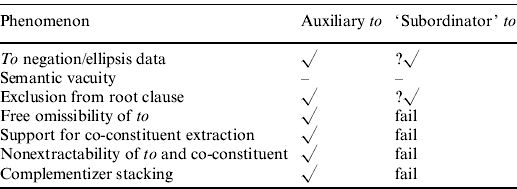
Table 1 summarizes the results of the preceding discussion. The first column identifies the diagnostic grammatical patterns reviewed above; the second, the predictions of the nonfinite auxiliary hypothesis (against the background, it must be emphasized of the correct structural characterization of that pattern's syntactic origins); the third, the predictions of the ‘subordinator’ analysis of to. The symbol ✓ indicates a correct prediction, the combined symbol ?✓ marks a prediction which is correct for to but leaves parallel data involving the canonical auxiliaries unaccounted for (again, against the background of the correct formulation of the relevant principle), a dash – indicates that the property in question is irreducibly stipulative via lexical specification, and ‘fail’ notates an incorrect prediction. Based on these results, there seems in principle no advantage, on any count, to assign to complementizer status, and every reason to take it to be a nonfinite auxiliary.
Comparison of competing analyses
The magisterial scope and high level of sophisticated linguistic reasoning displayed in CGEL represent a substantial, even spectacular improvement over the kind of comprehensive traditional descriptive grammars for English which preceded it. The Cambridge Grammar of the English Language goes far to prove, by demonstration, that the discipline of descriptive grammar is useful and insightful to the extent that it builds upon the methodological platform of what might be called ‘best practices’ in theoretically-informed syntactic and morphological analysis. In the case of infinitival to, however, these best practices do not appear to me to have been carried out to the requisite level; the kind of considerations raised above have been given short shrift, or neglected altogether. Certainly there is room for argument – very few questions in the descriptive analysis of even as well-studied a language as English can be said to have been answered definitively – but I believe the preceding discussion vindicates Pullum's (Reference Pullum1982) original conclusions.