


Introduction
Insomnia has become a major public health concern, with far-reaching consequences for the health and well-being of affected people. In Western countries, sleep complaints are reported by one-third of the adult population, and 6–10% meet the diagnostic criteria for insomnia disorder (Ohayon, Reference Ohayon2011). Negative consequences of insomnia are diverse and include daytime fatigue, reduced daytime performance, mood impairments, physical complaints, and neuropsychological consequences such as difficulties with concentration and memory (Katz and McHorney, Reference Katz and McHorney2002; Léger et al., Reference Léger, Guilleminault, Bader, Lévy and Paillard2002). Moreover, evidence shows that insomnia often precipitates, exacerbates or prolongs a broad range of medical complaints such as mental or physical illnesses (Baglioni et al., Reference Baglioni, Spiegelhalder, Lombardo and Riemann2010, Reference Baglioni, Battagliese, Feige, Spiegelhalder, Nissen and Voderholzer2011; Fernandez-Mendoza and Vgontzas, Reference Fernandez-Mendoza and Vgontzas2013; Pigeon et al., Reference Pigeon, Pinquart and Conner2012; Roth and Roehrs, Reference Roth and Roehrs2003; Spiegelhalder et al., Reference Spiegelhalder, Regen, Feige, Holz, Piosczyk and Baglioni2012).
Cognitive behavioural therapy for insomnia (CBT-I) is an effective treatment with moderate to large effects on measures of sleep continuity and on subjective insomnia severity in general (Irwin et al., Reference Irwin, Cole and Nicassio2006; Morin et al., Reference Morin, Vallieres, Guay, Ivers, Savard and Merette2009; Trauer et al., Reference Trauer, Qian, Doyle, Rajaratnam and Cunnington2015; Van Straten et al., Reference Van Straten, Van Der Zweerde, Kleiboer, Cuijpers, Morin and Lancee2017). Despite the fact that evidence-based treatments exist and despite the negative impacts of sleep disturbances, insomnia often remains unrecognized and untreated (Morin et al., Reference Morin, LeBlanc, Daley, Gregoire and Merette2006b). When insomnia symptoms are reported to professionals (usually to a primary care physician), treatment is normally limited to pharmacotherapy even though hypnotic medications can have severe side effects (Kripke et al., Reference Kripke, Garfinkel, Wingard, Klauber and Marler2002).
In recent years, scalable and low-threshold internet-based self-help treatments have been developed for addressing a broad range of mental disorders and behavioural problems. Most internet-based treatments target disorder-specific perpetuating factors, such as dysfunctional behaviours, through CBT-based exercises and techniques. These techniques and exercises are either guided or unguided (Barak et al., Reference Barak, Hen, Boniel-Nissim and Shapira2008). Such internet-based self-help tools have also been developed and tested for insomnia. One meta-analysis found eleven published randomized controlled trials (RCTs) which had tested the effect of internet-delivered CBT-I (Zachariae et al., Reference Zachariae, Lyby, Ritterband and O'Toole2016). The global effect size (Hedge's g) was high, with 1.09 (CI 0.74–1.45) for insomnia severity and satisfactory for a broad range of secondary outcomes such as sleep onset latency, wake after sleep onset, or total sleep time. The meta-analysis included studies on guided and unguided interventions. The degree of personal clinical support was found to be associated with a larger effect size for sleep efficiency at post-treatment and a larger reduction on insomnia severity at follow-up assessment. However, some studies on unguided interventions reported high effect sizes as well. One web-based treatment called Sleepio (Espie et al., Reference Espie, Kyle, Williams, Ong, Douglas, Hames and Brown2012) uses an animated avatar that provides all the content of the programme audio- and video-based with no clinical support needed. Sleepio was tested against a placebo and a treatment-as-usual group. High effect sizes on the primary outcome (sleep efficiency) were found when the treatment group was compared with both control groups.
Nevertheless, none of the 11 RCTs included in the meta-analysis reported long-term follow-up data. Only one recently published trial reported 12-month follow-up data of an online CBT-I intervention (indicating enduring effects; Ritterband et al., Reference Ritterband, Thorndike, Ingersoll, Lord, Gonder-Frederick and Frederick2017). The intervention was a fully automated, interactive and tailored web-based treatment called SHUTi that included sleep restriction, stimulus control, cognitive restructuring, sleep hygiene and relapse prevention.
Although treatment effects seem substantial in online CBT-I, it has remained unclear if they are equivalent to traditional face-to-face approaches. Two recent studies compared online CBT-I against a CBT-I programme delivered face-to-face, and found conflicting results: Lancee et al. (Reference Lancee, van Straten, Morina, Kaldo and Kamphuis2016) found that a face-to-face CBT-I treatment was superior to an online CBT-I intervention, whereas Blom et al. (Reference Blom, Tarkian Tillgren, Wiklund, Danlycke, Forssén and Söderström2015) found that their online CBT-I intervention was non-inferior, compared with a face-to-face treatment group.
Furthermore, it remains unclear which perpetuating factors that are hypothesized in theoretical models of insomnia are successfully targeted in online interventions. Conventional CBT-I, delivered face-to-face, mainly includes psychoeducation, sleep hygiene, stimulus control, sleep restriction, relaxation techniques and cognitive restructuring of unhelpful thoughts and beliefs about sleep (Morin, Reference Morin2006). The effects of the behavioural components of CBT-I (i.e. stimulus control and sleep restriction) are well established (Morin et al., Reference Morin, Bootzin, Buysse, Edinger, Espie and Lichstein2006a). Moreover, evidence shows that cognitions are also an important target for interventions (Harvey et al., Reference Harvey, Sharpley, Ree, Stinson and Clark2007). Compared with healthy subjects, insomnia patients report more dysfunctional thoughts, attitudes and beliefs about sleep (Morin et al., Reference Morin, Stone, Trinkle, Mercer and Remsberg1993), and such dysfunctional cognitions play an important role in theoretical models of insomnia (Espie, Reference Espie2002; Harvey, Reference Harvey2002; Lundh and Broman, Reference Lundh and Broman2000). Harvey (Reference Harvey2002) suggests that attentional and perceptual processes, together with maladaptive beliefs and behaviour, contribute to the perpetuation of insomnia. According to this model, attentional processes include the monitoring of internal and external sleep-related threats, such as indicators of not getting enough sleep and of not functioning well during the day. Harvey (Reference Harvey2002) postulates that these sleep-related threats lead to safety behaviours. Safety behaviours are maladaptive coping strategies (e.g. staying in bed longer than usual) that are executed to avoid the negative consequences of poor sleep. Harvey et al. (Reference Harvey, Sharpley, Ree, Stinson and Clark2007) suggest that such safety behaviours can be problematic for two reasons: first, safety behaviours may prevent patients from experiencing a non-confirmation of the feared negative consequence, and second, such behaviours may increase the probability that the anticipated negative consequences occur.
Cognitive and attentional biases as well as safety behaviours can be addressed and successfully altered in conventional, face-to-face CBT-I (e.g. Harvey et al., Reference Harvey, Sharpley, Ree, Stinson and Clark2007). However, only a few studies have investigated whether cognitions and safety behaviours can be successfully altered in online interventions as well. Lancee et al. (Reference Lancee, Eisma, van Straten and Kamphuis2015) found that dysfunctional beliefs about sleep and safety behaviours were reduced after a guided online intervention for the treatment of insomnia. However, evidence on the successful delivery of cognitive techniques is scarce, particularly with respect to unguided internet-based treatments.
The aim of this study was to test the efficacy of an unguided internet-based treatment, ‘mementor somnium’, which involves behavioural and cognitive techniques for the treatment of insomnia. Aside from testing the general efficacy of the program, this study examines whether effects are stable over a long follow-up period and aims to determine whether cognitions and safety behaviour can be successfully altered using a virtual sleep coach.
Method
Participants
All participants were self-recruited via a study website. The link to the webpage was spread via e-mail, newspapers, clinics and clinical practitioners in Switzerland, Austria and Germany. People who expressed their interest in participation received an e-mail with study information and informed consent. Once written informed consent was given, participants received a link with screening questionnaires consisting of self-report measures and demographic questions. Inclusion screening criteria were: fluency in German, at least 18 years of age, having access to a computer and internet, and a minimum of 8 on the Insomnia Severity Index (ISI; Bastien et al., Reference Bastien, Vallières and Morin2001). Exclusion criteria were working in shifts, ongoing psychological treatment, suicidality, psychotic disorder, alcohol abuse, a score higher than 19 on the Beck Depression Inventory revised (BDI-II; Beck et al., Reference Beck, Steer and Brown1996) or suffering from a sleep disorder other than insomnia. Screening questionnaires were used for the following sleep disorders: obstructive sleep apnoea, restless legs syndrome and parasomnia. If the screening was positive, participants were excluded from the study. Medication was only an exclusion criterion if the dose was changed before or during the treatment or if signs of an abusive intake existed. Participants were asked if they took any medication. If that was the case, they were asked if they recently had changed the dose; in addition, screening questions concerning medication abuse were asked. If the screening was positive or if the dose had changed, people were excluded from the study. In the study information, participants were explicitly instructed not to change their regular medication or, otherwise, to report any changes in medication immediately to the study coordinator.
Study design and procedure
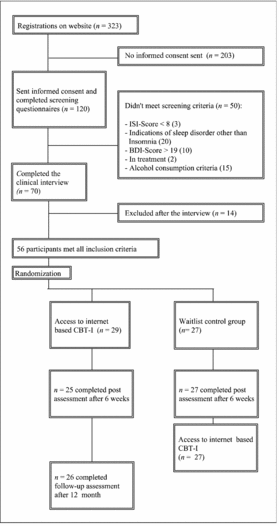
An RCT with two parallel arms was conducted: an online CBT-I group (treatment group), and a waiting list control group. After completion of the screening questionnaires, eligibility for inclusion was determined in a structured clinical interview by trained interviewers with at least a bachelor's degree in psychology. In the clinical interview, DSM-V criteria for insomnia disorder were checked. Participants who did not meet the criteria were excluded from the study. The interview took place via telephone. In total, 323 people showed interest in the study, 120 officially registered and completed the pre-study screening, and 56 participants met the inclusion criteria. The flowchart of the recruitment process, randomization, and assessments at pre-, post- and follow-up is presented in Fig. 1.
Flow of participants

Participants were assigned to either the intervention or the waiting list condition in a 1:1 ratio using blocked randomization with 10 participants per block. Randomization was conducted by an independent person who had no contact with the participants. The interviewers were blinded to the randomization list. Sample size was calculated based on a power analysis performed with G*Power (Faul et al., Reference Faul, Erdfelder, Buchner and Lang2009). Based on other studies (Zachariae et al., Reference Zachariae, Lyby, Ritterband and O'Toole2016) a large effect size of f = 0.5 for treatment effects was expected; with a power of 80% and a significance level of p < .01 a minimal sample size of 40 participants (20 in each group) was calculated.
Duration of the intervention was 6 weeks. Information from screening was used as a baseline measure. Outcome measures at post-treatment and follow-up (12 months) were obtained electronically via a link to the online questionnaires sent to participants’ e-mail addresses. Participants in the waitlist-condition received access to the treatment upon completion of the post-assessment. The study protocol was approved by the Ethics Committee Zurich. The trial was registered at Clinicaltrials.gov NCT02629913 and Swiss National Clinical Trials Portal.
Measures
The ISI (Bastien et al., Reference Bastien, Vallières and Morin2001) was used as the primary outcome measure. This self-report questionnaire consists of seven items scored on a 5-point Likert scale, with higher scores indicating a higher degree of symptoms and perceived impact of sleep difficulties. Items are summed to a total score ranging from 0 to 28. A total score of 0 to 7 is defined as normal, 8 to 14 as sub-threshold insomnia, 15 to 21 as moderate insomnia and above 21 as severe clinical insomnia (Bastien et al., Reference Bastien, Vallières and Morin2001).
In the treatment group a sleep diary was used to measure process parameters. The sleep diary consisted of a morning and evening report. The morning report followed the guidelines of a sleep expert consensus on sleep diaries (Carney et al., Reference Carney, Buysse, Ancoli-Israel, Edinger, Krystal, Lichstein and Morin2012). The evening report was a slightly adapted version of the short evening report of the German Society of Sleep Medicine (Liendl and Hoffmann, Reference Liendl and Hoffmann1999). Participants received e-mail reminders if they did not fill in the sleep diary. Moreover, sleep diary completion was automatically checked whenever the participant logged into the program, and participants could only continue the online treatment after adding missing reports for the prior three days. The following main parameters were calculated from the morning report of the sleep diary: sleep onset latency (SOL), wake after sleep onset (WASO), sleep efficiency (SE) and total sleep time (TST). In the evening report, participants rated ‘overall sleep restfulness’ (restfulness) and ‘overall daytime performance’ (daytime performance) on a scale from 0 to 100.
The Anxiety and Preoccupation about Sleep Questionnaire (APSQ; Tang and Harvey, Reference Tang and Harvey2004) was used to measure sleep-related cognitions. This instrument consists of 10 statements, and participants rate their agreement with each statement on a 10-point scale. The Sleep-related Behaviours Questionnaire (SRBQ; Ree and Harvey, Reference Ree and Harvey2004) was used to measure safety behaviour. The questionnaire consists of 32 items that assess insomnia-related safety behaviours. Items are rated on a 5-point Likert scale, adding to a sum score from 0 to 128. Finally, to assess secondary symptoms, two well-established questionnaires were administered: the Beck Depression Inventory-II (BDI-II; Beck et al., Reference Beck, Steer and Brown1996) for depression, and the Brief Symptom Inventory 18 (BSI-18; Derogatis, Reference Derogatis2001), using only the subscales somatization (BSI-S) and anxiety (BSI-A).
CBT-I intervention
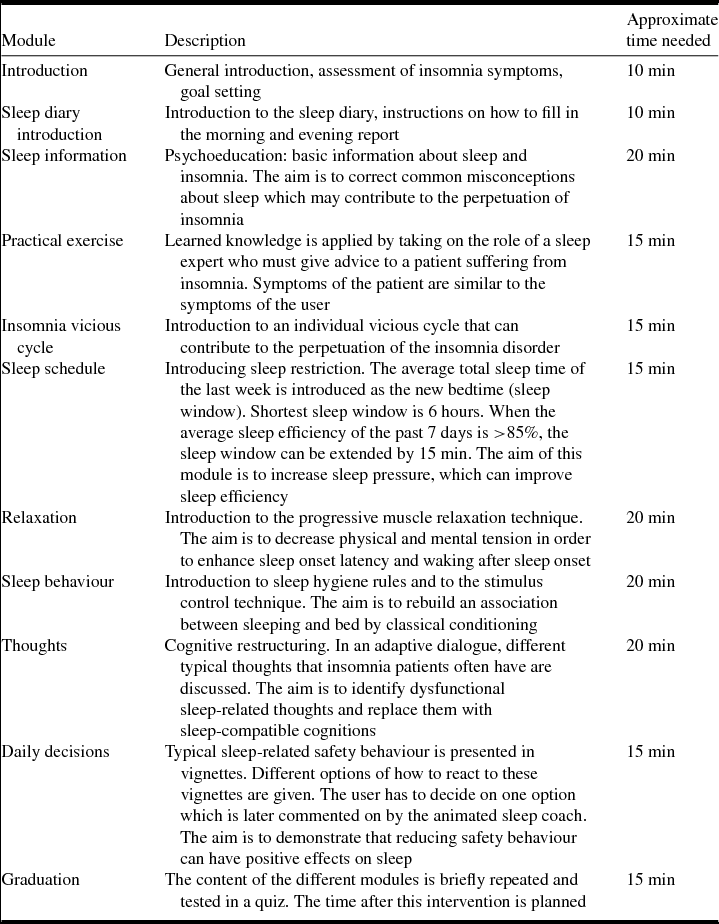
The online intervention ‘mementor somnium’ consists of six fully automated sessions of CBT-I; every session contains different modules including psychoeducation, sleep restriction, relaxation, sleep hygiene, cognitive restructuring and changing sleep-related behaviours. A detailed description of the module content is provided in Table 1. The six treatment sessions were delivered chronologically, with a minimum waiting period of 48 hours between sessions. Participants were guided through the intervention by an animated sleep coach, which provided audio information supported by dynamic and interactive graphical content. At the beginning of the intervention, participants set goals on which they received continuous feedback based on the sleep diary data. A unique feature of the intervention is its tailored dialogue with the animated sleep coach. The coach asks questions throughout the treatment course, and delivers content based on the user's response behaviour.
Content of ‘mementor somnium’

Statistical analyses
Baseline group differences regarding demographic and clinical characteristics were analysed using independent t-tests (two-sided) and Pearson χ2-tests. To evaluate the effect of treatment on study outcome measures, linear mixed-effects analyses (using Restricted Maximum Likelihood as the estimator) were conducted. This statistical procedure is recommended for clinical trials with incomplete data (Beunckens et al., Reference Beunckens, Molenberghs and Kenward2005). Treatment (mementor somnium versus wait-list control), time (pre- and post-assessment), and the interaction of Treatment × Time were entered as fixed factors, subject as a random factor, and ISI, APSQ, SRBQ, BDI-II, BSI-A and BSI-I as dependent variables in separate analyses. Effect sizes (Cohen's d) were calculated for changes within the treatment group from baseline to post- and follow-up assessment. Between-group effect sizes were calculated by using the mean pre/post-assessment change in the treatment group minus the mean pre/post-assessment change in the control group, divided by the pooled pre-assessment standard deviation as recommend by Morris (Reference Morris2008). Changes in sleep diary data were tested within the treatment group by using dependent t-tests (two-sided). For each of the six treatment weeks, daily sleep diary data were averaged to a weekly mean. As missing data could have influenced sleep diary and follow-up scores, multiple imputation was employed (Sterne et al., Reference Sterne, White, Carlin, Spratt, Royston and Kenward2009). For the missing scores, ten separate datasets were generated. Pooled t-test results were reported. To evaluate whether any baseline variables were associated with treatment response, a logistic regression analysis was computed entering baseline variables as predictors and the ISI remission criterion as the dependent variable. Statistical analyses were conducted using IBM SPSS Statistics, version 23 and R.
Results
Participant characteristics
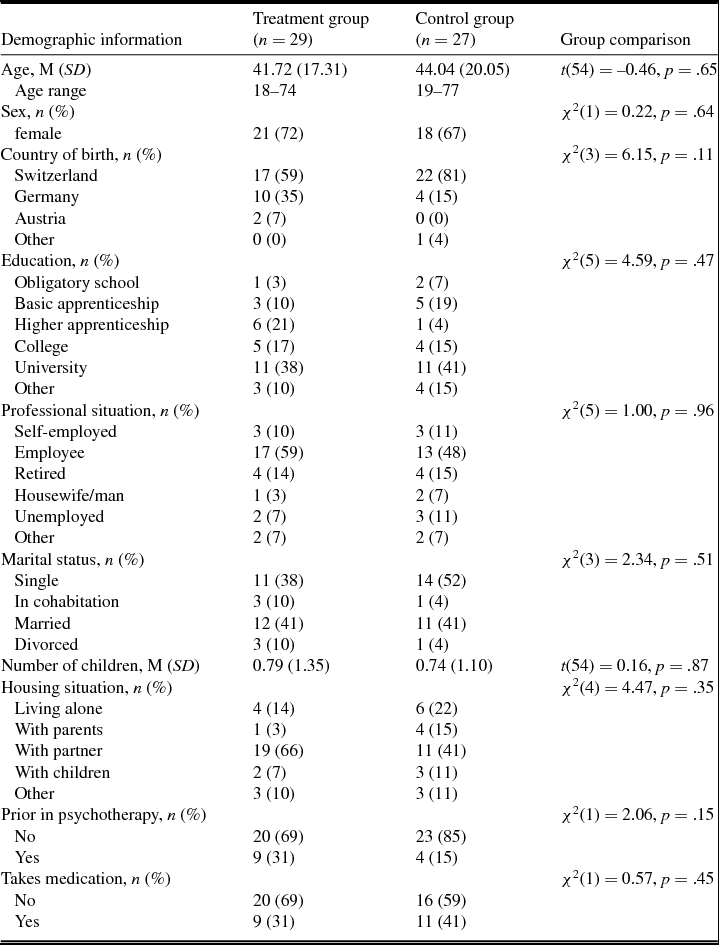
All demographic results for the different groups are reported in Table 2. For the analysis of group differences at baseline, independent sample t-tests were calculated. Significant differences were revealed for the ISI (t (54) = 2.25, p = .03) and BDI-II (t (54) = 2.23, p = .03), indicating higher scores on both variables for the treatment group. No significant differences were found on the remaining variables.
Demographic information

Treatment attrition
All participants of the control group and 25 participants of the treatment group completed the post-assessment (93%). All participants that completed the post-assessment, plus one who had missed post-assessment, completed the 12-month follow-up assessment (94% of all participants). The participant flow chart with detailed information is presented in Fig. 1.
On average, participants in the treatment group completed 5.62 of the six treatment sessions (SD = 0.74). All participants completed at least four treatment sessions. On average, the last treatment session was completed after 29.76 days of treatment access (SD = 11.78). Participants completed the sleep diary an average of 85.90% of the days (SD = 18.33).
Baseline characteristics
The mean score of the ISI (Insomnia severity) for the total sample was 14.36 (SD = 3.66) at baseline, which corresponds to a clinical insomnia with medium severity (Bastien et al., Reference Bastien, Vallières and Morin2001). For the other outcome measures the mean scores at baseline for the total sample were: BDI-II (depression) mean = 8.27 (SD = 4.38), APSQ (sleep-related cognitions) mean = 60.16 (SD = 19.14), SRBQ (sleep-related safety behaviour) mean = 41.25 (SD = 15.58), BSI-A (anxiety) mean = 3.57 (SD = 3.26) and BSI-S (somatization) mean = 2.21 (SD = 2.07). For the analysis of group differences at baseline, independent sample t-tests were calculated. Significant differences were revealed for the ISI (t (54) = 2.25, p = .03) and BDI-II (t (54) = 2.23, p = .03) indicating higher scores on both variables for the treatment group. No significant differences were found on the remaining variables.
Treatment effects
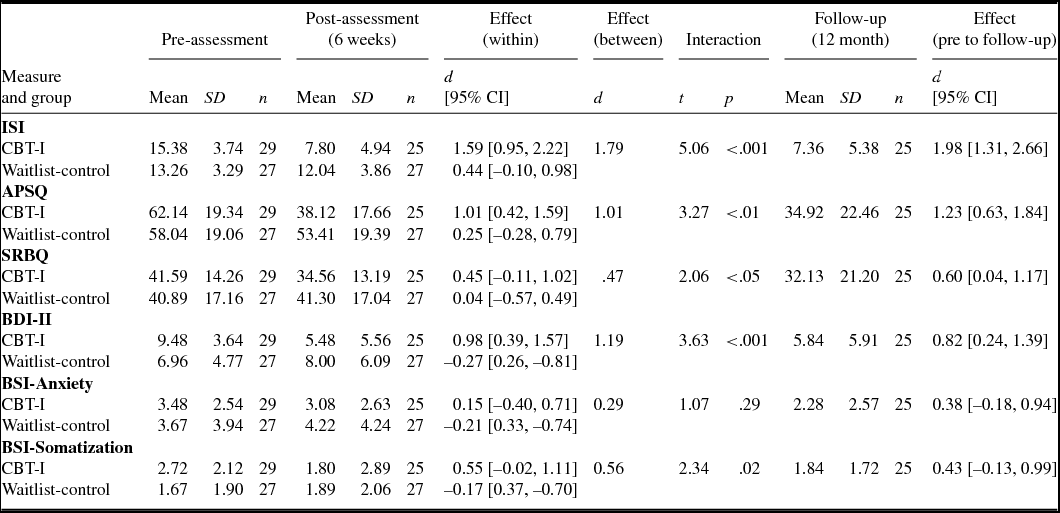
Results of the statistical analyses are presented in Table 3. For the main outcome parameter, the ISI (Insomnia severity), a significant group × time interaction effect was found, indicating a marked improvement from pre-assessment to post-assessment in the treatment group and little change in the control group. The between-group effect size and the within-treatment-group effect size were large.
Mean, standard deviation and n for each outcome measure divided by condition and assessment point, effect sizes and group × time interaction

ISI, Insomnia Severity Index; APSQ, Anxiety and Preoccupation about Sleep Questionnaire; SRBQ, Sleep-related Behaviours Questionnaire; BDI-II, Beck Depression Inventory revised; BSI-Anxiety, Anxiety subscale of the Brief Symptom Inventory; BSI-Somatization, Somatization subscale of the Brief Symptom Inventory.
Apart from the statistically significant change on self-rated insomnia severity, results also indicated a clinically significant improvement on the remission criterion of an ISI score lower than 8 (Bastien et al., Reference Bastien, Vallières and Morin2001). At post-treatment, 56% of the participants in the treatment group had achieved remission, compared with 11% in the control group. A Pearson chi-squared test revealed a significant difference between the two groups on the remission criterion (χ2 (1, n = 56) = 11.89, p < .01). None of the baseline variables predicted whether participants achieved remission (χ2 (6, n = 52) = 5.485, p = .48).
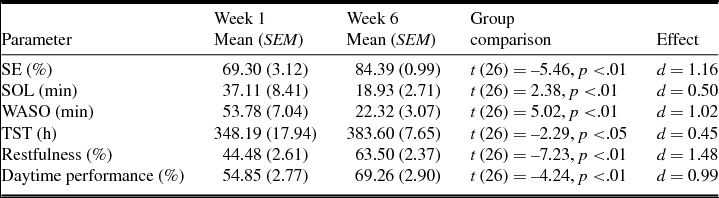
For all sleep diary parameters, significant within-treatment differences between week 1 and week 6 were found, with effect sizes ranging from d = 0.45 to d = 1.48. SOL and WASO were reduced on average by 19 and 31 min, respectively. TST increased an average of 35 min. Statistical results of all pre–post differences (week 1 to week 5) are given in Table 4.
Comparison of week 1 and week 6 sleep diary parameters

SE, sleep efficiency; SOL, sleep onset latency; WASO, wake after sleep onset; TST, total sleep time, SEM, standard error of the mean.
For the sleep-related cognitions and safety behaviours, significant group × time interaction effects emerged, indicating substantial improvements from pre- to post-assessment in the treatment group compared with the control group. In addition, there were significant group × time interaction effects on depression and somatization (BDI-II and BSI-S). In contrast to the other results, no significant group × time interaction effect on anxiety was revealed for the pre- to post-assessment comparison.
Large between-group and large within-treatment group effect sizes occurred for depression and sleep-related cognitions. For safety behaviour, somatization and anxiety small to medium between-group and small to medium within-treatment-group effect sizes occurred. For anxiety, 95% confidence intervals of the within-treatment-group effect size included 0 indicating non-significance.
Stability of treatment group effects
A large within effect size between pre-assessment and follow-up regarding insomnia severity was found, indicating a long-lasting primary treatment effect. The same pattern occurred for sleep-related cognitions, safety behaviour and depression, with medium to large effect sizes. This indicates that secondary effects of the intervention were long-lasting as well. Statistical results of all pre- to follow-up differences are presented in Table 3.
Discussion
In this study, an unguided internet-based self-help intervention for insomnia (CBT-I) was compared with a waitlist control group. On the primary endpoint of self-reported insomnia severity, large between- and within-treatment group effect sizes and a significant interaction between the treatment and control group were observed, indicating a marked improvement on insomnia severity for the treatment group compared with the control group. The treatment effect was stable over a long follow-up period (12 months). This outcome appears comparable to therapist-delivered CBT-I (Riemann and Perlis, Reference Riemann and Perlis2009) and to similar unguided CBT-I interventions (Espie et al., Reference Espie, Kyle, Williams, Ong, Douglas, Hames and Brown2012; Ritterband et al., Reference Ritterband, Thorndike, Gonder-Frederick, Magee, Bailey, Saylor and Morin2009). This study adds evidence to the literature on unguided internet interventions for insomnia and demonstrates that internet-based CBT-I can have substantial long-term effects on insomnia severity.
Interestingly, attrition rates were extremely low in this study (6–7%) compared with other studies, in which rates were 14–48% (Lancee et al., Reference Lancee, van den Bout, van Straten and Spoormaker2012, Reference Lancee, Eisma, van Straten and Kamphuis2015). Thus, delivering CBT-I with a virtual sleep coach, including dynamic and interactive graphical content through an advanced web-based technology, might have a positive impact on the retention rate.
Taking a closer look on secondary outcome parameters, it was remarkable that the anxiety score of the BSI-18 did not change significantly from pre- to post-assessment, even though insomnia symptoms were already drastically reduced at post-assessment. There was a trend towards a significant effect at follow-up assessment, but the confidence interval still included 0 at the lower end (–0.18 to 0.94). Other studies had already revealed a close link between insomnia and anxiety disorder and highlighted a bidirectional association between these conditions (Jansson-Fröjmark and Lindblom, Reference Jansson-Fröjmark and Lindblom2008). Therefore, it can be assumed that the non-significant effect could be due to the small sample size, reflecting a power problem.
Furthermore, in line with previous studies, we found a substantial effect on depression symptoms. The symptom improvement measured with the BDI-II was significantly stronger in the intervention group compared with the control group. The same pattern occurred for the somatization score of the BSI. Remarkably, the treatment effect size on depression was still large at the 12-month follow-up assessment, indicating long-lasting transfer effects of internet-based CBT-I on depression.
Apart from testing the effectiveness of the internet-based self-help program, this study examined to what extent cognitions can be successfully altered with an unguided self-help intervention. The analyses showed a significant decrease of sleep-related worries and fears in the treatment group compared with the control group. These results indicate that the online intervention (mementor somnium) successfully modified maladaptive cognitions that have been shown to play an important role in perpetuating insomnia (Harvey, Reference Harvey2002). Furthermore, the intervention led to an adaptation of sleep-related safety behaviours in the treatment group, compared with the control group. Lancee et al. (Reference Lancee, Eisma, van Straten and Kamphuis2015) reported a medium within-group effect size (d = .61) of their guided online intervention on sleep-related safety behaviour. This finding seems to be comparable to our own.
Limitations
Several limitations of the study must be mentioned. First, the small sample size did not allow for more sophisticated analysis for power reasons. With a bigger sample, it would have been possible to divide users into sub-samples and detect possible outcome mediators for them (e.g. improvements in safety behaviours or sleep-related cognitions). Second, the waitlist control-group did not have access to the sleep diary; this made it impossible to test for interaction effects on sleep diary parameters. Third, we did not include objective measurements (e.g. polysomnography) as outcome parameters due to the cost of such procedures. However, it should be noted that subjective measurements are standard in most RCTs for insomnia, and especially from the patient's point of view it is uncertain whether objective sleep parameters are more meaningful for measuring treatment effects of CBT-I (Buysse et al., Reference Buysse, Ancoli-Israel, Edinger, Lichstein and Morin2006).
Despite these limitations, this study adds an important piece of evidence to current literature, showing that the burden of insomnia in the population can be addressed sustainably using fully-automated CBT-I.
Acknowledgements
We thank all the participants who took part in the study. We acknowledge and thank mementor GmbH for making the online intervention available for this clinical trial.
Conflicts of interest: Noah Lorenz and Alexander Roetger are shareholders of mementor GmbH, the company that has developed the online intervention. Eva Birrer is part of the Advisory Board of mementor GmbH.
Ethical statements: The study was approved by the ethical committee of Zurich, Switzerland: KEK-ZH-Nr. 2015-0279.
Financial support: No funds were raised for this research. The study was conducted by the Department of Psychology, University of Zurich, Switzerland.
Supplementary material
To view supplementary material for this article, please visit https://doi.org/10.1017/S1352465818000486




Comments
No Comments have been published for this article.