Low turnout rates are considered as a serious democratic problem by politicians and political scientists alike (Lijphart Reference Lijphart1997). Second-order elections (SOEs) specifically (Reif and Schmitt Reference Reif and Schmitt1980), elections which do not serve the function of electing the head of government, have seen a dramatic decline in turnout in recent decades in many democracies. For example, the overall turnout rate for European Parliament elections (EEs) decreased from 62 percent in 1979 to 43 percent in 2014, with levels as low as 13 percent in some member states—despite an increase in the formal powers of the institution.
While some studies report negligible effects of turnout variation on electoral outcomes (Lutz and Marsh Reference Lutz and Marsh2007; Ferwerda Reference Ferwerda2014), large shifts have been noted in various contexts (Artés Reference Artés2014; Finseraas and Vernby Reference Finseraas and Vernby2014; Bechtel, Hangartner and Schmid Reference Bechtel, Hangartner and Schmid2015). As Lijphart (Reference Lijphart1997) argued, it is thus important to design institutions in a way that turnout levels are maximized in order to guarantee equal influence of all citizens—he therefore calls for a combination of SOEs with first-order elections. Electoral research has consistently found a substantial increase in turnout (see for an overview Geys Reference Geys2006), as turnout for the less important election increases to the level of the concurrent first-order elections. But beyond that, there is surprisingly little evidence on the electoral effects of concurrency.
This paper systematically analyzes the turnout effect of concurrent second-order elections (CSOEs). We argue that combining multiple SOEs should also lead to a substantial increase in turnout, beyond the levels obtained in any counterfactual stand-alone election. Our focus is on a particularly interesting case of concurrency: How is electoral participation influenced, if the elections for the two most distant levels of government, EE and local elections, are held on the same day? We bring a rigorous research design to bear on this question by exploiting partially overlapping electoral cycles as a quasi-experimental treatment condition. In the German state of Lower Saxony we find a closest-to-ideal case of study, where the 2014 EE was held concurrently with local mayoral elections in some municipalities, and not in others.
We find that the concurrency effect of local elections on EE turnout is substantial, on average around 10 percentage points. Furthermore, we show that the turnout effect depends on the nature of the local mayoral election that the EE is combined with. For municipalities that receive a more intense treatment, i.e. by holding a competitive mayoral election in a small village, we find EE turnout to increase by 18 percentage points. Less-attractive mayoral elections, such as uncontested races in larger districts, increase EE turnout only marginally. We also provide evidence for the external validity of our causal estimates by analyzing state-level EE turnout in Germany between 1979 and 2014 in the Appendix. We find that EE turnout in states that held concurrent statewide local legislative elections is consistently over 10 percentage points higher.
Our findings add to the literature on the relevance of election timing effects. While a positive effect of concurrency has been noted in the past, we are able to address endogeneity concerns that potentially bias results found so far in the literature (e.g., Mattila Reference Mattila2003; Schakel and Dandoy Reference Schakel and Dandoy2014) because the timing of concurrent elections is prone to be strategic (Meredith Reference Meredith2009). In combination with evidence provided by Fauvelle-Aymar and François (Reference Fauvelle-Aymar and François2015) on French regional elections and Schmid (Reference Schmid2015) on cantonal elections and concurrent referenda in Switzerland, our results indicate that CSOEs should “work” in a wide variety of contexts.
Our contribution does not only inform the narrow field of electoral timing research, but also adds to the broader turnout literature that is concerned with the effect of voting costs (Rallings, Thrasher and Borisyuk Reference Rallings and Thrasher2003; Haspel and Knotts Reference Haspel and Knotts2005; Hershey Reference Hershey2009; Hodler, Luechinger and Stutzer Reference Hodler, Luechinger and Stutzer2015) and voter pivotality and electoral competitiveness (Cox and Munger Reference Cox and Munger1989; Kirchgässner and Meyer zu Himmern Reference Kirchgässner and Meyer zu Himmern1995; Shachar and Nalebuff Reference Shachar and Nalebuff1999; Endersby, Galatas and Rackaway Reference Endersby, Galatas and Rackaway2002) on turnout. Furthermore, our findings have direct relevance for the ongoing debate on policy measures to increase turnout. Combining multiple “less important” elections is a simple but effective tool to increase turnout.
Why Do Concurrent Elections Increase Turnout?
What We Know So Far
It is a well-established finding of electoral research that turnout in SOEs increases when they are combined with first-order elections. Evidence stems from a wide range of elections (for an overview see Geys Reference Geys2006). In the United States, turnout in gubernatorial elections increases if they are held together with presidential elections (Boyd Reference Boyd1989). In European countries, turnout in local or regional election increases if these elections are combined with general national elections (Schakel and Dandoy Reference Schakel and Dandoy2014; Vetter Reference Vetter2015). Much less is known about the turnout effect of combining two SOEs, where turnout is relatively low in both instances. At the regional (Mattila Reference Mattila2003; Schakel and Dandoy Reference Schakel and Dandoy2014) and municipal level (Rallings and Thrasher Reference Rallings, Thrasher and Borisyuk2005; Vetter Reference Vetter2015) a turnout effect for CSOEs has been noted.
However, much of the literature on the turnout effect of concurrent elections lacks analytical rigor. First, that concurrency increases turnout is all too often treated as a self-evident truth. There is no well-established explicit theoretical model of turnout in multiple elections. Accordingly, the empirical strategy employed by most of the contributions is limited to multivariate analyses of turnout levels, where concurrency is treated as “just another dummy variable.” Confounding factors such as selection into concurrency are barely addressed. Reported estimates are therefore prone to selection and omitted variable bias, especially in cross-national research.
To the best of our knowledge, there are only three articles that have employed a causal identification strategy. Fowler (Reference Fowler2015) analyzes the effect of concurrent presidential elections on turnout in gubernatorial elections arguing that their overlap is quasi-random. He finds a sizeable concurrency effect of 17 percentage points of concurrent presidential, i.e., first-order elections on second-order turnout. Fauvelle-Aymar and François (Reference Fauvelle-Aymar and François2015) analyze turnout in French regional elections which take place every six years. Elections in the departments, a tier of government below the region, take place every three years in half of the departments. The assignment of departments to concurrency groups was random. Fauvelle-Aymar and François report a concurrency effect of 4 percentage points. Lastly, a working paper by Schmid (Reference Schmid2015) analyzes state-level elections in Switzerland with concurrent federal referendums. Schmid argues that strategic scheduling is unlikely and referendum turnout exogenous to cantonal election timing. Using individual-level and aggregate data from voting records, he finds a substantial concurrency effect on turnout of 8.5 percentage points.
The Calculus of Voting Under Concurrency
We extend the canonical Riker and Ordeshook (Reference Riker and Ordeshook1968) model to analyze the turnout effect of simultaneous elections. The Riker–Ordeshook model conceptualizes individual turnout decisions in a singular election as a cost–benefit calculus of the form R=pB+D−C. R is the individual’s expected benefit from turning out, which depends on the benefit derived from the election’s result (B), multiplied by the probability of being the decisive voter (p). An individual gains additional satisfaction from fulfilling her civic duty or taste for voting (D). Finally, expected benefit decreases with participation costs (C). If two elections are held on the same day, the model can be extended by separating the terms into election-specific components. This amounts to the idea that voters gain benefits and incur costs that are specific to casting a vote in the EE (subscript e), and specific to casting a vote in the local election (subscript l).
 $$\eqalign{ R\,{\equals}\,p_{e} B_{e} {\plus}D_{e} {\plus}p_{l} B_{l} {\plus}D_{l} \,{\minus}\,C\!\ \crC\,{\equals}\,F{\plus}v_{e} {\plus}v_{l} .$$
Costs C can be additionally divided into fixed costs F (unaffected by the additional election) and variable costs v (increasing in the number of elections) (see also Fauvelle-Aymar and François Reference Fauvelle-Aymar and François2015). F are primarily monetary costs of transportation and opportunity costs of the time spent during transportation. Variable costs are costs of collecting specific information, and the effort involved in filling out election-specific ballots. As fixed costs are only incurred once for taking part in two elections, participation in concurrent elections has “economies of scale” to the individual voter (Aldrich Reference Aldrich1993, 261).
In comparison to a singular EE turnout a concurrent EE increases if the benefits of the additional local election are larger than its additional variable costs, i.e. if p l B l +D l >v l . Moreover, if voting is not compulsory in any of the elections, there is a mechanism that assures that voters cannot be deterred by additional elections, i.e. p l B l +D l −v l ≥0. Voters whose additional variable costs are larger than their additional benefit can simply avoid incurring additional costs by not casting a vote in the additional election. Another potential strategy to deal with high election-specific information costs are informational shortcuts and heuristics, such as party identification or national-level party preferences. This has been discussed in the context of cross-ballot and cross-election contamination or interaction effects (Herron and Nishikawa Reference Herron and Nishikawa2000; Ferrara, Herron and Nishikawa Reference Ferrara, Herron and Nishikawa2005). The availability of such strategies implies that if voters follow a rational calculus, the likelihood of turnout cannot be decreased by a concurrent election.
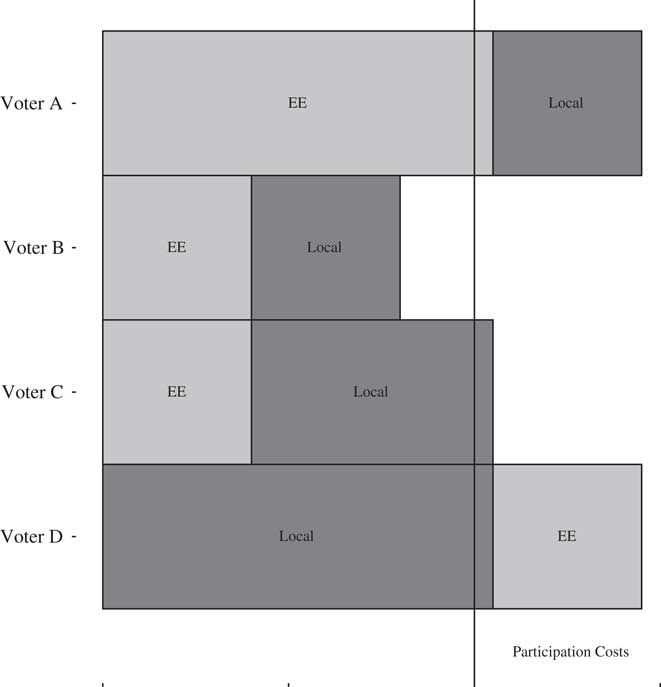
Election-specific benefits and costs vary between voters. Some voters are primarily motivated to vote in a European and some in a local election. Based on the different sum of benefits and cost perceptions, four representative voter ideal types can be identified that are relevant for an analysis of turnout in CSOEs (see Figure 1). For the sake of illustration, consider voters to turn out based on the summary benefits, relative to a constant cost threshold. Voter A will vote in the EE irrespective of whether there is a concurrent local election but will not vote in a singular local election. Voter B does not turn out, even in concurrent elections, as the sum of benefits does not outweigh costs. Voter C would not participate in any singular EE, but will in concurrent elections, as the benefit derived from voting in the local election pushes her above the participation threshold. Voter D assigns a benefit high enough to vote in local elections, irrespective of EE, but would not participate in a singular EE.
Illustration of the benefits and costs calculus in concurrent elections Note: Voter A always votes in European Parliament election (EE) irrespective of concurrent second-order election (CSOE). Voter B never votes irrespective of CSOE. Voter C only votes in case of CSOE. Voter D always votes in local elections but only in case of CSOE does she vote in EE. Not shown here is an additional voter type E who always votes.

The conditions under which concurrent local elections do not increase turnout are very strict. The electorate needs to be composed only of the specific voter types A and B for concurrency to not have a positive turnout effect. As this is unlikely to be fulfilled in any real-world election, we should expect turnout to always increase if additional elections are held on the same day. In our case, as we expect some voters to assign notable importance to the office of mayor, we expect a substantial increase in EE participation due to simultaneously held local elections.
District-Level Variation
Apart from individual-level variations in the turnout calculus, there is also systematic variation between units—due to the specific characteristics of the elections involved. In our case, while all voters vote in the same electoral district in the EE, the electoral circumstances of the concurrent local races vary. We expect especially variation in the “attractiveness,” or intensity, of (here local) races to influence the cost–benefit calculus of voters, and in turn the turnout effect of concurrency.
The Riker–Ordershook model indicates the election-level characteristics that determine the treatment intensity. First of all, the probability of being the decisive voter in the local election (p l ) is a function of the competitiveness of the local race, and the number of eligible voters in the local district.Footnote 1 With increasing competitiveness and decreasing size of the municipality, the benefits of participation in the local election increases, pushing more and more citizens over the participation threshold that would not have voted in a singular EE election (voter types C and D).
In addition, we expect municipality size to also have an effect on the non-instrumental benefit, the D l term. Citizens in smaller municipalities participate more because they have a greater sense of community and political effectiveness than citizens in larger municipalities (Wright, Verba and Nie Reference Wright, Verba and Nie1975). This sense of community should primarily apply to elections of local offices (D l ), and not at the European level (D e ). Consequently, in small municipalities relatively more voters of types C and D will exist than in larger municipalities. We therefore expect the concurrency effect on EE turnout to decrease in the size of the municipality. This finding should hold irrespective of the competitiveness of the local race—in small municipalities we expect to find a concurrency effect even for uncontested local races, where the p l term should practically play no role.
Research Design
Election timing has been shown to depend on strategic considerations of policy makers such as future economic prospects or anticipated feelings in the electorate (Lupia and Strom Reference Lupia and Strom1995; Smith Reference Smith2003; Kayser Reference Kayser2005). This could well imply that unobserved confounders correlate both with the occurrence of concurrent elections and counterfactual turnout levels. In this section, we discuss our identification strategy to deal with this issue and why we think that our research design provides causal estimates.
We exploit a quasi-experimental situation in the German federal state of Lower Saxony, where term length changes for mayors were likely unrelated to EE turnout. In addition, we draw on a difference-in-differences design (DiD) to reduce necessary assumptions—for one it differences out all unobserved time-constant confounders (Angrist and Pischke 2009). We assess the credibility of our design with a number of tests of the identifying assumptions. As dependent variable we use the difference of EE turnout to turnout in the preceding general election (GE)Footnote 2 —contrary to using the difference to preceding EE turnout, which is the more standard specification of DiD. We choose to difference EE turnout to the preceding GE for several reasons. First of all, following second-order theory, the frame of reference for SOEs is the first-order arena: “the campaign and results of each and every type of SOE are more or less heavily influenced by the political constellation of the dominant political arena within the system, the first order political arena” (Reif Reference Reif1997, 117). Second, we also see a number of methodological advantages. GE turnout can be viewed as the “maximum turnout potential” for SOEs. GEs then are always in an untreated “control” state as a concurrently held SOE does not change GE turnout.Footnote 3 We also opt for GEs because they are temporally closer to any given EE than the preceding EE as the electoral cycle for EE is five years and that for GE is four years. Our strategy allows us to keep the temporal distance low, which makes it more likely that necessary assumptions are met.Footnote 4 Another advantage of using the preceding GE is that we are able to use the first election in our time series which in a classical DID setting would drop out because there is no first difference for it.
In the case under investigation, the May 2014 EE in the German state of Lower Saxony, the preceding GE was held in September 2013. We also estimate a standard OLS model with EE turnout as the dependent variable. In the Appendix we provide the results to alternative specifications.Footnote 5 Using the differences to the preceding EE as the dependent variable in our models presented in the following section our results remain substantively unchanged.
In a potential outcomes framework following the Neyman–Rubin model (Rubin Reference Rubin1974), our quantity of interest is the average treatment effect (ATE) of CSOEs for our sample. The ATE is the average difference between the difference to turnout potential under treatment and control condition for each locality i and each time period t.Footnote 6 As we do not observe counterfactual outcomes directly, our estimation strategy builds on the core assumption that absent local elections, our “treated,” i.e. concurrent (D=1), localities would experience similar outcomes as “untreated,” i.e. stand-alone EE (D=0), localities (Angrist and Pischke 2009).
As campaigning for EEs takes place on the national and European level, exceeding state and municipality boundaries where our treatment varies, this assumption is at first sight plausible. Still, we have to ensure that the mechanism that assigns treatment and control locations is unrelated to turnout. For the case of Lower Saxony, the following section provides evidence that this is the case. We can therefore assume high internal validity of our estimates for Lower Saxony. We rely on placebo tests that assess whether our treatment has no effect on pre-treatment outcomes. Effectively, we test whether pre-treatment levels—
 $$E(Y_{{i,t{\minus}1}} ^{0}{\!} \mid {\!}D_{i} \,{\equals}\,1)\,{\equals}\,E(Y_{{i,t{\minus}1}} ^{0} {\!}\mid {\!}D_{i} \,{\equals}\,0)$$
—and trends in our dependent variable—
 $$E(Y_{i,{\rm EE,{\it t}{\minus}1}}^{0} {\minus}Y_{{i,{\rm GE,{\it t}{\minus}1}}}^{0} {\!}\mid {\!}D_{{i}} \,{\equals}\,1)\,{\minus}\,E(Y_{{i,{\rm EE,{\it t}{\minus}1}}}^{0} {\minus}Y_{{i,{\rm GE,{\it t}{\minus}1}}}^{0} {\!}\mid {\!}D_{{i}} \,{\equals}\,0)$$
—are identical in the control and treatment group.
As we show, differences are both insignificant and substantially small. We interpret this as an indication that our research design is likely providing causal estimates (Lechner Reference Lechner2011). For Lower Saxony we show these placebo tests not only for our main effect, but as well for subgroups, where we might be worried that these show different turnout levels or follow distinctively different turnout trends for unobserved reasons.Footnote 7 Again, we show that this is not the case. Our estimation for Lower Saxony follows the functional form
 $$(turnout_{{14}}^{{{\rm EE}}} \,{\minus}\,turnout_{{13}}^{{{\rm GE}}} )\,{\equals}\,\beta _{0} {\plus}\beta _{1} D_{i} {\plus}{\epsilon}_{i} .$$
We additionally report results of level regressions as treatment is, as we argue, exogenous.Footnote 8
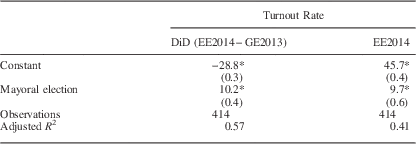
Average Treatment Effect of Concurrent Mayoral Election on European Parliament Election (EE) Turnout

Note: Results of cross-sectional ordinary least square regressions of 2014 turnout trend between the 2014 EE and the 2013 federal election (Model 1) and 2014 EE turnout (Model 2) on treatment indicator.
DiD=difference-in-differences design; GE=general election.
*p<0.01.
A final note concerns the Stable Unit Treatment Value Assumption (SUTVA) (Basu and Rubin Reference Basu and Rubin1980). SUTVA has two elements (Imbens and Rubin Reference Imbens and Rubin2014, 10–3). First, no interference between units and, second, no hidden variations in treatments which lead to different potential outcomes. Both of these are plausible in our case, especially because we deem general equilibrium effects (e.g., changes in overall party campaign behavior) unlikely. In our case, forms of active treatment are labeled CSOE but contain CSOEs with different degree of competitiveness and voter pivotality in municipal elections. Still, the comparison of group averages is a valid estimator of the causal effect if there are no common causes of treatment and treatment version (VanderWeele and Hernán Reference VanderWeele and Hernán2013). As the distributions of covariates in both treatment and control group are very similar it seems plausible to estimate an ATE.Footnote 9 Although this exclusion restriction is necessarily a strong assumption which we cannot proof, estimating an ATE is, from a policy perspective, highly desirable: policy makers would be interested in the average effect of conducting CSOEs. In our case, the ATE is defined as a CSOE in a municipality with average district size and competitiveness—around 15,000 inhabitants and 2.5 mayoral candidates. In the Appendix we generalize our findings to the federal level, where the unit of analysis is an election result at the federal state level.Footnote 10
A Quasi-Experiment in Lower Saxony
The following establishes the effect of CSOEs for the state of Lower Saxony. First of all, we introduce the institutional setting and legislative changes that led to the quasi-experimental setting. We corroborate this by providing tests that help establish that our ATE and our subgroup analysis is likely unbiased. Second, we provide evidence that CSOEs led to a turnout increase of about 10 percentage points. We finally show that this effect decreases in the size of the municipality and increases in the competitiveness of the local election.Footnote 11
The Case of Lower Saxony
To analyze the turnout effect of CSOEs, we draw on the case of concurrency in the 2014 EE in the German state of Lower Saxony. In some municipalities, mayoral elections were held on the same day. The 2014 EE in Lower Saxony is the closest–to-ideal case to study because the timing of the mayoral elections can be leveraged as a quasi-random treatment condition. We introduce the institutional setting and provide evidence for the quasi-randomness of treatment assignment.
The timing of EEs follows a five-year election cycle. In all of Germany, the 2014 EE was held on Sunday, May 25, 2014. All voters in Lower Saxony faced the same party lists and had the same influence on the composition of the European Parliament.Footnote 12 But on the same date some municipalities in Lower Saxony also elected their mayor. We refer to these municipalities with European and mayoral elections as treatment municipalities or “CSOE municipalities” in the following. The selection into treatment was the result of a complex and partially stochastic process.
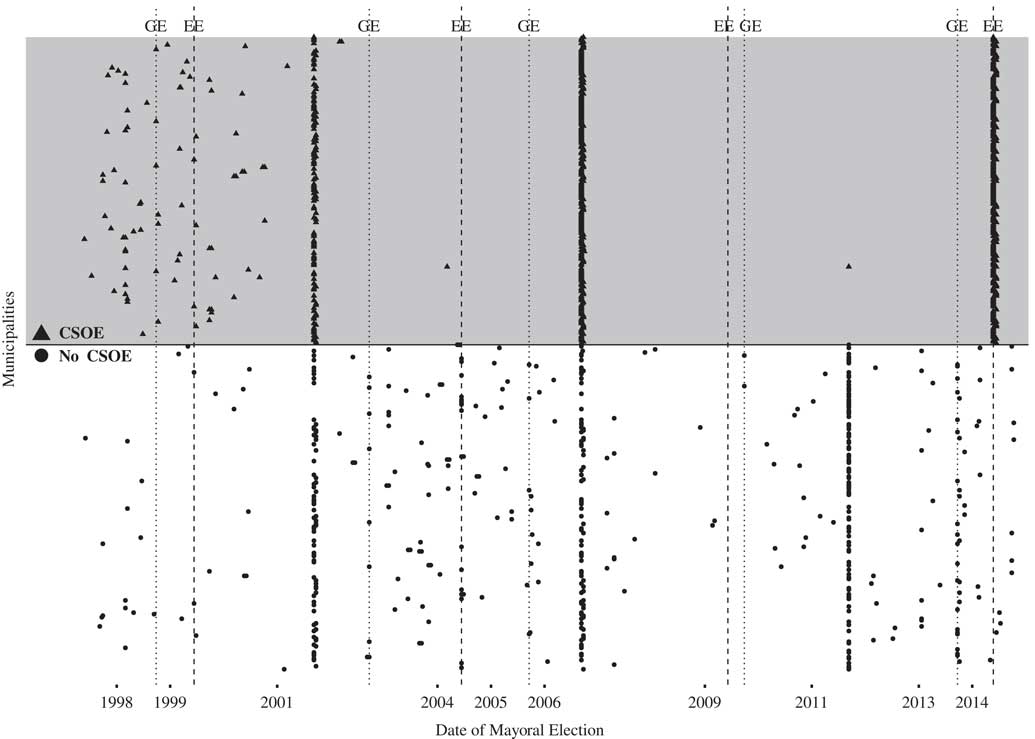
Municipalities were until the 1990s headed by a dual leadership, an honorary mayor and a professional local executive. The latter was indirectly elected by local municipal councils for 12 years. In 1996, the social-democratic SPD introduced direct election of local executives with five-year terms, against the opposition of the center-right CDU. Mayoral elections were to be held concurrently with council elections (Detjen Reference Detjen2000) in 2001 and 2006 in most municipalities. In 2006, 280 of the 414 municipalities were conducting on-cycle elections. The fact that some municipalities were “off the cycle” was the consequence of transition rules that did not force local executives to face reelection in 1996 and 2001 if their original 12-year term was still running (Armbrust Reference Armbrust2007, 60f.), and of exceptional elections due to death, retirement, resignation or changes in administrative boundaries.Footnote 13 In 2005, now under CDU rule and contested by the SPD-led opposition, the term length of mayors was prolonged to eight years (Armbrust Reference Armbrust2007, 60f.). The explicit political aim of the reform was to desynchronize mayoral and local council elections.Footnote 14 The legislation became effective for all mayoral elections after 2005 (Figure 2).
Timeline of mayoral elections in Lower Saxony Note: The figure presents one marker for each mayoral election in control (dot) and treatment group (triangle) since 1997. The treatment group (n=201) conducted elections on cycle, i.e. 2001, 2006 and 2014. Selection into this “normal” electoral cycle occurred when the terms of indirectly elected local executives ended in the late 1990s and if mayors did not step back early. The control group (n=213) conducted its last mayoral elections primarily in 2011 (concurrent with local council elections) and 2013 (concurrent with federal elections). Selection into the control group occurred, first, when the terms of indirectly elected local executives ended after 2001. Second, some municipalities selected into the control group when mayors resigned before their term ended, calling for early elections (n=81). EE=European Parliament election; GE=general election; CSOE=concurrent second-order election.

Accordingly, for the 201 treatment municipalities that held concurrent mayoral elections in 2014, the last mayoral election was regularly held in 2006. Mayoral elections in 2014 could be conducted concurrently wherever the term of the local executive ended within nine months of May 25 (Ipsen Reference Ipsen2011). Whether elections are then actually held concurrently is under scrutiny of the local administration, but it seems technical rather than political reasons dominate this question: only eight out of the 213 municipalities (3.8 percent) in our control group could by law have voted for their local executive on EE day, but did not (for unknown reasons). The municipalities that did not hold mayoral elections concurrently with the 2014 EE were either among the “off-cycle” municipalities in 2006 or municipalities where local executives stepped down or retired between 2006 and 2014.
Altogether, assignment of municipalities to the treatment condition, i.e. holding a concurrent mayoral elections in 2014, depended on remaining time in the term of office of mayors in 1996 when direct elections were introduced, and the individual retirement decisions of in-office mayors in the 1990s and 2000s.
Tests of the Identifying Assumptions
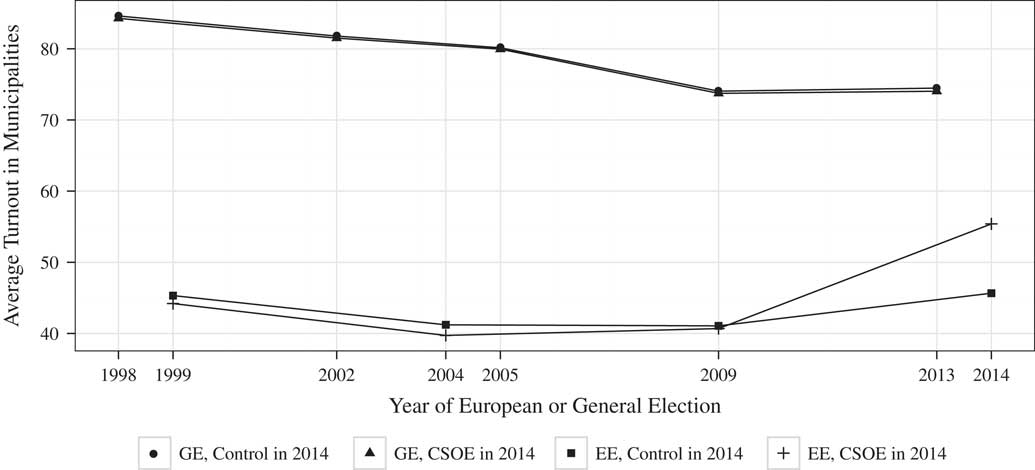
While we could think of potential confounders related to both retirement and turnout, such as local competitiveness, tests on covariate balance and pre-treatment trends in our dependent variable indicate very similar distributions in treatment and control group. To substantiate this claim, we first look at descriptive statistics. Figure 3 plots the trend in EE and GE turnout since 1998 for average municipalities with and without CSOE in 2014. As can be seen for GE turnout (upper lines), treatment and control municipalities do not differ in their average turnout. Similarly, the difference in turnout levels and changes of EE turnout for treatment and control municipalities is substantially small in the pre-treatment period, though sizeable with treatment in 2014. Table 2 in the Appendix reports results of a regression with year and state fixed effects that tests for differences in the pre-treatment trend of CSOE and non-CSOE municipalities—we find substantially small and on the 10 percent level insignificant coefficients when testing for different time trends in the 1998–2004 and the 2004–2009 period between both groups.
Trend of European Parliament election (EE) and general election (GE) turnout of an average concurrent second-order election (CSOE) and an average non-CSOE municipality in Lower Saxony Note: Averages are calculated for 201 CSOE and 213 non-CSOE municipalities. Election results are calculated in 2014 administrative boundaries.

In addition, we check for the balance of pre-treatment covariates related to mayoral elections between the treatment and control group in 2014. Specifically, we tested whether the distribution of party affiliation and gender of mayor is similar in both groups, whether treatment and control municipalities are equally distributed in the four regions of Lower Saxony, whether treatment correlates with administrative types of municipalities (rural municipality, city, joint (rural) municipality), whether mayors had to face a run-off election, whether mayors are in a consecutive term and whether mayors stem from municipalities of different size. Concerning all but one of these variables, we find no significant differences between both groups. Significant differences are present only for the share of mayors in a consecutive term, which is a consequence of the selection process as in the treatment group municipalities following the regular elections cycle without replacements during the term are over-represented. We also show that pre-treatment trends by consecutive term are similar and that treatment effects controlling for consecutive term are substantially unchanged.Footnote 15
One final concern relates to the selection process. Potentially, the control group could consist of more competitive municipalities, as selection might be driven by strategic resignations—and at the same time competitiveness drives political participation levels.Footnote 16 First, the similar turnout trend and levels in the pre-treatment period for EE and GE do not point in this direction. Second, to directly compare the competitiveness levels of mayoral elections in both groups, we would need to observe stand-alone mayoral elections in our treatment and control group at the same point in time. As a second-best alternative we compare our treatment and control observations with data from the 2006 mayoral elections. When testing for differences in turnout levels, average number of parties competing and the share of mayors facing run-off elections we find no significant differences between both groups. On the 5 percent level, the only significant difference lies in the average age of 2006 elected mayors, which is higher in the control group. This indicates that resignations were not driven by strategic considerations, but more likely age related.Footnote 17
In the Appendix, we additionally report a series of placebo regressions for all our specifications (average CSOE effect and CSOE effect by local competitiveness and by municipality size), drawing on the difference in turnout for the 2009 EE and 2009 GE (held on September 27, 2009)—the coefficients are all substantially small and insignificant.
Overall, both the political process that led to the decoupling of electoral cycles for local executive elections in Lower Saxony and empirical tests on pre-treatment turnout provide evidence of a unique case: 201 out of 414 municipalities in Lower Saxony were quasi-randomly conducting concurrent mayoral elections (our treatment group), while 213 municipalities were not (our control group).
ATE of Concurrent Mayoral Elections on EE Election Turnout
We estimate the ATE of mayoral elections on EE election turnout with two models. The first model implements our proposed DiD design, and has the difference in turnout rates between the EE and GE as the dependent variable. The second model has the turnout rate in the EE as the dependent variable. If treatment is assigned as-if-randomly as argued above, and the common linear trend assumption holds, both models yield in expectation the same estimates of the ATE. However, we expect the DiD model to estimate more precisely, as time-constant between-municipality variation in turnout is differenced out.
Table 1 shows that concurrent mayoral elections are estimated to boost EE turnout on average by 10 (95 percent CI: (9, 11)) percentage points. While turnout in the EE election drops 29 percentage points below the GE turnout rate in untreated municipalities, the decline is only 19 percentage points in municipalities that held concurrent mayoral elections. As expected, the DiD model realizes some noticeable gains in efficiency and model fit, lending support to the outlined estimation strategy.
Treatment Intensity Subgroup Analysis
Local elections are notoriously diverse. Some take place in very small rural municipalities, others in large cities. Some are highly contested, politicized or both, with multiple viable candidates competing. In other races there is only one candidate for the job. These different characteristics can best be understood as variation in treatment intensity. Our central premise is that the concurrency effect increases with the intensity, i.e. with the “importance” of the concurrently held local election. Our theoretical model highlights two central factors that modulate treatment intensity: the size of the local electorate and the competitiveness of the mayoral race.
We infer competitiveness from the candidate set of the local races and the closeness of the election: uncontested, contested and close races. We classify 44 races as uncompetitive because only one candidate stood for election, 134 races were identified as contested races—races in which at least two candidates stood for election, but which were not particularly close. Closeness is operationalized as a difference of less than 5 percentage points between the vote share of the winning and the second-placed candidate. Judging the electoral chances of candidates in local elections is very difficult for voters because in most cases polling data is not available. In this information-scarce environment, 5 percentage points can be considered well within the “margin of error” of voters using simple heuristics to determine the viability of candidates. In our sample there are 20 close races thus defined. The second criterion we use to identifying subgroups is the size of the local unit. We classify units by the number of eligible voters into four categories: 54 villages with <7500, 94 small towns with 7500 to 15,000, 37 towns with 15,000 to 30,000 and 16 cities with >30,000 eligible voters.
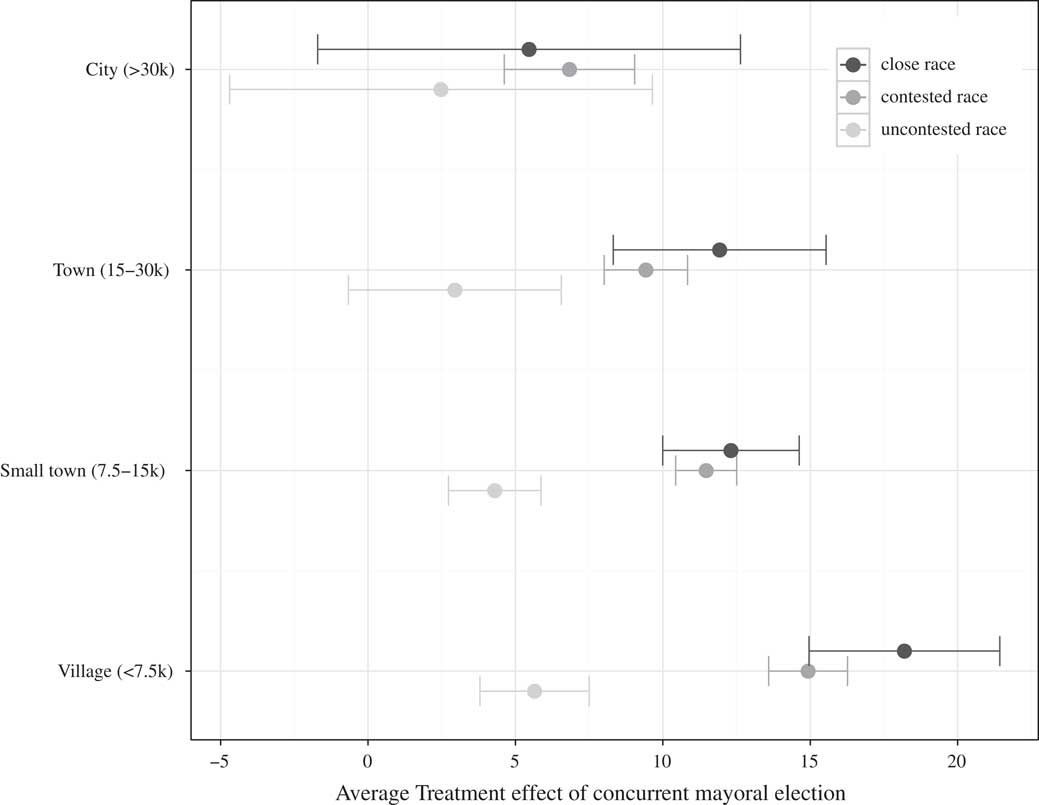
This leads to 12 treatment intensity subgroups, for which treatment effects are presented in Figure 4, showing strong support for our theoretical expectations.Footnote 18 The concurrency effect increases systematically with treatment intensity.
Average treatment effect estimates with 95 percent confidence intervals for treatment intensity subgroups Note: Subgroups are defined by the size of the municipality and the competitiveness of the mayoral race. Regression output is reported in Table 7 in the Appendix.

Given the size of a municipality, more competitive concurrently held mayoral elections lead to higher increases in EE turnout due to concurrency. The concurrency effect of uncontested races is much smaller than that in contested races. It ranges from barely noticeable in cities to around 6 percentage points in villages. Our interpretation of this finding is that while there is not much at stake when there is only one candidate for the job, voters in small municipalities, unlike voters in larger, more anonymous municipalities, still feel obliged to show up at the polls to fulfill their sense of duty to vote. As soon as there are two candidates for the job, the concurrency effect is substantial in all size groups. While a contested race raises turnout in cities by 7 percentage points, it is even higher in towns (9 percentage points) and in small towns (12 percentage points). In villages, the treatment effect of a contested mayoral race is the highest—turnout is 15 percentage points higher than in untreated municipalities. For close races our results point in the direction of an additional increase in the treatment effect. For villages, small towns and towns we find the treatment effect to be 3, 1 and 2.5 percentage points higher than in contested races, respectively. However, confidence to conclude a substantial difference in the treatment effect between contested and close races is not supported by the results. There is simply not enough data, and estimation uncertainty is too large to statistically distinguish the concurrency effect between contested and close races of the same size.
Nevertheless, the observed pattern is remarkably robust, indicating a systematic relationship between characteristics of the local election that modulate treatment intensity and the magnitude of the concurrency effect. These findings do not only corroborate our thesis that concurrency increases turnout, but provide valuable insights into the concurrency effect. The magnitude of the realized turnout increase ultimately depends on treatment intensity, i.e. how “attractive” the local election is that the EE is combined with. For the purposes of policy evaluation, these insights are of great value, such as for predicting the turnout effect of a synchronization of local and EE cycles in other countries or contexts. Based on our results, we predict that a synchronization would have a larger turnout effect in countries with smaller local-level political entities, and where local elections are generally more competitive. In addition, we would speculate that the concurrency effect also varies with the formal power that local parliaments and governments have. However, we could not test this preposition as in the case of our investigation there is no variation between municipalities in that respect.
Another noteworthy implication of our findings concern a possible over-representation of rural voter preferences in EE elections by introducing concurrency (compared with a status quo with singular elections). If rural municipalities are on average smaller than urban municipalities, and party preferences of rural and urban voters systematically differ, holding local elections together with EE (or any other state-level election) will favor specific parties. This is because treatment intensity, and in turn the realized turnout increase, is higher in smaller rural municipalities. It follows that more additional rural than urban voters will be drawn to the polls. Parties that have a higher vote share among rural voters should then profit from concurrency.
Discussion
Are CSOEs More Than Any of Their Parts?
The turnout effect of a concurrent local election is substantial—EE turnout increases by around 10 percentage points. While this seems impressive at first sight, there is an alternative explanation which would undermine the substantive relevance of this finding. If turnout in a singular local election were generally higher than in EEs, a turnout increase in concurrent EEs would mechanically follow, given that voters rarely cast blank ballots. The more pertinent question is therefore whether CSOE turnout increases beyond the counterfactual turnout levels obtained in any singular SOE. To answer this question, we would ideally report average turnout levels for counterfactual stand-alone mayoral elections for the same localities at the same point in time. Unfortunately, this is not possible as EEs were conducted in all municipalities.
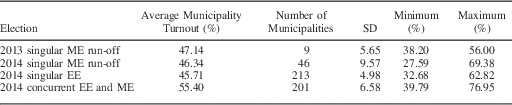
We use stand-alone mayoral run-off elections in June 2014 and October 2013 as arguably the best proxy for counterfactual singular mayoral election turnout.Footnote 19 , Footnote 20 In the 2013 and 2014 singular mayoral run-off elections, average municipality turnout was 46.3 and 47.1 percent (Table 2). This is slightly higher than turnout in an average municipality that held singular EE (45.7 percent). An average CSOE municipality experienced turnout of about 55.4 percent, substantially larger than both singular EE and singular mayoral run-off elections. Keeping in mind that the samples of municipalities and election dates differ, and that we use run-off elections as a proxy for first-round elections, we do not interpret these findings as definitive evidence. Still, we are confident in concluding that turnout levels in CSOEs are indeed “higher than in any of their parts.” CSOEs not only push participation rates to that of the highest counterfactual singular election, they realize a “net gain” in participation.
Average Turnout in Singular Mayoral Election (ME) Run-Off and European Parliament Election (EE) in 2013 and 2014 As Well As Turnout in Treatment and Control Group 2014

Note: ME in 2013 are all singular run-off elections on October 6, 2013; ME in 2014 are all singular run-off elections on June 15, 2014; EE in 2014 are all 2014 EE with/without ME on May 25, 2014 in Lower Saxony.
Conclusion
SOEs see markedly lower participation rates than first-order, i.e. general national, elections which is worrying for the legitimacy of the elected. In many SOEs, the costs of voting surpass its benefits for more than half of the electorate. This paper investigates how the combined holding of multiple SOEs can increase turnout rates.
Theoretically, in concurrent elections voters incur fixed participation costs only once, while they can reap potential benefits multiple times. Singular factors which induce participation such as perceptions of pivotality or electoral closeness can now push voters above their participation threshold for only one election, and in turn lead them to vote in the other election as well. Therefore, the incentive to participation in both elections can stem from either of the multiple electoral arenas.
We estimate the causal effect of combining two SOEs on turnout in a quasi-experimental design. In the German state of Lower Saxony, some municipalities held mayoral races concurrently with the 2014 EE. Mayoral election timing was plausibly exogenous to counterfactual turnout levels in the municipalities. We show that concurrent mayoral elections increase turnout by over 10 percentage points (i.e., >20 percent). Leveraging variation in treatment intensity, we show that the effect of CSOEs is highest in competitive races in small municipalities (up to 20 percentage points) and close to 0 in uncompetitive races in large cities. Analyzing state-level turnout in eight EEs held in Germany, we demonstrate large differences in turnout rates between states with concurrent municipal elections and those that held singular EEs, thereby establishing the external validity of our findings—reported in the Appendix only.
Our findings, which are robust to the use of different specifications and subsamples, have direct relevance for the ongoing political debate on policy measures against and consequences of low turnout. Our results, in combination with evidence provided by Fauvelle-Aymar and François (Reference Fauvelle-Aymar and François2015) on French regional elections and Schmid (Reference Bechtel, Hangartner and Schmid2015) on cantonal elections and concurrent referendums in Switzerland indicate that CSOEs should “work” in a wide variety of contexts. Combining multiple SOEs is a simple, yet very effective, policy tool to increase turnout rates. Taking our results literally, >80 percent of the much noted increase in EE turnout in Germany between 2009 and 2014 (from 43.3 to 48.1 percent) was due to the introduction of concurrency in German states (3.9 percentage points). Without concurrency in any state, counterfactual 2014 EE turnout in Germany would have been at only 39.0 percent instead of the actual 48.1 percent.Footnote 21
Most importantly, CSOEs do not simply push up turnout to the turnout level of the most attractive SOE—they are “more than any of their parts.” CSOEs increase turnout beyond the level of any of the two elections. Theory and indicative evidence from survey dataFootnote 22 lead us to suggest that this net increase in turnout is primarily due to a combination of sub-electorates that only turn out in one of the elections. In our case, this would imply that many of the additional EE voters are not interested in the EE, but only participate because there is a local election on the same day.
This indicates that there is a trade-off involved. While high turnout is desirable as the characteristics of voters resemble the general population more closely when turnout increases (Lijphart Reference Lijphart1997; Singh Reference Singh2015), the mixing of different subsections of the population that are not necessarily interested in one of the elections might lower the quality of vote choices. For instance, Börgers (Reference Börgers2004) and Krishna and Morgan (Reference Krishna and Morgan2011) argue theoretically that voluntary participation Pareto dominates compulsory voting. Hodler, Luechinger and Stutzer (Reference Hodler, Luechinger and Stutzer2015) provide evidence that the introduction of postal voting in Switzerland (i.e., lower costs) is associated with on average less knowledgeable voters. Further evidence from Switzerland on concurrent referendums indicates that as turnout increases, the average level of political knowledge of voters decreases (Schmid Reference Schmid2015). However, Schmid also reports an increase in information search behavior of these new voters. Although this might not offset the knowledge effect in the short term, exposure and engagement with the political system should increase knowledge over time (Wong Reference Wong2000). The question of whether concurrent elections (and lower voting costs in general) decrease the average quality of vote choice has to be further investigated, ideally with panel survey data covering interest and participation in CSOEs. Future research should also focus on the differences in the preference distributions between the sub-electorates that are drawn to the polls in concurrent elections. This would help us to better understand the political implications of holding concurrent elections.