1 Introduction
In a number of (historical) varieties of English, present-tense indicative verb endings are conditioned not just by person and number of the subject, but also, intriguingly, by its word category (personal pronoun or nominal) and its position relative to the finite verb (Vf, adjacent or non-adjacent to it). This pattern is known as the Northern Subject Rule (NSR). In present-day NSR dialects, the plural verb typically takes a zero ending (-∅) if the subject is a personal pronoun (Spro, i.e. we, you or they) and is adjacent to Vf, as in (1a) below; when the subject is nominal (SNP, as in (1b)) or when other elements intervene between subject and Vf (1c, d), the verb ends in -s (see Pietsch Reference Pietsch2005a, Reference Pietsch, Kortmann, Herrmann, Pietsch and Wagnerb).
(1)


There are thus two morphosyntactic conditions that are relevant to the NSR, which we will call the subject condition (whether the subject is nominal or pronominal), and the adjacency condition (whether the pronominal subject is adjacent to Vf). The NSR appeared widely in northern dialects of Middle English, often with -e as a variant of the zero ending (see Mustanoja Reference Mustanoja1960: 481–2; LALME, McIntosh et al. Reference McIntosh, Samuels, Benskin, Laing and Williamson1986 I: 554). This is illustrated in (2).
- (2)
(a) þai caste þair mantil and rennis a-mise.
they cast their mantle and run amiss
‘they throw away their mantles and are sinful’
(CMBenrul 13.457–60, North, 1400–25)
(b) And hali storis tels and sais þat helias, in ald dais, Was taken up als vnto heuen
and holy stories tell and say that Elias in old days was taken up as unto heaven
‘And holy stories tell and say that Elias, in the old days, was taken up as if to heaven’
(CMCursor 17.545, North, 1325–50)Footnote 2
The NSR pattern occurs in many other varieties of English as well, with a range of different inflectional endings, yet with similar types of syntactic conditioning. These include (non-exhaustively) Scots and Irish English varieties (Henry Reference Henry1995; McCafferty Reference McCafferty2004: 53), and North-American varieties (Montgomery Reference Montgomery, Fenton and MacDonald1994: 94; Wolfram & Schilling-Estes Reference Wolfram and Schilling-Estes1997; Godfrey & Tagliamonte Reference Godfrey and Tagliamonte1999; Tortora & Den Dikken Reference Tortora and den Dikken2010). This suggests strongly that the syntactic conditioning of the NSR-type pattern is common to all of these varieties and finds its origin in the syntax of early/pre-colonial English.
In this article, we focus on Northern and Northern Midlands English, on the express understanding that the account we seek has broader relevance for the development of the NSR pattern. We explore how the two morphosyntactic conditions on the NSR may have developed in the Northern dialects of English, against the backdrop of earlier scholarship about the morphology and syntax of the Northern English dialects in the late Old English and early Middle English periods. A key argument in our proposal is that the origin of the NSR pattern is in the positional asymmetry between pronominal and nominal subjects in Old and early Middle English generally, in line with van Kemenade (Reference Kemenade, Tieken-Boon van Ostade, Tottie and van der Wurff1999, Reference Kemenade, Pintzuk, Tsoulas and Warner2000); Haeberli (Reference Haeberli2000); van Kemenade & Los (Reference Kemenade, Los, van Kemenade and Bettelou2006); van Kemenade & Milicev (Reference Kemenade, Milicev, Jonas and Anderson2012). The idea that distinct subject positions for pronominal and nominal subjects form part of the syntactic conditions underlying the NSR is inspired by analyses of NSR-like phenomena in other varieties of English: Henry (Reference Henry1995: 31ff.) argues that in Belfast English, plural verbal -s (‘Singular Concord’) only occurs if the subject is in a lower position not available to nominative personal pronouns, and the same holds for Tortora & den Dikken's (Reference Tortora and den Dikken2010) analysis of NSR-like phenomena in Appalachian English. Our Middle English evidence suggests that this holds for the NSR in its early stages as well. Section 2 presents a detailed corpus study which shows that the subject condition on the NSR is quite stable across Northern Middle English. The adjacency condition is more variable, and the agreement morphology attested even more so: the NSR configuration variably occurs with -∅/e/n vs -s/th endings. Section 3 discusses the evidence for differential subject positions in Old and Middle English generally, and in our corpus of Northern early Middle English. Section 4 draws together the results of sections 2 and 3 into an analysis of the NSR phenomenon and a scenario for its rise, arguing that the established positional difference between subject types also played an important role in the origin of the NSR. Section 5 concludes the article and presents some implications for further research.
2 The NSR in early Middle English: a case study
2.1 Background: Northumbrian Old English verbal morphology
This section explores the variation attested in the early stages of the NSR, with the aim of finding evidence for its origins. Before moving on to the early Middle English evidence, we briefly review the Northumbrian Old English morphological evidence for the NSR. This evidence is limited both by the size of the available corpus and by its nature: the few extensive texts which contain large numbers of present-tense verbs are tenth-century glosses (notably, Lindisfarne and Rushworth;2 see Skeat Reference Skeat1871; Hogg Reference Hogg, Dossena and Lass2004). The innovative plural indicative -s ending competed with the older -th ending in these texts, and Cole (Reference Cole, Stenroos, Mäkinen and Særheim2012a, Reference Coleb) shows that in the Lindisfarne Glosses this variation was conditioned to some degree by subject type and adjacency. She finds that pronoun subjects and subject–verb adjacency promoted the use of the -s ending. This may seem surprising, but as we will discuss below, the syntactic conditions on the NSR were presumably more fundamental than its specific morphological realization. The reduced (-e) ending was used throughout the Old English period in subject–verb inversion contexts in which verb forms immediately precede first- and second-person plural subject pronouns, as in (3).
(3)
Compared to other Old English dialects, reduced verb endings are relatively infrequent in this context in Lindisfarne. They do, however, show a wider range of uses, including third-person plural pronouns and non-inverted word order (Cole Reference Cole, Stenroos, Mäkinen and Særheim2012a, Reference Coleb; see (4–5)).
(4)
(5)
(4) and (5) exemplify essentially the same context in which -e/∅ typically occurs in the Middle English NSR. As Cole (Reference Cole, Stenroos, Mäkinen and Særheim2012a) notes, partly following Benskin (Reference Benskin2011), it is plausible that reduced endings are underrepresented because the glossator avoided them as being insufficiently explicit to help clarify the Latin text. It may well be, then, that a form of the NSR with variation between -e and -th already existed in Northumbrian Old English, and that the use of the innovative -s ending went through a stage in which its conditions were unclear or changing before it crystallized into the NSR system as it has been described for Middle English.
2.2 Corpus and method for the early Middle English case study
The early Middle English evidence for this study is gathered from a survey of the intradialectal and interdialectal variation in plural present-indicative verb endings in a corpus consisting of 38 texts with a total of 177,204 words. The corpus comprises 36 localized texts dated between 1150 and 1350 from the LAEME corpus (Linguistic Atlas of Early Middle English, Laing & Lass Reference Laing and Lass2008–), supplemented by the early fourteenth-century Yorkshire Northern prose version of the rule of St Benet or Benrul (from Penn–Helsinki Parsed Corpus of Middle English 2 (PPCME2), Kroch & Taylor Reference Kroch and Taylor2000), and Anturs of Arther at the Tarnewathelan (or Anturs of Arther), a Lancashire romance digitized for the purpose of this study. It is from a fifteenth-century manuscript, but possibly represents the dialect of a thirteenth-century exemplar (Robson Reference Robson1842).Footnote 3
The text selection includes all available early Middle English texts from the Northern dialect area, the bordering areas of the Northwest Midlands and Northeast Midlands, and an area in the East Midlands, following up observations in the literature to the effect that this was where the NSR was general in late Middle English (see Mustanoja Reference Mustanoja1960: 481–2; LALME, McIntosh et al. Reference McIntosh, Samuels, Benskin, Laing and Williamson1986 I: 554, I: 467; IV: 110–11; Pietsch Reference Pietsch, Kortmann, Herrmann, Pietsch and Wagner2005b: 164), with an added area in the East Midlands where the NSR apparently occurred with -th instead of -s from late Middle English (McIntosh Reference McIntosh, Grey and Stanley1983).
All plural indicative present forms of regular verbs in these texts were counted (excluding be and preterite-present verbs because of their distinct paradigms) and analysed with respect to subject type (personal pronoun or full NP) and surface adjacency between subject and Vf, in order to determine the extent to which each form adheres to the NSR. We define adjacency here as string or surface adjacency, as we have reason to believe this is a deciding factor in the NSR (see section 4 for an analysis along these lines). Verb forms with alternative endings likely to be affected by the subject and adjacency conditions of the NSR in a similar way (-s and -th vs -∅, -e and -n) were grouped together for analysis, based on patterns of variation reported in the literature (see McIntosh Reference McIntosh, Grey and Stanley1983 and de Haas Reference Haas2011, with references cited there) and an initial survey of the data.
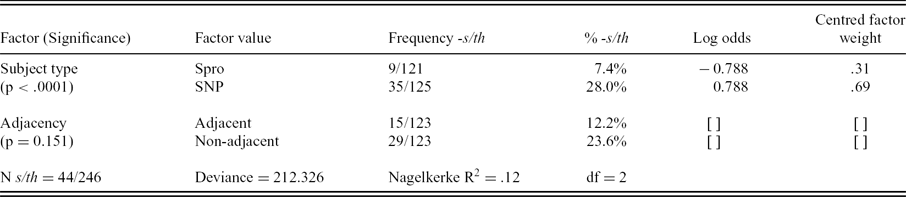
Using Rbrul (Johnson Reference Johnson2014), a logistic regression analysis was performed to test the presence and relative strength of subject and adjacency effects on plural verb endings, as well as an interaction effect between subject type and (non-)adjacency, as we expect adjacency to only play a role with pronominal subjects in NSR dialects. This analysis was done on aggregate data as logistic regression analysis is only reliable if the number of factors in the model is lower than one-twentieth of the number of cases with the minority outcome in the data (Harrell 2001: 61, quoted in Baayen Reference Baayen2008: 243). In this corpus, that meant a minimum of 61 -s/th endings was needed for a three-factor model including interaction, and a minimum of 41 for a two-factor model. A three-factor model could thus be constructed for the corpus data as a whole and for the Northern subset of the data, but only a two-factor model could be made for the Midlands data as a whole.
To gauge the presence of NSR patterns in individual texts with variation in endings, the statistical significance of the subject effect and the adjacency effect was measured using the chi-square (χ2) test or, where the χ2 test could not be used reliably (due to very low expected cell counts), Fisher's exact test. Texts with token numbers below 5 were excluded from this analysis, since these cannot yield statistically significant results.
2.3 Results: variation in the NSR in early Middle English
Only 15 out of 38 texts in the corpus displayed variation between -∅/e/n and -s/th endings.Footnote 4 An analysis of variation in these 15 texts reveals that there is a Northern core area for the NSR in early Middle English, where subject and adjacency effects are strongest, with a periphery where the effects are more diffuse. The subject condition in the peripheral varieties is as strong as the adjacency condition or stronger, and it is present in more varieties than the adjacency condition.
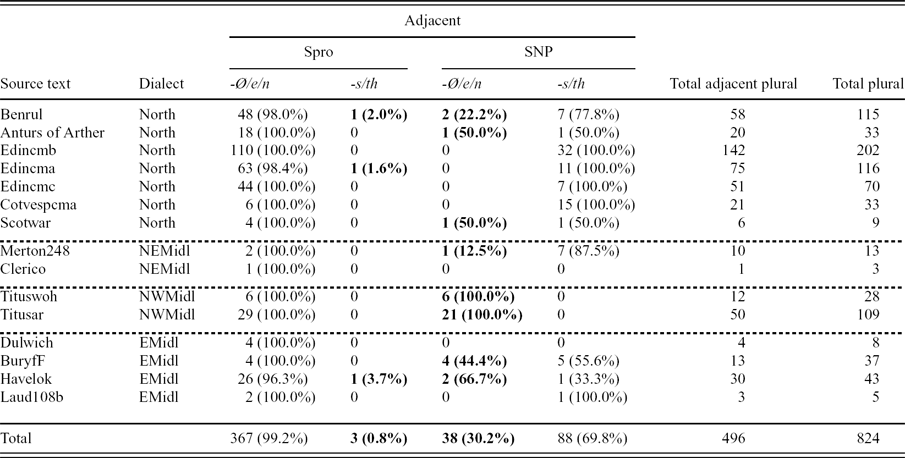
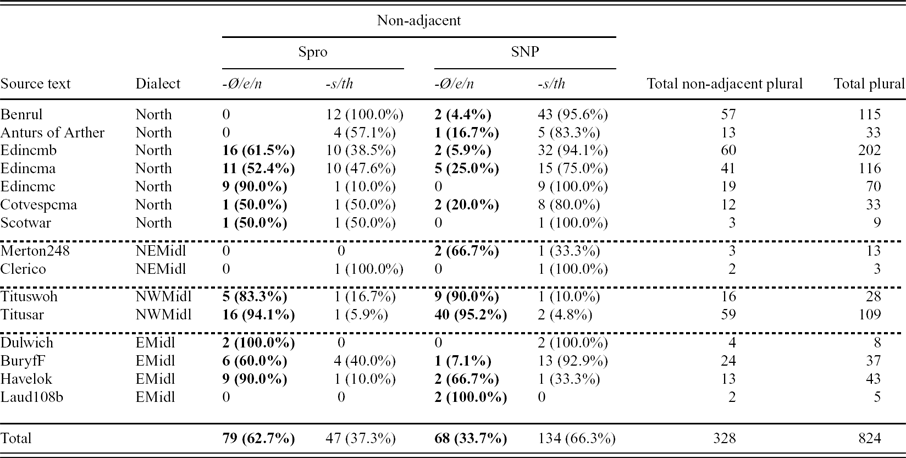
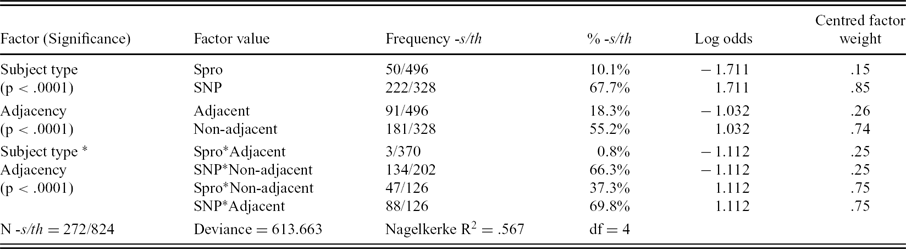
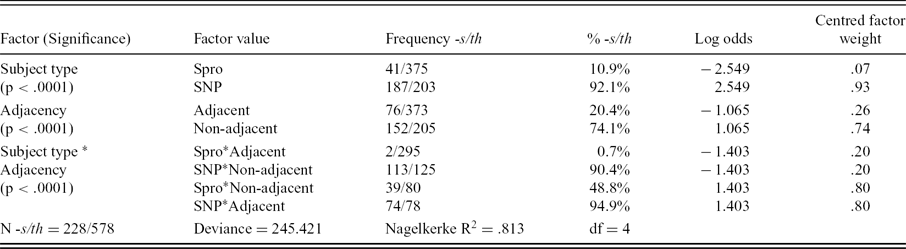
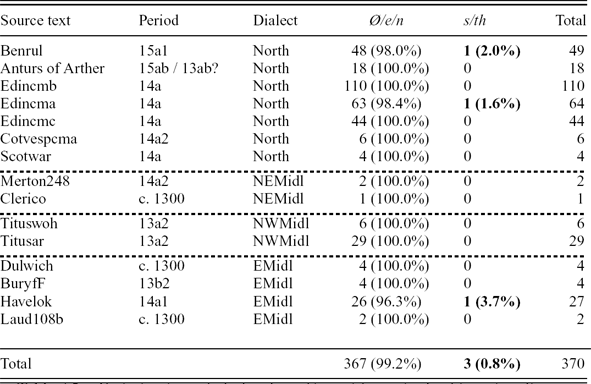
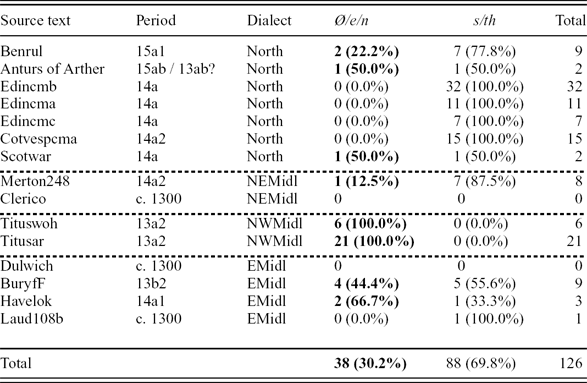
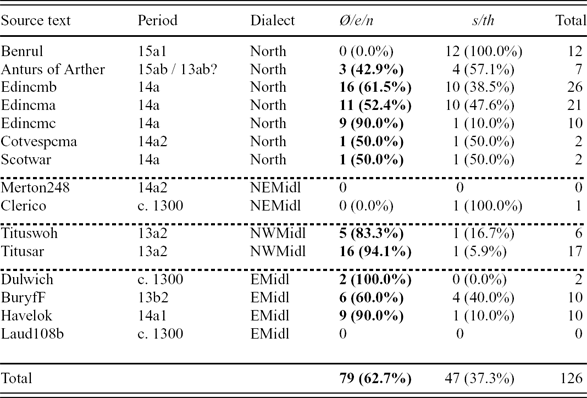
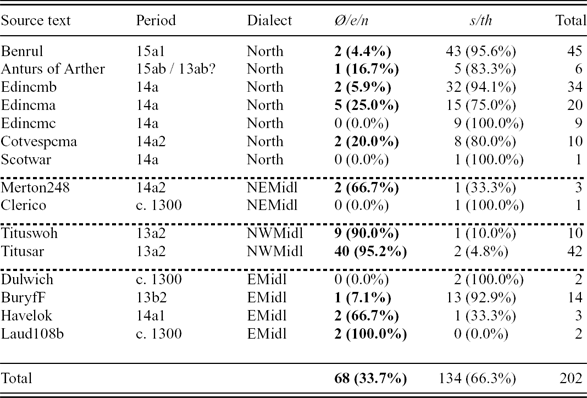
The 15 texts under analysis and their patterns of variation between -∅/e/n and -s/th endings with pronoun subjects and full NP subjects are shown in table 1 (with subjects adjacent to Vf) and table 2 (with subjects non-adjacent to Vf).Footnote 5 The outcomes of logistic regression analysis are shown in tables 3, 4 and 5. The results of χ2 and Fisher's exact tests are summarized in table 6 for all 15 texts except Interludium de Clerico et Puella (Clerico), which has only 3 tokens.
Early ME texts with variation in plural marking according to subject type in adjacent contexts. Percentages given per subject type. Exceptions to the NSR are in boldface

Early ME texts with variation in plural marking according to subject type in nonadjacent contexts. Percentages given per subject type. Exceptions to the NSR are in boldface
Logistic regression model analysing the effects of subject type (SNP vs Spro) and adjacency (non-adjacent vs adjacent) on plural marking (proportion of -s/th endings relative to -∅/e/n endings) in the early Middle English corpus
Logistic regression model analysing the effects of subject type (SNP vs Spro) and adjacency (non-adjacent vs adjacent) on plural marking (proportion of -s/th endings relative to -∅/e/n endings) in the Northern early Middle English corpus
Logistic regression model analysing the effects of subject type (SNP vs Spro) and adjacency (non-adjacent vs adjacent) on plural marking (proportion of -s/th endings relative to -∅/e/n endings) in the Midlands early Middle English corpus
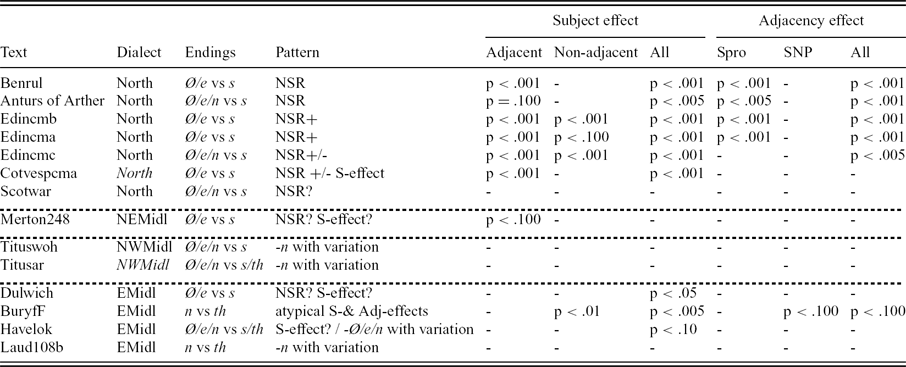
Endings and effects in early Middle English texts with variation in plural verb endings. In the Pattern column, ‘S-effect’ refers to a subject effect and ‘Adj-effect’ to an adjacency effect. Probability levels were obtained by performing chi-square (χ2) tests or, where cell counts below 5 were expected, Fisher's exact tests
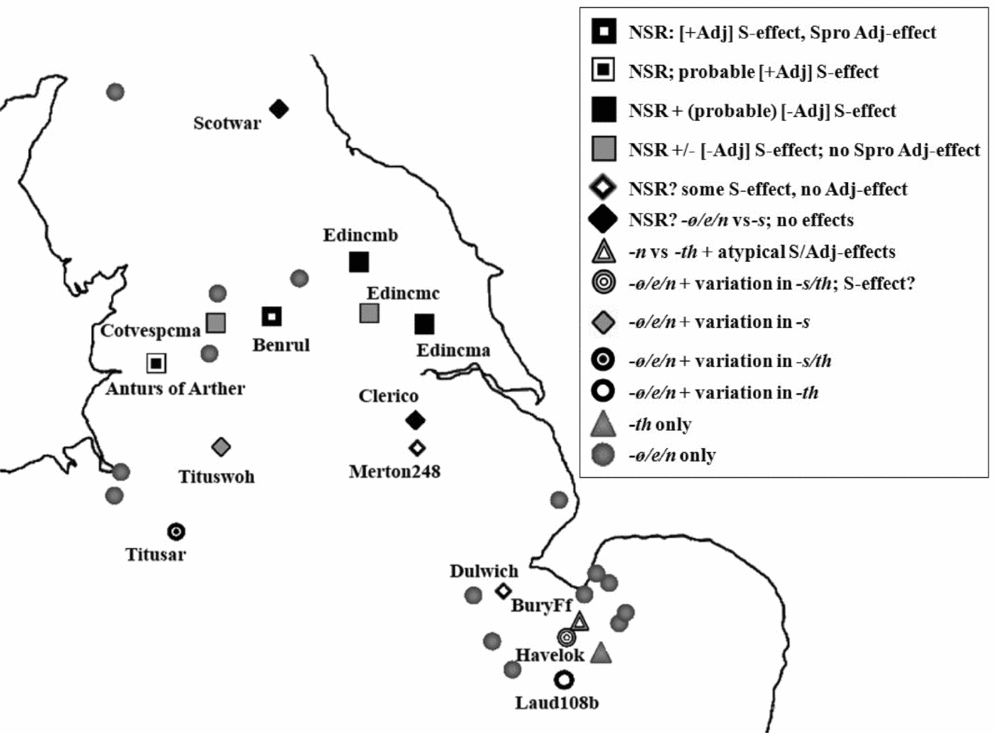
The map in figure 1 shows the locations of all 32 texts with relevant plural endings and their patterns of variation. The numbers in table 1 present clear evidence for the NSR: although the effects are not categorical for adjacent pronominal subjects, the counterexamples are erratic and number less than 1 per cent. Adjacent nominal subjects show more variation, with some subjects taking the -∅/e/n ending, and this is even categorical in the two texts from the Northwest Midlands, Þe Wohunge of Ure Lauerd (Tituswoh) and the Ancrene Riwle section from MS Cotton Titus D xviii, entry 1 (Titusar). table 2 shows that although in the non-adjacent cases there is more agreement variation, the subject effect is still robustly represented in many texts, again with Tituswoh and Titusar as notable exceptions.
Plural agreement patterns in the early Middle English corpus sample. ‘S-effect’ refers to a subject effect; ‘Adj-effect’ to an adjacency effect. [+Adj] is adjacent, [-Adj] is non-adjacent. Only texts with variation in endings have been named.
table 3 shows the results of the overall logistic regression analysis of the variation in endings in all 15 texts. Subject type is the strongest predictor for the type of plural marking: nominal subjects promote the use of -s/th with a factor weightFootnote 6 of .85, followed by adjacency (non-adjacency promotes -s/th with a factor weight of .74) and the interaction between the two, as pronominal subjects in non-adjacent contexts promote -s/th with a factor weight of .75. If we compare the results for the aggregate Northern data in table 4, we see that the effects are stronger in this subset of the data: although the effect of adjacency alone is similar, nominal subjects now promote -s/th with a factor weight of .93, and the interaction of pronominal subjects and non-adjacent contexts does so with a factor weight of .80. By comparison, the NSR effects are weak in the aggregate Midlands data shown in table 5. The data were too sparse to allow for a three-factor model here, but if subject type and adjacency are entered as possible factors, only subject type proves significant, with a factor weight of .69 for nominal subjects promoting -s/th. This shows that the NSR pattern is stronger in the Northern dialect texts than in the Midlands.
table 6 gives the statistical correlations between plural marking, the subject condition and the adjacency condition by text and dialect area, and thus shows a more fine-grained picture of variation per text. Combined with the graphical representation in figure 1, it shows that NSR-like patterns with -s are most strongly represented in the North, with a central area in Yorkshire and variant patterns fanning out to the south and north. There are very few extant texts from the far North. Competing patterns are generalized -n, found mostly in the East and Northwest Midlands, and variation with -th instead of -s, which is found mostly in the East Midlands. We will discuss these groups in turn.
The first two texts in table 6 have the most consistent NSR pattern: The Benedictine Rule or Benrul from Western Yorkshire (see example (2a) above) and The Anturs of Arther from Lancashire (the latter with variation between -s and -n as well as -∅/e; see (6). Footnote 7
(6)
East from this core group and next in table 6 are the dialects of the Edinburgh, Royal College of Physicians, MS of the Cursor Mundi, hands A, B and C (Edincma, Edincmb, Edincmc), which, beside regular NSR effects, show some evidence of a subject effect in non-adjacent contexts: they favour -∅/e endings with pronominal subjects even when they are not adjacent to the verb, as in (7).
(7)

The Edinburgh Cursor Mundi texts show that the subject condition is more robust in early Middle English NSR dialects than the adjacency effect. This suggests that the subject condition is the primary effect in the NSR pattern, and is more central than the adjacency effect. This tendency is shared by the Cotton Vespasian A.iii manuscript of the Cursor Mundi (Cotvespcma), which is from the same region and exhibits a highly significant subject effect (cf. example (2b) above) but no discernible adjacency effect. This may be due in part to the fact that the text sample has only 2 non-adjacent pronominal forms.
Other NSR-like dialects further away from the core area show the same tendency toward a subject effect without an adjacency effect, although we note that in some contexts low numbers of forms render the results somewhat uncertain. Probable or significant subject effects without an adjacency effect are found in three East Midland texts: Oxford, Merton College MS 248 (Merton248), London, Dulwich College MS XXII (Dulwich) and Havelok. Other texts which may be representative of NSR dialects but do not offer enough evidence for statistical analysis are A Ballad on the Scottish Wars (Scotwar) and Interludium de Clerico et Puella (Clerico), originating to the North and South of the core NSR area, respectively.
Several Midlands texts have general -n or -∅/e/n endings with some variation in -s, -th or both; these usually conform to the NSR conditions. Still, this pattern seems most strongly influenced by the general -en ending reported widely for Midlands dialects in Middle English (see Lass Reference Lass and Blake1992: 136–7; Mustanoja Reference Mustanoja1960: 481–2; Brunner Reference Brunner1962 II: 185, 188–9; Mossé Reference Mossé and Walker1952:76). Aside from its probable subject effect, the above-mentioned Havelok may be of this type, as well as two North-West Midlands texts: Þe Wohunge of Ure Lauerd (Tituswoh) and the Ancrene Riwle section from MS Cotton Titus D xviii, entry 1 (Titusar). The last text in table 3, the Debate between the Body and the Soul (MS Oxford, Bodleian Library, Laud Misc 108, entry 2) from the East Midlands (Laud108b) has a total of only 5 relevant plural forms (see tables 1 and 2). The majority of these have -n; the single -th form occurs with an adjacent NP subject. With numbers this low, it must remain a guess, but this may be a case of regular -n, with variant -th that is once again compatible with the NSR.
A more significant presence of -th endings in combination with -n can be found in the Bury documents (BuryFf), from the same region. Although the plural verb ending is consistently -n in adjacent pronominal contexts, there are very few of these in comparison to nominal and non-adjacent contexts (with variation between -n and -th), as in (8). This is probably why there is no subject effect in adjacency, nor an adjacency effect with pronoun subjects in this text, although there is some evidence for subject and adjacency effects in other contexts. Consequently, there is no clear evidence in this corpus for an NSR pattern with -th as found by McIntosh (Reference McIntosh, Grey and Stanley1983) for late Middle English, although such a pattern may already have existed in the dialect of the Bury documents scribe.
(8)
2.4 Discussion
The subject and adjacency effects associated with the NSR are represented most strongly in the heart of the Northern dialect area; the texts from the southern part of this area do not yield strong evidence for the presence of NSR patterns at this stage of the language. This supports the hypothesis that the NSR originated in the Northern dialect area. Clear evidence for NSR-type variation with -th is likewise absent in the early Middle English texts from the East Midlands, which is in line with McIntosh's (Reference McIntosh, Grey and Stanley1983) analysis of the NSR with -th as a late Middle English development.
The subject effect, which favours plural -∅/e/n over -s/th with pronoun subjects, emerges from our data as the core condition for NSR-type variation. In the early Middle English corpus, it is both stronger and more stable than the adjacency effect, in that it is present in more texts than the adjacency effect (especially where the NSR pattern dissipates to the south of its core area). Even in the core NSR area, moreover, a subject effect often occurs in non-adjacent contexts. This is in line with the fact that in Modern English varieties with NSR-type variation, the subject condition is attested much more widely than the adjacency condition (see McCafferty Reference McCafferty2004: 53; Pietsch Reference Pietsch2005a; Cole Reference Cole, Guzmán González and Fernández-Corugedo2009 for Northern English, Scots and Irish English varieties; see Montgomery Reference Montgomery, Fenton and MacDonald1994: 94; Wolfram & Schilling-Estes Reference Wolfram and Schilling-Estes1997; Godfrey & Tagliamonte Reference Godfrey and Tagliamonte1999 for North American varieties), and implies that the distinction between subject types is more essential to the NSR than the distinction between adjacency and non-adjacency.
3 Differential subject positions and the NSR
We saw in section 2 that the two syntactic conditions on the NSR are already present in the Northern texts in early Middle English; however, while the subject condition is quite stable across the early Northern Middle English texts, the adjacency condition is variable. In this section, we will relate the conditions on the NSR in Northern early Middle English to evidence for variation in subject positions that is attested more generally in Old and Middle English. The findings from our corpus of Northern texts show, contra Haeberli (Reference Haeberli2000) and Trips & Fuß (Reference Trips and Fuß2011), that the Northern Middle English texts in which the NSR is attested yield considerable independent evidence for differential subject positions. This is in line with the analysis of a clause structure with differential subject positions from Old English onward, until well into the early Modern period, in van Kemenade (Reference Kemenade, Pintzuk, Tsoulas and Warner2000), see also Haeberli (Reference Haeberli2000), and ties in with an analysis of NSR-like phenomena in Belfast English along the lines of Henry (Reference Henry1995) and in Appalachian English from Tortora & den Dikken (Reference Tortora and den Dikken2010). We will first summarize the general evidence for differential subject positions and their diagnostics in Old and Middle English, and then move on to discussing the evidence in the Northern Middle English texts.
3.1 Differential subject positions in Old and Middle English
There is a considerable body of evidence for differential subject positions in Old and Middle English generally, starting with van Kemenade (Reference Kemenade, Tieken-Boon van Ostade, Tottie and van der Wurff1999, Reference Kemenade, Pintzuk, Tsoulas and Warner2000) and Haeberli (Reference Haeberli2000). We start from the clause structure motivated in these works and given in (9), which we initially illustrate with examples of two types of main clause contexts in Old and Middle English, in which an adverb or secondary negator marks the distinction between two subject positions.
(9)
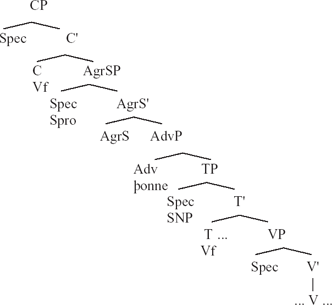
The first of these positions is exemplified in (10), which gives two main clause questions:
(10)
The questioned first constituent (Hu in (10a), Hu gerades in (10b)) is in SpecCP in (9). The finite verb is in C. In (10a), the pronominal subject (Spro) is in a higher position on the left of the diagnostic adverb þonne, which we here dub Spec,AgrSP, following Haeberli (Reference Haeberli2000). In (10b), the nominal subject (SNP) is in a subject position lower than the adverb, which we here dub Spec,TP.Footnote 8
A second context that testifies to this distribution of subjects is negated main clauses in Old English, when introduced by the negated finite verb and with na (or no) as the secondary clausal negator (see van Kemenade Reference Kemenade, Tieken-Boon van Ostade, Tottie and van der Wurff1999, Reference Kemenade, Pintzuk, Tsoulas and Warner2000, Reference Kemenade, Ingham and Larrivee2011). The secondary negator marks the distinction between the two subject positions. Two examples of Old English inverted negative clauses are given in (11).
(11)
table 7 gives figures for the distribution of pronominal and nominal subjects in Old English main clause questions such as those illustrated in (9), based on a full examination of the York Corpus of Old English (YCOE, Taylor et al. Reference Taylor, Warner, Pintzuk and Beths2003). table 8 gives figures for types of subject with respect to a secondary negator (see also van Kemenade Reference Kemenade, Ingham and Larrivee2011).
Order of subject and diagnostic adverb in main clause questions in Old English
Order of subject and secondary negator in negative-initial main clauses in Old English

The figures in tables 7–8 show that pronominal subjects in all but one case occur in the higher subject position Spec,AgrSP. The same facts show that the position of nominal subjects is variable. Van Kemenade & Los (Reference Kemenade, Los, van Kemenade and Bettelou2006), van Kemenade, Milicev & Baayen (Reference Baayen2008) and van Kemenade & Milicev (Reference Kemenade, Milicev, Jonas and Anderson2012) argue that the variable positioning of nominal subjects correlates with their discourse-referential status: nominal subjects that are discourse-given occur in the higher position, while the lower position is for subjects that are new or generic, or require focus.Footnote 9
3.2 Differential subject positions in Northern Middle English
Having considered the various types of evidence for diversified subject positions in early English generally, we now return to a discussion of Northern Middle English. Haeberli (Reference Haeberli2000), following up Kroch & Taylor (Reference Kroch, Taylor, Kemenade and Vincent1997), argues that the dialect of the Northern prose version of the rule of St Benet does not have differentiated subject positions like the other Middle English dialects: he finds no occurrences of a diagnostic adverb or secondary negator followed by a subject (nominal or pronominal) in this text. Note, however, that this conclusion is based on absence of evidence, i.e. there are no relevant examples, but there is no evidence against diversified subject positions either.Footnote 10 Trips & Fuß (Reference Trips and Fuß2011) in their proposed analysis of the NSR conclude from Haeberli's finding that there is no basis for an analysis of the NSR in terms of differentiated subject positions. We will reconsider this question by examining the Northern early Middle English texts in our corpus in the light of the type of evidence discussed in the previous section for Old and Middle English generally, and we will show that there is independent evidence for diversified subject positions in the North.
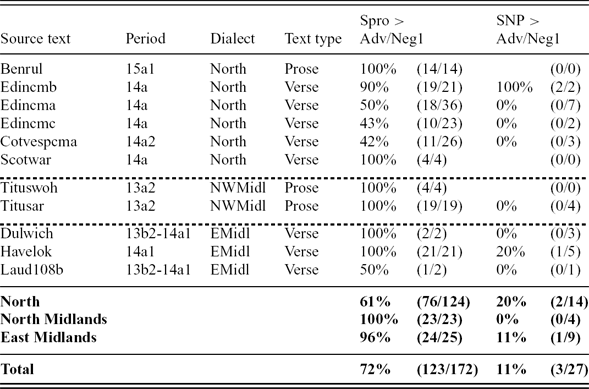
table 9 gives an overview of subject positions with respect to a diagnostic adverb or secondary negator.Footnote 11 Let us note first of all that table 9 shows up genuine differences between the Northern texts and those from the Northern Midlands. Admittedly, the pattern with nominal subjects has limited attestation, but the positional asymmetry between nominal and pronominal subjects with respect to the diagnostic adverb or secondary negator in the texts from the Northern Midlands is consistent with what we know about the pattern more generally, as discussed in section 3.1. This is true as well for nominal subjects in the texts from the North, except for Edincmb.
The position of Spro, SNP with respect to the adverbs now, then or secondary negator not (in Neg1P) in the eME corpus texts with variation in plural endings
What is more surprising, indeed puzzling, is the number of pronominal subjects following a diagnostic adverb or secondary negator in Edincma, Edincmb, Cotvespcma and Edincmc. This is unexpected in the light of the general patterning discussed in section 3.1, and it also runs counter to Haeberli's (Reference Haeberli2000) observation, based on Benrul, that all subjects always precede the diagnostic adverb or secondary negator. We will therefore first consider more closely those cases in the Northern texts in which a pronominal subject follows a diagnostic adverb or secondary negator, numbering 48 in all. It turns out that these represent an alternative word order pattern that is, as far as we are aware, not attested in other dialect areas: one in which the position of the adverb is altogether different. According to generally accepted diagnostics (following Pintzuk Reference Pintzuk1999), the finite verb is taken to be in C in the clause structure (9) if both nominal and pronominal subjects are inverted. In 40 of our 48 cases, however, the adverb precedes the finite verb as well. The data pool includes 40 cases with the following word order: first constituent - adverb - Vf - Spro. . .. As its position preceding the pronominal subject shows, the finite verb is in C in these cases, but nevertheless the adverb precedes the finite verb in the C-domain. The examples include 38 cases of topicalization, exemplified in (12a, b) and 2 questions, as in (12c):
(12)
What the examples in (12) first of all show is that the adverb must be somewhere in the C-domain, since it precedes the finite verb.Footnote 12 It seems, then, that in the dialects of these texts, there is an additional position for the adverb in the C-domain. This is seems to be akin to a similar alternation in questions in the present-day German dialects described in Bayer (Reference Bayer, Brugé, Cardinaletti, Giusti, Munaro and Poletto2012), Bayer & Obenauer (Reference Bayer and Obenauer2011), exemplified in (13a) from Bayer & Obenauer (Reference Bayer and Obenauer2011: 454) and (13b) from Bayer & Obenauer (Reference Bayer and Obenauer2011: 471).
(13)
Bayer & Obenauer (Reference Bayer and Obenauer2011) argue for an analysis of this alternation in which German adverbs such as denn, nur and schon (cf. denn in (13a)) are treated as discourse particles, usually occupying a fixed position that can be compared to the position between AgrSP and TP in (9). They analyse these particles as functional heads (labelled Prt) which have the special status of Minor Functional Heads (see Rothstein Reference Rothstein, Bouchard and Leffel1991) that do not count for the head movement constraint: they do not project their own categorial features. In a variant pattern, Prt may attract an emphatic XP over which it has scope to its left and form a constituent with it, which may subsequently move to SpecCP if it is a WH-phrase (see (13b)). We hypothesize that þan and nu in our examples (12) are structured in the same way, with the proviso that movement to Spec,CP is not restricted to questions as in (12c),Footnote 13 but also includes cases of topicalization as in (12a, b).
The special adverbial position in the CP-domain is also attested in non-subject-initial clauses where the finite verb is not in C (where the pronominal subject precedes the finite verb in 7 cases, all cases of topicalization). An example is given in (14):
(14)
We assume that here, too, the topic forms a constituent with the adverb/particle, and that they thus move to Spec,CP jointly.
This leaves one example unaccounted for, (15):
(15)

In this example, the adverb intervenes between the finite verb in C and the pronominal subject on its right. Our analysis cannot account for this one example, and we will treat it as exceptional.Footnote 14
We conclude that there is an independent account for the substantial number of cases in which, on the face of it, the pronominal subject follows a diagnostic adverb – we have shown that this constitutes a special context for which it can be demonstrated that the adverb is in an additional position characteristic of the dialect(s) of these texts, perhaps promoted by the metrical nature of the texts. Now that we have discussed the special status of these contexts, we return to consideration of the evidence for diversified subject positions.
The further figures for the Northern texts in table 9 show a picture of diversified subject positions that is by and large consistent with that of other dialects, except in a few texts which lack the data to show us the potential asymmetry (Benrul, Scotwar, Clerico), and in one text with only two examples of nominal subjects, both on the left of the diagnostic adverb (Edincmb). Pronominal subjects occur on the left of the diagnostic adverb or secondary negator in the higher subject position Spec,AgrSP, whereas nominal subjects have a preference for a position on its right. Some examples with diagnostic adverbs are given in (16)–(17):
(16)
(17)

Our data from the North thus warrant the conclusion that there is evidence for diversified subject positions in Northern Middle English. While the textual evidence is limited, careful study of it shows that, besides an interesting alternative pattern with adverbs in the C-domain, there is evidence in most Northern texts for a positional asymmetry between pronominal and nominal subjects with respect to a diagnostic adverb or secondary negator. This in turn shows that the clause structure of the Northern dialects is consistent with that of other dialects.
4 The rise of the NSR
In the previous sections we have established that two types of morphosyntactic conditions are relevant to the NSR. The first is the subject condition, according to which pronominal subjects strongly tend to favour -∅/e/n endings, while nominal subjects favour -s/th inflection. The second is the adjacency condition, which only allows -∅/e/n endings if a pronominal subject is immediately adjacent to the verb, and yields -s/th inflection elsewhere. Adjacency has a relatively strong effect in the core area for the NSR, but is more diffuse and erratic in the peripheral areas. We have also established that there is robust evidence for diversified subject positions in Northern Middle English texts.
Put together, these facts provide evidence for an analysis of the NSR in which -∅/e/n endings are a form of inflection reserved for a strictly defined context, namely with a (plural) personal pronoun subject (with our without adjacency condition), whereas -s/th endings occur elsewhere. It is plausible that the -∅/e/n endings represent plural agreement, whereas -s/th endings represent default present-tense inflection, which obtains whenever structural conditions on agreement are not met. Henry (Reference Henry1995) shows that in Belfast English, agreement with an adjacent pronominal subject correlates with a -∅ ending, whereas -s endings occur in all other contexts and represent something like default inflection. This third-person singular -s/-th ending is a common pattern for default inflection which is more widely attested throughout the history of English (see Visser Reference Visser1970: 71ff.). Agreement mismatches, for reasons that are poorly understood, seem to be more readily attested when subjects are in lower positions (see e.g. Mitchell Reference Mitchell1985: §1522; Allen Reference Allen1995: 72; Ingham & Grohmann Reference Ingham, Grohmann, Gotti, Dossena and Dury2008: 129). The core property which sets apart contexts with and without agreement in NSR dialects is the type of subject, and we have seen that this correlates with a positional distinction in older English: pronominal and nominal subjects occupy different positions. This syntactic distinction plausibly serves as the basis for the morphological difference in inflection, which is supported by the analysis of NSR-like phenomena in Belfast English and Appalachian English. Both in Belfast English (Henry Reference Henry1995) and in Appalachian English (Tortora & den Dikken Reference Tortora and den Dikken2010), word-order evidence shows that subject–verb agreement is restricted to contexts where the (pronominal) subject appears in Spec,AgrSP. Subjects in other positions do not trigger agreement in these varieties.
If our analysis is on the right track, Middle English NSR dialects have the same basic syntax as other varieties of older English, including differentiated subject positions. What makes NSR dialects different is their added condition on subject–verb agreement: that in the present indicative plural, it should obtain only with pronoun subjects. We hypothesize that, as in present-day Belfast English and Appalachian English, this is related to the structural configuration in which pronominal subjects occur, which is in the higher subject position Spec,AgrSP across the Old and Middle English dialects. This position is licensed by Spec–Head agreement with the functional head AgrS. This configuration obtains overtly when the finite verb is moved to and spelled out in AgrS. Assuming that verb movement leaves a copy in the source position of the verb, we follow Bobaljik's (Reference Bobaljik2002) proposal that the choice between spelling out the higher or lower copy of the verb is free at PF (and decided by factors outside the syntactic module). This provides a rationale for approaching the variability of the adjacency condition.
Subject–verb agreement between a pronominal subject in Spec,AgrSP and a finite verb spelled out in a lower position (the lower copy), for instance a head position below AgrS, such as T (as in (18a)), takes place through agreement with a copy of the verb which is covertly moved to AgrS. Northern Middle English varieties differ in whether subject–verb agreement is licensed only under surface adjacency or not: in the core NSR area, there is a condition on this type of agreement so that elements intervening between AgrS and the (spelled-out) finite verb effectively block agreement and default inflection appears instead (as in (18b)).
(18)

In the more peripheral areas, intervening elements do not block agreement, and the adjacency condition is not observed. An analysis in terms of differential positions for pronominal and nominal subjects thus facilitates an understanding of the NSR configuration.
The syntactic configuration of the NSR presumably provided the syntactic context for the rise of the NSR (and NSR-like patterns in other varieties of English), but it does not explain the morphological peculiarities of the NSR. A further key element in the rise of the NSR was the prior existence of variation between plural present-tense indicative -e/∅ and -s (or -th) in Northern Old English and/or early Middle English. As we saw in section 2.1, plural -s replaced -th in Northumbrian Old English. In addition, there were plural forms with pronominal subjects which ended in -e/∅. Unlike in other Old English dialects, -e/∅ not only occurred with first- and second-person plural pronouns immediately following the verb, but also with third-person pronouns and in non-inverted word order. Even though -e/∅ endings were not very frequent in this Old English dialect, they did have a wider range of use than in other dialects.
This extended range may have been a stage in a process of generalization: if the use of -e/∅ endings generalized from VS (ongete ge ‘do you understand’, see (3)) to SV order (woe ge geonge ‘we go’, see (5)), but not to non-adjacent contexts, this would have yielded the NSR pattern. The extensive morphological variation (between -s, -th and -e/∅) present in Old English may well have obscured the conditions of use of individual endings for speakers, paving the way towards a reanalysis of these conditions. This morphological variation, and confusion about its conditions, may well have been promoted by extensive language contact in Northumbrian Old English, with speakers of Brythonic Celtic (see Benskin Reference Benskin2011) as well as speakers of Old Norse. For a full discussion, see de Haas (Reference Haas2011).
Reanalysis of -e/∅ inflection as an effect of the presence of a pronominal subject would account for the subject condition.Footnote 15 Since the distinction between pronominal and nominal subjects was already robust in syntax, such a reanalysis would have fitted well with the Old / Middle English syntactic system.
We now turn to discussion of the rise of the adjacency condition. Non-adjacent contexts are robust in the early Middle English corpus: 328 out of 824 plural verb forms (39.8%) occur in this type of context. This represents a robust pattern, notwithstanding that it is a numerical minority. As such, it seems fair to assume that it occurred in sufficiently high frequencies in the input for language learners to analyse this syntactic pattern as a meaningful factor in the variations in verbal morphology that accompanied the likely confusion of conditions on the use of reduced (-∅/e) endings in late old English, especially among speakers of contact varieties. This is the context in which the adjacency condition likely arose, based on the newly innovated subject condition.
Verbal inflection occurring under adjacency to the subject could easily be interpreted as a corollary of the close relationship between subject and verb, but such a relationship would be less obvious in non-adjacency. As a result, when conditions on inflection shifted, speakers may or may not have assumed that the same condition on agreement would hold in non-adjacency as they found under adjacency, resulting in interspeaker (and interdialectal) variation. In addition, intradialectal variability in the application of the adjacency condition may also have resulted from such a paucity of evidence; this is predicted by models of acquisition (see Yang Reference Yang2002).Footnote 16
5 Conclusion
We have examined all the evidence for the NSR in early Middle English, showing that it was a robust pattern in the Northern and Northern Midlands dialects during this period. Variation between -∅/e/n and -s endings was conditioned by both subject type and adjacency in a core area around Yorkshire, whereas in more peripheral areas, the adjacency condition was weaker and often absent.
We have also examined the evidence for multiple subject positions in Northern Middle English. Our data show that it is robust, once an alternative pattern has been isolated. Bringing together these two lines of evidence, we have established an account of the rise of the NSR in which differential subject positions are crucial. Following the analyses of Henry (Reference Henry1995) and Tortora & den Dikken (Reference Tortora and den Dikken2010) for similar present-day phenomena, we have analysed plural -∅/e/n endings in the NSR as true agreement with AgrS and the pronominal subject in Spec,AgrSP, and -s (and later -th) endings as default present-tense inflection which obtains when the conditions on agreement are not met. This analysis may well be generalizable to present-day NSR dialects, but it also affords new insight in the origin of the phenomenon, which most likely arose when extensive variation in plural present-tense endings was reanalysed as the expression of a syntactic difference that was already there: differential subject positions.
Appendix A: Old and Middle English Texts
ÆHom. Ælfric's Homilies Supplemental. In James E Cross & Thomas D. Hill, 1982, he ‘Prose Solomon and Saturn’ and ‘Adrian and Ritheus’, 5–40. Toronto, Buffalo and London: University of Toronto Press.
ÆLS. Ælfric's Lives of Saints. In Walter William Skeat, 1966 (1881–1900), Ælfric's Lives of Saints. ETS 76, 82, 94, 114. London: Oxford University Press.
The Anturs of Arther at the Tarnewathelan. In John Robson (ed.), 1842, Three early English metrical romances, 1–26. London: Nichols. Date: MS C15, text C13? Localization: Lancashire. Word count: 5,763.
From LAEME (Laing, Margaret, and Roger Lass (2008–). A Linguistic Atlas of Early Middle English 1150–1325):Footnote 17
Arundel292vv. Manuscript: London, British Library, Arundel 292, entry 1. Date: C13b2–C14a1. Localization: W Norfolk. Word count: 325.
Ashmole360. Manuscript: Oxford, Bodleian Library, Ashmole 360, part VII. Text(s): Hand B.Date: C13b2. NW Norfolk. Word count: 83.
Bardney. Manuscript: Oxford, Bodleian Library, Rawlinson C 510. (c. 1270). Date: C13b1. Localization: Bardney, Central Lincs. Word count: 18.
Bestiary. Manuscript: London, British Library, Arundel 292, entry 2. b. Date: C13b2–C14a1. Localization: W Norfolk. Word count: 4102.
Bodley26. Manuscript: Oxford Bodleian Library, Bodley 26. Text(s): English in Hand D. Date: C13b2. Localization: E Lancs. Word count: 372.
BuryFf. Manuscript: Cambridge University Library Ff.II.33. Date: C13b2 (c. 1300). Localization: W Norfolk. Word count: 9468.
Candet3. Manuscript: Oxford, Bodleian Library, Digby 55. Date: C13b. Localization: SE Lincs. Word count: 118.
Clerico. Manuscript: London, British Library, Additional 23986 (roll). Date: c. 1300 (c. 1275–1300, OBMEV; c. 1300, D&W). Localization: NW Lincs. Word count: 529.
CotcleoBvi. Manuscript: London, British Library, Cotton Cleopatra B vi. Date: C13a2–b1 (1250, OBMEV). Localization: Yorkshire, West Riding. Word count: 370.
Cotfausta. Manuscript: London, British Library, Cotton Faustina A.v, entry 1. Hand A. Date: C14a. Localization: Fountains Abbey, Yorkshire, West Riding. Word count: 162.
Cotfaustb. Manuscript: London, British Library, Cotton Faustina A.v, entry 2. Hand B. Date: C14a. Localization: Fountains Abbey, Yorkshire, West Riding. Word count: 121.
Cotvespcma. Manuscript: London, British Library, Cotton Vespasian A.iii. Date: C14? Hand A. Localization: Yorkshire, West Riding. Word count: 10,364.
Culhh. MS Cambridge University Library Hh.6.11. Hand B. Date: C13. Localization: Ramsey, Hunts. Word count: 118.
Dulwich. Manuscript: London, Dulwich College MS XXII. Date: c.1300 (c.1300, MED Plan & Bibl, p. 40; 1250–1300, Wells). Localization: S Lincs. Word count: 3,296.
Edincma. Manuscript: Edinburgh, Royal College of Physicians, MS of Cursor Mundi, entry 1. Hand A. Date: C14a (Ker Med MSS 2, p. 40). Localization: Yorkshire, East Riding. Word count: 15,106.
Edincmb. Manuscript: Edinburgh, Royal College of Physicians, MS of Cursor Mundi, entry 2. Hand B. Date: C14a (Ker Med MSS 2, p. 40). Localization: Yorkshire, North Riding. Word count: 22,164.
Edincmc. Manuscript: Edinburgh, Royal College of Physicians, MS of Cursor Mundi, entry 3. Hand C. Date: C14a (Ker Med MSS 2, p. 40). Localization: York. Word count: 14,087.
Gandccreed. Manuscript: Cambridge, Gonville and Caius College 52/29. Date: C13. Language is perhaps of Ely or Norfolk. Word count: 183.
Genexod. Manuscript: Cambridge, Corpus Christi College 444. Date: C14a1 (a1325, MED Plan & Bibl, p. 42; ‘cent. XIV (near 1300)’ (James Reference James1912: 2, 357). Localization: W Norfolk. Word count: 12,467.
Gospatric. Manuscript: Carlisle, Cumbria RO, D/Lons/L Medieval Deeds C1. Date: *C13. Localization: Carlisle, Cumberland. Word count: 215.
Hale135. Manuscript: London, Lincoln's Inn Hale 135. Date: C13b2–C14a1 (c. 1300). Localization: N Lincs. Word count: 110.
Havelok. Manuscript: Oxford, Bodleian Library, Laud Misc 108, entry 3. Date: C14a1 (Smithers Reference Smithers1987: xii). Localization: W Norfolk. Word count: 17,089.
Lam499. Manuscript: London, Lambeth Palace Library 499. Date: C13b2 (written ‘almost certainly in the 1270s’ (Pickering Reference Pickering1992: 157)). Localization: Stanlaw Abbey, W Cheshire. Word count: 442.
Laud108b. Manuscript: Oxford, Bodleian Library, Laud Misc 108, entry 2. Hand B. Date: C13b2–C14a1 (c.1300, MED Plan & Bibl, pp. 73–4). Localization: Isle of Ely, Cambs. Word count: 3,025.
Merton248. Manuscript: Oxford, Merton College 248. Date: C14a2 (1330–40). Localization: NW Lincs. Word count: 2,298.
Orm. Manuscript: Oxford, Bodleian Library, Junius 1. Date: C12b2 (‘early in last quarter of the twelfth century’ (Parkes Reference Parkes, Stanley and Gray1983: 120–5)). Localization: Bourne, S Lincs. Word count: 11,504.
Petchron. Manuscript: Oxford, Bodleian Library, Laud Misc 636. Second or Final Continuation, 1132–1154. Date: C12b1 (c.1154). Localization: Peterborough, N Northants (Soke of Peterborough). Word count: 2,547.
Royal12e1a. Manuscript: London, British Library, Royal 12 E i, entry 1. Hand A. Date: C13b2–C14a1 (c.1300, OBMEV). Localization: Kings Lynn, NW Norfolk. Word count: 368.
Royal12e1b. Manuscript: London, British Library, Royal 12 E i, entry 2. Hand B. Date: C13b2–C14a1 (c.1300, OBMEV). Localization: Kings Lynn, NW Norfolk. Word count: 159.
Scotwar. Manuscript: London, British Library, Cotton Julius A v. Date: C14a. Localization: Lanchester, Co. Durham. Word count: 1,606.
Tanner169. Manuscript: Oxford, Bodleian Library, Tanner 169. Date: C13b1. Localization: Chester, Cheshire. Word count: 244.
TencmFf. Manuscript: Cambridge University Library Ff.VI.15. Date: C14a1. Localization: Louth Park, E Lincs. Word count: 58.
Titusar. Manuscript: London, British Library, Cotton Titus D xviii, entry 1. Date: C13a2 (1240–50). Localization: S Cheshire. Word count: 14,224.
Tituswoh. Manuscript: London, British Library, Cotton Titus D xviii, entry 5. Date: C13a2 (1240–50). Localization: NE Cheshire. Word count: 3,884.
Trin43B. Manuscript: Cambridge, Trinity College 43 (B.1.45), entry 2. Hand B. Date: C13b2 (probably 1284–9 (Dobson Reference Dobson1972: cxlvii and clx)). The text language is almost certainly of NW Norfolk or possibly of S Lincs. Word count: 98.
TrincleoD. Manuscript: Cambridge, Trinity College 43 (B.1.45), entry 1. Scribe D. Date: C13b1. Localization: W Norfolk. Word count: 1,898.
From PPCME2 (Kroch, Anthony and Ann Taylor (2000). The Penn–Helsinki Parsed Corpus of Middle English 2):
CMBenrul. The Northern prose version of the rule of St. Benet. In Ernst A. Kock (ed.), 1902, Three Middle-English versions of the rule of St. Benet and two contemporary rituals for the ordination of nuns, 1–47. London: EETS OS 120. Word count: 18,221.
CMMandev. Mandeville's travels. In Paul Hamelius (ed.), 1919–1923 (for 1916), Mandeville's travels, translated from the French of Jean D'Outremeuse. EETS O.S. 153, 154. Word count: 51,984.
CMPeterb. Peterborough chronicle. In Cecily Clark (ed.), 1970, The Peterborough chronicle 1070–1154, 2nd edn, 41–60. Oxford: Clarendon. Word count: 6,757.
CMWycser. Wycliffite sermons. In Anne Hudson (ed.), 1983, English Wycliffite sermons. Oxford: Clarendon. Word count: 57,067.
Appendix B: Detailed tables for variation in plural marking in the early Middle English corpus
Variation in verbal plural marking with pronominal subjects in adjacent contexts in early ME texts. Exceptions to the NSR are in boldface
Variation in verbal plural marking with nominal subjects in adjacent contexts in early ME texts. Exceptions to the NSR are in boldface
Variation in verbal plural marking with pronominal subjects in nonadjacent contexts in early ME texts. Exceptions to the NSR are in boldface
Variation in verbal plural marking with nominal subjects in nonadjacent contexts in early ME texts. Exceptions to the NSR are in boldface