1. Introduction
Advances in industrial automation [Reference Suthar, Abdulrahman and Zweiri1–Reference Faris, Alyammahi, Suthar, Muthusamy, Shah, Hussain and Zweiri3], medical assistance [Reference Chen, Zhu, He, Gao and Yao4, Reference Jha, Shukla, Mukherjee, Rathva, Joshi and Jain5], and special-service robotics [Reference Zahid, Abro and Alansari6, Reference Wang, Xu, Abu-Dakka, Kyrki, Yang, Li and Chen7] demand that dexterous hands, as end-effectors, possess high grasping capability, adaptability, and control precision. These have become critical metrics for overall system performance. In traditional robotic operation modes, the end-effector typically functions merely as a tool, with all compliant control relying solely on the manipulator body. When confronted with tasks that require sustained and stable contact force output, adaptation to dynamic interaction processes, unknown object parameters, or dexterous manipulation for object pose adjustment, these systems often exhibit limitations such as constrained force-tracking accuracy and weak environmental adaptability. This is primarily due to a mismatch in the manipulator’s dynamic model, a lack of environmental perception, and insufficient fingertip dexterity.
To address issues such as constrained accuracy during robotic tasks due to unknown environmental parameters, numerous researchers worldwide have conducted extensive studies on compliant control strategies. Chen [Reference Chen, Xu, Guo and Sheng8] proposed a variable admittance control (AC) method, which integrates the minimum-jerk model from motor science to extract velocity-curvature features for estimating indirect human intent and designing a guidance strategy. To achieve effective dynamic force tracking under time-varying end-effector trajectories, Pi [Reference Pi, Feng, Chen and Wu9] introduced an adaptive AC method that incorporates the dynamic interaction states between the end-effector and the environment. For applications demanding precise contact force in unknown environments, Liu [Reference Liu and Li10] proposed a smooth adaptive admittance controller. This controller generates a reference trajectory online and uses a feedforward PD loop to enhance robustness. Gao [Reference Gao, Wang, Li, Zhang, Du and Zhang11], addressing human–robot compatibility and collaborative control for lower-limb rehabilitation robots, first quantified and modeled human–robot interaction parameters and then designed an adaptive admittance dual-loop controller with RMSprop gain adjustment. Ye [Reference Ye, Yang, Jiang and Zhang12] presented a hybrid impedance-AC scheme for second-order unknown environments. Their method uses virtual inertia-impedance adaptation to derive an optimal target impedance model. Li [Reference Li, Xiong, Wang, Qu and Lou13] proposed an admittance controller that exploits the differentiability of collision contact force; it is formalized as a differential algebraic inclusion (DAI) with two interdependent set-valued loops. Jung [Reference Jung14] regulated the contact force indirectly in unknown environments by first modulating the impedance force through an admittance filter and then employing a position correction term. When confronting system modeling uncertainties and external unknown disturbances, other scholars have undertaken in-depth exploration to enhance the adaptability and robustness of AC. Researchers have integrated stability observers [Reference Shi, He, Wang, Stojanovic, Shi and Lv15, Reference Dao and Ahn16] for real-time disturbance compensation, fuzzy inference systems [Reference Toan and Khoi17, Reference Liu, Huang, Jia, Zhou and Li18] for adaptive rule construction, and neural networks [Reference Almaghout, Tarvirdizadeh, Alipour and Hadi19, Reference Wang, Lei and Zheng20] for learning-based adaptation. To varying degrees, these approaches improve the admittance controller’s tolerance to parameter uncertainties, unmodeled dynamics, and environmental variations, thereby enhancing force-tracking accuracy and stability in complex interactions.
Despite these advances, existing admittance-based compliant control strategies share a fundamental limitation: their force-tracking performance depends heavily on the accuracy of the environmental stiffness model. When grasping objects made of unknown or varying materials, the actual stiffness often deviates from the nominal value assumed in the controller design. Under such conditions, several methods estimate the environmental stiffness or position online and adapt the controller accordingly [Reference Liu and Li10, Reference Wang, Chen, Wang, Ying, Li and Yang21]. However, these approaches introduce additional complexity and remain sensitive to estimation accuracy; when the material properties are imprecisely known or change abruptly, the controller must be retuned, limiting its practicality in unstructured grasping tasks.
An alternative philosophy is to make the admittance dynamics inherently robust to parameter uncertainties, thereby eliminating the need for explicit stiffness identification or controller re-tuning. Sliding mode control (SMC) [Reference Chen, Jin, Shao, Wang, He, Stojanovic and Wang22–Reference Gao, Ma, Zhang and Zhou24] offers precisely this capability—it can force the system state to remain on a prescribed sliding surface regardless of bounded parameter variations. Meanwhile, an extended state observer (ESO) can estimate and compensate for unmodeled dynamics and measurement noise in real time. However, the integration of SMC and ESO within the AC framework, specifically for force tracking in unknown environments, has not been systematically investigated.
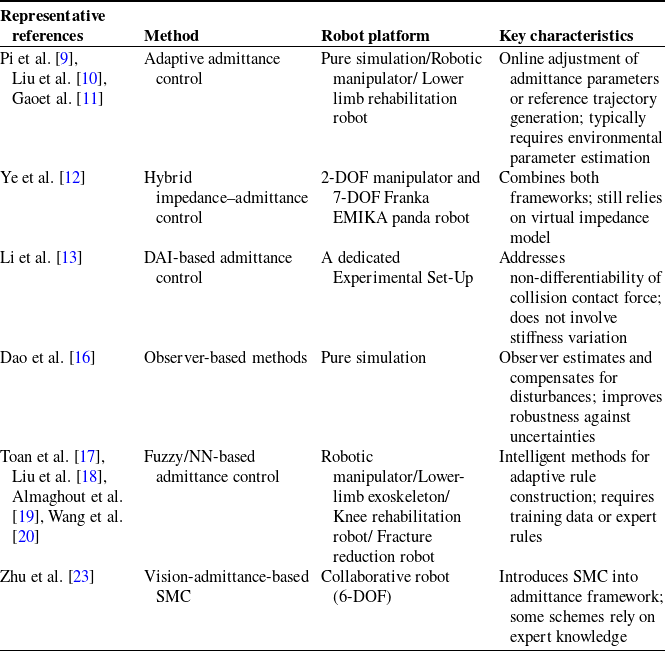
To clarify the positioning of our work, Table I categorizes representative compliant control strategies, summarizes their key characteristics, and identifies the robot platform on which each method is implemented. This comparison reveals two gaps in the existing literature. First, from an architectural perspective, the vast majority of admittance-based controllers are deployed on robotic manipulators or collaborative robots, where the end-effector functions as a passive follower of the manipulator’s motion. In contrast, we directly integrate AC into the dexterous end-effector, enabling the fingertips to actively regulate contact forces independently of the manipulator. Second, from a methodological perspective, most existing methods require either environmental parameter estimation or some form of prior knowledge. As a result, their force-tracking performance degrades when the object material is unknown or varies, limiting their practicality in grasping tasks.
To overcome these limitations, this paper proposes an ESO-based sliding mode admittance control (ESOSMCAC) strategy for the ODH grasping objects with unknown stiffness. The proposed method differs fundamentally from prior ESO-based admittance controllers in two respects. First, unlike approaches that use an ESO to estimate environmental parameters for controller adaptation, our ESO is tasked with estimating the noise in the force error derivative. This enables the reconstruction of a smooth sliding surface, effectively suppressing the chattering that would otherwise arise from direct numerical differentiation of noisy force signals. Second, rather than placing SMC in the inner position or force control loop, we embed the sliding mode control (SMC) term directly into the virtual admittance model. This structurally modifies the admittance dynamics such that the force-tracking performance becomes insensitive to variations in object stiffness, obviating the need for stiffness identification or per-object parameter tuning. A continuous SMC law, designed via Lyapunov stability theory, guarantees stable convergence and smooth force tracking.
Comparison of representative compliant control strategies in terms of control method, robot platform, and key characteristics.

Table I. Long description
Table I summarizes compliant control strategies from representative references, comparing control method, robot platform and key characteristics.Row 1: Pi et al., Liu et al., Gao et al. – adaptive admittance control; platforms: pure simulation, robotic manipulator, lower-limb rehabilitation robot; online admittance-parameter adjustment or reference-trajectory generation, requiring environmental-parameter estimation.Row 2: Ye et al. – hybrid impedance-admittance control; platforms: 2-DOF manipulator, 7-DOF Franka EMIKA panda robot; combines two frameworks yet relies on virtual impedance model.Row 3: Li et al. – DAI-based admittance control; platform: dedicated experimental set-up; addresses non-differentiability of collision contact force without stiffness-variation consideration.Row 4: Dao et al. – observer-based methods; platform: pure simulation; observer estimates and compensates disturbances to improve robustness against uncertainties.Row 5: Toan et al., Liu et al., Almaghout et al., Wang et al. – fuzzy-/NN-based admittance control; platforms: robotic manipulator, lower-limb exoskeleton, knee rehabilitation robot, fracture-reduction robot; intelligent adaptive-rule construction requiring training data or expert rules.Row 6: Zhu et al. – vision-admittance-based SMC; platform: 6-DOF collaborative robot; embeds SMC into admittance framework; some schemes depend on expert knowledge.
This paper is organized as follows: Section 2 describes the ODH mechanical structure, establishes its kinematic model, and analyzes its workspace as well as the range of graspable objects; Section 3 presents the ESOSMCAC strategy and provides theoretical stability analysis; Section 4 reports simulation and experimental results; and Section 5 concludes the study.
2. System model
2.1. Structure of the ODH
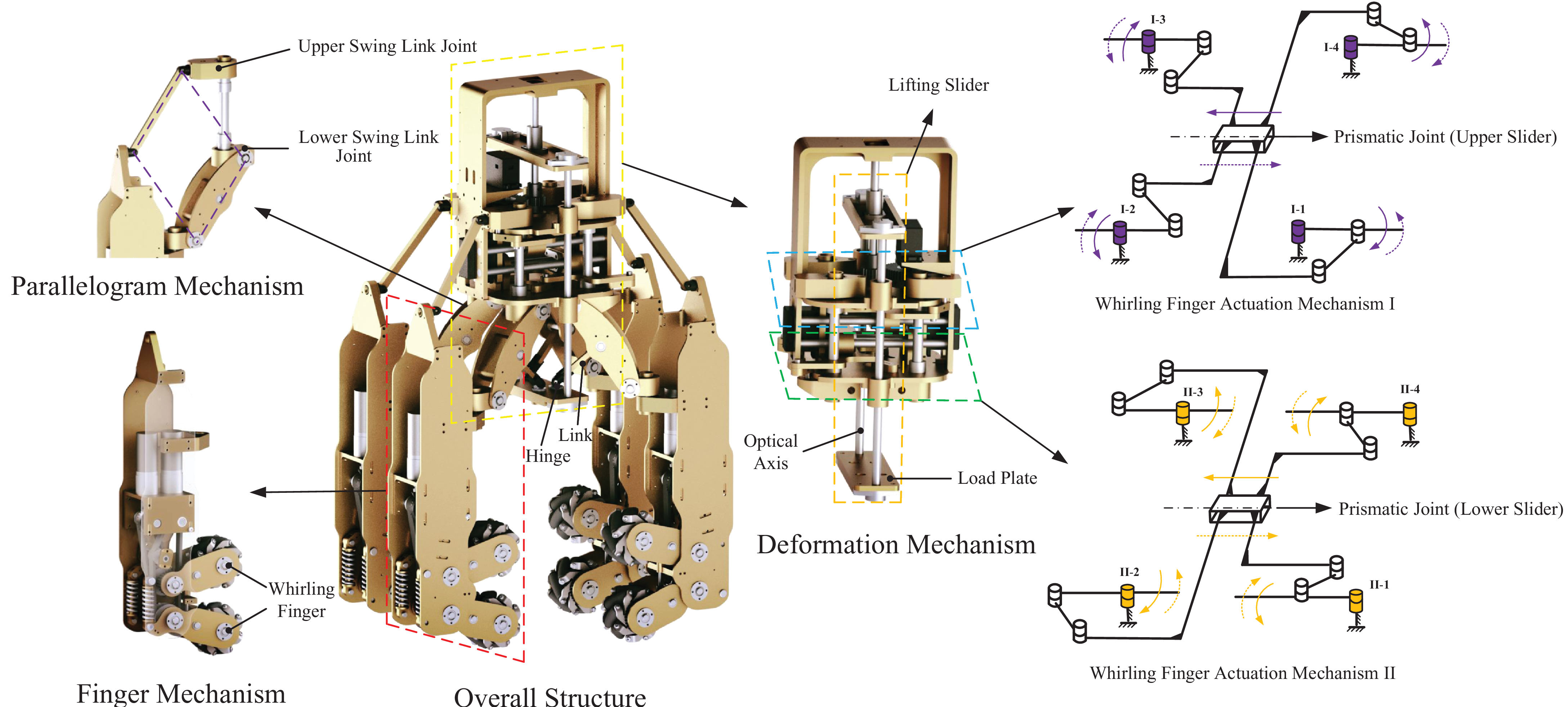
The ODH, as illustrated in Figure 1, comprises a deformation mechanism, a parallelogram mechanism, and four finger mechanisms. The deformation structure comprises an upper slider, a lower slider, and a lifting slider. Each slider has its own servo motor, which directly drives the rotation of the upper swing link joints I-(1-4) and the lower swing link joints II-(1-4), respectively. This motion transmits through the parallelogram mechanism to synchronously adjust the posture and position of all four fingers, allowing the hand to adapt to objects of various shapes. The lifting slider includes an optical axis and a load plate. A dedicated servo motor drives the optical axis to raise or lower the load plate. This action, transmitted through hinged connections, lifts or flattens four connecting rods, thereby executing the hand’s grasping and releasing motions. Each finger mechanism incorporates two whirling fingers with swing-rotation joints, designed for force-closure grasping of objects. Each whirling finger is equipped with an actively driven Mecanum wheel. Utilizing the friction generated between the object and the Mecanum wheel, the system achieves assisted grasping and in-hand posture adjustment of the object.
Model and partial kinematic diagram of the ODH.

Compared with conventional multifingered hands with fixed fingertips, the omnidirectional wheel design provides a unique capability: active in-hand manipulation without regrasping. When the fingertips are in contact with a grasped object, the omnidirectional wheels can drive the object to rotate continuously about the grasping axis or translate within the grasp, without releasing or reconfiguring the fingers. In contrast, conventional multifingered hands with fixed fingertips must sequentially release and reposition their fingers to rotate an object (regrasping); this process interrupts force continuity and introduces the risk of dropping the object. This capability of the ODH is essential for tasks such as workpiece reorientation for assembly, surface inspection requiring continuous rotation, and precision positioning in confined spaces where arm mobility is limited. Although the wheel mechanism increases the hand’s weight and mechanical complexity compared with fixed-fingertip designs, this trade-off is justified in applications where uninterrupted force control during in-hand manipulation is the primary requirement.
2.2. Forward kinematic model
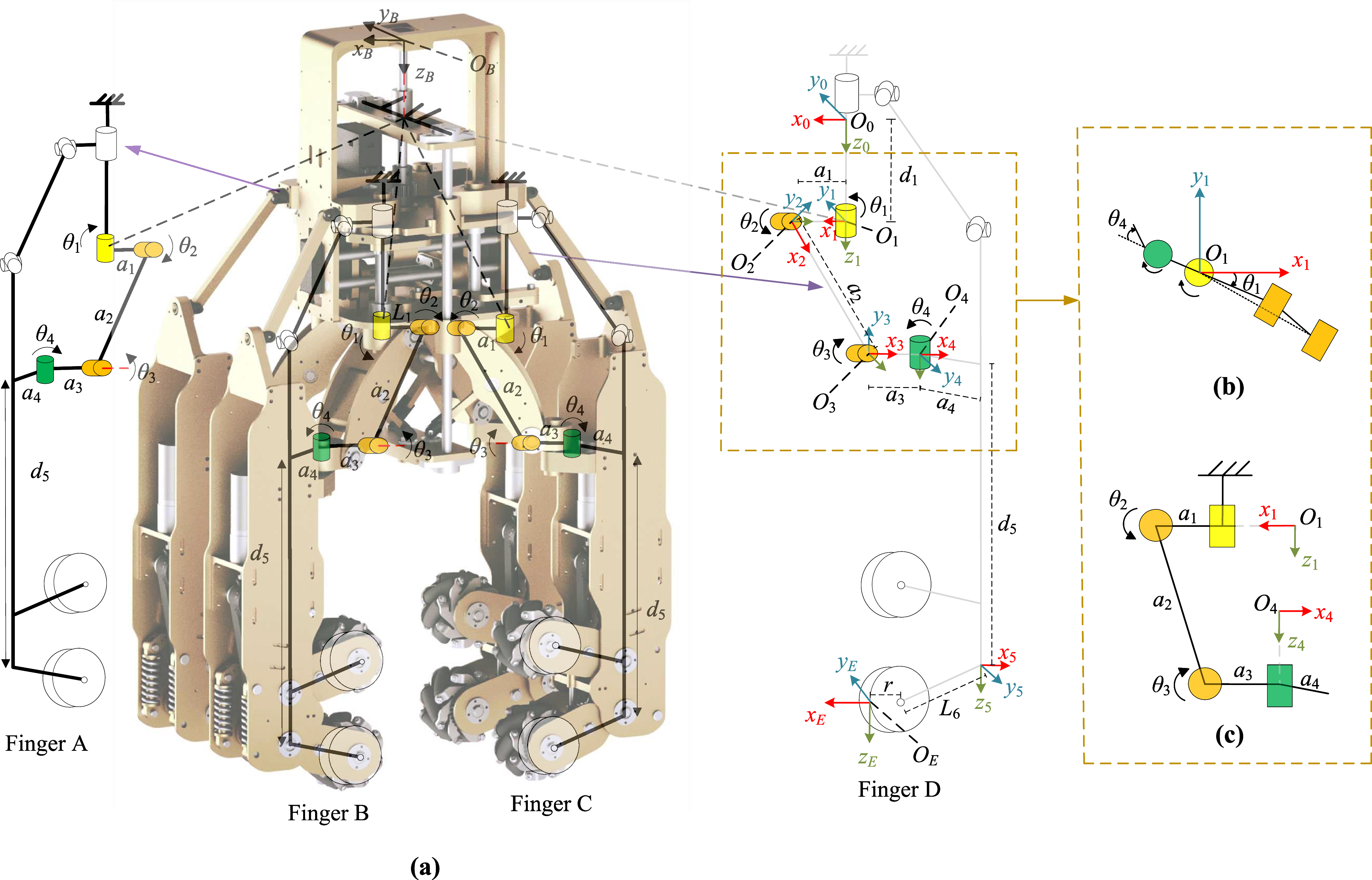
In performing the kinematic analysis of the ODH, we use the modified Denavit–Hartenberg (M-D-H) method [Reference Khalil and Kleinfinger25] for kinematic modeling. This method fixes the link coordinate system at the proximal end of each link. Since all four fingers are identical, we use Finger D to illustrate the forward kinematic model. Figure 2(a) establishes the coordinate system, with the base frame denoted as O B -x B y B z B . The motion of the lifting slider in Figure 1 can be equivalently described as the combined action of rotary joint 2 and rotary joint 3, with both joint angles undergoing an identical amount of change.
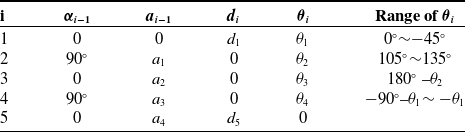
Parameters of the M-D-H method.

Table II. Long description
This table presents the Modified Denavit-Hartenberg (M-D-H) parameters for a five-joint mechanism. The columns are: i (joint number), α(i-1) (link twist angle), a(i-1) (link length), d_i (link offset), θ_i (joint angle), and Range of θ_i (range of joint angle).Joint 1: α(i-1) = 0, a(i-1) = 0, di = d1, θi = θ1, range of θ1 is 0° to -45°.Joint 2: α(i-1) = 90°, a(i-1) = a1, di = 0, θi = θ2, range of θ2 is 105° to 135°.Joint 3: α(i-1) = 0, a(i-1) = a2, di = 0, θi = θ3, range of θ3 is 180° - θ2.Joint 4: α(i-1) = 90°, a(i-1) = a3, di = 0, θi = θ4, range of θ4 is -90° - θ1 to -θ1.Joint 5: α(i-1) = 0, a(i-1) = a4, di = d5, θi = 0. The range of θi for joint 5 is not specified in the table.
(a) Coordinate system of the omnidirectional dexterous hand; (b) position of coordinate system O4-x4y4z4 in the x1-O1-z1 plane; (c) position of coordinate system O4-x4y4z4 in the x1-O1-y1 plane.

Figure 2. Long description
Subfigure (a) shows the global coordinate frames of the omnidirectional dexterous hand. Coordinate frames for the four fingers are labelled for forward-kinematics modelling. Each finger is annotated with Denavit-Hartenberg parameters a1,a2,a3,a4, link offset d5, and revolute joint angles θ1,θ2,θ3,θ4. The base frame OB(xB,yB,zB) is defined at the gripper base. For Finger D, the global base frame O0, intermediate frames O1,O2,O3,O4, and end-effector frame OE are plotted. Subfigure (b) presents the position of frame O4-x4y4z4 within the x1-O1-z1 plane. Subfigure (c) presents the position of frame O4-x4y4z4 within the x1-O1-y1 plane.
Based on the coordinate system established in Figure 2 and following the M-D-H modeling method, the parameter values for each link were determined, and the corresponding M-D-H parameter table is presented in Table II. In the table,
 $i$
denotes the joint number;
 $\alpha _{i-1}$
represents the rotation angle about axis
 $x_{i-1}$
that aligns axis
 $z_{i-1}$
with axis
 $z_{i}$
;
 $a_{i-1}$
indicates the displacement along axis
 $x_{i-1}$
from axis
 $z_{i-1}$
to axis
 $z_{i}$
;
 $\theta _{i}$
is the rotation angle about axis
 $z_{i}$
that brings axis
 $x_{i-1}$
parallel to axis
 $x_{i}$
; and
 $d_{i}$
denotes the displacement along axis
 $z_{i}$
from axis
 $x_{i-1}$
to axis
 $x_{i}$
.
According to the relationships defined above, the transformation matrix from coordinate system {i−1} to coordinate system {i} can be expressed as:
 \begin{equation}{i}^{\boldsymbol{i}-\mathbf{1}}{\boldsymbol{T}}{}=Rot(x,\alpha _{i-1})\cdot \textit{Trans}(\alpha _{i-1},0,0)\cdot Rot(z,\theta _{i})\cdot \textit{Trans}(0,0,d_{i})\end{equation}
By multiplying the four matrices in Eq. (1), the general form of the transformation matrix
 ${i}^{\boldsymbol{i}-\mathbf{1}}{\boldsymbol{T}}{}$
can be obtained as follows:
 \begin{equation}{i}^{\boldsymbol{i}-\mathbf{1}}{\boldsymbol{T}}{}=\left[\begin{array}{cccc} c\theta _{i} &\quad -s\theta _{i} &\quad 0 &\quad a_{i-1}\\[2pt] s\theta _{i}c\alpha _{i-1} &\quad c\theta _{i}c\alpha _{i-1} &\quad -s\alpha _{i-1} &\quad -s\alpha _{i-1}d_{i}\\[2pt] s\theta _{i}s\alpha _{i-1} &\quad c\theta _{i}s\alpha _{i-1} &\quad c\alpha _{i-1} &\quad c\alpha _{i-1}d_{i}\\[2pt] 0 &\quad 0 &\quad 0 &\quad 1 \end{array}\right]\end{equation}
where
 $c\theta _{i},s\theta _{i},c\alpha _{i-1}$
and
 $s\alpha _{i-1}$
denote
 $\cos \theta _{i},\sin \theta _{i}, \cos \alpha _{i-1}$
and
 $\sin \alpha _{i-1}$
, respectively.
Based on Eq. (2) and the parameters corresponding to each link coordinate system listed in Table II, the homogeneous transformation matrices between adjacent joint coordinate systems for Finger D are derived as
 ${}_{1}^{0}{\boldsymbol{T}}{},{}_{2}^{1}{\boldsymbol{T}}{},{}_{3}^{2}{\boldsymbol{T}}{},{}_{4}^{3}{\boldsymbol{T}}{},{}_{5}^{4}{\boldsymbol{T}}{}$
. Consequently, the forward kinematic model of the dexterous hand is obtained as follows:
 \begin{equation}{}_{E}^{B}{\boldsymbol{T}}{}={}_{0}^{B}{\boldsymbol{T}}{}\cdot {}_{1}^{0}{\boldsymbol{T}}{}\cdot {}_{2}^{1}{\boldsymbol{T}}{}\cdot {}_{3}^{2}{\boldsymbol{T}}{}\cdot {}_{4}^{3}{\boldsymbol{T}}{}\cdot {}_{5}^{4}{\boldsymbol{T}}{}\cdot {}_{E}^{5}{\boldsymbol{T}}{}\end{equation}
where
 ${}_{0}^{B}{\boldsymbol{T}}{}$
represents the pose transformation matrix from coordinate system O
B
-x
B
y
B
z
B
to the base coordinate system O
B
-x
B
y
B
z
B
, and
 ${}_{E}^{5}{\boldsymbol{T}}{}$
denotes the pose transformation matrix from coordinate system O
E
-x
E
y
E
z
E
to the base coordinate system O
5-x
5
y
5
z
5.
2.3. Inverse kinematic model
Solving the inverse kinematics is a prerequisite for dexterous hand control, aiming to determine all joint angles based on the desired fingertip pose. We derive the inverse kinematic model using Finger D. To simplify the analysis, we introduce the coordinate system O 4-x 4 y 4 z 4 at Joint 4 as an intermediate reference frame. Consequently, the forward kinematic model can be reformulated as follows:
 \begin{equation}{}_{E}^{B}{\boldsymbol{T}}{}={}_{1}^{B}{\boldsymbol{T}}{}\cdot {}_{4}^{1}{\boldsymbol{T}}{}\cdot {}_{E}^{4}{\boldsymbol{T}}{}\end{equation}
where
 ${}_{1}^{B}{\boldsymbol{T}}{}$
denotes the homogeneous transformation matrix from coordinate system O
1-x
1
y
1
z
1 to the base coordinate system O
B
-x
B
y
B
z
B
.
 ${}_{4}^{1}{\boldsymbol{T}}{}$
represents the homogeneous transformation matrix from coordinate system O
4-x
4
y
4
z
4 to coordinate system O
1-x
1
y
1
z
1, and
 ${}_{E}^{4}{\boldsymbol{T}}{}$
is the homogeneous transformation matrix from the fingertip coordinate system O
E
-x
E
y
E
z
E
to coordinate system O
4-x
4
y
4
z
4.
Let the fingertip pose of Finger D be given by:
 \begin{equation}{}_{E}^{B}{\boldsymbol{T}}{}=\left[\begin{array}{cccc} n_{x} &\quad o_{x} &\quad a_{x} &\quad p_{x}\\[3pt] n_{y} &\quad o_{y} &\quad a_{y} &\quad p_{y}\\[3pt] n_{z} &\quad o_{z} &\quad a_{z} &\quad p_{z}\\[3pt] 0 &\quad 0 &\quad 0 &\quad 1 \end{array}\right]\end{equation}
From Eq. (4), it follows that:
 \begin{equation}{}_{4}^{1}{\boldsymbol{T}}{}={}_{1}^{B}{\boldsymbol{T}}{}^{-\mathbf{1}}\cdot {}_{E}^{B}{\boldsymbol{T}}{}\cdot {}_{E}^{4}{\boldsymbol{T}}{}^{-\mathbf{1}}=\left[\begin{array}{cccc} {n}_{x}^{\left(4\right)} &\quad {o}_{x}^{\left(4\right)} &\quad {a}_{x}^{\left(4\right)} &\quad {p}_{x}^{\left(4\right)}\\[3pt] {n}_{y}^{\left(4\right)} &\quad {o}_{y}^{\left(4\right)} &\quad {a}_{y}^{\left(4\right)} &\quad {p}_{y}^{\left(4\right)}\\[3pt] {n}_{z}^{\left(4\right)} &\quad {o}_{z}^{\left(4\right)} &\quad {a}_{z}^{\left(4\right)} &\quad {p}_{z}^{\left(4\right)}\\[3pt] 0 &\quad 0 &\quad 0 &\quad 1 \end{array}\right]\end{equation}
The coordinate system O 4-x 4 y 4 z 4 of Finger D in Figure 2(a) is analyzed in the x 1-O 1-z 1 plane and the x 1-O 1-y 1 plane, respectively. The resulting geometric relationships are shown in Figure 2(b) and (c). Based on the joint angles and link-length parameters indicated in Figure 2(b), the following can be derived:
 \begin{align} p_{x1}=L_{1}+L_{2}\mathit{\cos } \left(\theta _{20}+\theta _{2}\right)+L_{3}\mathit{\cos } \left(\theta _{20}+\theta _{2}+\theta _{3}\right) \\[-8pt] \nonumber \end{align}
 \begin{align} p_{z1}=L_{2}\sin \left(\theta _{20}+\theta _{2}\right)+L_{3}\sin \left(\theta _{20}+\theta _{2}+\theta _{3}\right) \\[10pt] \nonumber \end{align}
where
 $p_{x1}$
and
 $p_{z1}$
represent the projected coordinates of O
4 along the x
1-axis and z
1-axis, respectively, within the x
1-O
1-z
1 plane of the coordinate system O
1-x
1
y
1
z
1.
According to the joint angles and link-length parameters illustrated in Figure 2(c), the following can be obtained:
 \begin{align}{p}_{x}^{\left(4\right)}=p_{x1}\cos \theta _{1}-L_{4}\cos \left(\theta _{1}+\theta _{4}\right) \\[-8pt] \nonumber \end{align}
 \begin{align}{p}_{y}^{\left(4\right)}=p_{x1}\sin \theta _{1}-L_{4}\sin \left(\theta _{1}+\theta _{4}\right) \\[-8pt] \nonumber \end{align}
 \begin{align}{p}_{z}^{\left(4\right)}=L_{2}\sin \left(\theta _{20}+\theta _{2}\right)\qquad \\[10pt] \nonumber \end{align}
Combining Eq. (11) with the angular range of
 $\theta _{2}$
, and given that the variations of
 $\theta _{2}$
and
 $\theta _{3}$
are equal,
 $\theta _{2}$
and
 $\theta _{3}$
can be solved as:
 \begin{equation}\theta _{3}=\theta _{2}=\pi -\theta _{20}-\sin ^{-1} \left(\frac{{p}_{z}^{\left(4\right)}}{L_{2}}\right)\end{equation}
To solve for
 $\theta _{1}$
and
 $\theta _{4}$
, let
 $a=L_{1}+L_{2}\cos (\theta _{20}+\theta _{2})-L_{3}$
. Squaring Eqs. (9) and (10), summing them, and simplifying yields the following expressions for
 $\theta _{1}$
and
 $\theta _{4}$
:
 \begin{align}\theta _{1}=\varphi \pm \cos ^{-1} \left(\frac{a^{2}-{L_{4}}^{2}+\left({p}_{x}^{\left(4\right)}\right)^{2}+\left({p}_{y}^{\left(4\right)}\right)^{2}}{2aR}\right) \\[-8pt] \nonumber \end{align}
 \begin{align} \theta _{4}=\tan ^{-1} \left(\frac{a\sin \theta _{1}-{p}_{y}^{\left(4\right)}}{a\cos \theta _{1}-{p}_{x}^{\left(4\right)}}\right)-\theta _{1}\qquad \\[10pt] \nonumber \end{align}
where
 $R=\sqrt{({p}_{x}^{(4)})^{2}+({p}_{y}^{(4)})^{2}}$
,
 $\varphi =\tan ^{-1} \dfrac{{p}_{y}^{\left(4\right)}}{{p}_{x}^{\left(4\right)}}$
.
2.4. Workspace analysis
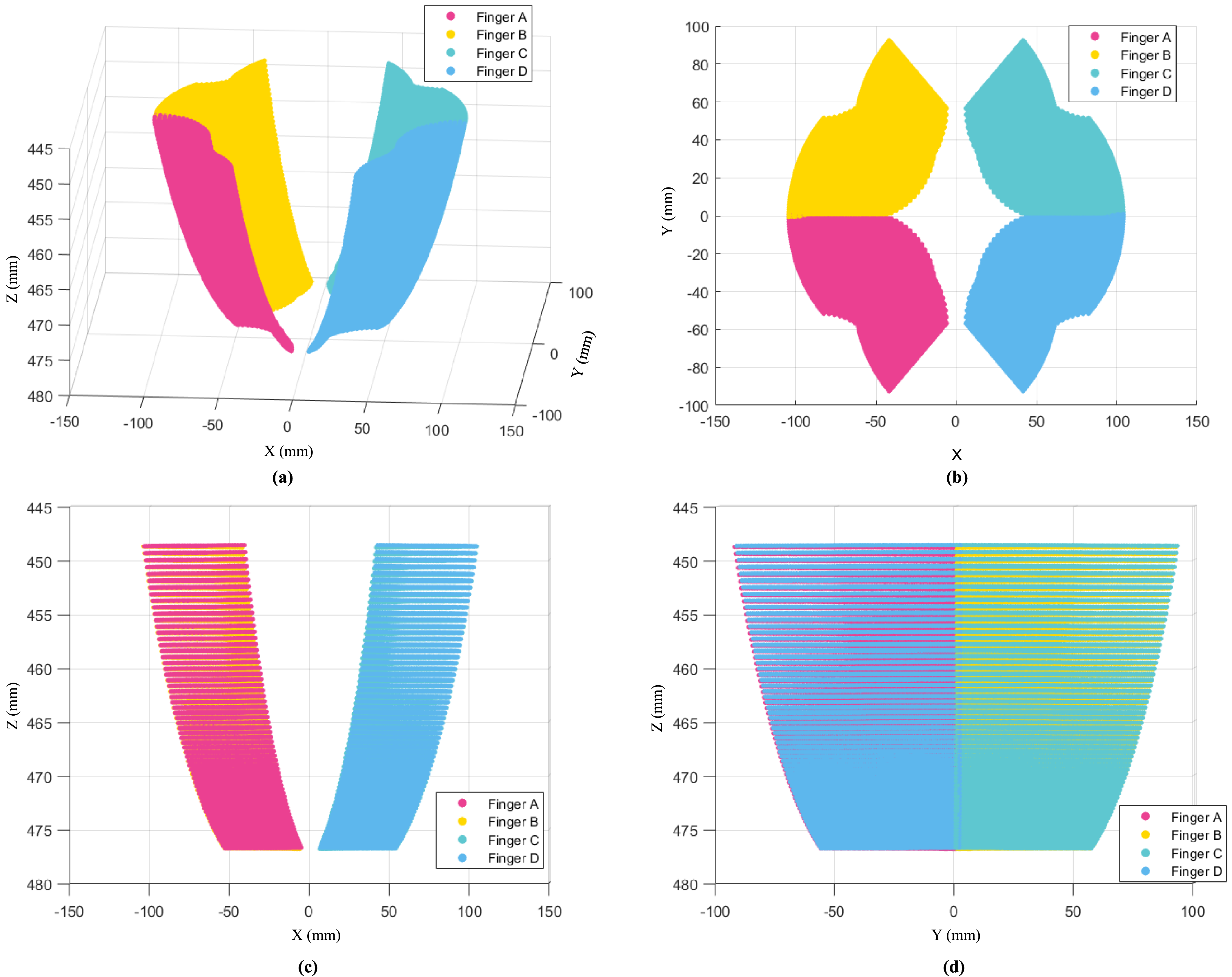
The workspace serves as a critical metric for evaluating the dexterous hand’s operational capability. It defines the set of all positions that the ODH fingertip can reach in space and can be dynamically adjusted through the deformation structure to achieve different grasping postures.
Based on the forward kinematic model established in Section 2.2 and the joint parameters listed in Table II, this section constructs the workspace of the dexterous hand by iterating over the feasible joint angles. The resulting spatial ranges in three dimensions as well as in each principal plane are illustrated in Figure 3.
(a) Three-dimensional workspace; (b) projection on the X-O-Y plane; (c) projection on the X-O-Z plane; (d) projection on the Y-O-Z plane.

Figure 3. Long description
This figure contains four sub-figures visualising the reachable workspace of the four fingers of the omnidirectional dexterous hand. Finger A is plotted in magenta, Finger B in yellow, Finger C in cyan, and Finger D in blue. All axes are measured in millimetres.Subfigure (a): 3-D view of segmented workspace volumes for all four fingers within X, Y, Z Cartesian space.Subfigure (b): 2-D X-Y planar projection of the workspace envelopes.Subfigure (c): 2-D X-Z planar projection of the workspace envelopes.Subfigure (d): 2-D Y-Z planar projection of the workspace envelopes.Each coloured region represents the spatial reachable area of the corresponding finger.
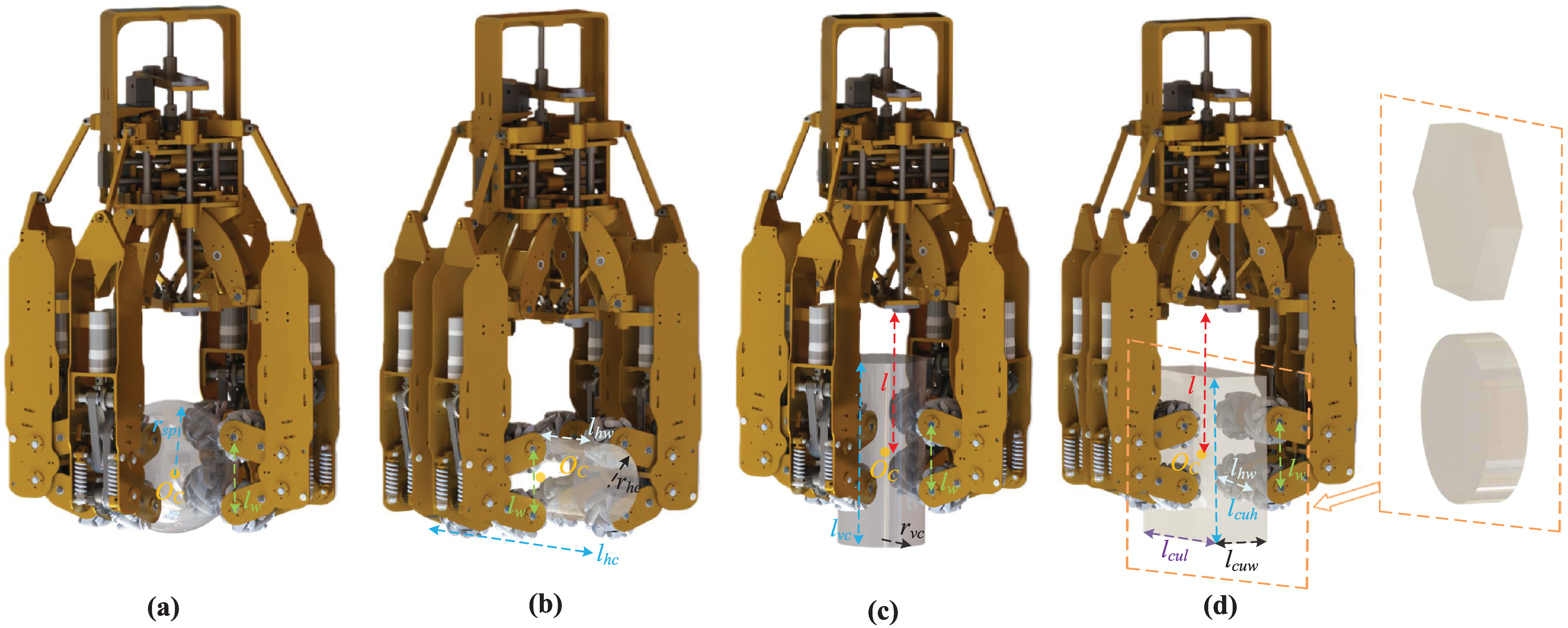
Several typical grasping postures are presented for handling objects such as a sphere, a laterally placed cylinder, a vertically placed cylinder, and a cuboid (or planar object), as shown in Figure 4. In Figure 4, l denotes the vertical distance between the object center (O C ) and the lowest point of the load plate; l w represents the longitudinal spacing between the wheels; l hw indicates the lateral spacing between the wheels. r vc and l vc are the radius and length of the vertical cylinder, respectively; r sp is the radius of the sphere; r hc and l hc are the radius and length of the horizontal cylinder, respectively. l cul , l cuw , and l cuh correspond to the length, width, and height of the cuboid, respectively.
Postures of the ODH grasping: (a) a sphere, (b) a horizontally oriented cylinder, (c) a vertically oriented cylinder, and (d) a cuboid (or a planar object).

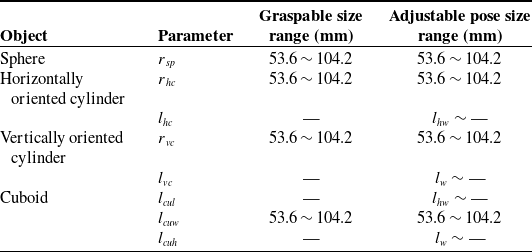
Based on the analysis of the ODH’s workspace, combined with its geometric characteristics and dimensional boundaries, the allowable size ranges for grasping and pose adjustment are evaluated for the aforementioned objects, as summarized in Table III. This provides a theoretical foundation and geometric constraints for subsequent control-strategy design and the selection of object dimensions in experiments. In Table III, the symbol “—” under “Graspable size range” indicates that objects of any size within the geometric limits can be grasped; while “—” under “Adjustable pose size range” implies that the feasibility of pose adjustment depends on the specific adjustment task and must be considered accordingly.
Graspable object ranges.

Table III. Long description
This table presents the graspable object ranges for four object types: sphere, horizontally oriented cylinder, vertically oriented cylinder, and cuboid. The columns are: Object, Parameter, Graspable size range (in mm), and Adjustable pose size range (in mm). In this table, a dash in the Graspable size range column indicates that objects of any size within the geometric limits can be grasped. A dash in the Adjustable pose size range column indicates that the feasibility of pose adjustment depends on the specific adjustment task and must be considered accordingly.Sphere: parameter rsp (sphere radius), graspable size range is 53.6 to 104.2 mm, adjustable pose size range is 53.6 to 104.2 mm.Horizontally oriented cylinder: parameter rhc (cylinder radius), graspable size range is 53.6 to 104.2 mm, adjustable pose size range is 53.6 to 104.2 mm. Parameter lhc (cylinder length): graspable size range is any size within geometric limits (marked with a dash), adjustable pose size range is from lhw to a value that depends on the specific adjustment task (marked with a dash).Vertically oriented cylinder: parameter rvc (cylinder radius), graspable size range is 53.6 to 104.2 mm, adjustable pose size range is 53.6 to 104.2 mm. Parameter lvc (cylinder length): graspable size range is any size within geometric limits (marked with a dash), adjustable pose size range is from lw to a value that depends on the specific adjustment task (marked with a dash).Cuboid: parameter lcul (cuboid length): graspable size range is any size within geometric limits (marked with a dash), adjustable pose size range is from lhw to a value that depends on the specific adjustment task (marked with a dash). Parameter lcuw (cuboid width): graspable size range is 53.6 to 104.2 mm, adjustable pose size range is 53.6 to 104.2 mm. Parameter lcuh (cuboid height): graspable size range is any size within geometric limits (marked with a dash), adjustable pose size range is from lw to a value that depends on the specific adjustment task (marked with a dash).
3. Extended state observer–sliding mode admittance control
3.1. Admittance control model
When the dexterous hand interacts with an object, AC establishes the virtual spring-mass-damper model for the fingertip wheels. Based on a given desired contact force, this model adjusts the desired position of the fingertip. Within the AC framework, the contact model between the fingertip of the dexterous hand and the external object is expressed as:
 \begin{equation}\boldsymbol{M}\left(\ddot{\boldsymbol{X}}_{\boldsymbol{r}}-\ddot{\boldsymbol{X}}_{\boldsymbol{d}}\right)+\boldsymbol{D}\left(\dot{\boldsymbol{X}}_{\boldsymbol{r}}-\dot{\boldsymbol{X}}_{\boldsymbol{d}}\right)+\boldsymbol{K}\left(\boldsymbol{X}_{\boldsymbol{r}}-\boldsymbol{X}_{\boldsymbol{d}}\right)=\boldsymbol{F}_{\boldsymbol{d}}-\boldsymbol{F}\end{equation}
where
 $\boldsymbol{M}$
,
 $\boldsymbol{D}$
, and
 $\boldsymbol{K}$
represent the virtual mass matrix, virtual damping matrix, and virtual stiffness matrix of the admittance model, respectively;
 $\boldsymbol{X}_{\boldsymbol{r}}$
,
 $\dot{\boldsymbol{X}}_{\boldsymbol{r}}$
, and
 $\ddot{\boldsymbol{X}}_{\boldsymbol{r}}$
denote the reference position, velocity, and acceleration of the dexterous hand;
 $\boldsymbol{X}_{\boldsymbol{d}}$
,
 $\dot{\boldsymbol{X}}_{\boldsymbol{d}}$
, and
 $\ddot{\boldsymbol{X}}_{\boldsymbol{d}}$
are the desired position, velocity, and acceleration; and
 $\boldsymbol{F}_{d}$
and
 $\boldsymbol{F}$
stand for the desired grasping force and the environmental interaction force, respectively.
In the ODH grasping configuration, the four fingers are arranged symmetrically around the object, and the deformation mechanism synchronously adjusts all fingertip positions. Once the hand has adapted to the object geometry, the dominant interaction occurs along the grasping direction. Under the assumption of symmetric contact, the off-diagonal coupling terms in the stiffness and damping matrices are negligible, and the multidimensional admittance dynamics can be decoupled into independent one-dimensional systems along each contact axis. This decoupling is a common practice in grasp force control when the contact geometry is well-conditioned [Reference Wang, Chen, Wang, Ying, Li and Yang21, Reference Xu, Yin and Wang27]. Accordingly, this paper focuses on a one-dimensional interactive system along the primary grasping direction, and the admittance model Eq. (15) reduces to:
 \begin{equation}M\left(\ddot{x}_{r}-\ddot{x}_{d}\right)+D\left(\dot{x}_{r}-\dot{x}_{d}\right)+K\left(x_{r}-x_{d}\right)=F_{d}-F\end{equation}
The influence of the tangential friction forces generated during active Mecanum wheel rotation also warrants discussion. When the wheels are driven to rotate or reposition the object, each wheel exerts a tangential friction force on the object surface. This tangential component acts in the plane perpendicular to the primary grasping direction, while the normal contact force acts along the grasping direction. Due to the symmetric arrangement of the four fingers and the orthogonal relationship between these two directions, the tangential friction force does not directly enter the force balance along the grasping direction to the first order.
However, tangential wheel motion may indirectly perturb the normal force channel through roller contact discontinuities on the Mecanum wheel surface, geometric asymmetries in the grasp, and friction-induced normal force fluctuations. These effects are bounded by the wheel motor torque limit. In this study, the wheels are actuated for object pose adjustment during grasping, rather than for high-speed continuous rotation. Under this operating condition, such perturbations are treated as part of the lumped disturbance term
 ${\unicode[Arial]{x0394}}$
in the sliding mode dynamics and are compensated by the ESO and the sliding mode control term.
It should be noted that the one-dimensional decoupling assumption is predicated on the grasping configurations and manipulation tasks addressed in this work. Under strongly asymmetric grasps or conditions involving significant tangential contact forces beyond those considered here, a multidimensional coupled contact model would be required. This extension is identified as a direction for future work.
In the admittance model,
 $x_{d}$
is constant or varies slowly; thus,
 $\dot{x}_{d}=0$
and
 $\ddot{x}_{d}=0$
. During grasping, the desired position
 $x_{d}$
corresponding to the desired grasping force
 $F_{d}$
cannot be directly measured. In most AC, the virtual stiffness term
 $K(x_{r}-x_{d})$
serves a dual purpose: it maps the force error to a position correction, and it drives the end-effector toward a desired absolute position
 $x_{d}$
. However, during grasping, the desired position
 $x_{d}$
that corresponds to a given desired force
 $F_{d}$
depends on the object’s geometry and material stiffness. Since the object properties are generally unknown,
 $x_{d}$
cannot be accurately specified. Furthermore, if the virtual stiffness
 $K$
does not match the true environmental stiffness, a steady-state force error inevitably arises. Many existing methods address this mismatch by estimating the environmental stiffness and adjusting the admittance parameters accordingly; however, this requires accurate identification.
In this work, we adopt a different strategy. Rather than estimating the environment to make the stiffness term work, we remove the stiffness term entirely. Our objective is accurate force tracking during sustained contact, not regulation to a specific absolute position. In this context, the stiffness term is unnecessary: the virtual damping
 $D$
provides sufficient control over the transient response, and the SMC term
 $u_{smc}$
(introduced in Section 3.2) ensures robust steady-state accuracy without requiring knowledge of the environmental stiffness. Setting
 $K=0$
eliminates both the dependence on
 $x_{d}$
and the risk of steady-state error due to stiffness mismatch. This strategy, of course, would not be appropriate if the task required the hand to return to a specific position after force release. In the present work, however, the primary objective is stable force tracking during grasping, for which
 $K=0$
is a deliberate and well-motivated design choice.
Consequently, we set
 $K=0$
, and the admittance model simplifies to:
 \begin{equation}M\ddot{x}_{r}+D\dot{x}_{r}=F_{d}-F\end{equation}
where
 $x_{r}$
represents the reference trajectory sent to the underlying position controller. Defining the force error as
 $e_{F}=F_{d}-F$
, the reference acceleration
 $\ddot{x}_{r}$
required by the position controller can be solved as follows:
 \begin{equation}\ddot{x}_{r}=\frac{1}{M}\left[-D\dot{x}_{r}+e_{F}\right]\end{equation}
In a practical discrete-time system,
 $\ddot{x}_{r}$
is integrated to obtain the reference velocity
 $\dot{x}_{r}$
, and
 $\dot{x}_{r}$
is further integrated to yield the position correction
 ${\unicode[Arial]{x0394}} x$
. Let
 $x_{0}$
denote the hand position at the initial contact with the object. The final reference position is then given by
 $x_{r}=x_{0}+{\unicode[Arial]{x0394}} x$
. The underlying position controller drives the actual hand position
 $x$
to track the continuously updated
 $x_{r}$
, thereby achieving grasping with the desired force.
3.2. Sliding mode admittance control
Equations (17) and (18) describe a second-order system, in which the dynamic behavior of the force error is entirely governed by the virtual mass
 $M$
and damping
 $D$
. When the mechanical properties of the grasped object are unknown or vary, the performance of this controller may degrade, manifesting as steady-state errors in force tracking, overshoot, or oscillations.
Sliding mode control (SMC) is a highly robust nonlinear control method that can force the system state to remain on a predefined sliding surface despite parameter uncertainties and disturbances. Therefore, this paper introduces a sliding-mode control term
 $u_{smc}$
into the admittance framework to enhance the system’s adaptability to different objects. Accordingly, Eqs. (17) and (18) are reformulated as follows:
 \begin{align} M\ddot{x}_{r}+D\dot{x}_{r}=F_{d}-F+u_{smc} \\[-8pt] \nonumber \end{align}
 \begin{align} \ddot{x}_{r}=\frac{1}{M}\left(-D\dot{x}_{r}+e_{F}+u_{smc}\right) \\[10pt] \nonumber \end{align}
The sliding surface is defined using the force error and its derivative:
 \begin{equation}s=\dot{e}_{F}+\lambda e_{F}\end{equation}
where
 $\lambda \gt 0$
represents the convergence rate of the system response to errors. When the system state is constrained to the sliding surface
 $s=0$
, the following relation holds:
 $\dot{e}_{F}+\lambda e_{F}=0.$
This homogeneous differential equation has the solution:
 $e_{F}(t)=e_{F}(0)e^{-\lambda t}$
, which indicates that the force error converges to zero exponentially at the rate
 $\lambda $
. The convergence behavior is deterministic and independent of the system parameters.
To apply SMC, two necessary conditions must be satisfied. First, the system must have a well-defined relative degree with respect to the chosen sliding variable, such that the control input appears explicitly in its derivative. Second, the matched uncertainty condition must hold, meaning that parameter uncertainties and external disturbances enter the system through the same channel as the control input, allowing the sliding mode term to compensate for them. We verify these conditions as follows.
Relative degree analysis. From the sliding surface definition
 $s=\dot{e}_{F}+\lambda e_{F}$
in (21), we compute its time derivative:
 \begin{equation}\dot{s}=\ddot{e}_{F}+\lambda \dot{e}_{F}\end{equation}
With
 $e_{F}=F_{d}-F$
and
 $F_{d}$
constant,
 $\dot{e}_{F}=-\dot{F}$
and
 $\ddot{e}_{F}=-\ddot{F}$
. In physical grasping, when the dexterous hand makes contact with an object, the object deforms elastically and exerts a reaction force on the fingertips. The true stiffness of any real object is strictly positive (
 $K_{e}\gt 0$
); otherwise, no contact force would arise. In practice, however, the exact stiffness value is rarely known, as it depends on the object’s material and geometry. For simulation purposes, an explicit contact model is required to generate a realistic interaction force between the hand and a virtual object. For analytical derivation, a structural relationship between the force and the relative motion is also necessary. To serve both purposes, we adopt the widely used contact model
 $F=K_{e}(x-x_{e})$
[Reference Duan, Gan, Chen and Dai26], where
 $K_{e}$
denotes the unknown environmental stiffness and
 $x_{e}$
is the position of the object surface. It is important to emphasize that our controller design does not require the numerical value of
 $K_{e}$
. The model is introduced in the theoretical analysis solely to establish the structural relationship between the contact force and the hand position.
We have
 $\ddot{F}\approx K_{e}\ddot{x}_{r}$
under the assumption that the inner position controller ensures
 $\ddot{x}=\ddot{x}_{r}$
. Substituting the admittance dynamics Eq. (20), we obtain:
 \begin{equation}\ddot{e}_{F}=-\frac{K_{e}}{M}\left(-D\dot{x}_{r}+e_{F}+u_{smc}\right)\end{equation}
Therefore,
 \begin{equation}\dot{s}=-\Gamma \left(-D\dot{x}_{r}+e_{F}+u_{smc}\right)-\lambda \dot{F}+{\unicode[Arial]{x0394}}\end{equation}
Since the environmental stiffness
 $K_{e}\gt 0$
and the virtual mass
 $M\gt 0$
, the coefficient of
 $u_{smc}$
in
 $\dot{s}$
is
 $\Gamma =\frac{K_{e}}{M}\gt 0$
. Hence, the control input
 $u_{smc}$
appears in the first derivative of
 $s$
, establishing that the system has a relative degree of 1 with respect to the sliding variable. This satisfies the first necessary condition for the SMC.
Matched uncertainty condition. This condition is verified by expanding and regrouping the terms in Eq. (24), which yields:
 \begin{equation}\dot{s}=\left(\Gamma D\dot{x}_{r}-\Gamma e_{F}-\lambda \dot{F}+{\unicode[Arial]{x0394}} \right)-\Gamma u_{smc}\end{equation}
where
 $\Gamma =\frac{K_{e}}{M}\gt 0$
, and
 ${\unicode[Arial]{x0394}}$
lumps estimation errors, model uncertainties, and other residual terms. The above expression shows that the total disturbance and the control input
 $u_{smc}$
enter the
 $\dot{s}$
dynamics through an additive channel with a nonzero coefficient
 $\Gamma \neq 0$
. Hence, the matched uncertainty condition is satisfied.
3.3. State estimation based on an ESO
However, this method relies on the accurate acquisition of the derivative of the force error,
 $\dot{e}_{F}$
. In practical systems, the measured contact force,
 $F_{m}(t)=F(t)+\nu (t)$
, inevitably contains noise
 $\nu (t)$
. Direct numerical differentiation of a noisy signal will severely amplify the noise, leading to significant fluctuations in the computed sliding surface and inducing high-frequency chattering in the control input
 $u_{\mathrm{smc}}$
. To address this issue, an ESO is introduced to estimate both the state of the force-error system and the total disturbance, thereby reconstructing the sliding surface.
Treating
 $e_{F}$
as the output of a second-order system, the state variables are defined as:
 $z_{1}=e_{F},z_{2}=\dot{e}_{F}.$
Owing to measurement noise and system uncertainties—such as unknown environmental stiffness and other unmodeled dynamics—the total disturbance is extended as an additional state variable
 $z_{3}$
. Its rate of change is assumed to be bounded; i.e., there exists a constant
 $L\gt 0$
such that
 $\dot{z}_{3}=h(t),\mid h(t)\mid \leq L.$
Consequently, the extended-state system is obtained as follows:
 \begin{align}\begin{cases} \dot{z}_{1}=z_{2} & \\[3pt] \dot{z}_{2}=z_{3} & \\[3pt] \dot{z}_{3}=h(t) & \\[3pt] y=z_{1}+\nu (t)& \end{cases}\end{align}
where
 $y=e_{F,m}$
denotes the measurable (noisy) force error, and
 $\nu (t)$
represents the measurement noise. In this work,
 $\nu (t)$
is assumed to be bounded,
 $\mid \nu (t)\mid \leq \nu _{\max }$
for some constant
 $\nu _{\max }\gt 0$
. This is a mild assumption in practical robotic systems.
Observability analysis. Before proceeding with the observer design, it is necessary to verify that the extended state system (26) is observable. Neglecting the noise term
 $\nu (t)$
and the disturbance derivative
 $h(t)$
, the noise-free part of system (26) can be written in the linear canonical form:
 \begin{equation}\dot{\boldsymbol{z}}=\boldsymbol{A}_{o}\boldsymbol{z},y=\boldsymbol{C}_{o}\boldsymbol{z}\end{equation}
where
 $\boldsymbol{z}=[\mathrm{z}_{1},\mathrm{z}_{2},\mathrm{z}_{3}]^{T}$
,
 $\boldsymbol{A}_{o}=\left[\begin{array}{ccccccc} 0 &&& 1 &&& 0\\[3pt] 0 &&& 0 &&& 1\\[3pt] 0 &&& 0 &&& 0 \end{array}\right],\boldsymbol{C}_{o}=[\begin{array}{ccccccc} 1 &&& 0 &&& 0 \end{array}]$
. The observability matrix for this system is
 \begin{equation}\mathcal{O}=\left[\begin{array}{c} \boldsymbol{C}_{o}\\[3pt] \boldsymbol{C}_{o}\boldsymbol{A}_{o}\\[3pt] \boldsymbol{C}_{o}{\boldsymbol{A}}_{o}^{2} \end{array}\right]=\left[\begin{array}{ccccccc} 1 &&& 0 &&& 0\\[3pt] 0 &&& 1 &&& 0\\[3pt] 0 &&& 0 &&& 1 \end{array}\right]\end{equation}
Since the observability matrix
 $\mathcal{O}$
is the identity matrix with rank equal to the state dimension of three, the extended state system is fully observable. For system (26), an ESO is designed as follows:
 \begin{align}\begin{cases} \dot{\hat{z}}_{1}=\hat{z}_{2}+\beta _{1}\left(y-\hat{z}_{1}\right)\\[3pt] \dot{\hat{z}}_{2}=\hat{z}_{3}+\beta _{2}\left(y-\hat{z}_{1}\right)\\[3pt] \dot{\hat{z}}_{3}=\beta _{3}\left(y-\hat{z}_{1}\right) \end{cases}\end{align}
where
 $\hat{z}_{1}$
,
 $\hat{z}_{2}$
, and
 $\hat{z}_{3}$
denote the estimates of
 $z_{1}$
,
 $z_{2}$
, and
 $z_{3}$
, respectively, and
 $\beta _{1},\beta _{2},\beta _{3}\gt 0$
are observer gains to be designed. Define the observer errors as
 $\tilde{z}_{i}=z_{i}-\hat{z}_{i}$
for
 $i=1,2,3$
. The error dynamics are derived from Eqs. (26) and (29) as follows:
 \begin{align}\begin{cases} \dot{\tilde{z}}_{1}=\dot{z}_{1}-\dot{\hat{z}}_{1}=\tilde{z}_{2}-\beta _{1}\tilde{z}_{1}-\beta _{1}\nu \left(t\right)\\[3pt] \dot{\tilde{z}}_{2}=\dot{z}_{2}-\dot{\hat{z}}_{2}=\tilde{z}_{3}-\beta _{2}\tilde{z}_{1}-\beta _{2}\nu \left(t\right)\\[3pt] \dot{\tilde{z}}_{3}=\dot{z}_{3}-\dot{\hat{z}}_{3}=h\left(t\right)-\beta _{3}\tilde{z}_{1}-\beta _{3}\nu \left(t\right) \end{cases}\end{align}
Neglecting the transient effects of measurement noise
 $\nu (t)$
and disturbance dynamics
 $h(t)$
, consider the homogeneous equation of the observer error:
 \begin{equation}\left[\begin{array}{c} \dot{\tilde{z}}_{1}\\[3pt] \dot{\tilde{z}}_{2}\\[3pt] \dot{\tilde{z}}_{3} \end{array}\right]=\boldsymbol{A}\left[\begin{array}{c} \tilde{z}_{1}\\[3pt] \tilde{z}_{2}\\[3pt] \tilde{z}_{3} \end{array}\right],\ \boldsymbol{A}=\left[\begin{array}{ccccccc} -\beta _{1} && & 1 &&& 0\\[3pt] -\beta _{2} &&& 0 &&& 1\\[3pt] -\beta _{3} &&& 0 &&& 0 \end{array}\right]\end{equation}
The characteristic polynomial of Eq. (31) is
 \begin{equation}\det \left(s\boldsymbol{I}-\boldsymbol{A}\right)=\det \left[\begin{array}{ccccccc} s+\beta _{1} &&& -1 &&& 0\\[3pt] \beta _{2} &&& s &&& -1\\[3pt] \beta _{3} &&& 0 &&& s \end{array}\right]=s^{3}+\beta _{1}s^{2}+\beta _{2}s+\beta _{3}\end{equation}
where
 $\boldsymbol{I}$
is the identity matrix. To simplify parameter tuning, the observer poles are all placed at
 $-\omega _{o}$
, with
 $\omega _{o}\gt 0$
representing the observer bandwidth. The desired characteristic polynomial is
 \begin{equation}\left(s+\omega _{o})^{3}=s^{3}+3\omega _{o}s^{2}+3{\omega }_{o}^{2}s+{\omega }_{o}^{3}\right.\end{equation}
Consequently, the observer gains are obtained as:
 $\beta _{1}=3\omega _{o},\beta _{2}=3{\omega }_{o}^{2},\beta _{3}={\omega }_{o}^{3}.$
Thus, the dynamic performance of the observer can be tuned via the single parameter
 $\omega _{o}$
. Using the estimate
 $\hat{z}_{2}=\widehat{\dot{e}}_{F}$
provided by the ESO, the sliding surface is reconstructed as:
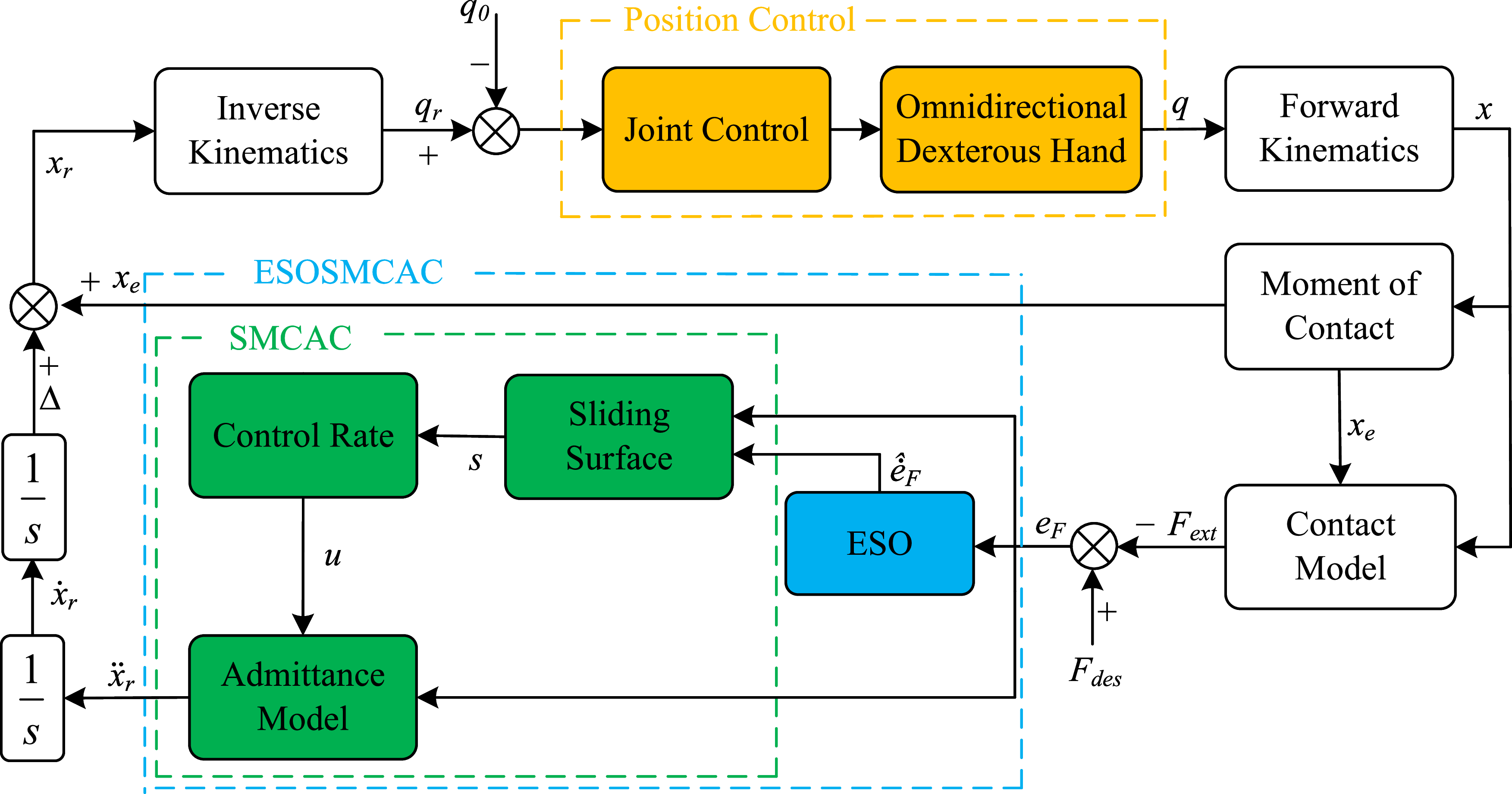
 \begin{equation}s=\widehat{\dot{e}}_{F}+\lambda e_{F}=\hat{z}_{2}+\lambda e_{F}\end{equation}
The system control block diagram is shown in Figure 5.
System control block diagram.

3.4. Stability analysis
A stability analysis of the proposed ESOSMCAC strategy is performed using the direct Lyapunov method. Consider the Lyapunov function candidate:
 \begin{equation}V=\frac{1}{2}s^{2}\end{equation}
Clearly,
 $V\geq 0$
, and the function is positive definite. Differentiating
 $V$
and substituting Eq. (24), the sliding mode control law is designed as
 $u_{smc}=\rho \cdot \mathrm{sgn}(s)$
, where
 $\mathrm{sgn}(s)$
is the signum function. Consequently, we obtain:
 \begin{equation}\dot{V}=s\dot{s}=-\Gamma s{\unicode[Arial]{x03A8}} -\Gamma \rho \mid s\mid\end{equation}
where
 ${\unicode[Arial]{x03A8}} =-D\dot{x}_{r}+e_{F}-\frac{\lambda }{\Gamma }\dot{F}+\frac{{\unicode[Arial]{x0394}} }{\Gamma }$
. The term
 ${\unicode[Arial]{x03A8}}$
consists of four components, each bounded under normal grasping conditions. The damping term
 $-D\dot{x}_{r}$
is bounded because the reference velocity remains finite during contact. The force error
 $e_{F}$
is regulated by the closed-loop controller. The force derivative term
 $-\frac{\lambda }{\Gamma }\dot{F}$
is bounded under physical contact with finite stiffness, since
 $\dot{F}=K_{e}\dot{x}$
with bounded hand velocity and finite
 $K_{e}$
. The residual term
 $\frac{{\unicode[Arial]{x0394}} }{\Gamma }$
encapsulates ESO estimation errors and unmodeled dynamics, which are bounded due to the proven convergence of the ESO. Therefore, there exists a constant
 $\rho _{0}\gt 0$
such that
 $\mid {\unicode[Arial]{x03A8}} \mid \leq \rho _{0}$
for all time
 $t$
. Designing the control gain as
 $\rho =\rho _{0}+\frac{\eta _{0}}{\Gamma },\eta _{0}\gt 0,$
and using the absolute-value inequality:
 $-s{\unicode[Arial]{x03A8}} \leq \mid s\mid \mid {\unicode[Arial]{x03A8}} \mid \leq \mid s\mid \rho _{0},$
we obtain:
 \begin{equation}\dot{V}\leq \Gamma \rho _{0}\mid s\mid -\Gamma \left(\rho _{0}+\eta _{0}/\Gamma \right)\mid s\mid =-\eta _{0}\mid s\mid \leq 0\end{equation}
Remark on the uncertainty in
 $\Gamma =\frac{K_{e}}{M}$
. The parameter
 $\Gamma$
involves the environmental stiffness
 $K_{e}$
, which is unknown and may vary during grasping. The stability proof does not require
 $\Gamma$
to be constant or precisely known, only that
 $\Gamma \gt 0$
(guaranteed by
 $K_{e}\gt 0$
for any real object) and that
 $\Gamma$
remains bounded within a finite range for a given object.
Equation (37) shows that the system is stable in the Lyapunov sense and satisfies the finite-time reaching condition of sliding-mode control, guaranteeing that the system state will reach the sliding surface
 $s=0$
in finite time and that the force error will converge exponentially. However, the sign function
 $\mathrm{sgn}(s)$
induces high-frequency chattering. To mitigate this effect, a continuous saturation function such as the hyperbolic tangent is commonly employed:
 \begin{equation}u_{\mathrm{smc}}=\rho \cdot \tanh \left(\frac{s}{\phi }\right)\end{equation}
where
 $\phi \gt 0$
is the boundary layer thickness. This continuous approximation creates a thin boundary layer around the sliding surface. When
 $\mid s\mid \gt \phi$
, the
 $\tanh$
function saturates and behaves approximately like the ideal signum function, preserving strong robustness. When
 $\mid s\mid \leq \phi$
, the control law degenerates into a linear proportional control
 $u_{smc}\approx \rho \cdot \frac{s}{\phi }$
, providing smooth regulation within the boundary layer.
It should be noted that with the continuous
 $\tanh$
function, the strict finite-time reaching condition no longer holds. Instead, the system converges asymptotically. Specifically, the system state enters the boundary layer region
 $\mid s\mid \leq \phi$
in finite time, after which it converges asymptotically to a small neighborhood of the sliding surface
 $s\approx 0$
. This represents a practical engineering trade-off: by sacrificing strict finite-time convergence, the control input becomes smooth and chattering is effectively suppressed.
Regarding practical implementation, actuator dynamics and communication delays can potentially excite chattering in sliding-mode controllers even when a continuous saturation function is used. In this work, the total loop delay—comprising sensor latency, controller computation, communication, and actuator response—is significantly shorter than the time constant of the admittance dynamics, ensuring that the controller responds to force variations before significant error accumulates. Moreover, because the
 $\tanh$
function replaces the discontinuous switching of the signum function with smooth linear feedback within the boundary layer, the control action is less susceptible to the repeated zero-crossing oscillations that would otherwise be induced by delays.
4. Simulations and experiments
To verify the effectiveness and superiority of the proposed ESOSMCAC approach, tests were conducted both in simulation and on a physical experimental platform. Based on the experimental data from Finger D, the method was evaluated in terms of force-control accuracy, convergence speed, and system stability under unknown stiffness conditions.
4.1. Simulations
A simulation environment was built in Matlab/Simulink. Based on the contact model, three control strategies are implemented and compared for desired force grasping of objects with unknown environmental stiffness: the AC from Eq. (17), the sliding-mode admittance control (SMCAC) incorporating Eq. (21), and the ESOSMCAC incorporating Eq. (34).
Four simulation cases were first designed without measurement noise to evaluate the baseline force tracking performance under different stiffness and desired force conditions: (A)
 $K_{e}=3$
N/mm,
 $F_{d}=10$
N; (B)
 $K_{e}=3$
N/mm,
 $F_{d}=20$
N; (C)
 $K_{e}=5$
N/mm,
 $F_{d}=10$
N; (D)
 $K_{e}=5$
N/mm,
 $F_{d}=20$
N.
The admittance parameters were identical for all three methods: virtual mass
 $m$
= 1, damping coefficient
 $d=$
3. For SMCAC and ESOSMCAC, the sliding-mode parameters were set to
 $\lambda =$
5, sliding gain
 $\rho =$
10, and boundary-layer thickness
 $\phi =$
1. In ESOSMCAC, the observer bandwidth was chosen as
 $\omega _{o}=$
50. These are tuned according to the following rationale. The parameter
 $\lambda $
governs the exponential decay rate of the force error on the sliding surface. A larger
 $\lambda $
accelerates convergence but amplifies the contribution of force measurement noise to the sliding variable. The gain
 $\rho$
must dominate the lumped uncertainty bound to satisfy the reaching condition. It is tuned by gradually increasing from a small value until overshoot or oscillation appears in the force response, then slightly reduced. The parameter
 $\phi$
controls the trade-off between chattering suppression and tracking accuracy. A smaller
 $\phi$
yields higher accuracy but increases control activity; a larger
 $\phi$
smooths the control signal at the expense of a wider steady-state error bound. The parameter
 $\omega _{o}$
is the sole tuning parameter of the ESO. The bandwidth
 $\omega _{o}$
governs a fundamental trade-off: a higher bandwidth enables the observer to estimate the force error derivative and the total disturbance more rapidly, which in turn allows faster sliding surface reconstruction and more timely disturbance compensation; however, it also amplifies the high-frequency measurement noise, degrading the smoothness of the reconstructed sliding surface and increasing control chattering. Conversely, a lower bandwidth provides stronger noise attenuation but slows down the estimation dynamics, which delays the sliding surface reconstruction and reduces force tracking accuracy. Accordingly, the parameters are adjusted based on the desired control performance and selected through several numerical simulations.
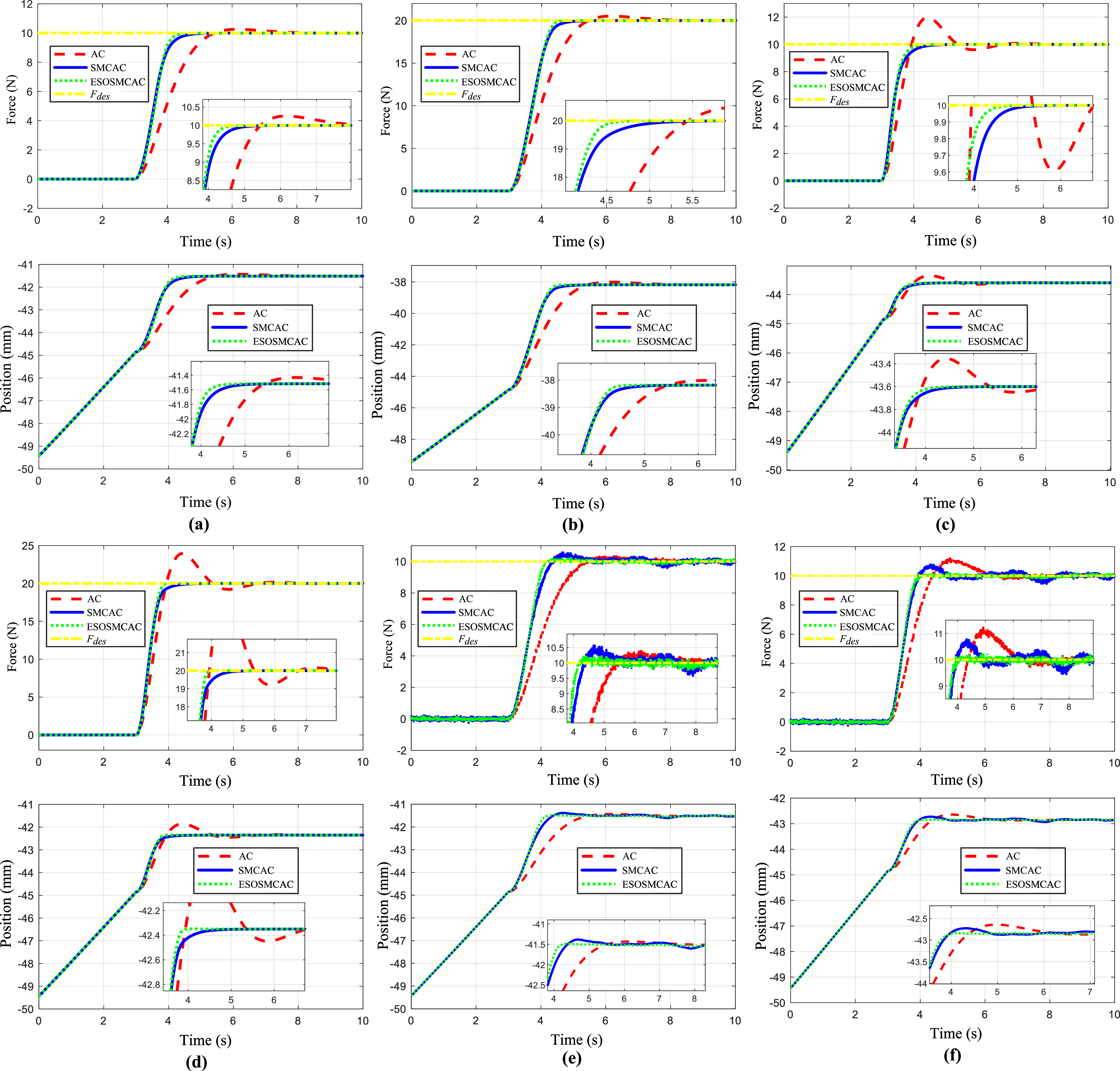
Force control and position tracking simulation results for the three methods. Subfigures (a)–(d) correspond to the noise-free cases (A)–(D), respectively. Subfigures (e)–(f) correspond to the noisy cases (E)–(F).

Figure 6. Long description
Six subfigures (a)-(f). Every subfigure has an upper force-time plot and lower position-time plot, with embedded zoom insets showing 4–8 s transient details.Traces: red dashed AC, solid blue SMCAC, green dotted ESOSMCAC; yellow dashed is desired-force Fdes.X-axis: Time 0-10 s. Upper Y-axis: Force (N). Lower Y-axis: Position (mm). Subfigures (a)-(f) correspond to six separate test cases.
During the initial stage, the ODH approaches the object at a constant velocity. Contact occurs at
 $t=3\mathrm{s}$
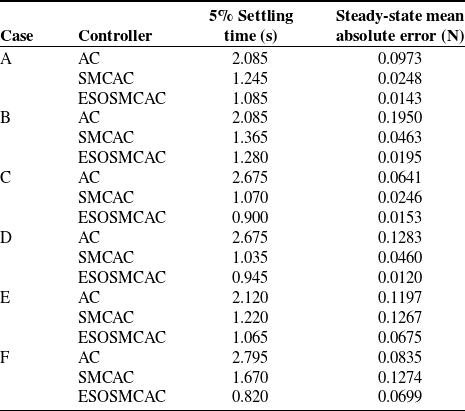
, after which the admittance-based control phase begins. The resulting force-control and position-tracking performances are shown in Figure 6(a)–(d). To quantitatively compare the three controllers, the 5% settling time and the mean absolute error (MAE) in steady state are evaluated for all nine cases. The settling time is defined as the time after contact at which the force error enters and remains within ±5% of the desired force. The MAE is computed over the steady-state interval after the transient response has settled. The results for cases (A)–(D) are summarized in Table IV.
Quantitative performance comparison of the three controllers across cases (A)–(F).

Table IV. Long description
This table presents a quantitative performance comparison of three controllers—AC, SMCAC, and ESOSMCAC—across six cases labeled A through F. The columns are: Case, Controller, 5% Settling Time (in seconds), and Steady-State Mean Absolute Error (in Newtons).Case A: AC has a settling time of 2.085 seconds and a steady-state mean absolute error of 0.0973 N. SMCAC has a settling time of 1.245 seconds and an error of 0.0248 N. ESOSMCAC has a settling time of 1.085 seconds and an error of 0.0143 N.Case B: AC has a settling time of 2.085 seconds and an error of 0.1950 N. SMCAC has a settling time of 1.365 seconds and an error of 0.0463 N. ESOSMCAC has a settling time of 1.280 seconds and an error of 0.0195 N.Case C: AC has a settling time of 2.675 seconds and an error of 0.0641 N. SMCAC has a settling time of 1.070 seconds and an error of 0.0246 N. ESOSMCAC has a settling time of 0.900 seconds and an error of 0.0153 N.Case D: AC has a settling time of 2.675 seconds and an error of 0.1283 N. SMCAC has a settling time of 1.035 seconds and an error of 0.0460 N. ESOSMCAC has a settling time of 0.945 seconds and an error of 0.0120 N.Case E: AC has a settling time of 2.120 seconds and an error of 0.1197 N. SMCAC has a settling time of 1.220 seconds and an error of 0.1267 N. ESOSMCAC has a settling time of 1.065 seconds and an error of 0.0675 N.Case F: AC has a settling time of 2.795 seconds and an error of 0.0835 N. SMCAC has a settling time of 1.670 seconds and an error of 0.1274 N. ESOSMCAC has a settling time of 0.820 seconds and an error of 0.0699 N.
To validate the noise rejection capability of the ESO and the robustness of the proposed method under more realistic conditions, five simulation cases with measurement noise are designed. In all five cases, Gaussian white noise with a standard deviation (SD) of 0.2 N is added to the measured contact force, representing the ripple observed in the force sensor signals on the experimental platform.
Cases E and F evaluate the force tracking performance in the presence of sensor noise under two stiffness conditions (
 $K_{e}=3$
N/mm and
 $5$
N/mm, respectively), both with
 $F_{d}=10$
N. The resulting force-control and position-tracking performances are shown in Figure 6(e)–(f). The results for cases (E)–(F) are summarized in Table IV.
The results of the six simulation cases demonstrate that the ESOSMCAC method significantly outperforms both the AC and SMCAC methods. In terms of force control, SMCAC and ESOSMCAC track the desired force more closely, exhibiting smaller steady-state errors and lower oscillation amplitudes across objects of different stiffnesses. However, ESOSMCAC achieves the best performance: its steady-state force error is reduced by approximately 37.8–57.9% compared to SMCAC and by about 16.3–90.6% compared to AC. In contrast, AC shows poor adaptability to varying stiffnesses, resulting in the largest force-control deviations. Regarding position response, both SMCAC and ESOSMCAC maintain smooth position tracking, while the position response of AC exhibits noticeable oscillations due to its larger force errors. In terms of convergence speed, the settling-time ranking is ESOSMCAC
 $\lt$
SMCAC
 $\lt$
AC. Specifically, ESOSMCAC reduces the settling time by approximately 6.2–50.9% compared to SMCAC and by about 38.6–70.7% compared to AC. These results fully validate the superiority of ESOSMCAC in balancing convergence speed with force-control accuracy when the object stiffness is unknown.
Cases G and H test the disturbance rejection capability against sudden external forces. In each case, an external force of 5 N is abruptly applied at
 $t=8$
s and removed at
 $t=11$
s, simulating an unexpected contact or collision during grasping. Case G uses
 $K_{e}=3$
N/mm, and Case H uses
 $K_{e}=5$
N/mm, both with
 $F_{d}=10$
N. Case I evaluates the robustness to time-varying environmental stiffness, a scenario that may arise when grasping objects with non-uniform internal structure or when the contact condition changes during in-hand posture adjustment. The desired force is maintained at
 $F_{d}=10$
N, while the stiffness varies over time:
 $K_{e}=3$
N/mm during
 $t=0$
–
 $7$
s,
 $K_{e}=6$
N/mm during
 $t=7$
–
 $11$
s, and
 $K_{e}=2$
N/mm during
 $t=11$
–
 $15$
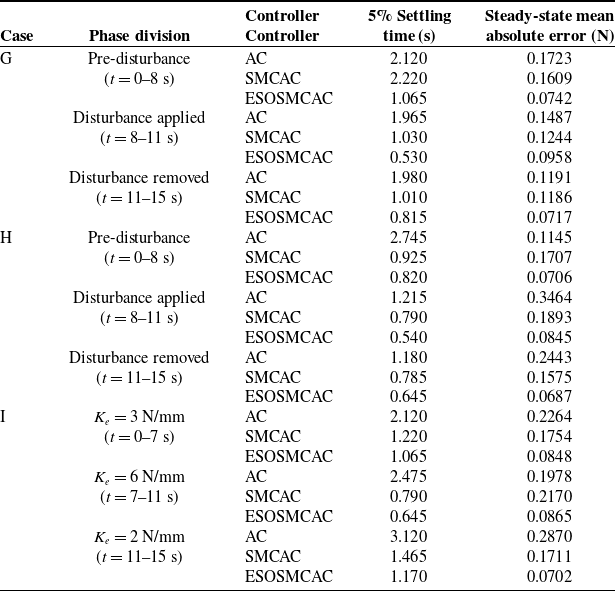
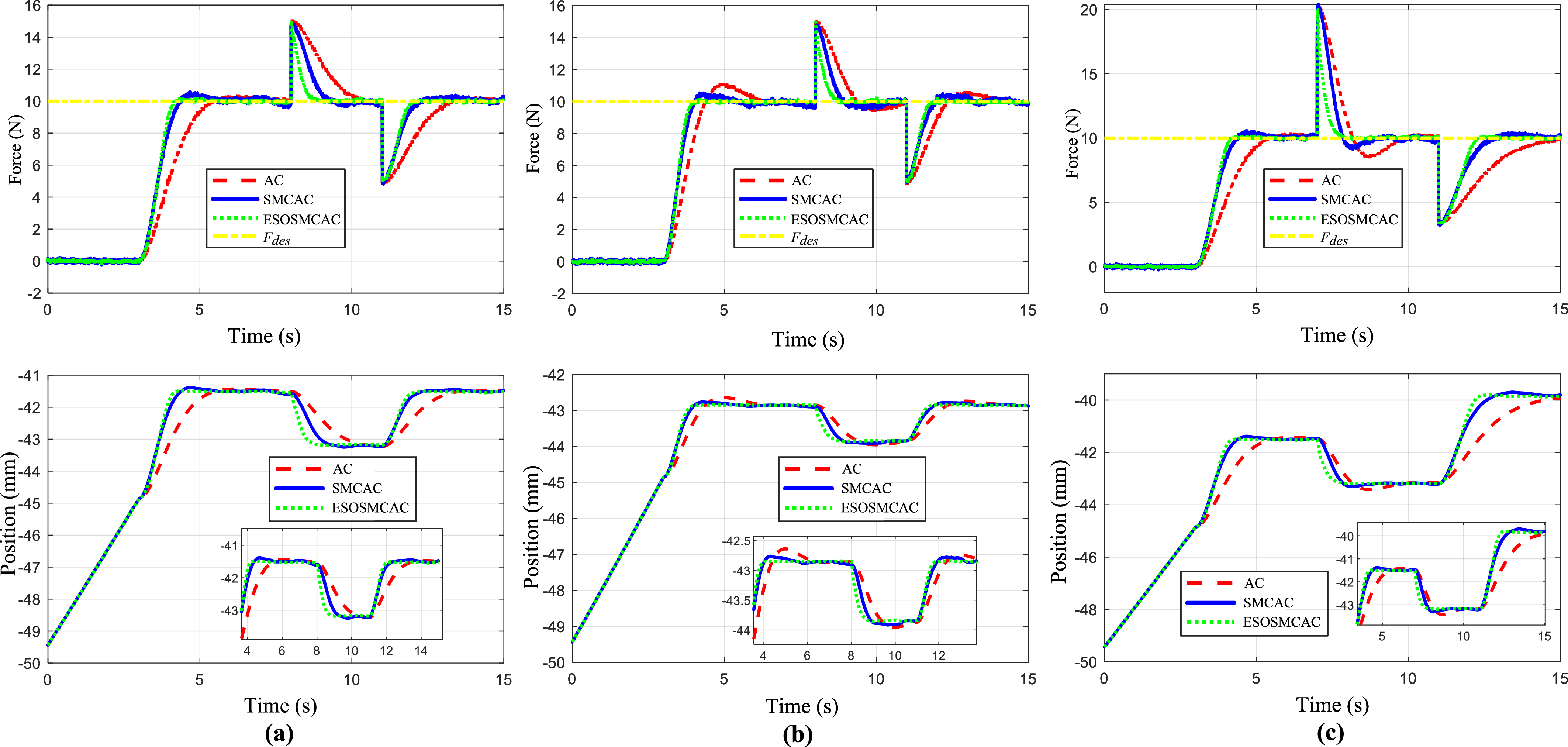
s. These cases examine whether the controller can reject the disturbance and restore the desired grasping force without overshoot or instability. The force control and position tracking performance for the noisy and disturbed cases (G)–(I) are shown in Figure 7. The 5% settling time and steady-state MAE for cases (G)–(I) are summarized in Table V.
Quantitative performance comparison of the three controllers across cases (G)–(I).

Table V. Long description
This table presents a quantitative performance comparison of three controllers—AC, SMCAC, and ESOSMCAC—across cases G, H, and I, with each case divided into phases. The columns are: Case, Phase Division, Controller, 5% Settling Time (in seconds), and Steady-State Mean Absolute Error (in Newtons).Case G is divided into three phases. In the Pre-disturbance phase (t = 0 to 8 s): AC has a settling time of 2.120 s and an error of 0.1723 N; SMCAC has a settling time of 2.220 s and an error of 0.1609 N; ESOSMCAC has a settling time of 1.065 s and an error of 0.0742 N. In the Disturbance applied phase (t = 8 to 11 s): AC has a settling time of 1.965 s and an error of 0.1487 N; SMCAC has a settling time of 1.030 s and an error of 0.1244 N; ESOSMCAC has a settling time of 0.530 s and an error of 0.0958 N. In the Disturbance removed phase (t = 11 to 15 s): AC has a settling time of 1.980 s and an error of 0.1191 N; SMCAC has a settling time of 1.010 s and an error of 0.1186 N; ESOSMCAC has a settling time of 0.815 s and an error of 0.0717 N.Case H is divided into three phases. In the Pre-disturbance phase (t = 0 to 8 s): AC has a settling time of 2.745 s and an error of 0.1145 N; SMCAC has a settling time of 0.925 s and an error of 0.1707 N; ESOSMCAC has a settling time of 0.820 s and an error of 0.0706 N. In the Disturbance applied phase (t = 8 to 11 s): AC has a settling time of 1.215 s and an error of 0.3464 N; SMCAC has a settling time of 0.790 s and an error of 0.1893 N; ESOSMCAC has a settling time of 0.540 s and an error of 0.0845 N. In the Disturbance removed phase (t = 11 to 15 s): AC has a settling time of 1.180 s and an error of 0.2443 N; SMCAC has a settling time of 0.785 s and an error of 0.1575 N; ESOSMCAC has a settling time of 0.645 s and an error of 0.0687 N.Case I is divided into three phases based on the environmental stiffness parameter K_e. In the phase K_e = 3 N/mm (t = 0 to 7 s): AC has a settling time of 2.120 s and an error of 0.2264 N; SMCAC has a settling time of 1.220 s and an error of 0.1754 N; ESOSMCAC has a settling time of 1.065 s and an error of 0.0848 N. In the phase K_e = 6 N/mm (t = 7 to 11 s): AC has a settling time of 2.475 s and an error of 0.1978 N; SMCAC has a settling time of 0.790 s and an error of 0.2170 N; ESOSMCAC has a settling time of 0.645 s and an error of 0.0865 N. In the phase K_e = 2 N/mm (t = 11 to 15 s): AC has a settling time of 3.120 s and an error of 0.2870 N; SMCAC has a settling time of 1.465 s and an error of 0.1711 N; ESOSMCAC has a settling time of 1.170 s and an error of 0.0702 N.
Force control simulation results for disturbance rejection and time-varying stiffness cases. Subfigures (a)–(b) correspond to Cases G and H. Subfigure (c) corresponds to Case I.

Figure 7. Long description
Three subfigures (a), (b), (c). Each subfigure has an upper force-time plot and lower position-time plot; embedded zoom insets illustrate local transient responses.Curves: red dashed for AC, solid blue for SMCAC, green dotted for ESOSMCAC, yellow-dashed for desired-force Fdes.Horizontal axis: Time 0-15 s. Upper vertical axis: Force (N). Lower vertical axis: Position (mm). Subfigures (a)-(c) represent Cases G, H, I respectively.
Without the ESO, AC and SMCAC rely on direct numerical differentiation of the noisy force signal to compute the force error derivative, which amplifies the noise and leads to high-frequency fluctuations in the control input. ESOSMCAC, by contrast, uses the ESO to estimate the force error derivative and reconstruct a smooth sliding surface, thereby suppressing noise-induced chattering. The quantitative results for the disturbance and variable stiffness cases (G)–(I) are presented in Table V. Both the 5% settling time and the steady-state MAE are reported for each phase, enabling a comprehensive evaluation of convergence speed and tracking accuracy. These results further demonstrate the robustness and material-independent force-tracking capability of the proposed ESOSMCAC strategy.
In the disturbance rejection cases (G and H), an external force of 5 N is abruptly applied and later removed. Across all three phases in both cases, ESOSMCAC consistently achieves the shortest settling time (0.53–0.82 s) and the lowest MAE (0.0687–0.0958 N). In Case H, the disturbance causes the MAE of AC to more than triple, indicating its high sensitivity to external disturbances when the contact stiffness is large. SMCAC partially mitigates this sensitivity, but its MAE still increases from 0.1707 N to 0.1893 N. In contrast, the MAE of ESOSMCAC remains tightly bounded between 0.0687 N and 0.0845 N throughout all three phases, demonstrating that the SMC term embedded in the admittance model effectively rejects external disturbances regardless of the environmental stiffness.
In the variable stiffness case (I), the MAE of AC fluctuates considerably with the stiffness change, ranging from 0.2264 N to 0.2870 N. SMCAC exhibits a reduced but still noticeable variation from 0.1711 N to 0.2170 N. By contrast, ESOSMCAC maintains both a consistently short settling time (1.065 s, 0.645 s, and 1.17 s) and a nearly constant MAE (0.0848 N, 0.0865 N, and 0.0702 N) across all three segments. The total variation in MAE is less than 0.017 N over a threefold stiffness range. This near-invariance of both convergence speed and steady-state accuracy under substantial stiffness variation confirms that ESOSMCAC effectively compensates for stiffness-induced uncertainties, achieving material-independent force tracking without requiring stiffness identification.
4.2. Experiments
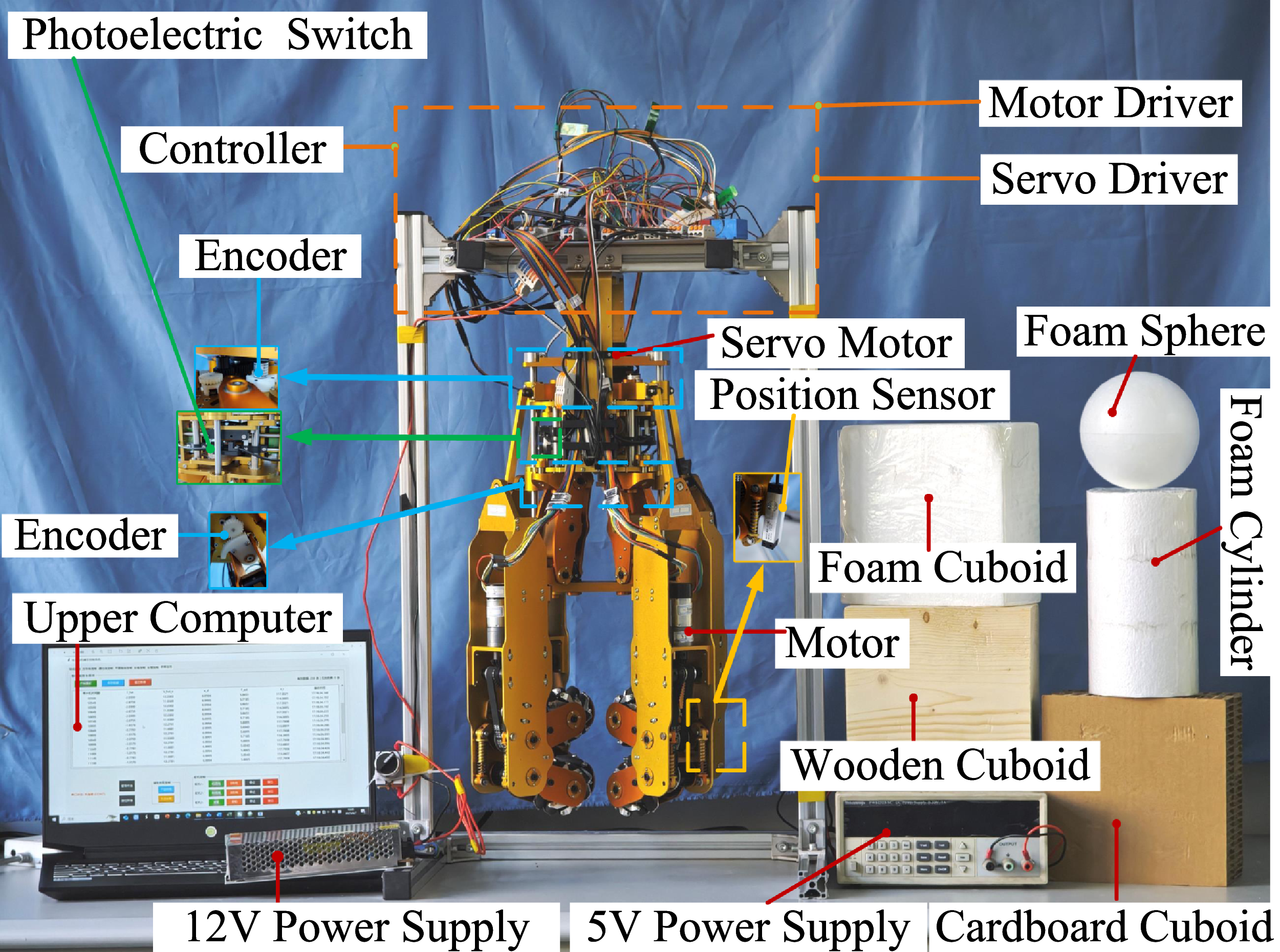
To evaluate the performance of the ESOSMCAC method during grasping with the ODH, experiments were conducted on a foam sphere, foam cylinders, foam cuboids, cardboard cuboids, and wooden cuboids, using desired contact forces. A comprehensive dexterous-hand experimental platform was constructed, as shown in Figure 8, which includes the ODH body, power supply, host computer, controller, drivers, encoders, servo motors, and displacement sensors.
Experimental platform of the ODH.

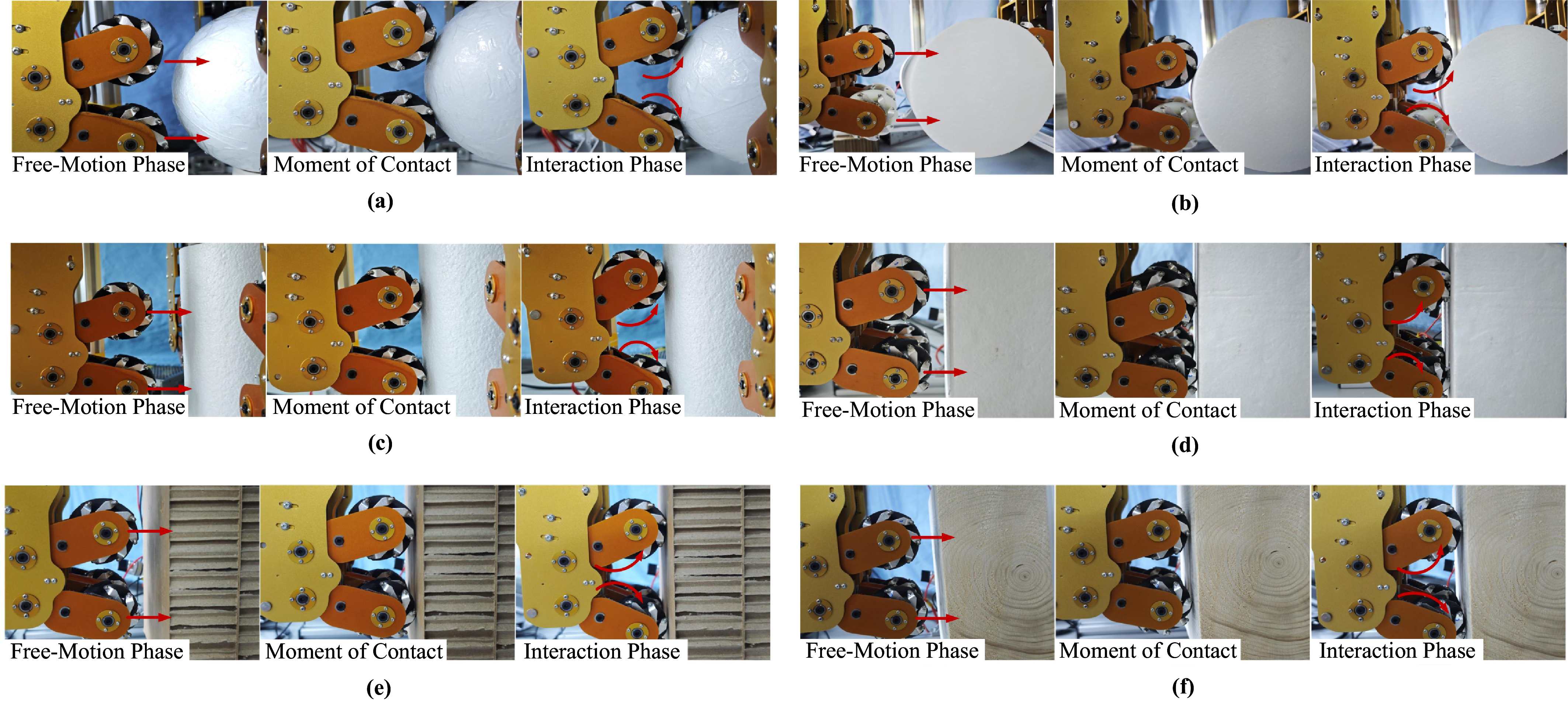
The grasping process with the ODH can be divided into three phases:
 $\unicode{x2460}$
Free-motion phase: the hand approaches the object gradually;
 $\unicode{x2461}$
Initial-contact phase: the fingertips just make contact with the object;
 $\unicode{x2462}$
Interaction phase: the hand engages with the object and enters the admittance-control stage.
It should be noted that during the initial contact stage between the ODH and the object, the small angle between the two wheel-fingers of the same finger leads to a prolonged response time for adapting to the object contour. To address this issue, the Mecanum wheels are actively driven to reduce friction between the object and the wheel-fingers, thereby assisting the grasping process. Schematic diagrams of the ODH grasping a foam sphere, a horizontally placed foam cylinder, a vertically placed foam cylinder, a foam cuboid, a cardboard cuboid, and a wooden cuboid are presented in Figure 9. The corresponding grasping results of the three methods are shown in Figure 10. In both grasping and posture-adjustment experiments, the admittance parameters were set as
 $m=$
1,
 $d=$
3, and the ESOSMCAC parameters were chosen as
 $\lambda =$
5,
 $\rho =$
5,
 $\phi =$
1, and
 $\omega _{o}=$
5. The desired grasping force was set to 10 N for all experiments.
Grasping processes for (a) a foam sphere, (b) a horizontally placed foam cylinder, (c) a vertically placed foam cylinder, (d) a foam cuboid, (e) a cardboard cuboid, and (f) a wooden cuboid.

Figure 9. Long description
Six subfigures (a) to (f). Each subfigure arranges three photographs from left to right: free-motion phase, moment of contact, interaction phase.Red straight arrows denote hand movement directions; red curved arrows indicate joint rotations during physical contact. Subfigures (a)-(f) correspond to foam sphere, horizontal foam cylinder, vertical foam cylinder, foam cuboid, cardboard cuboid and wooden cuboid, respectively.
In the hardware experiments, the observer bandwidth was reduced from
 $\omega _{o}=50$
to
 $\omega _{o}=5$
to account for the more complex noise environment of the physical platform. In simulation, a high bandwidth enables fast estimation of the force error derivative under idealized noise conditions. In the physical platform, however, the measured force signal is affected by mechanical vibration, intermittent contact switching of the Mecanum wheel rollers, and other hardware factors, which together introduce more high-frequency components than the idealized simulation noise model. A high observer bandwidth would amplify these components and induce chattering in the reconstructed sliding surface. Therefore, a lower bandwidth was adopted to provide stronger noise attenuation and ensure a smooth sliding surface. This reduction trades slower estimation dynamics for effective suppression of measurement noise, which helps maintain stable force control in the presence of hardware noise.
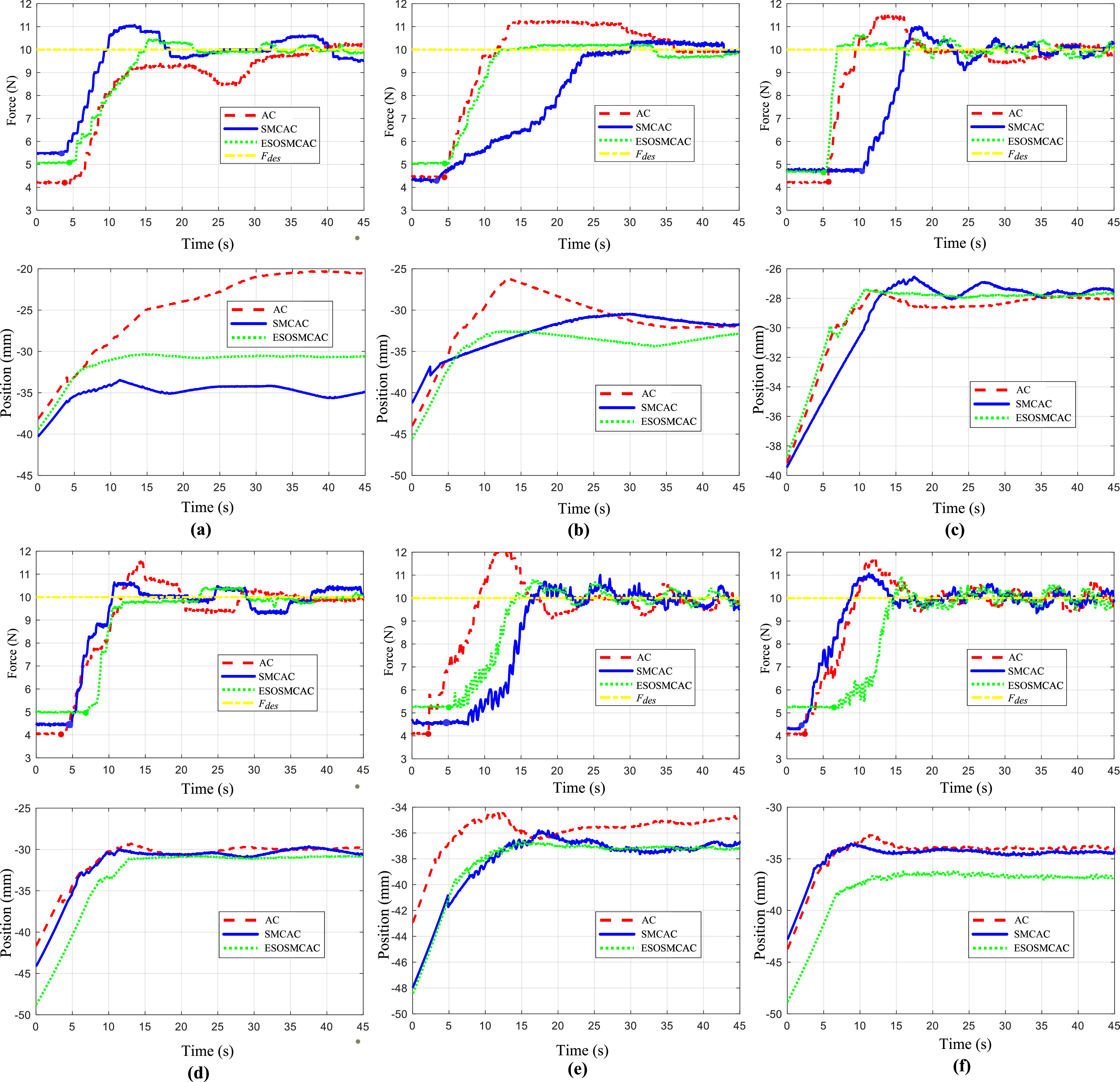
Force tracking and position responses of the three controllers during grasping of (a) a foam sphere, (b) a horizontally placed foam cylinder, (c) a vertically placed foam cylinder, (d) a foam cuboid, (e) a cardboard cuboid, and (f) a wooden cuboid.

Figure 10. Long description
Six subfigures (a) to (f). Each subfigure consists of an upper force-time subplot and a lower position-time subplot.Curves: red dashed for AC, solid blue for SMCAC, green dotted for ESOSMCAC, yellow-dashed for desired-force Fdes.Horizontal axis: Time from 0 to 45 s. Upper vertical axis: Force (N). Lower vertical axis: Position (mm). Subfigures (a)-(f) correspond to six physical grasping test cases respectively.
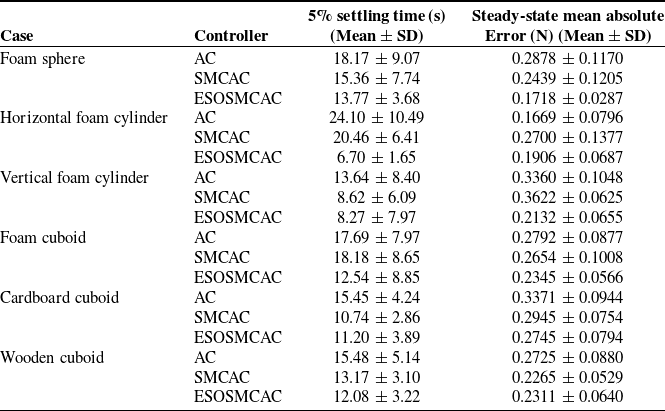
As shown in Figure 10, after the dexterous hand makes contact with the object and enters the AC phase, the initial response is relatively slow. Once the angle between the wheel fingers reaches a certain threshold, the response rapidly increases, and the actual contact force approaches the desired value, eventually reaching a steady state. Consequently, the position of the dexterous hand ceases to change or varies only slowly. To quantitatively compare the three controllers and assess repeatability, each grasping task was repeated five times for every object. The 5% settling time and the steady-state MAE are reported as mean ± SD in Table VI.
Quantitative comparison of AC, SMCAC, and ESOSMCAC in grasping experiments.

Table VI. Long description
This table presents a quantitative comparison of three controllers—AC, SMCAC, and ESOSMCAC—in grasping experiments with six objects: foam sphere, horizontal foam cylinder, vertical foam cylinder, foam cuboid, cardboard cuboid, and wooden cuboid. The columns are: Case, Controller, 5% Settling Time in seconds (Mean ± Standard Deviation), and Steady-State Mean Absolute Error in Newtons (Mean ± Standard Deviation).Foam sphere: AC has a settling time of 18.17 ± 9.07 s and an error of 0.2878 ± 0.1170 N; SMCAC has a settling time of 15.36 ± 7.74 s and an error of 0.2439 ± 0.1205 N; ESOSMCAC has a settling time of 13.77 ± 3.68 s and an error of 0.1718 ± 0.0287 N.Horizontal foam cylinder: AC has a settling time of 24.10 ± 10.49 s and an error of 0.1669 ± 0.0796 N; SMCAC has a settling time of 20.46 ± 6.41 s and an error of 0.2700 ± 0.1377 N; ESOSMCAC has a settling time of 6.70 ± 1.65 s and an error of 0.1906 ± 0.0687 N.Vertical foam cylinder: AC has a settling time of 13.64 ± 8.40 s and an error of 0.3360 ± 0.1048 N; SMCAC has a settling time of 8.62 ± 6.09 s and an error of 0.3622 ± 0.0625 N; ESOSMCAC has a settling time of 8.27 ± 7.97 s and an error of 0.2132 ± 0.0655 N.Foam cuboid: AC has a settling time of 17.69 ± 7.97 s and an error of 0.2792 ± 0.0877 N; SMCAC has a settling time of 18.18 ± 8.65 s and an error of 0.2654 ± 0.1008 N; ESOSMCAC has a settling time of 12.54 ± 8.85 s and an error of 0.2345 ± 0.0566 N.Cardboard cuboid: AC has a settling time of 15.45 ± 4.24 s and an error of 0.3371 ± 0.0944 N; SMCAC has a settling time of 10.74 ± 2.86 s and an error of 0.2945 ± 0.0754 N; ESOSMCAC has a settling time of 11.20 ± 3.89 s and an error of 0.2745 ± 0.0794 N.Wooden cuboid: AC has a settling time of 15.48 ± 5.14 s and an error of 0.2725 ± 0.0880 N; SMCAC has a settling time of 13.17 ± 3.10 s and an error of 0.2265 ± 0.0529 N; ESOSMCAC has a settling time of 12.08 ± 3.22 s and an error of 0.2311 ± 0.0640 N.
Across all six objects, ESOSMCAC achieves the shortest or near-shortest settling time and the lowest or near-lowest MAE. The advantage is most pronounced for the horizontal foam cylinder, where ESOSMCAC settles in 6.70 ± 1.65 s, compared with 24.10 ± 10.49 s for AC and 20.46 ± 6.41 s for SMCAC. For the foam sphere, the MAE of ESOSMCAC is 0.1718 ± 0.0287 N, with an SD substantially smaller than those of AC (0.2878 ± 0.1170 n) and SMCAC (0.2439 ± 0.1205 N), indicating superior repeatability. For the wooden cuboid, the three methods yield closer MAE values (ESOSMCAC: 0.2311 ± 0.0640 N; SMCAC: 0.2265 ± 0.0529 N; AC: 0.2725 ± 0.0880 N), as the higher stiffness of wood produces a more stable contact force with smaller inherent fluctuations. Nevertheless, ESOSMCAC consistently outperforms AC and achieves better performance than SMCAC across all tested objects. Grasping performance also varies with object geometry. For spheres and horizontally placed cylinders, the dexterous hand fully envelops the object, achieving complete force closure and thus more stable contact. For cuboids, the fingers adopt an opposing configuration rather than a fully wrapping one; meanwhile, the contact between the Mecanum wheel rollers and the flat surfaces undergoes intermittent switching, resulting in larger force fluctuations. These geometry-dependent differences are further compounded by rigid-body collisions in the mechanical structure and elastic hysteresis in the transmission, which introduce additional force ripples during the dynamic grasping process. Despite these mechanical effects, ESOSMCAC maintains robust force tracking across all tested shapes and materials.
In addition, the notable difference in settling time between simulation and hardware experiments can be partly attributed to several physical effects that are absent in the idealized simulation. First, upon initial contact, the small angle between the two whirling fingers of each finger mechanism requires time to adapt to the object contour before stable force closure is achieved; this wheel reconfiguration alignment delays the onset of the AC phase. Second, backlash and elastic hysteresis in the transmission chain, including hinged linkages and gear transmission, slow the closed-loop position response. Third, the communication latency between the controller and the motor drivers introduces a transport delay in the control loop. Nevertheless, the relative performance ranking among the three controllers remains consistent with the simulation results, confirming the robustness of the proposed method under realistic hardware conditions.
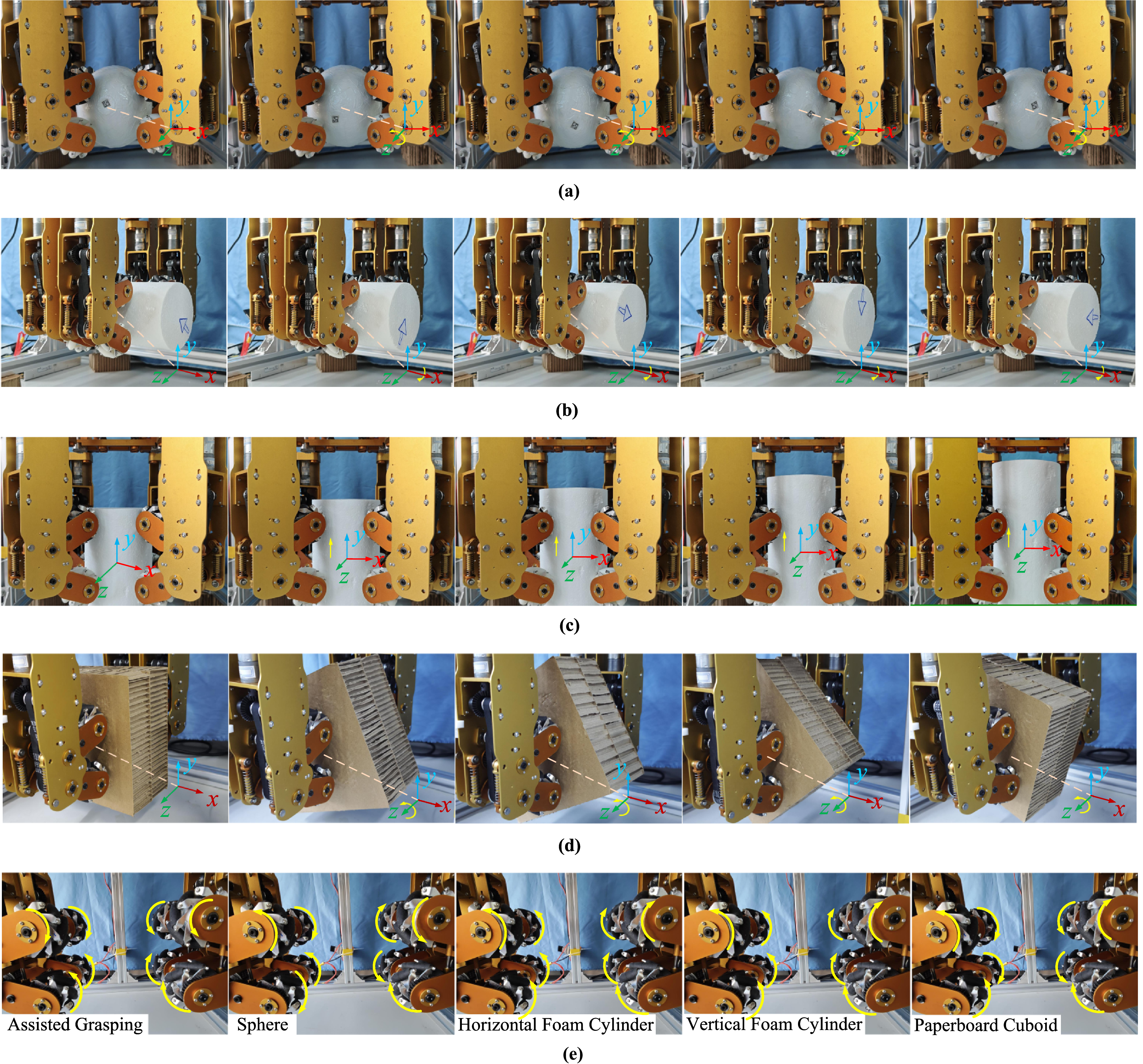
To further validate the ability of the ESOSMCAC method to maintain the desired force during in-hand posture adjustment with the ODH, the omnidirectional mobility of the Mecanum wheels is utilized. A central coordinate system is established for each object. Through the coordinated motion of the Mecanum wheel arrays on the four finger mechanisms, the following adjustments are achieved: rotation of the foam sphere about the z-axis; rotation of the horizontally placed foam cylinder about the x-axis; translation of the vertically placed foam cylinder along the y-axis; and rotation of the cardboard cuboid about the z-axis.
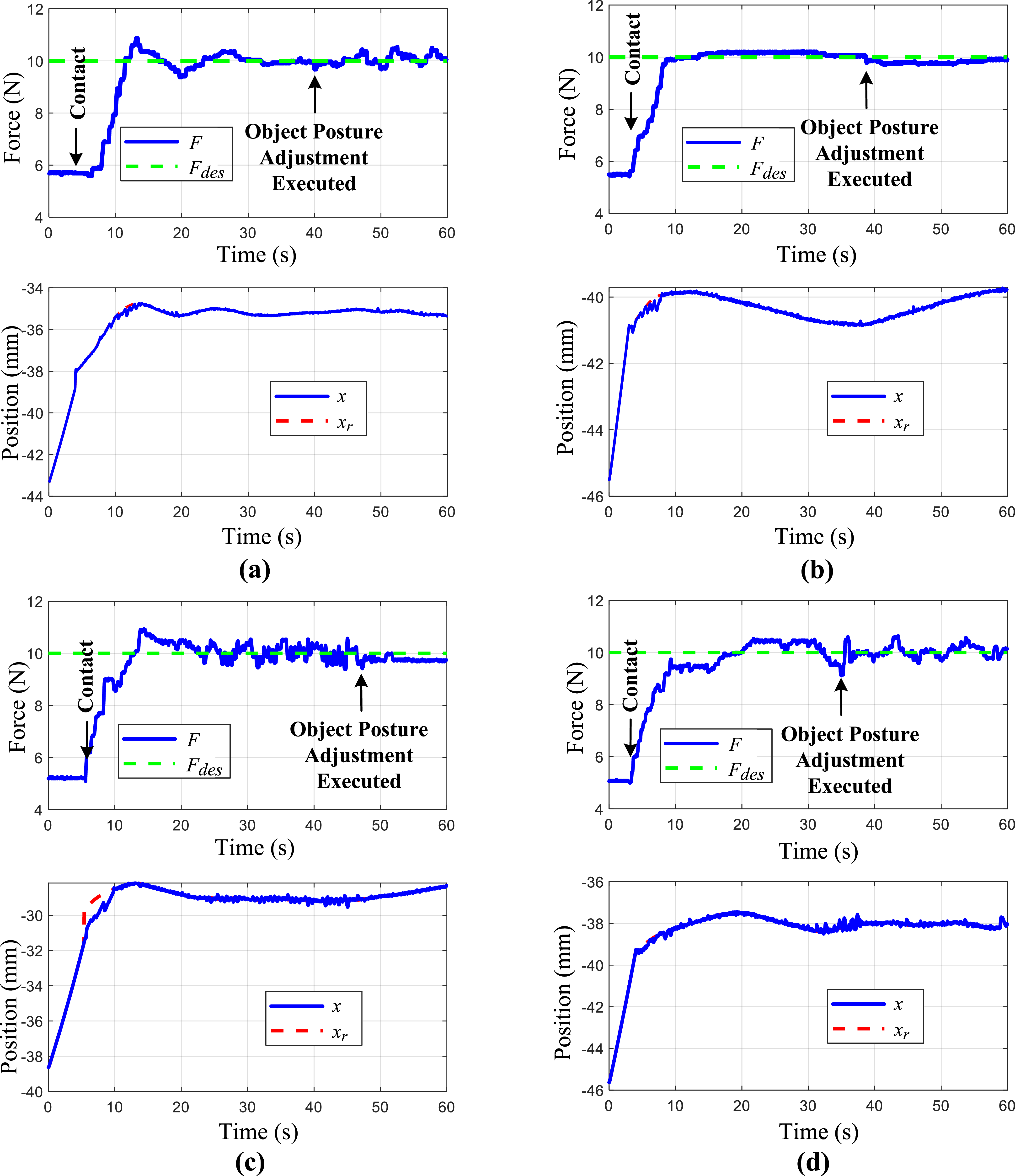
The corresponding Mecanum wheel motion directions for assisted grasping and the above posture adjustments are illustrated in Figure 11(e). The desired force is set to 10 N, and all control parameters remain the same as those used in the grasping phase. The posture-adjustment processes for the respective objects are shown in Figure 11(a)–(d), and the associated force-control and position-tracking performances are presented in Figure 12.
Posture-adjustment processes for (a) a foam sphere, (b) a horizontally placed cylinder, (c) a vertically placed cylinder, and (d) a cardboard cuboid. (e) Directions of Mecanum wheel motion during assisted grasping and posture adjustment for each object.

Figure 11. Long description
Five subfigures (a) to (e). Subfigures (a)-(d) each contain five consecutive photos demonstrating the posture-adjustment sequence for foam sphere, horizontal foam cylinder, vertical foam cylinder, and cardboard cuboid respectively. RGB coordinate axes are overlaid in each frame. Subfigure (e) marks Mecanum wheels with yellow circles and presents wheel motion directions for assisted grasping of different objects.
Force tracking and position responses during posture adjustment of (a) a foam sphere, (b) a horizontally placed cylinder, (c) a vertically placed cylinder, and (d) a cardboard cuboid.

Figure 12. Long description
Four subfigures (a) to (d). Each subfigure consists of an upper force-time subplot and a lower position-time subplot.Upper plot: blue solid line denotes actual contact force F, green dashed line denotes desired-force Fdes. Markers label “Contact” and “Object Posture Adjustment Executed”.Lower plot: blue solid line is actual position x, red dashed line is reference position xr.Horizontal axis: Time 0-60 s. Subfigures (a)-(d) correspond to foam sphere, horizontal foam cylinder, vertical foam cylinder, cardboard cuboid, respectively.
Before adjusting the object posture, the Mecanum wheel-assisted-grasping mode is turned off, and the wheels are then driven according to the required motion directions for posture adjustment. As can be observed from Figure 12, under the action of ESOSMCAC, the grasping force during the posture-adjustment phase remains around 10 N. The steady-state force error across different posture-adjustment tasks ranges from 0.151 N to 0.2598 N. Among these, the sphere and the horizontally placed cylinder exhibit smaller steady-state force errors compared with the other objects. Overall, both the grasping and posture-adjustment experiments further confirm the correctness and effectiveness of the proposed method. The experimental results align well with the earlier theoretical analysis and simulation studies.
5. Conclusion
To address the challenge of force control in grasping and in-hand posture adjustment with the ODH in environments with unknown material properties, this paper first establishes the kinematic model of the ODH using the modified D-H method and a geometric approach, constructs its workspace by sweeping through joint angles, and analyzes the parameter ranges of objects suitable for grasping and posture adjustment. On this basis, a novel AC strategy integrating an ESO with SMC is proposed. Within the virtual mass-damper admittance framework, a sliding-mode term is introduced to enhance robustness against uncertainties in environmental parameters. The ESO estimates and compensates for the noise in the derivative of the force error, reconstructs a smooth sliding surface, and thereby suppresses chattering. A continuous sliding-mode control law, designed via Lyapunov stability theory, ensures stable convergence and smooth force tracking, thereby optimizing the dynamic performance of the AC. Simulation and experimental results demonstrate that the proposed strategy achieves stable convergence and accurate tracking of contact forces under various conditions. This work provides a more robust technical foundation for compliant manipulation with dexterous hands and end effectors. Furthermore, the control framework can be extended to traditional robotic arms and rehabilitation robots, offering an effective solution for adaptive control in tasks such as polishing and grinding, human–robot collaboration, and personalized rehabilitation.
Author contribution
CY and SL performed conceptualization, methodology, mathematical model derivation, software, and manuscript drafting; SY and HL conducted technical support, manuscript review, and revision.
Financial support
This work was supported by the Basic Scientific Research Operating Funds for Universities in Liaoning Province (Grant numbers LJ222410143019, LJ232410143015).
Competing interest
The authors declare that no conflicts of interest exist.
Ethical approval
Not applicable.