Introduction
Phosphorus is an important macronutrient because it regulates primary productivity in coastal and oceanic environments (Schenau et al. Reference Schenau, Reichart and Langer2005). The phosphorus removal from oceans is controlled by particle incorporation and burial in sediments and by biological assimilation, and its availability is associated with fluvial, aeolian and terrestrial inputs with a contribution from organic matter mineralization. The oxidation of organic matter in sediments makes P also available for sorption by iron oxyhydroxides depending on the redox conditions. Phosphorus is later available for incorporation into authigenic P-bearing minerals (Filippelli & Delaney Reference Filippelli and Delaney1996, Slomp et al. Reference Slomp, van Der Gaast and van Raaporst1996). The phosphorus linked to iron oxyhydroxides and to organic matter in marine sediments is classified as more labile than that associated with other authigenic minerals (e.g. carbonate fluorapatite, CaCO3-P and fish debris), which comprise a permanent sink of reactive P (Ruttenberg Reference Ruttenberg2005). The formation and retention of apatites is the major process withdrawing phosphorus from the coastal biogeochemical cycle (Van Beusekom & De Jonge Reference Van Beusekom and De Jonge1997).
Concentrations of P in different forms are well documented in sediments underlying upwelling regions (Schenau et al. Reference Schenau, Reichart and Langer2005), non-upwelling continental margins (Ruttenberg & Berner Reference Ruttenberg and Berner1993, Filippelli & Delaney Reference Filippelli and Delaney1996), open Southern Ocean sediments (Latimer et al. Reference Latimer, Filippelli, Hendy and Newkirk2006), sediment traps (Faul et al. Reference Faul, Anderson and Delaney2005) and Arctic sediments (Zhang et al. Reference Zhang, Guo and Fischer2010).
The authigenic phosphorus (Auth-P) is as predominant P form in sediments near the oceanic areas submitted to a little P continental contribution (Faul et al. Reference Faul, Anderson and Delaney2005).
Admiralty Bay is a polar region that receives terrestrial inputs from ice melting, and sediment P studies at this region are rare. Ice melting in the bay, accompanied by the decrease of salinity, is associated with suspended material that reaches 200 ton day-1 (Pęcherzewski Reference Pęcherzewski1980). The study of P partition in surface sediment in this Antarctic region can contribute to the understanding of the P polar source that constitutes the bottom and intermediate Antarctic Water, which is rich in P. It may also provide insight into the rates of increased glacial meltwater associated with climate change. Zhang & Huang (Reference Zhang and Huang2011) showed that low water temperatures, such as in Antarctic regions, contributes to the release of sediment-bound P to the water column, thereby making sedimentary P more bioavailable. This study aims to characterize the spatial distribution of phosphorus forms in Admiralty Bay, King George Island, Antarctica, in relation to the other polar regions such as the Arctic and to evaluate the oceanographic and terrestrial processes that can influence the phosphorus sedimentary geochemistry in an Antarctic environment.
Study area
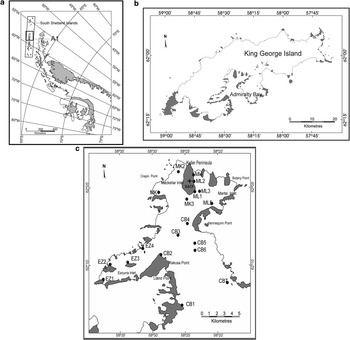
Admiralty Bay is located on the southern coastline of King George Island (South Shetland Islands) near the northern tip of the Antarctic Peninsula (Fig. 1a). Admiralty Bay is composed of three inlets: Mackellar (MK), Ezcurra (EZ) and Martel (ML), and the Central bay (CB) (Fig. 1c).
Study area. a. The South Shetland Islands in relation to the Antarctica Peninsula, A1 box is King George Island. b. King George Island in detail, where grey colour represents non-ice cover. c. The sampling sites in Admiralty Bay. The maps are adapted from Simões et al. (Reference Simões, Arigony Neto and Bremer2003).

Admiralty Bay has an area of 120 km2 and a maximum depth of 600 m in the central part of the bay. The air temperature during the summer ranges from 0–10°C, and the climate is classified as polar tundra (Kottek et al. Reference Kottek, Grkieser, Beck, Rudolf and Rubel2006). Hydrological conditions in Admiralty Bay are determined by the exchange of waters with Bransfield Strait, freshwater runoff and local processes in the fjord. Winds constitute the main meteorological agent and they are responsible for strong aeolic erosion and spreading of sand and gravel that speeds up glacier ablation (Domack & Ishman Reference Domack and Ishman1993, Setzer et al. Reference Setzer, Francelino, Schaefer, Costa and Bremer2004). The main type of soil on King George Island is basaltic andesite in all ice-free areas (non-ornithogenic) with low chemical weathering degree (Simas et al. Reference Simas, Schaefer, Albuquerque-Filho, Francelino, Fernandes Filho and Costa2008). Occupied research bases are located at Martel Inlet (“Comandante Ferraz” - Brazilian Antarctic research station) and in Ezcurra Inlet (“Henryk Arctowisky” - Polish research station), the latter near a penguin colony. These stations constitute potential sources of organic matter, rich in P.
Material and methods
Sampling
During the summer of 2004–05, 19 surface sediment samples (Fig. 1c) were collected in Admiralty Bay with an inox Van Veen grab sampler in a 15–80 m depth range (Table I) and preserved for analysis. The work was conducted as part of the Hidrogeoquimba Project linked to the Brazilian Antarctic Research Program (PROANTAR).
Relative standard deviation (RSD) of each fraction in the estuarine sediment (NIST 1646a) and marine sediment (MESS-3).

Sediment analyses
Sedimentary grain size analyses were carried out using c. 30 g of each sample. Hydrogen peroxide (H2O2 10%) was added to this material to eliminate the total organic matter completely. The remaining material was dried at 60°C, weighed and sieved to 0.062 mm (mud fraction) by the method described by Suguio (Reference Suguio1973). The carbonate percentages were obtained by acid dissolution, with HCl at 10% and by taking the difference between the initial and final weight of the sample after dissolution (Ingram Reference Ingram1971).
Organic carbon (Corg), total nitrogen (Ntotal) and total sulfur (Stotal) content of sediments were analysed. Calcium carbonate was removed by adding hydrochloric acid (HCl 10%), and 1 g of the remaining sediment was dried in a centrifuge tube. Aliquots were then used to determine total organic carbon and total sulfur content using a LECO CNS analyser®. The certificate reference materials SCO-1 and SDO-1 (United States Geological Survey) were used to calibrate the instrument.
Certified reference materials, Estuarine Sediment (NIST 1646a) and Marine Sediment (MESS- 3), were used for method validation. Each sample of sediment was extracted for phosphorus speciations seven times. We calculated the average for each fraction and summed the five fractions to obtain the P total (Ptotal) for calculating the recuperation of extraction. The P recuperation was higher than 90%. The details of extraction are shown in Table I for estuarine sediment (NIST 1646a), and Table II for Marine Sediment (MESS-3). See also Supplemental data at http://dx.doi.org/1017/S0954102013000552.
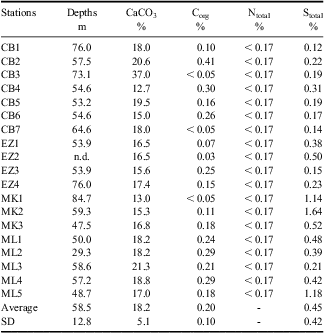
Depths, CaCO3, of Corg, Ntotal and Stotal concentrations, averages and standard deviations (SD) in Admiralty Bay sediments, Antarctic region.
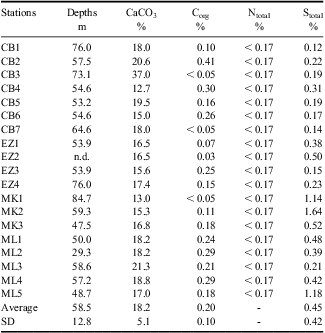
n.d. = non determinate.
The precision for each fraction and Ptotal in NIST 1646a and MESS - 3 is expressed by relative standard deviation (RSD; %) based on the following equation:
 $${\rm{RSD}}\, = \,\left( {{\rm{SD}}/{\rm{AC}}} \right)\,\ast\,{\rm{100}}\%, \eqno\rm$$
where SD = standard deviation and AC = average concentration determined. The phosphorus speciations in surface sediments were determined by the sequential extraction scheme (SEDEX) described by Ruttenberg (Reference Ruttenberg1992), and 0.2 g of bulk sediment was weighed in duplicates.
The SEDEX method has five steps that separate the major reservoirs of sedimentary phosphorus into five pools: i) loosely adsorbed or exchangeable (Pexch), ii) iron bound to oxyhydroxides (P-Fe), iii) Auth-P, which includes carbonate fluorapatite (CFA), biogenic apatite (fish debris) and phosphorus bound CaCO3, iv) Detrital-P, which is apatite from an igneous or metamorphic origin (Detrital-P), and v) organic P (Porg). The phosphate concentrations obtained at steps i, iii, iv and v were performed using a colorimetric method (Grasshoff et al. Reference Grasshoff, Ehrhardt and Kremeling1983) using a Genesys 2 spectrophometer (Bausch & Lomb®). The P concentration in sediment P-Fe (step ii) was determined using citrate-dithionite-bicarbonate (CDB) in a combined CDB - MAGIC (magnesium-induced co-precipitation) method (Huerta-Diaz et al. Reference Huerta-Diaz, Tovaz-Sánchez, Fillipelli, Latimer and Sañudo-Wilhelmy2005). Quantitative P removal from CDB solutions was accomplished through the alkaline precipitation of Mg(OH)2 with a 10 mol l-1 NaOH solution. After separation by centrifugation and two washings with 10% NH4OH solution, the precipitate was re-dissolved in 10% HCl solution.
Detrital-P was extracted with HCl 1 mol l-1 during 16 hours. For Porg, the sediment was transferred to a crucible with 50% (w/v) of MgNO3. The sediments were dried in an oven at 80°C and ashed at 550°C for 1 hour. The ashed sediment was extracted with 1 mol l-1 of HCl for 16 hours.
The P concentration extracted in the 1 mol l-1 HCl solution was measured by a phosphate conventional colorimetric method as described above. Ptotal was considered as the sum of the five phosphorus speciations.
The relative standard deviations of the replicates were < 6% for Pexch, 9% for P-Fe, 6% for Auth-P, 7% for Detrital-P and 5% for Porg. The quantification limits were 0.22 μmol g-1 for Pexch, 0.87 μmol g-1 for P-Fe, 0.16 μmol g-1 for Auth-P, 0.04 μmol g-1 for Detrital-P and 0.10 μmol g-1 for Porg. The quantification limits (QL) were estimated by average of blanks (AVblank) plus ten times of standard deviations (SD) of the values of blanks of each step (QL = AVblank + 10SD) (Eurachem 1998).
The data were graphically treated and statistically tested using Pearson correlation, considering significance level P < 0.01.
Results
Grain size distribution
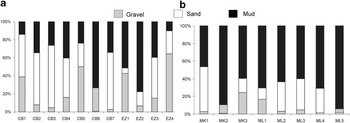
Figure 2a shows the grain sizes of CB and EZ stations and Fig. 2b, the MK and ML stations. Surface sediments in Admiralty Bay are heterogeneous. The stations CB1, CB5, EZ1, EZ4 and MK3 showed large amounts of gravel (> 30%), however, some stations had values < 10%.
Grain size pattern from a. Central Bay (CB) and Ezcurra Inlet (EZ), and b. Mackeller (MK) and Martel (ML) inlets.

In general, an irregular spatial distribution of gravel content was found. Sandy sediments were prominent in the CB stations. In the Ezcurra and Mackellar inlets, sand content ranged from 5.9–57.8%, indicating very heterogeneous spatial distribution. On the other hand, Martel Inlet bottom sediments were predominantly composed by mud with percentages higher than 70%. The calcium carbonate distribution (Table I) showed very homogenous spatial tendency (average of 17.1 ± 2.3%) that ranged from 12.7–21.3% with an outlier of 37.0% (station CB3).
Geochemistry of the sediments
Total organic carbon, Ntotal and Stotal data are shown in Table II. The Corg content was highest at CB2, at 0.41%. ML1, ML2, ML3 and ML4 points presented concentrations higher than 0.20%. The Stotal concentrations ranged from 0.12–1.64% and the highest were found at MK1, MK2 and ML5, with values higher than 1%. The other stations showed Stotal concentrations lower than 0.50%.
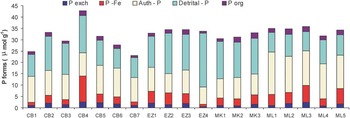
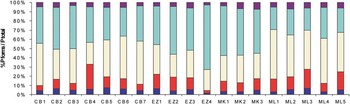
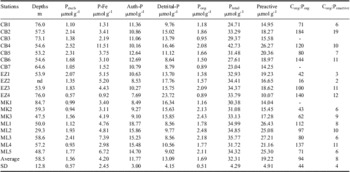
The concentrations and fractional distributions of phosphorus speciations are shown in the Figs 3 and 4, respectively, and listed in Table III.
Concentrations of P forms (μmol g-1) of Admiralty Bay surface sediments.

Percentages of P forms in relation to Ptotal of Admiralty Bay surface sediments.

Concentrations of P fractions, Preactive, Corg:Porg, Corg:Preactive ratios in the Admiralty Bay surface sediments considering Central bay (CB), Mackellar Inlet (MK), Martel Inlet (ML) and Ezcurra Inlet (EZ).
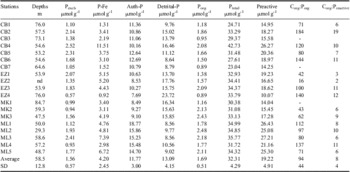
n.d. = non determinate.
Exchangeable phosphorus concentrations were highest at CB4. The percentages of Pexch in relation to Ptotal varied from 2–6%. Phosphorus iron oxyhydroxide bound (P-Fe) were highest in station CB5 (Fig. 3, Table III). The P-Fe (iron- oxyhydroxide bound phosphorus) for the Admiralty Bay sediments accounted for 3–27% of Ptotal, with distinct values of 27% in CB5, 21% in ML3 and 20% in ML5 (Fig. 4). Authigenic phosphorus was the second largest phosphorus form found in the sediments. The highest values were obtained in the Martel Inlet with percentages > 40% (Fig. 3). The highest values of Detrital-P were found in EZ4 with a value of 23.72 μmol g-1 (Fig. 3).
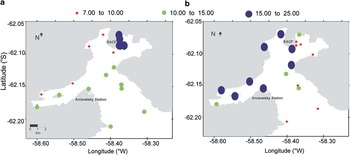
The CB1, CB5, CB6 and CB7 stations had values of Auth-P > 40% (Fig. 4). Detrital-P was the main sedimentary phosphorus form and accounted for 24–70% of the total P (Fig. 4). Spatial distribution on Fig. 5 shows that the highest concentrations of Auth-P were found at Martel Inlet (Fig. 5a). Conversely, Detrital-P concentrations were highest in the inner part of the Central Bay (CB3 and CB4), Ezcurra and Mackellar stations (Fig. 5b).
Spatial distribution of concentrations of a. Auth-P, and b. Detrital-P in μmol g-1.

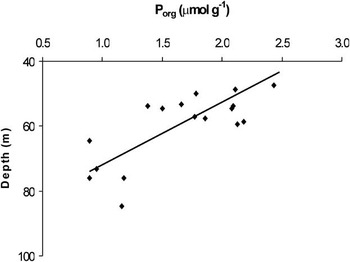
Organic phosphorus occurred in lower concentrations and contributed 2–6% of total phosphorus (Fig. 4). Organic phosphorus was correlated with depth (Table III). The highest concentrations of Porg were observed in Martel Inlet (Fig. 4).
Total phosphorus (Ptotal) concentrations ranged from 24.71–42.73 μmol g-1. The highest values were found at CB4 and the lowest at CB1. Reactive phosphorus (Preactive) ranged from 10.07–27.21 μmol g-1 and accounted for 30–76% in relation to Ptotal.
The Corg:Porg molar ratios (Table III) were close to Redfield ratio in the Central Bay. On the other hand, Corg:Porg ratios < 106 were observed in the Martel and Ezcurra inlets.
For all samples, Corg:Preactive ratios are significantly lower than Corg:Porg, by a factor of about ten.
Discussion
Antarctic shallow marine environments have heterogeneous surface sediments, as a result of non-selective grain discharge, typical of glacial environments (Domack & Ishman Reference Domack and Ishman1993). The heterogeneity of surface sediments in Admiralty Bay may be attributed to different environmental conditions in the western and eastern parts of the Bay. Large amounts of suspended particulate matter occur near the mouths of the subglacial streams, i.e. by liquid water discharge from under glacial bed that, carry non-working and coarse-grained sediments from eroded soil into the Bay. These inputs are estimated at 200 tons day-1 of sediment (Pęcherzewski Reference Pęcherzewski1980), a considerable quantity for this semi-closed region. The higher gravel percentage observed in the western part of Admiralty Bay can be attributed to the transport associated with glacial ice drift, which is more intensive at this portion of the Bay. The Ezcurra, Mackellar and Central bay surface sediments were composed of coarser fractions of sand with low concentrations of CaCO3. Rodrigues et al. (Reference Rodrigues, Maluf, Braga and Eichler2010) showed that the bottom sediments in Ezcurra Inlet had a very heterogeneous spatial distribution, which is confirmed by our results. The fine-grained sediment found in the Martel Inlet was probably associated with low hydrodynamic process at the eastern part of the Bay and the retreat of Keller Peninsula glaciers, which may have changed land-ocean interactions, increasing the clay and silt deposits (Simões et al. Reference Simões, Dani, Bremer, Aquino and Arigony-Neto2004, Santos et al. Reference Santos, Favaro, Schaefer and Silva-Filho2007).
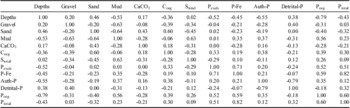
According to DeMaster et al. (Reference DeMaster, Nelson, Nittrouer and Harden1987), the well-oxygenated bottom waters of the high southern latitude in continental shelves result in the rapid degradation of total organic carbon in the surface sediments. Admiralty Bay bottom sediments have Corg concentrations of < 0.50%, very similar to observed content in Antarctic core sediment at Ross Sea (Sackett Reference Sackett1996) and values in the Bering and Chukchi seas in the Arctic (Zhang et al. Reference Zhang, Guo and Fischer2010). The dissolved oxygen in bottom water observed in the Hidrogeoquimba Project (PROANTAR XXIII), obtained at the same time as this study, revealed high concentrations as a result of the low temperature and high summer productivity in surface waters. Therefore, the surface sediments were under oxide conditions, facilitating the mineralization of organic matter. Also, the well-oxygenated waters allow the oxidation along the water column, as shown by the negative correlation between Porg and depth (Table IV & Fig. 6).
Pearson correlation considering grain size, Corg, Ntotal, Stotal, P forms and Ptotal in sediments in significance level P < 0.01.

Porg concentrations in function of depth graph in surface Admiralty Bay sediments.

In aerobic marine environments, sulfur levels in the surface sediments are < 0.13% (Turekian & Wedepohl Reference Turekian and Wedepohl1961). However, the values of Stotal > 1% found in MK1, MK2 and ML5 are possibly attributed to soils which are composed of pyrite of hydrothermal origin that is widely distributed in King George Island (Khim & Yoon Reference Khim and Yoon2003).
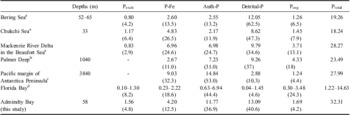
Table V shows average concentrations of phosphorus forms in Antarctic and Arctic sediments in previous studies (Faul et al. Reference Faul, Anderson and Delaney2005, Latimer et al. Reference Latimer, Filippelli, Hendy and Newkirk2006, Zhang et al. Reference Zhang, Guo and Fischer2010). The data are presented in concentration of μmol g-1 and the percentages in relation to total phosphorus in parentheses.
Phosphorus forms in averages (μmol g-1) and percentages of P forms in relation to total P (in parenthesis) obtained in sediments in previous studies.

aZhang et al. Reference Zhang, Guo and Fischer2010, bFaul et al. Reference Faul, Anderson and Delaney2005, cLatimer et al. Reference Latimer, Filippelli, Hendy and Newkirk2006, dZhang et al. Reference Zhang, Fischer and Ortner2004.
In Arctic and Antarctic sediments, the Pexch contents are very similar and closer to oceanic and shelves regions. The Pexch percentages verified in Admiralty Bay surface sediments agree with expected values for marine environments, i.e. values < 8% (Monbet et al. Reference Monbet, Brunskill, Zagorskis and Pfitzner2007).
The Corg:Porg molar ratio reflects the degree of redox-dependent preferential P regeneration from organic matter, while Corg:Preactive indicates the overall P retention efficiency in the sediment, accounting for sink switching from organic matter to mineral phases (Anderson et al. Reference Anderson, Delaney and Faul2001, Kraal et al. Reference Kraal, Slomp, Reed, Reichart and Poulton2012).
Extremely low values of Corg:Porg and Corg:Preactive were found in Admiralty Bay surface sediments. According to Anderson et al. (Reference Anderson, Delaney and Faul2001), detection limits for Corg have significant implications for calculating Corg:Porg with low organic carbon concentrations at or below detection limits. The same authors also argued that, for sites that have high-detrital inputs relative to organic matter input with low organic carbon concentrations, additional misinterpretation of Corg:Porg may result from errors in measuring Corg and Porg concentrations.
Preactive accounts for 30–76% of Ptotal and consequently results in very low Corg:Preactive molar ratios (Table III), showing the efficiency of phosphorus sinking.
Amorphous iron oxyhydroxide has a strong sorption capacity for phosphate (Krom & Berner Reference Krom and Berner1980). Consequently, the iron oxide content in sediments is an important factor in regulating the P retention capacity of sediments and is strongly dependent on redox conditions (Zhang & Huang Reference Zhang and Huang2007). The P-Fe concentrations in Admiralty Bay were also very similar to Arctic sediments (Table V).
Low concentrations of P-Fe in Admiralty Bay bottom sediments may be attributed to the predominance of poorly reactive and non-reactive iron in glacial environments, as a result of dominance of physical weathering over chemical weathering (Poulton & Raiswell Reference Poulton and Raiswell2002).
Authigenic P includes biogenic skeletal debris (bones and fish teeth - hydroxyapatite), phosphate-bound CaCO3 and francolite (carbonate fluorapatite - CFA). Authigenic P is the second largest pool of sedimentary phosphorus in the Admiralty Bay sediments (Table III), with levels similar to Arctic sediments (Table V). The highest Auth-P concentrations were found in Martel Inlet, associated with high levels of silt and clay sediments and organic matter (Corg, and Porg). Zhang et al. (Reference Zhang, Fischer and Ortner2004, Reference Zhang, Guo and Fischer2010) have improved the phosphorus speciation method (Ruttenberg Reference Ruttenberg1992) by including the organic P in exchangeable and in carbonate fractions, which would allow for more detail on the exchangeable fractions of Porg and P linked to carbonate.
No relationship was found between Auth-P and the concentration of CaCO3 in Antarctic sediments. It may indicate that Auth-P may be from biogenic skeletal debris and carbonate fluorapatite (CFA) formed during phosphorus digenesis. During remineralization of organic matter, the phosphorus released may be sorbed into iron oxides (Slomp et al. Reference Slomp, van Der Gaast and van Raaporst1996) or directly transformed in Auth-P (Ruttenberg & Berner Reference Ruttenberg and Berner1993).
Authigenic apatite formation in marine sediments has been recognized in numerous studies as an important sink of reactive phosphorus with potential impact on long-term nutrient availability and biological production. High concentrations of Auth-P may be attributed to the regeneration of organic phosphorus and exchange with other forms of P that begins in the water column and continues in the sediments (Faul et al. Reference Faul, Anderson and Delaney2005).
Detrital-P was the main form of sedimentary phosphorus observed in Admiralty Bay sediments, mainly in Mackellar and Ezcurra inlets, with values > 40%. High percentages of Detrital-P may be attributed to melting land ice and freshwater discharge that increase terrestrial input with high levels of gravel and coarse sediments as shown in our data.
In Admiralty Bay surface sediments, the concentrations of Porg were very low, particularly in deeper stations. Antarctic and Arctic terrestrial environments have cold climates, less vegetation and the organic phosphorus present in the terrestrial contribution to the ocean is limited. The high marine primary production in summer period generates organic debris that falls to the sediments, therefore the well-oxygenated bottom waters contribute to remineralization of total organic carbon and more labile Porg (DeMaster et al. Reference DeMaster, Nelson, Nittrouer and Harden1987, Ruttenberg & Goñi Reference Ruttenberg and Goñi1997, Lange et al. Reference Lange, Tenenbaum, Braga and Campos2007, Rodrigues et al. Reference Rodrigues, Maluf, Braga and Eichler2010, Zhang et al. Reference Zhang, Guo and Fischer2010). As a result, the organic matter accumulation in the sediment is not favoured.
Normally, Corg, Stotal, Ptotal and P forms have a distribution close to the grain size pattern with higher values associated with the muddy fraction. Despite high heterogeneity of grain size pattern in the sediments, Corg and Porg had similar low values in all stations. Also, no relationship was found between mud and phosphorus forms in the Admiralty sediments (Table IV). The lack of relationship between grain size, P forms and Ptotal (Table IV) indicates that terrestrial dilution seems to be a dominant control on the geochemistry of phosphorus, reflected in high levels of Detrital-P in surface sediments for all stations.
Conclusions
The granulometry of Admiralty Bay sediments showed a very heterogeneous distribution as a result of local environmental conditions such as ice melting and the hydrodynamics of bottom waters.
Low values of organic carbon and organic phosphorus may be attributed to intensive mineralization of organic matter in well-oxygenated waters, reflected in low values of Corg and Porg concentrations. High levels of total sulfur in Mackellar Inlet are attributed to a continental source.
Detrital-P from igneous and metamorphic origin was the main sedimentary phosphorus form observed in Admiralty Bay sediments, accounting for 41% of Ptotal on average.
High levels of gravel, coarse sediments and Detrital-P in the western part of Admiralty Bay may be attributed to the land ice melting that carries a large amount of terrestrial material with low biogenic constituents. In contrast, Martel Inlet presented had higher silt and clay contents. Non-labile phosphorus (Auth-P and Detrital-P) accounted for 63–93% of total phosphorus as observed in other polar sediments.
The geochemistry of phosphorus in the Admiralty Bay surface sediments may be driven by: 1) terrestrial dilution from ice melting and freshwater discharge as shown by high levels of gravel and Detrital-P, and 2) the intensive remineralization of organic matter, which released phosphorus may sorbed into iron oxides or transformed directly in Auth-P (low concentrations of Corg and Porg and high concentrations of Auth-P.
Acknowledgements
The authors thank the CNPq (Brazilian National Research Council) for the financial support of Hidrogeoquimba Project process n.550349/2002-2 and 558472/2005-2 projects that integrated the PROANTAR (Brazilian Antarctic Research Program). The authors are grateful to Dr Laurence Padman and the two reviewers for improving this manuscript. Also, we thank the colleagues Adriana R. Perretti, Katia S. Jaworski and João C. Maluf, members of the sampling team. This research was part of a PhD thesis supported by CAPES (Coordenadoria de Aperfeiçoamento ao Pessoal de Nível Superior) involving the first author.