Recent scholarship has changed the understanding of how governments borrowed abroad during the first financial globalization, in the decades before 1914. Creditors' decision to lend depended not only on the borrowers' macroeconomic fundamentals, but also on the reputation of the banks in charge of underwriting sovereign bonds. Underwriters endorsed their clients' debt when they floated their loans. A hierarchy among these banks guided the market. As Marc Flandreau and Juan Flores (Reference Flandreau and Flores2009, Reference Flandreau and Flores2011, Reference Flandreau and Flores2012) have argued, the underwriters played the role of “gate keepers,” helping to enforce debt contracts. The authors have made an important departure from the previous body of research, which presented economic policy—in particular the adoption of the gold standard—as the main determinant of lending conditions (Bordo and Rockoff Reference Bordo and Rockoff1996).
To analyze the role of underwriters, the new literature has focused on the demand side of the market—how these banks chose their clients and how final creditors reacted to that—rather than the supply side of sovereign debt, which Flandreau and Frédéric Zumer (Reference Flandreau and Frédéric 2004, p. 58) define as “the governments' borrowing policies.” This article addresses this gap by taking the underwriters into account. It investigates under what circumstances governments were likely to foster competition among different underwriters or to commit to a single patron bank. This question is relevant because high officials took the first step in the sovereign debt chain: they issued the bonds (Flandreau and Flores Reference Flandreau and Flores2009, p. 652). Moreover, governments and underwriters had different pay-offs when negotiating borrowing conditions. In most cases, the former sold new debt at a determined discount rate to the latter, which resold it at a margin to the final creditors (Flores Reference Flores2012, p. 15). The underwriters could handsomely profit depending on the market's demand and, crucially, the governments' willingness to issue the bonds at a relatively low price.
Based on the study of Rothschilds and Brazil, Flandreau and Flores (Reference Flandreau and Flores2011, pp. 15–18) assert that governments benefited from the association with first-class banks because of their capacity to attract credit. Brazil was fiscally fragile but borrowed at good terms because it granted Rothschilds exclusivity. Flandreau and Flores propose that governments were likely to commit to a single underwriter and accept their conditions if (1) they did not count with a good reputation among bondholders, and (2) the banks had a superior status, capable of compensating for the country's negative image. This hypothesis is a useful starting point, although it addresses an atypical case: Rothschilds had no rival in terms of reputation and Brazil was unusually loyal to its patron bank (Flores Reference Flores2012, p. 19). This article broadens that hypothesis by assessing if the corollary also holds; that is, whether governments with good reputation that could not access first-class banks promoted competition among second-class underwriters to improve borrowing conditions. Flandreau and Flores (Reference Flandreau and Flores2010, p. 13) admit that they “neglect this property.”
The few available studies on the government side of debt negotiations show deviations from this hypothesis. Flores (Reference Flores2010) demonstrates that Argentina bargained to borrow at conditions incompatible with its deteriorating fundamentals in the 1880s. A short-sighted borrower, the Argentinean government did not act as one would expect from its eroding reputation and its connection with Barings, a first-class bank. Toshio Suzuki (Reference Suzuki1994) shows that, after the conquest of Manchuria and the victory over Russia, the Japanese government negotiated with top underwriters, including Barings and Rothschilds, to issue loans at good rates. These works justify the need for more case studies, so that the hypothesis can be tested and developed based on the relations between governments and banks with different reputations. The three decades that preceded WWI are a particularly rich period for this analysis because the market became larger and more competitive with the entry of banks from the European continent and the United States. Moreover, final creditors started to evaluate macroeconomic fundamentals more thoroughly in order to assess risk (Mauro, Sussman, and Yafeh Reference Mauro, Sussman and Yafeh2006, pp. 11–12; Flandreau and Zumer Reference Flandreau and Frédéric 2004, pp. 27–28, 51–54).
This article studies the case of Porfirian Mexico (1876–1911), a debt mismanagement champion that subsequently became creditworthy. Porfirio Díaz started his 27 year-long administration in 1884, when the country was still under a financial embargo.Footnote 1 The government returned to the market in 1888 despite a terrible payment record, turned into a trusted borrower in the 1890s, and issued loans on increasingly good terms until 1910. This change in reputation is useful for testing the hypothesis of Flandreau and Flores.
Mexico is also a relevant case if compared to other borrowers. The Díaz administration never issued a loan with the same group of banks (a syndicate) twice. Its underwriter turnover rate (the probability that the government would be associated with different underwriters every time it issued a new loan) was 100 percent between 1870 and 1914. For this reason, the study of the Porfiriato complements the research on Brazil, whose turnover rate was zero percent (Flores Reference Flores2012, p. 19). Yet, while Mexico was atypical for doing business with many different banks, it was more representative than Argentina and Japan in regards to economic policy. Argentinean fundamentals eroded in the 1880s, while the improvement of payment capacity was the norm across countries in the 1890s and 1900s (Flandreau and Zumer Reference Flandreau and Frédéric 2004, pp. 45–46). Japan and Mexico shared similarities: they were both latecomers that became creditworthy and promoted competition to cheaply borrow. However, the Japanese credit depended upon the outcome of wars, making it an interesting but peculiar case (Suzuki Reference Suzuki1994, p. 181). The Porfiriato, by contrast, provides a classic example of a government that established a reputation because of sound policymaking.
To some extent, the Mexican negotiators acted according to the hypothesis in Flandreau and Flores. The negotiators accepted the underwriters' conditions when reputation was poor and bargained once it improved. In addition, decades of debt mismanagement prevented the country from accessing the top British houses. The government thus acted rationally, given the changes in its reputation and the status of the banks willing to underwrite its debt. Nonetheless, this was not the whole story. Mexico consistently refused to have a patron bank, even in the 1880s, when it was not yet a trusted borrower. Flores (Reference Flores2012, p. 14) characterizes this fact as “curious.” The ideology of the Porfirian state played a role in that decision. Díaz set up an authoritarian regime after a long series of foreign invasions. His main goal was to maintain the country's political and economic independence. Richard Weiner (Reference Weiner2000) and Steven Topik (Reference Topik, Ludlow and Silva1993, Reference Topik2000) show that this nationalistic ideology played an important role in shaping the way the officials of the Porfiriato dealt with foreign investors.
This article's quantitative analysis shows that Mexico exploited the rivalry among American and European underwriters to its advantage. The analysis compares the conditions at which the government issued the loans with the offers that different bankers presented while discussing these operations. The latter information comes from diffuse data collected from more than 50 pieces of correspondence, most of which remain unpublished. This conclusion is at odds with the qualitative research by Thomas Passananti (Reference Passananti, Ficker and Pietschmann2006, Reference Passananti2008). It also differs from Stephen Haber, Armando Razo, and Noel Maurer (Reference Haber, Razo and Maurer2003), according to whom Mexico was a crony-capitalist state that distributed rents to attract foreign capital in spite of bad institutions. By bargaining for cheaper loans, Díaz's administration limited rent-seeking. Such an interpretation is in line with the work by Paolo Riguzzi (Reference Riguzzi2009) and Passananti (Reference Passananti2007) on the railway and banking sectors, respectively.
The article analyzes Mexico's approach to debt negotiations in three stages. The first section evaluates the changes in the country's macroeconomic fundamentals and credit conditions. The subsequent section assesses the status of the banks that underwrote Mexican debt and estimates how much they gained from it. The remainder of the article analyzes the government's approach to debt negotiations.
FUNDAMENTALS, REPUTATION AND BORROWING RATES
Mexico was one of the nineteenth century's worst borrowers. It issued loans in London between 1823 and 1825, only to default in 1827. The country lacked a fiscal state, so the debt remained unpaid for about six decades. During this period the creditors imposed an embargo that prevented the government and domestic companies from floating bonds abroad (Salvucci Reference Salvucci2009; Casteloe Reference Casteloe2003). Matters changed after Porfirio Díaz took office. The Porfirian regime pacified the country and promoted economic growth (Rosenzweig Reference Rosenzweig and Cárdenas1992). The government borrowed again in 1888 in spite of its terrible record and unsound fiscal accounts. Its capacity to pay started to improve in the 1890s and Mexico became a respected borrower by the turn of the century.
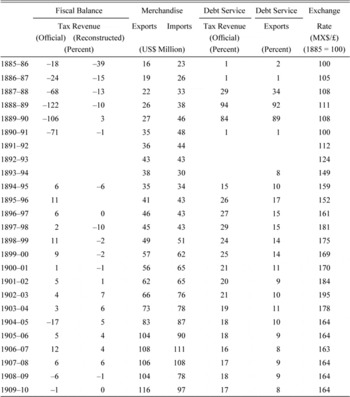
Table 1 shows a long-term improvement in macroeconomic fundamentals. The table reports both official and reconstructed fiscal series. The latter is arguably more reliable, but the contemporaries had access to the former. The official data shows a worse picture than the reconstructed series in the earlier period. Nevertheless, both still indicate that the government ran large fiscal deficits in the 1880s, when generous railway subsidies and expensive domestic debt increased expenditure (Marichal Reference Marichal, Ludlow and Silva1993, p. 443). Subsequently, there was a considerable improvement in the accounts.
MEXICAN MACROECONOMIC FUNDAMENTALS, 1885–1909

Sources:
Cuentas del Tesoro Federal for official fiscal data; Estadísticas Históricas de México for reconstructed fiscal data and exchange rate; Ficker (Reference Ficker2002) for trade; Memoria de la Hacienda for debt.
The ratios between services on the sovereign debt, tax revenue, and exports were low in the mid-1880s and extremely high at the end of that decade. This increase occurred due to a settlement that converted the old defaulted debt in 1885. The government issued £15 million of conversion bonds, which it could buy back at a 40 percent discount before December 1890 (SHCP 1989, pp. 152–55). Even with such a deduction, the obligations were equivalent to 34.5 percent of taxes collected from 1888/89 to 1890/91 (INEGI 2000, p. 627).
The price of silver fell by one-half between 1890 and 1894 (Officer and Williamson 2015). Mexico depended on silver exports to finance a persistent merchandise (excluding precious metals) trade deficit (Ficker Reference Ficker2002). The peso was pegged to silver, and the exchange rate depreciation increased the cost of servicing the recently contracted debt, which was denominated in gold (Rosenzweig Reference Rosenzweig and Cárdenas1992, p. 64). Table 1 shows a steep fall in imports, which must have depressed customs revenue. The government failed to publish fiscal data during these years, most probably as a deliberate measure to avoid revealing how unsound its accounts were.
The weak peso did fuel foreign trade. According to Luís Catão (Reference Ludlow, Marichal, Ludlow and Marichal1998, p. 59), the exchange rate depreciation had limited inflationary impacts because the sale of indigenous land had broken up native communities, making the labor supply elastic. The trade boom reduced the ratio between services on the sovereign debt and exports. Customs revenues grew by 11 percent per year between 1894 and 1910. Meanwhile, the government introduced new domestic duties, particularly on consumption goods, and prevented expenditure from rising as much as revenue (Carmagnani Reference Carmagnani1994, pp. 146–56). The official data shows a more positive trend than the reconstructed series, with the government running a surplus already in 1894/95. However, both sources confirm that fiscal accounts improved in the second one-half of the 1890s. The ratio between services and tax receipts both fell because of the increase in taxation and the adoption of the Gold Standard in 1904/05, which made the exchange rate appreciate (Stelo Reference Stelo2009).
This orthodox fiscal policy was associated with the rise of the científicos, a group of policymakers who considered sound budgets a precondition for the building of state capacity. The reduction of borrowing costs was a means towards that end. The científicos aimed to attract foreign capital to promote economic growth and increase taxation, with the final goal of making the state strong enough to protect sovereignty. Preserving independence was a crucial issue in a country that had been invaded by nearly every world power. This nationalist ideology was at the core of Díaz's generation—the president launched his political carrier as a hero of the war against a French occupation (Russell Reference Russell2010, pp. 188–213). The científicos formed a younger group that applied that principle to capital internationalization and public finance. For this reason, Weiner (Reference Weiner2000, p. 646) characterizes them as “ambivalent internationalists,” who opened the economy for nationalistic reasons. The most eminent científico was José Yves Limantour, the finance minister and major debt negotiator between 1893 and 1911.
These changes in macroeconomic fundamentals are consistent with the fluctuations in credit conditions. The cost of the debt is given by the risk premium, defined as:

where:
-
r jt = risk premium applied to the bond j in period t;
-
YTMjt = yield to maturity applied to j in t;
-
δ t = yield on the British consol (the benchmark) in t.
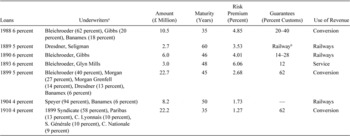
Table 2 reports the risk premium applied to the Porfirian loans. It also shows other relevant information: the composition of the syndicates that underwrote the operations, the guarantees that backed the debt and the use of resources.
MEXICAN SOVEREIGN LOANS, 1888–1910

Notes:
a The contracts of the 1889, 1890, and 1893 loans do not specify the share of bonds each underwriter accounted for.
b The revenue from the Tehuantepec railway guaranteed the 1889 loan.
Sources:
SHCP (1989); IMM.
Maturity varied across the bond issues. For this reason, Equation 1 calculates risk premium with the yield to maturity, the return on bonds from a given point t until the final redemption. The data on interests, discount, and maturity are from Colección de Leyes y Disposiciones Relacionadas con la Deuda Exterior de México, which contains the contracts of Mexican loans (SHCP 1989). The return on the British consol, the benchmark of the time, is from the Investor's Monthly Manual (hereafter IMM).Footnote 2
Following Equation 1, it is possible to measure Mexican risk, that is, the cost of the credit available for the government on the secondary market, defined as:

-
R t = Mexican risk in period t;
-
kjt = market capitalization of bond j in t; thus ∑j kjt is the amount of Mexican bonds outstanding in t.
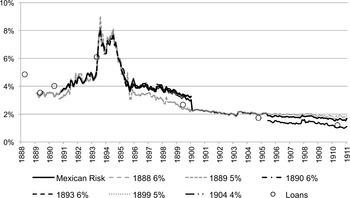
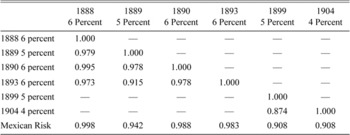
Equation 2 measures Mexican risk as an average of the risk premium applied to all bonds floating on the market at a given time t, weighted according to their respective capitalization. Mauro, Sussman, and Yafeh (Reference Mauro, Sussman and Yafeh2006) and Suzuki (Reference Suzuki1994, p. 14) also calculate country risk with all floating bonds taken into consideration. This methodology captures the heterogeneity among different bonds. The 1889 bonds had the lowest risk premium during most of the time, and the 1899 bonds were riskier than the 1904 bonds. These comparisons appear in Figure 1, which shows the risk premium for each bond issue and Mexican risk as defined in Equation 2. The risk premiums applied to the 1889 and 1904 bonds are less correlated to Mexican risk than those applied to the 1888, 1890, and 1893 bonds. However, all coefficients of correlation are above 0.90, indicating that Mexican risk is representative (see Appendix 2). The graph also contains the risk premiums at which the loans were issued, plotted in the months the government signed their respective contracts.
MEXICAN RISK AND RISK PREMIUM APPLIED TO LOANS, 1888–1913

The data on bond prices are from three different sources: the IMM, the New York Stock Exchange (hereafter NYSE), and the Bulletin de la Côte (hereafter BC), which report the quotes from London, New York, and Paris, respectively.Footnote 3 Between 1888 and 1899, underwriters from Amsterdam, Berlin, Brussels, London, and, to a smaller extent, New York issued Mexican bonds. It is beyond the scope of this article to research the quotations of these bonds everywhere they were floated or to determine the market shares. The London Stock Exchange was the most liquid of these markets, which justifies why Mauro, Sussman, and Yafeh (Reference Mauro, Sussman and Yafeh2006) use the IMM for the loans issued in those years. Arbitrage kept prices at similar levels in different markets. For instance, the coefficient of correlation between the prices of the 1899 bonds in London and New York was 0.95 between 1899 and 1910.Footnote 4 New York received most of the 1904 bonds, so the data on that issue are from the NYSE. The 1910 bonds do not appear in the IMM and the NYSE. A group of French banks underwrote a large share of that debt, so the data are from the BC.
Mexico started borrowing at a relatively high risk premium, around 4 percent, and Mexican risk rose sharply in the early 1890s, reaching 8 percent. Credit conditions deteriorated as the silver price fell and a default in Argentina caused the Baring Crisis, which, according to Kris J. Mitchener and Mark Weidenmier (Reference Mitchener and Weidenmier2008), raised the cost of capital across Latin America. According to Michael Tomz (Reference Tomz2007), bad borrowers upgrade their status if they honor obligations in spite of adverse conditions. This was Mexico's case. The government paid services during the crisis. Once silver prices stabilized, in the second one-half of that decade, the rapid economic recovery reflected in the trade and fiscal data reinforced Mexico's reputation. The Economist (26 March 1898, p. 407) reported that “the position attained by Mexican Government finance in recent years […] is a very creditable one, especially considering that it has been reached in face of considerable and unavoidable difficulties.” Mexican risk fell rapidly and fluctuated around 2 percent in the 1900s. The government had become a respected borrower, a long way from the serial defaulter it had been until the early Porfiriato.
UNDERWRITERS AND PRICE RUN-UPS
The bank owned by the Berlin financier Gerson von Bleichroeder was the main underwriter of Mexican debt. According to Fritz Stein (Reference Stein1980, pp. 426–27), Otto von Bismarck influenced Bleichroeder to underwrite Mexican bonds as part of an effort to expand Germany's economic influence. The syndicate that underwrote the first Porfirian loan also included Banamex, a semi-official bank. Banamex was privately owned but held prerogatives on tax collection, state banking, and money issuing (Maurer Reference Maurer2002, pp. 93–114). Based in Mexico with a branch in Europe, it was in charge of transferring funds between the government and bondholders (SHCP 1989). The other underwriters of the earlier Porfirian loans, issued between 1888 and 1893, were Dresdner, from Germany, and Gibbs and Glyn Mills, minor partners from London.
Once it established a reputation, the government widened the range of underwriters through which it borrowed. The syndicates in charge of Mexico's later loans included JP Morgan and Speyers, from New York, and a number of French banks, the most important of which was Paribas. None of these houses were at the top of the world market, a position exclusive to first-class British houses (Flandreau et al. Reference Flandreau and Flores2011, p. 9). The six decades of default on a London debt was so persistent a stain on the country's record that the government was limited to second-class banks. When Minister Limantour attempted to involve Rothschilds in the 1899 loan, the bankers promptly refused, even though they recognized that Mexico was a “coming country.”Footnote 5
While the government failed to access first-class underwriters, it still managed to borrow at relatively cheap rates in 1899, 1904, and 1910. These loans were issued at risk premiums below Mexican risk; in other words, they offered investors less return than the majority of the older bonds already on the market (see Figure 1). The underwriters must have expected to profit in some way, most probably by holding the new debt and subsequently selling it at a higher price. They could do so because the lending contracts only specified the issuing discount, establishing that the banks were “free” to arrange the floating of the bonds on the secondary market at any rate “at their own risk” (SHCP 1989). The contracts of the 1888, 1889, and 1899 loans protected the underwriters to some extent. The debt was issued in installments and the banks had the option of not buying the bonds after the first portion (SHCP 1989). In spite of that clause, the underwriting of Mexican loans implied some degree of speculation. The lower the risk premium applied to the loans vis-à-vis Mexican risk, the more the bankers anticipated a subsequent rise in the price of such bonds, and so a fall in Mexican risk.
The 1899 and 1910 loans were conversions: the former converted a 6 percent into a 5 percent debt, which the latter converted into 4 percent bonds. By the time Mexico launched these operations, the market was trading the older debt around par. There was space for Mexico to issue these loans below Mexican risk. However, it will be shown later in this article that the 1910 syndicate intended to underwrite the bonds above that rate. It took a great deal of negotiation to convince them otherwise. The 1904 loan was not a conversion nor did it involve guarantees. Bargaining was the only reason why the risk premium applied to these bonds was lower than Mexican risk.
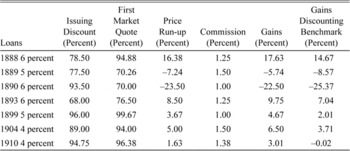
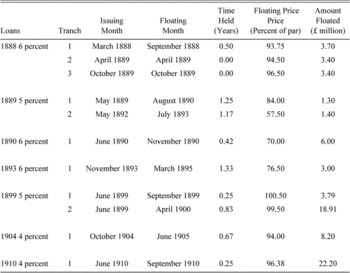
The underwriters of the late Porfirian loans did not lose money when they “bet” on the improvement of Mexican credit. Still, they profited much less than the syndicate that underwrote the first Mexican loan. Table 3 shows how much the banks gained through debt underwriting. The gains are given by the commission charged on each loan and the price run-ups (the difference between the issuing discounts and the prices at which the bonds were first quoted on the market).
GAINS FROM UNDERWRITING MEXICAN LOANS, 1888–1910

Sources:
Market data from IMM for the bonds issued between 1888 and 1899, NYSE for the 1904 bonds, and BC for the 1910 bonds; SHCP (1989) for commission.
It is impossible to investigate the underwriter's books for the prices at which they resold the bonds to the final creditors. Besides the large number of banks involved, a fire destroyed most of Bleichroeder's archive (the Harvard Business School Library holds the remainder). The use of data from the markets that absorbed this debt is a second best solution. The choice of sources does not affect the results, since the 1904 and 1899 bonds appeared on the IMM and the NYSE in the same month and at the same price. The 1910 bonds were quoted in the BC but not in the IMM and the NYSE.
The 1888 loan was by far the most lucrative operation. This profitability is also noted by Carlos Marichal (Reference Marichal and Liehr1995, p. 363), but according to him the underwriters sold the bonds at 92 percent, which is somewhat lower than the prices found for this article. The following two loans were bad business because of the fall in Mexico's bond prices in the early 1890s. After facing substantial losses with the 1890 loan, Bleichroeder profited in 1893, although not nearly as much as in 1888. Apart from the 1889 and 1890 loans, the last three operations were less profitable than the earlier ones. The 1910 loan was the least lucrative: it resulted in a smaller return than the British consols. This appears in the last column of the table, which discounts the underwriters' gains for the return on the consols during the period between the issuing of the bonds and the date they appeared on the market.
Price run-ups varied much more during the early Porfiriato. As Mexico became creditworthy, taking bonds “in firm” and selling them on the market was less risky. This is consistent with Flandreau and Flores (Reference Flandreau and Flores2009, p. 669), who have found that run-ups were proportional to risk. A better reputation enabled Mexico to issue debt at risk premiums lower than Mexican risk because the underwriters expected to be able to gain from positive run-ups, although small ones. However, market conditions were not the only explanation for the improvement in borrowing terms. The government still had to negotiate, as the remainder of this article will demonstrate.
THE 1888–1893 LOANS
The Swiss financier Edouard Noetzlin was the key player behind Mexico's return to the world market. Noetzlin was the founder of Banamex and the agent who organized the syndicate that underwrote the 1888 loan (Ludlow Reference Ludlow1990, pp. 982–84). The literature on Banamex focuses on its role as the state's main domestic creditor (Marichal Reference Marichal, Ludlow and Silva1993; Maurer Reference Maurer2002; Passananti Reference Passananti2007). But Noetzlin also intended to use the bank to profit from Mexico's foreign-denominated debt. In 1884, shortly after Banamex's creation, the government assigned the financier the double task of negotiating a settlement on the old debt in London and arranging a new loan abroad. The contract included a flagrant conflict of interests, as it established that “Mr. Noetzlin will arrange with the Bank [Banamex] the commission he is entitled to receive for the service.”Footnote 6 According to Leonor Ludlow and Marichal (Reference Ludlow, Marichal, Ludlow and Marichal1998, pp. 16–17), the commission turned out to be predictably high: the equivalent of £2.3 million. Congress refused to ratify Noetzlin's contract and Mexico converted the debt the following year in a settlement arranged by the Finance Minister Manuel Dublán (Marichal Reference Marichal and Liehr1995, p. 363).
It is striking that Noetzlin would coordinate the 1888 syndicate only a few years after having his debt settlement rejected in Congress, especially given the borrowing conditions that he had proposed. In a cable to Díaz, Francisco Mena, the Finance Ministry's agent in Europe, stated that the issuing discount rate of 78.5 percent was too low and the commission, at first established at 2.5 percent, was too high.Footnote 7 The underwriters reduced the commission to 1.25 percent, but the discount remained unchanged. Mena wrote that Noetzlin “is very dangerous to our country.”Footnote 8 The president justified the agreement with the following words:
I owe millions of pesos to the Banco Nacional [Banamex], which has got half of the Federal Treasury in its pocket, but nonetheless keeps on providing me with funds […] because [Banamex] has its sights on the [1888] loan, for which it will demand to be my confidant with Bleichroeder.Footnote 9
Díaz's administration depended on Banamex to finance the domestic debt, a short-term obligation that totaled the equivalent of £22.8 million in 1887/88.Footnote 10 The quote suggests that Banamex continued to finance such an unsound borrower because Noetzlin sought to organize the first sovereign loan of the Porfiriato. Maintaining a line of credit to the government gave him considerable leverage over the president.
The contract of the 1888 loan required the government to use the bulk of the funds to redeem the bonds issued in the 1885 conversion (SHCP 1989, p. 15). This cleared Mexico's record and created the possibility of further loans. Noetzlin was well aware of the opportunity. Already in 1888 he informed Díaz that Bleichroeder's syndicate “wish to participate in the finance of the Tehuantepec railway,” a state owned company under construction.Footnote 11 Mexico borrowed abroad to finance the Tehuantepec, but it did so through other banks: Dresdner and Seligman. According to Richard J. Salvucci (Reference Salvucci2009, p. 287), the 1888 loan contract had a “hidden” clause according to which the borrower could not issue new debt with other banks. If such a clause existed, the government did not comply, revealing its preference for credit diversification.
As it accessed foreign creditors, the government paid its obligations with Banamex. The contracts of the 1888 and 1893 loans, respectively, destined 6 and 10 percent of the borrowed funds to this end, but the government apparently used more than that (SHCP 1989, pp. 311–13). The public debt the bank held fell by 58 percent between 1888/89 and 1893/94 and was completely redeemed in the following year.Footnote 12 Those domestic-denominated obligations had higher interest rates and shorter maturities than the credit Mexico was accessing abroad (Marichal Reference Marichal, Ludlow and Silva1993). However, this was not the only reason for the swap. Once it became less dependent on Banamex in 1896, the government implemented a new law that limited the bank's role in the economy. In addition, Limantour pressured the Mexican board to reduce Noetzlin's influence within the organization (Passananti Reference Passananti2008, pp. 11–12, 21). Díaz and his cabinet seem to have learned a dire lesson in 1888. They ensured that Noetzlin would not use Banamex to impose adverse borrowing conditions again.
Sebastian Camacho, Mexico's new financial agent in Europe, also learned a fact from the 1893 loan. Mexico issued that facility in the middle of the silver crisis. The bonds were listed on the market only in 1895, by when the price of Mexican bonds had recovered, resulting in an 8.5 percent price run-up (see Table 3). Camacho wrote to Limantour that “the increase in our securities has enabled the Syndicate to profit brilliantly with the sale that they have lately made.”Footnote 13 Both officials were in charge of arranging the loans of the late Porfiriato, and the understanding that Bleichroeder had profited in that fashion shaped their approach to debt negotiations in the following years. This time, they counted on a good reputation and sound finance to defend the interests of the Treasury.
THE 1899 CONVERSION
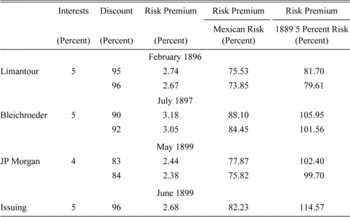
The improvement of Mexico's credit in the second one-half of the 1890s created the possibility of the conversion of the 6 percent debt into 5 percent. Limantour and Camacho agreed that the syndicate in charge of that operation would include several different banks to “balance the power that the Bleichroeder house has gained over the credit of the country.”Footnote 14 They established a target for the discount rate: from 95 to 96 percent.Footnote 15 Bleichroeder proposed to underwrite the loan between 90 and 92 as soon as the market quoted the old bonds at 98 percent of par, which happened in July 1897.Footnote 16 Camacho understood that Bleichroeder would “hold the bonds to sell them at a much higher price later on,” and classified the proposal as “immoral.”Footnote 17 After looking for alternative underwriters in London and Paris,Footnote 18 Limantour received a good offer in New York. JP Morgan and City Bank proposed the issuing of 4 percent bonds at a discount of between 83 and 84 percent.Footnote 19
Table 4 shows the risk premiums that correspond to the conditions presented during the negotiations. The months referred to in the table are the dates when the quotes appeared in the correspondence, except for Bleichroeder's offer. There is no data on maturity, so all risk premiums have been calculated at 45 years, the maturity of the actual loan.
1899 LOAN: OFFERED AND ISSUING CONDITIONS

Sources:
Offer conditions from AJYL; return on British consol and Mexican Risk from NYSE and IMM.
The American offer was better than the one from Bleichroeder—it corresponds to a lower risk premium. Nonetheless, the government ended up issuing 5 percent bonds at a 96 percent discount with a syndicate that included Bleichroeder, Dresdner, the British house Morgan Grenfell, and, surprisingly, JP Morgan. According to Passananti (Reference Passananti, Ficker and Pietschmann2006, p. 191), Bleichroeder arranged the introduction of JP Morgan so that the Mexicans would not exploit the rivalry between two competing syndicates. Archival material confirms that the officials intended to do so. Díaz was confident that the bankers in Europe would present a proposal that “does not differ much from the average level until now established by the Americans.”Footnote 20 Camacho believed that “the American offer surprised [the European banks] and will certainly force them to be more reasonable in their new proposals.”Footnote 21
Yet the deal was not the failure Passananti (Reference Passananti, Ficker and Pietschmann2006) presumes for three reasons. First, Mexico managed to issue the conversion at a 96 percent discount, the top of the range Limantour had established as a target. This was a consequence of Mexico's improved reputation as well as the minister's efforts in negotiating. Limantour waited until the price of Mexican bonds increased to a level at which Bleichroeder was more likely to comply. This can be seen in the comparison between the quotes and Mexican risk. The ratios between the risk premiums that Bleichroeder first presented and Mexican risk were 0.84 and 0.88 at the opening of negotiations. If one considers that the banker defined his offer based on market conditions, this indicates that the lowest risk premium at which he was willing to underwrite the new debt was 84 percent of Mexican risk. Limantour's target was way below that in 1896 (0.74 to 0.76), but not far in 1899. The growing appetite for the country's bonds among the public was crucial to making that target acceptable. However, the ratio between the issuing risk premium and Mexican risk (0.82) was still lower than that same ratio in Bleichroder's first offer (0.84 and 0.88). This suggests that the banker compromised to some extent in order to set the deal at the conditions the Mexicans wanted.
The Treasury benefited from the negotiations in spite of their long duration. The government received £1.13 million more than if it had agreed to Bleichroeder's first offer (average of 91 percent discount rate). Discounting for the higher interest it paid on the 6 percent bonds while negotiating the new 5 percent loan, the government gained a total of £735,800. This is a significant sum that corresponds to 16 percent of tax receipts in 1898–1899.Footnote 22 Had the minister rushed to accept Bleichroeder's first offer in 1897, the government would have been worse off.
Second, Passananti (2004) implies that the inclusion of JP Morgan in the syndicate prevented the government from issuing the loan at better conditions in New York. Nevertheless, the Mexicans did not intend to turn their debt into a Wall Street business. The American offer was only a bargaining tool to deal with the Europeans. Once Limantour turned it down, Díaz congratulated him for “refusing the volatile banks [and] pursuing the true goal of your journey […] in Europe.”Footnote 23 Camacho stated that it “would not be convenient for the Mexican government if Europe completely lost her interest in the country's public securities.”Footnote 24 Weiner (Reference Weiner2000, p. 668) points out that those at the head of the Porfirian state considered the growing American influence over the Mexican economy as a major threat to sovereignty.
JP Morgan and City Bank presented the best quote the market allowed. This follows from a comparison between their offer and the 1889 bonds, which traded at a risk premium significantly lower than the other bonds in the two years that preceded the 1899 loan.Footnote 25 As the least risky of the Mexican bonds, this debt was a benchmark. It indicated to what extent the bondholders would welcome a new loan. Unless a shock suddenly changed market conditions, the banks were unlikely to lose money with a negative price run-up if they underwrote the new bonds above the risk premium applied to the 1889 bonds. The American syndicate proposed a range of risk premiums that did not differ significantly from it (the ratios were 1.00 and 1.02). Had Limantour accepted their offer, the government would have accessed the final creditors as if there were no underwriters intermediating the lending, and the American syndicate would have probably profited very little or nothing at all. Yet the government issued the loan through a broad European-based syndicate at a risk premium that was 15 percent higher than the risk applied to the 1889 bonds. That was a price Mexico paid to limit its growing economic relations with the United States.
Finally, the loan was not a failure because the Mexicans fulfilled their goal of diversifying credit sources. Limantour arranged the participation of Dresdner, the underwriter of the 5 percent 1889 loan. The bank offered to convert the debt into 4 percent bonds, maintaining the guarantees on the Tehuantepec railway. The minister suggested the issuing of 5 percent bonds without any guarantees in order to include these obligations in the wide conversion the government was about to launch.Footnote 26 The presence of Dresdner and JP Morgan in the syndicate reduced the share of Bleichroeder to 40.3 percent of the bonds (SHCP 1989, p. 19). Bleichroeder was still the most important underwriter, but it was a long way from being the Mexico's patron bank.
THE 1904 AND 1910 LOANS
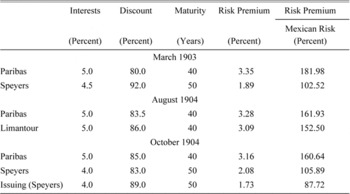
The 1904 loan financed the redemption of short-term notes that the government had issued in the early 1900s to nationalize railway companies.Footnote 27 Paribas and Speyers were in charge of those notes. Both banks competed to underwrite the new loan. Noetzlin acted as an intermediary in the talks between the government and Paribas, which formed a syndicate with Bleichroeder and the New York house Kuhn Loeb. The financier proposed to underwrite a 5 percent loan that would also be used to redeem the petit bleu, some bonds Mexico had issued during a French occupation in the 1860s. The uprising that expelled the French had led to that debt being repudiated, so the Paris bond market had been closed to the Mexican government thereafter (Topik Reference Topik, Ludlow and Silva1993, p. 452). According to the Noetzlin's offer, Mexico would receive 80 percent of the bonds' face value after the redemption of the petit bleu.Footnote 28 Limantour considered the proposal to be “impracticable” and “exorbitant.” The minister informed that “a US bank” would launch the loan at a 4.5 percent interest rate and a 92 percent discount rate.Footnote 29 The financier increased the discount rate to 83.5 percent, but Limantour demanded a further rise to 86 percent.Footnote 30 Noetzlin presented his final offer: 85 percent. In the same month, Speyer reduced the interest rate on its offer to 4 percent.Footnote 31 Limantour would finally accept this proposal.
Table 5 summarizes the quotes made in the negotiations for the 1904 loan. In order to compare them, it reports the discount rates Noetzlin proposed excluding the cost of converting the petit bleu. Paribas intended to issue 40-year bonds. Speyer never referred to maturity but ended up underwriting a 50-year loan in 1904.Footnote 32 Thus, risk premiums have been calculated at 40-year maturity for Paribas and 50-year for Speyers.
1904 LOAN: OFFERED AND ISSUING CONDITIONS

Sources:
Offer conditions from AJYL; return on British consol and Mexican Risk from NYSE and IMM.
A few weeks before Mexico issued the loan, Limantour proposed the merger of both syndicates.Footnote 33 If the promotion of cooperation after more than a year of competition was really his final goal, the plan backfired, as Speyers and Kuhn Loeb refused to share the role of underwriter in New York.Footnote 34 Nonetheless, the final result turned out to be quite positive for Mexico. In order to secure exclusivity, Speyer raised the discount rate from 83 percent to 89 percent.Footnote 35 This corresponds to a 1.73 percent risk premium, which was below Mexican risk. Still, Limantour insisted in forming a wide syndicate unless Speyer paid for the redemption of the petit bleu.Footnote 36 James Speyer, the head of the bank, regretted such “threats” but agreed to buy the old bonds with his own funds so that the “Government will sell us [the] whole loan.”Footnote 37
The petit bleu was a matter of national pride: it was a souvenir of a period when Mexico was an easy prey in international wars. For this reason, Limantour insisted that the underwriters were supposed to “take the entire loan, including all expenses and the petit papers,”Footnote 38 which they would “deliver to the Government.”Footnote 39 Topik (Reference Topik2000, p. 732) argues that the minister intended to counteract the opposition of more nationalistic Mexicans who condemned his French origins. With Díaz growing older, Limantour was a natural candidate to replace the dictator in office. According to a Paribas' agent who was sent to Mexico on Noetzlin's behalf, the minister played tough because of “personal politics.”Footnote 40
Following the 1904 loan, Speyer attempted to become Mexico's patron bank. It proposed to convert the 1899 bonds, Mexico's other debt apart from the 1904 bonds. The first time Speyer mentioned such a proposal, in 1906, Limantour replied that a deal would only be possible if Paribas was involved, which Speyer refused.Footnote 41 Speyer made another offer three years later. This time he was willing to underwrite 4 percent bonds at a 90 percent discount.Footnote 42 Limantour characterized the deal as premature and warned that he would only agree if “expenses [were] reduced to a minimum.”Footnote 43 The members of the 1899 loan—Bleichroeder, Dresdner Bank, Morgan Grenfell, and JP Morgan—offered to underwrite the conversion at a 4.5 percent interest rate and a 90 percent discount. However, the minister insisted on setting the interest rate at 4 percent.
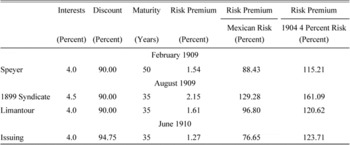
With the petit bleu out of the way, Noetzlin suggested the introduction of the French banks Paribas, Crédit Lyonnais, Société Générale, and Comtoir National d'Escompte into the 1899 syndicate.Footnote 44 The minister welcomed the proposal, but regretted that he could not simply impose the inclusion of those houses. Instead, he decided to “ask too high a price for the new bonds, so the [1899] syndicate will be practically forced […] to reach an agreement with the major French houses.”Footnote 45 This was a quite successful ploy, as the 1899 syndicate accepted the French banks, which underwrote 42.5 percent of the loan (SHCP 1989, p. 34). This broader syndicate lowered the interest rate to 4 percent and raised the discount to 94.75 percent, the final offer, as shown in Table 6.
1910 LOAN: OFFERED AND ISSUING CONDITIONS

Sources:
Offer conditions from AJYL; return on British consol and Mexican Risk from IMM.
Mexico ended up having its bonds underwritten at below Mexican risk. It is notable that the 1899 syndicate had no intention of doing so in the previous year. The issuing conditions were better than Limantour's counteroffer not only in absolute terms, but also in comparison with Mexican risk. The 1899 syndicate's first offer was 161 percent of the risk premium applied to the 1904 bonds, the least risky at the time, but Mexico ended up issuing the loan at only 124 percent. This was not far from the minister's counteroffer, which was 121 percent of the risk on the 1904 bonds. In the 1890s, the Mexicans had to wait for their credit to rise on the secondary market to set the deal at a previously established risk premium. Now they managed to improve their own target. Negotiations forced the underwriters to agree to terms that, at first, appeared too good vis-à-vis market conditions.
CONCLUSION
The Mexicans negotiated borrowing terms according to their country's reputation. They accepted the conditions Bleichroeder offered between 1888 and 1893. The long period of embargo was still recent and macroeconomic fundamentals were poor. Matters changed once sound fiscal policy improved Mexico's capacity to pay. Based on its newly-established status as a more reliable borrower, the government bargained with several underwriters from both sides of the Atlantic to borrow at the conditions they wanted in 1899, at better than expected terms in 1904, and at a record low risk premium in 1910. The will to negotiate is also consistent with the fact that all these banks were second-class underwriters. The stable association with one of them would not improve Mexico's reputation as much as an eventual deal with, for instance, Rothschilds. However, the latter was not a choice.
Yet factors specific to Mexico also conditioned this forceful approach to debt negotiations. The government never accepted a patron bank, even when it was still considered a bad borrower. To a large extent, the history of invasions explains this preference for credit diversification. Most of the military career of Díaz and his comrades consisted of fighting invading troops. Once in power, the dictator built a state capable of preserving political sovereignty and economic independence. The ability to deal with different foreign groups—including debt underwriters—was part of that goal.
Free from a patron bank, Finance Minister José Yves Limantour used the offers from American banks to bargain with European underwriters. The United States was a major source of foreign investment—a consequence of geographic proximity that explains why Mexico was ahead of other countries in exploiting this transatlantic rivalry: the 1899 and 1904 loans were the first such operations in Wall Street's history (Carosso and Sylla, 1991, pp. 60–61). Hence, this case study indicates that the hypothesis in Flandreau and Flores (Reference Flandreau and Flores2009, Reference Flandreau and Flores2011, Reference Flandreau and Flores2012) is valid. Nonetheless, it should be combined with country-specific characteristics in order to fully explain the governments' rationale when dealing with debt underwriters.
In Mexico, the government prevented the underwriters from using its debt as a source of rent. This is remarkable because some of these bankers sought to act as rent-seekers. Thanks to the special role that Banamex played in Mexico, its founder Noetzlin and partner Bleichroeder substantially profited from the 1888 loan. Evidence suggests that these financiers aimed to gain exclusivity on debt underwriting in order to profit every time Mexico issued a new loan. Speyer also attempted to become Mexico's patron bank. Stakes increased as Mexico became creditworthy. The final creditors accepted the bonds at prices higher than before, which created the possibility of larger turnovers. However, Limantour and his collaborators fostered competition to improve borrowing terms. The factors that conditioned this will to negotiate—reputation and ideology—prevented rent-seeking exactly when rents would otherwise have been the highest.
In the end, Mexico issued loans at rates below Mexican risk, close to the risk premium applied to the less risky bonds floating on the secondary market. Negotiations reduced the cost of debt intermediation, narrowing the gap between the borrower and the final creditors. If underwriters were gate keepers, those negotiating on behalf of the Porfirian state widened the gate so that the government could pass and enter the market without being hassled by the keepers.
Appendix 1 Data Sources
The manuscripts researched for this article are held at the following archives: Archive Historique Paribas [AHP], Paris; Archivo General Porfirio Díaz [AGPD], Universidad Iberoamericana, Mexico City; Archivo José Yves Limantour [AJYL], Condumex, Mexico City; Archivo Histórico Banamex [AHB], Mexico City; and Bleichroeder Collection [BCOL], Harvard Business School Library, Boston.
The prices of Mexican bonds are from: The Investor's Monthly Manual [IMM], available online at: http://som.yale.edu/faculty-research/our-centers-initiatives/international-center-finance/data/historical-london; New York Stock Exchange [NYSE], available online at: https://www.globalfinancialdata.com; and Bulletin de la Côte [BC], available online at: http://catalogue.bnf.fr.
Data on Mexican loans are from Colección de Leyes y Disposiciones Relacionadas con la Deuda Exterior de México, which contains their respective contracts and has been published by the Secreataría de Hacienda y Crédito Público [SHCP] in 1989.
Official fiscal data are from Cuentas del Tesoro Federal, a contemporary publication held at the Fondo Histórico de Hancienda, Lerdo de Tejada Library, Mexico City. Reconstructed fiscal data are from Estadísticas Históricas de México, published by the Instituto Nacional de Estadística, Geografía e Informática [INEGI] in 2000.
Appendix 2
CORRELATION OF RISK PREMIUMS APPLIED TO MEXICAN BONDS, 1889–1910

Appendix 3
ISSUING AND FIRST MARKET QUOTES OF MEXICAN BONDS, 1888–1910