1 Introduction
In a previous ultrasound study (Zharkova, Hewlett & Hardcastle Reference Zharkova, Hewlett and Hardcastle2011), we found that the tongue posture for /ʃ/ was influenced by the nature of the following vowel, in the syllables /ʃi ʃu ʃa/, in children aged approximately seven years, as well as adults: the tongue postures of ʃa compared to ʃi and of ʃa compared to ʃu were distinct from each other at the midpoint of the consonant, although the tongue postures of ʃi compared to ʃu were not distinct, in either group.Footnote 1 The data set used in that earlier study also contained /si/, /su/ and /sa/, recorded in a similar way by the same participants, and these latter syllables have now been processed and analysed, for the study reported here. We aimed to establish whether the tongue shape for /s/ was, like that for /ʃ/, influenced by the nature of the following vowel, in children as well as adults.
Measuring the extent to which the pronunciation of a syllable-initial consonant varies systematically according to the identity of a following vowel, and comparing the effects in adults and children, can be done either by measuring the time of onset of an effect or by comparing the size of any coarticulatory effect at a selected time-point. One can ask, for example, at what time-point during the articulation of an initial /s/, in a /sV/ syllable, the influence of the vowel first becomes apparent and attribute earlier onset of influence to greater coarticulation; or one can choose a certain time-point within the period of frication and compare the size of effect (if any) on the consonant at that point. The latter approach was adopted in the study reported here. The selected time-point was the temporal midpoint of the initial consonant. It was expected that the children's /s/ durations would be longer than the adults’ (Lee, Potamianos & Narayanan Reference Lee, Potamianos and Narayanan1999) and that use of a relative time-point of this sort would exert a normalising influence over variations in duration. The presence or otherwise of a vowel effect on the initial consonant was determined by measuring differences between the consonant tongue contours in different vowel environments, as described in more detail in Section 2 below. In this as in other respects, the methodology used in this study was similar to that used for the study reported in Zharkova et al. (Reference Zharkova, Hewlett and Hardcastle2011).
One motivation for choosing the strategy of measuring vowel-induced coarticulatory effect at the midpoint of the consonant, was an attempt to ensure that the object of measurement was indeed ‘coarticulation’ as opposed to being part of the ‘transition’ from consonant to vowel. Admittedly, a distinction between coarticulation and transition is much easier to make conceptually than it is to identify in practice, unless there is a requirement that the vowel effect is present from the beginning of the consonant, which is probably too strong a requirement. However, if an effect is tested for up to, or nearly up to, the onset of the vowel, the finding of an effect at some point is more or less inevitable, because the articulators cannot change from their position for the consonant to their position for the vowel in zero time. The question of interest in the present study was whether the child participants, as well as the adult participants, would adapt the posture of the tongue towards that of the impending vowel, whilst simultaneously implementing the fricative target.
In contrast with the acoustic signal, ultrasound data from tongue imaging provide direct evidence of articulatory movements (e.g. Stone Reference Stone2010). The main advantage of ultrasound over other articulatory techniques, such as electropalatography (EPG) and electromagnetic articulography (EMA), which have been used to assess speech development in young children (e.g. Katz & Bharadwaj Reference Katz and Bharadwaj2001, Nijland et al. Reference Nijland, Maassen, Hulstijn and Peters2004, Timmins et al. Reference Timmins, Hardcastle, McCann, Wood and Wishart2008), is that nothing is inserted into the speaker's mouth; the transducer is placed below the chin, and the image of the tongue surface is produced on the screen.
1.1 Coarticulation of /s/ in children and adults
Does coarticulation appear early or does it develop later over the time-course of speech acquisition? The empirical findings to date are quite various but on the whole they tend to favour early acquisition of coarticulation and some of the evidence has been interpreted to mean that young children actually coarticulate more than older children and adults do (see Zharkova et al. Reference Zharkova, Hewlett and Hardcastle2011 for a review). It may be, however, that whether children coarticulate more or less than (or to a similar degree to) adult speakers depends partly on the particular sounds or sound sequences involved and /s/ is an interesting case in this regard.
The work of Recasens and his colleagues (e.g. Recasens, Pallarès & Fontdevila Reference Recasens, Pallarès and Fontdevila1997; Recasens Reference Recasens1984, Reference Recasens2002; Recasens & Espinosa Reference Recasens and Espinosa2009; Farnetani & Recasens Reference Farnetani and Recasens2010; Recasens & Espinosa Reference Recasens and Espinosa2010; see also Fowler & Brancazio Reference Fowler and Brancazio2000) has focused on elaborating a hierarchy of resistance to coarticulation among both consonants and vowels, and much of their work has included analysis of the coarticulatory potential of /s/ and /ʃ/. The Degree of Articulatory Constraint (DAC) model of lingual coarticulation was described in Recasens et al. (Reference Recasens, Pallarès and Fontdevila1997). In vowel–consonant–vowel (VCV) sequences, labial consonants, which allow large amounts of lingual coarticulation, are assigned a DAC value of 1. The freedom of lingual consonants to adapt to the tongue position of an adjacent sound is constrained by the demand for a certain lingual posture by the consonant itself. Among the lingual consonants, alveolopalatals such as /ʃ/ receive the highest DAC value of 3, because the posture of the tongue dorsum is critical in the production of these sounds and this severely limits their potential for adaptation to the tongue posture of a following vowel. Most alveolar consonants have a DAC value of 2 but /s/ has an uncertain history in this respect. Recasens et al. (Reference Recasens, Pallarès and Fontdevila1997) decided on a DAC value of 3, equivalent to /ʃ/, since an EPG and acoustic study showed /s/ to have greater resistance than other alveolar consonants, probably because of a requirement to create a medial groove in the tongue (see also Stone et al. Reference Stone, Faber, Raphael and Shawker1992, Hoole, Nguyen-Trong & Hardcastle Reference Hoole, Nguyen-Trong and Hardcastle1993). Later, in Recasens & Espinosa (Reference Recasens and Espinosa2009), VCV sequences with several Catalan consonants and the vowels /i/, /a/ and /u/ were analysed using EMA. The authors found that the lingual posture of /s/ varied as a function of vowel environment more than that of /ʃ/ did (see Pouplier, Hoole & Scobbie Reference Pouplier, Hoole and Scobbie2011, who reported in an EPG study that /s/ assimilated towards /ʃ/ in /s#ʃ/ sequences more than /ʃ/ assimilated to /s/ in /ʃ#s/ sequences). Recasens & Espinosa's explanation for this result was that the main articulator for /s/ is the tongue tip/blade which is comparatively light and agile whereas that for /ʃ/ is the ‘more sluggish’ tongue dorsum and ‘fronting and raising the tongue dorsum blocks the coarticulatory activity of other tongue regions’ (Recasens & Espinosa Reference Recasens and Espinosa2009: 2289). So we might expect a strong vowel effect on /s/, at least when comparing the tongue posture in the context of /a/ with that in the context of /i/ and comparing the tongue posture in the context of /a/ with that in the context of /u/, in both our adult and child participants, since they both showed a vowel effect on /ʃ/, as reported in Zharkova et al. (Reference Zharkova, Hewlett and Hardcastle2011).
The results of previous studies on /s/-coarticulation in children and adults suggested a likelihood that children would coarticulate /s/ at least as much as they do /ʃ/ and at least as much as adults. In two acoustic studies, Nittrouer, Strudett-Kennedy & McGowan (Reference Nittrouer, Studdert-Kennedy and McGowan1989) and Nittrouer, Studdert-Kennedy & Neely (Reference Nittrouer, Studdert-Kennedy and Neely1996) measured F2 at 30 ms before voicing onset in pronunciations of /si sasu ʃi ʃaʃu/ by adults and by three-, five- and seven-year-old children and found evidence of greater coarticulation at this time-point on the part of the children than adults. Katz & Bharadwaj (Reference Katz and Bharadwaj2001) made direct articulatory measurements of tongue tip and tongue body movements, using EMA, during pronunciations of /s/ and /ʃ/ in the syllables /si su ʃi ʃu/. Their participants were six seven-year-old and three five-year-old children, and eight adults. They found that the tongue positions of /s/ in /si/ and /s/ in /su/ diverged from each other at an earlier time-point in the production of the syllable in children than in adults. In light of these findings, we hypothesised that our data would show systematic differences in tongue posture according to the identity of the following vowel, at the temporal midpoint of /s/.
1.2 The vowels /i/ and /u/ in Scottish English
In Zharkova et al. (Reference Zharkova, Hewlett and Hardcastle2011), no effect was found on initial /ʃ/, in either children or adults, according to whether the following vowel was /i/ or /u/. This was attributed to the comparatively fronted tongue position with which /u/ is articulated in Scottish English, rendering it, in lingual position, nearer to that of /i/ than is the case in most other accents of English. We hypothesised that an effect would nevertheless be found on /s/, given the greater coarticulatory facility that has been reported for this consonant (Recasens & Espinosa Reference Recasens and Espinosa2009, Pouplier et al. Reference Pouplier, Hoole and Scobbie2011).
1.3 Within-speaker variability
Reduction in within-speaker token-to-token variability with age is a very well-established finding (e.g. Kent & Forner Reference Kent and Forner1980, Sharkey & Folkins Reference Sharkey and Folkins1985, Nittrouer Reference Nittrouer1993, Smith & Goffman Reference Smith and Goffman1998, Lee et al. Reference Lee, Potamianos and Narayanan1999, Nijland et al. Reference Nijland, Maassen, Meulen, Gabreëls, Kraaimaat and Schreuder2002, Walsh & Smith Reference Walsh and Smith2002, Riely & Smith Reference Riely and Smith2003, Nittrouer et al. Reference Nittrouer, Estee, Lowenstein and Smith2005, Walsh, Smith & Weber-Fox Reference Walsh, Smith and Weber-Fox2006, Koenig, Lucero & Perlman Reference Koenig, Lucero and Perlman2008). In our previous investigation, using the data from /ʃ/ productions, we found that the tongue contours of the children were, as expected, significantly more variable than those of the adults. In this study, we aimed to confirm that this was also the case with /s/.
1.4 Hypotheses
The study was designed to address the following three hypotheses:
1. Midsagittal tongue contours of adults, at the temporal midpoint of /s/ in a /sV/ syllable, differ systematically according to the identity of the following vowel.
2. Midsagittal tongue contours of children, at the temporal midpoint of /s/ in a /sV/ syllable, differ systematically according to the identity of the following vowel and to a greater extent than in adults.
3. Midsagittal tongue contours of children, at the temporal midpoint of /s/, exhibit greater unconditioned variability than those of adults.
2 Method
2.1 Participants and stimuli
There were 10 typically developing child participants and 10 adult participants. All of them were native speakers of Standard Scottish English. The mean age for the children was 7;7 (years;months) and the age range was between 6;3 and 9;9. The mean age of the adults was 33 years and the range was between 27 and 46 years.
The stimuli were the syllables /si/, /su/ and /sa/, in the carrier phrase ‘It's a ___ Pam’. The target syllables were spelt as 〈sea〉, 〈Sue〉, 〈Sah〉. The sentences were shown to the participants on the computer screen, accompanied by images corresponding to the target words (the syllables /su/ and /sa/ were introduced as names of imaginary creatures). Every target was repeated ten times. The order of presentation was randomised.
2.2 Data collection
Synchronised ultrasound and acoustic data were collected using the Queen Margaret University ultrasound system (Articulate Instruments 2007, 2008). The ultrasound frame rate was 30 Hz and the estimated margin of error in the temporal matching of ultrasound frame to acoustic signal was +/– 40 ms. Special headgear was used for stabilising the position of the transducer with respect to the head (Scobbie, Wrench & van der Linden Reference Scobbie, Wrench and Linden2008), in order to allow for comparisons across multiple repetitions. A cubic spline was fitted to the on-screen tongue contour coinciding most nearly with the temporal midpoint of /s/. The fitting was carried out automatically but subject to subsequent manual correction. The contour was then captured as a set of xy points (approximately 100 per curve).
2.3 Comparison of tongue curves: Statistical approach
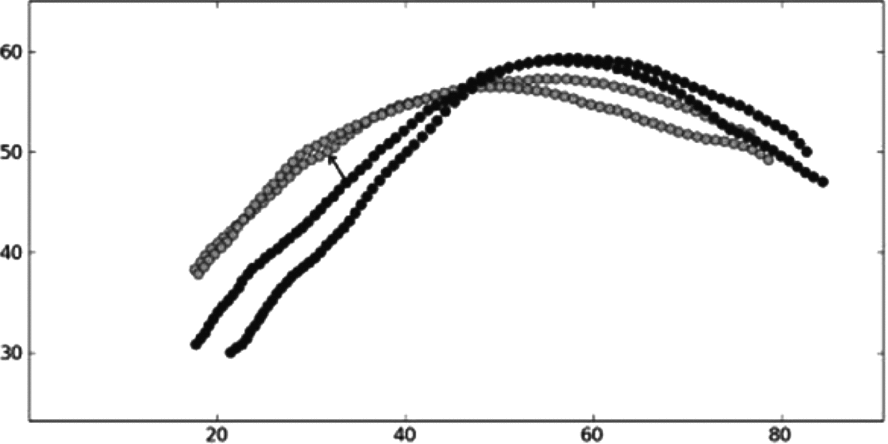
The use of ultrasound data for investigating coarticulation is quite novel and therefore a relatively lengthy account of the method used in our study is given here. The analysis is somewhat unusual in phonetics in that numerical comparison is made between whole curves. Each curve is defined by a series of xy values. To aid understanding of the description that follows, Figure 1 shows two sa curves and two si curves, taken from the same speaker in the same experimental session. The annotation on the figure is explained later in this section. The curves represent the imaged tongue surface outline along the midsagittal line. The front of the tongue is on the right. The origin of the X and Y axes does not correspond to any landmark in the vocal tract area. The hard palate was not traced in this study (see Epstein & Stone Reference Epstein and Stone2005, for methodological details on collecting palate contours with ultrasound). The portion of the tongue that is imaged by the ultrasound probe may vary slightly. The largest source of variation is at the anterior end: when the tongue tip/blade is raised such that there is air beneath it, this portion fails to be included in the image. Posteriorly, the curve usually ends at the tongue root meeting the shadow of the hyoid bone. (It makes no sense to directly compare the xy values of two curves taken from two different vocal tracts, of course, and within our set-up it is also not possible to directly compare two curves taken from different experimental sessions because consistency of transducer orientation and location cannot be guaranteed.)
Two sa curves (light circles) and two si curves (black circles), produced by the same speaker. An arrow represents the nearest neighbour distance from a point on a si curve to one of the sa curves. The scale is in millimetres.
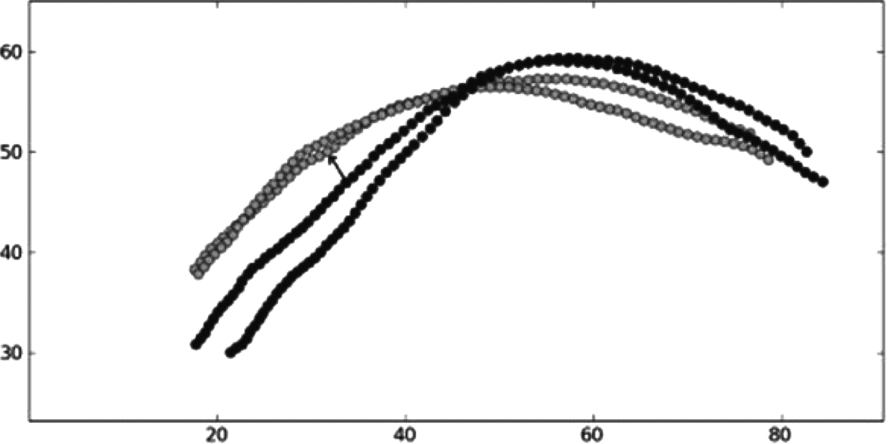
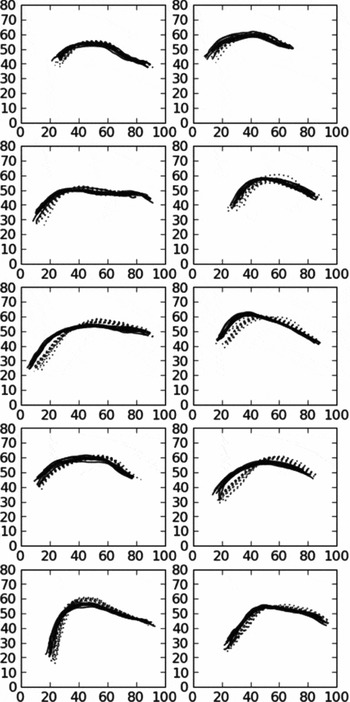
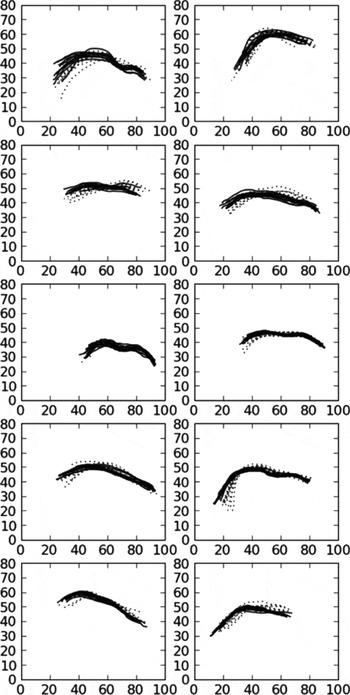
Quantification of the difference between tongue contours was carried out in Python (Lutz Reference Lutz2008). The data to be analysed consisted, for each participant, of a collection of curves residing in a two-dimensional space. While all curves were derived from /s/, the goal of the analysis was to discover if the shape, location or orientation (the latter refers to the position of the tongue contour on a continuum of ‘the pivot pattern’ of tongue movement, as described in Iskarous Reference Iskarous2005) of the curves had been affected by the categories to which they belonged, namely sa, si or su. For example, were the si curves significantly different in shape, location or orientation from the sa curves (see Figures 2 and 3, presenting ten sa curves and ten si curves on a single plot, separately for each speaker)? The categories were compared in a pair-wise fashion, since, for example, si and sa might turn out to be distinct while si and su were not. In order to determine the degree of separation between the curves in one category and those of the other, the absolute distance was calculated between all possible, unordered pairs of curves such that one member of the pair was in one category and the other member was in the other; for example, the distance was measured between a sa curve and a si curve, for all possible such pairs. The measurement technique was the so-called nearest neighbour distance, which involves calculating the mean of all the Euclidean distances between each point on one curve and its nearest neighbour on the other (Zharkova & Hewlett Reference Zharkova and Hewlett2009). A single nearest neighbour distance between one point on one of the si curves and its nearest neighbour on one of the sa curves, is shown in Figure 1. Since there were ten curves in each of the two categories, there were 102 = 100 pairs of curves. The resulting 100 mean distance measurements were called the across-set (AS) distances. The within-set (WS) distances were the distances between all possible, unordered pairs of curves within the same category. Since there were ten curves in a category (because each participant supplied ten curves per category) there were (10 × 9)/2 = 45 mean distance measurements in each category. Since there were two categories involved, the total number of WS distances involved in any comparison (such as that between the sa curves and the si curves) was 90. The reasoning was that if a vowel effect was present, then the AS distances should significantly exceed the WS distances.
Tongue contours for ten repetitions of sa (solid curves) and ten repetitions of si (dotted curves) in all adult speakers. Adults 1–5 are on the left, and Adults 6–10 are on the right.

Tongue contours for ten repetitions of sa (solid curves) and ten repetitions of si (dotted curves) in all child speakers. Children 1–5 are on the left, and Children 6–10 are on the right.

The presence of a coarticulatory effect on /s/ was tested for in each group, by comparing AS distances and WS distances, with ten participants in each group, and ‘Participant’ being a random factor. The question arose whether the mean WS distance entered into the test should be the mean of all 90 WS distances or whether two separate means should be used, one from the 45 WS distances from one category and the other from the 45 from the other category. For example, should the AS distances between sa and si (ASsa–si) be tested against the WS distances in sa (WSsa) and the WS distances in si (WSsi), pooled into a single set, or should they be tested first against the WSsa distances and then, in a separate test, against the WSsi distances? The latter alternative was decided upon because of a small risk that arises from the presence of unequal variances in the two sets of WS distances. In an extreme case, the AS distances might exceed the WS distances purely because of a difference in the amount of scatter in the two sets of curves that are being compared. To appreciate this, suppose that the sa curves and the si curves had identical shape and orientation but the si curves were tightly bunched together in the midst of a widely scattered set of sa curves. This would obviously not be a case of coarticulation but rather a case in which, for some reason, /s/ had a greater variability of tongue location in one vowel context than another. Nevertheless, the AS distances could exceed the pooled WS distances, in such a situation. Therefore, two tests for significance were carried out on each pair of consonant categories, with the stipulation that both must be significant in order for a vowel effect to be deemed to have occurred.
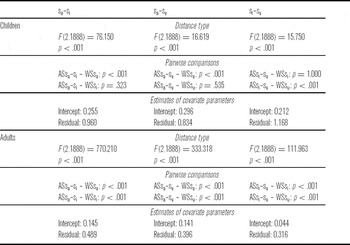
It should be emphasized that the child and adult groups were tested separately for the presence or absence of coarticulation. For each group, linear mixed models, with REML estimation method, were carried out in SPSS, one for each of the three vowel pairs. The fixed factor, called ‘Distance Type’, comprised of three distances: one set of AS distances and two sets of WS distances. For example, when testing for a distinction between sa and si, ASsa–si distances were compared with WSsa distances and with WSsi distances. For each vowel pair, the data from all participants in the group were analysed in the same model, with ‘Participant’ being a random factor in the analysis. For each participant, there were 100 AS distances and two sets of 45 WS distances. Estimated marginal means for the fixed factor (i.e. ‘Distance Type’) were compared using Bonferroni adjustment. If the main effect of Distance Type was significant, and the results of the pairwise comparison showed that the AS distances were significantly greater than each of the WS distances, it was concluded that vowel identity in this case had produced a significant coarticulatory effect on /s/. In each linear mixed model, a probability value of less than .05 was required for the main effect of Distance Type and for both pairwise comparisons, i.e. AS versus WS for one vowel context, and AS versus WS for the other vowel context. In summary, the following pairwise comparisons were made, for each group: ASsa–si vs WSsa; ASsa–si vs WSsi; ASsa–su vs WSsa; ASsa–su vs WSsu; ASsi–su vs WSsi; ASsi–su vs WSsu. Variance components were estimated within each linear mixed model. The outcome was checked against that obtained through the Variance Components procedure in SPSS with ANOVA Type III. Using estimates of covariance parameters (Intercept represented variation due to participant identity, while Residual represented the rest of the variation), it was assessed how much of the variation of the dependent variable could be explained by participant identity.
2.4 Comparison of tongue curves by visual examination
Exploration of individual differences in coarticulation and of the characteristic patterns of tongue shape, location and orientation in different participants was undertaken on the basis of visual examination of the curves.
2.5 Within-speaker variability
Greater variability is reflected in greater WS distances, in these data. WS distances for /s/ were compared across age group, in an independent directional t-test. For this purpose, all WS distances, in all vowel contexts, were pooled in each group. As a function of differential vocal tract size, greater distances would be expected between the tongue contours of the adults than those of the children, other things being equal. In the event that adults exhibited greater WS distances than children, normalisation for vocal tract size would be carried out on the basis of relative length of tongue contour, among all the participants. However, if children demonstrated significantly greater WS distances than adults, a normalisation procedure would be unnecessary.
3 Results
3.1 Coarticulatory effects
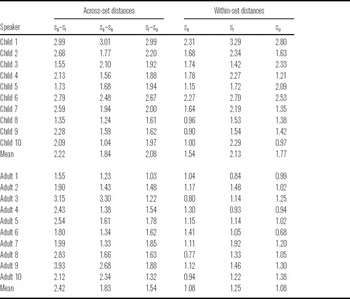
The mean AS and WS values for the child and adult groups are presented in Table 1. In one case the possibility of a significant vowel effect could be dismissed without recourse to statistical testing: in the child speakers, the mean WSsi was actually greater than the mean ASsi–su, and to qualify for a vowel effect the AS distance had to be significantly greater than the WS distance in each of the component vowel contexts.
Mean across-set distances, in mm, for sa–si, sa–su and si–su, for each participant; mean within-set distances, in mm, for each target segment and for each participant.

Table 2 contains the results from six linear mixed models, including the main effect of Distance Type, comparisons of estimated marginal means for the main effect, and estimates of covariance parameters. As our criteria for the presence of a coarticulatory effect included not only significant differences, but also greater AS than WS distances, the results from Table 1 are drawn upon to interpret the results from Table 2. For the adult group, in all three vowel pair contexts, there was a significant effect of Distance Type, and the AS distance was significantly greater than both WS distances, indicating that the adults had significant vowel effects in all comparisons. In children, the effect of Distance Type was significant for all three vowel pair contexts. However, the comparison between si and su in children was mentioned above (see Table 1). As for the other two vowel pairs in children, ASsa–si was not significantly greater than the WSsi, and the ASsa–su was not significantly greater than the WSsu. Therefore the criterion of achieving a significant difference between AS and both WS distances was not met, for either pair.
Results of the statistical testing for the presence of coarticulatory effects. ‘ASsa–si’ is across-set distance between sa and si; ‘ASsa–su’ is across-set distance between sa and su; ‘ASsi–su’ is across-set distance between si and su; ‘WSsa’ is within-set distance in the context of /a/; ‘WSsi’ is within-set distance in the context of /i/; ‘WSsu’ is within-set distance in the context of /u/.

3.2 Comparison of tongue curves by visual examination
Figure 2 shows the sa (solid lines) and si (dotted lines) tongue contours for each of the ten adult participants. For most speakers, it can be seen that the posterior tongue tends to have a more forward position in si, and a region in the front of the tongue tends to be higher, compared to sa. Figure 3 shows a similar record for the ten child participants, in which the pattern just described for the adults is absent or barely apparent. The difference between the two groups is not absolute, however. There are several children in whom an adult-like pattern seems to be developing, particularly Child 9 (this was the oldest child, aged nine years nine months). Conversely, there are individual adults in whom a difference between the tongue contours of the two contexts is barely discernable, notably Adult 1, Adult 4 and Adult 6. The two ways of estimating variance components produced exactly the same results. Participant identity accounted for up to about a quarter of the variation of the dependent variable: in the /a–i/ context, 21% in children and 23% in adults; in the /a–u/ context, 26% in both children and adults; in the /i–u/ context, 15% in children and 12% in adults.
3.3 Within-speaker variability
The child mean WS value was 1.81 mm, while the adult mean value was 1.14 mm. The t-test showed that this difference was significant at the .001 level, and since the child value exceeded the adult value, correction for vocal tract size was not necessary.
4 Discussion
For the adults, the hypothesis that the tongue contours at the midpoint of /s/ would show an effect from the following vowel was fully supported. They even differed according to whether the following vowel was /i/ or /u/, a result which was not achieved by the productions of /ʃ/ by the same participants (Zharkova et al. Reference Zharkova, Hewlett and Hardcastle2011).Footnote 2 The nature of the adaptation, as illustrated in Figure 2, accords with aspects of the articulatory differences between /a/ and /i/, namely that the latter has a more advanced tongue root and a higher and more fronted tongue position than the former (see Iskarous, Shadle & Proctor Reference Iskarous, Christine and Proctor2011, where the tongue dorsum in /s/ produced by American-English–speaking adults in words of the form /sVd/, was shown to be more anterior in front vowel contexts than in back vowel contexts already at the onset of /s/).
The surprising finding among the results was the lack of a significant vowel effect on the part of the children (the criteria for establishing a coarticulatory effect were not met for the vowel context /i/–/u/, and were only partly met for the other two vowel contexts); the hypothesis was in their case rejected. We think that these results could be explained by invoking the concept of tongue differentiation, and applying it to the development of coarticulation in children. In a mature lingual motor control system, there is more scope for coarticulation of /s/ than of /ʃ/, in consonant–vowel (CV) syllables, since there is less potential for conflict in the dorsal region with the tongue posture of a following vowel (e.g. Recasens & Espinosa Reference Recasens and Espinosa2009). However, speakers can only avail themselves of the full coarticulatory opportunities offered by /s/ if they are able to control tongue tip and tongue body to some extent independently. Anticipating the tongue posture of the vowel during the production of an alveolar fricative requires a certain degree of independence in controlling tongue tip/blade and tongue body. Gibbon (Reference Gibbon1999; see also Gick et al. Reference Gick, Bacsfalvi, Bernhardt, Oh, Stolar and Wilson2008) found that a lack of such independence was characteristic of some children with a developmental speech sound disorder and suggested that it might also, to some degree, be a feature of typical immature speech. Some suggestive empirical findings on the development of coarticulation in normal speech are reported in an EPG study by Cheng et al. (Reference Cheng, Murdoch, Goozée and Scott2007b, see also Cheng, Murdoch & Goozée Reference Cheng, Murdoch and Goozée2007a). Their data included /s/ but they did not analyse any coarticulatory properties of this sound. They did, however, measure anticipatory coarticulation in the initial consonant cluster /kl/ and found a forward shift with age in the place of articulation of the velar consonant. The biggest difference was observed between their 6–7-year-old group and the older participant groups: ‘The first sign of adult-like tongue-tip–tongue-back coordination was observed in the 8–11-year-old group, and continual refinement of lingual coordination continued into late adolescence’ (Cheng et al. Reference Cheng, Murdoch, Goozée and Scott2007b: 387). Based on these findings, it is reasonable to explain our results by suggesting that the children were unable to take advantage of the latitude allowed by an /s/ articulation (as compared with /ʃ/) in the positioning of the tongue body, because they could not yet control different parts of the tongue separately from each other, with sufficient precision. It seems that /k/, in the context described in Cheng et al. (Reference Cheng, Murdoch, Goozée and Scott2007b), may share similar difficulties of tongue differentiation that are suggested by our findings to prevail with /s/.
Visual examination suggests the presence of a dip along the midsagittal tongue surface, between the tongue front and back in some of the children (Children 1, 2, 3, 8, 9). This pattern is largely absent in the adults (with the possible exception of Adult 2). One possible interpretation is that children have a greater portion of the tongue included in the ‘tip’ than adults (or, in other words, the pivot point in the tongue between the body and tip may be relatively back in children compared to adults), which would be likely to lead to greater coupling with the rest of the tongue.Footnote 3
Based on the results from this study, our answer to the question of why children show less coarticulation than adults is that the children are limited by greater articulatory restrictions, which affect their ability to use the appropriate coarticulatory strategies for their language. We argue that the differentiation of tip/blade and dorsum in development of motor control of the tongue is gradual, and it has not been fully established by the age of nine years. In agreement with Cheng et al. (Reference Cheng, Murdoch, Goozée and Scott2007b), we have shown that constraints on independent movement of different parts of the tongue could inhibit coarticulation in certain circumstances, in children. Children may indeed have a propensity to coarticulate more than adults, but when it comes to adapting the tongue posture for /s/, the means are not yet available. The finding of the coarticulatory effect on /ʃ/ in children in our earlier study (Zharkova et al. Reference Zharkova, Hewlett and Hardcastle2011) is not in conflict with this explanation. Interarticulatory independence is necessary for the coarticulation of /s/ with a following vowel, but not (or far less so) for the coarticulation of /ʃ/, which relies on allowable shifts (i.e. shifts which do not compromise the acoustic-auditory identity of /ʃ/) in the whole of the forward part of the tongue, in one vowel context as compared to another.
4.1 Conflict with previous findings
The results of the present study are in apparent conflict with some previous findings on children's versus adults’ coarticulation of /s/, in particular those of Nittrouer et al. (Reference Nittrouer, Studdert-Kennedy and McGowan1989, Reference Nittrouer, Studdert-Kennedy and Neely1996) and Katz & Baradwaj (Reference Katz and Bharadwaj2001), which were described briefly in the introduction to this article. We address first the acoustic studies of Nittrouer and her colleagues. The 1989 study found no vowel effect on the fricative spectrum of /s/ at 100 ms or 30 ms before vowel (/i/ or /u/) onset, in children or adults, but there was an effect on F2 at 30 ms before vowel onset. The interesting aspect of their findings was a downward trend with increasing age in the amount of coarticulation that occurred (the age groups were three, five and seven years and adults). The 1996 study reported similar findings with respect to F2 at 30 ms before the vowel (the vowels were /a/ and /i/). The effect on F2 at this time-point is probably due to movements of the tongue, including the blade and tip, in the transition from the position required for the fricative towards that required for the vowel. As Nittrouer et al. (Reference Nittrouer, Studdert-Kennedy and McGowan1989: 384) put it, ‘[t]hus, at this location within the syllable (i.e. 30 ms before voicing onset), children's articulatory gestures appear to be further advanced towards their vowel targets than those of the adults’. The conflict in findings between the Nittrouer studies and the present study may be at least reduced by characterising the findings of the former as primarily reflecting the fricative–vowel transition late on in the fricative whereas the present study has demonstrated adaptations of tongue posture (or the lack of them, in the case of the child participants) in parts of the tongue that are not crucial to the creation of frication, and at an earlier time-point.
Explaining the conflict with the findings of Katz & Bharadwaj (Reference Katz and Bharadwaj2001) may be approached along similar lines. While we found an effect from all vowel pairs on mid-/s/ in the adults but not in the children, they observed an effect on /s/ from the /i/–/u/ vowel pair in the children at 100 ms before the vowel, an earlier measurement point than in the adults. Their EMA study used two lingual coils. One (described as the tongue-tip coil) was placed 1 cm behind the very tip of the tongue. The other was described as the tongue body coil and was obviously placed further back but no indication was given of its precise location. The differences in tongue contour found in the present study, due to the following vowel, particularly those involving /i/ versus /a/, can be explained in large part by differences in the position of the tongue root, which cannot be monitored in an EMA study because participants cannot tolerate a coil placed any further than the upper root. It is possible that the effects reported by Katz & Bharadwaj (Reference Katz and Bharadwaj2001) for their child participants might be due to a transitional movement of the forward part of the tongue towards the position for the vowel. If their child participants had longer fricative durations, as they did in our study (in which the mean adult duration of /s/ was 172 ms and that of children was 207 ms) then it is also possible that 100 ms before vowel onset the children would have completed a greater proportion of the change in tongue position between consonant and vowel than did the adults, simply because the children's tongue movements were slower.
4.2 Variability: Tongue placement or phasing?
The third hypothesis, of greater variability on the part of the children, was supported. It should be emphasized that these were group differences and Figures 2 and 3 clearly illustrate that the group trends cannot necessarily be projected onto an individual speaker, in either group. This is to be expected in the child group, since age can be assumed to be only a rough-and-ready guide to stage of speech motor development, especially in this particular age group of around seven years, when speakers are probably about to acquire more typically adult-like coarticulatory patterns (see Cheng et al. Reference Cheng, Murdoch, Goozée and Scott2007b). There is good reason to accept the possibility of individual variations among adults as well. Ghosh et al. (Reference Ghosh, Matthies, Maas, Hanson, Tiede, Ménard, Guenther, Lane and Perkell2010), for example, reported significant inter-speaker differences in the extent to which adults contrast their pronunciations of /s/ and /ʃ/, differences which correlated with differences in the auditory and somatosensory acuity of the speakers. The question of individual differences among adult speakers in coarticulatory behaviour has not, so far as we are aware, been much researched (see a review in Kühnert & Nolan Reference Kühnert, Nolan, Hardcastle and Hewlett1999).
Among the children, there was a strong tendency for greater variability in the tongue posture of si than of sa or su, a tendency which was little evident among the adult participants. The explanation for this greater variability in the tongue posture of si may have to do with the change in the mid-line profile of the tongue between the fricative and the following vowel, which is greater in the case of si than of su or sa. Thus the greater WS distances of si in the children's tongue postures may be due at least partly to inconsistencies in phasing, from one token to the next, in the movement from the fricative towards the vowel. A slight advancement or retardation in this movement, in one token as compared with another, would be liable to produce larger differences in tongue position in the case of si. If this is true, then the greater variability found in the children may be due to a combination of inconsistency of tongue placement and inconsistencies of timing, compared to the adults. This observation in turn emphasises that while no coarticulatory effect was found in the child group as a whole, some tokens by some children may have been subject to a vowel effect at the midpoint of the fricative. It is noticeable, for example, that Child 9's tongue contours for si (see Figure 3) show considerable variation with respect to the degree of advancement of the back of the tongue, implying differential adaptation to the upcoming vowel. We hope to clarify the relationship between tongue posture and movement timing in future research, using a data collection system which has a faster ultrasound frame rate.
5 Conclusion
Our results on lingual coarticulation of the consonant /s/ in children and adults present a certain conundrum: on the one hand, the tongue has a relatively large scope for coarticulation in the case of /s/, though on the other hand we did not find a significant coarticulatory effect on /s/ from contrasting vowels in children. The resolution we suggest is that /s/ does not in reality have large scope for lingual coarticulation in the case of children, because of tongue differentiation considerations. While adults anticipate the tongue posture of the vowel during the production of an alveolar fricative by controlling tongue tip/blade and tongue body independently, it is possible that constraints on independent movement of tip/blade and body in children do not allow them to anticipate the tongue configuration of a following vowel whilst simultaneously implementing an initial /s/ sound. The apparent differences between our results and those of Nittrouer et al. (Reference Nittrouer, Studdert-Kennedy and McGowan1989, Reference Nittrouer, Studdert-Kennedy and Neely1996) and Katz & Bharadwaj (Reference Katz and Bharadwaj2001) might at least partly be explained by methodological differences, as we argue above – and otherwise the ‘truth’ must emerge from further empirical findings, particularly those using detailed dynamic information on tongue movement throughout the CV syllable. We would also stress the need to consider the patterns of individual speakers alongside a comparison between groups, firstly because there are attested differences even among adult speakers’ pronunciations of sibilant fricatives and secondly because a group of children of similar age is likely to include speakers at different stages of speech development.
Acknowledgements
We are grateful to Alan Wrench for technical advice, to Stephen Cowen for assistance with instrumentation, and to Robert Rush for advice on statistical analysis. We wish to thank Sonya Bird and two anonymous reviewers for very helpful comments. This work was supported by an ESRC research grant RES-000-22-2833.