Introduction
During the ‘golden age’ of the European social model, the German labour market policy regime had become a reliable supporting pillar of the employment and production system. It combined a range of objectives, including that of maintaining a high level of workforce qualification and securing the living standards of the middle classes by protecting the socio-economic status of working citizens (Bogedan et al., Reference Bogedan, Bothfeld and Sesselmeier2012). Despite its high degree of social acceptance, fundamental scepticism towards the Welfare State of the Bismarckian type arose in the late 1980s (Palier, Reference Palier2010). Since then, the German social state has seen fundamental change so that researchers continually proclaim the end of the conservative German model (Lessenich, Reference Lessenich2003; Bleses and Seeleib-Kaiser, Reference Bleses and Seeleib-Kaiser2004; Hinrichs, Reference Hinrichs and Palier2010; Seeleib-Kaiser, Reference Seeleib-Kaiser2016). The main argument of this contribution is that policy reforms since the mid-1990s have reinforced the erosion effect of earlier structural modifications of the 1970s and 1980s (see Offe, Reference Offe1987), as they are going along with a normative shift away from the logic of status-centredness towards a scheme that aims at quick re-employment and the provision of minimum security (Eichhorst et al., Reference Eichhorst, Grienberger-Zingerle and Konle-Seidl2010; Bothfeld and Betzelt, Reference Bothfeld, Betzelt, Betzelt und and Bothfeld2011). In contrast to earlier analyses, that rejected the idea of radical change of the unemployment security scheme through the reforms of the 2000s (Clasen and Goerne, Reference Clasen and Goerne2011; Dingeldey, Reference Dingeldey, Clasen und and Clegg2011), this article seeks to broaden the perspective and demonstrate that, taken together, all incremental policy reforms since the mid-1990s – and particularly those from 2000 onwards – have undermined the German labour market policy regime. We argue that the basic guiding norm of status-centredness has been undermined by the modification of the underlying principle of equivalence, the modification of the rules concerning the status protection of the unemployed and by changes to the funding mode of the active labour market policy regime.
Secondly, we argue that, in order to grasp ongoing change properly, we need a comprehensive methodological approach. First, we presume institutional equivalences and the interconnectedness of policies so that – instead of analysing single programmes alone – we suggest focusing on a whole set of programmes and instruments that form an (un-) employment policy regime (Schmid and Schömann, Reference Schmid and Schömann1994). Second, our analysis takes account of ideational shifts as we show that single legal modifications do not provide information about the degree of change but that rather we need to address the question of whether underlying norms and principles (here: the norms of equity and status-centredness) are affected by policy reforms. With Robert Cox we aim at ‘offering an interpretation of what recent [labour market] reforms mean’ (Cox, Reference Cox1998: 3). We thereby adopt a neo-institutionalist reasoning that underlines the possibility of the coexistence of different sets of ideas and of paradigmatic change through incrementalism (see e.g. Streeck and Thelen, Reference Streeck, Thelen, Streeck und and Thelen2005). However, we do not focus on ideas as driving factors for institutional change but re-address ‘the independent variable problem’ and consider the ideational structure, i.e. the substances of the policy, in order to assess the degree of change. Third, we argue for a more-dimensional research design in social policy analysis that simultaneously takes into account legal modifications and policy impact on the citizens. We therefore complement our institutional analysis of the German labour market policy regime by a secondary analysis of statistical data and empirical analyses illustrating the impact of the observable modifications.Footnote 1 Against this background we argue that the German labour market policy regime is undergoing a multitude of more or less incremental changes which result in the undermining of its core principle, the protection of the once-attained status as a reflection of individual and collective social rights.
To address this complex challenge, we will refer to the political concept of status as the backbone of continental social citizenship and derive from this concept three basic principles that translate the idea of status-centredness into policies and programmes: the norm of equivalence, protection of the socio-economic status and horizontal solidarity in funding. These three principles guide our empirical analysis, before we conclude with a more general reflection on the analysis of welfare state change.
Status protection as a guarantee for social rights of the middle classes
In continental social insurance systems, we find the logic of ‘status-centred’ social protection (Offe, Reference Offe1972), as opposed to the Nordic countries’ logic of universal or the Anglo-Saxon logic of needs-based social provision, each involving a certain degree of redistribution and resulting in different degrees of social inequality (Korpi and Palme, Reference Korpi and Palme1998). The limited capacity of the German scheme for redistribution has been largely accepted because (male) citizens, mostly in regular employment, were considered the main breadwinners of their families. The law accordingly required ‘a high level of employment’ and free access to regular employment for all citizens. This implicit social contract represented the foundation of the German post-war middle class society as long as the aggregate level of unemployment and the risk of irregular employment were low (Offe, Reference Offe2003). Of course its underlying gendered pattern of the division of labour has been repeatedly criticised (Betzelt and Bothfeld, Reference Betzelt and Bothfeld2011).
As membership of the middle class is mainly based on the status of being an employed citizen and the security provision that underpins this status, the logic of status protection is a precondition for the social acceptance of social policies and the basis of the legitimacy of the German social state as a whole. However, the concept of status is two-dimensional: it does refer to a legal framework as well as to the actual social position of each individual in a society. Both concepts are interconnected because the latter, the more sociological concept, is preconditioned by the former and can be analysed as the observable socio-economic status of a person, including his/her professional qualification, income level, or social prestige. Accordingly, social rights produce particular patterns of social stratification (Esping-Andersen, Reference Esping-Andersen1990) and contribute to the perception of social security (Chung and Mau, Reference Chung and Mau2014; Lübke and Erlinghagen, Reference Lübke and Erlinghagen2014). Offe underscores the significance of the legal status for an economic system and defines it as follows:
By ‘status’ I mean a positive and statutory (as opposed to merely tradition-based) bundle of rights and duties, standards, licenses, mandates, legally prescribed procedures, entitlements, subsidies, and privileges which are attached to virtually every participant in contractual economic transactions and the collective actors representing and governing these participants. [. . .] The measure of the strength of the status component of a capitalist economic system is the degree to which partners to contracts are endowed with non-negotiable entitlements and duties, as well as the degree to which obligations to third parties not immediately involved in economic transaction are stipulated and enforced by law. (Offe, Reference Offe2003: 442).
This political concept constitutes the core of the ‘European model of social capitalism’ or social citizenship (Offe, Reference Offe2003: 450) and is based on labour law, the social security arrangement, labour market policies and systems of collective bargaining (ibid.: 455). These rights have formed a typical middle-class status that became quasi-universal in the 1970s and has proven stable but not unalterable (Seeleib-Kaiser, Reference Seeleib-Kaiser2002; Lessenich, Reference Lessenich2003).
Distinguishing between these two different concepts of status allows for two-dimensional access to analysing social and labour market policy change. Whilst the institutional analysis provides information about the potential of policy change and changes in power relations, the analysis of socio-economic characteristics, behaviour or attitudes of social groups allows for conclusions about the actual effects of policy change. We claim that, for more than two decades now, the deregulation of the labour market, and cuts in social benefit programmes as well as in active labour market policies have undermined the logic of status protection (see also Hinrichs, Reference Hinrichs and Palier2010). These changes are embedded in a more comprehensive process of structural change (Offe, Reference Offe1987) that brought along the gradual erosion of the corporatist organisation of power (Palier and Thelen, Reference Palier and Thelen2010) and was accomplished through some of the fundamental institutional changes of the ‘Hartz-Reforms’. This development contributes to the erosion of the status-centredness and to an increasing perception of social insecurity within the middle class (Castel, Reference Castel2003). We suggest illustrating this process using the example of the German labour market policy regime.
Basic policy principles for status-centredness – equivalence, status protection, and solidarity
As we argue above, status-centredness rests on a package of formalised rules, rights, and standards which in their turn reflect three basic policy principles: equivalence, which defines the logic of benefit provision; status protection, which determines to what extent lifetime achievements in terms of occupational and income status can be maintained; and the principle of ‘industrial’ solidarity, which shapes the mode of funding the unemployment support scheme.
The principle of equivalence
Rather than a strict arithmetical mechanism, equivalence is here conceived as a legitimate and acknowledged normative principle in social insurance states. The principle of equivalence underscores individual commitment, effort, and investment as a counterpart to social provision in the event of social risk. It is based on the norm of equity which refers to a relationship of mutual obligations (Schmid, Reference Schmid and Schmid1994). Mutual obligations exist in all Western welfare states, in which citizens have the duty to pay taxes or insurance contributions or to be ready to take up employment (Marshall, Reference Marshall and Marshall1963). In the German social insurance scheme, equivalence is not defined in a very exact way (Nullmeier and Vobruba, Reference Nullmeier, Vobruba, Nullmeier, Pioch und and Vobruba1994), but aims at covering the needs of the average (middle-class) worker in accordance with their market position, reflected by the duration and amount of insurance contributions. Unlike in systems providing tax-financed basic security, insurance entitlements take the form of material individual rights.
Goodin's distinction of the criteria of mutual obligation – conditionality, currency and temporality – is inspiring in terms of his analysis of the inner structure of mutual relationships (Goodin, Reference Goodin2002). His concept of conditionality refers very simply to the relationship between two agents in terms of interdependence or reciprocity of their claims which, in a work-fare regime, is stricter than in insurance schemes (ibid.: 886). In unemployment insurance schemes, preconditions may be status-related or behaviour-related criteria or work-readiness (Clasen and Clegg, Reference Clasen, Clegg, Clasen und and Siegel2007). We therefore suggest adding to the conditionality criteria the idea of an ‘exchange rate’ of mutually provided goods to assess the ‘generosity’ of a mutual relationship. We would then assess the form and size of the provided good (or the level and duration of benefits or programmes, see Ozkan, Reference Ozkan2014). For example, tax-funded or contribution-based unemployment protection schemes will either provide flat-rate (means-tested) benefits or a proportional income replacement. They may or may not offer substantial training programmes or wage subsidies. And, the ‘exchange rate’ may even encompass (dis-) proportionality, e.g. when low contributions are compensated by minimum benefits or high contributions are fully insured or cut at a certain threshold. On the other hand, lower and upper thresholds of contributable income do not solely define the very income segment that is subject to mandatory insurance but they also stipulate the degree of equivalence. The same goes for the determination of the necessary period of contributions, which are important for fixed-term employed. Benefit duration may be more or less strictly equivalent to former contributory periods, may be indefinite (i.e. not equivalent at all, as in Belgium), may acknowledge ‘lifetime achievements’, or may be cut off after a certain time.
The ‘currency’ of the exchange, denominates the form of the ‘good’ a person has to offer in exchange for the benefit (Goodin, Reference Goodin2002: 588f). In unemployment insurance schemes, former contributions could be considered as such a ‘good’. Public insurance schemes may exclude (or not) certain forms of income (e.g. from self- or short-term employment) or acknowledge individual circumstances (leave or care periods) to be covered by insurance. These criteria define the selectivity or inclusiveness of a scheme.
Finally, Goodin points out the importance of ‘temporality’, i.e. the time during which an exchange of goods by persons bound by mutual obligations has to take place. In insurance schemes, the possibility of maintaining entitlements over a long period or the provision of long-term regular and maximum durations, offer temporal leeway for individuals to plan their careers and eventually choose options to organise their re-integration in the event of unemployment. On the contrary, stricter rules of conditionality – resulting in a higher pressure to re-integrate into the labour market – decrease the average duration of unemployment at the expense of the vocational matching of the new job.
In short, the equivalence principle provides a basic logic for the design of the system but the actual legal definition of equivalence may differ critically; it is, in every case, subject to political decision-making.
The principle of status protection
From the citizen's perspective, the protection of their achieved socio-economic status provides protected latitude in the case of unemployment. For this, the socio-economic status does not need to be high; it needs rather to be appropriate, reliable, and protected by law (Offe, Reference Offe2003). According to Rawls’ concept of fairness, a status hierarchy can be perceived as just if citizens have fair chances to participate in the labour market and to achieve social mobility through formal qualifications, work experience and seniority. But preconditions for social acceptance of social inequality are the universal access to good quality employment and, thus, a certain degree of labour market regulation. Accordingly, mechanisms of status protection typically refer to an average type of employment with regular working conditions and average payment as – ideally – realised by members of the middle class.
Technically, effective status protection would rely on a loose rather than straight concept of equivalence and be secured by generous replacement rates and benefit durations, the provision of active labour market programmes and a decent degree of labour market regulation that provides unemployed people with a fair chance to find an adequate job. However, according to search theory, status protection is in conflict with the objective of quick re-employment. This is why a broader definition of ‘suitable’ employment, that lowers the reservation wage and exerts pressure on working conditions, is regularly recommended by labour market economists. The fact that this systematically leads to higher penalties in terms of occupational status or income losses and that this may, in the long run, induce a dynamic of downward mobility and devalue former work and income potential is often ignored (for a discussion of work enforcement in conceptual terms, see Rafass, Reference Rafass2016). Additionally, aside from a couple of minimum standards, a decent and legally defined framework for the quality of employment exists neither on the international level nor even in the EU (Bothfeld and Leschke, Reference Bothfeld and Leschke2012). As a consequence, national governments – particularly in the welfare states of the Bismarckian type – are challenged by the problem of whether, and to what degree, status-protecting policies should be maintained and developed further.
The solidarity principle in financing social security
Finally, in the continental welfare states, unemployment insurance schemes are funded by social insurance contributions paid by employers and employees and topped up by taxes, realised through subsidies, loans or other mechanisms (Esser et al., Reference Esser, Ferrarini, Nelson, Palme and Sjöberg2013). The respective combination in each national policy regime reflects a specific type of societal solidarity. Solidarity is here realised, on the one hand, through the practice of paying uniform contributions not scaled according to risk. As a consequence, high insurance contributions correlate with a low probability of becoming unemployed and vice versa. This leads to a horizontal redistribution of risks between people who constitute ‘good’ risks and those who constitute ‘bad’ risks, or between jobs in domains exposed to cyclical up- and downturns and other branches of the economy as well as between regular and atypical employment contracts (Schmid et al., Reference Schmid, Reissert and Bruche1992).
On the other hand, solidarity is also realised by public, tax-funded subsidies when the employment status is considered as the ideal typical status that should be accessible for every single citizen. Instead of being a selective and segmenting mechanism, the German social insurance system has rather been considered as quasi-universalist (Leisering, Reference Leisering, Liebig, Lengfeld und and Mau2004). In fact, despite its marked gender bias (Betzelt and Bothfeld, Reference Betzelt and Bothfeld2011), the regular employment status has been the general reference for social and labour policies in the continental types of social states. Hence, tax subsidies reflect the fact that the costs of status protection, including the prevention of the loss of skills through the provision of active measures, represent a public responsibility and are borne by all: employers, employees and tax-payers. In Germany, the role of the state as a ‘deficiency guarantor’ was made explicit (Schmid et al., Reference Schmid, Reissert and Bruche1992) in order to compensate for the structurally limited financing mode of the Federal Employment Agency (FEA).Footnote 2 These structural problems result from the fact that contribution rates are calculated as a function of the expectations of economic and employment growth and that labour costs may not exceed a certain threshold based on competitiveness. As a consequence, rising unemployment systematically causes an anticyclical time lag in the fiscal adjustment (low revenue in periods of high expenditure). This is why experts have underlined the need for stronger anticyclical mechanisms of funding, such as allocating resources according to the variation and stock of unemployment (Schmid et al., Reference Schmid, Reissert and Bruche1992).
The incremental erosion of the status protection unemployment security scheme
In the beginning of 2017, the German unemployment rate was at less than six per cent. Nonetheless, given the approximately seven million transitions from employment towards unemployment and back per year, and the circa one million people remaining unemployed for longer than one year, unemployment protection and labour market policies remain a core issue in Germany. To what extent does the current insurance scheme still represent the norm of status-centredness?
The redefinition of equivalence
The German labour market policy regime was based on a rather generous concept of equivalence which has changed through the deregulation of employment contracts and minor legal modifications concerning the access to and the maintenance of the insurance status. For example, the period for gaining insurance entitlements was reduced from 36 to 24 months in 2005. At the same time, very short part-time work (mini jobs), temporary agency work and fixed-term contracts have been facilitated through modifications of the labour law so that atypical and low-wage employment increased significantly (Hinrichs, Reference Hinrichs and Palier2010: 16). And, finally, the rules of conditionality (e.g. the rules for registering as unemployed) have become stricter and publicly subsidised jobs are now exempted from the payment of unemployment contributions. Although the necessary minimum and maximum periods of mandatory insurance contributions for benefit entitlement have remained unchanged (at 12 months for 6 months and 24 months for 12 months of benefit duration) these new rules exclude a growing number of workers from entitlements, particularly fixed-term or temporary agency workers who have employment breaks between short-term contracts.Footnote 3 Surprisingly, overall average job tenure in the German labour market is so short that only 54 per cent of men and 61 per cent of women have job tenures of at least 12 months and only about 40 per cent reach the 24-month threshold (Giannelli et al., Reference Giannelli, Jaenichen and Rothe2013: 27);.
Further, the entitlements for older long-term contributors have been significantly downgraded. Above all, unemployment assistance that, after several earlier modifications, was still granted for an indefinite duration following the expiry of insurance benefit, was cancelled in 2005. This modification was crucial, because unemployment assistance had ensured the status as insured unemployed, recognising former, often long-term, work experience that was different from the (less deserving) status of social assistance beneficiary (Oorschot, Reference Oorschot2000). At the same time, the former maximum entitlement duration of 32 months for unemployed people older than 55 years (which had successively been increased during the coal and steel crisis in the mid-1980s) was reduced to 24 months for unemployed people over 58 years of age. As older unemployed people usually have less chance of being re-employed, these changes not only redefine the equivalence principle in a far stricter way, they also end the idea of acknowledging long years of contribution as a ‘lifetime achievement’. In fact, these changes increase the risk of poverty for elderly unemployed persons.
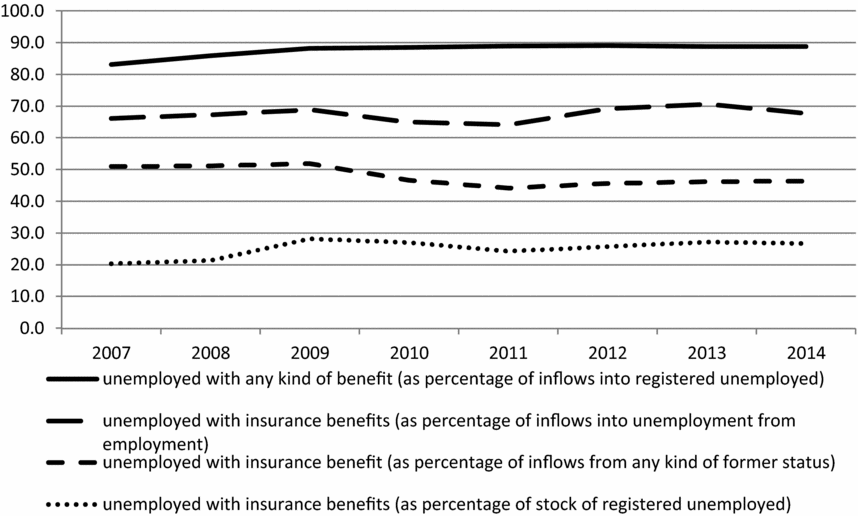
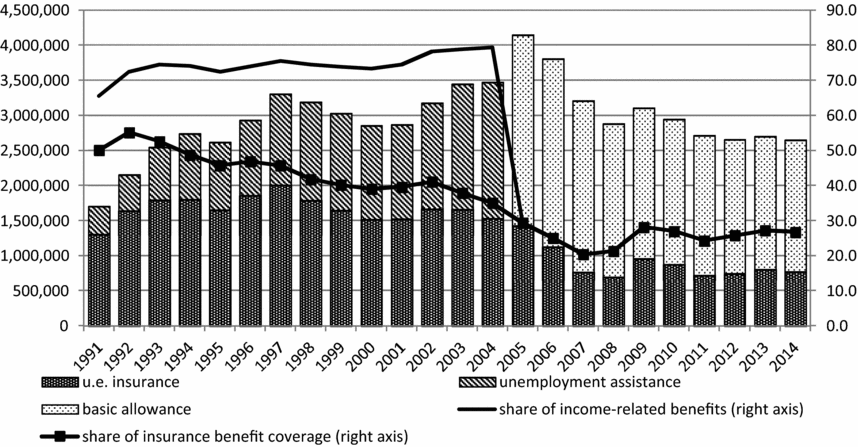
Taken together, these changes have reduced the proportion of unemployed persons with (income-related) insurance benefits (see Figure 2). Depending on the indicator we use, we may however come to different conclusions. It is still true that around 70 per cent of the newly unemployed (between 2007 and 2014) rely on the insurance scheme with most of them entitled to insurance benefits during the initial phase (see Figure 1, upper dashed line and also Clasen and Goerne, Reference Clasen and Goerne2011). This mainly reflects the share of employment covered by mandatory insurance (see also Esser et al., Reference Esser, Ferrarini, Nelson, Palme and Sjöberg2013) that has steadily increased in Germany between 2009 and 2016. Also, the introduction of the Basic Allowance scheme has raised the overall proportion of unemployment benefit recipients to almost 90 per cent of all registered unemployed (see Figure 1, continued line). However, looking at new entrants alone underestimates some of the problematic effects of the reforms. Firstly, those 30 per cent of new entrants who do not earn entitlements from the insurance scheme are now either directly subject to the much stricter Basic Allowance scheme, or have to use their own assets, or live on their partners’ income. Secondly, emphasising the initial phase of unemployment does not tell us even half the story. Although more than 90 per cent of the registered unemployed tend to leave the insurance scheme within 12 months, only half of them are re-employed, whilst the other half either withdraw from the labour market or enter an activation programme (Bundesagentur für Arbeit, Reference Arbeit2015b). About one-fifth of the annual average use up their entitlement to insurance benefits and then have to rely on the Basic Allowance scheme (Bundesagentur für Arbeit, Reference Arbeit2015a: 114). Thirdly, focusing solely on new entrants conceals the fact that the coverage of registered unemployed (measured in stocks) has seen a significant and continuing decrease since the mid-1970s. Even though the rate had already decreased to less than 40 per cent in the mid-1980s (Seeleib-Kaiser, Reference Seeleib-Kaiser2002), it has now continuously decreased for more than 20 years, reaching a historic level of less than 30 per cent of all unemployed in 2014 (see Figure 1, dotted line).
2007–2014. Four concepts of benefit coverage measurement – recipients of: any kind of benefits, unemployment insurance benefits as percentage on all inflows, inflows from employment into registered unemployment*, and insurance benefits on annual average stocks of registered unemployed.

Income-related benefits recipients (1991–2004), unemployment insurance and basic allowance recipients (2005–2014) in absolute numbers (left axis) and in per cent of all registered unemployed (right axis)

The phenomenon of an ever-less-generous scheme is also reflected by the fact that unemployment insurance does not necessarily ensure the income status of unemployed at a poverty proof level. Unlike in France or Belgium, there is no minimum benefit or disproportionate replacement rate for low wage-earners within the insurance scheme so that poverty has always been a major risk for all unemployed in Germany (Hauser et al., Reference Hauser, Nolan, Mörsdorf, Strengmann-Kuhn, Gallie und and Paugam2000). The continued reduction of the income replacement rate in 1984 and 1994, both times with the aim of reducing public spending (to finally 60 per cent for an unemployed person without and 63 per cent for an unemployed person with a dependent family member), has even further increased the poverty risk. Further, the non-existence of indexing and the decrease of real wages since the nineties, together with the increase of atypical employment and low wages, contributed to a crowding out of the protection scheme. As a consequence, many insurance benefit recipients become entitled to Basic Allowance benefits: in 2015 one in eight insurance benefit recipients (about 100,000 a year on average) receive additional Basic Allowance (Bundesagentur für Arbeit, Reference Arbeit2015a: 23) and are therefore re-categorised into the much stricter Basic Allowance scheme.Footnote 4
As a whole, the German unemployment benefit scheme has seen a substantial drop in total benefit generosity, especially after the reforms of 2005 (Stovicek and Turrini, Reference Stovicek and Turrini2012). Equivalence has become more narrowly defined so that an increasing share of workers is now completely excluded from the insurance scheme. This is caused by two mechanisms, policy drift (due to labour market deregulation and wage policy) and institutional modifications, amongst others the cancellation of the unemployment assistance. As a consequence, only a minor share of unemployed people can expect wage replacements that allow them to make ends meet.
Departure from the principle of status protection
The second main feature of the basic logic of the German labour market policy scheme, since the introduction of the Employment Promotion Act in 1969, was to secure the workers’ vocational status in the event of unemployment (Bogedan et al., Reference Bogedan, Bothfeld and Sesselmeier2012). But this principle was incrementally changed as early as in 1976, with the first Act on the Budget's Structure (Haushaltsstrukturgesetz 1976) when, for the first time, the generous provisions, especially the entitlements for participants in labour market programmes, were reduced. Later, especially since the 1980s, the conditions of access and the equivalence between contributory period and benefit duration were further narrowed (for a chronicle of changes see Bothfeld et al., Reference Bothfeld, Sesselmeier and Bogedan2012: 353ff.). These changes had an impact on the coverage rates of insurance benefits and unemployment assistance as early as the 1980s (Seeleib-Kaiser, Reference Seeleib-Kaiser2002). Unlike these incremental changes, we argue that the more recent modifications of the policy regime decisively contribute to the overall systemic change.
First, the most decisive change that undermined status protection in terms of benefit provision was the replacement of the income-related unemployment assistance scheme by the Basic Allowance scheme (Grundsicherung) in 2005 (Hinrichs, Reference Hinrichs and Palier2010).Footnote 5 This reduced the proportion of unemployed people who receive an income-related benefit from about 80 to 30 per cent overnight so that the only income-related benefit is now the unemployment insurance benefit (Arbeitslosengeld I) (see Figure 2).
As a consequence, hundreds of thousands of unemployed (formerly beneficiaries of unemployment assistance) now lack access to an income-related benefit. Additionally, 200,000 former recipients of unemployment assistance had their entitlement to these payments revoked because of the stricter means test of the new scheme (Bruckmeier and Schnitzlein, Reference Bruckmeier and Schnitzlein2009). About 11 per cent of all new unemployed per year (see Figure 1) must first liquidate assets and use up their savings before they become eligible for Basic Allowance payments. The decrease of the average insurance benefit duration from 24.3 weeks in 2004 to 18.9 in 2014 (Bundesagentur für Arbeit, Reference Arbeit2015a: 114) indicates not simply a more favourable labour market situation but it eventually means that people tend to avoid exhausting their insurance benefit and being transferred to the Basic Allowance scheme.
Again, elderly unemployed people are particularly affected, because compensatory measures to counteract the 1992 Pension Reform, which raised the standard pension age for unemployed from 60 to 65 years, were cancelled in 2007, e.g. longer benefit durations or the so-called ‘58-rule’ that since 1986 has exempted unemployed people of 58 years or older from job search requirements. Additionally, pension insurance contributions for recipients of the Basic Allowance were reduced as early as 2006 and then completely abandoned in 2011. As the Basic Allowance requires the use of all other resources before receiving any benefits, unemployed people older than 63 years, who have exhausted their insurance benefit, can now be obliged to retire, despite the fact that this is penalised by rebates on the pension payments.
Secondly, the provision of insurance benefits has been decoupled from the provision of active programmes together with the removal of the aim of promoting full-employment and of continuously improving the structure of employment.Footnote 6 Instead of providing active measures, the priority of re-employment has become an implementation rule for the employment agencies (Vermittlungsvorrang) so that support is only granted when considered necessary for attaining sustainable re-employment. This ‘work first’ strategy negates the promotion of vocational training and further education even within the insurance scheme (Oschmiansky, Reference Oschmiansky2010: 18). In fact, the number of people entering training or education has declined drastically since 2002 and the structure of vocational training has changed, too, with a new focus on short-term training at the expense of more substantial interventions (Bosch, Reference Bosch2012). This observation indicates that the ‘re-employment priority’ thwarts the original goal of acquiring new skills and obtaining better qualifications for the labour market – and even more so for the long-term unemployed.
Thirdly, the strengthening of sanctions and the new definition of reasonable employment that were introduced with the aim of decreasing reservation wages and accelerating re-employment also contribute to the erosion of status protection. This implicit threat was increased rather than mitigated by the operational changes introduced by the Hartz-reforms so that, compared to other OECD countries, Germany has the most stringent regulations concerning occupational mobility, availability and job search requirements today (Venn, Reference Venn2012): In 1998, the safeguard regarding the level of vocational qualification was abandoned but in 2005 a declining replacement rate, together with stricter rules regarding mobility requirements was introduced into the insurance scheme. These tougher measures were accompanied by more flexible disqualification mechanisms so that the quota of disqualification times in the insurance scheme rose from 9 per cent in 2004 to almost 29 per cent in 2011 (Bothfeld and Rosenthal, Reference Bothfeld and Rosenthal2014). These rules are even stricter in the Basic Allowance scheme, which prescribes that beneficiaries have to accept any kind of employment or training measures under the threat of losing their benefits. Furthermore, it may be difficult for employment office employees to offer unemployed persons reasonable jobs when permanent jobs or qualified jobs are not available. The application of different rules and the separation of the two schemes resulted in the emergence of a new category of ‘second class’ unemployed.
These institutional changes also made it more difficult for unemployed people to maintain the once-attained socio-economic status, particularly for those in the Basic Allowance scheme. Already, before the introduction of these measures, re-employment resulted in lower wages, a loss of vocational qualification or people being trapped in inadequate employment (see eg. Voßemer and Schuck, Reference Voßemer and Schuck2015). The stricter job search requirements have contributed to lowering the average duration of unemployment periods (Hofmann, Reference Hofmann2012) but the unemployed increasingly make concessions with respect to working conditions and pay (Engbom et al., Reference Engbom, Detragiache and Raei2015: 22). In fact, labour market re-entry entails a loss of about one-quarter to one-third of the former wage (Giannelli et al., Reference Giannelli, Jaenichen and Rothe2013: 20). This penalty has even increased by 10 points since the elimination of the unemployment assistance scheme and the reducing of benefit durations in 2005 (Engbom et al., Reference Engbom, Detragiache and Raei2015). The prospect of sliding down the social ladder in the event of unemployment leads not only to the perception of ‘new social insecurity’ (Castel, Reference Castel2003) but also exerts a disciplinary effect on people in regular employment (Dörre, Reference Dörre2006). A detrimental side-effect is that the allocation effect of the labour market is reduced, as employees increasingly refrain from changing their employment (Knuth, Reference Knuth2013). This confirms what earlier analyses have underlined, namely the erosion of the principle of securing living standards (Seeleib-Kaiser, Reference Seeleib-Kaiser2002: 30), and, more recently, the ‘end of the conservative welfare state model’ as a whole (Seeleib-Kaiser, Reference Seeleib-Kaiser2016).
Erosion of the solidarity principle in financing
From a formal viewpoint, the principle of tripartite funding of the German unemployment insurance and labour market policy scheme – embodying the specific mode of ‘industrial’ solidarity between employers, employees and the state – has remained intact. Nevertheless, the system of funding has been eroded due to the decrease of contributions on the one hand and the replacement of federal subsidies by a loan mechanism on the other. Thus, the often-criticised unstable and anti-cyclical dependency of labour market policy funding has even been exacerbated.
In fact – and contrary to the reform proposals of the 1990s to provide a sound financial basis for active labour market policies through rule-based, anti-cyclical federal subsidies – the state has withdrawn from funding labour market policies. Until 2006, the Federal Government allocated annual non-repayable subsidies for the Federal Employment Agency's budget deficit so that, in 2006 and 2007, the FEA was able to establish reserves and cover extra expenditures (Hausner et al., Reference Hausner, Simon and Spitznagel2015). This was a favourable situation with regard to funding the massive use of short-time work, caused by the temporary increase in unemployment in the autumn of 2008.Footnote 7 Through the amendment to federal budget legislation in 2006 (Haushaltsbegleitgesetz) the subsidy rule was changed to a loan scheme, obliging the Federal Employment Agency to repay loans when the budget situation permits. As a consequence, the Federal Government will not grant subsidies as long as the FEA has any reserves.
At the same time, both employers and employees have been relieved by a reduction of contribution payments. After having reached a zenith of 6.5 per cent on the gross salary in the 1990s, the contribution rate – due to the high level of reserves of the FEA at that time (Clemens, Reference Clemens2012) – was disproportionately reduced after 2007. This was further driven by the idea that a reduction in payroll taxes enhances international competitiveness. The rate was first reduced to 4.2 per cent and then 3 per cent. In 2010 it was even – temporarily – lowered to 2.8 per cent. Accordingly, the share of the FEA's revenues derived from insurance contributions declined to approximately 71 per cent in 2012 (from 91 per cent in 2006). The increase to 83 per cent in 2014 (Bundesagentur für Arbeit, Reference Arbeit2015c) was due to the modified pattern of revenues. The onset of the problem caused by the deficit in the budget was, however, delayed. The gaps between 2007 and 2012 were initially offset by a special intervention of the Federal Government when, in 2006, one-third of the revenues accrued from a hike in the value added tax were dedicated to the FEA's budget.Footnote 8 Due to a restructuring of the cost of the Basic Allowance scheme, the non-availability of supplementary funds was also partially offset.Footnote 9 However, as of 1 January 2013, such special arrangements on the part of the Federal Government are no longer allowed due to constitutional rules.
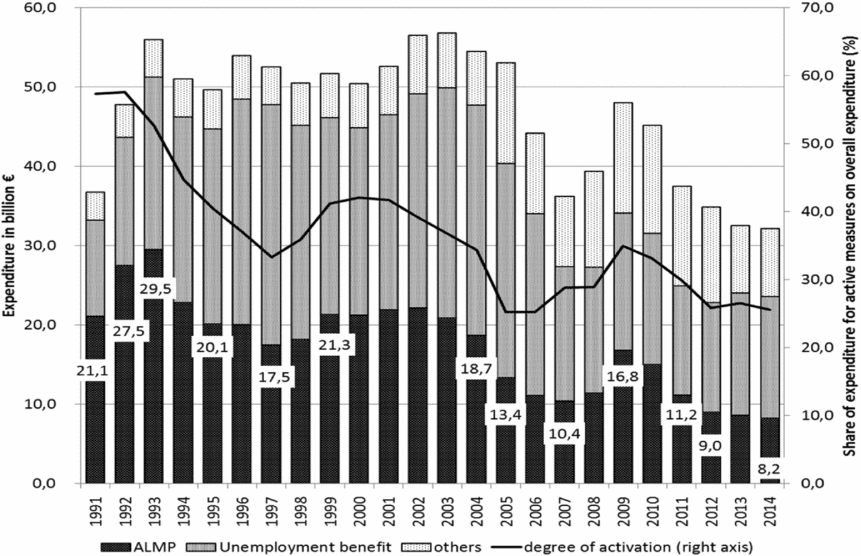
These incremental modifications have substantially weakened the budgetary situation of the German FEA. And, as it lacks the right and the duty to establish medium-term plans covering several years as a binding tool for anticipating revenues and expenditures (Hausner et al., Reference Hausner, Simon and Spitznagel2015), its capacity to respond to sharp drops in employment levels has been significantly constrained. In day-to-day business the mere anticipation of higher unemployment levels (and levels of expenditures for benefits) leads to a more cautious expenditure policy. As a result, expenditures on active measures were drastically adjusted to the annual fiscal situation of the FEA (see Figure 3). The share of active expenditures, measured as percentage of expenditure for active programmes on all expenditure, has continuously decreased to less than 30 per cent compared to 1990. As a consequence, the FEA's competencies are increasingly limited to the administration of the insurance scheme.
- Expenditure of the Federal Employment Agency for active and passive measures in billion € (left axis) and share of LMP expenditure for active measures (right axis) 1991–2014

Conclusion
Our analysis illustrates why the German labour market policy regime no longer adequately contributes to the stabilisation of the employment status which formed the main supporting pillar of the German continental social state. Taken together, the policy regime perspective, and our focus on the logic of status-centredness, uncover streams of simultaneous and random processes of change that may be summarised as follows. First, the equivalence principle has been restricted in a way that excludes an increasing share of atypically employed, establishes stricter rules of conditionality for all unemployed and reduces the entitlements of elderly unemployed. The legal modifications result from deliberate and conscious political decisions inspired by economic neo-classical reasoning. Alternatively, following a demand-side oriented strategy, the government could have opted for strengthening the more inclusive character of the insurance scheme, e.g. through a more generous definition of the equivalence principle. Secondly the reforms, particularly those of the mid-2000s, have curtailed or eliminated several crucial mechanisms aimed at protecting the once achieved socio-economic status, e.g. the unemployment assistance scheme, the provision of labour market policy programmes, or the protection of level of pay or qualification in the event of unemployment. As such, the activation strategy that was adopted in the mid-1990s and reinforced by the Hartz-Refoms has promoted a workfarist logic at the expense of the original social and investive objectives. Third, the solidarity principle in funding has seen both structural institutional change and the emergence of new significant problems that challenge the budgetary framework. Instead of providing status protecting or preventive programmes on the basis of individual entitlements, the FEA's role is restricted to the administration of the unemployment insurance scheme and the control of labour market integration processes. In sum, our analysis of modifications to the labour market policy regime, the focus on the logic of status protection, and the two-dimensional methodological approach has revealed a significant shift in German labour market policy regime – away from its core feature, its status-centredness.
We would finally like to return to our methodological concern: How can we grasp ongoing change and qualify modifications of social security schemes adequately? And, do we recognise paradigmatic change when we see it? Obviously, the ‘dependant variable problem’, i.e. to assess welfare state change adequately, is not resolved if we ignore the role of underlying norms and principles and their shifts – that are reflected in institutional rules – in social policy analysis. In fact, a stronger emphasis of critical social policy research on ideational aspects in social policy helps us to a much better understand of on-going change (see Cox, Reference Cox1998). Hence, we need a new methodological effort to research underlying norms and principles in social policy, their interconnectedness with policies as well as with processes of emergence, dominance or weakening of norms. And, complementary to research that either analyses single policies or societal institutional arrangements, we suggest focusing on the inherent logics of policies that take the form of policy principles and operate as driving belts between ideas, interest and institutional rules. Methodologically, this requires a critical reading of legal rules and the interpretation of available empirical data that evaluate the impact of legal modifications.
Focusing our analytical interest on norms and policy principles is an essential component of social policy analysis – as the erosion of fundamental normative patterns and institutional principles eventually challenges the political legitimacy of governments and political actors. Political protests and rising social cleavages, the loss of binding power of established political institutions or the rise of populism in the richest countries of the world at present indicate a profound discontent as well as the normative and political limits of social acceptance of policy change. Obviously, at least in Germany, the national government is beginning to perceive this interrelation and will possibly respond in the future. Sounding out the political latitude for new policies, that are compatible with an interest-and-value-based social consensus, will be a crucial issue for further social policy analysis.
Acknowledgements
This paper has benefited from discussions at the Annual Conference of the Bremen International Graduate School of Social Science of Bremen University in 2014 and the Annual Conference of the European Social Policy Network in Odense in 2015. The authors thank Petra Kaps and Matthias Knuth for valuable comments on an earlier version and the anonymous reviewers for their helpful comments and suggestions.