Introduction
Income inequality has been associated with increased suicide rates in men over the age of 55 years in developed countries (Cutright and Fernquist, Reference Cutright and Fernquist2000), in the elderly in a study of 87 countries (Shah et al., Reference Shah, Bhatt, MacKenzie and Koen2008a), up to the age of 75 years in Japan (Fukuda et al., Reference Fukuda, Nakamura and Takano2005), and in the general population in the U.S.A. (Kowalski et al., Reference Kowalski, Faupel and Starr1987) and in 10 European countries (Lorant et al., Reference Lorant, Kunst, Huisman, Costa and Mackenbach2005). Moreover, markers of economic adversity were associated with increased suicide rates in males of all ages in Australia, although the opposite was observed for females (Berk et al., Reference Berk, Dodd and Henry2006). Also, some markers of economic adversity have been found to be differentially associated with suicide rates in different age-bands, such as higher housing loan interest rates, which are associated with higher suicide rates in younger people but lower suicide rates in older people (Berk et al., Reference Berk, Dodd and Henry2006). Gross national domestic product (GDP) was positively correlated with suicide rates in the general population (Zhang, Reference Zhang1998) and in men aged 75+ years (Shah et al., Reference Shah, Bhatt, MacKenzie and Koen2008a) in large cross-national studies. However, in a study of 47 medium and high income countries, elderly suicide rates were negatively correlated with the GDP (Kiemo, Reference Kiemo2004). A decline in elderly suicide rates over time in England and Wales was associated with an increase in the GDP (Gunnell et al., Reference Gunnell, Middleston, Whitley, Dorling and Frankel2003). Collectively, these observations suggest that socio-economic status may differentially influence suicide rates in different age and sex groups in different countries.
Life expectancy was positively correlated with suicide rates in the elderly (Shah et al., Reference Shah, Bhatt, MacKenzie and Koen2008a) and the general population (Zhang, Reference Zhang1998) in cross-national studies. Given that suicide rates generally increase with age (Shah and De, Reference Shah and De1998; Shah, Reference Shah2007a), reduced life expectancy will result in fewer people reaching old age in countries with low socio-economic status (Shah et al., Reference Shah, Bhatt, MacKenzie and Koen2008a). This, in turn, will result in a reduced number of elderly suicides in countries with low socio-economic status (Shah et al., Reference Shah, Bhatt, MacKenzie and Koen2008a).
Younger and mixed-age African American suicide victims (Fernquist, Reference Fernquist2001; Willis et al., Reference Willis, Coombs, Drentea and Cockerham2003) and younger caucasian suicide victims (Beautrais, Reference Beautrais2003; Kung et al., Reference Kung, Liu and Juon2004) in the U.S.A. have low educational attainment. Elderly suicide victims may also have poor educational attainment (Rubenowitz et al., Reference Rubenowitz, Waern, Wilhelmson and Allebeck2001). However, male African American suicide victims aged 55+ years had higher levels of educational attainment (Fernquist, Reference Fernquist2001). General population suicide rates in the U.S.A., including those of African Americans, have been both positively correlated (Kowalski et al., Reference Kowalski, Faupel and Starr1987; Lester Reference Lester1990–1991; Stack, Reference Stack1998) and negatively correlated (Willis et al., Reference Willis, Coombs, Drentea and Cockerham2003; Abel and Kruger, Reference Abel and Kruger2005) with educational attainment. Also, general population suicide rates in Japan (Otsu et al., Reference Otsu, Araki, Sakai, Yokoyama and Voorhees2004) and in men in 10 European countries (Lorant et al., Reference Lorant, Kunst, Huisman, Costa and Mackenbach2005) were negatively correlated with educational attainment. Higher suicide rates were observed with higher literacy rates in France between 1852 and 1914 (Gillis, Reference Gillis1994), but this was not observed in another cross-national study (Mayer, Reference Mayer2000). These findings collectively suggest that educational attainment may differentially influence suicide rates in different age and ethnic groups in different countries.
Suicide rates have been reported to be positively correlated with both GDP and life expectancy (Zhang, Reference Zhang1998; Shah et al., Reference Shah, Bhatt, MacKenzie and Koen2008a). Life expectancy and GDP have a highly significant strong inter-correlation (Shah, Reference Shah2007; Shah et al., Reference Shah, Bhatt, MacKenzie and Koen2008a). However, due to difficulties with multiple collinearity, it has not been possible to separate out the independent effects of these two variables on elderly suicide rates using multiple regression techniques (Shah et al., Reference Shah, Bhatt, MacKenzie and Koen2008a). Moreover, previous studies have developed sequential models whereby increased GDP leads to increased life expectancy and increased life expectancy, in turn, leads to greater number of people reaching old age, where the risk of suicide is the highest (Shah, Reference Shah2007b; Shah et al., Reference Shah, Bhatt, MacKenzie and Koen2008a). However, other factors, including income inequality, may also influence life expectancy independent of GDP (Shah, Reference Shah2007b; Shah et al., Reference Shah, Bhatt, MacKenzie and Koen2008a), and it is also possible that both GDP and life expectancy may have an independent and cumulative effect on elderly suicide rates. The Human Development Index (HDI), developed by the United Nations (UN), is a composite index measuring the average achievements in a given country on three basic dimensions of human development: a long and healthy life, as measured by life expectancy; educational attainment, as measured by the adult literacy rate and the combined gross enrollment ratio for primary, secondary and tertiary schools; and, a decent standard of living, as measured by the GDP. Moreover, the UN ranks countries by the degree of development measured by the HDI and provides data on various other parameters including measures of economic growth, income inequality, life expectancy, child mortality rates, measures of childhood development, measures of healthcare provision and expenditure, educational attainment and expenditure, employment and fertility rates by the HDI rank of countries. Therefore, a cross-national study examining the relationship between the composite and cumulative effect of these three variables, measured by the HDI, and suicide rates in both sexes, in the age-bands 65–74 years and 75+ years, was conducted.
Methods
The World Health Organization (WHO) website (www.who.int/whois/database/mort/table1.cfm) provided data on suicide rates for both sexes in the age-bands 65–74 years and 75+ years for a given country (Shah et al., Reference Shah, Bhat, MacKenzie and Koen2007; Reference Shah, Bhatt, MacKenzie and Koen2008a). Data were excluded if raw numbers of suicides were available but the suicide rates were not, unless the number of suicides was zero (thus the suicide rate would be zero).These data were collected for the latest available year, with the median (range) of this latest year across the different countries being 2000 (1985–2003). The mean (standard deviation) and median (range) of suicide rates in both sexes in both the elderly age-bands across the countries were calculated (Shah et al., Reference Shah, Bhatt, MacKenzie and Koen2008a).
The UN website (www.hdr.undo.org/hdr2006/statistics/indicators/1.html) provided data on the HDI for the year 2004. The HDI is scored on a scale of 0 to 1 (given up to three decimal points), with higher scores reflecting a higher degree of human development on measures of life expectancy, educational attainment and socio-economic status. The mean (standard deviation) and median (range) for the HDI across the countries were also calculated.
The linear relationship between suicide rates in both sexes in both the elderly age-bands and the HDI was initially examined using Spearman's correlation coefficient. However, additional examination of the data on scatter plots suggested a curvilinear relationship between suicide rates and the HDI with an inverted U-shaped curve. As linear correlations can mask curvilinear correlations, the relationship between suicide rates and the HDI was examined with a curve estimation regression model to test this observed inverted U-shaped curvilinear relationship fitting the quadratic equation y = a + bx – cx 2 (where y is the suicide rate, x is the HDI, and a, b, and c are constants). Curve estimation regression models allow examination of non-linear relationships between two variables, including U-shaped or inverted U-shaped curvilinear relationships fitting traditional quadratic equations.
Results
Data on elderly suicide rates were available for 87 countries, and data on the HDI were available for 86 of these countries. The 87 countries with available data on elderly suicide rates have been listed in an earlier study (Shah et al., Reference Shah, Bhat, MacKenzie and Koen2007) and this list can also be obtained from the author. San Marino was the only country with available data on suicide rates but missing data on the HDI. An earlier study has reported many of the characteristics of the 87 countries with available suicide rates including mean (standard deviation) and median (range) of male and female life expectancy, male and female child mortality rates, GDP, Gini coefficient (a measure of income inequality), the proportion of GDP spent on healthcare, per capita healthcare expenditure, the elderly population size and the proportion of elderly in the total population (Shah et al., Reference Shah, Bhatt, MacKenzie and Koen2008a). As reported previously (Shah et al., Reference Shah, Bhatt, MacKenzie and Koen2008a), the mean (standard deviation) and the median (range) for suicide rates per 100, 000 of the relevant age and sex group were: males aged 65–74 years, 25.5 (24.2) and 19.2 (0–94.5); males aged 75+ years, 35.03 (34.3) and 26.5 (0–130.5); females aged 65–74 years, 6.8 (7.6) and 4.8 (0–39.2); and, females aged 75+ years, 9.8 (12.3) and 5.2 (0–61.1). The mean (standard deviation) and the median (range) for the HDI was 0.833 (0.084) and 0.826 (0.610 to 0.970) respectively.
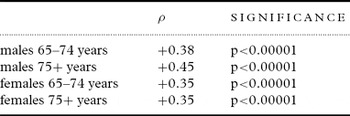
Table 1 illustrates the significant positive linear correlations between the HDI and suicide rates in both sexes in both elderly age-bands. However, the size of these correlations was small.
Linear correlations between suicide rates and human development index

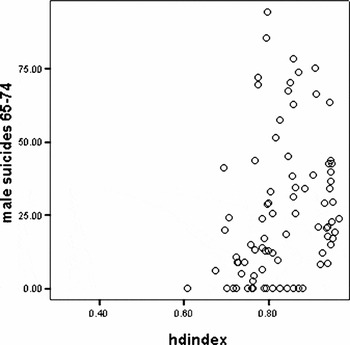
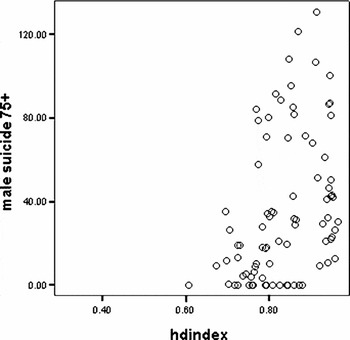
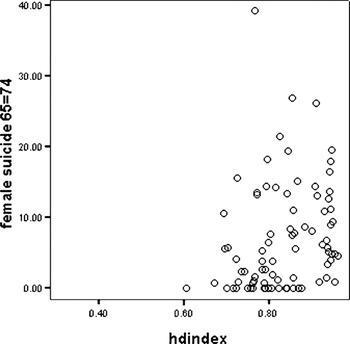
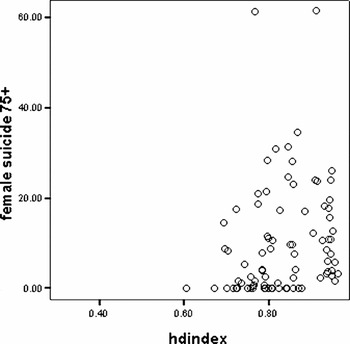
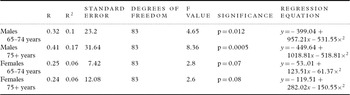
Figures 1–4 show scatter plots of the relationship between HDI and suicide rates in both sexes for both the elderly age-bands. Table 2 illustrates the curve estimation regression models for males and females in both the elderly age-bands. The relationship between suicide rates in males in the age-bands 65–74 years and 75+ years and the HDI was curvilinear (inverted U-shaped curve) and fitted the quadratic equation y = a + bx − cx 2; the significance level was at least at the 0.05 level. A similar curvilinear relationship was observed in females in both elderly age-bands, but the significance level only approached the 0.05 level.
Scatter plot of HDI and suicide rates in males aged 65–74 years

Scatter plot of HDI and suicide rates in males aged 75+ years

Scatter plot of HDI and suicide rates in females aged 65–74 years

Scatter plot of HDI and suicide rates in females aged 75+ years

Curve estimation regression models for the relationship between elderly suicides and the HDI

y = Suicide rates.
x = HDI.
HDI = human development index.
Figures 1–4 near here. They MUST be placed within the Results section. They are supplied as separate jpeg files, not incorporated in this paper].
Discussion
The main findings were: (i) a positive linear correlation between elderly suicide rates in both sexes and the HDI, but this linear relationship appeared to mask a curvilinear relationship; (ii) a significant curvilinear (inverted U-shaped curve) relationship between suicide rates in males in both elderly age-bands and the HDI fitting the quadratic equation y = a + bx − cx 2; and (iii) a similar curvilinear relationship in females in both the elderly age-bands, but the significance level only approached 0.05 level. The latter finding whereby the curvilinear relationship between HDI and female suicide rates only approached statistical significance may be due to the methodological difficulties discussed below and the observed smaller variations in female suicide rates across countries. However, it is likely that this curvilinear relationship is also present in females given that it approached significance, the scatter plots suggested an inverted U-shaped curve and the same relationship was statistically significant in males.
Some methodological issues need consideration. Cross-national data on suicide rates should be viewed cautiously because: data are not available from all countries (Moscicki, Reference Moscicki1995; Wasserman et al., Reference Wasserman, Cheng and Jiang2005); the validity of these data is unclear (Diekstra, Reference Diekstra1989; Wasserman et al., Reference Wasserman, Cheng and Jiang2005); the legal criteria for the proof of suicide vary between countries (Shah and Ganesvaran, Reference Shah, Ganesvaran, Chiu and Ames1994; Wasserman et al., Reference Wasserman, Cheng and Jiang2005); some countries have poor death registration facilities (Shah and Ganesvaran, Reference Shah, Ganesvaran, Chiu and Ames1994); and, cultural and religious factors and stigma attached to suicide may lead to under-reporting (Wasserman et al., Reference Wasserman, Cheng and Jiang2005; Abrahams et al., Reference Abrahams, Abrahams and Jacob2005). Data on life expectancy, health-related measures, educational attainment and socio-economic status should also be viewed cautiously because: the validity of this data is unclear; and, some countries have poor infrastructure to collect data on health-related measures and finances. However, the best and the latest available data set were obtained from the WHO and the UN.
Caution should be exercised in the attribution of a causal relationship and the direction of this relationship because of the cross-sectional and ecological study design whereby the findings are subject to ecological fallacy. Although such cross-national ecological studies cannot be used to explain longitudinal trends over time in elderly suicide rates, they allow development of potentially testable hypotheses of explanatory models in within-country longitudinal studies over time. The findings of this cross-national ecological study were used to develop a potentially testable theoretical and hypothetical four sequential stage model to explain the curvilinear relationship between elderly suicide rates and the HDI. Similar models have been proposed to explain the relationship between socio-economic status and cross-national variations in the prevalence of dementia (Suh and Shah, Reference Suh and Shah2001) and other mental disorders in old age (Shah, Reference Shah2007b), and the current model was further refined, modified and adapted for elderly suicide rates. An empirical assumption, whereby each country progresses through each of the four proposed developmental stages during it's development, was made. The model assumed that both elderly suicide rates and the HDI of countries can be dichotomized into two groups: high and low.
1 Low elderly suicide rate – low human development society stage
There is consistent evidence of an association between low elderly suicide rates and poor socio-economic status and greater income inequality from cross-national studies (Simpson and Conklin, Reference Simpson and Conklin1989; Zhang, Reference Zhang1998; Vijayakumar et al., Reference Vijayakumar, Nagaraj, Pirkis and Whiteford2005; Shah et al., Reference Shah, Bhat, MacKenzie and Koen2007a) and within-country studies (Kowalski et al., Reference Kowalski, Faupel and Starr1987). Societies with low socio-economic status and greater income inequality have poorly developed healthcare services (Shah, Reference Shah2007b; Shah et al., Reference Shah, Bhatt, MacKenzie and Koen2008a). Poorly developed healthcare services may mediate an increase in child mortality rates as observed by negative correlations between markers of development of healthcare services and child mortality rates (Suh and Shah, Reference Suh and Shah2001; Shah, Reference Shah2007b; Shah et al., Reference Shah, Bhatt, MacKenzie and Koen2008a). Child mortality rates were also negatively correlated with the GDP and positively correlated with the Gini coefficient (Zhang, Reference Zhang1998; Shah, Reference Shah2007b; Shah et al., Reference Shah, Bhatt, MacKenzie and Koen2008a). Increased child mortality rates will, in turn, reduce the life expectancy (Zhang, Reference Zhang1998; Shah, Reference Shah2007b; Shah et al., Reference Shah, Bhatt, MacKenzie and Koen2008a). Given that suicide rates generally increase with age (Shah and De, Reference Shah and De1998; Shah, Reference Shah2007b), reduced life expectancy will result in fewer people reaching the age of increased risk for suicide in countries with low socio-economic status, and result in a reduced number of elderly suicides in such countries. This is supported by positive correlations between life expectancy and suicide rates in the elderly (Shah et al., Reference Shah, Bhatt, MacKenzie and Koen2008a) and the general population (Zhang, Reference Zhang1998) in cross-national studies. Moreover, in societies with low socio-economic status, the elderly may be at reduced risk of suicide because they may have greater tolerance of additional hardship in old age due to life-long exposure to adversity (Seiden, Reference Seiden1981; Lindesay, Reference Lindesay1991); this has been suggested as an explanation for low elderly suicide rates among African Americans and native Americans in the U.S.A. (McIntosh, Reference McIntosh1984). The positive correlation between elderly suicide rates and the proportion of elderly in the population (Keimo, Reference Kiemo2004; Shah et al., Reference Shah, Bhatt, MacKenzie and Koen2008a;) further supports this hypothesis because increased life expectancy increases the proportion of elderly in the population. Furthermore, correlations between life expectancy and GDP (positive) and Gini coefficient (negative) have also been reported (Zhang, Reference Zhang1998; Keimo, Reference Kiemo2004; Shah, Reference Shah2007b; Shah et al., Reference Shah, Bhatt, MacKenzie and Koen2008a).
Poor socio-economic status may be associated with poor educational attainment. Low suicide rates were positively correlated with poor educational attainment in individual-level studies (Kung et al., Reference Kung, Liu and Juon2004; Fernquist, Reference Fernquist2001) and aggregate-level studies (Kowalski et al., Reference Kowalski, Faupel and Starr1987; Gillis, Reference Gillis1994; Lester Reference Lester1990–1991; Stack, Reference Stack1998), but they were from socio-economically well-developed countries and of younger age groups.
The above approach is consistent with a previously developed model with five sequential stages (Shah et al., Reference Shah, Bhatt, MacKenzie and Koen2008a): (i) presence of a low socio-economic status; (ii) low socio-economic status leading to poorly developed healthcare services; (iii) poorly developed healthcare services perhaps interacting with, mediating and modifying other factors and contributing to increased child mortality rates; (iv) increased child mortality rates leading to reduced life expectancy; and, (v) reduced life expectancy leading to fewer people reaching the age of increased risk of suicide, and resulting in low elderly suicide rates in societies with low socio-economic status. This situation could be labeled as a “low elderly suicide rate – low human development society stage.”
2 High elderly suicide rate – low human development society stage
Improvement in the development of healthcare services is associated with improvement in the socio-economic status of countries (Shah, Reference Shah2007b; Shah et al., Reference Shah, Bhatt, MacKenzie and Koen2008a). Improved healthcare services were observed to reduce child mortality (Shah, Reference Shah2007b; Shah et al., Reference Shah, Bhatt, MacKenzie and Koen2008a). Reduction in child mortality rates will, in turn, increase the life expectancy (Zhang, Reference Zhang1998; Shah et al., Reference Shah, Bhatt, MacKenzie and Koen2008a). This, in turn, will result in greater number of subjects reaching the age of increased risk of suicide and an increase in elderly suicide rates. This is supported by positive correlations between life expectancy and suicide rates in the elderly (Shah et al., Reference Shah, Bhatt, MacKenzie and Koen2008a) and general population (Zhang, Reference Zhang1998). This approach is also consistent with the five stage sequential model described above (Shah et al., Reference Shah, Bhatt, MacKenzie and Koen2008a). This will lead to a gradual transition from “low elderly suicide rate – low human development society stage” to a “high elderly suicide rate – low human development society stage.”
3 High elderly suicide rate – high human development society stage
As societies develop, a change from lower to higher human development status will occur. This will lead to further improvements in the development of healthcare services as observed by positive correlations between GDP and markers of development of healthcare, and negative correlations between the Gini coefficent and these variables (Shah, Reference Shah2007b; Shah et al., Reference Shah, Bhatt, MacKenzie and Koen2008a). Further improvement in healthcare services has been observed to facilitate further reductions in child mortality rates (Zhang, Reference Zhang1998; Shah, Reference Shah2007b; Shah et al., Reference Shah, Bhatt, MacKenzie and Koen2008a). Further reductions in child mortality rates will, in turn, further increase the life expectancy (Zhang, Reference Zhang1998; Shah, Reference Shah2007b; Shah et al., Reference Shah, Bhatt, MacKenzie and Koen2008a). This, in turn, will result in increasing number of subjects reaching the age of increased risk of suicide; the positive correlations between life expectancy and suicide rates in the elderly (Shah et al., Reference Shah, Bhatt, MacKenzie and Koen2008a) and general population (Zhang, Reference Zhang1998) further supports this. Moreover, the protective effects of life-long adversity on elderly suicide rates (Seiden, Reference Seiden1981; Lindesay, Reference Lindesay1991; McIntosh, Reference McIntosh1984) is likely to be less prevalent in countries with higher socio-economic status. The composite effect of these changes will increase the number of individuals at increased risk of suicide in old age in socio-economically more developed countries. This approach is also consistent with the five stage sequential model described above in the section on “low elderly suicide rates – low human development society stage” (Shah et al., Reference Shah, Bhatt, MacKenzie and Koen2008a). This will lead to a gradual transition from the “high elderly suicide rate – low human development society stage” to a “high elderly suicide rate – high human development society stage.”
4 Low elderly suicide rate – high human development society stage
Theoretically, in socio-economically well-developed countries, due to further reduction in child mortality rates and increase in life expectancy, greater numbers of people would reach the age of increased suicide risk, and consequently lead to higher elderly suicide rates. However, in socio-economically well-developed countries, including Italy, Netherlands, Norway, U.K. and U.S.A., elderly suicide rates are comparatively low (Shah et al., Reference Shah, Bhat, MacKenzie and Koen2007) and have declined over time (Shah et al., Reference Shah, Bhatt, MacKenzie and Koen2008c). The five-stage sequential model described above in the section on “low elderly suicide rates – low human development society stage” (Shah et al., Reference Shah, Bhatt, MacKenzie and Koen2008a) appears not to apply to socio-economically well developed countries. In socio-economically well developed countries, elderly suicide rates may progressively decline over many years due to improved efforts to control the risk factors for elderly suicides, enhance protective factors for elderly suicides, and advances in medical care. Ultimately, this will lead to a gradual transition from a “high elderly suicide rate – high human development society stage” to a “low elderly suicide rate – high human development society stage.”
England and Wales could be considered to be at this developmental stage. In England and Wales, elderly suicide rates have been shown to be higher in areas with high socio-economic deprivation (Whitley et al., Reference Whitley, Gunnell, Dorling and Smith1999; Shah et al., Reference Shah, Uren, Baker and Majeed2002) and high social fragmentation (Whitley et al., Reference Whitley, Gunnell, Dorling and Smith1999). A decline in elderly suicide rates over time in England and Wales has been associated with an increase in GDP (Gunnell et al., Reference Gunnell, Middleston, Whitley, Dorling and Frankel2003). Therefore, in socio-economically well-developed societies further improvement in socio-economic status appears to be an important factor in reducing elderly suicide rates. What is the mechanism for the reduction in elderly suicide rates due to improved socio-economic status?
Almost all elderly suicide victims have mental illness, and up to 90% have depression (Shah and De, Reference Shah and De1998). A significant number of elderly suicide victims in socio-economically well developed countries consult their general practitioner or psychiatrist or contact mental health services between one week and six months prior to the suicide (Barraclough, Reference Barraclough1971; Catell, Reference Cattell1988; Conwell et al., Reference Conwell, Rotenberg and Caine1990; Reference Conwell, Olsen, Caine and Flannery1991; Vassilas and Morgan, Reference Vassilas and Morgan1993; Reference Vassilas and Morgan1994; Catell and Jolley, Reference Cattell and Jolley1995). This offers opportunity for identification and treatment of the mental illness. Thus, the availability of appropriate healthcare services may be an important factor contributing to elderly suicide rates. High suicide rates in rural China and Hong Kong, in part, have been attributed to lack of mental health services and poorly developed social welfare and benefit systems (Yip and Tan, Reference Yip and Tan1998; Jianlin, Reference Jianlin2000; Yip et al., Reference Yip, Callanan and Yuen2000; Yip, Reference Yip2001). Socio-economically well-developed societies generally have well developed healthcare services, and this is supported by the observed positive correlations between GDP and markers development of healthcare and negative correlations between the Gini coefficent and these variables (Shah, Reference Shah2007b; Shah et al., Reference Shah, Bhatt, MacKenzie and Koen2008a). Decline in elderly suicide rates in England and Wales was associated with measures of improved healthcare for the elderly (Gunnell et al., Reference Gunnell, Middleston, Whitley, Dorling and Frankel2003; Lodhi and Shah, Reference Lodhi and Shah2005) including an increase in the number of general practitioners, hospital medical staff, out-patient appointments for mental illness, field social workers and day centre staff (Lodhi and Shah, Reference Lodhi and Shah2005). Reduction in elderly suicide rates in Singapore and urban China have been attributed to improved healthcare and welfare services for the elderly (Kua et al., Reference Kua, Ko and Ng2003; Yip et al., Reference Yip, Liu, Hu and Song2005). Socio-economically well-developed countries are also more likely to have appropriate healthcare facilities to resuscitate those who have attempted suicide, thus further reducing elderly suicide rates. Physical illness is an important risk factor for elderly suicides (Catell, Reference Cattell1988; Catell and Jolley, Reference Cattell and Jolley1995), and socio-economically well developed societies generally have appropriate healthcare care facilities for the treatment of physical illness, thus helping to further reduce elderly suicide rates.
Some recent public health initiatives in the U.K. may be responsible for the improvement in the health structure by improving detection and treatment of individuals at risk of suicide. Such initiatives included legislation encouraging general practitioners to offer annual physical and mental examination to those over the age of 75 years, the Defeat Depression Campaign organized by the Royal College of Psychiatrists and the Royal College of General Practitioners, the government's “Our Healthier Nation” suicide reduction targets, the National Confidential Enquiry into Suicides and Homicides, the National Service Frameworks for Mental Health and for Older People, and the National Suicide Prevention Strategy (Hoxey and Shah, Reference Hoxey and Shah2000; Shah et al., Reference Shah, Ellanchanny and Collinge2001; Shah, Reference Shah2007c). Additionally, a decline in elderly suicide rates in England and Wales was associated with an increase in prescription rates of antidepressants (Gunnell et al., Reference Gunnell, Middleston, Whitley, Dorling and Frankel2003; Lodhi and Shah, Reference Lodhi and Shah2004), particularly selective serotonin reuptake inhibitors (Lodhi and Shah, Reference Lodhi and Shah2004); this has also been observed in Sweden (Carlsten et al., Reference Carlsten, Waern and Allebeck1999) and Australia (Hall et al., Reference Hall, Mant, Mitchell, Rendle, Hickie and McManus2003). This change may have been a direct result of the various initiatives described above, which may have promoted health-seeking behavior among patients at risk of suicide and improved prescribing patterns for antidepressants amongst doctors. Furthermore, such public health initiatives are more likely to be instigated in countries at a more advanced stage of socio-economic development because they require substantive funding.
Also, higher socio-economic status is likely to be associated with higher educational attainment. There is evidence that low suicide rates are associated with higher educational attainment in individual-level studies (Fernquist, Reference Fernquist2001) and aggregate-level studies (Willis et al., Reference Willis, Coombs, Drentea and Cockerham2003; Otsu et al., Reference Otsu, Araki, Sakai, Yokoyama and Voorhees2004; Abel and Kruger, Reference Abel and Kruger2005; Lorant et al., Reference Lorant, Kunst, Huisman, Costa and Mackenbach2005) from socio-economically well-developed countries, although they are mainly of younger age groups.
Conclusion
A theoretical and hypothetical developmental model for elderly suicide rates with four sequential stages is proposed: (i) low elderly suicide rate – low human development society; (ii) high elderly suicide rate – low human development society; (iii) high elderly suicide rate – high human development society; and (iv) low elderly suicide rate – high human development society. Caution should be exercised in the application of this model because of the cross-sectional and ecological study design whereby the findings are subject to ecological fallacy and require rigorous testing in within-country longitudinal studies over time. It is likely that different countries will be at different stages of development, and each country would progress through each of these four developmental stages over time. This model can be formally tested by following up countries that are currently at the stage of “low elderly suicide rate – low human development society stage” over time to observe if they progress through the four developmental stages of the proposed model. However, such studies may not be practical or realistic because the follow-up period will take many years (perhaps several decades). This model is complementary to, and does not preclude, other proximal and distal etiological risk factors for elderly suicides including economic growth, health and welfare services for the elderly, psychosocial environment and religion – although some of these factors are discussed under subheadings of the four stages of the model above.
Conflict of interest
None.
Acknowledgment
The helpful comments of two anonymous reviewers were greatly appreciated.