














1. Introduction
1.1 Open questions settled
The theory of universal deformation quantizations of Lie bialgebras started with the paper by Drinfeld [Reference DrinfeldDri92] and played a very important role in several different areas of mathematics including the theory of quantum groups, the theory of Hopf algebras, the number theory, the theory of braid groups, the Poisson geometry, the theory of the Grothendieck–Teichmüller group and others. The first proof by Etingof and Kazhdan [Reference Etingof and KazhdanEK96] of the main theorem in this theory, the existence theorem of universal quantizations of Lie bialgebras, exhibited an important role which Drinfeld's associators play in the story: every such an associator gives us an associated universal quantization. This leads to the following questions. Do different associators give us really different (i.e. homotopy inequivalent) universal quantizations? Do Drinfeld associators give us all possible universal quantizations, or not? We settle these questions in the present paper by proving that the set of homotopy classes of universal quantizations of Lie bialgebras can be identified with the set of Drinfeld's associators. In particular, the Grothendieck–Teichmüller group acts transitively and faithfully on this set. In fact, we settle these questions in a greater generality: we give a complete classification of the associated universal formality maps (of which universal quantizations of Lie bialgebras form a special case), and prove that the deformation complex of any such a formality map is quasi-isomorphic to the full version of the graph complex introduced by Kontsevich [Reference KontsevichKon97] in the context of the theory of deformation quantizations of Poisson manifolds.
1.2 Polydifferential functor
We introduce an endofunctor  ${\mathcal {D}}$ in the category of (augmented) props with the property that for any representation of a prop
 ${\mathcal {P}}$ in a vector space
 $V$ the associated polydifferential prop
 ${\mathcal {D}}{\mathcal {P}}$ admits an induced representation on the graded commutative algebra
 ${\mathcal {O}}_V:=\odot ^\bullet V$ given in terms of polydifferential operators. For any
 ${\mathcal {P}}$ the polydifferential prop
 ${\mathcal {D}}{\mathcal {P}}$ comes equipped with a canonical injection
 ${\mathcal {C}} omb \rightarrow {\mathcal {D}} {\mathcal {P}}$ from the prop
 ${\mathcal {C}} omb$ of commutative and cocommutative bialgebras.
We apply this functor to the minimal resolution  $\widehat{\mathcal{L}\textit{ieb}}_\infty$ of the genus completed version of the prop of Lie bialgebras
 $\mathcal{L}\textit{ieb}$ introduced by Vladimir Drinfeld and obtain the following results.
maintheorem (i) For any choice of a Drinfeld associator  $\mathfrak{A}$ there is an associated highly non-trivial Footnote 1 morphism of dg props,
 \begin{equation} F_{\mathfrak{A}}: \mathcal{A}\textit{ssb}_\infty \longrightarrow {\mathcal{D}}\widehat{\mathcal{L}\textit{ieb}}_\infty, \end{equation}
where  $\mathcal {A}\textit{ssb}_\infty$ stands for a minimal resolution of the prop of associative bialgebras.
(ii) For any graded vector space  $V$, each morphism
 $F_{\mathfrak{A}}$ induces a
 ${\mathcal {L}} ie_\infty$ quasi-isomorphism (called a formality map) between the dg
 ${\mathcal {L}} ie_\infty$ algebra Footnote 2
 \[ \mathsf{Def}({\mathcal{A}} ssb_\infty\stackrel{\rho_0}{\longrightarrow} {\mathcal{E}} nd_{{\mathcal{O}}_V}) \]
controlling deformations Footnote 3 of the standard graded commutative and cocommutative bialgebra structure  $\rho _0$ in
 ${\mathcal {O}}_V$, and the Lie algebra Footnote 4
 \[ \mathsf{Def}(\mathcal{L}\textit{ieb}\stackrel{0}{\longrightarrow} {\mathcal{E}} nd_V) \]
controlling deformations of the trivial morphism  $0: \mathcal {L}\textit{ieb}\rightarrow {\mathcal {E}} nd_V$.
(iii) Let  $\mathsf {Def}(\mathcal {A}\textit{ssb}_\infty \stackrel {F_\mathfrak{A}}{\longrightarrow } {\mathcal {D}} \widehat {\mathcal {L}\textit{ieb}}_\infty )$ be the deformation complex of any given formality map
 $F_\mathfrak{A}$. Then there is a canonical quasi-isomorphism of complexes
 \[ \mathsf{fGC}_3^\uparrow \longrightarrow \mathsf{Def}\left(\mathcal{A}\textit{ssb}_\infty \stackrel{F_\mathfrak{A}}{\longrightarrow} {\mathcal{D}} \widehat{\mathcal{L}\textit{ieb}}_\infty\right). \]
Here  $\mathsf {fGC}_3^\uparrow$ is the oriented ‘
 $3$-dimensional’ incarnation (with the same cohomology [Reference WillwacherWil15b]) of the full ‘
 $2$-dimensional’ Kontsevich graph complex introduced in [Reference KontsevichKon97].
(iv) The set of homotopy classes of universal formality maps as in (1) can be identified with the set of Drinfeld associators. In particular, the Grothendieck–Teichmüller group  $GRT=GRT_1\rtimes {\mathbb {K}}^*$ acts faithfully and transitively on such universal formality maps.
In the proof of part (i) we used the Etingof–Kazhdan theorem [Reference Etingof and KazhdanEK96] which says that any Lie bialgebra can be deformation quantized in the sense introduced by Drinfeld in [Reference DrinfeldDri92]. Later different proofs of this theorem have been given by Tamarkin [Reference TamarkinTam07], Severa [Reference ŠeveraSev16] and the authors [Reference Merkulov and WillwacherMW18b] (the latest proof in [Reference Merkulov and WillwacherMW18b] gives an explicit formula for a universal quantization of Lie bialgebras). Part (ii) is a Lie bialgebra analogue of the famous Kontsevich formality theorem for deformation quantizations of Poisson manifolds (it was first proved in [Reference MerkulovMer11] with the help of a more complicated method). In the proof of part (iii) we used an earlier result [Reference Merkulov and WillwacherMW18a] which established a quasi-isomorphism between the deformation complex of the properad of Lie bialgebras and the oriented graph complex. In the proof of part (iv) we used a computation [Reference WillwacherWil15b] of the zeroth cohomology group of the graph complex  $\mathsf {fGC}_3^\uparrow$,
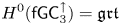 \[ H^0(\mathsf{fGC}_3^\uparrow)=\mathfrak{g}\mathfrak{r}\mathfrak{t} \]
where  $\mathfrak{g}\mathfrak{r}\mathfrak{t}$ is the Lie algebra of the Grothendieck–Teichmüller group
 $GRT$ introduced by Drinfeld in [Reference DrinfeldDri91].
Given any continuous morphism of topological dg props
 \[ i: \widehat{\mathcal{L}\textit{ieb}}_\infty \longrightarrow {\mathcal{P}} \]
there is, by the main theorem, an associated quantized morphism given as a composition
 \[ i_\mathfrak{A}: \mathcal{A}\textit{ssb}_\infty \stackrel{F_\mathfrak{A}}{\longrightarrow} {\mathcal{D}}\widehat{\mathcal{L}\textit{ieb}}_\infty \stackrel{{\mathcal{D}}(i)}{\longrightarrow}{\mathcal{D}} {\mathcal{P}} \]
which depends in general on the choice of an associator  $\mathfrak{A}$. An important example of such a non-trivial morphism
 $i$ was found recently in [Reference Merkulov and WillwacherMW15],
 \begin{equation} i: \widehat{\mathcal{L}\textit{ieb}}_\infty \longrightarrow \widehat{{\mathcal{R}}{\mathcal{G}} ra}, \end{equation}
where  ${\mathcal {R}}{\mathcal {G}} ra$ stands for the prop of ribbon graphs (see [Reference Merkulov and WillwacherMW15]) and
 $\widehat {{\mathcal {R}}{\mathcal {G}} ra}$ for its genus competition; this morphism
 $i$ provides us with many new algebraic structures on the totality
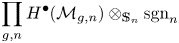 \[ \prod_{g,n} H^\bullet({\mathcal{M}}_{g,n})\otimes_{{\mathbb{S}}_n} {\text{sgn}}_n \]
of cohomology groups of moduli spaces of algebraic curves of genus  $g$ and with
 $n$ (skew-symmetrized) punctures, and establishes a surprisingly strong link between the latter and the cohomology theory of ordinary (i.e. non-ribbon) graph complexes [Reference Merkulov and WillwacherMW15]. The quantized version of the morphism (2) will be studied elsewhere.
Remark 1.1 The problem of studying the set of all formal quantization functors for Lie bialgebras has been addressed before by Enriquez [Reference EnriquezEnr01a, Reference EnriquezEnr01b], who showed that this set can be identified (essentially) with an algebraic object denoted by  ${\mathcal {w}}(\mathbb{K})$. Our approach to the classification differs from [Reference EnriquezEnr01a, Reference EnriquezEnr01b] in several aspects: we do not ask the quantization functor to be compatible with duals and doubles, and, moreover, we study quantization functors (which in our approach emerge as Maurer–Cartan elements of some
 ${\mathcal {L}} ie_\infty$ algebras) up to homotopy equivalence. Furthermore, we are able to express the result through a relatively well-known algebraic object, the Grothendieck–Teichmüller group.
1.5 Some notation
The set  $\{1,2, \ldots , n\}$ is abbreviated to
 $[n]$; its group of automorphisms is denoted by
 ${\mathbb {S}}_n$; the trivial one-dimensional representation of
 ${\mathbb {S}}_n$ is denoted by
 ${\mathbb{1}}_n$, while its one-dimensional sign representation is denoted by
 ${\text {sgn}}_n$; we often abbreviate
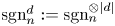 ${\text {sgn}}_n^d:= {\text {sgn}}_n^{\otimes |d|}$. The cardinality of a finite set
 $A$ is denoted by
 $\# A$. Given a set
 $S$, the associated vector space over a field
 ${\mathbb {K}}$ of linear combinations of elements of
 $S$ is denoted by
 ${\mathbb {K}}\langle S\rangle$.
We work throughout in the category of  ${\mathbb {Z}}$-graded vector spaces over a field
 ${\mathbb {K}}$ of characteristic zero. If
 $V=\oplus _{i\in {\mathbb {Z}}} V^i$ is a graded vector space, then
 $V[k]$ stands for the graded vector space with
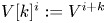 $V[k]^i:=V^{i+k}$ and
 $s^k$ for the associated isomorphism
 $V\rightarrow V[k]$; for
 $v\in V^i$ we set
 $|v|:=i$. For a pair of graded vector spaces
 $V_1$ and
 $V_2$, the symbol
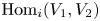 ${\mathrm {Hom}}_i(V_1,V_2)$ stands for the space of homogeneous linear maps of degree
 $i$, and
 ${\mathrm {Hom}}(V_1,V_2):=\bigoplus _{i\in {\mathbb {Z}}}{\mathrm {Hom}}_i(V_1,V_2)$; for example,
 $s^k\in {\mathrm {Hom}}_{-k}(V,V[k])$. Furthermore, we use the notation
 $\odot ^k V$ for the k-fold symmetric product of the vector space
 $V$ and set
 $\odot V:=\bigoplus _{k\geq 0} \odot ^k V$,
 $\odot ^{\geq 1} V:=\bigoplus _{k\geq 1} \odot ^k V$.
For a prop(erad)  ${\mathcal {P}}$ we denote by
 ${\mathcal {P}}\{k\}$ a prop(erad) which is uniquely defined by the following property: for any graded vector space
 $V$ a representation of
 ${\mathcal {P}}\{k\}$ in
 $V$ is identical to a representation of
 ${\mathcal {P}}$ in
 $V[k]$. The degree-shifted operad of Lie algebras
 ${\mathcal {L}} \textit{ie}\{d\}$ is denoted by
 ${\mathcal {L}} ie_{d+1}$ while its minimal resolution by
 ${\mathcal {H}} olie_{d+1}$; representations of
 ${\mathcal {L}} ie_{d+1}$ are vector spaces equipped with Lie brackets of degree
 $-d$. Given a collection of vector spaces,
 $V_1,\ldots ,V_k$, the associated
 $k$-coloured endomorphism properad is denoted by
 ${\mathcal {E}} nd_{V_1,\ldots , V_k}$.
For a right (respectively, left) module  $V$ over a group
 $G$ we denote by
 $V_G$ (respectively
 $_G\hspace {-0.5mm}V$) the
 ${\mathbb {K}}$-vector space of coinvariants:
 $V/\{g(v) - v\,|\,v\in V, g\in G\}$ and by
 $V^G$ (respectively
 $^GV$) the subspace of invariants:
 $\{\forall g\in G\,:\,g(v)=v,\ v\in V\}$. If
 $G$ is finite, then these spaces are canonically isomorphic as
 $char({\mathbb {K}})=0$.
2. A polydifferential endofunctor
2.1 Polydifferential operators
For an arbitrary vector space  $V$ the associated graded commutative tensor algebra
 ${\mathcal {O}}_V:=\odot ^\bullet V$ has a canonical structure of a commutative and cocommutative bialgebra with the multiplication denoted by (or simply by the juxtaposition)
 \[ \circ: {\mathcal{O}}_V\otimes {\mathcal{O}}_V \rightarrow {\mathcal{O}}_V \]
and the comultiplication denoted by
 \[ \Delta: {\mathcal{O}}_V \longrightarrow {\mathcal{O}}_V\otimes {\mathcal{O}}_V . \]
This comultiplication is uniquely determined by its value on an arbitrary element  $x\in V$ which is given by
 \[ \Delta(x)= 1\otimes x+ x\otimes 1. \]
The bialgebra  ${\mathcal {O}}_V$ is (co)augmented, with the (co)augmentation (co)ideal denoted by
 $\bar {{\mathcal {O}}}_V:=\odot ^{\bullet \geq 1} V$. The reduced diagonal
 $\bar {{\mathcal {O}}}_V \rightarrow \bar {{\mathcal {O}}}_V\otimes \bar {{\mathcal {O}}}_V$ is denoted by
 $\bar {\Delta }$. The multiplication in
 ${\mathcal {O}}_V$ induces naturally a multiplication in
 ${\mathcal {O}}_V^{\otimes m}$ for any
 $m\geq 2$,
 \[ \circ: {\mathcal{O}}_V^{\otimes m} \otimes {\mathcal{O}}_V^{\otimes m} \longrightarrow {\mathcal{O}}_V^{\otimes m}, \]
which is also often denoted by the juxtaposition or the central dot.
As  ${\mathcal {O}}_V$ is a bialgebra, one can consider an associated Gerstenhaber–Schack complex
 \[ C_{{\rm GS}}({\mathcal{O}}_V^{\otimes \bullet}, {\mathcal{O}}_V^{\otimes \bullet})= \bigoplus_{m,n\geq 1} {\mathrm{Hom}}({\mathcal{O}}_V^{\otimes n}, {\mathcal{O}}_V^{\otimes m})[m+n-2] \]
equipped with the differential [Reference Gerstenhaber and SchackGS90],
 \[ d_{\mathfrak{g}\mathfrak{s}}=d_1 \oplus d_2: {\mathrm{Hom}}({\mathcal{O}}_V^{\otimes n}, {\mathcal{O}}_V^{\otimes m}) \longrightarrow {\mathrm{Hom}}({\mathcal{O}}_V^{\otimes n+1}, {\mathcal{O}}_V^{\otimes m}) \oplus {\mathrm{Hom}}({\mathcal{O}}_V^{\otimes n}, {\mathcal{O}}_V^{\otimes m+1}), \]
with  $d_1$ given on an arbitrary
 $f\in {\mathrm {Hom}}(V^{\otimes n}, V^{\otimes m})$ by
 \begin{align*} (d_1f)(v_0, v_1, \ldots, v_n)&:=\Delta^{m-1}(v_0)\cdot f(v_1, v_2, \ldots, v_n) - \sum_{i=0}^{n-1} (-1)^if(v_1, \dots, v_iv_{i+1}, \ldots, v_n)\\ &\quad + (-1)^{n+1}f(v_1, v_2, \ldots, v_n)\cdot\Delta^{m-1}(v_n) \forall\ \ v_0, v_1,\ldots, v_n\in V, \end{align*}
where
 \[ \Delta^{m-1}:= (\Delta\otimes {\mathrm{Id}}^{\otimes m-2 })\circ (\Delta\otimes {\mathrm{Id}}^{\otimes m-3})\circ\cdots \circ \Delta: V \rightarrow V^{\otimes m}, \]
for  $m\geq 2$, we set
 $\Delta ^0:={\mathrm {Id}}$. The expression for
 $d_2$ is an obvious ‘dual’ analogue of the one for
 $d_1$.
One can consider a subspace,
 \begin{equation} C_{{\rm poly}}({\mathcal{O}}_V^{\otimes \bullet}, {\mathcal{O}}_V^{\otimes \bullet}) \subset C_{{\rm GS}}({\mathcal{O}}_V^{\otimes \bullet}, {\mathcal{O}}_V^{\otimes \bullet}), \end{equation}
spanned by so called polydifferential operators,
 \[ \begin{array}{rccc} \Phi: & {\mathcal{O}}_V^{\otimes m} & \longrightarrow & {\mathcal{O}}_V^{\otimes n}\\ & f_1\otimes \cdots \otimes f_m & \longrightarrow & \Phi(f_1, \ldots, f_m), \end{array} \]
which are linear combinations of operators of the form,
 \begin{equation} \Phi(f_1, \ldots, f_m)= x^{\beta_{J_1}} \otimes \cdots \otimes x^{\beta_{J_n}}\cdot \Delta^{n-1}\left( \frac{{\partial}^{|\alpha_{I_1}|}f_1}{{\partial} x^{\alpha_{I_1}}}\right)\cdot\cdots \cdot \Delta^{n-1}\left(\frac{{\partial}^{|\alpha_{I_m}|}f_m}{{\partial} x^{\alpha_{I_m}}}\right). \end{equation}
where  $\{x^\alpha \}_{\alpha \in S}$ is some basis in
 $V$,
 $\alpha _I$ and
 $\beta _{J}$ stand for multi-indices (say, for
 $\alpha _1\alpha _2\ldots \alpha _p$, and
 $\beta _1\beta _2\ldots \beta _q$) from the set
 $S$,
 \[ x^{\beta_J}:= x^{\beta_1}x^{\beta_2}\ldots x^{\beta_q}, \quad \frac{{\partial}^{|\alpha_I|}}{{\partial} x^{\alpha_I}}:= \frac{{\partial}^{p}}{{\partial} x^{\alpha_1}{\partial} x^{\alpha_2}\ldots {\partial} x^{\alpha_p}}. \]
In fact this subspace is a subcomplex of the Gerstenhaber–Shack complex with the differential given explicitly by
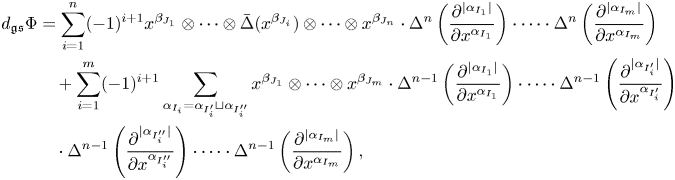 \begin{align*} d_{\mathfrak{g}\mathfrak{s}}\Phi &=\sum_{i=1}^{n}(-1)^{i+1} x^{\beta_{J_1}} \otimes {\cdots} \otimes \bar{\Delta}(x^{\beta_{J_i}})\otimes {\cdots} \otimes x^{\beta_{J_n}}\cdot \Delta^{n} \left( \frac{{\partial}^{|\alpha_{I_1}|}}{{\partial} x^{\alpha_{I_1}}}\right)\cdot\cdots \cdot \Delta^{n}\left( \frac{{\partial}^{|\alpha_{I_m}|}}{{\partial} x^{\alpha_{I_m}}}\right)\\ &\quad +\sum_{i=1}^{m}(-1)^{i+1}\sum_{\alpha_{I_i}=\alpha_{I_i'}\sqcup \alpha_{I_i''}} x^{\beta_{J_1}} \otimes {\cdots} \otimes x^{\beta_{J_m}}\cdot \Delta^{n-1}\left( \frac{{\partial}^{|\alpha_{I_1}|}}{{\partial} x^{\alpha_{I_1}}}\right)\cdot{\cdots} \cdot \Delta^{n-1}\left( \frac{{\partial}^{|\alpha_{I'_i}|}}{{\partial} x^{\alpha_{I'_i}}}\right)\\ &\quad \cdot \Delta^{n-1}\left( \frac{{\partial}^{|\alpha_{I_i''}|}}{{\partial} x^{\alpha_{I''_i}}}\right) \cdot{\cdots}\cdot \Delta^{n-1}\left( \frac{{\partial}^{|\alpha_{I_m}|}}{{\partial} x^{\alpha_{I_m}}}\right), \end{align*}
where the second summation goes over all possible splittings,  ${I_i=I_i'\sqcup I_i''}$, into disjoint subsets. Moreover, the inclusion (3) is a quasi-isomorphism [Reference MerkulovMer11]. Note that polydifferential operators (4) are allowed to have sets of multi-indices
 $I_i$ and
 $J_i$ with zero cardinalities
 $|I_i|=0$ and/or
 $|J_i|=0$ (so that the standard multiplication and comultiplication in
 ${\mathcal {O}}_V$ belong to the class of polydifferential operators.
2.2 The polydifferential prop associated to a prop
In this section we construct an endofunctor in the category of (augmented) props which has the property that, for any prop  ${\mathcal {P}}=\{{\mathcal {P}}(m,n)\}_{m,n\geq 1}$ and its representation
 \[ \rho: {\mathcal{P}} \longrightarrow {\mathcal{E}} nd_V \]
in a vector space  $V$, the associated prop
 ${\mathcal {D}}{\mathcal {P}}=\{{\mathcal {D}}{\mathcal {P}}(k)\}_{k\geq 1}$ admits an associated representation,
 \[ \rho^{{\rm poly}}: {\mathcal{D}}{\mathcal{P}} \longrightarrow {\mathcal{E}} nd_{\odot^\bullet V}, \]
in the graded commutative algebra  $\odot ^\bullet V$ on which elements
 $p\in {\mathcal {P}}$ act as polydifferential operators.
The idea is simple, and is best expressed in some basis  $\{x^\alpha \}_{\alpha \in S}$ in
 $V$ (so that
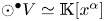 $\odot ^\bullet V\simeq {\mathbb {K}}[x^\alpha ]$). Any element
 $p\in {\mathcal {P}}(m,n)$ gets transformed by
 $\rho$ into a linear map
 \[ \begin{array}{rccc} \rho(p): & \otimes^n V & \longrightarrow & \otimes^m V\\ & x^{\alpha_1}\otimes x^{\alpha_2} \otimes\cdots \otimes x^{\alpha_n} & \longrightarrow & \displaystyle \sum_{\beta_1,\beta_2,\ldots,\beta_m} A^{\alpha_1\alpha_2\ldots\alpha_n}_{\beta_1\beta_2\ldots\beta_m} x^{\beta_1}\otimes x^{\beta_2} \otimes\cdots \otimes x^{\beta_n} \end{array} \]
for some 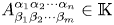 $A^{\alpha _1\alpha _2\cdots \alpha _n}_{\beta _1\beta _2\cdots \beta _m}\in {\mathbb {K}}$.
Then, for any partitions
 \[ [m]=J_1\sqcup \cdots \sqcup J_l\quad \mathrm{and}\quad [n]=I_1\sqcup \cdots \sqcup I_k \]
of the sets  $[m]$ and
 $[n]$ into a disjoint union of (possibly, not all non-empty) subsets,
 \[ J_j=\{s_{a_1}, s_{a_2}, \ldots, s_{a_{\# J_j}}\},\ 1\leq j\leq l,\quad \mbox{and}\quad I_i=\{s_{b_1}, s_{b_2}, \ldots, s_{b_{\# I_i}}\},\ 1\leq i\leq k, \]
we can associate to  $p\in {\mathcal {P}}(m,n)$ a polydifferential operator
 \[ \begin{array}{rccc} p^{{\rm poly}}: & \otimes^k (\odot^\bullet V) & \longrightarrow & \otimes^l(\odot^\bullet V)\\ & f_1(x)\otimes f_2(x) \otimes\cdots \otimes f_k(x) & \longrightarrow & p^{{\rm poly}}(f_1,\ldots,f_k) \end{array} \]
where
 \begin{align} &p^{{\rm poly}}(f_1,\ldots,f_k)\nonumber\\ &\quad := \displaystyle \sum_{\alpha_1,\ldots,\alpha_n\atop \beta_1,\ldots, \beta_m} A^{\alpha_{I_1}\cdots\alpha_{I_k}}_{\beta_{J_1}\cdots\beta_{J_l}}\, x^{\beta_{J_1}} \otimes \cdots \otimes x^{\beta_{J_l}}\cdot \Delta^{l-1}\left( \frac{{\partial}^{|\alpha_{I_1}|}f_1}{{\partial} x^{\alpha_{I_1}}}\right)\cdot\cdots \cdot \Delta^{l-1}\left( \frac{{\partial}^{|\alpha_{I_k}|}f_k}{{\partial} x^{\alpha_{I_k}}}\right). \end{align}
This association  $p\rightarrow p^{{\rm poly}}$ (for any fixed partition of
 $[m]$ and
 $[n]$) is independent of the choice of a basis used in the construction. Our purpose is to construct a prop
 ${\mathcal {D}}{\mathcal {P}}$ out of the prop
 ${\mathcal {P}}$ together with a linear map
 \[ F_{[n]=I_1\sqcup\cdots\sqcup I_k}^{[m]=J_1\sqcup\cdots\sqcup J_l}: {\mathcal{P}}(m,n) \longrightarrow {\mathcal{O}}{\mathcal{P}}(l,k) \]
such that, for any representation  $\rho :{\mathcal {P}}\rightarrow {\mathcal {E}} nd_V$, the prop
 ${\mathcal {D}}{\mathcal {P}}$ admits a natural representation
 $\rho ^{{\rm poly}}$ in
 $\odot ^\bullet V$ and

Remarks 2.1 (i) The symmetric tensor algebra  $\odot ^\bullet V$ carries a natural representation of the prop
 $\mathcal {C}\textit{omb}$ controlling commutative and cocommutative bialgebras so that the latter can also be incorporated into
 ${\mathcal {D}}{\mathcal {P}}$ in the form of operators corresponding, in the above notation, to the case when all the sets
 $I_i$ and
 $J_j$ are empty.
(ii) The functor  ${\mathcal {D}}$ (see below) can be defined for an arbitrary unital prop. However, some of our constructions in this paper become nicer if we assume that the props we consider are augmented,
 \[ {\mathcal{P}}= {\mathbb{K}} \oplus \bar{{\mathcal{P}}}, \]
and apply the functor  ${\mathcal {D}}$ to the augmentation ideal
 $\bar {{\mathcal {P}}}$ only.Footnote 5
Definition 2.2 Let  ${\mathcal {P}}$ be an augmented prop. Define a collection of (completed with respect to the filtration by the number of outputs and inputs)
 ${\mathbb {S}}$-modules,
 \[ {\mathcal{D}}{\mathcal{P}}(l,k) :=\mathcal{C}\textit{omb}(l,k)\ \oplus \prod_{m,n\geq 1}\bigoplus_{[m]=\ J_1\sqcup \cdots\sqcup J_l\atop {[n]=\ I_1\sqcup \cdots\sqcup I_k \atop \# I_i,\ldots, \# J_j\geq 0}} {\mathcal{D}}{\mathcal{P}}^{J_1,\ldots,J_l}_{I_1,\ldots,I_k}, \]
where
 \begin{align*} \mathcal{C}\textit{omb}(l,k)&:={\mathbb{1}}_l\otimes {\mathbb{1}}_k,\\ {\mathcal{D}}{\mathcal{P}}^{J_1,\ldots,J_l}_{I_1,\ldots,I_k}& := ({\mathbb{1}}_{S_{J_1}} \otimes \cdots \otimes {\mathbb{1}}_{S_{J_l}}) \otimes_{S_{J_1}\times \cdots\times S_{J_l}} \otimes \bar{{\mathcal{P}}}(m,n)\otimes_{S_{I_1}\times \cdots\times S_{I_k}} (\mathbb{1}_{S_{I_1}} \otimes \cdots \otimes {\mathbb{1}}_{S_{I_k}}), \end{align*}
where  ${\mathbb{1}}_I$ stands for the trivial one-dimensional representation of the permutation group
 $S_I$. Thus an element of the summand
 ${\mathcal {D}}{\mathcal {P}}^{J_1,\ldots ,J_l}_{I_1,\ldots ,I_k}$ is an element of
 ${\mathcal {P}}(\# I_1+ \cdots + \# I_l,\# J_1+ \cdots + \# J_k)$ with inputs (respectively, outputs) belonging to each bunch
 $I_i$ (respectively,
 $J_j$) symmetrized. We assume from now on that all legs in each bunch
 $I_i$ (respectively,
 $J_j$) are labelled by the same integer
 $i$ (respectively,
 $j$); this defines an action of the group
 ${\mathbb {S}}_l^{op}\times {\mathbb {S}}_k$ on
 ${\mathcal {D}}{\mathcal {P}}(l,k)$. There is a canonical linear projection,
 \begin{equation} \pi^{J_1,\ldots,J_l}_{I_1,\ldots,I_k}: \bar{{\mathcal{P}}}(m,n) \longrightarrow {\mathcal{D}}{\mathcal{P}}^{J_1,\ldots,J_l}_{I_1,\ldots,I_k}. \end{equation}
One can represent elements  $p$ of the (non-unital) prop
 $\bar {{\mathcal {P}}}$ as (decorated) corollas,Footnote 6
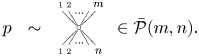
The image of  $p$ under the projection (6) is represented pictorially as the same corolla but with output and input legs decorated by not necessarily distinct numbers,

Note that some of the sets  $I_i$ and/or
 $J_j$ can be empty so that some of the numbers decorating inputs and/or outputs can have no legs attached at all. For example, one and the same element
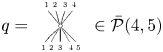
can generate, for different partitions, several different elements in  ${\mathcal {D}}{\mathcal {P}}$,

We shall often represent elements of  ${\mathcal {D}}{\mathcal {P}}$ as graphs having two types of vertices: the small ones which are decorated by elements of
 $\bar {{\mathcal {P}}}$, and new big ones corresponding to those input, respectively, output legs of
 ${\mathcal {D}}{\mathcal {P}}$ which having the same numerical labels,

In this notation elements (
7) gets represented, respectively, as
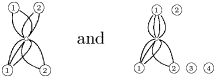
while the unique generator of  $\mathcal {C}\textit{omb}(k,l)\subset {\mathcal {D}}{\mathcal {P}}(k,l)$ as a two levelled collection of solely white vertices

In particular the multiplication generator in  $\mathcal {C}\textit{omb}$ is given by the graph

while the comultiplication generator is given by

. These new big white vertices come in two types: the incoming ones and outgoing ones; we call them from now on in-vertices and, respectively, out-vertices of an element  $p\in {\mathcal {D}}{\mathcal {P}}(l,k)$.
The  ${\mathbb {S}}$-bimodule
 ${\mathcal {D}}{\mathcal {P}}=\{\,{\mathcal {D}}{\mathcal {P}}(k,l)\}$ has a natural structure of a prop with respect to the following composition operations.
(I) The horizontal composition
 \[ \begin{array}{rccc} \Box_h: & {\mathcal{D}}{\mathcal{P}}(k,l) \otimes{\mathcal{D}}{\mathcal{P}}(k',l') & \longrightarrow & {\mathcal{D}}{\mathcal{P}}(k+k, l+l')\\ & p\otimes q & \longrightarrow & p \Box_h q \end{array} \]
is given as follows.
(i) If
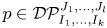
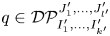
 $p\in {\mathcal {D}}{\mathcal {P}}^{J_1,\ldots ,J_l}_{I_1,\ldots ,I_k}$ and $q\in {\mathcal {D}}{\mathcal {P}}^{J_1',\ldots ,J'_{l'}}_{I'_1,\ldots ,I'_{k'}}$ the ${\mathbb {S}}$-equivariance of the horizontal composition $\circ _h$ in ${\mathcal {P}}$ assures that
and we set\[ p\circ_h q\in {\mathcal{D}}{\mathcal{P}}^{J_1,\ldots,J_l, J_1',\ldots,J'_{l'}}_{I_1,\ldots,I_k,I'_1,\ldots,I'_{k'} } \]$p\Box _h q:=p\circ _h q$.
(ii) If
$p\in {\mathcal {D}}{\mathcal {P}}^{J_1,\ldots ,J_l}_{I_1,\ldots ,I_k}\subset \bar {P}(m,n)$ and $q$ is the generator of $\mathcal {C}\textit{omb}(l',k')$, then we define
where\[ p\Box_h q:= \pi^{J_1,\ldots,J_l, J_1',\ldots,J'_{l'}}_{I_1,\ldots,I_k,I'_1,\ldots,I'_{k'} }(p) \in {\mathcal{D}}{\mathcal{P}}^{J_1,\ldots,J_l, J_1',\ldots,J'_{l'}}_{I_1,\ldots,I_k,I'_1,\ldots,I'_{k'} } \]$J_1'=\cdots =J'_{l'}=I'_1=\cdots =I'_{k'}=\emptyset$. Similarly one defines $q\Box _h p$.(iii) If
$p\in \mathcal {C}\textit{omb}(l,k)$ and $q\in \mathcal {C}\textit{omb}(l',k')$ then $p\Box _h q$ is defined to be the horizontal composition of these elements in the prop $\mathcal {C}\textit{omb}$.













(II) The vertical composition
 \[ \begin{array}{rccc} \Box_v: & {\mathcal{D}}{\mathcal{P}}(l,n) \otimes {\mathcal{D}}{\mathcal{P}}(n,k) & \longrightarrow & {\mathcal{D}}{\mathcal{P}}(l,k)\\ & \Gamma\otimes \Gamma' & \longrightarrow & \Gamma\Box_v\Gamma', \end{array} \]
by the following three-step procedure.
(1) Erase all
$n$ out-vertices of $\Gamma '$ and all $n$ in-vertices of $\Gamma$; this procedure leaves output legs of $\Gamma '$ (which are labelled by elements of the set $[n]$) and input legs of $\Gamma$ (which are also labelled by elements of the same set $[n]$) ‘hanging in the air’.(2) Take the sum over all possible ways of:
(2i) attaching a number of the hanging out-legs of
$\Gamma '$ to the same number of hanging in-legs of $\Gamma$ with the same numerical label;(2ii) attaching the remaining hanging edges of
$\Gamma '$ to the out-vertices of $\Gamma$;(2iii) attaching the remaining (after step (2i)) hanging in-legs of
$\Gamma$ to the in-vertices of $\Gamma '$.
(3) Perform the vertical composition (along new internal edges in step (2i)) and horizontal composition (of all remaining disjoint internal vertices) as in
${\mathcal {P}}$ to get a unique internal vertex in $\Gamma \Box _v\Gamma '$.


Often props  ${\mathcal {P}}$ are defined as quotients of free props
 ${\mathcal {F}} ree \langle E\rangle$ generated by some
 ${\mathbb {S}}$-bimodules
 $E$ modulo ideals
 ${\mathcal {R}}$ of relations; in this representation elements of
 ${\mathcal {P}}$ (and hence internal vertices of elements from
 ${\mathcal {D}}{\mathcal {P}}$) are themselves graphs (modulo some equivalence relation). Therefore it is enough to understand the above compositions
 $\Box _h$ and
 $\Box _v$ for props of the form
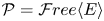 ${\mathcal {P}}={\mathcal {F}} ree\langle E\rangle$ in which case one has, for example,
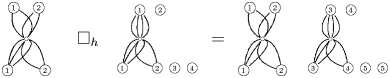
and

It is worth emphasizing that all graphs above are oriented in the sense that every edge is directed (but there are now directed paths of directed edge forming a closed path). We do not show directions in our pictures assuming that the flow goes by default from bottom to the top. For example, the graph

stands in fact for the directed graph

.
Let us summarize the above discussion in the following proposition–definition.
Proposition 2.2.3 (i) There is an endofunctor  ${\mathcal {D}}$ in the category of augmented props. The value
 ${\mathcal {D}}{\mathcal {P}}$ of the endofunctor
 ${\mathcal {D}}$ on an augmented prop
 ${\mathcal {P}}$ is called the polydifferential prop associated to
 ${\mathcal {P}}$.
(ii) Any representation of the augmented prop  ${\mathcal {P}}$ in a graded vector space
 $V$ induces canonically an associated representation of the polydifferential
 ${\mathcal {D}}{\mathcal {P}}$ in
 $\odot ^\bullet V$ given by polydifferential operators (which are defined explicitly in (5)).
(iii) For any augmented prop  ${\mathcal {P}}$ there is a canonical injection of props,
 \begin{equation} i:\mathcal{C}\textit{omb} \longrightarrow {\mathcal{D}}{\mathcal{P}} \end{equation}
sending the generator  $1$ of
 $\mathcal {C}\textit{omb}(l,k)={\mathbb{1}}_l\otimes {\mathbb{1}}_k={\mathbb {K}}$ to the graph (8).
Remark 2.2 The suboperad  $\{{\mathcal {D}}{\mathcal {P}}(1,n)\}_{n\geq 1}$ of the prop
 ${\mathcal {D}}{\mathcal {P}}$ has been studied earlier in [Reference Merkulov and WillwacherMW15] where it was denoted by
 ${\mathcal {O}}{\mathcal {P}}$.
Proposition 2.2.5 The endofunctor  ${\mathcal {D}}$ is exact.
Proof. Due to the classical Maschke's theorem, the functor of taking invariants and/or coinvariants in the category of representations of finite groups in dg vector spaces over a field of characteristic zero is exact. Hence the required claim follows.
2.3 Polydifferential props and hypergraphs
In the definition of the polydifferential prop  ${\mathcal {D}}{\mathcal {P}}$ horizontal compositions in a prop
 ${\mathcal {P}}$ play as important role as vertical ones. Therefore, to apply the polydifferential functor to a properad (or operad)
 ${\mathcal {P}}$ one has to take first its enveloping prop
 ${\mathcal {U}}{\mathcal {P}}$ and then apply the endofunctor
 ${\mathcal {D}}$ to the latter; for an augmented properad
 ${\mathcal {P}}$ we understand the prop
 ${\mathcal {U}}{\mathcal {P}}$ as
 ${\mathbb {K}} \oplus {\mathcal {U}}\bar {{\mathcal {P}}}$ and define
 \[ {\mathcal{D}}{\mathcal{P}}:={\mathcal{D}}({\mathcal{U}}{{\mathcal{P}}}). \]
The case of properads is of special interest as elements of  ${\mathcal {D}}{\mathcal {P}}$ can be understood now as hypergraphs, that is, generalizations of graphs in which edges can connect more than two vertices (cf. [Reference Merkulov and WillwacherMW15]). For example, elements of a properad
 ${\mathcal {P}}$

generate an element
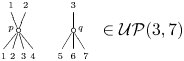
which in turn generates an element
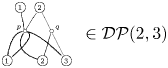
which looks like a real graph with many vertices of two types: the small ones which are decorated by elements of the properad  ${\mathcal {P}}$ and big ones corresponding to the inputs and outputs of the properad
 ${\mathcal {D}}{\mathcal {P}}$. Sometimes it is useful to understand such a graph as a hypergraph with small vertices playing the role of hyperedges (cf. [Reference Merkulov and WillwacherMW15]).
We consider below several concrete examples of polydifferential props and their applications.
2.4 A note on deformation complexes and Lie algebras of derivations of prop(erad)s
Our definitions of these notions are slightly non-standard, but only with these non-standard definitions the  ${\mathcal {L}} ie_\infty$ claim (ii) in the Main Theorem in § 1.3 holds true.
Let  $({\mathcal {P}},\delta )$ be an arbitrary dg prop(erad), and
 ${\mathcal {P}}^+$ be the prop(erad) freely generated by
 ${\mathcal {P}}$ and one extra operation

of arity  $(1,1)$ and of cohomological degree
 $+1$. We make
 ${\mathcal {P}}^+$ into a differential prop(erad) by setting the value of the differential
 $\delta ^+$ on the new generator by

and on any other element  $a\in {\mathcal {P}}(m,n)$ (which we identify pictorially with the
 $(m,n)$-corolla whose vertex is decorated with
 $a$) by the formula

The dg prop(erad)  $({\mathcal {P}}^+, \delta ^+)$ is uniquely characterized by the fact that there is a one-to-one correspondence between representations
 \[ \rho: {\mathcal{P}}^+ \longrightarrow {\mathcal{E}} nd_V \]
of  $({\mathcal {P}}^+, \delta ^+)$ in a dg vector space
 $(V,d)$, and representations of
 ${\mathcal {P}}$ in the same space
 $V$ but equipped with a deformed differential
 $d+d'$, where

. Clearly any  ${\mathcal {P}}$-algebra is a
 ${\mathcal {P}}^+$-algebra (with
 $d'=0$) so that there a canonical epimorphism
 $\pi : {\mathcal {P}}^+\to {\mathcal {P}}$ of dg prop(erad)s; we also have a canonical monomorphism
 ${\mathcal {P}}\rightarrow {\mathcal {P}}^+$ of non-differential prop(erad)s. We define the dg Lie algebra,
 $\mathrm {Der}({\mathcal {P}})$, of derivations of
 $({\mathcal {P}},\delta )$ as the complex of derivations of
 $({\mathcal {P}}^+,\delta ^+)$ with values in
 ${\mathcal {P}}$, that is, as the Lie algebra generated by linear maps
 \[ D: {\mathcal{P}}^+ \longrightarrow {\mathcal{P}} \]
which satisfy the condition
 \[ D(a \boxtimes_{1,1} b)= D(a) \boxtimes_{1,1} \pi(b) + (-1)^{|a||D|} \pi(a)\boxtimes_{1,1} D(b), \quad \forall \ a,b\in {\mathcal{P}}^+, \]
where  $\boxtimes _{1,1}$ stands [Reference ValletteVal07] for the properadic composition along any connected oriented two-vertex graph. The differential
 $d$ in
 $\mathrm {Der}({\mathcal {P}})$ is given by the formula
 \[ dD:= \delta\circ D - (-1)^{|D|} D\circ \delta^+. \]
Next, let  $f: {\mathcal {P}} \rightarrow {\mathcal {Q}}$ be a morphism of dg prop(erad)s. Its deformation complex
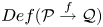 $Def({\mathcal {P}} \stackrel {f}{\rightarrow } {\mathcal {Q}})$ is a
 ${\mathcal {L}} ie _\infty$ algebra which is defined in full details (and in two different ways) in [Reference Merkulov and ValletteMV09] with the help of a cofibrant resolution
 $\tilde {{\mathcal {P}}}$ of the prop
 ${\mathcal {P}}$. Most often
 $\tilde {{\mathcal {P}}}$ is equal to (the prop enveloping of) the cobar construction
 $\Omega ({\mathcal {C}})={\mathcal {F}} ree\langle \bar {\mathcal {C}}[-1]\rangle$ of some coaugmented homotopy coproperad
 ${\mathcal {C}}$ (with the cokernel denoted by
 $\bar {\mathcal {C}}$), in which case one has an isomorphism of
 ${\mathbb {S}}$-modules,
 \[ Def({\mathcal{P}} \stackrel{f}{\rightarrow} {\mathcal{Q}})\equiv Def({\mathcal{P}} \stackrel{f}{\rightarrow} {\mathcal{Q}}) \simeq \prod_{m,n\geq 1} {\mathrm{Hom}}_{{\mathbb{S}}_m^{op}\times {\mathbb{S}}_n}\left(\bar{C}(m,n), Q(m,n) \right). \]
Again we need a slightly extended version of the deformation functor,
 \[ \mathsf{Def}({\mathcal{P}} \stackrel{f}{\rightarrow} {\mathcal{Q}}):=Def({\mathcal{P}} \stackrel{f}{\rightarrow} {\mathcal{Q}}) \oplus Q(1,1)[1] \simeq \prod_{m,n\geq 1} {\mathrm{Hom}}_{{\mathbb{S}}_m^{op}\times {\mathbb{S}}_n}\left({C}(m,n), Q(m,n) \right). \]
which includes an extra degree of freedom for deformations of the differentials. With this definition we have an isomorphism of complexes
 \[ \mathrm{Der}(P)=\mathsf{Def}({\mathcal{P}}\stackrel{{\mathrm{Id}}}{\rightarrow}{\mathcal{P}})[1] \]
relating our extended version of the complex derivations with the extended version of the deformations of the identity map. Note however that this isomorphism does not respect Lie brackets: they are quite different (with the right-hand side being in general a  ${\mathcal {L}} ie_\infty$ algebra, while the left-hand side being in a general a dg Lie algebra).
Finally we warn the reader that the formality theorem for quantization of Lie bialgebras as formulated in part (ii) of the Main Theorem in § 1.3 holds true only for our extended version  $\mathsf {Def}$ of the deformation functor
 ${Def}$.
3. Associative bialgebras, Lie bialgebras and their deformation complexes
3.1 A properad of Lie bialgebras
A Lie bialgebra is a graded vector space  $V$ equipped with compatible Lie brackets
 \[ [\ ,\ ]: \wedge^2 V \rightarrow V, \quad \triangle: V \rightarrow \wedge^2 V . \]
The compatibility relations are best described in terms of the properad  $\mathcal {L}\textit{ieb}$ governing Lie bialgebras via its representations
 $\rho _0: \mathcal {L}\textit{ieb} \rightarrow {\mathcal {E}} nd_V$ which send one generator to the Lie bracket and another generator to the Lie cobracket,

More precisely, the properad  $\mathcal {L}\textit{ieb}$ is defined [Reference DrinfeldDri92] as a quotient,
 \[ \mathcal{L}\textit{ieb}:= {{\mathcal{F}} ree \langle E_0\rangle}/(R) \]
of the free properad generated by an  ${\mathbb {S}}$-bimodule
 $E_0=\{E_0(m,n)\}$,
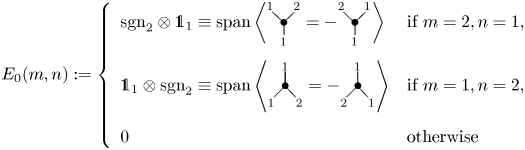
modulo the ideal generated by the following relationsFootnote 7
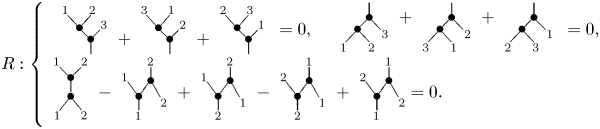
Its minimal resolution,  $\mathcal {L}\textit{ieb}_\infty$, is a dg free prop,
 \[ \mathcal{L}\textit{ieb}_\infty={\mathcal{F}} ree \langle E\rangle, \]
generated by the  ${\mathbb {S}}$–bimodule
 $E=\{ E(m,n)\}_{m,n\geq 1, m+n\geq 3}$,

and with the differential given on generating corollas by [Reference Markl and VoronovMV09, Reference ValletteVal07]

where  $\sigma (I_1\sqcup I_2)$ and
 $\sigma (J_1\sqcup J_2)$ are the signs of the shuffles
 $[1,\ldots ,m]\rightarrow I_1\sqcup I_2$ and, respectively,
 $[1,\ldots ,n]\rightarrow J_1\sqcup J_2$. For example,

Strongly homotopy Lie bialgebra structures,  $\rho : \mathcal {L}\textit{ieb}_\infty \longrightarrow {\mathcal {E}} nd_V,$ in a dg vector space
 $V$ can be identified with Maurer–Cartan (MC, for short) elements of a dg Lie algebra
 $\mathfrak{g}_V$ defined next.
3.1.1 Strongly homotopy Lie bialgebra structures as Maurer–Cartan elements
Let  $V$ be a dg vector space (with differential denoted by
 $d$). According to the general theory [Reference Merkulov and ValletteMV09], there is a one-to-one correspondence between the set of representations,
 $\{ \rho : \mathcal {L}\textit{ieb}_\infty \rightarrow {\mathcal {E}} nd_V\}$, and the set of Maurer–Cartan elements in the dg Lie algebra
 \begin{align} \mathsf{Def}(\mathcal{L}\textit{ieb}_\infty \stackrel{0}{\rightarrow} {\mathcal{E}} nd_V)&\simeq \prod_{m,n\geq 1} \wedge^mV^*\otimes \wedge^n V[2-m-n]\nonumber\\ &= \prod_{m,n\geq 1} \odot^m(V^*[-1])\otimes \odot^n(V[-1]) [2] =: \mathfrak{g}_V[2] \end{align}
controlling deformations of the zero map 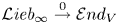 $\mathcal {L}\textit{ieb}_\infty \stackrel {0}{\rightarrow } {\mathcal {E}} nd_V$. The differential in
 $\mathfrak{g}_V$ is induced by the differential in
 $V$ while the Lie bracket can be described explicitly as follows. First one notices that the completed graded vector space
 \begin{equation} \mathfrak{g}_V=\prod_{m,n\geq 1} \odot^m(V^*[-1])\otimes \odot^n(V[-1])=\widehat{\odot^{\bullet \geq 1}}\left( V^*[-1])\oplus V[-1]\right) \end{equation}
is naturally a  $3$-algebra with degree
 $-2$ Lie brackets,
 $\{\ ,\ \}$, given on generators by
 \[ \{sv, sw\}=0,\quad \{s\alpha, s\beta\}=0, \quad \{s\alpha, sv\}=\langle\alpha,v\rangle, \quad \forall v,w\in V, \alpha,\beta\in V^*, \]
where  $s: V\rightarrow V[-1]$ and
 $s: V^*\rightarrow V^*[-1]$ are natural isomorphisms. Maurer–Cartan elements in
 $\mathfrak{g}_V$, that is degree-
 $3$ elements
 $\nu$ satisfying the equation
 \[ \{\nu,\nu\}=0, \]
are in one-to-one correspondence with representations  $\nu : \mathcal {L}\textit{ieb}_\infty \rightarrow {\mathcal {E}} nd_V$. Such elements satisfying the condition
 \[ \nu \in \odot^2(V^*[-1)\otimes V[-1] \oplus V^*[-1]\otimes \odot^2(V[-1]) \]
are precisely Lie bialgebra structures in  $V$.
Sometimes it is useful to use a coordinate representation of the above structure. Let  $\{x^i\}_{i\in I}$ be a basis in
 $V$ and
 $\{x_i\}_{i\in I}$ the dual basis in
 $V^*$. Set
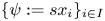 $\{\psi :=sx_i \}_{i\in I}$ and
 $\{\psi ^i:=sx^i\}$ for the associated bases of
 $V[-1]$ and
 $V^*[-1]$ respectively. Note that
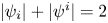 $|\psi _i|+|\psi ^i|=2$ and that
 ${\mathfrak{g}}_V\simeq {\mathbb {K}}[[\psi _i,\psi ^i]].$ Then the degree
 $-2$ Lie brackets in
 $\mathfrak{g}_V$ are given explicitly by
 \[ \{f, g\}=\sum_{i\in I} (-1)^{|f||\psi^i|} \frac{{\partial} f}{{\partial} \psi_i} \frac{{\partial} g}{{\partial} \psi^i} - (-1)^{|f||g|} \frac{{\partial} g}{{\partial} \psi_i} \frac{{\partial} f}{{\partial} \psi^i}. \]
It is an easy exercise to check that elements of the form
 \[ \nu:=\sum_{i,j,k\in I} C_{ij}^k \psi_k\psi^i\psi^j + \Phi_k^{ij}\psi^k \psi_i\psi_j. \]
satisfy  $\{\nu ,\nu \}=0$ if and only if the maps
 \[ \left(\triangle:V\rightarrow \wedge^2 V, [\ ,\ ]:\wedge^2V \rightarrow V\right) \]
with the structure constants  $C_{ij}^k$ and
 $\Phi _k^{ij}$ respectively,
 \[ [x_i,x_j]=:\sum_{k\in I} C_{ij}^k x_k,\quad \triangle(x_k)=:\sum_{i,j\in I} \Phi_k^{ij} x_i\wedge x_j. \]
define a Lie bialgebra structure in  $V$. (Here we assumed for simplicity that
 $V$ is concentrated in homological degree
 $0$ to avoid standard Koszul signs in the formulae.)
3.2 Associative bialgebras
An associative bialgebra is, by definition, a graded vector space  $V$ equipped with two degree zero linear maps,
 \[ \begin{array}{rccc} \mu: & V\otimes V & \longrightarrow & V \\ & a\otimes b & \longrightarrow & ab \end{array} , \quad \begin{array}{rccc} \Delta: & V & \longrightarrow & V\otimes V \\ & a & \longrightarrow & \sum a_{1}\otimes a_{2} \end{array} \]
satisfying:
(i) the associativity identity,
$(ab)c=a(bc)$;(ii) the coassociativity identity,
$(\Delta \otimes {\mathrm {Id}})\Delta a= ({\mathrm {Id}}\otimes \Delta )\Delta a$;(iii) the compatibility identity,
$\Delta$ is a morphism of algebras, i.e. $\Delta (ab)=\sum (-1)^{a_2b_1} a_1b_1\otimes a_2b_2$,




for any  $a,b, c\in V$. We often abbreviate ‘associative bialgebra’ to simply ‘bialgebra’.
A prop of bialgebras,  $\mathcal {A}\textit{ssb}$, is generated by two kinds of operations, the multiplication

and the comultiplication

, subject to relations which assure that its representations,
 \[ \rho: \mathcal{A}\textit{ssb} \longrightarrow {\mathcal{E}} nd_A, \]
in one-to-one correspondence with associative bialgebra structures on a graded vector space  $A$. More precisely,
 ${\mathcal {A}} ss{\mathcal {B}}$ is the quotient,
 \[ \mathcal{A}\textit{ssb}:= {{\mathcal{F}} ree\langle A_0 \rangle}/(R) \]
of the free prop,  ${\mathcal {F}} ree\langle A_0 \rangle$, generatedFootnote 8 by an
 ${\mathbb {S}}$-bimodule
 $A_0=\{A_0(m,n)\}$,
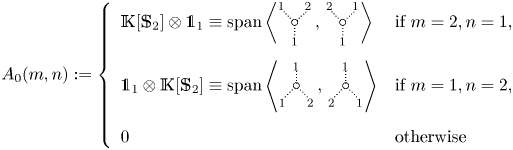
modulo the ideal generated by relations

which are not quadratic in the properadic sense (it is proven, however, in [Reference Merkulov and ValletteMV09] that  $\mathcal {A}\textit{ssb}$ is homotopy Koszul). A minimal resolution,
 $(\mathcal {A}\textit{ssb}_\infty ,\delta )$ of
 $\mathcal {A}\textit{ssb}$ exists and is generated by a relatively ‘small’
 ${\mathbb {S}}$-bimodule
 $A=\{ A(m,n)\}_{m,n\geq 1, m+n\geq 3}$,

The differential  $\delta$ in
 $\mathcal {A}\textit{ssb}_\infty$ is not quadratic, and its explicit value on generic
 $(m,n)$-corolla is not known at present, but we can (and will) assume from now on that
 $\delta$ preserves the path grading of
 $\mathcal {A}\textit{ssb}_\infty$ (which associates to any graph,
 $G$, from
 $\mathcal {A}\textit{ssb}_\infty$ the total number of directed paths connecting input legs of
 $G$ to the output ones, see [Reference Markl and VoronovMV09] for more details).
Let  $V$ be a
 ${\mathbb {Z}}$-graded vector space over a field
 ${\mathbb {K}}$ of characteristic zero. The associated symmetric tensor algebra
 ${\mathcal {O}}_V:= {\odot ^{\bullet }} V= \oplus _{n\geq 0} \odot ^n V$ comes equipped with the standard graded commutative and cocommutative bialgebra structure, i.e. there is a non-trivial representation,
 \begin{equation} \rho_0: \mathcal{A}\textit{ssb} \longrightarrow {\mathcal{E}} nd_{{\mathcal{O}}_V}. \end{equation}
According to [Reference Merkulov and ValletteMV09], the deformation complex
 \[ C_{{\rm GS}}^\bullet\left({\mathcal{O}}_V,{\mathcal{O}}_V\right)=\mathsf{Def}\left(\mathcal{A}\textit{ssb} \stackrel{\rho_0}{\longrightarrow} {\mathcal{E}} nd_{{\mathcal{O}}_V}\right)\simeq \prod_{m,n\geq 1}{\mathrm{Hom}}({\mathcal{O}}_V^{\otimes m}, {\mathcal{O}}_V^{\otimes n})[2-m-n] \]
and its polydifferential subcomplex 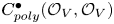 $C_{poly}^\bullet ({\mathcal {O}}_V,{\mathcal {O}}_V)$ come equipped with a
 ${\mathcal {L}} ie_\infty$ algebra structure,
 $\{\mu _n: \wedge ^n C_{{\rm GS}}^\bullet ({\mathcal {O}}_V,{\mathcal {O}}_V)\longrightarrow C_{{\rm GS}}^\bullet ({\mathcal {O}}_V,{\mathcal {O}}_V)[2-n]\}_{n\geq 1},$ such that
 $\mu _1$ coincides precisely with the Gerstenhaber–Shack differential. According to [Reference Gerstenhaber and SchackGS90], the cohomology of the complex
 $(C_{{\rm GS}}^\bullet ({\mathcal {O}}_V,{\mathcal {O}}_V), \mu _1)$ is precisely the vector space
 $\mathfrak{g}_V$; moreover, it is not hard to see that the operation
 $\mu _2$ induces the Lie brackets
 $\{\ ,\ \}$ in
 $\mathfrak{g}_V$. As we show in this paper, the set of
 ${\mathcal {L}} ie_\infty$ quasi-isomorphisms,
 \begin{equation} \left\{F: \left(\mathfrak{g}_V[2],\{\ ,\ \}\right) \longrightarrow \left(C_{{\rm GS}}^\bullet({\mathcal{O}}_V,{\mathcal{O}}_V), \mu_\bullet\right)\right\}, \end{equation}
is always non-empty.
4. A prop governing formality maps for Lie bialgebras
4.1 An operad of directed graphs
Let  $G_{n,l}$ be a set of directedFootnote 9 graphs
 $\Gamma$ with
 $n$ vertices and
 $l$ edges such that some bijections
 $V(\Gamma )\rightarrow [n]$ and
 $E(\Gamma )\rightarrow [l]$ are fixed, i.e. every edge and every vertex of
 $\Gamma$ has a fixed numerical label. There is a natural right action of the group
 ${\mathbb {S}}_n \times {\mathbb {S}}_l$ on the set
 $G_{n,l}$ with
 ${\mathbb {S}}_n$ acting by relabelling the vertices and
 ${\mathbb {S}}_l$ by relabelling the edges.
For each fixed integer  $d$, the collection of
 ${\mathbb {S}}_n$-modules,
 \[ d{\mathcal{G}} ra_{d}=\biggl\{d{\mathcal{G}} ra_d(n)= \prod_{l\geq 0} {\mathbb{K}} \langle G_{n,l}\rangle \otimes_{ {\mathbb{S}}_l} {\text{sgn}}_l^{\otimes |d-1|} [l(d-1)] \biggr\}_{n\geq 1} \]
is an operad with respect to the following operadic composition,
 \[ \begin{array}{rccc} \circ_i: & d{\mathcal{G}} ra_d(n) \times d{\mathcal{G}} ra_d(m) & \longrightarrow & d{\mathcal{G}} ra_d(m+n-1), \ \forall\ i\in [n]\\ & (\Gamma_1, \Gamma_2) & \longrightarrow & \Gamma_1\circ_i \Gamma_2, \end{array} \]
where  $\Gamma _1\circ _i \Gamma _2$ is defined by substituting the graph
 $\Gamma _2$ into the
 $i$-labelled vertex
 $v_i$ of
 $\Gamma _1$ and taking a sum over re-attachments of dangling edges (attached before to
 $v_i$) to vertices of
 $\Gamma _2$ in all possible ways.
The operad of directed graphs  $d{\mathcal {G}} ra_d$ contains a suboperad
 ${\mathcal {G}} ra^{{\rm or}}$ spanned by graphs with no closed paths of directed edges (wheels); we call such graphs oriented.
4.2 Graph complexes
For any operad  ${\mathcal {P}}=\{{\mathcal {P}}(n)\}_{n\geq 1}$ in the category of graded vector spaces, the linear map
 \[ \begin{array}{rccc} [\ ,\ ]: & {\mathsf P} \otimes {\mathsf P} & \longrightarrow & {\mathsf P}\\ & (a\in {\mathcal{P}}(n), b\in {\mathcal{P}}(m)) & \longrightarrow & [a, b]:= \sum_{i=1}^n a\circ_i b - (-1)^{|a||b|}\sum_{i=1}^m b\circ_i a \in {\mathcal{P}}(m+n-1) \end{array} \]
makes a graded vector space 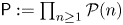 ${\mathsf P}:= \prod _{n\geq 1}{\mathcal {P}}(n)$ into a Lie algebra [Reference Kapranov and ManinKM01]; moreover, these brackets induce a Lie algebra structure on the subspace of invariants
 ${\mathsf P}^{\mathbb {S}}:= \prod _{n\geq 1}{\mathcal {P}}(n)^{{\mathbb {S}}_n}$. In particular, the graded vector spaces
 \[ \mathsf{dFGC}_{d}:= \prod_{n\geq 1} d{\mathcal{G}} ra_{d}(n)^{{\mathbb{S}}_n}[d(1-n)], \quad \mathsf{FGC}^{{\rm or}}_{d}:= \prod_{n\geq 1} {\mathcal{G}} ra^{{\rm or}}_{d}(n)^{{\mathbb{S}}_n}[d(1-n)] \]
are Lie algebra with respect to the above Lie brackets, and as such they can be identified with the deformation complexes  $\mathsf {Def}({\mathcal {L}} ie_d\stackrel {0}{\rightarrow } d{\mathcal {G}} ra_{d})$ and, respectively,
 $\mathsf {Def}({\mathcal {L}} ie_d\stackrel {0}{\rightarrow } {\mathcal {G}} ra_{d}^{{\rm or}})$ of the zero morphism. Hence non-trivial Maurer–Cartan elements of
 $(\mathsf {dFGC}_{d}/\mathsf {FGC}_d^{{\rm or}}, [\ ,\ ])$ give us non-trivial morphisms of operads
 \[ f:{\mathcal{L}} ie_d {\longrightarrow} d{\mathcal{G}} ra_{d}\quad\mathrm{and,\ respectively,}\ f:{\mathcal{L}} ie_d {\longrightarrow} {\mathcal{G}} ra_{d}^{{\rm or}}. \]
One such non-trivial morphism  $f$ is given explicitly on the generator of
 ${\mathcal {L}} ie_{d}$ by [Reference WillwacherWil15a]

Note that elements of  $\mathsf {dFGC}_{d}$ can be identified with graphs from
 ${\mathcal {D}}{\mathcal {G}} ra_d$ whose vertices’ labels are symmetrized (for
 $d$ even) or skew-symmetrized (for
 $d$ odd) so that in pictures we can forget about labels of vertices and denote them by unlabelled black bullets as in the formula above. Note also that graphs from
 $\mathsf {dFGC}_{d}$ come equipped with an orientation,
 $or$, which is a choice of ordering of edges (for
 $d$ even) or a choice of ordering of vertices (for
 $d$ odd) up to an even permutation on both cases. Thus every graph
 $\Gamma \in \mathsf {dFGC}_{d}$ has at most two different orientations,
 $pr$ and
 $or^{{\rm opp}}$, and one has the standard relation,
 $(\Gamma , or)=-(\Gamma , or^{{\rm opp}})$; as usual, the data
 $(\Gamma , or)$ is abbreviated to
 $\Gamma$ (with some choice of orientation implicitly assumed). Note that the homological degree of graph
 $\Gamma$ from
 $\mathsf {dFGC}_{d}$ is given by
 $|\Gamma |=d(\# V(\Gamma ) -1) + (1-d) \# E(\Gamma )$.
The above morphism (18) makes 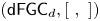 $(\mathsf {dFGC}_{d}, [\ ,\ ])$ (respectively,
 $(\mathsf {FGC}^{{\rm or}}_{d}, [\ ,\ ])$ into a differential Lie algebra with the differential

The dg Lie algebra  $\mathsf {dFGC}_{d}$ (respectively,
 $\mathsf {FGC}^{{\rm or}}_{d}$) contains a dg subalgebra
 $\mathsf {df{GC}}_{d}$ (respectively
 $\mathsf {fGC}^{{\rm or}}_{d}$) spanned by graphs with at least bivalent vertices and with no bivalent vertices of the form

. It was proven in [Reference WillwacherWil15b] that
 \[ H^\bullet(\mathsf{dFGC}_{d})= \mathsf{dfGC}_{d}\quad \text{and} \quad H^\bullet(\mathsf{FGC}^{{\rm or}}_{d})= \mathsf{fGC}^{{\rm or}}_{d}. \]
Furthermore,  $\mathsf {dfGC}_{d}$ and
 $\mathsf {fGC}^{{\rm or}}_{d}$ contains dg Lie subalgebras
 $\mathsf {dGC}_{d}$ and respectively
 $\mathsf {GC}^{{\rm or}}_d$ spanned by connected graphs, and one has
 \[ \mathsf{dfGC}_{d}= \odot^{\bullet\geq 1}\left(\mathsf{dGC}_{d}[-d]\right)[d] \quad \text{and}\quad \mathsf{fGC}^{{\rm or}}_{d}= \odot^{\bullet\geq 1}\left(\mathsf{GC}^{{\rm or}}_{d}[-d]\right)[d]. \]
Moreover, there is an isomorphism of graded vector spaces [Reference WillwacherWil15b],
 \[ H^\bullet(\mathsf{GC}^{{\rm or}}_{d+1})=H^\bullet(\mathsf{dGC}_d), \]
and an isomorphism of Lie algebras [Reference WillwacherWil15a],
 \[ H^0(\mathsf{dGC}_{2})=\mathfrak{g}\mathfrak{r}\mathfrak{t}_1, \]
where  $\mathfrak{g}\mathfrak{r}\mathfrak{t}_1$ is the Lie algebra of the Grothendieck–Teichmüller group
 $GRT_1$ introduced by Drinfeld [Reference DrinfeldDri91] in the context of deformation quantization of Lie bialgebras. In particular, one has a remarkable isomorphism of Lie algebras,
 $H^0(\mathsf {GC}_3^{{\rm or}})=\mathfrak{g}\mathfrak{r}\mathfrak{t}_1$. Moreover [Reference WillwacherWil15b],
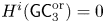 $H^i(\mathsf {GC}_3^{{\rm or}})=0$ for
 $i\leq 2$ and
 $H^{-1}(\mathsf {GC}_3^{{\rm or}})$ is a one-dimensional space generated by the graph

. Hence
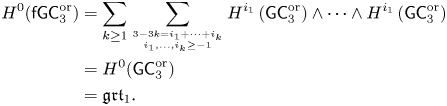 \begin{align*} H^0(\mathsf{fGC}^{{\rm or}}_{3}) &= \sum_{k\geq 1}\sum_{3-3k=i_1+\cdots+i_k\atop i_1,\ldots,i_k\geq-1} H^{i_1}\left(\mathsf{GC}^{{\rm or}}_{3}\right)\wedge \cdots \wedge H^{i_1}\left(\mathsf{GC}^{{\rm or}}_{3}\right) \\ &= H^0(\mathsf{GC}_3^{{\rm or}})\\ &=\mathfrak{g}\mathfrak{r}\mathfrak{t}_1. \end{align*}
4.3 Graph complexes and deformation complexes
Let  $\widehat {\mathcal {L}\textit{ieb}}_\infty$ be the genus completion of the properad
 $\mathcal {L}\textit{ieb}_\infty$. Then, according to [Reference Merkulov and WillwacherMW18a], there is a canonical morphism of dg Lie algebras
 \[ f: \mathsf{GC}_3^{{\rm or}}\to \mathrm{Der}(\widehat{\mathcal{L}\textit{ieb}}_\infty) \]
which is a quasi-isomorphism up to one class corresponding to the standard rescaling derivation of  $\widehat {\mathcal {L}\textit{ieb}}_\infty$, multiplying the generator of arity
 $(m,n)$ by
 $m+n-2$. Here
 $\mathrm {Der}(\widehat {\mathcal {L}\textit{ieb}}_\infty )$ is the dg Lie algebra of derivations of
 $\widehat {\mathcal {L}\textit{ieb}}_\infty$ as a properad. It is useful to add to
 $\mathsf {GC}_{d}^{{\rm or}}$ one extra generator in degree
 $0$ corresponding to the rescaling derivation. So from now on we are working with the extension
 \begin{equation} \mathsf{GC}_{d}^\uparrow:= \mathsf{GC}_{d}^{{\rm or}}\oplus {\mathbb{K}}[0] \end{equation}
of this graph complex, where the Lie bracket is extended such that the bracket with the rescaling class multiplies a graph by twice the number of loops. We also consider the full graph complex,
 \[ \mathsf{fGC}_{d}^\uparrow:=\odot^{\bullet\geq 1}\left(\mathsf{GC}_{d}^\uparrow[-d]\right)[d]. \]
Then the map  $f$ above extends to a quasi-isomorphism,
 \[ f: \mathsf{{GC}}_3^\uparrow\to \mathrm{Der}(\widehat{\mathcal{L}\textit{ieb}}_\infty), \]
and
 \[ H^0(\mathsf{fGC}^\uparrow_{3})=H^0(\mathsf{GC}^\uparrow_{3})=H^0(\mathsf{GC}_{3}^{{\rm or}}) \oplus {\mathbb{K}}=\mathfrak{g}\mathfrak{r}\mathfrak{t}_1\oplus {\mathbb{K}}=\mathfrak{g}\mathfrak{r}\mathfrak{t} \]
is the Lie algebra of the full Grothendieck–Teichmüller group  $GRT=GRT_1\rtimes {\mathbb {K}}^*$. This extension becomes especially useful when one works with props rather than with properads. The properad
 $\widehat {\mathcal {L}\textit{ieb}}_\infty$ has an associated dg prop which is usually denoted by the same letter; we denote the dg Lie algebra of derivations of
 $\widehat {\mathcal {L}\textit{ieb}}_\infty$ as a prop by
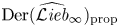 $\mathrm {Der}(\widehat {\mathcal {L}\textit{ieb}}_\infty )_{\mathrm {prop}}$. As the functor from the category of properads to the category of props is exact, the above result immediately implies existence of quasi-isomorphism of dg Lie algebras
 \begin{equation} F: \mathsf{fGC}_{3}^\uparrow\to \mathrm{Der}(\widehat{\mathcal{L}\textit{ieb}}_\infty)_{\mathrm{prop}}. \end{equation}
Therefore we conclude
 \begin{equation} H^0\bigl(\mathrm{Der}(\widehat{\mathcal{L}\textit{ieb}}_\infty)_{\mathrm{prop}}\bigr)=H^0(\mathsf{fGC}_{3}^\uparrow) =\mathfrak{g}\mathfrak{r}\mathfrak{t}. \end{equation}
4.4 A canonical representation of ${\mathcal {G}} ra_3^{{\rm or}}$ in $\mathfrak{g}_V$


For any graded vector space  $V$ the operad
 ${\mathcal {G}} ra_3^{{\rm or}}$ has a canonical representation in the associated vector space
 $\mathfrak{g}_V$ defined in (14),
 \begin{equation} \begin{array}{rccc} \rho: & {\mathcal{G}} ra^{{\rm or}}_3(n) & \longrightarrow & {\mathcal{E}} nd_{\mathfrak{g}_V}(n)= {\mathrm{Hom}}( \mathfrak{g}_V^{\otimes n},\mathfrak{g}_V)\\ & \Gamma & \longrightarrow & \Phi_\Gamma \end{array} \end{equation}
given by the formula,
 \[ \Phi_\Gamma(\gamma_1,\ldots, \gamma_n) :=\mu\biggl(\prod_{e\in E(\Gamma)} \Delta_e (\gamma_1(\psi)\otimes \gamma_2(\psi)\otimes \cdots\otimes \gamma_n(\psi))\biggr) \]
where, for an edge  connecting a vertex labelled by
 $a\in [n]$ and to a vertex labelled by
 $b\in [n]$, we set
 \begin{align*} &\Delta_e \left(\gamma_1\otimes \gamma_2\otimes \cdots\otimes \gamma_n \right)\\ &\quad = \left\{\begin{array}{ll}\underset{i\in I}{\sum}(-1)^{|\psi^i|(|\gamma_a| + |\gamma_{a+1}|+\cdots+ |\gamma_{b-1}|)} \gamma_1\otimes \cdots\otimes \dfrac{{\partial}\gamma_a}{{\partial} \psi_i}\otimes \cdots\otimes \dfrac{{\partial}\gamma_b}{{\partial} \psi^i}\otimes \cdots\otimes \gamma_n & \mbox{for} \ a< b\\ \underset{i\in I}{\sum}(-1)^{|\psi_i|(|\gamma_b| + |\gamma_{b+1}|+\cdots+ |\gamma_{a-1}| +1 )} \gamma_1\otimes \cdots\otimes \dfrac{{\partial}\gamma_b}{{\partial} \psi^i}\otimes \cdots\otimes \dfrac{{\partial}\gamma_a}{{\partial} \psi_i}\otimes \cdots\otimes \gamma_n & \mbox{for} \ b< a, \end{array}\right.\end{align*}
and where  $\mu$ is the multiplication map,
 \[ \begin{array}{rccc} \mu: & \mathfrak{g}_V^{\otimes n} & \longrightarrow & \mathfrak{g}_V\\ & \gamma_1\otimes \gamma_2\otimes \cdots \otimes \gamma_n & \longrightarrow & \gamma_1 \gamma_2 \ldots \gamma_n. \end{array} \]
If  $V$ is finite-dimensional, then the above formulae can be used to define a representation of the operad
 $d{\mathcal {G}} ra_3$ in
 $\mathfrak{g}_V$.
4.5 A prop of directed graphs
In this subsection we construct a two-coloured prop which admits canonically a representation in the pair of graded vector spaces  ${\mathcal {O}}_V$ and
 $\mathfrak{g}_V$ for any graded vector space
 $V$. Let
 $k\geq 0$,
 $m\geq 1$ and
 $n\geq 1$ be integers. Let
 ${\mathsf G}_{k;m,n}$ be a set of directed graphs consisting, by definition, of directed oriented graphs
 $\Gamma$ with
 $k$ vertices called internal,
 $m$ vertices called in-vertices, and
 $n$ vertices called out-vertices (i.e. there is a partition) satisfying the following conditions.
(i) The set of vertices is partitioned,
$V(\Gamma ):=V_{{\rm int}}(\Gamma )\sqcup V_{{\rm in}}(\Gamma )\sqcup V_{{\rm out}}(\Gamma ),$ into three subsets of the cardinalities,
elements of\[ \# V_{{\rm int}}(\Gamma)=k,\quad \# V_{{\rm in}}(\Gamma)=m,\quad \# V_{{\rm out}}(\Gamma)=n; \]$V_{{\rm int}}(\Gamma )$ are called internal vertices, elements of $V_{{\rm in}}(\Gamma )$ are called in-vertices, and elements of $V_{{\rm out}}(\Gamma )$ are called out-vertices.(ii) The vertices are labelled via isomorphisms,
\[ i_{{\rm int}}: V_{{\rm int}}(\Gamma)\rightarrow [k],\quad i_{{\rm in}}: V_{{\rm in}}(\Gamma)\rightarrow [m],\quad i_{{\rm out}}: V_{{\rm int}}(\Gamma)\rightarrow [n]. \](iii) Every in-vertex can have only outgoing edges (called in-legs), while every out-vertex can have only ingoing edges (called in-legs).
(iv) There are no edges connecting in-vertices to out-vertices, i.e. the set of all edges is partitioned into a disjoint union,
$E(\Gamma ):=E_{{\rm int}}(\Gamma )\sqcup E_{{\rm in}}(\Gamma )\sqcup E_{{\rm out}}(\Gamma )$, where $E_{{\rm in}}(\Gamma )$ is the set of in-legs, $E_{{\rm out}}(\Gamma )$ the set of out-legs, and $E_{{\rm int}}(\Gamma )$ the set of internal edges which connect internal vertices to internal ones.(v) The set of legs
$E_{{\rm in}}(\Gamma )\sqcup E_{{\rm out}}(\Gamma )$ is totally ordered up to an even permutation
where in- and out-vertices are depicted by small white circles, while internal vertices by small black ones (and we do not show numerical labels of the vertices).










Define a graded vector space
 \[ {\mathcal{B}}{\mathcal{G}} ra^{{\rm or}}(k;m,n):={\mathbb{R}}\langle{\mathsf G}_{k;m,n}\rangle \]
by assigning to each graph  $\Gamma \in {\mathsf G}_{k;m,n}$ homological degree,
 \[ |\Gamma|=-2\#E_{{\rm int}}(\Gamma) -\#E_{{\rm in}}(\Gamma)-\# E_{{\rm out}}(\Gamma), \]
i.e. by assigning to each internal edge degree  $-2$ and to each leg degree
 $-1$. Consider next an
 ${\mathbb {S}}$-bimodule,
 \[ {\mathcal{B}}{\mathcal{G}} ra^{{\rm or}}=\biggl\{{\mathcal{B}}{\mathcal{G}} ra^{{\rm or}}(m,n):=\sum_{k\geq 0} {\mathcal{B}}{\mathcal{G}} ra^{{\rm or}}(k;m,n)\biggr\}. \]
We claim that it has a natural structure of a prop with:
• horizontal composition,
by taking the disjoint union of the graphs\[ \begin{array}{rccc} \boxtimes: & {\mathcal{B}}{\mathcal{G}} ra^{{\rm or}}(k;m,n) \otimes{\mathcal{B}}{\mathcal{G}} ra^{{\rm or}}(k';m',n') & \longrightarrow & {\mathcal{B}}{\mathcal{G}} ra^{{\rm or}}(k+k';m+m',n+n')\\ & \Gamma\otimes \Gamma' & \longrightarrow & \Gamma\boxtimes \Gamma', \end{array} \]$\Gamma$ and $\Gamma '$ and relabelling in-, out- and internal vertices of $\Gamma '$ accordingly;• vertical composition,
by the following three-step procedure: (a) erase all\[ \begin{array}{rccc} \circ: & {\mathcal{B}}{\mathcal{G}} ra^{{\rm or}}(k;m,n) \otimes{\mathcal{B}}{\mathcal{G}} ra^{{\rm or}}(k';n,l) & \longrightarrow & {\mathcal{B}}{\mathcal{G}} ra^{{\rm or}}(k+k';m,l)\\ & \Gamma\otimes \Gamma' & \longrightarrow & \Gamma\circ\Gamma', \end{array} \]$m$ out-vertices of $\Gamma$ and all $m$ in-vertices of $\Gamma '$; (b) take a sum over all possible ways of attaching the hanging out-legs of $\Gamma$ to hanging in-legs of $\Gamma '$ as well as to out-vertices of $\Gamma '$, and also attaching the remaining in-legs of $\Gamma '$ to in-vertices of $\Gamma$; (c) relabel internal vertices of $\Gamma '$ by adding the value $k$ to each label.






For example, a vertical composition of the following two graphs,

is given by the following sum (cf. § 2.2.2)
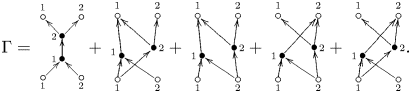
Note that the  ${\mathbb {S}}$-bimodule
 $\{{\mathcal {B}} {\mathcal {G}} ra^{{\rm or}}(0;m,n)\}$ is a subprop of
 ${\mathcal {B}} {\mathcal {G}} ra^\uparrow$ isomorphic to
 $\mathcal {C}\textit{omb}$.
Note also that we can also define compositions
 \begin{align*} &\circ: {\mathcal{G}} ra^{{\rm or}}_3(p_1) \otimes {\mathcal{G}} ra^{{\rm or}}_3(p_2)\otimes\cdots \otimes {\mathcal{G}} ra^{{\rm or}}_3(p_k)\otimes {\mathcal{B}}{\mathcal{G}} ra^{{\rm or}}(k,m,n)\\ &\quad \longrightarrow {\mathcal{B}}{\mathcal{G}} ra^{{\rm or}}(p_1+p_2+\cdots+p_k,m,n) \end{align*}
by substituting  $k$ graphs from
 ${\mathcal {G}} ra_3^{{\rm or}}$ into internal vertices of a graph from
 ${\mathcal {B}}{\mathcal {G}} ra^{{\rm or}}(k,m,n)$ and redistributing edges in exactly the same way as in the definition of the operadic composition in
 ${\mathcal {G}} ra_3^{{\rm or}}$ (and setting to zero all graphs which do not satisfy the condition that every black vertex has at least one incoming edge and at least one outgoing edge). An example is
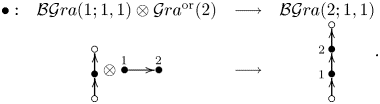
If we denote by the same symbol  ${\mathcal {G}} ra_3^{{\rm or}}$ the prop generated by the operad
 ${\mathcal {G}} ra_3^{{\rm or}}$ then we conclude that the data
 \[ {\mathcal{B}} ra^{{\rm or}}:= \left\{{\mathcal{B}}{\mathcal{G}} ra^{{\rm or}}, {\mathcal{G}} ra_3^{{\rm or}}\right\} \]
generates a two-coloured prop in the category of graded vector spaces.
Abusing notation, let us denote by  ${\mathcal {L}} ie_3$ the prop generated by the operad
 ${\mathcal {L}} ie\{2\}$. Then formula (18) says that there is a canonical morphism of props,
 \begin{equation} i_1: {\mathcal{L}} ie_3 \longrightarrow {\mathcal{B}} ra^{{\rm or}}. \end{equation}
There is also a morphism of props
 \begin{equation} i_2: \mathcal{A}\textit{ssb}\longrightarrow {\mathcal{B}} ra^{{\rm or}} \end{equation}
given on the generators as follows:

4.5.1 A canonical representation of the prop ${\mathcal {B}} ra^{{\rm or}}$

Let  $V$ be an arbitrary graded vector space with a basis
 $\{x^i\}$ so that
 ${\mathcal {O}}_V={\mathbb {K}}[x^i]$ and
 $\mathfrak{g}_V={\mathbb {K}}[[\psi ^i,\psi _i]]$ with
 $\psi ^i=sx^i$. Let
 \[ {\mathcal{E}} nd_{{\mathcal{O}}_V,\ \mathfrak{g}_V}=\{{\mathrm{Hom}}( \mathfrak{g}_V^{\otimes p}\otimes {\mathcal{O}}_V^{\otimes m}, \mathfrak{g}_V^{\otimes q}\otimes {\mathcal{O}}_V^{\otimes n}\} \]
be the two-coloured endomorphism prop of vector spaces  ${\mathcal {O}}_V$ (in white colour) and
 $\mathfrak{g}_V$ (in black colour). A representation,
 \[ \rho: {\mathcal{B}} ra^{{\rm or}} \longrightarrow {\mathcal{E}} nd_{{\mathcal{O}}_V, \mathfrak{g}_V} \]
is uniquely determined by its values on the generators. The values of  $\rho$ on the generators of
 ${\mathcal {G}} ra_3^{ar}$ are given by (22). The value,
 \[ \rho_\Gamma\in {\mathrm{Hom}}(\mathfrak{g}_V^{\otimes k}\otimes {\mathcal{O}}_V^{\otimes m} , {\mathcal{O}}_V^{\otimes n}), \]
of  $\rho$ on a graph
 $\Gamma \in {\mathsf G}_{k;m,n}$ of
 ${\mathcal {B}} ra^{{\rm or}}$ is defined as a composition of maps,
 \begin{equation} \begin{matrix} \rho_{\Gamma}: & \mathfrak{g}_V^{\otimes k}\otimes {\mathcal{O}}_V^{\otimes m} \hspace{-3mm} & \longrightarrow & \hspace{-1mm} {\mathcal{O}}_V^{\otimes n}\otimes\mathfrak{g}_V^{\otimes k}\otimes {\mathcal{O}}_V^{\otimes m} & \stackrel{\Psi_\Gamma}{\longrightarrow} & \hspace{-1mm} {\mathcal{O}}_V^{\otimes n}\otimes {\mathcal{O}}_V^{\otimes m} \hspace{-2mm} & \stackrel{\mu}{\longrightarrow} & \hspace{-2mm} {\mathcal{O}}_V^{\otimes n}\\ & \hspace{-3mm}\gamma_1\otimes \cdots\otimes \gamma_k\otimes f_{{1}}\otimes \cdots\otimes f_{{m}}\hspace{-1mm} & \hspace{-3mm} \longrightarrow & 1^{\otimes n}\otimes \gamma_1\otimes \cdots\otimes \gamma_k\otimes f_{{1}}\otimes \cdots\otimes f_{{m}} & & & & \end{matrix} \end{equation}
where
 \begin{align*} &\Psi_\Gamma(\underbrace{1,\ldots,1}_n, \gamma_1,\ldots, \gamma_k,f_{{1}},\ldots, f_{{m}})\\ &\quad= \biggl(\prod_{\bar{e}\in E_{{\rm out}}(\Gamma)} \Delta_{\bar{e}}\prod_{{e}\in E_{{\rm int}}(\Gamma)}\Delta_e \prod_{\underline{e}\in E_{{\rm in}}(\Gamma)}\Delta_{\underline{e}} ( \underbrace{1\otimes \cdots\otimes 1}_n\otimes \gamma_1\otimes \cdots\otimes \gamma_k\otimes f_{{1}}\otimes \cdots\otimes f_{{m}})\biggr)_{ \hspace{-1mm}\psi_i=0\atop \hspace{-1mm} \psi^i=0} \end{align*}
with:
• for an in-leg
connecting ${\alpha }$th in-vertex to $a$th internal vertex, $\alpha \in [m]$, $a\in [k]$,
\[ \Delta_{\underline{e}}:=\sum_{i\in I}\underbrace{\frac{{\partial}}{{\partial}\psi^i}}_{\mathrm{acts\ on}\ a\mathrm{th}\atop \mathrm{tensor\ factor\ of}\ \mathfrak{g}_V^{\otimes k}}\otimes \underbrace{\frac{{\partial}}{{\partial} x_i}}_{\mathrm{acts\ on} \ \alpha\mathrm{th}\atop \mathrm{tensor\ factor\ of}\ {\mathcal{O}}_V^{\otimes m}}; \]• for an internal edge
, $a,b\in [k]$,
\[ \Delta_{{e}}:=\sum_{i\in I}\underbrace{\frac{{\partial}}{{\partial}\psi^i}}_{\mathrm{acts\ on}\ a\text{th}\atop \mathrm{tensor\ factor\ of}\ \mathfrak{g}_V^{\otimes k}}\otimes \underbrace{\frac{{\partial}}{{\partial} \psi_i}}_{\mathrm{acts\ on}\ b\text{th}\atop \mathrm{tensor\ factor\ of}\ \mathfrak{g}_V^{\otimes k}}; \]• for an out-leg
, $a\in [k]$, $\beta \in [n]$,
\[ \Delta_{\bar{e}}:=\sum_{i\in I}\underbrace{x_i}_{\mathrm{acts\ as\ multiplication\ on}\ \beta\text{th}\atop \mathrm{tensor\ factor\ of}\ 1^{\otimes n}}\otimes \underbrace{\frac{{\partial}}{{\partial} \psi_i}}_{\mathrm{acts\ on} \ a\text{th}\atop \mathrm{tensor\ factor\ of}\ \mathfrak{g}_V^{\otimes k}}, \]


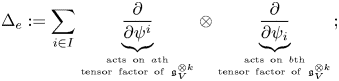


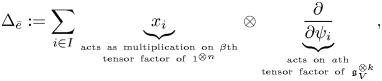
and where
 \[ \begin{matrix} \mu: & {\mathcal{O}}_V^{\otimes n}\otimes {\mathcal{O}}_V^{\otimes m} & \longrightarrow & {\mathcal{O}}_V^{\otimes n}\\ & g_1\otimes \cdots\otimes g_n \otimes h_1\otimes\cdots\otimes h_m & \longrightarrow & ( g_1\otimes \cdots\otimes g_n)\cdot (\Delta^{n-1} (h_1\cdots h_m)) \end{matrix} \]
with  $\cdot$ being the standard multiplication in the algebra
 ${\mathcal {O}}_V^{\otimes n}$.
The proof of the claim that the above formula for  $\rho (\Gamma )$ gives a morphism of props (i.e. respects prop compositions) is a straightforward untwisting of the definitions; in fact, the prop compositions in
 ${\mathcal {B}} {\mathcal {G}} ra^{{\rm or}}$ have been defined just precisely for the purpose to make this claim true, i.e. they have been read out from the compositions of the operators
 $\rho (\Gamma )$.
Remarks 4.1 (i) Note that operators  $\Delta _{\underline {e}}$ and
 $\Delta _{\bar {e}}$ have degree
 $-1$ (in contrast to operators
 $\Delta _e$ which have degree
 $-2$) so that the ordering of legs of a graph
 $\Gamma$ from
 ${\mathcal {B}}{\mathcal {G}} ra^{{\rm or}}$ is required to make the definition of
 $\rho (\Gamma )$ unambiguous. However, we shall see below that this choice is irrelevant for the application of the morphism
 $\rho$ to deformation quantization.
(ii) As our formula for  $\rho (\Gamma )$ involves evaluation at
 $\psi _\bullet =\psi ^\bullet =0$, we can say that
 $\rho (\Gamma )(\gamma _1,\ldots ,\gamma _k,f_1,\ldots ,f_m)$ is non-zero only in the case when for any
 $a\in [k]$ one has
 \[ \gamma_a\in \odot^{\# {\rm In}(v_a)} V^*[1] \otimes \odot^{\# {\rm Out}(v_a)} V[1] \]
where  $v_a$ is the
 $a$-labelled internal vertex of
 $\Gamma$ and
 ${\rm In}(v_a)$ (respectively,
 ${\rm Out}(v_a)$) is the set of input (respectively, output) half-edges.
Examples 4.2 (cf. [Sho04]) (1) The map 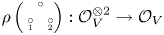 is just the multiplication in
 ${\mathcal {O}}_V$.
(2) The map 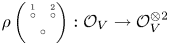 is the comultiplication
 $\Delta$ in
 ${\mathcal {O}}_V$.
(3) If  $\gamma =\sum _{i,j,k\in I}C_{ij}^k\psi _k \psi ^i\psi ^j$,
 $C_{ij}^k\in {\mathbb {R}}$, then, for any
 $f_1(x),f_2(x)\in {\mathcal {O}}_V$, one has (modulo a sign coming from a choice of ordering of legs)

(4) If  $\gamma =\sum _{i,j,k\in I}\Phi ^{ij}_k\psi _i\psi _j\psi ^k$,
 $\Phi ^{ij}_k\in {\mathbb {R}}$, then, for any
 $f(x)\in {\mathcal {O}}_V$, one has (modulo a sign coming from a choice of ordering of legs)

(5) If f  $\gamma _1=\sum _{i,j,k\in I}C_{ij}^k\psi _k \psi ^i\psi ^j$,
 $\gamma _2=\sum _{i,j,k\in I}\Phi ^{ij}_k\psi _i\psi _j\psi ^k$,
 $C_{ij}^k,\Phi ^{ij}_k\in {\mathbb {R}}$, then, for any
 $f_1,f_2\in {\mathcal {O}}_V$, one has (modulo a sign coming from a choice of ordering of legs)

4.6 A two-coloured prop of ${\mathcal {L}} ie_3$ actions on bialgebras

Consider an auxiliary two-coloured prop (in straight and dashed colours),  ${\mathcal {Q}} ua$, generated by the binary operations

modulo Jacobi relations
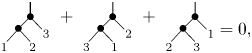
the associative bialgebra relations (15), and also the following:
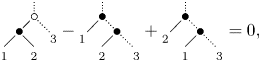

Rather surprisingly, this prop arises naturally in the context of formality maps for universal quantizations of Lie bialgebras.
4.7 A prop governing formality maps
Sometimes it is useful to define a prop in terms of generators and relations, and sometimes it is easier to define it by specifying its generic representation. We shall define a useful for our purposes prop  ${\mathcal {Q}} ua_\infty$ using both approaches (but start with the second one which explains its relation to formality maps)) and then prove that
 ${\mathcal {Q}} ua_\infty$ is a minimal resolution of
 ${\mathcal {Q}} ua$ (the abbreviation for Quantization).
Let  ${\mathcal {Q}} ua_\infty$ be a two-coloured prop whose arbitrary representation,
 $\rho : {\mathcal {Q}} ua\rightarrow {\mathcal {E}} nd_{\mathfrak{g},A}$, in a pair of graded vector spaces
 $\mathfrak{g}$ and
 $A$ provides these spaces with the following list of algebraic structures:
(i) the structure of a
${\mathcal {H}} olie_{3}$-algebra in $\mathfrak{g}$, i.e. a representation $\rho _1: {\mathcal {H}} olie_{3}\rightarrow {\mathcal {E}} nd_{\mathfrak{g}}$ (note that $\mathfrak{g}[2]$ is then an ordinary ${\mathcal {L}} ie_\infty$ algebra);(ii) the structure of an
$\mathcal {A}\textit{ssb}_\infty$-algebra in $A$, i.e. a representation $\rho _2: \mathcal {A}\textit{ssb}_\infty \rightarrow {\mathcal {E}} nd_{A}$;(iii) a morphism of
${\mathcal {L}} ie_\infty$ algebras,
\[ F: \mathfrak{g}[2]\longrightarrow \mathsf{Def}(\mathcal{A}\textit{ssb}_\infty \stackrel{\rho}{\longrightarrow} {\mathcal{E}} nd_A). \]








The prop  ${\mathcal {Q}} ua_\infty$ is free with the space of generators in the colour responsible for datum (i) given by

and the space of generators (of mixed colours) responsible for data (ii) and (iii) given by

Corollas with  $k=0$ take care of datum (ii), i.e. they are the standard generators of
 $\mathcal {A}\textit{ssb}_\infty$, while corollas with
 $k\geq 1$ take care of datum (ii). The prop
 ${\mathcal {Q}} ua_\infty$ is equipped with a differential; the values of its differential
 $d$ on:
• the generators (31) of
${\mathcal {H}} olie_3$ are given by the standard formula,
• the generators (32) with
$k=0$ are determined by a choice of a minimal resolution, ${\mathcal {A}} ss{\mathcal {B}}_\infty$, i.e. $d$ restricted to these generators equals precisely the differential $\delta$ in $\mathcal {A}\textit{ssb}_\infty$;• the generators (32) with
$k\geq 1,n\geq 1$ are determined uniquely by the choice of a minimal resolution $\mathcal {A}\textit{ssb}_\infty$ and the standard formulae for a ${\mathcal {L}} ie_\infty$ morphism.


Roughly speaking, the value of the differential on a generator (
32) with  $k\geq 1,n\geq 1$ is a sum over all possible attachments of
 $k$ solid legs to the vertices in the graph

plus standard terms of ‘ ${\mathcal {L}} ie_\infty$’ type. For example, one has in the simplest cases
 $m=1$,
 $k=0$,
 $n\geq 2$,

and  $n=1$,
 $k=0$,
 $m\geq 2$,

so that the formulae for the values of  $d$ on corollas with
 $m=1$,
 $k\geq 1$,
 $n\geq 1$ and, respectively, with
 $m\geq 1$,
 $k\geq 1$,
 $n= 1$, are given (modulo signs) by
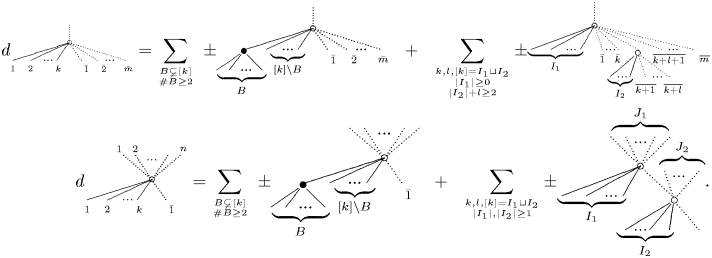
We are interested in a few special cases of these formulae for which we give precise expressions,


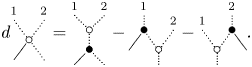
These equations say that there exists a canonical morphism of dg props,
 \begin{equation} p: {\mathcal{Q}} ua_\infty \longrightarrow {\mathcal{Q}} ua \end{equation}
which sends to zero all generators of  ${\mathcal {Q}} ua_\infty$ except

,

,

and

.
Theorem 4.3 The morphism  $p$ is a quasi-isomorphism.
Proof. The differential in the complex  $({\mathcal {Q}} ua_\infty ,d)$ is connected (that is, its value on any generator is given by a sum of connected graphs) and preserves the path grading.Footnote 10 Hence by Theorem 27 in [Reference Markl and VoronovMV09], the genus filtration
 \[ F_p^{{\rm genus}}:=\left\{ \mathrm{span}\langle \Gamma\in {\mathcal{Q}} ua_\infty(m,n) \rangle : \text{the genus of}\ \Gamma>-p\right\} \]
induces a converging spectral sequence whose initial page we denote by  $Gr^{{\rm gen}}({\mathcal {Q}} ua_\infty )$. The projection map
 $p$ respects genus filtrations of both sides, and hence induces a morphism of complexes
 \[ p': Gr^{{\rm gen}}({\mathcal{Q}} ua_\infty) \longrightarrow Gr^{{\rm gen}}({\mathcal{Q}} ua). \]
The complex  $Gr^{{\rm gen}}({\mathcal {Q}} ua_\infty )$ admits a path filtration
 \[ F_p^{{\rm path}}:=\left\{ \mathrm{span}\langle \Gamma\in Gr^{{\rm gen}}({\mathcal{Q}} ua_\infty)(m,n) \rangle : |\Gamma|_{{\rm path}} < p\right\} \]
with the converging spectral sequence whose first term we denote by  $Gr^{{\rm gen}, {\rm path}}({\mathcal {Q}} ua_\infty )$. The map
 $p'$ above preserves path filtrations of both sides and hence induces a morphism of the associated graded complexes,
 \[ p'': Gr^{{\rm gen},{\rm path}}({\mathcal{Q}} ua_\infty) \longrightarrow Gr^{{\rm gen},{\rm path}}({\mathcal{Q}} ua) .\]
The right-hand side equals the prop enveloping of a quadratic  $\frac {1}{2}$-prop
 ${\mathcal {P}}_0$ generated by:
(i) the Koszul operad
${\mathcal {A}} ss$ with generators ;(ii) the two-coloured Koszul [Reference AlmAlm11, Reference Hoefel and LivernetHL12] operad of non-commutative Gerstenhaber algebras (also known as operad of Leibniz pairs) with generators
, , and


modulo  $\frac {1}{2}$-propFootnote 11 relations

It is easy to compute the minimal resolution of the  $\frac {1}{2}$-prop
 ${\mathcal {P}}_0$ and notice that its prop enveloping equals precisely
 $Gr^{{\rm gen},{\rm path}}({\mathcal {Q}} ua_\infty )$. Hence the morphism
 $p''$ is a quasi-isomorphism which implies that the morphism
 $p'$ is a quasi-isomorphism which in tern implies that the morphism
 $p$ is a quasi-isomorphism.
4.8 Formality morphisms as Maurer–Cartan elements
The morphism (24) factors through the inclusion  ${\mathcal {G}} ra^{{\rm or}}\rightarrow {\mathcal {B}}{\mathcal {G}} ra^{{\rm or}}$, and extends to the following one.
Proposition 4.4 There is a morphism of props
 \begin{equation} i: {\mathcal{Q}} ua \longrightarrow {\mathcal{B}} ra^{{\rm or}} \end{equation}
given on the generators as follows:


Proof. Relation (29) follows from the example (23) and the fact that

Analogously one checks that all other relations (15) and (30) are also respected by the map  $i$.
The composition of maps  $p: {\mathcal {Q}} ua_\infty \rightarrow {\mathcal {Q}} ua$ and
 $i$ from (35) gives us a canonical morphism of props,
 \[ q_0: {\mathcal{Q}} ua_\infty\longrightarrow {\mathcal{B}} ra^{{\rm or}}, \]
so that we can consider a graph complex (in fact, a  ${\mathcal {L}} ie_\infty$ algebra)
 \[ \mathsf{Def}({\mathcal{Q}} ua_\infty \stackrel{q_0}{\rightarrow} {\mathcal{B}} ra)=: \mathsf{fGC}_3^{{\rm or}} \oplus \mathsf{BGC}^{{\rm or}} \]
controlling deformations of the morphism  $q_0$. The properad
 ${\mathcal {Q}} ua_\infty$ is two-coloured and has two sets of generators, (31) and (32). Hence as a dg vector space (not as a
 ${\mathcal {L}} ie_\infty$ algebra) the deformation complex decomposes into a direct sum of dg vector spaces, the first summand
 $\mathsf {fGC}_3^{{\rm or}}$ corresponding to the values of morphisms on the generators (31) and the second complex
 $\mathsf {BGC}^{{\rm or}}$ corresponding to the values of the morphisms on (32). The whole complex is a
 ${\mathcal {L}} ie_\infty$ algebra, while the summand
 $\mathsf {fGC}_3^{{\rm or}}$ is its dg Lie subalgebra. Moreover, we can (and will) assume without loss of generality that the subcomplex
 $\mathsf {BGC}^{{\rm or}}$ is spanned by graphs with at least trivalent vertices (cf. [Reference WillwacherWil15a]).
Elements of  $\mathsf {BGC}^{{\rm or}}$ can be understood as (linear combinations of) oriented directed graphs
 $\Gamma$ from
 ${\mathsf G}_{k;m,n}$ which have labels of black vertices skew-symmetrized (so that labelling of black vertices can be omitted in the pictures), and which are assigned the homological degree
 \begin{align} |\Gamma|&=3|V_{{\rm int}}(\Gamma)| + |V_{{\rm in}}(\Gamma)|+ |V_{{\rm out}}(\Gamma)| -2|E_{{\rm int}}(\Gamma)| - |E_{{\rm in}}(\Gamma)|- |E_{{\rm out}}(\Gamma)| -2\nonumber\\ &= \sum_{i=1}^{|V_{{\rm int}}(\Gamma)|} (3-|v_i|) + |V_{{\rm in}}(\Gamma)|+ |V_{{\rm out}}(\Gamma)| -2, \end{align}
where  $|v_i|$ stands for the valency (the total number of input and output half-edges) of the
 $i$th internal vertex.
4.9 Universal formality maps
A generic Maurer–Cartan element in the  ${\mathcal {L}} ie_\infty$ algebra
 $\mathsf {Def}({\mathcal {Q}} ua_\infty \stackrel {q_0}{\rightarrow } {\mathcal {B}} ra^{{\rm or}})$ (or its oriented version) is a direct sum
 \[ (q', q) \in \mathsf{fGC}_3^{{\rm or}} \oplus \mathsf{BGC}^{{\rm or}}, \]
where  $q'$ is responsible for the deformation of the map
 $i_1$ in (24). In this paper we are interested in deformations which keeps
 $i_0$ fixed (speaking plainly, this means that we want to preserve the Poisson brackets
 $\{\ ,\ \}$ in
 $\mathfrak{g}_V$ which define strongly homotopy bialgebras). This leads us to the following notion.
Definitions 4.5 A Maurer–Cartan element of the  ${\mathcal {L}} ie_\infty$ algebra
 $\mathsf {Def}({\mathcal {Q}} ua_\infty \stackrel {q_0}{\rightarrow } {\mathcal {B}} ra^{{\rm or}})$ of the form
 $(0,q)$, that is, a generic Maurer–Cartan element
 $q$ of its
 ${\mathcal {L}} ie_\infty$ subalgebra
 $\mathsf {BGC}^{{\rm or}}$, is called a universal quantization of arbitrary (possibly, infinite-dimensional) strongly homotopy Lie bialgebras. A universal quantization
 $q\in {\mathcal {M}}{\mathcal {C}}( \mathsf {BGC}^{{\rm or}})$ is a called a universal formality map if the associated morphism of dg props,
 \[ F: {\mathcal{Q}} ua_\infty \stackrel{q_0+q}{\longrightarrow} {\mathcal{B}} ra^{{\rm or}}, \]
satisfies the following condition,
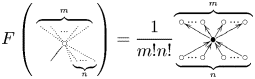
where the graph in the right-hand side is assumed to be skew-symmetrized over the labels of in- and out-vertices.
The set of universal formality maps is denoted by  ${\mathcal {M}}{\mathcal {C}}_{\mathrm {form}}$. We call them universal because any such a formality map provides us immediately with a quasi-isomorphism of
 ${\mathcal {L}} ie_\infty$ algebras as in part (ii) of Theorem 1.1 for arbitrary graded vector space
 $V$.
4.10 On $GRT_1$ action

The  ${\mathcal {L}} ie_\infty$ algebra structure
 \[ \left\{\mu_n: \wedge^n \mathsf{Def}({\mathcal{Q}} ua_\infty \stackrel{q_0}{\rightarrow} {\mathcal{B}} ra^{{\rm or}}) \rightarrow \mathsf{Def}({\mathcal{Q}} ua_\infty \stackrel{q_0}{\rightarrow} {\mathcal{P}}{\mathcal{G}} ra^{{\rm or}})[2-n]\right\}_{n\geq 1} \]
satisfies the condition that the maps  $\mu _n$ restricted to the subspace
 $\mathsf {fGC}_3^{{\rm or}}\otimes \wedge ^{n-1} \mathsf {Def}({\mathcal {Q}} ua_\infty \stackrel {q_0}{\rightarrow } {\mathcal {P}}{\mathcal {G}} ra^{{\rm or}})$ vanish for
 $n\geq 3$. This means that the map
 \[ \begin{matrix} Ad: & \mathsf{fGC}_3^{{\rm or}}\otimes \mathsf{BGC}^{\mathsf{or}} & \longrightarrow & \mathsf{BGC}^{\mathsf{or}}\\ & \gamma\otimes \Gamma & \longrightarrow & ad_\gamma\Gamma:= \mu_2(\gamma, \Gamma) \end{matrix} \]
gives us a injective morphism of Lie algebras,
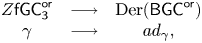 \begin{equation} \begin{matrix}Z\mathsf{fGC}_{\mathsf{3}}^{\mathsf{or}} & \longrightarrow & \mathrm{Der}(\mathsf{BGC}^{\mathsf{or}})\\ \gamma & \longrightarrow & ad_\gamma, \end{matrix} \end{equation}
where  $Z\mathsf {fGC}_{\mathsf {3}}^{\mathsf {or}}\subset \mathsf {fGC}_{\mathsf {3}}^{\mathsf {or}}$ is the graded Lie subalgebra of cocycles, and
 $\mathrm {Der}(\mathsf {BGC}^{\mathsf {or}})$ is the Lie algebra of derivations of the
 ${\mathcal {L}} ie_\infty$ algebra
 $\mathsf {BGC}^{\mathsf {or}}$. Hence we also have a canonical map
 \[ \mathfrak{g}\mathfrak{r}\mathfrak{t}_1 \longrightarrow H^0(\mathrm{Der}(\mathsf{BGC}^{\mathsf{or}})) \]
which implies the following.
Proposition 4.6 The prounipotent Grothendieck–Teichmüller group  $GRT_1=\exp (\mathfrak{g}\mathfrak{r}\mathfrak{t})$ acts on the set of gauge equivalence classes,
 ${\mathcal {M}}{\mathcal {C}}(\mathsf {BGC}^{{\rm or}})/\sim$, of Maurer–Cartan elements in the
 ${\mathcal {L}} ie_\infty$ algebra
 $\mathsf {BGC}^{\mathsf {or}}$. Moreover, this action descends to the action on the subset
 ${\mathcal {M}}{\mathcal {C}}_{\mathrm {form}}\subset {\mathcal {M}}{\mathcal {C}}(\mathsf {BGC}^{\mathsf {or}})$ of formality maps. The action
 \[ \begin{matrix}GRT_1 \times {\mathcal{M}}{\mathcal{C}}_{\mathrm{form}} & \longrightarrow & {\mathcal{M}}{\mathcal{C}}_{\mathrm{form}}\\ (\exp(\gamma), F=\sum \Gamma) & \longrightarrow & \sum \exp(\gamma) \cdot \Gamma \end{matrix} \]
is given by (repeated) substitutions of a graph representative of an element  $\gamma \in \mathfrak{g}\mathfrak{r} \mathfrak{t}_1$ in
 $Z\mathsf {fGC}_{\mathsf {3}}^{\mathsf {or}}$ into black vertices of graphs
 $\Gamma$ representing the formality map
 $F$ (cf. [Reference WillwacherWil15a]).
4.10.2 From formality maps to quantizations of strongly homotopy algebras
Any element  $q \in {\mathcal {M}}{\mathcal {C}}(\mathsf {BGC}^{{\rm or}})$ is the same as a morphism of props, which deforms the standard morphism
 $q_0$ in such a way that its component
 $i_0$ stays invariant. As the prop
 ${\mathcal {B}} ra^{{\rm or}}$ admits a canonical representation in
 ${\mathcal {E}} nd_{{\mathcal {O}}_V,\mathfrak{g}_V}$ for any (possibly, infinite-dimensional) graded vector space
 $V$, the universal quantization
 $q$ gives us a representation
 \[ {\mathcal{Q}} ua_\infty \stackrel{q_0+q}{\longrightarrow} {\mathcal{B}} ra \longrightarrow {\mathcal{E}} nd_{\mathfrak{g}_V,{\mathcal{O}}_V}, \]
that is, a  ${\mathcal {L}} ie_\infty$ morphism,
 \[ F=\left\{ F_k: \wedge^k (\mathfrak{g}_V[2]) \longrightarrow C^\bullet_{{\rm GS}}({\mathcal{O}}_V,{\mathcal{O}}_V),\quad |F_k|=1-k\right\}_{k\geq 1} .\]
If  $q$ satisfies in addition the condition (37), this
 ${\mathcal {L}} ie_\infty$ morphism
 $F$ must be a quasi-isomorphism. Indeed, at the cohomology level the map
 $F_1$ induces a linear map
 $[F_1]:\mathfrak{g}_V[2]\rightarrow \mathfrak{g}_V[2]$; then the boundary condition assures that this induced map is an isomorphism.
Let  $\nu$ be an arbitrary Maurer–Cartan element in
 $\mathfrak{g}_V$, that is, an arbitrary strongly homotopy Lie bialgebra structure on
 $V$. Then the morphism
 $F$ gives us in turn an associated Maurer–Cartan element,
 \begin{equation} \rho^{\hbar}:=\rho_0+ \sum_{k=1}^\infty \frac{\hbar^{k}}{k!}F_k(\gamma,\ldots, \gamma), \end{equation}
in  $\mathfrak{g}\mathfrak{s}({\mathcal {O}}_V,{\mathcal {O}}_V)[[\hbar ]]$, that is, a continuous
 ${\mathcal {A}} ss{\mathcal {B}}_\infty$ structure in
 ${\mathcal {O}}_V[[\hbar ]]$ which deforms the standard
 ${\mathcal {A}} ss{\mathcal {B}}$ structure in
 ${\mathcal {O}}_V$,
 \[ \rho^\hbar|_{\hbar=0}= \rho_0, \]
and also satisfies,
 \[ \frac{d \rho^{\hbar}}{d\hbar}|_{\hbar=0}=\gamma. \]
Thus any universal formality map gives a universal quantization of strongly homotopy algebras.
5. Existence and classification of universal formality maps
5.1 A one-coloured prop of graph complexes
Consider an  ${\mathbb {S}}$-bimodule,
 \[ {\mathcal{B}}^{{\rm or}}:=\biggl\{{\mathcal{B}}^{{\rm or}}(m,n):=\prod_{k\geq 0} {\mathcal{B}}{\mathcal{G}} ra^{{\rm or}}(k;m,n)\otimes_{{\mathbb{S}}_k} {\text{sgn}}_k[3k]\biggr\}. \]
An element of  ${\mathcal {B}}^{{\rm or}}$ can be understood as a graph
 $\Gamma$ from
 ${\mathcal {B}} ra^{{\rm or}}$ whose internal vertices have no labels and are totally ordered (up to an even permutation),Footnote 12 and which is assigned the homological degree
 \begin{equation} |\Gamma|=3|V_{{\rm int}}(\Gamma)| -2|E_{{\rm int}}(\Gamma)| -|E_{{\rm in}}(\Gamma)|-|E_{{\rm out}}(\Gamma)|. \end{equation}
One should, however, keep in mind that in reality such a graph  $\Gamma$ stands for a linear combination of graphs from
 ${\mathcal {P}}{\mathcal {G}} ra^{{\rm or}}$ whose internal vertices are skew-symmetrized, for example,

We use such an identification in the following definition of a degree- $1$ operation on
 ${\mathcal {B}}^{{\rm or}}$,

where  $\bullet _1$ stands for the substitution of the graph

into the internal vertex labelled by  $1$ in the skew-symmetrized linear combination of graphs corresponding to
 $\Gamma$, and then the summation over all possible ways of reconnecting the ‘hanging’ half-edges to the two vertices of the substituted graph which respect the directed flow
 $\uparrow$ on edges and the condition that each internal vertex of the resulting graph has at least one incoming half-edge and at least one outgoing half-edge (cf. (23)). An example is

Note that each element  $\Gamma$ from
 ${\mathcal {B}}^{{\rm or}}$ comes equipped with an orientation, i.e. an element (of unit length) in
 $\det {\mathbb {R}}^{|V_{{\rm int}}(\Gamma )|}\otimes \det {\mathbb {R}}^{|E_{{\rm in}}(\Gamma )|} \otimes \det {\mathbb {R}}^{|E_{{\rm in}}(\Gamma )|}$, and that
 $\Gamma$ is identified with
 $-\Gamma ^{{\rm opp}}$, where
 $\Gamma ^{{\rm opp}}$ is the unique graph which is identical to
 $\Gamma$ in all data except orientation.
It is obvious that the prop structure in  ${\mathcal {B}} ra^{{\rm or}}$ induces a prop structure in
 ${\mathcal {B}}^{{\rm or}}$. What is less obvious is that the one-coloured prop
 ${\mathcal {B}}^{{\rm or}}$ has a natural differential
 $\delta _\bullet$.
For any  $l\geq 1$ and any
 $i\in [l]$ define a degree-
 $1$ element,
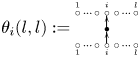
in  $B^{{\rm or}}(l,l)$, and then consider a linear map

where  $\circ _v$ stands for the vertical composition in the prop
 ${\mathcal {B}} ra^{{\rm or}}$.
Lemma 5.1 The linear map  is a differential in the prop
 ${\mathcal {B}}^{{\rm or}}$ which makes it identical to the dg prop
 ${\mathcal {D}} \widehat {\mathcal {L}\textit{ieb}}_\infty$.
Proof. This claim can be proven in two different ways.
(i) By construction, every internal vertex of  ${\mathcal {B}}^{{\rm or}}$ is at least trivalent. A direct inspection of the formula for
 $\delta _\bullet$ shows that it acts only on black (i.e. internal) vertices,

of graphs from  ${\mathcal {B}}^{{\rm or}}$ by splitting them precisely as in (11). The only non-obvious part of this claim is the formula for signs. Recall that any graph
 $\Gamma$ from
 ${\mathcal {B}} {\mathcal {G}} ra^{{\rm or}}$ comes equipped with an orientation, that is, with a choice of an element (of unit length) in
 $\det {\mathbb {R}}^{|V_{{\rm int}}(\Gamma )|}\otimes \det {\mathbb {R}}^{|E_{{\rm in}}(\Gamma )|}\otimes {\mathbb {R}}^{|E_{{\rm out}}(\Gamma )|}$. It was proven in [Reference ThurstonThu99] that the latter space can be canonically identified with
 $\det {\mathbb {R}}^{|e(\Gamma )|}\otimes \det {\mathbb {R}}^{\dim H_1(|Ga|)}$, where
 $e(\Gamma )$ is the set of all edges of
 $\Gamma$ and
 $H_1(|Ga|)$ is the first homology group of the geometric realization of
 $\Gamma$. The map
 $\delta _\bullet$ leaves
 $H_1(|Ga|)$ invariant so that, if we want to understand induced orientations on summands of the expression
 $d\Gamma$ for any
 $\Gamma \in {\mathcal {B}} {\mathcal {G}} ra^{{\rm or}}$, it is enough to take care only about the orientation of the space
 ${\mathbb {R}}^{|e(\Gamma )|}$ generated by all edges. Then the translation of graph orientations into signs becomes more or less straightforward: it was first done in [Reference Markl and VoronovMV09] (in a different context), and we refer to § 7.1 of that paper for the proof that the formula for signs is exactly the one given by (11).
(ii) Consider a morphism of props,  $f: {\mathcal {Q}} ua \longrightarrow {\mathcal {B}} ra^{{\rm or}}$, given on the generators as follows (cf. (35)):
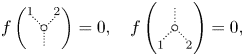

Then, as before, the dg vector space
 \[ \mathsf{Def}({\mathcal{Q}} ua_\infty \stackrel{f}{\rightarrow} {\mathcal{B}} ra^{{\rm or}})\simeq \mathsf{fGC}_3^{{\rm or}} \oplus \mathsf{BGC}^{{\rm or}}_3 \]
splits into a direct sum of complexes. Up to a degree shift graphs from  $\mathsf {BGC}_3^{{\rm or}}$ can be identified with graphs from
 ${\mathcal {B}}^{{\rm or}}$. It remains to notice that the differential in
 $\mathsf {BGC}_3^{{\rm or}}$ induced by the morphism
 $f$ is precisely the sum

.
As the functor  ${\mathcal {D}}$ is exact, the above result computes immediately the cohomology of the dg prop
 ${\mathcal {B}}^{{\rm or}}$.
Corollary 5.2 The canonical surjection  $\pi : {\mathcal {B}}^{{\rm or}}\equiv {\mathcal {D}}\widehat {\mathcal {L}\textit{ieb}}_\infty \longrightarrow {\mathcal {D}}\widehat {\mathcal {L}\textit{ieb}}$ is a quasi-isomorphism.
5.2 The graph complex $\mathsf {BGC}^{\mathsf {or}}$ reinterpreted

Note that elements in  $\mathsf {BBC}_3^{{\rm or}}$ which have no internal vertices are cycles with respect to the differential
 $\delta _\bullet$, that is,
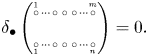
Therefore there is a morphism of dg props,
 \[ i_\circ: ({\mathcal{A}} ss{\mathcal{B}},0) \longrightarrow ({\mathcal{D}}\widehat{\mathcal{L}\textit{ieb}}_\infty, \delta_\bullet) \]
given on the generators as follows

and hence a morphism of dg props  ${\mathcal {A}} ss{\mathcal {B}}_\infty \rightarrow {\mathcal {D}}\widehat {\mathcal {L}\textit{ieb}}_\infty$ denoted by the same letter
 $i_\circ$. Using the above identification of
 ${\mathcal {D}}\mathcal {L}\textit{ieb}_\infty$ with
 ${\mathcal {B}}^{{\rm or}}$ and the relation of the latter with
 ${\mathcal {B}} ra^{{\rm or}}$, it is now straightforward to see that the deformation complex of the morphism
 $i_\circ$,
 \[ \mathsf{Def}({\mathcal{A}} ss{\mathcal{B}} \stackrel{i_\circ}{\longrightarrow} {\mathcal{D}}\widehat{\mathcal{L}\textit{ieb}}_\infty ) , \]
can be identified as a  ${\mathcal {L}} ie_\infty$ algebra with the earlier defined graph complex
 $\mathsf {BGC}^{{\rm or}}$. Thus the Maurer–Cartan elements
 $\gamma$ of, for example, the
 ${\mathcal {L}} ie_\infty$ algebra
 $\mathsf {BGC}^{{\rm or}}$ can be understood not only as morphisms of two-coloured dg props,
 \[ ({\mathcal{Q}} ua_\infty, \delta) \stackrel{\gamma}{\longrightarrow} ({\mathcal{B}} ra^{{\rm or}},0) , \]
but also as morphisms of one-coloured dg props,
 \[ ({\mathcal{A}} ss{\mathcal{B}}_\infty, \delta) \stackrel{\gamma}{\longrightarrow} ({\mathcal{D}}\widehat{\mathcal{L}\textit{ieb}}_\infty, \delta_\bullet). \]
This double meaning of one and the same element  $\gamma \in {\mathcal {M}}{\mathcal {C}}(\mathsf {BGC}^{{\rm or}})$ is not surprising and can be understood in terms of representations as follows.
Let  $\nu :\mathcal {L}\textit{ieb}_\infty \rightarrow {\mathcal {E}} nd_V$ be a strongly homotopy Lie bialgebra structure in a dg vector space
 $V$; we can understand it as a Maurer–Cartan element
 $\nu$ in the Lie algebra
 $\mathfrak{g}_V$. According to the general principle (see § 2), there is an associated representation,
 $\rho _\nu : {\mathcal {D}}\mathcal {L}\textit{ieb}_\infty \longrightarrow {\mathcal {E}} nd_{{\mathcal {O}}_V}$ which we would like to describe explicitly. In fact, as we work with completed prop
 $\widehat {\mathcal {L}\textit{ieb}}_\infty$ one has to take care about convergence in the standard way: the associated representation will be a continuous morphism
 $\rho _\nu : {\mathcal {D}}\widehat {\mathcal {L}\textit{ieb}}_\infty \longrightarrow {\mathcal {E}} nd_{{\mathcal {O}}_V}[[\hbar ]]$ of topological props.
Recall (see § 4.5.1) that there is a canonical representation of the two-coloured prop  ${\mathcal {B}} ra^{{\rm or}}$ in the pair of vector spaces
 $(\mathfrak{g}, {\mathcal {O}}_V)$ which associates to a graph
 $\Gamma$ from
 ${\mathcal {B}}{\mathcal {G}} ra^{{\rm or}}(k;m,n)$ a linear map (26),
 \[ \begin{matrix} \rho_\Gamma: & \mathfrak{g}_V^{\otimes k}\otimes {\mathcal{O}}_V^{\otimes n} & \longrightarrow & {\mathcal{O}}_V^{\otimes m}\\ & \gamma_1\otimes\cdots\otimes \gamma_k\otimes f_1\otimes\cdots\otimes f_n & \longrightarrow & \rho_\Gamma(\gamma_1\otimes\cdots\otimes \gamma_k\otimes f_1\otimes\cdots\otimes f_n). \end{matrix} \]
According to Lemma 5.1, a generator of  ${\mathcal {D}}\widehat {\mathcal {L}\textit{ieb}}_\infty (m,n)$ can be understood as a graph
 $\Gamma ^{{\rm skew}}$ obtained by skew-symmetrization of labels of internal vertices of some graph
 $\Gamma$ from
 ${\mathcal {B}} {\mathcal {G}} ra(k;m,n)$. Then the formula
 \[ \begin{matrix} \Phi_\Gamma^\nu:=\rho(\Gamma^{{\rm skew}}): & {\mathcal{O}}_V^{\otimes n} & \longrightarrow & {\mathcal{O}}_V^{\otimes m}[[\hbar]]\\ & f_1\otimes\cdots\otimes f_n & \longrightarrow & \dfrac{\hbar^k}{k!}\rho_\Gamma(\nu\otimes\cdots\otimes \nu\otimes f_1\otimes\cdots\otimes f_n) \end{matrix} \]
gives us the required continuous representation of  ${\mathcal {D}}\widehat {\mathcal {L}\textit{ieb}}_\infty$ in
 ${\mathcal {O}}_V[[\hbar ]]$. Comparing this formula with (39), we see that any Maurer–Cartan element
 $\gamma$ of the
 ${\mathcal {L}} ie_\infty$ algebra
 $\mathsf {BGC}^{{\rm or}}$ can indeed be understood as a morphisms of one-coloured dg props
 $\gamma ': {\mathcal {A}} ss{\mathcal {B}}_\infty \stackrel {\gamma }{\longrightarrow } {\mathcal {D}}\widehat {\mathcal {L}\textit{ieb}}_\infty$ such that the
 ${\mathcal {A}} ss{\mathcal {B}}_\infty$ algebra structure in
 ${\mathcal {O}}_V[[\hbar ]]$ induced from the representation
 $\nu$ in accordance with the formality map
 $\gamma \in \mathsf {BGC}^{{\rm or}}$ and formula (39) coincides precisely with the composition
 \[ {\mathcal{A}} ss{\mathcal{B}}_\infty \stackrel{\gamma'}{\longrightarrow} {\mathcal{B}} ra^{{\rm or}} \stackrel{\rho_\nu}{\longrightarrow} {\mathcal{E}} nd_{{\mathcal{O}}_V}[[\hbar]]. \]
Put another way, the identification of  ${\mathcal {L}} ie_\infty$ algebras
 $\mathsf {BGC}^{{\rm or}}$ and
 $\mathsf {Def}({\mathcal {A}} ss{\mathcal {B}} \stackrel {i_\circ }{\longrightarrow } {\mathcal {D}}\widehat {\mathcal {L}\textit{ieb}}_\infty )$ is no more than a universal (graph) incarnation of the main observation in § 4.10.1 that formality maps give us quantizations of strongly homotopy Lie bialgebras.
Similarly, morphisms of (non-differential) props,
 \[ {\mathcal{A}} ss{\mathcal{B}} \longrightarrow {\mathcal{D}}\widehat{\mathcal{L}\textit{ieb}} , \]
can be understood as universal quantizations of Lie bialgebras.
Theorem 5.3 (Existence theorem) For any Drinfeld associator  $\mathfrak{A}$ there is an associated formality map
 $F_\mathfrak{A}\in {\mathcal {M}}{\mathcal {C}}_{\mathrm {form}}$. In particular, the set of universal formality maps is non-empty.
Proof. The Etingof–Kazhdan theorem [Reference Etingof and KazhdanEK96] (see also [Reference Enriquez and EtingofEE05]) says that for any Drinfeld associator  $\mathfrak{A}$ there there is a morphism of props
 \[ f_\mathfrak{A}: \mathcal{A}\textit{ssb} \longrightarrow {\mathcal{D}}\widehat{\mathcal{L}\textit{ieb}} \]
such that

The theorem is proven once we show that there exists a morphism of dg props
 \[ F_\mathfrak{A}: \mathcal{A}\textit{ssb}_\infty \longrightarrow {\mathcal{B}}^{{\rm or}}\equiv {\mathcal{D}}\widehat{\mathcal{L}\textit{ieb}}_\infty \]
which makes the following diagram commutative
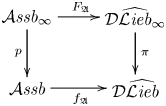
and satisfies the conditions
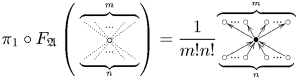
for all  $m+n\geq 4$,
 $m,n\geq 1$. Here
 $\pi _1: {\mathcal {D}}\widehat {\mathcal {L}\textit{ieb}}_\infty \rightarrow {\mathcal {D}}\widehat {\mathcal {L}\textit{ieb}}_\infty ^{(1)}$ is the projection to the subspace spanned by graphs with precisely one black (internal) vertex.
One can construct the required morphism  $F$ by a standard induction on the degree of the generators of
 $\mathcal {A}\textit{ssb}_\infty$. As the map
 $\pi$ is a surjective quasi-isomorphism, there exists cycles
 $B_2^1$ and
 $B_1^2$ in
 ${\mathcal {D}}\mathcal {L}\textit{ieb}_\infty$ such that

We set the values of  $F$ on degree-
 $0$ generators to be given by

Assume now that values of  $F$ are defined on the generators of
 $\mathcal {A}\textit{ssb}_\infty$ of degree greater than or equal to
 $-N+1$. Let us define
 $F$ on generators of degree
 $-N$, that is, on
 $(m,n)$ corollas,

satisfying  $m+n-3=N$. Note that
 $\delta e_n^m$ is a linear combination of graphs whose vertices are decorated by corollas of degrees greater than or equal to
 $-N+1$ (as
 $\delta$ increases degree by
 $+1$). By induction,
 ${F}(\delta e_n^m)$ is a well-defined closed element in
 ${\mathcal {B}} ra^{{\rm or}}$. As
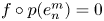 $f\circ p(e_n^m)=0$, we have
 $\pi ({F}(\delta e_n^m))=0$. Since the surjection
 $\pi$ is a quasi-isomorphism, the element
 ${F}(\delta e_n^m)$ must be exact. Thus there exists
 $B_n^m\in {\mathcal {B}} ra^{{\rm or}}$ such that
 \[ \delta_\bullet {B_n^m}= {{\mathcal{F}}}(\delta e_n^m). \]
We set 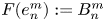 ${F}(e_n^m):= B_n^m$.
To complete the inductive construction of  ${F}$ one has to show that
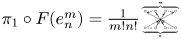 . This step is the same as in [Reference MerkulovMer16] and we omit the details.
5.4 Deformation complex of a formality map
Let  $F_\mathfrak{A}$ be any formality map. By composing derivations of the prop
 $\mathcal {L}\textit{ieb}_\infty$ with
 $F_\mathfrak{A}$ we obtain a morphism of complexes,
 \begin{equation} s: \mathrm{Der}(\widehat{\mathcal{L}\textit{ieb}}_\infty)_{\mathrm{prop}}[-1]\equiv \mathsf{Def}\left(\widehat{\mathcal{L}\textit{ieb}}_\infty \stackrel{{\mathrm{Id}}}{\longrightarrow}\widehat{\mathcal{L}\textit{ieb}}_\infty\right)_{\mathrm{prop}} \longrightarrow \mathsf{Def}\left(\mathcal{A}\textit{ssb}_\infty \stackrel{F_\mathfrak{A}}{\longrightarrow} {\mathcal{D}}\widehat{\mathcal{L}\textit{ieb}}_\infty \right). \end{equation}
Proposition 5.3 The map  $s$ in (43) is a quasi-isomorphism.
Proof. The complex  $\mathrm {Der}(\widehat {\mathcal {L}\textit{ieb}}_\infty )$ of properadic derivations is described very explicitly in terms of connected graphs in [Reference Merkulov and WillwacherMW18a]; the complex
 $\mathrm {Der}(\mathcal {L}\textit{ieb}_\infty )_{\mathrm {prop}}$ of derivations of the prop
 $\mathcal {L}\textit{ieb}_\infty$ can be described by the same graphs but with the connectedness assumption dropped. Both complexes in (43) admit filtrations by the number of edges in the graphs, and the map
 $s$ preserves these filtrations, and hence induces a morphism of the associated spectral sequences,
 \[ s_r: ({\mathcal{E}}_r\mathrm{Der}(\widehat{\mathcal{L}\textit{ieb}}_\infty)_{\mathrm{prop}}[-1], d_r) \longrightarrow \left({\mathcal{E}}_r\mathsf{Def}(\mathcal{A}\textit{ssb}_\infty \stackrel{F_\mathfrak{A}}{\longrightarrow} {\mathcal{D}}\widehat{\mathcal{L}\textit{ieb}}_\infty ), \delta_r\right), \quad r\geq 0. \]
The induced differential  $d_0$ on the initial page of the spectral sequence of the left-hand side is trivial,
 $d_0=0$. The induced differential on the initial page of the spectral sequence of the right-hand side is not trivial and is determined by the summand

in  $F_\mathfrak{A}$. Hence the differential
 $\delta _0$ acts only on white vertices of graphs from
 $\mathsf {Def}(\mathcal {A}\textit{ssb}_\infty \stackrel {F_\mathfrak{A}}{\longrightarrow } {\mathcal {D}}\widehat {\mathcal {L}\textit{ieb}}_\infty )$ by splitting them in two white vertices and redistributes outgoing or incoming edges and all possible ways. The cohomology
 \[ E_1\mathsf{Def}\left(\mathcal{A}\textit{ssb}_\infty \stackrel{F_\mathfrak{A}}{\longrightarrow} {\mathcal{D}}\widehat{\mathcal{L}\textit{ieb}}_\infty \right)=H^\bullet\left(E_0\mathsf{Def}(\mathcal{A}\textit{ssb}_\infty \stackrel{F_\mathfrak{A}}{\longrightarrow} {\mathcal{D}}\widehat{\mathcal{L}\textit{ieb}}_\infty ), \delta_0\right) \]
is spanned by graphs all of whose white vertices are precisely univalent (see [Reference MerkulovMer11, Theorem 3.2.4] or [Reference WillwacherWil15a, Appendix A]) and hence is isomorphic to  $\mathrm {Der}(\widehat {\mathcal {L}\textit{ieb}}_\infty )_{\mathrm {prop}}[-1]$ as a graded vector space. By boundary condition (42), the induced differential
 $\delta _1$ in
 $E_1\mathsf {Def}(\mathcal {A}\textit{ssb} \stackrel {F_\mathfrak{A}}{\longrightarrow } {\mathcal {D}}\widehat {\mathcal {L}\textit{ieb}}_\infty )$ agrees with the induced differential
 $d_1$ in
 ${\mathcal {E}}_1\mathrm {Der}(\widehat {\mathcal {L}\textit{ieb}}_\infty )_{\mathrm {prop}}[-1]$ so that the morphism of the next pages of the spectral sequences,
 \[ s_1: ({\mathcal{E}}_1\mathrm{Der}(\widehat{\mathcal{L}\textit{ieb}}_\infty)_{\mathrm{prop}}[-1], d_1)\simeq \mathrm{Der}(\widehat{\mathcal{L}\textit{ieb}}_\infty)_{\mathrm{prop}}[-1] \longrightarrow \left({\mathcal{E}}_1\mathsf{Def}(\mathcal{A}\textit{ssb}_\infty \stackrel{F_\mathfrak{A}}{\longrightarrow} {\mathcal{D}}\widehat{\mathcal{L}\textit{ieb}}_\infty ), \delta_1\right) ,\]
is an isomorphism. By the comparison theorem, the morphism  $s$ is a quasi-isomorphism.
Corollary 5.4 For any formality morphism  $F_\mathfrak{A}$ the associated deformation complex comes equipped with a canonical morphism of complexes
 \[ \mathsf{fGC}_3^\uparrow \longrightarrow \mathsf{Def}\left(\mathcal{A}\textit{ssb}_\infty \stackrel{F_\mathfrak{A}}{\longrightarrow} {\mathcal{D}} \widehat{\mathcal{L}\textit{ieb}}_\infty\right)[1] \]
which is a quasi-isomorphism. In particular,
 \[ H^{\bullet+1}\left(\mathsf{Def}(\mathcal{A}\textit{ssb}_\infty \stackrel{F_\mathfrak{A}}{\longrightarrow} {\mathcal{D}}\mathcal{L}\textit{ieb}_\infty )\right)= H^\bullet(\mathsf{fGC}^\uparrow_3). \]
5.5 Proof of the Main Theorem 1.3
Claim (i) follows from Theorem 5.3.
Claim (ii) follows from the identification of the deformation complex  $\mathsf {Def}(\mathcal {A}\textit{ssb}_\infty \stackrel {F_\mathfrak{A}}{\longrightarrow } {\mathcal {D}}\widehat {\mathcal {L}\textit{ieb}}_\infty )$ with the subcomplex
 $\mathsf {BGC}_3^{{\rm or}}$ of the complex
 $\mathsf {Def}({\mathcal {Q}} ua_\infty \stackrel {f}{\rightarrow } {\mathcal {B}} ra^{{\rm or}})$.
Claim (iii) is the Corollary 5.4.2.
Claim (iv) follows from Corollary 5.4.2 and the fact (21) that 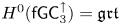 $H^0(\mathsf {fGC}^\uparrow _3)=\mathfrak{g}\mathfrak{r}\mathfrak{t}$.









