Introduction
Research has shown consistently that exposure to combat is associated with an increased risk of post-traumatic stress disorder (PTSD). Prior to 1980 the links between combat and acute breakdown were well known, but the role of combat as opposed to predisposition in the genesis of longer-term disorder was more controversial (Jones & Wessely, Reference Jones and Wessely2007). After 1980 and the introduction of PTSD into DSM-III, studies started to retrospectively link the newly defined disorder to service during the Vietnam War. Two large epidemiological studies of Vietnam veterans varied greatly in their reported prevalence of PTSD; lifetime prevalence has been reported between 14.7% and 30.9%, and current prevalence of PTSD in the late 1980s was reported as 2.2% compared to 15.2% (CDC, 1988; Kulka et al. Reference Kulka, Schlenger, Fairbank, Hough, Jordan, Marmar and Weiss1988). This controversy has led to debate regarding the true prevalence of PTSD. A reanalysis of a subsample of the National Vietnam Veterans Readjustment Study (NVVRS) with data from diagnostic examinations resulted in a lifetime prevalence of 18.7% and a current prevalence of 9.1% 10–12 years after the war (Dohrenwend et al. Reference Dohrenwend, Turner, Turse, Adams, Koenen and Marshall2006). These differences in estimates of PTSD prevalence are of interest to research of current combat deployments, including policy makers, planners and health service providers in the Armed Forces and the wider community.
There are several methodological issues, such as the sample and measurements used, that impact on the validity of a prevalence estimate (Boyle, Reference Boyle1998). The sampling frame and population studied impact on the generalizability of the estimate. Sample bias is an important issue in military studies, which focus on young males who are highly mobile and difficult to contact and engage (thus representing low-responding populations). The use of self-report measures is common practice in epidemiological surveys as these are time-saving and cost-effective. However, these measures are rarely validated in samples appropriate for the purposes of population screening, and the specificity and sensitivity of the measure is dependent on the true prevalence in the population (Terhakopian et al. Reference Terhakopian, Sinaii, Engel, Schnurr and Hoge2008). For PTSD prevalence studies, the time elapsed between the assessment and the exposure may also cause variability in the prevalence estimates (Bliese et al. Reference Bliese, Wright, Adler, Thomas and Hoge2007).
The 2003 Iraq War has stimulated a new round of interest in the psychological effects of combat, not least given the numbers of personnel involved, and that far from being a ‘short sharp shock and awe’ similar to the 1991 Gulf War, it has developed into a prolonged counter-insurgency operation involving far more direct combat exposure than was ever predicted. The results of studies of participating military personnel have shown large variability in the prevalence of PTSD. In particular, several studies have shown that there is a difference in rates between UK and US military personnel, with UK studies reporting lower rates of PTSD (Grieger et al. Reference Grieger, Cozza, Ursano, Hoge, Martinez, Engel and Wain2006; Hoge et al. Reference Hoge, Auchterlonie and Milliken2006, Reference Hoge, Terhakopian, Castro, Messer and Engel2007; Hotopf et al. Reference Hotopf, Hull, Fear, Browne, Horn, Iversen, Jones, Murphy, Bland, Earnshaw, Greenberg, Hacker Hughes, Tate, Dandeker, Rona and Wessely2006). This difference, although not examined systematically, has been suggested as being due to differences between the USA and UK with regard to deployment experiences, sociodemographics and the study methodology used (Hoge & Castro, Reference Hoge and Castro2006; Hotopf et al. Reference Hotopf, Hull, Fear, Browne, Horn, Iversen, Jones, Murphy, Bland, Earnshaw, Greenberg, Hacker Hughes, Tate, Dandeker, Rona and Wessely2006).
This paper presents a systematic and quantitative review of the prevalence of PTSD in members of the Coalition Forces who have served in Iraq since the advent of the war in 2003, and we explain some of the variability in prevalence of PTSD in relation to methodological differences between studies.
Method
Literature search
Literature searches were carried out by one of the authors (J.S.) on 2 June 2009 using Medline, EMBASE and PsychINFO electronic databases with PubMed, OvidSP and ISI Web of Knowledge search engines to identify studies of PTSD in military personnel who had been deployed to Iraq.
Search terms included key words regarding PTSD, the military and deployments in Iraq. All search terms were used as free text terms, and combined with Boolean operators: (posttraumatic stress disorder OR PTSD OR stress disorder OR acute stress) AND (military OR armed services OR soldiers OR veterans) AND (Iraq OR Operation Iraqi Freedom OR OIF OR TELIC). Operation Iraqi Freedom (OIF) is the US codename for operations in Iraq, and TELIC is the UK codename for operations in Iraq; TELIC 1 refers to the first phase of the Iraq War, between 18 January and 28 April 2003, and subsequent UK operations are called TELIC 2, TELIC 3, and so on. Relevant published citations, including published reports, were pursued from articles obtained and from reviews published recently (Tanielian & Jaycox, Reference Tanielian and Jaycox2008). After excluding all duplicates, the literature searches identified 518 studies.
Studies identified
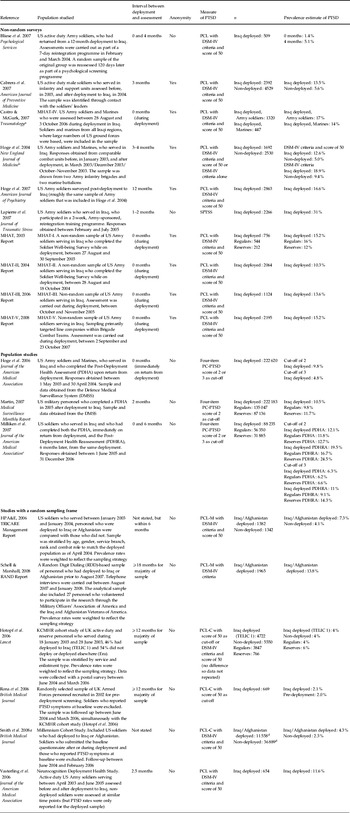
Studies were included if they reported on the prevalence of PTSD in military personnel who had deployed to Iraq, or if they reported the prevalence for a combined sample of personnel who had deployed to either Iraq or Afghanistan. Peer-reviewed articles and published reports were included. Selection criteria were applied to include studies with a sample size of n⩾300, but studies based on help-seeking samples or restricted to personnel currently in treatment or suffering from a severe injury were excluded. The use of broad search terms resulted in a large number of papers that were not relevant after abstracts were examined. Sixty papers were identified as possibly relevant articles. These were reduced to 19 papers selected for inclusion in the review (Table 1), after the selection criteria were applied.
Description of the 19 studies included in the review

DSM-IV, Diagnostic and Statistical Manual of Mental Disorders; HPA&E, Health Program Analysis & Evaluation; MHAT, Mental Health Advisory Team; PCL, PTSD Checklist; PCL-C, PTSD Checklist – Civilian Version; PCL-M, PTSD Checklist – Military Version; PC-PTSD, the Primary Care PTSD Screen; SPTSS, Screen for Post-traumatic Stress Symptoms; KCMHR, King's Centre for Military Health Research.
a Data were reported separately for Army soldiers and Marines and insufficient information was provided to report the prevalence for the two groups combined.
b The combined prevalence for Army and Marine personnel was estimated from the number of cases and combined sample size.
c The combined prevalence for regular and reserve personnel was estimated from the number of cases and combined sample size.
d Estimated from number of cases and prevalence estimate.
The 41 references that were not included in the review were excluded because: 13 studies did not fit the sample size criteria (Turner et al. Reference Turner, Kiernan, McKechanie, Finch, McManus and Neal2005; Engelhard et al. Reference Engelhard, Huijding, van den Hout and de Jong2007a, Reference Engelhard and van den Houtb, Reference Engelhard, van den Hout and McNally2008; Erbes et al. Reference Erbes, Westermeyer, Engdahl and Johnsen2007; Helmer et al. Reference Helmer, Rossignol, Blatt, Agarwal, Teichman and Lange2007; Jakupcak et al. Reference Jakupcak, Conybeare, Phelps, Hunt, Holmes, Felker, Klevens and McFall2007, Reference Jakupcak, Luterek, Hunt, Conybeare and McFall2008; Kolkow et al. Reference Kolkow, Spira, Morse and Grieger2007; Felker et al. Reference Felker, Hawkins, Dobie, Gutierrez and McFall2008; Pietrzak et al. Reference Pietrzak, Johnson, Goldstein, Malley, Rivers, Morgan and Southwick2009a, Reference Pietrzak, Johnson, Goldstein, Malley and Southwickb; Renshaw et al. Reference Renshaw, Rodrigues and Jones2009); five studies had not reported the prevalence of PTSD (Engelhard & van den Hout, Reference Engelhard and van den Hout2007; Wright et al. Reference Wright, Bliese, Thomas, Adler, Eckford and Hoge2007; Fontana & Rosenheck, Reference Fontana and Rosenheck2008; Peterson et al. Reference Peterson, Baker and McCarthy2008; Riddle et al. Reference Riddle, Sanders, Jones and Webb2008); 10 studies were based on subsamples of larger studies (Browne et al. Reference Browne, Hull, Horn, Jones, Murphy, Fear, Greenberg, French, Rona, Wessely and Hotopf2007; Iversen et al. Reference Iversen, Fear, Ehlers, Hacker Hughes, Hull, Earnshaw, Greenberg, Rona, Wessely and Hotopf2008; Jones et al. Reference Jones, Fear, Greenberg, Jones, Hull, Hotopf, Wessely and Rona2008; Smith et al. Reference Smith, Wingard, Ryan, Kritz-Silverstein, Slymen and Sallis2008b; Vasterling et al. Reference Vasterling, Schumm, Proctor, Gentry, King and King2008; LeardMann et al. Reference LeardMann, Smith, Smith, Wells and Ryan2009; Rona et al. Reference Rona, Hooper, Jones, Iversen, Hull, Murphy, Hotopf and Wessely2009a, Reference Rona, Jones, Iversen, Hull, Greenberg, Fear, Hotopf and Wesselyb; Smith et al. Reference Smith, Wingard, Ryan, Kritz-Silverstein, Slymen and Sallis2009; Wilson et al. Reference Wilson, Jones, Fear, Hull, Hotopf, Wessely and Rona2009); 12 studies used treatment samples (Kang & Hyams, Reference Kang and Hyams2005; Grieger et al. Reference Grieger, Cozza, Ursano, Hoge, Martinez, Engel and Wain2006; Rundell, Reference Rundell2006; Gahm et al. Reference Gahm, Lucenko, Retzlaff and Fukuda2007; Rosenheck & Fontana, Reference Rosenheck and Fontana2007; Seal et al. Reference Seal, Bertenthal, Miner, Sen and Marmar2007, Reference Seal, Bertenthal, Maguen, Gima, Chu and Marmar2008; Larson et al. Reference Larson, Highfill-McRoy and Booth-Kewley2008; McDonald et al. Reference McDonald, Beckham, Morey, Marx, Tupler and Calhoun2008; McGhee et al. Reference McGhee, Maani, Garza, Gaylord and Black2008, Reference McGhee, Maani, Garza, Desocio, Gaylord and Black2009; Schneiderman et al. Reference Schneiderman, Braver and Kang2008); and one study reported the prevalence for repeated assessments and provided insufficient information to calculate the adjusted standard errors (Shen et al. Reference Shen, Arkes and Pilgrim2009).
Extraction of data and analyses
The sample size and the prevalence of PTSD were extracted from all studies, and the standard error of the prevalence was calculated. For some studies the denominator was not provided, the standard error was then estimated based on the prevalence and the numerator. Where possible, PTSD prevalence and the corresponding standard error were also extracted for enlistment type (regular or reserves). For studies that assessed personnel more than once (Bliese et al. Reference Bliese, Wright, Adler, Thomas and Hoge2007; Milliken et al. Reference Milliken, Auchterlonie and Hoge2007), only one prevalence was extracted for inclusion in the meta-analyses; this decision was made to ensure independence between studies. We also excluded the study by Hoge et al. (Reference Hoge, Terhakopian, Castro, Messer and Engel2007) from the meta-analyses because the study followed up approximately the same sample analysed in an earlier study (Hoge et al. Reference Hoge, Castro, Messer, McGurk, Cotting and Koffman2004). However, for the examination of changes to the PTSD prevalence with time since return from deployment, we included both the study by Hoge et al. (Reference Hoge, Terhakopian, Castro, Messer and Engel2007) and all prevalence estimates for studies that assessed personnel more than once (Bliese et al. Reference Bliese, Wright, Adler, Thomas and Hoge2007; Milliken et al. Reference Milliken, Auchterlonie and Hoge2007).
The prevalence of PTSD was assessed across studies and sources of variability were examined by subgroup analyses (Thompson & Higgins, Reference Thompson and Higgins2002). Random effects models were fitted to account for residual heterogeneity not explained by the stratification, and forest plots were generated in Stata 10 (Stata Corporation, USA) with the metan command. Heterogeneity was assessed with I 2, which is an estimate of the variability in results across studies that can be attributed to heterogeneity as opposed to chance (Higgins et al. Reference Higgins, Thompson, Deeks and Altman2003). I 2 ranges between 0% and 100%, and suggested benchmarks characterize <25% as low, 25–50% as modest, and >50% as high heterogeneity.
Results
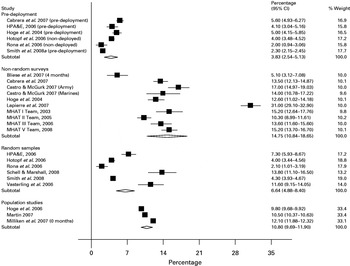
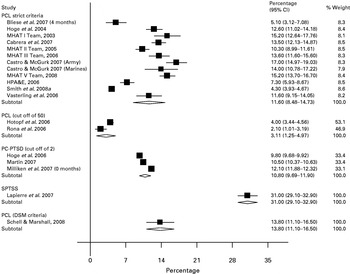
There is a high level of variability in prevalence of PTSD between studies of military personnel deployed to Iraq; this is displayed with a forest plot of the studies described in Table 1 (Fig. 1). The overall heterogeneity between the studies was very high, I 2=99.9%.
Graphical display of PTSD prevalence stratified by study type and time of assessment.

The variability between studies remained high after stratifying for study type and time of follow-up; for example, the prevalence of PTSD in non-deployed and pre-deployed samples was highly heterogeneous (I 2=96.9%). However, unlike rates in the post-deployment samples, pre- and non-deployed rates of PTSD were fairly consistent (prevalence ranged between 2% and 5.6%). This suggests that the discrepancy in PTSD prevalence is particularly relevant for post-deployment samples.
The group of studies based on non-random surveys had the highest rates of PTSD (between 5.1% and 31%). This group included studies conducted on line infantry units exposed to direct ground combat. There were two outliers within this group (Bliese et al. Reference Bliese, Wright, Adler, Thomas and Hoge2007; Lapierre et al. Reference Lapierre, Schwegler and Labauve2007). These two studies differed from the rest of the group in that both were on-the-record surveys; the study by Lapierre et al. (Reference Lapierre, Schwegler and Labauve2007) assessed PTSD with a different measure, the Screen for Post-traumatic Stress Symptoms (SPTSS), and the study by Bliese et al. (Reference Bliese, Wright, Adler, Thomas and Hoge2007) sampled data from one military unit. If these two studies are excluded, the range of PTSD prevalence is more consistent and lies between 10.3% and 17%; however, the heterogeneity remained high (I 2=83.4%).
Studies that were based on random samples tended to report lower prevalence of PTSD, between 2.1% and 13.8%. There was large heterogeneity in prevalence between these studies, which is partly due to differences in the method of assessing PTSD, and also to differences in the population studied, as this group included two UK-based studies that reported the lowest prevalence of PTSD.
Studies based on population samples carried out shortly after return from deployment tended to report a lower prevalence [ranging between 9.8% and 12.1%, with a Primary Care PTSD Screen (PC-PTSD) score of 2 as the cut-off] compared to studies based on non-random surveys, but reported higher prevalence compared to most studies based on random samples. Two studies in this group also reported PTSD prevalence assessed with the PC-PTSD and a score of 3 as cut-off (Hoge et al. Reference Hoge, Auchterlonie and Milliken2006; Milliken et al. Reference Milliken, Auchterlonie and Hoge2007), resulting in prevalence comparable to those reported in studies based on random samples (between 4.8% and 6.3%). However, there are insufficient numbers of studies based on population samples to draw any conclusions about differences in PTSD prevalence.
Differences in PTSD prevalence by level of combat exposure
There was insufficient information available in the studies included in this review to compare PTSD prevalence by the level of combat exposure. The studies based on non-random surveys of line infantry units generally constitute high combat samples compared to the studies based on random samples of the deployed military population, as these include personnel from the Navy and Air Force as well as from the Army and Marine forces. The studies that were based on line infantry units generally reported higher prevalence of PTSD (Fig. 1), but these studies also differed from the remainder of the studies on several aspects of study design (e.g. assessment method and PTSD measure).
Differences in PTSD prevalence between anonymous and on-the-record screening studies
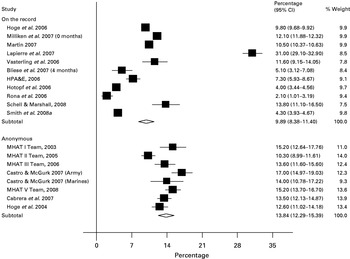
Screening studies that use anonymous surveys tend to report higher rates of PTSD compared to studies that use on-the-record screening (Hoge et al. Reference Hoge, Castro, Messer, McGurk, Cotting and Koffman2004, Reference Hoge and Castro2006). We examined whether anonymous versus non-anonymous screening accounts for the differences in PTSD prevalence (Fig. 2).
Graphical display of PTSD prevalence stratified by the study sampling frame.

Heterogeneity was higher in the group of studies that used on-the-record screening to assess PTSD, compared to the group of studies that used anonymous screening. The group that used on-the-record screening included studies that differed in sampling frame and the measure of PTSD, whereas the group of anonymous surveys used comparable sampling strategies and the same measure to assess PTSD.
With the exception of one outlier (Lapierre et al. Reference Lapierre, Schwegler and Labauve2007), the group of studies with on-the-record screening tend to report lower rates of PTSD, compared to the group of studies with anonymous screening. These results are substantiated by a recent record review, comparing on-the-record and anonymous screenings of PTSD rates in military hospital employees at the Naval Medical Centre San Diego (McLay et al. Reference McLay, Deal, Murphy, Center, Kolkow and Grieger2008). PTSD was assessed with the PTSD Checklist (PCL), scored according to DSM-IV criteria, and the reported rate for the on-the-record screening (7.8%) was half the reported rate for the anonymous screening (15.7%). Although the results from this review are not as striking as those reported by McLay et al. (Reference McLay, Deal, Murphy, Center, Kolkow and Grieger2008), there is support for higher rates of PTSD reported in anonymous surveys.
Differences in PTSD prevalence by enlistment type: regular and reserve personnel
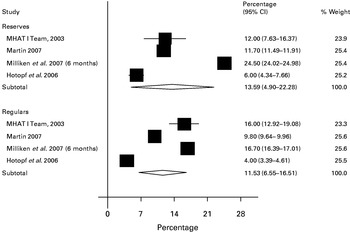
Several studies have shown that reserve personnel report higher levels of PTSD compared to regular personnel (Gray et al. Reference Gray, Reed, Kaiser, Smith and Gastanaga2002; Browne et al. Reference Browne, Hull, Horn, Jones, Murphy, Fear, Greenberg, French, Rona, Wessely and Hotopf2007; Milliken et al. Reference Milliken, Auchterlonie and Hoge2007; Vogt et al. Reference Vogt, Samper, King, King and Martin2008). Therefore, we examine whether the variability in PTSD rates between studies of Iraq deployed personnel can be explained by the differences in rates of PTSD between regular and reserve personnel (Fig. 3). Few studies reported the prevalence of PTSD separately for regular and reserve personnel who had deployed to Iraq, and these studies differ in sampling frame, the population studied and the assessment of PTSD.
Graphical display of PTSD prevalence stratified by regular and reserve personnel.

Heterogeneity was high within both groups, and stratifying studies by enlistment type did not explain the variability in PTSD prevalence. There was no indication of differences in PTSD prevalence between regular and reserve personnel in the one study that assessed PTSD during deployment (MHAT, 2003). Both the UK and US studies showed that there was a differential effect for reserve as opposed to regular personnel, with an increased risk of PTSD in reserve personnel in the period following deployment (Hotopf et al. Reference Hotopf, Hull, Fear, Browne, Horn, Iversen, Jones, Murphy, Bland, Earnshaw, Greenberg, Hacker Hughes, Tate, Dandeker, Rona and Wessely2006; Martin, Reference Martin2007; Milliken et al. Reference Milliken, Auchterlonie and Hoge2007).
Differences in PTSD prevalence by the measure of PTSD
The majority of studies reporting PTSD rates have used the PCL together with DSM-IV criteria, referred to as PCL strict criteria. The strict criteria define cases as those reporting a moderate or above level of one intrusion symptom, three avoidance symptoms, and two hyperarousal symptoms, in addition to scoring ⩾50. A few studies have used the PCL with a cut-off score of 50, or the PC-PTSD with a cut-off score of 2. One study used the PCL with DSM-IV criteria and no cut-off score (Schell & Marshall, Reference Schell, Marshall, Tanielian and Jaycox2008), and one study used the SPTSS (Lapierre et al. Reference Lapierre, Schwegler and Labauve2007).
Stratifying studies by the measure of PTSD showed that variability is high between studies regardless of the measure that was used (Fig. 4). The group of studies that measured PTSD with the PCL with strict criteria was highly heterogeneous. There were too few studies that used other measures of PTSD to assess the impact of PTSD measure on the prevalence estimate.
Graphical display of PTSD prevalence stratified by PTSD measure.

Four studies have compared different cut-offs of the same measure for assessing PTSD. Two studies that assessed PTSD with the PC-PTSD reported estimates for cut-offs of 2 and 3, which resulted in prevalence ranging between 9.8% and 12.1% compared to 4.8% and 6.3% (Hoge et al. Reference Hoge, Auchterlonie and Milliken2006; Milliken et al. Reference Milliken, Auchterlonie and Hoge2007). Hoge et al. (Reference Hoge, Castro, Messer, McGurk, Cotting and Koffman2004) showed that the PCL with DSM-IV criteria alone resulted in a much higher PTSD prevalence (18.9%) compared to the PCL with strict criteria (12.6%). Hotopf et al. (Reference Hotopf, Hull, Fear, Browne, Horn, Iversen, Jones, Murphy, Bland, Earnshaw, Greenberg, Hacker Hughes, Tate, Dandeker, Rona and Wessely2006) compared assessments based on PCL with strict criteria and PCL with a cut-off of 50 and found that there was no difference in prevalence.
The study by Lapierre et al. (Reference Lapierre, Schwegler and Labauve2007) is an outlier with a prevalence rate of 31%; this is also the only study that used the SPTSS to assess symptoms of PTSD. The SPTSS is a recently developed questionnaire that has been validated in a sample of psychiatric in-patients (Carlson, Reference Carlson2001) and a sample of Bedouins who had served in the Israeli defence forces (Caspi et al. Reference Caspi, Carlson and Klein2007). The psychometric properties of the SPTSS were evaluated against the Structured Clinical Interview for DSM-IV (SCID) and the Post-traumatic Stress Scale (PSS). The results indicated that the SPTSS had good convergent validity and sensitivity and a specificity of 89% at a cut-off value of 5.5 (Caspi et al. Reference Caspi, Carlson and Klein2007). However, the SPTSS has not been widely used and it is not known how it compares to commonly used measures such as the PCL and the PC-PTSD.
Changes to the prevalence of PTSD with time since return from deployment
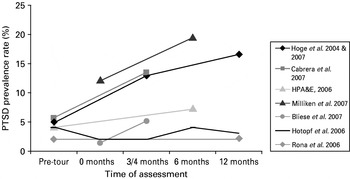
Few studies have assessed the prevalence of PTSD longitudinally (Fig. 5). Some studies have assessed rates in a pre-deployed or non-deployed sample in comparison with a deployed sample (Hoge et al. Reference Hoge, Castro, Messer, McGurk, Cotting and Koffman2004; Hotopf et al. Reference Hotopf, Hull, Fear, Browne, Horn, Iversen, Jones, Murphy, Bland, Earnshaw, Greenberg, Hacker Hughes, Tate, Dandeker, Rona and Wessely2006; Cabrera et al. Reference Cabrera, Hoge, Bliese, Castro and Messer2007). However, there are few (longitudinal) studies following the same deployed personnel at more than one occasion.
Changes in PTSD prevalence with time since return from deployment.

Two US studies have assessed a group of deployed personnel immediately upon return from deployment, and again after 4 and 6 months respectively (Bliese et al. Reference Bliese, Wright, Adler, Thomas and Hoge2007; Milliken et al. Reference Milliken, Auchterlonie and Hoge2007). Both of these studies indicated that rates of PTSD increase with time since return from deployment. Further support for an increase in PTSD rates comes from two US studies that followed a sample of anonymous Army personnel with assessments at 6 and 12 months post-deployment (Hoge et al. Reference Hoge, Castro, Messer, McGurk, Cotting and Koffman2004; Hoge et al. Reference Hoge, Terhakopian, Castro, Messer and Engel2007). These two studies showed a considerable increase in rates pre- to post-deployment and suggest that rates continue to increase post-deployment. However, these studies were not able to link individuals and do not constitute a longitudinal follow-up of personnel. There are only limited data on changes in PTSD prevalence over time in UK military personnel. The rate of PTSD among personnel who were assessed at varying times post-deployment did not differ from the pre-deployment rate (Hotopf et al. Reference Hotopf, Hull, Fear, Browne, Horn, Iversen, Jones, Murphy, Bland, Earnshaw, Greenberg, Hacker Hughes, Tate, Dandeker, Rona and Wessely2006; Rona et al. Reference Rona, Hooper, Jones, Hull, Browne, Horn, Murphy, Hotopf and Wessely2006); these results are in contrast to the US studies. However, these analyses were based on a small sample, and a clearer picture will not be available until the follow-up of the entire cohort is completed later this year (Hotopf et al. Reference Hotopf, Hull, Fear, Browne, Horn, Iversen, Jones, Murphy, Bland, Earnshaw, Greenberg, Hacker Hughes, Tate, Dandeker, Rona and Wessely2006).
Discussion
Overall, these examinations of differences between studies, in terms of the methods used and the prevalence of reported PTSD, indicate that there is large heterogeneity across studies. This review has shown that several factors relate to the variability in the prevalence of PTSD. Pre-deployment samples tended to have lower prevalence of PTSD compared to prevalence during and post-deployment. Studies based on non-random anonymous surveys of line infantry units using the PCL had the highest prevalence of PTSD. Although these studies are not representative of the deployed forces as a whole, they show a fairly consistent prevalence, between 10% and 17%, of PTSD among combat deployed troops. The prevalence among population and random samples representative of all the deployed forces tends to be lower, at 2.1–11.6%. Exceptions are studies that used the PCL with the DSM-IV criteria alone (Schell & Marshall, Reference Schell, Marshall, Tanielian and Jaycox2008) or the PC-PTSD with a cut-off of 2 (Martin, Reference Martin2007), both of which have been shown to result in higher prevalence compared to the PCL with a cut-off of 50 (Hoge et al. Reference Hoge, Castro, Messer, McGurk, Cotting and Koffman2004; Terhakopian et al. Reference Terhakopian, Sinaii, Engel, Schnurr and Hoge2008).
US studies that have assessed personnel more than once since return from deployment have shown that PTSD prevalence increases over the 12 months following deployment. This has been shown for both population studies and non-random surveys. There are several reasons why PTSD prevalence may increase over the months following return from deployment; the initial relief and joy of coming home may overshadow any mental health difficulties experienced, and symptoms that do not seem to be problematic during the immediate reintegration period may become distressing if they start to impact on social or work functioning.
Studies that used anonymous assessment reported higher prevalence of PTSD, but these studies were all samples of infantry units, which make it difficult to differentiate the impact of high levels of combat exposure from the impact of anonymous and on-the-record screening.
Enlistment type did not seem to explain the variability in PTSD prevalence between studies, despite support from both US and UK research of a differential effect between regular and reserve personnel (Browne et al. Reference Browne, Hull, Horn, Jones, Murphy, Fear, Greenberg, French, Rona, Wessely and Hotopf2007; Vogt et al. Reference Vogt, Samper, King, King and Martin2008). It is likely that any differences in PTSD prevalence between regular and reserve personnel are masked by differences in other study characteristics, and it may be more appropriate to compare results within a country. Within-study analyses show higher prevalence in reserve personnel following return from deployment (Hotopf et al. Reference Hotopf, Hull, Fear, Browne, Horn, Iversen, Jones, Murphy, Bland, Earnshaw, Greenberg, Hacker Hughes, Tate, Dandeker, Rona and Wessely2006; Martin, Reference Martin2007; Milliken et al. Reference Milliken, Auchterlonie and Hoge2007), but PTSD prevalence did not differ between regulars and reserves when assessed during deployment (MHAT, 2003). Concerns about discrimination and health-care provision, together with a perceived lack of support among reserve personnel, have been described to explain these differences (Browne et al. Reference Browne, Hull, Horn, Jones, Murphy, Fear, Greenberg, French, Rona, Wessely and Hotopf2007; Milliken et al. Reference Milliken, Auchterlonie and Hoge2007). Research on the UK reserve forces suggests that these issues have improved, with fewer problems reported in reservists' military role in theatre (French et al., Reference French, Dandeker, Greenberg, Hatch, Riley, van Staden and Wesselyin press).
The variability of PTSD prevalence was not reduced by accounting for the method of assessment alone. The majority of studies have used the PCL with strict criteria so it is not clear whether other measures impact on the prevalence of PTSD. It is important to note that all prevalence rates discussed in this paper are based on self-reported measures and do not represent definitive rates of PTSD. Research has shown that clinician-administered structured interviews result in lower prevalence of PTSD compared to self-report measures (Turner et al. Reference Turner, Bowie, Dunn, Laidon and Yule2003; Terhakopian et al. Reference Terhakopian, Sinaii, Engel, Schnurr and Hoge2008).
Deployment to the Iraq War has not as yet been associated with higher rates of PTSD for regular personnel in the UK Armed Forces compared to non-Iraq deployed (Hotopf et al. Reference Hotopf, Hull, Fear, Browne, Horn, Iversen, Jones, Murphy, Bland, Earnshaw, Greenberg, Hacker Hughes, Tate, Dandeker, Rona and Wessely2006; Rona et al. Reference Rona, Hooper, Jones, Hull, Browne, Horn, Murphy, Hotopf and Wessely2006). By contrast, most US studies have shown that deployment to Iraq was associated with higher rates of PTSD (Hoge et al. Reference Hoge, Castro, Messer, McGurk, Cotting and Koffman2004; Hoge et al. Reference Hoge, Terhakopian, Castro, Messer and Engel2007). This finding was supported by the meta-analysis; despite some overlap, PTSD prevalence tends to be lower in the pre-deployed samples compared to post-deployment prevalence. Several factors may explain the lower prevalence of PTSD reported in UK studies compared to US studies of military deployed to Iraq. This review only included two UK studies, both were carried out by the same research team and used random samples representative of the UK Armed Forces. By contrast, US studies have been carried out by several different research groups, and vary in study design and sampling frame. Consequently, there is greater variability in the PTSD prevalence reported in US studies. Differences in sample characteristics, such as combat exposure and length of deployment, are also probable explanatory factors for the lower PTSD prevalence in UK military studies (Hoge & Castro, Reference Hoge and Castro2006). Cultural and social differences in terms of benefits and health-care provision may also account for the higher rates of PTSD in the US studies. Differences in stigma are unlikely to account for differences in PTSD prevalence. Research in both UK and US Armed Forces personnel has shown that one of the main barriers to health screening is a lack of trust in military health care, and concerns regarding confidentiality and stigmatization (French et al. Reference French, Rona, Jones and Wessely2004; Hoge et al. Reference Hoge, Castro, Messer, McGurk, Cotting and Koffman2004).
Limitations
Only four studies report the prevalence of PTSD by enlistment status. Three studies included in their sample personnel who had deployed to either Iraq or Afghanistan (HPA&E, 2006; Schell & Marshall, Reference Schell, Marshall, Tanielian and Jaycox2008; Smith et al. Reference Smith, Ryan, Wingard, Slymen, Sallis and Kritz-Silverstein2008a). It is possible that this would bias estimates of PTSD prevalence. Early research comparing PTSD prevalence between personnel who deployed to Iraq and Afghanistan in 2003/2004 reported that prevalence is higher following deployment to Iraq (Hoge et al. Reference Hoge, Castro, Messer, McGurk, Cotting and Koffman2004, Reference Hoge and Castro2006). However, research of more recent deployments showed that PTSD prevalence is similar between Iraq and Afghanistan deployed personnel (Lapierre et al. Reference Lapierre, Schwegler and Labauve2007; MHAT-V, 2008). We were not able to examine to what extent combining Iraq and Afghanistan deployments in one sample may bias estimates of PTSD prevalence because of the limited number of studies available. Excluding these three studies slightly reduced the range and variability of studies that assessed PTSD with the PCL with strict criteria from I 2 of 98.4% to 91.4%, but did not impact on the conclusions of this review.
Because of methodological differences and the high level of heterogeneity between studies (in part explained by methodological differences), the reported group estimates of PTSD prevalences should be used with caution (Petitti, Reference Petitti2001).
These analyses were based on published estimates of PTSD prevalence, and we were not able to adjust for covariates in the analyses. A pooled analysis of individual-level data from these studies may make it possible to adjust for confounders, and provide more insight into the variability in prevalence of PTSD.
Implications for PTSD research in the military
This review demonstrates the importance of considering study methodology, study population and selection criteria when comparing PTSD rates between different studies. Ideally, comparisons of PTSD rates should only be made between studies that have similar methodologies, such as sample frame and whether anonymous or on-the-record surveys were used. However, in practice this is not feasible, and therefore comparisons across studies should control for differences in moderating factors of PTSD.
The current body of literature suggests that service planning for PTSD should be based on studies with random samples, and should be adjusted upwards for combat personnel. US studies have shown that PTSD prevalence increases over the 12 months following deployment; this has yet to be replicated in studies of the UK Armed Forces. Further studies based on longitudinal samples are needed to understand how the prevalence of PTSD changes over time.
Acknowledgements
This work was supported by the UK Ministry of Defence (MOD) (R&T/1/0078); and the South London and Maudsley National Health Service (NHS) Foundation Trust/Institute of Psychiatry National Institute of Health Research (NIHR) Biomedical Research Centre (to S.W.)]. We thank the anonymous reviewers of the first version of this paper for their helpful comments.
Declaration of Interest
S. Wessely is Honorary Civilian Consultant Advisor to the British Army.