Clostridioides difficile and carbapenem-resistant Enterobacteriaceae (CRE) are among the most urgent antimicrobial resistance threats to the United States healthcare system. 1 Inappropriate broad-spectrum antibiotic consumption is an important risk factor for C. difficile and CRE infections. Reference Richter, Miller and Needleman2,Reference Seddon, Bookstaver and Justo3 Although any antibiotic can predispose patients to C. difficile infection (CDI), fluoroquinolones carry high risk and are among the most overprescribed antimicrobial agents. Reference Pollack and Srinivasan4,Reference Werner, Hecker, Sethi and Donskey5 Selective pressure due to inappropriate carbapenem consumption is a key link to carbapenem resistance. Reference Kabbani, Hersh, Shapiro, Fleming-Dutra, Pavia and Hicks6-Reference Zou, Ma and Liu9 Use of more narrow-spectrum agents and rapid de-escalation can limit unnecessary exposure to broad-spectrum agents and antimicrobial resistance. Reference Patel, Harrington and Dihmess10 The Centers for Disease Control and Prevention (CDC) recommends the development of antimicrobial stewardship programs (ASPs) to guide healthcare providers in optimizing antibiotic consumption to avoid these complications. Reference Barlam, Cosgrove and Abbo11 Behavioral strategies provide an opportunity for ASPs to nudge prescribers toward more desirable choices in a low-cost, low-labor approach while maintaining prescriber autonomy. Reference Langford, Leung and Haj12
Selective reporting of antimicrobial susceptibility testing (AST) occurs when results for an organism–drug combination are obtained but not reported in the electronic health record. Cascade reporting is a subset of selective reporting in which AST results for broader-spectrum agents are withheld unless the organism is resistant to narrow-spectrum agents. Reference Weinstein13 ASPs need few resources to implement cascade reporting to lessen the inappropriate consumption of broad-spectrum and costlier antimicrobials. Reference McNulty, Lasseter and Charlett14
AST reporting has been shown to guide prescribing practices; however, data evaluating the effects of cascade reporting implementation on antimicrobial consumption are limited. Reference Tan, McNulty, Charlett, Nessa, Kelly and Beswick15-Reference Coupat, Pradier, Degand, Hofliger and Pulcini17 Several studies have important limitations, including a lack of baseline data. Reference Tan, McNulty, Charlett, Nessa, Kelly and Beswick15,Reference Pulcini, Tebano and Mutters16,Reference Bourdellon, Thilly, Fougnot, Pulcini and Henard18,Reference Liao, Rhodes, Jandarov, DeVore and Sopirala19 Clinical studies demonstrate favorable outcomes associated with decreased broad-spectrum antimicrobial consumption, but they are primarily limited to cefazolin- or ceftriaxone-susceptible Enterobacteriaceae bloodstream infections. Reference Johnson, Patel, King and Maslow20,Reference Langford, Seah, Chan, Downing, Johnstone and Matukas21 Only 1 study has demonstrated reduced ciprofloxacin consumption associated with suppressed fluoroquinolone susceptibilities upon urine culture. Reference Dallas, Van Driel, Van De Mortel and Magin22 Additional data are needed to better define optimal cascade reporting algorithms and implementation strategies.
At our facility, the mean standardized antimicrobial administration ratios from March 2017 through February 2018 for broad-spectrum agents predominantly used for hospital-onset multidrug-resistant bacteria in adult medical-surgical ICUs (TAR-1) and adult medical-surgical wards (TAR-2) were 1.17 and 1.52, respectively. Reference van Santen, Edwards and Webb23 These ratios reflect higher broad-spectrum antimicrobial use compared to national benchmarks. Based on our institutional 2017–2018 antibiogram, 30%–40% Escherichia coli and Pseudomonas aeruginosa isolates were fluoroquinolone resistant and 17% of P. aeruginosa isolates were carbapenem resistant. Cascade reporting was implemented according to genus of bacteria across all specimen types (urine, blood, wounds, etc) in March 2018 to reduce inappropriate fluoroquinolone and meropenem use.
The purpose of this study was to evaluate the impact of cascade reporting on meropenem and fluoroquinolone use across inpatient patient care units. We hypothesized that cascade reporting would lead to a decrease in meropenem and fluoroquinolone consumption.
Methods
Location and study design
Cascade reporting was implemented at a 399-bed, tertiary-care, Veterans’ Affairs medical center (VAMC) in Richmond, Virginia, on March 31, 2018. A retrospective, quasi-experimental approach was conducted to determine the effectiveness of the cascade reporting intervention implemented at our institution. We chose an interrupted time series design to compare the outcomes in the pre- and postintervention periods.
Antimicrobial consumption was measured as antimicrobial days of therapy (DOT) per 1,000 days present (DP) for all 8 inpatient units at the facility: 1 medical ICU, 1 surgical ICU, 3 medical wards, 1 surgical ward, and 2 spinal cord injury units. Data were extracted from the Center for Disease Control and Prevention (CDC) National Health Safety Network (NHSN) antimicrobial use (AU) module for the 12 months before the implementation of cascade reporting (April 2017–March 2018) and after the implementation of cascade reporting (April 2018–March 2019). We investigated the use of the following antimicrobials: amoxicillin/clavulanate, cefdinir, cefpodoxime, cephalexin, ciprofloxacin, levofloxacin, moxifloxacin, trimethoprim/sulfamethoxazole, ceftriaxone, cefepime, piperacillin/tazobactam, imipenem/cilastatin, and meropenem. Ampicillin/sulbactam, ertapenem, and ceftazidime were not included due to low use at our facility. Cefazolin was not included because cascade reporting algorithms were not designed to affect its use. Antibiotics that may be used as alternative agents to fluoroquinolones and carbapenems were included in the analysis to determine corresponding changes in consumption. Combined facility-wide hospital-onset and healthcare-facility–associated CDI rates were extracted per NHSN definitions for each month during the study period through the VA inpatient evaluation center data management system.
Overview of antibiotic stewardship program
The ASP at our facility consists of 1 lead physician and 1 pharmacist, each with 0.25 full-time equivalents dedicated to stewardship. The ASP uses prospective audit and feedback for all positive blood cultures and has robust preauthorization of >30 antimicrobials including carbapenems. Fluoroquinolones are not restricted. Theradoc software (Premier, Charlotte, NC) was implemented in June 2018 to enhance prospective audit and feedback. Antimicrobial susceptibility test results were performed using the VITEK 2 bioMerieux, Durham, NC) AST-GN84 card according to Clinical and Laboratory Standards Institute guidelines. This study included susceptibility testing for amoxicillin/clavulanic acid, piperacillin/tazobactam, cefazolin, ceftriaxone, aztreonam, ertapenem, imipenem, meropenem, gentamicin, ciprofloxacin, levofloxacin, tetracycline, nitrofurantoin, and trimethoprim/sulfamethoxazole.
Overview of the cascade reporting initiative
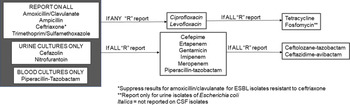
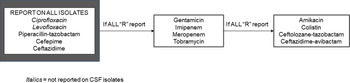
A multidisciplinary team composed of ASP members, infectious diseases physicians, and the microbiology laboratory director developed cascade reporting algorithms by genus of bacteria based on the local antibiogram and practice guidelines for the management of infectious diseases. All susceptibility testing was performed using the AST-GN84 card. The cascade reporting algorithms used for Enterobacteriaceae and P. aeruginosa were designed to include cultures from all specimen sources to limit the consumption of broad-spectrum antibiotics including fluoroquinolones, carbapenems, and broad-spectrum β-lactam agents if narrow-spectrum agents were susceptible (Fig. 1). Special consideration was made for organisms with the highest predisposition for AmpC β-lactamase production (Enterobacter, Serratia, and Citrobacter spp). For these organisms, a comment was added to the AST report, stating “Use caution with β-lactam antibiotics. Carbapenems, if susceptible, are preferred for serious infections. Consult ID with questions.”
A. Cascade reporting algorithm for antimicrobial susceptibility reporting for Enterobacteriaceae.

Outcomes
The primary outcome was slope of antimicrobial use after the implementation of cascade reporting versus before cascade reporting. An interrupted time series analysis across the 8 inpatient units was represented graphically; means and standard deviations of use for each antimicrobial before and after implementation were reported.
Statistical analysis
For antibiotics with low utilization, medians and interquartile ranges are reported because data were not normally distributed. A t test was used to compare mean antimicrobial consumption before and after implementation of cascade reporting. An interrupted time series was used to compare outcomes in the pre- and postimplementation periods. Linear mixed-effects models were performed for each antimicrobial, which included an implementation indicator (before or after), time in months (1–12) and an implementation-by-time interaction. Each model included Fourier terms to account for seasonality where a seasonal cycle (quarterly or monthly) was chosen based on model fit. First-order autoregressive [AR(1)] or heterogeneous variance first-order auto-regressive [ARH(1)] covariance structures were used to model intersubject dependence. The Huber-White sandwich estimator was used to estimate variance. Antimicrobials with poor model fit due to low-utilization (resulting in modes of zero) were reparametrized as a zero-inflated Poisson model. Specifically, the DOT per 1,000 DP were multiplied by 1,000 to produce a pseudo-count of days of therapy, which was then normalized with a log (1,000) offset term. All fixed- and random-effect terms were similar to those used in the linear mixed-effects model. The same models were used to compare rates of CDI before and after implementation. All analyses were performed in SAS version 9.4 software (SAS Institute, Cary, NC) with α = 0.05.
Results
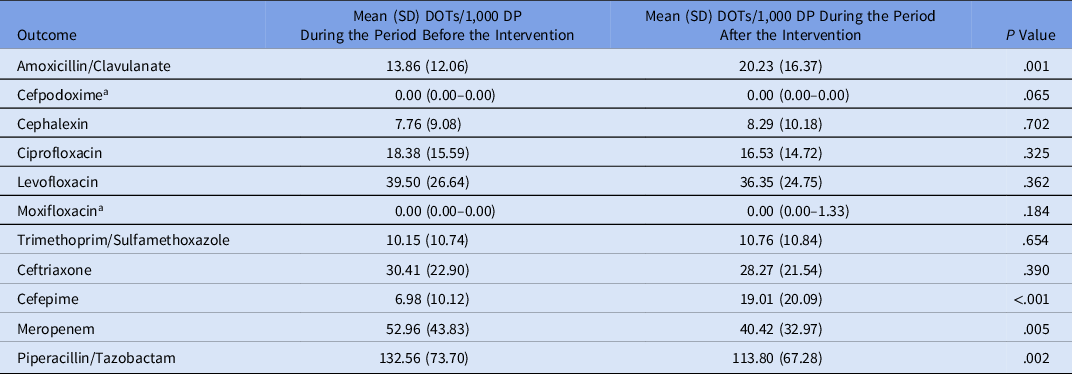
During the pre- and postintervention periods, the total numbers of isolates in our antibiogram were similar. Before cascade reporting, 331 (11%) of 2,805 isolates were P. aeruginosa, and after the intervention, 263 (11%) of 2,298 isolates were P. aeruginosa. Before cascade reporting, 1,598 (54%) of 2,805 isolates were Enterobacteriaceae, and after the intervention, 1,235 (57%) of 2,298 isolates were Enterobacteriaceae. Due to consistent low utilization of cefdinir and imipenem/cilastatin, these antibiotics were excluded from further analysis. A 24% decrease in mean DOT per 1,000 DP for meropenem occurred in the postintervention period, falling from 52.96 to 40.42 DOT per 1,000 DP (P = .005) (Table 1). Mean piperacillin/tazobactam consumption also decreased and cefepime consumption increased in the postintervention period. Notably, however, this agent was restricted by the ASP until month 9 of the preintervention period. Mean consumption of amoxicillin/clavulanate significantly increased compared to the baseline, and consumption of the other antimicrobials did not change significantly after the implementation of cascade reporting (Table 1).
Consumption of Antimicrobials Before and After the Cascade Reporting Intervention

Note. SD, standard deviation; DOT, days of therapy, DP, days present.
a Median (interquartile range). The Wilcoxon signed-rank test was used due to low utilization.
B. Cascade reporting algorithm for antimicrobial susceptibility reporting for Pseudomonas aeruginosa.

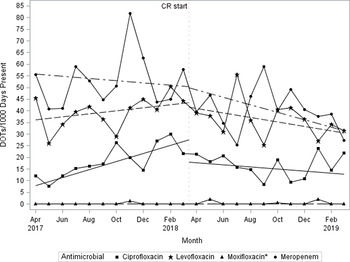
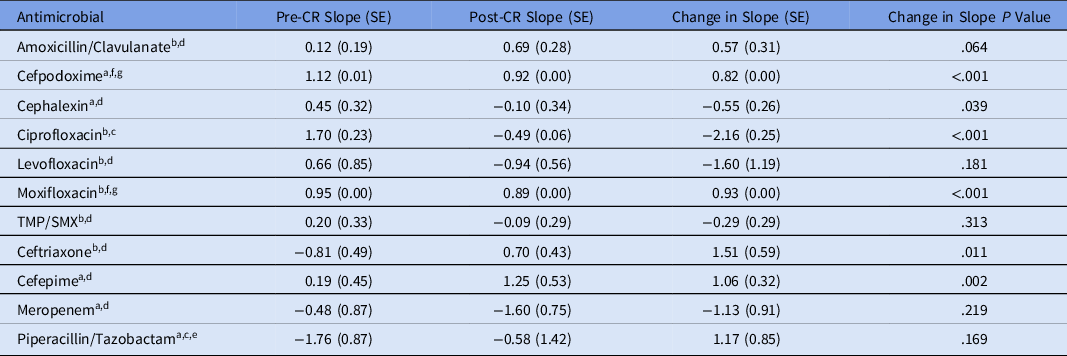
The results of the interrupted time series analysis are shown in Figure 2. In the year preceding the implementation of cascade reporting, ciprofloxacin consumption was 1.70 DOT per 1,000 DP per month, standard error (SE) = 0.23. After implementation, consumption significantly decreased to −0.49 DOT per 1,000 DP per month (SE, 0.25; P < .001) (Table 2). We detected a decrease in cefpodoxime, moxifloxacin, and cephalexin consumption as well as an increase in the slope of ceftriaxone and cefepime. Levofloxacin and meropenem consumption did not change significantly after the implementation of cascade reporting. There were no significant changes in hospital-onset CDI infection rates per 10,000 bed days of care after the implementation of cascade reporting.
Interrupted time series analysis depicting the slope before and after the cascade reporting implementation periods for ciprofloxacin, levofloxacin, moxifloxacin, and meropenem. Antimicrobial use is reported across all units in average days of therapy (DOTs) per 1,000 days present. Note. CR, cascade reporting. *For moxifloxacin, medians are reported because data were not normally distributed.

Slope of Antimicrobial Consumption Before and After the Implementation of Cascade Reporting

Note. CR, cascade reporting; TMP/SMX, trimethoprim/sulfamethoxazole.
a Monthly seasonal cycle (s=12).
b Quarterly seasonal cycle (s=4).
c ARH(1) residual covariance structure.
d AR(1) residual covariance structure.
e Random effect on intercept only.
f Variance components covariance structure.
g Zero-inflated Poisson model (results presented are exp(β) of Poisson count model).
Discussion
In this study, a comprehensive cascade reporting strategy for AST results from all specimen types was implemented to suppress fluoroquinolone and broad-spectrum antibiotic susceptibilities, especially carbapenems, from sight of prescribers if isolates were susceptible to more narrow-spectrum antibiotics and to reduce inappropriate meropenem and fluoroquinolone use. This strategy required a dynamic collaboration between the ASP and the microbiology laboratory to develop a pathway to guide clinicians to use more narrow-spectrum agents through the reported AST results. After cascade reporting was implemented, the mean meropenem consumption decreased and the slope of ciprofloxacin consumption decreased.
Fluoroquinolones are among the most overprescribed antibiotics. They are associated with significant adverse effects, including collagen-associated effects and cardiac arrhythmias. Reference Pollack and Srinivasan4,Reference Werner, Hecker, Sethi and Donskey5 At our facility, they remain overprescribed for the treatment of urinary tract infections despite the high rates of E. coli resistance locally (40%) and regionally (25%). Given the side-effect profile, resistance rates, and overprescribing, fluroquinolones are ideal targets for cascade reporting interventions. As hypothesized, after the implementation of cascade reporting, we detected a decline in the slope of ciprofloxacin consumption across all units. However, there was no statistically significant decrease in levofloxacin consumption. Because ciprofloxacin is mostly prescribed for the treatment of urinary tract infections at our facility, this decreasing trend likely reflects the utility of cascade reporting in AST reporting of urine cultures. Levofloxacin consumption was likely not affected by this intervention because it is most often prescribed to treat respiratory infections, for which microbiological culture data are limited and AST reporting rarely guides treatment. The restriction of fluoroquinolone susceptibilities likely resulted in a “squeezing the balloon effect” with increased consumption of alternative antibiotics to treat urinary tract infections. Reference Peterson25
Following the implementation of cascade reporting, mean monthly meropenem and piperacillin/tazobactam consumption significantly decreased; however, the slope of consumption did not significantly change. These trends highlight the importance of considering slope of consumption over time, which adds context to the interpretation of the results. For all antimicrobials, we detected high variability of consumption in both periods, which may influence results. A mean decrease in consumption without a change in slope may reflect other measures that were already in place to limit broad-spectrum antibiotic consumption in the preintervention period. Meropenem was restricted (requiring ASP approval to prescribe) throughout the study period. Therefore, the impact of cascade reporting in omitting meropenem from AST reports may have limited requests for approval of meropenem, further decreasing its consumption. Our cascade reporting strategy also discouraged the consumption of carbapenems as the default treatment for potential AmpC β-lactamase–producing organisms by embedding interpretive comments within the AST report. It remains unclear whether other studies that demonstrated a decline in antipseudomonal β-lactam consumption after cascade reporting for cefazolin- or ceftriaxone-susceptible Enterobacteriaceae also used alternative ASP strategies to limit broad-spectrum antimicrobial consumption. Reference Johnson, Patel, King and Maslow20,Reference Langford, Seah, Chan, Downing, Johnstone and Matukas21
ASPs aim to change prescriber practices and limit unnecessary broad-spectrum antimicrobial therapy in the battle against rising antimicrobial resistance and CDI. Many of the tools that ASPs can deploy are resource intensive and require clinician willingness to follow recommendations. Reference Barlam, Cosgrove and Abbo11,Reference McNulty, Lasseter and Charlett14 Behavioral nudges such as cascade reporting are variable tools that can produce durable effects on antibiotic prescribing without adverse outcomes, using fewer resources. Reference Langford, Leung and Haj12 Other forms of behavioral nudges, including clarifications in the reporting of respiratory culture results, have had favorable affects. Reference Musgrove, Kenney and Kendall24
The process of implementing cascade reporting created various challenges. Software errors required correction for results to be displayed appropriately. Microbiology laboratory personnel underwent additional cascade reporting training to utilize this method of susceptibility reporting and to troubleshoot effectively. The absence of some susceptibility reports made infection control measures of surveillance for multidrug-resistant organisms difficult and required additional processes to ensure accuracy. The microbiology laboratory and infectious diseases consultation team encountered more phone calls requesting additional susceptibilities to be reported. No known adverse patient outcomes were reported, and they were not systematically assessed.
Our study has several limitations. The quasi-experimental design, although robust, does not eliminate all confounding effects. We attempted to mitigate potential confounding effect due to seasonal antimicrobial prescribing trends by accounting for seasonality. Low utilization and lack of variability in the use of some antimicrobials (moxifloxacin, cefpodoxime) required the data to be fit to alternative models. Although these models enabled statistical conclusions to be drawn by taking into account modes of zeros, they have lower statistical strength. Local resistance patterns should also be considered when interpreting results. Based on our institutional antibiograms, there was significant fluoroquinolone resistance among Escherichia coli (40%) and meropenem resistance among Pseudomonas aeruginosa (17%–22%) during the study period. Other ASP interventions during the study period may have introduced confounders that affected our results. Increased use of Theradoc for prospective audit and feedback increased the presence of ASP at the institution. For phenotypes of extended-spectrum β lactamases, based on ceftriaxone resistance, piperacillin/tazobactam was reported as resistant. A campaign for C. difficile diagnostic stewardship was being conducted during our study. Notably, cefepime was restricted until November 2018 (month 9 of the postimplementation period) then was derestricted, which likely increased consumption in the postimplementation period. The timing of the enhanced black-box warning in for fluoroquinolones in 2016 may have affected fluoroquinolone use at our institution. As a single-center study, these data may not be generalizable across other medical centers.
Additionally, our study is limited by the lack of patient-level data. We were unable to determine whether antimicrobial consumption was appropriate without accounting for patient-level resistance profiles and the clinical syndromes being treated. Even with this information, it is difficult to link cascade reporting to patient-level outcomes due to confounders. Liao et al Reference Liao, Rhodes, Jandarov, DeVore and Sopirala19 implemented a ceftriaxone-based cascade reporting strategy and retrospectively investigated antimicrobial consumption after the intervention as well as patient-level outcomes including CDI, hospital readmission, and mortality. They demonstrated that cefepime consumption decreased after the implementation of cascade reporting without harm; no increase was detected in mortality or 30-day readmissions, CDIs, or antimicrobial resistance in the postintervention period. Reference Liao, Rhodes, Jandarov, DeVore and Sopirala19 These findings reassure prescribers that cascade reporting can be implemented safely without adverse events; however, many confounders, including severity of illness, comorbidities and antimicrobial resistance patterns, contribute to these outcomes. Therefore, associations of cascade reporting with patient-level outcomes should be interpreted with caution.
In this study, we demonstrated that implementation of cascade reporting correlated with a decline in ciprofloxacin consumption based on AST results. Mean meropenem consumption decreased in the postintervention period. Cascade reporting is a valuable tool that ASPs can deploy to encourage prescribers to select more narrow-spectrum antimicrobial agents. Further investigation is warranted to determine how cascade reporting strategies affect rates of C. difficile, antimicrobial resistance, and clinical outcomes.
Acknowledgments
Financial support
The statistical analysis was supported by the Biostatistics Consulting Laboratory, which is partially supported by the National Institutes of Health’s National Center for Advancing Translational Science (grant no. UL1TR002649).
Conflicts of interest
All authors report no conflicts of interest relevant to this article.