Introduction
The traditional role of men in society has created a gap in parenting for all fathers, especially those who become divorced or separated. Fathers, more than ever, need to seek out support in order for them to develop their parenting skills and learn ways to nurture and healthily attach to their children. Most importantly, providing a safe environment to learn these skills is necessary to help men achieve their role as an involved father.
Leading researchers, and studies in Australia and internationally, have identified that being an involved father brings with it many health and social benefits to fathers and children (Fagan & Palm, Reference Fagan and Palm2004; Fletcher, Reference Fletcher2011; King, Reference King2000). When fathers build a strong relationship with their children and others in the family, they are more likely to receive support and caring in return. Healthy family relationships provide the strongest and most important support network a person can have, whether that person is a child or an adult. Research shows that the father's early involvement in a child's life is positively related to early educational achievement, positive peer and familial relationships in adolescence, and protection against mental health problems in the event of parental separation (Department for Education and Skills (DfES), 2007; Robinson, Reference Robinson2001). The specific health and social benefits of fathers being involved with their children are many and varied.
Not only does involvement in family members’ lives improve outcomes for children, but also contributes to the wellbeing of fathers. Research indicates that benefits for fathers include developing secure attachment relationships, resilience in stressful situations and everyday hassles, occupational confidence in job and parenting skills, and social relationships (Burgess, Reference Burgess2009; Pleck & Masciadrelli, Reference Pleck, Masciadrelli and Lamb2004). While all men will respond to stressors differently, due to a variety of different factors such as family structure and cultural diversity, the benefits of having a father involved in raising his children has become more evident over the past few decades.
The Important Role that Attachment Plays for Fathers and Children
Sir Richard Bowlby argues that attachment theory now recognises that dual attachment roles are often demonstrated in families with each parent usually providing different proportions of attachment relationship (cited in Newland & Coyl, Reference Newland and Coyl2010). According to attachment theory, a secure relationship is essential to healthy development (Bowlby, Reference Bowlby1988). In the past, studies of the development of children focused almost exclusively on a child's relationship with their mother. While not a new phenomenon, the role fathers play in a child's development is better understood today than it was 20 years ago (Berk, Reference Berk and Berk2006). Healthy child development relies on the role of both mother and father, whether they be together or apart.
Most importantly, research has shown that the early years of bonding and attachment are crucial to the developing child's brain which sets the blueprint for the rest of their lives. Over the past couple of decades the emphasis has moved from father involvement to father sensitivity. That is, rather than quantity, quality of time spent with a child is the important factor. As children grow and develop, fathers take on added roles of guiding their child's intellectual and social development. Even when a father is ‘just playing’ with his children, he is nurturing their development. Research suggests that mothers and fathers interact with their children in different ways; fathers tend to play more physically and induce more excitement from their children than do mothers (Fletcher, Reference Fletcher2011). Fathers also can instil a sense of confidence to explore within relationships (Ferguson & Gates, Reference Ferguson and Gates2013). Bowlby states: ‘in families where there are two people raising the children, one parent is the highest ranking attachment figure for providing a secure base and haven in times of distress, and the other parent is the highest ranking attachment figure for providing risk and exploration and excitement when times are favourable – different roles but equally significant’ (cited in Newland & Coyl, Reference Newland and Coyl2010, p. 27). The roles may be influenced by gender, but are not gender specific.
Studies on attachment have shown that there are no differences between fathers’ and mothers’ potential abilities to develop an attachment to their children (Newland & Coyl, Reference Newland and Coyl2010). It has been shown that fathers and mothers in a representative population are equally able to form a secure base for their children (Pruett, Reference Pruett1987). In the first years of a child's life, the mother often holds a child for the purposes of care taking and nurturing, whereas a father holds the child for the purposes of playing (Lamb, Reference Lamb1977). The fathers’ interactions are often more active, stimulating, exciting, teasing, challenging and may even, at times, scare or arouse anxiety in the infant. These experiences serve as an important purpose in children's lives, not just for their immediate care but also for their longer-term development.
Traditionally, attachment theory has emphasised the significance of safety, comfort and security as key factors in a child's development. ‘Risk and exploration’ are equally important factors and are often undervalued.
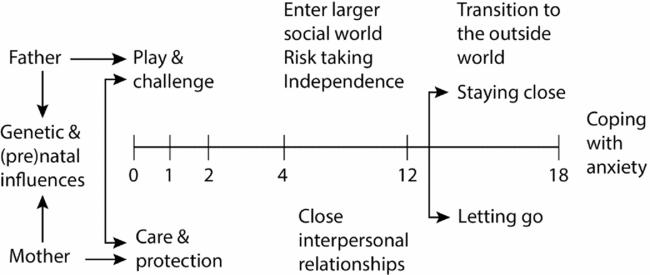
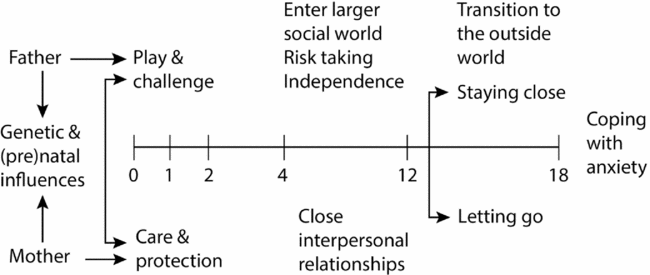
Figure 1 highlights that the child's experience of the play and challenge experiences with their father support the development of independence, risk taking and the skills required for development throughout childhood into the larger social world (Paquette, Reference Paquette2004). A key focus in understanding this today is the experience of ‘rough and tumble play’.
Different roles of fathers and mothers in their child's development (from Bogels & Phares, Reference Bogels and Phares2008, with permission).
Rough and tumble play is not equivalent to fighting between children. All mammals on the planet, especially the juveniles, have some form of rough and tumble play. In experiments, when rats are deprived of rough and tumble play, they are much more anxious and likely to be socially isolated (Fletcher, Reference Fletcher2011). Rough and tumble play:
• may involve wrestling, grappling, kicking and tumbling;
• has few rules;
• can be clearly distinguished as different to fighting;
• involves enjoyment, not anger, as the key emotion;
• involves dominance swapping (different people take turns in ‘winning’);
• can involve the fathers teaching the skill of winning/losing with effort;
• is connected with the development of emotional self-regulation in children.
Fathers’ play with their children seems to promote an active, competitive, autonomous and curious attitude in children that is beneficial to the child's cognitive and social development. It also buffers early separation, stranger and social anxiety (Bogels & Phares, Reference Bogels and Phares2008).
While the involvement of fathers has been associated with the rearing of boys, it is equally important for girls. However, while dads may be seen to have natural tendency to play with their children, they need to be more conscious of the important opportunity they have and actively develop more quality play experiences with their children. This suggests there is a key role for health professionals who work with families.
For researchers and other professionals to work effectively with families, it needs to be recognised that fathers can be engaged in a caring and healthy relationships with their children. This is referred to as ‘non-deficit perspectives’ to fathering, where men take an active role in family life and the care of children (King, Reference King2005). However, some factors exist which can limit fathers’ involvement in their child's early years, impairing their ability to be involved in healthy attachments to their children.
Situations which impair early childhood involvement can include external factors, such as employment (e.g. fly-in-fly-out, Defence Force commitments or professional sport), as well as internal factors, such as mental illness. It is important to recognise that these fathers may need more support and may need to be assessed for their suitability for engagement in intervention. Disengagement and leaving them out of the intervention can increase risk over safety (Scourfield, Reference Scourfield2003).
In summary, the evidence from cross-sectional and longitudinal research into infancy, childhood and adolescence suggests that the father has an important and unique role in child development. In general terms, the father's role can be described as one in which it is undertaken through play, challenge, risk-taking, encouraging independence and, later in development, by helping the child make the transition to the outside world (Paquette, Reference Paquette2004). It is therefore important to encourage fathers to develop strong attachments with their children as it will benefit not only the child but also the father, their relationship and society in general.
Effective Service Delivery: What Have we Learnt?
There are lots of different kinds of fathers. They may be in a two-parent family, in a step-family, be a full-time, single parent, or have their children with them for some of the time. While parenting can be done by either parent, children have unique experiences with both their fathers and their mothers.
Fathers sometimes only become active caregivers of their children by default or when necessity demands it; such as when the mother is unavailable or through change in employment status (Walmsley, Strega, Brown, Dominelli, & Callahan, Reference Walmsley, Strega, Brown, Dominelli and Callahan2009). In addition, fathers may genuinely feel unsure about what is expected of them, which is due, in part, to the changing nature and role of fathers and mothers in today's society (Collier & Sheldon, Reference Collier and Sheldon2008). The major difference between men's and women's experiences in managing these changes is that women more often articulate the changes they face as mothers, while fathers articulate less. This, ultimately, has an impact on their confidence and flexibility.
Family services need to focus on the family's individual needs to work out the best blend of roles played by the mother and father. Services can be responsive to the needs of fathers by asking them what they already do with their children, and what kinds of assistance they may require from staff and services. It is likely that men will be more suspicious about trusting a large organisation, as they are more likely to prefer a stronger connection to an individual worker whom they respect. It is also important to begin working with those fathers already in contact with the service, as they may be able to assist in recruiting others. Where possible, work in partnership with other services or practitioners who may be already engaged with fathers specifically (Department of Family, Housing, Community Services and Indigenous Affairs (FaHCSIA), 2009).
Group work with fathers has also been shown to have a more positive impact than one-to-one counselling sessions or generic parenting programmes, such as Triple P, on a father's wellbeing, particularly during times of stress and change in the family structure (King, Reference King2000). Also, there is evidence that there is greater benefit for working in combination with couples than solely with fathers (Cowan, Cowan, Pruett, Pruett, & Wong, Reference Garfield and Issaco2009).
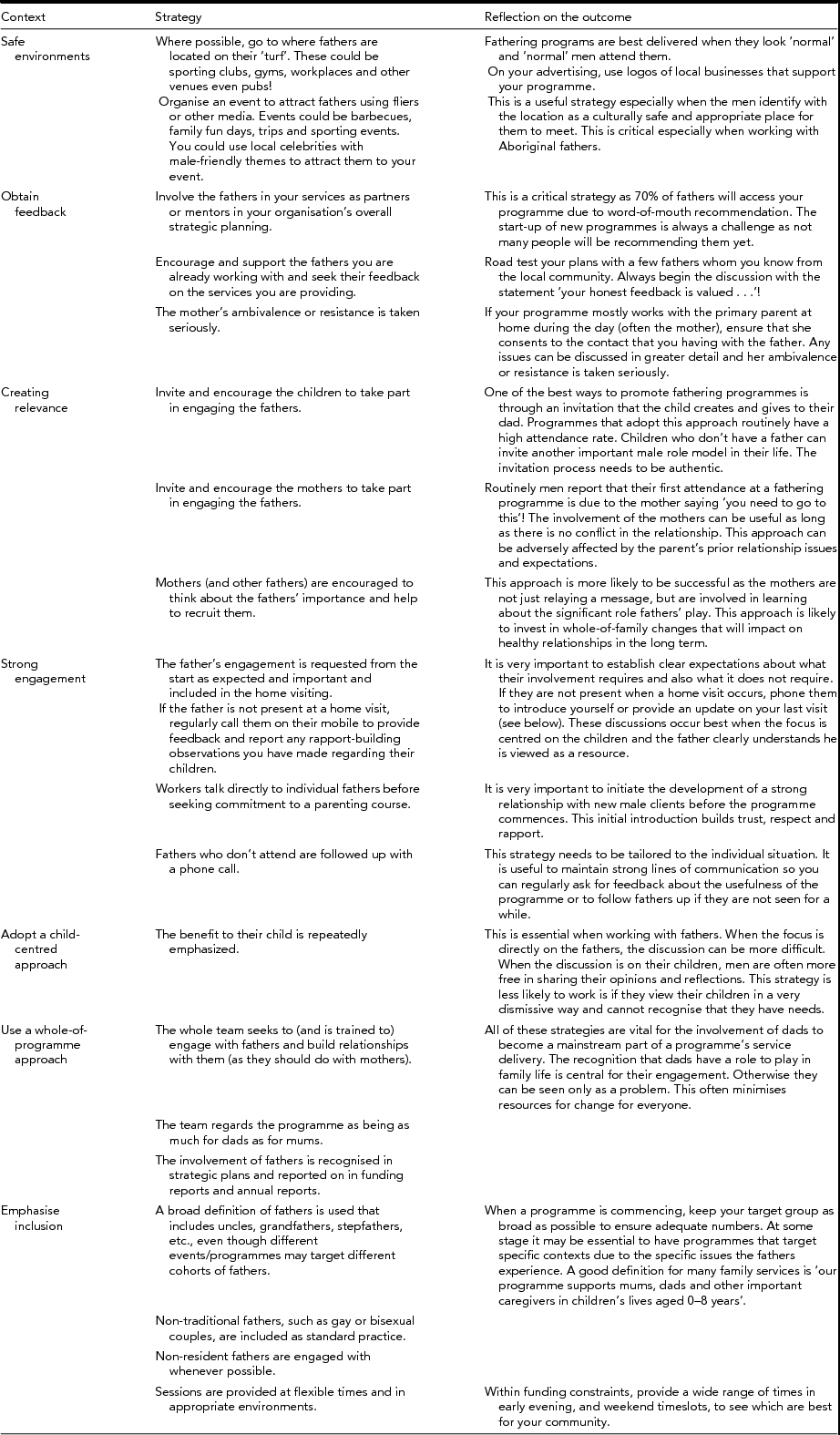
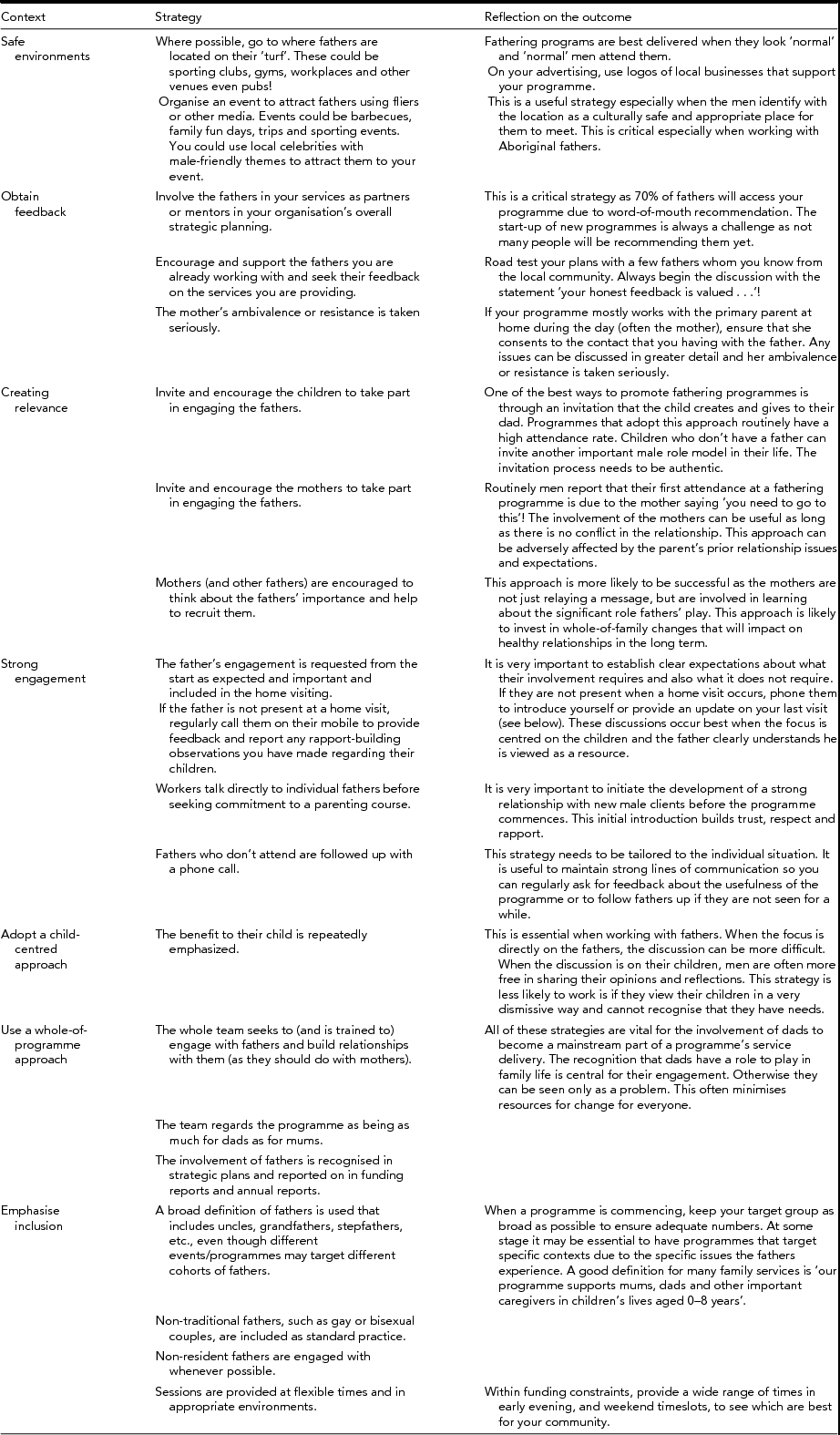
Beyond group-work approaches there are a wide variety of methods that family services and practitioners can do to involve fathers. Table 1 provides a useful overview of engagement strategies, but the list is by no means comprehensive.
Engagement strategies.
Often services are comfortable recruiting fathers, but have trouble understanding how to maximise service impact. Burgess (Reference Burgess2009) found that fathers are likely to find parenting interventions more rewarding when workers:
• set out clearly the goals and expectations of any parenting course;
• consult with fathers about their goals for participation in the intervention, and tailor the programme accordingly;
• allow fathers and mothers to own the process for change, rather than the focus being on completing the programme;
• adopt a strengths-based approach which supports the father's capabilities rather than treating him as a resource;
• help fathers create a baseline checklist of their involvement activities with their children, so they can see how they are progressing; seek out feedback about the difference it makes within their family.
• remind fathers of upcoming sessions (e.g. using text messaging) and follow up non-attenders;
• introduce ‘active’ course elements (e.g. video playback, father–child activities) and ability to discuss things in smaller groups, and move around the room;
• create changes of mood/pace within the intervention (e.g. formal/informal; structured/unstructured; discussion/activity);
• include information on fathers’ roles in their child's development;
• create opportunities for fathers (and mothers) to reflect on their understandings of gender, masculinity and care, in relation to their own fathers and other influences;
• address couple-relationship issues and gender roles, including the importance of uncles, stepfathers and grandfathers.
This is not meant to be exhaustive list but offers some things that have been learned in practice about involving fathers. In the past decade, many health and welfare services have realised that they can make a big difference to families when they systematically welcome and support fathers.
Services and practitioners can involve fathers effectively, and this has been achieved by a number of agencies in Australia, as well as internationally. A simple change in a service can result in significant numbers of fathers being involved in programmes. One such example in Australia is the Fathers And Schools Together (FAST), which is a literacy programme that focuses on helping schools to bring fathers more into their children's literacy learning (Fletcher & Silberberg, Reference Fletcher and Silberberg2006).
There are significant differences among fathers in their willingness to engage with health practitioners and, being a diverse group, ‘one size’ does not fit all fathers, so a local approach needs to be part of an effective model of service delivery. Effective service delivery with fathers will only work if the fathers are genuinely involved and report that they feel connected to the service. The ideas listed are suggestions and should be used where appropriate. The emphasis is on having and promoting a hands-on responsibility for fathers.
Importance of Having a ‘Hands-on’ Responsibility
Fathers can not only influence their children through the quantity, type and quality of the father–child interactions, but also through the emotional and physical support they can provide to the mother or partner, including economic support and domestic labour (for example, childcare). We refer to this as ‘hands-on’ responsibility.
For fathers to achieve a ‘hands-on’ responsibility for their child's development requires effective engagement strategies to not only invite fathers into services, but also keep them there in the long term. Relationships between parents and professionals of all kinds play a more prominent role during the period of early childhood development than at any other time in a child's life (Lamb & Tamis-LeMonda, Reference Lamb, Tamis-LeMonda and Lamb2004). The availability of both private and public services that are external to the home environment provides an opportunity to engage with parents. Creating a culture of father involvement in service delivery can be a long-term process, but also one which is beneficial.
Some of the service-related barriers identified in a recent research project on fathers’ involvement in services and programmes (Fleming, Reference Fleming2010) include:
• operating times of the agency or service (usually 9 a.m. to 5 p.m.);
• practitioners’ lack of knowledge or skills of how to involve fathers, especially with vulnerable families;
• fathers who did not show up for appointments perceived by practitioners as disinterested; and
• working with the mothers and the children seen as core business, fathers as a parent adjunct or ‘third wheel’ (see Cosson & Graham, Reference Cosson and Graham2012).
Fleming (Reference Fleming2010) also identified that while practitioners were grappling with the practice issue on how to involve fathers, they were also very keen to work with fathers in their service. Practice research suggests that fathering is influenced by a variety of factors (Robson, Reference Robson2006); and if practitioners are aware of these factors, they are in a better position to identify some of the barriers, or likely problems, fathers experience when they encounter a particular service or services.
The transition to parenthood is a major life event that affects all aspects of psychosocial functioning (see King, Reference King2012). Only recently has it been acknowledged that this transition for men into the role of a father has its own challenges as well as rewards. For example, researchers have identified that their partner’s pregnancy is the most stressful time for men undergoing the transition to parenting (Condon, Boyce, & Corkindale, Reference Condon, Boyce and Corkindale2004). Professionals are crucial for meeting the needs of fathers during this transition and also the parenting journey.
Personal Beliefs Impact on Practitioners’ Engagement of Fathers
Having an involved father has obvious benefits to children. Recent media coverage on fathers identified the clear benefits of fathers being involved in a child's life, particularly in the early stages of development, by providing love, support and comfort (Roberts, Reference Roberts2012). We can probably also agree that fathers are important because they help to teach children values and lessons in solving life's challenges and problems. Fathers also serve as role models in their child's life, which can affect how well their children relate to peers and adults outside the home (Allen & Daly, Reference Allen and Daly2007).
Research has demonstrated that fathers have assumed more childcare responsibilities, and hours spent with children are converging for both men and women (Pruett, Reference Pruett2000). Despite this reality, professionals can still find it difficult to involve fathers. This is primarily because of the, often false, assumption by some practitioners that ‘they know how to include fathers’.
Some of the personal factors that may prevent the inclusion of fathers include:
• The practitioner's own family of origin can subtly frame personal attitudes and beliefs about fathers (memory of their father being physically or emotionally absent).
• Traditional professional education and curriculum has tended to omit content about the significance of fathers and how to work with them in practice (Walmsley et al., Reference Walmsley, Strega, Brown, Dominelli and Callahan2009).
• Identification with fathers is potentially more difficult because frontline health and human service occupations are female-dominated professions (Garfield & Issaco, Reference Garfield and Issaco2006).
Despite these factors, many services are taking a proactive stance and providing staff training in how to include fathers in their work. This has mainly been driven by the growth and development in research, education and training available for professionals to develop their skills with fathers, including nationally funded studies on fathering, self-help websites for fathers and recent literature by parenting experts directed at fathers (Ferguson & Gates, Reference Ferguson and Gates2013).
Although the research on fathers in the professional literature is still relatively sparse in comparison to that concerning mothers, there does exist innovative and helpful material for both beginning and seasoned practitioners. In order to support involved fathering, we must first acknowledge some key assumptions on father inclusion. These are:
• most fathers want to be effective parents;
• parenting experience for either mother or father is a highly complex and challenging role;
• by including fathers it conveys a message that we have positive expectations of them and they, in turn, respond by being involved and aspire to being the best fathers the can be; and
• fathers will require support from the wider environment, external to the family (Tiedje & Darling-Fisher, Reference Tiedje and Darling-Fisher2003).
Furthermore, some researchers have even argued that fathering and fatherhood are greatly influenced by family and community factors in addition to the mother (Doherty, Kouneski, & Erickson, Reference Doherty, Kouneski and Erickson1998). A practitioners awareness of their own interactions with fathers is the first step towards supporting involved fathering.
The following questions are meant to be a guide to self-assessment as a practitioner on interactions with fathers:
• How do you acknowledge the presence of a father on your first interaction and do you include fathers in the conversation when both caregivers are present?
• What is your body language saying that will indicate inclusion?
• Do you have eye contact with the father or is it directed at the mother/other caregiver?
• Do you include fathers in discussions about their children or respond to questions about their child by the father?
• What are your own beliefs about fathers and their ability to engage in child care tasks?
Most importantly, fathers need clear information. Research shows that often they do not see a defined role for themselves in plans and will assume that ‘parent’ actually means ‘mother’ (Daniel & Taylor, Reference Daniel and Taylor2001).
Conclusion
In summary, there can be no doubt that there has been a dramatic shift in expectations for both mothers and fathers over the past two decades, which has resulted in services being in ‘catch-up mode’ to include fathers. These shifts have been brought about by rapid, unprecedented changes to society in which we live and work. Research into the family system indicates that to enact change, services need to engage with men, women and children independently, but also as a whole.
At its foundation, parenting is a process involving both men and women, but for the most part there has existed a gap in the practice theory about how this can be achieved. Although most agencies and services will have father inclusiveness in their policy and procedures or strategic planning, these intentions are not always followed through.
The most effective method of supporting fathers begins with the professional. For some professionals they may already be achieving the goal of involving fathers, for others more reflection may be required. What we have learned so far about working with fathers is simply the importance of keeping the dialogue active and robust. This paper has provided some emerging trends from the available research on including fathers.
Although it is not meant to be prescriptive, this paper has sought to highlight some key issues in relation to how this work can be achieved. It acknowledges that there are still issues that need to be addressed further, such as the need to develop better ways to engage and work with vulnerable groups, and cultural and sexual diversity. This work needs to build upon the current knowledge base about fathers and father-inclusive practices, primarily through ongoing dialogue with professionals, fathers and mothers alike.