INTRODUCTION
Many changes are taking place in the world of agriculture today, with global warming and land degradation bringing new stresses to crops, leading to a reduction of suitable growing locations and local food shortages. Over-use of agrochemicals in an effort to maintain yield under increasing stress is causing serious environmental damage and increasing economic costs. Beneficial fungal root endophytes have the potential to reduce chemical use, increase pathogen resistance and enhance stress tolerance while still maintaining yield. Realizing this potential means that research in this field is critically important.
Fungal endophytes are non-mycorrhizal associates that spend most or all of their lives within plant tissues, often with no outward sign of their presence (Stone et al. Reference Stone, Polishook, White, Mueller, Bills and Foster2004; Schulz & Boyle Reference Schulz, Boyle, Schulz, Boyle and Sieber2006; Weiβ et al. Reference Weiß, Sýkorová, Garnica, Riess, Martos, Krause, Oberwinkler, Bauer and Redecker2011). Though distinctions between mycorrhizal and endophytic fungi are not always clear-cut and they can be functionally similar, mycorrhizal fungi form detectable interaction structures in plant cells whereas endophytic fungi usually have no clear intracellular interface (Weiβ et al. Reference Weiß, Sýkorová, Garnica, Riess, Martos, Krause, Oberwinkler, Bauer and Redecker2011).
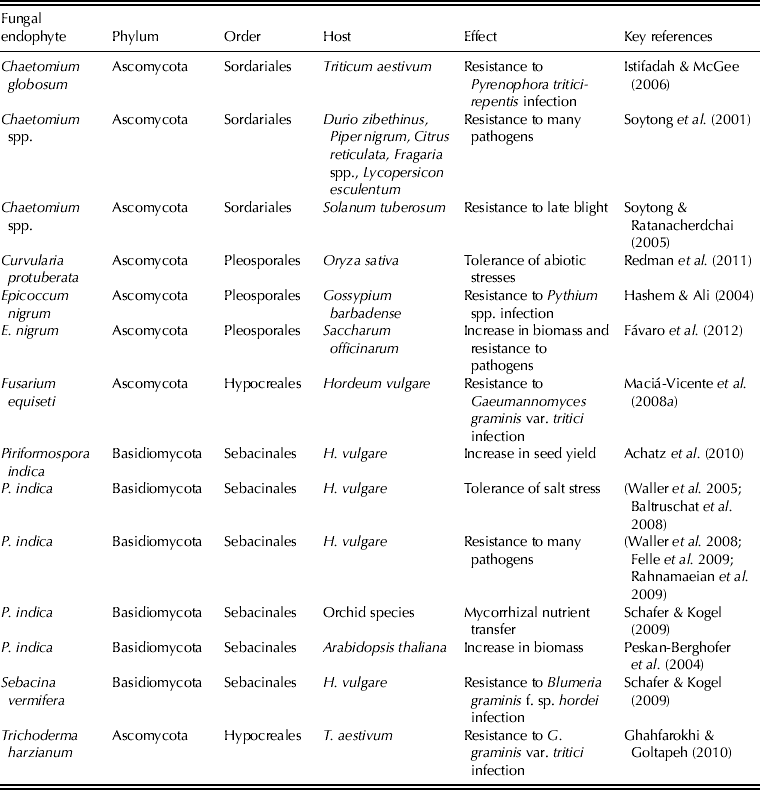
The full effects of a pathogenic infection on the host plant are sometimes not apparent until the disease is well established and the negative impacts can be substantial. Endophytic fungal infections can have an equal, but beneficial, impact on plant growth and survival. Definitions of endophyte infection have included a range of infection interaction types, some even detrimental (Wang et al. Reference Wang, Johnston, Yang and Townsend2009), but most authors use the term to refer to symptomless infections only (Kogel et al. Reference Kogel, Franken and Hückelhoven2006; Schulz & Boyle Reference Schulz, Boyle, Schulz, Boyle and Sieber2006). Endophytes are micro-organisms (bacteria, fungi and unicellular eukaryotes), which can live at least part of their life cycle inter- or intracellularly inside plants, usually without inducing pathogenic symptoms. This can include competent, facultative, obligate, opportunistic and passenger endophytes. Endophytes can have several functions and/or may change function during their life-cycle. The taxonomic range of fungal endophytes is huge, with foliar endophytes being particularly diverse (Arnold & Lutzoni Reference Arnold and Lutzoni2013; de Souza Leite et al. Reference de Souza Leite, Cnossen-Fassoni, Pereira, Mizubuti, De Araújo and De Queiroz2013). Root endophytes also belong to diverse taxa and can have a broad range of beneficial effects (Table 1). Fungal root endophytes initially infect plants through the root and usually remain in the roots, but may occasionally infect or spread to other plant tissues (Kumar & Hyde Reference Kumar and Hyde2004; Sánchez Márquez et al. Reference Sánchez Márquez, Bills, Domínguez Acuña and Zabalgogeazcoa2010).
Representative examples of fungal root endophytes and their beneficial effects on barley and other hosts

Several reviews have been published on fungal endophytes (Kogel et al. Reference Kogel, Franken and Hückelhoven2006; Schulz & Boyle Reference Schulz, Boyle, Schulz, Boyle and Sieber2006; Mayerhofer et al. Reference Mayerhofer, Kernaghan and Harper2012). These reviews provide extensive coverage of endophytes in general, but there is a lack of a detailed synthesis of knowledge for the fungal endophytes of barley (Hordeum vulgare L.) roots in particular. The only review which specifically examines root endophytes (Mayerhofer et al. Reference Mayerhofer, Kernaghan and Harper2012) does not include the Basidiomycetes, which, as we will see, are important endophytes of barley. The present paper addresses that gap and suggests where future research is required. It demonstrates that fungal root infections in barley should be treated as friends as well as foes and explores the potential for developing specific strains (or combinations of such) suited to individual barley cultivars as well as strains with a universal value among a diverse range of barley cultivars.
ENDOPHYTES AND BARLEY
Benefits to barley and other plants infected with endophytic fungi include an increase in seed yield (Achatz et al. Reference Achatz, von Rüden, Andrade, Neumann, Pons-Kühnemann, Kogel, Franken and Waller2010), enhanced resistance to pathogens and herbivores (Cheplick & Faeth Reference Cheplick and Faeth2009) and increased stress tolerance (Waller et al. Reference Waller, Achatz, Baltruschat, Fodor, Becker, Fischer, Heier, Hückelhoven, Neumann, Von Wettstein, Franken and Kogel2005; Rodriguez et al. Reference Rodriguez, White, Arnold and Redman2009). A beneficial host–endophyte association is a balanced antagonism, whereas a pathogenic association is imbalanced; the pathogenic infection results in disease (Wilson Reference Wilson1995; Schulz et al. Reference Schulz, Rommert, Dammann, Aust and Strack1999).
Barley disease can also be caused by other types of endophytes, such as bacteria and viruses, and are discussed elsewhere (Mathre Reference Mathre1997; Clay & Schardl Reference Clay and Schardl2002). These organisms can infect other plant species, with similar detrimental effects; for example, barley yellow dwarf virus is commonly found on other cereal and grass species and is twice as frequent in endophyte-free grasses (Clay & Schardl Reference Clay and Schardl2002).
Endophytic fungal pathogens of barley have been studied and characterized extensively (Mathre Reference Mathre1997), but not so their beneficial counterparts. Megatons of fungicides, pesticides and fertilizers are applied to crops every year, incurring large economic costs and contributing to ecosystem degradation (Powell & Jutsum Reference Powell and Jutsum1993; Underwood Reference Underwood2000). In 2000, the worldwide crop protection market was estimated to be about US$31 billion (Underwood Reference Underwood2000). Herbicides represented about 0·50 of the total, with insecticides (0·25), fungicides (0·20) and others (0·05) making up the balance (Underwood Reference Underwood2000). Further costs are incurred in testing varieties of barley to use as genetic resources for disease resistance breeding (Statkevičiūtė & Leistrumaitė Reference Statkevičiūtė and Leistrumaitė2010; Knupfer et al. Reference Knupfer, Maggioni, Jalli, Kolodinsla, Fasoula and Lipman2011). Beneficial fungal endophytes may have the potential to reduce these costs and may even enable the production of crops on previously unsuitable or marginal sites.
Fungal pathogens can infect many barley tissue types and above-ground infections are usually obvious; but the generally symptomless and less visible root tissue is the least studied. Barley is the world's fourth most important crop, grown annually on 48 million hectares (CGIAR 2012), and is often planted on stress-susceptible marginal land, so the potential of beneficial fungal root endophytes to improve barley crop performance requires extensive study. Endophyte colonization can have neutral, positive or negative effects on the plant, depending on many variables including host and endophyte identity, and the nature of available nutrients (Tellenbach et al. Reference Tellenbach, Grünig and Sieber2011; Mayerhofer et al. Reference Mayerhofer, Kernaghan and Harper2012; Reininger et al. Reference Reininger, Grünig and Sieber2012). Mayerhofer et al. (Reference Mayerhofer, Kernaghan and Harper2012) found that the response of a broad range of plants to endophyte inoculation was that total biomass was reduced by 18% compared with non-inoculated controls. Their meta-analysis of the effects of fungal root endophytes on plants found that trees seem to respond negatively to endophyte colonization, while herbaceous monocots (including grasses) are more likely to respond positively to endophyte inoculation. Barley, as a model monocot, appears to display a mostly positive response to endophyte colonization.
BENEFICIAL FUNGAL ROOT ENDOPHYTES OF BARLEY
In contrast to the large number of beneficial fungal endophytes that have been recorded on various hosts (Table 1), beneficial endophyte infection of barley roots has only been described with a few fungal species and most noticeably Piriformospora indica. Since its discovery in the Thar desert of north-west India in 1997 (Verma et al. Reference Verma, Varma, Rexer, Hassel, Kost, Sarbhoy, Bisen, Bütehorn and Franken1998), the Basidiomycete P. indica has become the model experimental organism for the study of fungal endophyte root colonization (Oelmüller et al. Reference Oelmüller, Sherameti, Tripathi and Varma2009). Piriformospora indica belongs to the Sebacinales, an order of mostly endophytic fungi with extensive cryptic biodiversity (Oberwinkler et al. Reference Oberwinkler, Riess, Bauer, Selosse, Weiß, Garnica and Zuccaro2013). In barley, P. indica has been shown to increase yield by 5·3–11% (Achatz et al. Reference Achatz, von Rüden, Andrade, Neumann, Pons-Kühnemann, Kogel, Franken and Waller2010), enable salt tolerance (Waller et al. Reference Waller, Achatz, Baltruschat, Fodor, Becker, Fischer, Heier, Hückelhoven, Neumann, Von Wettstein, Franken and Kogel2005; Baltruschat et al. Reference Baltruschat, Fodor, Harrach, Niemczyk, Barna, Gullner, Janeczko, Kogel, Schäfer, Schwarczinger, Zuccaro and Skooczowski2008) and enhance pathogen resistance (Waller et al. Reference Waller, Mukherjee, Deshmukh, Achatz, Sharma, Schäfer and Kogel2008; Felle et al. Reference Felle, Waller, Molitor and Kogel2009; Rahnamaeian et al. Reference Rahnamaeian, Langen, Imani, Khalifa, Altincicek, von Wettstein, Kogel and Vilcinskas2009). In other plant groups, such as orchids, P. indica may predominantly exist as a mycorrhizal partner (Schafer & Kogel Reference Schafer, Kogel and Deising2009).
P. indica, unlike many endophytes, can be easily cultured outside of a plant host (Singh et al. Reference Singh, Singh, Kumari, Rai and Varma2003; Oelmüller et al. Reference Oelmüller, Sherameti, Tripathi and Varma2009; Qiang et al. Reference Qiang, Weiss, Kogel and Schäfer2011). It is thus an ideal experimental subject, especially as it readily colonizes the model angiosperms Arabidopsis thaliana and barley (Peskan-Berghofer et al. Reference Peskan-Berghofer, Shahollari, Giong, Hehl, Markert, Blanke, Kost, Varma and Oelmuller2004; Stein et al. Reference Stein, Molitor, Kogel and Waller2008; Oelmüller et al. Reference Oelmüller, Sherameti, Tripathi and Varma2009; Achatz et al. Reference Achatz, von Rüden, Andrade, Neumann, Pons-Kühnemann, Kogel, Franken and Waller2010; Qiang et al. Reference Qiang, Zechmann, Reitz, Kogel and Schäfer2012). Other fungal root endophytes have also shown promise as bio-control and bio-fertilizing organisms. For example, Fusarium equiseti (Maciá-Vicente et al. Reference Maciá-Vicente, Jansson, Mendgen and Lopez-Llorca2008a) and Sebacina vermifera (Schafer & Kogel Reference Schafer, Kogel and Deising2009) have both been shown to reduce pathogen infection of barley by up to 80%.
The present review will now examine the barley–endophyte relationship and the benefits conferred on barley by P. indica and other fungal root endophytes. It will provide an overview of what is known regarding colonization and the benefits to the plant, including resistance to pathogens, yield enhancement, stress tolerance and interactions with other organisms.
COLONIZATION
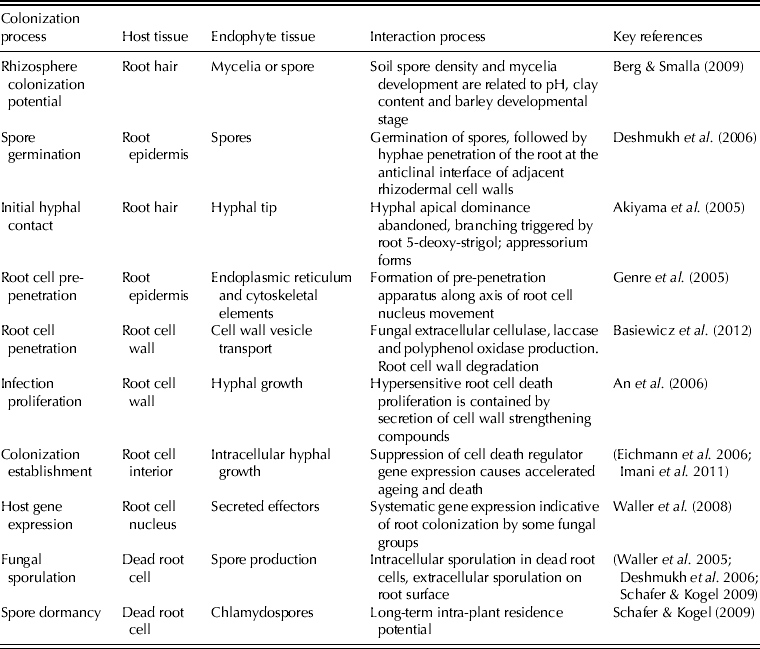
When plants are challenged by fungal pathogens, host factors control plant resistance and susceptibility through the complex signalling pathways that mediate plant disease resistance (Toyoda et al. Reference Toyoda, Collins, Takahashi and Shirasu2002). Similarly, the nature of the relationship between barley and fungal root endophytes such as P. indica is controlled by a subtle physical and biochemical dialogue (Table 2), with the final outcome dependent on the combination of genotype and developmental stage of each partner (Kogel et al. Reference Kogel, Franken and Hückelhoven2006).
Fungal root endophyte host colonization and interaction processes
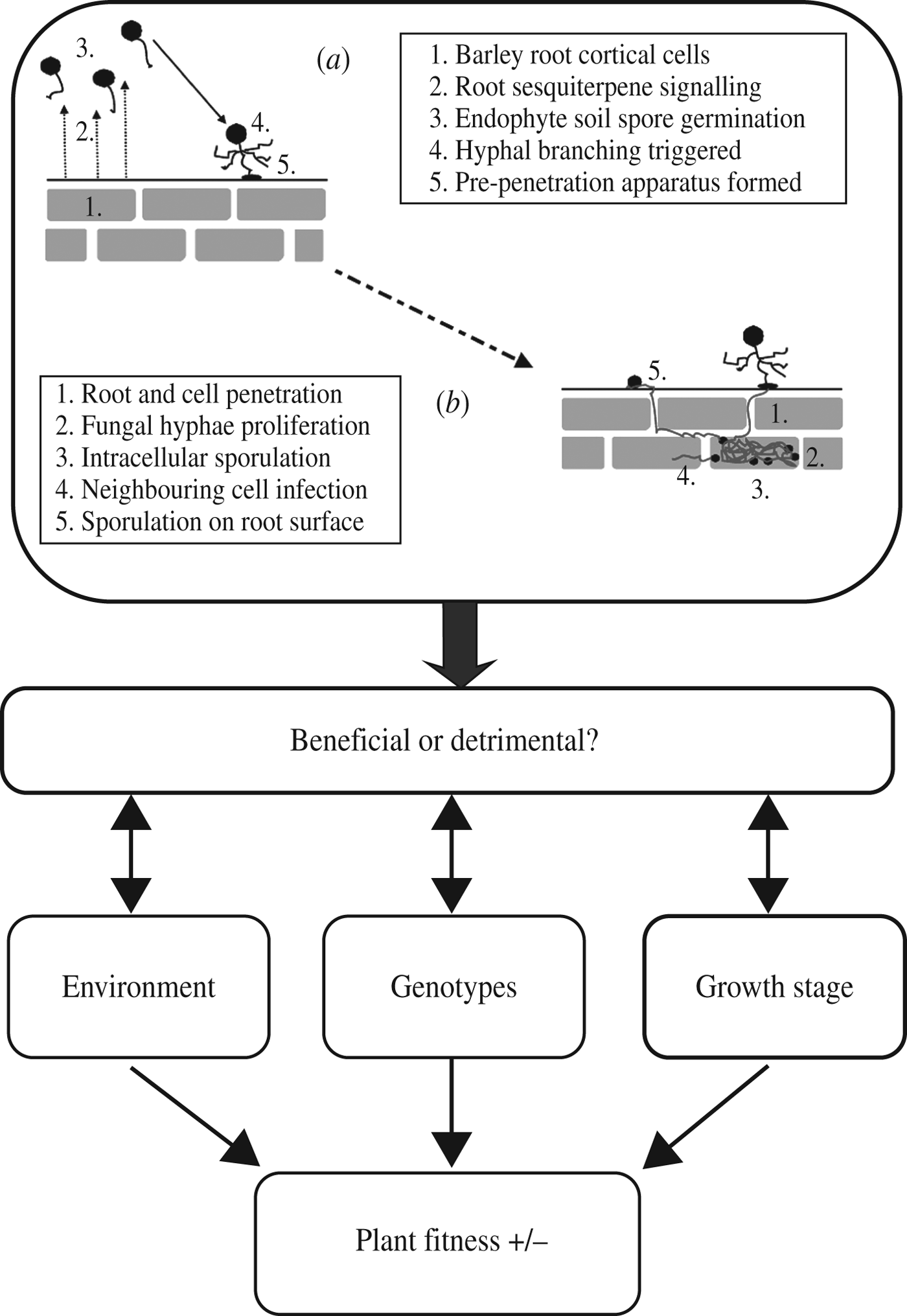
The infection process starts either with germination and hyphal growth of spores present in soil or in the plant tissue, or is initiated by contact between the endophyte hyphal tip and the barley root hair (Fig. 1). Hyphal apical dominance is abandoned and hyphal branching is triggered by fungal perception of the strigolactone 5-deoxy-strigol, followed by the formation of a pre-penetration apparatus (Genre et al. Reference Genre, Chabaud, Timmers, Bonfante and Barker2005). Strigolactones are a group of sesquiterpene lactones, previously isolated as seed germination stimulants for the parasitic weeds Striga and Orobanche (Akiyama et al. Reference Akiyama, Matsuzaki and Hayashi2005). The endophyte must now colonize the root without triggering a full-blown defence response, so the relationship develops in a finely balanced way that does not result in pathogenicity or endophyte death. There is strong evidence for a balanced antagonism between the virulence of the colonizing endophyte and the plant defence response (Maciá-Vicente et al. Reference Maciá-Vicente, Jansson, Talbot and Lopez-Llorca2009). Recognition of the endophyte as a friendly intruder rather than a pathogen is realized by host receptor-kinase-mediated transmembrane signalling (Stracke et al. Reference Stracke, Kistner, Yoshida, Mulder, Sato, Kaneko, Tabata, Sandal, Stougaard, Szczyglowski and Parniske2002). Fungal hyphae penetrate the root at the anticlinal interface of adjacent rhizodermal cell walls (Deshmukh et al. Reference Deshmukh, Hückelhoven, Schäfer, Imani, Sharma, Weiss, Waller and Kogel2006).
Colonization of barley roots by a fungal endophyte and the subsequent effect on plant fitness; determined by environmental factors and the growth stage and genotype of both partners. (a) Barley root exudates attract fungal hyphae or stimulate fungal spore germination. Hyphal apical dominance is abandoned, hyphal branching is triggered, and a pre-penetration apparatus is formed. (b) Root penetration occurs at the anticlinal interface of adjacent rhizodermal cells, followed by cortical cell penetration; cell wall degradation is facilitated by fungal enzymes. The fungal hyphae proliferate intracellularly, often accompanied by root cell death. Sporulation can occur inside the colonized cell or on the root surface, and neighbouring cells may be infected.
The first hurdle to be overcome by the endophyte is gaining entry into the root cell. The cellulose, hemicellulose, pectin and lignin in the cell wall must be broken down by cellulolytic and ligninolytic enzymes and endophytes use a variety of these enzymes (polyphenol oxidases, cellulases and laccases) to help with root cell penetration (Basiewicz et al. Reference Basiewicz, Weiss, Kogel, Langen, Zorn and Zuccaro2012). Direct endophyte contact with the barley root results in increased enzyme production, but in vitro cultures show a much reduced enzyme activity (Basiewicz et al. Reference Basiewicz, Weiss, Kogel, Langen, Zorn and Zuccaro2012), suggesting that contact with a living root is required to induce fungal enzyme production.
The barley root cell does make some attempt to arrest fungal proliferation. In Blumeria graminis f. sp. hordei-resistant barley strains, an increase in the secretion of building blocks for cell wall apposition and plasmodesmata blocking retards hypersensitive cell death in neighbouring cells, as early as 21 h after infection (An et al. Reference An, Ehlers, Kogel, van Bel and Hückelhoven2006). In P. indica infection of barley roots, fungal colonization and sporulation is always associated with limited cell death (Deshmukh et al. Reference Deshmukh, Hückelhoven, Schäfer, Imani, Sharma, Weiss, Waller and Kogel2006). The infected cell may still die, but hypersensitive death of neighbouring cells is contained. The suppression of host defence reactions needed for successful infection is associated with the reduction of a cell death regulator protein of barley, resulting in a 50% increase in infection (Eichmann et al. Reference Eichmann, Dechert, Kogel and Huckelhoven2006). Overexpression of the associated gene (BAX INHIBITOR-1) diminishes colonization by P. indica (Imani et al. Reference Imani, Li, Schäfer and Kogel2011). Older cells are more likely to undergo cell death, and P. indica preferentially colonizes the oldest root hairs of barley (Waller et al. Reference Waller, Achatz, Baltruschat, Fodor, Becker, Fischer, Heier, Hückelhoven, Neumann, Von Wettstein, Franken and Kogel2005).
Once the endophyte has fully colonized the root cell, it will then either move on to infect neighbouring cells or sporulate (Fig. 1). Unlike mycorrhizal fungi (which sporulate outside the root), endophyte sporulation can occur inside or outside the barley roots (Schafer & Kogel Reference Schafer, Kogel and Deising2009), for example as chlamydospores, and this gives the fungus a long-term in planta residence potential, with spores able to remain dormant in plant tissue. Colonization of further cells can then initiate from these spores in differentiated tissue (Deshmukh et al. Reference Deshmukh, Hückelhoven, Schäfer, Imani, Sharma, Weiss, Waller and Kogel2006).
Although infection by the root endophyte may be entirely symptomless, gene expression studies indicate that infection by some fungal groups, such as Sebacinales, elicits a systemic resistance against leaf pathogenic fungi (Waller et al. Reference Waller, Mukherjee, Deshmukh, Achatz, Sharma, Schäfer and Kogel2008) and expression of these genes may provide a simple and reliable marker of colonization. Roots colonized by P. indica show relatively low induction of defence-related genes, while other genes are differentially regulated, indicating a faster P. indica-dependent root development. Systemic gene expression analysis using mRNAs has detected a P. indica-associated doubling in the expression of the pathogenesis-related gene HvPr17b and the molecular chaperone HvHsp70 (Waller et al. Reference Waller, Mukherjee, Deshmukh, Achatz, Sharma, Schäfer and Kogel2008).
Hormones and other metabolites are important signalling molecules in the plant system and these too show marked changes in expression and activity in response to fungal endophyte infection (Schulz et al. Reference Schulz, Rommert, Dammann, Aust and Strack1999; Molitor & Kogel Reference Molitor and Kogel2009; Khatabi et al. Reference Khatabi, Molitor, Lindermayr, Pfiffi, Durner, Von Wettstein, Kogel and Schäfer2012; Lahrmann & Zuccaro Reference Lahrmann and Zuccaro2012). Fungal–host interactions involve constant mutual antagonisms, often based on a coordinated response to the secondary metabolites the partners produce (Schulz et al. Reference Schulz, Rommert, Dammann, Aust and Strack1999). Endophyte colonization success may ultimately depend on the nature of plant hormone signalling activity. In barley, the evasion and suppression of the host defences during early colonization may be related to the perturbance of plant hormone balance and the secretion of fungal effectors such as lectins and other small proteins (Lahrmann & Zuccaro Reference Lahrmann and Zuccaro2012). Plant hormones are important factors for compatibility in plant root–P. indica associations, and might provide a first explanation for colonization success in a wide range of higher plants. Piriformospora indica induces ethylene synthesis in barley, which suggests that ethylene signalling is required for symbiotic root colonization (Molitor & Kogel Reference Molitor and Kogel2009; Khatabi et al. Reference Khatabi, Molitor, Lindermayr, Pfiffi, Durner, Von Wettstein, Kogel and Schäfer2012). The hormones gibberellin, auxin and abscisic acid are up-regulated in response to P. indica infection, accompanied by a general suppression of the plant innate immune system, and these changes are significant factors of compatibility in the mutualistic association (Schäfer et al. Reference Schäfer, Pfiffi, Voll, Zajic, Chandler, Waller, Scholz, Pons-Kühnemann, Sonnewald, Sonnewald and Kogel2009).
A significant increase in the phytohormones indoleacetic acid (IAA) and indole-3-lactate (ILA) is involved in the subsequent establishment of a biotrophic symbiosis (Hilbert et al. Reference Hilbert, Voll, Ding, Hofmann, Sharma and Zuccaro2012), and might represent a compatibility factor in endophyte infection. The key player in this process is the P. indica gene piTam1, which is involved in tryptophan transamination. Piriformospora indica strains in which the piTam1 gene was silenced were compromised in IAA and ILA production and displayed reduced colonization of barley roots in the biotrophic phase (Hilbert et al. Reference Hilbert, Voll, Ding, Hofmann, Sharma and Zuccaro2012).
Outside of the endophyte–host system, infection potential from the rhizosphere-associated microbial population is related to many factors and soil type is the main determinant (Berg & Smalla Reference Berg and Smalla2009). Soil fungi spore density and fungal development are positively correlated to high pH, high clay content and barley developmental stage (Black & Tinker Reference Black and Tinker1979). The ecological interactions are complex and covered elsewhere (Black & Tinker Reference Black and Tinker1979; Maciá-Vicente et al Reference Maciá-Vicente, Jansson, Abdullah, Descals, Salinas and Lopez-Llorca2008b).
Once the endophyte is established, the infection may now develop as a beneficial symbiosis or a virulent pathogenesis (Fig. 1), largely dependent on host and fungal genotypes, colonization density and the presence of competing endophyte strains (Tellenbach et al. Reference Tellenbach, Grünig and Sieber2011; Reininger et al. Reference Reininger, Grünig and Sieber2012). Environmental conditions can provoke a pathogenic lifestyle in the usually beneficial endophyte P. indica. Kaldorf et al. (Reference Kaldorf, Koch, Rexer, Kost and Varma2005) showed that P. indica infection of Populus seedlings resulted in reduced root growth and leaf necrosis when ammonium instead of nitrate was provided as the single nitrogen source during plant–fungus co-cultivation.
Fungal root endophytes are often intimately associated with particular bacterial companions (Sharma et al. Reference Sharma, Schmid, Rothballer, Hause, Zuccaro, Imani, Kämpfer, Domann, Schäfer, Hartmann and Kogel2008), and both P. indica and S. vermifera have species-specific associations with bacteria. In fact, it is nearly always the case that both partners are found together (Sharma et al. Reference Sharma, Schmid, Rothballer, Hause, Zuccaro, Imani, Kämpfer, Domann, Schäfer, Hartmann and Kogel2008; Schafer & Kogel Reference Schafer, Kogel and Deising2009). This raises the question as to whether it is the association or the individual partners that confer the beneficial effects on plants. Schafer & Kogel (Reference Schafer, Kogel and Deising2009) showed that inoculating barley with the bacteria alone (Rhizobium radiobacter) gave similar effects to P. indica inoculation.
RESISTANCE TO PATHOGENS
Fungal root endophytes can inhibit the colonization potential of the most damaging barley pathogens, including the economically important B. graminis (‘powdery mildew’), Fusarium graminearum (‘fusarium head blight’), Gaeumannomyces graminis (‘take-all’) and Pyrenophora teres (‘net blotch’).
Although the root endophyte may only colonize the root tissue, the beneficial effects for the plant may be systemic. Gaeumannomyces graminis infection is systemically reduced when the roots of barley are colonized by the endophytic fungus F. equiseti (Maciá-Vicente et al. Reference Maciá-Vicente, Jansson, Mendgen and Lopez-Llorca2008a) and some mycorrhizal fungi also show a systemic reduction of this disease (Khaosaad et al. Reference Khaosaad, García-Garrido, Steinkellner and Vierheilig2007).
Several different endophytic fungi have been identified as potential agents for the biocontrol of G. graminis disease in wheat (Ghahfarokhi & Goltapeh Reference Ghahfarokhi and Goltapeh2010) and may have similar potential for barley. Ghahfarokhi & Goltapeh (Reference Ghahfarokhi and Goltapeh2010) tested P. indica, S. vermifera and Trichoderma species for G. graminis resistance in wheat and all of these endophytes colonize barley readily (Waller et al. Reference Waller, Achatz, Baltruschat, Fodor, Becker, Fischer, Heier, Hückelhoven, Neumann, Von Wettstein, Franken and Kogel2005; Baltruschat et al. Reference Baltruschat, Fodor, Harrach, Niemczyk, Barna, Gullner, Janeczko, Kogel, Schäfer, Schwarczinger, Zuccaro and Skooczowski2008; Achatz et al. Reference Achatz, von Rüden, Andrade, Neumann, Pons-Kühnemann, Kogel, Franken and Waller2010). Maciá-Vicente et al. (Reference Maciá-Vicente, Jansson, Abdullah, Descals, Salinas and Lopez-Llorca2008b) tested 15 fungal root endophytes from natural vegetation and eight of these caused systemic reduction of G. graminis symptoms in barley.
Many types of powdery mildew pathogens infect barley and while most barley varieties are resistant to some infections (e.g. Erysiphe graminis), the powdery mildew causing B. graminis f. sp. hordei is still a serious crop pathogen. Piriformospora indica and the closely related S. vermifera both reduce B. graminis infection significantly. Piriformospora indica confers both local and systemic resistance to B. graminis (Deshmukh et al. Reference Deshmukh, Hückelhoven, Schäfer, Imani, Sharma, Weiss, Waller and Kogel2006), with leaf pustule frequencies reduced by up to 70% (Waller et al. Reference Waller, Achatz, Baltruschat, Fodor, Becker, Fischer, Heier, Hückelhoven, Neumann, Von Wettstein, Franken and Kogel2005; Schafer & Kogel Reference Schafer, Kogel and Deising2009). Blumeria graminis colony numbers can be reduced significantly by P. indica infection, with reductions of 48–58% in 3-week-old barley seedlings (Waller et al. Reference Waller, Achatz, Baltruschat, Fodor, Becker, Fischer, Heier, Hückelhoven, Neumann, Von Wettstein, Franken and Kogel2005). Barley colonized by S. vermifera can reduce B. graminis infection by 10–80% (Schafer & Kogel Reference Schafer, Kogel and Deising2009).
Plant protection associated with endophyte presence may result from an indirect effect, with the endophyte inducing plant defence responses that protect against disease. This type of protective mechanism is typical when barley is infected with F. graminearum. Root rot caused by this pathogen is reduced significantly when the barley roots are inoculated with P. indica, whereas the in vitro interaction of P. indica and F. graminearum did not reveal reciprocal growth inhibition, suggesting a plant-mediated retardation of F. graminearum rather than an antibiosis produced by the endophyte (Deshmukh & Kogel Reference Deshmukh and Kogel2007). Harrach et al. (Reference Harrach, Baltruschat, Barna, Fodor and Kogel2013) found that pre-treatment of barley roots with P. indica spores prevented the necrotization of root tissue and retardation of plant growth usually associated with Fusarium culmorum infection.
Barley varieties vary widely in P. teres resistance and selected crossings have produced reliably resistant varieties (Statkevičiūtė & Leistrumaitė Reference Statkevičiūtė and Leistrumaitė2010). Nevertheless, P. teres is still an important pathogen of barley. Although no specific endophytes have been tested for protective competence against P. teres in barley, other studies have shown endophyte-mediated protection against P. teres in related cereal crops (Poling et al. Reference Poling, Wicklow, Rogers and Gloer2008). The antimicrobial metabolites in non-barley studies are similar to those found in P. teres infections of barley (Nukina et al. Reference Nukina, Sassa, Oyama and Ikeda1979).
Although research has focused on a few well-characterized fungal root endophytes, there may be many others that have the potential to inhibit barley pathogens. Maciá-Vicente et al. (Reference Maciá-Vicente, Jansson, Mendgen and Lopez-Llorca2008a) tested 73 endophyte isolates belonging to diverse genera, and all showed some inhibition of the pathogen G. graminis in barley roots. More screening of this diversity is required in future work.
Many antifungal and antibacterial agents from various endophytes have been described (Joseph & Priya Reference Joseph and Priya2011; Fávaro et al. Reference Fávaro, Sebastianes and Araújo2012; Liang et al. Reference Liang, Xing, Chen, Zhang, Guo and Wang2012; Mousa & Raizada Reference Mousa and Raizada2013), but details regarding the beneficial interactions and mechanisms involved are often not well understood. More experimental work with barley is needed to fully describe and utilize the potential of these agents.
MECHANISMS OF PATHOGEN RESISTANCE
A number of mechanisms have been implicated in endophyte-induced pathogen resistance in barley.
In mycorrhizal associations, the systemic bioprotectional effect depends on the degree of root colonization by the mycobiont (Khaosaad et al. Reference Khaosaad, García-Garrido, Steinkellner and Vierheilig2007). In wheat, the antagonistic effect of the endophyte against a pathogen can be due to activation of host defences rather than direct antagonism (Istifadah & McGee Reference Istifadah and McGee2006) and in the expression of herbivore resistance the specific combination of host plant species/genotype and endophyte species/strain is important (Clement et al. Reference Clement, Wilson, Lester and Davitt1997).
Even though it is clear that P. indica requires host cell death to proliferate (Deshmukh et al. Reference Deshmukh, Hückelhoven, Schäfer, Imani, Sharma, Weiss, Waller and Kogel2006), the P. indica-induced programmed cell death – where cell death is restricted to fully colonized barley root cells – is different from the hypersensitive cell death response in pathogen defence. The limited cell death associated with P. indica infection allows for P. indica-induced pathogen resistance without causing disease symptoms in the barley.
The production of reactive oxygen species is a pre-requisite for successful fungal development and pathogenesis of necrotrophic infections (Waller et al. Reference Waller, Achatz, Baltruschat, Fodor, Becker, Fischer, Heier, Hückelhoven, Neumann, Von Wettstein, Franken and Kogel2005), and pathogen-resistance-related antioxidant capacity is enhanced in P. indica-infected barley (Waller et al. Reference Waller, Achatz, Baltruschat, Fodor, Becker, Fischer, Heier, Hückelhoven, Neumann, Von Wettstein, Franken and Kogel2005; Harrach et al. Reference Harrach, Baltruschat, Barna, Fodor and Kogel2013). Ascorbic acid is a major antioxidant buffer and free radical scavenger and levels of ascorbate are consistently higher in P. indica-infected roots. Waller et al. (Reference Waller, Achatz, Baltruschat, Fodor, Becker, Fischer, Heier, Hückelhoven, Neumann, Von Wettstein, Franken and Kogel2005) found that higher ascorbate and glutathione levels protect roots from cell death provoked by the root pathogens F. culmorum and Cochliobolus sativus and speculated that elevated ascorbate levels could be the reason for the observed control of necrotrophic pathogens in barley roots.
Changes in the root surface pH are a feature of P. indica colonization, resulting in a long-term response of a change in leaf surface pH upon B. graminis infection (Felle et al. Reference Felle, Waller, Molitor and Kogel2009). In P. indica-colonized barley, leaf apoplastic pH increased by 2 when inoculated with the leaf pathogenic powdery mildew fungus B. graminis f. sp. hordei, while the leaf apoplast pH of non-inoculated barley rose by only 0·8. The P. indica-primed pH increase is indicative of and supports the potentiated systemic response to B. graminis infection.
Variable gene expression may occur in response to fungal pathogen infection, depending on the presence or absence of a beneficial endophyte. Pathogenesis-related gene expression strongly increases in F. graminearum-infected barley, but in contrast diminishes in the presence of P. indica (Deshmukh & Kogel Reference Deshmukh and Kogel2007). Genes related to root cell skeletal (actin) reorganization are activated in barley attacked by B. graminis, resulting in actin focusing at the point of infection; presumably strengthening the defence against pathogen ingress (Opalski et al. Reference Opalski, Schultheiss, Kogel and Hückelhoven2005). Enhanced activation of genes associated with this process due to beneficial endophyte presence in barley root cells has not yet been demonstrated.
Compatibility mechanisms in host–microbe interactions are complex and an increase in phytohormone signalling may be necessary for successful fungal colonization (Schäfer et al. Reference Schäfer, Pfiffi, Voll, Zajic, Chandler, Waller, Scholz, Pons-Kühnemann, Sonnewald, Sonnewald and Kogel2009). In G. graminis-infected barley, salicylic acid-associated gene expression is suppressed (Khaosaad et al. Reference Khaosaad, García-Garrido, Steinkellner and Vierheilig2007). Systemically induced resistance and protection is also strongly associated with an increase in the expression of the signalling protein jasmonate (Waller et al. Reference Waller, Achatz, Baltruschat, Fodor, Becker, Fischer, Heier, Hückelhoven, Neumann, Von Wettstein, Franken and Kogel2005; Stein et al. Reference Stein, Molitor, Kogel and Waller2008; Molitor & Kogel Reference Molitor and Kogel2009). The changes in hormone homoeostasis are accompanied with a general suppression of the plant innate immune system.
Barley does produce antifungal and herbicidal substances of its own and these are enhanced by the presence of the beneficial endophyte. Concentrations of defence-related plant secondary metabolites such as phenylpropanoids and oligomeric proanthocyanidins can increase significantly in the roots of barley infected with several different endophyte species (Schulz et al. Reference Schulz, Rommert, Dammann, Aust and Strack1999).
YIELD ENHANCEMENT
In most plants, grain yield improvement and an increase in biomass often go hand-in-hand and barley is no exception. Piriformospora indica infection of barley grown in a glasshouse increased shoot fresh weight by up to 65% after only 4 weeks of mutualistic symbiosis (Waller et al. Reference Waller, Achatz, Baltruschat, Fodor, Becker, Fischer, Heier, Hückelhoven, Neumann, Von Wettstein, Franken and Kogel2005), but in field-colonized barley increases in plant biomass due to endophyte treatment were only 10% (Schäfer et al. Reference Schäfer, Pfiffi, Voll, Zajic, Chandler, Waller, Scholz, Pons-Kühnemann, Sonnewald, Sonnewald and Kogel2009), probably due to other stresses not encountered in the glasshouse.
Grain yield effects due to fungal root endophyte infection also vary depending on the experimental environment. Piriformospora indica field-colonized barley grain yield increases can be up to 10% (Schäfer et al. Reference Schäfer, Pfiffi, Voll, Zajic, Chandler, Waller, Scholz, Pons-Kühnemann, Sonnewald, Sonnewald and Kogel2009), whereas glasshouse colonized barley grain yield increases can be up to three times more (Waller et al. Reference Waller, Achatz, Baltruschat, Fodor, Becker, Fischer, Heier, Hückelhoven, Neumann, Von Wettstein, Franken and Kogel2005).
The increases in barley grain yield due to root colonization by P. indica are apparent even under very different nutrient regimes (Achatz et al. Reference Achatz, von Rüden, Andrade, Neumann, Pons-Kühnemann, Kogel, Franken and Waller2010), due to accelerated growth of barley plants early in development and earlier maturation of barley heads. Achatz et al. (Reference Achatz, von Rüden, Andrade, Neumann, Pons-Kühnemann, Kogel, Franken and Waller2010) showed that higher grain yield was induced by P. indica infection, independently of markedly different phosphate and nitrogen fertilization levels. Unlike mycorrhizal symbiosis, improved phosphate supply was not observed in the P. indica-barley experiments.
An endophyte-induced relative increase in root biomass over shoot biomass has been demonstrated in some grass species (Czarnoleski et al. Reference Czarnoleski, Olejniczak, Górzyńska, Kozłowski and Lembicz2012), including rice (Redman et al. Reference Redman, Kim, Woodward, Greer, Espino, Doty and Rodriguez2011). No equivalent pattern has been reported in barley studies, though nearly all barley yield-related experiments have shown an overall increase in plant biomass due to beneficial endophyte infection (Waller et al. Reference Waller, Achatz, Baltruschat, Fodor, Becker, Fischer, Heier, Hückelhoven, Neumann, Von Wettstein, Franken and Kogel2005; Schäfer et al. Reference Schäfer, Pfiffi, Voll, Zajic, Chandler, Waller, Scholz, Pons-Kühnemann, Sonnewald, Sonnewald and Kogel2009).
ABIOTIC STRESS TOLERANCE
Although some beneficial endophyte research has studied a wide variety of abiotic stress tolerance types (Rodriguez et al. Reference Rodriguez, Henson, Van Volkenburgh, Hoy, Wright, Beckwith, Kim and Redman2008, Reference Rodriguez, White, Arnold and Redman2009; Redman et al. Reference Redman, Kim, Woodward, Greer, Espino, Doty and Rodriguez2011; Singh et al. Reference Singh, Gill and Tuteja2011; Zelicourt et al. Reference Zelicourt, De Al-Yousif and Hirt2013), studies using barley and fungal root endophytes have focused mainly on salt stress.
Piriformospora indica is beneficial in protecting the barley plant against many different biotic and abiotic stresses (Schäfer et al. Reference Schäfer, Pfiffi, Voll, Zajic, Chandler, Waller, Scholz, Pons-Kühnemann, Sonnewald, Sonnewald and Kogel2009). Some barley species (e.g. Hordeum spontaneum) are adapted to marginal and stress-prone environments (Willcox Reference Willcox2005), often characterized by gradually increasing salinity. Therefore, salt tolerance in derived modern barley varieties is an important factor for the grower considering planting barley as a risk-aversion crop on saline soils. Saline soils can inhibit the activity of most soil fungi (Dixon et al. Reference Dixon, Rao and Garg1993) and may lead to reduced competition for a more salt-tolerant beneficial root endophyte.
Metabolic heat efflux, salt-induced lipid changes and fatty acid desaturation are all associated with salt stress in plants (Criddle et al. Reference Criddle, Hansen, Breidenbach, Ward and Huffaker1989; Ahmad et al. Reference Ahmad, Azooz and Prasad2013). Barley root colonization by P. indica attenuated all of these factors in the leaves of a salt-sensitive cultivar and still increased plant growth (Baltruschat et al. Reference Baltruschat, Fodor, Harrach, Niemczyk, Barna, Gullner, Janeczko, Kogel, Schäfer, Schwarczinger, Zuccaro and Skooczowski2008). Several studies have found that endophyte-mediated salt tolerance was associated with a strong increase in antioxidants (Criddle et al. Reference Criddle, Hansen, Breidenbach, Ward and Huffaker1989; Baltruschat et al. Reference Baltruschat, Fodor, Harrach, Niemczyk, Barna, Gullner, Janeczko, Kogel, Schäfer, Schwarczinger, Zuccaro and Skooczowski2008).
The vacuoles of plant cells can act as salinity buffers, sequestering the salts for later processing (Blumwald & Poole Reference Blumwald and Poole1987; Horie & Schroeder Reference Horie and Schroeder2004), but this process results in the loss of cell membrane stability due to a reduction of membrane phospholipids (Sun et al. Reference Sun, Liu and Zhang2002). Membrane-mediated transport can be enhanced in salt-stressed barley seedlings by the application of exogenous fatty acids (Zhao & Qin Reference Zhao and Qin2005), resulting in protective effects against salt stress. Endophyte-induced salt stress tolerance may involve a similar attenuation of NaCl-related membrane lipid peroxidation (Baltruschat et al. Reference Baltruschat, Fodor, Harrach, Niemczyk, Barna, Gullner, Janeczko, Kogel, Schäfer, Schwarczinger, Zuccaro and Skooczowski2008). Mycorrhizal fungi can also increase the rate of sodium neutralization in plants grown in highly saline soils (Mohammad et al. Reference Mohammad, Malkawi and Shibli2011).
Studies using other plant species have examined a broader range of abiotic stresses (Rodriguez et al. Reference Rodriguez, Henson, Van Volkenburgh, Hoy, Wright, Beckwith, Kim and Redman2008, Reference Rodriguez, White, Arnold and Redman2009; Redman et al. Reference Redman, Kim, Woodward, Greer, Espino, Doty and Rodriguez2011; Singh et al. Reference Singh, Gill and Tuteja2011), but more work needs to be done on endophyte-induced cold and drought tolerance in barley, which may extend the growing season.
SYNTHESIS AND CONCLUSIONS
Fungal root endophyte infections are often beneficial to the host and much of the evidence examined here shows that barley, particularly, can benefit from endophyte infection. However, endophytes can also be detrimental and the present review reveals contradictory study results regarding the effects of fungal root endophytes on the barley plant. In their meta-analysis, Mayerhofer et al. (Reference Mayerhofer, Kernaghan and Harper2012) determined the effects of fungal root endophyte inoculation on plant biomass and nitrogen concentration in a range of plant taxa, and explored the effects of experimental conditions on the host–endophyte relationship. They also found that the effect of endophyte infection can be negative, positive or neutral.
Clearly, prevailing circumstances dictate the nature of the plant–endophyte relationship. Even if an endophyte is never pathogenic, it is not always beneficial and is often neutral in effect. Despite the potential benefits of benign fungal root endophyte infection, there will always be a cost to the plant, with the fungus needing to extract at least some nutrients to survive. Beneficial fungal endophyte colonization can reduce the availability of free sugars and amino acids to the root tip (Schäfer et al. Reference Schäfer, Pfiffi, Voll, Zajic, Chandler, Waller, Scholz, Pons-Kühnemann, Sonnewald, Sonnewald and Kogel2009) and even affect all barley tissues detrimentally when ammonium is the only available nitrogen source (Kaldorf et al. Reference Kaldorf, Koch, Rexer, Kost and Varma2005; Schafer & Kogel Reference Schafer, Kogel and Deising2009). Gorischek et al. (Reference Gorischek, Afkhami, Seifert and Rudgers2013) showed that endophyte infection of Elymus virginicus (a grass species related to Triticum) can shift host resources towards the sex through which they propagate. Martín et al. (Reference Martín, Witzell, Blumenstein, Rozpedowska, Helander, Sieber and Gil2013) found that a reduction in xylem endophytic fungi was associated with increased resistance to Dutch elm disease; a clear trade-off between resistance to all fungal infections and the potential benefits related to endophyte infection. More work with the barley–endophyte relationship will reveal if these effects are significant in barley.
The most important factors that determine the degree of benefit to the host are the specific combination of partner genotypes (or strains) and developmental stages, and the ecological and environmental settings. A fungal endophyte that has beneficial effects on a particular barley variety may be detrimental to another variety in a different environment or at a different developmental stage. This is why the term ‘endophyte’ is used in the present review to encompass fungal organisms that can be either beneficial (symptomless) or detrimental, depending on circumstances. In a stress-free situation any fungal infection will impose some cost on the plant and it is only the protection afforded against more virulent pathogens that gives the endophyte its beneficial status. Some definitions of endophytes consider them symptomless, but they still exact an energy cost from the plant.
However, of course, there is rarely such a thing as a stress-free environment and in any natural ecological setting a plant will be exposed to many fluctuating stressors. Therefore, the fungal infection may give the plant a greater ability to cope with the stress if the partners are in a balanced relationship. As we have seen, this balance can be maintained by a variety of mechanisms.
In situations where there may be many fungal organisms in the rhizosphere, the competition for root living space will inevitably result in contingent temporal outcomes. At different times, the same fungus can be either a winner or loser, depending on the mix of competing organisms and the developmental stages of both host and fungi. Likewise, the same fungus may turn out to be predominantly beneficial or pathogenic. The antibiosis displayed in vitro by putative beneficial fungal root endophytes may be partly a result of the unnatural experimental conditions and may not translate to a complex natural ecology.
There seems to be no significant consistent relationship between nutrient levels and colonization. Neither the nutrient status of the plant nor the availability of soil nutrients greatly affects the degree of beneficial endophyte colonization, and, unlike mycorrhizae, there is no apparent increase in endophyte-associated phosphorous transfer. However, there are indications of an association between successful endophyte colonization and high soil pH and clay content.
The greatest advantages to the barley plant resulting from the colonization of root tissue by a beneficial fungal endophyte seem to be obtained in abiotically stressed environments. In these situations, endophyte colonization does seem to confer consistent and predictable benefits on the barley plant. An up-regulation of antioxidants and endophyte-associated lipid changes in the plant cell membrane enhance plant tolerance of the stress, and increase growth and yield over non-infected plants. Salt stress in particular may inhibit the activity of other potentially pathogenic fungi and lead to a relaxation of competitive pressure, enabling the full effects of the beneficial endophyte to be realized.
The relationship between fungal root endophytes and barley is based on a finely balanced and complex dialogue between the partners, with the final effect on the plant uncertain. The ability of beneficial endophytic fungi to improve barley crop yields and sustainability depends on many variables: plant and fungal species or genotype, developmental stage of both partners, intermicrobial competition, and the biotic and abiotic environmental stresses. Each new study reveals an increasing diversity of beneficial fungal root endophytes, and the full potential of these organisms is still to be determined. There have been reports of beneficial endophytes isolated from wild barley populations (Clement et al. Reference Clement, Wilson, Lester and Davitt1997; Dugan et al. Reference Dugan, Sitton, Sullivan and White2002), but there is a need for more studies of wild barley species to fully elucidate the potential of discovered endophytes for improving cultivated barley performance. It is likely that there are ideal fungal partners for each variety of barley but there is also the potential to develop ‘universal’ partners that can benefit all. If these ideal fungal partners can be discovered, then a farmer harvesting a healthy crop of chemical-free salt marsh barley in winter may yet be seen.
The authors would like to thank Helena Murphy who assisted with proof reading and the de-cluttering of technical terms. Funding for research was provided in the form of a Trinity College Dublin studentship grant.