

Introduction
Swaffer (Reference Swaffer2015) described the advice given to people with dementia post-diagnosis as “Prescribed Disengagement®”. Swaffer was specifically told; “Give up work, give up study, get your end-of-life affairs in order, and get acquainted with aged care.” Anecdotally, Swaffer's experience is common. People with dementia are offered limited treatments, advised to get their end-of-life affairs in order, to get acquainted with aged care and to plan for when the disease gets worse – with either explicit or implicit suggestions that the person should be slowing down or pulling back from work and other activities. According to Swaffer, Prescribed Disengagement® results in people with dementia giving up hope, losing self-esteem and self-identity, becoming increasingly isolated, taking on a "sick" role, developing learned helplessness, and withdrawing from potentially beneficial activities. All these impact on the person's social health and quality of life (Vernooij-Dassen and Jeon, Reference Vernooij-Dassen and Jeon2016).
It is not clear from the literature whether the lived experiences of people with dementia support the notion of Prescribed Disengagement®. A systematic review of the experiences of receiving a diagnosis of dementia reports that the greatest difficulty for people with dementia is coming to terms with psychological, social, and functional losses (Robinson et al., Reference Robinson2011). Another review reported prevailing dissatisfaction with health services (Prorok et al., Reference Prorok, Horgan and Seitz2013). In a survey of people with early dementia recruited from memory clinics, 15 out of 41 reported being told it was not possible to do things to control the condition (Clare et al., Reference Clare, Quinn, Jones and Woods2016). However, a review also found that people living with dementia have positive experiences in spite of, and even because of, living with the condition (Wolverson et al., Reference Wolverson, Clarke and Moniz-Cook2016).
Guidelines on communicating a diagnosis of dementia do not recommend that clinicians tell people with dementia to reduce their activities; however, beyond information provision, no treatments or support are usually suggested that may assist in maintaining an active lifestyle or quality of life. For example, a clinical review published in the British Medical Journal on timely diagnosis and early intervention for dementia suggests that post-diagnosis options for mild dementia are the use of cholinesterase inhibitors, and discussion of personal wishes for future care (Robinson et al., Reference Robinson, Tang and Taylor2015). The 2016 Australian Clinical Practice Guidelines and Principles of Care for People with Dementia recommend that following diagnosis information should be provided on the signs and symptoms of dementia, the course and prognosis of the condition, treatments, sources of financial and legal advice and advocacy, and medico-legal issues including driving (Clinical Adaptation Committee, 2016).
The overarching aim of this study is to review whether Swaffer's concept of Prescribed Disengagement® can be identified in the subjective experiences of people living with early dementia. The review is limited to early stage dementia, because when the symptoms are milder, people are most able to manage their own lives and care. The review will document and synthesize studies on the subjective experiences of people with dementia after diagnosis including impact on levels of activity (work, home life, social life, and hobbies), view of the future and self-identity, and any perceived impact of the communication of the diagnosis and post-diagnostic support on these experiences.
Methods
Search strategy
The search was conducted in August 2016, with all literature up to this date included. Databases searched, search terms, inclusion criteria, and extracted information are described in Table 1. A data extraction form was developed and piloted on three papers, revised, and used to collect data about the studies by the first author. Methodological quality of each study was rated using the Critical Appraisal Skills Programme Checklist that has a possible range of scores from 1 to 10 with higher scores indicating better quality (Critical Appraisal Skills Programme (CASP), 2015).
Search terms, inclusion criteria and information extraction

Analysis
Thematic synthesis of papers was undertaken (Thomas and Harden, Reference Thomas and Harden2008). This involved the first author reading and rereading results and discussions sections of each article to extract any experiences (first-order data) or themes identified by researchers (second-order data) relating to levels of activity, view of future and self-identity, as well as any attributions as to the reasons for or contributors to those experiences (Thomas and Harden, Reference Thomas and Harden2008). During these analyses, the author focused on material relating to, or derived from, the people with dementia rather than family carers or health professionals who may have been also included in the studies. In some studies, themes were derived based on all participants, and it was not possible to make this separation. New themes (third-order data) were generated based on both first- and second-order data, which were interpreted and coded within and across articles in an iterative process; these themes were discussed with co-authors and refined. A second author (MM) independently coded four papers – differences in interpretation of themes were discussed and incorporated into recoding of material. Data saturation was reached in that the final ten papers did not yield any further new themes. Third-order themes were structured and reinterpreted in relation to the concept of Prescribed Disengagement®.
Results
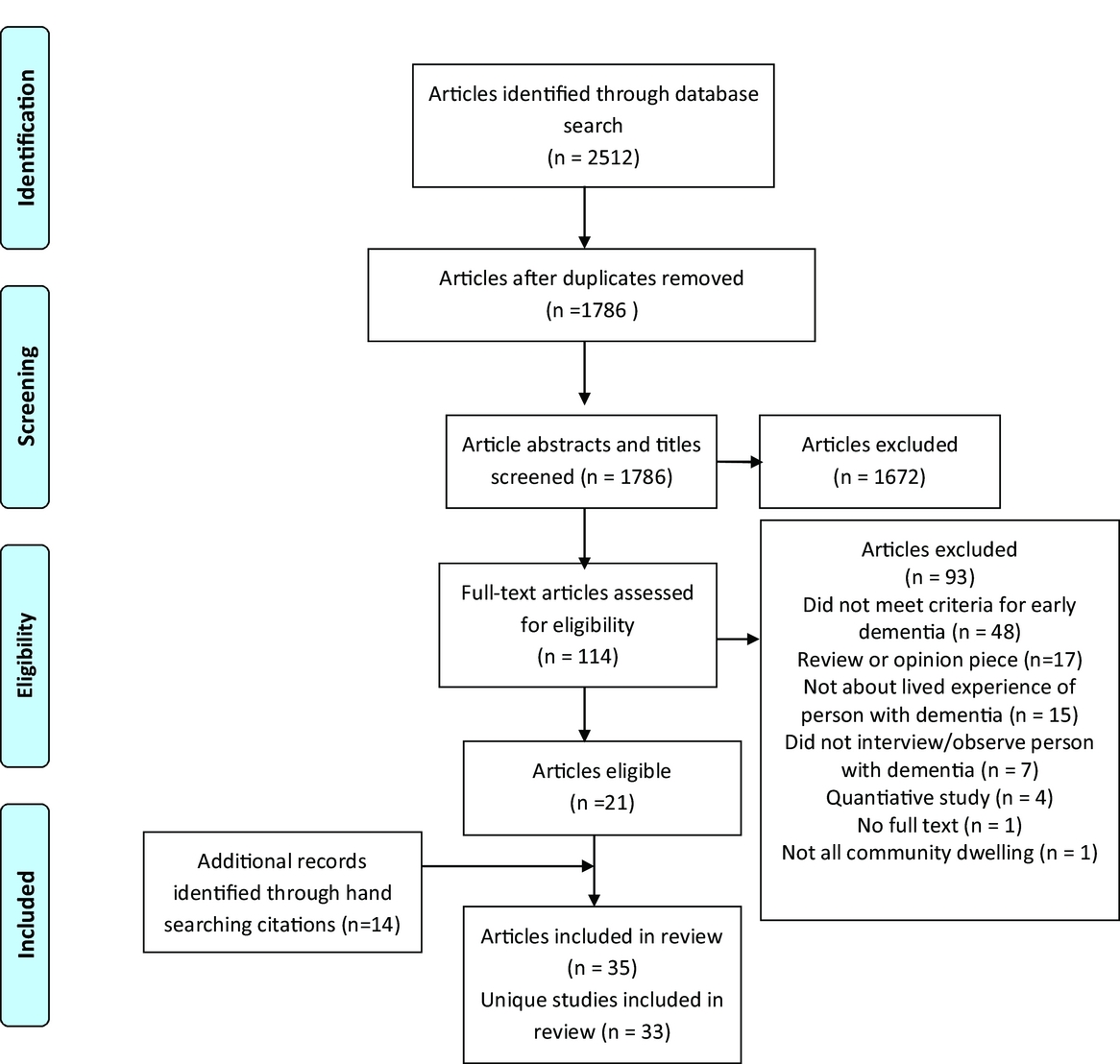
The search yielded 1,786 unique papers, of which 21 met inclusion criteria. A further 14 papers were identified through hand searches yielding a final total of 35 included papers (see Figure 1). The papers are described in Table 2. In total, 373 participants were included, with the sample size for individual studies ranging from a single participant case study to 30 people. Of these, 166 (45%) were male and 199 (55%) female; gender data were not provided for 8 participants. The most common diagnosis in participants when described was Alzheimer's disease (i.e. 237 out of 295 or 80%), followed by vascular dementia (24 out of 295 or 8%) and mixed diagnoses (15 out of 295 or 5%), frontotemporal dementia (3 out of 295 or 1%), Lewy body dementia (4 out of 295 or 1%), and cortical/subcortical dementia (4 out of 295 or 1%). All studies were conducted in developed countries – most in the United Kingdom and Europe with a few in North America. Not all studies described a methodological approach; in those that did, phenomenology was the most common (13 studies), followed by grounded theory (5 studies). Other approaches were ethnography (one study). In studies where analysis method was not explicitly stated, we interpreted the approach based on the description in the methods. Analytical methods were interpretive phenomenological analysis (12 studies), thematic analysis (5 studies), content analysis (5 studies), constant comparison method (3 studies), voice relational analysis (1 study), and narrative analysis (1 study). Scores on the Critical Appraisal Skills Programme Qualitative Checklist ranged from 6 to 10, studies tended to be weakest on considering or describing the relationships between researcher and participant, data collection methods, ethical issues, and data analyses.
Flow chart indicating inclusion of articles in the review.

Characteristics of included studies

Abbreviations: AD = Alzheimer's disease; VaD = vascular dementia; LBD = Lewy body dementia; FTD = frontotemporal dementia.
a Critical Appraisal Skills Program Qualitative Checklist score.
Self-identity: a struggle between self-maintenance and self-adjustment
Following a diagnosis of dementia, almost all the papers which asked relevant questions reported first-order data describing changes to self-identity. Many papers described second-order concepts relating to strategies whereby people with dementia maintained their existing identity (self-maintenance, also labeled continuity, preservation, self-protecting, "I want to be me" and "holding on") and/or strategies which incorporated the symptoms or diagnosis of dementia into their sense of self (self-adjusting, also labeled integrative responding, reconstructing, adapting, compensating).
Self-maintaining ways of thinking included denying, avoiding, minimizing, or normalizing their symptoms, comparing to others, reinforcing their identity through past experiences and family. People with dementia denied having symptoms or dementia, avoided thinking about their symptoms, or minimized their severity or impact in order to avoid emotional pain related to the consequences of having dementia. They also normalized their symptoms by attributing them to normal aging. They also boosted their self-image by relative comparison to others who had physical illness, poorer functioning, or were worse off because of their life situations. In order to maintain their identity, people with dementia thought about their life story. For some, it was affirming that they were valued by people around them for who they are and what they had done (e.g. a good mother).
Patients use denial and avoidance throughout the diagnostic process and following their diagnosis as part of a grieving process and as a coping strategy to manage loss of sense of self and anxieties about the future. (researcher; Milby et al., Reference Milby, Murphy and Winthrop2015)
I just put it down to my age. . .everybody forgets things. (person with dementia; Lee et al., Reference Lee, Roen and Thornton2014)
When I see what some of the other people were doing I think, "Oh well, I'm not too bad really." (person with dementia; Willis et al., Reference Willis, Chan, Murray, Matthews and Banerjee2009)
Another important coping strategy (that) patients used to protect them against the feeling of decline in personal dignity and value was their individual story of life. (researcher; Sørensen et al., Reference Sørensen, Waldorff and Waldemar2008)
Self-adjusting ways of thinking included acceptance of dementia as part of life, living in the moment, and developing and using practical strategies. Acceptance meant that the symptoms and/or diagnosis of dementia were included as part of how persons with dementia saw themselves. Usually, this was associated with less strong emotions about the symptoms (e.g. anger or fear), but sometimes it was described in relation to despair, particularly for the future. Acceptance was sometimes described as occurring with time, or a way of thinking that the person decided to take. Living in the moment rather than dwelling on negative thoughts about the future appeared to help people with dementia accept the diagnosis. People with dementia also adapted to symptoms using strategies such as memory aids, routines, and home meal services. A few studies described people with dementia about seeing the positive side of having dementia in terms of personal growth, or becoming closer to family.
These adjustments are necessary for a shift in the personal attitude toward the disease, where the participant moves from a state where intense efforts are made to resist and manage the disease to a state characterized by feelings of acceptance and reconciliation. (researcher; Robinson et al., Reference Robinson, Giorgi and Ekman2012)
That is my motto now. We all have only today. No yesterday, no tomorrow. So we have to live in this moment . . . and we have nothing special to worry about in our everyday life. (person with dementia; Pesonen et al., Reference Pesonen, Remes and Isola2013)
Many men noted using practical strategies, which often comprised a variety of methods such as trying to look up information, setting themselves routines, using anxiety management techniques and writing themselves notes or instructions. (researcher; Pearce et al., Reference Pearce, Clare and Pistrang2002)
. . . In some ways I could be grateful for what's happened . . . you learn a lot in the process. (person with dementia; Clare, Reference Clare2002)
People with dementia struggled with self-identity and could use both self-maintaining and self-adjusting strategies. This struggle appeared to be ongoing with people with dementia moving back and forth between protecting their pre-dementia self-identity and incorporating dementia into how they saw themselves. We do not suggest that either stance is "better" as a way of coping or in terms of level of psychological distress. The diagnosis of dementia and symptoms challenges people with dementia to evaluate how they see themselves.
The central dynamic in participants’ accounts . . . was perceived as a tension between attempts to protect the self from threat and attempts to engage with the potential threat and integrate the resulting experience into the self. (researcher; Clare, Reference Clare2003)
Independence, control and status: maintained, reduced or disempowered
A specific and important aspect of self-identity mentioned in many studies is how people with dementia see their independence, control in life and status in society. Some people with dementia actively maintained through conscious effort their independence, control, and status. This maintenance was related to the concepts of both self-maintenance and self-adjustment and did not appear to be due to specific advice from healthcare professionals.
I can still do things, even new things. I've recently got a bus pass and I go to Llandudno [sea-side town in North Wales] every week. Getting on the bus is like a club; it's a social event for me. It keeps my independence. (person with dementia; Keady et al., Reference Keady, Williams and Hughes-Roberts2007)
The stories stressed independence and autonomy. Independence reflected competencies such as the ability to clean the house, to cook meals, to buy groceries, to manage one's finances, to go out with friends, and to perform a job or give advice to others. Stressing independence was often related to not being burdensome to the family, and even more, to still being helpful to the family. More than being functionally independent, these competencies allow persons with dementia to be autonomous. (researcher; Steeman et al., Reference Steeman, Tournoy, Grypdonck, Godderis and Dierckx De Casterlé2013)
Other people with dementia experienced reduction or loss of independence and control that was attributed to the symptoms of dementia.
It was a difficult time for me with a sense of losing control as it was beginning to affect my day-to-day living. I was slowing down, losing my train of thought. I couldn't do things as well as I used to. (person with dementia; Keady et al., Reference Keady, Williams and Hughes-Roberts2007)
We also identified a theme of disempowerment of people with dementia by others, usually family carers. Sometimes the actions leading to disempowerment were well-intentioned help or supervision provided by carers, other times disempowerment occurred because the carer misunderstood the person's abilities or dementia symptoms. This disempowerment affected the way people with dementia viewed themselves, and may have also have contributed to excess disability.
The autonomy of persons with AD is often restricted by relatives’ paternalism. (researcher; Bronner et al., Reference Bronner, Perneczky, McCabe, Kurz and Hamann2016)
Interviewer: You're no longer driving?
Participant: No! No! That irked, that irked me! Oh, I was furious! It wasn't the idea of what they did. It was not to have talked to me too! You know like, say to me, we think this is the best for you, and we will look after you. (person with dementia; MacQuarrie, Reference MacQuarrie2005)
Participant: My wife keeps correcting me and I won't stand for it. When I tell her not to reprimand me she doesn't answer. I don't think she appreciates me anymore.
Interviewer: Was it like that before?
Participant: No, [after a long break the patient continues in a very low voice] I am more vulnerable now and I irritate her. I am no longer the man she married. (Sørensen et al., Reference Sørensen, Waldorff and Waldemar2008)
Activities: maintained, reduced, or “given up”
We conceptualize people as beings within the world and self-identity as being influenced by how we see our impact on the world, as well as how the people around us see us (Goffman, Reference Goffman1963). Social health is critical within this conceptualization of personhood. The struggle between maintaining and adapting the self is reflected in how people with dementia talked about their day-to-day activities, recreation, and socialization. In a similar pattern to independence, activities were actively maintained, lost, or given up. Many people described actively partaking in their usual activities even when they found them more difficult; this was described under themes of active coping or "use it or lose it," many people described specific strategies they used to be able to maintain their activities.
The most important element of using strategies seemed to be the resulting positive effects on confidence. (researcher; Clare, Reference Clare2002)
People with dementia also described having reduced levels of activity because of the dementia. Some of those people with dementia talked about losing the ability to do some activities, or that activities were reduced because of their symptoms.
It was a difficult time for me with a sense of losing control as it was beginning to affect my day-to-day living. I was slowing down, losing my train of thought. I couldn't do things as well as I used to. I was increasingly becoming overwhelmed by things. I couldn't understand what was happening to me and why I was unable to do things I'd always been able to do. (person with dementia; Keady et al., Reference Keady, Williams and Hughes-Roberts2007)
However, others talked about giving up activities. Activities were given up because of concern of failure – perhaps in defense of self-identity, or because participants let significant others do those activities for them. Activities that are "given up" could be also interpreted as examples of excess disability.
I'm giving up various activities because I have the onset of Alzheimer's disease. (person with dementia; Harman and Clare, Reference Harman and Clare2006)
. . .this response to a question about driving: No, I gave that up as soon as I knew what my problem was. I stopped right then because that's when I'm phasing everything out that could hurt anybody. (person with dementia; MacQuarrie, Reference MacQuarrie2005)
(The theme) accepting care occurred when mothers passively accepted assistance from their daughters regardless of whether, in their opinion, they needed it or not. This response was particularly common among mothers who were receiving regular, almost daily, care from their daughter. (researcher; Ward-Griffin et al., Reference Ward-Griffin, Bol and Oudshoorn2006)
Experiences of stigma: from others, anticipatory stigma, and self-stigma
A common theme in many papers was of the experience of stigma of others – negative treatment by others because the person has dementia. This experience of stigma from others had negative impacts on the person with dementia.
Those with Alzheimer's disease were sometimes hurt by others’ responses to the disease, as when treated as though they did not exist. Through having early-stage dementia, they experienced social exclusion and devaluation. This made them scared about the disease itself. . . (researcher; Katsuno, Reference Katsuno2005)
A notable subtheme in stigma was self-stigma; this occurs when negative stereotypes are internalized (Corrigan and Rao, Reference Corrigan and Rao2012). People with dementia had negative perceptions of the self that were out of proportion to the symptoms being experienced. These appeared to be related to the having diagnosis of dementia itself and all the associated characteristics associated with stereotypes of dementia and future decline rather than how they currently were. This subtheme is related to self-adjustment in that it incorporates dementia into sense of self; however, self-stigma has a negative rather than adaptive impact.
‘Well, I think that I'm stupid.’ (person with dementia; MacQuarrie, Reference MacQuarrie2005)
They were also concerned that they would become incompetent or stupid suggesting the potential for negative beliefs about the self. As a result unhelpful strategies were adopted - social withdrawal and hypervigilance for evidence of cognitive lapses. The former reduced access to a valued social identity and thus could be expected to lower self-esteem. The latter resulted in reported increased anxiety with consequent worsening of memory performance. (researcher; Husband, Reference Husband2000)
(about the diagnosis). . . It was nasty, I was nasty. (person with dementia; Beard, Reference Beard2004)
Related to self-stigma was anticipated stigma, where participants believed that others would treat them negatively if they knew they had dementia.
They believed that others would treat them differently as though they were in a second childhood or an idiot. (researcher; Husband, Reference Husband2000)
Experiences of stigma (from others, anticipated stigma, and self-stigma) impacted on self-identity, often resulting in reduction of or "giving up" activities and social withdrawal.
View on future course of dementia: positive, nothing can be done, uncertainty
People with dementia's self-identity may have been influenced by their own view on the future course of their dementia. People with dementia expressed a range of views about their dementia in the future. Some expressed a positive view – ranging from cautious optimism to hope and actively fighting the disease. Having a fighting view was sometimes interpreted as one of the processes of self-adaptation.
One corollary of allowing oneself to experience the full emotional impact of the diagnosis was that it became possible to begin to develop a fighting spirit "rather than just waiting for it and getting worse." (researcher; Clare, Reference Clare2002)
Some studies described pessimistic, negative views on dementia that decline is inevitable and nothing can be done.
It's going to get worse anyway, there's nothing I can do about it. (person with dementia; Aminzadeh et al., Reference Aminzadeh, Byszewski, Molnar and Eisner2007)
The concept of decline was central to participants’ representations of dementia. Dementia was generally seen in terms of certain decline. (researcher; Harman and Clare, Reference Harman and Clare2006)
For some people it was uncertainty about the future that led to fear and distress. They were not sure what deterioration might occur, how long this would take and what impact this may have on their lives and their families’ lives.
Thus, overall it is apparent that some participants were wrestling with uncertainties about their future, and the potential for dementia to affect their functioning. (researcher; Caddell and Clare, Reference Caddell and Clare2011)
Implied hopelessness and disempowerment: being told the diagnosis, not enough information and treatment
Many studies reported participants’ dissatisfaction with diagnosis and information provided and post-diagnosis support. How people were told the diagnosis may have sent a message about their social status and abilities now that they had a diagnosis of dementia. In older papers, particularly, some people with dementia were not explicitly given the diagnosis of dementia or Alzheimer's disease, though their family may have been told. Not being told a diagnosis may have implied that the diagnosis is very bad and possibly shameful and there is no point in knowing as nothing can be done. Further telling the family without telling the person with dementia suggests that the person with dementia can no longer make decisions or needs to be "protected," which may add to disempowerment of the person with dementia.
All family members but only nine (of 20) of the people with dementia were informed of the diagnosis. (researcher; Steeman et al., Reference Steeman, Godderis, Grypdonck, De Bal and De Casterlé2007)
When people were told the diagnostic label, not enough information about dementia was provided, including information that may clarify preconceptions of dementia such as involving inevitable decline and loss of abilities and independence. This may have made it more difficult for people with dementia to accept the diagnosis as part of their self-identity and exacerbated anticipated and self-stigma.
Failure to provide a diagnosis, or use of euphemisms such as ‘memory loss’, might account for the limited use of the terms ‘Alzheimer's’ or ‘dementia’. However, even among people who had clearly been explicitly told their diagnosis, uncertainty and confusion about terminology and aetiology remained. (researcher; Clare et al., Reference Clare, Goater and Woods2006)
When we walked out from [the physician's office] we were handed a brown envelope about it. . . . And that's what you got from [the physician], and he is a specialist. . . I didn't feel that they really gave us anything to guide us. I mean, he said, did we know ourselves. Well, we didn't know. I mean, we were looking for answers. (person with dementia; Werezak and Stewart, Reference Werezak and Stewart2009)
The amount of treatment and support received by people with dementia appeared to vary between studies; for most participants, treatments were limited. Medication was the most common treatment reported, and was sometimes associated with hope. The social health of participants was rarely attended to, with support groups occasionally mentioned. Professional help with memory (e.g. memory training and mnemonic strategies) was rarely described, nor was support to help with other symptoms such as occupational therapy for functional difficulties or speech pathology for communication difficulties.
. . .aside from the prescription of acetylcholinesterase inhibitors to six of the seven participants in the study, there did not appear to be any coherent form of psychological or psychosocial support offered to participants and the eventual transition between memory clinic → home→ GP and/or community support [should it be needed] was as stark as this text makes it appear. (researcher; Campbell et al., Reference Campbell2016)
Couples expressed feelings of disappointment, as they had hoped for more follow-up help and more advice. Some couples were left feeling confused about what was actually wrong with the person with dementia, and all the couples felt they should have been told more by health professionals, either about the diagnosis or prognosis of dementia or about what could be done to help them. (researcher; Robinson et al., Reference Robinson, Clare and Evans2005)
A few papers specifically reported on disempowerment in health contexts by family and health professionals.
Persons with AD felt only physically present and weren't properly involved in the consultation by relatives and doctors. (researcher; Bronner et al., Reference Bronner, Perneczky, McCabe, Kurz and Hamann2016)
The majority of people were worried about no longer being consulted or listened to believing that once you developed dementia then your views didn't count particularly with health professionals. (researcher; Husband, Reference Husband2000)
We did not find any quotes or qualitative findings suggesting that people with dementia reduced their activity based on the advice of health professionals.
Discussion
For most conditions, diagnosis is a key point in people managing their disease because knowing the diagnosis helps in understanding the causes, symptoms, and prognosis, and in obtaining treatments and services. Our findings suggest that diagnosis is a key point of disempowerment for people with dementia; some people were not told their diagnosis, there was not enough information about dementia given that may have made it more difficult to accept the diagnosis, treatments were often limited to medication with little support in managing memory and other symptoms, and many wanted more post-diagnosis support. The experiences reported here were consistent with the literature about the practices of doctors. For example, a prospective observational of Dutch general practitioners found that they told the diagnosis to 42% of people with probable dementia and to 74% of their carers (Van Hout et al., Reference Van Hout, Vernooij-Dassen, Jansen and Stalman2006). An observational study found that memory clinic practitioners talked with the person with suspected dementia in the initial diagnostic interview, but talked about or ignored the person with dementia when communicating the diagnosis to their carer (Karnieli-Miller et al., Reference Karnieli-Miller, Werner, Neufeld-Kroszynski and Eidelman2012).
These results do not support the notion of Prescribed Disengagement®. However, during the diagnosis of dementia and post-diagnosis support, it may be implied that the person with dementia should disengage with life. We identified examples when people with dementia experienced interactions with health professionals that suggested that they did not have the capacity to cope with knowing their diagnosis, that they had reduced status once they got dementia, and that a diagnosis of dementia is terrible and there is no treatment (i.e. hope). Trusted health experts with strong social influence conveyed a message that aligned with the common stereotype of dementia being a "living death" (Peel, Reference Peel2014). The person with dementia could interpret this to mean that their experience will fit the dementia stereotype and they should act according to that stereotype. The stigma about dementia experienced in their treatment from others may also have had a social influence on how those with dementia saw themselves. Stereotype embodiment theory has shown that stereotypes are internalized and these influence functioning and health (Levy, Reference Levy2009). This is consistent with our findings that there is a struggle in self-identity, people with dementia experience self-stigma, give up activities pre-empting failure and embarrassment, and accept family unnecessarily taking over.
Diagnosis is an opportunity for intervention for people with dementia that could include support to maximize adaptive responses to diagnosis and quality of life (Husband, Reference Husband2000; Bryden Reference Bryden2002; Clare, Reference Clare2003; Vernooij-Dassen et al., Reference Vernooij-Dassen, Derksen, Scheltens and Moniz-Cook2006; Aminzadeh et al., Reference Aminzadeh, Byszewski, Molnar and Eisner2007) such as identity management (Tanner, Reference Tanner2013), challenging self-stigma (Milne, Reference Milne2010), self-management (Quinn et al., Reference Quinn2014) and peer support (Logsdon et al., Reference Logsdon2010). In addition, rehabilitation-focused interventions such as cognitive rehabilitation (as opposed to memory training) (Kasper et al., Reference Kasper2015), occupational therapy (Graff et al., Reference Graff2008), as well as physical therapy and speech pathology (Khayum and Wynn, Reference Khayum and Wynn2015) may be delivered as needed to support people with dementia with strategies to maintain their quality of life, activities, and sense of independence and control. There is growing evidence that multicomponent and individual therapies can have benefits for cognition and quality of life of people with early dementia (Graff et al., Reference Graff, Vernooij-Dassen, Thijssen, Dekker, Hoefnagels and OldeRikkert2007; Jha et al., Reference Jha, Jan, Gale and Newman2013; Tokuchi et al., Reference Tokuchi2016; Matsuzono et al., Reference Matsuzono2016)
This review has several limitations. While additional search terms may have improved the comprehensiveness of the search, we hand searched the included articles and related reviews and achieved saturation of themes. Only studies containing an objective description of participants in early stage dementia were included. As all studies were from developed countries and the majority of participants were Caucasian and had Alzheimer's disease, the results may not be generalizable to all settings or cultures, or stages or types of dementia. Many studies were sampled from memory clinics or specialist diagnostic services – people who attend memory clinics may be different to those diagnosed by general practitioners in terms of self-awareness, health literacy, and be on average at an earlier stage of the disease. People with dementia seem to regard experiences with memory clinics positively, and appear to be less satisfied in terms of dementia support from primary care physicians (Brodaty et al., Reference Brodaty, Griffin and Hadzi-Pavlovic1990; Prorok et al., Reference Prorok, Horgan and Seitz2013), so the experiences of disempowerment may be greater in primary care.
The review was limited by the aims and questions asked in the included studies. There were only a few that focused on the experiences of diagnosis (Husband, Reference Husband2000; Smith and Beattie, Reference Smith and Beattie2001; Milby et al., Reference Milby, Murphy and Winthrop2015) or on post-diagnosis support (Bronner et al., Reference Bronner, Perneczky, McCabe, Kurz and Hamann2016). Some studies interviewed persons with dementia together with their spouse or family (Clare and Shakespeare, Reference Clare and Shakespeare2004; Pesonen et al., Reference Pesonen, Remes and Isola2013), making it sometimes difficult to know which themes arose from the people with dementia. There was also a range of study quality. Data extraction and reinterpretation were subject to our own assumptions as researchers interested in the effect of dementia diagnosis and post-diagnosis support on the lived experience of dementia. Our objectivity was increased by having variety of experiential viewpoints in our authorship team including a member who has experienced receiving a diagnosis of dementia (KS), who gives diagnoses (HB), and who is familiar (LFL) and less familiar (MM) with the diagnostic and support processes.
Future research could include qualitative and quantitative studies specifically investigating how diagnosis and post-diagnosis support services for persons with dementia impact on self-identity, hope, activities, and quality of life. Systematic reviews of the experiences of families and health professionals on the diagnosis of dementia and post-diagnosis support will help understand the interplay between the experiences of people with dementia and these key groups. In the future, treatment programs may be developed, and best practice guidelines for dementia diagnosis may be revisited.
In conclusion, this systematic review of qualitative studies of the lived experiences of people with early dementia suggests that the process of being told a diagnosis and post-diagnostic support implicitly disempowers people with dementia. This in turn may have negative impacts on their self-identity, sense of independence and control, level of activity, and view of the future. We close with a quote from an essay by Sir Terry Pratchett, who lived with dementia:
I remember on that day of rage thinking that if l'd been diagnosed with cancer of any kind, at least there would have opened in front of me a trodden path. There would have been specialists, examinations; there would be in short, some machinery in place. I was not in the mood for a response that said, more or less, ‘go away and come back in six years’. (Pratchett, Reference Pratchett2012)
Conflict of interest
K Swaffer holds the trademark for the phrase Prescribed Disengagement®. There are no other conflicts of interest.
Description of authors’ roles
L.F. Low designed the review, conducted the search and analysis, and wrote the paper. K. Swaffer and H. Brodaty assisted with the conceptualization of the review and with writing the paper. M. McGrath contributed to analysis and writing the paper. All authors reviewed the final manuscript.
Acknowledgments
Prof Low is funded by an NHMRC Career Development Fellowship.