Introduction
Nuevo León, Mexico has five water reservoirs, and three of them (Cuchillo-Solidaridad, José López Portillo and Rodrigo Gómez) contain the main state dams and were built to supply water for residential, industrial, agricultural and livestock use. The remaining two reservoirs (Sombreretillo and Salinillas) are used mainly for agriculture and livestock in rural counties (CONAGUA, 2014). These water reservoirs are also used for recreational sport fishing competitions targeting largemouth bass, Micropterus salmoides (Lacepède, 1802). The native range of this fish species extends south from Ontario (Canada) to Iowa, through Texas, Florida and Virginia (USA), and into north-eastern Mexico (Nuevo León, Tamaulipas), although it is now one of the most widely distributed freshwater fish in the world, mainly because of its popularity as a sport fish. In addition, largemouth bass are an economically important fish owing to their high nutritional value (Brown et al., Reference Brown, Runciman, Pollard and Grant2009).
These reservoirs are also home to 83 known fish species, of which 55 are endemic (Lozano-Vilano et al., Reference Lozano-Vilano, García-Ramírez, Espinosa-Narváez, Cantú-Ayala, Rovalo-Merino and Marmolejo2013). Nevertheless, no studies have been conducted on ectoparasites infecting M. salmoides in these reservoirs or in the Bravo-Conchos basin of Nuevo León. Largemouth bass are found in the freshwater fish helminth inventory of Mexico (Aguilar-Aguilar et al., Reference Aguilar-Aguilar, Martínez-Aquino, Espinosa–Pérez and Pérez-Ponce de León2014) and numerous records are available from the USA (e.g. Bangham, Reference Bangham1941; Mizelle & Crane, Reference Mizelle and Crane1964; McGee et al., Reference McGee, Whitney and Heckmann2001; Richardson & Abdo, Reference Richardson and Abdo2011). Therefore, the present study surveyed the monogeneans found in largemouth bass over 2 years because it is important to identify parasitic infections in advance to prevent devastating infestations, which are usually asymptomatic but cause severe morbidities and reduce market value as well as growth and reproduction (Sanil et al., Reference Sanil, Azokan, John and Vijayan2011). Our results provide the first insight into the abundance, intensity, prevalence and relationships of monogenean parasites with fish condition factor and seasonal changes.
Materials and methods
Study sites
This study was conducted in the state of Nuevo León, which is located in north-eastern Mexico (table 1), and shares a northern border with Texas, USA (27°49′ to 23°11′N, and 98°26′ to 101°14′W). The study area included five reservoirs (common names and abbreviations are cited in parentheses), such as Rodrigo Gómez dam (La Boca; LB) and El Cuchillo–Solidaridad dam (CS), which are located in the municipalities of Santiago and China, respectively, and Mariano Escobedo dam (Sombreretillo; S), Sabinas Hidalgo, Laguna Salinillas (LS), Anáhuac, and Cerro Prieto dam (José López Portillo; CP) in the city of Linares. These five reservoirs belong to the Bravo-Conchos basin (CONAGUA, 2014). The reservoirs are situated 240–530 m above sea level and lie inside the Nearctic biogeographic zone, which belongs to the Great Plains of North America (Gran Llanura de Norteamérica). Nuevo León has extremely hot and dry weather (arid to semi-arid). The mean temperature is 20°C, but it can reach 40°C in summer and fall below zero in winter. Mean humidity is 62% and rain is scarce, with an average annual rainfall of 602 mm; but an occasional strong rainy season can be triggered by hurricanes in August, September and October. This region contains vegetation and wildlife found in scrub and chaparral desert ecosystems (INEGI, 2013).
Geographical coordinates and morphometric parameters (mean values ± SD) of Micropterus salmoides from five reservoir sites, including Salinillas, Anáhuac (LS); Cerro Prieto Linares (CP); El Cuchillo–Solidaridad, China (CS); La Boca, Santiago (LB); Sombreretillo, Sabinas Hidalgo (S), from Nuevo León, Mexico.

Examination of fish for parasites
A total of 820 largemouth bass were collected from August 2011 to September 2013 using dip nets, gill nets (mesh sizes of 2, 3 and 4 inches) and from recreational fishing tournaments. Fish were transported in a fish tank to the laboratory of the Facultad de Ciencias Biológicas, Universidad Autónoma de Nuevo León, where they were killed by cervical dislocation following general anaesthesia in a solution of 200 p.p.m. tricaine methanesulphonate (TMS; Syndel International Inc., Qualicum Beach, British Columbia, Canada) (Anonymous, 2010). All fish were measured (cm), weighed (g) and sexed, and Fulton's condition factor was calculated (Fulton, Reference Fulton1904) to determine the effect of parasite abundance on fish condition.
All external surfaces were examined under a stereomicroscope. The gills were excised and placed in 1:4000 formalin solution. Free parasites were pipetted from the soaking solution, fixed in 4% formalin for 48–72 h (Kritsky et al., Reference Kritsky, Thatcher and Boeger1986), and stored in 70% ethanol. Parasites were retained for later identification and counting. A sample of the parasites was stained with Semichon's acetocarmine, dehydrated through a graded alcohol series, cleared in methyl salicylate and mounted in Entellan (Merck, Darmstadt, Germany). Another monogenean sample was mounted unstained in Gray–Wess fixative (Vidal-Martínez et al., Reference Vidal-Martínez, Aguirre-Macedo, Scholtz, González-Solis and Mendoza2002) to study sclerotized structures and for species identification. Measurements and morphology of the haptoral parts (ventral and dorsal bars, ventral and dorsal hamulus, and number and arrangement of hooks), penis and accessory piece were determined for all species using an ocular micrometer, according to Beverley-Burton (Reference Beverley-Burton1986). Taxonomic identification and nomenclatural decisions were made using original descriptions, keys and the taxonomic summaries of Mueller (Reference Mueller1934, Reference Mueller1936, Reference Mueller1937), Hargis (Reference Hargis1952), Mizelle et al. (Reference Mizelle, Stokely, Jaskoski, Seamster and Monaco1956), Mizelle & Crane (Reference Mizelle and Crane1964), Price (Reference Price1967) and Beverley-Burton (Reference Beverley-Burton1986). Vouchers of the stained adult parasite specimens, and vials with parasites preserved in 70% ethanol, representing each species recovered were deposited in the parasite collection of the Colección Nacional de Helmintos (CNHE), Universidad Nacional Autónoma de México (UNAM).
Data analysis
Mean abundance (number of individuals of a monogenean species within each individual host), mean intensity (number of parasites per parasitized fish) and prevalence (percentage of infected fish) followed the definitions in Bush et al. (Reference Bush, Lafferty, Lotz and Shostak1997). Fulton's condition factor was calculated using the formula: k= (W/L 3) × 100, where k is Fulton's condition factor, W is weight, and L is total length (Sarkar et al., Reference Sarkar, Khan, Dabas, Pathak, Mir, Rebello and Singh2013). Statistical analyses were conducted to determine differences between growth parameters (fish length, weight and Fulton's condition factor) and mean intensity of helminths using analysis of variance (ANOVA), and Spearman's rank correlation analysis was used to detect associations. Abundance and prevalence data were analysed using Pearson's chi-square test to determine whether abundance was independent of season and month. The abundance data were log-transformed to achieve homoscedasticity, and one-way analysis of variance (ANOVA) and a multiple comparisons test (Tukey's HSD) were performed. The assumptions of normality and homoscedasticity were also checked with Shapiro–Wilk's and Levene's tests, respectively. A P value ≤ 0.05 was considered significant (Comas et al., Reference Comas, Ribas, Milazzo, Sperone and Tripepi2014; Santoro et al., Reference Santoro, Mattiucci, Cipriani, Bellisario, Romanelli, Cimmaruta and Nascetti2014). A multiple regression analysis was performed for each parasite species to test how the condition factor changed with abundance. All tests were performed using STATA software (STATA Corp., College Station, Texas, USA).
Results
A total of 33,559 parasites were collected from 677 infected M. salmoides (82.9%), with a mean of 40.9 ( ± 124.14) monogeneans per fish. The highest Fulton's condition factor was observed in fish from Cuchillo–Solidaridad (k= 1.4), and the lowest was found in Cerro Prieto (k= 1.06, table 1). The prevalence, infection levels and seasonality of five ancyrocephalids and one calceostomatid were reported from largemouth bass collected in Nuevo León, Mexico (tables 2 and 3).
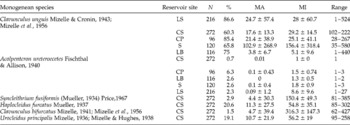
Prevalence (%), mean abundance (MA), mean intensity (MI) of infection, and range of monogenean species in Micropterus salmoides from five reservoir sites, including Salinillas, Anáhuac (LS); Cerro Prieto Linares (CP); El Cuchillo–Solidaridad, China (CS); La Boca, Santiago (LB); Sombreretillo, Sabinas Hidalgo (S), from Nuevo León, Mexico; N= number of fish examined.

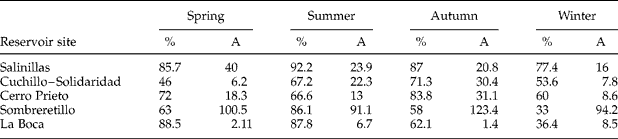
The prevalence (%) and abundance (A) of infection of Clavunculus unguis from five reservoir sites in Nuevo León, Mexico, relative to season.

Infection levels and season
A total of 672 adult and juvenile fish could be sexed (363 males and 309 females). Significant differences were observed in the lengths and weights of fish from La Boca, Cerro Prieto, Salinillas, Sombreretillo and Cuchillo–Solidaridad (ANOVA, F= 81.81, P < 0.0001; χ2= 44.00, P < 0.0001). Fish from La Boca reached 3822 g compared with ≤ 1297 g at the other four localities. No significant differences were detected in the sizes of female and male largemouth bass examined at any of the localities.
Positive significant associations were observed between fish length, weight and condition factor of infected fish (P < 0.05), as well as abundance of the ancyrocephalids Clavunculus unguis (CNHE 9820), Syncleithrium fusiformis (CNHE 9822), Haplocleidus furcatus (CNHE 9823), Clavunculus bifurcatus (CNHE 9824) and Urocleidus principalis (CNHE 9825) from Salinillas, Cerro Prieto, Cuchillo–Solidaridad and La Boca. In particular, the abundance was positively correlated with fish length, and the 21–34 cm fish size was most frequently infected by monogeneans (Spearman's rank correlation r s = 0.0773, P < 0.05). In contrast, a negative correlation was detected between mean intensity of Acolpenteron ureteroecetes (CNHE 9821) and Fulton's condition factor (P < 0.005).
The abundance of monogenean species (S. fusiformis, C. bifurcatus, and U. principalis) was generally greater in spring. Only H. furcatus showed the higher abundance in summer than in the other seasons. However, abundance of C. unguis in Cerro Prieto, Cuchillo–Solidaridad and Sombreretillo was generally higher in autumn, whereas in Salinillas and La Boca, the abundance increased in spring and winter months, respectively (table 3). Although season was independent of abundance and prevalence (ANOVA, F= 0.88, P <0.60; r s = − 0.0934, P< 0.0154), the months with the highest temperature (May, June, July, August and September) were positively correlated with parasite abundance (ANOVA, F= 8.55, P <0.005; χ2= 323.98, P< 0.0001). The abundance of A. ureteroecetes was greater in spring in Salinillas (27) and Sombreretillo (8) than in summer, as observed in Cerro Prieto (2).
Infection levels and locality
Micropterus salmoides from Cuchillo–Solidaridad harboured the most diverse monogenean community in the gills, including C. unguis, S. fusiformis, H. furcatus, C. bifurcatus and U. principalis, whereas A. ureteroecetes was detected in the ureters and urinary bladder (table 2). The highest prevalence at all localities was C. unguis (60.3–86.6%), and its mean abundance and intensity reached 102.9 and 156.4, respectively. Lower infection rates (prevalence, mean abundance and mean intensity) were observed for A. ureteroecetes from the five localities (table 2). This is the first report of S. fusiformis, C. unguis, H. furcatus, C. bifurcates and A. ureteroecetes from Mexico.
Discussion
In total, 33,559 parasites represented by six monogenean species (five ancyrocephalids and one calceostomatid) were identified in largemouth bass collected from the five Nuevo León reservoirs. Clavunculus unguis dominated the monogenean fauna, as this parasite was found in all five reservoirs and had the highest prevalence at all localities, followed by H. furcatus and U. principalis (20.58 and 19.11%, respectively), which were observed only in Cuchillo–Solidaridad with S. fusiformis and C. bifurcatus (table 2). Reports of the prevalence of the six species described in this study are scarce. Collins & Janovy (Reference Collins and Janovy2003) reported lower prevalence rates of C. unguis, H. furcatus and U. principalis in M. salmoides (1%) than our results; however, S. fusiformis was more prevalent (10%) than our results and those described by Aliff et al. (Reference Aliff, Smith and Lucas1977). Fischthal & Allison (Reference Fischthal and Allison1941) reported a 76% prevalence of A. ureteroecetes in M. salmoides and M. dolomieu (1–5 worms), which harboured worms only in the ureters, demonstrating a much greater predilection for ureters than the kidney, and occasional heavy infections of 22–52 monogeneans. This finding agrees with our results, except we found that the highest prevalence in Sombreretillo was 9.16%, whereas 73 worms were found in a 454 g largemouth bass in Texas, USA, which is the nearest locality reported for A. ureteroecetes (Meade & Bedinger, Reference Meade and Bedinger1972).
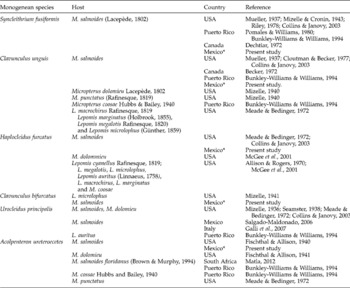
Five new geographic records for M. salmoides monogeneans were reported for Mexico in the present study (table 4); however, the exception was for the monogenean U. principalis, which was reported previously in M. salmoides from Guanajuato State (450 miles from our study area), where it is considered to be an invasive species (Salgado-Maldonado, Reference Salgado-Maldonado2006). A unique study performed by Aguilar-Aguilar et al. (Reference Aguilar-Aguilar, Martínez-Aquino, Espinosa–Pérez and Pérez-Ponce de León2014) during 2008–2011 involved a recent inventory of M. salmoides helminth parasites from Cuatro Ciénegas, Coahuila, a neighbouring state of Nuevo León, which is also in the Conchos basin. They did not report any monogeneans and only found endohelminths. Thus, we present five monogeneans as newly introduced species to this area of Mexico, considering that the parasitic fauna in the Cuchillo–Solidaridad reservoir was represented by six different monogeneans, and the other four reservoirs had another two different species (C. unguis and A. ureteroecetes).
Geographical distribution of monogenean species from a range of fish species, including the largemouth bass Micropterus salmoides from Nuevo León Mexico.

* New host record.
Few studies have considered the seasonal occurrence of the monogeneans described in this study. Our findings show that the abundance of all parasitic species was independent of season but the highest abundance values were generally observed in the months having the highest temperature (late spring to autumn). Rawson & Rogers (Reference Rawson and Rogers1972a, Reference Rawson and Rogersb) recorded four monogenean species described herein from largemouth bass (C. unguis, S. fusiformis, H. furcatus and U. principalis) and bluegill, Lepomis macrochirus Rafinesque, 1819 (Mizelle & Brennan, Reference Mizelle and Brennan1942) (S. fusiformis and U. principalis) from Walter F. George Reservoir in Alabama, USA. They also observed that abundance peaks seemed to be associated with water temperature; peaks occurred prior to spring and in June and September, and then declined in autumn, which agreed with our results, with the exception of C. unguis. Nuevo León has a temperate climate marked by four different seasons with wide variations in temperature that influence the occurrence of fish parasitic infections (Mouritsen & Poulin, Reference Mouritsen and Poulin2002; Khurshid & Ahmad, Reference Khurshid and Ahmad2014). A similar pattern was observed for Ligictaluridus floridanus Mueller, Reference Mueller1936 found infesting Ictalurus punctatus (Rafinesque, 1819) and Cyprinus carpio Linnaeus 1758 in the same Conchos-Bravo study area (Galaviz-Silva et al., Reference Galaviz-Silva, Witt-Sepulveda, Mercado-Hernández and Martínez-Hernández1990), as well as U. principalis infesting M. salmoides in California, USA (Mizelle & Crane, Reference Mizelle and Crane1964). The Ancyrocephalinae species described herein appear to belong to Group 2 (a group of large species with greatest abundance during spring) in the classification of Rawson & Roger Reference Rawson and Rogers(1972b).
We found a strong correlation between fish condition factor, length, weight and abundance of C. unguis, S. fusiformis, H. furcatus, C. bifurcatus and U. principalis, suggesting that fish condition is proportional to abundance. Gill monogenean infections often have little adverse impact on growth or survival of the host and often produce no clinical signs of disease (Crafford et al., Reference Crafford, Luus-Powell and Avenant-Oldewage2014), or they kill the host, as observed for other monogeneans (Tu et al., Reference Tu, Ling, Huang and Wang2014). Our results also agree with the evolutionary models of resistance (the host's ability to reduce its parasite load) which predict that increases in parasite-induced mortality should drive the evolution of increased resistance in the host population – because individual hosts that are better able to avoid, control or clear parasites gain higher lifetime reproductive success (Roy & Kirchner, Reference Roy and Kirchner2000; Dargent et al., Reference Dargent, Scott, Hendry and Fussmann2013). In contrast, the abundance of other ancyrocephalids that infect L. macrochirus, such as Anchoradiscus triangularis, Lyrodiscus seminolensis, C. robustus, Actinocleidus fergusoni, Urocleidus dispar, Urocleidus ferox, U. acer and C. nematocirruus, was not significantly correlated with host length (Rawson & Roger, Reference Rawson and Rogers1972b). The significant negative association between Fulton's condition factor and A. ureteroecetes abundance may be due to poor host condition caused by monogeneans in the ureters and urinary bladder (although very few parasites were present), which would make them an easier target for A. ureteroecetes and other parasites with an active transmission route (Guidelli et al., Reference Guidelli, Gomez-Tavechio, Takemoto and Pavanelli2011; Crafford et al., Reference Crafford, Luus-Powell and Avenant-Oldewage2014), because in natural populations, counter to popular opinion, parasites may play a crucial role in regulating the size of their host populations due to high parasite-induced host mortality rates, coupled with small k values (Anderson & May, Reference Anderson and May1978).
In conclusion, our findings contribute to the national inventory of parasites of M. salmoides, particularly those from the northern region of Mexico; however, more studies are necessary to complete the list. Our results also contribute to a further understanding of the associations between monogeneans and seasonal changes, as well as the growth conditions of this host.
Acknowledgements
The authors thank QBP Hesperia Andrea Corzo Ariyama and QBP Jesus Davila Barboza for their help with necropsy and parasite collections. The authors also extend special thanks to Dr Guillermo Salgado-Maldonado for his support and suggestions to improve the manuscript. We also extend special thanks to Dr Gerardo Pérez-Ponce de León for his invaluable literature recommendations.
Financial support
This research was funded by grant no. CN-835-11 (PAICYT-UANL) for the project ‘Parasitofauna de peces silvestres y cultivados en la región hidrológica Bravo-Conchos del estado de Nuevo León, México y análisis filogenético molecular de helmintos de importancia en salud pública’.
Conflict of interest
None.