INTRODUCTION
The complex interaction of protected areas (PAs) and rural livelihoods has been much discussed (see for example Adams & Hutton Reference Adams and Hutton2007), and the Convention on Biological Diversity (2010) recognized that poverty reduction should not be compromised by conservation. Beyond ethical concerns, the disproportionate reliance of poor households on biodiversity for livelihood subsistence and risk mitigation ultimately requires the conservation of natural resources and ecosystem services to support livelihoods (Roe et al. Reference Roe, Elliot, Sandbrook and Walpole2013). Although protectionist conservation has been favoured in East Africa, there has also been growing acceptance that protectionism was socially unjust (Adams & McShane Reference Adams and McShane1992; Neumann Reference Neumann1998), and resistance to exclusionary protectionism has been gaining support (Hutton et al. Reference Hutton, Adams and Murombedzi2005). Integrated conservation and development programmes (ICDPs) were developed to address this disconnect between PA conservation and poverty alleviation, by linking community development with conservation outcomes (Wells Reference Wells1992).
Since education is a means of improving livelihoods and communicating conservation objectives, ICDPs initially worked with schools to improve education quality and infrastructure, increase awareness of ecosystems and conservation goals, and change attitudes towards forest destruction or hunting (Jacobson et al. Reference Jacobson, McDuff and Monroe2006). In addition, shared tourism revenues improved educational infrastructure (MacKenzie Reference MacKenzie2012a ), and scholarships or ‘eco-bursaries’ were offered (Jackson & Naughton-Treves Reference Jackson and Naughton-Treves2012). ICDPs, and more recently reduced emissions from deforestation and forest degradation (REDD) programmes, have pursued dual conservation and development goals with mixed reviews (Bauch et al. Reference Bauch, Sills and Pattanayak2014). A common critique was that actions needed to target individuals rather than communities, particularly when individuals lost income as a result of exclusion from economic activities tied to PAs (Baker et al. Reference Baker, Milner-Gulland and Leader-Williams2011). ICDPs focusing on alternative income-generation schemes have thus become common (Roe et al. Reference Roe, Elliot, Sandbrook and Walpole2013).
Given the mixed review of ICDP/REDD implementation, a set of best practices have now been proposed (Blom et al. Reference Blom, Sutherland and Murdiyarso2010). Chief among these recommendations is that ICDPs be both of sufficient duration and locally tailored to community needs, while acknowledging community heterogeneity. Collaboration between projects in an area and the provisioning of additional non-monetary community benefits, such as medical supplies and educational tools, are now considered likely to provide visible and sustained benefit to the entire community (Blom et al. Reference Blom, Sutherland and Murdiyarso2010; Elliott & Sumba Reference Elliott, Sumba, Roe, Elliot, Sandbrook and Walpole2013). Baral et al. (Reference Baral, Stern and Heinen2007) also concluded that adequate duration was essential to the success of ICDPs, because improvements in conservation activities tended to lag developmental activities by approximately a decade. Although ICDPs focused on income generation can be effective (Elliot & Sumba Reference Elliott, Sumba, Roe, Elliot, Sandbrook and Walpole2013), these best practices suggest that ICDPs focused on childhood education are still appropriate.
An additional argument for ICDPs to support childhood education is that living near PAs disproportionately exposes households to crop raiding by wild animals, requiring adults and children to guard crops (Naughton-Treves Reference Naughton-Treves1998). For example, near the Kilombero Game Control Area in Tanzania, over 80% of school children reported guarding crops; 60% admitted missing classes to do so (Haule et al. Reference Haule, Johnsen and Maganga2002). Primary school pupils living closer to Kibale National Park in Uganda had lower average grades than peers living further away; average grades were a function of the neighbouring-village mean perception of how badly villagers were troubled by crop raiding and the percentage of households in the village that permitted children to guard crops more than two days per week (MacKenzie & Ahabyona Reference MacKenzie and Ahabyona2012).
Conservationists cite growing human population density as the greatest threat to PAs (Brook et al. Reference Brook, Bradshaw, Koh and Sodhi2006). Improved female education has been linked with lower fertility rates (see Castro-Martin Reference Castro-Martin1995; Jejeebhoy Reference Jejeebhoy1995), however, a 75% completion rate of primary grade four (P4) for both boys and girls was required to impact fertility change in 23 Sub-Saharan countries (Lloyd et al. Reference Lloyd, Kaufman and Hewett2000). In addition, poverty in communities neighbouring PAs is seen as a critical constraint to achieving conservation objectives, because poorer households are more likely to extract natural resources (Adams et al. Reference Adams, Aveling, Brockington, Dickson, Elliot, Hutton, Roe, Vira and Wolmer2004; Roe et al. Reference Roe, Elliot, Sandbrook and Walpole2013). Gains in poverty alleviation have been realized in Asia through increased household income from non-farm employment (Cherdchuchai & Otsuka Reference Cherdchuchai and Otsuka2006), and, in East Africa, years of schooling is the strongest contributor to a person's ability to be employed off-farm or to migrate for employment (Matsumoto et al. Reference Matsumoto, Kijima and Yamano2006). It is therefore in the interest of conservation to help children attain primary and even secondary school completion to reduce anthropogenic pressure on PAs.
Over 32 million children in Sub-Saharan Africa are not enrolled in school and only one-third of children will complete primary school (Lewin Reference Lewin2009). Low enrolment and poor educational attainment of African children has been attributed to the inability to pay school expenses, the need for child labour in subsistence households, low levels of adult education, long distances to poor quality schools, and gender, with girls being less likely to be enrolled (Lloyd & Blanc Reference Lloyd and Blanc1996; Bommier & Lambert Reference Bommier and Lambert2000; Ainsworth et al. Reference Ainsworth, Beegle and Koda2002; Burke & Beegle Reference Burke and Beegle2004; Weir Reference Weir2007). The older the child, the less likely it is that they will complete primary school (Grogan Reference Grogan2008). Girls drop out at puberty due to inadequate female latrines, pregnancy or early marriage, while boys drop out to find work (Colclough et al. Reference Colclough, Rose and Tembon2000; Admassie Reference Admassie2003). Children are more likely to complete P4 if they come from wealthier households, have more educated parents, and more school-age siblings with whom to share household tasks (Lloyd & Blanc Reference Lloyd and Blanc1996; Glick & Sahn Reference Glick and Sahn2000; Rose & Al-Samarrai Reference Rose and Al-Samarrai2001), although the expectation to help with child care can hinder girls’ progress in school (Shapiro & Oleke Tambashe Reference Shapiro and Oleke Tambashe2001). Also, the spread of AIDS across Africa has increased the number of orphans, and if orphaned, the child is less likely to be enrolled in or to have completed primary school (Case et al. Reference Case, Paxson and Ableidinger2004; Evans & Miguel Reference Evans and Miguel2007; Weir Reference Weir2007).
Uganda introduced universal primary education (UPE) in 1997, eliminating fees in government schools, and, unlike some other African countries, the policy has remained in place (Oketch & Rolleston Reference Oketch and Rolleston2007; Nishimura et al. Reference Nishimura, Yamano and Sasaoka2008). The introduction of UPE led to increased enrolment (1996: 2.5 million school pupils; 1997: 5.4 million school pupils) as girls entered the education system, requiring rapid expansion of primary schools and the number of teachers from 1996 to 2009 (Bategeka & Okurut Reference Bategeka and Okurut2006; UBS [Ugandan Bureau of Statistics] 2012). Rural primary schools are still overcrowded, lack electricity, and rarely provision for separate female latrines (Juuko & Kabonesa Reference Juuko and Kabonesa2007; Kasirye Reference Kasirye2009).
Kibale National Park (KNP) in south-western Uganda has provided a stable policy environment for studying the relative influence of conservation and socioeconomic factors on childhood education. The population growth rate in Uganda is 3.4% (World Bank 2013), putting ever-increasing pressure on PA integrity. ICDPs concentrating on conservation education and improved school infrastructure have been active around KNP for over two decades (Kasenene & Ross Reference Kasenene, Ross, Wrangham and Ross2008), and shared tourism revenues have funded school buildings (MacKenzie Reference MacKenzie2012a ). In addition, there are financial and social costs of crop raiding in neighbouring communities (Naughton-Treves Reference Naughton-Treves1998; MacKenzie & Ahabyona Reference MacKenzie and Ahabyona2012). Although government primary schools no longer charge tuition, there are still incidental fees for examinations, books, and school lunches, the non-payment of which can result in children being sent home from school (Evans & Miguel Reference Evans and Miguel2007). Therefore, crop-raiding losses can directly influence the ability of parents to afford an education for their children.
Schooling in Uganda starts at age six, with seven years of primary school (P1 to P7) followed by four years of lower secondary school (O-levels), two years of upper secondary school (A-levels), and finally university or college for the privileged few (Grogan Reference Grogan2008). At the end of primary school, children undertake a nationally-standardized primary leaving examination (PLE), with results made available to the public (Lewin Reference Lewin2009). The PLE contains four subjects: English, mathematics, science, and social science (UNEB [Uganda National Examinations Board] 2010). The percentage grade on each section is scored (80% to 100% results in a score of one, 75% to 79% scores two, and so on down to 0% to 39% scoring nine) and the four section scores are combined to produce a PLE score ranging from four to 36. A low PLE score indicates good performance on the exam.
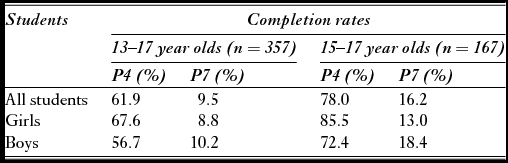
Although there are seven grades of primary school, the completion rate of P7 around KNP for 13–17 year olds is very low (9.5%). We therefore focused on the completion of P4 (61.9% around KNP) because four years is the minimum education recommended by UNICEF (UNICEF 1993) and P4 is considered the minimum grade completion to influence fertility rates in Sub-Saharan Africa (Lloyd et al. Reference Lloyd, Kaufman and Hewett2000). We ask the following research questions: (1) Which societal factors influence school enrolment and P4 completion? (2) Are ICDPs and revenue sharing influencing school quality, enrolment and P4 completion? (3) Is crop raiding influencing enrolment or P4 completion? (4) Are PA conservation influences, relative to societal factors, significantly impacting on the probability that children will complete P4, and does the relative influence of these factors differ between boys and girls?
We provide gender-specific insight into the relative influence of PA conservation on childhood education and highlight potential future directions for ICDPs to support conservation and development objectives.
METHODS
Study site
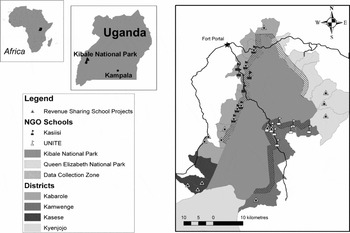
Kibale National Park (KNP), located 15 km from the urban centre of Fort Portal (population 40988; UBS 2010) in western Uganda is a 795 km2 forested PA (Fig. 1), providing habitat for elephants (Loxodonta africana) and 13 primate species including the endangered chimpanzee (Pan troglodytes) and red colobus (Piliocolobus tephrosceles) (Chapman & Lambert Reference Chapman and Lambert2000). The Kasiisi Project (2008), an ICDP around KNP active since 1997, provides primary school infrastructure improvements, teacher training, text books, conservation education materials, and scholarships, and helps schools become ‘girl-friendly’ by providing mentorship, counselling and separate female latrines. Another ICDP, Uganda and North Carolina International Teaching for the Environment (Uganda UNITE 2007), provides conservation education materials, teacher training, and classroom buildings. Introduced by legislation in 1996, and implemented in KNP since 2003, the Uganda Wildlife Authority (UWA) shares 20% of gate entrance fees paid by tourists with local government councils to build community projects. Forty-nine per cent of the 55 revenue-sharing projects (RSPs) implemented before 2009 built classrooms, primary school latrines, and teacher housing (MacKenzie Reference MacKenzie2012a ).
Kibale National Park and schools supported by non-governmental organizations and the Uganda Wildlife Authority revenue-sharing programme.

Villages in this study were located within 3.5 km of the Park boundary, c. 5 km apart within the data collection zone (Fig. 1). Since illegal resource extraction from the Park was measured proximate to these same villages, exact locations have been masked to prevent retribution from UWA (MacKenzie et al. Reference MacKenzie, Chapman and Sengupta2012). Village residents are primarily subsistence agriculturalists with minimal livestock holdings. Household losses accrued due to living next to KNP have been primarily caused by crop raiding (MacKenzie Reference MacKenzie2012b ), with elephants and baboons (Papio cynocephalus) causing 93.5% of crop damage by area (MacKenzie & Ahabyona Reference MacKenzie and Ahabyona2012). Village population densities were 70–611 people km−2 with 42–241 households per village (MacKenzie & Hartter Reference MacKenzie and Hartter2013).
Data collection
We combined a household wealth-stratified survey conducted in July and August 2009 to understand conservation benefits and losses for communities near KNP (MacKenzie Reference MacKenzie2012b ), with a survey of school quality in primary schools neighbouring the Park (unpublished) that we conducted in May 2010 and July 2011. The school quality survey accessed the PLE scores of students from the prior year (2009 and 2010). Although the household survey coincided with the first year of PLE results, we chose to add an additional year of PLE scores to smooth any year to year variation in exam difficulty. Twenty-two of the 25 villages from the former study were selected based on children from those 22 villages attending local primary schools that were included in the survey of primary school quality. Within the 22 villages, 524 households were surveyed of which 380 (72.5%) had school-age children (age 6–17, n = 1027). The household survey provided for each child (<18 years old) the age, gender, currently-enrolled school grade, and whether or not the child was an orphan. Household demographic and socioeconomic data were also collected, including: number of adults and children in the household, levels of adult education, whether the household head had migrated to the boundary of KNP, and capital assets owned (livestock, land, buildings, bicycles, motorcycles, radios and cell phones) from which a total value of household capital asset wealth was calculated (MacKenzie & Hartter Reference MacKenzie and Hartter2013).
If the household respondent, the most senior adult present at the time of the survey interview, reported crop raiding by wild animals, we also recorded their estimates of the percentage yield of staple crops lost in the previous growing season to wild animals, and whether, and for how many days per week, they allowed their children to guard crops. Self-estimated crop losses are known to be somewhat unreliable (Tchamba Reference Tchamba1996). When the estimates provided in this survey were compared with a measured area crop-raiding study conducted around KNP the following year, 20% of household cultivation area was damaged on average, somewhat less than the 30% average lost yield estimated in the survey (MacKenzie & Ahabyona Reference MacKenzie and Ahabyona2012). Although 90 households did overlap between the survey and the measured area crop-raiding study, direct household comparisons were not possible considering the likelihood of the same animals raiding the same households by the same amount in two consecutive years. However, the number of person days (including adults and children) expended to guard crops was found to be a function of the number of people in the household and the estimated percentage of lost crop yield (MacKenzie & Ahabyona Reference MacKenzie and Ahabyona2012), indicating that the decision to invest household manpower to guard crops was based on people's perceptions of how bad the crop raiding had been in prior seasons, rather than current season losses. Therefore, we felt that the decision to hold children back from school to guard crops was best modelled in this study by the household's estimate of lost production yield in the prior season.
To assess school quality, we collected PLE scores achieved by students from 36 schools. Since only children finishing the last year of primary school undertake this exam, the individual student grades were not linked to survey households, as this would have eliminated too many children from the P4 completion analysis. Primary school quality was represented by the averaged PLE scores for all students taking the exam in a given school in both years. A global positioning system (GPS) receiver was used to locate all study schools and households, and roads were GPS mapped so that road distances between households and schools, and schools and Fort Portal could be determined. The household GPS locations also allowed straight line distance to the nearest boundary of KNP to be determined using ArcMap.
Additional contextual information about childhood education was collected during focus groups and meetings. Focus groups were held in 15 of the 22 villages in 2008, where participants were asked about the benefits and problems of living near KNP (MacKenzie Reference MacKenzie2012b ). As per village norms, the village chairperson helped organize the focus group meetings, inviting adult men and women, ranging in age to represent the adult population in the village. The same structured question guide (see Supplementary material at Journals.cambridge.org/10.1017/S0376892915000120) was used in all 15 focus groups. The first two questions of each meeting asked what were the problems, and then what were the benefits, of living next to KNP. Participants highlighted crop raiding as the most serious problem of living near the Park, and with no further prompting explained the financial and social costs resulting from wild animals damaging crops. We first became aware of the negative influence of crop raiding on childhood education during these focus groups, causing this study to be added to the research plan.
Following the completion of the benefit and loss study, research findings were individually shared with village chairpersons from the 25 villages that participated in the household survey, and 11 sub-county and three district chairpersons responsible for the sub-counties and districts within which the study villages were located. These meetings acted as a means to member-check the research findings, and to gain a broader contextual understanding as chairpersons provided their explanations of the results.
Analysis
Whether or not school-aged children (6–17) were enrolled in primary school was determined from household survey responses. Given the prevalence of late school starts in Uganda (Wells Reference Wells2009), we determined completion rates of P4 and P7 for children aged 13 to 17. Individual child data tended not to follow a normal distribution (Kolmogorov-Smirnov test), so non-parametric statistics were employed: chi-squared, Mann-Whitney U, and Spearman's correlation (rs). Village-aggregate and school data were normally distributed so Pearson's correlations (r) and t-tests could be used.
A logistic regression model was developed, separately by gender, for the dichotomous dependent variable representing whether the child had completed P4. A model for completing P7 was not viable given low P7 completion rates (9.5% for 13–17 year olds). The P4 model included categorical and continuous variables representing student, household, school, and conservation attributes. Student attributes included age, and whether the child was an orphan. Household attributes included: the logarithm of capital asset wealth, the maximum years of education for adult men and women in the household, whether the household head had migrated to the borders of KNP, and the path distance from home to primary school. Since the opportunity cost of child labour in the household can influence school attendance, the number of school-aged children in the home who might participate in household chores, the number of pre-school children who girls may have to babysit, and the number of goats that boys may have to herd, were also included as household variables. School attributes included the school quality represented by the average PLE score for each school, and, to capture any urban influence, the road distance from the school to Fort Portal was also included. Conservation variables included: the straight line distance from the household to the Park, the estimated percentage of crops lost to Park-protected animals in the prior growing season, and whether the primary school was supported by the Kasiisi Project, UNITE or had infrastructure improvement funded by UWA's revenue-sharing programme. The logistic model was run separately for boys and girls (aged 13–17); first with student, household and school attributes, and then with the addition of conservation attributes.
RESULTS
Societal factors influencing enrolment and P4 attainment
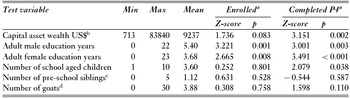
Of the 1027 school-aged children in the survey, 84% (n = 863) were enrolled in school. Fifty-two per cent of school-age children were boys (82.7% enrolled), and 48% were girls (85.5% enrolled). The probability of being enrolled was not dependent on gender (χ2 = 1.509, p = 0.233). Twelve per cent of school-age children were orphans, of which 79.5% were enrolled in school. Although the enrolment percentage was lower for orphans, they were as likely as other children to be enrolled in school (χ2 = 2.111, p = 0.149). For girls and boys, school enrolment peaked between ages 11 and 13, and declined into the teen years. If started on time, primary school should be completed by age 13. Both P4 and P7 completion rates were higher for 15–17 year olds than 13–17 year olds (Table 1); more girls than boys completed P4, but fewer girls than boys completed P7. Children from low wealth households were less likely to be enrolled (low = 78.7%, medium = 86.2%, high = 84.9%; χ2 = 7.957, p = 0.019). Children were more likely to have completed P4 if they came from wealthier households and households where adult men and women had achieved higher levels of education (Table 2).
Completion rates for primary grades four and seven.

Societal factors influencing enrolment and P4 completion. aMann-Whitney test results; bsee MacKenzie and Hartter (Reference MacKenzie and Hartter2013) for details on household wealth; ccalculated for girls only; and dcalculated for boys only.

The likelihood of being enrolled in school was not related to the number of school-aged children in the home, but children with more school-age siblings were more likely to have completed P4 (Table 2). The number of pre-school siblings did not influence enrolment or P4 completion for girls (Table 2), indicating girls caring for younger siblings were not having a strong influence on girls’ education. Similarly, the number of goats owned by the household had no significant influence on boys’ enrolment or P4 completion (Table 2). Fifty-seven per cent of school-aged children came from households where the household head had immigrated to the boundaries of KNP, but the migratory status of the household did not influence enrolment (χ2 = 0.975, p = 0.323) nor whether the child completed P4 (χ2 = 1.162, p = 0.281).
Conservation support and school quality, enrolment and P4 attainment
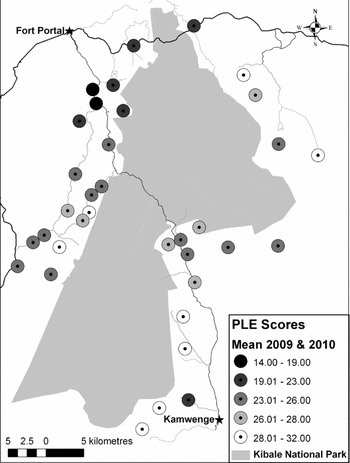
PLE scores tended to be better in rural schools that were located closer to Fort Portal (Fig. 2) in both 2009 (r = 0.685, p < 0.001, n = 36), and 2010 (r = 0.443, p = 0.023, n = 36). A sub-county chairperson in Kyenjojo district explained that; ‘The villages are hard to reach, so teachers don't want to work here’ (23 July 2012). However, the proximity of the school to the boundary of KNP did not correlate with PLE score in either 2009 (r = 0.011, p = 0.954, n = 36) or 2010 (r = –0.231, p = 0.257, n = 36).
Mean 2009 and 2010 primary leaving exam (PLE) scores for primary schools.

In general, the distribution of PLE scores tended not to differ between schools affiliated or not affiliated with an ICDP (t-test; 2009 t = 1.431, p = 0.165; 2010 t = 1.826, p = 0.080, n = 36). However, schools participating specifically with the Kasiisi Project did have improved PLE scores in 2009 (t-test; t = 3.077, p = 0.005, n = 36). Controlling for the variation in school quality, boys tended to do better on PLEs than girls (paired t-test; 2009 t = –3.405, p = 0.002; 2010 t = –3.919, p = 0.001, n = 36). However, at Kasiisi Project schools this difference was not significant (paired t-test; 2009 t = –1.335, p = 0.230; 2010 t = –0.956, p = 0.371, n = 7), indicating girls were performing as well as boys in Kasiisi Project schools. The general school enrolment rate was also higher in villages where the local primary school was supported by an ICDP (t-test, t = –3.124, p = 0.005, n = 22).
For the 22 schools associated with the villages studied, six were supported by the Kasiisi Project, five by UNITE, and eight had received an infrastructure project funded through the UWA revenue-sharing programme. The enrolment rate was higher in schools supported by the Kasiisi Project (90.2%, χ2 = 10.588, p = 0.001) and UNITE (88.5%, χ2 = 4.427, p = 0.035), but enrolment rates were similar in unsupported schools and revenue-sharing supported schools (86.6%, χ2 = 2.511, p = 0.113). However, completion rates for P4 were similar in supported and unsupported schools (p > 0.164).
Crop raiding influence on school enrolment and P4 attainment
Living within 3.5 km of KNP, households have to guard against Park-protected animals damaging the family's food crops; ‘Our children guard against elephants at night and primates during the day so when can they go to school? Most do not finish primary school so how can they go to secondary school or university?’ (Focus group participant, 22 June 2008). Forty-one per cent of the enrolled children came from households that permitted their children to guard crops from one to seven days per week during high raiding seasons (May–July and November–January); ‘We hold children back from school to guard against crop raiding. If raiding could be stopped, then our children could go to school’ (Focus group participant, 1 July 2008).
The average estimated crop yield lost to wild animals was 51% in households where boys were not enrolled in school, and only 28% in households where boys were enrolled in school (Mann-Whitney z = –2.602, p = 0.009), indicating households may be holding boys back from enrolling in school in areas of high crop raiding. There was no significant difference in estimated crop yield losses for households where girls were or were not enrolled in school (Mann-Whitney z = -0.504, p = 0.614). The number of days per week that children were allowed to guard crops was higher in households estimating higher crop-raiding losses (rs = 0.437, p < 0.001). Boys completing P4 marginally tended to come from households with lower estimated crop-raiding losses (27% versus 34%; Mann-Whitney z = −1.748, p = 0.080). Conversely, average estimated crop-raiding losses were marginally higher in households where girls had completed P4 (37% versus 29%; Mann-Whitney z = 1.704, p = 0.088).
Villagers explained that crop raiding also led to poverty, for example stating ‘that due to heavy crop raiding by elephants we cannot pay school fees and children are sent home’ (13 July 2008), and ‘we have to send lunch with the child or contribute maize corn, and if you experience crop raiding, you have no maize corn and your child may be sent home’ (1 July 2008).
Predicting the probability of completing P4
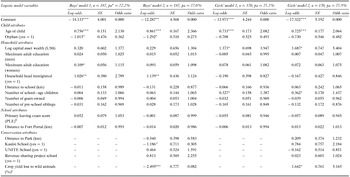
The logistic model for the probability of completing P4 showed that for both boys and girls, each year older doubled the probability of completing P4 (Table 3). However, being an orphan significantly reduced the probability of completing P4 for boys with all other variables held constant.
Logistic regression models for the probability of completing P4. apa = prediction accuracy relative to a null model accuracy of 56.7% for boys and 67.6% for girls; blower score indicates better performance; ccrop yield loss as estimated by the survey household; + significant at 0.100,* significant at 0.050,** significant at 0.010,*** significant at 0.001.

Higher household wealth and higher numbers of school-aged children in the household increased the chances of girls completing P4, while for boys, being from a migrant family was more likely to increase the probability of P4 completion. The model predicts boys were more likely to complete P4 if better educated women lived in the household. However, improved adult female education was not significant for girls. School quality and the road distance between the school and Fort Portal had no significant influence on the probability of the child completing P4 for either boys or girls living within 3.5 km of KNP.
The estimated amount of crop losses experienced by the household was the strongest influence on boys’ education, significantly reducing the chances of boys completing P4 because they were preferentially held back from school to guard crops. ‘It is the boys who do the crop guarding because the baboons are not scared of girls and women’ (Sub-county chairperson, 18 July 2012), and a village chairperson added that, ‘the boys spend nights out guarding with the men too, and this leads to poorer performance in school because they doze in class or don't even go to school’ (19 July 2012). The odds of a boy completing P4 from a household losing an estimated 100% of the crop yield to wild animals were only 8% of the odds of a boy completing P4 from a household claiming they had no crop raiding if all other factors were equal. Conversely, girls’ probability of completing P4 actually rose with increased estimated crop losses, possibly because keeping the boys at home to guard crops provided an increased opportunity for girls to stay in school; ‘Some children go to school while others stay home to guard crops’ (Focus group participant, 1 July 2008).
The logistic model confirms UNITE support and UWA revenue-sharing do not significantly influence P4 completion. However, for Kasiisi Project schools, the influence of ICDP support on P4 completion was gender specific. The odds ratio for girls attending Kasiisi Project schools indicated they were twice as likely to complete P4. However, boys attending Kasiisi schools were less likely to complete P4. Although the Kasiisi project does have a strong focus on supporting female education, PLE scores for boys leaving Kasiisi schools were actually better (t-test, t = 3.195, p = 0.003, n = 36) than boys finishing P7 in other schools, implying boys were not disadvantaged at Kasiisi schools. The negative influence of Kasiisi Project schools on the completion of P4 by boys may be better explained by external forces that were not included in the analysis. Tea plantations dominate the land use around the north of KNP, and many of the Kasiisi Project supported schools are located in this area. A chairperson from a northern sub-county explained that, ‘the tea estates are using child labour, so children are working instead of going to school’ (23 July 2012). He also told us that, ‘the boys start working as early as age 10’ (23 July 2012), so the chances of these boys ever completing P4 are low.
DISCUSSION
Reducing human population growth rates and poverty near PAs is germane to meeting conservation objectives (Brook et al. Reference Brook, Bradshaw, Koh and Sodhi2006; Roe et al. Reference Roe, Elliot, Sandbrook and Walpole2013). Helping children who live near PAs to attain primary, and even secondary, school completion supports this goal by lowering birth rates (Lloyd et al. Reference Lloyd, Kaufman and Hewett2000), and improving opportunities for off-farm and urban employment (Matsumoto et al. Reference Matsumoto, Kijima and Yamano2006). Since lower fertility rates have been observed in women who have attained P4 primary education or higher (Lloyd et al. Reference Lloyd, Kaufman and Hewett2000), the focus on female education by some ICDPs is understandable. The opportunity for girls to be educated is improving around KNP due to the introduction of universal primary education, which has removed the burden of tuition fees from local families and built more schools to accommodate the influx of girls into the education system. The Kasiisi Project is also helping to improve girls’ education with their ‘girl-friendly’ school programme.
However, this research shows that crop raiding by Park-protected animals, coupled with household labour decision-making, is having a negative influence on the education of boys living within 3.5 km of KNP, because boys are being kept out of school to guard crops against baboons during the day and may stay up at night to help their fathers guard against elephants. Lloyd et al. (Reference Lloyd, Kaufman and Hewett2000) found that it was as important for boys to be educated as for girls to slow population growth; 75% of both genders had to progress beyond P4 to have a significant impact on fertility rates. Although an 85% P4 completion rate for 15–17 year old girls living within 3.5 km of KNP achieves the target recommended by Lloyd et al. (Reference Lloyd, Kaufman and Hewett2000), the P4 completion rate for 15–17 year old boys is only 72%, below the 75% requirement. Boys not achieving the target of 75% P4 completion coupled with the lack of control women have over reproductive choices in rural Uganda means that even with >75% of girls completing P4, the goal of reducing population growth is unlikely to be met until boys’ education improves.
In Uganda, the ability to create off-farm income to alleviate poverty and reduce reliance on subsistence agriculture, or to migrate to an urban centre to be employed is highly dependent upon the number of years of schooling attained. Off-farm workers have on average 6.7 years of school and migrating workers attain on average 8.7 years of education (Matsumoto et al. Reference Matsumoto, Kijima and Yamano2006). Low primary school completion rates for both boys and girls within 3.5 km of KNP implies that a majority of these children will continue to base their livelihoods on subsistence agriculture. Therefore, by helping children attain primary or even secondary school completion, non-governmental organizations could improve employment opportunities for these children. Having the opportunity to find employment rather than being a subsistence farmer may help reduce the rapid fragmentation and land-use intensification of lands bordering KNP that is further isolating the protected habitat inside the Park (Hartter et al. Reference Hartter, Ryan, MacKenzie, Goldman, Dowhaniuk, Palace, Diem and Chapman2014). Since boys living within 3.5 km of KNP had poor P4 attainment, improvements might be achieved by providing tutoring for boys living near the Park, or subsidizing incidental school fees for families living directly adjacent to the Park.
Beyond trying to reduce fertility rates and reduce poverty, conservation organizations also have an ethical responsibility to try to mitigate the harm to local communities caused by the creation of PAs (Adams Reference Adams2009). Crop raiding by wild animals has been recognized as a cause for poor school attendance and performance (Haule et al. Reference Haule, Johnsen and Maganga2002; MacKenzie & Ahabyona Reference MacKenzie and Ahabyona2012). However, our study extends this understanding by demonstrating that the influence of crop guarding is gender specific around KNP, because the boys, rather than the girls, are held back from school to guard against baboons. Long-term data indicate baboon populations in KNP have been steadily increasing since KNP was established (C. Chapman, personal communication 2011), and the frequency and spatial extent of crop-raiding incidents bordering KNP have also been increasing, including those attributable to baboons (Naughton-Treves Reference Naughton-Treves1998; Naughton-Treves & Treves Reference Naughton-Treves, Treves, Woodroffe, Thirgood and Rabinowitz2005; MacKenzie & Ahabyona Reference MacKenzie and Ahabyona2012). Recovering animal populations mean PA conservation is promising in KNP, but the consequence of higher crop losses in local communities requires attention by UWA, local governments, and conservation organizations. During British colonial rule, hunters were hired to kill problem animals in agricultural areas around KNP (Naughton-Treves Reference Naughton-Treves1999). Many local residents suggested a similar approach be applied today; ‘Train two people per village and arm them so they can be the crop guards for the village’ (Village Chairperson, 6 July 2012). In the regions around KNP human population density has increased tenfold since the end of colonial rule (Hartter et al. Reference Hartter, Ryan, MacKenzie, Goldman, Dowhaniuk, Palace, Diem and Chapman2014). UWA does not have the manpower to cover all of the villages along the Park periphery, but district governments are proposing to train vermin guards. Baboons are listed as vermin in Uganda, and can therefore be killed outside of PAs (Uganda Wildlife Statute 1996). However, the cost of training vermin guards remains a barrier to implementation.
Although the completion of P4 by boys is influenced by a complex interaction of socioeconomic and conservation variables, education for boys could be improved by developing and implementing crop defences around KNP. Elephant trenches have been built along parts of the KNP boundary, reducing elephant and bush pig crop raiding; but the trenches are ineffective against baboons (MacKenzie & Ahabyona Reference MacKenzie and Ahabyona2012). UWA have tried culling baboons, but local people say this only deters baboons for a few weeks before another troop moves in and starts raiding the crops. Between 1999 and 2008, the revenue-sharing programme around KNP invested US$ 150000 in community development projects (MacKenzie Reference MacKenzie2012a ); 46% was spent on crop-raiding defences and 18% was spent on school infrastructure. Our findings support revenue-sharing funds continuing to be prioritized towards crop-raiding defences, since perceived crop-raiding risk has such a large negative influence on boys’ education, while funding school infrastructure did not have a significant influence on P4 completion rates. However, the lack of effective baboon crop defence mechanisms also highlights a role for conservation organizations and researchers to invest to find improved means of managing baboons.
ICDPs have focused on childhood education around KNP since 1988 (Kasenene & Ross Reference Kasenene, Ross, Wrangham and Ross2008). More recent recommendations to return to long-term community-centric ICDPs with non-monetary benefits of health and education (Baral et al. Reference Baral, Stern and Heinen2007; Blom et al. Reference Blom, Sutherland and Murdiyarso2010; Elliott & Sumba Reference Elliott, Sumba, Roe, Elliot, Sandbrook and Walpole2013) support the continued operation of these ICDPs. However, given the international development focus on improving education for girls in less developed countries (Tembon & Fort Reference Tembon and Fort2008), funding for boys’ education around KNP has been hard to find (Kasiisi Project Director, personal communication 2012). For ICDPs continuing to focus on childhood education, our findings that boys are educationally disadvantaged because their families require them to guard crops could support ICDP efforts to find funding for boys’ education near PAs. Even ICDPs focusing on household income generation in support of conservation goals could help mitigate crop-raiding losses as a means of improving household income. Focus group participants in this study made it very clear that ‘only if the animals stay in the Park can we become good conservationists’ (23 June 2008).
Coupling focus groups, surveys and member-checking meetings in a gender-specific study of primary school P4 completion has shed light on the complex interaction between the existence of a PA and local childhood education. Although circumstances may vary for different PAs, our findings show that primary school education for boys living next to KNP is compromised because boys are preferentially held back from school to guard crops from Park-protected animals. However, with the support of ICDPs and the introduction of universal primary education, primary school enrolment and P4 completion are improving for girls living next to KNP. Improved educational attainment has been linked to lower population growth and improved opportunities for off-farm employment. Providing support to childhood education around PAs could support conservation by helping to reduce anthropogenic pressure on and isolation of PAs caused by increased human population density and intensified subsistence agriculture on lands bordering PAs. The linking of conservation and community development through conservation outreach provides an opportunity for conservation organizations, local governments, and wildlife authorities to tailor programmes to mitigate negative influences of crop raiding, while helping livelihood development and poverty alleviation through crop-loss mitigation and improved education; keeping boys in class, instead of chasing baboons.
ACKNOWLEDGEMENTS
Funding was provided by the Warren Development Geography Fund, the Theo Hills Development Award, and the McGill Faculty of Science African Field Work Award. The Uganda National Council for Science and Technology, the Uganda Wildlife Authority, and local government officials provided useful assistance and granted permission for this research. All procedures complied with the ethical standards of national and institutional committees on human subject research. We thank our Ugandan field assistants, all villagers and government officials who participated in this study, the Kasiisi Project and UNITE for providing background information, local primary school head teachers for providing primary school leaving results, and anonymous reviewers for insightful comments.
Supplementary material
To view supplementary material for this article, please visit Journals.cambridge.org/10.1017/S0376892915000120